
Does anyone know the state of immutability support in vm and image? The latest vm downloadable is compiled with IMMUTABILITY=1 (Esteban said that). When I open a pharo6 image with this VM and do: ASUser new setIsReadOnlyObject: true; name: 'foo' with ASUser>>#name: arg1 name := arg1 I don't get an exception. Is there something missing or am I not understanding? Norbert
Am 25.01.2017 um 11:40 schrieb Denis Kudriashov <dionisiydk@gmail.com>:
2017-01-25 11:35 GMT+01:00 Norbert Hartl <norbert@hartl.name <mailto:norbert@hartl.name>>: ASUser new setIsReadOnlyObject: true
And why so ugly name? Why not #isReadOnlyObject:?
To be honest I think #isReadOnlyObject: is worse :) isXXX is a prefix for testing methods. isXXX with an argument feels even more strange. I would rather have #beReadOnly Norbert

On 25 Jan 2017, at 11:47, Norbert Hartl <norbert@hartl.name> wrote:
Am 25.01.2017 um 11:40 schrieb Denis Kudriashov <dionisiydk@gmail.com>:
2017-01-25 11:35 GMT+01:00 Norbert Hartl <norbert@hartl.name>: ASUser new setIsReadOnlyObject: true
And why so ugly name? Why not #isReadOnlyObject:?
To be honest I think #isReadOnlyObject: is worse :) isXXX is a prefix for testing methods. isXXX with an argument feels even more strange. I would rather have #beReadOnly
Yes, #beReadOnly
Norbert

2017-01-25 11:47 GMT+01:00 Norbert Hartl <norbert@hartl.name>:
To be honest I think #isReadOnlyObject: is worse :) isXXX is a prefix for testing methods. isXXX with an argument feels even more strange. I would rather have #beReadOnly
Now there is #beReadOnlyObject and #beWritableObject. Maybe for primitive it is better to use #primReadOnlyObject:. It also raise another question: does these primitives support mirror approach? (when it can be called with receiver as first argument?)
On 25 Jan 2017, at 11:55, Denis Kudriashov <dionisiydk@gmail.com> wrote:
2017-01-25 11:47 GMT+01:00 Norbert Hartl <norbert@hartl.name>: To be honest I think #isReadOnlyObject: is worse :) isXXX is a prefix for testing methods. isXXX with an argument feels even more strange. I would rather have #beReadOnly
Now there is #beReadOnlyObject and #beWritableObject. Maybe for primitive it is better to use #primReadOnlyObject:.
why the object suffix, everything is an object, right ? the simplest wording is often the best, unless there is a good reason for something else.
It also raise another question: does these primitives support mirror approach? (when it can be called with receiver as first argument?)

On 25 Jan 2017, at 12:04, Denis Kudriashov <dionisiydk@gmail.com> wrote:
2017-01-25 12:03 GMT+01:00 Denis Kudriashov <dionisiydk@gmail.com <mailto:dionisiydk@gmail.com>>: I think problem that these names could be already in use by frameworks. I am sure #isReadOnly, #beReadOnly is used in many UI's. For example Margitte uses it
And probably Glorp
yes, but #setIsReadOnlyObject: deserves a place in the podium of ugly names :) I thought the names were going to be like beWritable/beNotWritable/isWritable which are not a lot better, but well⦠Esteban
Am 25.01.2017 um 12:16 schrieb Esteban Lorenzano <estebanlm@gmail.com>:
On 25 Jan 2017, at 12:04, Denis Kudriashov <dionisiydk@gmail.com <mailto:dionisiydk@gmail.com>> wrote:
2017-01-25 12:03 GMT+01:00 Denis Kudriashov <dionisiydk@gmail.com <mailto:dionisiydk@gmail.com>>: I think problem that these names could be already in use by frameworks. I am sure #isReadOnly, #beReadOnly is used in many UI's. For example Margitte uses it
And probably Glorp
yes, but #setIsReadOnlyObject: deserves a place in the podium of ugly names :)
Absolutely. And we are a really caring community because we care so much about a method name of a feature that does not work :) Norbert
I thought the names were going to be like beWritable/beNotWritable/isWritable which are not a lot better, but wellâ¦
Esteban

So, beImmutable and beMutable seem pretty usable and not collision causing IMHO. Phil On Wed, Jan 25, 2017 at 12:19 PM, Norbert Hartl <norbert@hartl.name> wrote:
Am 25.01.2017 um 12:16 schrieb Esteban Lorenzano <estebanlm@gmail.com>:
On 25 Jan 2017, at 12:04, Denis Kudriashov <dionisiydk@gmail.com> wrote:
2017-01-25 12:03 GMT+01:00 Denis Kudriashov <dionisiydk@gmail.com>:
I think problem that these names could be already in use by frameworks. I am sure #isReadOnly, #beReadOnly is used in many UI's. For example Margitte uses it
And probably Glorp
yes, but #setIsReadOnlyObject: deserves a place in the podium of ugly names :)
Absolutely. And we are a really caring community because we care so much about a method name of a feature that does not work :)
Norbert
I thought the names were going to be like beWritable/beNotWritable/ isWritable which are not a lot better, but wellâ¦
Esteban
but this is not real immutability, is like a write barrier, thatâs why those method names were not chosen. Esteban
On 25 Jan 2017, at 12:37, phil@highoctane.be wrote:
So, beImmutable and beMutable seem pretty usable and not collision causing IMHO.
Phil
On Wed, Jan 25, 2017 at 12:19 PM, Norbert Hartl <norbert@hartl.name <mailto:norbert@hartl.name>> wrote:
Am 25.01.2017 um 12:16 schrieb Esteban Lorenzano <estebanlm@gmail.com <mailto:estebanlm@gmail.com>>:
On 25 Jan 2017, at 12:04, Denis Kudriashov <dionisiydk@gmail.com <mailto:dionisiydk@gmail.com>> wrote:
2017-01-25 12:03 GMT+01:00 Denis Kudriashov <dionisiydk@gmail.com <mailto:dionisiydk@gmail.com>>: I think problem that these names could be already in use by frameworks. I am sure #isReadOnly, #beReadOnly is used in many UI's. For example Margitte uses it
And probably Glorp
yes, but #setIsReadOnlyObject: deserves a place in the podium of ugly names :)
Absolutely. And we are a really caring community because we care so much about a method name of a feature that does not work :)
Norbert
I thought the names were going to be like beWritable/beNotWritable/isWritable which are not a lot better, but wellâ¦
Esteban

On 25/01/2017 12:59, Esteban Lorenzano wrote:
but this is not real immutability, is like a write barrier, thatâs why those method names were not chosen.
Then why not #(des)activateWriteBarrier?
Esteban
-- Cyril Ferlicot http://www.synectique.eu 2 rue Jacques Prévert 01, 59650 Villeneuve d'ascq France

On Wed, Jan 25, 2017 at 12:59 PM, Esteban Lorenzano <estebanlm@gmail.com> wrote:
but this is not real immutability, is like a write barrier, thatâs why those method names were not chosen.
As Esteban mentioned, read-only objects are not immutable objects, that's why we didn't use these names. This followed a lot of discussion with many mails (read-only objects are working for a year now, so we had time to discuss) and I don't think we should discuss again this topic.
Esteban
On 25 Jan 2017, at 12:37, phil@highoctane.be wrote:
So, beImmutable and beMutable seem pretty usable and not collision causing IMHO.
Phil
On Wed, Jan 25, 2017 at 12:19 PM, Norbert Hartl <norbert@hartl.name> wrote:
Am 25.01.2017 um 12:16 schrieb Esteban Lorenzano <estebanlm@gmail.com>:
On 25 Jan 2017, at 12:04, Denis Kudriashov <dionisiydk@gmail.com> wrote:
2017-01-25 12:03 GMT+01:00 Denis Kudriashov <dionisiydk@gmail.com>:
I think problem that these names could be already in use by frameworks. I am sure #isReadOnly, #beReadOnly is used in many UI's. For example Margitte uses it
And probably Glorp
yes, but #setIsReadOnlyObject: deserves a place in the podium of ugly names :)
Absolutely. And we are a really caring community because we care so much about a method name of a feature that does not work :)
Norbert
I thought the names were going to be like beWritable/beNotWritable/isWri table which are not a lot better, but wellâ¦
Esteban

On 01/25/2017 03:59 AM, Esteban Lorenzano wrote:
but this is not real immutability, is like a write barrier, thatâs why those method names were not chosen.
Thank you for choosing names based on "write barrier," not the incorrect "read-only" or "immutable" (which are just things that can be done with a write barrier, but not the only useful things). Regards, -Martin
Hi again. On Wed, Jan 25, 2017 at 12:04 PM, Denis Kudriashov <dionisiydk@gmail.com> wrote:
2017-01-25 12:03 GMT+01:00 Denis Kudriashov <dionisiydk@gmail.com>:
I think problem that these names could be already in use by frameworks. I am sure #isReadOnly, #beReadOnly is used in many UI's. For example Margitte uses it
And probably Glorp
The only thing we (the VM developers) care is that we have only 2 primitives, 163 to check is an object is read-only and 164 to change the read-only property of an object. We do not want to have #beReadOnlyObject and #beWritableObject as 2 different primitives, we prefer having only one primitive to mutate the state, which is currently in the Object>>#setIsReadOnlyObject: method. The Pharo community is free to pick the names they like for their primitives. We tried to use #isReadOnly, #isWritable and #beReadOnly, but as Denis mentioned, there were conflicts with other frameworks. If you rename Object>>#attemptToAssign:withIndex:, don't forget to update the special object array with the new selector.
On Wed, Jan 25, 2017 at 11:55 AM, Denis Kudriashov <dionisiydk@gmail.com> wrote:
2017-01-25 11:47 GMT+01:00 Norbert Hartl <norbert@hartl.name>:
To be honest I think #isReadOnlyObject: is worse :) isXXX is a prefix for testing methods. isXXX with an argument feels even more strange. I would rather have #beReadOnly
Now there is #beReadOnlyObject and #beWritableObject. Maybe for primitive it is better to use #primReadOnlyObject:.
It also raise another question: does these primitives support mirror approach? (when it can be called with receiver as first argument?)
Yes I made sure the mirror approach works. Even better, there are tests ensuring that it works. You can see in the class WriteBarrierTest that objects can become read-only through an instance of TTMirror, look for example into the users of TTMirror>>#setIsReadOnlyObjectOf: object to: boolean.
2017-01-25 13:59 GMT+01:00 Clément Bera <bera.clement@gmail.com>:
It also raise another question: does these primitives support mirror
approach? (when it can be called with receiver as first argument?)
Yes I made sure the mirror approach works. Even better, there are tests ensuring that it works. You can see in the class WriteBarrierTest that objects can become read-only through an instance of TTMirror, look for example into the users of TTMirror>>#setIsReadOnlyObjectOf: object to: boolean.
I think we need move it to MirrorPrimitives which was introduced in Pharo 6.
@Phil, then the VM does not support it. I believe the latest VM from files.pharo.org should support it, but not the stable one. @Denis Sure move it to MirrorPrimitive and update the WriteBarrier tests. On Wed, Jan 25, 2017 at 3:09 PM, Denis Kudriashov <dionisiydk@gmail.com> wrote:
2017-01-25 13:59 GMT+01:00 Clément Bera <bera.clement@gmail.com>:
It also raise another question: does these primitives support mirror
approach? (when it can be called with receiver as first argument?)
Yes I made sure the mirror approach works. Even better, there are tests ensuring that it works. You can see in the class WriteBarrierTest that objects can become read-only through an instance of TTMirror, look for example into the users of TTMirror>>#setIsReadOnlyObjectOf: object to: boolean.
I think we need move it to MirrorPrimitives which was introduced in Pharo 6.
I am using a quite recent VM that Esteban provides on the JFrog bintray (debug version with symbols). So this is a bit surprising. Phil On Wed, Jan 25, 2017 at 3:41 PM, Clément Bera <bera.clement@gmail.com> wrote:
@Phil, then the VM does not support it. I believe the latest VM from files.pharo.org should support it, but not the stable one.
@Denis Sure move it to MirrorPrimitive and update the WriteBarrier tests.
On Wed, Jan 25, 2017 at 3:09 PM, Denis Kudriashov <dionisiydk@gmail.com> wrote:
2017-01-25 13:59 GMT+01:00 Clément Bera <bera.clement@gmail.com>:
It also raise another question: does these primitives support mirror
approach? (when it can be called with receiver as first argument?)
Yes I made sure the mirror approach works. Even better, there are tests ensuring that it works. You can see in the class WriteBarrierTest that objects can become read-only through an instance of TTMirror, look for example into the users of TTMirror>>#setIsReadOnlyObjectOf: object to: boolean.
I think we need move it to MirrorPrimitives which was introduced in Pharo 6.
Yes, exactly how it felt. Maybe #setImmutable would be more intention revealing. Phil On Wed, Jan 25, 2017 at 11:47 AM, Norbert Hartl <norbert@hartl.name> wrote:
Am 25.01.2017 um 11:40 schrieb Denis Kudriashov <dionisiydk@gmail.com>:
2017-01-25 11:35 GMT+01:00 Norbert Hartl <norbert@hartl.name>:
ASUser new setIsReadOnlyObject: true
And why so ugly name? Why not #isReadOnlyObject:?
To be honest I think #isReadOnlyObject: is worse :) isXXX is a prefix for testing methods. isXXX with an argument feels even more strange. I would rather have #beReadOnly
Norbert
On Wed, Jan 25, 2017 at 11:35 AM, Norbert Hartl <norbert@hartl.name> wrote:
Does anyone know the state of immutability support in vm and image? The latest vm downloadable is compiled with
IMMUTABILITY=1
(Esteban said that). When I open a pharo6 image with this VM and do:
ASUser new setIsReadOnlyObject: true; name: 'foo'
with
ASUser>>#name: arg1 name := arg1
I don't get an exception. Is there something missing or am I not understanding?
Hi Norbert, Thank you very much for looking read-only objects. When mutating an instance variable, the VM triggers a call-back that by default does nothing. In your case, running your code does not raise an exception but the object should not be modified either. If you want an exception, you need to change the call-back code, i.e., the method Object>>#attemptToAssign: value withIndex: index. For example, you could write: Object>>#attemptToAssign: value withIndex: index | process | self notify: 'object changed !'. process := Processor activeProcess. [ process suspendedContext: process suspendedContext sender ] forkAt: Processor activePriority + 1. Processor yield. Then, your code should open a notification window with 'object changed', and proceeding keeps running the code without mutating the object. One needs to build a ModificationTracker framework on top of the VM support I introduced. Multiple things are required, like default behavior in this call-back and in primitive failure code. I am willing to support and help anyone willing to build such a framework, but I won't build it myself. If you have any other questions or if you find bug don't hesitate to ask further questions Best, PS: Make sure "Smalltalk vm supportsWriteBarrier" answers true in your system, if this is not the case it means the VM does not support read-only objects. Clement
Norbert
The "latest" Windows VM I do use has no such method. Virtual Machine --------------- C:\Users\Philippe\Dropbox\Sibelga\JiraAutomation\Pharo5.0\latestvm\pharo.exe CoInterpreter * VMMaker.oscog-eem.2090 uuid: 63a161b9-17e1-4911-a89a-1687d9ba9a1a Jan 15 2017 StackToRegisterMappingCogit * VMMaker.oscog-eem.2090 uuid: 63a161b9-17e1-4911-a89a-1687d9ba9a1a Jan 15 2017 VM: 201701151442 https://github.com/pharo-project/pharo-vm.git $ Date: Sun Jan 15 15:42:39 2017 +0100 $ Plugins: 201701151442 https://github.com/pharo-project/pharo-vm.git $ Win32 built on Jan 15 2017 15:59:52 CUT Compiler: 5.4.0 VMMaker versionString VM: 201701151442 https://github.com/pharo-project/pharo-vm.git $ Date: Sun Jan 15 15:42:39 2017 +0100 $ Plugins: 201701151442 https://github.com/pharo-project/pharo-vm.git $ CoInterpreter * VMMaker.oscog-eem.2090 uuid: 63a161b9-17e1-4911-a89a-1687d9ba9a1a Jan 15 2017 StackToRegisterMappingCogit * VMMaker.oscog-eem.2090 uuid: 63a161b9-17e1-4911-a89a-1687d9ba9a1a Jan 15 2017 [image: Inline image 1] On Wed, Jan 25, 2017 at 1:54 PM, Clément Bera <bera.clement@gmail.com> wrote:
On Wed, Jan 25, 2017 at 11:35 AM, Norbert Hartl <norbert@hartl.name> wrote:
Does anyone know the state of immutability support in vm and image? The latest vm downloadable is compiled with
IMMUTABILITY=1
(Esteban said that). When I open a pharo6 image with this VM and do:
ASUser new setIsReadOnlyObject: true; name: 'foo'
with
ASUser>>#name: arg1 name := arg1
I don't get an exception. Is there something missing or am I not understanding?
Hi Norbert,
Thank you very much for looking read-only objects.
When mutating an instance variable, the VM triggers a call-back that by default does nothing. In your case, running your code does not raise an exception but the object should not be modified either. If you want an exception, you need to change the call-back code, i.e., the method Object>>#attemptToAssign: value withIndex: index. For example, you could write:
Object>>#attemptToAssign: value withIndex: index | process | self notify: 'object changed !'. process := Processor activeProcess. [ process suspendedContext: process suspendedContext sender ] forkAt: Processor activePriority + 1. Processor yield.
Then, your code should open a notification window with 'object changed', and proceeding keeps running the code without mutating the object.
One needs to build a ModificationTracker framework on top of the VM support I introduced. Multiple things are required, like default behavior in this call-back and in primitive failure code. I am willing to support and help anyone willing to build such a framework, but I won't build it myself.
If you have any other questions or if you find bug don't hesitate to ask further questions
Best,
PS: Make sure "Smalltalk vm supportsWriteBarrier" answers true in your system, if this is not the case it means the VM does not support read-only objects.
Clement
Norbert
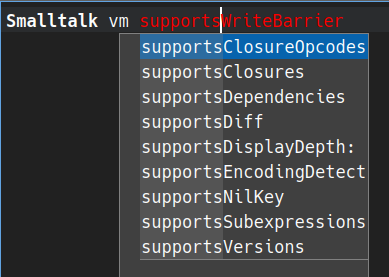
I introduced the method #supportsWriteBarrier in Pharo 6. You can backport it if you want: VirtualMachine>>#supportsWriteBarrier "Answer whether the VM observes the per-object read-only flag and consequently aborts writes to inst vars of, and fails primitives that attempt to write, to read-only objects." ^(self parameterAt: 65) ifNil: [false] ifNotNil: [:param| "In older VMs this is a boolean reflecting MULTIPLE_BYTECODE_SETS" param isInteger "In newer VMs it is a set of integer flags, bit 1 of which is IMMUTABILITY" ifTrue: [param anyMask: 2] ifFalse: [false]] On Wed, Jan 25, 2017 at 2:06 PM, phil@highoctane.be <phil@highoctane.be> wrote:
The "latest" Windows VM I do use has no such method.
Virtual Machine --------------- C:\Users\Philippe\Dropbox\Sibelga\JiraAutomation\Pharo5. 0\latestvm\pharo.exe CoInterpreter * VMMaker.oscog-eem.2090 uuid: 63a161b9-17e1-4911-a89a-1687d9ba9a1a Jan 15 2017 StackToRegisterMappingCogit * VMMaker.oscog-eem.2090 uuid: 63a161b9-17e1-4911-a89a-1687d9ba9a1a Jan 15 2017 VM: 201701151442 https://github.com/pharo-project/pharo-vm.git $ Date: Sun Jan 15 15:42:39 2017 +0100 $ Plugins: 201701151442 https://github.com/pharo-project/pharo-vm.git $
Win32 built on Jan 15 2017 15:59:52 CUT Compiler: 5.4.0 VMMaker versionString VM: 201701151442 https://github.com/pharo- project/pharo-vm.git $ Date: Sun Jan 15 15:42:39 2017 +0100 $ Plugins: 201701151442 https://github.com/pharo-project/pharo-vm.git $ CoInterpreter * VMMaker.oscog-eem.2090 uuid: 63a161b9-17e1-4911-a89a-1687d9ba9a1a Jan 15 2017 StackToRegisterMappingCogit * VMMaker.oscog-eem.2090 uuid: 63a161b9-17e1-4911-a89a-1687d9ba9a1a Jan 15 2017
[image: Inline image 1]
On Wed, Jan 25, 2017 at 1:54 PM, Clément Bera <bera.clement@gmail.com> wrote:
On Wed, Jan 25, 2017 at 11:35 AM, Norbert Hartl <norbert@hartl.name> wrote:
Does anyone know the state of immutability support in vm and image? The latest vm downloadable is compiled with
IMMUTABILITY=1
(Esteban said that). When I open a pharo6 image with this VM and do:
ASUser new setIsReadOnlyObject: true; name: 'foo'
with
ASUser>>#name: arg1 name := arg1
I don't get an exception. Is there something missing or am I not understanding?
Hi Norbert,
Thank you very much for looking read-only objects.
When mutating an instance variable, the VM triggers a call-back that by default does nothing. In your case, running your code does not raise an exception but the object should not be modified either. If you want an exception, you need to change the call-back code, i.e., the method Object>>#attemptToAssign: value withIndex: index. For example, you could write:
Object>>#attemptToAssign: value withIndex: index | process | self notify: 'object changed !'. process := Processor activeProcess. [ process suspendedContext: process suspendedContext sender ] forkAt: Processor activePriority + 1. Processor yield.
Then, your code should open a notification window with 'object changed', and proceeding keeps running the code without mutating the object.
One needs to build a ModificationTracker framework on top of the VM support I introduced. Multiple things are required, like default behavior in this call-back and in primitive failure code. I am willing to support and help anyone willing to build such a framework, but I won't build it myself.
If you have any other questions or if you find bug don't hesitate to ask further questions
Best,
PS: Make sure "Smalltalk vm supportsWriteBarrier" answers true in your system, if this is not the case it means the VM does not support read-only objects.
Clement
Norbert
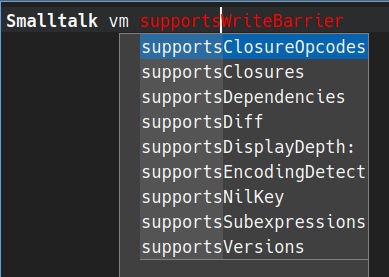
Tried it and it returns false for this Windows VM. Phil On Wed, Jan 25, 2017 at 2:14 PM, Clément Bera <bera.clement@gmail.com> wrote:
I introduced the method #supportsWriteBarrier in Pharo 6.
You can backport it if you want:
VirtualMachine>>#supportsWriteBarrier "Answer whether the VM observes the per-object read-only flag and consequently aborts writes to inst vars of, and fails primitives that attempt to write, to read-only objects."
^(self parameterAt: 65) ifNil: [false] ifNotNil: [:param| "In older VMs this is a boolean reflecting MULTIPLE_BYTECODE_SETS" param isInteger "In newer VMs it is a set of integer flags, bit 1 of which is IMMUTABILITY" ifTrue: [param anyMask: 2] ifFalse: [false]]
On Wed, Jan 25, 2017 at 2:06 PM, phil@highoctane.be <phil@highoctane.be> wrote:
The "latest" Windows VM I do use has no such method.
Virtual Machine --------------- C:\Users\Philippe\Dropbox\Sibelga\JiraAutomation\Pharo5.0\ latestvm\pharo.exe CoInterpreter * VMMaker.oscog-eem.2090 uuid: 63a161b9-17e1-4911-a89a-1687d9ba9a1a Jan 15 2017 StackToRegisterMappingCogit * VMMaker.oscog-eem.2090 uuid: 63a161b9-17e1-4911-a89a-1687d9ba9a1a Jan 15 2017 VM: 201701151442 https://github.com/pharo-project/pharo-vm.git $ Date: Sun Jan 15 15:42:39 2017 +0100 $ Plugins: 201701151442 https://github.com/pharo-project/pharo-vm.git $
Win32 built on Jan 15 2017 15:59:52 CUT Compiler: 5.4.0 VMMaker versionString VM: 201701151442 https://github.com/pharo-proje ct/pharo-vm.git $ Date: Sun Jan 15 15:42:39 2017 +0100 $ Plugins: 201701151442 https://github.com/pharo-project/pharo-vm.git $ CoInterpreter * VMMaker.oscog-eem.2090 uuid: 63a161b9-17e1-4911-a89a-1687d9ba9a1a Jan 15 2017 StackToRegisterMappingCogit * VMMaker.oscog-eem.2090 uuid: 63a161b9-17e1-4911-a89a-1687d9ba9a1a Jan 15 2017
[image: Inline image 1]
On Wed, Jan 25, 2017 at 1:54 PM, Clément Bera <bera.clement@gmail.com> wrote:
On Wed, Jan 25, 2017 at 11:35 AM, Norbert Hartl <norbert@hartl.name> wrote:
Does anyone know the state of immutability support in vm and image? The latest vm downloadable is compiled with
IMMUTABILITY=1
(Esteban said that). When I open a pharo6 image with this VM and do:
ASUser new setIsReadOnlyObject: true; name: 'foo'
with
ASUser>>#name: arg1 name := arg1
I don't get an exception. Is there something missing or am I not understanding?
Hi Norbert,
Thank you very much for looking read-only objects.
When mutating an instance variable, the VM triggers a call-back that by default does nothing. In your case, running your code does not raise an exception but the object should not be modified either. If you want an exception, you need to change the call-back code, i.e., the method Object>>#attemptToAssign: value withIndex: index. For example, you could write:
Object>>#attemptToAssign: value withIndex: index | process | self notify: 'object changed !'. process := Processor activeProcess. [ process suspendedContext: process suspendedContext sender ] forkAt: Processor activePriority + 1. Processor yield.
Then, your code should open a notification window with 'object changed', and proceeding keeps running the code without mutating the object.
One needs to build a ModificationTracker framework on top of the VM support I introduced. Multiple things are required, like default behavior in this call-back and in primitive failure code. I am willing to support and help anyone willing to build such a framework, but I won't build it myself.
If you have any other questions or if you find bug don't hesitate to ask further questions
Best,
PS: Make sure "Smalltalk vm supportsWriteBarrier" answers true in your system, if this is not the case it means the VM does not support read-only objects.
Clement
Norbert
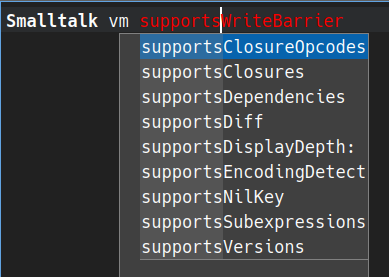
nevertheless it should be there in latests vms. which version are you using? Esteban
On 25 Jan 2017, at 15:04, phil@highoctane.be wrote:
Tried it and it returns false for this Windows VM.
Phil
On Wed, Jan 25, 2017 at 2:14 PM, Clément Bera <bera.clement@gmail.com <mailto:bera.clement@gmail.com>> wrote: I introduced the method #supportsWriteBarrier in Pharo 6.
You can backport it if you want:
VirtualMachine>>#supportsWriteBarrier "Answer whether the VM observes the per-object read-only flag and consequently aborts writes to inst vars of, and fails primitives that attempt to write, to read-only objects."
^(self parameterAt: 65) ifNil: [false] ifNotNil: [:param| "In older VMs this is a boolean reflecting MULTIPLE_BYTECODE_SETS" param isInteger "In newer VMs it is a set of integer flags, bit 1 of which is IMMUTABILITY" ifTrue: [param anyMask: 2] ifFalse: [false]]
On Wed, Jan 25, 2017 at 2:06 PM, phil@highoctane.be <mailto:phil@highoctane.be> <phil@highoctane.be <mailto:phil@highoctane.be>> wrote: The "latest" Windows VM I do use has no such method.
Virtual Machine --------------- C:\Users\Philippe\Dropbox\Sibelga\JiraAutomation\Pharo5.0\latestvm\pharo.exe CoInterpreter * VMMaker.oscog-eem.2090 uuid: 63a161b9-17e1-4911-a89a-1687d9ba9a1a Jan 15 2017 StackToRegisterMappingCogit * VMMaker.oscog-eem.2090 uuid: 63a161b9-17e1-4911-a89a-1687d9ba9a1a Jan 15 2017 VM: 201701151442 https://github.com/pharo-project/pharo-vm.git <https://github.com/pharo-project/pharo-vm.git> $ Date: Sun Jan 15 15:42:39 2017 +0100 $ Plugins: 201701151442 https://github.com/pharo-project/pharo-vm.git <https://github.com/pharo-project/pharo-vm.git> $
Win32 built on Jan 15 2017 15:59:52 CUT Compiler: 5.4.0 VMMaker versionString VM: 201701151442 https://github.com/pharo-project/pharo-vm.git <https://github.com/pharo-project/pharo-vm.git> $ Date: Sun Jan 15 15:42:39 2017 +0100 $ Plugins: 201701151442 https://github.com/pharo-project/pharo-vm.git <https://github.com/pharo-project/pharo-vm.git> $ CoInterpreter * VMMaker.oscog-eem.2090 uuid: 63a161b9-17e1-4911-a89a-1687d9ba9a1a Jan 15 2017 StackToRegisterMappingCogit * VMMaker.oscog-eem.2090 uuid: 63a161b9-17e1-4911-a89a-1687d9ba9a1a Jan 15 2017
<image.png>
On Wed, Jan 25, 2017 at 1:54 PM, Clément Bera <bera.clement@gmail.com <mailto:bera.clement@gmail.com>> wrote:
On Wed, Jan 25, 2017 at 11:35 AM, Norbert Hartl <norbert@hartl.name <mailto:norbert@hartl.name>> wrote: Does anyone know the state of immutability support in vm and image? The latest vm downloadable is compiled with
IMMUTABILITY=1
(Esteban said that). When I open a pharo6 image with this VM and do:
ASUser new setIsReadOnlyObject: true; name: 'foo'
with
ASUser>>#name: arg1 name := arg1
I don't get an exception. Is there something missing or am I not understanding?
Hi Norbert,
Thank you very much for looking read-only objects.
When mutating an instance variable, the VM triggers a call-back that by default does nothing. In your case, running your code does not raise an exception but the object should not be modified either. If you want an exception, you need to change the call-back code, i.e., the method Object>>#attemptToAssign: value withIndex: index. For example, you could write:
Object>>#attemptToAssign: value withIndex: index | process | self notify: 'object changed !'. process := Processor activeProcess. [ process suspendedContext: process suspendedContext sender ] forkAt: Processor activePriority + 1. Processor yield.
Then, your code should open a notification window with 'object changed', and proceeding keeps running the code without mutating the object.
One needs to build a ModificationTracker framework on top of the VM support I introduced. Multiple things are required, like default behavior in this call-back and in primitive failure code. I am willing to support and help anyone willing to build such a framework, but I won't build it myself.
If you have any other questions or if you find bug don't hesitate to ask further questions
Best,
PS: Make sure "Smalltalk vm supportsWriteBarrier" answers true in your system, if this is not the case it means the VM does not support read-only objects.
Clement
Norbert
pharo-win-i386-201701151442-c50dec0.zip On Wed, Jan 25, 2017 at 3:57 PM, Esteban Lorenzano <estebanlm@gmail.com> wrote:
nevertheless it should be there in latests vms. which version are you using?
Esteban
On 25 Jan 2017, at 15:04, phil@highoctane.be wrote:
Tried it and it returns false for this Windows VM.
Phil
On Wed, Jan 25, 2017 at 2:14 PM, Clément Bera <bera.clement@gmail.com> wrote:
I introduced the method #supportsWriteBarrier in Pharo 6.
You can backport it if you want:
VirtualMachine>>#supportsWriteBarrier "Answer whether the VM observes the per-object read-only flag and consequently aborts writes to inst vars of, and fails primitives that attempt to write, to read-only objects."
^(self parameterAt: 65) ifNil: [false] ifNotNil: [:param| "In older VMs this is a boolean reflecting MULTIPLE_BYTECODE_SETS" param isInteger "In newer VMs it is a set of integer flags, bit 1 of which is IMMUTABILITY" ifTrue: [param anyMask: 2] ifFalse: [false]]
On Wed, Jan 25, 2017 at 2:06 PM, phil@highoctane.be <phil@highoctane.be> wrote:
The "latest" Windows VM I do use has no such method.
Virtual Machine --------------- C:\Users\Philippe\Dropbox\Sibelga\JiraAutomation\Pharo5.0\la testvm\pharo.exe CoInterpreter * VMMaker.oscog-eem.2090 uuid: 63a161b9-17e1-4911-a89a-1687d9ba9a1a Jan 15 2017 StackToRegisterMappingCogit * VMMaker.oscog-eem.2090 uuid: 63a161b9-17e1-4911-a89a-1687d9ba9a1a Jan 15 2017 VM: 201701151442 https://github.com/pharo-project/pharo-vm.git $ Date: Sun Jan 15 15:42:39 2017 +0100 $ Plugins: 201701151442 https://github.com/pharo-project/pharo-vm.git $
Win32 built on Jan 15 2017 15:59:52 CUT Compiler: 5.4.0 VMMaker versionString VM: 201701151442 https://github.com/pharo-proje ct/pharo-vm.git $ Date: Sun Jan 15 15:42:39 2017 +0100 $ Plugins: 201701151442 https://github.com/pharo-project/pharo-vm.git $ CoInterpreter * VMMaker.oscog-eem.2090 uuid: 63a161b9-17e1-4911-a89a-1687d9ba9a1a Jan 15 2017 StackToRegisterMappingCogit * VMMaker.oscog-eem.2090 uuid: 63a161b9-17e1-4911-a89a-1687d9ba9a1a Jan 15 2017
<image.png>
On Wed, Jan 25, 2017 at 1:54 PM, Clément Bera <bera.clement@gmail.com> wrote:
On Wed, Jan 25, 2017 at 11:35 AM, Norbert Hartl <norbert@hartl.name> wrote:
Does anyone know the state of immutability support in vm and image? The latest vm downloadable is compiled with
IMMUTABILITY=1
(Esteban said that). When I open a pharo6 image with this VM and do:
ASUser new setIsReadOnlyObject: true; name: 'foo'
with
ASUser>>#name: arg1 name := arg1
I don't get an exception. Is there something missing or am I not understanding?
Hi Norbert,
Thank you very much for looking read-only objects.
When mutating an instance variable, the VM triggers a call-back that by default does nothing. In your case, running your code does not raise an exception but the object should not be modified either. If you want an exception, you need to change the call-back code, i.e., the method Object>>#attemptToAssign: value withIndex: index. For example, you could write:
Object>>#attemptToAssign: value withIndex: index | process | self notify: 'object changed !'. process := Processor activeProcess. [ process suspendedContext: process suspendedContext sender ] forkAt: Processor activePriority + 1. Processor yield.
Then, your code should open a notification window with 'object changed', and proceeding keeps running the code without mutating the object.
One needs to build a ModificationTracker framework on top of the VM support I introduced. Multiple things are required, like default behavior in this call-back and in primitive failure code. I am willing to support and help anyone willing to build such a framework, but I won't build it myself.
If you have any other questions or if you find bug don't hesitate to ask further questions
Best,
PS: Make sure "Smalltalk vm supportsWriteBarrier" answers true in your system, if this is not the case it means the VM does not support read-only objects.
Clement
Norbert
yeah, something fishy is happening there. I will take a look.
On 25 Jan 2017, at 18:31, phil@highoctane.be wrote:
pharo-win-i386-201701151442-c50dec0.zip
On Wed, Jan 25, 2017 at 3:57 PM, Esteban Lorenzano <estebanlm@gmail.com <mailto:estebanlm@gmail.com>> wrote: nevertheless it should be there in latests vms. which version are you using?
Esteban
On 25 Jan 2017, at 15:04, phil@highoctane.be <mailto:phil@highoctane.be> wrote:
Tried it and it returns false for this Windows VM.
Phil
On Wed, Jan 25, 2017 at 2:14 PM, Clément Bera <bera.clement@gmail.com <mailto:bera.clement@gmail.com>> wrote: I introduced the method #supportsWriteBarrier in Pharo 6.
You can backport it if you want:
VirtualMachine>>#supportsWriteBarrier "Answer whether the VM observes the per-object read-only flag and consequently aborts writes to inst vars of, and fails primitives that attempt to write, to read-only objects."
^(self parameterAt: 65) ifNil: [false] ifNotNil: [:param| "In older VMs this is a boolean reflecting MULTIPLE_BYTECODE_SETS" param isInteger "In newer VMs it is a set of integer flags, bit 1 of which is IMMUTABILITY" ifTrue: [param anyMask: 2] ifFalse: [false]]
On Wed, Jan 25, 2017 at 2:06 PM, phil@highoctane.be <mailto:phil@highoctane.be> <phil@highoctane.be <mailto:phil@highoctane.be>> wrote: The "latest" Windows VM I do use has no such method.
Virtual Machine --------------- C:\Users\Philippe\Dropbox\Sibelga\JiraAutomation\Pharo5.0\latestvm\pharo.exe CoInterpreter * VMMaker.oscog-eem.2090 uuid: 63a161b9-17e1-4911-a89a-1687d9ba9a1a Jan 15 2017 StackToRegisterMappingCogit * VMMaker.oscog-eem.2090 uuid: 63a161b9-17e1-4911-a89a-1687d9ba9a1a Jan 15 2017 VM: 201701151442 https://github.com/pharo-project/pharo-vm.git <https://github.com/pharo-project/pharo-vm.git> $ Date: Sun Jan 15 15:42:39 2017 +0100 $ Plugins: 201701151442 https://github.com/pharo-project/pharo-vm.git <https://github.com/pharo-project/pharo-vm.git> $
Win32 built on Jan 15 2017 15:59:52 CUT Compiler: 5.4.0 VMMaker versionString VM: 201701151442 https://github.com/pharo-project/pharo-vm.git <https://github.com/pharo-project/pharo-vm.git> $ Date: Sun Jan 15 15:42:39 2017 +0100 $ Plugins: 201701151442 https://github.com/pharo-project/pharo-vm.git <https://github.com/pharo-project/pharo-vm.git> $ CoInterpreter * VMMaker.oscog-eem.2090 uuid: 63a161b9-17e1-4911-a89a-1687d9ba9a1a Jan 15 2017 StackToRegisterMappingCogit * VMMaker.oscog-eem.2090 uuid: 63a161b9-17e1-4911-a89a-1687d9ba9a1a Jan 15 2017
<image.png>
On Wed, Jan 25, 2017 at 1:54 PM, Clément Bera <bera.clement@gmail.com <mailto:bera.clement@gmail.com>> wrote:
On Wed, Jan 25, 2017 at 11:35 AM, Norbert Hartl <norbert@hartl.name <mailto:norbert@hartl.name>> wrote: Does anyone know the state of immutability support in vm and image? The latest vm downloadable is compiled with
IMMUTABILITY=1
(Esteban said that). When I open a pharo6 image with this VM and do:
ASUser new setIsReadOnlyObject: true; name: 'foo'
with
ASUser>>#name: arg1 name := arg1
I don't get an exception. Is there something missing or am I not understanding?
Hi Norbert,
Thank you very much for looking read-only objects.
When mutating an instance variable, the VM triggers a call-back that by default does nothing. In your case, running your code does not raise an exception but the object should not be modified either. If you want an exception, you need to change the call-back code, i.e., the method Object>>#attemptToAssign: value withIndex: index. For example, you could write:
Object>>#attemptToAssign: value withIndex: index | process | self notify: 'object changed !'. process := Processor activeProcess. [ process suspendedContext: process suspendedContext sender ] forkAt: Processor activePriority + 1. Processor yield.
Then, your code should open a notification window with 'object changed', and proceeding keeps running the code without mutating the object.
One needs to build a ModificationTracker framework on top of the VM support I introduced. Multiple things are required, like default behavior in this call-back and in primitive failure code. I am willing to support and help anyone willing to build such a framework, but I won't build it myself.
If you have any other questions or if you find bug don't hesitate to ask further questions
Best,
PS: Make sure "Smalltalk vm supportsWriteBarrier" answers true in your system, if this is not the case it means the VM does not support read-only objects.
Clement
Norbert
Guess the method is wrong given the comment. Shouldn't it be [param anyMask: 1] instead of [param anyMask: 2] ? Phil On Wed, Jan 25, 2017 at 2:14 PM, Clément Bera <bera.clement@gmail.com> wrote:
I introduced the method #supportsWriteBarrier in Pharo 6.
You can backport it if you want:
VirtualMachine>>#supportsWriteBarrier "Answer whether the VM observes the per-object read-only flag and consequently aborts writes to inst vars of, and fails primitives that attempt to write, to read-only objects."
^(self parameterAt: 65) ifNil: [false] ifNotNil: [:param| "In older VMs this is a boolean reflecting MULTIPLE_BYTECODE_SETS" param isInteger "In newer VMs it is a set of integer flags, bit 1 of which is IMMUTABILITY" ifTrue: [param anyMask: 2] ifFalse: [false]]
On Wed, Jan 25, 2017 at 2:06 PM, phil@highoctane.be <phil@highoctane.be> wrote:
The "latest" Windows VM I do use has no such method.
Virtual Machine --------------- C:\Users\Philippe\Dropbox\Sibelga\JiraAutomation\Pharo5.0\ latestvm\pharo.exe CoInterpreter * VMMaker.oscog-eem.2090 uuid: 63a161b9-17e1-4911-a89a-1687d9ba9a1a Jan 15 2017 StackToRegisterMappingCogit * VMMaker.oscog-eem.2090 uuid: 63a161b9-17e1-4911-a89a-1687d9ba9a1a Jan 15 2017 VM: 201701151442 https://github.com/pharo-project/pharo-vm.git $ Date: Sun Jan 15 15:42:39 2017 +0100 $ Plugins: 201701151442 https://github.com/pharo-project/pharo-vm.git $
Win32 built on Jan 15 2017 15:59:52 CUT Compiler: 5.4.0 VMMaker versionString VM: 201701151442 https://github.com/pharo-proje ct/pharo-vm.git $ Date: Sun Jan 15 15:42:39 2017 +0100 $ Plugins: 201701151442 https://github.com/pharo-project/pharo-vm.git $ CoInterpreter * VMMaker.oscog-eem.2090 uuid: 63a161b9-17e1-4911-a89a-1687d9ba9a1a Jan 15 2017 StackToRegisterMappingCogit * VMMaker.oscog-eem.2090 uuid: 63a161b9-17e1-4911-a89a-1687d9ba9a1a Jan 15 2017
[image: Inline image 1]
On Wed, Jan 25, 2017 at 1:54 PM, Clément Bera <bera.clement@gmail.com> wrote:
On Wed, Jan 25, 2017 at 11:35 AM, Norbert Hartl <norbert@hartl.name> wrote:
Does anyone know the state of immutability support in vm and image? The latest vm downloadable is compiled with
IMMUTABILITY=1
(Esteban said that). When I open a pharo6 image with this VM and do:
ASUser new setIsReadOnlyObject: true; name: 'foo'
with
ASUser>>#name: arg1 name := arg1
I don't get an exception. Is there something missing or am I not understanding?
Hi Norbert,
Thank you very much for looking read-only objects.
When mutating an instance variable, the VM triggers a call-back that by default does nothing. In your case, running your code does not raise an exception but the object should not be modified either. If you want an exception, you need to change the call-back code, i.e., the method Object>>#attemptToAssign: value withIndex: index. For example, you could write:
Object>>#attemptToAssign: value withIndex: index | process | self notify: 'object changed !'. process := Processor activeProcess. [ process suspendedContext: process suspendedContext sender ] forkAt: Processor activePriority + 1. Processor yield.
Then, your code should open a notification window with 'object changed', and proceeding keeps running the code without mutating the object.
One needs to build a ModificationTracker framework on top of the VM support I introduced. Multiple things are required, like default behavior in this call-back and in primitive failure code. I am willing to support and help anyone willing to build such a framework, but I won't build it myself.
If you have any other questions or if you find bug don't hesitate to ask further questions
Best,
PS: Make sure "Smalltalk vm supportsWriteBarrier" answers true in your system, if this is not the case it means the VM does not support read-only objects.
Clement
Norbert
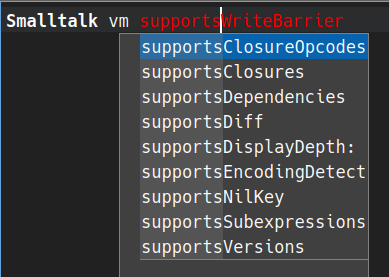
Now we have integrated case 19613 <https://pharo.fogbugz.com/f/cases/19613/> with VisualWorks names. But I propose better names 19614 <https://pharo.fogbugz.com/f/cases/19614/Better-names-for-NoModificationError...>. It would be nice if you put some notes about it (at issue page). 2017-01-26 22:39 GMT+01:00 phil@highoctane.be <phil@highoctane.be>:
Guess the method is wrong given the comment.
Shouldn't it be [param anyMask: 1] instead of [param anyMask: 2] ?
Phil
On Wed, Jan 25, 2017 at 2:14 PM, Clément Bera <bera.clement@gmail.com> wrote:
I introduced the method #supportsWriteBarrier in Pharo 6.
You can backport it if you want:
VirtualMachine>>#supportsWriteBarrier "Answer whether the VM observes the per-object read-only flag and consequently aborts writes to inst vars of, and fails primitives that attempt to write, to read-only objects."
^(self parameterAt: 65) ifNil: [false] ifNotNil: [:param| "In older VMs this is a boolean reflecting MULTIPLE_BYTECODE_SETS" param isInteger "In newer VMs it is a set of integer flags, bit 1 of which is IMMUTABILITY" ifTrue: [param anyMask: 2] ifFalse: [false]]
On Wed, Jan 25, 2017 at 2:06 PM, phil@highoctane.be <phil@highoctane.be> wrote:
The "latest" Windows VM I do use has no such method.
Virtual Machine --------------- C:\Users\Philippe\Dropbox\Sibelga\JiraAutomation\Pharo5.0\la testvm\pharo.exe CoInterpreter * VMMaker.oscog-eem.2090 uuid: 63a161b9-17e1-4911-a89a-1687d9ba9a1a Jan 15 2017 StackToRegisterMappingCogit * VMMaker.oscog-eem.2090 uuid: 63a161b9-17e1-4911-a89a-1687d9ba9a1a Jan 15 2017 VM: 201701151442 https://github.com/pharo-project/pharo-vm.git $ Date: Sun Jan 15 15:42:39 2017 +0100 $ Plugins: 201701151442 https://github.com/pharo-project/pharo-vm.git $
Win32 built on Jan 15 2017 15:59:52 CUT Compiler: 5.4.0 VMMaker versionString VM: 201701151442 https://github.com/pharo-proje ct/pharo-vm.git $ Date: Sun Jan 15 15:42:39 2017 +0100 $ Plugins: 201701151442 https://github.com/pharo-project/pharo-vm.git $ CoInterpreter * VMMaker.oscog-eem.2090 uuid: 63a161b9-17e1-4911-a89a-1687d9ba9a1a Jan 15 2017 StackToRegisterMappingCogit * VMMaker.oscog-eem.2090 uuid: 63a161b9-17e1-4911-a89a-1687d9ba9a1a Jan 15 2017
[image: Inline image 1]
On Wed, Jan 25, 2017 at 1:54 PM, Clément Bera <bera.clement@gmail.com> wrote:
On Wed, Jan 25, 2017 at 11:35 AM, Norbert Hartl <norbert@hartl.name> wrote:
Does anyone know the state of immutability support in vm and image? The latest vm downloadable is compiled with
IMMUTABILITY=1
(Esteban said that). When I open a pharo6 image with this VM and do:
ASUser new setIsReadOnlyObject: true; name: 'foo'
with
ASUser>>#name: arg1 name := arg1
I don't get an exception. Is there something missing or am I not understanding?
Hi Norbert,
Thank you very much for looking read-only objects.
When mutating an instance variable, the VM triggers a call-back that by default does nothing. In your case, running your code does not raise an exception but the object should not be modified either. If you want an exception, you need to change the call-back code, i.e., the method Object>>#attemptToAssign: value withIndex: index. For example, you could write:
Object>>#attemptToAssign: value withIndex: index | process | self notify: 'object changed !'. process := Processor activeProcess. [ process suspendedContext: process suspendedContext sender ] forkAt: Processor activePriority + 1. Processor yield.
Then, your code should open a notification window with 'object changed', and proceeding keeps running the code without mutating the object.
One needs to build a ModificationTracker framework on top of the VM support I introduced. Multiple things are required, like default behavior in this call-back and in primitive failure code. I am willing to support and help anyone willing to build such a framework, but I won't build it myself.
If you have any other questions or if you find bug don't hesitate to ask further questions
Best,
PS: Make sure "Smalltalk vm supportsWriteBarrier" answers true in your system, if this is not the case it means the VM does not support read-only objects.
Clement
Norbert
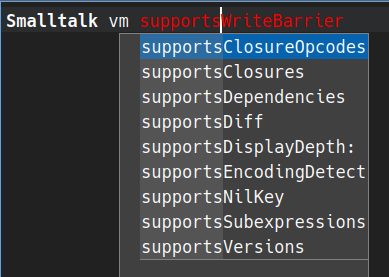
Clément,
Am 25.01.2017 um 13:54 schrieb Clément Bera <bera.clement@gmail.com>:
On Wed, Jan 25, 2017 at 11:35 AM, Norbert Hartl <norbert@hartl.name <mailto:norbert@hartl.name>> wrote: Does anyone know the state of immutability support in vm and image? The latest vm downloadable is compiled with
IMMUTABILITY=1
(Esteban said that). When I open a pharo6 image with this VM and do:
ASUser new setIsReadOnlyObject: true; name: 'foo'
with
ASUser>>#name: arg1 name := arg1
I don't get an exception. Is there something missing or am I not understanding?
Hi Norbert,
Thank you very much for looking read-only objects.
When mutating an instance variable, the VM triggers a call-back that by default does nothing. In your case, running your code does not raise an exception but the object should not be modified either. If you want an exception, you need to change the call-back code, i.e., the method Object>>#attemptToAssign: value withIndex: index. For example, you could write:
Object>>#attemptToAssign: value withIndex: index | process | self notify: 'object changed !'. process := Processor activeProcess. [ process suspendedContext: process suspendedContext sender ] forkAt: Processor activePriority + 1. Processor yield.
Then, your code should open a notification window with 'object changed', and proceeding keeps running the code without mutating the object.
thank you very much for the explanation. What was the rationale behind doing nothing as default? I can see there is two interpretations of read-only. One being just don't modify the object the other being throwing an exception when an attempt to modify is made. I think that having an exception thrown would make it easier to write code using it. I don't want to monkey patch Object but still make this general applicable.
One needs to build a ModificationTracker framework on top of the VM support I introduced. Multiple things are required, like default behavior in this call-back and in primitive failure code. I am willing to support and help anyone willing to build such a framework, but I won't build it myself.
Modification tracking is exactly the reason why I look into it. I have two other approaches doing modification tracking. But both are inferior to an approach using read-only objects. Norbert
If you have any other questions or if you find bug don't hesitate to ask further questions
Best,
PS: Make sure "Smalltalk vm supportsWriteBarrier" answers true in your system, if this is not the case it means the VM does not support read-only objects.
Clement
Norbert
Norbert, On Wed, Jan 25, 2017 at 3:36 PM, Norbert Hartl <norbert@hartl.name> wrote:
Clément,
Am 25.01.2017 um 13:54 schrieb Clément Bera <bera.clement@gmail.com>:
On Wed, Jan 25, 2017 at 11:35 AM, Norbert Hartl <norbert@hartl.name> wro te:
Does anyone know the state of immutability support in vm and image? The latest vm downloadable is compiled with
IMMUTABILITY=1
(Esteban said that). When I open a pharo6 image with this VM and do:
ASUser new setIsReadOnlyObject: true; name: 'foo'
with
ASUser>>#name: arg1 name := arg1
I don't get an exception. Is there something missing or am I not understanding?
Hi Norbert,
Thank you very much for looking read-only objects.
When mutating an instance variable, the VM triggers a call-back that by default does nothing. In your case, running your code does not raise an exception but the object should not be modified either. If you want an exception, you need to change the call-back code, i.e., the method Object>>#attemptToAssign: value withIndex: index. For example, you could write:
Object>>#attemptToAssign: value withIndex: index | process | self notify: 'object changed !'. process := Processor activeProcess. [ process suspendedContext: process suspendedContext sender ] forkAt: Processor activePriority + 1. Processor yield.
Then, your code should open a notification window with 'object changed', and proceeding keeps running the code without mutating the object.
thank you very much for the explanation. What was the rationale behind doing nothing as default? I can see there is two interpretations of read-only. One being just don't modify the object the other being throwing an exception when an attempt to modify is made. I think that having an exception thrown would make it easier to write code using it. I don't want to monkey patch Object but still make this general applicable.
Well, when I introduced the code I thought someone would build a ModificationTracker framework... I think there should be a modification tracker framework that throws an exception only if no program is registered to handle the modification failure. No exception should be thrown in the generic case.
One needs to build a ModificationTracker framework on top of the VM support I introduced. Multiple things are required, like default behavior in this call-back and in primitive failure code. I am willing to support and help anyone willing to build such a framework, but I won't build it myself.
Modification tracking is exactly the reason why I look into it. I have two other approaches doing modification tracking. But both are inferior to an approach using read-only objects.
Overall, you need to: - change the code of all numbered primitives mutating objects (such as at:put:) so that when they fail because of a read-only object they call the modification tracker framework. - add the call to the modification tracker framework from the #attemptToAssign:withIndex: call-back. - build a Modification tracker framework where external programs can easily register themselves to catch modification on specific objects or all instances of a specific class. Programs tracking modifications should be able to temporarily make the object writable, perform the modification and make it read-only again. You can check the VisualWork implementation (check for example the fall-back code of #at:put: and what it calls) and the comment I wrote in #attemptToAssign:withIndex: to get inspired. If you do something like that, please, *please*, please contribute it back to the base Pharo image. Thank you for experimenting with read-only objects. Don't hesitate to contact me if you have issues or questions.
Norbert
If you have any other questions or if you find bug don't hesitate to ask further questions
Best,
PS: Make sure "Smalltalk vm supportsWriteBarrier" answers true in your system, if this is not the case it means the VM does not support read-only objects.
Clement
Norbert
2017-01-25 15:52 GMT+01:00 Clément Bera <bera.clement@gmail.com>:
Overall, you need to: - change the code of all numbered primitives mutating objects (such as at:put:) so that when they fail because of a read-only object they call the modification tracker framework.
I think it is for future. But now behaviour is just inconsistent because making object readonly breaks any app using it *silently*. Also I see that instVarAt:put: will raise error instead of skipping it. So two ways to modify object lead to different behavior. It's not good. My conclusion: it must be error by default. Something like this: Object>>#attemptToAssign: value withIndex: index (ModificationForbidden for: self at: index with: value) signal It is not fix completely inconsistence with #instVarAt:put: but at least they both will fail. By the way I was supprized that failed #instVarAt:put: shows "bad receiver" in primitive *er* variable (<primitive: 174 error: *ec*>). Is "bad receiver" is always about mutability? And if not then how we will distinguish different cases?
Another question Clement. I found that current method doing something strange: attemptToAssign: value withIndex: index process := Processor activeProcess. [ process suspendedContext: process suspendedContext sender ] forkAt: Processor activePriority + 1. Processor yield. "CAN'T REACH" Could you comment why new process needed here? I just check simple version with error and it works: attemptToAssign: value withIndex: index ^self error: 'modification failed'. Also if I will modify #contents: as "*^*contents:=newValue" then following code is working well: o := ValueHolder new. o beReadOnlyObject. [o contents: #test] on: Error do: [:err | err resumeUnchecked: #done]. "=> #done" So I not understand the problem described in method comment. 2017-01-25 16:21 GMT+01:00 Denis Kudriashov <dionisiydk@gmail.com>:
2017-01-25 15:52 GMT+01:00 Clément Bera <bera.clement@gmail.com>:
Overall, you need to: - change the code of all numbered primitives mutating objects (such as at:put:) so that when they fail because of a read-only object they call the modification tracker framework.
I think it is for future.
But now behaviour is just inconsistent because making object readonly breaks any app using it *silently*. Also I see that instVarAt:put: will raise error instead of skipping it. So two ways to modify object lead to different behavior. It's not good.
My conclusion: it must be error by default. Something like this:
Object>>#attemptToAssign: value withIndex: index (ModificationForbidden for: self at: index with: value) signal
It is not fix completely inconsistence with #instVarAt:put: but at least they both will fail.
By the way I was supprized that failed #instVarAt:put: shows "bad receiver" in primitive *er* variable (<primitive: 174 error: *ec*>). Is "bad receiver" is always about mutability? And if not then how we will distinguish different cases?
On Wed, Jan 25, 2017 at 4:42 PM, Denis Kudriashov <dionisiydk@gmail.com> wrote:
Another question Clement.
I found that current method doing something strange:
attemptToAssign: value withIndex: index process := Processor activeProcess. [ process suspendedContext: process suspendedContext sender ] forkAt: Processor activePriority + 1. Processor yield. "CAN'T REACH"
Could you comment why new process needed here? I just check simple version with error and it works:
attemptToAssign: value withIndex: index ^self error: 'modification failed'.
Also if I will modify #contents: as "*^*contents:=newValue" then following code is working well:
o := ValueHolder new. o beReadOnlyObject. [o contents: #test] on: Error do: [:err | err resumeUnchecked: #done]. "=> #done"
So I not understand the problem described in method comment.
Hi Denis, I will look into this case tomorrow, it looks like a bug. Thanks for reporting. For the Process hack, it's because the call-back was designed to return no value. It may look like it works when returning a value but you will have uncommon crashes.
2017-01-25 16:21 GMT+01:00 Denis Kudriashov <dionisiydk@gmail.com>:
2017-01-25 15:52 GMT+01:00 Clément Bera <bera.clement@gmail.com>:
Overall, you need to: - change the code of all numbered primitives mutating objects (such as at:put:) so that when they fail because of a read-only object they call the modification tracker framework.
I think it is for future.
But now behaviour is just inconsistent because making object readonly breaks any app using it *silently*. Also I see that instVarAt:put: will raise error instead of skipping it. So two ways to modify object lead to different behavior. It's not good.
My conclusion: it must be error by default. Something like this:
Object>>#attemptToAssign: value withIndex: index (ModificationForbidden for: self at: index with: value) signal
It is not fix completely inconsistence with #instVarAt:put: but at least they both will fail.
By the way I was supprized that failed #instVarAt:put: shows "bad receiver" in primitive *er* variable (<primitive: 174 error: *ec*>). Is "bad receiver" is always about mutability? And if not then how we will distinguish different cases?
2017-01-25 18:23 GMT+01:00 Clément Bera <bera.clement@gmail.com>:
For the Process hack, it's because the call-back was designed to return no value.
Now I am confused. Why anybody needs to return value from this method? And why there is "CAN'T REACH" comment at the end of method? Do you mean that method should never return?
It may look like it works when returning a value but you will have uncommon crashes.
That's fun :)
2017-01-25 22:24 GMT+01:00 Denis Kudriashov <dionisiydk@gmail.com>:
For the Process hack, it's because the call-back was designed to return no
value.
Now I am confused. Why anybody needs to return value from this method? And why there is "CAN'T REACH" comment at the end of method? Do you mean that method should never return?
It may look like it works when returning a value but you will have uncommon crashes.
And is it safe to just signal error?
The "CAN'T REACH" comment is there because execution never reach that part of the code. If you write code there, it will never be executed. The process code performs a return without pushing any value on stack. Signalling an error is safe if the error is never resumed. But you'll need the returnNoValue for performance intensive modification tracking. On Wed, Jan 25, 2017 at 10:26 PM, Denis Kudriashov <dionisiydk@gmail.com> wrote:
2017-01-25 22:24 GMT+01:00 Denis Kudriashov <dionisiydk@gmail.com>:
For the Process hack, it's because the call-back was designed to return
no value.
Now I am confused. Why anybody needs to return value from this method? And why there is "CAN'T REACH" comment at the end of method? Do you mean that method should never return?
It may look like it works when returning a value but you will have uncommon crashes.
And is it safe to just signal error?
Am 26.01.2017 um 08:11 schrieb Clément Bera <bera.clement@gmail.com>:
The "CAN'T REACH" comment is there because execution never reach that part of the code. If you write code there, it will never be executed. The process code performs a return without pushing any value on stack.
Because you return from the sender, right?
Signalling an error is safe if the error is never resumed. But you'll need the returnNoValue for performance intensive modification tracking.
Ok, while you are popping of the stack there is no way to return, right? I cannot see what it has to be that way but I can see that my approach cannot work this way. In my case the error is resumed because not resuming would defeat the purpose of having transparent modification tracking. I'll use announcements for it because it is a better fit for that anyway. Norbert
On Wed, Jan 25, 2017 at 10:26 PM, Denis Kudriashov <dionisiydk@gmail.com <mailto:dionisiydk@gmail.com>> wrote:
2017-01-25 22:24 GMT+01:00 Denis Kudriashov <dionisiydk@gmail.com <mailto:dionisiydk@gmail.com>>: For the Process hack, it's because the call-back was designed to return no value.
Now I am confused. Why anybody needs to return value from this method? And why there is "CAN'T REACH" comment at the end of method? Do you mean that method should never return?
It may look like it works when returning a value but you will have uncommon crashes.
And is it safe to just signal error?
On Thu, Jan 26, 2017 at 9:54 AM, Norbert Hartl <norbert@hartl.name> wrote:
Am 26.01.2017 um 08:11 schrieb Clément Bera <bera.clement@gmail.com>:
The "CAN'T REACH" comment is there because execution never reach that part of the code. If you write code there, it will never be executed. The process code performs a return without pushing any value on stack.
Because you return from the sender, right?
Yes because the process code returns to the sender. In Smalltalk a send returns necessarily a value to be pushed on the stack of the context performing the send. In the write barrier call-back, the context is not performing a send, but an instance variable store. Unlike sends, instance variable stores are not expected to push a value on stack. If the call-back returns a value, it's pushed on stack while nothing is expected, and if further code use values on stack it will use the returned value instead of the correct one, furthermore, stack depth computation is messed up, overflowing the context stack somewhere in the runtime memory leading to data corruption.
Signalling an error is safe if the error is never resumed. But you'll need the returnNoValue for performance intensive modification tracking.
Ok, while you are popping of the stack there is no way to return, right? I cannot see what it has to be that way but I can see that my approach cannot work this way. In my case the error is resumed because not resuming would defeat the purpose of having transparent modification tracking.
I'll use announcements for it because it is a better fit for that anyway.
You can signal an error, but then keep the process code. For example: Object>>#attemptToAssign: value withIndex: index | process | NoModification signal. process := Processor activeProcess. [ process suspendedContext: process suspendedContext sender ] forkAt: Processor activePriority + 1. Processor yield. this method just works fine. However, Object>>#attemptToAssign: value withIndex: index NoModification signal. this method does not work because it returns a value.
Norbert
On Wed, Jan 25, 2017 at 10:26 PM, Denis Kudriashov <dionisiydk@gmail.com> wrote:
2017-01-25 22:24 GMT+01:00 Denis Kudriashov <dionisiydk@gmail.com>:
For the Process hack, it's because the call-back was designed to return
no value.
Now I am confused. Why anybody needs to return value from this method? And why there is "CAN'T REACH" comment at the end of method? Do you mean that method should never return?
It may look like it works when returning a value but you will have uncommon crashes.
And is it safe to just signal error?
Am 26.01.2017 um 10:32 schrieb Clément Bera <bera.clement@gmail.com>:
On Thu, Jan 26, 2017 at 9:54 AM, Norbert Hartl <norbert@hartl.name <mailto:norbert@hartl.name>> wrote:
Am 26.01.2017 um 08:11 schrieb Clément Bera <bera.clement@gmail.com <mailto:bera.clement@gmail.com>>:
The "CAN'T REACH" comment is there because execution never reach that part of the code. If you write code there, it will never be executed. The process code performs a return without pushing any value on stack.
Because you return from the sender, right?
Yes because the process code returns to the sender.
In Smalltalk a send returns necessarily a value to be pushed on the stack of the context performing the send. In the write barrier call-back, the context is not performing a send, but an instance variable store. Unlike sends, instance variable stores are not expected to push a value on stack. If the call-back returns a value, it's pushed on stack while nothing is expected, and if further code use values on stack it will use the returned value instead of the correct one, furthermore, stack depth computation is messed up, overflowing the context stack somewhere in the runtime memory leading to data corruption.
I see. I'm not sure I understand it correctly. But isn't it the case that you return the value of attemptToAssign:index: as return value of the sender? In the current implementation it will return self. This would break any method with instVar access that do not return self.
Signalling an error is safe if the error is never resumed. But you'll need the returnNoValue for performance intensive modification tracking.
Ok, while you are popping of the stack there is no way to return, right? I cannot see what it has to be that way but I can see that my approach cannot work this way. In my case the error is resumed because not resuming would defeat the purpose of having transparent modification tracking.
I'll use announcements for it because it is a better fit for that anyway.
You can signal an error, but then keep the process code. For example:
Object>>#attemptToAssign: value withIndex: index | process | NoModification signal. process := Processor activeProcess. [ process suspendedContext: process suspendedContext sender ] forkAt: Processor activePriority + 1. Processor yield.
this method just works fine.
However,
Object>>#attemptToAssign: value withIndex: index NoModification signal.
this method does not work because it returns a value.
Ok, thanks. Norbert
Norbert
On Wed, Jan 25, 2017 at 10:26 PM, Denis Kudriashov <dionisiydk@gmail.com <mailto:dionisiydk@gmail.com>> wrote:
2017-01-25 22:24 GMT+01:00 Denis Kudriashov <dionisiydk@gmail.com <mailto:dionisiydk@gmail.com>>: For the Process hack, it's because the call-back was designed to return no value.
Now I am confused. Why anybody needs to return value from this method? And why there is "CAN'T REACH" comment at the end of method? Do you mean that method should never return?
It may look like it works when returning a value but you will have uncommon crashes.
And is it safe to just signal error?
2017-01-26 8:11 GMT+01:00 Clément Bera <bera.clement@gmail.com>:
The "CAN'T REACH" comment is there because execution never reach that part of the code. If you write code there, it will never be executed. The process code performs a return without pushing any value on stack.
Sorry Clement, maybe I am stupid but it is not clear for me. If I put halt after "CAN'T REACH" I got debugger which means that it "can reach". Maybe by "CAN'T REACH" you mean that any return value will not be used? But it is not true: if I return something it will be result of original assignment expression. But as you said it could crash VM.
Signalling an error is safe if the error is never resumed. But you'll need the returnNoValue for performance intensive modification tracking.
Do you have reproducible test case to crash VM when #attemptToAssign is badly implemented? It will help for framework implementation and would be nice description for method. In comment we can point to it. Because this magic with forking process is very confusing. Also I not get your "returnNoValue" sentence.
*Sorry Clement, maybe I am stupid but it is not clear for me.* *If I put halt after "CAN'T REACH" I got debugger which means that it "can reach".* *Maybe by "CAN'T REACH" you mean that any return value will not be used? But it is not true: if I return something it will be result of original assignment expression. But as you said it could crash VM.* Ok I tried and I can see that. This is why I have bugs. Well "CAN'T REACH" was supposed to mean it cannot be reached, I don't understand how it could be reached. On Thu, Jan 26, 2017 at 10:18 AM, Denis Kudriashov <dionisiydk@gmail.com> wrote:
2017-01-26 8:11 GMT+01:00 Clément Bera <bera.clement@gmail.com>:
The "CAN'T REACH" comment is there because execution never reach that part of the code. If you write code there, it will never be executed. The process code performs a return without pushing any value on stack.
Sorry Clement, maybe I am stupid but it is not clear for me. If I put halt after "CAN'T REACH" I got debugger which means that it "can reach". Maybe by "CAN'T REACH" you mean that any return value will not be used? But it is not true: if I return something it will be result of original assignment expression. But as you said it could crash VM.
Signalling an error is safe if the error is never resumed. But you'll need the returnNoValue for performance intensive modification tracking.
Do you have reproducible test case to crash VM when #attemptToAssign is badly implemented? It will help for framework implementation and would be nice description for method. In comment we can point to it. Because this magic with forking process is very confusing. Also I not get your "returnNoValue" sentence.
Let's rewrite the method this way: attemptToAssign: value withIndex: index | process | "INSERT CODE HERE" process := Processor activeProcess. [ process suspendedContext: process suspendedContext sender ] fork. Processor yield. self error: 'should not be reached'. This way it's clear that execution flow never reaches the end of the method as the error message is never sent. For some reason in the previous code by increasing the priority of the process the end of the method could be reached, as Denis showed, which leaded to incorrect behavior. This is still hackish and we still need to provide a better way of performing such returns. Any code can be written at the "INSERT CODE HERE" position, including exception signals, etc. Normal methods ends with a return, for example, "^ self". When performed, "^ self" pushes "self" on the sender's stack and resumes execution in the sender. In this call-back, when reaching the end of the method, the sender's execution needs to be resumed, but no value needs to be pushed on its stack. That's why instead of a normal return I use: process := Processor activeProcess. [ process suspendedContext: process suspendedContext sender ] fork. Processor yield. I don't know how to explain it better. I understand that because it was bugged it was very hard to understand. I will put a slice on the bug tracker. On Thu, Jan 26, 2017 at 10:35 AM, Clément Bera <bera.clement@gmail.com> wrote:
*Sorry Clement, maybe I am stupid but it is not clear for me.*
*If I put halt after "CAN'T REACH" I got debugger which means that it "can reach".* *Maybe by "CAN'T REACH" you mean that any return value will not be used? But it is not true: if I return something it will be result of original assignment expression. But as you said it could crash VM.*
Ok I tried and I can see that. This is why I have bugs. Well "CAN'T REACH" was supposed to mean it cannot be reached, I don't understand how it could be reached.
On Thu, Jan 26, 2017 at 10:18 AM, Denis Kudriashov <dionisiydk@gmail.com> wrote:
2017-01-26 8:11 GMT+01:00 Clément Bera <bera.clement@gmail.com>:
The "CAN'T REACH" comment is there because execution never reach that part of the code. If you write code there, it will never be executed. The process code performs a return without pushing any value on stack.
Sorry Clement, maybe I am stupid but it is not clear for me. If I put halt after "CAN'T REACH" I got debugger which means that it "can reach". Maybe by "CAN'T REACH" you mean that any return value will not be used? But it is not true: if I return something it will be result of original assignment expression. But as you said it could crash VM.
Signalling an error is safe if the error is never resumed. But you'll need the returnNoValue for performance intensive modification tracking.
Do you have reproducible test case to crash VM when #attemptToAssign is badly implemented? It will help for framework implementation and would be nice description for method. In comment we can point to it. Because this magic with forking process is very confusing. Also I not get your "returnNoValue" sentence.

Hi Clement:
On 26 Jan 2017, at 10:59, Clément Bera <bera.clement@gmail.com> wrote:
Let's rewrite the method this way:
attemptToAssign: value withIndex: index | process | "INSERT CODE HERE" process := Processor activeProcess. [ process suspendedContext: process suspendedContext sender ] fork. Processor yield. self error: âshould not be reached'.
The PRocessorScheduler>>#yield does not guarantee that this process becomes never runnable again. It just puts the processes at the end of the runnable list. The fallback code of yield even explicitly forks another processes thatâs signaling the old process again to make it runnable. Best regards Stefan -- Stefan Marr Johannes Kepler Universität Linz http://stefan-marr.de/research/
2017-01-26 10:59 GMT+01:00 Clément Bera <bera.clement@gmail.com>:
Let's rewrite the method this way:
attemptToAssign: value withIndex: index | process | "INSERT CODE HERE" process := Processor activeProcess. [ process suspendedContext: process suspendedContext sender ] fork. Processor yield. self error: 'should not be reached'.
This way it's clear that execution flow never reaches the end of the method as the error message is never sent. For some reason in the previous code by increasing the priority of the process the end of the method could be reached, as Denis showed, which leaded to incorrect behavior. This is still hackish and we still need to provide a better way of performing such returns.
Any code can be written at the "INSERT CODE HERE" position, including exception signals, etc.
Normal methods ends with a return, for example, "^ self". When performed, "^ self" pushes "self" on the sender's stack and resumes execution in the sender. In this call-back, when reaching the end of the method, the sender's execution needs to be resumed, but no value needs to be pushed on its stack. That's why instead of a normal return I use: process := Processor activeProcess. [ process suspendedContext: process suspendedContext sender ] fork. Processor yield. I don't know how to explain it better. I understand that because it was bugged it was very hard to understand. I will put a slice on the bug tracker.
Thank's Clement. Now I understand it.
2017-01-26 10:59 GMT+01:00 Clément Bera <bera.clement@gmail.com>:
Let's rewrite the method this way:
attemptToAssign: value withIndex: index | process | "INSERT CODE HERE" process := Processor activeProcess. [ process suspendedContext: process suspendedContext sender ] fork. Processor yield. self error: 'should not be reached'.
I guess I found simplest solution to problem. Instead of process logic we can just use "thisContext sender jump". attemptToAssign: value withIndex: index | process | thisContext sender jump. self error: 'should not be reached'. In my tests it works correctly. I use this method: ValueHolder>>contents2: anObject | result | result := (contents := anObject). self halt. ^result printString. So debugger is opened at halt. And #result var contains anObject.
Denis' idea is good. There is one problem with the implementation of jump though. MyClass>>iv iv := 1. [ 2 ] value. 1halt. MyClass new beReadOnlyObject ; iv When reaching the halt we see there is an extra nil on stack. I think this is better than the process hack, at least until we add VM support for this case. On Thu, Jan 26, 2017 at 11:36 AM, Denis Kudriashov <dionisiydk@gmail.com> wrote:
2017-01-26 10:59 GMT+01:00 Clément Bera <bera.clement@gmail.com>:
Let's rewrite the method this way:
attemptToAssign: value withIndex: index | process | "INSERT CODE HERE" process := Processor activeProcess. [ process suspendedContext: process suspendedContext sender ] fork. Processor yield. self error: 'should not be reached'.
I guess I found simplest solution to problem. Instead of process logic we can just use "thisContext sender jump".
attemptToAssign: value withIndex: index | process | thisContext sender jump. self error: 'should not be reached'.
In my tests it works correctly. I use this method:
ValueHolder>>contents2: anObject
| result |
result := (contents := anObject). self halt. ^result printString.
So debugger is opened at halt. And #result var contains anObject.
participants (9)
-
 Clément Bera
 -
 Cyril Ferlicot D.
 -
 Denis Kudriashov
 -
 Esteban Lorenzano
 -
 Martin McClure
 -
 Norbert Hartl
 -
 phil@highoctane.be
 -
 Stefan Marr
 -
 Sven Van Caekenberghe