
Will Pharo 7 be ready for i18n of applications? I mean some simple and useful way like in Cincom Visual Works, where translation dictionaries are separated from code and could be dinamycally changed without changing my application. It is very important for huge commercial applications, especially with lots of UI forms, dialogs and user-messages. I transfer my code from Cincom VW (VW is not available now for Russia due to politic situation) to Pharo and is very interested in simple internationalization mechanism. I don't want to reinvent the wheel but sometimes it seems to me that pharo developers are forced to do it. By the way, the error i had last week with clean Pharo 6\Pharo 6.1 installation ("UTF8InvalidText: Invalid utf8 input detected" on image load - error caused by cyrillic path to application folder) didn't solved and i had no feedback from community. best regards, Vikenti Potapov.

Hi vikenti I would love. Now if nobody using a different alphabet does not give us feedback and help we will not really make progress. Denis how do you it? Hilaire is using gettext or something like that in DrGeo. Vikenti did you check the Entreprise Pharo book because it contains nice chapters from svn on cahracter encoding. By the way, the error i had last week with clean Pharo 6\Pharo 6.1 installation ("UTF8InvalidText: Invalid utf8 input detected" on image load - error caused by cyrillic path to application folder) didn't solved and i had no feedback from community. Did you report it? We are slowly deprecating the old streams (because they are messy) and replacing then with ZnStreams. Now if you want to help this would be useful to produce a better Pharo. Stef On Thu, Nov 9, 2017 at 9:29 PM, ÐикенÑий ÐоÑапов <vikenti.potapov@gmail.com> wrote:
Will Pharo 7 be ready for i18n of applications? I mean some simple and useful way like in Cincom Visual Works, where translation dictionaries are separated from code and could be dinamycally changed without changing my application.
It is very important for huge commercial applications, especially with lots of UI forms, dialogs and user-messages.
I transfer my code from Cincom VW (VW is not available now for Russia due to politic situation) to Pharo and is very interested in simple internationalization mechanism. I don't want to reinvent the wheel but sometimes it seems to me that pharo developers are forced to do it.
By the way, the error i had last week with clean Pharo 6\Pharo 6.1 installation ("UTF8InvalidText: Invalid utf8 input detected" on image load - error caused by cyrillic path to application folder) didn't solved and i had no feedback from community.
best regards, Vikenti Potapov.

Hi 2017-11-09 22:15 GMT+01:00 Stephane Ducasse <stepharo.self@gmail.com>:
Hi vikenti
I would love. Now if nobody using a different alphabet does not give us feedback and help we will not really make progress. Denis how do you it?
I got this kind of errors in past with Pharo 1 on Windows XP. Now I was sure that it was fixed. I checked it with Pharo 3 (I guess). Now I have no such environment to test.
Hilaire is using gettext or something like that in DrGeo.
Vikenti did you check the Entreprise Pharo book because it contains nice chapters from svn on cahracter encoding.
By the way, the error i had last week with clean Pharo 6\Pharo 6.1 installation ("UTF8InvalidText: Invalid utf8 input detected" on image load - error caused by cyrillic path to application folder) didn't solved and i had no feedback from community.
Did you report it? We are slowly deprecating the old streams (because they are messy) and replacing then with ZnStreams. Now if you want to help this would be useful to produce a better Pharo.
Stef
On Thu, Nov 9, 2017 at 9:29 PM, ÐикенÑий ÐоÑапов <vikenti.potapov@gmail.com> wrote:
Will Pharo 7 be ready for i18n of applications? I mean some simple and useful way like in Cincom Visual Works, where
translation dictionaries are separated from code and could be dinamycally changed without changing my application.
It is very important for huge commercial applications, especially with
lots of UI forms, dialogs and user-messages.
I transfer my code from Cincom VW (VW is not available now for Russia
due to politic situation) to Pharo and is very interested in simple internationalization mechanism. I don't want to reinvent the wheel but sometimes it seems to me that pharo developers are forced to do it.
By the way, the error i had last week with clean Pharo 6\Pharo 6.1
installation ("UTF8InvalidText: Invalid utf8 input detected" on image load - error caused by cyrillic path to application folder) didn't solved and i had no feedback from community.
best regards, Vikenti Potapov.
In my experience I used my own custom implementation to support multiple languages. It was based on super simple dictionary of lang->labelName->text. I loaded it from custom xml file. My problem was that I never understood how gettext is supposed to be used on Windows. 2017-11-09 21:29 GMT+01:00 ÐикенÑий ÐоÑапов <vikenti.potapov@gmail.com>:
Will Pharo 7 be ready for i18n of applications? I mean some simple and useful way like in Cincom Visual Works, where translation dictionaries are separated from code and could be dinamycally changed without changing my application.
It is very important for huge commercial applications, especially with lots of UI forms, dialogs and user-messages.
I transfer my code from Cincom VW (VW is not available now for Russia due to politic situation) to Pharo and is very interested in simple internationalization mechanism. I don't want to reinvent the wheel but sometimes it seems to me that pharo developers are forced to do it.
By the way, the error i had last week with clean Pharo 6\Pharo 6.1 installation ("UTF8InvalidText: Invalid utf8 input detected" on image load - error caused by cyrillic path to application folder) didn't solved and i had no feedback from community.
best regards, Vikenti Potapov.

The Pharo 7/8 roadmap does not (yet) include I18N: https://github.com/pharo-project/pharo-workingRoadmaps/blob/master/Pharo7/RO... and the Pharo core image still includes the "NaturalLanguageTranslator" solution still from Squeak. See this class for more details and all senders of #translated message. So far the whole Pharo UI is in English and while books, the mooc or others were translated the Pharo image so far is not. I guess some more work would be needed also on the font frontier to provide an internationalized image and the different languages. But for own applications (like web applications) there are some more (external) solutions: 1. I once wrote and announced an own I18N framwork: http://lists.pharo.org/pipermail/pharo-dev_lists.pharo.org/2014-September/10... which is fully documented on http://smalltalkhub.com/#!/~TorstenBergmann/I18N but is a completely proprietary solution. 2. There is also some stuff from Jan van de Sandt: https://lists.gforge.inria.fr/pipermail/pharo-project/2012-October/070652.ht... 3. And there is GetText (from Seaside web framework) which I guess is either here http://smalltalkhub.com/#!/~PharoExtras/Gettext or now maintained here: https://github.com/SeasideSt/Seaside/wiki/Gettext Unfortunately back at the time this one was not independently loadable and had other trouble which I critisized on http://forum.world.st/ANN-Easy-I18N-for-Pharo-td4778194.html Maybe situation for this project has improved. But so far nobody pushed I18N really into Pharo ... 4. Therefore back in 2014 I started with a consolidation by starting a clean room implementation of Gettext - based on code from 3. but now with tests and Pharo Spec based tools (see screenshot attached). I did it in an own repo to be able to experiment and not break the Seaside solution right in the beginning. My code is on STHub http://smalltalkhub.com/#!/~TorstenBergmann/Gettext and it is not yet fully usable and so far still unfinished But one can load the project still in Pharo 7 using Gofer it smalltalkhubUser: 'TorstenBergmann' project: 'Gettext'; configuration; load. (Smalltalk at: #ConfigurationOfGettext) project bleedingEdge load All 11 Tests are green so at least what is there should work. Check the world menu and the code. Load the "Foo" package from the same repository to see something in the tools. The idea was to have support for MO and PO files completely written in Smalltalk as well as tools that allow you to find and translate internationalized text. But as always: this would require more work. I would still favour a fully in Pharo written solution (following the gettext formats) but maybe for performance reasons then also bind to libgettext using UFFI. Hope this gives some insights on the current existing solutions/status. Thanks Torsten
Gesendet: Donnerstag, 09. November 2017 um 21:29 Uhr Von: "ÐикенÑий ÐоÑапов" <vikenti.potapov@gmail.com> An: pharo-users@lists.pharo.org Betreff: [Pharo-users] I18n in pharo
Will Pharo 7 be ready for i18n of applications? I mean some simple and useful way like in Cincom Visual Works, where translation dictionaries are separated from code and could be dinamycally changed without changing my application.
It is very important for huge commercial applications, especially with lots of UI forms, dialogs and user-messages.
I transfer my code from Cincom VW (VW is not available now for Russia due to politic situation) to Pharo and is very interested in simple internationalization mechanism. I don't want to reinvent the wheel but sometimes it seems to me that pharo developers are forced to do it.
By the way, the error i had last week with clean Pharo 6\Pharo 6.1 installation ("UTF8InvalidText: Invalid utf8 input detected" on image load - error caused by cyrillic path to application folder) didn't solved and i had no feedback from community.
best regards, Vikenti Potapov.

I think this is two different problems: 1. pharo itself supporting different languages/keyboards, etc. 2. pharo allowing the development of i18n applications I think we still need to work on point 1, but for point 2 we already have gettext package, which is a standard we can/should use. Maybe that needs to be better documented (as everything), but well⦠we have a solution there :) Esteban
On 9 Nov 2017, at 18:58, Torsten Bergmann <astares@gmx.de> wrote:
The Pharo 7/8 roadmap does not (yet) include I18N: https://github.com/pharo-project/pharo-workingRoadmaps/blob/master/Pharo7/RO...
and the Pharo core image still includes the "NaturalLanguageTranslator" solution still from Squeak. See this class for more details and all senders of #translated message. So far the whole Pharo UI is in English and while books, the mooc or others were translated the Pharo image so far is not. I guess some more work would be needed also on the font frontier to provide an internationalized image and the different languages.
But for own applications (like web applications) there are some more (external) solutions:
1. I once wrote and announced an own I18N framwork: http://lists.pharo.org/pipermail/pharo-dev_lists.pharo.org/2014-September/10... which is fully documented on http://smalltalkhub.com/#!/~TorstenBergmann/I18N but is a completely proprietary solution.
2. There is also some stuff from Jan van de Sandt: https://lists.gforge.inria.fr/pipermail/pharo-project/2012-October/070652.ht...
3. And there is GetText (from Seaside web framework) which I guess is either here http://smalltalkhub.com/#!/~PharoExtras/Gettext or now maintained here: https://github.com/SeasideSt/Seaside/wiki/Gettext
Unfortunately back at the time this one was not independently loadable and had other trouble which I critisized on http://forum.world.st/ANN-Easy-I18N-for-Pharo-td4778194.html
Maybe situation for this project has improved.
But so far nobody pushed I18N really into Pharo ...
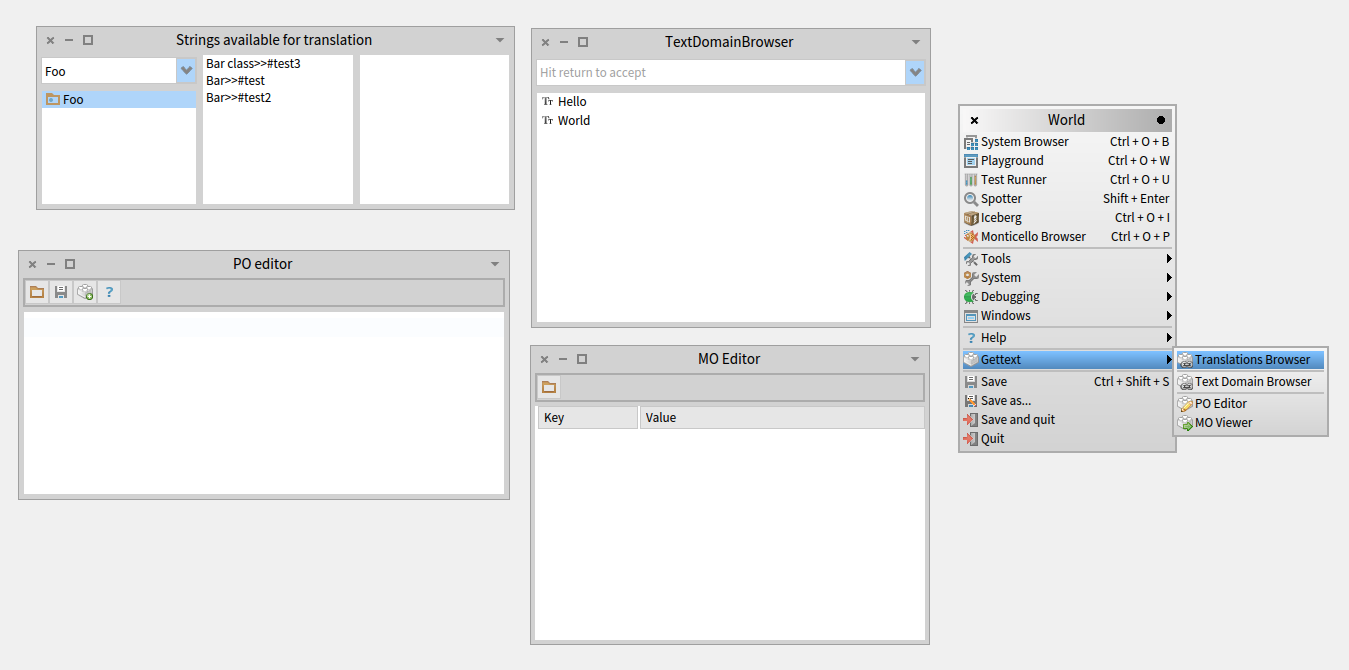
4. Therefore back in 2014 I started with a consolidation by starting a clean room implementation of Gettext - based on code from 3. but now with tests and Pharo Spec based tools (see screenshot attached). I did it in an own repo to be able to experiment and not break the Seaside solution right in the beginning.
My code is on STHub http://smalltalkhub.com/#!/~TorstenBergmann/Gettext and it is not yet fully usable and so far still unfinished
But one can load the project still in Pharo 7 using
Gofer it smalltalkhubUser: 'TorstenBergmann' project: 'Gettext'; configuration; load.
(Smalltalk at: #ConfigurationOfGettext) project bleedingEdge load
All 11 Tests are green so at least what is there should work. Check the world menu and the code. Load the "Foo" package from the same repository to see something in the tools. The idea was to have support for MO and PO files completely written in Smalltalk as well as tools that allow you to find and translate internationalized text.
But as always: this would require more work. I would still favour a fully in Pharo written solution (following the gettext formats) but maybe for performance reasons then also bind to libgettext using UFFI.
Hope this gives some insights on the current existing solutions/status.
Thanks Torsten
Gesendet: Donnerstag, 09. November 2017 um 21:29 Uhr Von: "ÐикенÑий ÐоÑапов" <vikenti.potapov@gmail.com> An: pharo-users@lists.pharo.org Betreff: [Pharo-users] I18n in pharo
Will Pharo 7 be ready for i18n of applications? I mean some simple and useful way like in Cincom Visual Works, where translation dictionaries are separated from code and could be dinamycally changed without changing my application.
It is very important for huge commercial applications, especially with lots of UI forms, dialogs and user-messages.
I transfer my code from Cincom VW (VW is not available now for Russia due to politic situation) to Pharo and is very interested in simple internationalization mechanism. I don't want to reinvent the wheel but sometimes it seems to me that pharo developers are forced to do it.
By the way, the error i had last week with clean Pharo 6\Pharo 6.1 installation ("UTF8InvalidText: Invalid utf8 input detected" on image load - error caused by cyrillic path to application folder) didn't solved and i had no feedback from community.
best regards, Vikenti Potapov.
<GetTextNewTools.png>

2017-11-09 23:50 GMT+01:00 Esteban Lorenzano <estebanlm@gmail.com>:
> I think this is two different problems:
>
> 1. pharo itself supporting different languages/keyboards, etc.
> 2. pharo allowing the development of i18n applications
>
> I think we still need to work on point 1, but for point 2 we already have
> gettext package, which is a standard we can/should use. Maybe that needs to
> be better documented (as everything), but well⦠we have a solution there :)
>
Will we include it into the standard image?
-- Pavel
> Esteban
>
> > On 9 Nov 2017, at 18:58, Torsten Bergmann <astares@gmx.de> wrote:
> >
> > The Pharo 7/8 roadmap does not (yet) include I18N:
> https://github.com/pharo-project/pharo-workingRoadmaps/
> blob/master/Pharo7/ROADMAP.md
> >
> > and the Pharo core image still includes the "NaturalLanguageTranslator"
> solution still from Squeak. See this class for more details and
> > all senders of #translated message. So far the whole Pharo UI is in
> English and while books, the mooc or others were translated the Pharo
> > image so far is not.
> > I guess some more work would be needed also on the font frontier to
> provide an internationalized image and the different languages.
> >
> >
> >
> > But for own applications (like web applications) there are some more
> (external) solutions:
> >
> >
> > 1. I once wrote and announced an own I18N framwork:
> http://lists.pharo.org/pipermail/pharo-dev_lists.pharo.org/2014-September/
> 100247.html
> > which is fully documented on http://smalltalkhub.com/#!/~
> TorstenBergmann/I18N but is a completely proprietary solution.
> >
> > 2. There is also some stuff from Jan van de Sandt:
> > https://lists.gforge.inria.fr/pipermail/pharo-project/2012-
> October/070652.html
> >
> > 3. And there is GetText (from Seaside web framework) which I guess is
> either here http://smalltalkhub.com/#!/~PharoExtras/Gettext
> > or now maintained here: https://github.com/SeasideSt/
> Seaside/wiki/Gettext
> >
> > Unfortunately back at the time this one was not independently loadable
> and had other trouble which I critisized on
> > http://forum.world.st/ANN-Easy-I18N-for-Pharo-td4778194.html
> >
> > Maybe situation for this project has improved.
> >
> >
> > But so far nobody pushed I18N really into Pharo ...
> >
> > 4. Therefore back in 2014 I started with a consolidation by starting a
> clean room implementation of Gettext - based on code from 3.
> > but now with tests and Pharo Spec based tools (see screenshot
> attached). I did it in an own repo to be able to experiment and
> > not break the Seaside solution right in the beginning.
> >
> > My code is on STHub http://smalltalkhub.com/#!/~
> TorstenBergmann/Gettext and it is not yet fully usable and so far still
> > unfinished
> >
> > But one can load the project still in Pharo 7 using
> >
> > Gofer it
> > smalltalkhubUser: 'TorstenBergmann' project: 'Gettext';
> > configuration;
> > load.
> >
> > (Smalltalk at: #ConfigurationOfGettext) project bleedingEdge load
> >
> > All 11 Tests are green so at least what is there should work. Check
> the world menu and the code. Load the "Foo" package from the same repository
> > to see something in the tools. The idea was to have support for MO and
> PO files completely written in Smalltalk as well as tools that allow you
> > to find and translate internationalized text.
> >
> > But as always: this would require more work. I would still favour a
> fully in Pharo written solution (following the gettext formats) but maybe
> for
> > performance reasons then also bind to libgettext using UFFI.
> >
> >
> > Hope this gives some insights on the current existing solutions/status.
> >
> > Thanks
> > Torsten
> >
> >
> >> Gesendet: Donnerstag, 09. November 2017 um 21:29 Uhr
> >> Von: "ÐикенÑий ÐоÑапов" <vikenti.potapov@gmail.com>
> >> An: pharo-users@lists.pharo.org
> >> Betreff: [Pharo-users] I18n in pharo
> >>
> >>
> >> Will Pharo 7 be ready for i18n of applications?
> >> I mean some simple and useful way like in Cincom Visual Works, where
> translation dictionaries are separated from code and could be dinamycally
> changed without changing my application.
> >>
> >> It is very important for huge commercial applications, especially with
> lots of UI forms, dialogs and user-messages.
> >>
> >> I transfer my code from Cincom VW (VW is not available now for Russia
> due to politic situation) to Pharo and is very interested in simple
> internationalization mechanism. I don't want to reinvent the wheel but
> sometimes it seems to me that pharo developers are forced to do it.
> >>
> >> By the way, the error i had last week with clean Pharo 6\Pharo 6.1
> installation ("UTF8InvalidText: Invalid utf8 input detected" on image load
> - error caused by cyrillic path to application folder) didn't solved and i
> had no feedback from community.
> >>
> >> best regards,
> >> Vikenti Potapov.
> >>
> >>
> > <GetTextNewTools.png>
>
>
>
On 10 Nov 2017, at 04:05, Pavel Krivanek <pavel.krivanek@gmail.com> wrote:
2017-11-09 23:50 GMT+01:00 Esteban Lorenzano <estebanlm@gmail.com <mailto:estebanlm@gmail.com>>: I think this is two different problems:
1. pharo itself supporting different languages/keyboards, etc. 2. pharo allowing the development of i18n applications
I think we still need to work on point 1, but for point 2 we already have gettext package, which is a standard we can/should use. Maybe that needs to be better documented (as everything), but well⦠we have a solution there :)
Will we include it into the standard image?
No. The whole idea with PharoExtras was âthere are packages we care about and we want to make them available, but there is no reason to keep them *in* imageâ. I do not see why we should change that policy. Now, we definitively need better documentation about it. Esteban
-- Pavel
Esteban
On 9 Nov 2017, at 18:58, Torsten Bergmann <astares@gmx.de <mailto:astares@gmx.de>> wrote:
The Pharo 7/8 roadmap does not (yet) include I18N: https://github.com/pharo-project/pharo-workingRoadmaps/blob/master/Pharo7/RO... <https://github.com/pharo-project/pharo-workingRoadmaps/blob/master/Pharo7/RO...>
and the Pharo core image still includes the "NaturalLanguageTranslator" solution still from Squeak. See this class for more details and all senders of #translated message. So far the whole Pharo UI is in English and while books, the mooc or others were translated the Pharo image so far is not. I guess some more work would be needed also on the font frontier to provide an internationalized image and the different languages.
But for own applications (like web applications) there are some more (external) solutions:
1. I once wrote and announced an own I18N framwork: http://lists.pharo.org/pipermail/pharo-dev_lists.pharo.org/2014-September/10... <http://lists.pharo.org/pipermail/pharo-dev_lists.pharo.org/2014-September/10...> which is fully documented on http://smalltalkhub.com/#!/~TorstenBergmann/I18N <http://smalltalkhub.com/#!/~TorstenBergmann/I18N> but is a completely proprietary solution.
2. There is also some stuff from Jan van de Sandt: https://lists.gforge.inria.fr/pipermail/pharo-project/2012-October/070652.ht... <https://lists.gforge.inria.fr/pipermail/pharo-project/2012-October/070652.ht...>
3. And there is GetText (from Seaside web framework) which I guess is either here http://smalltalkhub.com/#!/~PharoExtras/Gettext <http://smalltalkhub.com/#!/~PharoExtras/Gettext> or now maintained here: https://github.com/SeasideSt/Seaside/wiki/Gettext <https://github.com/SeasideSt/Seaside/wiki/Gettext>
Unfortunately back at the time this one was not independently loadable and had other trouble which I critisized on http://forum.world.st/ANN-Easy-I18N-for-Pharo-td4778194.html <http://forum.world.st/ANN-Easy-I18N-for-Pharo-td4778194.html>
Maybe situation for this project has improved.
But so far nobody pushed I18N really into Pharo ...
4. Therefore back in 2014 I started with a consolidation by starting a clean room implementation of Gettext - based on code from 3. but now with tests and Pharo Spec based tools (see screenshot attached). I did it in an own repo to be able to experiment and not break the Seaside solution right in the beginning.
My code is on STHub http://smalltalkhub.com/#!/~TorstenBergmann/Gettext <http://smalltalkhub.com/#!/~TorstenBergmann/Gettext> and it is not yet fully usable and so far still unfinished
But one can load the project still in Pharo 7 using
Gofer it smalltalkhubUser: 'TorstenBergmann' project: 'Gettext'; configuration; load.
(Smalltalk at: #ConfigurationOfGettext) project bleedingEdge load
All 11 Tests are green so at least what is there should work. Check the world menu and the code. Load the "Foo" package from the same repository to see something in the tools. The idea was to have support for MO and PO files completely written in Smalltalk as well as tools that allow you to find and translate internationalized text.
But as always: this would require more work. I would still favour a fully in Pharo written solution (following the gettext formats) but maybe for performance reasons then also bind to libgettext using UFFI.
Hope this gives some insights on the current existing solutions/status.
Thanks Torsten
Gesendet: Donnerstag, 09. November 2017 um 21:29 Uhr Von: "ÐикенÑий ÐоÑапов" <vikenti.potapov@gmail.com <mailto:vikenti.potapov@gmail.com>> An: pharo-users@lists.pharo.org <mailto:pharo-users@lists.pharo.org> Betreff: [Pharo-users] I18n in pharo
Will Pharo 7 be ready for i18n of applications? I mean some simple and useful way like in Cincom Visual Works, where translation dictionaries are separated from code and could be dinamycally changed without changing my application.
It is very important for huge commercial applications, especially with lots of UI forms, dialogs and user-messages.
I transfer my code from Cincom VW (VW is not available now for Russia due to politic situation) to Pharo and is very interested in simple internationalization mechanism. I don't want to reinvent the wheel but sometimes it seems to me that pharo developers are forced to do it.
By the way, the error i had last week with clean Pharo 6\Pharo 6.1 installation ("UTF8InvalidText: Invalid utf8 input detected" on image load - error caused by cyrillic path to application folder) didn't solved and i had no feedback from community.
best regards, Vikenti Potapov.
<GetTextNewTools.png>

On 10 Nov 2017, at 11:18, Esteban Lorenzano <estebanlm@gmail.com> wrote:
On 10 Nov 2017, at 04:05, Pavel Krivanek <pavel.krivanek@gmail.com <mailto:pavel.krivanek@gmail.com>> wrote:
2017-11-09 23:50 GMT+01:00 Esteban Lorenzano <estebanlm@gmail.com <mailto:estebanlm@gmail.com>>: I think this is two different problems:
1. pharo itself supporting different languages/keyboards, etc. 2. pharo allowing the development of i18n applications
I think we still need to work on point 1, but for point 2 we already have gettext package, which is a standard we can/should use. Maybe that needs to be better documented (as everything), but well⦠we have a solution there :)
Will we include it into the standard image?
No. The whole idea with PharoExtras was âthere are packages we care about and we want to make them available, but there is no reason to keep them *in* imageâ. I do not see why we should change that policy.
Now, we definitively need better documentation about it.
But having I18 support is not bad⦠e.g. there are many programs out there that provide translated menus. It would not be completely a bad idea to do that for Pharo, too. Marcus
Marcus translate is incomplete and I would not focus on translating Pharo. I would prefer to improve the self documentation in english. Let us concentrate where we can get better. Stef On Fri, Nov 10, 2017 at 11:20 AM, Marcus Denker <marcus.denker@inria.fr> wrote:
On 10 Nov 2017, at 11:18, Esteban Lorenzano <estebanlm@gmail.com> wrote:
On 10 Nov 2017, at 04:05, Pavel Krivanek <pavel.krivanek@gmail.com> wrote:
2017-11-09 23:50 GMT+01:00 Esteban Lorenzano <estebanlm@gmail.com>:
I think this is two different problems:
1. pharo itself supporting different languages/keyboards, etc. 2. pharo allowing the development of i18n applications
I think we still need to work on point 1, but for point 2 we already have gettext package, which is a standard we can/should use. Maybe that needs to be better documented (as everything), but well⦠we have a solution there :)
Will we include it into the standard image?
No. The whole idea with PharoExtras was âthere are packages we care about and we want to make them available, but there is no reason to keep them *in* imageâ. I do not see why we should change that policy.
Now, we definitively need better documentation about it.
But having I18 support is not bad⦠e.g. there are many programs out there that provide translated menus. It would not be completely a bad idea to do that for Pharo, too.
Marcus
Hi Pavel Does it make sense to have loaded by default? Stef On Fri, Nov 10, 2017 at 8:05 AM, Pavel Krivanek <pavel.krivanek@gmail.com> wrote:
2017-11-09 23:50 GMT+01:00 Esteban Lorenzano <estebanlm@gmail.com>:
I think this is two different problems:
1. pharo itself supporting different languages/keyboards, etc. 2. pharo allowing the development of i18n applications
I think we still need to work on point 1, but for point 2 we already have gettext package, which is a standard we can/should use. Maybe that needs to be better documented (as everything), but well⦠we have a solution there :)
Will we include it into the standard image?
-- Pavel
Esteban
On 9 Nov 2017, at 18:58, Torsten Bergmann <astares@gmx.de> wrote:
The Pharo 7/8 roadmap does not (yet) include I18N: https://github.com/pharo-project/pharo-workingRoadmaps/blob/master/Pharo7/RO...
and the Pharo core image still includes the "NaturalLanguageTranslator" solution still from Squeak. See this class for more details and all senders of #translated message. So far the whole Pharo UI is in English and while books, the mooc or others were translated the Pharo image so far is not. I guess some more work would be needed also on the font frontier to provide an internationalized image and the different languages.
But for own applications (like web applications) there are some more (external) solutions:
1. I once wrote and announced an own I18N framwork: http://lists.pharo.org/pipermail/pharo-dev_lists.pharo.org/2014-September/10... which is fully documented on http://smalltalkhub.com/#!/~TorstenBergmann/I18N but is a completely proprietary solution.
2. There is also some stuff from Jan van de Sandt:
https://lists.gforge.inria.fr/pipermail/pharo-project/2012-October/070652.ht...
3. And there is GetText (from Seaside web framework) which I guess is either here http://smalltalkhub.com/#!/~PharoExtras/Gettext or now maintained here: https://github.com/SeasideSt/Seaside/wiki/Gettext
Unfortunately back at the time this one was not independently loadable and had other trouble which I critisized on http://forum.world.st/ANN-Easy-I18N-for-Pharo-td4778194.html
Maybe situation for this project has improved.
But so far nobody pushed I18N really into Pharo ...
4. Therefore back in 2014 I started with a consolidation by starting a clean room implementation of Gettext - based on code from 3. but now with tests and Pharo Spec based tools (see screenshot attached). I did it in an own repo to be able to experiment and not break the Seaside solution right in the beginning.
My code is on STHub http://smalltalkhub.com/#!/~TorstenBergmann/Gettext and it is not yet fully usable and so far still unfinished
But one can load the project still in Pharo 7 using
Gofer it smalltalkhubUser: 'TorstenBergmann' project: 'Gettext'; configuration; load.
(Smalltalk at: #ConfigurationOfGettext) project bleedingEdge load
All 11 Tests are green so at least what is there should work. Check the world menu and the code. Load the "Foo" package from the same repository to see something in the tools. The idea was to have support for MO and PO files completely written in Smalltalk as well as tools that allow you to find and translate internationalized text.
But as always: this would require more work. I would still favour a fully in Pharo written solution (following the gettext formats) but maybe for performance reasons then also bind to libgettext using UFFI.
Hope this gives some insights on the current existing solutions/status.
Thanks Torsten
Gesendet: Donnerstag, 09. November 2017 um 21:29 Uhr Von: "ÐикенÑий ÐоÑапов" <vikenti.potapov@gmail.com> An: pharo-users@lists.pharo.org Betreff: [Pharo-users] I18n in pharo
Will Pharo 7 be ready for i18n of applications? I mean some simple and useful way like in Cincom Visual Works, where translation dictionaries are separated from code and could be dinamycally changed without changing my application.
It is very important for huge commercial applications, especially with lots of UI forms, dialogs and user-messages.
I transfer my code from Cincom VW (VW is not available now for Russia due to politic situation) to Pharo and is very interested in simple internationalization mechanism. I don't want to reinvent the wheel but sometimes it seems to me that pharo developers are forced to do it.
By the way, the error i had last week with clean Pharo 6\Pharo 6.1 installation ("UTF8InvalidText: Invalid utf8 input detected" on image load - error caused by cyrillic path to application folder) didn't solved and i had no feedback from community.
best regards, Vikenti Potapov.
<GetTextNewTools.png>
2017-11-11 12:16 GMT+01:00 Stephane Ducasse <stepharo.self@gmail.com>:
Hi Pavel
Does it make sense to have loaded by default?
I'm not sure. For Pharo itself it does not make sense to be translated but the applications can use some standard Pharo services like inform/confirm dialogs, file dialog etc. So if they want to use some external translation mechanism, they will fight to two different frameworks. -- Pavel
Stef
On Fri, Nov 10, 2017 at 8:05 AM, Pavel Krivanek <pavel.krivanek@gmail.com> wrote:
2017-11-09 23:50 GMT+01:00 Esteban Lorenzano <estebanlm@gmail.com>:
I think this is two different problems:
1. pharo itself supporting different languages/keyboards, etc. 2. pharo allowing the development of i18n applications
I think we still need to work on point 1, but for point 2 we already
have
gettext package, which is a standard we can/should use. Maybe that needs to be better documented (as everything), but well⦠we have a solution there :)
Will we include it into the standard image?
-- Pavel
Esteban
On 9 Nov 2017, at 18:58, Torsten Bergmann <astares@gmx.de> wrote:
The Pharo 7/8 roadmap does not (yet) include I18N: https://github.com/pharo-project/pharo-workingRoadmaps/
blob/master/Pharo7/ROADMAP.md
and the Pharo core image still includes the
"NaturalLanguageTranslator"
solution still from Squeak. See this class for more details and all senders of #translated message. So far the whole Pharo UI is in English and while books, the mooc or others were translated the Pharo image so far is not. I guess some more work would be needed also on the font frontier to provide an internationalized image and the different languages.
But for own applications (like web applications) there are some more (external) solutions:
1. I once wrote and announced an own I18N framwork: http://lists.pharo.org/pipermail/pharo-dev_lists. pharo.org/2014-September/100247.html which is fully documented on http://smalltalkhub.com/#!/~TorstenBergmann/I18N but is a completely proprietary solution.
2. There is also some stuff from Jan van de Sandt:
https://lists.gforge.inria.fr/pipermail/pharo-project/2012- October/070652.html
3. And there is GetText (from Seaside web framework) which I guess is either here http://smalltalkhub.com/#!/~PharoExtras/Gettext or now maintained here: https://github.com/SeasideSt/Seaside/wiki/Gettext
Unfortunately back at the time this one was not independently loadable and had other trouble which I critisized on http://forum.world.st/ANN-Easy-I18N-for-Pharo-td4778194.html
Maybe situation for this project has improved.
But so far nobody pushed I18N really into Pharo ...
4. Therefore back in 2014 I started with a consolidation by starting a clean room implementation of Gettext - based on code from 3. but now with tests and Pharo Spec based tools (see screenshot attached). I did it in an own repo to be able to experiment and not break the Seaside solution right in the beginning.
My code is on STHub http://smalltalkhub.com/#!/~TorstenBergmann/Gettext and it is not yet fully usable and so far still unfinished
But one can load the project still in Pharo 7 using
Gofer it smalltalkhubUser: 'TorstenBergmann' project: 'Gettext'; configuration; load.
(Smalltalk at: #ConfigurationOfGettext) project bleedingEdge load
All 11 Tests are green so at least what is there should work. Check the world menu and the code. Load the "Foo" package from the same repository to see something in the tools. The idea was to have support for MO and PO files completely written in Smalltalk as well as tools that allow you to find and translate internationalized text.
But as always: this would require more work. I would still favour a fully in Pharo written solution (following the gettext formats) but maybe for performance reasons then also bind to libgettext using UFFI.
Hope this gives some insights on the current existing solutions/status.
Thanks Torsten
Gesendet: Donnerstag, 09. November 2017 um 21:29 Uhr Von: "ÐикенÑий ÐоÑапов" <vikenti.potapov@gmail.com> An: pharo-users@lists.pharo.org Betreff: [Pharo-users] I18n in pharo
Will Pharo 7 be ready for i18n of applications? I mean some simple and useful way like in Cincom Visual Works, where translation dictionaries are separated from code and could be dinamycally changed without changing my application.
It is very important for huge commercial applications, especially with lots of UI forms, dialogs and user-messages.
I transfer my code from Cincom VW (VW is not available now for Russia due to politic situation) to Pharo and is very interested in simple internationalization mechanism. I don't want to reinvent the wheel but sometimes it seems to me that pharo developers are forced to do it.
By the way, the error i had last week with clean Pharo 6\Pharo 6.1 installation ("UTF8InvalidText: Invalid utf8 input detected" on image load - error caused by cyrillic path to application folder) didn't solved and i had no feedback from community.
best regards, Vikenti Potapov.
<GetTextNewTools.png>

Iâd think about porting the I18n Gem from Ruby but replacing Gettext with xliff to be a better, more generalized solution. Cascade in the Ruby Gem is a useful feature missing from other implementations Iâve used. https://github.com/svenfuchs/i18n/tree/master/test http://docs.oasis-open.org/xliff/xliff-core/xliff-core.html It would also likely be easier and more reliable, since the XML support in Pharo is already quite good. Andrew Glynn Sent from Mail for Windows 10 From: Torsten Bergmann Sent: Thursday, November 9, 2017 4:59 PM To: pharo-users@lists.pharo.org Subject: Re: [Pharo-users] I18n in pharo The Pharo 7/8 roadmap does not (yet) include I18N: https://github.com/pharo-project/pharo-workingRoadmaps/blob/master/Pharo7/RO... and the Pharo core image still includes the "NaturalLanguageTranslator" solution still from Squeak. See this class for more details and all senders of #translated message. So far the whole Pharo UI is in English and while books, the mooc or others were translated the Pharo image so far is not. I guess some more work would be needed also on the font frontier to provide an internationalized image and the different languages. But for own applications (like web applications) there are some more (external) solutions: 1. I once wrote and announced an own I18N framwork: http://lists.pharo.org/pipermail/pharo-dev_lists.pharo.org/2014-September/10... which is fully documented on http://smalltalkhub.com/#!/~TorstenBergmann/I18N but is a completely proprietary solution. 2. There is also some stuff from Jan van de Sandt: https://lists.gforge.inria.fr/pipermail/pharo-project/2012-October/070652.ht... 3. And there is GetText (from Seaside web framework) which I guess is either here http://smalltalkhub.com/#!/~PharoExtras/Gettext or now maintained here: https://github.com/SeasideSt/Seaside/wiki/Gettext Unfortunately back at the time this one was not independently loadable and had other trouble which I critisized on http://forum.world.st/ANN-Easy-I18N-for-Pharo-td4778194.html Maybe situation for this project has improved. But so far nobody pushed I18N really into Pharo ... 4. Therefore back in 2014 I started with a consolidation by starting a clean room implementation of Gettext - based on code from 3. but now with tests and Pharo Spec based tools (see screenshot attached). I did it in an own repo to be able to experiment and not break the Seaside solution right in the beginning. My code is on STHub http://smalltalkhub.com/#!/~TorstenBergmann/Gettext and it is not yet fully usable and so far still unfinished But one can load the project still in Pharo 7 using Gofer it smalltalkhubUser: 'TorstenBergmann' project: 'Gettext'; configuration; load. (Smalltalk at: #ConfigurationOfGettext) project bleedingEdge load All 11 Tests are green so at least what is there should work. Check the world menu and the code. Load the "Foo" package from the same repository to see something in the tools. The idea was to have support for MO and PO files completely written in Smalltalk as well as tools that allow you to find and translate internationalized text. But as always: this would require more work. I would still favour a fully in Pharo written solution (following the gettext formats) but maybe for performance reasons then also bind to libgettext using UFFI. Hope this gives some insights on the current existing solutions/status. Thanks Torsten
Gesendet: Donnerstag, 09. November 2017 um 21:29 Uhr Von: "ÐикенÑий ÐоÑапов" <vikenti.potapov@gmail.com> An: pharo-users@lists.pharo.org Betreff: [Pharo-users] I18n in pharo
Will Pharo 7 be ready for i18n of applications? I mean some simple and useful way like in Cincom Visual Works, where translation dictionaries are separated from code and could be dinamycally changed without changing my application.
It is very important for huge commercial applications, especially with lots of UI forms, dialogs and user-messages.
I transfer my code from Cincom VW (VW is not available now for Russia due to politic situation) to Pharo and is very interested in simple internationalization mechanism. I don't want to reinvent the wheel but sometimes it seems to me that pharo developers are forced to do it.
By the way, the error i had last week with clean Pharo 6\Pharo 6.1 installation ("UTF8InvalidText: Invalid utf8 input detected" on image load - error caused by cyrillic path to application folder) didn't solved and i had no feedback from community.
best regards, Vikenti Potapov.
Thereâs an online translation service for XLIff files (well, thereâs quite a few but most Iâve found use human translators, and as a result cost a fair bit). Itâs not free either, but for 2-3 languages itâs relatively reasonable at $19/mo., and a couple of monthsâ subscription would allow for a fair number of automated translations which could be quickly tweaked. https://lingohub.com/pricing/ Mojito allows you to integrate the Xliff translation as part of a Travis CI build. Itâs written in Java but supports localization for a number of languages, which implies it wouldnât take much modification to support Pharo. https://github.com/box/mojito Thereâs also a number of Xliff editors on GitHub, including a plugin for Oxygen XML, which I happen to use when I do edit XML rather than using IADS with SGML and exporting XML. Not sure if this is the kind of thing youâre looking for, but it might be a quick way to get key applicationsâ text translated and be used by a relatively simple Pharo / Seaside tool. Itâs even possible that a decent modification of Mojito might allow semi-automated translations using LingoHub. Andrew Glynn From: Andrew Glynn Sent: Friday, November 10, 2017 6:09 PM To: Any question about pharo is welcome Subject: RE: [Pharo-users] I18n in pharo Iâd think about porting the I18n Gem from Ruby but replacing Gettext with xliff to be a better, more generalized solution. Cascade in the Ruby Gem is a useful feature missing from other implementations Iâve used. https://github.com/svenfuchs/i18n/tree/master/test http://docs.oasis-open.org/xliff/xliff-core/xliff-core.html It would also likely be easier and more reliable, since the XML support in Pharo is already quite good. Andrew Glynn Sent from Mail for Windows 10 From: Torsten Bergmann Sent: Thursday, November 9, 2017 4:59 PM To: pharo-users@lists.pharo.org Subject: Re: [Pharo-users] I18n in pharo The Pharo 7/8 roadmap does not (yet) include I18N: https://github.com/pharo-project/pharo-workingRoadmaps/blob/master/Pharo7/ROADMAP.md  and the Pharo core image still includes the "NaturalLanguageTranslator" solution still from Squeak. See this class for more details and all senders of #translated message. So far the whole Pharo UI is in English and while books, the mooc or others were translated the Pharo image so far is not. I guess some more work would be needed also on the font frontier to provide an internationalized image and the different languages. But for own applications (like web applications) there are some more (external) solutions: 1. I once wrote and announced an own I18N framwork: http://lists.pharo.org/pipermail/pharo-dev_lists.pharo.org/2014-September/10...   which is fully documented on http://smalltalkhub.com/#!/~TorstenBergmann/I18N but is a completely proprietary solution. 2. There is also some stuff from Jan van de Sandt:   https://lists.gforge.inria.fr/pipermail/pharo-project/2012-October/070652.ht... 3. And there is GetText (from Seaside web framework) which I guess is either here http://smalltalkhub.com/#!/~PharoExtras/Gettext   or now maintained here: https://github.com/SeasideSt/Seaside/wiki/Gettext   Unfortunately back at the time this one was not independently loadable and had other trouble which I critisized on    http://forum.world.st/ANN-Easy-I18N-for-Pharo-td4778194.html   Maybe situation for this project has improved. But so far nobody pushed I18N really into Pharo ... 4. Therefore back in 2014 I started with a consolidation by starting a clean room implementation of Gettext - based on code from 3.   but now with tests and Pharo Spec based tools (see screenshot attached). I did it in an own repo to be able to experiment and   not break the Seaside solution right in the beginning.   My code is on STHub http://smalltalkhub.com/#!/~TorstenBergmann/Gettext and it is not yet fully usable and so far still    unfinished   But one can load the project still in Pharo 7 using     Gofer it        smalltalkhubUser: 'TorstenBergmann' project: 'Gettext';       configuration;       load.     (Smalltalk at: #ConfigurationOfGettext) project bleedingEdge load   All 11 Tests are green so at least what is there should work. Check the world menu and the code. Load the "Foo" package from the same repository    to see something in the tools. The idea was to have support for MO and PO files completely written in Smalltalk as well as tools that allow you    to find and translate internationalized text.   But as always: this would require more work. I would still favour a fully in Pharo written solution (following the gettext formats) but maybe for   performance reasons then also bind to libgettext using UFFI. Hope this gives some insights on the current existing solutions/status. Thanks Torsten
Gesendet: Donnerstag, 09. November 2017 um 21:29 Uhr Von: "ÐикенÑий ÐоÑапов" <vikenti.potapov@gmail.com> An: pharo-users@lists.pharo.org Betreff: [Pharo-users] I18n in pharo
Will Pharo 7 be ready for i18n of applications? I mean some simple and useful way like in Cincom Visual Works, where translation dictionaries are separated from code and could be dinamycally changed without changing my application.
It is very important for huge commercial applications, especially with lots of UI forms, dialogs and user-messages.
I transfer my code from Cincom VW (VW is not available now for Russia due to politic situation) to Pharo and is very interested in simple internationalization mechanism. I don't want to reinvent the wheel but sometimes it seems to me that pharo developers are forced to do it.
By the way, the error i had last week with clean Pharo 6\Pharo 6.1 installation ("UTF8InvalidText: Invalid utf8 input detected" on image load - error caused by cyrillic path to application folder) didn't solved and i had no feedback from community.
best regards, Vikenti Potapov.
Hi torsten Thanks for your summary. I was lost with all the efforts around. Two points: - I do not think that Pharo IDE should be multilingual - I would love to have one or two strong solutions for Application internationalisation. Now Questions: - what do you mean by propretiary solution. The license is MIT. - I think that it would be good to have your solution and getText ready to be loaded and for me this would be nice. Now I have a question how people developing seaside components manage to have internationalised version? Stef On Thu, Nov 9, 2017 at 10:58 PM, Torsten Bergmann <astares@gmx.de> wrote:
The Pharo 7/8 roadmap does not (yet) include I18N: https://github.com/pharo-project/pharo-workingRoadmaps/blob/master/Pharo7/RO...
and the Pharo core image still includes the "NaturalLanguageTranslator" solution still from Squeak. See this class for more details and all senders of #translated message. So far the whole Pharo UI is in English and while books, the mooc or others were translated the Pharo image so far is not. I guess some more work would be needed also on the font frontier to provide an internationalized image and the different languages.
But for own applications (like web applications) there are some more (external) solutions:
1. I once wrote and announced an own I18N framwork: http://lists.pharo.org/pipermail/pharo-dev_lists.pharo.org/2014-September/10... which is fully documented on http://smalltalkhub.com/#!/~TorstenBergmann/I18N but is a completely proprietary solution.
2. There is also some stuff from Jan van de Sandt: https://lists.gforge.inria.fr/pipermail/pharo-project/2012-October/070652.ht...
3. And there is GetText (from Seaside web framework) which I guess is either here http://smalltalkhub.com/#!/~PharoExtras/Gettext or now maintained here: https://github.com/SeasideSt/Seaside/wiki/Gettext
Unfortunately back at the time this one was not independently loadable and had other trouble which I critisized on http://forum.world.st/ANN-Easy-I18N-for-Pharo-td4778194.html
Maybe situation for this project has improved.
But so far nobody pushed I18N really into Pharo ...
4. Therefore back in 2014 I started with a consolidation by starting a clean room implementation of Gettext - based on code from 3. but now with tests and Pharo Spec based tools (see screenshot attached). I did it in an own repo to be able to experiment and not break the Seaside solution right in the beginning.
My code is on STHub http://smalltalkhub.com/#!/~TorstenBergmann/Gettext and it is not yet fully usable and so far still unfinished
But one can load the project still in Pharo 7 using
Gofer it smalltalkhubUser: 'TorstenBergmann' project: 'Gettext'; configuration; load.
(Smalltalk at: #ConfigurationOfGettext) project bleedingEdge load
All 11 Tests are green so at least what is there should work. Check the world menu and the code. Load the "Foo" package from the same repository to see something in the tools. The idea was to have support for MO and PO files completely written in Smalltalk as well as tools that allow you to find and translate internationalized text.
But as always: this would require more work. I would still favour a fully in Pharo written solution (following the gettext formats) but maybe for performance reasons then also bind to libgettext using UFFI.
Hope this gives some insights on the current existing solutions/status.
Thanks Torsten
Gesendet: Donnerstag, 09. November 2017 um 21:29 Uhr Von: "ÐикенÑий ÐоÑапов" <vikenti.potapov@gmail.com> An: pharo-users@lists.pharo.org Betreff: [Pharo-users] I18n in pharo
Will Pharo 7 be ready for i18n of applications? I mean some simple and useful way like in Cincom Visual Works, where translation dictionaries are separated from code and could be dinamycally changed without changing my application.
It is very important for huge commercial applications, especially with lots of UI forms, dialogs and user-messages.
I transfer my code from Cincom VW (VW is not available now for Russia due to politic situation) to Pharo and is very interested in simple internationalization mechanism. I don't want to reinvent the wheel but sometimes it seems to me that pharo developers are forced to do it.
By the way, the error i had last week with clean Pharo 6\Pharo 6.1 installation ("UTF8InvalidText: Invalid utf8 input detected" on image load - error caused by cyrillic path to application folder) didn't solved and i had no feedback from community.
best regards, Vikenti Potapov.

On 09-11-17 21:29, ÐикенÑий ÐоÑапов wrote:
Will Pharo 7 be ready for i18n of applications?
With QCMagritte we have provided string translations since Pharo 4 or so. In a Magritte-based application you can just add a visitor that walks the descriptions and extracts what needs translating. We demonstrated a web based interface allowing live translations (and im- and export to csv) for that a few years ago. https://www.youtube.com/watch?v=cTut44Xs3_U It needs updating for Pharo 6/7 again, and is missing things like translating keybindings. I am not so impressed by the gettext functionality but it is something that translators are used to. Stephan

You can go with http://smalltalkhub.com/#!/~PharoExtras/Gettext For non latin language you will have to provide extra font at load time. It works fine on DrGeo based on P3, wtih Latin, Cyrilic, Korean, Chinese ideogram, Japanese[1] messages. I have no idea regarding its compatibility with P7 however. Will not work with right to left languages, though. For asian input methods, a no go too. Hilaire [1] https://twitter.com/GNUDrGeo/status/832878470216691712 Le 09/11/2017 à 21:29, ÐикенÑий ÐоÑапов a écrit :
It is very important for huge commercial applications, especially with lots of UI forms, dialogs and user-messages.
-- Dr. Geo http://drgeo.eu
It would be nice if someone who uses it would take the lead so we can improve the default that is shipped with Pharo.
On 10 Nov 2017, at 11:10, Hilaire <hilaire@drgeo.eu> wrote:
You can go with http://smalltalkhub.com/#!/~PharoExtras/Gettext
For non latin language you will have to provide extra font at load time.
It works fine on DrGeo based on P3, wtih Latin, Cyrilic, Korean, Chinese ideogram, Japanese[1] messages.
I have no idea regarding its compatibility with P7 however.
Will not work with right to left languages, though.
For asian input methods, a no go too.
Hilaire
[1] https://twitter.com/GNUDrGeo/status/832878470216691712
Le 09/11/2017 à 21:29, ÐикенÑий ÐоÑапов a écrit :
It is very important for huge commercial applications, especially with lots of UI forms, dialogs and user-messages.
-- Dr. Geo http://drgeo.eu
A cleaner Pharo will help there. To be frank, I found later Pharo releases not inspiring. Bigger, bigger and bigger with added code, protocol changes, and bugs at will. It is becoming too complicated for a hobby use of it. I decided I will not finish porting DrGeo to P6 or P7, and it will likely die with P3. Pharo should have been clean up to the bones before adding. It was the initial moto, no? Le 10/11/2017 à 11:14, Marcus Denker a écrit :
It would be nice if someone who uses it would take the lead so we can improve the default that is shipped with Pharo.
-- Dr. Geo http://drgeo.eu

On 11/10/17, Hilaire <hilaire@drgeo.eu> wrote:
A cleaner Pharo will help there.
To be frank, I found later Pharo releases not inspiring. Bigger, bigger and bigger with added code, protocol changes, and bugs at will. It is becoming too complicated for a hobby use of it.
I decided I will not finish porting DrGeo to P6 or P7, and it will likely die with P3.
What are the main show stoppers which make it difficult to port your application to P6?
Pharo should have been clean up to the bones before adding. It was the initial moto, no?
Le 10/11/2017 à 11:14, Marcus Denker a écrit :
It would be nice if someone who uses it would take the lead so we can improve the default that is shipped with Pharo.
-- Dr. Geo http://drgeo.eu
Maybe in a different thread... On 11/10/17, H. Hirzel <hannes.hirzel@gmail.com> wrote:
On 11/10/17, Hilaire <hilaire@drgeo.eu> wrote:
A cleaner Pharo will help there.
To be frank, I found later Pharo releases not inspiring. Bigger, bigger and bigger with added code, protocol changes, and bugs at will. It is becoming too complicated for a hobby use of it.
I decided I will not finish porting DrGeo to P6 or P7, and it will likely die with P3.
What are the main show stoppers which make it difficult to port your application to P6?
Pharo should have been clean up to the bones before adding. It was the initial moto, no?
Le 10/11/2017 à 11:14, Marcus Denker a écrit :
It would be nice if someone who uses it would take the lead so we can improve the default that is shipped with Pharo.
-- Dr. Geo http://drgeo.eu

A cleaner Pharo will help there.
To be frank, I found later Pharo releases not inspiring. Bigger, bigger and bigger with added code, protocol changes, and bugs at will. It is becoming too complicated for a hobby use of it.
Itâs quite a moving target with so many fundamental changes (GIT being one, Bootstrap another huge one). But I have the opposite impression (of course I donât have to maintain a big project like yours - I wouldnât say youâre the hobby user :) ). But I really find P6 more consistent than what I used to try in the past (last squeaks up to 3.9 and firsts pharo). And the bootstrapping of P7 will (I think) finally solve big image issues (allowing to build cleaner distributions). I believe it will be a huge step forward. At least for me and especially to convince others to try out Pharo. I just dream of having a network of small images running and communicating, eventually accessed and programmed by a larger developper image (with TelePharo). I havenât tried the bootstrap yet but sure in the future. Plus I have the impression Morphic mess is about to be solved. Whatâs more problematic to me (as I guess for newcomers) is to find the âgoodâ packages'. For instance, Iâm still puzzled when I have to choose between OSProcess and OSSubprocess (and sometimes depending on loaded projects, we need bothâ¦).
I decided I will not finish porting DrGeo to P6 or P7, and it will likely die with P3.
Pharo should have been clean up to the bones before adding. It was the initial moto, no?
I have the (naive) impression that bootstrap will help a lot here, so be patient ;). Maybe porting to P7/P8 will be more appropriate. What I would like, is a kind of notation for package to know its state and usage possibilities. We see for instance that several I18N exists already (but not 100% integrated hence this post)... My 2 cents, Cédrick OT question: Would it be possible in the future to generate a bootstrap image of a given program from a bigger developer image containing running program (like if running tests where activating all code dependancies ? ⦠like tracing usage⦠I guess this is not trivial at all ! I guess this is particularly difficult to trace all use cases and as dynamically bound, it sure must be hard).
Le 10/11/2017 à 11:14, Marcus Denker a écrit :
It would be nice if someone who uses it would take the lead so we can improve the default that is shipped with Pharo.
-- Dr. Geo http://drgeo.eu
Itâs quite a moving target with so many fundamental changes (GIT being one, Bootstrap another huge one).
I would not call it moving target. The API changes slowly and we deprecate most of them.
But I have the opposite impression (of course I donât have to maintain a big project like yours - I wouldnât say youâre the hobby user :) ). But I really find P6 more consistent than what I used to try in the past (last squeaks up to 3.9 and firsts pharo).
Me too.
And the bootstrapping of P7 will (I think) finally solve big image issues (allowing to build cleaner distributions). I believe it will be a huge step forward. At least for me and especially to convince others to try out Pharo. I just dream of having a network of small images running and communicating, eventually accessed and programmed by a larger developper image (with TelePharo).
Yes we want the same.
I havenât tried the bootstrap yet but sure in the future.
It is working already and you can use the Bootstrap. Pavel has been working on providing package and configurations that we can reload.
Plus I have the impression Morphic mess is about to be solved.
Well I hope :)
Whatâs more problematic to me (as I guess for newcomers) is to find the âgoodâ packages'. For instance, Iâm still puzzled when I have to choose between OSProcess and OSSubprocess (and sometimes depending on loaded projects, we need bothâ¦).
People should document their packages and publish them in the meta catalog. We cannot do more. We should publish a package market but we are behind our plans.
I decided I will not finish porting DrGeo to P6 or P7, and it will likely die with P3.
Pharo should have been clean up to the bones before adding. It was the initial moto, no?
I have the (naive) impression that bootstrap will help a lot here, so be patient ;). Maybe porting to P7/P8 will be more appropriate. What I would like, is a kind of notation for package to know its state and usage possibilities. We see for instance that several I18N exists already (but not 100% integrated hence this post)...
My 2 cents,
Cédrick
OT question: Would it be possible in the future to generate a bootstrap image of a given program from a bigger developer image containing running program (like if running tests where activating all code dependancies ? ⦠like tracing usage⦠I guess this is not trivial at all ! I guess this is particularly difficult to trace all use cases and as dynamically bound, it sure must be hard).
Yes guille did it with tornado. Now it was experiemental. You will be in better shape to take the miniimage and load what you need.
Le 10/11/2017 à 11:14, Marcus Denker a écrit :
It would be nice if someone who uses it would take the lead so we can improve the default that is shipped with Pharo.
-- Dr. Geo http://drgeo.eu
On 10-11-17 12:23, Cédrick Béler wrote:
Plus I have the impression Morphic mess is about to be solved.
There is still an awful lot of essential complexity in beautiful graphics and typography that is not going away. Microsoft Word still cannot layout a paragraph of text after 34 years of development Stephan
On 11/11/17, stephan <stephan@stack.nl> wrote:
On 10-11-17 12:23, Cédrick Béler wrote:
Plus I have the impression Morphic mess is about to be solved.
There is still an awful lot of essential complexity in beautiful graphics and typography that is not going away. Microsoft Word still cannot layout a paragraph of text after 34 years of development
Can you point to an example of this? --Hannes
Stephan
On 11-11-17 21:18, H. Hirzel wrote:
On 11/11/17, stephan <stephan@stack.nl> wrote:
On 10-11-17 12:23, Cédrick Béler wrote:
Plus I have the impression Morphic mess is about to be solved.
There is still an awful lot of essential complexity in beautiful graphics and typography that is not going away. Microsoft Word still cannot layout a paragraph of text after 34 years of development
Can you point to an example of this?

Hi Hilaire, About my perception on Pharo, from a distant POV, I see
parallel/overlapping/contiguous layers like Morphic, Athens, Sparta, Bloc, Brick, Spec, GT,
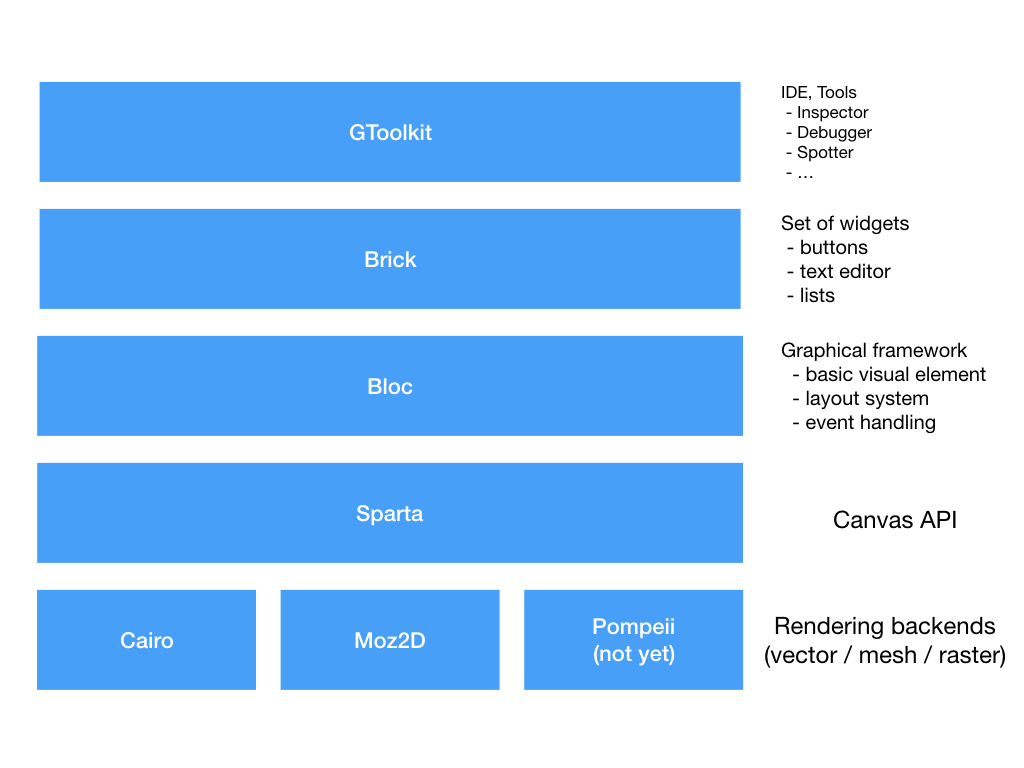
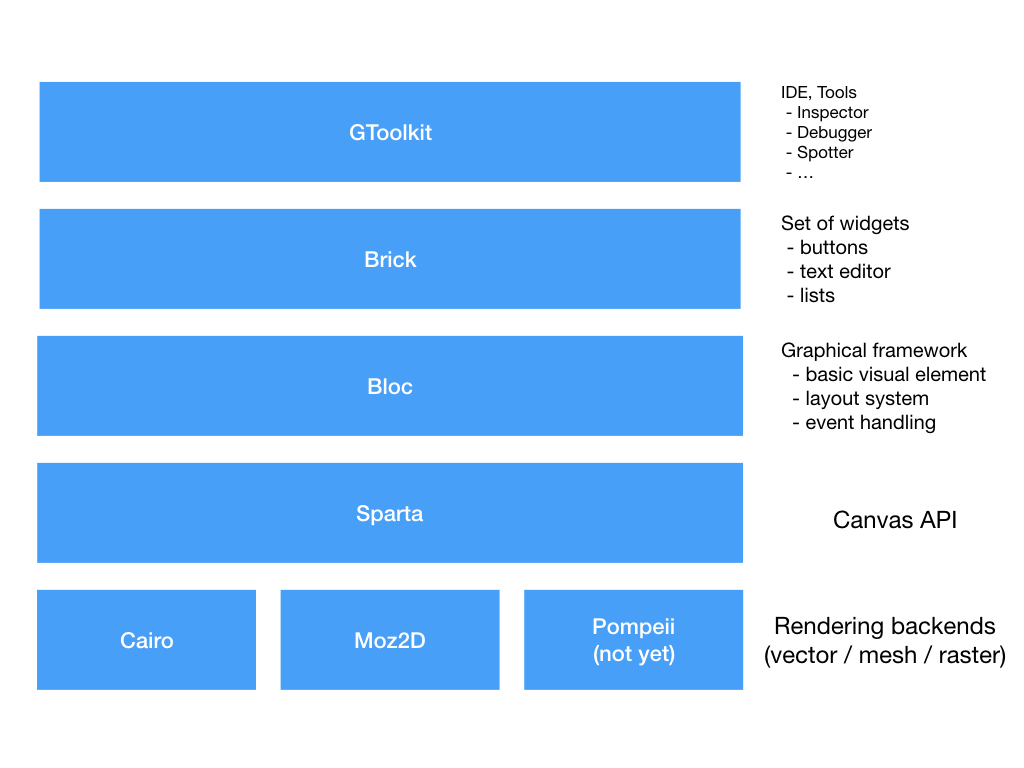
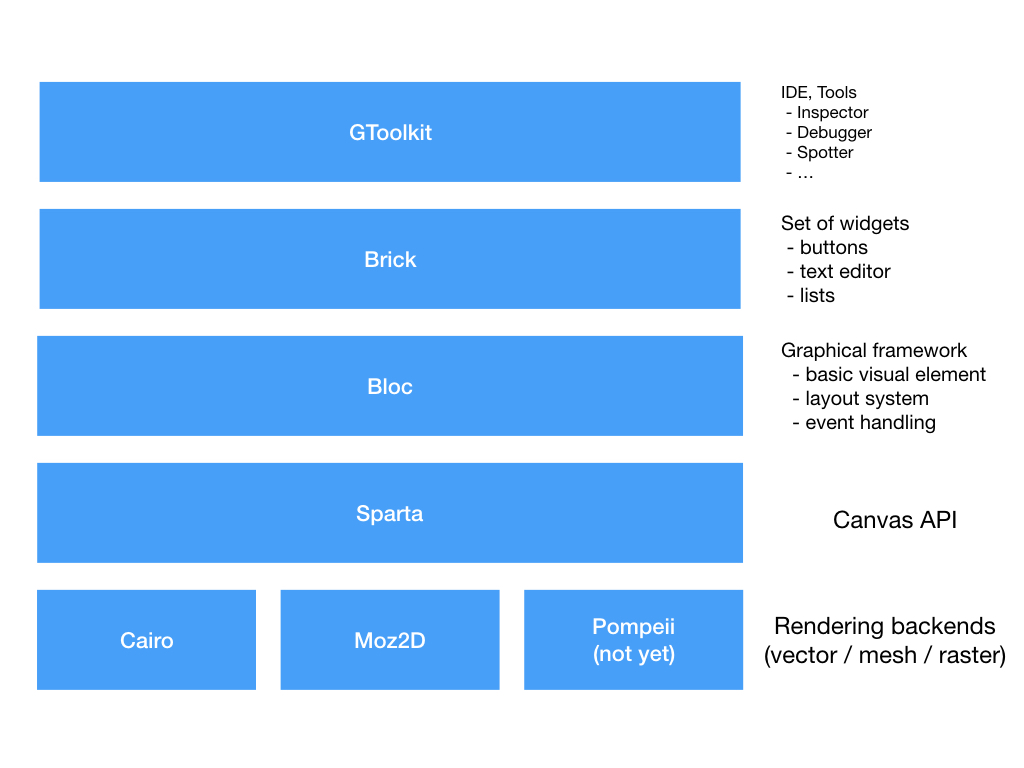
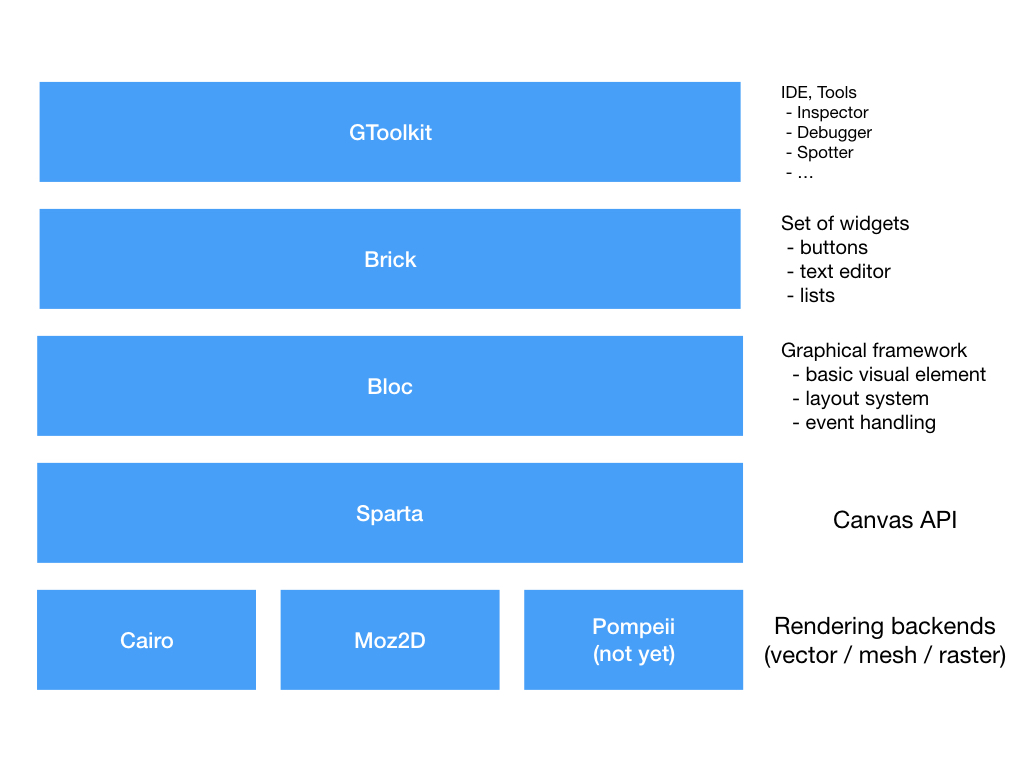
Could you, please, explain in a bit more detail why do you think that Sparta, Bloc, Brick and GT are overlapping layers? In attachment you can find a layered architecture diagram that explains how those technologies are stacked *from our* point of view :) [image: Inline images 1] Cheers, Alex On 11 November 2017 at 21:48, stephan <stephan@stack.nl> wrote:
On 11-11-17 21:18, H. Hirzel wrote:
On 11/11/17, stephan <stephan@stack.nl> wrote:
On 10-11-17 12:23, Cédrick Béler wrote:
Plus I have the impression Morphic mess is about to be solved.
There is still an awful lot of essential complexity in beautiful graphics and typography that is not going away. Microsoft Word still cannot layout a paragraph of text after 34 years of development
Can you point to an example of this?
https://en.wikipedia.org/wiki/Microtypography
Stephan

Thanks for the diagram Aliaksei. It helps to understand the Pharo buildings blocks. Where Spec would be located there? Cheers, Offray On 11/11/17 15:56, Aliaksei Syrel wrote:
Hi Hilaire,
About my perception on Pharo, from a distant POV, I see parallel/overlapping/contiguous layers like Morphic, Athens, Sparta, Bloc, Brick, Spec, GT,
Could you, please, explain in a bit more detail why do you think that Sparta, Bloc, Brick and GT are overlapping layers?
In attachment you can find a layered architecture diagram that explains how those technologies are stacked _from our_ point of view :) Inline images 1 Cheers, Alex
On 11 November 2017 at 21:48, stephan <stephan@stack.nl <mailto:stephan@stack.nl>> wrote:
On 11-11-17 21:18, H. Hirzel wrote:
On 11/11/17, stephan <stephan@stack.nl <mailto:stephan@stack.nl>> wrote:
On 10-11-17 12:23, Cédrick Béler wrote:
Plus I have the impression Morphic mess is about to be solved.
There is still an awful lot of essential complexity in beautiful graphics and typography that is not going away. Microsoft Word still cannot layout a paragraph of text after 34 years of development
Can you point to an example of this?
https://en.wikipedia.org/wiki/Microtypography <https://en.wikipedia.org/wiki/Microtypography>
Stephan
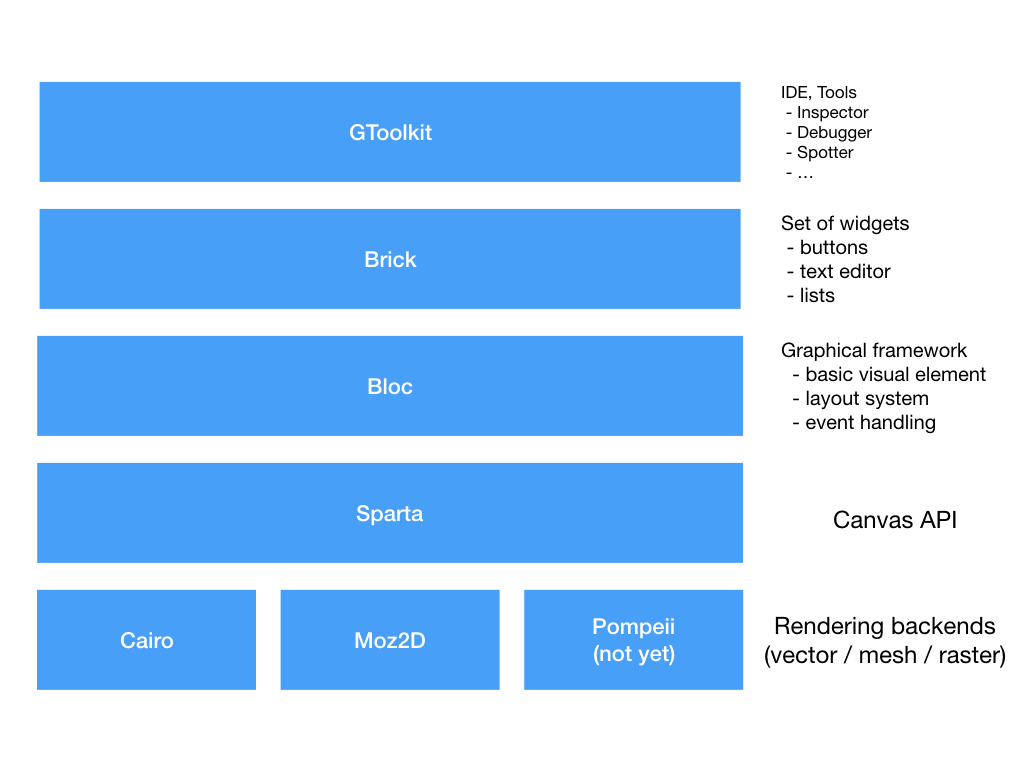
Spec is at the same level than GTtoolkit. On top of available widgets. On Sun, Nov 12, 2017 at 12:59 AM, Offray Vladimir Luna Cárdenas < offray.luna@mutabit.com> wrote:
Thanks for the diagram Aliaksei. It helps to understand the Pharo buildings blocks. Where Spec would be located there?
Cheers,
Offray
On 11/11/17 15:56, Aliaksei Syrel wrote:
Hi Hilaire,
About my perception on Pharo, from a distant POV, I see
parallel/overlapping/contiguous layers like Morphic, Athens, Sparta, Bloc, Brick, Spec, GT,
Could you, please, explain in a bit more detail why do you think that Sparta, Bloc, Brick and GT are overlapping layers?
In attachment you can find a layered architecture diagram that explains how those technologies are stacked *from our* point of view :) [image: Inline images 1] Cheers, Alex
On 11 November 2017 at 21:48, stephan <stephan@stack.nl> wrote:
On 11-11-17 21:18, H. Hirzel wrote:
On 11/11/17, stephan <stephan@stack.nl> wrote:
On 10-11-17 12:23, Cédrick Béler wrote:
Plus I have the impression Morphic mess is about to be solved.
There is still an awful lot of essential complexity in beautiful graphics and typography that is not going away. Microsoft Word still cannot layout a paragraph of text after 34 years of development
Can you point to an example of this?
https://en.wikipedia.org/wiki/Microtypography
Stephan
Offray Pavel and me have been working to clean and enhance Spec aspects. We are getting slowly but we will continue. I want to support menu in a much better way (declarative). Peter rewrote the Spec Interpreter and I hope that it will finish it, else we will have to do it because the code is "suboptimal". Stef On Sun, Nov 12, 2017 at 12:59 AM, Offray Vladimir Luna Cárdenas < offray.luna@mutabit.com> wrote:
Thanks for the diagram Aliaksei. It helps to understand the Pharo buildings blocks. Where Spec would be located there?
Cheers,
Offray
On 11/11/17 15:56, Aliaksei Syrel wrote:
Hi Hilaire,
About my perception on Pharo, from a distant POV, I see
parallel/overlapping/contiguous layers like Morphic, Athens, Sparta, Bloc, Brick, Spec, GT,
Could you, please, explain in a bit more detail why do you think that Sparta, Bloc, Brick and GT are overlapping layers?
In attachment you can find a layered architecture diagram that explains how those technologies are stacked *from our* point of view :) [image: Inline images 1] Cheers, Alex
On 11 November 2017 at 21:48, stephan <stephan@stack.nl> wrote:
On 11-11-17 21:18, H. Hirzel wrote:
On 11/11/17, stephan <stephan@stack.nl> wrote:
On 10-11-17 12:23, Cédrick Béler wrote:
Plus I have the impression Morphic mess is about to be solved.
There is still an awful lot of essential complexity in beautiful graphics and typography that is not going away. Microsoft Word still cannot layout a paragraph of text after 34 years of development
Can you point to an example of this?
https://en.wikipedia.org/wiki/Microtypography
Stephan
Thanks Stef, Spec/GT-Tools bridge by Johan Fabry is working well for me and is what has enabled Grafoscopio as, essentially, a notebook of embedded playgrounds inside a tree like document. I confident that the infrastructure will mature even more to allow more Spec+GT magic. Soon I hope to share with the community more Grafoscopio books, which are my take on some Pharo powered books, particularly Agile Visualization. Cheers, Offray On 12/11/17 07:06, Stephane Ducasse wrote:
Offray
Pavel and me have been working to clean and enhance Spec aspects. We are getting slowly but we will continue. I want to support menu in a much better way (declarative). Peter rewrote the Spec Interpreter and I hope that it will finish it, else we will have to do it because the code is "suboptimal".
Stef
On Sun, Nov 12, 2017 at 12:59 AM, Offray Vladimir Luna Cárdenas <offray.luna@mutabit.com <mailto:offray.luna@mutabit.com>> wrote:
Thanks for the diagram Aliaksei. It helps to understand the Pharo buildings blocks. Where Spec would be located there?
Cheers,
Offray
On 11/11/17 15:56, Aliaksei Syrel wrote:
Hi Hilaire,
About my perception on Pharo, from a distant POV, I see parallel/overlapping/contiguous layers like Morphic, Athens, Sparta, Bloc, Brick, Spec, GT,
Could you, please, explain in a bit more detail why do you think that Sparta, Bloc, Brick and GT are overlapping layers?
In attachment you can find a layered architecture diagram that explains how those technologies are stacked _from our_ point of view :) Inline images 1 Cheers, Alex
On 11 November 2017 at 21:48, stephan <stephan@stack.nl <mailto:stephan@stack.nl>> wrote:
On 11-11-17 21:18, H. Hirzel wrote:
On 11/11/17, stephan <stephan@stack.nl <mailto:stephan@stack.nl>> wrote:
On 10-11-17 12:23, Cédrick Béler wrote:
Plus I have the impression Morphic mess is about to be solved.
There is still an awful lot of essential complexity in beautiful graphics and typography that is not going away. Microsoft Word still cannot layout a paragraph of text after 34 years of development
Can you point to an example of this?
https://en.wikipedia.org/wiki/Microtypography <https://en.wikipedia.org/wiki/Microtypography>
Stephan
Likely your extracted list from the items I mentionned is contiguous :) Looks like a big sandwich, though. Will Athne be throwm away? With Polymorph and Morph? Le 11/11/2017 à 21:56, Aliaksei Syrel a écrit :
Could you, please, explain in a bit more detail why do you think that Sparta, Bloc, Brick and GT are overlapping layers?
In attachment you can find a layered architecture diagram that explains how those technologies are stacked _from our_ point of view :) Inline images 1
-- Dr. Geo http://drgeo.eu
Looks like a big sandwich, though.
Will Athne be throwm away? With Polymorph and Morph?
Yes. Morph and Polymorph as well as Athens but Sparta offers a similar API. So conversion should be easy. And Bloc opens a lot of possibilities. Bloc is the result of around 4 years of effort understanding the domain and comparing solutions. Stef
Ok, got it. Le 12/11/2017 à 13:04, Stephane Ducasse a écrit :
Yes. Morph and Polymorph as well as Athens but Sparta offers a similar API. So conversion should be easy. And Bloc opens a lot of possibilities. Bloc is the result of around 4 years of effort understanding the domain and comparing solutions.
-- Dr. Geo http://drgeo.eu
P6 is definitely a better IDE compare to previous version, and for coming Calypso looks fantastic, but P6 is a worst vehicle for a desktop application. There is much more code included and you are on your on to shrink/clean it to deploy your desktop application to make it looks and behave user friendly. May be for a specialized audience it could be just fine to deploy as is. About my perception on Pharo, from a distant POV, I see parallel/overlapping/contiguous layers like Morphic, Athens, Sparta, Bloc, Brick, Spec, GT, Polymorph all this looks confusing for me and I really don't know or understand where to put my eggs. When I took a look at Pharo keyboard shortcut, it seems to be -- without been sure 100% -- there are two different implementations. One from GT and another one, probably a legacy one. How can it happen? Then you wonder about other part of the system. It makes fells like changes/implementations are not coherent, and you don't really fell the environment as coherent or trustful. May be the twist is ontological, Pharo (and Squeak) taking too much responsibilities and not delegating enough to the host environment: GUI, Freetype, Canvas. The energy required is then out of reach or the needed coherence in teams works too complex. Don't know, just blind guesses, I will now shut up. Le 10/11/2017 à 12:23, Cédrick Béler a écrit :
But I have the opposite impression (of course I donât have to maintain a big project like yours - I wouldnât say youâre the hobby user:) ). But I really find P6 more consistent than what I used to try in the past (last squeaks up to 3.9 and firsts pharo).
-- Dr. Geo http://drgeo.eu
Just change the subject as this is not (only) on I18n. As a summary and from my impression (I just dive into pharo more seriously these days).
Le 11 nov. 2017 à 21:29, Hilaire <hilaire@drgeo.eu> a écrit :
P6 is definitely a better IDE compare to previous version, and for coming Calypso looks fantastic, but P6 is a worst vehicle for a desktop application. There is much more code included and you are on your on to shrink/clean it to deploy your desktop application to make it looks and behave user friendly. May be for a specialized audience it could be just fine to deploy as is.
So itâs more a problem of deployment here. To me P6 is the last « fat image » artefact. P7 will definitely be better here (even if of course one must learn to create image differently - and of course the process might be quite fragile at first and error prone). Still my impression but P7 looks more appropriate for doing desktop app versus P6.
About my perception on Pharo, from a distant POV, I see parallel/overlapping/contiguous layers like Morphic, Athens, Sparta, Bloc, Brick, Spec, GT, Polymorph all this looks confusing for me and I really don't know or understand where to put my eggs.
It is to me too (hence something else to learn). But again personally, this is the first time I think of doing desktop applications in Pharo/ST (before, it was a no go => web apps only). Still, I wait another iteration to dive into (I just read brick and block doc).
When I took a look at Pharo keyboard shortcut, it seems to be -- without been sure 100% -- there are two different implementations. One from GT and another one, probably a legacy one. How can it happen? Then you wonder about other part of the system. It makes fells like changes/implementations are not coherent, and you don't really fell the environment as coherent or trustful.
Probable as the new rendering stack must be used and improved. I canât make some shortcuts (native) working like CMD+SHIFT+W for instance...
May be the twist is ontological, Pharo (and Squeak) taking too much responsibilities and not delegating enough to the host environment: GUI, Freetype, Canvas. The energy required is then out of reach or the needed coherence in teams works too complex. Don't know, just blind guesses, I will now shut up.
I donât think you have to shut up :) Dr Geo is a quite complex software the used a lot morphic I think, so it is also a perfect candidate to see how switching to Bloc/Brick is possible/interesting :) I just have the impression that P7 would be more appropriate than P6 for upgrading it. Again, only my 2 cents, Cédrick
Le 10/11/2017 à 12:23, Cédrick Béler a écrit :
But I have the opposite impression (of course I donât have to maintain a big project like yours - I wouldnât say youâre the hobby user:) ). But I really find P6 more consistent than what I used to try in the past (last squeaks up to 3.9 and firsts pharo).
-- Dr. Geo http://drgeo.eu
Hilaire Bloc, Brick are not in Pharo yet. So either you want to build on top of Bloc and you use Bloc or not. Easy. Right now in Pharo we have - plain Morphic (with Polymorph but this is the same) - Spec to build user interface independent of the underlying layer (Morphic for now) - Glamour to build browser/navigation Now if you need vector graphics: you use Athens in Pharo. In the future we will have Sparta which is better adapted for Bloc (local coordinates over global coordinates) but this is the same kind of API. So this is not complex. The decision tree is Using plain Pharo or not => Morphic or Bloc Stef On Sat, Nov 11, 2017 at 9:29 PM, Hilaire <hilaire@drgeo.eu> wrote:
P6 is definitely a better IDE compare to previous version, and for coming Calypso looks fantastic, but P6 is a worst vehicle for a desktop application. There is much more code included and you are on your on to shrink/clean it to deploy your desktop application to make it looks and behave user friendly. May be for a specialized audience it could be just fine to deploy as is.
About my perception on Pharo, from a distant POV, I see parallel/overlapping/contiguous layers like Morphic, Athens, Sparta, Bloc, Brick, Spec, GT, Polymorph all this looks confusing for me and I really don't know or understand where to put my eggs.
When I took a look at Pharo keyboard shortcut, it seems to be -- without been sure 100% -- there are two different implementations. One from GT and another one, probably a legacy one. How can it happen? Then you wonder about other part of the system. It makes fells like changes/implementations are not coherent, and you don't really fell the environment as coherent or trustful.
May be the twist is ontological, Pharo (and Squeak) taking too much responsibilities and not delegating enough to the host environment: GUI, Freetype, Canvas. The energy required is then out of reach or the needed coherence in teams works too complex. Don't know, just blind guesses, I will now shut up.
Le 10/11/2017 à 12:23, Cédrick Béler a écrit :
But I have the opposite impression (of course I donât have to maintain a big project like yours - I wouldnât say youâre the hobby user:) ). But I really find P6 more consistent than what I used to try in the past (last squeaks up to 3.9 and firsts pharo).
-- Dr. Geo http://drgeo.eu
Hilaire I think that Pharo is getting a lot more modular. Do you imagine that we can reload Morphic? That we have a minimal image that does not rely on the compiler? and that we can reload the compiler, SUnit and more. We will start another pass because we will run an experience to get microPharo. Did you see the amazonLambda experience? Many people are telling to us that Pharo and that the system is improving and it is really improving. Now we do not make progress without breaking eggs. And we are cleaning but probably things that you do not care: such as startup list, streams, layouts We will throw away a lot of code with Bloc too.
A cleaner Pharo will help there.
To be frank, I found later Pharo releases not inspiring. Bigger, bigger and bigger with added code, protocol changes, and bugs at will.
Hilaire - when did you report bugs that we did not consider? and that we did not fix if it was something that we could do fast?
It is becoming too complicated for a hobby use of it.
I decided I will not finish porting DrGeo to P6 or P7, and it will likely die with P3.
I'm sad that you decided that because we like DrGeo. Now we cannot do much if you do not want to do it. May be you should come to visit us from time to time.
Pharo should have been clean up to the bones before adding. It was the initial moto, no?
And this is what we are doing. But seriously do you think that it is easy? Did you look at the ESUG videos of Prague. I can tell you that christophe, pavel and guille worked several months and this is not just for hacking around. So you probably do not know what we did and what we are doing. Stef
Le 10/11/2017 à 11:14, Marcus Denker a écrit :
It would be nice if someone who uses it would take the lead so we can improve the default that is shipped with Pharo.
-- Dr. Geo http://drgeo.eu
2017-11-10 11:52 GMT+01:00 Hilaire <hilaire@drgeo.eu>:
A cleaner Pharo will help there.
To be frank, I found later Pharo releases not inspiring. Bigger, bigger and bigger with added code, protocol changes, and bugs at will. It is becoming too complicated for a hobby use of it.
I decided I will not finish porting DrGeo to P6 or P7, and it will likely die with P3.
To run DrGeo on Pharo 7 is not hard (see the screenshot) - of course it has some issues but they can be definitely solved. It would be pity to throw it away - at least you can benefit from 64-bit and faster VM. -- Pavel
Pharo should have been clean up to the bones before adding. It was the initial moto, no?
Le 10/11/2017 à 11:14, Marcus Denker a écrit :
It would be nice if someone who uses it would take the lead so we can improve the default that is shipped with Pharo.
-- Dr. Geo http://drgeo.eu
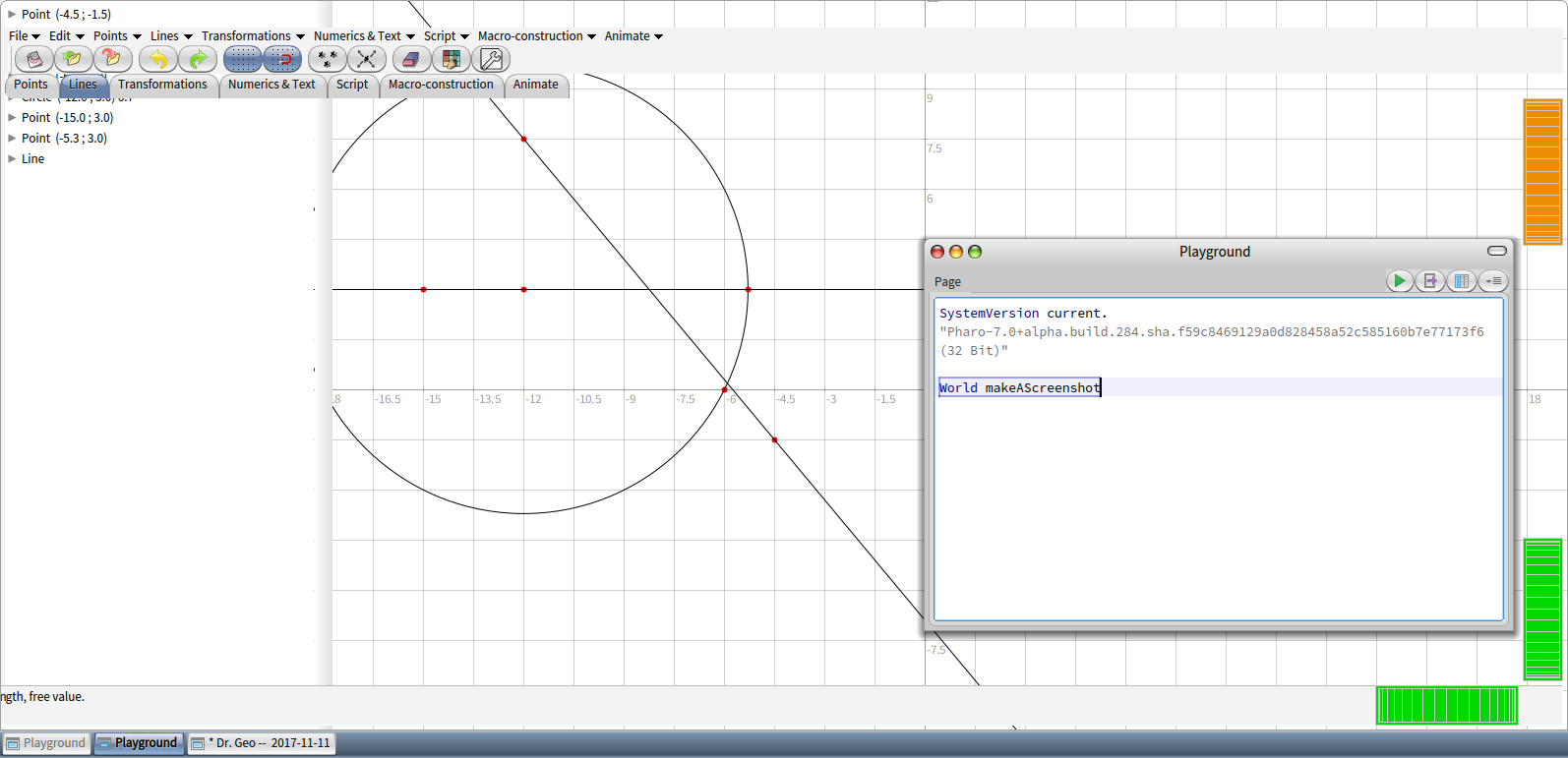
I guess you used the latest source code version, which was reto-porting to P3. The prior one should get you a correct layout. Le 12/11/2017 à 00:13, Pavel Krivanek a écrit :
To run DrGeo on Pharo 7 is not hard (see the screenshot) - of course it has some issues but they can be definitely solved. It would be pity to throw it away - at least you can benefit from 64-bit and faster VM.
-- Dr. Geo http://drgeo.eu
Excellent Pavel. This is great. So I do not get it. What is then not working? Stef On Sun, Nov 12, 2017 at 12:13 AM, Pavel Krivanek <pavel.krivanek@gmail.com> wrote:
2017-11-10 11:52 GMT+01:00 Hilaire <hilaire@drgeo.eu>:
A cleaner Pharo will help there.
To be frank, I found later Pharo releases not inspiring. Bigger, bigger and bigger with added code, protocol changes, and bugs at will. It is becoming too complicated for a hobby use of it.
I decided I will not finish porting DrGeo to P6 or P7, and it will likely die with P3.
To run DrGeo on Pharo 7 is not hard (see the screenshot) - of course it has some issues but they can be definitely solved. It would be pity to throw it away - at least you can benefit from 64-bit and faster VM.
-- Pavel
Pharo should have been clean up to the bones before adding. It was the initial moto, no?
Le 10/11/2017 à 11:14, Marcus Denker a écrit :
It would be nice if someone who uses it would take the lead so we can improve the default that is shipped with Pharo.
-- Dr. Geo http://drgeo.eu
2017-11-12 13:02 GMT+01:00 Stephane Ducasse <stepharo.self@gmail.com>:
Excellent Pavel. This is great. So I do not get it. What is then not working?
The layout of the menu is wrong and everything needs to be proven with the newer versions of the dependent packages. -- Pavel
Stef
On Sun, Nov 12, 2017 at 12:13 AM, Pavel Krivanek <pavel.krivanek@gmail.com> wrote:
2017-11-10 11:52 GMT+01:00 Hilaire <hilaire@drgeo.eu>:
A cleaner Pharo will help there.
To be frank, I found later Pharo releases not inspiring. Bigger, bigger and bigger with added code, protocol changes, and bugs at will. It is becoming too complicated for a hobby use of it.
I decided I will not finish porting DrGeo to P6 or P7, and it will
likely
die with P3.
To run DrGeo on Pharo 7 is not hard (see the screenshot) - of course it has some issues but they can be definitely solved. It would be pity to throw it away - at least you can benefit from 64-bit and faster VM.
-- Pavel
Pharo should have been clean up to the bones before adding. It was the initial moto, no?
Le 10/11/2017 à 11:14, Marcus Denker a écrit :
It would be nice if someone who uses it would take the lead so we can improve the default that is shipped with Pharo.
-- Dr. Geo http://drgeo.eu
Indeed we should make sure that all the Inform:, Alert: can be translated. Now I'm not convinced that we should use the old SqueakTranslator. On Sun, Nov 12, 2017 at 1:17 PM, Pavel Krivanek <pavel.krivanek@gmail.com> wrote:
2017-11-12 13:02 GMT+01:00 Stephane Ducasse <stepharo.self@gmail.com>:
Excellent Pavel. This is great. So I do not get it. What is then not working?
The layout of the menu is wrong and everything needs to be proven with the newer versions of the dependent packages.
-- Pavel
Stef
On Sun, Nov 12, 2017 at 12:13 AM, Pavel Krivanek <pavel.krivanek@gmail.com> wrote:
2017-11-10 11:52 GMT+01:00 Hilaire <hilaire@drgeo.eu>:
A cleaner Pharo will help there.
To be frank, I found later Pharo releases not inspiring. Bigger, bigger and bigger with added code, protocol changes, and bugs at will. It is becoming too complicated for a hobby use of it.
I decided I will not finish porting DrGeo to P6 or P7, and it will likely die with P3.
To run DrGeo on Pharo 7 is not hard (see the screenshot) - of course it has some issues but they can be definitely solved. It would be pity to throw it away - at least you can benefit from 64-bit and faster VM.
-- Pavel
Pharo should have been clean up to the bones before adding. It was the initial moto, no?
Le 10/11/2017 à 11:14, Marcus Denker a écrit :
It would be nice if someone who uses it would take the lead so we can improve the default that is shipped with Pharo.
-- Dr. Geo http://drgeo.eu
tx hiliare for the feedback. On Fri, Nov 10, 2017 at 11:10 AM, Hilaire <hilaire@drgeo.eu> wrote:
You can go with http://smalltalkhub.com/#!/~PharoExtras/Gettext
For non latin language you will have to provide extra font at load time.
It works fine on DrGeo based on P3, wtih Latin, Cyrilic, Korean, Chinese ideogram, Japanese[1] messages.
I have no idea regarding its compatibility with P7 however.
Will not work with right to left languages, though.
For asian input methods, a no go too.
Hilaire
[1] https://twitter.com/GNUDrGeo/status/832878470216691712
Le 09/11/2017 à 21:29, ÐикенÑий ÐоÑапов a écrit :
It is very important for huge commercial applications, especially with lots of UI forms, dialogs and user-messages.
-- Dr. Geo http://drgeo.eu
participants (14)
-
 Aliaksei Syrel
 -
 Andrew Glynn
 -
 Cédrick Béler
 -
 Denis Kudriashov
 -
 Esteban Lorenzano
 -
 H. Hirzel
 -
 Hilaire
 -
 Marcus Denker
 -
 Offray Vladimir Luna Cárdenas
 -
 Pavel Krivanek
 -
 stephan
 -
 Stephane Ducasse
 -
 Torsten Bergmann
 -
 ÐикенÑий ÐоÑапов