Pharo-users
By thread
pharo-users@lists.pharo.org
By month
Messages by month
- ----- 2026 -----
- August
- July
- June
- May
- April
- March
- February
- January
- ----- 2025 -----
- December
- November
- October
- September
- August
- July
- June
- May
- April
- March
- February
- January
- ----- 2024 -----
- December
- November
- October
- September
- August
- July
- June
- May
- April
- March
- February
- January
- ----- 2023 -----
- December
- November
- October
- September
- August
- July
- June
- May
- April
- March
- February
- January
- ----- 2022 -----
- December
- November
- October
- September
- August
- July
- June
- May
- April
- March
- February
- January
- ----- 2021 -----
- December
- November
- October
- September
- August
- July
- June
- May
- April
- March
- February
- January
- ----- 2020 -----
- December
- November
- October
- September
- August
- July
- June
- May
- April
- March
- February
- January
- ----- 2019 -----
- December
- November
- October
- September
- August
- July
- June
- May
- April
- March
- February
- January
- ----- 2018 -----
- December
- November
- October
- September
- August
- July
- June
- May
- April
- March
- February
- January
- ----- 2017 -----
- December
- November
- October
- September
- August
- July
- June
- May
- April
- March
- February
- January
- ----- 2016 -----
- December
- November
- October
- September
- August
- July
- June
- May
- April
- March
- February
- January
- ----- 2015 -----
- December
- November
- October
- September
- August
- July
- June
- May
- April
- March
- February
- January
- ----- 2014 -----
- December
- November
- October
- September
- August
- July
- June
- May
- April
- March
- February
- January
- ----- 2013 -----
- December
- November
- October
- September
- August
- July
- June
- May
- April
- March
- February
- January
- ----- 2012 -----
- December
- November
- October
- September
- August
- July
- June
- May
- April
- March
- February
- January
- ----- 2011 -----
- December
- November
- October
- September
- August
- July
- June
- May
- April
- March
- February
- January
- ----- 2010 -----
- December
- November
- October
- September
- August
- July
- June
- May
- April
- March
- February
- January
- 6 participants
- 50351 messages

Re: [Pharo-users] How to declare a do:[] loop for a matrix to read and acces its elements?
by Photon
Thank for your answer. Those are awesome tips :)
If you read my posts in the forum you should be able to read what I wrote.
Its because whenever I insert raw text it gets deletet right away and I have
to edit the post and put it back in.
Anyways in my last post you see how i did it. I think you are also refering
to that.
I know using 2d matrix/ array is a a waste. Maybe when I start to refactory
this game I try to focus on you aprooach. Sounds good. One could even use a
1d container like a list.
Im not sure is the gameworld should grow inifitly. In the ruleset on
wikipedia there is a fixed board size. The smallest one is 3*3 but I could
implement is as one possible size to select from.
To the part that i would only need to check certain cells I think I have to
check all of them because they could get born in the next generation even
tho they were never alive nor dead.
Thng I wanted to improve here was that i do not need to check all the 6
neighbours. As soon as neighboars equals 4 the cell is dead for sure and
there is no need to check further. Couls save at max half the time beauce
only half the checks are made.
--
Sent from: http://forum.world.st/Pharo-Smalltalk-Users-f1310670.html
Jan. 16, 2018

Re: [Pharo-users] Set Rounding mode for IEEE floating point operations
by Serge Stinckwich
On Mon, Jan 15, 2018 at 12:27 PM, Steffen Märcker <merkste(a)web.de> wrote:
> Hi,
>
> is there any way to set the rounding mode for IEEE floating point
> operations? Maybe something like
>
> Double roundToMinusInfWhile: [... code goes here ...]Double
>> roundToZeroWhile: [... more code here ...]
>>
>
> If not, is it possible to add this behavior, e.g., via a custom primitive?
>
>
âThis might interesting to have something like that for PolyMath, but I'm a
little worried of subtle consequences
that might appear in UI if you use points for examples.â
--
Serge Stinckwich
UMI UMMISCO 209 (IRD/UPMC/UY1)
"Programs must be written for people to read, and only incidentally for
machines to execute."http://www.doesnotunderstand.org/
Jan. 16, 2018

Re: [Pharo-users] ZnClient POST then GET of different URL path, GET has POST's entity
by Sven Van Caekenberghe
Hi Paul,
Your analysis is correct: #resetEntity is (by default) only called before executing HEAD and DELETE methods and not (by default) before a GET (nor a PUT or POST).
The reason is that ZnClient is (also) a builder to construct requests. One of the features of the builder is that it lets you do multiple requests to the same server (or resource) where you might have lots of options configured. It also lets you build up the entity that you want to sent along.
More specifically, HTML forms using an applicationFormUrlEncodedEntity and a GET are supported through #formAt:* - see for example #testGetForm.
The issue you raised is the consequence of preferring the latter as a works-out-of-the-box vs. your surprise it-sends-and-older-entity with a GET. I can't immediately see how to solve both by default.
Both manually calling #resetEntity or configuring #autoResetEntityMethods: are options/solutions.
For example, here is how my main/internal API client sets up its re-usable ZnClient instance:
setUpHttpClient
^ ZnClient new
clientId: 'T3clnt';
host: self connectionSpec host;
port: self connectionSpec port;
accept: ZnMimeType applicationJson;
logLevel: 2;
enforceAcceptContentType: true;
autoResetEntityMethods: #(#HEAD #DELETE #GET);
contentReader: [ :entity | self parseJson: entity ];
contentWriter: [ :data | self asJsonEntity: data ];
yourself
I change the reset entity default because I know I never use the form option.
HTH,
Sven
> On 16 Jan 2018, at 01:47, PAUL DEBRUICKER <pdebruic(a)gmail.com> wrote:
>
>
> Hi -
>
> Should #resetEntity be called automatically for long lived sessions ? I see that it is called automatically for HEAD and DELETE methods.
>
>
> If you do a
>
> |client |
> client:=ZnClient new.
> client get: 'http://example.com/getPath'
> client inspect
> client post: 'http://example.com' contents:'My Contents'
> client inspect.
> client get: 'http://example.com/getPath'
> client inspect.
> client close.
>
>
> and then look at the changed headers between the first and last GET you can see that the body from the POST was sent in the 2nd GET request. I can't think of a time when you'd want that, generally.
>
> Maybe it would be better to make keeping the entity around as the exception in all cases and ask for it specifically when you want it. I'm not sure of the answer I was just surprised by the behavior and can definitely send #resetEntity for my use case.
>
>
> Paul
Jan. 16, 2018

Re: [Pharo-users] How to declare a do:[] loop for a matrix to read and acces its elements?
by Richard O'Keefe
PS: note that a matrix representation of the Life world (a) wastes a ton of
space,
(b) wastes a ton of time if you iterate over all the cells (because most of
them are
irrelevant), (c) is awkward to grow, and (d) has problems at the edges
(which
should not exist). In C or C++ I would not dream of using a rectangular
matrix
for Life. I might possibly use a quad tree, but I'd probably stick with a
set of points.
On 16 January 2018 at 19:41, Richard O'Keefe <raoknz(a)gmail.com> wrote:
> I'm reading this in gmail. After "this method work:" I see a gap with
> nothing visible.
> After "wich looks like this" there is again a gap with nothing visible.
>
> Recalling that the Life universe is an *infinite* two-dimensional space,
> you want a data
> structure that naturally grows to be as big as it needs to be and no
> bigger. I ran across
> a similar problem last year. A Dictionary[Integer->Dictionary[Integer->State]]
> turned
> out to work very well. You could also use a Dictionary[Point[Integer,Integer]
> -> State]
> which would be logically simpler. The key idea is that you don't want to
> iterate over
> all the cells, only the cells which are live. Now the states in Life are
> very simple,
> so the data structure you want is actually a Set[Point[Integer,Integer]].
> The only
> cells that can change state are the live cells and the dead (not present
> in the set) that
> are king-wise adjacent to a live cell. So you will be doing something
> like
> candidates := Bag new.
> dyingCells := Set new.
> liveCells do: [:each |
> n := 0.
> each kingwiseNeighboursDo: [:neighbour |
> (liveCells includes: neighbour)
> ifTrue: [n := n + 1]
> ifFalse: [candidates add: Bag]]
> (n between: 2 and: 3) ifFalse: [dyingCells add: each].
> liveCells removeAll: dyingCells.
> candidates valuesAndCounts keysAndValuesDo: [:each :count |
> count = 3 ifTrue: [liveCells add: each]].
> WARNING: This code has not been tested.
>
> On 16 January 2018 at 03:29, Photon <nico-braun(a)live.de> wrote:
>
>> Hello folks,
>>
>> I am trying since yesterday to make a game of life implemenation work. It
>> looks all ok so far but in can`t figure out the final steps. I think I get
>> the logic I have to use and if I imagine the code in C++ for example it
>> would be pretty much straight forward. But with pharo I got trouble
>> telling
>> the machine what I want.
>>
>> In short I`m trying to make this method work:
>>
>>
>>
>> I wrote a test wich looks like this:
>>
>>
>>
>> I want to go trough each element of the matrix(cells), check its
>> surounding
>> cells if they are alive, and set its counter if there are any living
>> neighbours. It should move like this through the whole matrix to set the
>> neighbour counter for each element.
>>
>> In this method i just tried the implement the topLeft check yet but I
>> think
>> you get the idea. You can look at the comment in the top section it shows
>> where the neighbour indexes are.
>>
>> I tried so many things by now, did research read methods of the
>> superclasses
>> but I can`t make it work.
>> I woud be really glad if someone gave me a little hint. What is wrong
>> here?
>>
>>
>>
>> --
>> Sent from: http://forum.world.st/Pharo-Smalltalk-Users-f1310670.html
>>
>>
>
Jan. 16, 2018
Re: [Pharo-users] How to declare a do:[] loop for a matrix to read and acces its elements?
by Richard O'Keefe
I'm reading this in gmail. After "this method work:" I see a gap with
nothing visible.
After "wich looks like this" there is again a gap with nothing visible.
Recalling that the Life universe is an *infinite* two-dimensional space,
you want a data
structure that naturally grows to be as big as it needs to be and no
bigger. I ran across
a similar problem last year. A
Dictionary[Integer->Dictionary[Integer->State]] turned
out to work very well. You could also use a
Dictionary[Point[Integer,Integer] -> State]
which would be logically simpler. The key idea is that you don't want to
iterate over
all the cells, only the cells which are live. Now the states in Life are
very simple,
so the data structure you want is actually a Set[Point[Integer,Integer]].
The only
cells that can change state are the live cells and the dead (not present in
the set) that
are king-wise adjacent to a live cell. So you will be doing something like
candidates := Bag new.
dyingCells := Set new.
liveCells do: [:each |
n := 0.
each kingwiseNeighboursDo: [:neighbour |
(liveCells includes: neighbour)
ifTrue: [n := n + 1]
ifFalse: [candidates add: Bag]]
(n between: 2 and: 3) ifFalse: [dyingCells add: each].
liveCells removeAll: dyingCells.
candidates valuesAndCounts keysAndValuesDo: [:each :count |
count = 3 ifTrue: [liveCells add: each]].
WARNING: This code has not been tested.
On 16 January 2018 at 03:29, Photon <nico-braun(a)live.de> wrote:
> Hello folks,
>
> I am trying since yesterday to make a game of life implemenation work. It
> looks all ok so far but in can`t figure out the final steps. I think I get
> the logic I have to use and if I imagine the code in C++ for example it
> would be pretty much straight forward. But with pharo I got trouble telling
> the machine what I want.
>
> In short I`m trying to make this method work:
>
>
>
> I wrote a test wich looks like this:
>
>
>
> I want to go trough each element of the matrix(cells), check its surounding
> cells if they are alive, and set its counter if there are any living
> neighbours. It should move like this through the whole matrix to set the
> neighbour counter for each element.
>
> In this method i just tried the implement the topLeft check yet but I think
> you get the idea. You can look at the comment in the top section it shows
> where the neighbour indexes are.
>
> I tried so many things by now, did research read methods of the
> superclasses
> but I can`t make it work.
> I woud be really glad if someone gave me a little hint. What is wrong here?
>
>
>
> --
> Sent from: http://forum.world.st/Pharo-Smalltalk-Users-f1310670.html
>
>
Jan. 16, 2018

Re: [Pharo-users] [ANN] Bittrex API
by Hernán Morales Durand
Hi Ben
2018-01-15 4:53 GMT-03:00 Ben Coman <btc(a)openinworld.com>:
> On 15 January 2018 at 14:19, Hernán Morales Durand
> <hernan.morales(a)gmail.com> wrote:
>> Hi Ben,
>>
>> Thank you for sharing this, looks really cool.
>>
>
>
>
>> I have some issues installing the library. In the "Clone repository"
>> dialog I had to use
>>
>> https://github.com/Traadh/bittrex.git
>>
>
> Which OS are you on?
> For Windows you need to enable Iceberg > Settings > Custom keys
> since Iceberg is not playing well there with ssh-agent.
> Also, the software for creating ssh keys is not built into Windows. Try...
> http://guides.beanstalkapp.com/version-control/git-on-windows.html
>
>
> Have you previously accessed github via SSH keys from command line?
> Check your SSH keys are configured properly...
> https://help.github.com/articles/testing-your-ssh-connection/
> and if not, get that working first...
> https://help.github.com/articles/connecting-to-github-with-ssh/
>
Thanks, I am using Windows and actually I can use other repositories.
Anyway I prefer to wait the Baseline :)
>
>> The install procedure did not downloaded the libsodium library.
>
> Whoops, missed that. I'll update the procedure.
> Also its about time I write my first Baseline.
>
>
>> I had to install it from loading Nacl.
>> Any particular difference with Nacl? From the dll in Nacl I can see
>> Bittrex functions are supported but appending a "256" in the function
>> prototype, i.e.: crypto_auth_hmacsha512256_keybytes ,
>> maybe you can add the functions to the Nacl repository?
>> http://www.smalltalkhub.com/#!/~tonyg/Crypto-Nacl
>
> I tried Crpto-Nacl first. This was my first time using Libsodium and
> it was difficult to find examples directly on the
> HMAC512 function I needed. The sample C code I compiled as a test
> didn't match the function names
> exported from Crypto-Nacl so this confounded my trials. It was simple
> to FFI wrap the one Libsodium function I needed,
> so thats what I did.
Crypto-Nacl just provides the core operations, while sodium is a Nacl
fork which includes extra functions, which honestly I never need but
the library should work as well as they claim to be 100% compatible.
>
> The Configuration of Crypto-Nacl downloads a pre-compiled libsodium
> that exports different symbols to the system libsodium.
I didn't knew there was a system libsodium. I guess it is some lib
that is included in you OS by default.
> So IIUC its not a matter of just adding extra Smalltalk methods to the
> Crypto-Nacl.
> I don't know enough about Libsodium to understand the difference in
> function naming
> and I guess replacing it might break existing users ??
>
I will have a look, can you provide a link to the libsodium library
you are using?
>
>> Or you can use the URL's in ConfigurationOfNacl>>platformLibraryUrl to
>> download the library for each platform,
>> or integrate the download procedure in
>> https://github.com/hernanmd/MetacelloFileDownload
>
> good idea. thx for the tip.
> cheers -ben
>
>
>>
>> Cheers,
>>
>> Hernán
>>
>>
>>
>>
>>
>>
>> 2018-01-13 16:07 GMT-03:00 Ben Coman <btc(a)openinworld.com>:
>>> Thanks everyone who advised on Zinc, REST, NeoJSON, HMAC & Libsodium
>>> to help me on my way to implement an interface to the Bittrex bitcoin
>>> exchange. I've got to the point where I'm happy to make an initial
>>> 0.x release. After all my years having fun hacking around Pharo, this
>>> is my first (tiny) product. Hopefully it may grow. :)
>>>
>>> The implementation is probably closest to a Command pattern
>>> with a class per entry-point. All the v1.1 entry points are
>>> implemented except a few to deposit & withdraw money from the
>>> exchange. These are currently infrequent events for me and left for
>>> manual action.
>>>
>>> I'm optimistic that I'll add a few more exchanges so I created a
>>> github org to group them together. Contributions welcome.
>>>
>>> Please see quick start instructions here...
>>> https://github.com/Traadh/bittrex
>>>
>>> Have fun and take care...
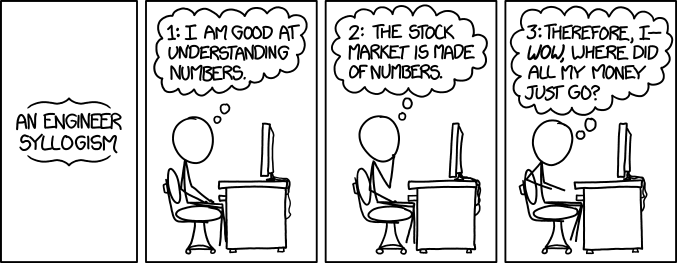
>>> https://imgs.xkcd.com/comics/engineer_syllogism.png
>>>
>>> cheers -ben
>>>
>>
>
Jan. 16, 2018
Re: [Pharo-users] How to declare a do:[] loop for a matrix to read and acces its elements?
by Photon
So for those of you who are interested or maybe is struggeling himself.
I did it now in a more C fashion if i can call it like that. I don`t know if
its even legit :P
I managed to make the game work based on this method, the rest was easy. At
least enough for tonight. Tomorrow I try to add a nice U.I.
still here is how I did it :
I also wrote two tests. The first one is the test for the method itself and
the second one is just to test an algorythm construction because the one i
used before had an endless loop I quess.
And :
--
Sent from: http://forum.world.st/Pharo-Smalltalk-Users-f1310670.html
Jan. 16, 2018

Re: [Pharo-users] Pharo-users Digest, Vol 57, Issue 39
by Dale Henrichs
Ian,
You are not being completely transparent ....
My initial response[2] (on the8th of January) to your initial post on
the tode mailing list[1] (from the 4th of January):
I am wanting to use Gemstone as a persistent object store.
I do not want it to run any client facing applications.
I want to run all client facing applications in pharo images of
there own connected to a central backing stone. Is this the wrong
way to think about this?
was to echo Petr Fischer's initial response[3] which was
"Your best bet is to use REST"
You continued to ask several questions about how GemStone actually works
(calling it a backing store is not a fair characterization of GemStone)
and I tried to fill in various additional details about other possible
approaches since you didn't seem to be very clear about what you were
interested in.
It wasn't until the 11th that you wrote the nicely detailed post[4]
about intentions to use Amber and GemStone and a RESTful API for your
application that involves petabytes of data.
And then this morning you decided to post some non-flattering comments
on the Pharo mailing list of all places quoting the post from the 11th
before I even responded.
I did not have a chance to respond to your nicely detailed post until
late this morning[5] and never did see your post on this list until this
afternoon, because it was titled "Pharo-users Digest, Vol 57, Issue 39".
At the end of the day you seem to be upset that an out-of-the-box
client/server solution does not exist for GemStone and my answer to that
is that we have had out-of-the-box client/server solutions for over 2
decades; for VW and VAÂ and we have active customers who have been
running applications using this technology for just as long ...
We just do not have the same kind of solution for Pharo, but as I
mentioned in my email from this morning[5] we are headed in that
direction. However, with 2 decades of experience under our belts we will
take a slightly different approach to the object replication
architecture this time around - and the reality is that there are
several possible directions to take..
It is also worth mentioning that we have Seaside customers using a
develop in Pharo deploy in GemStone methodology who have been running
production applications continuously for over a decade.
I mentioned in my mail from this morning that I would be willing to work
with on your proof of concept and that statement still stands.
Using GemStone as an object store for visualizing and inspecting objects
derived from big data streams does seem to be an application that
GemStone is well suited for but there is work that needs to be done to
make it a reality as there is no out-of-box solution for this problem at
the moment.
Dale
[1] http://forum.world.st/tode-st-Gemstone-Seaside-tp5062364.html
[2] http://forum.world.st/tode-st-Gemstone-Seaside-tp5062364p5062601.html
[3] http://forum.world.st/tode-st-Gemstone-Seaside-tp5062364p5062370.html
[4] http://forum.world.st/tode-st-Gemstone-Seaside-tp5062364p5062837.html
[5] http://forum.world.st/tode-st-Gemstone-Seaside-tp5062364p5063206.html
On 1/15/18 5:42 AM, Ian Ian wrote:
> W.R.T Database Connectivity:
>
> Hi All,
>
> The database connectivity issue as discussed is near and dear to my
> evaluation of Smalltalk(s). It is a huge problem/stumbling block as I
> see it.
>
> Here Is a cut and paste of my replay to the Gemstone users group:
>
> >>>>>>>>>>>>>>>>>>>>>>>>>>>>>>>>>
> Hi Dale,
>
> I am evaluating Gemstone as an application server/big data
> repository. Hence my confusion up till now.
>
> I work for an organization that has rather large data storage
> requirements (understatement:Â into the 100's of petabyte range).
>
> Currently, several independent Apache Hadoop stacks are used to manage
> this data. There are several serious issues that are evident with
> this setup, prime of which is object to relational mapping errors (as
> datasets in a given space change over time - data is mandated to be
> kept into perpetuity) regardless of whether the database is NoSQL, SQL
> of any other schema. The issue bubbles up into the organization
> application layers of many diverse and distributed verticals.Â
> Maintenance of the system is not trivial and is very expensive and
> time consuming.
>
> We use virtualization (in the VMWare sense) to create views into the
> data. Generally, access is a split between virtualized kiosk systems,
> another level of indirection, where by mandate, we must now archive
> the state of the vm's as well as business data, and direct workstation
> access,  Not fun, error prone and hardware intensive (from a data
> storage perspective).
>
> As I have been reading about object databases and what they are said
> to buy in terms of efficiency (objects being stored natively and
> directly) coupled with the fact the we are virtualizing everything we
> can, I, along with a couple of colleagues, thought that we should take
> a look at what new (laugh) technologies were available.
>
> After a little time I came across Gemstone. Did my reading and
> research and after a period of semantic confusion (still going) became
> enamored with the possibilities.
>
> All this said, from a network, sys admin point of view, an image that
> contains the application and it's objects is a godsend if object
> persistence was guaranteed. It would allow me to archive a self
> contained living blob that manages its own living state (in the VMWare
> snapshot sense) and at the same time the data is available to other
> blobs/views (seaside).
>
> On views in to the data store:
>
> Currently data mining occurs on the application layer (rather than
> database level views). Various development groups create views
> (applications) to access (possibly update, if they are the owning
> group) the data. As mandate trickle (waterfall) from above new data
> points can be added or removed (some of the mandate for this is
> governed by changing regulations - in other words it must be done
> regardless of the technical difficulties involved). You can image the
> difficulties and manpower involved.
>
> This brings me back to the application server. Currently, whatever
> tool a group uses to access the data, be it browser, remote client
> application, whatever have you (generally based on the skill sets in
> the group), requires a set of policies and procedures wrapped around
> the effort (mandated disaster recovery and etc...). Tones of work
> that can never be standardized in any way but nevertheless must be
> documented and managed.
>
> Okay (to long winded self):
>
> Having spent some time looking at this problem from a smalltalk, image
> virtualization, integrated application management perspective, all my
> issues could be alleviated within a single technology. Yippee!
>
> The spawning of an idea:
>
> Amber -> Seaside -> Gemstone. One language (integrated properly ->
> one tool).
>
> Amber:
>
> *Â Each group, with a small learning curve could create and manage
> their own views into the data.
> *Â The serialized javascript, once the client was developed, could be
> streamed from the application server (Seaside/Gemstone) on demand. It
> just becomes another object.
>
> Seaside:
>
> * Client interface manager transport system (HTTP) for any and all views.
>
> Gemstone:
>
> * Object level persistence with no forced mappings of any kind.
> * Extensibility. (can gemstone handle data levels in the petadata range?)
>
> Cool!:
>
> * Users/Developers of the system have a completely controlled view
> into the image/system (perhaps a clustered NginX front end?).
> * Image access at the machine level is completely controlled/secure.
> * Everything in one place with system knowledge transfer and expertise
> leveraged vertically and horizontally.
> * The images can easily be archived in whatever manner (at the bit
> level using any version control system if desired) at whatever schedule.
> * Another level of 'complete system' security achieved. (Way cool!!)
> * Whole systems is a single entity! Fantastical!
> * A significantly smaller foot print.
>
> * Cost reductions, increased efficiency all the way through...
>
> Pipe dream? Maybe but I think it is doable over time with smalltalk.Â
> The same system is not doable in any other way with any other
> technology without extensive dollars and effort and once built making
> dynamic unplanned for changes virtually impossible. You are locked in
> (Silly but happens all the time). With the system I envision, changes,
> even schema changes, are relatively easy.
>
> For my money:
>
> * Gemtalk should integrate development tools directly into Gemstone
> (Gemstone with seaside is an order of magnitude more useful than
> without it)
> * Gemtools should be in the reference client - Pharo - permanently
> (CGI/RPC, everything).
> Â What does the tODE buy me, other than access, but a shell?
> Â Give Pharo a permanent seamless object store - make it easy for
> me/others. The user base will grow.
> Â Gemtalk will sell more licenses in the long run.
> * Gemstone should be re-branded as a fully functional pure OO
> application server with extensible secure persistence built in.
> (slight difference but HUGE!!! - MS, in truth, is a marketing company)
> Â Let's see if java can compete with that! (Not - they would be forced
> to make changes just to try.)
> * There are more but I am saying too much as it is....
>
> Lastly,
>
> My proof of concept:
>
> 1. Create a seaside app
> 2. Create its client in amber.
> 3. Upload the client js to the stone.
> 4. Stream the client(s) to the browser based on some form of uri
> 5. Manipulated the data store (gemstone) with the client.
> 6. Cluster the system.
> 7. Develop a DR process.
> 8. Sell it
>
> Should on the face of it be simple?
>
> >>>>>>>>>>>>>>>>>>>>>>>>>>>>>>>>>
>
> I know what this means for me as an evaluator of Smalltalk as a viable
> system. I only include my response to that group to simply to show my
> pain.
>
> The responses I got were on the order of 'you could do this,' or write
> that... Neither answer, from my perspective is valid.
>
> I reiterate that Pharo with built in persistence as in a fully
> integrated Gemstone is, IMHO, the best approach to take. The fact
> that gemstone as the only non-flattened oo extensible database is
> sad.  Worse is that Gemtalk sees Gemstone as a separate entity.Â
> Object persistence requires application level integration ie. gemstone
> requires you to develop your app and have it run in the stone in order
> to persist. The Gemtalk philosophy is thus flawed on the face of it.
>
> I don't means to disparage anyone just stating facts as I see them.
>
>
>
>
>
> On 15 January 2018 at 08:22, <pharo-users-request(a)lists.pharo.org
> <mailto:pharo-users-request@lists.pharo.org>> wrote:
>
> Send Pharo-users mailing list submissions to
> pharo-users(a)lists.pharo.org <mailto:pharo-users@lists.pharo.org>
>
> To subscribe or unsubscribe via the World Wide Web, visit
> http://lists.pharo.org/mailman/listinfo/pharo-users_lists.pharo.org
> <http://lists.pharo.org/mailman/listinfo/pharo-users_lists.pharo.org>
> or, via email, send a message with subject or body 'help' to
> pharo-users-request(a)lists.pharo.org
> <mailto:pharo-users-request@lists.pharo.org>
>
> You can reach the person managing the list at
> pharo-users-owner(a)lists.pharo.org
> <mailto:pharo-users-owner@lists.pharo.org>
>
> When replying, please edit your Subject line so it is more specific
> than "Re: Contents of Pharo-users digest..."
>
> Today's Topics:
>
> Â Â 1. Re: Databases (Sven Van Caekenberghe)
> Â Â 2. Re: [Moose-dev] [ann] gt connector (Sven Van Caekenberghe)
> Â Â 3. Re: [Moose-dev] [ann] gt connector (Kjell Godo)
> Â Â 4. Re: [ANN] OpenSSL-Pharo works on Windows (Tudor Girba)
> Â Â 5. Set Rounding mode for IEEE floating point operations
> Â Â Â (Steffen M?rcker)
> Â Â 6. [Seaside] WAComponent instances tree + proper page refreshing
> Â Â Â for user (back button) - confusion (Petr Fischer)
>
>
> ---------- Forwarded message ----------
> From:Â Sven Van Caekenberghe <sven(a)stfx.eu <mailto:sven@stfx.eu>>
> To:Â Benoit St-Jean <bstjean(a)yahoo.com <mailto:bstjean@yahoo.com>>,
> Any question about pharo is welcome <pharo-users(a)lists.pharo.org
> <mailto:pharo-users@lists.pharo.org>>
> Cc:
> Bcc:
> Date:Â Mon, 15 Jan 2018 10:55:04 +0100
> Subject:Â Re: [Pharo-users] Databases
> Benoît,
>
> Yes, of course databases are important and I know many users ask
> for them, but on the other hand, the low development activity can
> only mean that there is not enough interest (or some existing
> solutions work well enough).
>
> There are many SQL and non-SQL databases out there, as well as
> many, incompatible Smalltalk implementations. I do not believe
> that there can be one magic solution to fix all problems everywhere.
>
> Remember that setting up a database is often a challenge by itself.
>
> I do not think the current situation is bad, it is just confusing.
> Making a good meta overview (i.e. documentation writing) and
> testing solutions would already help many people.
>
> To add to your list, I recently wrote a new PostgreSQL client, P3,
> that is using only TCP networking (no native library mess). It
> supports most recent Pharo distributions.
>
> https://github.com/svenvc/P3
>
> P3 can be used under Glorp. Glorp in still being maintained and in
> active use, but could use some love in the promotion department.
>
> Here is some documentation
>
> http://files.pharo.org/books-pdfs/booklet-Glorp/2017-05-02-Glorp-Spiral.pdf
> <http://files.pharo.org/books-pdfs/booklet-Glorp/2017-05-02-Glorp-Spiral.pdf>
> https://medium.com/concerning-pharo/reddit-st-in-10-cool-pharo-classes-1b53…
> <https://medium.com/concerning-pharo/reddit-st-in-10-cool-pharo-classes-1b53…>
> https://github.com/SquareBracketAssociates/Booklet-Reddit
> <https://github.com/SquareBracketAssociates/Booklet-Reddit>
> (updated version of the former)
> https://bintray.com/squarebracketassociates/wip/download_file?file_path=red…
> <https://bintray.com/squarebracketassociates/wip/download_file?file_path=red…>
>
> Actually, few languages have as nice an Object Relational Mapper
> as Glorp.
>
> There is also Voyage that seems quite popular.
>
> Sven
>
> > On 15 Jan 2018, at 10:13, Benoit St-Jean via Pharo-users
> <pharo-users(a)lists.pharo.org <mailto:pharo-users@lists.pharo.org>>
> wrote:
> >
> >
> > From: Benoit St-Jean <bstjean(a)yahoo.com <mailto:bstjean@yahoo.com>>
> > Subject: Databases
> > Date: 15 January 2018 at 10:13:10 GMT+1
> > To: "pharo-users(a)lists.pharo.org
> <mailto:pharo-users@lists.pharo.org>" <pharo-users(a)lists.pharo.org
> <mailto:pharo-users@lists.pharo.org>>,
> "squeak-dev(a)lists.squeakfoundation.org
> <mailto:squeak-dev@lists.squeakfoundation.org>"
> <squeak-dev(a)lists.squeakfoundation.org
> <mailto:squeak-dev@lists.squeakfoundation.org>>
> > Reply-To: Benoit St-Jean <bstjean(a)yahoo.com
> <mailto:bstjean@yahoo.com>>
> >
> >
> > Bear with me for a moment...
> >
> > First and foremost, this post is *not intended in any way* to
> criticize the work of anyone who could have worked on those
> packages/projects/frameworks.
> >
> > Now, I'll tell you a story to make my point.
> >
> > Often times, in public or in private, I help newcomers on Quora,
> IRC, the mailing list(s) or elsewhere with various Smalltalk
> environments. Often times, I try to be helpful getting them
> started on Squeak or Pharo. Often times, they are just amazed by
> how powerful Smalltalk is...
> >
> > Now, the sad part. Everything goes well until they just want to
> "code something" to experiment and they ask me about databases...
> >
> > -How can I connect to a MySQL (or insert your favorite database
> here) with Squeak/Pharo ?
> >
> >
> > As far as I can remember, the database connectivity with
> Squeak/Pharo has always been an area where, as a Squeak/Pharo
> community, we suck big time. I don't recall the last time I
> loaded a package, ran the tests and everything was fine. There is
> almost ALWAYS something broken with the databases packages.Â
> Understandibly, Squeak and Pharo were for a long time moving
> targets. Whether it was VM changes (FFI, NativeBoost, uFFI, 32 vs
> 64 bit, OS differences/problems, differences between Squeak and
> Pharo, etc), code refactoring (cryptography class name changes),
> the DateAndTime/Timestamp/TimeStamp/Date(Magnitude)/Date(Timespan)
> were used from one version to the other in the driver, code that
> was removed by some cleanup, compiler
> changes/problems/incompatibilities, etc. In other words, database
> connectivity needs some love.
> >
> > Unfortunately, it looks like there doesn't seem to be a
> consensus or a shared desire to fix things *together*. There is
> duplicate effort all over the place. Just as an example, I listed
> the various implementations of MySQL packages that exists (I did
> not list the 8-9 of them that had no code but a project listed on
> one of those sites). So, let's say you are a newcomer and you want
> to connect to a MySQL database. Here are the choices you are
> offered (and remember, as a newcomer, you have NO clue which one
> to pick) :
> >
> >
> > Databases supported : Project name
> >
> > 1) SqueakSource
> >
> > MySQL : Automatic Object Storage To MySQL
> > OpenDBX
> > SqueakDBX
> >
> >
> > 2) SmalltalkHub
> >
> > DBX/Talk / DBXDatabaseModel
> > GlorpDriverMySQL
> > PharoExtras / ODBC
> > DBXTalk / Garage
> > UDBC
> > UDBC2
> >
> > 3) GitHub.io
> >
> > dbxtalk
> >
> > 4) GitHub
> >
> > pharo-rdbms/garage
> >
> > Now, let's say you picked one package. In some cases, if you
> are lucky, the code will load without any problem or warning. And
> then, you run the tests. That is where it almost *always* breaks!
> >
> > Today, I tried to load *each and everyone of them* in a Pharo
> 6.1 (Windows) image : none of them worked right out of the box!
> >
> > In other words, that newcomer I told you about just goes from
> "WOW!!!" to "WHAT?!?!" in 10 seconds. People are usually not so
> impressed with a TestRunner that fails a gazillion unit tests...
> >
> > So, now the nice part...
> >
> > Database connectivity is, in my humble opinion, a MUST for Pharo
> and Squeak. I think it's about time we do *something* about the
> current state of this mess. There are enough brilliant and
> talented people in the Squeak and Pharo communities to fix this
> situation. At least, we could start *talking* about it if we want
> to address the problems. Ideally, we would come up with a will to
> change things and establish a plan.
> >
> > In a perfect world, we'd have something like JDBC (or some kind
> of Smalltalk universal driver) in Smalltalk for native drivers.Â
> Plus ODBC connectivity. Plus it would have to work
> right-out-of-the-box. Plus documentation that has at least an
> example with Connect/SELECT/UPDATE/DELETE/CREATE/DROP/disconnect
> simple examples to get newbies started. Plus a solid suite of
> tests to beat the sh*t out of that code. Plus a compatibility
> layer for Squeak/Pharo differences. To that regard, Glorp is an
> example to follow! IMHO, it's about time we share stuff to
> maximize our efforts!
> >
> > As I told someone recently, it's about time we do something
> about databases (RDBMS). And as I told that person, I don't mind
> writing Smalltalk code and SQL scripts and running tests. Even do
> performance testing. My MySQL Server currently has close to 1
> billion records to torture the MySQL driver if needed. And I can
> also work on SQLite. And Oracle. And DB/2. And MySQL Server.Â
> And I don't mind installing other RDBMS on my machine and test
> other driver ports. Now, it's just a matter of knowing if we all
> want to work together.
> >
> > As for OpenDBX/DBX, I'm not sure. Having another dependency
> (and C code) that we more or less control doesn't inspire me. I
> have yet to see how DBX/OpenDBX gives me any advantage over, say,
> ODBC...
> >
> > As I said, it's time to discuss!
> >
> > Anyone interested?
> >
> > -----------------
> > Benoît St-Jean
> > Yahoo! Messenger: bstjean
> > Twitter: @BenLeChialeux
> > Pinterest: benoitstjean
> > Instagram: Chef_Benito
> > IRC: lamneth
> > Blogue: endormitoire.wordpress.com
> <http://endormitoire.wordpress.com>
> > "A standpoint is an intellectual horizon of radius zero". (A.
> Einstein)
> >
> >
>
>
>
>
>
> ---------- Forwarded message ----------
> From:Â Sven Van Caekenberghe <sven(a)stfx.eu <mailto:sven@stfx.eu>>
> To:Â Moose-related development <moose-dev(a)list.inf.unibe.ch
> <mailto:moose-dev@list.inf.unibe.ch>>
> Cc:Â Pharo Development List <pharo-dev(a)lists.pharo.org
> <mailto:pharo-dev@lists.pharo.org>>, Any question about pharo is
> welcome <pharo-users(a)lists.pharo.org
> <mailto:pharo-users@lists.pharo.org>>
> Bcc:
> Date:Â Mon, 15 Jan 2018 11:19:59 +0100
> Subject:Â Re: [Pharo-users] [Moose-dev] [ann] gt connector
>
>
> > On 14 Jan 2018, at 22:54, Tudor Girba <tudor(a)tudorgirba.com
> <mailto:tudor@tudorgirba.com>> wrote:
> >
> > Hi,
> >
> > Towards the end of last year we worked on GT Connector, a new
> kind of interface that allows us to exercise and test the limits
> (or the lack thereof) of Bloc.
> >
> > It looks like this:
> > <connector2.jpeg>
> >
> > You can see it in action here:
> > https://twitter.com/feenkcom/status/936109463462965248
> <https://twitter.com/feenkcom/status/936109463462965248>
>
> Incredible stuff !
>
> Keep on pushing the boundaries.
>
> > In the current implementation, the Connector allows us to
> navigate and connect example methods. The focus is not on
> examples, but on the connections. We used examples because the
> engine was already around and offered us a nice use case. We want
> to extend it in the near future to other kinds of objects.
> >
> > There are a couple of things that are worth noting:
> > ⢠The editor works live, and the connection points appear and
> disappear as you type.
> > ⢠The layout of the editor elements is based on a tree-based
> graph layout that only works with constrains (no actual visible
> edges between the editor elements).
> > ⢠The editor works live, so adding new elements to the scene
> properly rearranges the scene.
> > ⢠But, perhaps, the most exciting part is the fact that the
> lines connect an element from inside the text editor element with
> another that lives outside of the editor element.
> >
> > All these validate the architecture of Bloc of having exactly
> one rendering tree. It was not an obvious goal a couple of years
> ago, but we are really happy that it works.
> >
> > To put it in perspective, let's compare this with the html
> world. Text is text is rendered through the DOM tree. If you want
> graphics you might use something like SVG which comes with its own
> tree. However, these are two distinct worlds, and you cannot go
> from one to another, or at least not easily. This is the case in
> most engines we looked at.
> >
> > Why is this important? One thing we learn in the Smalltalk world
> is that covering the same space with less concepts opens up a
> whole dimension of creativity that is simply not possible outside
> of it.
> >
> > The goal with Bloc is to enable new kinds of user interfaces. As
> we are late to the game of modern interfaces, even though the
> field was invented in Smalltalk, our only chance to take the lead
> again is to rethink the model.
> >
> > Let's look at the Connector again. In most user interfaces we
> have panes on the outside, and visuals confined within the
> boundaries of those panes. Interestingly, we can trace this
> pattern to the very first Smalltalk interfaces. In the Connector
> interface we have no boundaries with text and visualization being
> intertwined to form a new kind of workflow.
> >
> > Talking about workflows, we now have two distinct and novel ways
> to explore examples: one is Connector, and the other one is the
> expandable code editor. For example, the scene from above looks
> like this in the example expanding editor:
> >
> >Â <editor.jpg>
> >
> >
> > Both of these interfaces are not found in other infrastructures,
> and yet they were both inexpensive to implement in Bloc.
> >
> > We believe this will have a deep impact for all sorts of
> interfaces, and especially for the IDE. If you are interested in
> more details related to the IDE, take a look at the following
> paper from 2015:
> >
> http://scg.unibe.ch/archive/papers/Girb15b-PervasiveSoftwareVisualizations.…
> <http://scg.unibe.ch/archive/papers/Girb15b-PervasiveSoftwareVisualizations.…>
> >
> > Please let us know what you think.
> >
> > Cheers,
> > The feenk team
> >
> >
> > --
> > www.tudorgirba.com <http://www.tudorgirba.com>
> > www.feenk.com <http://www.feenk.com>
> >
> > "What is more important: To be happy, or to make happy?"
> >
> > _______________________________________________
> > Moose-dev mailing list
> > Moose-dev(a)list.inf.unibe.ch <mailto:Moose-dev@list.inf.unibe.ch>
> > https://www.list.inf.unibe.ch/listinfo/moose-dev
> <https://www.list.inf.unibe.ch/listinfo/moose-dev>
>
>
>
>
>
> ---------- Forwarded message ----------
> From:Â Kjell Godo <squeaklist(a)gmail.com <mailto:squeaklist@gmail.com>>
> To:Â Moose-related development <moose-dev(a)list.inf.unibe.ch
> <mailto:moose-dev@list.inf.unibe.ch>>
> Cc:Â Any question about pharo is welcome
> <pharo-users(a)lists.pharo.org
> <mailto:pharo-users@lists.pharo.org>>, Pharo Development List
> <pharo-dev(a)lists.pharo.org <mailto:pharo-dev@lists.pharo.org>>
> Bcc:
> Date:Â Mon, 15 Jan 2018 10:44:26 +0000
> Subject:Â Re: [Pharo-users] [Moose-dev] [ann] gt connector
> i want to use it
>
>
> ---------- Forwarded message ----------
> From:Â Tudor Girba <tudor(a)tudorgirba.com <mailto:tudor@tudorgirba.com>>
> To:Â Any question about pharo is welcome
> <pharo-users(a)lists.pharo.org <mailto:pharo-users@lists.pharo.org>>
> Cc:
> Bcc:
> Date:Â Mon, 15 Jan 2018 12:20:00 +0100
> Subject:Â Re: [Pharo-users] [ANN] OpenSSL-Pharo works on Windows
> Thanks a lot!
>
> Doru
>
>
> > On Dec 20, 2017, at 8:55 AM, Pierce Ng <pierce(a)samadhiweb.com
> <mailto:pierce@samadhiweb.com>> wrote:
> >
> > Hi all,
> >
> > OpenSSL-Pharo now works on Windows. Tested on Windows 10 with a
> fresh 32-bit
> > Pharo 6.1 zip package downloaded from pharo.org
> <http://pharo.org>. On Windows this library uses
> > libeay.dll which is bundled with the Pharo VM.
> >
> >Â Metacello new
> >Â Â baseline: 'OpenSSL';
> >Â Â smalltalkhubUser: 'PierceNg' project: 'OpenSSL-Pharo';
> >Â Â load.
> >
> > Pierce
> >
> >
>
> --
> www.tudorgirba.com <http://www.tudorgirba.com>
> www.feenk.com <http://www.feenk.com>
>
> "No matter how many recipes we know, we still value a chef."
>
>
>
>
>
>
>
>
>
>
>
> ---------- Forwarded message ----------
> From: "Steffen Märcker" <merkste(a)web.de <mailto:merkste@web.de>>
> To:Â Any question about pharo is welcome
> <pharo-users(a)lists.pharo.org <mailto:pharo-users@lists.pharo.org>>
> Cc:
> Bcc:
> Date:Â Mon, 15 Jan 2018 12:27:06 +0100
> Subject:Â [Pharo-users] Set Rounding mode for IEEE floating point
> operations
> Hi,
>
> is there any way to set the rounding mode for IEEE floating point
> operations? Maybe something like
>
> Double roundToMinusInfWhile: [... code goes here ...]Double
> roundToZeroWhile: [... more code here ...]
>
>
> If not, is it possible to add this behavior, e.g., via a custom
> primitive?
>
> Best, Steffen
>
>
>
>
> ---------- Forwarded message ----------
> From:Â Petr Fischer <petr.fischer(a)me.com <mailto:petr.fischer@me.com>>
> To: pharo-users(a)lists.pharo.org <mailto:pharo-users@lists.pharo.org>
> Cc:
> Bcc:
> Date:Â Mon, 15 Jan 2018 14:21:28 +0100
> Subject:Â [Pharo-users] [Seaside] WAComponent instances tree +
> proper page refreshing for user (back button) - confusion
> Hello, sorry for crossposting (from Seaside list), but I probably
> do not understand something very basic in Seaside - how to
> properly refresh instantiated WAComponent tree (data views) and
> when (+ back button problems).
>
> Seaside manual says ("About Callbacks" section):
>
> "Do not change state while rendering... Just produce output and
> define callbacks that do the fancy stuff you canât do while
> rendering."
>
> OK, then my small example:
>
> 1) Suppose I have a page - WAMyListPage (WAComponent sub class),
> which presents a list of items from DB table, easy.
>
> 2) When WAMyListPage is instantiated at the beginnig, it loads 10
> rows from the DB, creates WAMyItem (WAComponent subclass) for
> every DB row and puts these WAMyItem instances to the WAMyListPage
> instance variable "items" (OrderedCollection)
>
> 3) WAMyListPage is rendered to the browser (simple render call on
> all WAMyItem "items" components in a loop) - 10 items (db rows)
> are displayed - OK
>
> 4) User 1 clicks on the WAMyItem component from the rendered list
> (on the WAMyListPage) and goes into item detail page (detail page
> is not interesting here)
>
> 5) User 2 deletes 5 items/rows from the database (some way)
>
> 6) User 1 clicks browser back button and returns to the
> WAMyListPage, two cases can occur:
>
> Â Â Â Â Â Â Â Â A) typically, the "list page" is cached in the
> browser and browser immediatelly renders the list page from the
> cache (without request) - with all 10 old items (no refresh,
> broken old view with some non existing items)
>
> Â Â Â Â Â Â Â Â B) request from the browser to the Seaside app is
> made again (with old Seaside URL from browser history), then
> Seaside app just renders old state of WAMyListPage instance from
> the history and again - there is all 10 old WAMyItem items
> instantiated, so, broken again, old items in the view
>
> My question - where can I do a proper refresh of WAMyListPage list
> items? (manual refresh button in the Seaside app is unacceptable)
>
> Note: I can solve this by reloading WAMyListPage "items" instvar
> collection in every renderContentOn: (reload from DB, reload all
> WAMyItem instances) + instruct the browser to not cache any web
> page (in HTTP headers), so in point (6A) above, browser will
> ignore caching and make request to Seaside app again.
> In this way, everything works, WAMyListPage is actual every time,
> but main Seaside rule "Do not change state while rendering" is
> violated (WAMyItems are reinstantiated in every renderContentOn:).
>
> So, how do I face this? Thanks very much! pf
>
>
>
> _______________________________________________
> Pharo-users mailing list
> Pharo-users(a)lists.pharo.org <mailto:Pharo-users@lists.pharo.org>
> http://lists.pharo.org/mailman/listinfo/pharo-users_lists.pharo.org
> <http://lists.pharo.org/mailman/listinfo/pharo-users_lists.pharo.org>
>
>
Jan. 16, 2018

ZnClient POST then GET of different URL path, GET has POST's entity
by PAUL DEBRUICKER
Hi -
Should #resetEntity be called automatically for long lived sessions ? I see that it is called automatically for HEAD and DELETE methods.
If you do a
|client |
client:=ZnClient new.
client get: 'http://example.com/getPath'
client inspect
client post: 'http://example.com' contents:'My Contents'
client inspect.
client get: 'http://example.com/getPath'
client inspect.
client close.
and then look at the changed headers between the first and last GET you can see that the body from the POST was sent in the 2nd GET request. I can't think of a time when you'd want that, generally.
Maybe it would be better to make keeping the entity around as the exception in all cases and ask for it specifically when you want it. I'm not sure of the answer I was just surprised by the behavior and can definitely send #resetEntity for my use case.
Paul
Jan. 16, 2018

Re: [Pharo-users] Databases
by Offray Vladimir Luna Cárdenas
Hi,
In my casoe UDBC2 and SQLite have worked pretty well, but I have a
problem in the transition from Pharo 4.0 to 5.0 and UDBC that was
quickly fixed once I asked for community support (if I remember was
related with the location of the Sqlite binary). I could help with
testing such scenario. But yes, SQLite is kind of the out of the box
solution for databases in all other programming languages, so we need to
be sure this experience is working for our users also (I remember one of
our workshop participants complaining about how this default was even
alien for Pharo).
It's difficult to transmit some sense of stability in a quickly evolving
software like this, but I think that is important to have some defaults
working out of the box.
Cheers,
Offray
On 15/01/18 04:13, Benoit St-Jean via Pharo-users wrote:
> Subject:
> Databases
> From:
> Benoit St-Jean <bstjean(a)yahoo.com>
> Date:
> 15/01/18 04:13
>
> To:
> "pharo-users(a)lists.pharo.org" <pharo-users(a)lists.pharo.org>,
> "squeak-dev(a)lists.squeakfoundation.org"
> <squeak-dev(a)lists.squeakfoundation.org>
>
>
> Bear with me for a moment...
>
> First and foremost, this post is *not intended in any way* to
> criticize the work of anyone who could have worked on those
> packages/projects/frameworks.
>
> Now, I'll tell you a story to make my point.
>
> Often times, in public or in private, I help newcomers on Quora, IRC,
> the mailing list(s) or elsewhere with various Smalltalk environments.Â
> Often times, I try to be helpful getting them started on Squeak or
> Pharo. Often times, they are just amazed by how powerful Smalltalk
> is...Â
>
> Now, the sad part. Everything goes well until they just want to "code
> something" to experiment and they ask me about databases...
>
> -How can I connect to a MySQL (or insert your favorite database here)
> with Squeak/Pharo ?
>
>
> As far as I can remember, the database connectivity with Squeak/Pharo
> has always been an area where, as a Squeak/Pharo community, we suck
> big time. I don't recall the last time I loaded a package, ran the
> tests and everything was fine. There is almost ALWAYS something
> broken with the databases packages. Understandibly, Squeak and Pharo
> were for a long time moving targets. Whether it was VM changes (FFI,
> NativeBoost, uFFI, 32 vs 64 bit, OS differences/problems, differences
> between Squeak and Pharo, etc), code refactoring (cryptography class
> name changes), the
> DateAndTime/Timestamp/TimeStamp/Date(Magnitude)/Date(Timespan) were
> used from one version to the other in the driver, code that was
> removed by some cleanup, compiler changes/problems/incompatibilities,
> etc. In other words, database connectivity needs some love.
>
> Unfortunately, it looks like there doesn't seem to be a consensus or a
> shared desire to fix things *together*. There is duplicate effort all
> over the place. Just as an example, I listed the various
> implementations of MySQL packages that exists (I did not list the 8-9
> of them that had no code but a project listed on one of those sites).Â
> So, let's say you are a newcomer and you want to connect to a MySQL
> database. Here are the choices you are offered (and remember, as a
> newcomer, you have NO clue which one to pick) :
>
>
> Databases supported : Project name
>
> 1) SqueakSource
>
> MySQL : Automatic Object Storage To MySQL
> OpenDBX
> SqueakDBX
>
>
> 2) SmalltalkHub
>
> DBX/Talk / DBXDatabaseModel
> GlorpDriverMySQL
> PharoExtras / ODBC
> DBXTalk / Garage
> UDBC
> UDBC2
>
> 3) GitHub.io
>
> dbxtalk
>
> 4) GitHub
>
> pharo-rdbms/garage
>
> Now, let's say you picked one package. In some cases, if you are
> lucky, the code will load without any problem or warning. And then,
> you run the tests. That is where it almost *always* breaks!
>
> Today, I tried to load *each and everyone of them* in a Pharo 6.1
> (Windows) image : none of them worked right out of the box!
>
> In other words, that newcomer I told you about just goes from "WOW!!!"
> to "WHAT?!?!" in 10 seconds. People are usually not so impressed with
> a TestRunner that fails a gazillion unit tests...
>
> So, now the nice part...
>
> Database connectivity is, in my humble opinion, a MUST for Pharo and
> Squeak. I think it's about time we do *something* about the current
> state of this mess. There are enough brilliant and talented people in
> the Squeak and Pharo communities to fix this situation. At least, we
> could start *talking* about it if we want to address the problems.Â
> Ideally, we would come up with a will to change things and establish a
> plan.
>
> In a perfect world, we'd have something like JDBC (or some kind of
> Smalltalk universal driver) in Smalltalk for native drivers. Plus
> ODBC connectivity. Plus it would have to work right-out-of-the-box.Â
> Plus documentation that has at least an example with
> Connect/SELECT/UPDATE/DELETE/CREATE/DROP/disconnect simple examples to
> get newbies started. Plus a solid suite of tests to beat the sh*t out
> of that code. Plus a compatibility layer for Squeak/Pharo
> differences. To that regard, Glorp is an example to follow! IMHO,
> it's about time we share stuff to maximize our efforts!
>
> As I told someone recently, it's about time we do something about
> databases (RDBMS). And as I told that person, I don't mind writing
> Smalltalk code and SQL scripts and running tests. Even do performance
> testing. My MySQL Server currently has close to 1 billion records to
> torture the MySQL driver if needed. And I can also work on SQLite.Â
> And Oracle. And DB/2. And MySQL Server. And I don't mind installing
> other RDBMS on my machine and test other driver ports. Now, it's just
> a matter of knowing if we all want to work together.
>
> As for OpenDBX/DBX, I'm not sure. Having another dependency (and C
> code) that we more or less control doesn't inspire me. I have yet to
> see how DBX/OpenDBX gives me any advantage over, say, ODBC...
>
> As I said, it's time to discuss!
>
> Anyone interested?
> Â
> -----------------
Jan. 16, 2018