About "it's not pharo but smalltalk"

I think it is time again to remind people on this list about a subtle but important difference: pharo is not smalltalk You can read this either way and like it or not. But this is a pharo list which wants to focus on the development and usage of pharo. It is not the place for "all things smalltalk". If you have a smalltalk topic please find the appropriate channel to publish or advocate. There are many smalltalkers out there that do not read this list. So in order to reach the people that are interested in smalltalk there are plenty of better channels to put things there. We know that a bit of off-topic discussion is normal but we want to remind everyone to try keeping that really low or find better channels to put that. Norbert

Pharo IS Smalltalk, whether you like it or not. my 2 cents: This thread is incredibly ridiculous IMHO. Is this becoming something like a religious argument, like church schisms in medieval times? Pharo IS Smalltalk and that is good: That means everyone that is familiar with Smalltalk can use Pharo without any serious difficulties. For example, for learning, one can still use nearly everything from an "old" book like "Smalltalk By Example" by Alex Sharp from 1997 without any modifications whatsoever. It all works. I've ported .st files between different Smalltalk systems and it nearly always works without any modifications! (i don't use traits btw, because this is not Smalltalk as I know it and creates nasty inter-object dependencies, kind of "goto to attempt to multiple inheritance", but that's me :o) Apart from some minor deviations, Pharo conforms to nearly all Smalltalk rules, object hierarchy and syntax. The fundamental system classes throughout all Smalltalk implementations are virtually the same everywhere. Thank the gods for that. COMPATIBILITY. <- read this again if you like. Pharo excels in that the Pharo people did a lot of work in making the Pharo environment productive and a real pleasure to work with! but under the hood -even with the inclusion of new additions- it luckily still is Smalltalk. How can it be not: even the newer Pharo additions are in fact.. classes written in Smalltalk? Making too much distinctions and differences between various implementations and dialects of Smalltalk is not a good idea I think. You all want to promote Smalltalk? Then Stick Together As Smalltalkers no matter what version or dialect one is using! Does this sound alien to you, maybe? To, me personally, it doesn't make much difference because luckily most Smalltalk implementations are mostly quite similar, allowing me to switch if needed between (in arbitrary order , sigh) Squeak, Pharo, VisualWorks etc. without too much effort. In making too much distinctions, you are in fact dividing the Smalltalk community, which is bad in Smalltalk's fragile world. Smalltalk, indeed, OOP already has too much opposition of those sticking to other programming techniques etc. Kind Regards TedvG -- Sent from: http://forum.world.st/Pharo-Smalltalk-Users-f1310670.html

We are so over this discussion. You want to take the Smalltalk heritage as a definition, thatâs ok. We donât, and thatâs ok too. Is about what we want to do. For any other argument, please take into account this thought from Alan Kay: https://pbs.twimg.com/media/EMJoLicXsAA7dej?format=jpg&name=small The real point is: This is a list for Pharo users, about Pharo usage. This is not comp.lang.smalltalk. This is not /r/smalltalk So, while off-topic is allowed at a certain point (and while talking about other dialects sometimes is not off-topic), please take that into account when you smalltalk about smalltalk. Cheers, Esteban
On 5 Feb 2020, at 16:36, TedVanGaalen <tedvga@gmail.com> wrote:
Pharo IS Smalltalk, whether you like it or not. my 2 cents:
This thread is incredibly ridiculous IMHO. Is this becoming something like a religious argument, like church schisms in medieval times?
Pharo IS Smalltalk and that is good: That means everyone that is familiar with Smalltalk can use Pharo without any serious difficulties.
For example, for learning, one can still use nearly everything from an "old" book like "Smalltalk By Example" by Alex Sharp from 1997 without any modifications whatsoever. It all works.
I've ported .st files between different Smalltalk systems and it nearly always works without any modifications!
(i don't use traits btw, because this is not Smalltalk as I know it and creates nasty inter-object dependencies, kind of "goto to attempt to multiple inheritance", but that's me :o)
Apart from some minor deviations, Pharo conforms to nearly all Smalltalk rules, object hierarchy and syntax.
The fundamental system classes throughout all Smalltalk implementations are virtually the same everywhere. Thank the gods for that. COMPATIBILITY. <- read this again if you like.
Pharo excels in that the Pharo people did a lot of work in making the Pharo environment productive and a real pleasure to work with! but under the hood -even with the inclusion of new additions- it luckily still is Smalltalk. How can it be not: even the newer Pharo additions are in fact.. classes written in Smalltalk?
Making too much distinctions and differences between various implementations and dialects of Smalltalk is not a good idea I think. You all want to promote Smalltalk? Then Stick Together As Smalltalkers no matter what version or dialect one is using! Does this sound alien to you, maybe?
To, me personally, it doesn't make much difference because luckily most Smalltalk implementations are mostly quite similar, allowing me to switch if needed between (in arbitrary order , sigh) Squeak, Pharo, VisualWorks etc. without too much effort.
In making too much distinctions, you are in fact dividing the Smalltalk community, which is bad in Smalltalk's fragile world. Smalltalk, indeed, OOP already has too much opposition of those sticking to other programming techniques etc.
Kind Regards TedvG
-- Sent from: http://forum.world.st/Pharo-Smalltalk-Users-f1310670.html

Hi, Can you point me to how to unsubscribe. Obviously not the list for me. Thanks, Steve On Wed, 05 Feb 2020, 18:04 Esteban Lorenzano, <estebanlm@gmail.com> wrote:
We are so over this discussion. You want to take the Smalltalk heritage as a definition, thatâs ok. We donât, and thatâs ok too. Is about what we want to do. For any other argument, please take into account this thought from Alan Kay: https://pbs.twimg.com/media/EMJoLicXsAA7dej?format=jpg&name=small
The real point is: This is a list for Pharo users, about Pharo usage. This is not comp.lang.smalltalk. This is not /r/smalltalk
So, while off-topic is allowed at a certain point (and while talking about other dialects sometimes is not off-topic), please take that into account when you smalltalk about smalltalk.
Cheers, Esteban
On 5 Feb 2020, at 16:36, TedVanGaalen <tedvga@gmail.com> wrote:
Pharo IS Smalltalk, whether you like it or not. my 2 cents:
This thread is incredibly ridiculous IMHO. Is this becoming something like a religious argument, like church schisms in medieval times?
Pharo IS Smalltalk and that is good: That means everyone that is familiar with Smalltalk can use Pharo without any serious difficulties.
For example, for learning, one can still use nearly everything from an "old" book like "Smalltalk By Example" by Alex Sharp from 1997 without any modifications whatsoever. It all works.
I've ported .st files between different Smalltalk systems and it nearly always works without any modifications!
(i don't use traits btw, because this is not Smalltalk as I know it and creates nasty inter-object dependencies, kind of "goto to attempt to multiple inheritance", but that's me :o)
Apart from some minor deviations, Pharo conforms to nearly all Smalltalk rules, object hierarchy and syntax.
The fundamental system classes throughout all Smalltalk implementations are virtually the same everywhere. Thank the gods for that. COMPATIBILITY. <- read this again if you like.
Pharo excels in that the Pharo people did a lot of work in making the Pharo environment productive and a real pleasure to work with! but under the hood -even with the inclusion of new additions- it luckily still is Smalltalk. How can it be not: even the newer Pharo additions are in fact.. classes written in Smalltalk?
Making too much distinctions and differences between various implementations and dialects of Smalltalk is not a good idea I think. You all want to promote Smalltalk? Then Stick Together As Smalltalkers no matter what version or dialect one is using! Does this sound alien to you, maybe?
To, me personally, it doesn't make much difference because luckily most Smalltalk implementations are mostly quite similar, allowing me to switch if needed between (in arbitrary order , sigh) Squeak, Pharo, VisualWorks etc. without too much effort.
In making too much distinctions, you are in fact dividing the Smalltalk community, which is bad in Smalltalk's fragile world. Smalltalk, indeed, OOP already has too much opposition of those sticking to other programming techniques etc.
Kind Regards TedvG
-- Sent from: http://forum.world.st/Pharo-Smalltalk-Users-f1310670.html

https://lists.pharo.org/mailman/listinfo/pharo-users_lists.pharo.org
Le 5 févr. 2020 à 17:08, Steve Davies <steve@connection-telecom.com> a écrit :
 Hi,
Can you point me to how to unsubscribe. Obviously not the list for me.
Thanks, Steve
On Wed, 05 Feb 2020, 18:04 Esteban Lorenzano, <estebanlm@gmail.com> wrote: We are so over this discussion. You want to take the Smalltalk heritage as a definition, thatâs ok. We donât, and thatâs ok too. Is about what we want to do. For any other argument, please take into account this thought from Alan Kay: https://pbs.twimg.com/media/EMJoLicXsAA7dej?format=jpg&name=small
The real point is: This is a list for Pharo users, about Pharo usage. This is not comp.lang.smalltalk. This is not /r/smalltalk
So, while off-topic is allowed at a certain point (and while talking about other dialects sometimes is not off-topic), please take that into account when you smalltalk about smalltalk.
Cheers, Esteban
On 5 Feb 2020, at 16:36, TedVanGaalen <tedvga@gmail.com> wrote:
Pharo IS Smalltalk, whether you like it or not. my 2 cents:
This thread is incredibly ridiculous IMHO. Is this becoming something like a religious argument, like church schisms in medieval times?
Pharo IS Smalltalk and that is good: That means everyone that is familiar with Smalltalk can use Pharo without any serious difficulties.
For example, for learning, one can still use nearly everything from an "old" book like "Smalltalk By Example" by Alex Sharp from 1997 without any modifications whatsoever. It all works.
I've ported .st files between different Smalltalk systems and it nearly always works without any modifications!
(i don't use traits btw, because this is not Smalltalk as I know it and creates nasty inter-object dependencies, kind of "goto to attempt to multiple inheritance", but that's me :o)
Apart from some minor deviations, Pharo conforms to nearly all Smalltalk rules, object hierarchy and syntax.
The fundamental system classes throughout all Smalltalk implementations are virtually the same everywhere. Thank the gods for that. COMPATIBILITY. <- read this again if you like.
Pharo excels in that the Pharo people did a lot of work in making the Pharo environment productive and a real pleasure to work with! but under the hood -even with the inclusion of new additions- it luckily still is Smalltalk. How can it be not: even the newer Pharo additions are in fact.. classes written in Smalltalk?
Making too much distinctions and differences between various implementations and dialects of Smalltalk is not a good idea I think. You all want to promote Smalltalk? Then Stick Together As Smalltalkers no matter what version or dialect one is using! Does this sound alien to you, maybe?
To, me personally, it doesn't make much difference because luckily most Smalltalk implementations are mostly quite similar, allowing me to switch if needed between (in arbitrary order , sigh) Squeak, Pharo, VisualWorks etc. without too much effort.
In making too much distinctions, you are in fact dividing the Smalltalk community, which is bad in Smalltalk's fragile world. Smalltalk, indeed, OOP already has too much opposition of those sticking to other programming techniques etc.
Kind Regards TedvG
-- Sent from: http://forum.world.st/Pharo-Smalltalk-Users-f1310670.html
On Wed, 5 Feb 2020 at 19:08, Cédrick Béler <cdrick65@gmail.com> wrote:
https://lists.pharo.org/mailman/listinfo/pharo-users_lists.pharo.org
Thanks. My problem is I'm a newbie. I thought Pharo was a Smalltalk, containing code going back to ST80. I don't know where Pharo stops and Smalltalk starts, so its not easy for me to tell if my question is a Pharo question of a Smalltalk one. Where are the better places for a Smalltalk (Pharo?) newbie to ask questions and follow along to deepen my understanding? Thanks, Steve

On Wed, Feb 5, 2020 at 2:22 PM Steve Davies <steve@connection-telecom.com> wrote:
I don't know where Pharo stops and Smalltalk starts, so its not easy for me to tell if my question is a Pharo question of a Smalltalk one.
Pharo is the political division(*) , Smalltalk was is the same territory.
From now on you can call it Pharo because it was built with its own merits, but you can't deny that regardless of the new flag, there was Smalltalk in the same territory. :-)
Regards, (*) In cases like this, literally an arbitrary border. Esteban A. Maringolo

Hi Steve,
On 5 Feb 2020, at 18:21, Steve Davies <steve@connection-telecom.com> wrote:
On Wed, 5 Feb 2020 at 19:08, Cédrick Béler <cdrick65@gmail.com> wrote: https://lists.pharo.org/mailman/listinfo/pharo-users_lists.pharo.org
Thanks.
My problem is I'm a newbie. I thought Pharo was a Smalltalk, containing code going back to ST80. I don't know where Pharo stops and Smalltalk starts, so its not easy for me to tell if my question is a Pharo question of a Smalltalk one.
Where are the better places for a Smalltalk (Pharo?) newbie to ask questions and follow along to deepen my understanding?
Thanks, Steve
As long as you ask questions about Pharo, this is the place. It does not matter that you would use the term Smalltalk when doing so or when learning. This is not the place to talk about fishing, time travel, different shades of blue, ... The context should always be Pharo, it is very simple. Sven BTW: 'Smalltalk' is a concept, not a single concrete language, and certainly not a single implementation.
Am 05.02.2020 um 18:22 schrieb Steve Davies <steve@connection-telecom.com>:

On Wed, 5 Feb 2020 at 19:08, Cédrick Béler <cdrick65@gmail.com> wrote: https://lists.pharo.org/mailman/listinfo/pharo-users_lists.pharo.org
Thanks.
My problem is I'm a newbie. I thought Pharo was a Smalltalk, containing code going back to ST80. I don't know where Pharo stops and Smalltalk starts, so its not easy for me to tell if my question is a Pharo question of a Smalltalk one.
Where are the better places for a Smalltalk (Pharo?) newbie to ask questions and follow along to deepen my understanding?
Iâm sorry for the confusion. But this list is exactly for people like you. If you take pharo and have a question or a problem this is the list to ask. The current threads are to ensure this list stays useful for this purpose. And thatâs why we want to reduce non-pharo related stuff and misuse of this list Please stay, Norbert
Thanks, Steve

You want to take the Smalltalk heritage as a definition, thatâs ok. We donât, and thatâs ok too. Is about what we want to do.
Who's "we"? Last time I checked, nobody owns Pharo. Pharo is not a bunch of core developers; it's a community. And I believe there are many Pharoers who share my view. Since I'm a Smalltalk evangelist and not a Pharo evangelist, I guess I shouldn't ever mention Pharo in my blog. After all, if it's not Smalltalk, why should I promote it??? In fact, this is disastrous for my JRMPC competition since it's based entirely on Pharo. I'm promoting Smalltalk but pushing Pharo on all the participating teams??? What the f*ck am I doing?!! -- Sent from: http://forum.world.st/Pharo-Smalltalk-Users-f1310670.html
On 5 Feb 2020, at 19:01, horrido <horrido.hobbies@gmail.com> wrote:
You want to take the Smalltalk heritage as a definition, thatâs ok. We donât, and thatâs ok too. Is about what we want to do.
Who's "we"?
Last time I checked, nobody owns Pharo. Pharo is not a bunch of core developers; it's a community. And I believe there are many Pharoers who share my view.
Since I'm a Smalltalk evangelist and not a Pharo evangelist, I guess I shouldn't ever mention Pharo in my blog. After all, if it's not Smalltalk, why should I promote it???
In fact, this is disastrous for my JRMPC competition since it's based entirely on Pharo. I'm promoting Smalltalk but pushing Pharo on all the participating teams??? What the f*ck am I doing?!!
You don't understand: we don't deny our history or our family, we just don't want to be defined or constraint by it, nor do we want our mailing lists to be used for other purposes than to talk about Pharo.
Am 05.02.2020 um 19:02 schrieb horrido <horrido.hobbies@gmail.com>:

You want to take the Smalltalk heritage as a definition, thatâs ok. We
donât, and thatâs ok too. Is about what we want to do.
Who's "we"?
As you have obviously trouble reading our web site for instructions like bug reporting or other things I copy the footer for you. â Pharo is developed by an international community of open-source developers, coordinated and maintained by the pharo consortium and receives essential support from Inria, RMOD, CNRS, UDL, Cristal and many others.â So we are a lot of core developers, Inria staff, consortium members and pharo board although Iâm not speaking on their behalf.
Last time I checked, nobody owns Pharo. Pharo is not a bunch of core developers; it's a community. And I believe there are many Pharoers who share my view.
Where did you check?
Since I'm a Smalltalk evangelist and not a Pharo evangelist, I guess I shouldn't ever mention Pharo in my blog. After all, if it's not Smalltalk, why should I promote it???
It is your initiative, you should know, nobody asked you to do it
In fact, this is disastrous for my JRMPC competition since it's based entirely on Pharo. I'm promoting Smalltalk but pushing Pharo on all the participating teams??? What the f*ck am I doing?!!
I just know that you are reluctant for a very long time to hear what we are saying. The rest is yours Norbert
-- Sent from: http://forum.world.st/Pharo-Smalltalk-Users-f1310670.html
It is your initiative, you should know, nobody asked you to do it
Well, that's a peculiar attitude. There are many, many programming language evangelists and I don't think anybody "asked" them to do it. They do it for the love of the language. I hear what you're saying, and I understand fully. I just don't agree with it entirely. I think it's short-sighted. Smalltalk has long been criticized for being a secluded island, and now you want to do the same for Pharo? Even as I try to build bridges to the island? You could ban everybody from this forum who aren't focussed 100% on Pharo and you'd have a much smaller community. You could ban everybody who is a Smalltalker. The result is a much more tightly focussed forum, clean and free from distractions. Fine. But what is the long-term cost? Smalltalk evangelism would come to an end. Why? Because frankly nobody is interested in the other Smalltalks. Pharo is where all the action is. And without Smalltalk evangelism, I don't see a path for Pharo becoming more than a niche language. Pharo doesn't show up an *any* language popularity index. At least Clojure, Erlang/Elixir, and Haskell are in the top 30 in several places. At Indeed, there are 18 job postings in the United States that mention Smalltalk, and none for Pharo. Even Clojure has 404, Erlang has 274, and Haskell has 519, pathetic though these numbers are. Yes, I also understand that there are many Pharoers who don't care about remaining niche. That's a tragedy. I would rather not have wasted the last five years of my life. -- Sent from: http://forum.world.st/Pharo-Smalltalk-Users-f1310670.html

st 5. 2. 2020 v 20:42 odesÃlatel horrido <horrido.hobbies@gmail.com> napsal:
It is your initiative, you should know, nobody asked you to do it
Well, that's a peculiar attitude. There are many, many programming language evangelists and I don't think anybody "asked" them to do it. They do it for the love of the language.
I hear what you're saying, and I understand fully. I just don't agree with it entirely.
I think it's short-sighted. Smalltalk has long been criticized for being a secluded island, and now you want to do the same for Pharo? Even as I try to build bridges to the island?
You could ban everybody from this forum who aren't focussed 100% on Pharo and you'd have a much smaller community. You could ban everybody who is a Smalltalker. The result is a much more tightly focussed forum, clean and free from distractions. Fine. But what is the long-term cost?
Smalltalk evangelism would come to an end. Why? Because frankly nobody is interested in the other Smalltalks. Pharo is where all the action is.
And without Smalltalk evangelism, I don't see a path for Pharo becoming more than a niche language. Pharo doesn't show up an *any* language popularity index. At least Clojure, Erlang/Elixir, and Haskell are in the top 30 in several places.
At Indeed, there are 18 job postings in the United States that mention Smalltalk, and none for Pharo. Even Clojure has 404, Erlang has 274, and Haskell has 519, pathetic though these numbers are.
Yes, I also understand that there are many Pharoers who don't care about remaining niche. That's a tragedy.
I would rather not have wasted the last five years of my life.
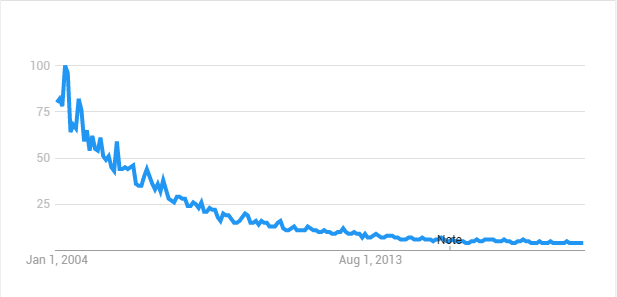
Sorry to say that but you wasted the last five years of your life. Google trends for Smalltalk: [image: chrome_JbORSPVuGv.png] Smalltalk is dead. Dead and no-one can change it. It is an interesting historical curiosity. You are trying to sell a dead horse. And yes, Pharo is an irrelevant niche language and it is very unlikely that it will change in future. It definitely will not change If it will be promoted the way you do that. -- Pavel
-- Sent from: http://forum.world.st/Pharo-Smalltalk-Users-f1310670.html
I beg to differ. I believe it is possible to re-energize Smalltalk. I believe /marketing/ is the key. Read https://medium.com/@richardeng/yes-it-is-allow-me-to-explain-dbd33ef0ff21 I've always known this was an uphill battle. Ultimately, you may be right, but I choose to be more optimistic. My philosophy is that it's better to have tried and failed, then to not have tried at all. Pavel Krivanek-3 wrote
st 5. 2. 2020 v 20:42 odesÃlatel horrido <
horrido.hobbies@
> napsal:
It is your initiative, you should know, nobody asked you to do it
Well, that's a peculiar attitude. There are many, many programming language evangelists and I don't think anybody "asked" them to do it. They do it for the love of the language.
I hear what you're saying, and I understand fully. I just don't agree with it entirely.
I think it's short-sighted. Smalltalk has long been criticized for being a secluded island, and now you want to do the same for Pharo? Even as I try to build bridges to the island?
You could ban everybody from this forum who aren't focussed 100% on Pharo and you'd have a much smaller community. You could ban everybody who is a Smalltalker. The result is a much more tightly focussed forum, clean and free from distractions. Fine. But what is the long-term cost?
Smalltalk evangelism would come to an end. Why? Because frankly nobody is interested in the other Smalltalks. Pharo is where all the action is.
And without Smalltalk evangelism, I don't see a path for Pharo becoming more than a niche language. Pharo doesn't show up an *any* language popularity index. At least Clojure, Erlang/Elixir, and Haskell are in the top 30 in several places.
At Indeed, there are 18 job postings in the United States that mention Smalltalk, and none for Pharo. Even Clojure has 404, Erlang has 274, and Haskell has 519, pathetic though these numbers are.
Yes, I also understand that there are many Pharoers who don't care about remaining niche. That's a tragedy.
I would rather not have wasted the last five years of my life.
Sorry to say that but you wasted the last five years of your life. Google trends for Smalltalk:
[image: chrome_JbORSPVuGv.png]
Smalltalk is dead. Dead and no-one can change it. It is an interesting historical curiosity. You are trying to sell a dead horse. And yes, Pharo is an irrelevant niche language and it is very unlikely that it will change in future. It definitely will not change If it will be promoted the way you do that.
-- Pavel
-- Sent from: http://forum.world.st/Pharo-Smalltalk-Users-f1310670.html
chrome_JbORSPVuGv.png (11K) <http://forum.world.st/attachment/5111235/0/chrome_JbORSPVuGv.png>;
-- Sent from: http://forum.world.st/Pharo-Smalltalk-Users-f1310670.html
Am 05.02.2020 um 20:41 schrieb horrido <horrido.hobbies@gmail.com>:
It is your initiative, you should know, nobody asked you to do it
Well, that's a peculiar attitude. There are many, many programming language evangelists and I don't think anybody "asked" them to do it. They do it for the love of the language.
I hear what you're saying, and I understand fully. I just don't agree with it entirely.
I doubt that.
I think it's short-sighted. Smalltalk has long been criticized for being a secluded island, and now you want to do the same for Pharo? Even as I try to build bridges to the island?
Now, you just don't understand. We are being criticized for leaving the island. From where you stand it looks that Smalltalk would still exist and we are making an island in the sea of nothing.
You could ban everybody from this forum who aren't focussed 100% on Pharo and you'd have a much smaller community. You could ban everybody who is a Smalltalker. The result is a much more tightly focussed forum, clean and free from distractions. Fine. But what is the long-term cost?
You don't understand. We don't usually ban people but we should. And I don't care about the size of the community because the part of the community that does not focus on pharo is useless to us. Is that so hard to get?
Smalltalk evangelism would come to an end. Why? Because frankly nobody is interested in the other Smalltalks. Pharo is where all the action is.
Yes, and it is for a reason. It is because we did a hard and good job the last 12 years. You just need to understand that this Smalltalk thing does not exist if it ever has.
And without Smalltalk evangelism, I don't see a path for Pharo becoming more than a niche language. Pharo doesn't show up an *any* language popularity index. At least Clojure, Erlang/Elixir, and Haskell are in the top 30 in several places.
And what kind of metric is that? And why the hell you think that Smalltalk evangelising can change that? I cannot imagine a single reason that makes that assumption hold.
At Indeed, there are 18 job postings in the United States that mention Smalltalk, and none for Pharo. Even Clojure has 404, Erlang has 274, and Haskell has 519, pathetic though these numbers are.
We are working on it. And if we do not succeed so be it. The one thing I'm sure is that you are not helping.
Yes, I also understand that there are many Pharoers who don't care about remaining niche. That's a tragedy.
You really have to understand that IT changed since you've been active. Software is omnipresent today meaning it enters all areas of live. And most of these areas you can call a niche. Being mainstream does not make things better!
I would rather not have wasted the last five years of my life.
I'm sorry for you but you did. And in my opinion you should stop that because you do more harm than good. I know this just confirms you in ongoing but so be it. Norbert
-- Sent from: http://forum.world.st/Pharo-Smalltalk-Users-f1310670.html
As I suggested earlier, my evangelism has been rather polarizing. There are a lot of people like yourself who don't appreciate my efforts. There a lot of people who do. For example, when I attended the FAST conference in Salta, many people (Leandro Caniglia, Carlos Ferro, etc.) expressed their appreciation. Another example, members of TSUG (Bob Nemec, Norman Branitsky, Dave Mason, etc.) appreciate my efforts. I wonder, if I attended an ESUG conference, might I find supporters, as well? At Twitter, Facebook, LinkedIn, Quora, Medium, etc., there are many fans of my evangelism. Amazingly, there are supporters on this forum, too! So how much weight should I give to your opinion? Should I now stop on your say so? Make a convincing case and I shall drop everything. I shall terminate JRMPC immediately and return all the money to LabWare (thereby disappointing over 120 participating students). I shall delete smalltalk.tech.blog <https://smalltalk.tech.blog/> . I shall remove all my existing blogs and videos about Smalltalk from Medium and YouTube. Perhaps this will reverse the damage. I await your case... NorbertHartl wrote
Am 05.02.2020 um 20:41 schrieb horrido <
horrido.hobbies@
>:
It is your initiative, you should know, nobody asked you to do it
Well, that's a peculiar attitude. There are many, many programming language evangelists and I don't think anybody "asked" them to do it. They do it for the love of the language.
I hear what you're saying, and I understand fully. I just don't agree with it entirely.
I doubt that.
I think it's short-sighted. Smalltalk has long been criticized for being a secluded island, and now you want to do the same for Pharo? Even as I try to build bridges to the island?
Now, you just don't understand. We are being criticized for leaving the island. From where you stand it looks that Smalltalk would still exist and we are making an island in the sea of nothing.
You could ban everybody from this forum who aren't focussed 100% on Pharo and you'd have a much smaller community. You could ban everybody who is a Smalltalker. The result is a much more tightly focussed forum, clean and free from distractions. Fine. But what is the long-term cost?
You don't understand. We don't usually ban people but we should. And I don't care about the size of the community because the part of the community that does not focus on pharo is useless to us. Is that so hard to get?
Smalltalk evangelism would come to an end. Why? Because frankly nobody is interested in the other Smalltalks. Pharo is where all the action is.
Yes, and it is for a reason. It is because we did a hard and good job the last 12 years. You just need to understand that this Smalltalk thing does not exist if it ever has.
And without Smalltalk evangelism, I don't see a path for Pharo becoming more than a niche language. Pharo doesn't show up an *any* language popularity index. At least Clojure, Erlang/Elixir, and Haskell are in the top 30 in several places.
And what kind of metric is that? And why the hell you think that Smalltalk evangelising can change that? I cannot imagine a single reason that makes that assumption hold.
At Indeed, there are 18 job postings in the United States that mention Smalltalk, and none for Pharo. Even Clojure has 404, Erlang has 274, and Haskell has 519, pathetic though these numbers are.
We are working on it. And if we do not succeed so be it. The one thing I'm sure is that you are not helping.
Yes, I also understand that there are many Pharoers who don't care about remaining niche. That's a tragedy.
You really have to understand that IT changed since you've been active. Software is omnipresent today meaning it enters all areas of live. And most of these areas you can call a niche. Being mainstream does not make things better!
I would rather not have wasted the last five years of my life.
I'm sorry for you but you did. And in my opinion you should stop that because you do more harm than good. I know this just confirms you in ongoing but so be it.
Norbert
-- Sent from: http://forum.world.st/Pharo-Smalltalk-Users-f1310670.html
-- Sent from: http://forum.world.st/Pharo-Smalltalk-Users-f1310670.html
Am 06.02.2020 um 14:45 schrieb horrido <horrido.hobbies@gmail.com>:
As I suggested earlier, my evangelism has been rather polarizing. There are a lot of people like yourself who don't appreciate my efforts. There a lot of people who do.
For example, when I attended the FAST conference in Salta, many people (Leandro Caniglia, Carlos Ferro, etc.) expressed their appreciation. Another example, members of TSUG (Bob Nemec, Norman Branitsky, Dave Mason, etc.) appreciate my efforts. I wonder, if I attended an ESUG conference, might I find supporters, as well?
At Twitter, Facebook, LinkedIn, Quora, Medium, etc., there are many fans of my evangelism. Amazingly, there are supporters on this forum, too!
So how much weight should I give to your opinion? Should I now stop on your say so? Make a convincing case and I shall drop everything. I shall terminate JRMPC immediately and return all the money to LabWare (thereby disappointing over 120 participating students). I shall delete smalltalk.tech.blog <https://smalltalk.tech.blog/ <https://smalltalk.tech.blog/>> . I shall remove all my existing blogs and videos about Smalltalk from Medium and YouTube. Perhaps this will reverse the damage.
I await your caseâ¦
Sorry, I was not clear in the last mail. I can't and I won't tell you what you should do or not. You can evangelize what you want but I would prefer if you have to evangelize, keep it to smalltalk and do not refer to pharo, not even with screenshots. And it would be nice if you wouldn't misuse this community for your needs. You might have fans and everyone is allowed to have an opinion. But none of the people you mentioned I identify as member of this community. So it doesn't matter much to me. The weight of my opinion? That I don't know. But as a member of the pharo board it has enough weight to not be neglected. And with this weight I want to tell you that you are one of the major annoyances in this community. I hope it is more clear this time. regards, Norbert
NorbertHartl wrote
Am 05.02.2020 um 20:41 schrieb horrido <
horrido.hobbies@
>:
It is your initiative, you should know, nobody asked you to do it
Well, that's a peculiar attitude. There are many, many programming language evangelists and I don't think anybody "asked" them to do it. They do it for the love of the language.
I hear what you're saying, and I understand fully. I just don't agree with it entirely.
I doubt that.
I think it's short-sighted. Smalltalk has long been criticized for being a secluded island, and now you want to do the same for Pharo? Even as I try to build bridges to the island?
Now, you just don't understand. We are being criticized for leaving the island. From where you stand it looks that Smalltalk would still exist and we are making an island in the sea of nothing.
You could ban everybody from this forum who aren't focussed 100% on Pharo and you'd have a much smaller community. You could ban everybody who is a Smalltalker. The result is a much more tightly focussed forum, clean and free from distractions. Fine. But what is the long-term cost?
You don't understand. We don't usually ban people but we should. And I don't care about the size of the community because the part of the community that does not focus on pharo is useless to us. Is that so hard to get?
Smalltalk evangelism would come to an end. Why? Because frankly nobody is interested in the other Smalltalks. Pharo is where all the action is.
Yes, and it is for a reason. It is because we did a hard and good job the last 12 years. You just need to understand that this Smalltalk thing does not exist if it ever has.
And without Smalltalk evangelism, I don't see a path for Pharo becoming more than a niche language. Pharo doesn't show up an *any* language popularity index. At least Clojure, Erlang/Elixir, and Haskell are in the top 30 in several places.
And what kind of metric is that? And why the hell you think that Smalltalk evangelising can change that? I cannot imagine a single reason that makes that assumption hold.
At Indeed, there are 18 job postings in the United States that mention Smalltalk, and none for Pharo. Even Clojure has 404, Erlang has 274, and Haskell has 519, pathetic though these numbers are.
We are working on it. And if we do not succeed so be it. The one thing I'm sure is that you are not helping.
Yes, I also understand that there are many Pharoers who don't care about remaining niche. That's a tragedy.
You really have to understand that IT changed since you've been active. Software is omnipresent today meaning it enters all areas of live. And most of these areas you can call a niche. Being mainstream does not make things better!
I would rather not have wasted the last five years of my life.
I'm sorry for you but you did. And in my opinion you should stop that because you do more harm than good. I know this just confirms you in ongoing but so be it.
Norbert
-- Sent from: http://forum.world.st/Pharo-Smalltalk-Users-f1310670.html
-- Sent from: http://forum.world.st/Pharo-Smalltalk-Users-f1310670.html <http://forum.world.st/Pharo-Smalltalk-Users-f1310670.html>
You can evangelize what you want but I would prefer if you have to evangelize, keep it to smalltalk and do not refer to pharo, not even with screenshots.
Whoa! You want me to remove all references to Pharo in my smalltalk.tech.blog??? That would eliminate most of the current blog posts. It would hollow out the Resources page. And like I intimated before, it would utterly destroy my JRMPC competition. There would be no point in evangelizing Smalltalk anymore. Your position is completely unreasonable. I'll go further and say it's insane. I hope most Pharoers are not so extreme. -- Sent from: http://forum.world.st/Pharo-Smalltalk-Users-f1310670.html
st 5. 2. 2020 v 19:02 odesÃlatel horrido <horrido.hobbies@gmail.com> napsal:
You want to take the Smalltalk heritage as a definition, thatâs ok. We donât, and thatâs ok too. Is about what we want to do.
Who's "we"?
Last time I checked, nobody owns Pharo. Pharo is not a bunch of core developers; it's a community. And I believe there are many Pharoers who share my view.
Since I'm a Smalltalk evangelist and not a Pharo evangelist, I guess I shouldn't ever mention Pharo in my blog. After all, if it's not Smalltalk, why should I promote it???
Pharo 8.0 release Reddit discussion included some feedback you may appreciate: "Thanks. Does this Pharo release removes feature "Richard Kenneth Eng"? That was the only feature in detriment to such an excellent environment as Pharo." "I really like the idea of pharo's features and smalltalk is quite interesting, but I can't help but be put off by the insanely stupid marketing culture around it. Most articles about it exaggerate way too much and seem like they're written by people who were paid to write about it. Or maybe I'm reading Medium-cancer too much."
In fact, this is disastrous for my JRMPC competition since it's based entirely on Pharo. I'm promoting Smalltalk but pushing Pharo on all the participating teams??? What the f*ck am I doing?!!
-- Sent from: http://forum.world.st/Pharo-Smalltalk-Users-f1310670.html
I learned a long time ago that you can't please everybody. I've heard the critics about my evangelism. I've also heard the praise. So what am I supposed to do? Listen to the critics and ignore the fans? If you're an evangelist, you have to develop a thick skin and follow your heart. Otherwise, get out of the kitchen... Pavel Krivanek-3 wrote
st 5. 2. 2020 v 19:02 odesÃlatel horrido <
horrido.hobbies@
> napsal:
You want to take the Smalltalk heritage as a definition, thatâs ok. We donât, and thatâs ok too. Is about what we want to do.
Who's "we"?
Last time I checked, nobody owns Pharo. Pharo is not a bunch of core developers; it's a community. And I believe there are many Pharoers who share my view.
Since I'm a Smalltalk evangelist and not a Pharo evangelist, I guess I shouldn't ever mention Pharo in my blog. After all, if it's not Smalltalk, why should I promote it???
Pharo 8.0 release Reddit discussion included some feedback you may appreciate:
"Thanks. Does this Pharo release removes feature "Richard Kenneth Eng"? That was the only feature in detriment to such an excellent environment as Pharo."
"I really like the idea of pharo's features and smalltalk is quite interesting, but I can't help but be put off by the insanely stupid marketing culture around it. Most articles about it exaggerate way too much and seem like they're written by people who were paid to write about it. Or maybe I'm reading Medium-cancer too much."
In fact, this is disastrous for my JRMPC competition since it's based entirely on Pharo. I'm promoting Smalltalk but pushing Pharo on all the participating teams??? What the f*ck am I doing?!!
-- Sent from: http://forum.world.st/Pharo-Smalltalk-Users-f1310670.html
-- Sent from: http://forum.world.st/Pharo-Smalltalk-Users-f1310670.html
On Wed, Feb 5, 2020 at 4:48 PM horrido <horrido.hobbies@gmail.com> wrote:
I learned a long time ago that you can't please everybody. I've heard the critics about my evangelism. I've also heard the praise.
So what am I supposed to do? Listen to the critics and ignore the fans?
tr;dr answer: know who you listen to. But if you've been for a while (it is, years) here in this tiny tribe (in global scale) that is the Smalltalk community, you'd pay attention to the critics from many whose feedback can be treated as wisdom. In particular when you're promoting something that you might have mastered in the past, but given your recent questions in the list, you don't today. Smalltalk as a concept lacks a good PR these days, so does Pharo as a product (although non-commercial), but Pharo has been successful in growing organically and create some kind of grassroots, albeit slow. And in technical environments bad PR is counterproductive and if you push too hard it usually fires back. Regards, Esteban A. Maringolo
I'm not sure whose feedback I should regard as wisdom. This uncertainty stems from a key philosophical difference I had 5 years ago. Read Interview with a Smalltalk Evangelist <https://medium.com/@richardeng/interview-with-a-smalltalk-evangelist-711e3f1...> . At the time, I don't think anybody agreed with me philosophically. I imagine most of you /still/ don't agree with me. So given this disagreement, how can I regard any feedback as wisdom?
but given your recent questions in the list, you don't today.
You are correct, I'm no longer much of a programmer today. I retired many years ago and I've grown rusty. Nevertheless, my background qualifies me to evangelize a programming language at an overview level. I may not be able to evangelize at a technical code level, but at a conceptual level, I certainly can. Esteban A. Maringolo wrote
On Wed, Feb 5, 2020 at 4:48 PM horrido <
horrido.hobbies@
> wrote:
I learned a long time ago that you can't please everybody. I've heard the critics about my evangelism. I've also heard the praise.
So what am I supposed to do? Listen to the critics and ignore the fans?
tr;dr answer: know who you listen to.
But if you've been for a while (it is, years) here in this tiny tribe (in global scale) that is the Smalltalk community, you'd pay attention to the critics from many whose feedback can be treated as wisdom.
In particular when you're promoting something that you might have mastered in the past, but given your recent questions in the list, you don't today.
Smalltalk as a concept lacks a good PR these days, so does Pharo as a product (although non-commercial), but Pharo has been successful in growing organically and create some kind of grassroots, albeit slow.
And in technical environments bad PR is counterproductive and if you push too hard it usually fires back.
Regards,
Esteban A. Maringolo
-- Sent from: http://forum.world.st/Pharo-Smalltalk-Users-f1310670.html
st 5. 2. 2020 v 20:48 odesÃlatel horrido <horrido.hobbies@gmail.com> napsal:
I learned a long time ago that you can't please everybody. I've heard the critics about my evangelism. I've also heard the praise.
So what am I supposed to do? Listen to the critics and ignore the fans?
If you're an evangelist, you have to develop a thick skin and follow your heart. Otherwise, get out of the kitchen...
You are a victim of your own strong confirmation bias. I hardly can break it but I just want to point out that in the mentioned discussion, there was no fan of you (and there were more people complaining than the two I mentioned). Pavel Krivanek-3 wrote
st 5. 2. 2020 v 19:02 odesÃlatel horrido <
horrido.hobbies@
> napsal:
You want to take the Smalltalk heritage as a definition, thatâs ok. We donât, and thatâs ok too. Is about what we want to do.
Who's "we"?
Last time I checked, nobody owns Pharo. Pharo is not a bunch of core developers; it's a community. And I believe there are many Pharoers who share my view.
Since I'm a Smalltalk evangelist and not a Pharo evangelist, I guess I shouldn't ever mention Pharo in my blog. After all, if it's not Smalltalk, why should I promote it???
Pharo 8.0 release Reddit discussion included some feedback you may appreciate:
"Thanks. Does this Pharo release removes feature "Richard Kenneth Eng"? That was the only feature in detriment to such an excellent environment as Pharo."
"I really like the idea of pharo's features and smalltalk is quite interesting, but I can't help but be put off by the insanely stupid marketing culture around it. Most articles about it exaggerate way too much and seem like they're written by people who were paid to write about it. Or maybe I'm reading Medium-cancer too much."
In fact, this is disastrous for my JRMPC competition since it's based entirely on Pharo. I'm promoting Smalltalk but pushing Pharo on all the participating teams??? What the f*ck am I doing?!!
-- Sent from: http://forum.world.st/Pharo-Smalltalk-Users-f1310670.html
-- Sent from: http://forum.world.st/Pharo-Smalltalk-Users-f1310670.html
Reddit is a strange bird. I have found more resistance to Smalltalk there than from any other source on the planet. Moreover, those people *really* don't appreciate me evangelizing anything. Consequently, I've avoided Reddit like the plague. I don't know what kind of readership exists at Reddit, but they are openly hostile. So you'll forgive me if I don't lend much credence to what Redditors say. Pavel Krivanek-3 wrote
st 5. 2. 2020 v 20:48 odesÃlatel horrido <
horrido.hobbies@
> napsal:
I learned a long time ago that you can't please everybody. I've heard the critics about my evangelism. I've also heard the praise.
So what am I supposed to do? Listen to the critics and ignore the fans?
If you're an evangelist, you have to develop a thick skin and follow your heart. Otherwise, get out of the kitchen...
You are a victim of your own strong confirmation bias. I hardly can break it but I just want to point out that in the mentioned discussion, there was no fan of you (and there were more people complaining than the two I mentioned).
Pavel Krivanek-3 wrote
st 5. 2. 2020 v 19:02 odesÃlatel horrido <
horrido.hobbies@
> napsal:
You want to take the Smalltalk heritage as a definition, thatâs ok. We donât, and thatâs ok too. Is about what we want to do.
Who's "we"?
Last time I checked, nobody owns Pharo. Pharo is not a bunch of core developers; it's a community. And I believe there are many Pharoers who share my view.
Since I'm a Smalltalk evangelist and not a Pharo evangelist, I guess I shouldn't ever mention Pharo in my blog. After all, if it's not Smalltalk, why should I promote it???
Pharo 8.0 release Reddit discussion included some feedback you may appreciate:
"Thanks. Does this Pharo release removes feature "Richard Kenneth Eng"? That was the only feature in detriment to such an excellent environment as Pharo."
"I really like the idea of pharo's features and smalltalk is quite interesting, but I can't help but be put off by the insanely stupid marketing culture around it. Most articles about it exaggerate way too much and seem like they're written by people who were paid to write about it. Or maybe I'm reading Medium-cancer too much."
In fact, this is disastrous for my JRMPC competition since it's based entirely on Pharo. I'm promoting Smalltalk but pushing Pharo on all the participating teams??? What the f*ck am I doing?!!
-- Sent from: http://forum.world.st/Pharo-Smalltalk-Users-f1310670.html
-- Sent from: http://forum.world.st/Pharo-Smalltalk-Users-f1310670.html
-- Sent from: http://forum.world.st/Pharo-Smalltalk-Users-f1310670.html

FWIW I am one of the mods of /r/smalltalk - happy to have material Sent from my iPhone
On Feb 5, 2020, at 13:12, horrido <horrido.hobbies@gmail.com> wrote:
Reddit is a strange bird. I have found more resistance to Smalltalk there than from any other source on the planet. Moreover, those people *really* don't appreciate me evangelizing anything. Consequently, I've avoided Reddit like the plague.
I don't know what kind of readership exists at Reddit, but they are openly hostile. So you'll forgive me if I don't lend much credence to what Redditors say.
Pavel Krivanek-3 wrote
st 5. 2. 2020 v 20:48 odesÃlatel horrido <
horrido.hobbies@
> napsal:
I learned a long time ago that you can't please everybody. I've heard the critics about my evangelism. I've also heard the praise.
So what am I supposed to do? Listen to the critics and ignore the fans?
If you're an evangelist, you have to develop a thick skin and follow your heart. Otherwise, get out of the kitchen...
You are a victim of your own strong confirmation bias. I hardly can break it but I just want to point out that in the mentioned discussion, there was no fan of you (and there were more people complaining than the two I mentioned).
Pavel Krivanek-3 wrote
st 5. 2. 2020 v 19:02 odesÃlatel horrido <
horrido.hobbies@
> napsal:
You want to take the Smalltalk heritage as a definition, thatâs ok. We donât, and thatâs ok too. Is about what we want to do.
Who's "we"?
Last time I checked, nobody owns Pharo. Pharo is not a bunch of core developers; it's a community. And I believe there are many Pharoers who share my view.
Since I'm a Smalltalk evangelist and not a Pharo evangelist, I guess I shouldn't ever mention Pharo in my blog. After all, if it's not Smalltalk, why should I promote it???
Pharo 8.0 release Reddit discussion included some feedback you may appreciate:
"Thanks. Does this Pharo release removes feature "Richard Kenneth Eng"? That was the only feature in detriment to such an excellent environment as Pharo."
"I really like the idea of pharo's features and smalltalk is quite interesting, but I can't help but be put off by the insanely stupid marketing culture around it. Most articles about it exaggerate way too much and seem like they're written by people who were paid to write about it. Or maybe I'm reading Medium-cancer too much."
In fact, this is disastrous for my JRMPC competition since it's based entirely on Pharo. I'm promoting Smalltalk but pushing Pharo on all the participating teams??? What the f*ck am I doing?!!
-- Sent from: http://forum.world.st/Pharo-Smalltalk-Users-f1310670.html
-- Sent from: http://forum.world.st/Pharo-Smalltalk-Users-f1310670.html
-- Sent from: http://forum.world.st/Pharo-Smalltalk-Users-f1310670.html
Yes, Esteban, maybe I was a bit harsh, in a sense you're right too, However it becomes blurred then wat Smalltalk really is. (e.g. I recommend Pharo as Smalltalk to others) I would prefer -but who am I- that all Smalltalk dialects should implement the ANSI standard as a minimum and at least on that level stay compatible. New developments should be built on top of that. and get incorporated in the ANSI standard at certain points in time. So that everybody on this planet can work with one Smalltalk. That makes sense, don't you agree? They came very close to that with PLs like COBOL, ANSI C etc. Standardization is industrial. No need to further explain this I guess. The f. devil lives in the details, as they say, and it is exactly those little differences that makes it very hard to port packages from one Smalltalk dialect to another. In the current situation, that is where everybody wants to go their own unique way, this has the consequence that if one Smalltalk dialect disappears (e.g. Squeak, Pharo, Visualworks, whatever) this would render packages with often tons of work(e.g. Roassal ?) worthless because they don't load/work in other Smalltalk implementations/dialects without rewriting and retesting the package again. This should not be the case. Again, I am impressed by Pharo and really like it. but for me it goes too far to say that Pharo isn't Smalltalk. As a user, I edit classes methods etc in exactly the same way (syntax) as in most other Smalltalk dialects. If you would take out the Smalltalk from Pharo all is left are a few bolts and nuts rendered useless: nothing to mount it on. (Still the differences are currently not that big: if I can file in st files from Squeak from 2010 and the only thing I had to change was a datetime property) (yet another reason I don't use traits is to remain compatible as much as possible between different Smalltalk implementations) my 4 cents. :o) Regards, thank you. TedvG btw Hard to convince people about this: Also. nothing should be deprecated. Old sources should remain compatible. (Not like in Swift, where I had to rewrite parts of my apps nearly every year because of deprecation fever) -- Sent from: http://forum.world.st/Pharo-Smalltalk-Users-f1310670.html
I'm not sure ANSI compliance is particularly useful. Nobody develops an application strictly to the ANSI standard. Ben Coman had to port VisualWorks code to Pharo for my JRMPC competition and it wasn't exactly a cake walk. My friend Bob Nemic got confused between VisualWorks and Pharo because of the IDE! There is no standard convention applied to Smalltalk IDEs and, to me, that's a big issue as well. The fact is, the world of Smalltalk is just like the world of Linux. There are enough differences among the various family members that you just have to adapt. It will never be easy. TedVanGaalen wrote
Yes, Esteban,
maybe I was a bit harsh, in a sense you're right too, However it becomes blurred then wat Smalltalk really is. (e.g. I recommend Pharo as Smalltalk to others)
I would prefer -but who am I- that all Smalltalk dialects should implement the ANSI standard as a minimum and at least on that level stay compatible. New developments should be built on top of that. and get incorporated in the ANSI standard at certain points in time. So that everybody on this planet can work with one Smalltalk. That makes sense, don't you agree?
They came very close to that with PLs like COBOL, ANSI C etc.
Standardization is industrial. No need to further explain this I guess.
The f. devil lives in the details, as they say, and it is exactly those little differences that makes it very hard to port packages from one Smalltalk dialect to another.
In the current situation, that is where everybody wants to go their own unique way, this has the consequence that if one Smalltalk dialect disappears (e.g. Squeak, Pharo, Visualworks, whatever) this would render packages with often tons of work(e.g. Roassal ?) worthless because they don't load/work in other Smalltalk implementations/dialects without rewriting and retesting the package again. This should not be the case.
Again, I am impressed by Pharo and really like it. but for me it goes too far to say that Pharo isn't Smalltalk.
As a user, I edit classes methods etc in exactly the same way (syntax) as in most other Smalltalk dialects. If you would take out the Smalltalk from Pharo all is left are a few bolts and nuts rendered useless: nothing to mount it on.
(Still the differences are currently not that big: if I can file in st files from Squeak from 2010 and the only thing I had to change was a datetime property) (yet another reason I don't use traits is to remain compatible as much as possible between different Smalltalk implementations)
my 4 cents. :o) Regards, thank you. TedvG btw Hard to convince people about this: Also. nothing should be deprecated. Old sources should remain compatible. (Not like in Swift, where I had to rewrite parts of my apps nearly every year because of deprecation fever)
-- Sent from: http://forum.world.st/Pharo-Smalltalk-Users-f1310670.html
-- Sent from: http://forum.world.st/Pharo-Smalltalk-Users-f1310670.html

Here we go again... <rant> What is wrong with you people? Seriously? With this "Pharo is NOT Smalltalk" BS? If it looks like a duck, swims like a duck, and quacks like a duck, then it probably is a duck! To convince yourself, I urge you all to try to evaluate this in any other Smalltalk (Dolphin, Cuis, VisualWorks, LittleSmalltalk, ObjectStudio, VisualAge Smalltalk, IBM Smalltalk, Instantiations Smalltalk, Smalltalk/X, ObjectWorks, Visual Smalltalk Enterprise, Smalltalk Express, Amber Smalltalk, Redline Smalltalk, Smalltalk MT, GNU Smalltalk, you-f*cking-name-it-Smalltalk) to see if it compiles: Transcript inspect. Workspace inspect. Processor inspect. Smalltalk inspect. true inspect. false inspect. thisContext inspect. nil inspect. self inspect. super inspect. Undeclared inspect. #someSymbol inspect. #(1 2 3) inspect. Object allInstances. OrderedCollection class inspect. Behavior inspect. Class inspect. MethodDictionary inspect. Smalltalk garbageCollect. 3@4 inspect. ([ :a :b | a + b ] value: 3 value: 4) inspect. [50 factorial] forkAt: Processor userBackgroundPriority. Now, if you still think that Pharo is NOT Smalltalk, I strongly suggest we remove all the code that was inherited from Squeak (Smalltalk) or inspired/borrowed by/from VisualWorks & others. Same thing for the VM : we should build our own from scratch as Squeak and Cuis also use the same! And we should assign different numbers to every primitive we do share with all other Smalltalks out there since 1980 : we wouldn't want to be associated with any Smalltalk, right? We don't want any Smalltalk in Pharo, don't we, since it is NOT Smalltalk? Besides, just so you can glady remove all traces of the "forbidden" word or heritage, you must know that the current Pharo 8 images has 1724 references to the global Smalltalk. If you dig a little bit deeper (adding comments, deprecated code, the string 'Smalltalk' as well as the #Smalltalk symbol, you'll end up with 5000+ occurrences of the "forbidden word" "Smalltalk" in the current Pharo 8 image. Wanna add occurrences of "Smalltalk" in method names as well while we're at it? ;) But hey, Pharo is NOT Smalltalk, right? ;) loll Should I create a PR for every occurrence of the forbidden word so we can get rid of that shameful heritage and clean up the image? We should also remove the strings Squeak (56 times), Cuis, VisualWorks, VW, VisualAge & others since Pharo is NOT Smalltalk? Did I say it enough? Pharo is NOT Smalltalk! Even if I can load Smalltalk code from SmalltalkHub, SqueakSource and ss3.gemtalksystems.com, Pharo is NOT Smalltalk, do you get it? I can load mcz packages made for Cuis & Squeak but, nonetheless, Pharo is NOT Smalltalk! How many times do I have to say it? Imagine the following discussion: A- I heard you bought a new car? B- No I bought a Toyota Corolla. A- So you bought a new car! B- A TOYOTA COROLLA IS **NOT** A CAR. Ain't that discussion & deny stupid enough? I get the impression we constantly have this kind of denial/discussion here... A serious case of SSS : Shame of Smalltalk Syndrome. Pharo wants to be different : okay. Fine. Cool! But please, stop saying that Pharo is NOT Smalltalk. It is. </rant> // -- ----------------- Benoît St-Jean Yahoo! Messenger: bstjean Twitter: @BenLeChialeux Pinterest: benoitstjean Instagram: Chef_Benito IRC: lamneth GitHub: bstjean Blogue: endormitoire.wordpress.com "A standpoint is an intellectual horizon of radius zero". (A. Einstein)
So, Iâm going to say this and then I will close this thread: Regardless what you think about Pharo and its heritage and how it should be called, this is a list to talk about this particular artefact that is Pharo. You can say: There is Smalltalk, and there is Pharo who is a part of it. Thatâs fine. Then let it phrase it like this: this list is not to talk about the whole Smalltalk universe but this particular implementation. In fact, this is a list for "pharo usersâ (hence its name), to let them share experiences and ask for help. And this is why is âoff-topicâ anything that is talking about other stuff. Now, everybody can do as they please (I will not enter on criticising otherâs work here, they can do what they believe is the best). But they cannot do as they please in the house of others. And this is the house of Pharo Users. So, the rules are: we talk about *pharo usage* here. We can off-topic in some way, as long as the off-topic is restricted. And thatâs all. Esteban Ps: again, *is not the point to argue about what you think is Pharo or not*. Please stop discussing that. We (the board) do not care about that. We (the board) decided a lot of time ago that we will take the Smalltalk inheritance in the Alan Kayâs way: we do not do âSmalltalk", we bootstrap something new, that may resemble Smalltalk (whatever that is), that may share a lot of things with Smalltalk (even syntax and some libraries), but it is still other thing. Pps: It was me who said to Horrido âyou are welcome here, as long as your campaign does not eats the whole listâ (word more, word less, this is what I said). Well, now this is eating the whole list, and it has to end.
On 6 Feb 2020, at 00:13, TedVanGaalen <tedvga@gmail.com> wrote:
Yes, Esteban,
maybe I was a bit harsh, in a sense you're right too, However it becomes blurred then wat Smalltalk really is. (e.g. I recommend Pharo as Smalltalk to others)
I would prefer -but who am I- that all Smalltalk dialects should implement the ANSI standard as a minimum and at least on that level stay compatible. New developments should be built on top of that. and get incorporated in the ANSI standard at certain points in time. So that everybody on this planet can work with one Smalltalk. That makes sense, don't you agree?
They came very close to that with PLs like COBOL, ANSI C etc.
Standardization is industrial. No need to further explain this I guess.
The f. devil lives in the details, as they say, and it is exactly those little differences that makes it very hard to port packages from one Smalltalk dialect to another.
In the current situation, that is where everybody wants to go their own unique way, this has the consequence that if one Smalltalk dialect disappears (e.g. Squeak, Pharo, Visualworks, whatever) this would render packages with often tons of work(e.g. Roassal ?) worthless because they don't load/work in other Smalltalk implementations/dialects without rewriting and retesting the package again. This should not be the case.
Again, I am impressed by Pharo and really like it. but for me it goes too far to say that Pharo isn't Smalltalk.
As a user, I edit classes methods etc in exactly the same way (syntax) as in most other Smalltalk dialects. If you would take out the Smalltalk from Pharo all is left are a few bolts and nuts rendered useless: nothing to mount it on.
(Still the differences are currently not that big: if I can file in st files from Squeak from 2010 and the only thing I had to change was a datetime property) (yet another reason I don't use traits is to remain compatible as much as possible between different Smalltalk implementations)
my 4 cents. :o) Regards, thank you. TedvG btw Hard to convince people about this: Also. nothing should be deprecated. Old sources should remain compatible. (Not like in Swift, where I had to rewrite parts of my apps nearly every year because of deprecation fever)
-- Sent from: http://forum.world.st/Pharo-Smalltalk-Users-f1310670.html
Then I have a question... and I'm not being sarcastic here! As Pharo users, are we allowed to suggest ideas from other environments, even other languages or projects? If I think we should implement something similar to VisualWork's MemoryPolicy in Pharo, where should I discuss that? If I see package XYZ in Python that I think would be worth porting to Pharo, where should I discuss that? If there are features in the Atom editor that are worth considering & cool for Pharo, where should I discuss that? If I have ideas/places/means to promote Pharo or give it exposure, where should I discuss that? If VisualAge has a nice config map to interface MQSeries and I'd like to know if a port to Pharo would interest anyone, where should I discuss that? If I want to know if there's any interest to develop a native DB2 database driver, should I discuss it here ? From what I've read, the answer is NO. Do you really think that if I post "hey guys, we should really port that to Pharo" on comp.databases.ibm-db2, it will draw any attention from Pharoers ? This is getting ridiculous! I mean, are we limited to only discuss about what's in the Pharo image? Yeah, the Collection hierarchy is cool but are we gonna talk about that for the next 5 years? As a Pharo USER, I am not limited to what's in the image : Pharo interfaces with lots of things on the outside. If we can't discuss about what's outside of the image and that could improve Pharo (library-wise), tell me where I can do so! If I understand correctly, we can't talk about anything that is not 100% Pharo on pharo-dev, pharo-users and lse-pharo4pharo, is that it ?!?!?!? What's left for the "outside world" ? P.S. I'm not saying that this mailing list should be a catch-all place where we can discuss about baseball, fishing, cars, music, chess, C# and politics. There has to be a way to sometimes discuss about stuff that is "outside" of Pharo but that could help us improve it! On 2020-02-06 03:21, Esteban Lorenzano wrote:
Then let it phrase it like this: this list is not to talk about the whole Smalltalk universe but this particular implementation.
-- ----------------- Benoît St-Jean Yahoo! Messenger: bstjean Twitter: @BenLeChialeux Pinterest: benoitstjean Instagram: Chef_Benito IRC: lamneth GitHub: bstjean Blogue: endormitoire.wordpress.com "A standpoint is an intellectual horizon of radius zero". (A. Einstein)
Dear Esteban, To make a long thread short: For users, your attitude/opinion implies the following facts: -if adhering to Pharo, then all the things one creates become increasingly incompatible with Smalltalk, because, in effect, you state that Pharo abandons/deviates from Smalltalk as a standard. So: -If a user wants to be productive: Why then should they write applications in a Pharo if one looses the compatibility with the rest of the Smalltalk world? (this is actually the REAL subject of this thread, not whether or not "dissonant" opinions causes list "pollution" imho) Btw, I am not exactly an "evangelist" with my ca. 2 or 3 "contributions" to this forum per year, so I am not exactly flooding the list, am I? (btw, most of my reactions to this list were about a 5 year old freeze-on-mac-at-full-screen-bug-since-Pharo-5.0 which still hasn't been repaired (VM problem i think)) However, I think this discussion is very important on a user level. which highly influences whether or not to use Pharo as a real tool for application development in a production environment or to regard it as some sort of academic hobby, standing on its own? But, don't worry, If you'd like to live on an island, you're free to do so. Also of course you are free to completely ignore and not having some initiative to at least try to standardize Smalltalk, which would benefit all of us! (user perspective) The latter btw goes for all Smalltalk incarnations alike, not only Pharo. Perfect example how to more or less doom a fantastic programming language/environment nowhere nothing found alike, by not talking, working together and reaching a consensus. (no matter how hard this can be at times, the smaller the islands become) Currently I won't recommend Pharo any further to new Smalltalk users because it puts them, without most of them realizing it, on an island with no boats to get them back to the real world. Never mind, just ignore me, as I am just a mere speck in the IT/Smalltalk world and of little significance I will now forget this whole thing, take a sunny walk along the Dordogne here, which, if it could talk, undoubtedly will confirm my question: "Pardon me, Dordogne, for asking: Are you a river? " with: "Huh? Yes of course I am, and indeed a beautiful one too, if I may say so! can't you see that?" The river is a lot wiser that me: it's only talk is the serene sound of eternal water flowing by and the wind playing with the leaves of trees surrounding it. I could learn a thing or two from that.. so can you.. Don't worry I will not react further on this. eat your own cake, I don't mind. Regards TedvG. -- Sent from: http://forum.world.st/Pharo-Smalltalk-Users-f1310670.html
Although I'll stick to what I wrote, looking back at what I wrote, it appears as to be not friendly at all times, I will try to prevent that next time. It also has to do with communication in writing only, which is a whole lot different as talking and listening while e.g. sharing a table together and discuss things e.g. during a coffee break.. and some laughter at times. What I still kindly suggest: make improvement/changes only in such a way that anything written before will run without any modification, which in fact also means: do not deprecate things! Downward compatibility prevents people from have tediously edit and test their packages again and again each time some have the "brilliant" idea to deprecate stuff. This is probably the biggest curse in software development these days. If you want to implement newer core like things co-existence with previous is preferable. Do at the very least not alter the core/system classes. It is probably also the maximum level where standardization in Smalltalk is possible, nevertheless.. This attitude then could open up the possibility for minimal standardization for core/system classes. Solely on that level. On top of that everybody can build whatever they want. In any aspect in industry the awareness that standardization is a necessity is beyond any doubt, alas, not in software development. One of the reasons aeroplanes are falling from the sky, elections go wrong and so on. For those not aware about the importance of standardization: read this: https://en.wikipedia.org/wiki/Standardization Regards TedvG -- Sent from: http://forum.world.st/Pharo-Smalltalk-Users-f1310670.html

I am of the side of this argument that Pharo is a kind of Smalltalk, but the group that forked Squeak to create Pharo did so with the express intention of being separate-from-Smalltalk and we should respect that intention. Indeed here we can see three reasons why they feel the need to advertise that separation... On Fri, 7 Feb 2020 at 21:45, TedVanGaalen <tedvga@gmail.com> wrote:
make improvement/changes only in such a way that anything written before will run without any modification
You are constraining what Pharo can be.
Downward compatibility prevents people from have tediously edit and test their packages again and again each time some have the "brilliant" idea to deprecate stuff.
You are constraining what Pharo can be.
If you want to implement newer core like things co-existence with previous is preferable. Do at the very least not alter the core/system classes.
You are constraining what Pharo can be. The aim of the advertised statement that Pharo-is-not-Smalltalk is to avoid you "later" being surprised if it differs from ST-80. A marketing strategy analogous to a "fail early" programming paradigm, and avoid such arguments that try to shackle Pharo. In practice, its probably many years before Pharo is any more incompatible with Smalltalk than the incompatibilities between existing Smalltalks. But Smalltalk-backward-compatibility should not be one of your tick-boxes to choose Pharo. cheers -ben
Smalltalk didn't "fail". We just didn't have the CPU power at the time to achieve our dreams! And "Smalltalk is slow" was tagged forever besides the name... 2020-02-08 07:17, Ben Coman wrote:The aim of the advertised statement that Pharo-is-not-Smalltalk is to
avoid you "later" being surprised if it differs from ST-80. A marketing strategy analogous to a "fail early" programming paradigm, and avoid such arguments that try to shackle Pharo.
In practice, its probably many years before Pharo is any more incompatible with Smalltalk than the incompatibilities between existing Smalltalks. But Smalltalk-backward-compatibility should not be one of your tick-boxes to choose Pharo.
cheers -ben
-- ----------------- Benoît St-Jean Yahoo! Messenger: bstjean Twitter: @BenLeChialeux Pinterest: benoitstjean Instagram: Chef_Benito IRC: lamneth GitHub: bstjean Blogue: endormitoire.wordpress.com "A standpoint is an intellectual horizon of radius zero". (A. Einstein)
I agree completely. Pharo is a Smalltalk, but it need not be constrained by Smalltalk-80. Pharo is completely free to chart its own course. As far as I can tell, Nik Boyd's Hoot Smalltalk is doing the same thing. This is purely a PR matter. Pharo's reputation doesn't want to be tarred with Smalltalk's feathers. So the philosophy is, sever all ties with Smalltalk's legacy. Well, that's one approach. Here's another: change the public's perception of Smalltalk. Take the bull by the horns. That's the total premise of my five-year PR campaign. Smalltalk's legacy is not an albatross. It can be a source of great power for publicity. I intend to prove that. Ben Coman wrote
I am of the side of this argument that Pharo is a kind of Smalltalk, but the group that forked Squeak to create Pharo did so with the express intention of being separate-from-Smalltalk and we should respect that intention. Indeed here we can see three reasons why they feel the need to advertise that separation...
On Fri, 7 Feb 2020 at 21:45, TedVanGaalen <
tedvga@
> wrote:
make improvement/changes only in such a way that anything written before will run without any modification
You are constraining what Pharo can be.
Downward compatibility prevents people from have tediously edit and test their packages again and again each time some have the "brilliant" idea to deprecate stuff.
You are constraining what Pharo can be.
If you want to implement newer core like things co-existence with previous is preferable. Do at the very least not alter the core/system classes.
You are constraining what Pharo can be.
The aim of the advertised statement that Pharo-is-not-Smalltalk is to avoid you "later" being surprised if it differs from ST-80. A marketing strategy analogous to a "fail early" programming paradigm, and avoid such arguments that try to shackle Pharo.
In practice, its probably many years before Pharo is any more incompatible with Smalltalk than the incompatibilities between existing Smalltalks. But Smalltalk-backward-compatibility should not be one of your tick-boxes to choose Pharo.
cheers -ben
-- Sent from: http://forum.world.st/Pharo-Smalltalk-Users-f1310670.html
Hi Ben Maybe you misunderstood what I meant. I was thinking of Pharo-backward-compatibility. not Smalltalk-backward-compatibility I am only suggesting that Pharo should be downward compatible (that is, within Pharo's scope only). meaning that everything built wit Pharo version X should load and run in Pharo pharo version X + n without any changes. This means that a package/app running OK in Pharo 8, should work without any changes whatsoever in, say, Pharo 12, ca 2 years later. and even beyond that, preferably many Pharo releases later! Therefore, any extension/improvement of Pharo itself should be done on top of that, not by replacing/deprecating existing classes. As not to break downward compatibility. (looking at the basic underlying system classes, it looks like this has already been done that way in most cases, simply because Smalltalk is a hierarchical rooted object system, which means that changing the deeper is very hard because it (could) tears up the very fabric of Smalltalk/Pharo itself, right?) If one reads through this Pharo user forum, and also many other Smalltalk forums, you can read about many cases of packages that no longer will work after yet another version of Pharo is released. This is unacceptable: new Pharo releases should not break those packages. read again:
Downward compatibility prevents people from have tediously edit and test their packages again and again each time some have the "brilliant" idea to deprecate stuff.
Let's assume for a moment that I want (currently i don't) to create a package/application, taking many months of my precious time. After a long time, my hard work is finally completed and tested: wow, the big dragon flies! However, yet another year later, it no longer loads and I have to spend a considerable amount of time re-editing and testing my package to get it working correctly again, let alone thereby considering the delicate interaction with other third party packages that -guess what?- are dealing with similar release breaking problems at the same time. Unnecessary work, repeating itself with almost every new version of Pharo. Realizing that this is an almost eternal trap, this suffices to deter me from even starting to create such a package! Thus trying to avoid a very tedious and iterating process of repairing things that once were perfectly OK. Somehow many don't seem get this: Too academic? making some sort of hobby out of their work. without realizing real-world situations in a though production/industrial environment. In combination with the lack of standardization of Smalltalk, this is probably one the reasons the installed base of Smalltalk (and Pharo based apps) is very small. If one doesn't understand this, one should ask themselves why the heck they are software developers in the first place. On IBM mainframes I can still load and recompile unchanged COBOL source files from ca. 1974 and they'll run flawlessly: more than 40 years later. (btw your bank account runs on mainframes, probably in COBOL btw.) Of course it is a splendid idea to improve Pharo, seeing how Pharo is now, great to work with. However, this should be done in such a way that downward compatibility is guaranteed. IMHO, Regards TedvG. -- Sent from: http://forum.world.st/Pharo-Smalltalk-Users-f1310670.html

+10 Ted, I have recently completed a conceptual model with tools for a new way of programming for novices. It works under Squeak version 3.10.2 and it is tempting to port it to the current version of Pharo to make it generally available. This will take time, and the port will probably be outdated and useless by the time it's finished. I'm 90, so the temptation is resisted and story ends here. Best --Trygve On 08.02.2020 18:02, TedVanGaalen wrote:
Hi Ben Maybe you misunderstood what I meant. I was thinking of Pharo-backward-compatibility. not Smalltalk-backward-compatibility
I am only suggesting that Pharo should be downward compatible (that is, within Pharo's scope only). meaning that everything built wit Pharo version X should load and run in Pharo pharo version X + n without any changes.
This means that a package/app running OK in Pharo 8, should work without any changes whatsoever in, say, Pharo 12, ca 2 years later. and even beyond that, preferably many Pharo releases later!
Therefore, any extension/improvement of Pharo itself should be done on top of that, not by replacing/deprecating existing classes. As not to break downward compatibility.
(looking at the basic underlying system classes, it looks like this has already been done that way in most cases, simply because Smalltalk is a hierarchical rooted object system, which means that changing the deeper is very hard because it (could) tears up the very fabric of Smalltalk/Pharo itself, right?)
If one reads through this Pharo user forum, and also many other Smalltalk forums, you can read about many cases of packages that no longer will work after yet another version of Pharo is released. This is unacceptable: new Pharo releases should not break those packages.
read again:
Downward compatibility prevents people from have tediously edit and test their packages again and again each time some have the "brilliant" idea to deprecate stuff. Let's assume for a moment that I want (currently i don't) to create a package/application, taking many months of my precious time. After a long time, my hard work is finally completed and tested: wow, the big dragon flies!
However, yet another year later, it no longer loads and I have to spend a considerable amount of time re-editing and testing my package to get it working correctly again, let alone thereby considering the delicate interaction with other third party packages that -guess what?- are dealing with similar release breaking problems at the same time.
Unnecessary work, repeating itself with almost every new version of Pharo.
Realizing that this is an almost eternal trap, this suffices to deter me from even starting to create such a package! Thus trying to avoid a very tedious and iterating process of repairing things that once were perfectly OK.
Somehow many don't seem get this: Too academic? making some sort of hobby out of their work. without realizing real-world situations in a though production/industrial environment. In combination with the lack of standardization of Smalltalk, this is probably one the reasons the installed base of Smalltalk (and Pharo based apps) is very small.
If one doesn't understand this, one should ask themselves why the heck they are software developers in the first place.
On IBM mainframes I can still load and recompile unchanged COBOL source files from ca. 1974 and they'll run flawlessly: more than 40 years later. (btw your bank account runs on mainframes, probably in COBOL btw.)
Of course it is a splendid idea to improve Pharo, seeing how Pharo is now, great to work with. However, this should be done in such a way that downward compatibility is guaranteed.
IMHO, Regards TedvG.
-- Sent from: http://forum.world.st/Pharo-Smalltalk-Users-f1310670.html
-- /The essence of object orientation is that objects collaborateto achieve a goal. / Trygve Reenskaug mailto: trygver@ifi.uio.no <mailto:%20trygver@ifi.uio.no> Morgedalsvn. 5A http://folk.uio.no/trygver/ N-0378 Oslo http://fullOO.info Norway                     Tel: (+47) 468 58 625

Trygve Reenskaug wrote
I have recently completed a conceptual model with tools for a new way of programming for novices.
Hi trygve, what is the project and how can I install it? I try to follow all your work... Trygve Reenskaug wrote
the port will probably be outdated and useless by the time it's finished.
I wouldn't say that's true in my experience updating projects from Pharo 1.x -> 8.0.1 as each version came out. While it can be difficult to do a big jump, porting from one to the next has usually been fairly straightforward. So if you did port it (and maybe I can help), it shouldn't be too outdated/hard-to-maintain. That said, a Morphic replacement has been on the burner for quite a while and I assume there's a heavy graphical component, so that would have to be redone. However, this is a problem *everyone* will face together so I am sure there will be plenty of support... ----- Cheers, Sean -- Sent from: http://forum.world.st/Pharo-Smalltalk-Users-f1310670.html
TedVanGaalen wrote
I am only suggesting that Pharo should be downward compatible (that is, within Pharo's scope only).
I agree that this is a worthy ideal, but IMHO is not realistic with the current resources (time and staff). All that additional code would have to be maintained. In the worst case, entire subsystems would have to remain in the image - we changed to Calypso browser but Nautilus would still have to lurk around in case someone hooked in. For limited cases, there could be a compatibility layer, but again, we are struggling to implement our top priority dreams, and don't have the luxury of extra resources available for worthy but lower-priority things like this. Of course anyone - or group - for which this is a higher priority, could do just that. It would be like Grease, but for Ph2Ph I guess... ----- Cheers, Sean -- Sent from: http://forum.world.st/Pharo-Smalltalk-Users-f1310670.html
Although I'll stick to what I wrote, looking back at what I wrote, it appears as to be not friendly at all times, I will try to prevent that next time. It also has to do with communication in writing only, which is a whole lot different as talking and listening while e.g. sharing a table together and discuss things e.g. during a coffee break.. and some laughter at times. What I still kindly suggest: make improvement/changes only in such a way that anything written before will run without any modification, which in fact also means: do not deprecate things! Downward compatibility prevents people from have tediously edit and test their packages again and again each time some have the "brilliant" idea to deprecate stuff. This is probably the biggest curse in software development these days. If you want to implement newer core like things co-existence with previous is preferable. Do at the very least not alter the core/system classes. It is probably also the maximum level where standardization in Smalltalk is possible, nevertheless.. This attitude then could open up the possibility for minimal standardization for core/system classes. Solely on that level. On top of that everybody can build whatever they want. In any aspect in industry the awareness that standardization is a necessity is beyond any doubt, alas, not in software development. One of the reasons aeroplanes are falling from the sky, elections go wrong and so on. For those not aware about the importance of standardization: read this: https://en.wikipedia.org/wiki/Standardization Regards TedvG -- Sent from: http://forum.world.st/Pharo-Smalltalk-Users-f1310670.html
pharo is not smalltalk TedVanGaalen wrote
Pharo IS Smalltalk, whether you like it or not.
An ancient parable goes...
A group of blind men heard that a strange animal, called an elephant, had been brought to the town, but none of them were aware of its shape and form. Out of curiosity, they said: "We must inspect and know it by touch, of which we are capable". So, they sought it out, and when they found it they groped about it. In the case of the first person, whose hand landed on the trunk, said "This being is like a thick snake". For another one whose hand reached its ear, it seemed like a kind of fan. As for another person, whose hand was upon its leg, said, the elephant is a pillar like a tree-trunk. The blind man who placed his hand upon its side said the elephant, "is a wall". Another who felt its tail, described it as a rope. The last felt its tusk, stating the elephant is that which is hard, smooth and like a spear.
And from its Wikipedia article:
In some versions, they stop talking, start listening and collaborate to "see" the full elephant.
TL;DR Two parts of the same elephant: 1. Pharo is Smalltalk (in the sense that St-72, 76, and 80 are) 2. Pharo is not Smalltalk (in the sense that most non-Smalltalkers think that "Smalltalk" = St-80, so they would be mislead and unnecessary turned off by #1) The *marketing* decision's logic is something like the following: Given that both of these soundbites are equally (un)true, which one is more likely to bring people to Pharo? |-----------------|-------------Audience--------------------| |--Sound Byte--|--Familiar w ST--|------Unfamiliar------| ____________________________________________| |--Pharo = ST---|-----N/A*-------| Ew! Last century!----| |-Pharo ~= ST--|-----N/A*-------| Hmm, interesting...--| * Have already made up their mind and will not likely be convinced by a soundbite anyway While one can certainly understand disagreeing with the possible effectiveness of the strategy, these threads usually IMHO have the feel of a holy war from the camp touching the "Pharo = ST" part of the elephant. In the unlikely event that anyone is still reading this, I'll paste my longer explanation from a similar 2015 thread [1] Sean P. DeNigris wrote
The best way to understand the rationale for Pharo's marketing decision is to read one of the many long threads about it on the Pharo lists. I doubt rehashing it will provide new value.
The issue boils down to the fact that the term Smalltalk has been overloaded. The original meaning was prototype Dynabook software that was used to bootstrap its replacement every 4 years. This true definition, by design, leaves plenty of room for innovation. Unfortunately, when Smalltalk-80 was released to the world, that became what people mean when they use the word Smalltalk. Obviously, people already familiar with Smalltalk are going to look at Pharo and go, "oh look, it's Smalltalk"*. But that is not the target market. The audience for the Smalltalk-inspired campaign is the other 99% of programmers who would never get past: "Smalltalk = 1980 = dead = not worth checking out".
Anyway, I'd rather get back to hacking than waste more time in these IMHO mostly-pointless debates. In fact, I disagree that unpopularity is a problem at all. I would say that our biggest advantage is not being popular. I'll take a small community of true-believers over a mob of trend followers any day.
* Although they'd probably base that opinion on the syntax, which is the least important part of Smalltalk (the live environment being first, and libraries second). In fact, if Ruby had a live, dynamic, turtles-all-the-way-down environment, with a Morphic-like uniform, live interface, and Smalltalk-like tools, I probably wouldn't have gravitated to Smalltalk
1. Why Aren't People Using Smalltalk? http://forum.world.st/Why-Aren-t-People-Using-Smalltalk-tp4843473p4848195.ht... ----- Cheers, Sean -- Sent from: http://forum.world.st/Pharo-Smalltalk-Users-f1310670.html
The audience for the Smalltalk-inspired campaign is the other 99% of programmers who would never get past: "Smalltalk = 1980 = dead = not worth checking out".
Never? This is what I've been trying to overcome for the past 5 years with hundreds of blogs.
Have already made up their mind and will not likely be convinced by a soundbite anyway
Agreed. However, hundreds of blogs over 5 years is much more than a "soundbite." I agree that Pharo's current "marketing" strategy is working, if by working you mean slow but steady growth. It may never become as "popular" as, say, Kotlin or Rust. I have a greater ambition for Smalltalk: to restore its popularity from 25 years ago. Or even from just 7 years ago when it was #37 at TIOBE <https://web.archive.org/web/20121215020045/http://www.tiobe.com/index.php/co...> . (Sadly, today it's not even in the Top 50.) I *believe* Smalltalk can have a bright future. Unfortunately, few people share this sentiment. https://youtu.be/BS_gLFOrjMw Sean P. DeNigris wrote
pharo is not smalltalk TedVanGaalen wrote
Pharo IS Smalltalk, whether you like it or not.
An ancient parable goes...
A group of blind men heard that a strange animal, called an elephant, had been brought to the town, but none of them were aware of its shape and form. Out of curiosity, they said: "We must inspect and know it by touch, of which we are capable". So, they sought it out, and when they found it they groped about it. In the case of the first person, whose hand landed on the trunk, said "This being is like a thick snake". For another one whose hand reached its ear, it seemed like a kind of fan. As for another person, whose hand was upon its leg, said, the elephant is a pillar like a tree-trunk. The blind man who placed his hand upon its side said the elephant, "is a wall". Another who felt its tail, described it as a rope. The last felt its tusk, stating the elephant is that which is hard, smooth and like a spear.
And from its Wikipedia article:
In some versions, they stop talking, start listening and collaborate to "see" the full elephant.
TL;DR
Two parts of the same elephant: 1. Pharo is Smalltalk (in the sense that St-72, 76, and 80 are) 2. Pharo is not Smalltalk (in the sense that most non-Smalltalkers think that "Smalltalk" = St-80, so they would be mislead and unnecessary turned off by #1)
The *marketing* decision's logic is something like the following: Given that both of these soundbites are equally (un)true, which one is more likely to bring people to Pharo?
|-----------------|-------------Audience--------------------| |--Sound Byte--|--Familiar w ST--|------Unfamiliar------| ____________________________________________| |--Pharo = ST---|-----N/A*-------| Ew! Last century!----| |-Pharo ~= ST--|-----N/A*-------| Hmm, interesting...--| * Have already made up their mind and will not likely be convinced by a soundbite anyway
While one can certainly understand disagreeing with the possible effectiveness of the strategy, these threads usually IMHO have the feel of a holy war from the camp touching the "Pharo = ST" part of the elephant.
In the unlikely event that anyone is still reading this, I'll paste my longer explanation from a similar 2015 thread [1]
Sean P. DeNigris wrote
The best way to understand the rationale for Pharo's marketing decision is to read one of the many long threads about it on the Pharo lists. I doubt rehashing it will provide new value.
The issue boils down to the fact that the term Smalltalk has been overloaded. The original meaning was prototype Dynabook software that was used to bootstrap its replacement every 4 years. This true definition, by design, leaves plenty of room for innovation. Unfortunately, when Smalltalk-80 was released to the world, that became what people mean when they use the word Smalltalk. Obviously, people already familiar with Smalltalk are going to look at Pharo and go, "oh look, it's Smalltalk"*. But that is not the target market. The audience for the Smalltalk-inspired campaign is the other 99% of programmers who would never get past: "Smalltalk = 1980 = dead = not worth checking out".
Anyway, I'd rather get back to hacking than waste more time in these IMHO mostly-pointless debates. In fact, I disagree that unpopularity is a problem at all. I would say that our biggest advantage is not being popular. I'll take a small community of true-believers over a mob of trend followers any day.
* Although they'd probably base that opinion on the syntax, which is the least important part of Smalltalk (the live environment being first, and libraries second). In fact, if Ruby had a live, dynamic, turtles-all-the-way-down environment, with a Morphic-like uniform, live interface, and Smalltalk-like tools, I probably wouldn't have gravitated to Smalltalk
1. Why Aren't People Using Smalltalk? http://forum.world.st/Why-Aren-t-People-Using-Smalltalk-tp4843473p4848195.ht...
----- Cheers, Sean -- Sent from: http://forum.world.st/Pharo-Smalltalk-Users-f1310670.html
-- Sent from: http://forum.world.st/Pharo-Smalltalk-Users-f1310670.html
pharo is not smalltalk
I understand that Pharo wants to chart its own future, and that's great, but to deny its heritage only makes Pharo look haughty and foolish because... Pharo *is* Smalltalk in the same way that VisualWorks is Smalltalk and VA Smalltalk is Smalltalk and GemStone/S is Smalltalk and Squeak is Smalltalk and Dolphin Smalltalk is Smalltalk and so on. At their core, they're all Smalltalk. Their individual enhancements don't change this. And from 10,000 feet up, even their IDEs look all the same. It would be like trying to deny that Clojure, Scheme, and Racket are not LISP. Only an imbecile would claim they're not. If it walks like a duck and it quacks like a duck... To be honest, I can't fathom the reason for denying that Pharo is Smalltalk. I don't see what it accomplishes. Smalltalk's heritage is not an albatross... it's a Russian rocket launcher <https://smalltalk.tech.blog/2020/01/19/why-smalltalk-is-so-easy-to-evangeliz...> .
So in order to reach the people that are interested in smalltalk there are plenty of better channels to put things there.
Like what??? Name me one place that's well-populated and actively maintained for Smalltalk discussion. I scoured the web for such places and they were all ghost towns. -- Sent from: http://forum.world.st/Pharo-Smalltalk-Users-f1310670.html
On 5 Feb 2020, at 18:50, horrido <horrido.hobbies@gmail.com> wrote:
It would be like trying to deny that Clojure, Scheme, and Racket are not LISP. Only an imbecile would claim they're not.
I am pretty sure the mailing lists of Clojure, Scheme or Racket don't want you to go there to discuss Common Lisp or Emacs' Lisp or to talk about general lisp revivals. Especially, they would not want you tell them what they should or can't do based on their history.
Yes, these are two completely different issues... - Pharo is Smalltalk - you don't want general Smalltalk discussion polluting this forum I get it. But as I point out here <http://forum.world.st/Fuzzy-Thinking-in-Smalltalk-tp5111111p5111191.html> , Pharo is in a unique position and I would hope that the Pharo community is willing to participate in evangelizing Smalltalk. If there is truly another avenue that is as effective, I'm all ears. Sven Van Caekenberghe-2 wrote
On 5 Feb 2020, at 18:50, horrido <
horrido.hobbies@
> wrote:
It would be like trying to deny that Clojure, Scheme, and Racket are not LISP. Only an imbecile would claim they're not.
I am pretty sure the mailing lists of Clojure, Scheme or Racket don't want you to go there to discuss Common Lisp or Emacs' Lisp or to talk about general lisp revivals.
Especially, they would not want you tell them what they should or can't do based on their history.
-- Sent from: http://forum.world.st/Pharo-Smalltalk-Users-f1310670.html
Le 5 févr. 2020 à 19:50, horrido <horrido.hobbies@gmail.com> a écrit :
Yes, these are two completely different issues...
- Pharo is Smalltalk
As you state, you use Smalltalk as the superset of all Smalltalk descendance, what Sven call âConceptâ and this is true to me. But, as I understand it (Iâm not a board member), if called « Smalltalk », then some people will ask (and debate) so that Pharo has to be conform to ANSI Smalltalk standard (the standard approved on May 19, 1998). Pharo is a fork of squeak and can be seen as Smalltalk-80 grand-parent, Squeak being the parent ^^. Pharo wants to emancipate as all child. Squeak actually had/have this recurring question already [1]. Pharo *from the start* decided not to be ANSI compliant as it is orthogonal to the envisioned progress/changes (Trait are one first example and this really was a hard discussion and probably what settled the fork). I think Pharo founders wanted to avoid flaming wars again on design and architectural decisions by trying to squeeze this aspect (not a pure smalltalk so do no expect ANSI compliance) and now, as a result, we get this backlashing thread where people feel Pharo donât assume Smalltalk heritage. Life is often ironic :-s. Pharo is Pharo, a Smalltalk descendant with its own life, and even if they share lots of the same ADN. My 2 cents, Cédrick [1] https://wiki.squeak.org/squeak/172 <https://wiki.squeak.org/squeak/172>
- you don't want general Smalltalk discussion polluting this forum
I get it. But as I point out here <http://forum.world.st/Fuzzy-Thinking-in-Smalltalk-tp5111111p5111191.html> , Pharo is in a unique position and I would hope that the Pharo community is willing to participate in evangelizing Smalltalk.
If there is truly another avenue that is as effective, I'm all ears.
Sven Van Caekenberghe-2 wrote
On 5 Feb 2020, at 18:50, horrido <
horrido.hobbies@
> wrote:
It would be like trying to deny that Clojure, Scheme, and Racket are not LISP. Only an imbecile would claim they're not.
I am pretty sure the mailing lists of Clojure, Scheme or Racket don't want you to go there to discuss Common Lisp or Emacs' Lisp or to talk about general lisp revivals.
Especially, they would not want you tell them what they should or can't do based on their history.
-- Sent from: http://forum.world.st/Pharo-Smalltalk-Users-f1310670.html
I don't think conformance or non-conformance to ANSI is important. This is a red herring. If Pharo becomes mainstream, nobody will care about ANSI conformance. Ditto for any other flavour of Smalltalk.
Pharo is Pharo, a Smalltalk descendant with its own life
And VisualWorks doesn't have its own life? How about VA Smalltalk? This is sophistry. cedreek wrote
Le 5 févr. 2020 à 19:50, horrido <
horrido.hobbies@
> a écrit :
Yes, these are two completely different issues...
- Pharo is Smalltalk
As you state, you use Smalltalk as the superset of all Smalltalk descendance, what Sven call âConceptâ and this is true to me.
But, as I understand it (Iâm not a board member), if called « Smalltalk », then some people will ask (and debate) so that Pharo has to be conform to ANSI Smalltalk standard (the standard approved on May 19, 1998).
Pharo is a fork of squeak and can be seen as Smalltalk-80 grand-parent, Squeak being the parent ^^. Pharo wants to emancipate as all child. Squeak actually had/have this recurring question already [1].
Pharo *from the start* decided not to be ANSI compliant as it is orthogonal to the envisioned progress/changes (Trait are one first example and this really was a hard discussion and probably what settled the fork).
I think Pharo founders wanted to avoid flaming wars again on design and architectural decisions by trying to squeeze this aspect (not a pure smalltalk so do no expect ANSI compliance) and now, as a result, we get this backlashing thread where people feel Pharo donât assume Smalltalk heritage. Life is often ironic :-s.
Pharo is Pharo, a Smalltalk descendant with its own life, and even if they share lots of the same ADN.
My 2 cents,
Cédrick
[1] https://wiki.squeak.org/squeak/172 <https://wiki.squeak.org/squeak/172>;
- you don't want general Smalltalk discussion polluting this forum
I get it. But as I point out here <http://forum.world.st/Fuzzy-Thinking-in-Smalltalk-tp5111111p5111191.html>; , Pharo is in a unique position and I would hope that the Pharo community is willing to participate in evangelizing Smalltalk.
If there is truly another avenue that is as effective, I'm all ears.
Sven Van Caekenberghe-2 wrote
On 5 Feb 2020, at 18:50, horrido <
horrido.hobbies@
> wrote:
It would be like trying to deny that Clojure, Scheme, and Racket are not LISP. Only an imbecile would claim they're not.
I am pretty sure the mailing lists of Clojure, Scheme or Racket don't want you to go there to discuss Common Lisp or Emacs' Lisp or to talk about general lisp revivals.
Especially, they would not want you tell them what they should or can't do based on their history.
-- Sent from: http://forum.world.st/Pharo-Smalltalk-Users-f1310670.html
-- Sent from: http://forum.world.st/Pharo-Smalltalk-Users-f1310670.html
I don't think conformance or non-conformance to ANSI is important. This is a red herring.
You think... it was important in lots of past discussions that is at the end pure waste of energy as, unsurprisingly, this thread.
If Pharo becomes mainstream, nobody will care about ANSI conformance. Ditto for any other flavour of Smalltalk.
Yes... if... For now itâs not.
Pharo is Pharo, a Smalltalk descendant with its own life
And VisualWorks doesn't have its own life? How about VA Smalltalk? This is sophistry.
Yes but they are more like uncles ^^, eventually first cousins but clearly not brothers or sisters (this last sentence engages only my opinion and is again some sort of metaphors) ;-) Side note: thatâd be fun to do a genealogy tree for the Smalltalk family. Maybe that could lower the noise on such subjects. Iâll give it a go. Just found this slide from Oscar Nierstrasz Cheers, Cédrick
cedreek wrote
Le 5 févr. 2020 à 19:50, horrido <
horrido.hobbies@
> a écrit :
Yes, these are two completely different issues...
- Pharo is Smalltalk
As you state, you use Smalltalk as the superset of all Smalltalk descendance, what Sven call âConceptâ and this is true to me.
But, as I understand it (Iâm not a board member), if called « Smalltalk », then some people will ask (and debate) so that Pharo has to be conform to ANSI Smalltalk standard (the standard approved on May 19, 1998).
Pharo is a fork of squeak and can be seen as Smalltalk-80 grand-parent, Squeak being the parent ^^. Pharo wants to emancipate as all child. Squeak actually had/have this recurring question already [1].
Pharo *from the start* decided not to be ANSI compliant as it is orthogonal to the envisioned progress/changes (Trait are one first example and this really was a hard discussion and probably what settled the fork).
I think Pharo founders wanted to avoid flaming wars again on design and architectural decisions by trying to squeeze this aspect (not a pure smalltalk so do no expect ANSI compliance) and now, as a result, we get this backlashing thread where people feel Pharo donât assume Smalltalk heritage. Life is often ironic :-s.
Pharo is Pharo, a Smalltalk descendant with its own life, and even if they share lots of the same ADN.
My 2 cents,
Cédrick
[1] https://wiki.squeak.org/squeak/172 <https://wiki.squeak.org/squeak/172>;
- you don't want general Smalltalk discussion polluting this forum
I get it. But as I point out here <http://forum.world.st/Fuzzy-Thinking-in-Smalltalk-tp5111111p5111191.html>; , Pharo is in a unique position and I would hope that the Pharo community is willing to participate in evangelizing Smalltalk.
If there is truly another avenue that is as effective, I'm all ears.
Sven Van Caekenberghe-2 wrote
On 5 Feb 2020, at 18:50, horrido <
horrido.hobbies@
> wrote:
It would be like trying to deny that Clojure, Scheme, and Racket are not LISP. Only an imbecile would claim they're not.
I am pretty sure the mailing lists of Clojure, Scheme or Racket don't want you to go there to discuss Common Lisp or Emacs' Lisp or to talk about general lisp revivals.
Especially, they would not want you tell them what they should or can't do based on their history.
-- Sent from: http://forum.world.st/Pharo-Smalltalk-Users-f1310670.html
-- Sent from: http://forum.world.st/Pharo-Smalltalk-Users-f1310670.html
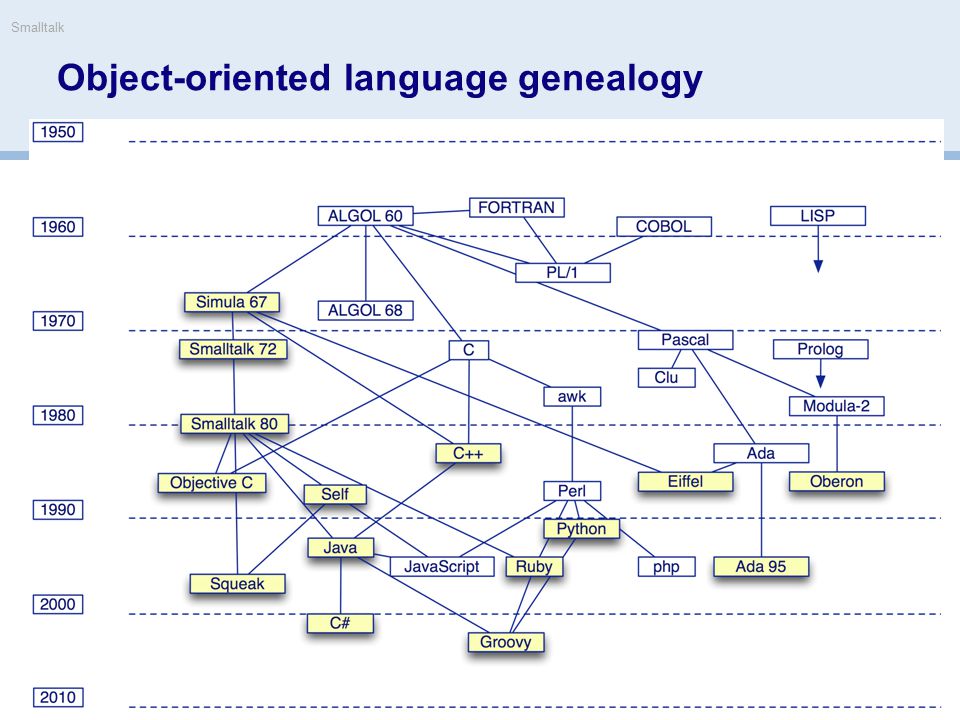

Thanks for mentioning me. I would just like to point out that I made FuzzyWorld in both Pharo and VSE, but since all my applications were in VSE (which I have been using since 1985!) I have brought it to VSE for graphic content and tools I had already developped. As you can see in the first slide of my presentation, FuzzyWorld is an extension of the Smalltalk classes and not of VSE or Pharo; both can use it. Anyway, I am a Pharo member, so I have been surprised for comments on my presentation. If I can express my opinion, this discussion is based on nothing: in my opinion Pharo is Smalltalk; everything else is VAPOR WARE. Lorenzo -----Messaggio originale----- Da: Pharo-users [mailto:pharo-users-bounces@lists.pharo.org] Per conto di horrido Inviato: mercoledì 5 febbraio 2020 19:51 A: pharo-users@lists.pharo.org Oggetto: Re: [Pharo-users] About "it's not pharo but smalltalk" Yes, these are two completely different issues... - Pharo is Smalltalk - you don't want general Smalltalk discussion polluting this forum I get it. But as I point out here <http://forum.world.st/Fuzzy-Thinking-in-Smalltalk-tp5111111p5111191.html> , Pharo is in a unique position and I would hope that the Pharo community is willing to participate in evangelizing Smalltalk. If there is truly another avenue that is as effective, I'm all ears. Sven Van Caekenberghe-2 wrote
On 5 Feb 2020, at 18:50, horrido <
horrido.hobbies@
> wrote:
It would be like trying to deny that Clojure, Scheme, and Racket are not LISP. Only an imbecile would claim they're not.
I am pretty sure the mailing lists of Clojure, Scheme or Racket don't want you to go there to discuss Common Lisp or Emacs' Lisp or to talk about general lisp revivals.
Especially, they would not want you tell them what they should or can't do based on their history.
-- Sent from: http://forum.world.st/Pharo-Smalltalk-Users-f1310670.html
participants (15)
-
 Ben Coman
 -
 Benoit St-Jean
 -
 Cédrick Béler
 -
 Esteban Lorenzano
 -
 Esteban Maringolo
 -
 horrido
 -
 Lorenzo
 -
 Norbert Hartl
 -
 Pavel Krivanek
 -
 Sean P. DeNigris
 -
 Steve Davies
 -
 Sven Van Caekenberghe
 -
 TedVanGaalen
 -
 Todd Blanchard
 -
 Trygve Reenskaug