perspective request for those earning a living from Smalltalk

At https://news.ycombinator.com/item?id=15523807 the question is asked... "Does anyone on here program in Smalltalk professionally? Not to get off topic, but I'm curious and would like to know how it stacks up compared to what they did previously? " If you've earning a living from programming Smalltalk, please drop a comment there. cheers -ben

Done :) On Sun, Oct 22, 2017 at 10:33 AM, Ben Coman <btc@openinworld.com> wrote:
At https://news.ycombinator.com/item?id=15523807 the question is asked... "Does anyone on here program in Smalltalk professionally? Not to get off topic, but I'm curious and would like to know how it stacks up compared to what they did previously? "
If you've earning a living from programming Smalltalk, please drop a comment there.
cheers -ben
-- Mariano http://marianopeck.wordpress.com

Here. (But from one point of view, it's a litte misery, 10-20 year old code sometimes, a mess, old VAST, absolutely no interest from young colleagues with no experience to willingly learn something about Smalltalk etc etc.). If I bring up enough arguments, we will use Gemstone+Pharo tools in the future, which is a dream for me... but, we will see... pf
At https://news.ycombinator.com/item?id=15523807 the question is asked... "Does anyone on here program in Smalltalk professionally? Not to get off topic, but I'm curious and would like to know how it stacks up compared to what they did previously? "
If you've earning a living from programming Smalltalk, please drop a comment there.
cheers -ben

Push petr! We are trying hard to make Pharo really a different programming experience and slowly we are getting there. Stef On Sun, Oct 22, 2017 at 6:56 PM, Petr Fischer <petr.fischer@me.com> wrote:
Here. (But from one point of view, it's a litte misery, 10-20 year old code sometimes, a mess, old VAST, absolutely no interest from young colleagues with no experience to willingly learn something about Smalltalk etc etc.).
If I bring up enough arguments, we will use Gemstone+Pharo tools in the future, which is a dream for me... but, we will see...
pf
At https://news.ycombinator.com/item?id=15523807 the question is asked... "Does anyone on here program in Smalltalk professionally? Not to get off topic, but I'm curious and would like to know how it stacks up compared to what they did previously? "
If you've earning a living from programming Smalltalk, please drop a comment there.
cheers -ben

Petr, I've been working as a Consultant for many big corporations (mainly in VA Smalltalk) since 1996. The situation you describe is very well known to me. But in my opinion there is no technical reason for this. It's a managerial problem. Ever since IBM went out to their customers and told them to move to Java for the better ini the mid-90ies, managers wanted the Smalltalk projects to go away as fast as possible. Nobody asked why IBM was still happily using VisualAge Smalltalk internally at that time frame.... So the Smalltalk projects were declared legacy by Management. Replacement projects were started with big efforts and optimism. Some went well, some somewhat came to fly in a bit more than double the time and much more times the costthan planned, some failed miserably. One thing was in common to the replacement projects all over the place: they took much longer, turned out to be much mor complicated and took a lot more manpower than anybody had ever imagined. So two important things happened: 1) People were told the old Smalltalk stuff would be gone soon, so if you wanted to be a valued and appreciated staff member, you better stay away from these projects 2) The people who knew the business and technical side of the existing projects were moved to the new projects. Some liked it (because of 1) some were frustrated (because they knew / feared the new project was going to be a death march) Over the first 2 years or so, nobody realized how bad the situation really was. It was easy to postpone user requirements to the new project, accumulate more and more manpower in the new project and still keep up green flags everywhere. ...until yellow was the new green and users/stakeholders wanted the new features NOW - and not one day when the replacement project would become real. So the remaining manpower in the old project (not the ones with lots of experience and knowledge) had to extend the old system, integrate it with the new system (thereby implementing all the stuff that IBM once told their management would never be possible in Smalltalk) and keep it up and ranning year after year. Nobody ever said Thank You or would appreciate the work they did. Because that was old stuff anyways and was already irrelevant. Some of these old systems still exist today, serving users every single day, while some of the new systems never appeared. No manpower was ever added to these projects, and never would anybody ever say: okay, guys, you won. They still work on legacy code and try to do their best to fulfill user requirements. While on other projects that never see the light of day, people get appreciation, are allowed to work with new technologies and do cool stuff. Nobody ever asked the Smalltalkers whether they could do that as well, because "if you want to do web, you need to do Java". IBM said so, you know (and many other consultants as well). So this is why new people try to stay away from these old projects. This is why the remaining staff is frustrated and this is why nobody allows them to do the cool things that Smalltalk can do as well as the others. They are just required to fix bugs, add new features in the old GUIs and else keep silent. Some of them were trying to fight this and tried to prove Smalltalk's strengths, but back then nobody would listen. One day they gave up. Management still frustrates people every. single. day. Just my opinion Joachim Am 22.10.17 um 18:56 schrieb Petr Fischer:
Here. (But from one point of view, it's a litte misery, 10-20 year old code sometimes, a mess, old VAST, absolutely no interest from young colleagues with no experience to willingly learn something about Smalltalk etc etc.).
If I bring up enough arguments, we will use Gemstone+Pharo tools in the future, which is a dream for me... but, we will see...
pf
At https://news.ycombinator.com/item?id=15523807 the question is asked... "Does anyone on here program in Smalltalk professionally? Not to get off topic, but I'm curious and would like to know how it stacks up compared to what they did previously? "
If you've earning a living from programming Smalltalk, please drop a comment there.
cheers -ben
-- ----------------------------------------------------------------------- Objektfabrik Joachim Tuchel mailto:jtuchel@objektfabrik.de Fliederweg 1Â Â Â Â Â Â Â Â Â Â Â Â Â http://www.objektfabrik.de D-71640 Ludwigsburg http://joachimtuchel.wordpress.com Telefon: +49 7141 56 10 86 0Â Â Â Â Â Fax: +49 7141 56 10 86 1

Your history is accurate, but thereâs a few things Iâd like to add, due to having been employed by IBM at exactly that period working specifically on VisualAge, not only for Smalltalk, but for Java, C++ and Cobol as well. (my NDAâs finally having expired also helps ð). Itâs not a correction or contradiction, but a complement to your description, providing a relevant but different perspective. IBM did tell some of their customers to move to Java, but that was partly based on the existence of VisualAge for Java, which in some ways went beyond VA Smalltalk, in others not as far, but did make migration to Java easier, and in some cases possible at all. Its replacement, Eclipse, simply doesnât. And it could do so, because as with all VisualAge products, it was written in Smalltalk. One of the things that annoys me about the whole thing the most is that the biggest complaint, which was a partial but significant reason it wasnât more popular, was from developers who âcouldnât see their filesâ, i.e. couldnât edit them in vi(le) and build on the command line. I heard that complaint on a project using both the Java and C++ versions so many times I finally responded ânobody gives a shit about your f*cking filesâ, in the middle of the office at Pratt & Whitney Aerospace, lol. Since VA for Java (and VA C++) are now abandonware, itâs an example of what I meant by owning a market, failing to promote it, and thereby destroying it, and also the reason I referred to IBM specifically as being âvery good at it' I was involved in writing a major application in both Java and C++ using CORBA in 2000-2002, and on that we also used both VA C++ and VA Java. Otherwise, quite honestly, we may not have finished it despite having some brilliant people on the team, since doing CORBA manually, especially with object trees that use C++ multiple inheritance, can be near impossible to get working reliably. Unfortunately, due to being abandoned, the core of the app is no longer even buildable with current tools. If you look at the binary jars in the latest release (2016) the dates on them are still mid-2002. The most surprising thing to me is that they still run at all, particularly with Java 8 on current platforms (mainly Solaris 11 and Windows 10), considering they were written and built on Java 1.3.1, and although they targeted Windows and Solaris/AIX, were in fact written on OS/2 v. 4, because Solaris didnât run at the time on any laptop, and Windows 2000 loaded on a high spec laptop for the time but couldnât really be judged to be running, i.e. it loaded and proceeded to thrash to the degree that nothing further got accomplished. VA Smalltalk as itâs publicly available (at the not insignificant cost of ~$8500+ per license), is written on a base IBM Smalltalk thatâs ~26 years old. Instantiations has improved some things, but the core is vastly out of date. Meanwhile, IBM themselves have a fully current version (the last version I saw, when visiting a former colleague at the lab, was released early last year, but is only available internally. This wasnât one of the four I referred to in my other post, but nearly qualifies as âpublicly unavailableâ, since the available version is not nearly the same. VA is also very out of date in comparison with VW, Pharo, F-Script and Squeak, not only in comparison with the internal version. In particular the UI doesnât fully incorporate the improvements made (largely via the Announcer) in Morphic and the other current Smalltalk GUIâs. Like Swing and SWT, part of those improvements are there, but that in many ways only makes things worse. That WindowBuilder (available free for Java in Eclipse, but not for free in VA Smalltalk) is in fact a simple port of the original Smalltalk version is demonstration enough that the UI is not significantly different than the UI in Eclipse itself, or in Swing, since Swing is also supported by WindowBuilder. As an example of the remaining problems, I recently reverse engineered a complex legacy database via the Eclipse Dali JPA tools in order to make it available to BIRT / Talend for reporting. On an i7 with the DB on an SSD, it took over 950 CPU hours to complete. As of today, it has been in process of exiting for another 140 CPU hours, trying to catch up with the events triggered by Dali. Perhaps that helps understand why Iâm not thrilled with even some of the better libraries in many other environments. Outside Smalltalk and languages with IDEâs written in it. OS/2 is a great example of owning a market, then destroying it by not promoting it. OS/2 never owned the mainstream market of course, but what it did largely own was the smaller but sometimes crucial market for PC based systems that could run complex software reliably. Despite having âkilledâ OS/2 13 years ago, version 5.0 came out in June, released by a âcompanyâ of former IBM people financed by IBM, whose company name means ânew boxâ. The reason IBM canât completely kill it is that companies who canât move software off it, because every attempt to do so (to either Windows Server or different forms of *nix) has failed, in some cases over a dozen times, include such small entities as Boeing, MIT, NASA, the US government, including all four branches of the military, all of the worldâs airlines, GE, Rolls Royce, Pratt & Whitney, GM, Siemens, AT&T, and Citibank, just to name a few I know of (and none are exactly publicizing the fact). Despite the existence, today, of both Linux and Solaris on x86, and the improvements between Windows NT in the 1990âs and Windows Server today, institutions with fairly capable developers, such as MIT and Bell Labs, just to name two, canât port software they simultaneously canât be without, to any of those platforms. There is a specific technology in OS/2 not available elsewhere that is the main culprit, the Distributed System Object Model. Somewhat ironically though, one of the main uses of SOM/DSOM is to provide the type of live object manipulation and debugging to the core environment (and in a distributed manner) common in dialects of Smalltalk but virtually unknown otherwise. The person I learned Java RMI, JINI and J2EE architecture from was, by happenstance, the same person who architected OS/2. A somewhat humorous story is that IBM dropped out of a project begun with Sun in the late 1990âs to write a pure JavaOS. IBMâs reason for dropping out was embarrassment at the fact that pure Java apps ran faster on OS/2 than on the pure JavaOS. Sun couldnât at the time afford to complete it on their own so it disappeared, as unreleased products do, without even the marginal trace of existing on abandonware sites. That person was also, unsurprisingly, one of the key developers of IBM Smalltalk. Iâm not claiming that IBM or anyone else does such things in a completely aware way. Rather, the fact that efficient environments are difficult to build without significant time and resources (both are necessary because no matter how many resources are available, rushing the development will result in mistakes that have to be fixed later, giving the environment an unstable base to build on), combined with the advantage industry inefficiencies provide to the companies with those resources, makes the situation relatively easy to reinforce without really needing to admit what youâre doing, particularly to yourself. Andrew Sent from Mail for Windows 10 From: jtuchel@objektfabrik.de Sent: Monday, October 23, 2017 3:32 AM To: Any question about pharo is welcome Subject: Re: [Pharo-users] perspective request for those earning a living fromSmalltalk Petr, I've been working as a Consultant for many big corporations (mainly in VA Smalltalk) since 1996. The situation you describe is very well known to me. But in my opinion there is no technical reason for this. It's a managerial problem. Ever since IBM went out to their customers and told them to move to Java for the better ini the mid-90ies, managers wanted the Smalltalk projects to go away as fast as possible. Nobody asked why IBM was still happily using VisualAge Smalltalk internally at that time frame.... So the Smalltalk projects were declared legacy by Management. Replacement projects were started with big efforts and optimism. Some went well, some somewhat came to fly in a bit more than double the time and much more times the costthan planned, some failed miserably. One thing was in common to the replacement projects all over the place: they took much longer, turned out to be much mor complicated and took a lot more manpower than anybody had ever imagined. So two important things happened: 1) People were told the old Smalltalk stuff would be gone soon, so if you wanted to be a valued and appreciated staff member, you better stay away from these projects 2) The people who knew the business and technical side of the existing projects were moved to the new projects. Some liked it (because of 1) some were frustrated (because they knew / feared the new project was going to be a death march) Over the first 2 years or so, nobody realized how bad the situation really was. It was easy to postpone user requirements to the new project, accumulate more and more manpower in the new project and still keep up green flags everywhere. ...until yellow was the new green and users/stakeholders wanted the new features NOW - and not one day when the replacement project would become real. So the remaining manpower in the old project (not the ones with lots of experience and knowledge) had to extend the old system, integrate it with the new system (thereby implementing all the stuff that IBM once told their management would never be possible in Smalltalk) and keep it up and ranning year after year. Nobody ever said Thank You or would appreciate the work they did. Because that was old stuff anyways and was already irrelevant. Some of these old systems still exist today, serving users every single day, while some of the new systems never appeared. No manpower was ever added to these projects, and never would anybody ever say: okay, guys, you won. They still work on legacy code and try to do their best to fulfill user requirements. While on other projects that never see the light of day, people get appreciation, are allowed to work with new technologies and do cool stuff. Nobody ever asked the Smalltalkers whether they could do that as well, because "if you want to do web, you need to do Java". IBM said so, you know (and many other consultants as well). So this is why new people try to stay away from these old projects. This is why the remaining staff is frustrated and this is why nobody allows them to do the cool things that Smalltalk can do as well as the others. They are just required to fix bugs, add new features in the old GUIs and else keep silent. Some of them were trying to fight this and tried to prove Smalltalk's strengths, but back then nobody would listen. One day they gave up. Management still frustrates people every. single. day. Just my opinion Joachim Am 22.10.17 um 18:56 schrieb Petr Fischer:
Here. (But from one point of view, it's a litte misery, 10-20 year old code sometimes, a mess, old VAST, absolutely no interest from young colleagues with no experience to willingly learn something about Smalltalk etc etc.).
If I bring up enough arguments, we will use Gemstone+Pharo tools in the future, which is a dream for me... but, we will see...
pf
At https://news.ycombinator.com/item?id=15523807 the question is asked... "Does anyone on here program in Smalltalk professionally? Not to get off topic, but I'm curious and would like to know how it stacks up compared to what they did previously? "
If you've earning a living from programming Smalltalk, please drop a comment there.
cheers -ben
-- ----------------------------------------------------------------------- Objektfabrik Joachim Tuchel mailto:jtuchel@objektfabrik.de Fliederweg 1Â Â Â Â Â Â Â Â Â Â Â Â Â http://www.objektfabrik.de D-71640 Ludwigsburg http://joachimtuchel.wordpress.com Telefon: +49 7141 56 10 86 0Â Â Â Â Â Fax: +49 7141 56 10 86 1

Thank you , Andrew, for that back-story! I really liked OS/2 and was extremely reluctant to give it up; it had a really good design. On Sat, Oct 28, 2017 at 10:59 AM, Andrew Glynn <aglynn42@gmail.com> wrote:
Your history is accurate, but thereâs a few things Iâd like to add, due to having been employed by IBM at exactly that period working specifically on VisualAge, not only for Smalltalk, but for Java, C++ and Cobol as well. (my NDAâs finally having expired also helps ð). Itâs not a correction or contradiction, but a complement to your description, providing a relevant but different perspective.
IBM *did* tell some of their customers to move to Java, but that was partly based on the existence of VisualAge for Java, which in some ways went beyond VA Smalltalk, in others not as far, but did make migration to Java easier, and in some cases possible at all. Its replacement, Eclipse, simply doesnât. And it could do so, because as with all VisualAge products, it was written in Smalltalk. One of the things that annoys me about the whole thing the most is that the biggest complaint, which was a partial but significant reason it wasnât more popular, was from developers who âcouldnât see their filesâ, i.e. couldnât edit them in vi(le) and build on the command line. I heard that complaint on a project using both the Java and C++ versions so many times I finally responded ânobody gives a shit about your f*cking filesâ, in the middle of the office at Pratt & Whitney Aerospace, lol.
Since VA for Java (and VA C++) are now abandonware, itâs an example of what I meant by owning a market, failing to promote it, and thereby destroying it, and also the reason I referred to IBM specifically as being âvery good at it'
I was involved in writing a major application in both Java and C++ using CORBA in 2000-2002, and on that we also used both VA C++ and VA Java. Otherwise, quite honestly, we may not have finished it despite having some brilliant people on the team, since doing CORBA manually, especially with object trees that use C++ multiple inheritance, can be near impossible to get working reliably.
Unfortunately, due to being abandoned, the core of the app is no longer even buildable with current tools. If you look at the binary jars in the latest release (2016) the dates on them are still mid-2002. The most surprising thing to me is that they still run at all, particularly with Java 8 on current platforms (mainly Solaris 11 and Windows 10), considering they were written and built on Java 1.3.1, and although they targeted Windows and Solaris/AIX, were in fact written on OS/2 v. 4, because Solaris didnât run at the time on any laptop, and Windows 2000 *loaded* on a high spec laptop for the time but couldnât really be judged to be *running*, i.e. it loaded and proceeded to thrash to the degree that nothing further got accomplished.
VA Smalltalk as itâs publicly available (at the not insignificant cost of ~$8500+ per license), is written on a base IBM Smalltalk thatâs ~26 years old. Instantiations has improved some things, but the core is vastly out of date. Meanwhile, IBM themselves have a fully current version (the last version I saw, when visiting a former colleague at the lab, was released early last year, but is only available internally. This wasnât one of the four I referred to in my other post, but nearly qualifies as âpublicly unavailableâ, since the available version is not nearly the same.
VA is also very out of date in comparison with VW, Pharo, F-Script and Squeak, not only in comparison with the internal version. In particular the UI doesnât fully incorporate the improvements made (largely via the Announcer) in Morphic and the other current Smalltalk GUIâs. Like Swing and SWT, part of those improvements are there, but that in many ways only makes things worse. That WindowBuilder (available free for Java in Eclipse, but not for free in VA Smalltalk) is in fact a simple port of the original Smalltalk version is demonstration enough that the UI is not significantly different than the UI in Eclipse itself, or in Swing, since Swing is also supported by WindowBuilder.
As an example of the remaining problems, I recently reverse engineered a complex legacy database via the Eclipse Dali JPA tools in order to make it available to BIRT / Talend for reporting. On an i7 with the DB on an SSD, it took over 950 CPU hours to complete. As of today, it has been in process of exiting for another 140 CPU hours, trying to catch up with the events triggered by Dali.
Perhaps that helps understand why Iâm not thrilled with even some of the better libraries in many other environments.
Outside Smalltalk and languages with IDEâs written in it. OS/2 is a great example of owning a market, then destroying it by not promoting it. OS/2 never owned the mainstream market of course, but what it did largely own was the smaller but sometimes crucial market for PC based systems that could run complex software reliably. Despite having âkilledâ OS/2 13 years ago, version 5.0 came out in June, released by a âcompanyâ of former IBM people financed by IBM, whose company name means ânew boxâ.
The reason IBM canât completely kill it is that companies who canât move software off it, because every attempt to do so (to either Windows Server or different forms of *nix) has failed, in some cases over a dozen times, include such small entities as Boeing, MIT, NASA, the US government, including all four branches of the military, all of the worldâs airlines, GE, Rolls Royce, Pratt & Whitney, GM, Siemens, AT&T, and Citibank, just to name a few I know of (and none are exactly publicizing the fact). Despite the existence, today, of both Linux and Solaris on x86, and the improvements between Windows NT in the 1990âs and Windows Server today, institutions with fairly capable developers, such as MIT and Bell Labs, just to name two, canât port software they simultaneously canât be without, to any of those platforms. There *is* a specific technology in OS/2 not available elsewhere that is the main culprit, the Distributed System Object Model. Somewhat ironically though, one of the main uses of SOM/DSOM is to provide the type of live object manipulation and debugging to the core environment (and in a distributed manner) common in dialects of Smalltalk but virtually unknown otherwise.
The person I learned Java RMI, JINI and J2EE architecture from was, by happenstance, the same person who architected OS/2. A somewhat humorous story is that IBM dropped out of a project begun with Sun in the late 1990âs to write a pure JavaOS. IBMâs reason for dropping out was embarrassment at the fact that pure Java apps ran faster on OS/2 than on the pure JavaOS. Sun couldnât at the time afford to complete it on their own so it disappeared, as unreleased products do, without even the marginal trace of existing on abandonware sites. That person was also, unsurprisingly, one of the key developers of IBM Smalltalk.
Iâm not claiming that IBM or anyone else does such things in a completely aware way. Rather, the fact that efficient environments are difficult to build without significant time and resources (both are necessary because no matter how many resources are available, rushing the development will result in mistakes that have to be fixed later, giving the environment an unstable base to build on), combined with the advantage industry inefficiencies provide to the companies *with* those resources, makes the situation relatively easy to reinforce *without *really needing to admit what youâre doing, particularly to yourself.
Andrew
Sent from Mail <https://go.microsoft.com/fwlink/?LinkId=550986> for Windows 10
*From: *jtuchel@objektfabrik.de *Sent: *Monday, October 23, 2017 3:32 AM *To: *Any question about pharo is welcome <pharo-users@lists.pharo.org> *Subject: *Re: [Pharo-users] perspective request for those earning a living fromSmalltalk
Petr,
I've been working as a Consultant for many big corporations (mainly in
VA Smalltalk) since 1996. The situation you describe is very well known
to me. But in my opinion there is no technical reason for this. It's a
managerial problem. Ever since IBM went out to their customers and told
them to move to Java for the better ini the mid-90ies, managers wanted
the Smalltalk projects to go away as fast as possible. Nobody asked why
IBM was still happily using VisualAge Smalltalk internally at that time
frame....
So the Smalltalk projects were declared legacy by Management.
Replacement projects were started with big efforts and optimism. Some
went well, some somewhat came to fly in a bit more than double the time
and much more times the costthan planned, some failed miserably. One
thing was in common to the replacement projects all over the place: they
took much longer, turned out to be much mor complicated and took a lot
more manpower than anybody had ever imagined.
So two important things happened:
1) People were told the old Smalltalk stuff would be gone soon, so if
you wanted to be a valued and appreciated staff member, you better stay
away from these projects
2) The people who knew the business and technical side of the existing
projects were moved to the new projects. Some liked it (because of 1)
some were frustrated (because they knew / feared the new project was
going to be a death march)
Over the first 2 years or so, nobody realized how bad the situation
really was. It was easy to postpone user requirements to the new
project, accumulate more and more manpower in the new project and still
keep up green flags everywhere.
...until yellow was the new green and users/stakeholders wanted the new
features NOW - and not one day when the replacement project would become
real.
So the remaining manpower in the old project (not the ones with lots of
experience and knowledge) had to extend the old system, integrate it
with the new system (thereby implementing all the stuff that IBM once
told their management would never be possible in Smalltalk) and keep it
up and ranning year after year. Nobody ever said Thank You or would
appreciate the work they did. Because that was old stuff anyways and was
already irrelevant.
Some of these old systems still exist today, serving users every single
day, while some of the new systems never appeared. No manpower was ever
added to these projects, and never would anybody ever say: okay, guys,
you won. They still work on legacy code and try to do their best to
fulfill user requirements. While on other projects that never see the
light of day, people get appreciation, are allowed to work with new
technologies and do cool stuff. Nobody ever asked the Smalltalkers
whether they could do that as well, because "if you want to do web, you
need to do Java". IBM said so, you know (and many other consultants as
well).
So this is why new people try to stay away from these old projects. This
is why the remaining staff is frustrated and this is why nobody allows
them to do the cool things that Smalltalk can do as well as the others.
They are just required to fix bugs, add new features in the old GUIs and
else keep silent. Some of them were trying to fight this and tried to
prove Smalltalk's strengths, but back then nobody would listen. One day
they gave up.
Management still frustrates people every. single. day.
Just my opinion
Joachim
Am 22.10.17 um 18:56 schrieb Petr Fischer:
Here. (But from one point of view, it's a litte misery, 10-20 year old code sometimes, a mess, old VAST, absolutely no interest from young colleagues with no experience to willingly learn something about Smalltalk etc etc.).
If I bring up enough arguments, we will use Gemstone+Pharo tools in the future, which is a dream for me... but, we will see...
pf
the question is asked... "Does anyone on here program in Smalltalk
professionally? Not to get off topic, but I'm curious and would like to
know how it stacks up compared to what they did previously? "
If you've earning a living from programming Smalltalk, please drop a
comment there.
cheers -ben
--
-----------------------------------------------------------------------
Objektfabrik Joachim Tuchel mailto:jtuchel@objektfabrik.de
Fliederweg 1 http://www.objektfabrik.de
D-71640 Ludwigsburg http://joachimtuchel.wordpress.com
Telefon: +49 7141 56 10 86 0 Fax: +49 7141 56 10 86 1
A tiny example why OS/2 was great: You could have two printer instances on your desktop for colour printers: one for a b/w printing and one for Colour printing. You could even have another one for printing from tray 1,2, or duplex. You still can't do that in Windows these days (about 20 years later) and even on a Mac it is complicated and hard to handle. Great does not necessarily mean great money. So things get abandoned no matter how great they are ;-) Joachim Am 28.10.17 um 20:11 schrieb Richard Sargent:
Thank you , Andrew, for that back-story! I really liked OS/2 and was extremely reluctant to give it up; it had a really good design.
On Sat, Oct 28, 2017 at 10:59 AM, Andrew Glynn <aglynn42@gmail.com <mailto:aglynn42@gmail.com>> wrote:
Your history is accurate, but thereâs a few things Iâd like to add, due to having been employed by IBM at exactly that period working specifically on VisualAge, not only for Smalltalk, but for Java, C++ and Cobol as well. (my NDAâs finally having expired also helps ð). Itâs not a correction or contradiction, but a complement to your description, providing a relevant but different perspective.
IBM /did/ tell some// of their customers to move to Java, but that was partly based on the existence of VisualAge for Java, which in some ways went beyond VA Smalltalk, in others not as far, but did make migration to Java easier, and in some cases possible at all. Its replacement, Eclipse, simply doesnât. And it could do so, because as with all VisualAge products, it was written in Smalltalk. One of the things that annoys me about the whole thing the most is that the biggest complaint, which was a partial but significant reason it wasnât more popular, was from developers who âcouldnât see their filesâ, i.e. couldnât edit them in vi(le) and build on the command line. I heard that complaint on a project using both the Java and C++ versions so many times I finally responded ânobody gives a shit about your f*cking filesâ, in the middle of the office at Pratt & Whitney Aerospace, lol.
Since VA for Java (and VA C++) are now abandonware, itâs an example of what I meant by owning a market, failing to promote it, and thereby destroying it, and also the reason I referred to IBM specifically as being âvery good at it'
I was involved in writing a major application in both Java and C++ using CORBA in 2000-2002, and on that we also used both VA C++ and VA Java. Otherwise, quite honestly, we may not have finished it despite having some brilliant people on the team, since doing CORBA manually, especially with object trees that use C++ multiple inheritance, can be near impossible to get working reliably.
Unfortunately, due to being abandoned, the core of the app is no longer even buildable with current tools. If you look at the binary jars in the latest release (2016) the dates on them are still mid-2002. The most surprising thing to me is that they still run at all, particularly with Java 8 on current platforms (mainly Solaris 11 and Windows 10), considering they were written and built on Java 1.3.1, and although they targeted Windows and Solaris/AIX, were in fact written on OS/2 v. 4, because Solaris didnât run at the time on any laptop, and Windows 2000 /loaded/ on a high spec laptop for the time but couldnât really be judged to be /running/, i.e. it loaded and proceeded to thrash to the degree that nothing further got accomplished.
VA Smalltalk as itâs publicly available (at the not insignificant cost of ~$8500+ per license), is written on a base IBM Smalltalk thatâs ~26 years old. Instantiations has improved some things, but the core is vastly out of date. Meanwhile, IBM themselves have a fully current version (the last version I saw, when visiting a former colleague at the lab, was released early last year, but is only available internally. This wasnât one of the four I referred to in my other post, but nearly qualifies as âpublicly unavailableâ, since the available version is not nearly the same.
VA is also very out of date in comparison with VW, Pharo, F-Script and Squeak, not only in comparison with the internal version. In particular the UI doesnât fully incorporate the improvements made (largely via the Announcer) in Morphic and the other current Smalltalk GUIâs. Like Swing and SWT, part of those improvements are there, but that in many ways only makes things worse. That WindowBuilder (available free for Java in Eclipse, but not for free in VA Smalltalk) is in fact a simple port of the original Smalltalk version is demonstration enough that the UI is not significantly different than the UI in Eclipse itself, or in Swing, since Swing is also supported by WindowBuilder.
As an example of the remaining problems, I recently reverse engineered a complex legacy database via the Eclipse Dali JPA tools in order to make it available to BIRT / Talend for reporting. On an i7 with the DB on an SSD, it took over 950 CPU hours to complete. As of today, it has been in process of exiting for another 140 CPU hours, trying to catch up with the events triggered by Dali.
Perhaps that helps understand why Iâm not thrilled with even some of the better libraries in many other environments.
Outside Smalltalk and languages with IDEâs written in it.  OS/2 is a great example of owning a market, then destroying it by not promoting it. OS/2 never owned the mainstream market of course, but what it did largely own was the smaller but sometimes crucial market for PC based systems that could run complex software reliably. Despite having âkilledâ OS/2 13 years ago, version 5.0 came out in June, released by a âcompanyâ of former IBM people financed by IBM, whose company name means ânew boxâ.
The reason IBM canât completely kill it is that companies who canât move software off it, because every attempt to do so (to either Windows Server or different forms of *nix) has failed, in some cases over a dozen times, include such small entities as Boeing, MIT, NASA, the US government, including all four branches of the military, all of the worldâs airlines, GE, Rolls Royce, Pratt & Whitney, GM, Siemens, AT&T, and Citibank, just to name a few I know of (and none are exactly publicizing the fact). Despite the existence, today, of both Linux and Solaris on x86, and the improvements between Windows NT in the 1990âs and Windows Server today, institutions with fairly capable developers, such as MIT and Bell Labs, just to name two, canât port software they simultaneously canât be without, to any of those platforms. There /is/ a specific technology in OS/2 not available elsewhere that is the main culprit, the Distributed System Object Model. Somewhat ironically though, one of the main uses of SOM/DSOM is to provide the type of live object manipulation and debugging to the core environment (and in a distributed manner) common in dialects of Smalltalk but virtually unknown otherwise.
The person I learned Java RMI, JINI and J2EE architecture from was, by happenstance, the same person who architected OS/2. A somewhat humorous story is that IBM dropped out of a project begun with Sun in the late 1990âs to write a pure JavaOS. IBMâs reason for dropping out was embarrassment at the fact that pure Java apps ran faster on OS/2 than on the pure JavaOS. Sun couldnât at the time afford to complete it on their own so it disappeared, as unreleased products do, without even the marginal trace of existing on abandonware sites. That person was also, unsurprisingly, one of the key developers of IBM Smalltalk.
Iâm not claiming that IBM or anyone else does such things in a completely aware way. Rather, the fact that efficient environments are difficult to build without significant time and resources (both are necessary because no matter how many resources are available, rushing the development will result in mistakes that have to be fixed later, giving the environment an unstable base to build on), combined with the advantage industry inefficiencies provide to the companies /with/ those resources, makes the situation relatively easy to reinforce /without /really needing to admit what youâre doing, particularly to yourself.
Andrew
Sent from Mail <https://go.microsoft.com/fwlink/?LinkId=550986> for Windows 10
*From: *jtuchel@objektfabrik.de <mailto:jtuchel@objektfabrik.de> *Sent: *Monday, October 23, 2017 3:32 AM *To: *Any question about pharo is welcome <mailto:pharo-users@lists.pharo.org> *Subject: *Re: [Pharo-users] perspective request for those earning a living fromSmalltalk
Petr,
I've been working as a Consultant for many big corporations (mainly in
VA Smalltalk) since 1996. The situation you describe is very well known
to me. But in my opinion there is no technical reason for this. It's a
managerial problem. Ever since IBM went out to their customers and told
them to move to Java for the better ini the mid-90ies, managers wanted
the Smalltalk projects to go away as fast as possible. Nobody asked why
IBM was still happily using VisualAge Smalltalk internally at that time
frame....
So the Smalltalk projects were declared legacy by Management.
Replacement projects were started with big efforts and optimism. Some
went well, some somewhat came to fly in a bit more than double the time
and much more times the costthan planned, some failed miserably. One
thing was in common to the replacement projects all over the place: they
took much longer, turned out to be much mor complicated and took a lot
more manpower than anybody had ever imagined.
So two important things happened:
1) People were told the old Smalltalk stuff would be gone soon, so if
you wanted to be a valued and appreciated staff member, you better stay
away from these projects
2) The people who knew the business and technical side of the existing
projects were moved to the new projects. Some liked it (because of 1)
some were frustrated (because they knew / feared the new project was
going to be a death march)
Over the first 2 years or so, nobody realized how bad the situation
really was. It was easy to postpone user requirements to the new
project, accumulate more and more manpower in the new project and still
keep up green flags everywhere.
...until yellow was the new green and users/stakeholders wanted the new
features NOW - and not one day when the replacement project would become
real.
So the remaining manpower in the old project (not the ones with lots of
experience and knowledge) had to extend the old system, integrate it
with the new system (thereby implementing all the stuff that IBM once
told their management would never be possible in Smalltalk) and keep it
up and ranning year after year. Nobody ever said Thank You or would
appreciate the work they did. Because that was old stuff anyways and was
already irrelevant.
Some of these old systems still exist today, serving users every single
day, while some of the new systems never appeared. No manpower was ever
added to these projects, and never would anybody ever say: okay, guys,
you won. They still work on legacy code and try to do their best to
fulfill user requirements. While on other projects that never see the
light of day, people get appreciation, are allowed to work with new
technologies and do cool stuff. Nobody ever asked the Smalltalkers
whether they could do that as well, because "if you want to do web, you
need to do Java". IBM said so, you know (and many other consultants as
well).
So this is why new people try to stay away from these old projects. This
is why the remaining staff is frustrated and this is why nobody allows
them to do the cool things that Smalltalk can do as well as the others.
They are just required to fix bugs, add new features in the old GUIs and
else keep silent. Some of them were trying to fight this and tried to
prove Smalltalk's strengths, but back then nobody would listen. One day
they gave up.
Management still frustrates people every. single. day.
Just my opinion
Joachim
Am 22.10.17 um 18:56 schrieb Petr Fischer:
> Here. (But from one point of view, it's a litte misery, 10-20 year old code sometimes, a mess, old VAST, absolutely no interest from young colleagues with no experience to willingly learn something about Smalltalk etc etc.).
>
> If I bring up enough arguments, we will use Gemstone+Pharo tools in the future, which is a dream for me... but, we will see...
>
> pf
>
>> At https://news.ycombinator.com/item?id=15523807 <https://news.ycombinator.com/item?id=15523807>
>> the question is asked... "Does anyone on here program in Smalltalk
>> professionally? Not to get off topic, but I'm curious and would like to
>> know how it stacks up compared to what they did previously? "
>>
>> If you've earning a living from programming Smalltalk, please drop a
>> comment there.
>>
>> cheers -ben
>
--
-----------------------------------------------------------------------
Objektfabrik Joachim Tuchel         mailto:jtuchel@objektfabrik.de <mailto:jtuchel@objektfabrik.de>
Fliederweg 1 http://www.objektfabrik.de
D-71640 Ludwigsburg http://joachimtuchel.wordpress.com <http://joachimtuchel.wordpress.com>
Telefon: +49 7141 56 10 86 0 Â Fax: +49 7141 56 10 86 1
-- ----------------------------------------------------------------------- Objektfabrik Joachim Tuchel mailto:jtuchel@objektfabrik.de Fliederweg 1Â Â Â Â Â Â Â Â Â Â Â Â Â http://www.objektfabrik.de D-71640 Ludwigsburg http://joachimtuchel.wordpress.com Telefon: +49 7141 56 10 86 0Â Â Â Â Â Fax: +49 7141 56 10 86 1
They did just release 5.0 in June, lol. Sent from Mail for Windows 10 From: jtuchel@objektfabrik.de Sent: Monday, November 6, 2017 2:46 AM To: pharo-users@lists.pharo.org Subject: Re: [Pharo-users] perspective request for those earning a livingfromSmalltalk A tiny example why OS/2 was great: You could have two printer instances on your desktop for colour printers: one for a b/w printing and one for Colour printing. You could even have another one for printing from tray 1,2, or duplex. You still can't do that in Windows these days (about 20 years later) and even on a Mac it is complicated and hard to handle. Great does not necessarily mean great money. So things get abandoned no matter how great they are ;-) Joachim Am 28.10.17 um 20:11 schrieb Richard Sargent: Thank you , Andrew, for that back-story! I really liked OS/2 and was extremely reluctant to give it up; it had a really good design. On Sat, Oct 28, 2017 at 10:59 AM, Andrew Glynn <aglynn42@gmail.com> wrote: Your history is accurate, but thereâs a few things Iâd like to add, due to having been employed by IBM at exactly that period working specifically on VisualAge, not only for Smalltalk, but for Java, C++ and Cobol as well. (my NDAâs finally having expired also helps ð). Itâs not a correction or contradiction, but a complement to your description, providing a relevant but different perspective.  IBM did tell some  of their customers to move to Java, but that was partly based on the existence of VisualAge for Java, which in some ways went beyond VA Smalltalk, in others not as far, but did make migration to Java easier, and in some cases possible at all. Its replacement, Eclipse, simply doesnât. And it could do so, because as with all VisualAge products, it was written in Smalltalk. One of the things that annoys me about the whole thing the most is that the biggest complaint, which was a partial but significant reason it wasnât more popular, was from developers who âcouldnât see their filesâ, i.e. couldnât edit them in vi(le) and build on the command line. I heard that complaint on a project using both the Java and C++ versions so many times I finally responded ânobody gives a shit about your f*cking filesâ, in the middle of the office at Pratt & Whitney Aerospace, lol.  Since VA for Java (and VA C++) are now abandonware, itâs an example of what I meant by owning a market, failing to promote it, and thereby destroying it, and also the reason I referred to IBM specifically as being âvery good at it'   I was involved in writing a major application in both Java and C++ using CORBA in 2000-2002, and on that we also used both VA C++ and VA Java. Otherwise, quite honestly, we may not have finished it despite having some brilliant people on the team, since doing CORBA manually, especially with object trees that use C++ multiple inheritance, can be near impossible to get working reliably.  Unfortunately, due to being abandoned, the core of the app is no longer even buildable with current tools. If you look at the binary jars in the latest release (2016) the dates on them are still mid-2002. The most surprising thing to me is that they still run at all, particularly with Java 8 on current platforms (mainly Solaris 11 and Windows 10), considering they were written and built on Java 1.3.1, and although they targeted Windows and Solaris/AIX, were in fact written on OS/2 v. 4, because Solaris didnât run at the time on any laptop, and Windows 2000 loaded on a high spec laptop for the time but couldnât really be judged to be running, i.e. it loaded and proceeded to thrash to the degree that nothing further got accomplished.  VA Smalltalk as itâs publicly available (at the not insignificant cost of ~$8500+ per license), is written on a base IBM Smalltalk thatâs ~26 years old. Instantiations has improved some things, but the core is vastly out of date. Meanwhile, IBM themselves have a fully current version (the last version I saw, when visiting a former colleague at the lab, was released early last year, but is only available internally. This wasnât one of the four I referred to in my other post, but nearly qualifies as âpublicly unavailableâ, since the available version is not nearly the same.  VA is also very out of date in comparison with VW, Pharo, F-Script and Squeak, not only in comparison with the internal version. In particular the UI doesnât fully incorporate the improvements made (largely via the Announcer) in Morphic and the other current Smalltalk GUIâs. Like Swing and SWT, part of those improvements are there, but that in many ways only makes things worse. That WindowBuilder (available free for Java in Eclipse, but not for free in VA Smalltalk) is in fact a simple port of the original Smalltalk version is demonstration enough that the UI is not significantly different than the UI in Eclipse itself, or in Swing, since Swing is also supported by WindowBuilder.  As an example of the remaining problems, I recently reverse engineered a complex legacy database via the Eclipse Dali JPA tools in order to make it available to BIRT / Talend for reporting. On an i7 with the DB on an SSD, it took over 950 CPU hours to complete. As of today, it has been in process of exiting for another 140 CPU hours, trying to catch up with the events triggered by Dali.  Perhaps that helps understand why Iâm not thrilled with even some of the better libraries in many other environments.  Outside Smalltalk and languages with IDEâs written in it.  OS/2 is a great example of owning a market, then destroying it by not promoting it. OS/2 never owned the mainstream market of course, but what it did largely own was the smaller but sometimes crucial market for PC based systems that could run complex software reliably. Despite having âkilledâ OS/2 13 years ago, version 5.0 came out in June, released by a âcompanyâ of former IBM people financed by IBM, whose company name means ânew boxâ.  The reason IBM canât completely kill it is that companies who canât move software off it, because every attempt to do so (to either Windows Server or different forms of *nix) has failed, in some cases over a dozen times, include such small entities as Boeing, MIT, NASA, the US government, including all four branches of the military, all of the worldâs airlines, GE, Rolls Royce, Pratt & Whitney, GM, Siemens, AT&T, and Citibank, just to name a few I know of (and none are exactly publicizing the fact). Despite the existence, today, of both Linux and Solaris on x86, and the improvements between Windows NT in the 1990âs and Windows Server today, institutions with fairly capable developers, such as MIT and Bell Labs, just to name two, canât port software they simultaneously canât be without, to any of those platforms. There is a specific technology in OS/2 not available elsewhere that is the main culprit, the Distributed System Object Model. Somewhat ironically though, one of the main uses of SOM/DSOM is to provide the type of live object manipulation and debugging to the core environment (and in a distributed manner) common in dialects of Smalltalk but virtually unknown otherwise.  The person I learned Java RMI, JINI and J2EE architecture from was, by happenstance, the same person who architected OS/2. A somewhat humorous story is that IBM dropped out of a project begun with Sun in the late 1990âs to write a pure JavaOS. IBMâs reason for dropping out was embarrassment at the fact that pure Java apps ran faster on OS/2 than on the pure JavaOS. Sun couldnât at the time afford to complete it on their own so it disappeared, as unreleased products do, without even the marginal trace of existing on abandonware sites. That person was also, unsurprisingly, one of the key developers of IBM Smalltalk.  Iâm not claiming that IBM or anyone else does such things in a completely aware way. Rather, the fact that efficient environments are difficult to build without significant time and resources (both are necessary because no matter how many resources are available, rushing the development will result in mistakes that have to be fixed later, giving the environment an unstable base to build on), combined with the advantage industry inefficiencies provide to the companies with those resources, makes the situation relatively easy to reinforce without really needing to admit what youâre doing, particularly to yourself.  Andrew   Sent from Mail for Windows 10  From: jtuchel@objektfabrik.de Sent: Monday, October 23, 2017 3:32 AM To: Any question about pharo is welcome Subject: Re: [Pharo-users] perspective request for those earning a living fromSmalltalk  Petr,  I've been working as a Consultant for many big corporations (mainly in VA Smalltalk) since 1996. The situation you describe is very well known to me. But in my opinion there is no technical reason for this. It's a managerial problem. Ever since IBM went out to their customers and told them to move to Java for the better ini the mid-90ies, managers wanted the Smalltalk projects to go away as fast as possible. Nobody asked why IBM was still happily using VisualAge Smalltalk internally at that time frame....  So the Smalltalk projects were declared legacy by Management. Replacement projects were started with big efforts and optimism. Some went well, some somewhat came to fly in a bit more than double the time and much more times the costthan planned, some failed miserably. One thing was in common to the replacement projects all over the place: they took much longer, turned out to be much mor complicated and took a lot more manpower than anybody had ever imagined.  So two important things happened:  1) People were told the old Smalltalk stuff would be gone soon, so if you wanted to be a valued and appreciated staff member, you better stay away from these projects 2) The people who knew the business and technical side of the existing projects were moved to the new projects. Some liked it (because of 1) some were frustrated (because they knew / feared the new project was going to be a death march)   Over the first 2 years or so, nobody realized how bad the situation really was. It was easy to postpone user requirements to the new project, accumulate more and more manpower in the new project and still keep up green flags everywhere.  ...until yellow was the new green and users/stakeholders wanted the new features NOW - and not one day when the replacement project would become real.  So the remaining manpower in the old project (not the ones with lots of experience and knowledge) had to extend the old system, integrate it with the new system (thereby implementing all the stuff that IBM once told their management would never be possible in Smalltalk) and keep it up and ranning year after year. Nobody ever said Thank You or would appreciate the work they did. Because that was old stuff anyways and was already irrelevant.   Some of these old systems still exist today, serving users every single day, while some of the new systems never appeared. No manpower was ever added to these projects, and never would anybody ever say: okay, guys, you won. They still work on legacy code and try to do their best to fulfill user requirements. While on other projects that never see the light of day, people get appreciation, are allowed to work with new technologies and do cool stuff. Nobody ever asked the Smalltalkers whether they could do that as well, because "if you want to do web, you need to do Java". IBM said so, you know (and many other consultants as well).  So this is why new people try to stay away from these old projects. This is why the remaining staff is frustrated and this is why nobody allows them to do the cool things that Smalltalk can do as well as the others. They are just required to fix bugs, add new features in the old GUIs and else keep silent. Some of them were trying to fight this and tried to prove Smalltalk's strengths, but back then nobody would listen. One day they gave up.   Management still frustrates people every. single. day.   Just my opinion   Joachim     Am 22.10.17 um 18:56 schrieb Petr Fischer:
Here. (But from one point of view, it's a litte misery, 10-20 year old code sometimes, a mess, old VAST, absolutely no interest from young colleagues with no experience to willingly learn something about Smalltalk etc etc.). Â If I bring up enough arguments, we will use Gemstone+Pharo tools in the future, which is a dream for me... but, we will see... Â pf Â
At https://news.ycombinator.com/item?id=15523807 the question is asked... "Does anyone on here program in Smalltalk professionally? Not to get off topic, but I'm curious and would like to know how it stacks up compared to what they did previously? "  If you've earning a living from programming Smalltalk, please drop a comment there.  cheers -ben   --
Objektfabrik Joachim Tuchel         mailto:jtuchel@objektfabrik.de Fliederweg 1             http://www.objektfabrik.de D-71640 Ludwigsburg                 http://joachimtuchel.wordpress.com Telefon: +49 7141 56 10 86 0     Fax: +49 7141 56 10 86 1    -- ----------------------------------------------------------------------- Objektfabrik Joachim Tuchel mailto:jtuchel@objektfabrik.de Fliederweg 1             http://www.objektfabrik.de D-71640 Ludwigsburg http://joachimtuchel.wordpress.com Telefon: +49 7141 56 10 86 0     Fax: +49 7141 56 10 86 1

I know, I still use it, along with VA Java and VA C++ (the COBOL I can live without, tbh). I use them largely for prototyping, and when I need to do weird things like creating micro VMâs with cross VM client/server software in order to create enough traffic to test things like monitoring virtualized Cisco routers. Theyâre also damnably fast on a modern machine, lol. I have one laptop with OS/2 v. 5, an i5 with 16GB RAM. It just flies. VA Java with Java 1.4.2 makes it easier to create reliable Java than any other Java IDE Iâve used. Much of the syntactic parmesan thatâs been added to Java since only hurts reliability (by hiding what youâre actually doing) and makes stack traces useless. 1.4.2 was stable compared with earlier versions, but didnât have the issues that started coming in with Java 5 based on the need to âkeep upâ with features in other languages. Btw, try writing a CORBA app without VA Java and VA C++ ⦠Sent from Mail for Windows 10 From: Marten Feldtmann Sent: Monday, November 6, 2017 3:52 AM To: Any question about pharo is welcome Subject: Re: [Pharo-users] perspective request for those earning alivingfromSmalltalk Am 06.11.2017 um 09:36 schrieb Andrew Glynn:
They did just release 5.0 in June, lol.
VisualAge Smalltalk 6.01 for OS/2 is still running without any problems ... Marten -- Marten Feldtmann

On Sat, Oct 28, 2017 at 7:59 PM, Andrew Glynn <aglynn42@gmail.com> wrote:
Your history is accurate, but thereâs a few things Iâd like to add, due to having been employed by IBM at exactly that period working specifically on VisualAge, not only for Smalltalk, but for Java, C++ and Cobol as well. (my NDAâs finally having expired also helps ð). Itâs not a correction or contradiction, but a complement to your description, providing a relevant but different perspective.
Andrew, please find a way to write an article or blog post on this subject. It is priceless. davorin
Thank you. I will see if I can get to it today or tomorrow. Andrew Sent from Mail for Windows 10 From: Davorin Rusevljan Sent: Monday, November 6, 2017 4:17 AM To: Any question about pharo is welcome Subject: Re: [Pharo-users] perspective request for those earning a livingfromSmalltalk On Sat, Oct 28, 2017 at 7:59 PM, Andrew Glynn <aglynn42@gmail.com> wrote: Your history is accurate, but thereâs a few things Iâd like to add, due to having been employed by IBM at exactly that period working specifically on VisualAge, not only for Smalltalk, but for Java, C++ and Cobol as well. (my NDAâs finally having expired also helps ð). Itâs not a correction or contradiction, but a complement to your description, providing a relevant but different perspective. Andrew, please find a way to write an article or blog post on this subject. It is priceless. davorin

Andrew, I worked with OS/2 in the early 90s and really liked it; I adopted it for my personal use as well. I really enjoyed reading the details you provided earlier. I have a hypothesis that when IBM tried to sell OS/2 (Warp) via a retail channel that it "hurt". A company whose DNA was channel sales would find dealing with retail issues to be entirely different from everything they knew. So, I speculate that there were enough people to felt (and argued) that OS/2 wasn't "worth it". Any thoughts you would care to share on that supposition would be appreciated. _____ From: Pharo-users [mailto:pharo-users-bounces@lists.pharo.org] On Behalf Of Andrew Glynn Sent: November 6, 2017 04:18 To: Any question about pharo is welcome Subject: Re: [Pharo-users] perspective request for those earning a livingfromSmalltalk Thank you. I will see if I can get to it today or tomorrow. Andrew Sent from Mail <https://go.microsoft.com/fwlink/?LinkId=550986> for Windows 10 From: Davorin <mailto:davorin.rusevljan@gmail.com> Rusevljan Sent: Monday, November 6, 2017 4:17 AM To: Any question about pharo is <mailto:pharo-users@lists.pharo.org> welcome Subject: Re: [Pharo-users] perspective request for those earning a livingfromSmalltalk On Sat, Oct 28, 2017 at 7:59 PM, Andrew Glynn <aglynn42@gmail.com> wrote: Your history is accurate, but thereâs a few things Iâd like to add, due to having been employed by IBM at exactly that period working specifically on VisualAge, not only for Smalltalk, but for Java, C++ and Cobol as well. (my NDAâs finally having expired also helps ð). Itâs not a correction or contradiction, but a complement to your description, providing a relevant but different perspective. Andrew, please find a way to write an article or blog post on this subject. It is priceless. davorin
I suspect that a (mostly repressed) underlying sense that a reliable, inexpensive platform, if popular, would have been more detrimental to IBM than to its smaller competitors. The same goes for the VisualAge family -> Smalltalk (sold now by Instantiations at v. 9.0), Java, C++ and COBOL. One of the (largely unthought) reasons for Smalltalkâs difficulties in the 1990âs, when hardware could run it decently, was that it took a fair number of resources/time to write a decent version, while using it would have been a bigger advantage to smaller companies than to the companies with the money to develop one. The result was that only a few, very expensive versions were publicly available. VA Smalltalk still retails at ~$8500 / seat. Those kinds of hazy (because not admitted to oneself) reasons for doing things end up resulting in apparently contradictory actions such as spending large amounts writing something, releasing it, then failing to support it with any sales or marketing push, and even actively undermining it. Nobody wants to fully admit that inefficiencies are actually to their advantage, which is the reason itâs repressed (implying both known and not known, simultaneously). Iâm totally speculating of course and may be dead wrong, but it fits with other IBM actions and non-actions. IBM is a strange company that sees itself, partly for good reason, as a business that must make money and as an international resource that must continue to exist. Though the latter depends to a degree on the former, they donât always imply the same specific decisions. Interestingly, to prove the scalability of a VM based system IBM wrote âRVMâ (originally meaning âRenaissance VMâ), and proved near linear scaling to 1024 cores, but RVM is a VM for Squeak and earlier versions of Pharo, not IBM Smalltalk (the source is available, on GitHub I believe). Arca Noae (meaning âNew Boxâ), the company that released v.5.0 in June, was set up because too many big customers canât migrate crucial apps from OS/2 to anything else. The new version looks more modern, borrowing icons and other things from Linux, mainly KDE. It can run a fair number of Win32 apps, and supports virtually all modern hardware, scaling to 128 threads and 16GB RAM, though itâs still 32 bit in most senses. As you can imagine, given the base requirements are a Pentium Pro with 64MB RAM, on an average laptop today it flies. Andrew Sent from Mail for Windows 10 From: Richard Sargent Sent: Monday, November 6, 2017 11:55 AM To: 'Any question about pharo is welcome' Subject: Re: [Pharo-users] perspective request for those earning alivingfromSmalltalk Andrew,  I worked with OS/2 in the early 90s and really liked it; I adopted it for my personal use as well. I really enjoyed reading the details you provided earlier.  I have a hypothesis that when IBM tried to sell OS/2 (Warp) via a retail channel that it "hurt". A company whose DNA was channel sales would find dealing with retail issues to be entirely different from everything they knew. So, I speculate that there were enough people to felt (and argued) that OS/2 wasn't "worth it".   Any thoughts you would care to share on that supposition would be appreciated.  From: Pharo-users [mailto:pharo-users-bounces@lists.pharo.org] On Behalf Of Andrew Glynn Sent: November 6, 2017 04:18 To: Any question about pharo is welcome Subject: Re: [Pharo-users] perspective request for those earning a livingfromSmalltalk Thank you. I will see if I can get to it today or tomorrow. Andrew Sent from Mail for Windows 10 From: Davorin Rusevljan Sent: Monday, November 6, 2017 4:17 AM To: Any question about pharo is welcome Subject: Re: [Pharo-users] perspective request for those earning a livingfromSmalltalk On Sat, Oct 28, 2017 at 7:59 PM, Andrew Glynn <aglynn42@gmail.com> wrote: Your history is accurate, but thereâs a few things Iâd like to add, due to having been employed by IBM at exactly that period working specifically on VisualAge, not only for Smalltalk, but for Java, C++ and Cobol as well. (my NDAâs finally having expired also helps ð). Itâs not a correction or contradiction, but a complement to your description, providing a relevant but different perspective. Andrew, please find a way to write an article or blog post on this subject. It is priceless. davorin


Hi Andrew, Le 06/11/2017 à 19:59, Andrew Glynn a écrit :
I /suspect/ that a (mostly repressed) underlying sense that a reliable, inexpensive platform, if popular, would have been more detrimental to IBM than to its smaller competitors. The same goes for the VisualAge family -> Smalltalk (sold now by Instantiations at v. 9.0), Java, C++ and COBOL. One of the (largely unthought) reasons for Smalltalkâs difficulties in the 1990âs, when hardware could run it decently, was that it took a fair number of resources/time to write a decent version, while using it would have been a bigger advantage to smaller companies than to the companies with the money to develop one.  The result was that only a few, very expensive versions were publicly available. VA Smalltalk still retails at ~$8500 / seat.
Those kinds of hazy (because not admitted to oneself) reasons for doing things end up resulting in apparently contradictory actions such as spending large amounts writing something, releasing it, then failing to support it with any sales or marketing push, and even actively undermining it. Nobody wants to fully admit that inefficiencies are actually to their advantage, which is the reason itâs repressed (implying both known /and/ not known, simultaneously).
Iâm totally speculating of course and may be dead wrong, but it fits with other IBM actions and non-actions. IBM is a strange company that sees itself, partly for good reason, as a business that must make money /and/ as an international resource that must continue to exist. Though the latter depends to a degree on the former, they donât always imply the same specific decisions.
Interestingly, to prove the scalability of a VM based system IBM wrote âRVMâ (originally meaning âRenaissance VMâ), and proved near linear scaling to 1024 cores, but RVM is a VM for Squeak and earlier versions of Pharo, not IBM Smalltalk (the source is available, on GitHub I believe).
https://github.com/smarr/RoarVM I wouldn't say it is IBM, instead that it is David Ungar work (of Self and a few other things)... Has probably ties to the Jikes RVM as well.
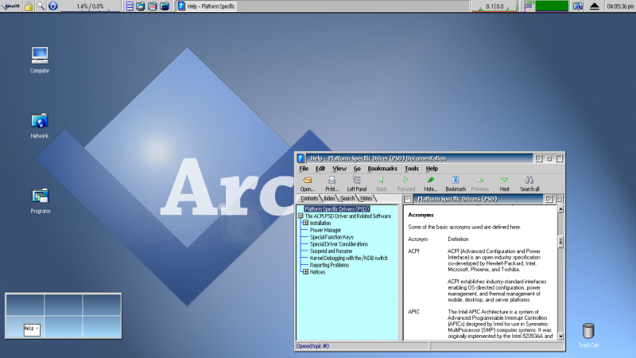
Arca Noae (meaning âNew Boxâ), the company that released v.5.0 in June, was set up because too many big customers canât migrate crucial apps from OS/2 to anything else. The new version looks more modern, borrowing icons and other things from Linux, mainly KDE. It can run a fair number of Win32 apps, and supports virtually all modern hardware, scaling to 128 threads and 16GB RAM, though itâs still 32 bit in most senses.
As you can imagine, given the base requirements are a Pentium Pro with 64MB RAM, on an average laptop today it flies.
I'm not nostalgic, but the object model and how it was handling versionning was cool. Anybody remember Taligent? Thierry
Andrew
Sent from Mail <https://go.microsoft.com/fwlink/?LinkId=550986> for Windows 10
*From: *Richard Sargent <mailto:rsargent@5x5.on.ca> *Sent: *Monday, November 6, 2017 11:55 AM *To: *'Any question about pharo is welcome' <mailto:pharo-users@lists.pharo.org> *Subject: *Re: [Pharo-users] perspective request for those earning alivingfromSmalltalk
Andrew,
I worked with OS/2 in the early 90s and really liked it; I adopted it for my personal use as well. I really enjoyed reading the details you provided earlier.
I have a hypothesis that when IBM tried to sell OS/2 (Warp) via a retail channel that it "hurt". A company whose DNA was channel sales would find dealing with retail issues to be entirely different from everything they knew. So, I speculate that there were enough people to felt (and argued) that OS/2 wasn't "worth it".
Any thoughts you would care to share on that supposition would be appreciated.
*From:*Pharo-users [mailto:pharo-users-bounces@lists.pharo.org] *On Behalf Of *Andrew Glynn *Sent:* November 6, 2017 04:18 *To:* Any question about pharo is welcome *Subject:* Re: [Pharo-users] perspective request for those earning a livingfromSmalltalk
Thank you. I will see if I can get to it today or tomorrow.
Andrew
Sent from Mail <https://go.microsoft.com/fwlink/?LinkId=550986> for Windows 10
*From: *Davorin Rusevljan <mailto:davorin.rusevljan@gmail.com> *Sent: *Monday, November 6, 2017 4:17 AM *To: *Any question about pharo is welcome <mailto:pharo-users@lists.pharo.org> *Subject: *Re: [Pharo-users] perspective request for those earning a livingfromSmalltalk
On Sat, Oct 28, 2017 at 7:59 PM, Andrew Glynn <aglynn42@gmail.com <mailto:aglynn42@gmail.com>> wrote:
Your history is accurate, but thereâs a few things Iâd like to add, due to having been employed by IBM at exactly that period working specifically on VisualAge, not only for Smalltalk, but for Java, C++ and Cobol as well. (my NDAâs finally having expired also helps ð). Itâs not a correction or contradiction, but a complement to your description, providing a relevant but different perspective.
Andrew,
please find a way to write an article or blog post on this subject. It is priceless.
davorin
OpenDoc was also very cool, but without branding, where would M$ be? Sent from Mail for Windows 10 From: Thierry Goubier Sent: Monday, November 6, 2017 2:48 PM To: pharo-users@lists.pharo.org Subject: Re: [Pharo-users] perspective request for those earningalivingfromSmalltalk Hi Andrew, Le 06/11/2017 à 19:59, Andrew Glynn a écrit :
I /suspect/ that a (mostly repressed) underlying sense that a reliable, inexpensive platform, if popular, would have been more detrimental to IBM than to its smaller competitors. The same goes for the VisualAge family -> Smalltalk (sold now by Instantiations at v. 9.0), Java, C++ and COBOL. One of the (largely unthought) reasons for Smalltalkâs difficulties in the 1990âs, when hardware could run it decently, was that it took a fair number of resources/time to write a decent version, while using it would have been a bigger advantage to smaller companies than to the companies with the money to develop one.  The result was that only a few, very expensive versions were publicly available. VA Smalltalk still retails at ~$8500 / seat.
Those kinds of hazy (because not admitted to oneself) reasons for doing things end up resulting in apparently contradictory actions such as spending large amounts writing something, releasing it, then failing to support it with any sales or marketing push, and even actively undermining it. Nobody wants to fully admit that inefficiencies are actually to their advantage, which is the reason itâs repressed (implying both known /and/ not known, simultaneously).
Iâm totally speculating of course and may be dead wrong, but it fits with other IBM actions and non-actions. IBM is a strange company that sees itself, partly for good reason, as a business that must make money /and/ as an international resource that must continue to exist. Though the latter depends to a degree on the former, they donât always imply the same specific decisions.
Interestingly, to prove the scalability of a VM based system IBM wrote âRVMâ (originally meaning âRenaissance VMâ), and proved near linear scaling to 1024 cores, but RVM is a VM for Squeak and earlier versions of Pharo, not IBM Smalltalk (the source is available, on GitHub I believe).
https://github.com/smarr/RoarVM I wouldn't say it is IBM, instead that it is David Ungar work (of Self and a few other things)... Has probably ties to the Jikes RVM as well.
Arca Noae (meaning âNew Boxâ), the company that released v.5.0 in June, was set up because too many big customers canât migrate crucial apps from OS/2 to anything else. The new version looks more modern, borrowing icons and other things from Linux, mainly KDE. It can run a fair number of Win32 apps, and supports virtually all modern hardware, scaling to 128 threads and 16GB RAM, though itâs still 32 bit in most senses.
As you can imagine, given the base requirements are a Pentium Pro with 64MB RAM, on an average laptop today it flies.
I'm not nostalgic, but the object model and how it was handling versionning was cool. Anybody remember Taligent? Thierry
Andrew
Sent from Mail <https://go.microsoft.com/fwlink/?LinkId=550986> for Windows 10
*From: *Richard Sargent <mailto:rsargent@5x5.on.ca> *Sent: *Monday, November 6, 2017 11:55 AM *To: *'Any question about pharo is welcome' <mailto:pharo-users@lists.pharo.org> *Subject: *Re: [Pharo-users] perspective request for those earning alivingfromSmalltalk
Andrew,
I worked with OS/2 in the early 90s and really liked it; I adopted it for my personal use as well. I really enjoyed reading the details you provided earlier.
I have a hypothesis that when IBM tried to sell OS/2 (Warp) via a retail channel that it "hurt". A company whose DNA was channel sales would find dealing with retail issues to be entirely different from everything they knew. So, I speculate that there were enough people to felt (and argued) that OS/2 wasn't "worth it".
Any thoughts you would care to share on that supposition would be appreciated.
*From:*Pharo-users [mailto:pharo-users-bounces@lists.pharo.org] *On Behalf Of *Andrew Glynn *Sent:* November 6, 2017 04:18 *To:* Any question about pharo is welcome *Subject:* Re: [Pharo-users] perspective request for those earning a livingfromSmalltalk
Thank you. I will see if I can get to it today or tomorrow.
Andrew
Sent from Mail <https://go.microsoft.com/fwlink/?LinkId=550986> for Windows 10
*From: *Davorin Rusevljan <mailto:davorin.rusevljan@gmail.com> *Sent: *Monday, November 6, 2017 4:17 AM *To: *Any question about pharo is welcome <mailto:pharo-users@lists.pharo.org> *Subject: *Re: [Pharo-users] perspective request for those earning a livingfromSmalltalk
On Sat, Oct 28, 2017 at 7:59 PM, Andrew Glynn <aglynn42@gmail.com <mailto:aglynn42@gmail.com>> wrote:
Your history is accurate, but thereâs a few things Iâd like to add, due to having been employed by IBM at exactly that period working specifically on VisualAge, not only for Smalltalk, but for Java, C++ and Cobol as well. (my NDAâs finally having expired also helps ð). Itâs not a correction or contradiction, but a complement to your description, providing a relevant but different perspective.
Andrew,
please find a way to write an article or blog post on this subject. It is priceless.
davorin
I see you appreciate Mr. Ungar almost as little as I do Roy Fielding ⦠Sent from Mail for Windows 10 From: Thierry Goubier Sent: Monday, November 6, 2017 2:48 PM To: pharo-users@lists.pharo.org Subject: Re: [Pharo-users] perspective request for those earningalivingfromSmalltalk Hi Andrew, Le 06/11/2017 à 19:59, Andrew Glynn a écrit :
I /suspect/ that a (mostly repressed) underlying sense that a reliable, inexpensive platform, if popular, would have been more detrimental to IBM than to its smaller competitors. The same goes for the VisualAge family -> Smalltalk (sold now by Instantiations at v. 9.0), Java, C++ and COBOL. One of the (largely unthought) reasons for Smalltalkâs difficulties in the 1990âs, when hardware could run it decently, was that it took a fair number of resources/time to write a decent version, while using it would have been a bigger advantage to smaller companies than to the companies with the money to develop one.  The result was that only a few, very expensive versions were publicly available. VA Smalltalk still retails at ~$8500 / seat.
Those kinds of hazy (because not admitted to oneself) reasons for doing things end up resulting in apparently contradictory actions such as spending large amounts writing something, releasing it, then failing to support it with any sales or marketing push, and even actively undermining it. Nobody wants to fully admit that inefficiencies are actually to their advantage, which is the reason itâs repressed (implying both known /and/ not known, simultaneously).
Iâm totally speculating of course and may be dead wrong, but it fits with other IBM actions and non-actions. IBM is a strange company that sees itself, partly for good reason, as a business that must make money /and/ as an international resource that must continue to exist. Though the latter depends to a degree on the former, they donât always imply the same specific decisions.
Interestingly, to prove the scalability of a VM based system IBM wrote âRVMâ (originally meaning âRenaissance VMâ), and proved near linear scaling to 1024 cores, but RVM is a VM for Squeak and earlier versions of Pharo, not IBM Smalltalk (the source is available, on GitHub I believe).
https://github.com/smarr/RoarVM I wouldn't say it is IBM, instead that it is David Ungar work (of Self and a few other things)... Has probably ties to the Jikes RVM as well.
Arca Noae (meaning âNew Boxâ), the company that released v.5.0 in June, was set up because too many big customers canât migrate crucial apps from OS/2 to anything else. The new version looks more modern, borrowing icons and other things from Linux, mainly KDE. It can run a fair number of Win32 apps, and supports virtually all modern hardware, scaling to 128 threads and 16GB RAM, though itâs still 32 bit in most senses.
As you can imagine, given the base requirements are a Pentium Pro with 64MB RAM, on an average laptop today it flies.
I'm not nostalgic, but the object model and how it was handling versionning was cool. Anybody remember Taligent? Thierry
Andrew
Sent from Mail <https://go.microsoft.com/fwlink/?LinkId=550986> for Windows 10
*From: *Richard Sargent <mailto:rsargent@5x5.on.ca> *Sent: *Monday, November 6, 2017 11:55 AM *To: *'Any question about pharo is welcome' <mailto:pharo-users@lists.pharo.org> *Subject: *Re: [Pharo-users] perspective request for those earning alivingfromSmalltalk
Andrew,
I worked with OS/2 in the early 90s and really liked it; I adopted it for my personal use as well. I really enjoyed reading the details you provided earlier.
I have a hypothesis that when IBM tried to sell OS/2 (Warp) via a retail channel that it "hurt". A company whose DNA was channel sales would find dealing with retail issues to be entirely different from everything they knew. So, I speculate that there were enough people to felt (and argued) that OS/2 wasn't "worth it".
Any thoughts you would care to share on that supposition would be appreciated.
*From:*Pharo-users [mailto:pharo-users-bounces@lists.pharo.org] *On Behalf Of *Andrew Glynn *Sent:* November 6, 2017 04:18 *To:* Any question about pharo is welcome *Subject:* Re: [Pharo-users] perspective request for those earning a livingfromSmalltalk
Thank you. I will see if I can get to it today or tomorrow.
Andrew
Sent from Mail <https://go.microsoft.com/fwlink/?LinkId=550986> for Windows 10
*From: *Davorin Rusevljan <mailto:davorin.rusevljan@gmail.com> *Sent: *Monday, November 6, 2017 4:17 AM *To: *Any question about pharo is welcome <mailto:pharo-users@lists.pharo.org> *Subject: *Re: [Pharo-users] perspective request for those earning a livingfromSmalltalk
On Sat, Oct 28, 2017 at 7:59 PM, Andrew Glynn <aglynn42@gmail.com <mailto:aglynn42@gmail.com>> wrote:
Your history is accurate, but thereâs a few things Iâd like to add, due to having been employed by IBM at exactly that period working specifically on VisualAge, not only for Smalltalk, but for Java, C++ and Cobol as well. (my NDAâs finally having expired also helps ð). Itâs not a correction or contradiction, but a complement to your description, providing a relevant but different perspective.
Andrew,
please find a way to write an article or blog post on this subject. It is priceless.
davorin
Btw, did Self ever work? At all? The last I remember it was in a similar state to Electron without the M$ adds in Visual Studio, i.e. the samples from the site donât build. Sent from Mail for Windows 10 From: Thierry Goubier Sent: Monday, November 6, 2017 2:48 PM To: pharo-users@lists.pharo.org Subject: Re: [Pharo-users] perspective request for those earningalivingfromSmalltalk Hi Andrew, Le 06/11/2017 à 19:59, Andrew Glynn a écrit :
I /suspect/ that a (mostly repressed) underlying sense that a reliable, inexpensive platform, if popular, would have been more detrimental to IBM than to its smaller competitors. The same goes for the VisualAge family -> Smalltalk (sold now by Instantiations at v. 9.0), Java, C++ and COBOL. One of the (largely unthought) reasons for Smalltalkâs difficulties in the 1990âs, when hardware could run it decently, was that it took a fair number of resources/time to write a decent version, while using it would have been a bigger advantage to smaller companies than to the companies with the money to develop one.  The result was that only a few, very expensive versions were publicly available. VA Smalltalk still retails at ~$8500 / seat.
Those kinds of hazy (because not admitted to oneself) reasons for doing things end up resulting in apparently contradictory actions such as spending large amounts writing something, releasing it, then failing to support it with any sales or marketing push, and even actively undermining it. Nobody wants to fully admit that inefficiencies are actually to their advantage, which is the reason itâs repressed (implying both known /and/ not known, simultaneously).
Iâm totally speculating of course and may be dead wrong, but it fits with other IBM actions and non-actions. IBM is a strange company that sees itself, partly for good reason, as a business that must make money /and/ as an international resource that must continue to exist. Though the latter depends to a degree on the former, they donât always imply the same specific decisions.
Interestingly, to prove the scalability of a VM based system IBM wrote âRVMâ (originally meaning âRenaissance VMâ), and proved near linear scaling to 1024 cores, but RVM is a VM for Squeak and earlier versions of Pharo, not IBM Smalltalk (the source is available, on GitHub I believe).
https://github.com/smarr/RoarVM I wouldn't say it is IBM, instead that it is David Ungar work (of Self and a few other things)... Has probably ties to the Jikes RVM as well.
Arca Noae (meaning âNew Boxâ), the company that released v.5.0 in June, was set up because too many big customers canât migrate crucial apps from OS/2 to anything else. The new version looks more modern, borrowing icons and other things from Linux, mainly KDE. It can run a fair number of Win32 apps, and supports virtually all modern hardware, scaling to 128 threads and 16GB RAM, though itâs still 32 bit in most senses.
As you can imagine, given the base requirements are a Pentium Pro with 64MB RAM, on an average laptop today it flies.
I'm not nostalgic, but the object model and how it was handling versionning was cool. Anybody remember Taligent? Thierry
Andrew
Sent from Mail <https://go.microsoft.com/fwlink/?LinkId=550986> for Windows 10
*From: *Richard Sargent <mailto:rsargent@5x5.on.ca> *Sent: *Monday, November 6, 2017 11:55 AM *To: *'Any question about pharo is welcome' <mailto:pharo-users@lists.pharo.org> *Subject: *Re: [Pharo-users] perspective request for those earning alivingfromSmalltalk
Andrew,
I worked with OS/2 in the early 90s and really liked it; I adopted it for my personal use as well. I really enjoyed reading the details you provided earlier.
I have a hypothesis that when IBM tried to sell OS/2 (Warp) via a retail channel that it "hurt". A company whose DNA was channel sales would find dealing with retail issues to be entirely different from everything they knew. So, I speculate that there were enough people to felt (and argued) that OS/2 wasn't "worth it".
Any thoughts you would care to share on that supposition would be appreciated.
*From:*Pharo-users [mailto:pharo-users-bounces@lists.pharo.org] *On Behalf Of *Andrew Glynn *Sent:* November 6, 2017 04:18 *To:* Any question about pharo is welcome *Subject:* Re: [Pharo-users] perspective request for those earning a livingfromSmalltalk
Thank you. I will see if I can get to it today or tomorrow.
Andrew
Sent from Mail <https://go.microsoft.com/fwlink/?LinkId=550986> for Windows 10
*From: *Davorin Rusevljan <mailto:davorin.rusevljan@gmail.com> *Sent: *Monday, November 6, 2017 4:17 AM *To: *Any question about pharo is welcome <mailto:pharo-users@lists.pharo.org> *Subject: *Re: [Pharo-users] perspective request for those earning a livingfromSmalltalk
On Sat, Oct 28, 2017 at 7:59 PM, Andrew Glynn <aglynn42@gmail.com <mailto:aglynn42@gmail.com>> wrote:
Your history is accurate, but thereâs a few things Iâd like to add, due to having been employed by IBM at exactly that period working specifically on VisualAge, not only for Smalltalk, but for Java, C++ and Cobol as well. (my NDAâs finally having expired also helps ð). Itâs not a correction or contradiction, but a complement to your description, providing a relevant but different perspective.
Andrew,
please find a way to write an article or blog post on this subject. It is priceless.
davorin

On 6 Nov 2017, at 21:00 , Andrew Glynn <aglynn42@gmail.com> wrote:
Btw, did Self ever work? At all? The last I remember it was in a similar state to Electron without the M$ adds in Visual Studio, i.e. the samples from the site donât build.
Self worked fine. It was a bit memory-hungry on the machines of the early 1990s, but I taught a class on OOP using it in about 1996 or 1997. The NewtonScript language for the ill-fated Newton tablet was essentially Self. A bit ahead of its time â it would run fine in todayâs mobile phones. Andrew Black

On 10-11-17 17:56, Prof. Andrew P. Black wrote:
On 6 Nov 2017, at 21:00 , Andrew Glynn <aglynn42@gmail.com> wrote:
Btw, did Self ever work?
Self works fine. I played with it on a mac last year. I think Tobias Pape released a new version last year or so. Stephan
Yea, I tried a really early version and it slipped my mind to ever get back to it â I did use NewtonScript a bit â I was one of the few that liked the Newton, probably because I hate talking on the phone, lol. It was pretty good on the last release of the Newton. I still have it somewhere but I put it in a box in my last move and havenât come across it again. I like the iPhone ok, but I rarely answer calls, I use it as anything but a phone. Planning to run up a version if I can get one that will run on Solaris 11, or at least I can rebuild the VM for it â I have a couple of T2000âs and a couple of T5120âs â 64 threads and 64GB RAM should be plenty ð. Right now a bit short of time for just playing though. Andrew Glynn Sent from Mail for Windows 10 From: Prof. Andrew P. Black Sent: Friday, November 10, 2017 11:57 AM To: Any question about pharo is welcome Subject: Re: [Pharo-users] perspective request for thoseearningalivingfromSmalltalk
On 6 Nov 2017, at 21:00 , Andrew Glynn <aglynn42@gmail.com> wrote:
Btw, did Self ever work? At all? The last I remember it was in a similar state to Electron without the M$ adds in Visual Studio, i.e. the samples from the site donât build.
Self worked fine. It was a bit memory-hungry on the machines of the early 1990s, but I taught a class on OOP using it in about 1996 or 1997. The NewtonScript language for the ill-fated Newton tablet was essentially Self. A bit ahead of its time â it would run fine in todayâs mobile phones. Andrew Black
participants (13)
-
 Andrew Glynn
 -
 Ben Coman
 -
 Davorin Rusevljan
 -
 jtuchel@objektfabrik.de
 -
 Mariano Martinez Peck
 -
 Marten Feldtmann
 -
 Petr Fischer
 -
 Prof. Andrew P. Black
 -
 Richard Sargent
 -
 Richard Sargent
 -
 stephan
 -
 Stephane Ducasse
 -
 Thierry Goubier