Hi, Comments below. El 20/05/15 a las 07:03, Ben Coman escribió:
On Wed, May 20, 2015 at 3:04 AM, Avdi Grimm <avdi@avdi.org <mailto:avdi@avdi.org>> wrote:
I dunno if this is useful to anyone, but I was rolling around concepts in my mind and this is something I came up with:
Inline image 1
This takes some cues from modern IDEs, but it also differs in that it doesn't make the assumption that you want to see just one "buffer" at a time, and that "split window mode" isn't sufficiently powerful to handle the need for lots of windows open on lots of little methods.
Interesting idea. It might be better to use a breadcrumb rather than the three pulldowns and I think Playground tends to need more room.
One idea I've contemplated, since often my many open windows result from following some path investigating senders/implementors of other senders/implementors, is that it would be useful to have a tree structure docked to the side that records that hierarchical path of investigation. This would help in cases when I want to back up a few steps to investigate another path but usually I've lost the needed window (so I just open another one). This would also help when it came time to prune an investigation, since windows often hang around longer than needed since its hard to remember which windows below to which path of investigation. Ideally you might collapse the middle items of a path.
cheers -ben
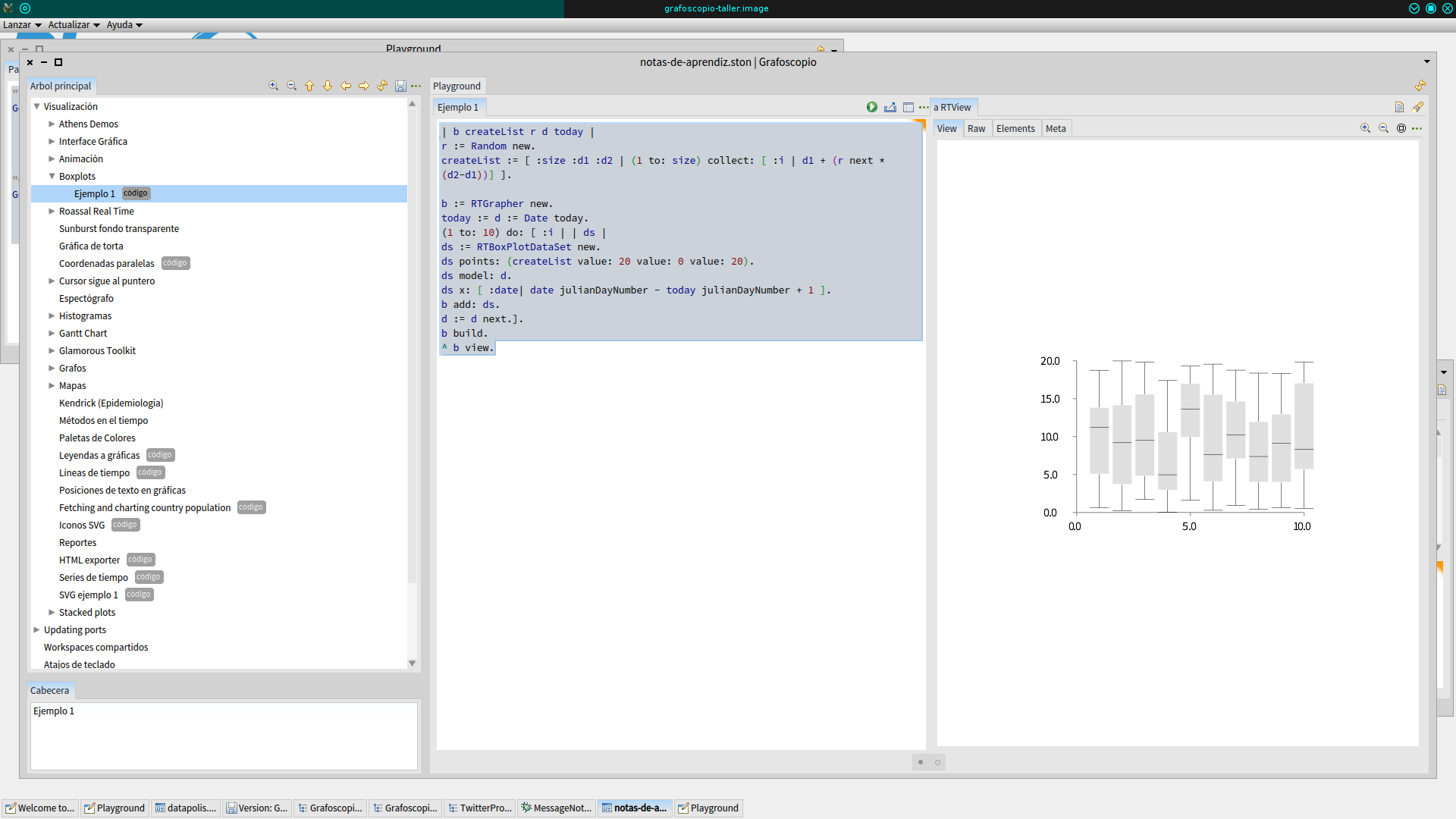
Attached is an screenshot[*] of my mockup for a tree-like explorative computing, which I think is in the same lines of Ben's "tree structure docked to the side that records that hierarchical path of investigation". It's wrote on Smalltalk itself and modelled as a document expressed like a tree, which can contain nested nodes of code playgrounds and documentation wrote light markup language (markdown). Its an attempt to make concrete the ideas in an old blog post[1] and I don't know how well is suited for programmers/coders (I'm not one myself), but is more about people which writes and interchanges code with prose (which is my case). [1] http://mutabit.com/offray/static/blog/output/posts/on-deepness-and-complexit... I remember finding Smalltalk in 2005 and having difficulties to be comfortable there, kind of a bittersweet sensation (still there today but in less proportion). On one hand is was a concretion of older ideas of mine about what computation could be (maleable and cognitive empowering), but on the other it was so difficult to connect with my previous experiences with documentation and scripting: The browser hierarchy and "the everything is an object" imposed to much order/paradigm for me. 10 years later, after Pharo, Moose, Leo[2], IPython[3] and others, I'm finding my place again, trying to mix the emergent nature of the tree/document/script with the more structured browser and class and object paradigm. [2] http://leoeditor.com/ [3] http://ipython.org/ If user interface is about experience, we could try to search in sharing our own experiences and mockups what Pharo could be for growing and diverse number of people, even going beyond programmers as a key about this future experience we would like to have. Cheers, Offray [*] In the screenshot you see the tree and 10 open windows, but mostly I go from playgrounds to the document tree to the class browser, switching/cycling tree windows to most of my experience.