2015-01-26 9:01 GMT-03:00 Sven Van Caekenberghe <sven@stfx.eu>:
Hernán,
On 26 Jan 2015, at 08:00, Hernán Morales Durand < hernan.morales@gmail.com> wrote:
It is possible :) I work with DNA sequences, there could be millions of common SNPs in a genome.
Still weird for CSV. How many record are there then ?
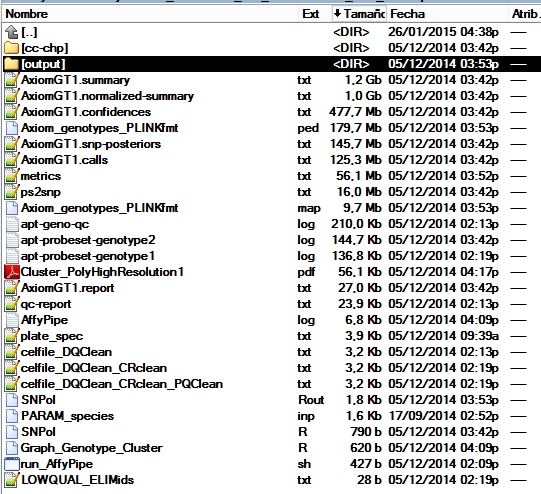
We genotyped few individuals (24 records) but now we have a genotyping platform (GeneTitan) with array plates allowing up to 96 samples, which is up to 2.6 million of markers. The first run I completed generated CSVs of 1 million of records (see attach). Sadly the high-level analysis of this data (annotation, clustering, discrimination) now is performed with R with packages like SNPolisher. And this is microarray analysis, NGS platforms produce larger volumes of data in a shorter period of time (several genomes in a day). See http://www.slideshare.net/allenday/renaissance-in-medicine-strata-nosql-and-... for the 2014-2020 predictions. Feel free to contact me if you want to experiment with metrics. I assume they all have the same number of fields ?
Yes, never seen CSV file with variable number of fields (in this domain) Anyway, could you point me to the specification of the format you want to
read ?
Actually I have no rush for this, I want to avoid awk, sed and shell scripts in the next run. I would like to avoid Python but spreads like a virus. I will be working mostly with CSV's from Axiom annotation files [1] and genotyping results. Other file formats I use are genotype file formats for programs like PLINK [2] (PED files, column 7 onwards) and HaploView. Is worst than you might think, because you have to transpose the output generated by genotyping platforms (millions of records), and then filter & cut them by chromosome because those Java programs cannot deal with all chromosomes at the same time.
And to the older the that you used to use ?
http://www.smalltalkhub.com/#!/~hernan/CSV Cheers, Hernán [1] http://www.affymetrix.com/support/technical/annotationfilesmain.affx [2] http://pngu.mgh.harvard.edu/~purcell/plink/data.shtml#ped
Thx,
Sven
Cheers,
Hernán
2015-01-26 3:33 GMT-03:00 Sven Van Caekenberghe <sven@stfx.eu>:
On 26 Jan 2015, at 06:32, Hernán Morales Durand < hernan.morales@gmail.com> wrote:
2015-01-23 18:00 GMT-03:00 Sven Van Caekenberghe <sven@stfx.eu>:
On 23 Jan 2015, at 20:53, Hernán Morales Durand < hernan.morales@gmail.com> wrote:
Hi Sven,
2015-01-23 16:06 GMT-03:00 Sven Van Caekenberghe <sven@stfx.eu>: Hi Hernán,
On 23 Jan 2015, at 19:50, Hernán Morales Durand < hernan.morales@gmail.com> wrote:
I used to use a CSV parser from Squeak where I could attach conditional iterations:
csvParser rowsSkipFirst: 2 do: [: row | " some action ignoring first 2 fields on each row " ]. csvParser rowsSkipLast: 2 do: [: row | " some action ignoring last 2 fields on each row " ].
With NeoCSVParser you can describe how each field is read and converted, using the same mechanism you can ignore fields. Have a look at the senders of #addIgnoredField from the unit tests.
I am trying to understand the implementation, I see you included #addIgnoredFields: for consecutive fields in Neo-CSV-Core-SvenVanCaekenberghe.21 A question about usage then, adding ignored field(s) requires adding field types on all other remaining fields?
Yes, like this:
testReadWithIgnoredField | input | input := (String crlf join: #( '1,2,a,3' '1,2,b,3' '1,2,c,3' '')). self assert: ((NeoCSVReader on: input readStream) addIntegerField; addIntegerField; addIgnoredField; addIntegerField; upToEnd) equals: { #(1 2 3). #(1 2 3). #(1 2 3).}
May be you like to know if you make a pass to NeoCSV, for some data sets I have 1 million of columns, it would be nice an addFieldsInterval: or such.
1 million columns ? How is that possible, useful ?
The reader is like a builder. You could try to do this yourself by writing a little loop or two.
But still, 1 million ?
Thank you.
Hernán