Conditional CSV parsing

I used to use a CSV parser from Squeak where I could attach conditional iterations: csvParser rowsSkipFirst: 2 do: [: row | " some action ignoring first 2 fields on each row " ]. csvParser rowsSkipLast: 2 do: [: row | " some action ignoring last 2 fields on each row " ]. csvParser rowsWhere: [ " a condition block " ] do: [ : row | " ... " ]. csvParser rowsUpTo: 500000 do: [ " some action for rows up to 500000 " ]. csvParser rowsFrom: 2000 to: 5000 do: [ " some action for rows between 2000 to 5000 " ]. I want to replace the parser with NeoCSVReader, is this easily possible with the current implementation? Cheers, Hernán

Hi Hernán,
On 23 Jan 2015, at 19:50, Hernán Morales Durand <hernan.morales@gmail.com> wrote:
I used to use a CSV parser from Squeak where I could attach conditional iterations:
csvParser rowsSkipFirst: 2 do: [: row | " some action ignoring first 2 fields on each row " ]. csvParser rowsSkipLast: 2 do: [: row | " some action ignoring last 2 fields on each row " ].
With NeoCSVParser you can describe how each field is read and converted, using the same mechanism you can ignore fields. Have a look at the senders of #addIgnoredField from the unit tests.
csvParser rowsWhere: [ " a condition block " ] do: [ : row | " ... " ].
NeoCSVParser behaves a bit like a stream and a bit like a collection, there are #next, #atEnd and #upToEnd as well as #do: and #select:
csvParser rowsUpTo: 500000 do: [ " some action for rows up to 500000 " ]. csvParser rowsFrom: 2000 to: 5000 do: [ " some action for rows between 2000 to 5000 " ].
Those are not there, you will have to count yourself. #next can be used to #skip.
I want to replace the parser with NeoCSVReader, is this easily possible with the current implementation?
Should work, let me know if you have any problems.
Cheers,
Hernán
Sven
Hi Sven, 2015-01-23 16:06 GMT-03:00 Sven Van Caekenberghe <sven@stfx.eu>:
Hi Hernán,
On 23 Jan 2015, at 19:50, Hernán Morales Durand < hernan.morales@gmail.com> wrote:
I used to use a CSV parser from Squeak where I could attach conditional iterations:
csvParser rowsSkipFirst: 2 do: [: row | " some action ignoring first 2 fields on each row " ]. csvParser rowsSkipLast: 2 do: [: row | " some action ignoring last 2 fields on each row " ].
With NeoCSVParser you can describe how each field is read and converted, using the same mechanism you can ignore fields. Have a look at the senders of #addIgnoredField from the unit tests.
I am trying to understand the implementation, I see you included #addIgnoredFields: for consecutive fields in Neo-CSV-Core-SvenVanCaekenberghe.21 A question about usage then, adding ignored field(s) requires adding field types on all other remaining fields?
csvParser rowsWhere: [ " a condition block " ] do: [ : row | " ... " ].
NeoCSVParser behaves a bit like a stream and a bit like a collection, there are #next, #atEnd and #upToEnd as well as #do: and #select:
I was using the version from the Configuration and missed the #select:[thenDo:] update.
csvParser rowsUpTo: 500000 do: [ " some action for rows up to 500000 " ]. csvParser rowsFrom: 2000 to: 5000 do: [ " some action for rows between 2000 to 5000 " ].
Those are not there, you will have to count yourself. #next can be used to #skip.
Ok
I want to replace the parser with NeoCSVReader, is this easily possible with the current implementation?
Should work, let me know if you have any problems.
Thank you Sven! Cheers,
On 23 Jan 2015, at 20:53, Hernán Morales Durand <hernan.morales@gmail.com> wrote:
Hi Sven,
2015-01-23 16:06 GMT-03:00 Sven Van Caekenberghe <sven@stfx.eu>: Hi Hernán,
On 23 Jan 2015, at 19:50, Hernán Morales Durand <hernan.morales@gmail.com> wrote:
I used to use a CSV parser from Squeak where I could attach conditional iterations:
csvParser rowsSkipFirst: 2 do: [: row | " some action ignoring first 2 fields on each row " ]. csvParser rowsSkipLast: 2 do: [: row | " some action ignoring last 2 fields on each row " ].
With NeoCSVParser you can describe how each field is read and converted, using the same mechanism you can ignore fields. Have a look at the senders of #addIgnoredField from the unit tests.
I am trying to understand the implementation, I see you included #addIgnoredFields: for consecutive fields in Neo-CSV-Core-SvenVanCaekenberghe.21 A question about usage then, adding ignored field(s) requires adding field types on all other remaining fields?
Yes, like this: testReadWithIgnoredField | input | input := (String crlf join: #( '1,2,a,3' '1,2,b,3' '1,2,c,3' '')). self assert: ((NeoCSVReader on: input readStream) addIntegerField; addIntegerField; addIgnoredField; addIntegerField; upToEnd) equals: { #(1 2 3). #(1 2 3). #(1 2 3).}
csvParser rowsWhere: [ " a condition block " ] do: [ : row | " ... " ].
NeoCSVParser behaves a bit like a stream and a bit like a collection, there are #next, #atEnd and #upToEnd as well as #do: and #select:
I was using the version from the Configuration and missed the #select:[thenDo:] update.
Yes, please use #bleedingEdge, I have to update #stable.
csvParser rowsUpTo: 500000 do: [ " some action for rows up to 500000 " ]. csvParser rowsFrom: 2000 to: 5000 do: [ " some action for rows between 2000 to 5000 " ].
Those are not there, you will have to count yourself. #next can be used to #skip.
Ok
I want to replace the parser with NeoCSVReader, is this easily possible with the current implementation?
Should work, let me know if you have any problems.
Thank you Sven!
Cheers,
2015-01-23 18:00 GMT-03:00 Sven Van Caekenberghe <sven@stfx.eu>:
On 23 Jan 2015, at 20:53, Hernán Morales Durand < hernan.morales@gmail.com> wrote:
Hi Sven,
2015-01-23 16:06 GMT-03:00 Sven Van Caekenberghe <sven@stfx.eu>: Hi Hernán,
On 23 Jan 2015, at 19:50, Hernán Morales Durand < hernan.morales@gmail.com> wrote:
I used to use a CSV parser from Squeak where I could attach conditional iterations:
csvParser rowsSkipFirst: 2 do: [: row | " some action ignoring first 2 fields on each row " ]. csvParser rowsSkipLast: 2 do: [: row | " some action ignoring last 2 fields on each row " ].
With NeoCSVParser you can describe how each field is read and converted, using the same mechanism you can ignore fields. Have a look at the senders of #addIgnoredField from the unit tests.
I am trying to understand the implementation, I see you included #addIgnoredFields: for consecutive fields in Neo-CSV-Core-SvenVanCaekenberghe.21 A question about usage then, adding ignored field(s) requires adding field types on all other remaining fields?
Yes, like this:
testReadWithIgnoredField | input | input := (String crlf join: #( '1,2,a,3' '1,2,b,3' '1,2,c,3' '')). self assert: ((NeoCSVReader on: input readStream) addIntegerField; addIntegerField; addIgnoredField; addIntegerField; upToEnd) equals: { #(1 2 3). #(1 2 3). #(1 2 3).}
May be you like to know if you make a pass to NeoCSV, for some data sets I have 1 million of columns, it would be nice an addFieldsInterval: or such. Thank you. Hernán
On 26 Jan 2015, at 06:32, Hernán Morales Durand <hernan.morales@gmail.com> wrote:
2015-01-23 18:00 GMT-03:00 Sven Van Caekenberghe <sven@stfx.eu>:
On 23 Jan 2015, at 20:53, Hernán Morales Durand <hernan.morales@gmail.com> wrote:
Hi Sven,
2015-01-23 16:06 GMT-03:00 Sven Van Caekenberghe <sven@stfx.eu>: Hi Hernán,
On 23 Jan 2015, at 19:50, Hernán Morales Durand <hernan.morales@gmail.com> wrote:
I used to use a CSV parser from Squeak where I could attach conditional iterations:
csvParser rowsSkipFirst: 2 do: [: row | " some action ignoring first 2 fields on each row " ]. csvParser rowsSkipLast: 2 do: [: row | " some action ignoring last 2 fields on each row " ].
With NeoCSVParser you can describe how each field is read and converted, using the same mechanism you can ignore fields. Have a look at the senders of #addIgnoredField from the unit tests.
I am trying to understand the implementation, I see you included #addIgnoredFields: for consecutive fields in Neo-CSV-Core-SvenVanCaekenberghe.21 A question about usage then, adding ignored field(s) requires adding field types on all other remaining fields?
Yes, like this:
testReadWithIgnoredField | input | input := (String crlf join: #( '1,2,a,3' '1,2,b,3' '1,2,c,3' '')). self assert: ((NeoCSVReader on: input readStream) addIntegerField; addIntegerField; addIgnoredField; addIntegerField; upToEnd) equals: { #(1 2 3). #(1 2 3). #(1 2 3).}
May be you like to know if you make a pass to NeoCSV, for some data sets I have 1 million of columns, it would be nice an addFieldsInterval: or such.
1 million columns ? How is that possible, useful ? The reader is like a builder. You could try to do this yourself by writing a little loop or two. But still, 1 million ?
Thank you.
Hernán
It is possible :) I work with DNA sequences, there could be millions of common SNPs in a genome. Cheers, Hernán 2015-01-26 3:33 GMT-03:00 Sven Van Caekenberghe <sven@stfx.eu>:
On 26 Jan 2015, at 06:32, Hernán Morales Durand < hernan.morales@gmail.com> wrote:
2015-01-23 18:00 GMT-03:00 Sven Van Caekenberghe <sven@stfx.eu>:
On 23 Jan 2015, at 20:53, Hernán Morales Durand < hernan.morales@gmail.com> wrote:
Hi Sven,
2015-01-23 16:06 GMT-03:00 Sven Van Caekenberghe <sven@stfx.eu>: Hi Hernán,
On 23 Jan 2015, at 19:50, Hernán Morales Durand < hernan.morales@gmail.com> wrote:
I used to use a CSV parser from Squeak where I could attach conditional iterations:
csvParser rowsSkipFirst: 2 do: [: row | " some action ignoring first 2 fields on each row " ]. csvParser rowsSkipLast: 2 do: [: row | " some action ignoring last 2 fields on each row " ].
With NeoCSVParser you can describe how each field is read and converted, using the same mechanism you can ignore fields. Have a look at the senders of #addIgnoredField from the unit tests.
I am trying to understand the implementation, I see you included #addIgnoredFields: for consecutive fields in Neo-CSV-Core-SvenVanCaekenberghe.21 A question about usage then, adding ignored field(s) requires adding field types on all other remaining fields?
Yes, like this:
testReadWithIgnoredField | input | input := (String crlf join: #( '1,2,a,3' '1,2,b,3' '1,2,c,3' '')). self assert: ((NeoCSVReader on: input readStream) addIntegerField; addIntegerField; addIgnoredField; addIntegerField; upToEnd) equals: { #(1 2 3). #(1 2 3). #(1 2 3).}
May be you like to know if you make a pass to NeoCSV, for some data sets I have 1 million of columns, it would be nice an addFieldsInterval: or such.
1 million columns ? How is that possible, useful ?
The reader is like a builder. You could try to do this yourself by writing a little loop or two.
But still, 1 million ?
Thank you.
Hernán
Hernán,
On 26 Jan 2015, at 08:00, Hernán Morales Durand <hernan.morales@gmail.com> wrote:
It is possible :) I work with DNA sequences, there could be millions of common SNPs in a genome.
Still weird for CSV. How many record are there then ? I assume they all have the same number of fields ? Anyway, could you point me to the specification of the format you want to read ? And to the older the that you used to use ? Thx, Sven
Cheers,
Hernán
2015-01-26 3:33 GMT-03:00 Sven Van Caekenberghe <sven@stfx.eu>:
On 26 Jan 2015, at 06:32, Hernán Morales Durand <hernan.morales@gmail.com> wrote:
2015-01-23 18:00 GMT-03:00 Sven Van Caekenberghe <sven@stfx.eu>:
On 23 Jan 2015, at 20:53, Hernán Morales Durand <hernan.morales@gmail.com> wrote:
Hi Sven,
2015-01-23 16:06 GMT-03:00 Sven Van Caekenberghe <sven@stfx.eu>: Hi Hernán,
On 23 Jan 2015, at 19:50, Hernán Morales Durand <hernan.morales@gmail.com> wrote:
I used to use a CSV parser from Squeak where I could attach conditional iterations:
csvParser rowsSkipFirst: 2 do: [: row | " some action ignoring first 2 fields on each row " ]. csvParser rowsSkipLast: 2 do: [: row | " some action ignoring last 2 fields on each row " ].
With NeoCSVParser you can describe how each field is read and converted, using the same mechanism you can ignore fields. Have a look at the senders of #addIgnoredField from the unit tests.
I am trying to understand the implementation, I see you included #addIgnoredFields: for consecutive fields in Neo-CSV-Core-SvenVanCaekenberghe.21 A question about usage then, adding ignored field(s) requires adding field types on all other remaining fields?
Yes, like this:
testReadWithIgnoredField | input | input := (String crlf join: #( '1,2,a,3' '1,2,b,3' '1,2,c,3' '')). self assert: ((NeoCSVReader on: input readStream) addIntegerField; addIntegerField; addIgnoredField; addIntegerField; upToEnd) equals: { #(1 2 3). #(1 2 3). #(1 2 3).}
May be you like to know if you make a pass to NeoCSV, for some data sets I have 1 million of columns, it would be nice an addFieldsInterval: or such.
1 million columns ? How is that possible, useful ?
The reader is like a builder. You could try to do this yourself by writing a little loop or two.
But still, 1 million ?
Thank you.
Hernán
2015-01-26 9:01 GMT-03:00 Sven Van Caekenberghe <sven@stfx.eu>:
Hernán,
On 26 Jan 2015, at 08:00, Hernán Morales Durand < hernan.morales@gmail.com> wrote:
It is possible :) I work with DNA sequences, there could be millions of common SNPs in a genome.
Still weird for CSV. How many record are there then ?
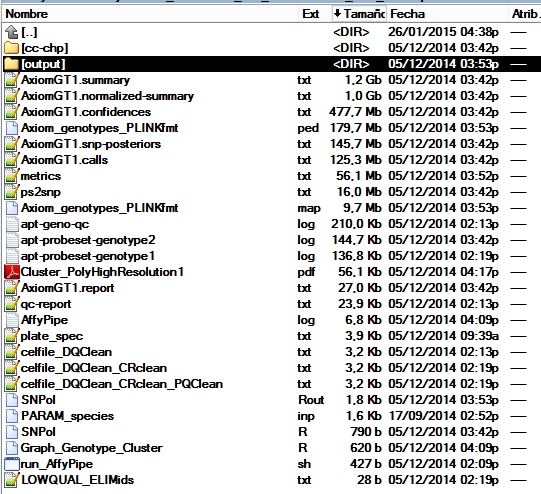
We genotyped few individuals (24 records) but now we have a genotyping platform (GeneTitan) with array plates allowing up to 96 samples, which is up to 2.6 million of markers. The first run I completed generated CSVs of 1 million of records (see attach). Sadly the high-level analysis of this data (annotation, clustering, discrimination) now is performed with R with packages like SNPolisher. And this is microarray analysis, NGS platforms produce larger volumes of data in a shorter period of time (several genomes in a day). See http://www.slideshare.net/allenday/renaissance-in-medicine-strata-nosql-and-... for the 2014-2020 predictions. Feel free to contact me if you want to experiment with metrics. I assume they all have the same number of fields ?
Yes, never seen CSV file with variable number of fields (in this domain) Anyway, could you point me to the specification of the format you want to
read ?
Actually I have no rush for this, I want to avoid awk, sed and shell scripts in the next run. I would like to avoid Python but spreads like a virus. I will be working mostly with CSV's from Axiom annotation files [1] and genotyping results. Other file formats I use are genotype file formats for programs like PLINK [2] (PED files, column 7 onwards) and HaploView. Is worst than you might think, because you have to transpose the output generated by genotyping platforms (millions of records), and then filter & cut them by chromosome because those Java programs cannot deal with all chromosomes at the same time.
And to the older the that you used to use ?
http://www.smalltalkhub.com/#!/~hernan/CSV Cheers, Hernán [1] http://www.affymetrix.com/support/technical/annotationfilesmain.affx [2] http://pngu.mgh.harvard.edu/~purcell/plink/data.shtml#ped
Thx,
Sven
Cheers,
Hernán
2015-01-26 3:33 GMT-03:00 Sven Van Caekenberghe <sven@stfx.eu>:
On 26 Jan 2015, at 06:32, Hernán Morales Durand < hernan.morales@gmail.com> wrote:
2015-01-23 18:00 GMT-03:00 Sven Van Caekenberghe <sven@stfx.eu>:
On 23 Jan 2015, at 20:53, Hernán Morales Durand < hernan.morales@gmail.com> wrote:
Hi Sven,
2015-01-23 16:06 GMT-03:00 Sven Van Caekenberghe <sven@stfx.eu>: Hi Hernán,
On 23 Jan 2015, at 19:50, Hernán Morales Durand < hernan.morales@gmail.com> wrote:
I used to use a CSV parser from Squeak where I could attach conditional iterations:
csvParser rowsSkipFirst: 2 do: [: row | " some action ignoring first 2 fields on each row " ]. csvParser rowsSkipLast: 2 do: [: row | " some action ignoring last 2 fields on each row " ].
With NeoCSVParser you can describe how each field is read and converted, using the same mechanism you can ignore fields. Have a look at the senders of #addIgnoredField from the unit tests.
I am trying to understand the implementation, I see you included #addIgnoredFields: for consecutive fields in Neo-CSV-Core-SvenVanCaekenberghe.21 A question about usage then, adding ignored field(s) requires adding field types on all other remaining fields?
Yes, like this:
testReadWithIgnoredField | input | input := (String crlf join: #( '1,2,a,3' '1,2,b,3' '1,2,c,3' '')). self assert: ((NeoCSVReader on: input readStream) addIntegerField; addIntegerField; addIgnoredField; addIntegerField; upToEnd) equals: { #(1 2 3). #(1 2 3). #(1 2 3).}
May be you like to know if you make a pass to NeoCSV, for some data sets I have 1 million of columns, it would be nice an addFieldsInterval: or such.
1 million columns ? How is that possible, useful ?
The reader is like a builder. You could try to do this yourself by writing a little loop or two.
But still, 1 million ?
Thank you.
Hernán

hernan if you need some help you can also find a smart student and ask ESUG to sponsor him during a summertalk. Stef Le 26/1/15 21:03, Hernán Morales Durand a écrit :
2015-01-26 9:01 GMT-03:00 Sven Van Caekenberghe <sven@stfx.eu <mailto:sven@stfx.eu>>:
Hernán,
> On 26 Jan 2015, at 08:00, Hernán Morales Durand <hernan.morales@gmail.com <mailto:hernan.morales@gmail.com>> wrote: > > It is possible :) > I work with DNA sequences, there could be millions of common SNPs in a genome.
Still weird for CSV. How many record are there then ?
We genotyped few individuals (24 records) but now we have a genotyping platform (GeneTitan) with array plates allowing up to 96 samples, which is up to 2.6 million of markers. The first run I completed generated CSVs of 1 million of records (see attach). Sadly the high-level analysis of this data (annotation, clustering, discrimination) now is performed with R with packages like SNPolisher.
And this is microarray analysis, NGS platforms produce larger volumes of data in a shorter period of time (several genomes in a day). See http://www.slideshare.net/allenday/renaissance-in-medicine-strata-nosql-and-... for the 2014-2020 predictions.
Feel free to contact me if you want to experiment with metrics.
I assume they all have the same number of fields ?
Yes, never seen CSV file with variable number of fields (in this domain)
Anyway, could you point me to the specification of the format you want to read ?
Actually I have no rush for this, I want to avoid awk, sed and shell scripts in the next run. I would like to avoid Python but spreads like a virus.
I will be working mostly with CSV's from Axiom annotation files [1] and genotyping results. Other file formats I use are genotype file formats for programs like PLINK [2] (PED files, column 7 onwards) and HaploView. Is worst than you might think, because you have to transpose the output generated by genotyping platforms (millions of records), and then filter & cut them by chromosome because those Java programs cannot deal with all chromosomes at the same time.
And to the older the that you used to use ?
http://www.smalltalkhub.com/#!/~hernan/CSV <http://www.smalltalkhub.com/#%21/%7Ehernan/CSV>
Cheers, Hernán
[1] http://www.affymetrix.com/support/technical/annotationfilesmain.affx [2] http://pngu.mgh.harvard.edu/~purcell/plink/data.shtml#ped <http://pngu.mgh.harvard.edu/%7Epurcell/plink/data.shtml#ped>
Thx,
Sven
> Cheers, > > Hernán > > > 2015-01-26 3:33 GMT-03:00 Sven Van Caekenberghe <sven@stfx.eu <mailto:sven@stfx.eu>>: > > > On 26 Jan 2015, at 06:32, Hernán Morales Durand <hernan.morales@gmail.com <mailto:hernan.morales@gmail.com>> wrote: > > > > > > > > 2015-01-23 18:00 GMT-03:00 Sven Van Caekenberghe <sven@stfx.eu <mailto:sven@stfx.eu>>: > > > > > On 23 Jan 2015, at 20:53, Hernán Morales Durand <hernan.morales@gmail.com <mailto:hernan.morales@gmail.com>> wrote: > > > > > > Hi Sven, > > > > > > 2015-01-23 16:06 GMT-03:00 Sven Van Caekenberghe <sven@stfx.eu <mailto:sven@stfx.eu>>: > > > Hi Hernán, > > > > > > > On 23 Jan 2015, at 19:50, Hernán Morales Durand <hernan.morales@gmail.com <mailto:hernan.morales@gmail.com>> wrote: > > > > > > > > I used to use a CSV parser from Squeak where I could attach conditional iterations: > > > > > > > > csvParser rowsSkipFirst: 2 do: [: row | " some action ignoring first 2 fields on each row " ]. > > > > csvParser rowsSkipLast: 2 do: [: row | " some action ignoring last 2 fields on each row " ]. > > > > > > With NeoCSVParser you can describe how each field is read and converted, using the same mechanism you can ignore fields. Have a look at the senders of #addIgnoredField from the unit tests. > > > > > > > > > I am trying to understand the implementation, I see you included #addIgnoredFields: for consecutive fields in Neo-CSV-Core-SvenVanCaekenberghe.21 > > > A question about usage then, adding ignored field(s) requires adding field types on all other remaining fields? > > > > Yes, like this: > > > > testReadWithIgnoredField > > | input | > > input := (String crlf join: #( '1,2,a,3' '1,2,b,3' '1,2,c,3' '')). > > self > > assert: ((NeoCSVReader on: input readStream) > > addIntegerField; > > addIntegerField; > > addIgnoredField; > > addIntegerField; > > upToEnd) > > equals: { > > #(1 2 3). > > #(1 2 3). > > #(1 2 3).} > > > > > > > > May be you like to know if you make a pass to NeoCSV, for some data sets I have 1 million of columns, it would be nice an addFieldsInterval: or such. > > 1 million columns ? How is that possible, useful ? > > The reader is like a builder. You could try to do this yourself by writing a little loop or two. > > But still, 1 million ? > > > Thank you. > > > > Hernán > > > > >
There are some cool ideas here: https://github.com/BurntSushi/xsv
On 31 Jan 2015, at 14:26, stepharo <stepharo@free.fr> wrote:
hernan
if you need some help you can also find a smart student and ask ESUG to sponsor him during a summertalk.
Stef
Le 26/1/15 21:03, Hernán Morales Durand a écrit :
2015-01-26 9:01 GMT-03:00 Sven Van Caekenberghe <sven@stfx.eu>: Hernán,
On 26 Jan 2015, at 08:00, Hernán Morales Durand <hernan.morales@gmail.com> wrote:
It is possible :) I work with DNA sequences, there could be millions of common SNPs in a genome.
Still weird for CSV. How many record are there then ?
We genotyped few individuals (24 records) but now we have a genotyping platform (GeneTitan) with array plates allowing up to 96 samples, which is up to 2.6 million of markers. The first run I completed generated CSVs of 1 million of records (see attach). Sadly the high-level analysis of this data (annotation, clustering, discrimination) now is performed with R with packages like SNPolisher.
And this is microarray analysis, NGS platforms produce larger volumes of data in a shorter period of time (several genomes in a day). See http://www.slideshare.net/allenday/renaissance-in-medicine-strata-nosql-and-... for the 2014-2020 predictions.
Feel free to contact me if you want to experiment with metrics.
I assume they all have the same number of fields ?
Yes, never seen CSV file with variable number of fields (in this domain)
Anyway, could you point me to the specification of the format you want to read ?
Actually I have no rush for this, I want to avoid awk, sed and shell scripts in the next run. I would like to avoid Python but spreads like a virus.
I will be working mostly with CSV's from Axiom annotation files [1] and genotyping results. Other file formats I use are genotype file formats for programs like PLINK [2] (PED files, column 7 onwards) and HaploView. Is worst than you might think, because you have to transpose the output generated by genotyping platforms (millions of records), and then filter & cut them by chromosome because those Java programs cannot deal with all chromosomes at the same time.
And to the older the that you used to use ?
http://www.smalltalkhub.com/#!/~hernan/CSV
Cheers, Hernán
[1] http://www.affymetrix.com/support/technical/annotationfilesmain.affx [2] http://pngu.mgh.harvard.edu/~purcell/plink/data.shtml#ped
Thx,
Sven
Cheers,
Hernán
2015-01-26 3:33 GMT-03:00 Sven Van Caekenberghe <sven@stfx.eu>:
On 26 Jan 2015, at 06:32, Hernán Morales Durand <hernan.morales@gmail.com> wrote:
2015-01-23 18:00 GMT-03:00 Sven Van Caekenberghe <sven@stfx.eu>:
On 23 Jan 2015, at 20:53, Hernán Morales Durand <hernan.morales@gmail.com> wrote:
Hi Sven,
2015-01-23 16:06 GMT-03:00 Sven Van Caekenberghe <sven@stfx.eu>: Hi Hernán,
On 23 Jan 2015, at 19:50, Hernán Morales Durand <hernan.morales@gmail.com> wrote:
I used to use a CSV parser from Squeak where I could attach conditional iterations:
csvParser rowsSkipFirst: 2 do: [: row | " some action ignoring first 2 fields on each row " ]. csvParser rowsSkipLast: 2 do: [: row | " some action ignoring last 2 fields on each row " ].
With NeoCSVParser you can describe how each field is read and converted, using the same mechanism you can ignore fields. Have a look at the senders of #addIgnoredField from the unit tests.
I am trying to understand the implementation, I see you included #addIgnoredFields: for consecutive fields in Neo-CSV-Core-SvenVanCaekenberghe.21 A question about usage then, adding ignored field(s) requires adding field types on all other remaining fields?
Yes, like this:
testReadWithIgnoredField | input | input := (String crlf join: #( '1,2,a,3' '1,2,b,3' '1,2,c,3' '')). self assert: ((NeoCSVReader on: input readStream) addIntegerField; addIntegerField; addIgnoredField; addIntegerField; upToEnd) equals: { #(1 2 3). #(1 2 3). #(1 2 3).}
May be you like to know if you make a pass to NeoCSV, for some data sets I have 1 million of columns, it would be nice an addFieldsInterval: or such.
1 million columns ? How is that possible, useful ?
The reader is like a builder. You could try to do this yourself by writing a little loop or two.
But still, 1 million ?
Thank you.
Hernán
I will add that to the topic list! Stef Le 22/2/15 22:15, Sven Van Caekenberghe a écrit :
There are some cool ideas here:
https://github.com/BurntSushi/xsv
On 31 Jan 2015, at 14:26, stepharo <stepharo@free.fr> wrote:
hernan
if you need some help you can also find a smart student and ask ESUG to sponsor him during a summertalk.
Stef
Le 26/1/15 21:03, Hernán Morales Durand a écrit :
2015-01-26 9:01 GMT-03:00 Sven Van Caekenberghe <sven@stfx.eu>: Hernán,
On 26 Jan 2015, at 08:00, Hernán Morales Durand <hernan.morales@gmail.com> wrote:
It is possible :) I work with DNA sequences, there could be millions of common SNPs in a genome. Still weird for CSV. How many record are there then ?
We genotyped few individuals (24 records) but now we have a genotyping platform (GeneTitan) with array plates allowing up to 96 samples, which is up to 2.6 million of markers. The first run I completed generated CSVs of 1 million of records (see attach). Sadly the high-level analysis of this data (annotation, clustering, discrimination) now is performed with R with packages like SNPolisher.
And this is microarray analysis, NGS platforms produce larger volumes of data in a shorter period of time (several genomes in a day). See http://www.slideshare.net/allenday/renaissance-in-medicine-strata-nosql-and-... for the 2014-2020 predictions.
Feel free to contact me if you want to experiment with metrics.
I assume they all have the same number of fields ?
Yes, never seen CSV file with variable number of fields (in this domain)
Anyway, could you point me to the specification of the format you want to read ?
Actually I have no rush for this, I want to avoid awk, sed and shell scripts in the next run. I would like to avoid Python but spreads like a virus.
I will be working mostly with CSV's from Axiom annotation files [1] and genotyping results. Other file formats I use are genotype file formats for programs like PLINK [2] (PED files, column 7 onwards) and HaploView. Is worst than you might think, because you have to transpose the output generated by genotyping platforms (millions of records), and then filter & cut them by chromosome because those Java programs cannot deal with all chromosomes at the same time.
And to the older the that you used to use ?
http://www.smalltalkhub.com/#!/~hernan/CSV
Cheers, Hernán
[1] http://www.affymetrix.com/support/technical/annotationfilesmain.affx [2] http://pngu.mgh.harvard.edu/~purcell/plink/data.shtml#ped
Thx,
Sven
Cheers,
Hernán
2015-01-26 3:33 GMT-03:00 Sven Van Caekenberghe <sven@stfx.eu>:
On 26 Jan 2015, at 06:32, Hernán Morales Durand <hernan.morales@gmail.com> wrote:
2015-01-23 18:00 GMT-03:00 Sven Van Caekenberghe <sven@stfx.eu>:
On 23 Jan 2015, at 20:53, Hernán Morales Durand <hernan.morales@gmail.com> wrote:
Hi Sven,
2015-01-23 16:06 GMT-03:00 Sven Van Caekenberghe <sven@stfx.eu>: Hi Hernán,
On 23 Jan 2015, at 19:50, Hernán Morales Durand <hernan.morales@gmail.com> wrote:
I used to use a CSV parser from Squeak where I could attach conditional iterations:
csvParser rowsSkipFirst: 2 do: [: row | " some action ignoring first 2 fields on each row " ]. csvParser rowsSkipLast: 2 do: [: row | " some action ignoring last 2 fields on each row " ]. With NeoCSVParser you can describe how each field is read and converted, using the same mechanism you can ignore fields. Have a look at the senders of #addIgnoredField from the unit tests.
I am trying to understand the implementation, I see you included #addIgnoredFields: for consecutive fields in Neo-CSV-Core-SvenVanCaekenberghe.21 A question about usage then, adding ignored field(s) requires adding field types on all other remaining fields? Yes, like this:
testReadWithIgnoredField | input | input := (String crlf join: #( '1,2,a,3' '1,2,b,3' '1,2,c,3' '')). self assert: ((NeoCSVReader on: input readStream) addIntegerField; addIntegerField; addIgnoredField; addIntegerField; upToEnd) equals: { #(1 2 3). #(1 2 3). #(1 2 3).}
May be you like to know if you make a pass to NeoCSV, for some data sets I have 1 million of columns, it would be nice an addFieldsInterval: or such. 1 million columns ? How is that possible, useful ?
The reader is like a builder. You could try to do this yourself by writing a little loop or two.
But still, 1 million ?
Thank you.
Hernán
participants (3)
-
 Hernán Morales Durand
 -
 stepharo
 -
 Sven Van Caekenberghe