Problem with delay waiting (OSSubprocess code) on Pharo 5.0

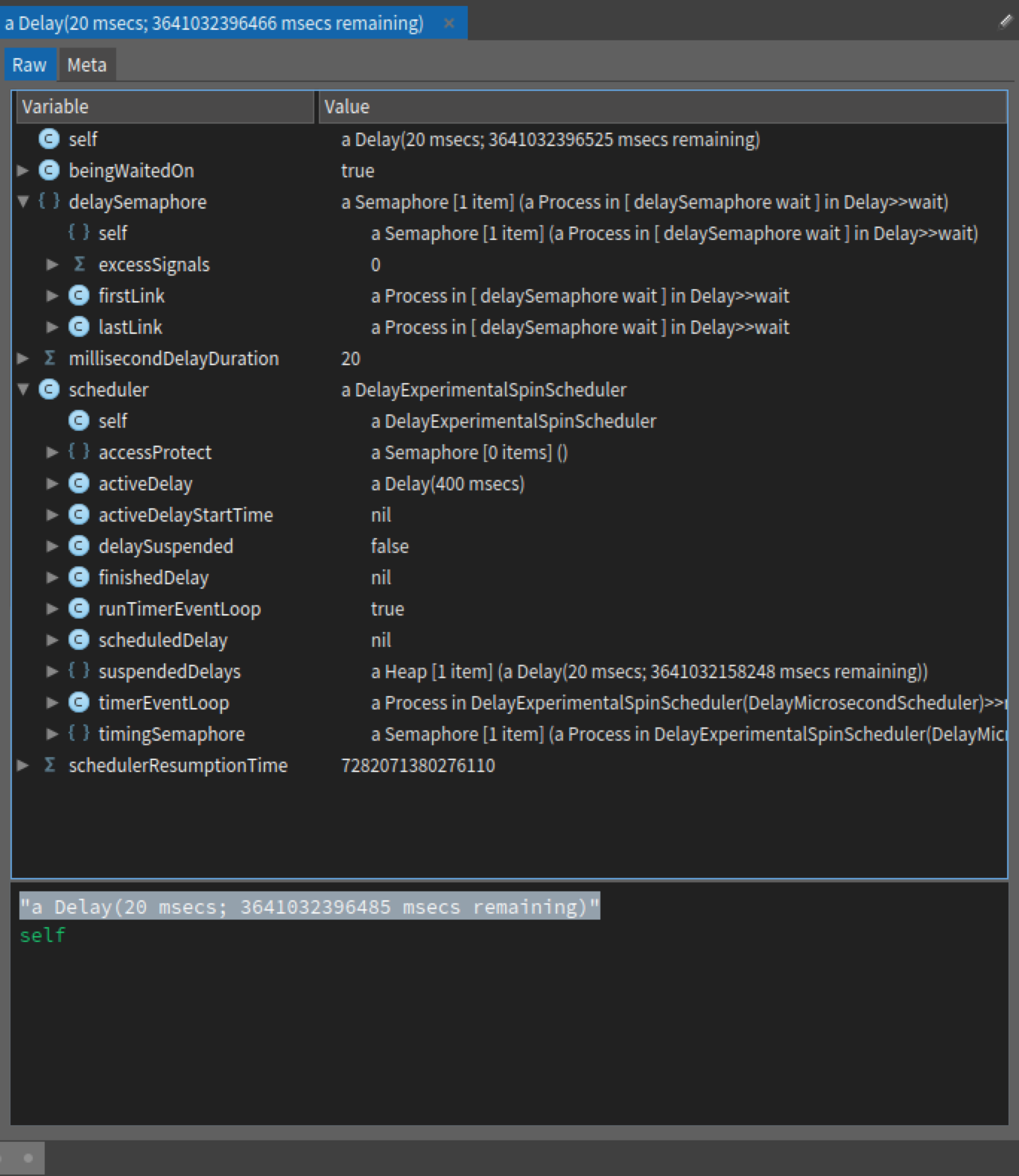
Hi guys, I am seeing a problem in Pharo 5.0 regarding Delay >> wait. I cannot explain how this could happened but it does, and it happened to me a couple of times (but not fully reproducible). In OSSubprocess I have this child watcher: initializeChildWatcher "This is a process which waits for the death of a child processes. Use SIGCHLD events rather than a Delay to poll." | processSynchronizationDelay | *processSynchronizationDelay := Delay forMilliseconds: 20.* childWatcher ifNil: [ childWatcher := [[ "OSProcess authors suspected that there were various ways in which OS signals could be missed under conditions of heavy load. For that reason, we use #waitTimeoutMSecs: with the semaphore, so that if a signal is missed, we time out and rescan occasionally anyway (#updateActiveChildrenAndNotifyDead sends queryExitStatus which sends waitpid() ) " self sigChldSemaphore waitTimeoutMSecs: 1000. *processSynchronizationDelay wait. "Avoids lost signals in heavy process switching"* self updateActiveChildrenAndNotifyDead. ] repeat] newProcess. childWatcher resume. "name selected to look reasonable in the process browser" childWatcher name: ((ReadStream on: childWatcher hash asString) next: 5) , ': the OSSubprocess child watcher' ] The problem is that now above process is hung on the "*processSynchronizationDelay wait.". *At least that's what I can see from the process browser. That should not hung, of course, and should stop waiting after 20 ms. If I inspect the Delay instance in question (doing the wait) I see that the print string is bad.... "a Delay(20 msecs; 3641032396485 msecs remaining)". WTF? 20ms and you remain 3641032396485 to wait??? I attach an screenshot of the Delay instance in case there could be something wrong. Maybe it is wrong to keep and re-use same instance of Delay? (note it is outside the closure) (this was not a problem in the past). Thanks in advance for any clue. -- Mariano http://marianopeck.wordpress.com

I don't have time to look at this properly until tomorrow. In the meantime, could you just post the result of... Delay delaySchedulerClass it should be "DelayExperimentalSpinScheduler" *** Also could you try a few of the other options from World > System > Settings > System ... ***whoops, the Experimental tag should have been dropped for Pharo 5 Release. Its been fine for months (unless this is a fault :) ] On Wed, May 18, 2016 at 11:49 PM, Mariano Martinez Peck <marianopeck@gmail.com> wrote:
Hi guys,
I am seeing a problem in Pharo 5.0 regarding Delay >> wait. I cannot explain how this could happened but it does, and it happened to me a couple of times (but not fully reproducible).
In OSSubprocess I have this child watcher:
initializeChildWatcher "This is a process which waits for the death of a child processes. Use SIGCHLD events rather than a Delay to poll."
| processSynchronizationDelay | processSynchronizationDelay := Delay forMilliseconds: 20. childWatcher ifNil: [ childWatcher := [[ "OSProcess authors suspected that there were various ways in which OS signals could be missed under conditions of heavy load. For that reason, we use #waitTimeoutMSecs: with the semaphore, so that if a signal is missed, we time out and rescan occasionally anyway (#updateActiveChildrenAndNotifyDead sends queryExitStatus which sends waitpid() ) " self sigChldSemaphore waitTimeoutMSecs: 1000. processSynchronizationDelay wait. "Avoids lost signals in heavy process switching" self updateActiveChildrenAndNotifyDead. ] repeat] newProcess.
childWatcher resume. "name selected to look reasonable in the process browser" childWatcher name: ((ReadStream on: childWatcher hash asString) next: 5) , ': the OSSubprocess child watcher' ]
The problem is that now above process is hung on the "processSynchronizationDelay wait.". At least that's what I can see from the process browser. That should not hung, of course, and should stop waiting after 20 ms.
If I inspect the Delay instance in question (doing the wait) I see that the print string is bad.... "a Delay(20 msecs; 3641032396485 msecs remaining)". WTF? 20ms and you remain 3641032396485 to wait??? I attach an screenshot of the Delay instance in case there could be something wrong.
Maybe it is wrong to keep and re-use same instance of Delay? (note it is outside the closure) (this was not a problem in the past).
Not sure. I've heard others say Delays should only be used once. To experiment, could you try creating a delay each time. cheers -ben
On Wed, May 18, 2016 at 2:10 PM, Ben Coman <btc@openinworld.com> wrote:
I don't have time to look at this properly until tomorrow. In the meantime, could you just post the result of...
Delay delaySchedulerClass it should be "DelayExperimentalSpinScheduler" ***
Yes, it is.
Also could you try a few of the other options from World > System > Settings > System ...
Do you know which is the "Safest" to use? Or at least which was used in say, 4.0?
***whoops, the Experimental tag should have been dropped for Pharo 5 Release. Its been fine for months (unless this is a fault :) ]
Yes, I found that strange too.
Maybe it is wrong to keep and re-use same instance of Delay? (note it is outside the closure) (this was not a problem in the past).
Not sure. I've heard others say Delays should only be used once. To experiment, could you try creating a delay each time.
Ok, I will try this. But again, it would take some some time to test and it happens to me every in while only. Thanks!! -- Mariano http://marianopeck.wordpress.com

the reason I asked about OSProcess in Pharo 5 was that OSProcess waitForCommand: 'ls' never returned. Maybe its another instance of this problem. And it happens everytime. There is a 50ms delay in the #waitForCommand: method hope this helps Paul Mariano Martinez Peck wrote
On Wed, May 18, 2016 at 2:10 PM, Ben Coman <
btc@
> wrote:
I don't have time to look at this properly until tomorrow. In the meantime, could you just post the result of...
Delay delaySchedulerClass it should be "DelayExperimentalSpinScheduler" ***
Yes, it is.
Also could you try a few of the other options from World > System > Settings > System ...
Do you know which is the "Safest" to use? Or at least which was used in say, 4.0?
***whoops, the Experimental tag should have been dropped for Pharo 5 Release. Its been fine for months (unless this is a fault :) ]
Yes, I found that strange too.
Maybe it is wrong to keep and re-use same instance of Delay? (note it
is
outside the closure) (this was not a problem in the past).
Not sure. I've heard others say Delays should only be used once. To experiment, could you try creating a delay each time.
Ok, I will try this. But again, it would take some some time to test and it happens to me every in while only.
Thanks!!
-- Mariano http://marianopeck.wordpress.com
-- View this message in context: http://forum.world.st/Problem-with-delay-waiting-OSSubprocess-code-on-Pharo-... Sent from the Pharo Smalltalk Developers mailing list archive at Nabble.com.

On 05/18/2016 02:46 PM, Paul DeBruicker wrote:
the reason I asked about OSProcess in Pharo 5 was that
OSProcess waitForCommand: 'ls'
never returned.
Maybe its another instance of this problem. And it happens everytime.
There is a 50ms delay in the #waitForCommand: method
I'm currently having a problem with an OSProcess of a chmod never returning. And that's in Pharo 4! Never seen a problem there before. Investigating. Regards, -Martin
On Wed, May 18, 2016 at 7:28 PM, Martin McClure <martin@hand2mouse.com> wrote:
On 05/18/2016 02:46 PM, Paul DeBruicker wrote:
the reason I asked about OSProcess in Pharo 5 was that
OSProcess waitForCommand: 'ls'
never returned.
Maybe its another instance of this problem. And it happens everytime.
There is a 50ms delay in the #waitForCommand: method
I'm currently having a problem with an OSProcess of a chmod never returning. And that's in Pharo 4! Never seen a problem there before. Investigating.
Thanks Martin. I cannot tell about 4.0 as OSSubprocess only works in 5.0... What I know is that in 5.0 there have been changes in the wait delay (that's why Ben answered).
Regards,
-Martin
-- Mariano http://marianopeck.wordpress.com
On Wed, May 18, 2016 at 6:46 PM, Paul DeBruicker <pdebruic@gmail.com> wrote:
the reason I asked about OSProcess in Pharo 5 was that
OSProcess waitForCommand: 'ls'
never returned.
Maybe its another instance of this problem. And it happens everytime.
There is a 50ms delay in the #waitForCommand: method
It looks quite similar indeed. And... both, OSProcess and OSSubprocess have a similar child watcher (I based mine in OSProcess one). Paul could you inspect the child process from the process browser tool, do an inspect, and check the suspended process? Check the wait time to see if it is 50ms or 20ms etc...that way we can see which part is the "hunging".
hope this helps
Paul
Mariano Martinez Peck wrote
On Wed, May 18, 2016 at 2:10 PM, Ben Coman <
btc@
> wrote:
I don't have time to look at this properly until tomorrow. In the meantime, could you just post the result of...
Delay delaySchedulerClass it should be "DelayExperimentalSpinScheduler" ***
Yes, it is.
Also could you try a few of the other options from World > System > Settings > System ...
Do you know which is the "Safest" to use? Or at least which was used in say, 4.0?
***whoops, the Experimental tag should have been dropped for Pharo 5 Release. Its been fine for months (unless this is a fault :) ]
Yes, I found that strange too.
Maybe it is wrong to keep and re-use same instance of Delay? (note it
is
outside the closure) (this was not a problem in the past).
Not sure. I've heard others say Delays should only be used once. To experiment, could you try creating a delay each time.
Ok, I will try this. But again, it would take some some time to test and it happens to me every in while only.
Thanks!!
-- Mariano http://marianopeck.wordpress.com
-- View this message in context: http://forum.world.st/Problem-with-delay-waiting-OSSubprocess-code-on-Pharo-... Sent from the Pharo Smalltalk Developers mailing list archive at Nabble.com.
-- Mariano http://marianopeck.wordpress.com
On 05/18/2016 08:49 AM, Mariano Martinez Peck wrote:
Hi guys,
I am seeing a problem in Pharo 5.0 regarding Delay >> wait. I cannot explain how this could happened but it does, and it happened to me a couple of times (but not fully reproducible).
Hmm. The schedulerResumptionTime is, somehow, being (approximately) doubled. It's not clear how that can happen, but I'll look a little more. -Martin
On 05/18/2016 03:17 PM, Martin McClure wrote:
On 05/18/2016 08:49 AM, Mariano Martinez Peck wrote:
Hi guys,
I am seeing a problem in Pharo 5.0 regarding Delay >> wait. I cannot explain how this could happened but it does, and it happened to me a couple of times (but not fully reproducible).
Hmm. The schedulerResumptionTime is, somehow, being (approximately) doubled. It's not clear how that can happen, but I'll look a little more.
Mario, is there any chance that you might be saving the image during one of these Delays? This one smells like a race condition, and I think I see something that *might* explain it. But I don't have any more time to spend on this one, so I'll leave the rest to someone else. I hope this is helpful: The only way I immediately see for the schedulerResumptionTime to become approximately doubled is if the Delay's resumption time is adjusted by #restoreResumptionTimes without previously having been adjusted by #saveResumptionTimes. The only time either of those are sent, that I can see, is on saving the image. Both are normally sent, (save before the snapshot, restore afterwards), but there may be a hole there. #saveResumptionTimes is only sent (by this scheduler class) when the accessProtect semaphore is held, but #handleTimerEvent: is executed in the timing Process *without* the protection of accessProtect, in the case of the VM signaling the timingSemaphore. If the VM signals the timingSemaphore, #handleTimerEvent: could run in the middle of #saveResumptionTimes. If some Delay expires because of that timer event, our Delay could move from being the first suspended delay to being the active delay. If that happens after we've adjusted the active delay, but before we've processed the suspended delays, that Delay will not get adjusted, and will show the symptoms that Mariano is seeing. Also, I'm not sure how the Heap that holds the suspendedDelays will react to being modified in the middle of an enumeration. That might open a larger window for the problem. Regards, -Martin
On Thu, May 19, 2016 at 8:49 AM, Martin McClure <martin@hand2mouse.com> wrote:
On 05/18/2016 03:17 PM, Martin McClure wrote:
On 05/18/2016 08:49 AM, Mariano Martinez Peck wrote:
Hi guys,
I am seeing a problem in Pharo 5.0 regarding Delay >> wait. I cannot explain how this could happened but it does, and it happened to me a couple of times (but not fully reproducible).
Hmm. The schedulerResumptionTime is, somehow, being (approximately) doubled. It's not clear how that can happen, but I'll look a little more.
Mario, is there any chance that you might be saving the image during one of these Delays?
This one smells like a race condition, and I think I see something that *might* explain it. But I don't have any more time to spend on this one, so I'll leave the rest to someone else. I hope this is helpful:
The only way I immediately see for the schedulerResumptionTime to become approximately doubled is if the Delay's resumption time is adjusted by #restoreResumptionTimes without previously having been adjusted by #saveResumptionTimes.
The only time either of those are sent, that I can see, is on saving the image. Both are normally sent, (save before the snapshot, restore afterwards), but there may be a hole there.
#saveResumptionTimes is only sent (by this scheduler class) when the accessProtect semaphore is held, but #handleTimerEvent: is executed in the timing Process *without* the protection of accessProtect, in the case of the VM signaling the timingSemaphore. If the VM signals the timingSemaphore, #handleTimerEvent: could run in the middle of #saveResumptionTimes. If some Delay expires because of that timer event, our Delay could move from being the first suspended delay to being the active delay. If that happens after we've adjusted the active delay, but before we've processed the suspended delays, that Delay will not get adjusted, and will show the symptoms that Mariano is seeing.
A quick experiment to test this might be in shutDown/#startUp trying... [ self saveResumptionTimes ] valueAt: Processor timingPriority [ self resumeResumptionTimes ] valueAt: Processor timingPriority
Also, I'm not sure how the Heap that holds the suspendedDelays will react to being modified in the middle of an enumeration. That might open a larger window for the problem.
Regards,
-Martin
Even if not directly related to Mariano's problem, I agree with your general assessment. I'm not comfortable with the way that #save/#restoreResumptionTimes (which manipulate suspendedDelays) are called from user priority code via #shutDown/#startUp. Per the original code**, accessProtect can't be used inside the timing priority #handleTimerEvent since accessProtect is held by the user priority #schedule when it uses "timingSemaphore signal" to invoke invokes #handleTimerEvent. accessProtect never protected timingPriority manipulation of suspendedDelays by #handleTimerEvent, nor expired delays waking up. But ahhh... the disabling of accessProtect previously prevented new delays being scheduled between a #save and #restore. If a new delay is scheduled after the #save, when it is #restore'd its resumptionTime would be wrong. Waiting in the wings for Pharo 6 I have changes that should help: * have #save/#restoreResumptionTimes *only* called from timing priority event loop (i.e. #handleTimerEvent) * shutDown/startUp suspends/resumes the timing priority event loop, instead of trying to block signals to timingSemaphore I haven't touched it for a few months so I'll need to chase it up to provide a preview. Mariano, can you try DelayMillisecondScheduler (which however is missing some fixes for other issues). cheers -ben
On 05/18/2016 07:39 PM, Ben Coman wrote:
Waiting in the wings for Pharo 6 I have changes that should help: * have #save/#restoreResumptionTimes*only* called from timing priority event loop (i.e. #handleTimerEvent) * shutDown/startUp suspends/resumes the timing priority event loop, instead of trying to block signals to timingSemaphore
Yeah, that sounds better, thanks. -Martin
On Wed, May 18, 2016 at 11:39 PM, Ben Coman <btc@openinworld.com> wrote:
On Thu, May 19, 2016 at 8:49 AM, Martin McClure <martin@hand2mouse.com> wrote:
On 05/18/2016 03:17 PM, Martin McClure wrote:
On 05/18/2016 08:49 AM, Mariano Martinez Peck wrote:
Hi guys,
I am seeing a problem in Pharo 5.0 regarding Delay >> wait. I cannot explain how this could happened but it does, and it happened to me a
couple
of times (but not fully reproducible).
Hmm. The schedulerResumptionTime is, somehow, being (approximately) doubled. It's not clear how that can happen, but I'll look a little more.
Mario, is there any chance that you might be saving the image during one of these Delays?
This one smells like a race condition, and I think I see something that *might* explain it. But I don't have any more time to spend on this one, so I'll leave the rest to someone else. I hope this is helpful:
The only way I immediately see for the schedulerResumptionTime to become approximately doubled is if the Delay's resumption time is adjusted by #restoreResumptionTimes without previously having been adjusted by #saveResumptionTimes.
The only time either of those are sent, that I can see, is on saving the image. Both are normally sent, (save before the snapshot, restore afterwards), but there may be a hole there.
#saveResumptionTimes is only sent (by this scheduler class) when the accessProtect semaphore is held, but #handleTimerEvent: is executed in the timing Process *without* the protection of accessProtect, in the case of the VM signaling the timingSemaphore. If the VM signals the timingSemaphore, #handleTimerEvent: could run in the middle of #saveResumptionTimes. If some Delay expires because of that timer event, our Delay could move from being the first suspended delay to being the active delay. If that happens after we've adjusted the active delay, but before we've processed the suspended delays, that Delay will not get adjusted, and will show the symptoms that Mariano is seeing.
A quick experiment to test this might be in shutDown/#startUp trying... [ self saveResumptionTimes ] valueAt: Processor timingPriority [ self resumeResumptionTimes ] valueAt: Processor timingPriority
Also, I'm not sure how the Heap that holds the suspendedDelays will
react to
being modified in the middle of an enumeration. That might open a larger window for the problem.
Regards,
-Martin
Even if not directly related to Mariano's problem, I agree with your general assessment. I'm not comfortable with the way that #save/#restoreResumptionTimes (which manipulate suspendedDelays) are called from user priority code via #shutDown/#startUp. Per the original code**, accessProtect can't be used inside the timing priority #handleTimerEvent since accessProtect is held by the user priority #schedule when it uses "timingSemaphore signal" to invoke invokes #handleTimerEvent. accessProtect never protected timingPriority manipulation of suspendedDelays by #handleTimerEvent, nor expired delays waking up. But ahhh... the disabling of accessProtect previously prevented new delays being scheduled between a #save and #restore. If a new delay is scheduled after the #save, when it is #restore'd its resumptionTime would be wrong.
Waiting in the wings for Pharo 6 I have changes that should help: * have #save/#restoreResumptionTimes *only* called from timing priority event loop (i.e. #handleTimerEvent) * shutDown/startUp suspends/resumes the timing priority event loop, instead of trying to block signals to timingSemaphore
I haven't touched it for a few months so I'll need to chase it up to provide a preview.
Mariano, can you try DelayMillisecondScheduler (which however is missing some fixes for other issues).
Ben, Did you find a chance to do something else with this? I am still finding lookups every in a while even with the DelayMillisecondScheduler :( Thanks! -- Mariano http://marianopeck.wordpress.com
On Wed, Jul 13, 2016 at 12:30 AM, Mariano Martinez Peck <marianopeck@gmail.com> wrote:
On Wed, May 18, 2016 at 11:39 PM, Ben Coman <btc@openinworld.com> wrote:
On Thu, May 19, 2016 at 8:49 AM, Martin McClure <martin@hand2mouse.com> wrote:
On 05/18/2016 03:17 PM, Martin McClure wrote:
On 05/18/2016 08:49 AM, Mariano Martinez Peck wrote:
Hi guys,
I am seeing a problem in Pharo 5.0 regarding Delay >> wait. I cannot explain how this could happened but it does, and it happened to me a couple of times (but not fully reproducible).
Hmm. The schedulerResumptionTime is, somehow, being (approximately) doubled. It's not clear how that can happen, but I'll look a little more.
Mario, is there any chance that you might be saving the image during one of these Delays?
This one smells like a race condition, and I think I see something that *might* explain it. But I don't have any more time to spend on this one, so I'll leave the rest to someone else. I hope this is helpful:
The only way I immediately see for the schedulerResumptionTime to become approximately doubled is if the Delay's resumption time is adjusted by #restoreResumptionTimes without previously having been adjusted by #saveResumptionTimes.
The only time either of those are sent, that I can see, is on saving the image. Both are normally sent, (save before the snapshot, restore afterwards), but there may be a hole there.
#saveResumptionTimes is only sent (by this scheduler class) when the accessProtect semaphore is held, but #handleTimerEvent: is executed in the timing Process *without* the protection of accessProtect, in the case of the VM signaling the timingSemaphore. If the VM signals the timingSemaphore, #handleTimerEvent: could run in the middle of #saveResumptionTimes. If some Delay expires because of that timer event, our Delay could move from being the first suspended delay to being the active delay. If that happens after we've adjusted the active delay, but before we've processed the suspended delays, that Delay will not get adjusted, and will show the symptoms that Mariano is seeing.
A quick experiment to test this might be in shutDown/#startUp trying... [ self saveResumptionTimes ] valueAt: Processor timingPriority [ self resumeResumptionTimes ] valueAt: Processor timingPriority
Also, I'm not sure how the Heap that holds the suspendedDelays will react to being modified in the middle of an enumeration. That might open a larger window for the problem.
Regards,
-Martin
Even if not directly related to Mariano's problem, I agree with your general assessment. I'm not comfortable with the way that #save/#restoreResumptionTimes (which manipulate suspendedDelays) are called from user priority code via #shutDown/#startUp. Per the original code**, accessProtect can't be used inside the timing priority #handleTimerEvent since accessProtect is held by the user priority #schedule when it uses "timingSemaphore signal" to invoke invokes #handleTimerEvent. accessProtect never protected timingPriority manipulation of suspendedDelays by #handleTimerEvent, nor expired delays waking up. But ahhh... the disabling of accessProtect previously prevented new delays being scheduled between a #save and #restore. If a new delay is scheduled after the #save, when it is #restore'd its resumptionTime would be wrong.
Waiting in the wings for Pharo 6 I have changes that should help: * have #save/#restoreResumptionTimes *only* called from timing priority event loop (i.e. #handleTimerEvent) * shutDown/startUp suspends/resumes the timing priority event loop, instead of trying to block signals to timingSemaphore
I haven't touched it for a few months so I'll need to chase it up to provide a preview.
Mariano, can you try DelayMillisecondScheduler (which however is missing some fixes for other issues).
Ben,
Did you find a chance to do something else with this? I am still finding lookups every in a while even with the DelayMillisecondScheduler :(
Hi Mariano, Sorry for the delay attending to this. I got a bit twisted up on whether I'm complicating things too much with my DelayScheduler refactoring for Pharo 6 (I should just put it out for early review), but then I had to get through a Netflix addiction to the Star Trek prequel Enterprise, and family time over my kids school holidays. I'm back looking at it now - and taking a step back to see what is the minimum change required to fix this. Do you have some test code or a test image I could run to reproduce the problem? Now I have one thing for you to try. In the move of DelaySchedulerXxx from milliseconds to microseconds, the code for dealing with clock wrap-around was removed, but I wonder if it was also covering clock jitter as a side effect. Could you try again the SpinScheduler but restore this code...
From handletTimerEvent... "Check for clock wrap-around." millisecondNowTick < activeDelayStartTime ifTrue: [ "clock wrapped" self saveResumptionTimes. self restoreResumptionTimes ]. activeDelayStartTime := millisecondNowTick.
From runTimerEventLoop... Time millisecondClockValue < millisecondNowTick ifTrue:[ timingSemaphore signal ]. "retry"
From startup... activeDelayStartTime := Time millisecondClockValue.
cheers -ben
On Sun, Jul 17, 2016 at 6:46 AM, Ben Coman <btc@openinworld.com> wrote:
On Wed, Jul 13, 2016 at 12:30 AM, Mariano Martinez Peck <marianopeck@gmail.com> wrote:
On Wed, May 18, 2016 at 11:39 PM, Ben Coman <btc@openinworld.com> wrote:
On Thu, May 19, 2016 at 8:49 AM, Martin McClure <martin@hand2mouse.com> wrote:
On 05/18/2016 03:17 PM, Martin McClure wrote:
On 05/18/2016 08:49 AM, Mariano Martinez Peck wrote:
Hi guys,
I am seeing a problem in Pharo 5.0 regarding Delay >> wait. I cannot explain how this could happened but it does, and it happened to me a couple of times (but not fully reproducible).
Hmm. The schedulerResumptionTime is, somehow, being (approximately) doubled. It's not clear how that can happen, but I'll look a little more.
Mario, is there any chance that you might be saving the image during
one
of these Delays?
This one smells like a race condition, and I think I see something that *might* explain it. But I don't have any more time to spend on this one, so I'll leave the rest to someone else. I hope this is helpful:
The only way I immediately see for the schedulerResumptionTime to become approximately doubled is if the Delay's resumption time is adjusted by #restoreResumptionTimes without previously having been adjusted by #saveResumptionTimes.
The only time either of those are sent, that I can see, is on saving the image. Both are normally sent, (save before the snapshot, restore afterwards), but there may be a hole there.
#saveResumptionTimes is only sent (by this scheduler class) when the accessProtect semaphore is held, but #handleTimerEvent: is executed in the timing Process *without* the protection of accessProtect, in the case of the VM signaling the timingSemaphore. If the VM signals the timingSemaphore, #handleTimerEvent: could run in the middle of #saveResumptionTimes. If some Delay expires because of that timer event, our Delay could move from being the first suspended delay to being the active delay. If that happens after we've adjusted the active delay, but before we've processed the suspended delays, that Delay will not get adjusted, and will show the symptoms that Mariano is seeing.
A quick experiment to test this might be in shutDown/#startUp trying... [ self saveResumptionTimes ] valueAt: Processor timingPriority [ self resumeResumptionTimes ] valueAt: Processor timingPriority
Also, I'm not sure how the Heap that holds the suspendedDelays will react to being modified in the middle of an enumeration. That might open a
larger
window for the problem.
Regards,
-Martin
Even if not directly related to Mariano's problem, I agree with your general assessment. I'm not comfortable with the way that #save/#restoreResumptionTimes (which manipulate suspendedDelays) are called from user priority code via #shutDown/#startUp. Per the original code**, accessProtect can't be used inside the timing priority #handleTimerEvent since accessProtect is held by the user priority #schedule when it uses "timingSemaphore signal" to invoke invokes #handleTimerEvent. accessProtect never protected timingPriority manipulation of suspendedDelays by #handleTimerEvent, nor expired delays waking up. But ahhh... the disabling of accessProtect previously prevented new delays being scheduled between a #save and #restore. If a new delay is scheduled after the #save, when it is #restore'd its resumptionTime would be wrong.
Waiting in the wings for Pharo 6 I have changes that should help: * have #save/#restoreResumptionTimes *only* called from timing priority event loop (i.e. #handleTimerEvent) * shutDown/startUp suspends/resumes the timing priority event loop, instead of trying to block signals to timingSemaphore
I haven't touched it for a few months so I'll need to chase it up to provide a preview.
Mariano, can you try DelayMillisecondScheduler (which however is missing some fixes for other issues).
Ben,
Did you find a chance to do something else with this? I am still finding lookups every in a while even with the DelayMillisecondScheduler :(
Hi Mariano,
Sorry for the delay attending to this. I got a bit twisted up on whether I'm complicating things too much with my DelayScheduler refactoring for Pharo 6 (I should just put it out for early review), but then I had to get through a Netflix addiction to the Star Trek prequel Enterprise, and family time over my kids school holidays. I'm back looking at it now - and taking a step back to see what is the minimum change required to fix this.
hahaha no problem.
Do you have some test code or a test image I could run to reproduce the problem?
The problem is that I cannot reproduce it immediately. It takes me some days and likely some image save and start again until I reproduce it.
Now I have one thing for you to try. In the move of DelaySchedulerXxx from milliseconds to microseconds, the code for dealing with clock wrap-around was removed, but I wonder if it was also covering clock jitter as a side effect. Could you try again the SpinScheduler but restore this code...
From handletTimerEvent... "Check for clock wrap-around." millisecondNowTick < activeDelayStartTime ifTrue: [ "clock wrapped" self saveResumptionTimes. self restoreResumptionTimes ]. activeDelayStartTime := millisecondNowTick.
From runTimerEventLoop... Time millisecondClockValue < millisecondNowTick ifTrue:[ timingSemaphore signal ]. "retry"
From startup... activeDelayStartTime := Time millisecondClockValue.
OK, I put back the code into the spin scheduler. Then I kept using milisecond one until I finished the changes. Then I saved image and switch to spin one: the image hungs. I cannot even interrupt it. I attach my modifications. Do they look correct? Thanks! -- Mariano http://marianopeck.wordpress.com
On Fri, Jul 22, 2016 at 4:42 AM, Mariano Martinez Peck < marianopeck@gmail.com> wrote:
On Sun, Jul 17, 2016 at 6:46 AM, Ben Coman <btc@openinworld.com> wrote:
Do you have some test code or a test image I could run to reproduce the problem?
The problem is that I cannot reproduce it immediately. It takes me some days and likely some image save and start again until I reproduce it.
Could you try How about something that invokes
Now I have one thing for you to try. In the move of DelaySchedulerXxx from milliseconds to microseconds, the code for dealing with clock wrap-around was removed, but I wonder if it was also covering clock jitter as a side effect. Could you try again the SpinScheduler but restore this code...
From handletTimerEvent... "Check for clock wrap-around." millisecondNowTick < activeDelayStartTime ifTrue: [ "clock wrapped" self saveResumptionTimes. self restoreResumptionTimes ]. activeDelayStartTime := millisecondNowTick.
From runTimerEventLoop... Time millisecondClockValue < millisecondNowTick ifTrue:[ timingSemaphore signal ]. "retry"
From startup... activeDelayStartTime := Time millisecondClockValue.
OK, I put back the code into the spin scheduler. Then I kept using milisecond one until I finished the changes. Then I saved image and switch to spin one: the image hungs. I cannot even interrupt it. I attach my modifications. Do they look correct?
I confirm that locked my image also. One change of milli to micro was missed at the bottom of runTimeEventLoop... That is... Time millisecondClockValue < microsecondNowTick to... Time microsecondClockValue < microsecondNowTick (just a case of domestic blindness) [1] :) :) cheers -ben [1] http://www.urbandictionary.com/define.php?term=domestic%20blindness P.S. A trick to debug delays is to bypass interCycleDelay by at the top of it putting... true ifTrue: [^self].

On 22 Jul 2016, at 07:26, Ben Coman <btc@openInWorld.com> wrote:
On Fri, Jul 22, 2016 at 4:42 AM, Mariano Martinez Peck <marianopeck@gmail.com <mailto:marianopeck@gmail.com>> wrote:
On Sun, Jul 17, 2016 at 6:46 AM, Ben Coman <btc@openinworld.com <mailto:btc@openinworld.com>> wrote:
Do you have some test code or a test image I could run to reproduce the problem?
The problem is that I cannot reproduce it immediately. It takes me some days and likely some image save and start again until I reproduce it.
Could you try How about something that invokes
Now I have one thing for you to try. In the move of DelaySchedulerXxx from milliseconds to microseconds, the code for dealing with clock wrap-around was removed, but I wonder if it was also covering clock jitter as a side effect. Could you try again the SpinScheduler but restore this code...
From handletTimerEvent... "Check for clock wrap-around." millisecondNowTick < activeDelayStartTime ifTrue: [ "clock wrapped" self saveResumptionTimes. self restoreResumptionTimes ]. activeDelayStartTime := millisecondNowTick.
From runTimerEventLoop... Time millisecondClockValue < millisecondNowTick ifTrue:[ timingSemaphore signal ]. "retry"
From startup... activeDelayStartTime := Time millisecondClockValue.
OK, I put back the code into the spin scheduler. Then I kept using milisecond one until I finished the changes. Then I saved image and switch to spin one: the image hungs. I cannot even interrupt it. I attach my modifications. Do they look correct?
I confirm that locked my image also.
One change of milli to micro was missed at the bottom of runTimeEventLoop... That is... Time millisecondClockValue < microsecondNowTick to... Time microsecondClockValue < microsecondNowTick
(just a case of domestic blindness) [1] :) :)
And I reviewed your code and missed itâ¦
cheers -ben
[1] http://www.urbandictionary.com/define.php?term=domestic%20blindness <http://www.urbandictionary.com/define.php?term=domestic%20blindness>
P.S. A trick to debug delays is to bypass interCycleDelay by at the top of it putting... true ifTrue: [^self].
Thanks Max for reviewing it :) On Fri, Jul 22, 2016 at 11:08 AM, Max Leske <maxleske@gmail.com> wrote:
On 22 Jul 2016, at 07:26, Ben Coman <btc@openInWorld.com <btc@openinworld.com>> wrote:
On Fri, Jul 22, 2016 at 4:42 AM, Mariano Martinez Peck < marianopeck@gmail.com> wrote:
On Sun, Jul 17, 2016 at 6:46 AM, Ben Coman <btc@openinworld.com> wrote:
Do you have some test code or a test image I could run to reproduce the problem?
The problem is that I cannot reproduce it immediately. It takes me some days and likely some image save and start again until I reproduce it.
Could you try How about something that invokes
Now I have one thing for you to try. In the move of DelaySchedulerXxx from milliseconds to microseconds, the code for dealing with clock wrap-around was removed, but I wonder if it was also covering clock jitter as a side effect. Could you try again the SpinScheduler but restore this code...
From handletTimerEvent... "Check for clock wrap-around." millisecondNowTick < activeDelayStartTime ifTrue: [ "clock wrapped" self saveResumptionTimes. self restoreResumptionTimes ]. activeDelayStartTime := millisecondNowTick.
From runTimerEventLoop... Time millisecondClockValue < millisecondNowTick ifTrue:[ timingSemaphore signal ]. "retry"
From startup... activeDelayStartTime := Time millisecondClockValue.
OK, I put back the code into the spin scheduler. Then I kept using milisecond one until I finished the changes. Then I saved image and switch to spin one: the image hungs. I cannot even interrupt it. I attach my modifications. Do they look correct?
I confirm that locked my image also.
One change of milli to micro was missed at the bottom of runTimeEventLoop... That is... Time millisecondClockValue < microsecondNowTick to... Time microsecondClockValue < microsecondNowTick
(just a case of domestic blindness) [1] :) :)
And I reviewed your code and missed itâ¦
cheers -ben
[1] http://www.urbandictionary.com/define.php?term=domestic%20blindness
P.S. A trick to debug delays is to bypass interCycleDelay by at the top of it putting... true ifTrue: [^self].
-- Mariano http://marianopeck.wordpress.com
On Fri, Jul 22, 2016 at 2:26 AM, Ben Coman <btc@openinworld.com> wrote:
On Fri, Jul 22, 2016 at 4:42 AM, Mariano Martinez Peck < marianopeck@gmail.com> wrote:
On Sun, Jul 17, 2016 at 6:46 AM, Ben Coman <btc@openinworld.com> wrote:
Do you have some test code or a test image I could run to reproduce the problem?
The problem is that I cannot reproduce it immediately. It takes me some days and likely some image save and start again until I reproduce it.
Could you try How about something that invokes
Hi Ben. I tried to reproduce it in a couple of ways, trying to simulate what I do for real but I failed: | commandString | commandString := 'wkhtmltopdf --javascript-delay 300 --encoding utf8 --page-size A4 --image-quality 100 --footer-spacing 10 --header-spacing 10 --margin-top 10 --header-html "http://google.com" --footer-html " http://google.com" "http://pharo.org/" "/tmp/TestPharoExport.pdf"'. 10 timesRepeat: [ 3 timesRepeat: [ OSSUnixSubprocess new shellCommand: commandString; redirectStdout; redirectStderr; runAndWaitOnExitDo: [ :command :outString :errString | Transcript show: errString. Transcript show: outString. ]. ]. Smalltalk saveSession. ] But...I could not yet reproduce it in the real case either....so I will keep you informed.
Now I have one thing for you to try. In the move of DelaySchedulerXxx from milliseconds to microseconds, the code for dealing with clock wrap-around was removed, but I wonder if it was also covering clock jitter as a side effect. Could you try again the SpinScheduler but restore this code...
From handletTimerEvent... "Check for clock wrap-around." millisecondNowTick < activeDelayStartTime ifTrue: [ "clock wrapped" self saveResumptionTimes. self restoreResumptionTimes ]. activeDelayStartTime := millisecondNowTick.
From runTimerEventLoop... Time millisecondClockValue < millisecondNowTick ifTrue:[ timingSemaphore signal ]. "retry"
From startup... activeDelayStartTime := Time millisecondClockValue.
OK, I put back the code into the spin scheduler. Then I kept using milisecond one until I finished the changes. Then I saved image and switch to spin one: the image hungs. I cannot even interrupt it. I attach my modifications. Do they look correct?
I confirm that locked my image also.
One change of milli to micro was missed at the bottom of runTimeEventLoop... That is... Time millisecondClockValue < microsecondNowTick to... Time microsecondClockValue < microsecondNowTick
Thanks. That did the trick!
(just a case of domestic blindness) [1] :) :)
cheers -ben
[1] http://www.urbandictionary.com/define.php?term=domestic%20blindness
P.S. A trick to debug delays is to bypass interCycleDelay by at the top of it putting... true ifTrue: [^self].
-- Mariano http://marianopeck.wordpress.com
Hi Mariano, How are you going with this problem? On Fri, Jul 22, 2016 at 11:05 PM, Mariano Martinez Peck <marianopeck@gmail.com> wrote:
On Fri, Jul 22, 2016 at 2:26 AM, Ben Coman <btc@openinworld.com> wrote:
On Fri, Jul 22, 2016 at 4:42 AM, Mariano Martinez Peck <marianopeck@gmail.com> wrote:
On Sun, Jul 17, 2016 at 6:46 AM, Ben Coman <btc@openinworld.com> wrote:
Do you have some test code or a test image I could run to reproduce the problem?
The problem is that I cannot reproduce it immediately. It takes me some days and likely some image save and start again until I reproduce it.
Could you try How about something that invokes
Hi Ben. I tried to reproduce it in a couple of ways, trying to simulate what I do for real but I failed:
| commandString | commandString := 'wkhtmltopdf --javascript-delay 300 --encoding utf8 --page-size A4 --image-quality 100 --footer-spacing 10 --header-spacing 10 --margin-top 10 --header-html "http://google.com" --footer-html "http://google.com" "http://pharo.org/" "/tmp/TestPharoExport.pdf"'.
10 timesRepeat: [
3 timesRepeat: [ OSSUnixSubprocess new shellCommand: commandString; redirectStdout; redirectStderr; runAndWaitOnExitDo: [ :command :outString :errString | Transcript show: errString. Transcript show: outString. ]. ]. Smalltalk saveSession.
]
But...I could not yet reproduce it in the real case either....so I will keep you informed.
Now I have one thing for you to try. In the move of DelaySchedulerXxx from milliseconds to microseconds, the code for dealing with clock wrap-around was removed, but I wonder if it was also covering clock jitter as a side effect. Could you try again the SpinScheduler but restore this code...
From handletTimerEvent... "Check for clock wrap-around." millisecondNowTick < activeDelayStartTime ifTrue: [ "clock wrapped" self saveResumptionTimes. self restoreResumptionTimes ]. activeDelayStartTime := millisecondNowTick.
From runTimerEventLoop... Time millisecondClockValue < millisecondNowTick ifTrue:[ timingSemaphore signal ]. "retry"
From startup... activeDelayStartTime := Time millisecondClockValue.
OK, I put back the code into the spin scheduler. Then I kept using milisecond one until I finished the changes. Then I saved image and switch to spin one: the image hungs. I cannot even interrupt it. I attach my modifications. Do they look correct?
I confirm that locked my image also.
One change of milli to micro was missed at the bottom of runTimeEventLoop... That is... Time millisecondClockValue < microsecondNowTick to... Time microsecondClockValue < microsecondNowTick
Thanks. That did the trick!
Hi Ben, Sorry, I do not have yet a verdict. The part of the system that reproduces the crash is not used frequently so it takes me quite some time to reproduce it :( Will keep you informed if I see it again or not with the last changes. Thanks for checking with me. On Mon, Aug 8, 2016 at 12:43 PM, Ben Coman <btc@openinworld.com> wrote:
Hi Mariano, How are you going with this problem?
On Fri, Jul 22, 2016 at 11:05 PM, Mariano Martinez Peck <marianopeck@gmail.com> wrote:
On Fri, Jul 22, 2016 at 2:26 AM, Ben Coman <btc@openinworld.com> wrote:
On Fri, Jul 22, 2016 at 4:42 AM, Mariano Martinez Peck <marianopeck@gmail.com> wrote:
On Sun, Jul 17, 2016 at 6:46 AM, Ben Coman <btc@openinworld.com>
wrote:
Do you have some test code or a test image I could run to reproduce the problem?
The problem is that I cannot reproduce it immediately. It takes me some days and likely some image save and start again until I reproduce it.
Could you try How about something that invokes
Hi Ben. I tried to reproduce it in a couple of ways, trying to simulate what I do for real but I failed:
| commandString | commandString := 'wkhtmltopdf --javascript-delay 300 --encoding utf8 --page-size A4 --image-quality 100 --footer-spacing 10 --header-spacing 10 --margin-top 10 --header-html "http://google.com" --footer-html "http://google.com" "http://pharo.org/" "/tmp/TestPharoExport.pdf"'.
10 timesRepeat: [
3 timesRepeat: [ OSSUnixSubprocess new shellCommand: commandString; redirectStdout; redirectStderr; runAndWaitOnExitDo: [ :command :outString :errString | Transcript show: errString. Transcript show: outString. ]. ]. Smalltalk saveSession.
]
But...I could not yet reproduce it in the real case either....so I will keep you informed.
Now I have one thing for you to try. In the move of DelaySchedulerXxx from milliseconds to microseconds, the code for dealing with clock wrap-around was removed, but I wonder if it was also covering clock jitter as a side effect. Could you try again the SpinScheduler but restore this code...
From handletTimerEvent... "Check for clock wrap-around." millisecondNowTick < activeDelayStartTime ifTrue: [ "clock wrapped" self saveResumptionTimes. self restoreResumptionTimes ]. activeDelayStartTime := millisecondNowTick.
From runTimerEventLoop... Time millisecondClockValue < millisecondNowTick ifTrue:[ timingSemaphore signal ]. "retry"
From startup... activeDelayStartTime := Time millisecondClockValue.
OK, I put back the code into the spin scheduler. Then I kept using milisecond one until I finished the changes. Then I saved image and
switch
to spin one: the image hungs. I cannot even interrupt it. I attach my modifications. Do they look correct?
I confirm that locked my image also.
One change of milli to micro was missed at the bottom of runTimeEventLoop... That is... Time millisecondClockValue < microsecondNowTick to... Time microsecondClockValue < microsecondNowTick
Thanks. That did the trick!
-- Mariano http://marianopeck.wordpress.com
On Wed, May 18, 2016 at 9:49 PM, Martin McClure <martin@hand2mouse.com> wrote:
On 05/18/2016 03:17 PM, Martin McClure wrote:
On 05/18/2016 08:49 AM, Mariano Martinez Peck wrote:
Hi guys,
I am seeing a problem in Pharo 5.0 regarding Delay >> wait. I cannot explain how this could happened but it does, and it happened to me a couple of times (but not fully reproducible).
Hmm. The schedulerResumptionTime is, somehow, being (approximately) doubled. It's not clear how that can happen, but I'll look a little more.
Mario, is there any chance that you might be saving the image during one of these Delays?
This one smells like a race condition, and I think I see something that *might* explain it. But I don't have any more time to spend on this one, so I'll leave the rest to someone else. I hope this is helpful:
The only way I immediately see for the schedulerResumptionTime to become approximately doubled is if the Delay's resumption time is adjusted by #restoreResumptionTimes without previously having been adjusted by #saveResumptionTimes.
The only time either of those are sent, that I can see, is on saving the image. Both are normally sent, (save before the snapshot, restore afterwards), but there may be a hole there.
Martin, first off, thanks for the research!!! Now....your email made me remember something:* I did get VM crash when saving the image a couple of times. The VM crashed when saving the image. *If I re-opened the image, it looks like if the image was indeed saved (so the snapshot primitive itself did work), but I suspect not all shutdown code could have been run correctly. The VM crash looks like the FreeTypeFace >> pvtDestroyHandle which, as far as I know, it's a "known crash" (I attach crash dump). From what I can see, if I follow all the stack, the crash starts from the WeakArray >> startUp: . That means that...depending on the order of the startup list...the Scheduler may not have been run after the crash. Now.... WeakArray initialization does: SessionManager default registerSystemClassNamed: self name. While... Delay class >> startUp "Restart active delay, if any, when resuming a snapshot." Scheduler startUp. And the Delay registration is SessionManager default registerSystemClassNamed: self name atPriority: 20. So...that seems correct... I can verify this by: SessionManager default systemCategory prioritizedList Anyway...not sure if this adds something, but just wanted to note this.
#saveResumptionTimes is only sent (by this scheduler class) when the accessProtect semaphore is held, but #handleTimerEvent: is executed in the timing Process *without* the protection of accessProtect, in the case of the VM signaling the timingSemaphore. If the VM signals the timingSemaphore, #handleTimerEvent: could run in the middle of #saveResumptionTimes. If some Delay expires because of that timer event, our Delay could move from being the first suspended delay to being the active delay. If that happens after we've adjusted the active delay, but before we've processed the suspended delays, that Delay will not get adjusted, and will show the symptoms that Mariano is seeing.
Also, I'm not sure how the Heap that holds the suspendedDelays will react to being modified in the middle of an enumeration. That might open a larger window for the problem.
Regards,
-Martin
-- Mariano http://marianopeck.wordpress.com
Ben, for the record, I am using DelayMillisecondScheduler for a day and a half and so far no problem. On Thu, May 19, 2016 at 9:19 AM, Mariano Martinez Peck < marianopeck@gmail.com> wrote:
On Wed, May 18, 2016 at 9:49 PM, Martin McClure <martin@hand2mouse.com> wrote:
On 05/18/2016 03:17 PM, Martin McClure wrote:
On 05/18/2016 08:49 AM, Mariano Martinez Peck wrote:
Hi guys,
I am seeing a problem in Pharo 5.0 regarding Delay >> wait. I cannot explain how this could happened but it does, and it happened to me a couple of times (but not fully reproducible).
Hmm. The schedulerResumptionTime is, somehow, being (approximately) doubled. It's not clear how that can happen, but I'll look a little more.
Mario, is there any chance that you might be saving the image during one of these Delays?
This one smells like a race condition, and I think I see something that *might* explain it. But I don't have any more time to spend on this one, so I'll leave the rest to someone else. I hope this is helpful:
The only way I immediately see for the schedulerResumptionTime to become approximately doubled is if the Delay's resumption time is adjusted by #restoreResumptionTimes without previously having been adjusted by #saveResumptionTimes.
The only time either of those are sent, that I can see, is on saving the image. Both are normally sent, (save before the snapshot, restore afterwards), but there may be a hole there.
Martin, first off, thanks for the research!!!
Now....your email made me remember something:* I did get VM crash when saving the image a couple of times. The VM crashed when saving the image. *If I re-opened the image, it looks like if the image was indeed saved (so the snapshot primitive itself did work), but I suspect not all shutdown code could have been run correctly.
The VM crash looks like the FreeTypeFace >> pvtDestroyHandle which, as far as I know, it's a "known crash" (I attach crash dump). From what I can see, if I follow all the stack, the crash starts from the WeakArray
startUp: . That means that...depending on the order of the startup list...the Scheduler may not have been run after the crash.
Now.... WeakArray initialization does:
SessionManager default registerSystemClassNamed: self name. While...
Delay class >> startUp "Restart active delay, if any, when resuming a snapshot." Scheduler startUp.
And the Delay registration is
SessionManager default registerSystemClassNamed: self name atPriority: 20.
So...that seems correct...
I can verify this by:
SessionManager default systemCategory prioritizedList
Anyway...not sure if this adds something, but just wanted to note this.
#saveResumptionTimes is only sent (by this scheduler class) when the accessProtect semaphore is held, but #handleTimerEvent: is executed in the timing Process *without* the protection of accessProtect, in the case of the VM signaling the timingSemaphore. If the VM signals the timingSemaphore, #handleTimerEvent: could run in the middle of #saveResumptionTimes. If some Delay expires because of that timer event, our Delay could move from being the first suspended delay to being the active delay. If that happens after we've adjusted the active delay, but before we've processed the suspended delays, that Delay will not get adjusted, and will show the symptoms that Mariano is seeing.
Also, I'm not sure how the Heap that holds the suspendedDelays will react to being modified in the middle of an enumeration. That might open a larger window for the problem.
Regards,
-Martin
-- Mariano http://marianopeck.wordpress.com
-- Mariano http://marianopeck.wordpress.com
On Sat, May 21, 2016 at 12:05 AM, Mariano Martinez Peck <marianopeck@gmail.com> wrote:
Ben, for the record, I am using DelayMillisecondScheduler for a day and a half and so far no problem.
Cool. Thats why I left it there. I hope to soon have something for you to try with the newer design. Thanks for the update. cheers -ben
On Thu, May 19, 2016 at 9:19 AM, Mariano Martinez Peck <marianopeck@gmail.com> wrote:
On Wed, May 18, 2016 at 9:49 PM, Martin McClure <martin@hand2mouse.com> wrote:
On 05/18/2016 03:17 PM, Martin McClure wrote:
On 05/18/2016 08:49 AM, Mariano Martinez Peck wrote:
Hi guys,
I am seeing a problem in Pharo 5.0 regarding Delay >> wait. I cannot explain how this could happened but it does, and it happened to me a couple of times (but not fully reproducible).
Hmm. The schedulerResumptionTime is, somehow, being (approximately) doubled. It's not clear how that can happen, but I'll look a little more.
Mario, is there any chance that you might be saving the image during one of these Delays?
This one smells like a race condition, and I think I see something that *might* explain it. But I don't have any more time to spend on this one, so I'll leave the rest to someone else. I hope this is helpful:
The only way I immediately see for the schedulerResumptionTime to become approximately doubled is if the Delay's resumption time is adjusted by #restoreResumptionTimes without previously having been adjusted by #saveResumptionTimes.
The only time either of those are sent, that I can see, is on saving the image. Both are normally sent, (save before the snapshot, restore afterwards), but there may be a hole there.
Martin, first off, thanks for the research!!!
Now....your email made me remember something: I did get VM crash when saving the image a couple of times. The VM crashed when saving the image. If I re-opened the image, it looks like if the image was indeed saved (so the snapshot primitive itself did work), but I suspect not all shutdown code could have been run correctly.
The VM crash looks like the FreeTypeFace >> pvtDestroyHandle which, as far as I know, it's a "known crash" (I attach crash dump). From what I can see, if I follow all the stack, the crash starts from the WeakArray >> startUp: . That means that...depending on the order of the startup list...the Scheduler may not have been run after the crash.
Now.... WeakArray initialization does:
SessionManager default registerSystemClassNamed: self name. While...
Delay class >> startUp "Restart active delay, if any, when resuming a snapshot." Scheduler startUp.
And the Delay registration is
SessionManager default registerSystemClassNamed: self name atPriority: 20.
So...that seems correct...
I can verify this by:
SessionManager default systemCategory prioritizedList
Anyway...not sure if this adds something, but just wanted to note this.
#saveResumptionTimes is only sent (by this scheduler class) when the accessProtect semaphore is held, but #handleTimerEvent: is executed in the timing Process *without* the protection of accessProtect, in the case of the VM signaling the timingSemaphore. If the VM signals the timingSemaphore, #handleTimerEvent: could run in the middle of #saveResumptionTimes. If some Delay expires because of that timer event, our Delay could move from being the first suspended delay to being the active delay. If that happens after we've adjusted the active delay, but before we've processed the suspended delays, that Delay will not get adjusted, and will show the symptoms that Mariano is seeing.
Also, I'm not sure how the Heap that holds the suspendedDelays will react to being modified in the middle of an enumeration. That might open a larger window for the problem.
Regards,
-Martin
-- Mariano http://marianopeck.wordpress.com
-- Mariano http://marianopeck.wordpress.com
Hi Ben, I opened this issue for tracking the problem and not forget: https://pharo.fogbugz.com/f/cases/18359/Problem-with-DelayExperimentalSpinSc... Cheers, On Fri, May 20, 2016 at 2:58 PM, Ben Coman <btc@openinworld.com> wrote:
On Sat, May 21, 2016 at 12:05 AM, Mariano Martinez Peck <marianopeck@gmail.com> wrote:
Ben, for the record, I am using DelayMillisecondScheduler for a day and a half and so far no problem.
Cool. Thats why I left it there. I hope to soon have something for you to try with the newer design. Thanks for the update.
cheers -ben
On Thu, May 19, 2016 at 9:19 AM, Mariano Martinez Peck <marianopeck@gmail.com> wrote:
On Wed, May 18, 2016 at 9:49 PM, Martin McClure <martin@hand2mouse.com> wrote:
On 05/18/2016 03:17 PM, Martin McClure wrote:
On 05/18/2016 08:49 AM, Mariano Martinez Peck wrote:
Hi guys,
I am seeing a problem in Pharo 5.0 regarding Delay >> wait. I cannot explain how this could happened but it does, and it happened to me a
couple
of times (but not fully reproducible).
Hmm. The schedulerResumptionTime is, somehow, being (approximately) doubled. It's not clear how that can happen, but I'll look a little more.
Mario, is there any chance that you might be saving the image during one of these Delays?
This one smells like a race condition, and I think I see something that *might* explain it. But I don't have any more time to spend on this one, so I'll leave the rest to someone else. I hope this is helpful:
The only way I immediately see for the schedulerResumptionTime to become approximately doubled is if the Delay's resumption time is adjusted by #restoreResumptionTimes without previously having been adjusted by #saveResumptionTimes.
The only time either of those are sent, that I can see, is on saving the image. Both are normally sent, (save before the snapshot, restore afterwards), but there may be a hole there.
Martin, first off, thanks for the research!!!
Now....your email made me remember something: I did get VM crash when saving the image a couple of times. The VM crashed when saving the image. If I re-opened the image, it looks like if the image was indeed saved (so the snapshot primitive itself did work), but I suspect not all shutdown code could have been run correctly.
The VM crash looks like the FreeTypeFace >> pvtDestroyHandle which, as far as I know, it's a "known crash" (I attach crash dump). From what I can see, if I follow all the stack, the crash starts from the WeakArray >> startUp: . That means that...depending on the order of the startup list...the Scheduler may not have been run after the crash.
Now.... WeakArray initialization does:
SessionManager default registerSystemClassNamed: self name. While...
Delay class >> startUp "Restart active delay, if any, when resuming a snapshot." Scheduler startUp.
And the Delay registration is
SessionManager default registerSystemClassNamed: self name atPriority: 20.
So...that seems correct...
I can verify this by:
SessionManager default systemCategory prioritizedList
Anyway...not sure if this adds something, but just wanted to note this.
#saveResumptionTimes is only sent (by this scheduler class) when the accessProtect semaphore is held, but #handleTimerEvent: is executed in
the
timing Process *without* the protection of accessProtect, in the case of the VM signaling the timingSemaphore. If the VM signals the timingSemaphore, #handleTimerEvent: could run in the middle of #saveResumptionTimes. If some Delay expires because of that timer event, our Delay could move from being the first suspended delay to being the active delay. If that happens after we've adjusted the active delay, but before we've processed the suspended delays, that Delay will not get adjusted, and will show the symptoms that Mariano is seeing.
Also, I'm not sure how the Heap that holds the suspendedDelays will react to being modified in the middle of an enumeration. That might open a larger window for the problem.
Regards,
-Martin
-- Mariano http://marianopeck.wordpress.com
-- Mariano http://marianopeck.wordpress.com
-- Mariano http://marianopeck.wordpress.com

Hi Mariano. Some time ago I had a similar problem (Windows, Linux did not happen) and the solution was "OSProcessAccessor initialize" to open the image. HTH http://forum.world.st/OSProcess-error-in-1-3-tp4602389p4604877.html Cheers 2016-05-30 10:31 GMT-03:00 Mariano Martinez Peck <marianopeck@gmail.com>:
Hi Ben,
I opened this issue for tracking the problem and not forget: https://pharo.fogbugz.com/f/cases/18359/Problem-with-DelayExperimentalSpinSc...
Cheers,
On Fri, May 20, 2016 at 2:58 PM, Ben Coman <btc@openinworld.com> wrote:
On Sat, May 21, 2016 at 12:05 AM, Mariano Martinez Peck <marianopeck@gmail.com> wrote:
Ben, for the record, I am using DelayMillisecondScheduler for a day and a half and so far no problem.
Cool. Thats why I left it there. I hope to soon have something for you to try with the newer design. Thanks for the update.
cheers -ben
On Thu, May 19, 2016 at 9:19 AM, Mariano Martinez Peck <marianopeck@gmail.com> wrote:
On Wed, May 18, 2016 at 9:49 PM, Martin McClure <martin@hand2mouse.com
wrote:
On 05/18/2016 03:17 PM, Martin McClure wrote:
On 05/18/2016 08:49 AM, Mariano Martinez Peck wrote:
Hi guys,
I am seeing a problem in Pharo 5.0 regarding Delay >> wait. I cannot explain how this could happened but it does, and it happened to me
a couple
of times (but not fully reproducible).
Hmm. The schedulerResumptionTime is, somehow, being (approximately) doubled. It's not clear how that can happen, but I'll look a little more.
Mario, is there any chance that you might be saving the image during one of these Delays?
This one smells like a race condition, and I think I see something that *might* explain it. But I don't have any more time to spend on this one, so I'll leave the rest to someone else. I hope this is helpful:
The only way I immediately see for the schedulerResumptionTime to become approximately doubled is if the Delay's resumption time is adjusted by #restoreResumptionTimes without previously having been adjusted by #saveResumptionTimes.
The only time either of those are sent, that I can see, is on saving the image. Both are normally sent, (save before the snapshot, restore afterwards), but there may be a hole there.
Martin, first off, thanks for the research!!!
Now....your email made me remember something: I did get VM crash when saving the image a couple of times. The VM crashed when saving the image. If I re-opened the image, it looks like if the image was indeed saved (so the snapshot primitive itself did work), but I suspect not all shutdown code could have been run correctly.
The VM crash looks like the FreeTypeFace >> pvtDestroyHandle which, as far as I know, it's a "known crash" (I attach crash dump). From what I can see, if I follow all the stack, the crash starts from the WeakArray >> startUp: . That means that...depending on the order of the startup list...the Scheduler may not have been run after the crash.
Now.... WeakArray initialization does:
SessionManager default registerSystemClassNamed: self name. While...
Delay class >> startUp "Restart active delay, if any, when resuming a snapshot." Scheduler startUp.
And the Delay registration is
SessionManager default registerSystemClassNamed: self name atPriority: 20.
So...that seems correct...
I can verify this by:
SessionManager default systemCategory prioritizedList
Anyway...not sure if this adds something, but just wanted to note this.
#saveResumptionTimes is only sent (by this scheduler class) when the accessProtect semaphore is held, but #handleTimerEvent: is executed
in the
timing Process *without* the protection of accessProtect, in the case of the VM signaling the timingSemaphore. If the VM signals the timingSemaphore, #handleTimerEvent: could run in the middle of #saveResumptionTimes. If some Delay expires because of that timer event, our Delay could move from being the first suspended delay to being the active delay. If that happens after we've adjusted the active delay, but before we've processed the suspended delays, that Delay will not get adjusted, and will show the symptoms that Mariano is seeing.
Also, I'm not sure how the Heap that holds the suspendedDelays will react to being modified in the middle of an enumeration. That might open a larger window for the problem.
Regards,
-Martin
-- Mariano http://marianopeck.wordpress.com
-- Mariano http://marianopeck.wordpress.com
-- Mariano http://marianopeck.wordpress.com
participants (6)
-
 Ben Coman
 -
 Gastón Dall' Oglio
 -
 Mariano Martinez Peck
 -
 Martin McClure
 -
 Max Leske
 -
 Paul DeBruicker