[Pharo-project] [Seaside] Re: change n same words in browser with one action

You should not expect that -- Pharo used to have it but it was removed in favor of a more mainstream editor look-and-feel -- so that it be would more attractive to new users. Command+J / Control+J are just two of several powerful code-editing capabilities Pharo originally inherited from Squeak, along with my other favorites Command+E = Exchange the last two selections and Command+[, (, {, or | = Surround the highlighted text with that bracket-type pair. (not sure if those are still there in Pharo).
Now what would be really cool is to have a documentation about all those, and make them easily discoverable. I worked with Squeak long enough, and didn't saw anything close to that. I said that it is 'command-g' instead 'command-j' exactly because of that, because you never know... And for me it was always felt like: - let user discover shortcuts by pressing random key combinations and see what happens. And then tell me, what are the chances that people will understand what exactly cmd-j does without reading documentation? In 99% of cases it will be 'oh.. what was just happen' .. This is about "more attractive". And if you hiding knowledge behind sealed doors, don't be surprised that someone will come and build a new library with open doors, replacing yours.
You didn't look hard enough -- it's under the "help" menu. Squeak 3.0 is the earliest I have on my HD but.. yes, it was there then and its still there now. Ok, I know you just forgot we miss you too Igor. ;) I admire Pharo blazing new trails but notice a pattern in some of the "gold" feedback from Pharo customers which worth taking to heart. Like: http://lists.gforge.inria.fr/pipermail/pharo-project/2012-May/064702.html
This is, what i think, happens with shortcuts changes in Pharo, except form those which was remapped.
Pharo favors _familiarity_ for new users somewhat at the cost of productivity for its experienced users. It somewhat resembles eclipse -- with pop-up dialogs and a seemingly "modal" philosophy. Squeak, by constrast, has kept pushing the "simple-but-powerful" philosphy of its IDE to near extremes. While it's less familiar for new uesrs, once learned, general navigation and editing require _far fewer_ gestures.
Another thing, is that i first time hear that pharo is in favor of newcomers at expense of experienced users. I am not involved in changes to key bindings / shortcuts, but i doubt that people, who doing that, making changes having such strange aim. I think they are focused on making it good for newcomers and experienced users both. Otherwise i don't see much sense in doing this at all, and would be first who will be against it.
Ok, glad to hear that. I would rather have the best system possible than one with the most mainstream acceptance.
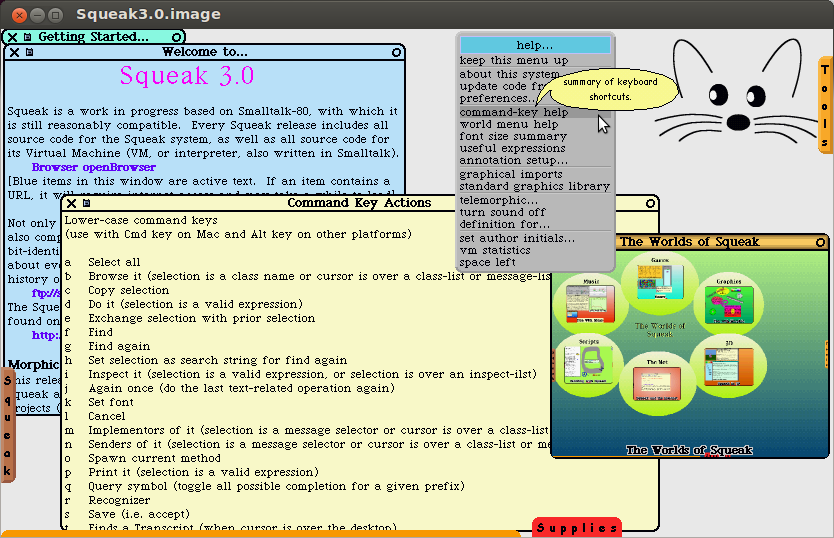
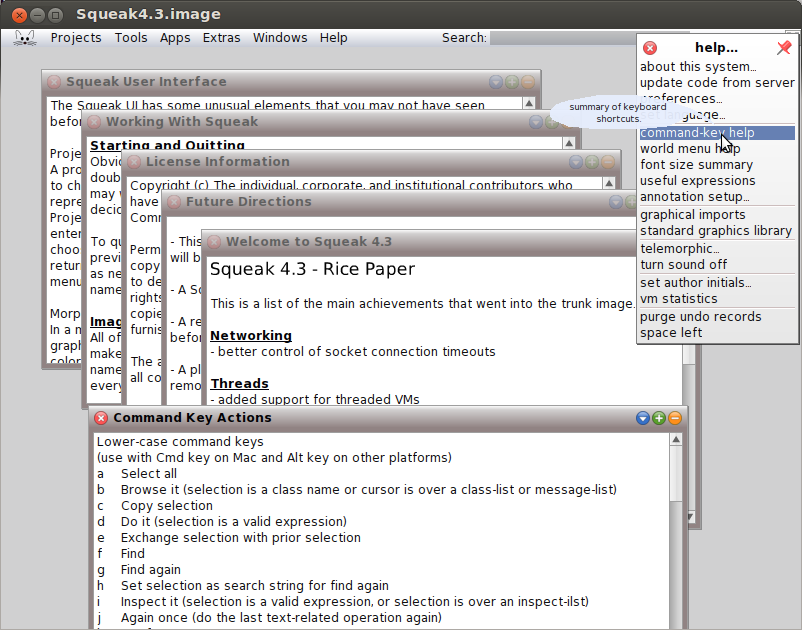

I agree with Igor and want to add, that a newbie will not be disturbed by shortcuts and can use the dialogs. It is the normal way, if you learn a new system, you get to know one thing after the other and someday, you get to know the shortcuts and they help to work faster. As you can see in the screenshot (left side), the feature is documented. At the right side you can see, that it is not implemented ;.) Perhaps it is possible to implement it in one of the next releases? On Sat, Sep 29, 2012 at 7:28 AM, Chris Muller <ma.chris.m@gmail.com> wrote:
You should not expect that -- Pharo used to have it but it was removed in favor of a more mainstream editor look-and-feel -- so that it be would more attractive to new users. Command+J / Control+J are just two of several powerful code-editing capabilities Pharo originally inherited from Squeak, along with my other favorites Command+E = Exchange the last two selections and Command+[, (, {, or | = Surround the highlighted text with that bracket-type pair. (not sure if those are still there in Pharo).
Now what would be really cool is to have a documentation about all those, and make them easily discoverable. I worked with Squeak long enough, and didn't saw anything close to that. I said that it is 'command-g' instead 'command-j' exactly because of that, because you never know... And for me it was always felt like: - let user discover shortcuts by pressing random key combinations and see what happens. And then tell me, what are the chances that people will understand what exactly cmd-j does without reading documentation? In 99% of cases it will be 'oh.. what was just happen' .. This is about "more attractive". And if you hiding knowledge behind sealed doors, don't be surprised that someone will come and build a new library with open doors, replacing yours.
You didn't look hard enough -- it's under the "help" menu. Squeak 3.0 is the earliest I have on my HD but.. yes, it was there then and its still there now. Ok, I know you just forgot we miss you too Igor. ;)
I admire Pharo blazing new trails but notice a pattern in some of the "gold" feedback from Pharo customers which worth taking to heart. Like:
http://lists.gforge.inria.fr/pipermail/pharo-project/2012-May/064702.html
This is, what i think, happens with shortcuts changes in Pharo, except form those which was remapped.
Pharo favors _familiarity_ for new users somewhat at the cost of productivity for its experienced users. It somewhat resembles eclipse -- with pop-up dialogs and a seemingly "modal" philosophy. Squeak, by constrast, has kept pushing the "simple-but-powerful" philosphy of its IDE to near extremes. While it's less familiar for new uesrs, once learned, general navigation and editing require _far fewer_ gestures.
Another thing, is that i first time hear that pharo is in favor of newcomers at expense of experienced users. I am not involved in changes to key bindings / shortcuts, but i doubt that people, who doing that, making changes having such strange aim. I think they are focused on making it good for newcomers and experienced users both. Otherwise i don't see much sense in doing this at all, and would be first who will be against it.
Ok, glad to hear that. I would rather have the best system possible than one with the most mainstream acceptance.

On 2012-09-29, at 10:04, Sabine Knöfel <sabine.knoefel@gmail.com> wrote:
I agree with Igor and want to add, that a newbie will not be disturbed by shortcuts and can use the dialogs. It is the normal way, if you learn a new system, you get to know one thing after the other and someday, you get to know the shortcuts and they help to work faster.
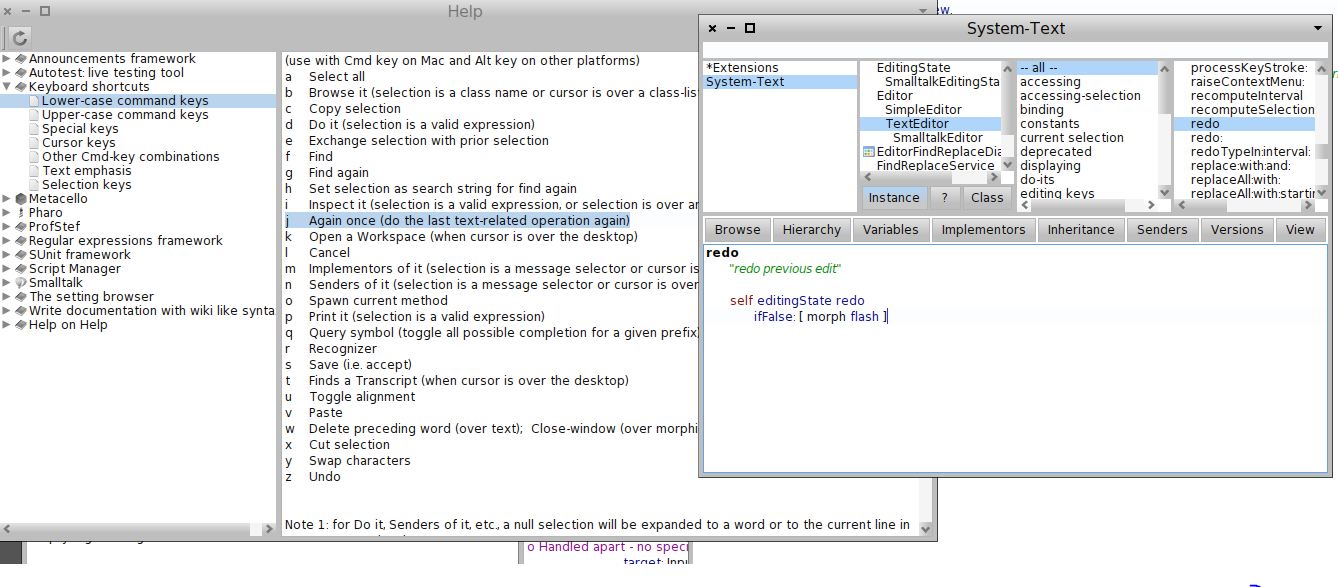
As you can see in the screenshot (left side), the feature is documented. At the right side you can see, that it is not implemented ;.)
Perhaps it is possible to implement it in one of the next releases?
I don't think replacements on a textual basis make much sense: 1. methods are only a few lines of code, thus limiting the usefulness of such replacements 2. besides renaming temporaries, most renames should be applied to other methods as well. For instance inst-var renames, or method renames.. Though I would like to see on-the-fly variable renaming. For instance as soon as you start typing on the name of the variable definition it will automatically rewrite all the other accesses to that variable in the current method. But for that we need a decent AST-based text editor. So unless you are a pro-pharo-shortcut user, think about the time you loose otherwise by point-and-clicking with your mouse ;), a little search and replace dialog interaction won't add too much :) best cami

On 29 September 2012 10:17, Camillo Bruni <camillobruni@gmail.com> wrote:
On 2012-09-29, at 10:04, Sabine Knöfel <sabine.knoefel@gmail.com> wrote:
I agree with Igor and want to add, that a newbie will not be disturbed by shortcuts and can use the dialogs. It is the normal way, if you learn a new system, you get to know one thing after the other and someday, you get to know the shortcuts and they help to work faster.
As you can see in the screenshot (left side), the feature is documented. At the right side you can see, that it is not implemented ;.)
Perhaps it is possible to implement it in one of the next releases?
I don't think replacements on a textual basis make much sense:
1. methods are only a few lines of code, thus limiting the usefulness of such replacements 2. besides renaming temporaries, most renames should be applied to other methods as well. For instance inst-var renames, or method renames..
Though I would like to see on-the-fly variable renaming. For instance as soon as you start typing on the name of the variable definition it will automatically rewrite all the other accesses to that variable in the current method. But for that we need a decent AST-based text editor.
So unless you are a pro-pharo-shortcut user, think about the time you loose otherwise by point-and-clicking with your mouse ;), a little search and replace dialog interaction won't add too much :)
no, Cami, with cmd-j you don't need to click and point. you just keep pressing cmd-j till all old occurrences is replaced with one which you over-typed. but i agree, that this feature has limited use in smalltalk code, knowing that most of methods is 1-liner and, i would say, if you need such thing, most of the times it is a sign that you violating DRY principle somehow and should really think how to refactor your code, instead of changing single variable name/expression 10 times.
best cami
-- Best regards, Igor Stasenko.
On 29 September 2012 07:28, Chris Muller <ma.chris.m@gmail.com> wrote:
You should not expect that -- Pharo used to have it but it was removed in favor of a more mainstream editor look-and-feel -- so that it be would more attractive to new users. Command+J / Control+J are just two of several powerful code-editing capabilities Pharo originally inherited from Squeak, along with my other favorites Command+E = Exchange the last two selections and Command+[, (, {, or | = Surround the highlighted text with that bracket-type pair. (not sure if those are still there in Pharo).
Now what would be really cool is to have a documentation about all those, and make them easily discoverable. I worked with Squeak long enough, and didn't saw anything close to that. I said that it is 'command-g' instead 'command-j' exactly because of that, because you never know... And for me it was always felt like: - let user discover shortcuts by pressing random key combinations and see what happens. And then tell me, what are the chances that people will understand what exactly cmd-j does without reading documentation? In 99% of cases it will be 'oh.. what was just happen' .. This is about "more attractive". And if you hiding knowledge behind sealed doors, don't be surprised that someone will come and build a new library with open doors, replacing yours.
You didn't look hard enough -- it's under the "help" menu. Squeak 3.0 is the earliest I have on my HD but.. yes, it was there then and its still there now.
Maybe i didn't look hard enough (well actually i did, cause i remember looking for the code which implements/introduces them).. Still since you cannot remember all shortcuts at once , unless they are catching your eye (in context menus/elsewhere), you tend to forget/not using them. What i can say about Pharo 2.0 today, that yes, a new shortcut is a bit alienating (because many you need to learn from scratch), but in other turn they are much easier to discover. And if you try Nautilus, you can figure, that you can do everything without even touching a mouse. I can hardly characterize this as "newbie-friendly"/anti-poweruser approach, but IMO it is much more friendly to power-users.. once you learn shortcuts, of course. Still, this is a work-in-progress, but i like the way guys doing it.. we'll see the end result once dust settles :)
Ok, I know you just forgot we miss you too Igor. ;)
but i cannot spend my time on everything, everywhere. I need to focus on stuff i do :)
I admire Pharo blazing new trails but notice a pattern in some of the "gold" feedback from Pharo customers which worth taking to heart. Like:
http://lists.gforge.inria.fr/pipermail/pharo-project/2012-May/064702.html
What can i say, it is of course not nice when you breaking old habits, unless you have a good reasons for doing so, and when you don't provide alternative(s).
This is, what i think, happens with shortcuts changes in Pharo, except form those which was remapped.
Pharo favors _familiarity_ for new users somewhat at the cost of productivity for its experienced users. It somewhat resembles eclipse -- with pop-up dialogs and a seemingly "modal" philosophy. Squeak, by constrast, has kept pushing the "simple-but-powerful" philosphy of its IDE to near extremes. While it's less familiar for new uesrs, once learned, general navigation and editing require _far fewer_ gestures.
Another thing, is that i first time hear that pharo is in favor of newcomers at expense of experienced users. I am not involved in changes to key bindings / shortcuts, but i doubt that people, who doing that, making changes having such strange aim. I think they are focused on making it good for newcomers and experienced users both. Otherwise i don't see much sense in doing this at all, and would be first who will be against it.
Ok, glad to hear that. I would rather have the best system possible than one with the most mainstream acceptance.
i can say you, it has nothing to do with mainstream: it is just new people , who learned things differently, and of course their preferences influencing the choices they do. i , for instance, i a long-time windows user. And many things in squeak were alien to me, like using alt-key instead of control key for most of shortcuts. Still, it doesn't matters as long as they meeting two key criteria: - consistent - easy to learn. -- Best regards, Igor Stasenko.
participants (4)
-
 Camillo Bruni
 -
 Chris Muller
 -
 Igor Stasenko
 -
 Sabine Knöfel