Introducing new feature dataTypes for the PolyMath/DataFrame project

Hello Everyone, I have been working on the addition of a new feature, DataFrame >> dataTypes, which briefs us about the data type of columns in dataframes we work on. Summarising a dataset is really important during the initial stage of any Data Science and Machine Learning tasks. Knowing the data type of the attribute is one major thing to begin with. I have tried to work with some sample datasets for a clear understanding of this new feature. Please go through the following blog post. Any kind of suggestion or feedback is welcome. Link to the Post : https://balaji612141526.wordpress.com/2021/08/06/introducing-new-feature-in-... Previous discussions can be found here : https://lists.pharo.org/empathy/thread/BFOHPRUU72MDYVTJP3YV2DQ5LAZHXELE and here : https://lists.pharo.org/empathy/thread/JZXKXGHSURC3DCDA2NXA7KDWZ2EINAZ5 Cheers Balaji G

Hi Balaji,
Please go through the following blog post. Any kind of suggestion or feedback is welcome.
That's a nice description, easy to follow. But there is a missing piece: how do you actually find the dataType for a series of values? My first guess was that you are using the same method as Collection >> commonSuperclass, but then a nil value should yield UndefinedObject, not Object as in your example. Cheers Konrad.
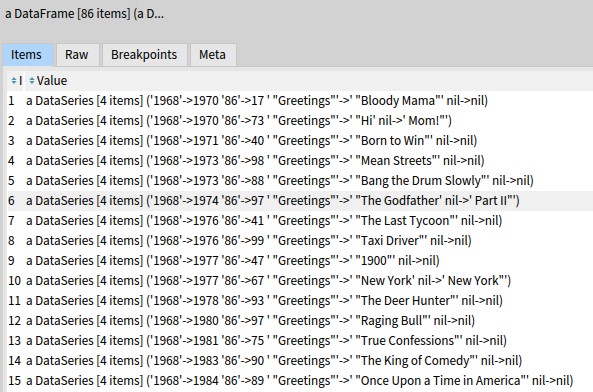
Hi Konrad Thanks for pointing this out. You are right with how the data types are calculated, similar to collection >> commonSuperClass. But this time, it is calculated only during the creation of DataFrame once and for all. Now coming to the next part, Kindly have a look at the below code. ------------------------------ series := #( nil nil nil ) asDataSeries. series calculateDataType. "UndefinedObject" . A nil value, or a Series of nil values yields UndefinedObject as its super class. There was an error with the dataset used on that example blog post. I have corrected it now. The problem was that the dataset was not clean, and had some garbage values of different types in that column. This resulted in a column, with type Object . This was the dataset and specifically the last column resulted in this mistake. On Sat, Aug 7, 2021 at 9:58 PM Konrad Hinsen <konrad.hinsen@fastmail.net> wrote:
Hi Balaji,
Please go through the following blog post. Any kind of suggestion or feedback is welcome.
That's a nice description, easy to follow. But there is a missing piece: how do you actually find the dataType for a series of values? My first guess was that you are using the same method as Collection >> commonSuperclass, but then a nil value should yield UndefinedObject, not Object as in your example.
Cheers Konrad.
Hi Balaji,
Thanks for pointing this out. You are right with how the data types are calculated, similar to collection >> commonSuperClass. But this time, it is calculated only during the creation of DataFrame once and for all.
That sounds good.
A nil value, or a Series of nil values yields UndefinedObject as its super class. There was an error with the dataset used on that example blog post. I have corrected it now.
OK, that explains my confusion. Cheers, Konrad.

I am not quite sure what the point of the datatypes feature is. x := nil. aSequence do: [:each | each ifNotNil: [ x := x ifNil: [each class] ifNotNil: [x commonSuperclassWith: each class]]]. doesn't seem terribly complicated. My difficulty is that from a statistics/data science perspective, it doesn't seem terribly *useful*. I'm currently reading a book about geostatistics with R (based on a survey of the Kola peninsula). For that task, it is ESSENTIAL to know the units in which the items are recorded. If Calcium is measured in mg/kg and Caesium is measured in µg/kg, you really really need to know that. This is not information you can derive by looking at the representation of the data in Pharo. Consider for example 1. mass of animals in kg 2. maximum speed of cars in km/h 3. volume of rain in successive dates, in mL (for fixed area) 4. directions taken by sand-hoppers released at different times of day, in degrees 5. region of space illuminated by light bulbs in steradians. These might all have the *same* representation in Pharo, but they are *semantically* very different. 1 and 2 are linear, but cannot be negative. 3 also cannot be negative, but the variable is a *time series*, which 1 and 2 are not. 4 is a circular measure, and taking the usual arithmetic mean or median would be an elementary blunder producing meaningless answers. 5 is perhaps best viewed as a proportion. (These are all actual examples, by the way.) THIS kind of information IS valuable for analysis. The difference between SmallInteger and Float64 is nowhere near as interesting. There's a bunch of weather data that i'm very interested in which has things like air temperature, soil temperature, relative humidity, wind speed and direction (last 5 minutes), gust speed and direction (maximum in last 5 minutes), illumination in W/m^2 (visible, UVB, UVA), rainfall, and of course date+time. Temperatures are measured on an interval scale, so dividing them makes no sense. Nor does adding them. If it's 10C today and 10C tomorrow, nothing is 20C. But oddly enough arithmetic means DO make sense. Humidity is bounded between 0 and 100; adding two relative humidities makes no sense at all. Medians make sense but means do not. Wind speed and direction are reported as separate variables, but they are arguably one 2D vector quantity. Illumination is on a ratio scale. Dividing one illumination by another makes sense, or would if there were no moonless nights... The total illumination over a day makes sense. Rainfall is also on a ratio scale. Dividing the rainfall on one day by that on another would make sense if only the usual measurement were not 0. Total rainfall over a day makes sense. The whole problem a statistician/data scientist faces is that there is important information you need to know even which *basic* operations make sense that has already disappeared by the time Pharo stores it, and cannot be inferred from the DataFrame. I remember one time I was given a CSV file with about 50 variables and it took me about 2 weeks to recover this missing meta-information. On Sat, 7 Aug 2021 at 04:23, Balaji G <gbalaji20002000@gmail.com> wrote:
Hello Everyone,
I have been working on the addition of a new feature, DataFrame >> dataTypes, which briefs us about the data type of columns in dataframes we work on. Summarising a dataset is really important during the initial stage of any Data Science and Machine Learning tasks. Knowing the data type of the attribute is one major thing to begin with. I have tried to work with some sample datasets for a clear understanding of this new feature. Please go through the following blog post. Any kind of suggestion or feedback is welcome.
Link to the Post : https://balaji612141526.wordpress.com/2021/08/06/introducing-new-feature-in-...
Previous discussions can be found here : https://lists.pharo.org/empathy/thread/BFOHPRUU72MDYVTJP3YV2DQ5LAZHXELE and here : https://lists.pharo.org/empathy/thread/JZXKXGHSURC3DCDA2NXA7KDWZ2EINAZ5
Cheers Balaji G
"Richard O'Keefe" <raoknz@gmail.com> writes:
My difficulty is that from a statistics/data science perspective, it doesn't seem terribly *useful*.
There are two common use cases in my experience: 1) Error checking, most frequently right after reading in a dataset. A quick look at the data types of all columns shows if it is coherent with your expectations. If you have a column called "data" of data type "Object", then most probably something went wrong with parsing some date format. 2) Type checking for specific operations. For example, you might want to compute an average over all rows for each numerical column in your dataset. That's easiest to do by selecting columns of the right data type. You are completely right that data type information is not sufficient for checking for all possible problems, such as unit mismatch. But it remains a useful tool. Cheers, Konrad.
Neither of those use cases actually works. Consider the following partial class hierarchy from my Smalltalk system: Object VectorSpace Complex Quaternion Magnitude MagnitudeWithAddition DateAndTime QuasiArithmetic Duration Number AbstractRationalNumber Integer SmallInteger There is a whole fleet of "numeric" things like Matrix3x3 which have some arithmetic properties but which cannot be given a total order consistent with those properties. Complex is one of them. It makes less than no sense to make Complex inherit from Magnitude, so it cannot inherit from Number, This means that the common superclass of 1 and 1 - 2 i is Object. Yet it makes perfect sense to have a column of Gaussian integers some of which have zero imaginary part. So "the dataType is Object means there's an error" fails at the first hurdle. Conversely, the common superclass of 1 and DateAndTime now is MagnitudeWithAddition, which is not Object, but the combination is probably wrong, and the dataType test fails at the second hurdle. "You might want to compute an average..." But dataType is no use for that either, as I was at pains to explain. If you have a bunch of angles expressed as Numbers, you *can* compute an arithmetic mean of them, but you *shouldn't*, because that's not how you compute the average of circular measures. The obvious algorithm (self sum / self size) does not work at all for a collection of DateAndTimes, but the notion of average makes perfect sense and a subtly different algorithm works well. (I wrote a technical report about this, if anyone is interested.) dataType will tell you you CAN take an average when you cannot or should not. dataType will tell you you CAN'T take an average when you really honestly can. The distinctions we need to make are not the distinctions that the class hierarchy makes. For example, how about the distinction between *ordered* factors and *unordered* factors? On Mon, 9 Aug 2021 at 03:03, Konrad Hinsen <konrad.hinsen@fastmail.net> wrote:
"Richard O'Keefe" <raoknz@gmail.com> writes:
My difficulty is that from a statistics/data science perspective, it doesn't seem terribly *useful*.
There are two common use cases in my experience:
1) Error checking, most frequently right after reading in a dataset. A quick look at the data types of all columns shows if it is coherent with your expectations. If you have a column called "data" of data type "Object", then most probably something went wrong with parsing some date format.
2) Type checking for specific operations. For example, you might want to compute an average over all rows for each numerical column in your dataset. That's easiest to do by selecting columns of the right data type.
You are completely right that data type information is not sufficient for checking for all possible problems, such as unit mismatch. But it remains a useful tool.
Cheers, Konrad.
"Richard O'Keefe" <raoknz@gmail.com> writes:
Neither of those use cases actually works.
In practice, they do.
Consider the following partial class hierarchy from my Smalltalk system:
That's not what I have to deal with in practice. My data comes in as a CSV file or a JSON file, i.e. formats with very shallow data classification. All I can expect to distinguish are strings vs. numbers, plus a few well-defined subsets of each, such as integers, specific constants (nil, true, false), or data recognizable by their format, such as dates. For internal processing, I might then want to redefine a column's data type to be something more specific. In particular, I might want to distinguish between "categorical" (a predefined finite set of string values) vs. "generic string". But most of the classes in a Smalltalk hierarchy just never occur in data frames. It's a simple data structure for simply structured data.
"You might want to compute an average..." But dataType is no use for that either, as I was at pains to explain. If you have a bunch of angles expressed as Numbers, you *can* compute an arithmetic mean of them, but you *shouldn't*, because that's not how you compute the average of circular measures.
I agree. There are many things you shouldn't do for any given dataset but which no formal structure will prevent you from doing. Data science is very much about shallow computations, with automation limited to simple stuff that is then applied to large datasets. Tools like data type analysis are no more than a help for the data scientist, who is the ultimate arbiter of what is or is not OK to do. Think of this as the data equivalent of a spell checker. A spell checker won't recognize bad grammar, but it's still a useful tool to have. Cheers, Konrad.
participants (3)
-
 Balaji G
 -
 Konrad Hinsen
 -
 Richard O'Keefe