
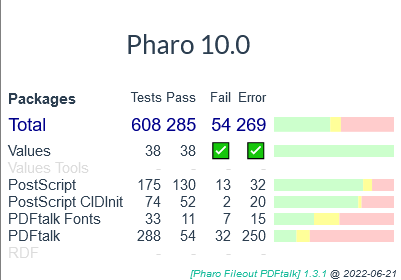
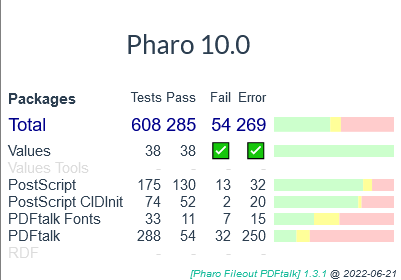
With help from the community some issues were fixed which improved the test statistics nicely. Check it out: https://wiki.pdftalk.de/doku.php?id=portingblog#second_pdftalk_fileout_for_s... Thanks to everybody involved! Happy hacking, ChristianÂ

Great! Sadly I have no time to help for real on this, but I will have a look at all related issue tracker entries, For Pharo, I would not try to support too old versions, e.g. Pharo 6.1, 7.0 are really old⦠we fix bugs and improve things All the time, targeting very very old systems is a lot of work, while the need might not be there as there might not be many Users. Marcus
On 22 Jun 2022, at 12:42, christian.haider <christian.haider@smalltalked-visuals.com> wrote:
With help from the community some issues were fixed which improved the test statistics nicely. Check it out: https://wiki.pdftalk.de/doku.php?id=portingblog#second_pdftalk_fileout_for_s...
Thanks to everybody involved!
Happy hacking, Christian

Hi Christian. Iâm trying to port from VW 8.3 to Pharo. Is there a detailed algorithm in addition to the Workflow section mentioned here?: https://wiki.pdftalk.de/doku.php?id=pdftalknonnamespacefileout 1. generate the source for the target dialect from VisualWorks with the defined code transformations. Fix problems so that there are no errors or warnings. ⦠How does one generate the source (run the transformation)? Where are the aforementioned âdefined code transformationsâ, Is there an example of how to setup the declarative template needed to map VW namespace names to Pharo class prefixes? I loaded the following packages into my VW 8.3 image: Values Project Values Values Fileout Pharo Values Testing Values Tools Values Tools Testing Pharo Fileout Values Pharo Transform Smalltalk Transform Project Smalltalk Transform TestBundle Smalltalk Transform Tests Smalltalk Transform Smalltalk Transform Model Smalltalk Transform Testing Smalltalk Transform TestPackage Smalltalk Transform Tools Any package not updated recently (in the last few months) I didnât load. Did I miss anything? 2. Port the Values package. This is easy, since no namespaces are involved. This first instruction after VW package setup says to port the contents of the Values package from VW to Pharo. Do you mean manually? Probably not. I feel like Iâve missed the main details of how to start the transformation. Iâd like to do a small fully contained test package with no external dependencies as a first test, probably my Magnitude or Collection packages. Suggestions are welcome. Thatâs for do this and sharing it. Shaping From: christian.haider <christian.haider@smalltalked-visuals.com> Sent: Wednesday, 22 June, 2022 05:42 To: pharo-users@lists.pharo.org Subject: [Pharo-users] [PDFtalk] second fileOut for Squeak and Pharo With help from the community some issues were fixed which improved the test statistics nicely. Check it out: https://wiki.pdftalk.de/doku.php?id=portingblog#second_pdftalk_fileout_for_s... Thanks to everybody involved! Happy hacking, Christian
Hi Christian. Iâm trying to port from VW 8.3 to Pharo. Is there a detailed algorithm in addition to the Workflow section mentioned here?: https://wiki.pdftalk.de/doku.php?id=pdftalknonnamespacefileout 1. generate the source for the target dialect from VisualWorks with the defined code transformations. Fix problems so that there are no errors or warnings. ⦠How does one generate the source (run the transformation)? Where are the aforementioned âdefined code transformationsâ, Is there an example of how to setup the declarative template needed to map VW namespace names to Pharo class prefixes? I loaded the following packages into my VW 8.3 image: Values Project Values Values Fileout Pharo Values Testing Values Tools Values Tools Testing Pharo Fileout Values Pharo Transform Smalltalk Transform Project Smalltalk Transform TestBundle Smalltalk Transform Tests Smalltalk Transform Smalltalk Transform Model Smalltalk Transform Testing Smalltalk Transform TestPackage Smalltalk Transform Tools Any package not updated recently (in the last few months) I didnât load. Did I miss anything? 2. Port the Values package. This is easy, since no namespaces are involved. This first instruction after VW package setup says to port the contents of the Values package from VW to Pharo. Do you mean manually? Probably not. I feel like Iâve missed the main details of how to start the transformation. Iâd like to do a small fully contained test package with no external dependencies as a first test, probably my Magnitude or Collection packages. Suggestions are welcome. Thanks for doing this and sharing it. Shaping From: christian.haider <christian.haider@smalltalked-visuals.com <mailto:christian.haider@smalltalked-visuals.com> > Sent: Wednesday, 22 June, 2022 05:42 To: pharo-users@lists.pharo.org <mailto:pharo-users@lists.pharo.org> Subject: [Pharo-users] [PDFtalk] second fileOut for Squeak and Pharo With help from the community some issues were fixed which improved the test statistics nicely. Check it out: https://wiki.pdftalk.de/doku.php?id=portingblog#second_pdftalk_fileout_for_s... Thanks to everybody involved! Happy hacking, Christian
Hi Shaping, great! :) Answers inline⦠Von: Shaping <shaping@uurda.org> Gesendet: Mittwoch, 3. August 2022 16:03 An: 'Any question about pharo is welcome' <pharo-users@lists.pharo.org>; 'Pharo Development List' <pharo-dev@lists.pharo.org> Betreff: [Pharo-users] FW: Porting from VW 8.3 to Pharo Hi Christian. Iâm trying to port from VW 8.3 to Pharo. Is there a detailed algorithm in addition to the Workflow section mentioned here?: https://wiki.pdftalk.de/doku.php?id=pdftalknonnamespacefileout 1. generate the source for the target dialect from VisualWorks with the defined code transformations. Fix problems so that there are no errors or warnings. ⦠No. The page is a bit outdated and reflected the beginning of the project, I will go over it and update the description. How does one generate the source (run the transformation)? Where are the aforementioned âdefined code transformationsâ, Is there an example of how to setup the declarative template needed to map VW namespace names to Pharo class prefixes? I loaded the following packages into my VW 8.3 image: Values Project Yes Values Values Fileout Pharo Values Testing Values Tools Values Tools Testing Automatic Load PDFtalk Project bundle. Since the main target is PDFtalk. Values (and PostScript) are just bycatch. Pharo Fileout Values No, this package has been renamed to [Pharo Fileout PDFtalk]. Load this. Pharo Transform No, not separate. This is part of the Transform Project. Smalltalk Transform Project Yes Smalltalk Transform TestBundle Smalltalk Transform Tests Smalltalk Transform Smalltalk Transform Model Smalltalk Transform Testing Smalltalk Transform TestPackage Smalltalk Transform Tools Automatic Any package not updated recently (in the last few months) I didnât load. Did I miss anything? Yes. The ideal setup from a virgin image is: Load {Values Project] bundle Load {PDFtalk Project} bundle Load {Smalltalk Transform Project} bundle Load [Pharo Fileout PDFtalk] package Save, done To transform Values do: âPharo100 fileOutValuesâ The [Pharo Fileout PDFtalk] package includes the latest Values transformations. I am thinking about a better modularization⦠Also, the wiki is a bit out of control. It really needs some restructuring. In the cites wiki page, there is a link to a blog where I record the changes. This might be informative. 2. Port the Values package. This is easy, since no namespaces are involved. This first instruction after VW package setup says to port the contents of the Values package from VW to Pharo. Do you mean manually? Probably not. No, no. This has been finished in March. For each dialect, I have a GitHub repository where I release important versions: <https://github.com/PortingPDFtalk/PharoPDFtalk> https://github.com/PortingPDFtalk/PharoPDFtalk. You can find the working port as first release â <https://github.com/PortingPDFtalk/PharoPDFtalk/releases/tag/1.3.0.0> Working versionâ. There you can download the ported Values fileout with the exact description with which versions of what it was created. This should be a good starting example. I feel like Iâve missed the main details of how to start the transformation. Iâd like to do a small fully contained test package with no external dependencies as a first test, probably my Magnitude or Collection packages. Suggestions are welcome. Thanks for doing this and sharing it. If I may suggest, I would look at the transformations on the class side of the SmalltalkTransform.Pharo class: methods #ValuesProject and #PDFtalkProject (I know, some would detest, that I start methods sometimes with a capital letterâ¦). To get a feel for the machinery, you could debug through âPharo100 fileOutValuesâ (for Pharo 10.0). As said, Values donât use namespaces. To see what is involved there, you could look at #PDFtalkProject for the name mapping. But beware! The PDFtalk transformation is not finished yet. Still, you could get some inspiration and can probably reuse some of the rules. Shaping Great that you are trying to use the transformation project. The more use, the better it should get. Please share your questions and insights (and successes :)). Happy hacking, Christian From: christian.haider <christian.haider@smalltalked-visuals.com <mailto:christian.haider@smalltalked-visuals.com> > Sent: Wednesday, 22 June, 2022 05:42 To: pharo-users@lists.pharo.org <mailto:pharo-users@lists.pharo.org> Subject: [Pharo-users] [PDFtalk] second fileOut for Squeak and Pharo With help from the community some issues were fixed which improved the test statistics nicely. Check it out: https://wiki.pdftalk.de/doku.php?id=portingblog#second_pdftalk_fileout_for_s... Thanks to everybody involved! Happy hacking, Christian
[â¦] How does one generate the source (run the transformation)? Where are the aforementioned âdefined code transformationsâ, Is there an example of how to setup the declarative template needed to map VW namespace names to Pharo class prefixes? I loaded the following packages into my VW 8.3 image: Values Project Yes Values Values Fileout Pharo Values Testing Values Tools Values Tools Testing Automatic Load PDFtalk Project bundle. Since the main target is PDFtalk. Values (and PostScript) are just bycatch. Pharo Fileout Values No, this package has been renamed to [Pharo Fileout PDFtalk]. Load this. Pharo Transform No, not separate. This is part of the Transform Project. Smalltalk Transform Project Yes Smalltalk Transform TestBundle Smalltalk Transform Tests Smalltalk Transform Smalltalk Transform Model Smalltalk Transform Testing Smalltalk Transform TestPackage Smalltalk Transform Tools Automatic Yes, I just loaded the head packages and the dependencies were also loaded. Thanks for trimming that down for me. Any package not updated recently (in the last few months) I didnât load. Did I miss anything? Yes. The ideal setup from a virgin image Ok. I donât have a virgin image. I have a very non-virgin image, about 27 years of development Iâm trying to port to Pharo. I donât yet have a specific interest in the PDFtalk, though I do see a need for PDF generation later, and will probably revisit that. For now, I just want my own stuff to run in Pharo. is: Load {Values Project] bundle Load {PDFtalk Project} bundle Load {Smalltalk Transform Project} bundle Load [Pharo Fileout PDFtalk] package Save, done Okay, so do I understand correctly that I need to include the PDFtalk stuff even if Iâm not interested in PDFtalk, because thatâs where a lot of the Smalltalk transformation machinery lives? Or is the PDFtalk just being used as an example for how to do a massive transformation? Or Both? To transform Values do: âPharo100 fileOutValuesâ The [Pharo Fileout PDFtalk] package includes the latest Values transformations. I am thinking about a better modularization⦠Also, the wiki is a bit out of control. It really needs some restructuring. In the cites wiki page, there is a link to a blog where I record the changes. This might be informative. 2. Port the Values package. This is easy, since no namespaces are involved. This first instruction after VW package setup says to port the contents of the Values package from VW to Pharo. Do you mean manually? Probably not. No, no. This has been finished in March. For each dialect, I have a GitHub repository where I release important versions: <https://github.com/PortingPDFtalk/PharoPDFtalk> https://github.com/PortingPDFtalk/PharoPDFtalk. You can find the working port as first release â <https://github.com/PortingPDFtalk/PharoPDFtalk/releases/tag/1.3.0.0> Working versionâ. There you can download the ported Values fileout with the exact description with which versions of what it was created. This should be a good starting example. Why do I need any new code installed in Pharo before I begin the transformation, if Iâm transforming code from VW to pharo? Iâm not understanding the basic constraints of the problem, even when the detailed steps are clear. Iâve done these steps so far: 1. Went to <https://github.com/PortingPDFtalk/PharoPDFtalk> https://github.com/PortingPDFtalk/PharoPDFtalk. 2. Saved down PDFtalk.Pharo100.st into <my Pharo 10 image directory>/pharo-local/Smalltalk-Transformation. (I figured that was a good place to save it. If anyone disagrees, or has a better or more conventional idea about where files should be saved, please say so. I setup a Pharo Git repo and played with it briefly for the first time yesterday. Iâve used Pharo off an on for 16 years, but this is the first time Iâm making a serious effort to manage source, and not throw away what Iâm working on.) 3. Filed-in PDFtalk.Pharo100.st. This went on for about 7 minutes or so. I have a hundreds if not over a thousand classes showing in Epicea. Is there anyway to get Epicea to give me a count of changes with a time-range filter? 4. Deleted (forgot) yesterdayâs, old Main practice-repo from both the image and the drive, and made a new one. I need to add to Main all the packages I just filed-in, but I donât see an efficient way to do that. I would like to use the Add Package button, but this gives a filtered list of available packages. I can filter subgroups, and then individually select each of the checkboxes to the left of each package (there is no Ctrl-A [select all] option here, which seems to be a strange omission given the potentially large number of packages involved). I see lots of prefixes for the classes just loaded. I could easily miss something if I filter/select/add one prefix-group at a time. Is there an easier way? Over in Epicea I donât see a way to push the loaded items listed to a specific repo. The first thought I have is to select all filed-in code artifacts by datetime span. I did that and saved it as an .ombu file (I have no idea what that is). I donât see a way to import that .ombu file into repo Mainâs âWorking copyâ window. It must be easy, but I donât see it. Please suggest the best way. I feel like Iâve missed the main details of how to start the transformation. Iâd like to do a small fully contained test package with no external dependencies as a first test, probably my Magnitude or Collection packages. Suggestions are welcome. Thanks for doing this and sharing it. If I may suggest, I would look at the transformations on the class side of the SmalltalkTransform.Pharo class: methods #ValuesProject and #PDFtalkProject (I know, some would detest, that I start methods sometimes with a capital letterâ¦). I used to be this way. Iâm okay with it now, and actually have selectors that are completely capitalized Acronyms. Times change. To get a feel for the machinery, you could debug through âPharo100 fileOutValuesâ (for Pharo 10.0). This will be my next step, but Iâm trying to understand the big picture of dependencies. The file-in was clean. I want to commit that before moving on. As said, Values donât use namespaces. To see what is involved there, you could look at #PDFtalkProject for the name mapping. But beware! The PDFtalk transformation is not finished yet. Still, you could get some inspiration and can probably reuse some of the rules. Great that you are trying to use the transformation project. The more use, the better it should get. Please share your questions and insights (and successes :)). Iâve been looking for a tool like this for many years. Thanks again. Shaping From: christian.haider <christian.haider@smalltalked-visuals.com <mailto:christian.haider@smalltalked-visuals.com> > Sent: Wednesday, 22 June, 2022 05:42 To: pharo-users@lists.pharo.org <mailto:pharo-users@lists.pharo.org> Subject: [Pharo-users] [PDFtalk] second fileOut for Squeak and Pharo With help from the community some issues were fixed which improved the test statistics nicely. Check it out: https://wiki.pdftalk.de/doku.php?id=portingblog#second_pdftalk_fileout_for_s... Thanks to everybody involved! Happy hacking, Christian
Hi Christian. (You can find some other discussion of this in Discord with Yanni and others.) I just evaled: SmalltalkTransform.Pharo100 fileOutValues This wrote file Values.Pharo100.st of size 42 KB to my VW image directory. So that little example is a test that shows how the transformation is done. It converts just package Values to a Pharo-compatible file-in. My task is then to queue a bunch of ProjectChange instances like this one: SmalltalkTransform.Pharo100>> ValuesProject ^ProjectChange name: #Values source: (Array with: (Package name: #Values)) changes: (Valuemap with: 'Values' -> self ValuesTransform) but for my own packages. No bundles are transformed (just their contained packages) because Pharo doesnât have bundles. Is that right? Is method ValuesTransform ^PackageChange ignoredNames: #(#{Smalltalk.GeneralBindingReference}) bridgeClasses: (Valuemap with: #{Timestamp} -> #DateAndTime with: #{Smalltalk.ColorValue} -> #Color) localChanges: self valuesLocalTransform extensions: (Array with: (SystemClassChange className: #Color instanceChanges: (Array with: (Add method: #asColorValue code: #_ph_asColorValue))) with: (SystemClassChange className: #TextStream instanceChanges: (Array with: (Add method: #nextPutAllText: code: #_ph_nextPutAllText:)))) written specifically for that package? I would think it applies to all packages. I see some expected mappings like Timestampe to DateAndTime. What about conversion of VW arrays to Pharo literal arrays? How is that done? I recall that one of the Smalltalks (I donât recall which) had Stream semantics differing from VWâs. ⦠I just checked. VWâs #upTo: method includes the object and leaves the index after it, and Pharoâs excludes the object and leaves the index at the object. So that is some major breakage if we donât correct it. Can it be done automatically?
valuesLocalTransform
has lots of juicy bits. But this doesnât look very simple. We canât just replace an old method with a new one. We also have to write the new one to tweak how the indices are used in #upTo:, and make sure that new method gets filed-in as well into the Pharo target image. Or, we have to do this kind of change manually. How did you handle conversion to literal arrays conversion and Stream semantic adjustment? This bit (SystemClassChange className: #Color instanceChanges: (Array with: (Add method: #asColorValue code: #_ph_asColorValue))) is replacing #asColorValue with #_ph_asColorValue because some special Pharo-color conversion needs to happen. But how does #_ph_asColorValue get defined? Itâs neither in VW nor in Pharo 10. Shaping [â¦] How does one generate the source (run the transformation)? Where are the aforementioned âdefined code transformationsâ, Is there an example of how to setup the declarative template needed to map VW namespace names to Pharo class prefixes? I loaded the following packages into my VW 8.3 image: Values Project Yes Values Values Fileout Pharo Values Testing Values Tools Values Tools Testing Automatic Load PDFtalk Project bundle. Since the main target is PDFtalk. Values (and PostScript) are just bycatch. Pharo Fileout Values No, this package has been renamed to [Pharo Fileout PDFtalk]. Load this. Pharo Transform No, not separate. This is part of the Transform Project. Smalltalk Transform Project Yes Smalltalk Transform TestBundle Smalltalk Transform Tests Smalltalk Transform Smalltalk Transform Model Smalltalk Transform Testing Smalltalk Transform TestPackage Smalltalk Transform Tools Automatic Yes, I just loaded the head packages and the dependencies were also loaded. Thanks for trimming that down for me. Any package not updated recently (in the last few months) I didnât load. Did I miss anything? Yes. The ideal setup from a virgin image Ok. I donât have a virgin image. I have a very non-virgin image, about 27 years of development Iâm trying to port to Pharo. I donât yet have a specific interest in the PDFtalk, though I do see a need for PDF generation later, and will probably revisit that. For now, I just want my own stuff to run in Pharo. is: Load {Values Project] bundle Load {PDFtalk Project} bundle Load {Smalltalk Transform Project} bundle Load [Pharo Fileout PDFtalk] package Save, done Okay, so do I understand correctly that I need to include the PDFtalk stuff even if Iâm not interested in PDFtalk, because thatâs where a lot of the Smalltalk transformation machinery lives? Or is the PDFtalk just being used as an example for how to do a massive transformation? Or Both? To transform Values do: âPharo100 fileOutValuesâ The [Pharo Fileout PDFtalk] package includes the latest Values transformations. I am thinking about a better modularization⦠Also, the wiki is a bit out of control. It really needs some restructuring. In the cites wiki page, there is a link to a blog where I record the changes. This might be informative. 2. Port the Values package. This is easy, since no namespaces are involved. This first instruction after VW package setup says to port the contents of the Values package from VW to Pharo. Do you mean manually? Probably not. No, no. This has been finished in March. For each dialect, I have a GitHub repository where I release important versions: <https://github.com/PortingPDFtalk/PharoPDFtalk> https://github.com/PortingPDFtalk/PharoPDFtalk. You can find the working port as first release â <https://github.com/PortingPDFtalk/PharoPDFtalk/releases/tag/1.3.0.0> Working versionâ. There you can download the ported Values fileout with the exact description with which versions of what it was created. This should be a good starting example. Why do I need any new code installed in Pharo before I begin the transformation, if Iâm transforming code from VW to pharo? Iâm not understanding the basic constraints of the problem, even when the detailed steps are clear. Iâve done these steps so far: 1. Went to <https://github.com/PortingPDFtalk/PharoPDFtalk> https://github.com/PortingPDFtalk/PharoPDFtalk. 2. Saved down PDFtalk.Pharo100.st into <my Pharo 10 image directory>/pharo-local/Smalltalk-Transformation. (I figured that was a good place to save it. If anyone disagrees, or has a better or more conventional idea about where files should be saved, please say so. I setup a Pharo Git repo and played with it briefly for the first time yesterday. Iâve used Pharo off an on for 16 years, but this is the first time Iâm making a serious effort to manage source, and not throw away what Iâm working on.) 3. Filed-in PDFtalk.Pharo100.st. This went on for about 7 minutes or so. I have a hundreds if not over a thousand classes showing in Epicea. Is there anyway to get Epicea to give me a count of changes with a time-range filter? 4. Deleted (forgot) yesterdayâs, old Main practice-repo from both the image and the drive, and made a new one. I need to add to Main all the packages I just filed-in, but I donât see an efficient way to do that. I would like to use the Add Package button, but this gives a filtered list of available packages. I can filter subgroups, and then individually select each of the checkboxes to the left of each package (there is no Ctrl-A [select all] option here, which seems to be a strange omission given the potentially large number of packages involved). I see lots of prefixes for the classes just loaded. I could easily miss something if I filter/select/add one prefix-group at a time. Is there an easier way? Over in Epicea I donât see a way to push the loaded items listed to a specific repo. The first thought I have is to select all filed-in code artifacts by datetime span. I did that and saved it as an .ombu file (I have no idea what that is). I donât see a way to import that .ombu file into repo Mainâs âWorking copyâ window. It must be easy, but I donât see it. Please suggest the best way. I feel like Iâve missed the main details of how to start the transformation. Iâd like to do a small fully contained test package with no external dependencies as a first test, probably my Magnitude or Collection packages. Suggestions are welcome. Thanks for doing this and sharing it. If I may suggest, I would look at the transformations on the class side of the SmalltalkTransform.Pharo class: methods #ValuesProject and #PDFtalkProject (I know, some would detest, that I start methods sometimes with a capital letterâ¦). I used to be this way. Iâm okay with it now, and actually have selectors that are completely capitalized Acronyms. Times change. To get a feel for the machinery, you could debug through âPharo100 fileOutValuesâ (for Pharo 10.0). This will be my next step, but Iâm trying to understand the big picture of dependencies. The file-in was clean. I want to commit that before moving on. As said, Values donât use namespaces. To see what is involved there, you could look at #PDFtalkProject for the name mapping. But beware! The PDFtalk transformation is not finished yet. Still, you could get some inspiration and can probably reuse some of the rules. Great that you are trying to use the transformation project. The more use, the better it should get. Please share your questions and insights (and successes :)). Iâve been looking for a tool like this for many years. Thanks again. Shaping From: christian.haider <christian.haider@smalltalked-visuals.com <mailto:christian.haider@smalltalked-visuals.com> > Sent: Wednesday, 22 June, 2022 05:42 To: pharo-users@lists.pharo.org <mailto:pharo-users@lists.pharo.org> Subject: [Pharo-users] [PDFtalk] second fileOut for Squeak and Pharo With help from the community some issues were fixed which improved the test statistics nicely. Check it out: https://wiki.pdftalk.de/doku.php?id=portingblog#second_pdftalk_fileout_for_s... Thanks to everybody involved! Happy hacking, Christian
Hi Shaping, Ha, lots of good questions â nice. Iâll try to answer both emals inline, so, donât stop after the first :) ). Von: Shaping <shaping@uurda.org> Gesendet: Donnerstag, 4. August 2022 12:01 An: 'Any question about pharo is welcome' <pharo-users@lists.pharo.org>; 'Pharo Development List' <pharo-dev@lists.pharo.org> Betreff: [Pharo-users] Re: [Pharo-users]Porting from VW 8.3 to Pharo: Pharo100 fileOutValues Hi Christian. (You can find some other discussion of this in Discord with Yanni and others.) I will look, although this kind of always available on demand thing is too disruptive for me⦠I just evaled: SmalltalkTransform.Pharo100 fileOutValues This wrote file Values.Pharo100.st of size 42 KB to my VW image directory. So that little example is a test that shows how the transformation is done. It converts just package Values to a Pharo-compatible file-in. My task is then to queue a bunch of ProjectChange instances like this one: SmalltalkTransform.Pharo100>> ValuesProject ^ProjectChange name: #Values source: (Array with: (Package name: #Values)) changes: (Valuemap with: 'Values' -> self ValuesTransform) Exactly but for my own packages. No bundles are transformed (just their contained packages) because Pharo doesnât have bundles. Is that right? No, bundles are handled. For real examples, you need to look at the PDFtalk transforms. Yes, Pharo does not have a concept of bundles (ordered aggregates of packages). Instead it relies on a naming convention for packages. That convention is honored in the fileout, so that packages will be partly grouped in Pharo according to the category prefix. For each VW-package, one Pharo package is created. A bundle itself is also represented as Pharo package with one class About<bundlename> with class methods for the metadata of the bundle, including a method giving you the ordered list of component packages. So, all contents and metadata of packages and bundles are transformed for Pharo. No code or info gets lost. Is method ValuesTransform ^PackageChange ignoredNames: #(#{Smalltalk.GeneralBindingReference}) bridgeClasses: (Valuemap with: #{Timestamp} -> #DateAndTime with: #{Smalltalk.ColorValue} -> #Color) localChanges: self valuesLocalTransform extensions: (Array with: (SystemClassChange className: #Color instanceChanges: (Array with: (Add method: #asColorValue code: #_ph_asColorValue))) with: (SystemClassChange className: #TextStream instanceChanges: (Array with: (Add method: #nextPutAllText: code: #_ph_nextPutAllText:)))) written specifically for that package? I would think it applies to all packages. I see some expected mappings like Timestampe to DateAndTime. Yes, this method returns a PackageChange Value describing the transformations needed to create the Pharo fileout for this specific package (inspect the return value for the fully expanded Value). Methods exist with the same name for other Smalltalks. Depending on the dialect (or version of a dialect), the transforms are different. Squeak and Pharo are quite similar, because they share a common history, but VA or Gemstone need quite different transforms. So, in general, for each package, there is one such method/Value for each target Smalltalk/version. I do not dare to extract commonalities before the machinery is really robust and stable. For now everything is neatly separate and self-contained (and probably it will stay that way, although there are lots of duplications). The mapping of class names is the responsibility of the enclosing ProjectChange Value where you define the list of source bundles/packages to transform, the PackageChanges for all packages and the mapping of âglobalâ names. (The bridge classes above are no renames, but a subclass relationship (is-a) to avoid renamings. The new class Timestamp will be created as subclass of DateAndTime which has almost the same semantics. Therefore, I can still use Timestamp which will be basically a DateAndTime now.) There is still a technical challenge here. Currently, a ProjectChange need to include all prerequisites (Values is part of the PDFtalk project and will be transformed with it). A ProjectWriter, which coordinates the transform, keeps track of the mappings when they are created (either explicitly or through a namespace renaming â see implementers of #PDFtalkProject). I would like to have this more modular: the mappings from the Values transformation should be persistently saved, so that other transformation projects can just use them, instead of including the sources into one own project. For this, I need to have renamings local to a package (where they first occur), not global on the project level. For Values and Values Tests and Values Tools this works, because there are no mappings in the Values package. What about conversion of VW arrays to Pharo literal arrays? How is that done? (I think you mean dynamic arrays like {1. âabcâ size. 42} in which evaluation happens (in contrast to literal things which can be resolved already by the compiler). Not! Since a while, VW also has dynamic arrays, but not in VW 8.3 â the last publicly available version. I will not shut out those users, because âopen-sourceâ would be quite absurd, if it is only available for paying customers. In 8.3, the compiler does not accept that syntax and therefore, there is no easy way to represent this in replacement code. So, no. It is not possible until Cincom releases an public version which can handle that. I recall that one of the Smalltalks (I donât recall which) had Stream semantics differing from VWâs. ⦠I just checked. VWâs #upTo: method includes the object and leaves the index after it, and Pharoâs excludes the object and leaves the index at the object. So that is some major breakage if we donât correct it. Can it be done automatically? Yes, these are the usual porting challenges and exactly the reason why this library exists :). Thank you for the question :). Yes, the stream semantics need to be fixed. The idea is that a set of transforms for this issue can be reused by others.
valuesLocalTransform
has lots of juicy bits. But this doesnât look very simple. We canât just replace an old method with a new one. We also have to write the new one to tweak how the indices are used in #upTo:, and make sure that new method gets filed-in as well into the Pharo target image. Or, we have to do this kind of change manually. Naa, itâs very easy, I think :). A PackageChange specifies transforms for classes used in the package (#localChanges) and #extensions for system classes of the target. For a class, you can have a ClassChange describing the changes to instance or class methods. A MethodChange has 4 subclasses for: * Ignore â donât write this method to the target * Add â add this new method (not in the source system) to the target * Replace â replace the body of this method with other code * Rewrite â rewrite the method source using a rewrite rule. Add and Replace need the target code. This is stored in another method with a derived name like #_ph_upTo: . The method name is not important, because only the body of the method is used. But the name should not be used in the source â it is just a holder for the replacement code. These methods live in the specific [<Smalltalk> Fileout <Package>] package. There are lots of working(!) examples for all of those in the PDFtalk transform project. How did you handle conversion to literal arrays conversion and Stream semantic adjustment? This bit (SystemClassChange className: #Color instanceChanges: (Array with: (Add method: #asColorValue code: #_ph_asColorValue))) is replacing #asColorValue with #_ph_asColorValue because some special Pharo-color conversion needs to happen. But how does #_ph_asColorValue get defined? Itâs neither in VW nor in Pharo 10. You got bitten by the old version of [Pharo Fileout Values]. Please load [Pharo Fileout PDFtalk]. There, the methods exist. Shaping [â¦] How does one generate the source (run the transformation)? Where are the aforementioned âdefined code transformationsâ, Is there an example of how to setup the declarative template needed to map VW namespace names to Pharo class prefixes? I loaded the following packages into my VW 8.3 image: Values Project Yes Values Values Fileout Pharo Values Testing Values Tools Values Tools Testing Automatic Load PDFtalk Project bundle. Since the main target is PDFtalk. Values (and PostScript) are just bycatch. Pharo Fileout Values No, this package has been renamed to [Pharo Fileout PDFtalk]. Load this. Pharo Transform No, not separate. This is part of the Transform Project. Smalltalk Transform Project Yes Smalltalk Transform TestBundle Smalltalk Transform Tests Smalltalk Transform Smalltalk Transform Model Smalltalk Transform Testing Smalltalk Transform TestPackage Smalltalk Transform Tools Automatic Yes, I just loaded the head packages and the dependencies were also loaded. Thanks for trimming that down for me. Any package not updated recently (in the last few months) I didnât load. Did I miss anything? Yes. The ideal setup from a virgin image Ok. I donât have a virgin image. I have a very non-virgin image, about 27 years of development Iâm trying to port to Pharo. I donât yet have a specific interest in the PDFtalk, though I do see a need for PDF generation later, and will probably revisit that. For now, I just want my own stuff to run in Pharo. Virgin image just means that you donât need anything else. You can safely load it in you favorite special images :). I would load PDFtalk, although technically you donât need to (all the extensions to PDFtalk would be unloadable, but that doesnât affect Values). is: Load {Values Project] bundle Load {PDFtalk Project} bundle Load {Smalltalk Transform Project} bundle Load [Pharo Fileout PDFtalk] package Save, done Okay, so do I understand correctly that I need to include the PDFtalk stuff even if Iâm not interested in PDFtalk, because thatâs where a lot of the Smalltalk transformation machinery lives? Or is the PDFtalk just being used as an example for how to do a massive transformation? Or Both? No, the transformation machinery is fully independent of PDFtalk. I just tried it. The dependencies are in the specific [Pharo Fileout PDFtalk] package, since I have already quite a few replacement methods which are extensions to PDFtalk classes. PDFtalk is the focus of the project and therefore all issues are solved first with this library in mind. Therefore, bundles and namespaces are handled, for example. When you study the more interesting transformations for PDFtalk, it would be a shame not to be able to browse the methods and classes involved. So, PDFtalk is the real world reference example. To transform Values do: âPharo100 fileOutValuesâ The [Pharo Fileout PDFtalk] package includes the latest Values transformations. I am thinking about a better modularization⦠Also, the wiki is a bit out of control. It really needs some restructuring. In the cites wiki page, there is a link to a blog where I record the changes. This might be informative. 2. Port the Values package. This is easy, since no namespaces are involved. This first instruction after VW package setup says to port the contents of the Values package from VW to Pharo. Do you mean manually? Probably not. No, no. This has been finished in March. For each dialect, I have a GitHub repository where I release important versions: <https://github.com/PortingPDFtalk/PharoPDFtalk> https://github.com/PortingPDFtalk/PharoPDFtalk. You can find the working port as first release â <https://github.com/PortingPDFtalk/PharoPDFtalk/releases/tag/1.3.0.0> Working versionâ. There you can download the ported Values fileout with the exact description with which versions of what it was created. This should be a good starting example. Why do I need any new code installed in Pharo before I begin the transformation, if Iâm transforming code from VW to pharo? Iâm not understanding the basic constraints of the problem, even when the detailed steps are clear. No, no. You donât need anything on the Pharo side. The fileouts on GitHub are the end products of a transformation for people who donât use VisualWorks, but want to use Values in Pharo. Or help with PDFtalk by fixing some issues, so that I can write the transformations. Iâve done these steps so far: 1. Went to <https://github.com/PortingPDFtalk/PharoPDFtalk> https://github.com/PortingPDFtalk/PharoPDFtalk. Mistake :). You donât want to look at the unfinished product of the current version of the incomplete transformations for PDFtalk. See https://wiki.pdftalk.de/doku.php?id=stateoftheport#pharo-10-0: Instead, you want to look at the unfinished product of the transformations of your projects :). 2. Saved down PDFtalk.Pharo100.st into <my Pharo 10 image directory>/pharo-local/Smalltalk-Transformation. (I figured that was a good place to save it. If anyone disagrees, or has a better or more conventional idea about where files should be saved, please say so. I setup a Pharo Git repo and played with it briefly for the first time yesterday. Iâve used Pharo off an on for 16 years, but this is the first time Iâm making a serious effort to manage source, and not throw away what Iâm working on.) 3. Filed-in PDFtalk.Pharo100.st. This went on for about 7 minutes or so. I have a hundreds if not over a thousand classes showing in Epicea. Is there anyway to get Epicea to give me a count of changes with a time-range filter? 4. Deleted (forgot) yesterdayâs, old Main practice-repo from both the image and the drive, and made a new one. I need to add to Main all the packages I just filed-in, but I donât see an efficient way to do that. I would like to use the Add Package button, but this gives a filtered list of available packages. I can filter subgroups, and then individually select each of the checkboxes to the left of each package (there is no Ctrl-A [select all] option here, which seems to be a strange omission given the potentially large number of packages involved). I see lots of prefixes for the classes just loaded. I could easily miss something if I filter/select/add one prefix-group at a time. Is there an easier way? Over in Epicea I donât see a way to push the loaded items listed to a specific repo. The first thought I have is to select all filed-in code artifacts by datetime span. I did that and saved it as an .ombu file (I have no idea what that is). I donât see a way to import that .ombu file into repo Mainâs âWorking copyâ window. It must be easy, but I donât see it. Please suggest the best way. Iâd like to know as well â I am not quite familiar with the source management concepts in Pharo. It is planned to generate Tonel output in the future, but for now I feel safer with the traditional fileout where I can have doIts. I am not sure how Tonel reacts to crippled sources, which are normal during the development of the transformations. I feel like Iâve missed the main details of how to start the transformation. Iâd like to do a small fully contained test package with no external dependencies as a first test, probably my Magnitude or Collection packages. Suggestions are welcome. Thanks for doing this and sharing it. If I may suggest, I would look at the transformations on the class side of the SmalltalkTransform.Pharo class: methods #ValuesProject and #PDFtalkProject (I know, some would detest, that I start methods sometimes with a capital letterâ¦). I used to be this way. Iâm okay with it now, and actually have selectors that are completely capitalized Acronyms. Times change. To get a feel for the machinery, you could debug through âPharo100 fileOutValuesâ (for Pharo 10.0). This will be my next step, but Iâm trying to understand the big picture of dependencies. The file-in was clean. I want to commit that before moving on. As said, Values donât use namespaces. To see what is involved there, you could look at #PDFtalkProject for the name mapping. But beware! The PDFtalk transformation is not finished yet. Still, you could get some inspiration and can probably reuse some of the rules. Great that you are trying to use the transformation project. The more use, the better it should get. Please share your questions and insights (and successes :)). Iâve been looking for a tool like this for many years. Thanks again. Shaping Thank you :) Christian From: christian.haider <christian.haider@smalltalked-visuals.com <mailto:christian.haider@smalltalked-visuals.com> > Sent: Wednesday, 22 June, 2022 05:42 To: pharo-users@lists.pharo.org <mailto:pharo-users@lists.pharo.org> Subject: [Pharo-users] [PDFtalk] second fileOut for Squeak and Pharo With help from the community some issues were fixed which improved the test statistics nicely. Check it out: https://wiki.pdftalk.de/doku.php?id=portingblog#second_pdftalk_fileout_for_s... Thanks to everybody involved! Happy hacking, Christian
I will look, although this kind of always available on demand thing is too disruptive for me⦠I know what you mean. I try be disciplined about it. I really like to be able to fix typos, because there are almost always typos. But e-mail is okay. So that little example is a test that shows how the transformation is done. It converts just package Values to a Pharo-compatible file-in. My task is then to queue a bunch of ProjectChange instances like this one: SmalltalkTransform.Pharo100>> ValuesProject ^ProjectChange name: #Values source: (Array with: (Package name: #Values)) changes: (Valuemap with: 'Values' -> self ValuesTransform) Exactly but for my own packages. No bundles are transformed (just their contained packages) because Pharo doesnât have bundles. Is that right? No, bundles are handled. For real examples, you need to look at the PDFtalk transforms. Yes, Pharo does not have a concept of bundles (ordered aggregates of packages). Instead it relies on a naming convention for packages. That convention is honored in the fileout, so that packages will be partly grouped in Pharo according to the category prefix. For each VW-package, one Pharo package is created. A bundle itself is also represented as Pharo package with one class About<bundlename> with class methods for the metadata of the bundle, including a method giving you the ordered list of component packages. So, all contents and metadata of packages and bundles are transformed for Pharo. No code or info gets lost. Okay. Is method ValuesTransform ^PackageChange ignoredNames: #(#{Smalltalk.GeneralBindingReference}) bridgeClasses: (Valuemap with: #{Timestamp} -> #DateAndTime with: #{Smalltalk.ColorValue} -> #Color) localChanges: self valuesLocalTransform extensions: (Array with: (SystemClassChange className: #Color instanceChanges: (Array with: (Add method: #asColorValue code: #_ph_asColorValue))) with: (SystemClassChange className: #TextStream instanceChanges: (Array with: (Add method: #nextPutAllText: code: #_ph_nextPutAllText:)))) written specifically for that package? I would think it applies to all packages. I see some expected mappings like Timestamp to DateAndTime. Yes, this method returns a PackageChange Value describing the transformations needed to create the Pharo fileout for this specific package (inspect the return value for the fully expanded Value). Methods exist with the same name for other Smalltalks. Depending on the dialect (or version of a dialect), the transforms are different. Squeak and Pharo are quite similar, because they share a common history, but VA or Gemstone need quite different transforms. So, in general, for each package, there is one such method/Value for each target Smalltalk/version. Okay. I do not dare to extract commonalities before the machinery is really robust and stable. For now everything is neatly separate and self-contained (and probably it will stay that way, although there are lots of duplications). The mapping of class names is the responsibility of the enclosing ProjectChange Value where you define the list of source bundles/packages to transform, the PackageChanges for all packages and the mapping of âglobalâ names. (The bridge classes above are no renames, but a subclass relationship (is-a) to avoid renamings. The new class Timestamp will be created as subclass of DateAndTime which has almost the same semantics. Therefore, I can still use Timestamp which will be basically a DateAndTime now.) Okay. There is still a technical challenge here. Currently, a ProjectChange need to include all prerequisites (Values is part of the PDFtalk project and will be transformed with it). A ProjectWriter, which coordinates the transform, keeps track of the mappings when they are created (either explicitly or through a namespace renaming â see implementers of #PDFtalkProject). I would like to have this more modular: the mappings from the Values transformation should be persistently saved, so that other transformation projects can just use them, instead of including the sources into one own project. For this, I need to have renamings local to a package (where they first occur), not global on the project level. Right. For Values and Values Tests and Values Tools this works, because there are no mappings in the Values package. What about conversion of VW arrays to Pharo literal arrays? How is that done? (I think you mean dynamic arrays like {1. âabcâ size. 42} in which evaluation happens (in contrast to literal things which can be resolved already by the compiler). Yes, dynamic arrays. Not! Since a while, VW also has dynamic arrays, but not in VW 8.3 â the last publicly available version. Okay, I was wondering when that would happen. I will not shut out those users, because âopen-sourceâ would be quite absurd, if it is only available for paying customers. In 8.3, the compiler does not accept that syntax and therefore, there is no easy way to represent this in replacement code. So, no. It is not possible until Cincom releases an public version which can handle that. Okay. I recall that one of the Smalltalks (I donât recall which) had Stream semantics differing from VWâs. ⦠I just checked. VWâs #upTo: method includes the object and leaves the index after it, and Pharoâs excludes the object and leaves the index at the object. So that is some major breakage if we donât correct it. Can it be done automatically? Yes, these are the usual porting challenges and exactly the reason why this library exists :). Thank you for the question :). Yes, the stream semantics need to be fixed. The idea is that a set of transforms for this issue can be reused by others. Okay.
valuesLocalTransform
has lots of juicy bits. But this doesnât look very simple. We canât just replace an old method with a new one. We also have to write the new one to tweak how the indices are used in #upTo:, and make sure that new method gets filed-in as well into the Pharo target image. Or, we have to do this kind of change manually. Naa, itâs very easy, I think :). A PackageChange specifies transforms for classes used in the package (#localChanges) and #extensions for system classes of the target. For a class, you can have a ClassChange describing the changes to instance or class methods. A MethodChange has 4 subclasses for: - Ignore â donât write this method to the target - Add â add this new method (not in the source system) to the target - Replace â replace the body of this method with other code - Rewrite â rewrite the method source using a rewrite rule. Add and Replace need the target code. Add then always involves a new name for a method in the target. Replaces use an old name in the target with a new code body. This is stored in another method with a derived name like #_ph_upTo: . The method name is not important, because only the body of the method is used. But the name should not be used in the source â it is just a holder for the replacement code. These methods live in the specific [<Smalltalk> Fileout <Package>] package. Okay. There are lots of working(!) examples for all of those in the PDFtalk transform project. This bit (SystemClassChange className: #Color instanceChanges: (Array with: (Add method: #asColorValue code: #_ph_asColorValue))) is replacing #asColorValue with #_ph_asColorValue because some special Pharo-color conversion needs to happen. But how does #_ph_asColorValue get defined? Itâs neither in VW nor in Pharo 10. You got bitten by the old version of [Pharo Fileout Values]. Please load [Pharo Fileout PDFtalk]. There, the methods exist. Yes, I see it now. Ok. I donât have a virgin image. I have a very non-virgin image, about 27 years of development Iâm trying to port to Pharo. I donât yet have a specific interest in the PDFtalk, though I do see a need for PDF generation later, and will probably revisit that. For now, I just want my own stuff to run in Pharo. Virgin image just means that you donât need anything else. You can safely load it in you favorite special images :). I would load PDFtalk, although technically you donât need to (all the extensions to PDFtalk would be unloadable, but that doesnât affect Values). Okay. is: Load {Values Project] bundle Load {PDFtalk Project} bundle Load {Smalltalk Transform Project} bundle Load [Pharo Fileout PDFtalk] package Save, done Okay, so do I understand correctly that I need to include the PDFtalk stuff even if Iâm not interested in PDFtalk, because thatâs where a lot of the Smalltalk transformation machinery lives? Or is the PDFtalk just being used as an example for how to do a massive transformation? Or Both? No, the transformation machinery is fully independent of PDFtalk. I just tried it. The dependencies are in the specific [Pharo Fileout PDFtalk] package, since I have already quite a few replacement methods which are extensions to PDFtalk classes. Okay. PDFtalk is the focus of the project and therefore all issues are solved first with this library in mind. Therefore, bundles and namespaces are handled, for example. When you study the more interesting transformations for PDFtalk, it would be a shame not to be able to browse the methods and classes involved. So, PDFtalk is the real world reference example. And Values is the simplest example. To transform Values do: âPharo100 fileOutValuesâ The [Pharo Fileout PDFtalk] package includes the latest Values transformations. I am thinking about a better modularization⦠Also, the wiki is a bit out of control. It really needs some restructuring. In the cites wiki page, there is a link to a blog where I record the changes. This might be informative. 2. Port the Values package. This is easy, since no namespaces are involved. This first instruction after VW package setup says to port the contents of the Values package from VW to Pharo. Do you mean manually? Probably not. No, no. This has been finished in March. For each dialect, I have a GitHub repository where I release important versions: <https://github.com/PortingPDFtalk/PharoPDFtalk> https://github.com/PortingPDFtalk/PharoPDFtalk. You can find the working port as first release â <https://github.com/PortingPDFtalk/PharoPDFtalk/releases/tag/1.3.0.0> Working versionâ. There you can download the ported Values fileout with the exact description with which versions of what it was created. This should be a good starting example. Why do I need any new code installed in Pharo before I begin the transformation, if Iâm transforming code from VW to pharo? Iâm not understanding the basic constraints of the problem, even when the detailed steps are clear. No, no. You donât need anything on the Pharo side. The fileouts on GitHub are the end products of a transformation for people who donât use VisualWorks, but want to use Values in Pharo. Or help with PDFtalk by fixing some issues, so that I can write the transformations. Iâve done these steps so far: 1. Went to <https://github.com/PortingPDFtalk/PharoPDFtalk> https://github.com/PortingPDFtalk/PharoPDFtalk. Mistake :). You donât want to look at the unfinished product of the current version of thincomplete transformations for PDFtalk. Do you mean âfinishedâ here? Isnât that file-in the finished result? I thought the above links was the currently finished result (as good as it can be until the rest of the bugs are goine and tests all run). Yes, that was confusing. Thatâs why I had the early impression that Values was somehow apart of the transformation machinery. See https://wiki.pdftalk.de/doku.php?id=stateoftheport#pharo-10-0: Instead, you want to look at the unfinished product of the transformations of your projects :). 2. Saved down PDFtalk.Pharo100.st into <my Pharo 10 image directory>/pharo-local/Smalltalk-Transformation. (I figured that was a good place to save it. If anyone disagrees, or has a better or more conventional idea about where files should be saved, please say so. I setup a Pharo Git repo and played with it briefly for the first time yesterday. Iâve used Pharo off an on for 16 years, but this is the first time Iâm making a serious effort to manage source, and not throw away what Iâm working on.) 3. Filed-in PDFtalk.Pharo100.st. This went on for about 7 minutes or so. I have a hundreds if not over a thousand classes showing in Epicea. Is there anyway to get Epicea to give me a count of changes with a time-range filter? 4. Deleted (forgot) yesterdayâs, old Main practice-repo from both the image and the drive, and made a new one. I need to add to Main all the packages I just filed-in, but I donât see an efficient way to do that. I would like to use the Add Package button, but this gives a filtered list of available packages. I can filter subgroups, and then individually select each of the checkboxes to the left of each package (there is no Ctrl-A [select all] option here, which seems to be a strange omission given the potentially large number of packages involved). I see lots of prefixes for the classes just loaded. I could easily miss something if I filter/select/add one prefix-group at a time. Is there an easier way? Over in Epicea I donât see a way to push the loaded items listed to a specific repo. The first thought I have is to select all filed-in code artifacts by datetime span. I did that and saved it as an .ombu file (I have no idea what that is). I donât see a way to import that .ombu file into repo Mainâs âWorking copyâ window. It must be easy, but I donât see it. Please suggest the best way. Iâd like to know as well â I am not quite familiar with the source management concepts in Pharo. I asked in Discord. I donât understand why stuff like this is missing. The only conclusion I can draw is that no one does huge file-ins (but you do). It is planned to generate Tonel output in the future, but for now I feel safer with the traditional fileout where I can have doIts. I am not sure how Tonel reacts to crippled sources, which are normal during the development of the transformations. Shaping From: christian.haider <christian.haider@smalltalked-visuals.com <mailto:christian.haider@smalltalked-visuals.com> > Sent: Wednesday, 22 June, 2022 05:42 To: pharo-users@lists.pharo.org <mailto:pharo-users@lists.pharo.org> Subject: [Pharo-users] [PDFtalk] second fileOut for Squeak and Pharo With help from the community some issues were fixed which improved the test statistics nicely. Check it out: https://wiki.pdftalk.de/doku.php?id=portingblog#second_pdftalk_fileout_for_s... Thanks to everybody involved! Happy hacking, Christian
This method pdftalkPackageChanges ^(Valuemap new) add: 'Values' -> self ValuesTransform; add: 'PostScript' -> self PostScriptTransform; add: 'PDFtalk Basics' -> self PDFtalkBasicsTransform; add: 'PDFtalk Typing' -> self PDFtalkTypingTransform; add: 'PDFtalk Basic Objects' -> self PDFtalkBasicObjectsTransform; add: 'PDFtalk Streams' -> self PDFtalkStreamsTransform; add: 'PDFtalk Data Structures' -> self PDFtalkDataStructuresTransform; add: 'PDFtalk Parsing' -> self PDFtalkParsingTransform; add: 'PDFtalk Colour' -> self PDFtalkColourTransform; add: 'PostScript Fonts' -> self PostScriptFontsTransform; add: 'PostScript CIDInit' -> self PostScriptCIDInitTransform; add: 'PDFtalk Fonts Basics' -> self PDFtalkFontsBasicsTransform; add: 'PDFtalk Fonts Type1' -> self PDFtalkFontsType1Transform; add: 'PDFtalk Fonts OpenType' -> self PDFtalkFontsOpenTypeTransform; add: 'PDFtalk Fonts' -> self PDFtalkFontsTransform; add: 'PDFtalk Graphics' -> self PDFtalkGraphicsTransform; add: 'PDFtalk Graphics Operations' -> self PDFtalkGraphicsOperationsTransform; add: 'PDFtalk XObjects' -> self PDFtalkXObjectsTransform; add: 'PDFtalk Images' -> self PDFtalkImagesTransform; add: 'PDFtalk Files' -> self PDFtalkFilesTransform; add: 'PDFtalk Document' -> self PDFtalkDocumentTransform; add: 'PDFtalk Rendering' -> self PDFtalkRenderingTransform; add: 'PDFtalk Shading' -> self PDFtalkShadingTransform; add: 'PDFtalk Interactive Features' -> self PDFtalkInteractiveFeaturesTransform; add: 'PDFtalk Deploying' -> self PDFtalkDeployingTransform; add: 'Values Testing' -> self ValuesTestingTransform; add: 'PDFtalk test resources' -> self PDFtalkTestResourcesTransform; add: 'PostScript Testing' -> self PostScriptTestingTransform; add: 'PostScript CIDInit Testing' -> self PostScriptCIDInitTestingTransform; add: 'PDFtalk Fonts tests' -> self PDFtalkFontsTestsTransform; add: 'PDFtalk tests' -> self PDFtalkTestsTransform; add: 'PDFtalk Demonstrations' -> self PDFtalkDemonstrationsTransform; yourself effectively looks like the head transform structure for a project, in this case all the PDFtalk stuff, which includes Values and Postscript. This is not exactly a bundle idea, is it? Itâs project spread across potentially many bundles and packages. Iâll start coding my transform with a similar method, and work down toward the details. Takes a bit to get used to all the correct, yet dangling VW methods that are useless in VW, but which will become new code in the target image and there no longer appear to be dangling (with syntax highlighting aberrations). Odd looking but completely by design. Shaping From: Shaping <shaping@uurda.org> Sent: Thursday, 4 August, 2022 19:18 To: 'Any question about pharo is welcome' <pharo-users@lists.pharo.org> Subject: [Pharo-users] Re: [Pharo-users]Porting from VW 8.3 to Pharo: Pharo100 fileOutValues I will look, although this kind of always available on demand thing is too disruptive for me⦠I know what you mean. I try be disciplined about it. I really like to be able to fix typos, because there are almost always typos. But e-mail is okay. So that little example is a test that shows how the transformation is done. It converts just package Values to a Pharo-compatible file-in. My task is then to queue a bunch of ProjectChange instances like this one: SmalltalkTransform.Pharo100>> ValuesProject ^ProjectChange name: #Values source: (Array with: (Package name: #Values)) changes: (Valuemap with: 'Values' -> self ValuesTransform) Exactly but for my own packages. No bundles are transformed (just their contained packages) because Pharo doesnât have bundles. Is that right? No, bundles are handled. For real examples, you need to look at the PDFtalk transforms. Yes, Pharo does not have a concept of bundles (ordered aggregates of packages). Instead it relies on a naming convention for packages. That convention is honored in the fileout, so that packages will be partly grouped in Pharo according to the category prefix. For each VW-package, one Pharo package is created. A bundle itself is also represented as Pharo package with one class About<bundlename> with class methods for the metadata of the bundle, including a method giving you the ordered list of component packages. So, all contents and metadata of packages and bundles are transformed for Pharo. No code or info gets lost. Okay. Is method ValuesTransform ^PackageChange ignoredNames: #(#{Smalltalk.GeneralBindingReference}) bridgeClasses: (Valuemap with: #{Timestamp} -> #DateAndTime with: #{Smalltalk.ColorValue} -> #Color) localChanges: self valuesLocalTransform extensions: (Array with: (SystemClassChange className: #Color instanceChanges: (Array with: (Add method: #asColorValue code: #_ph_asColorValue))) with: (SystemClassChange className: #TextStream instanceChanges: (Array with: (Add method: #nextPutAllText: code: #_ph_nextPutAllText:)))) written specifically for that package? I would think it applies to all packages. I see some expected mappings like Timestamp to DateAndTime. Yes, this method returns a PackageChange Value describing the transformations needed to create the Pharo fileout for this specific package (inspect the return value for the fully expanded Value). Methods exist with the same name for other Smalltalks. Depending on the dialect (or version of a dialect), the transforms are different. Squeak and Pharo are quite similar, because they share a common history, but VA or Gemstone need quite different transforms. So, in general, for each package, there is one such method/Value for each target Smalltalk/version. Okay. I do not dare to extract commonalities before the machinery is really robust and stable. For now everything is neatly separate and self-contained (and probably it will stay that way, although there are lots of duplications). The mapping of class names is the responsibility of the enclosing ProjectChange Value where you define the list of source bundles/packages to transform, the PackageChanges for all packages and the mapping of âglobalâ names. (The bridge classes above are no renames, but a subclass relationship (is-a) to avoid renamings. The new class Timestamp will be created as subclass of DateAndTime which has almost the same semantics. Therefore, I can still use Timestamp which will be basically a DateAndTime now.) Okay. There is still a technical challenge here. Currently, a ProjectChange need to include all prerequisites (Values is part of the PDFtalk project and will be transformed with it). A ProjectWriter, which coordinates the transform, keeps track of the mappings when they are created (either explicitly or through a namespace renaming â see implementers of #PDFtalkProject). I would like to have this more modular: the mappings from the Values transformation should be persistently saved, so that other transformation projects can just use them, instead of including the sources into one own project. For this, I need to have renamings local to a package (where they first occur), not global on the project level. Right. For Values and Values Tests and Values Tools this works, because there are no mappings in the Values package. What about conversion of VW arrays to Pharo literal arrays? How is that done? (I think you mean dynamic arrays like {1. âabcâ size. 42} in which evaluation happens (in contrast to literal things which can be resolved already by the compiler). Yes, dynamic arrays. Not! Since a while, VW also has dynamic arrays, but not in VW 8.3 â the last publicly available version. Okay, I was wondering when that would happen. I will not shut out those users, because âopen-sourceâ would be quite absurd, if it is only available for paying customers. In 8.3, the compiler does not accept that syntax and therefore, there is no easy way to represent this in replacement code. So, no. It is not possible until Cincom releases an public version which can handle that. Okay. I recall that one of the Smalltalks (I donât recall which) had Stream semantics differing from VWâs. ⦠I just checked. VWâs #upTo: method includes the object and leaves the index after it, and Pharoâs excludes the object and leaves the index at the object. So that is some major breakage if we donât correct it. Can it be done automatically? Yes, these are the usual porting challenges and exactly the reason why this library exists :). Thank you for the question :). Yes, the stream semantics need to be fixed. The idea is that a set of transforms for this issue can be reused by others. Okay.
valuesLocalTransform
has lots of juicy bits. But this doesnât look very simple. We canât just replace an old method with a new one. We also have to write the new one to tweak how the indices are used in #upTo:, and make sure that new method gets filed-in as well into the Pharo target image. Or, we have to do this kind of change manually. Naa, itâs very easy, I think :). A PackageChange specifies transforms for classes used in the package (#localChanges) and #extensions for system classes of the target. For a class, you can have a ClassChange describing the changes to instance or class methods. A MethodChange has 4 subclasses for: - Ignore â donât write this method to the target - Add â add this new method (not in the source system) to the target - Replace â replace the body of this method with other code - Rewrite â rewrite the method source using a rewrite rule. Add and Replace need the target code. Add then always involves a new name for a method in the target. Replaces use an old name in the target with a new code body. This is stored in another method with a derived name like #_ph_upTo: . The method name is not important, because only the body of the method is used. But the name should not be used in the source â it is just a holder for the replacement code. These methods live in the specific [<Smalltalk> Fileout <Package>] package. Okay. There are lots of working(!) examples for all of those in the PDFtalk transform project. This bit (SystemClassChange className: #Color instanceChanges: (Array with: (Add method: #asColorValue code: #_ph_asColorValue))) is replacing #asColorValue with #_ph_asColorValue because some special Pharo-color conversion needs to happen. But how does #_ph_asColorValue get defined? Itâs neither in VW nor in Pharo 10. You got bitten by the old version of [Pharo Fileout Values]. Please load [Pharo Fileout PDFtalk]. There, the methods exist. Yes, I see it now. Ok. I donât have a virgin image. I have a very non-virgin image, about 27 years of development Iâm trying to port to Pharo. I donât yet have a specific interest in the PDFtalk, though I do see a need for PDF generation later, and will probably revisit that. For now, I just want my own stuff to run in Pharo. Virgin image just means that you donât need anything else. You can safely load it in you favorite special images :). I would load PDFtalk, although technically you donât need to (all the extensions to PDFtalk would be unloadable, but that doesnât affect Values). Okay. is: Load {Values Project] bundle Load {PDFtalk Project} bundle Load {Smalltalk Transform Project} bundle Load [Pharo Fileout PDFtalk] package Save, done Okay, so do I understand correctly that I need to include the PDFtalk stuff even if Iâm not interested in PDFtalk, because thatâs where a lot of the Smalltalk transformation machinery lives? Or is the PDFtalk just being used as an example for how to do a massive transformation? Or Both? No, the transformation machinery is fully independent of PDFtalk. I just tried it. The dependencies are in the specific [Pharo Fileout PDFtalk] package, since I have already quite a few replacement methods which are extensions to PDFtalk classes. Okay. PDFtalk is the focus of the project and therefore all issues are solved first with this library in mind. Therefore, bundles and namespaces are handled, for example. When you study the more interesting transformations for PDFtalk, it would be a shame not to be able to browse the methods and classes involved. So, PDFtalk is the real world reference example. And Values is the simplest example. To transform Values do: âPharo100 fileOutValuesâ The [Pharo Fileout PDFtalk] package includes the latest Values transformations. I am thinking about a better modularization⦠Also, the wiki is a bit out of control. It really needs some restructuring. In the cites wiki page, there is a link to a blog where I record the changes. This might be informative. 2. Port the Values package. This is easy, since no namespaces are involved. This first instruction after VW package setup says to port the contents of the Values package from VW to Pharo. Do you mean manually? Probably not. No, no. This has been finished in March. For each dialect, I have a GitHub repository where I release important versions: <https://github.com/PortingPDFtalk/PharoPDFtalk> https://github.com/PortingPDFtalk/PharoPDFtalk. You can find the working port as first release â <https://github.com/PortingPDFtalk/PharoPDFtalk/releases/tag/1.3.0.0> Working versionâ. There you can download the ported Values fileout with the exact description with which versions of what it was created. This should be a good starting example. Why do I need any new code installed in Pharo before I begin the transformation, if Iâm transforming code from VW to pharo? Iâm not understanding the basic constraints of the problem, even when the detailed steps are clear. No, no. You donât need anything on the Pharo side. The fileouts on GitHub are the end products of a transformation for people who donât use VisualWorks, but want to use Values in Pharo. Or help with PDFtalk by fixing some issues, so that I can write the transformations. Iâve done these steps so far: 1. Went to <https://github.com/PortingPDFtalk/PharoPDFtalk> https://github.com/PortingPDFtalk/PharoPDFtalk. Mistake :). You donât want to look at the unfinished product of the current version of thincomplete transformations for PDFtalk. Do you mean âfinishedâ here? Isnât that file-in the finished result? I thought the above links was the currently finished result (as good as it can be until the rest of the bugs are goine and tests all run). Yes, that was confusing. Thatâs why I had the early impression that Values was somehow apart of the transformation machinery. See https://wiki.pdftalk.de/doku.php?id=stateoftheport#pharo-10-0: Instead, you want to look at the unfinished product of the transformations of your projects :). 2. Saved down PDFtalk.Pharo100.st into <my Pharo 10 image directory>/pharo-local/Smalltalk-Transformation. (I figured that was a good place to save it. If anyone disagrees, or has a better or more conventional idea about where files should be saved, please say so. I setup a Pharo Git repo and played with it briefly for the first time yesterday. Iâve used Pharo off an on for 16 years, but this is the first time Iâm making a serious effort to manage source, and not throw away what Iâm working on.) 3. Filed-in PDFtalk.Pharo100.st. This went on for about 7 minutes or so. I have a hundreds if not over a thousand classes showing in Epicea. Is there anyway to get Epicea to give me a count of changes with a time-range filter? 4. Deleted (forgot) yesterdayâs, old Main practice-repo from both the image and the drive, and made a new one. I need to add to Main all the packages I just filed-in, but I donât see an efficient way to do that. I would like to use the Add Package button, but this gives a filtered list of available packages. I can filter subgroups, and then individually select each of the checkboxes to the left of each package (there is no Ctrl-A [select all] option here, which seems to be a strange omission given the potentially large number of packages involved). I see lots of prefixes for the classes just loaded. I could easily miss something if I filter/select/add one prefix-group at a time. Is there an easier way? Over in Epicea I donât see a way to push the loaded items listed to a specific repo. The first thought I have is to select all filed-in code artifacts by datetime span. I did that and saved it as an .ombu file (I have no idea what that is). I donât see a way to import that .ombu file into repo Mainâs âWorking copyâ window. It must be easy, but I donât see it. Please suggest the best way. Iâd like to know as well â I am not quite familiar with the source management concepts in Pharo. I asked in Discord. I donât understand why stuff like this is missing. The only conclusion I can draw is that no one does huge file-ins (but you do). It is planned to generate Tonel output in the future, but for now I feel safer with the traditional fileout where I can have doIts. I am not sure how Tonel reacts to crippled sources, which are normal during the development of the transformations. Shaping From: christian.haider <christian.haider@smalltalked-visuals.com <mailto:christian.haider@smalltalked-visuals.com> > Sent: Wednesday, 22 June, 2022 05:42 To: pharo-users@lists.pharo.org <mailto:pharo-users@lists.pharo.org> Subject: [Pharo-users] [PDFtalk] second fileOut for Squeak and Pharo With help from the community some issues were fixed which improved the test statistics nicely. Check it out: https://wiki.pdftalk.de/doku.php?id=portingblog#second_pdftalk_fileout_for_s... Thanks to everybody involved! Happy hacking, Christian
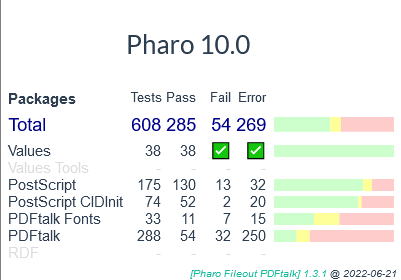
The full project in which the mentioned method used looks like this: PDFtalkProject ^ProjectChange name: #PDFtalk source: ((OrderedCollection new) add: (Package name: #Values); add: (Bundle name: #PDFtalk); add: (Package name: #'Values Testing'); add: (Bundle name: #'PDFtalk Testing'); add: (Package name: #'PDFtalk Demonstrations'); yourself) changes: self pdftalkPackageChanges nameMapping: (NameMapping keep: ((OrderedCollection new) add: #{Smalltalk.PDF}; add: #{PostScript.PSDictionary}; add: #{PDFtalk.PDFObject}; add: #{PDFtalk.PDFArray}; add: #{PDFtalk.PDFDictionary}; add: #{PDFtalk.PDFStream}; add: #{PDFtalk.PDFString}; add: #{PDFtalk.PDFDate}; add: #{PDFtalk.PDFTypeDefinition}; add: #{PDFtalk.PDFEncoder}; yourself) classToNames: ((Valuemap new) add: #{SubscriptOutOfBoundsError} -> #Error; add: #{NonIntegerIndexError} -> #Error; add: #{NotFoundError} -> #KeyNotFound; add: #{KeyNotFoundError} -> #KeyNotFound; yourself) namespaceToPrefixes: ((Valuemap new) add: #{Smalltalk.PostScript} -> 'PS'; add: #{Smalltalk.PDFtalk} -> 'Pt'; add: #{PDFtalk.Fonts} -> 'PtF'; add: #{PDFtalk.Fonts.OpenType} -> 'PtOT'; yourself)) In the #source: are the bundles and packages to be transformed. The #changes: (your method) specify the transforms (PackageChange) for each package explicitly. Only packages contain code and therefore, only packages need the code transformations. Bundles are transformed without transformations. (Well, the code for pre-, post- whatever blocks are transformed with the class name mappings rules). So, the mapping from packages to the corresponding PackageChange has to be stated somehow. Using a dictionary (Valuemap) for this seems also natural. The only change I might like is to use pragmas to tag the PackageChange returning methods with âtheirâ package like <package: âValues Toolsâ> or so. Putting the package reference into the PackageChange is not a good idea, because all those Objects need to be created before your can find out which package is affected. (Ok, I am creating all PackageChange objects tooâ¦). Happy hacking, Christian Von: Shaping <shaping@uurda.org> Gesendet: Freitag, 5. August 2022 03:26 An: 'Any question about pharo is welcome' <pharo-users@lists.pharo.org>; 'Pharo Development List' <pharo-dev@lists.pharo.org> Betreff: [Pharo-users] Re: [Pharo-users]Porting from VW 8.3 to Pharo: pdftalkPackageChanges This method pdftalkPackageChanges ^(Valuemap new) add: 'Values' -> self ValuesTransform; add: 'PostScript' -> self PostScriptTransform; add: 'PDFtalk Basics' -> self PDFtalkBasicsTransform; add: 'PDFtalk Typing' -> self PDFtalkTypingTransform; add: 'PDFtalk Basic Objects' -> self PDFtalkBasicObjectsTransform; add: 'PDFtalk Streams' -> self PDFtalkStreamsTransform; add: 'PDFtalk Data Structures' -> self PDFtalkDataStructuresTransform; add: 'PDFtalk Parsing' -> self PDFtalkParsingTransform; add: 'PDFtalk Colour' -> self PDFtalkColourTransform; add: 'PostScript Fonts' -> self PostScriptFontsTransform; add: 'PostScript CIDInit' -> self PostScriptCIDInitTransform; add: 'PDFtalk Fonts Basics' -> self PDFtalkFontsBasicsTransform; add: 'PDFtalk Fonts Type1' -> self PDFtalkFontsType1Transform; add: 'PDFtalk Fonts OpenType' -> self PDFtalkFontsOpenTypeTransform; add: 'PDFtalk Fonts' -> self PDFtalkFontsTransform; add: 'PDFtalk Graphics' -> self PDFtalkGraphicsTransform; add: 'PDFtalk Graphics Operations' -> self PDFtalkGraphicsOperationsTransform; add: 'PDFtalk XObjects' -> self PDFtalkXObjectsTransform; add: 'PDFtalk Images' -> self PDFtalkImagesTransform; add: 'PDFtalk Files' -> self PDFtalkFilesTransform; add: 'PDFtalk Document' -> self PDFtalkDocumentTransform; add: 'PDFtalk Rendering' -> self PDFtalkRenderingTransform; add: 'PDFtalk Shading' -> self PDFtalkShadingTransform; add: 'PDFtalk Interactive Features' -> self PDFtalkInteractiveFeaturesTransform; add: 'PDFtalk Deploying' -> self PDFtalkDeployingTransform; add: 'Values Testing' -> self ValuesTestingTransform; add: 'PDFtalk test resources' -> self PDFtalkTestResourcesTransform; add: 'PostScript Testing' -> self PostScriptTestingTransform; add: 'PostScript CIDInit Testing' -> self PostScriptCIDInitTestingTransform; add: 'PDFtalk Fonts tests' -> self PDFtalkFontsTestsTransform; add: 'PDFtalk tests' -> self PDFtalkTestsTransform; add: 'PDFtalk Demonstrations' -> self PDFtalkDemonstrationsTransform; yourself effectively looks like the head transform structure for a project, in this case all the PDFtalk stuff, which includes Values and Postscript. This is not exactly a bundle idea, is it? Itâs project spread across potentially many bundles and packages. Iâll start coding my transform with a similar method, and work down toward the details. Takes a bit to get used to all the correct, yet dangling VW methods that are useless in VW, but which will become new code in the target image and there no longer appear to be dangling (with syntax highlighting aberrations). Odd looking but completely by design. Shaping From: Shaping <shaping@uurda.org <mailto:shaping@uurda.org> > Sent: Thursday, 4 August, 2022 19:18 To: 'Any question about pharo is welcome' <pharo-users@lists.pharo.org <mailto:pharo-users@lists.pharo.org> > Subject: [Pharo-users] Re: [Pharo-users]Porting from VW 8.3 to Pharo: Pharo100 fileOutValues I will look, although this kind of always available on demand thing is too disruptive for me⦠I know what you mean. I try be disciplined about it. I really like to be able to fix typos, because there are almost always typos. But e-mail is okay. So that little example is a test that shows how the transformation is done. It converts just package Values to a Pharo-compatible file-in. My task is then to queue a bunch of ProjectChange instances like this one: SmalltalkTransform.Pharo100>> ValuesProject ^ProjectChange name: #Values source: (Array with: (Package name: #Values)) changes: (Valuemap with: 'Values' -> self ValuesTransform) Exactly but for my own packages. No bundles are transformed (just their contained packages) because Pharo doesnât have bundles. Is that right? No, bundles are handled. For real examples, you need to look at the PDFtalk transforms. Yes, Pharo does not have a concept of bundles (ordered aggregates of packages). Instead it relies on a naming convention for packages. That convention is honored in the fileout, so that packages will be partly grouped in Pharo according to the category prefix. For each VW-package, one Pharo package is created. A bundle itself is also represented as Pharo package with one class About<bundlename> with class methods for the metadata of the bundle, including a method giving you the ordered list of component packages. So, all contents and metadata of packages and bundles are transformed for Pharo. No code or info gets lost. Okay. Is method ValuesTransform ^PackageChange ignoredNames: #(#{Smalltalk.GeneralBindingReference}) bridgeClasses: (Valuemap with: #{Timestamp} -> #DateAndTime with: #{Smalltalk.ColorValue} -> #Color) localChanges: self valuesLocalTransform extensions: (Array with: (SystemClassChange className: #Color instanceChanges: (Array with: (Add method: #asColorValue code: #_ph_asColorValue))) with: (SystemClassChange className: #TextStream instanceChanges: (Array with: (Add method: #nextPutAllText: code: #_ph_nextPutAllText:)))) written specifically for that package? I would think it applies to all packages. I see some expected mappings like Timestamp to DateAndTime. Yes, this method returns a PackageChange Value describing the transformations needed to create the Pharo fileout for this specific package (inspect the return value for the fully expanded Value). Methods exist with the same name for other Smalltalks. Depending on the dialect (or version of a dialect), the transforms are different. Squeak and Pharo are quite similar, because they share a common history, but VA or Gemstone need quite different transforms. So, in general, for each package, there is one such method/Value for each target Smalltalk/version. Okay. I do not dare to extract commonalities before the machinery is really robust and stable. For now everything is neatly separate and self-contained (and probably it will stay that way, although there are lots of duplications). The mapping of class names is the responsibility of the enclosing ProjectChange Value where you define the list of source bundles/packages to transform, the PackageChanges for all packages and the mapping of âglobalâ names. (The bridge classes above are no renames, but a subclass relationship (is-a) to avoid renamings. The new class Timestamp will be created as subclass of DateAndTime which has almost the same semantics. Therefore, I can still use Timestamp which will be basically a DateAndTime now.) Okay. There is still a technical challenge here. Currently, a ProjectChange need to include all prerequisites (Values is part of the PDFtalk project and will be transformed with it). A ProjectWriter, which coordinates the transform, keeps track of the mappings when they are created (either explicitly or through a namespace renaming â see implementers of #PDFtalkProject). I would like to have this more modular: the mappings from the Values transformation should be persistently saved, so that other transformation projects can just use them, instead of including the sources into one own project. For this, I need to have renamings local to a package (where they first occur), not global on the project level. Right. For Values and Values Tests and Values Tools this works, because there are no mappings in the Values package. What about conversion of VW arrays to Pharo literal arrays? How is that done? (I think you mean dynamic arrays like {1. âabcâ size. 42} in which evaluation happens (in contrast to literal things which can be resolved already by the compiler). Yes, dynamic arrays. Not! Since a while, VW also has dynamic arrays, but not in VW 8.3 â the last publicly available version. Okay, I was wondering when that would happen. I will not shut out those users, because âopen-sourceâ would be quite absurd, if it is only available for paying customers. In 8.3, the compiler does not accept that syntax and therefore, there is no easy way to represent this in replacement code. So, no. It is not possible until Cincom releases an public version which can handle that. Okay. I recall that one of the Smalltalks (I donât recall which) had Stream semantics differing from VWâs. ⦠I just checked. VWâs #upTo: method includes the object and leaves the index after it, and Pharoâs excludes the object and leaves the index at the object. So that is some major breakage if we donât correct it. Can it be done automatically? Yes, these are the usual porting challenges and exactly the reason why this library exists :). Thank you for the question :). Yes, the stream semantics need to be fixed. The idea is that a set of transforms for this issue can be reused by others. Okay.
valuesLocalTransform
has lots of juicy bits. But this doesnât look very simple. We canât just replace an old method with a new one. We also have to write the new one to tweak how the indices are used in #upTo:, and make sure that new method gets filed-in as well into the Pharo target image. Or, we have to do this kind of change manually. Naa, itâs very easy, I think :). A PackageChange specifies transforms for classes used in the package (#localChanges) and #extensions for system classes of the target. For a class, you can have a ClassChange describing the changes to instance or class methods. A MethodChange has 4 subclasses for: - Ignore â donât write this method to the target - Add â add this new method (not in the source system) to the target - Replace â replace the body of this method with other code - Rewrite â rewrite the method source using a rewrite rule. Add and Replace need the target code. Add then always involves a new name for a method in the target. Replaces use an old name in the target with a new code body. This is stored in another method with a derived name like #_ph_upTo: . The method name is not important, because only the body of the method is used. But the name should not be used in the source â it is just a holder for the replacement code. These methods live in the specific [<Smalltalk> Fileout <Package>] package. Okay. There are lots of working(!) examples for all of those in the PDFtalk transform project. This bit (SystemClassChange className: #Color instanceChanges: (Array with: (Add method: #asColorValue code: #_ph_asColorValue))) is replacing #asColorValue with #_ph_asColorValue because some special Pharo-color conversion needs to happen. But how does #_ph_asColorValue get defined? Itâs neither in VW nor in Pharo 10. You got bitten by the old version of [Pharo Fileout Values]. Please load [Pharo Fileout PDFtalk]. There, the methods exist. Yes, I see it now. Ok. I donât have a virgin image. I have a very non-virgin image, about 27 years of development Iâm trying to port to Pharo. I donât yet have a specific interest in the PDFtalk, though I do see a need for PDF generation later, and will probably revisit that. For now, I just want my own stuff to run in Pharo. Virgin image just means that you donât need anything else. You can safely load it in you favorite special images :). I would load PDFtalk, although technically you donât need to (all the extensions to PDFtalk would be unloadable, but that doesnât affect Values). Okay. is: Load {Values Project] bundle Load {PDFtalk Project} bundle Load {Smalltalk Transform Project} bundle Load [Pharo Fileout PDFtalk] package Save, done Okay, so do I understand correctly that I need to include the PDFtalk stuff even if Iâm not interested in PDFtalk, because thatâs where a lot of the Smalltalk transformation machinery lives? Or is the PDFtalk just being used as an example for how to do a massive transformation? Or Both? No, the transformation machinery is fully independent of PDFtalk. I just tried it. The dependencies are in the specific [Pharo Fileout PDFtalk] package, since I have already quite a few replacement methods which are extensions to PDFtalk classes. Okay. PDFtalk is the focus of the project and therefore all issues are solved first with this library in mind. Therefore, bundles and namespaces are handled, for example. When you study the more interesting transformations for PDFtalk, it would be a shame not to be able to browse the methods and classes involved. So, PDFtalk is the real world reference example. And Values is the simplest example. To transform Values do: âPharo100 fileOutValuesâ The [Pharo Fileout PDFtalk] package includes the latest Values transformations. I am thinking about a better modularization⦠Also, the wiki is a bit out of control. It really needs some restructuring. In the cites wiki page, there is a link to a blog where I record the changes. This might be informative. 2. Port the Values package. This is easy, since no namespaces are involved. This first instruction after VW package setup says to port the contents of the Values package from VW to Pharo. Do you mean manually? Probably not. No, no. This has been finished in March. For each dialect, I have a GitHub repository where I release important versions: <https://github.com/PortingPDFtalk/PharoPDFtalk> https://github.com/PortingPDFtalk/PharoPDFtalk. You can find the working port as first release â <https://github.com/PortingPDFtalk/PharoPDFtalk/releases/tag/1.3.0.0> Working versionâ. There you can download the ported Values fileout with the exact description with which versions of what it was created. This should be a good starting example. Why do I need any new code installed in Pharo before I begin the transformation, if Iâm transforming code from VW to pharo? Iâm not understanding the basic constraints of the problem, even when the detailed steps are clear. No, no. You donât need anything on the Pharo side. The fileouts on GitHub are the end products of a transformation for people who donât use VisualWorks, but want to use Values in Pharo. Or help with PDFtalk by fixing some issues, so that I can write the transformations. Iâve done these steps so far: 1. Went to <https://github.com/PortingPDFtalk/PharoPDFtalk> https://github.com/PortingPDFtalk/PharoPDFtalk. Mistake :). You donât want to look at the unfinished product of the current version of thincomplete transformations for PDFtalk. Do you mean âfinishedâ here? Isnât that file-in the finished result? I thought the above links was the currently finished result (as good as it can be until the rest of the bugs are goine and tests all run). Yes, that was confusing. Thatâs why I had the early impression that Values was somehow apart of the transformation machinery. See https://wiki.pdftalk.de/doku.php?id=stateoftheport#pharo-10-0: Instead, you want to look at the unfinished product of the transformations of your projects :). 2. Saved down PDFtalk.Pharo100.st into <my Pharo 10 image directory>/pharo-local/Smalltalk-Transformation. (I figured that was a good place to save it. If anyone disagrees, or has a better or more conventional idea about where files should be saved, please say so. I setup a Pharo Git repo and played with it briefly for the first time yesterday. Iâve used Pharo off an on for 16 years, but this is the first time Iâm making a serious effort to manage source, and not throw away what Iâm working on.) 3. Filed-in PDFtalk.Pharo100.st. This went on for about 7 minutes or so. I have a hundreds if not over a thousand classes showing in Epicea. Is there anyway to get Epicea to give me a count of changes with a time-range filter? 4. Deleted (forgot) yesterdayâs, old Main practice-repo from both the image and the drive, and made a new one. I need to add to Main all the packages I just filed-in, but I donât see an efficient way to do that. I would like to use the Add Package button, but this gives a filtered list of available packages. I can filter subgroups, and then individually select each of the checkboxes to the left of each package (there is no Ctrl-A [select all] option here, which seems to be a strange omission given the potentially large number of packages involved). I see lots of prefixes for the classes just loaded. I could easily miss something if I filter/select/add one prefix-group at a time. Is there an easier way? Over in Epicea I donât see a way to push the loaded items listed to a specific repo. The first thought I have is to select all filed-in code artifacts by datetime span. I did that and saved it as an .ombu file (I have no idea what that is). I donât see a way to import that .ombu file into repo Mainâs âWorking copyâ window. It must be easy, but I donât see it. Please suggest the best way. Iâd like to know as well â I am not quite familiar with the source management concepts in Pharo. I asked in Discord. I donât understand why stuff like this is missing. The only conclusion I can draw is that no one does huge file-ins (but you do). It is planned to generate Tonel output in the future, but for now I feel safer with the traditional fileout where I can have doIts. I am not sure how Tonel reacts to crippled sources, which are normal during the development of the transformations. Shaping From: christian.haider <christian.haider@smalltalked-visuals.com <mailto:christian.haider@smalltalked-visuals.com> > Sent: Wednesday, 22 June, 2022 05:42 To: pharo-users@lists.pharo.org <mailto:pharo-users@lists.pharo.org> Subject: [Pharo-users] [PDFtalk] second fileOut for Squeak and Pharo With help from the community some issues were fixed which improved the test statistics nicely. Check it out: https://wiki.pdftalk.de/doku.php?id=portingblog#second_pdftalk_fileout_for_s... Thanks to everybody involved! Happy hacking, Christian
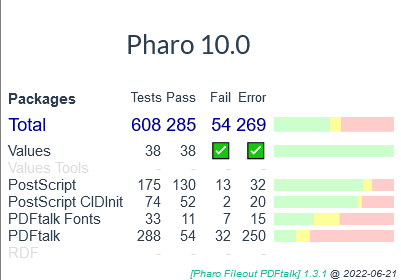
Iâll make my first run soon on my first package. Iâll do one package extra each time I run, building up the code. Each package will have its own <package name>Transform method, per the examples. Iâm not sure how to build these methods, except to assume that rewriting the pharo base methods is never wrong. Iâll file-in the resulting .st file to see what breaks. Then Iâll go back to the package whose .st source is not loading completely and add additional fixes (class keeps, base methods rewrites if needed and missing, method code body replacements if needed) to its transform method until it loads completely on the next run. That could take a while. Is that what you do in practice? Iâm assuming the code writer is taking into account inter-package dependencies in order to get the load order right. Shaping From: christian.haider@smalltalked-visuals.com <christian.haider@smalltalked-visuals.com> Sent: Friday, 5 August, 2022 05:53 To: 'Any question about pharo is welcome' <pharo-users@lists.pharo.org>; 'Pharo Development List' <pharo-dev@lists.pharo.org> Subject: [Pharo-users] Re: [Pharo-users]Porting from VW 8.3 to Pharo: pdftalkPackageChanges The full project in which the mentioned method used looks like this: PDFtalkProject ^ProjectChange name: #PDFtalk source: ((OrderedCollection new) add: (Package name: #Values); add: (Bundle name: #PDFtalk); add: (Package name: #'Values Testing'); add: (Bundle name: #'PDFtalk Testing'); add: (Package name: #'PDFtalk Demonstrations'); yourself) changes: self pdftalkPackageChanges nameMapping: (NameMapping keep: ((OrderedCollection new) add: #{Smalltalk.PDF}; add: #{PostScript.PSDictionary}; add: #{PDFtalk.PDFObject}; add: #{PDFtalk.PDFArray}; add: #{PDFtalk.PDFDictionary}; add: #{PDFtalk.PDFStream}; add: #{PDFtalk.PDFString}; add: #{PDFtalk.PDFDate}; add: #{PDFtalk.PDFTypeDefinition}; add: #{PDFtalk.PDFEncoder}; yourself) classToNames: ((Valuemap new) add: #{SubscriptOutOfBoundsError} -> #Error; add: #{NonIntegerIndexError} -> #Error; add: #{NotFoundError} -> #KeyNotFound; add: #{KeyNotFoundError} -> #KeyNotFound; yourself) namespaceToPrefixes: ((Valuemap new) add: #{Smalltalk.PostScript} -> 'PS'; add: #{Smalltalk.PDFtalk} -> 'Pt'; add: #{PDFtalk.Fonts} -> 'PtF'; add: #{PDFtalk.Fonts.OpenType} -> 'PtOT'; yourself)) In the #source: are the bundles and packages to be transformed. The #changes: (your method) specify the transforms (PackageChange) for each package explicitly. Only packages contain code and therefore, only packages need the code transformations. Bundles are transformed without transformations. (Well, the code for pre-, post- whatever blocks are transformed with the class name mappings rules). So, the mapping from packages to the corresponding PackageChange has to be stated somehow. Using a dictionary (Valuemap) for this seems also natural. The only change I might like is to use pragmas to tag the PackageChange returning methods with âtheirâ package like <package: âValues Toolsâ> or so. Putting the package reference into the PackageChange is not a good idea, because all those Objects need to be created before your can find out which package is affected. (Ok, I am creating all PackageChange objects tooâ¦). Happy hacking, Christian Von: Shaping <shaping@uurda.org <mailto:shaping@uurda.org> > Gesendet: Freitag, 5. August 2022 03:26 An: 'Any question about pharo is welcome' <pharo-users@lists.pharo.org <mailto:pharo-users@lists.pharo.org> >; 'Pharo Development List' <pharo-dev@lists.pharo.org <mailto:pharo-dev@lists.pharo.org> > Betreff: [Pharo-users] Re: [Pharo-users]Porting from VW 8.3 to Pharo: pdftalkPackageChanges This method pdftalkPackageChanges ^(Valuemap new) add: 'Values' -> self ValuesTransform; add: 'PostScript' -> self PostScriptTransform; add: 'PDFtalk Basics' -> self PDFtalkBasicsTransform; add: 'PDFtalk Typing' -> self PDFtalkTypingTransform; add: 'PDFtalk Basic Objects' -> self PDFtalkBasicObjectsTransform; add: 'PDFtalk Streams' -> self PDFtalkStreamsTransform; add: 'PDFtalk Data Structures' -> self PDFtalkDataStructuresTransform; add: 'PDFtalk Parsing' -> self PDFtalkParsingTransform; add: 'PDFtalk Colour' -> self PDFtalkColourTransform; add: 'PostScript Fonts' -> self PostScriptFontsTransform; add: 'PostScript CIDInit' -> self PostScriptCIDInitTransform; add: 'PDFtalk Fonts Basics' -> self PDFtalkFontsBasicsTransform; add: 'PDFtalk Fonts Type1' -> self PDFtalkFontsType1Transform; add: 'PDFtalk Fonts OpenType' -> self PDFtalkFontsOpenTypeTransform; add: 'PDFtalk Fonts' -> self PDFtalkFontsTransform; add: 'PDFtalk Graphics' -> self PDFtalkGraphicsTransform; add: 'PDFtalk Graphics Operations' -> self PDFtalkGraphicsOperationsTransform; add: 'PDFtalk XObjects' -> self PDFtalkXObjectsTransform; add: 'PDFtalk Images' -> self PDFtalkImagesTransform; add: 'PDFtalk Files' -> self PDFtalkFilesTransform; add: 'PDFtalk Document' -> self PDFtalkDocumentTransform; add: 'PDFtalk Rendering' -> self PDFtalkRenderingTransform; add: 'PDFtalk Shading' -> self PDFtalkShadingTransform; add: 'PDFtalk Interactive Features' -> self PDFtalkInteractiveFeaturesTransform; add: 'PDFtalk Deploying' -> self PDFtalkDeployingTransform; add: 'Values Testing' -> self ValuesTestingTransform; add: 'PDFtalk test resources' -> self PDFtalkTestResourcesTransform; add: 'PostScript Testing' -> self PostScriptTestingTransform; add: 'PostScript CIDInit Testing' -> self PostScriptCIDInitTestingTransform; add: 'PDFtalk Fonts tests' -> self PDFtalkFontsTestsTransform; add: 'PDFtalk tests' -> self PDFtalkTestsTransform; add: 'PDFtalk Demonstrations' -> self PDFtalkDemonstrationsTransform; yourself effectively looks like the head transform structure for a project, in this case all the PDFtalk stuff, which includes Values and Postscript. This is not exactly a bundle idea, is it? Itâs project spread across potentially many bundles and packages. Iâll start coding my transform with a similar method, and work down toward the details. Takes a bit to get used to all the correct, yet dangling VW methods that are useless in VW, but which will become new code in the target image and there no longer appear to be dangling (with syntax highlighting aberrations). Odd looking but completely by design. Shaping From: Shaping <shaping@uurda.org <mailto:shaping@uurda.org> > Sent: Thursday, 4 August, 2022 19:18 To: 'Any question about pharo is welcome' <pharo-users@lists.pharo.org <mailto:pharo-users@lists.pharo.org> > Subject: [Pharo-users] Re: [Pharo-users]Porting from VW 8.3 to Pharo: Pharo100 fileOutValues I will look, although this kind of always available on demand thing is too disruptive for me⦠I know what you mean. I try be disciplined about it. I really like to be able to fix typos, because there are almost always typos. But e-mail is okay. So that little example is a test that shows how the transformation is done. It converts just package Values to a Pharo-compatible file-in. My task is then to queue a bunch of ProjectChange instances like this one: SmalltalkTransform.Pharo100>> ValuesProject ^ProjectChange name: #Values source: (Array with: (Package name: #Values)) changes: (Valuemap with: 'Values' -> self ValuesTransform) Exactly but for my own packages. No bundles are transformed (just their contained packages) because Pharo doesnât have bundles. Is that right? No, bundles are handled. For real examples, you need to look at the PDFtalk transforms. Yes, Pharo does not have a concept of bundles (ordered aggregates of packages). Instead it relies on a naming convention for packages. That convention is honored in the fileout, so that packages will be partly grouped in Pharo according to the category prefix. For each VW-package, one Pharo package is created. A bundle itself is also represented as Pharo package with one class About<bundlename> with class methods for the metadata of the bundle, including a method giving you the ordered list of component packages. So, all contents and metadata of packages and bundles are transformed for Pharo. No code or info gets lost. Okay. Is method ValuesTransform ^PackageChange ignoredNames: #(#{Smalltalk.GeneralBindingReference}) bridgeClasses: (Valuemap with: #{Timestamp} -> #DateAndTime with: #{Smalltalk.ColorValue} -> #Color) localChanges: self valuesLocalTransform extensions: (Array with: (SystemClassChange className: #Color instanceChanges: (Array with: (Add method: #asColorValue code: #_ph_asColorValue))) with: (SystemClassChange className: #TextStream instanceChanges: (Array with: (Add method: #nextPutAllText: code: #_ph_nextPutAllText:)))) written specifically for that package? I would think it applies to all packages. I see some expected mappings like Timestamp to DateAndTime. Yes, this method returns a PackageChange Value describing the transformations needed to create the Pharo fileout for this specific package (inspect the return value for the fully expanded Value). Methods exist with the same name for other Smalltalks. Depending on the dialect (or version of a dialect), the transforms are different. Squeak and Pharo are quite similar, because they share a common history, but VA or Gemstone need quite different transforms. So, in general, for each package, there is one such method/Value for each target Smalltalk/version. Okay. I do not dare to extract commonalities before the machinery is really robust and stable. For now everything is neatly separate and self-contained (and probably it will stay that way, although there are lots of duplications). The mapping of class names is the responsibility of the enclosing ProjectChange Value where you define the list of source bundles/packages to transform, the PackageChanges for all packages and the mapping of âglobalâ names. (The bridge classes above are no renames, but a subclass relationship (is-a) to avoid renamings. The new class Timestamp will be created as subclass of DateAndTime which has almost the same semantics. Therefore, I can still use Timestamp which will be basically a DateAndTime now.) Okay. There is still a technical challenge here. Currently, a ProjectChange need to include all prerequisites (Values is part of the PDFtalk project and will be transformed with it). A ProjectWriter, which coordinates the transform, keeps track of the mappings when they are created (either explicitly or through a namespace renaming â see implementers of #PDFtalkProject). I would like to have this more modular: the mappings from the Values transformation should be persistently saved, so that other transformation projects can just use them, instead of including the sources into one own project. For this, I need to have renamings local to a package (where they first occur), not global on the project level. Right. For Values and Values Tests and Values Tools this works, because there are no mappings in the Values package. What about conversion of VW arrays to Pharo literal arrays? How is that done? (I think you mean dynamic arrays like {1. âabcâ size. 42} in which evaluation happens (in contrast to literal things which can be resolved already by the compiler). Yes, dynamic arrays. Not! Since a while, VW also has dynamic arrays, but not in VW 8.3 â the last publicly available version. Okay, I was wondering when that would happen. I will not shut out those users, because âopen-sourceâ would be quite absurd, if it is only available for paying customers. In 8.3, the compiler does not accept that syntax and therefore, there is no easy way to represent this in replacement code. So, no. It is not possible until Cincom releases an public version which can handle that. Okay. I recall that one of the Smalltalks (I donât recall which) had Stream semantics differing from VWâs. ⦠I just checked. VWâs #upTo: method includes the object and leaves the index after it, and Pharoâs excludes the object and leaves the index at the object. So that is some major breakage if we donât correct it. Can it be done automatically? Yes, these are the usual porting challenges and exactly the reason why this library exists :). Thank you for the question :). Yes, the stream semantics need to be fixed. The idea is that a set of transforms for this issue can be reused by others. Okay.
valuesLocalTransform
has lots of juicy bits. But this doesnât look very simple. We canât just replace an old method with a new one. We also have to write the new one to tweak how the indices are used in #upTo:, and make sure that new method gets filed-in as well into the Pharo target image. Or, we have to do this kind of change manually. Naa, itâs very easy, I think :). A PackageChange specifies transforms for classes used in the package (#localChanges) and #extensions for system classes of the target. For a class, you can have a ClassChange describing the changes to instance or class methods. A MethodChange has 4 subclasses for: - Ignore â donât write this method to the target - Add â add this new method (not in the source system) to the target - Replace â replace the body of this method with other code - Rewrite â rewrite the method source using a rewrite rule. Add and Replace need the target code. Add then always involves a new name for a method in the target. Replaces use an old name in the target with a new code body. This is stored in another method with a derived name like #_ph_upTo: . The method name is not important, because only the body of the method is used. But the name should not be used in the source â it is just a holder for the replacement code. These methods live in the specific [<Smalltalk> Fileout <Package>] package. Okay. There are lots of working(!) examples for all of those in the PDFtalk transform project. This bit (SystemClassChange className: #Color instanceChanges: (Array with: (Add method: #asColorValue code: #_ph_asColorValue))) is replacing #asColorValue with #_ph_asColorValue because some special Pharo-color conversion needs to happen. But how does #_ph_asColorValue get defined? Itâs neither in VW nor in Pharo 10. You got bitten by the old version of [Pharo Fileout Values]. Please load [Pharo Fileout PDFtalk]. There, the methods exist. Yes, I see it now. Ok. I donât have a virgin image. I have a very non-virgin image, about 27 years of development Iâm trying to port to Pharo. I donât yet have a specific interest in the PDFtalk, though I do see a need for PDF generation later, and will probably revisit that. For now, I just want my own stuff to run in Pharo. Virgin image just means that you donât need anything else. You can safely load it in you favorite special images :). I would load PDFtalk, although technically you donât need to (all the extensions to PDFtalk would be unloadable, but that doesnât affect Values). Okay. is: Load {Values Project] bundle Load {PDFtalk Project} bundle Load {Smalltalk Transform Project} bundle Load [Pharo Fileout PDFtalk] package Save, done Okay, so do I understand correctly that I need to include the PDFtalk stuff even if Iâm not interested in PDFtalk, because thatâs where a lot of the Smalltalk transformation machinery lives? Or is the PDFtalk just being used as an example for how to do a massive transformation? Or Both? No, the transformation machinery is fully independent of PDFtalk. I just tried it. The dependencies are in the specific [Pharo Fileout PDFtalk] package, since I have already quite a few replacement methods which are extensions to PDFtalk classes. Okay. PDFtalk is the focus of the project and therefore all issues are solved first with this library in mind. Therefore, bundles and namespaces are handled, for example. When you study the more interesting transformations for PDFtalk, it would be a shame not to be able to browse the methods and classes involved. So, PDFtalk is the real world reference example. And Values is the simplest example. To transform Values do: âPharo100 fileOutValuesâ The [Pharo Fileout PDFtalk] package includes the latest Values transformations. I am thinking about a better modularization⦠Also, the wiki is a bit out of control. It really needs some restructuring. In the cites wiki page, there is a link to a blog where I record the changes. This might be informative. 2. Port the Values package. This is easy, since no namespaces are involved. This first instruction after VW package setup says to port the contents of the Values package from VW to Pharo. Do you mean manually? Probably not. No, no. This has been finished in March. For each dialect, I have a GitHub repository where I release important versions: <https://github.com/PortingPDFtalk/PharoPDFtalk> https://github.com/PortingPDFtalk/PharoPDFtalk. You can find the working port as first release â <https://github.com/PortingPDFtalk/PharoPDFtalk/releases/tag/1.3.0.0> Working versionâ. There you can download the ported Values fileout with the exact description with which versions of what it was created. This should be a good starting example. Why do I need any new code installed in Pharo before I begin the transformation, if Iâm transforming code from VW to pharo? Iâm not understanding the basic constraints of the problem, even when the detailed steps are clear. No, no. You donât need anything on the Pharo side. The fileouts on GitHub are the end products of a transformation for people who donât use VisualWorks, but want to use Values in Pharo. Or help with PDFtalk by fixing some issues, so that I can write the transformations. Iâve done these steps so far: 1. Went to <https://github.com/PortingPDFtalk/PharoPDFtalk> https://github.com/PortingPDFtalk/PharoPDFtalk. Mistake :). You donât want to look at the unfinished product of the current version of thincomplete transformations for PDFtalk. Do you mean âfinishedâ here? Isnât that file-in the finished result? I thought the above links was the currently finished result (as good as it can be until the rest of the bugs are goine and tests all run). Yes, that was confusing. Thatâs why I had the early impression that Values was somehow apart of the transformation machinery. See https://wiki.pdftalk.de/doku.php?id=stateoftheport#pharo-10-0: Instead, you want to look at the unfinished product of the transformations of your projects :). 2. Saved down PDFtalk.Pharo100.st into <my Pharo 10 image directory>/pharo-local/Smalltalk-Transformation. (I figured that was a good place to save it. If anyone disagrees, or has a better or more conventional idea about where files should be saved, please say so. I setup a Pharo Git repo and played with it briefly for the first time yesterday. Iâve used Pharo off an on for 16 years, but this is the first time Iâm making a serious effort to manage source, and not throw away what Iâm working on.) 3. Filed-in PDFtalk.Pharo100.st. This went on for about 7 minutes or so. I have a hundreds if not over a thousand classes showing in Epicea. Is there anyway to get Epicea to give me a count of changes with a time-range filter? 4. Deleted (forgot) yesterdayâs, old Main practice-repo from both the image and the drive, and made a new one. I need to add to Main all the packages I just filed-in, but I donât see an efficient way to do that. I would like to use the Add Package button, but this gives a filtered list of available packages. I can filter subgroups, and then individually select each of the checkboxes to the left of each package (there is no Ctrl-A [select all] option here, which seems to be a strange omission given the potentially large number of packages involved). I see lots of prefixes for the classes just loaded. I could easily miss something if I filter/select/add one prefix-group at a time. Is there an easier way? Over in Epicea I donât see a way to push the loaded items listed to a specific repo. The first thought I have is to select all filed-in code artifacts by datetime span. I did that and saved it as an .ombu file (I have no idea what that is). I donât see a way to import that .ombu file into repo Mainâs âWorking copyâ window. It must be easy, but I donât see it. Please suggest the best way. Iâd like to know as well â I am not quite familiar with the source management concepts in Pharo. I asked in Discord. I donât understand why stuff like this is missing. The only conclusion I can draw is that no one does huge file-ins (but you do). It is planned to generate Tonel output in the future, but for now I feel safer with the traditional fileout where I can have doIts. I am not sure how Tonel reacts to crippled sources, which are normal during the development of the transformations. Shaping From: christian.haider <christian.haider@smalltalked-visuals.com <mailto:christian.haider@smalltalked-visuals.com> > Sent: Wednesday, 22 June, 2022 05:42 To: pharo-users@lists.pharo.org <mailto:pharo-users@lists.pharo.org> Subject: [Pharo-users] [PDFtalk] second fileOut for Squeak and Pharo With help from the community some issues were fixed which improved the test statistics nicely. Check it out: https://wiki.pdftalk.de/doku.php?id=portingblog#second_pdftalk_fileout_for_s... Thanks to everybody involved! Happy hacking, Christian
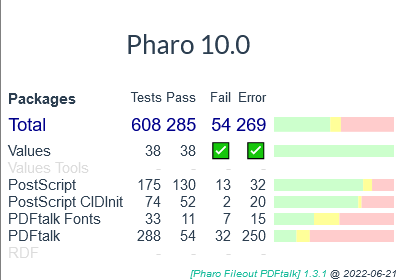
Von: Shaping <shaping@uurda.org> Gesendet: Freitag, 5. August 2022 15:55 An: 'Any question about pharo is welcome' <pharo-users@lists.pharo.org>; 'Pharo Development List' <pharo-dev@lists.pharo.org> Betreff: [Pharo-users] Re: [Pharo-users]Porting from VW 8.3 to Pharo: doing first run soon Iâll make my first run soon on my first package. Iâll do one package extra each time I run, building up the code. Each package will have its own <package name>Transform method, per the examples. Iâm not sure how to build these methods, except to assume that rewriting the pharo base methods is never wrong. Iâll file-in the resulting .st file to see what breaks. Then Iâll go back to the package whose .st source is not loading completely and add additional fixes (class keeps, base methods rewrites if needed and missing, method code body replacements if needed) to its transform method until it loads completely on the next run. That could take a while. Is that what you do in practice? Perfect! That is exactly how I do it. I start with an empty PackageChange. Then I add incrementally transforms until the code loads - phase one. This has been achieved for PDFtalk with the first release on GitHub. The second and final phase is to make all tests run (including the new to-write tests). This can take a while, because all syntactic and semantic differences must be addressed. Here, some cross-fertilization is possible. The nice thing is, that the system is always telling you what to do. In fact, at first there are so many issues that it is a lot of fun to browse them and chose a nice one. Always the nicest or easiest bug first :-). Iâm assuming the code writer is taking into account inter-package dependencies in order to get the load order right. Yes. Shaping Christian From: christian.haider@smalltalked-visuals.com <mailto:christian.haider@smalltalked-visuals.com> <christian.haider@smalltalked-visuals.com <mailto:christian.haider@smalltalked-visuals.com> > Sent: Friday, 5 August, 2022 05:53 To: 'Any question about pharo is welcome' <pharo-users@lists.pharo.org <mailto:pharo-users@lists.pharo.org> >; 'Pharo Development List' <pharo-dev@lists.pharo.org <mailto:pharo-dev@lists.pharo.org> > Subject: [Pharo-users] Re: [Pharo-users]Porting from VW 8.3 to Pharo: pdftalkPackageChanges The full project in which the mentioned method used looks like this: PDFtalkProject ^ProjectChange name: #PDFtalk source: ((OrderedCollection new) add: (Package name: #Values); add: (Bundle name: #PDFtalk); add: (Package name: #'Values Testing'); add: (Bundle name: #'PDFtalk Testing'); add: (Package name: #'PDFtalk Demonstrations'); yourself) changes: self pdftalkPackageChanges nameMapping: (NameMapping keep: ((OrderedCollection new) add: #{Smalltalk.PDF}; add: #{PostScript.PSDictionary}; add: #{PDFtalk.PDFObject}; add: #{PDFtalk.PDFArray}; add: #{PDFtalk.PDFDictionary}; add: #{PDFtalk.PDFStream}; add: #{PDFtalk.PDFString}; add: #{PDFtalk.PDFDate}; add: #{PDFtalk.PDFTypeDefinition}; add: #{PDFtalk.PDFEncoder}; yourself) classToNames: ((Valuemap new) add: #{SubscriptOutOfBoundsError} -> #Error; add: #{NonIntegerIndexError} -> #Error; add: #{NotFoundError} -> #KeyNotFound; add: #{KeyNotFoundError} -> #KeyNotFound; yourself) namespaceToPrefixes: ((Valuemap new) add: #{Smalltalk.PostScript} -> 'PS'; add: #{Smalltalk.PDFtalk} -> 'Pt'; add: #{PDFtalk.Fonts} -> 'PtF'; add: #{PDFtalk.Fonts.OpenType} -> 'PtOT'; yourself)) In the #source: are the bundles and packages to be transformed. The #changes: (your method) specify the transforms (PackageChange) for each package explicitly. Only packages contain code and therefore, only packages need the code transformations. Bundles are transformed without transformations. (Well, the code for pre-, post- whatever blocks are transformed with the class name mappings rules). So, the mapping from packages to the corresponding PackageChange has to be stated somehow. Using a dictionary (Valuemap) for this seems also natural. The only change I might like is to use pragmas to tag the PackageChange returning methods with âtheirâ package like <package: âValues Toolsâ> or so. Putting the package reference into the PackageChange is not a good idea, because all those Objects need to be created before your can find out which package is affected. (Ok, I am creating all PackageChange objects tooâ¦). Happy hacking, Christian Von: Shaping <shaping@uurda.org <mailto:shaping@uurda.org> > Gesendet: Freitag, 5. August 2022 03:26 An: 'Any question about pharo is welcome' <pharo-users@lists.pharo.org <mailto:pharo-users@lists.pharo.org> >; 'Pharo Development List' <pharo-dev@lists.pharo.org <mailto:pharo-dev@lists.pharo.org> > Betreff: [Pharo-users] Re: [Pharo-users]Porting from VW 8.3 to Pharo: pdftalkPackageChanges This method pdftalkPackageChanges ^(Valuemap new) add: 'Values' -> self ValuesTransform; add: 'PostScript' -> self PostScriptTransform; add: 'PDFtalk Basics' -> self PDFtalkBasicsTransform; add: 'PDFtalk Typing' -> self PDFtalkTypingTransform; add: 'PDFtalk Basic Objects' -> self PDFtalkBasicObjectsTransform; add: 'PDFtalk Streams' -> self PDFtalkStreamsTransform; add: 'PDFtalk Data Structures' -> self PDFtalkDataStructuresTransform; add: 'PDFtalk Parsing' -> self PDFtalkParsingTransform; add: 'PDFtalk Colour' -> self PDFtalkColourTransform; add: 'PostScript Fonts' -> self PostScriptFontsTransform; add: 'PostScript CIDInit' -> self PostScriptCIDInitTransform; add: 'PDFtalk Fonts Basics' -> self PDFtalkFontsBasicsTransform; add: 'PDFtalk Fonts Type1' -> self PDFtalkFontsType1Transform; add: 'PDFtalk Fonts OpenType' -> self PDFtalkFontsOpenTypeTransform; add: 'PDFtalk Fonts' -> self PDFtalkFontsTransform; add: 'PDFtalk Graphics' -> self PDFtalkGraphicsTransform; add: 'PDFtalk Graphics Operations' -> self PDFtalkGraphicsOperationsTransform; add: 'PDFtalk XObjects' -> self PDFtalkXObjectsTransform; add: 'PDFtalk Images' -> self PDFtalkImagesTransform; add: 'PDFtalk Files' -> self PDFtalkFilesTransform; add: 'PDFtalk Document' -> self PDFtalkDocumentTransform; add: 'PDFtalk Rendering' -> self PDFtalkRenderingTransform; add: 'PDFtalk Shading' -> self PDFtalkShadingTransform; add: 'PDFtalk Interactive Features' -> self PDFtalkInteractiveFeaturesTransform; add: 'PDFtalk Deploying' -> self PDFtalkDeployingTransform; add: 'Values Testing' -> self ValuesTestingTransform; add: 'PDFtalk test resources' -> self PDFtalkTestResourcesTransform; add: 'PostScript Testing' -> self PostScriptTestingTransform; add: 'PostScript CIDInit Testing' -> self PostScriptCIDInitTestingTransform; add: 'PDFtalk Fonts tests' -> self PDFtalkFontsTestsTransform; add: 'PDFtalk tests' -> self PDFtalkTestsTransform; add: 'PDFtalk Demonstrations' -> self PDFtalkDemonstrationsTransform; yourself effectively looks like the head transform structure for a project, in this case all the PDFtalk stuff, which includes Values and Postscript. This is not exactly a bundle idea, is it? Itâs project spread across potentially many bundles and packages. Iâll start coding my transform with a similar method, and work down toward the details. Takes a bit to get used to all the correct, yet dangling VW methods that are useless in VW, but which will become new code in the target image and there no longer appear to be dangling (with syntax highlighting aberrations). Odd looking but completely by design. Shaping From: Shaping <shaping@uurda.org <mailto:shaping@uurda.org> > Sent: Thursday, 4 August, 2022 19:18 To: 'Any question about pharo is welcome' <pharo-users@lists.pharo.org <mailto:pharo-users@lists.pharo.org> > Subject: [Pharo-users] Re: [Pharo-users]Porting from VW 8.3 to Pharo: Pharo100 fileOutValues I will look, although this kind of always available on demand thing is too disruptive for me⦠I know what you mean. I try be disciplined about it. I really like to be able to fix typos, because there are almost always typos. But e-mail is okay. So that little example is a test that shows how the transformation is done. It converts just package Values to a Pharo-compatible file-in. My task is then to queue a bunch of ProjectChange instances like this one: SmalltalkTransform.Pharo100>> ValuesProject ^ProjectChange name: #Values source: (Array with: (Package name: #Values)) changes: (Valuemap with: 'Values' -> self ValuesTransform) Exactly but for my own packages. No bundles are transformed (just their contained packages) because Pharo doesnât have bundles. Is that right? No, bundles are handled. For real examples, you need to look at the PDFtalk transforms. Yes, Pharo does not have a concept of bundles (ordered aggregates of packages). Instead it relies on a naming convention for packages. That convention is honored in the fileout, so that packages will be partly grouped in Pharo according to the category prefix. For each VW-package, one Pharo package is created. A bundle itself is also represented as Pharo package with one class About<bundlename> with class methods for the metadata of the bundle, including a method giving you the ordered list of component packages. So, all contents and metadata of packages and bundles are transformed for Pharo. No code or info gets lost. Okay. Is method ValuesTransform ^PackageChange ignoredNames: #(#{Smalltalk.GeneralBindingReference}) bridgeClasses: (Valuemap with: #{Timestamp} -> #DateAndTime with: #{Smalltalk.ColorValue} -> #Color) localChanges: self valuesLocalTransform extensions: (Array with: (SystemClassChange className: #Color instanceChanges: (Array with: (Add method: #asColorValue code: #_ph_asColorValue))) with: (SystemClassChange className: #TextStream instanceChanges: (Array with: (Add method: #nextPutAllText: code: #_ph_nextPutAllText:)))) written specifically for that package? I would think it applies to all packages. I see some expected mappings like Timestamp to DateAndTime. Yes, this method returns a PackageChange Value describing the transformations needed to create the Pharo fileout for this specific package (inspect the return value for the fully expanded Value). Methods exist with the same name for other Smalltalks. Depending on the dialect (or version of a dialect), the transforms are different. Squeak and Pharo are quite similar, because they share a common history, but VA or Gemstone need quite different transforms. So, in general, for each package, there is one such method/Value for each target Smalltalk/version. Okay. I do not dare to extract commonalities before the machinery is really robust and stable. For now everything is neatly separate and self-contained (and probably it will stay that way, although there are lots of duplications). The mapping of class names is the responsibility of the enclosing ProjectChange Value where you define the list of source bundles/packages to transform, the PackageChanges for all packages and the mapping of âglobalâ names. (The bridge classes above are no renames, but a subclass relationship (is-a) to avoid renamings. The new class Timestamp will be created as subclass of DateAndTime which has almost the same semantics. Therefore, I can still use Timestamp which will be basically a DateAndTime now.) Okay. There is still a technical challenge here. Currently, a ProjectChange need to include all prerequisites (Values is part of the PDFtalk project and will be transformed with it). A ProjectWriter, which coordinates the transform, keeps track of the mappings when they are created (either explicitly or through a namespace renaming â see implementers of #PDFtalkProject). I would like to have this more modular: the mappings from the Values transformation should be persistently saved, so that other transformation projects can just use them, instead of including the sources into one own project. For this, I need to have renamings local to a package (where they first occur), not global on the project level. Right. For Values and Values Tests and Values Tools this works, because there are no mappings in the Values package. What about conversion of VW arrays to Pharo literal arrays? How is that done? (I think you mean dynamic arrays like {1. âabcâ size. 42} in which evaluation happens (in contrast to literal things which can be resolved already by the compiler). Yes, dynamic arrays. Not! Since a while, VW also has dynamic arrays, but not in VW 8.3 â the last publicly available version. Okay, I was wondering when that would happen. I will not shut out those users, because âopen-sourceâ would be quite absurd, if it is only available for paying customers. In 8.3, the compiler does not accept that syntax and therefore, there is no easy way to represent this in replacement code. So, no. It is not possible until Cincom releases an public version which can handle that. Okay. I recall that one of the Smalltalks (I donât recall which) had Stream semantics differing from VWâs. ⦠I just checked. VWâs #upTo: method includes the object and leaves the index after it, and Pharoâs excludes the object and leaves the index at the object. So that is some major breakage if we donât correct it. Can it be done automatically? Yes, these are the usual porting challenges and exactly the reason why this library exists :). Thank you for the question :). Yes, the stream semantics need to be fixed. The idea is that a set of transforms for this issue can be reused by others. Okay.
valuesLocalTransform
has lots of juicy bits. But this doesnât look very simple. We canât just replace an old method with a new one. We also have to write the new one to tweak how the indices are used in #upTo:, and make sure that new method gets filed-in as well into the Pharo target image. Or, we have to do this kind of change manually. Naa, itâs very easy, I think :). A PackageChange specifies transforms for classes used in the package (#localChanges) and #extensions for system classes of the target. For a class, you can have a ClassChange describing the changes to instance or class methods. A MethodChange has 4 subclasses for: - Ignore â donât write this method to the target - Add â add this new method (not in the source system) to the target - Replace â replace the body of this method with other code - Rewrite â rewrite the method source using a rewrite rule. Add and Replace need the target code. Add then always involves a new name for a method in the target. Replaces use an old name in the target with a new code body. This is stored in another method with a derived name like #_ph_upTo: . The method name is not important, because only the body of the method is used. But the name should not be used in the source â it is just a holder for the replacement code. These methods live in the specific [<Smalltalk> Fileout <Package>] package. Okay. There are lots of working(!) examples for all of those in the PDFtalk transform project. This bit (SystemClassChange className: #Color instanceChanges: (Array with: (Add method: #asColorValue code: #_ph_asColorValue))) is replacing #asColorValue with #_ph_asColorValue because some special Pharo-color conversion needs to happen. But how does #_ph_asColorValue get defined? Itâs neither in VW nor in Pharo 10. You got bitten by the old version of [Pharo Fileout Values]. Please load [Pharo Fileout PDFtalk]. There, the methods exist. Yes, I see it now. Ok. I donât have a virgin image. I have a very non-virgin image, about 27 years of development Iâm trying to port to Pharo. I donât yet have a specific interest in the PDFtalk, though I do see a need for PDF generation later, and will probably revisit that. For now, I just want my own stuff to run in Pharo. Virgin image just means that you donât need anything else. You can safely load it in you favorite special images :). I would load PDFtalk, although technically you donât need to (all the extensions to PDFtalk would be unloadable, but that doesnât affect Values). Okay. is: Load {Values Project] bundle Load {PDFtalk Project} bundle Load {Smalltalk Transform Project} bundle Load [Pharo Fileout PDFtalk] package Save, done Okay, so do I understand correctly that I need to include the PDFtalk stuff even if Iâm not interested in PDFtalk, because thatâs where a lot of the Smalltalk transformation machinery lives? Or is the PDFtalk just being used as an example for how to do a massive transformation? Or Both? No, the transformation machinery is fully independent of PDFtalk. I just tried it. The dependencies are in the specific [Pharo Fileout PDFtalk] package, since I have already quite a few replacement methods which are extensions to PDFtalk classes. Okay. PDFtalk is the focus of the project and therefore all issues are solved first with this library in mind. Therefore, bundles and namespaces are handled, for example. When you study the more interesting transformations for PDFtalk, it would be a shame not to be able to browse the methods and classes involved. So, PDFtalk is the real world reference example. And Values is the simplest example. To transform Values do: âPharo100 fileOutValuesâ The [Pharo Fileout PDFtalk] package includes the latest Values transformations. I am thinking about a better modularization⦠Also, the wiki is a bit out of control. It really needs some restructuring. In the cites wiki page, there is a link to a blog where I record the changes. This might be informative. 2. Port the Values package. This is easy, since no namespaces are involved. This first instruction after VW package setup says to port the contents of the Values package from VW to Pharo. Do you mean manually? Probably not. No, no. This has been finished in March. For each dialect, I have a GitHub repository where I release important versions: <https://github.com/PortingPDFtalk/PharoPDFtalk> https://github.com/PortingPDFtalk/PharoPDFtalk. You can find the working port as first release â <https://github.com/PortingPDFtalk/PharoPDFtalk/releases/tag/1.3.0.0> Working versionâ. There you can download the ported Values fileout with the exact description with which versions of what it was created. This should be a good starting example. Why do I need any new code installed in Pharo before I begin the transformation, if Iâm transforming code from VW to pharo? Iâm not understanding the basic constraints of the problem, even when the detailed steps are clear. No, no. You donât need anything on the Pharo side. The fileouts on GitHub are the end products of a transformation for people who donât use VisualWorks, but want to use Values in Pharo. Or help with PDFtalk by fixing some issues, so that I can write the transformations. Iâve done these steps so far: 1. Went to <https://github.com/PortingPDFtalk/PharoPDFtalk> https://github.com/PortingPDFtalk/PharoPDFtalk. Mistake :). You donât want to look at the unfinished product of the current version of thincomplete transformations for PDFtalk. Do you mean âfinishedâ here? Isnât that file-in the finished result? I thought the above links was the currently finished result (as good as it can be until the rest of the bugs are goine and tests all run). Yes, that was confusing. Thatâs why I had the early impression that Values was somehow apart of the transformation machinery. See https://wiki.pdftalk.de/doku.php?id=stateoftheport#pharo-10-0: Instead, you want to look at the unfinished product of the transformations of your projects :). 2. Saved down PDFtalk.Pharo100.st into <my Pharo 10 image directory>/pharo-local/Smalltalk-Transformation. (I figured that was a good place to save it. If anyone disagrees, or has a better or more conventional idea about where files should be saved, please say so. I setup a Pharo Git repo and played with it briefly for the first time yesterday. Iâve used Pharo off an on for 16 years, but this is the first time Iâm making a serious effort to manage source, and not throw away what Iâm working on.) 3. Filed-in PDFtalk.Pharo100.st. This went on for about 7 minutes or so. I have a hundreds if not over a thousand classes showing in Epicea. Is there anyway to get Epicea to give me a count of changes with a time-range filter? 4. Deleted (forgot) yesterdayâs, old Main practice-repo from both the image and the drive, and made a new one. I need to add to Main all the packages I just filed-in, but I donât see an efficient way to do that. I would like to use the Add Package button, but this gives a filtered list of available packages. I can filter subgroups, and then individually select each of the checkboxes to the left of each package (there is no Ctrl-A [select all] option here, which seems to be a strange omission given the potentially large number of packages involved). I see lots of prefixes for the classes just loaded. I could easily miss something if I filter/select/add one prefix-group at a time. Is there an easier way? Over in Epicea I donât see a way to push the loaded items listed to a specific repo. The first thought I have is to select all filed-in code artifacts by datetime span. I did that and saved it as an .ombu file (I have no idea what that is). I donât see a way to import that .ombu file into repo Mainâs âWorking copyâ window. It must be easy, but I donât see it. Please suggest the best way. Iâd like to know as well â I am not quite familiar with the source management concepts in Pharo. I asked in Discord. I donât understand why stuff like this is missing. The only conclusion I can draw is that no one does huge file-ins (but you do). It is planned to generate Tonel output in the future, but for now I feel safer with the traditional fileout where I can have doIts. I am not sure how Tonel reacts to crippled sources, which are normal during the development of the transformations. Shaping From: christian.haider <christian.haider@smalltalked-visuals.com <mailto:christian.haider@smalltalked-visuals.com> > Sent: Wednesday, 22 June, 2022 05:42 To: pharo-users@lists.pharo.org <mailto:pharo-users@lists.pharo.org> Subject: [Pharo-users] [PDFtalk] second fileOut for Squeak and Pharo With help from the community some issues were fixed which improved the test statistics nicely. Check it out: https://wiki.pdftalk.de/doku.php?id=portingblog#second_pdftalk_fileout_for_s... Thanks to everybody involved! Happy hacking, Christian
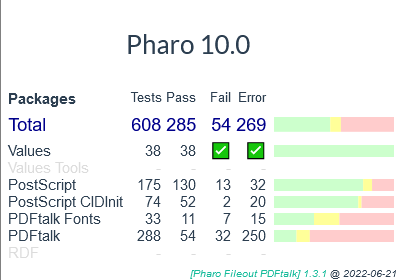
Iâll make my first run soon on my first package. Iâll do one package extra each time I run, building up the code. Each package will have its own <package name>Transform method, per the examples. Iâm not sure how to build these methods, except to assume that rewriting the pharo base methods is never wrong. Iâll file-in the resulting .st file to see what breaks. Then Iâll go back to the package whose .st source is not loading completely and add additional fixes (class keeps, base methods rewrites if needed and missing, method code body replacements if needed) to its transform method until it loads completely on the next run. That could take a while. Is that what you do in practice? Perfect! That is exactly how I do it. I start with an empty PackageChange. Then I add incrementally transforms until the code loads - phase one. This has been achieved for PDFtalk with the first release on GitHub. The second and final phase is to make all tests run (including the new to-write tests). This can take a while, because all syntactic and semantic differences must be addressed. Here, some cross-fertilization is possible. Yeah, and I have to be thorough finally about all my SUnit tests⦠The nice thing is, that the system is always telling you what to do. In fact, at first there are so many issues that it is a lot of fun to browse them and chose a nice one. Always the nicest or easiest bug first :-). Right. Iâm assuming the code writer is taking into account inter-package dependencies in order to get the load order right. Yes. Shaping From: christian.haider@smalltalked-visuals.com <mailto:christian.haider@smalltalked-visuals.com> <christian.haider@smalltalked-visuals.com <mailto:christian.haider@smalltalked-visuals.com> > Sent: Friday, 5 August, 2022 05:53 To: 'Any question about pharo is welcome' <pharo-users@lists.pharo.org <mailto:pharo-users@lists.pharo.org> >; 'Pharo Development List' <pharo-dev@lists.pharo.org <mailto:pharo-dev@lists.pharo.org> > Subject: [Pharo-users] Re: [Pharo-users]Porting from VW 8.3 to Pharo: pdftalkPackageChanges The full project in which the mentioned method used looks like this: PDFtalkProject ^ProjectChange name: #PDFtalk source: ((OrderedCollection new) add: (Package name: #Values); add: (Bundle name: #PDFtalk); add: (Package name: #'Values Testing'); add: (Bundle name: #'PDFtalk Testing'); add: (Package name: #'PDFtalk Demonstrations'); yourself) changes: self pdftalkPackageChanges nameMapping: (NameMapping keep: ((OrderedCollection new) add: #{Smalltalk.PDF}; add: #{PostScript.PSDictionary}; add: #{PDFtalk.PDFObject}; add: #{PDFtalk.PDFArray}; add: #{PDFtalk.PDFDictionary}; add: #{PDFtalk.PDFStream}; add: #{PDFtalk.PDFString}; add: #{PDFtalk.PDFDate}; add: #{PDFtalk.PDFTypeDefinition}; add: #{PDFtalk.PDFEncoder}; yourself) classToNames: ((Valuemap new) add: #{SubscriptOutOfBoundsError} -> #Error; add: #{NonIntegerIndexError} -> #Error; add: #{NotFoundError} -> #KeyNotFound; add: #{KeyNotFoundError} -> #KeyNotFound; yourself) namespaceToPrefixes: ((Valuemap new) add: #{Smalltalk.PostScript} -> 'PS'; add: #{Smalltalk.PDFtalk} -> 'Pt'; add: #{PDFtalk.Fonts} -> 'PtF'; add: #{PDFtalk.Fonts.OpenType} -> 'PtOT'; yourself)) In the #source: are the bundles and packages to be transformed. The #changes: (your method) specify the transforms (PackageChange) for each package explicitly. Only packages contain code and therefore, only packages need the code transformations. Bundles are transformed without transformations. (Well, the code for pre-, post- whatever blocks are transformed with the class name mappings rules). So, the mapping from packages to the corresponding PackageChange has to be stated somehow. Using a dictionary (Valuemap) for this seems also natural. The only change I might like is to use pragmas to tag the PackageChange returning methods with âtheirâ package like <package: âValues Toolsâ> or so. Putting the package reference into the PackageChange is not a good idea, because all those Objects need to be created before your can find out which package is affected. (Ok, I am creating all PackageChange objects tooâ¦). Happy hacking, Christian Von: Shaping <shaping@uurda.org <mailto:shaping@uurda.org> > Gesendet: Freitag, 5. August 2022 03:26 An: 'Any question about pharo is welcome' <pharo-users@lists.pharo.org <mailto:pharo-users@lists.pharo.org> >; 'Pharo Development List' <pharo-dev@lists.pharo.org <mailto:pharo-dev@lists.pharo.org> > Betreff: [Pharo-users] Re: [Pharo-users]Porting from VW 8.3 to Pharo: pdftalkPackageChanges This method pdftalkPackageChanges ^(Valuemap new) add: 'Values' -> self ValuesTransform; add: 'PostScript' -> self PostScriptTransform; add: 'PDFtalk Basics' -> self PDFtalkBasicsTransform; add: 'PDFtalk Typing' -> self PDFtalkTypingTransform; add: 'PDFtalk Basic Objects' -> self PDFtalkBasicObjectsTransform; add: 'PDFtalk Streams' -> self PDFtalkStreamsTransform; add: 'PDFtalk Data Structures' -> self PDFtalkDataStructuresTransform; add: 'PDFtalk Parsing' -> self PDFtalkParsingTransform; add: 'PDFtalk Colour' -> self PDFtalkColourTransform; add: 'PostScript Fonts' -> self PostScriptFontsTransform; add: 'PostScript CIDInit' -> self PostScriptCIDInitTransform; add: 'PDFtalk Fonts Basics' -> self PDFtalkFontsBasicsTransform; add: 'PDFtalk Fonts Type1' -> self PDFtalkFontsType1Transform; add: 'PDFtalk Fonts OpenType' -> self PDFtalkFontsOpenTypeTransform; add: 'PDFtalk Fonts' -> self PDFtalkFontsTransform; add: 'PDFtalk Graphics' -> self PDFtalkGraphicsTransform; add: 'PDFtalk Graphics Operations' -> self PDFtalkGraphicsOperationsTransform; add: 'PDFtalk XObjects' -> self PDFtalkXObjectsTransform; add: 'PDFtalk Images' -> self PDFtalkImagesTransform; add: 'PDFtalk Files' -> self PDFtalkFilesTransform; add: 'PDFtalk Document' -> self PDFtalkDocumentTransform; add: 'PDFtalk Rendering' -> self PDFtalkRenderingTransform; add: 'PDFtalk Shading' -> self PDFtalkShadingTransform; add: 'PDFtalk Interactive Features' -> self PDFtalkInteractiveFeaturesTransform; add: 'PDFtalk Deploying' -> self PDFtalkDeployingTransform; add: 'Values Testing' -> self ValuesTestingTransform; add: 'PDFtalk test resources' -> self PDFtalkTestResourcesTransform; add: 'PostScript Testing' -> self PostScriptTestingTransform; add: 'PostScript CIDInit Testing' -> self PostScriptCIDInitTestingTransform; add: 'PDFtalk Fonts tests' -> self PDFtalkFontsTestsTransform; add: 'PDFtalk tests' -> self PDFtalkTestsTransform; add: 'PDFtalk Demonstrations' -> self PDFtalkDemonstrationsTransform; yourself effectively looks like the head transform structure for a project, in this case all the PDFtalk stuff, which includes Values and Postscript. This is not exactly a bundle idea, is it? Itâs project spread across potentially many bundles and packages. Iâll start coding my transform with a similar method, and work down toward the details. Takes a bit to get used to all the correct, yet dangling VW methods that are useless in VW, but which will become new code in the target image and there no longer appear to be dangling (with syntax highlighting aberrations). Odd looking but completely by design. Shaping From: Shaping <shaping@uurda.org <mailto:shaping@uurda.org> > Sent: Thursday, 4 August, 2022 19:18 To: 'Any question about pharo is welcome' <pharo-users@lists.pharo.org <mailto:pharo-users@lists.pharo.org> > Subject: [Pharo-users] Re: [Pharo-users]Porting from VW 8.3 to Pharo: Pharo100 fileOutValues I will look, although this kind of always available on demand thing is too disruptive for me⦠I know what you mean. I try be disciplined about it. I really like to be able to fix typos, because there are almost always typos. But e-mail is okay. So that little example is a test that shows how the transformation is done. It converts just package Values to a Pharo-compatible file-in. My task is then to queue a bunch of ProjectChange instances like this one: SmalltalkTransform.Pharo100>> ValuesProject ^ProjectChange name: #Values source: (Array with: (Package name: #Values)) changes: (Valuemap with: 'Values' -> self ValuesTransform) Exactly but for my own packages. No bundles are transformed (just their contained packages) because Pharo doesnât have bundles. Is that right? No, bundles are handled. For real examples, you need to look at the PDFtalk transforms. Yes, Pharo does not have a concept of bundles (ordered aggregates of packages). Instead it relies on a naming convention for packages. That convention is honored in the fileout, so that packages will be partly grouped in Pharo according to the category prefix. For each VW-package, one Pharo package is created. A bundle itself is also represented as Pharo package with one class About<bundlename> with class methods for the metadata of the bundle, including a method giving you the ordered list of component packages. So, all contents and metadata of packages and bundles are transformed for Pharo. No code or info gets lost. Okay. Is method ValuesTransform ^PackageChange ignoredNames: #(#{Smalltalk.GeneralBindingReference}) bridgeClasses: (Valuemap with: #{Timestamp} -> #DateAndTime with: #{Smalltalk.ColorValue} -> #Color) localChanges: self valuesLocalTransform extensions: (Array with: (SystemClassChange className: #Color instanceChanges: (Array with: (Add method: #asColorValue code: #_ph_asColorValue))) with: (SystemClassChange className: #TextStream instanceChanges: (Array with: (Add method: #nextPutAllText: code: #_ph_nextPutAllText:)))) written specifically for that package? I would think it applies to all packages. I see some expected mappings like Timestamp to DateAndTime. Yes, this method returns a PackageChange Value describing the transformations needed to create the Pharo fileout for this specific package (inspect the return value for the fully expanded Value). Methods exist with the same name for other Smalltalks. Depending on the dialect (or version of a dialect), the transforms are different. Squeak and Pharo are quite similar, because they share a common history, but VA or Gemstone need quite different transforms. So, in general, for each package, there is one such method/Value for each target Smalltalk/version. Okay. I do not dare to extract commonalities before the machinery is really robust and stable. For now everything is neatly separate and self-contained (and probably it will stay that way, although there are lots of duplications). The mapping of class names is the responsibility of the enclosing ProjectChange Value where you define the list of source bundles/packages to transform, the PackageChanges for all packages and the mapping of âglobalâ names. (The bridge classes above are no renames, but a subclass relationship (is-a) to avoid renamings. The new class Timestamp will be created as subclass of DateAndTime which has almost the same semantics. Therefore, I can still use Timestamp which will be basically a DateAndTime now.) Okay. There is still a technical challenge here. Currently, a ProjectChange need to include all prerequisites (Values is part of the PDFtalk project and will be transformed with it). A ProjectWriter, which coordinates the transform, keeps track of the mappings when they are created (either explicitly or through a namespace renaming â see implementers of #PDFtalkProject). I would like to have this more modular: the mappings from the Values transformation should be persistently saved, so that other transformation projects can just use them, instead of including the sources into one own project. For this, I need to have renamings local to a package (where they first occur), not global on the project level. Right. For Values and Values Tests and Values Tools this works, because there are no mappings in the Values package. What about conversion of VW arrays to Pharo literal arrays? How is that done? (I think you mean dynamic arrays like {1. âabcâ size. 42} in which evaluation happens (in contrast to literal things which can be resolved already by the compiler). Yes, dynamic arrays. Not! Since a while, VW also has dynamic arrays, but not in VW 8.3 â the last publicly available version. Okay, I was wondering when that would happen. I will not shut out those users, because âopen-sourceâ would be quite absurd, if it is only available for paying customers. In 8.3, the compiler does not accept that syntax and therefore, there is no easy way to represent this in replacement code. So, no. It is not possible until Cincom releases an public version which can handle that. Okay. I recall that one of the Smalltalks (I donât recall which) had Stream semantics differing from VWâs. ⦠I just checked. VWâs #upTo: method includes the object and leaves the index after it, and Pharoâs excludes the object and leaves the index at the object. So that is some major breakage if we donât correct it. Can it be done automatically? Yes, these are the usual porting challenges and exactly the reason why this library exists :). Thank you for the question :). Yes, the stream semantics need to be fixed. The idea is that a set of transforms for this issue can be reused by others. Okay.
valuesLocalTransform
has lots of juicy bits. But this doesnât look very simple. We canât just replace an old method with a new one. We also have to write the new one to tweak how the indices are used in #upTo:, and make sure that new method gets filed-in as well into the Pharo target image. Or, we have to do this kind of change manually. Naa, itâs very easy, I think :). A PackageChange specifies transforms for classes used in the package (#localChanges) and #extensions for system classes of the target. For a class, you can have a ClassChange describing the changes to instance or class methods. A MethodChange has 4 subclasses for: - Ignore â donât write this method to the target - Add â add this new method (not in the source system) to the target - Replace â replace the body of this method with other code - Rewrite â rewrite the method source using a rewrite rule. Add and Replace need the target code. Add then always involves a new name for a method in the target. Replaces use an old name in the target with a new code body. This is stored in another method with a derived name like #_ph_upTo: . The method name is not important, because only the body of the method is used. But the name should not be used in the source â it is just a holder for the replacement code. These methods live in the specific [<Smalltalk> Fileout <Package>] package. Okay. There are lots of working(!) examples for all of those in the PDFtalk transform project. This bit (SystemClassChange className: #Color instanceChanges: (Array with: (Add method: #asColorValue code: #_ph_asColorValue))) is replacing #asColorValue with #_ph_asColorValue because some special Pharo-color conversion needs to happen. But how does #_ph_asColorValue get defined? Itâs neither in VW nor in Pharo 10. You got bitten by the old version of [Pharo Fileout Values]. Please load [Pharo Fileout PDFtalk]. There, the methods exist. Yes, I see it now. Ok. I donât have a virgin image. I have a very non-virgin image, about 27 years of development Iâm trying to port to Pharo. I donât yet have a specific interest in the PDFtalk, though I do see a need for PDF generation later, and will probably revisit that. For now, I just want my own stuff to run in Pharo. Virgin image just means that you donât need anything else. You can safely load it in you favorite special images :). I would load PDFtalk, although technically you donât need to (all the extensions to PDFtalk would be unloadable, but that doesnât affect Values). Okay. is: Load {Values Project] bundle Load {PDFtalk Project} bundle Load {Smalltalk Transform Project} bundle Load [Pharo Fileout PDFtalk] package Save, done Okay, so do I understand correctly that I need to include the PDFtalk stuff even if Iâm not interested in PDFtalk, because thatâs where a lot of the Smalltalk transformation machinery lives? Or is the PDFtalk just being used as an example for how to do a massive transformation? Or Both? No, the transformation machinery is fully independent of PDFtalk. I just tried it. The dependencies are in the specific [Pharo Fileout PDFtalk] package, since I have already quite a few replacement methods which are extensions to PDFtalk classes. Okay. PDFtalk is the focus of the project and therefore all issues are solved first with this library in mind. Therefore, bundles and namespaces are handled, for example. When you study the more interesting transformations for PDFtalk, it would be a shame not to be able to browse the methods and classes involved. So, PDFtalk is the real world reference example. And Values is the simplest example. To transform Values do: âPharo100 fileOutValuesâ The [Pharo Fileout PDFtalk] package includes the latest Values transformations. I am thinking about a better modularization⦠Also, the wiki is a bit out of control. It really needs some restructuring. In the cites wiki page, there is a link to a blog where I record the changes. This might be informative. 2. Port the Values package. This is easy, since no namespaces are involved. This first instruction after VW package setup says to port the contents of the Values package from VW to Pharo. Do you mean manually? Probably not. No, no. This has been finished in March. For each dialect, I have a GitHub repository where I release important versions: <https://github.com/PortingPDFtalk/PharoPDFtalk> https://github.com/PortingPDFtalk/PharoPDFtalk. You can find the working port as first release â <https://github.com/PortingPDFtalk/PharoPDFtalk/releases/tag/1.3.0.0> Working versionâ. There you can download the ported Values fileout with the exact description with which versions of what it was created. This should be a good starting example. Why do I need any new code installed in Pharo before I begin the transformation, if Iâm transforming code from VW to pharo? Iâm not understanding the basic constraints of the problem, even when the detailed steps are clear. No, no. You donât need anything on the Pharo side. The fileouts on GitHub are the end products of a transformation for people who donât use VisualWorks, but want to use Values in Pharo. Or help with PDFtalk by fixing some issues, so that I can write the transformations. Iâve done these steps so far: 1. Went to <https://github.com/PortingPDFtalk/PharoPDFtalk> https://github.com/PortingPDFtalk/PharoPDFtalk. Mistake :). You donât want to look at the unfinished product of the current version of thincomplete transformations for PDFtalk. Do you mean âfinishedâ here? Isnât that file-in the finished result? I thought the above links was the currently finished result (as good as it can be until the rest of the bugs are goine and tests all run). Yes, that was confusing. Thatâs why I had the early impression that Values was somehow apart of the transformation machinery. See https://wiki.pdftalk.de/doku.php?id=stateoftheport#pharo-10-0: Instead, you want to look at the unfinished product of the transformations of your projects :). 2. Saved down PDFtalk.Pharo100.st into <my Pharo 10 image directory>/pharo-local/Smalltalk-Transformation. (I figured that was a good place to save it. If anyone disagrees, or has a better or more conventional idea about where files should be saved, please say so. I setup a Pharo Git repo and played with it briefly for the first time yesterday. Iâve used Pharo off an on for 16 years, but this is the first time Iâm making a serious effort to manage source, and not throw away what Iâm working on.) 3. Filed-in PDFtalk.Pharo100.st. This went on for about 7 minutes or so. I have a hundreds if not over a thousand classes showing in Epicea. Is there anyway to get Epicea to give me a count of changes with a time-range filter? 4. Deleted (forgot) yesterdayâs, old Main practice-repo from both the image and the drive, and made a new one. I need to add to Main all the packages I just filed-in, but I donât see an efficient way to do that. I would like to use the Add Package button, but this gives a filtered list of available packages. I can filter subgroups, and then individually select each of the checkboxes to the left of each package (there is no Ctrl-A [select all] option here, which seems to be a strange omission given the potentially large number of packages involved). I see lots of prefixes for the classes just loaded. I could easily miss something if I filter/select/add one prefix-group at a time. Is there an easier way? Over in Epicea I donât see a way to push the loaded items listed to a specific repo. The first thought I have is to select all filed-in code artifacts by datetime span. I did that and saved it as an .ombu file (I have no idea what that is). I donât see a way to import that .ombu file into repo Mainâs âWorking copyâ window. It must be easy, but I donât see it. Please suggest the best way. Iâd like to know as well â I am not quite familiar with the source management concepts in Pharo. I asked in Discord. I donât understand why stuff like this is missing. The only conclusion I can draw is that no one does huge file-ins (but you do). It is planned to generate Tonel output in the future, but for now I feel safer with the traditional fileout where I can have doIts. I am not sure how Tonel reacts to crippled sources, which are normal during the development of the transformations. Shaping From: christian.haider <christian.haider@smalltalked-visuals.com> Sent: Wednesday, 22 June, 2022 05:42 To: pharo-users@lists.pharo.org <mailto:pharo-users@lists.pharo.org> Subject: [Pharo-users] [PDFtalk] second fileOut for Squeak and Pharo With help from the community some issues were fixed which improved the test statistics nicely. Check it out: https://wiki.pdftalk.de/doku.php?id=portingblog#second_pdftalk_fileout_for_s... Thanks to everybody involved! Happy hacking, Christian
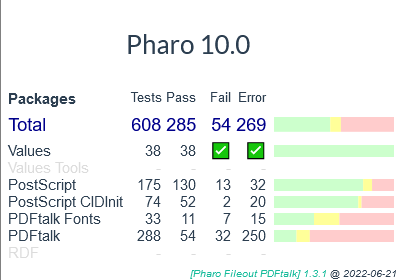
I got about 6 seconds into the first file-in. Iâm running empty transforms on all packages. The problem Iâm having is using this Syntax error to determine where in the file-in the problem occurred so that I can know the package whose transform needs work. I was expecting more context. So Iâm poking around in STCommandLineHandler next with breakpoints. Open to suggestions. Shaping. Iâll make my first run soon on my first package. Iâll do one package extra each time I run, building up the code. Each package will have its own <package name>Transform method, per the examples. Iâm not sure how to build these methods, except to assume that rewriting the pharo base methods is never wrong. Iâll file-in the resulting .st file to see what breaks. Then Iâll go back to the package whose .st source is not loading completely and add additional fixes (class keeps, base methods rewrites if needed and missing, method code body replacements if needed) to its transform method until it loads completely on the next run. That could take a while. Is that what you do in practice? Perfect! That is exactly how I do it. I start with an empty PackageChange. Then I add incrementally transforms until the code loads - phase one. This has been achieved for PDFtalk with the first release on GitHub. The second and final phase is to make all tests run (including the new to-write tests). This can take a while, because all syntactic and semantic differences must be addressed. Here, some cross-fertilization is possible. Yeah, and I have to be thorough finally about all my SUnit tests⦠The nice thing is, that the system is always telling you what to do. In fact, at first there are so many issues that it is a lot of fun to browse them and chose a nice one. Always the nicest or easiest bug first :-). Right. Iâm assuming the code writer is taking into account inter-package dependencies in order to get the load order right. Yes. Shaping From: christian.haider@smalltalked-visuals.com <mailto:christian.haider@smalltalked-visuals.com> <christian.haider@smalltalked-visuals.com <mailto:christian.haider@smalltalked-visuals.com> > Sent: Friday, 5 August, 2022 05:53 To: 'Any question about pharo is welcome' <pharo-users@lists.pharo.org <mailto:pharo-users@lists.pharo.org> >; 'Pharo Development List' <pharo-dev@lists.pharo.org <mailto:pharo-dev@lists.pharo.org> > Subject: [Pharo-users] Re: [Pharo-users]Porting from VW 8.3 to Pharo: pdftalkPackageChanges The full project in which the mentioned method used looks like this: PDFtalkProject ^ProjectChange name: #PDFtalk source: ((OrderedCollection new) add: (Package name: #Values); add: (Bundle name: #PDFtalk); add: (Package name: #'Values Testing'); add: (Bundle name: #'PDFtalk Testing'); add: (Package name: #'PDFtalk Demonstrations'); yourself) changes: self pdftalkPackageChanges nameMapping: (NameMapping keep: ((OrderedCollection new) add: #{Smalltalk.PDF}; add: #{PostScript.PSDictionary}; add: #{PDFtalk.PDFObject}; add: #{PDFtalk.PDFArray}; add: #{PDFtalk.PDFDictionary}; add: #{PDFtalk.PDFStream}; add: #{PDFtalk.PDFString}; add: #{PDFtalk.PDFDate}; add: #{PDFtalk.PDFTypeDefinition}; add: #{PDFtalk.PDFEncoder}; yourself) classToNames: ((Valuemap new) add: #{SubscriptOutOfBoundsError} -> #Error; add: #{NonIntegerIndexError} -> #Error; add: #{NotFoundError} -> #KeyNotFound; add: #{KeyNotFoundError} -> #KeyNotFound; yourself) namespaceToPrefixes: ((Valuemap new) add: #{Smalltalk.PostScript} -> 'PS'; add: #{Smalltalk.PDFtalk} -> 'Pt'; add: #{PDFtalk.Fonts} -> 'PtF'; add: #{PDFtalk.Fonts.OpenType} -> 'PtOT'; yourself)) In the #source: are the bundles and packages to be transformed. The #changes: (your method) specify the transforms (PackageChange) for each package explicitly. Only packages contain code and therefore, only packages need the code transformations. Bundles are transformed without transformations. (Well, the code for pre-, post- whatever blocks are transformed with the class name mappings rules). So, the mapping from packages to the corresponding PackageChange has to be stated somehow. Using a dictionary (Valuemap) for this seems also natural. The only change I might like is to use pragmas to tag the PackageChange returning methods with âtheirâ package like <package: âValues Toolsâ> or so. Putting the package reference into the PackageChange is not a good idea, because all those Objects need to be created before your can find out which package is affected. (Ok, I am creating all PackageChange objects tooâ¦). Happy hacking, Christian Von: Shaping <shaping@uurda.org <mailto:shaping@uurda.org> > Gesendet: Freitag, 5. August 2022 03:26 An: 'Any question about pharo is welcome' <pharo-users@lists.pharo.org <mailto:pharo-users@lists.pharo.org> >; 'Pharo Development List' <pharo-dev@lists.pharo.org <mailto:pharo-dev@lists.pharo.org> > Betreff: [Pharo-users] Re: [Pharo-users]Porting from VW 8.3 to Pharo: pdftalkPackageChanges This method pdftalkPackageChanges ^(Valuemap new) add: 'Values' -> self ValuesTransform; add: 'PostScript' -> self PostScriptTransform; add: 'PDFtalk Basics' -> self PDFtalkBasicsTransform; add: 'PDFtalk Typing' -> self PDFtalkTypingTransform; add: 'PDFtalk Basic Objects' -> self PDFtalkBasicObjectsTransform; add: 'PDFtalk Streams' -> self PDFtalkStreamsTransform; add: 'PDFtalk Data Structures' -> self PDFtalkDataStructuresTransform; add: 'PDFtalk Parsing' -> self PDFtalkParsingTransform; add: 'PDFtalk Colour' -> self PDFtalkColourTransform; add: 'PostScript Fonts' -> self PostScriptFontsTransform; add: 'PostScript CIDInit' -> self PostScriptCIDInitTransform; add: 'PDFtalk Fonts Basics' -> self PDFtalkFontsBasicsTransform; add: 'PDFtalk Fonts Type1' -> self PDFtalkFontsType1Transform; add: 'PDFtalk Fonts OpenType' -> self PDFtalkFontsOpenTypeTransform; add: 'PDFtalk Fonts' -> self PDFtalkFontsTransform; add: 'PDFtalk Graphics' -> self PDFtalkGraphicsTransform; add: 'PDFtalk Graphics Operations' -> self PDFtalkGraphicsOperationsTransform; add: 'PDFtalk XObjects' -> self PDFtalkXObjectsTransform; add: 'PDFtalk Images' -> self PDFtalkImagesTransform; add: 'PDFtalk Files' -> self PDFtalkFilesTransform; add: 'PDFtalk Document' -> self PDFtalkDocumentTransform; add: 'PDFtalk Rendering' -> self PDFtalkRenderingTransform; add: 'PDFtalk Shading' -> self PDFtalkShadingTransform; add: 'PDFtalk Interactive Features' -> self PDFtalkInteractiveFeaturesTransform; add: 'PDFtalk Deploying' -> self PDFtalkDeployingTransform; add: 'Values Testing' -> self ValuesTestingTransform; add: 'PDFtalk test resources' -> self PDFtalkTestResourcesTransform; add: 'PostScript Testing' -> self PostScriptTestingTransform; add: 'PostScript CIDInit Testing' -> self PostScriptCIDInitTestingTransform; add: 'PDFtalk Fonts tests' -> self PDFtalkFontsTestsTransform; add: 'PDFtalk tests' -> self PDFtalkTestsTransform; add: 'PDFtalk Demonstrations' -> self PDFtalkDemonstrationsTransform; yourself effectively looks like the head transform structure for a project, in this case all the PDFtalk stuff, which includes Values and Postscript. This is not exactly a bundle idea, is it? Itâs project spread across potentially many bundles and packages. Iâll start coding my transform with a similar method, and work down toward the details. Takes a bit to get used to all the correct, yet dangling VW methods that are useless in VW, but which will become new code in the target image and there no longer appear to be dangling (with syntax highlighting aberrations). Odd looking but completely by design. Shaping From: Shaping <shaping@uurda.org <mailto:shaping@uurda.org> > Sent: Thursday, 4 August, 2022 19:18 To: 'Any question about pharo is welcome' <pharo-users@lists.pharo.org <mailto:pharo-users@lists.pharo.org> > Subject: [Pharo-users] Re: [Pharo-users]Porting from VW 8.3 to Pharo: Pharo100 fileOutValues I will look, although this kind of always available on demand thing is too disruptive for me⦠I know what you mean. I try be disciplined about it. I really like to be able to fix typos, because there are almost always typos. But e-mail is okay. So that little example is a test that shows how the transformation is done. It converts just package Values to a Pharo-compatible file-in. My task is then to queue a bunch of ProjectChange instances like this one: SmalltalkTransform.Pharo100>> ValuesProject ^ProjectChange name: #Values source: (Array with: (Package name: #Values)) changes: (Valuemap with: 'Values' -> self ValuesTransform) Exactly but for my own packages. No bundles are transformed (just their contained packages) because Pharo doesnât have bundles. Is that right? No, bundles are handled. For real examples, you need to look at the PDFtalk transforms. Yes, Pharo does not have a concept of bundles (ordered aggregates of packages). Instead it relies on a naming convention for packages. That convention is honored in the fileout, so that packages will be partly grouped in Pharo according to the category prefix. For each VW-package, one Pharo package is created. A bundle itself is also represented as Pharo package with one class About<bundlename> with class methods for the metadata of the bundle, including a method giving you the ordered list of component packages. So, all contents and metadata of packages and bundles are transformed for Pharo. No code or info gets lost. Okay. Is method ValuesTransform ^PackageChange ignoredNames: #(#{Smalltalk.GeneralBindingReference}) bridgeClasses: (Valuemap with: #{Timestamp} -> #DateAndTime with: #{Smalltalk.ColorValue} -> #Color) localChanges: self valuesLocalTransform extensions: (Array with: (SystemClassChange className: #Color instanceChanges: (Array with: (Add method: #asColorValue code: #_ph_asColorValue))) with: (SystemClassChange className: #TextStream instanceChanges: (Array with: (Add method: #nextPutAllText: code: #_ph_nextPutAllText:)))) written specifically for that package? I would think it applies to all packages. I see some expected mappings like Timestamp to DateAndTime. Yes, this method returns a PackageChange Value describing the transformations needed to create the Pharo fileout for this specific package (inspect the return value for the fully expanded Value). Methods exist with the same name for other Smalltalks. Depending on the dialect (or version of a dialect), the transforms are different. Squeak and Pharo are quite similar, because they share a common history, but VA or Gemstone need quite different transforms. So, in general, for each package, there is one such method/Value for each target Smalltalk/version. Okay. I do not dare to extract commonalities before the machinery is really robust and stable. For now everything is neatly separate and self-contained (and probably it will stay that way, although there are lots of duplications). The mapping of class names is the responsibility of the enclosing ProjectChange Value where you define the list of source bundles/packages to transform, the PackageChanges for all packages and the mapping of âglobalâ names. (The bridge classes above are no renames, but a subclass relationship (is-a) to avoid renamings. The new class Timestamp will be created as subclass of DateAndTime which has almost the same semantics. Therefore, I can still use Timestamp which will be basically a DateAndTime now.) Okay. There is still a technical challenge here. Currently, a ProjectChange need to include all prerequisites (Values is part of the PDFtalk project and will be transformed with it). A ProjectWriter, which coordinates the transform, keeps track of the mappings when they are created (either explicitly or through a namespace renaming â see implementers of #PDFtalkProject). I would like to have this more modular: the mappings from the Values transformation should be persistently saved, so that other transformation projects can just use them, instead of including the sources into one own project. For this, I need to have renamings local to a package (where they first occur), not global on the project level. Right. For Values and Values Tests and Values Tools this works, because there are no mappings in the Values package. What about conversion of VW arrays to Pharo literal arrays? How is that done? (I think you mean dynamic arrays like {1. âabcâ size. 42} in which evaluation happens (in contrast to literal things which can be resolved already by the compiler). Yes, dynamic arrays. Not! Since a while, VW also has dynamic arrays, but not in VW 8.3 â the last publicly available version. Okay, I was wondering when that would happen. I will not shut out those users, because âopen-sourceâ would be quite absurd, if it is only available for paying customers. In 8.3, the compiler does not accept that syntax and therefore, there is no easy way to represent this in replacement code. So, no. It is not possible until Cincom releases an public version which can handle that. Okay. I recall that one of the Smalltalks (I donât recall which) had Stream semantics differing from VWâs. ⦠I just checked. VWâs #upTo: method includes the object and leaves the index after it, and Pharoâs excludes the object and leaves the index at the object. So that is some major breakage if we donât correct it. Can it be done automatically? Yes, these are the usual porting challenges and exactly the reason why this library exists :). Thank you for the question :). Yes, the stream semantics need to be fixed. The idea is that a set of transforms for this issue can be reused by others. Okay.
valuesLocalTransform
has lots of juicy bits. But this doesnât look very simple. We canât just replace an old method with a new one. We also have to write the new one to tweak how the indices are used in #upTo:, and make sure that new method gets filed-in as well into the Pharo target image. Or, we have to do this kind of change manually. Naa, itâs very easy, I think :). A PackageChange specifies transforms for classes used in the package (#localChanges) and #extensions for system classes of the target. For a class, you can have a ClassChange describing the changes to instance or class methods. A MethodChange has 4 subclasses for: - Ignore â donât write this method to the target - Add â add this new method (not in the source system) to the target - Replace â replace the body of this method with other code - Rewrite â rewrite the method source using a rewrite rule. Add and Replace need the target code. Add then always involves a new name for a method in the target. Replaces use an old name in the target with a new code body. This is stored in another method with a derived name like #_ph_upTo: . The method name is not important, because only the body of the method is used. But the name should not be used in the source â it is just a holder for the replacement code. These methods live in the specific [<Smalltalk> Fileout <Package>] package. Okay. There are lots of working(!) examples for all of those in the PDFtalk transform project. This bit (SystemClassChange className: #Color instanceChanges: (Array with: (Add method: #asColorValue code: #_ph_asColorValue))) is replacing #asColorValue with #_ph_asColorValue because some special Pharo-color conversion needs to happen. But how does #_ph_asColorValue get defined? Itâs neither in VW nor in Pharo 10. You got bitten by the old version of [Pharo Fileout Values]. Please load [Pharo Fileout PDFtalk]. There, the methods exist. Yes, I see it now. Ok. I donât have a virgin image. I have a very non-virgin image, about 27 years of development Iâm trying to port to Pharo. I donât yet have a specific interest in the PDFtalk, though I do see a need for PDF generation later, and will probably revisit that. For now, I just want my own stuff to run in Pharo. Virgin image just means that you donât need anything else. You can safely load it in you favorite special images :). I would load PDFtalk, although technically you donât need to (all the extensions to PDFtalk would be unloadable, but that doesnât affect Values). Okay. is: Load {Values Project] bundle Load {PDFtalk Project} bundle Load {Smalltalk Transform Project} bundle Load [Pharo Fileout PDFtalk] package Save, done Okay, so do I understand correctly that I need to include the PDFtalk stuff even if Iâm not interested in PDFtalk, because thatâs where a lot of the Smalltalk transformation machinery lives? Or is the PDFtalk just being used as an example for how to do a massive transformation? Or Both? No, the transformation machinery is fully independent of PDFtalk. I just tried it. The dependencies are in the specific [Pharo Fileout PDFtalk] package, since I have already quite a few replacement methods which are extensions to PDFtalk classes. Okay. PDFtalk is the focus of the project and therefore all issues are solved first with this library in mind. Therefore, bundles and namespaces are handled, for example. When you study the more interesting transformations for PDFtalk, it would be a shame not to be able to browse the methods and classes involved. So, PDFtalk is the real world reference example. And Values is the simplest example. To transform Values do: âPharo100 fileOutValuesâ The [Pharo Fileout PDFtalk] package includes the latest Values transformations. I am thinking about a better modularization⦠Also, the wiki is a bit out of control. It really needs some restructuring. In the cites wiki page, there is a link to a blog where I record the changes. This might be informative. 2. Port the Values package. This is easy, since no namespaces are involved. This first instruction after VW package setup says to port the contents of the Values package from VW to Pharo. Do you mean manually? Probably not. No, no. This has been finished in March. For each dialect, I have a GitHub repository where I release important versions: <https://github.com/PortingPDFtalk/PharoPDFtalk> https://github.com/PortingPDFtalk/PharoPDFtalk. You can find the working port as first release â <https://github.com/PortingPDFtalk/PharoPDFtalk/releases/tag/1.3.0.0> Working versionâ. There you can download the ported Values fileout with the exact description with which versions of what it was created. This should be a good starting example. Why do I need any new code installed in Pharo before I begin the transformation, if Iâm transforming code from VW to pharo? Iâm not understanding the basic constraints of the problem, even when the detailed steps are clear. No, no. You donât need anything on the Pharo side. The fileouts on GitHub are the end products of a transformation for people who donât use VisualWorks, but want to use Values in Pharo. Or help with PDFtalk by fixing some issues, so that I can write the transformations. Iâve done these steps so far: 1. Went to <https://github.com/PortingPDFtalk/PharoPDFtalk> https://github.com/PortingPDFtalk/PharoPDFtalk. Mistake :). You donât want to look at the unfinished product of the current version of thincomplete transformations for PDFtalk. Do you mean âfinishedâ here? Isnât that file-in the finished result? I thought the above links was the currently finished result (as good as it can be until the rest of the bugs are goine and tests all run). Yes, that was confusing. Thatâs why I had the early impression that Values was somehow apart of the transformation machinery. See https://wiki.pdftalk.de/doku.php?id=stateoftheport#pharo-10-0: Instead, you want to look at the unfinished product of the transformations of your projects :). 2. Saved down PDFtalk.Pharo100.st into <my Pharo 10 image directory>/pharo-local/Smalltalk-Transformation. (I figured that was a good place to save it. If anyone disagrees, or has a better or more conventional idea about where files should be saved, please say so. I setup a Pharo Git repo and played with it briefly for the first time yesterday. Iâve used Pharo off an on for 16 years, but this is the first time Iâm making a serious effort to manage source, and not throw away what Iâm working on.) 3. Filed-in PDFtalk.Pharo100.st. This went on for about 7 minutes or so. I have a hundreds if not over a thousand classes showing in Epicea. Is there anyway to get Epicea to give me a count of changes with a time-range filter? 4. Deleted (forgot) yesterdayâs, old Main practice-repo from both the image and the drive, and made a new one. I need to add to Main all the packages I just filed-in, but I donât see an efficient way to do that. I would like to use the Add Package button, but this gives a filtered list of available packages. I can filter subgroups, and then individually select each of the checkboxes to the left of each package (there is no Ctrl-A [select all] option here, which seems to be a strange omission given the potentially large number of packages involved). I see lots of prefixes for the classes just loaded. I could easily miss something if I filter/select/add one prefix-group at a time. Is there an easier way? Over in Epicea I donât see a way to push the loaded items listed to a specific repo. The first thought I have is to select all filed-in code artifacts by datetime span. I did that and saved it as an .ombu file (I have no idea what that is). I donât see a way to import that .ombu file into repo Mainâs âWorking copyâ window. It must be easy, but I donât see it. Please suggest the best way. Iâd like to know as well â I am not quite familiar with the source management concepts in Pharo. I asked in Discord. I donât understand why stuff like this is missing. The only conclusion I can draw is that no one does huge file-ins (but you do). It is planned to generate Tonel output in the future, but for now I feel safer with the traditional fileout where I can have doIts. I am not sure how Tonel reacts to crippled sources, which are normal during the development of the transformations. Shaping From: christian.haider <christian.haider@smalltalked-visuals.com <mailto:christian.haider@smalltalked-visuals.com> > Sent: Wednesday, 22 June, 2022 05:42 To: pharo-users@lists.pharo.org <mailto:pharo-users@lists.pharo.org> Subject: [Pharo-users] [PDFtalk] second fileOut for Squeak and Pharo With help from the community some issues were fixed which improved the test statistics nicely. Check it out: https://wiki.pdftalk.de/doku.php?id=portingblog#second_pdftalk_fileout_for_s... Thanks to everybody involved! Happy hacking, Christian
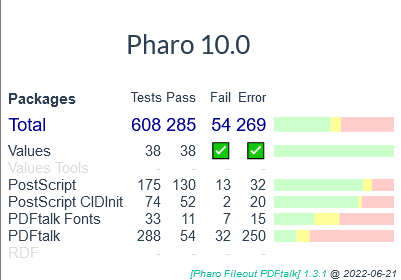
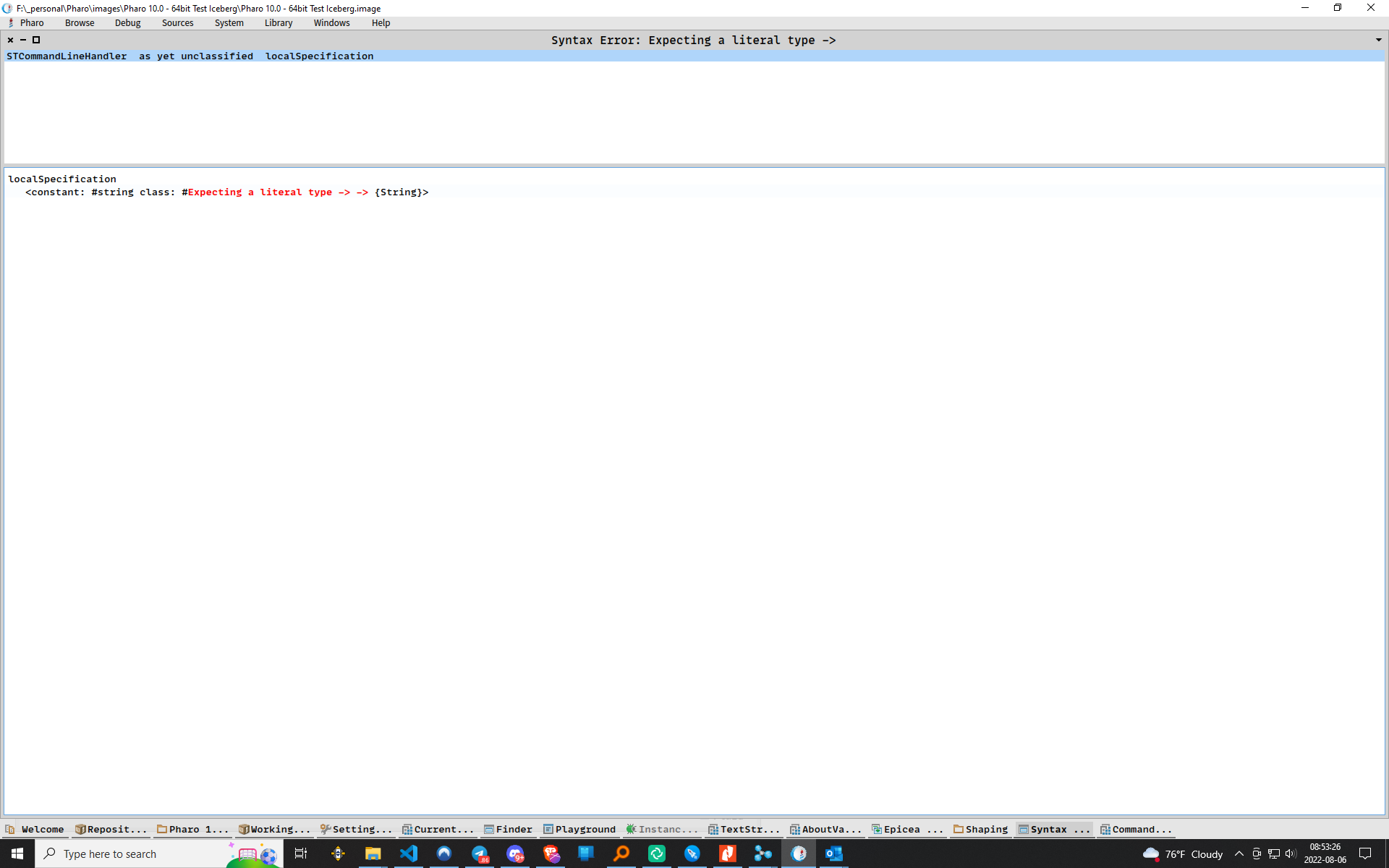
Von: Shaping <shaping@uurda.org> Gesendet: Samstag, 6. August 2022 15:59 An: 'Any question about pharo is welcome' <pharo-users@lists.pharo.org>; 'Pharo Development List' <pharo-dev@lists.pharo.org> Betreff: [Pharo-users] Re: [Pharo-users]Porting from VW 8.3 to Pharo: first transformation test I got about 6 seconds into the first file-in. Iâm running empty transforms on all packages. Great. You do need a ProjectChange though. Starting with empty PackageChanges is perfect. The problem Iâm having is using this Syntax error to determine where in the file-in the problem occurred so that I can know the package whose transform needs work. I was expecting more context. So Iâm poking around in STCommandLineHandler next with breakpoints. Open to suggestions. Strange. The #{String} syntax should have been automatically transformed to #String for Pharo⦠strange. All the namespace related issues (like this literal binding reference) should be taken care of. Christian Shaping. Iâll make my first run soon on my first package. Iâll do one package extra each time I run, building up the code. Each package will have its own <package name>Transform method, per the examples. Iâm not sure how to build these methods, except to assume that rewriting the pharo base methods is never wrong. Iâll file-in the resulting .st file to see what breaks. Then Iâll go back to the package whose .st source is not loading completely and add additional fixes (class keeps, base methods rewrites if needed and missing, method code body replacements if needed) to its transform method until it loads completely on the next run. That could take a while. Is that what you do in practice? Perfect! That is exactly how I do it. I start with an empty PackageChange. Then I add incrementally transforms until the code loads - phase one. This has been achieved for PDFtalk with the first release on GitHub. The second and final phase is to make all tests run (including the new to-write tests). This can take a while, because all syntactic and semantic differences must be addressed. Here, some cross-fertilization is possible. Yeah, and I have to be thorough finally about all my SUnit tests⦠The nice thing is, that the system is always telling you what to do. In fact, at first there are so many issues that it is a lot of fun to browse them and chose a nice one. Always the nicest or easiest bug first :-). Right. Iâm assuming the code writer is taking into account inter-package dependencies in order to get the load order right. Yes. Shaping From: christian.haider@smalltalked-visuals.com <mailto:christian.haider@smalltalked-visuals.com> <christian.haider@smalltalked-visuals.com <mailto:christian.haider@smalltalked-visuals.com> > Sent: Friday, 5 August, 2022 05:53 To: 'Any question about pharo is welcome' <pharo-users@lists.pharo.org <mailto:pharo-users@lists.pharo.org> >; 'Pharo Development List' <pharo-dev@lists.pharo.org <mailto:pharo-dev@lists.pharo.org> > Subject: [Pharo-users] Re: [Pharo-users]Porting from VW 8.3 to Pharo: pdftalkPackageChanges The full project in which the mentioned method used looks like this: PDFtalkProject ^ProjectChange name: #PDFtalk source: ((OrderedCollection new) add: (Package name: #Values); add: (Bundle name: #PDFtalk); add: (Package name: #'Values Testing'); add: (Bundle name: #'PDFtalk Testing'); add: (Package name: #'PDFtalk Demonstrations'); yourself) changes: self pdftalkPackageChanges nameMapping: (NameMapping keep: ((OrderedCollection new) add: #{Smalltalk.PDF}; add: #{PostScript.PSDictionary}; add: #{PDFtalk.PDFObject}; add: #{PDFtalk.PDFArray}; add: #{PDFtalk.PDFDictionary}; add: #{PDFtalk.PDFStream}; add: #{PDFtalk.PDFString}; add: #{PDFtalk.PDFDate}; add: #{PDFtalk.PDFTypeDefinition}; add: #{PDFtalk.PDFEncoder}; yourself) classToNames: ((Valuemap new) add: #{SubscriptOutOfBoundsError} -> #Error; add: #{NonIntegerIndexError} -> #Error; add: #{NotFoundError} -> #KeyNotFound; add: #{KeyNotFoundError} -> #KeyNotFound; yourself) namespaceToPrefixes: ((Valuemap new) add: #{Smalltalk.PostScript} -> 'PS'; add: #{Smalltalk.PDFtalk} -> 'Pt'; add: #{PDFtalk.Fonts} -> 'PtF'; add: #{PDFtalk.Fonts.OpenType} -> 'PtOT'; yourself)) In the #source: are the bundles and packages to be transformed. The #changes: (your method) specify the transforms (PackageChange) for each package explicitly. Only packages contain code and therefore, only packages need the code transformations. Bundles are transformed without transformations. (Well, the code for pre-, post- whatever blocks are transformed with the class name mappings rules). So, the mapping from packages to the corresponding PackageChange has to be stated somehow. Using a dictionary (Valuemap) for this seems also natural. The only change I might like is to use pragmas to tag the PackageChange returning methods with âtheirâ package like <package: âValues Toolsâ> or so. Putting the package reference into the PackageChange is not a good idea, because all those Objects need to be created before your can find out which package is affected. (Ok, I am creating all PackageChange objects tooâ¦). Happy hacking, Christian Von: Shaping <shaping@uurda.org <mailto:shaping@uurda.org> > Gesendet: Freitag, 5. August 2022 03:26 An: 'Any question about pharo is welcome' <pharo-users@lists.pharo.org <mailto:pharo-users@lists.pharo.org> >; 'Pharo Development List' <pharo-dev@lists.pharo.org <mailto:pharo-dev@lists.pharo.org> > Betreff: [Pharo-users] Re: [Pharo-users]Porting from VW 8.3 to Pharo: pdftalkPackageChanges This method pdftalkPackageChanges ^(Valuemap new) add: 'Values' -> self ValuesTransform; add: 'PostScript' -> self PostScriptTransform; add: 'PDFtalk Basics' -> self PDFtalkBasicsTransform; add: 'PDFtalk Typing' -> self PDFtalkTypingTransform; add: 'PDFtalk Basic Objects' -> self PDFtalkBasicObjectsTransform; add: 'PDFtalk Streams' -> self PDFtalkStreamsTransform; add: 'PDFtalk Data Structures' -> self PDFtalkDataStructuresTransform; add: 'PDFtalk Parsing' -> self PDFtalkParsingTransform; add: 'PDFtalk Colour' -> self PDFtalkColourTransform; add: 'PostScript Fonts' -> self PostScriptFontsTransform; add: 'PostScript CIDInit' -> self PostScriptCIDInitTransform; add: 'PDFtalk Fonts Basics' -> self PDFtalkFontsBasicsTransform; add: 'PDFtalk Fonts Type1' -> self PDFtalkFontsType1Transform; add: 'PDFtalk Fonts OpenType' -> self PDFtalkFontsOpenTypeTransform; add: 'PDFtalk Fonts' -> self PDFtalkFontsTransform; add: 'PDFtalk Graphics' -> self PDFtalkGraphicsTransform; add: 'PDFtalk Graphics Operations' -> self PDFtalkGraphicsOperationsTransform; add: 'PDFtalk XObjects' -> self PDFtalkXObjectsTransform; add: 'PDFtalk Images' -> self PDFtalkImagesTransform; add: 'PDFtalk Files' -> self PDFtalkFilesTransform; add: 'PDFtalk Document' -> self PDFtalkDocumentTransform; add: 'PDFtalk Rendering' -> self PDFtalkRenderingTransform; add: 'PDFtalk Shading' -> self PDFtalkShadingTransform; add: 'PDFtalk Interactive Features' -> self PDFtalkInteractiveFeaturesTransform; add: 'PDFtalk Deploying' -> self PDFtalkDeployingTransform; add: 'Values Testing' -> self ValuesTestingTransform; add: 'PDFtalk test resources' -> self PDFtalkTestResourcesTransform; add: 'PostScript Testing' -> self PostScriptTestingTransform; add: 'PostScript CIDInit Testing' -> self PostScriptCIDInitTestingTransform; add: 'PDFtalk Fonts tests' -> self PDFtalkFontsTestsTransform; add: 'PDFtalk tests' -> self PDFtalkTestsTransform; add: 'PDFtalk Demonstrations' -> self PDFtalkDemonstrationsTransform; yourself effectively looks like the head transform structure for a project, in this case all the PDFtalk stuff, which includes Values and Postscript. This is not exactly a bundle idea, is it? Itâs project spread across potentially many bundles and packages. Iâll start coding my transform with a similar method, and work down toward the details. Takes a bit to get used to all the correct, yet dangling VW methods that are useless in VW, but which will become new code in the target image and there no longer appear to be dangling (with syntax highlighting aberrations). Odd looking but completely by design. Shaping From: Shaping <shaping@uurda.org <mailto:shaping@uurda.org> > Sent: Thursday, 4 August, 2022 19:18 To: 'Any question about pharo is welcome' <pharo-users@lists.pharo.org <mailto:pharo-users@lists.pharo.org> > Subject: [Pharo-users] Re: [Pharo-users]Porting from VW 8.3 to Pharo: Pharo100 fileOutValues I will look, although this kind of always available on demand thing is too disruptive for me⦠I know what you mean. I try be disciplined about it. I really like to be able to fix typos, because there are almost always typos. But e-mail is okay. So that little example is a test that shows how the transformation is done. It converts just package Values to a Pharo-compatible file-in. My task is then to queue a bunch of ProjectChange instances like this one: SmalltalkTransform.Pharo100>> ValuesProject ^ProjectChange name: #Values source: (Array with: (Package name: #Values)) changes: (Valuemap with: 'Values' -> self ValuesTransform) Exactly but for my own packages. No bundles are transformed (just their contained packages) because Pharo doesnât have bundles. Is that right? No, bundles are handled. For real examples, you need to look at the PDFtalk transforms. Yes, Pharo does not have a concept of bundles (ordered aggregates of packages). Instead it relies on a naming convention for packages. That convention is honored in the fileout, so that packages will be partly grouped in Pharo according to the category prefix. For each VW-package, one Pharo package is created. A bundle itself is also represented as Pharo package with one class About<bundlename> with class methods for the metadata of the bundle, including a method giving you the ordered list of component packages. So, all contents and metadata of packages and bundles are transformed for Pharo. No code or info gets lost. Okay. Is method ValuesTransform ^PackageChange ignoredNames: #(#{Smalltalk.GeneralBindingReference}) bridgeClasses: (Valuemap with: #{Timestamp} -> #DateAndTime with: #{Smalltalk.ColorValue} -> #Color) localChanges: self valuesLocalTransform extensions: (Array with: (SystemClassChange className: #Color instanceChanges: (Array with: (Add method: #asColorValue code: #_ph_asColorValue))) with: (SystemClassChange className: #TextStream instanceChanges: (Array with: (Add method: #nextPutAllText: code: #_ph_nextPutAllText:)))) written specifically for that package? I would think it applies to all packages. I see some expected mappings like Timestamp to DateAndTime. Yes, this method returns a PackageChange Value describing the transformations needed to create the Pharo fileout for this specific package (inspect the return value for the fully expanded Value). Methods exist with the same name for other Smalltalks. Depending on the dialect (or version of a dialect), the transforms are different. Squeak and Pharo are quite similar, because they share a common history, but VA or Gemstone need quite different transforms. So, in general, for each package, there is one such method/Value for each target Smalltalk/version. Okay. I do not dare to extract commonalities before the machinery is really robust and stable. For now everything is neatly separate and self-contained (and probably it will stay that way, although there are lots of duplications). The mapping of class names is the responsibility of the enclosing ProjectChange Value where you define the list of source bundles/packages to transform, the PackageChanges for all packages and the mapping of âglobalâ names. (The bridge classes above are no renames, but a subclass relationship (is-a) to avoid renamings. The new class Timestamp will be created as subclass of DateAndTime which has almost the same semantics. Therefore, I can still use Timestamp which will be basically a DateAndTime now.) Okay. There is still a technical challenge here. Currently, a ProjectChange need to include all prerequisites (Values is part of the PDFtalk project and will be transformed with it). A ProjectWriter, which coordinates the transform, keeps track of the mappings when they are created (either explicitly or through a namespace renaming â see implementers of #PDFtalkProject). I would like to have this more modular: the mappings from the Values transformation should be persistently saved, so that other transformation projects can just use them, instead of including the sources into one own project. For this, I need to have renamings local to a package (where they first occur), not global on the project level. Right. For Values and Values Tests and Values Tools this works, because there are no mappings in the Values package. What about conversion of VW arrays to Pharo literal arrays? How is that done? (I think you mean dynamic arrays like {1. âabcâ size. 42} in which evaluation happens (in contrast to literal things which can be resolved already by the compiler). Yes, dynamic arrays. Not! Since a while, VW also has dynamic arrays, but not in VW 8.3 â the last publicly available version. Okay, I was wondering when that would happen. I will not shut out those users, because âopen-sourceâ would be quite absurd, if it is only available for paying customers. In 8.3, the compiler does not accept that syntax and therefore, there is no easy way to represent this in replacement code. So, no. It is not possible until Cincom releases an public version which can handle that. Okay. I recall that one of the Smalltalks (I donât recall which) had Stream semantics differing from VWâs. ⦠I just checked. VWâs #upTo: method includes the object and leaves the index after it, and Pharoâs excludes the object and leaves the index at the object. So that is some major breakage if we donât correct it. Can it be done automatically? Yes, these are the usual porting challenges and exactly the reason why this library exists :). Thank you for the question :). Yes, the stream semantics need to be fixed. The idea is that a set of transforms for this issue can be reused by others. Okay.
valuesLocalTransform
has lots of juicy bits. But this doesnât look very simple. We canât just replace an old method with a new one. We also have to write the new one to tweak how the indices are used in #upTo:, and make sure that new method gets filed-in as well into the Pharo target image. Or, we have to do this kind of change manually. Naa, itâs very easy, I think :). A PackageChange specifies transforms for classes used in the package (#localChanges) and #extensions for system classes of the target. For a class, you can have a ClassChange describing the changes to instance or class methods. A MethodChange has 4 subclasses for: - Ignore â donât write this method to the target - Add â add this new method (not in the source system) to the target - Replace â replace the body of this method with other code - Rewrite â rewrite the method source using a rewrite rule. Add and Replace need the target code. Add then always involves a new name for a method in the target. Replaces use an old name in the target with a new code body. This is stored in another method with a derived name like #_ph_upTo: . The method name is not important, because only the body of the method is used. But the name should not be used in the source â it is just a holder for the replacement code. These methods live in the specific [<Smalltalk> Fileout <Package>] package. Okay. There are lots of working(!) examples for all of those in the PDFtalk transform project. This bit (SystemClassChange className: #Color instanceChanges: (Array with: (Add method: #asColorValue code: #_ph_asColorValue))) is replacing #asColorValue with #_ph_asColorValue because some special Pharo-color conversion needs to happen. But how does #_ph_asColorValue get defined? Itâs neither in VW nor in Pharo 10. You got bitten by the old version of [Pharo Fileout Values]. Please load [Pharo Fileout PDFtalk]. There, the methods exist. Yes, I see it now. Ok. I donât have a virgin image. I have a very non-virgin image, about 27 years of development Iâm trying to port to Pharo. I donât yet have a specific interest in the PDFtalk, though I do see a need for PDF generation later, and will probably revisit that. For now, I just want my own stuff to run in Pharo. Virgin image just means that you donât need anything else. You can safely load it in you favorite special images :). I would load PDFtalk, although technically you donât need to (all the extensions to PDFtalk would be unloadable, but that doesnât affect Values). Okay. is: Load {Values Project] bundle Load {PDFtalk Project} bundle Load {Smalltalk Transform Project} bundle Load [Pharo Fileout PDFtalk] package Save, done Okay, so do I understand correctly that I need to include the PDFtalk stuff even if Iâm not interested in PDFtalk, because thatâs where a lot of the Smalltalk transformation machinery lives? Or is the PDFtalk just being used as an example for how to do a massive transformation? Or Both? No, the transformation machinery is fully independent of PDFtalk. I just tried it. The dependencies are in the specific [Pharo Fileout PDFtalk] package, since I have already quite a few replacement methods which are extensions to PDFtalk classes. Okay. PDFtalk is the focus of the project and therefore all issues are solved first with this library in mind. Therefore, bundles and namespaces are handled, for example. When you study the more interesting transformations for PDFtalk, it would be a shame not to be able to browse the methods and classes involved. So, PDFtalk is the real world reference example. And Values is the simplest example. To transform Values do: âPharo100 fileOutValuesâ The [Pharo Fileout PDFtalk] package includes the latest Values transformations. I am thinking about a better modularization⦠Also, the wiki is a bit out of control. It really needs some restructuring. In the cites wiki page, there is a link to a blog where I record the changes. This might be informative. 2. Port the Values package. This is easy, since no namespaces are involved. This first instruction after VW package setup says to port the contents of the Values package from VW to Pharo. Do you mean manually? Probably not. No, no. This has been finished in March. For each dialect, I have a GitHub repository where I release important versions: <https://github.com/PortingPDFtalk/PharoPDFtalk> https://github.com/PortingPDFtalk/PharoPDFtalk. You can find the working port as first release â <https://github.com/PortingPDFtalk/PharoPDFtalk/releases/tag/1.3.0.0> Working versionâ. There you can download the ported Values fileout with the exact description with which versions of what it was created. This should be a good starting example. Why do I need any new code installed in Pharo before I begin the transformation, if Iâm transforming code from VW to pharo? Iâm not understanding the basic constraints of the problem, even when the detailed steps are clear. No, no. You donât need anything on the Pharo side. The fileouts on GitHub are the end products of a transformation for people who donât use VisualWorks, but want to use Values in Pharo. Or help with PDFtalk by fixing some issues, so that I can write the transformations. Iâve done these steps so far: 1. Went to <https://github.com/PortingPDFtalk/PharoPDFtalk> https://github.com/PortingPDFtalk/PharoPDFtalk. Mistake :). You donât want to look at the unfinished product of the current version of thincomplete transformations for PDFtalk. Do you mean âfinishedâ here? Isnât that file-in the finished result? I thought the above links was the currently finished result (as good as it can be until the rest of the bugs are goine and tests all run). Yes, that was confusing. Thatâs why I had the early impression that Values was somehow apart of the transformation machinery. See https://wiki.pdftalk.de/doku.php?id=stateoftheport#pharo-10-0: Instead, you want to look at the unfinished product of the transformations of your projects :). 2. Saved down PDFtalk.Pharo100.st into <my Pharo 10 image directory>/pharo-local/Smalltalk-Transformation. (I figured that was a good place to save it. If anyone disagrees, or has a better or more conventional idea about where files should be saved, please say so. I setup a Pharo Git repo and played with it briefly for the first time yesterday. Iâve used Pharo off an on for 16 years, but this is the first time Iâm making a serious effort to manage source, and not throw away what Iâm working on.) 3. Filed-in PDFtalk.Pharo100.st. This went on for about 7 minutes or so. I have a hundreds if not over a thousand classes showing in Epicea. Is there anyway to get Epicea to give me a count of changes with a time-range filter? 4. Deleted (forgot) yesterdayâs, old Main practice-repo from both the image and the drive, and made a new one. I need to add to Main all the packages I just filed-in, but I donât see an efficient way to do that. I would like to use the Add Package button, but this gives a filtered list of available packages. I can filter subgroups, and then individually select each of the checkboxes to the left of each package (there is no Ctrl-A [select all] option here, which seems to be a strange omission given the potentially large number of packages involved). I see lots of prefixes for the classes just loaded. I could easily miss something if I filter/select/add one prefix-group at a time. Is there an easier way? Over in Epicea I donât see a way to push the loaded items listed to a specific repo. The first thought I have is to select all filed-in code artifacts by datetime span. I did that and saved it as an .ombu file (I have no idea what that is). I donât see a way to import that .ombu file into repo Mainâs âWorking copyâ window. It must be easy, but I donât see it. Please suggest the best way. Iâd like to know as well â I am not quite familiar with the source management concepts in Pharo. I asked in Discord. I donât understand why stuff like this is missing. The only conclusion I can draw is that no one does huge file-ins (but you do). It is planned to generate Tonel output in the future, but for now I feel safer with the traditional fileout where I can have doIts. I am not sure how Tonel reacts to crippled sources, which are normal during the development of the transformations. Shaping From: christian.haider <christian.haider@smalltalked-visuals.com <mailto:christian.haider@smalltalked-visuals.com> > Sent: Wednesday, 22 June, 2022 05:42 To: pharo-users@lists.pharo.org <mailto:pharo-users@lists.pharo.org> Subject: [Pharo-users] [PDFtalk] second fileOut for Squeak and Pharo With help from the community some issues were fixed which improved the test statistics nicely. Check it out: https://wiki.pdftalk.de/doku.php?id=portingblog#second_pdftalk_fileout_for_s... Thanks to everybody involved! Happy hacking, Christian
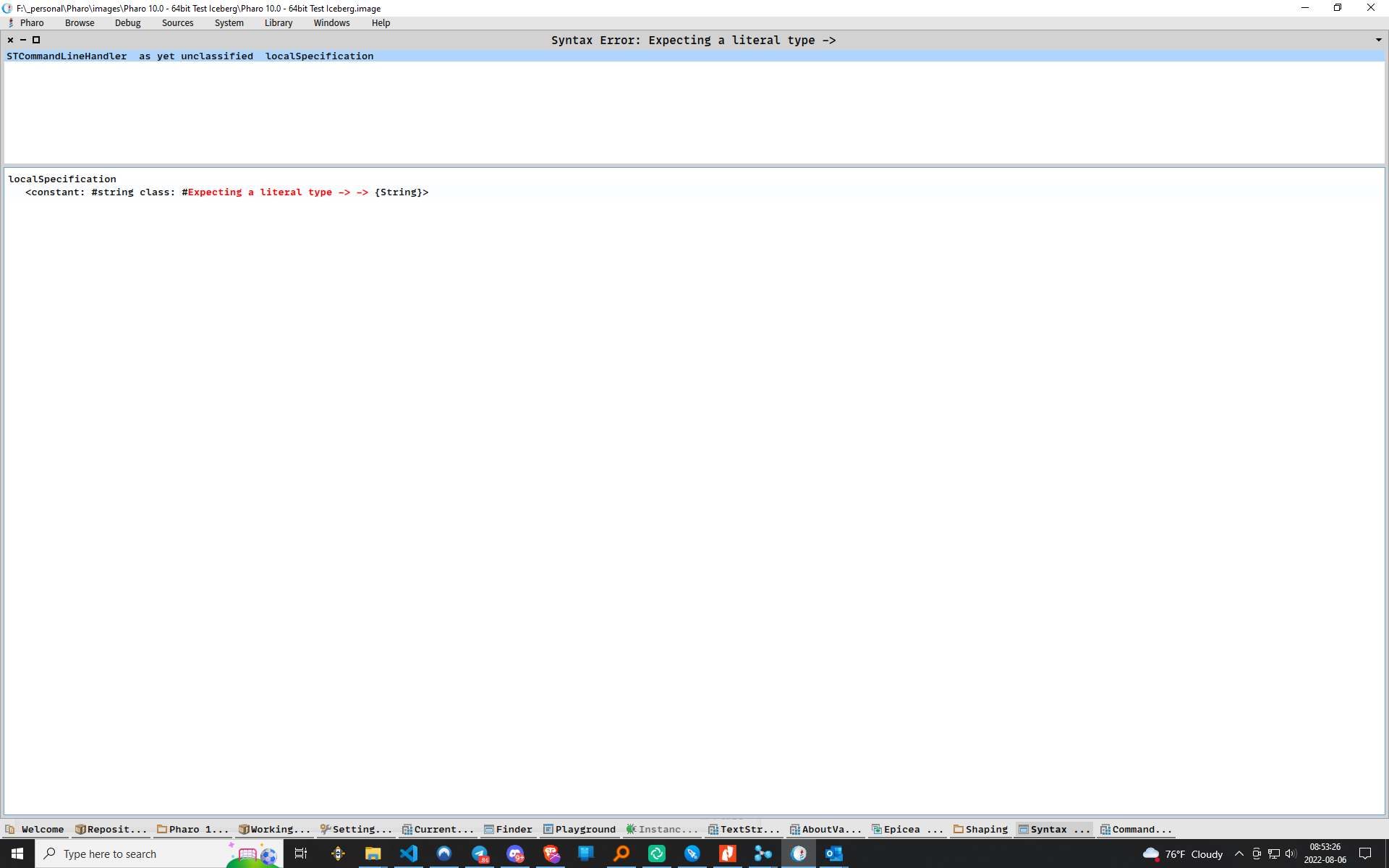
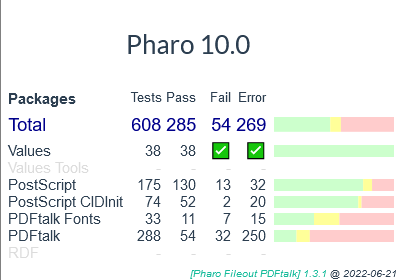
I got about 6 seconds into the first file-in. Iâm running empty transforms on all packages. Great. You do need a ProjectChange though. Starting with empty PackageChanges is perfect. Yes, I have the one big ProjectChange with all the PackageChanges (about 25) currently empty. The problem Iâm having is using this Syntax error to determine where in the file-in the problem occurred so that I can know the package whose transform needs work. I was expecting more context. So Iâm poking around in STCommandLineHandler next with breakpoints. Open to suggestions. Strange. The #{String} syntax should have been automatically transformed to #String for Pharo⦠strange. All the namespace related issues (like this literal binding reference) should be taken care of. I had a bunch of those namespace/shared-variable bad-reference problems, which I cleared up for several hours before I was able to produce the first file-in. The transformation machinery is very strict, and helps you clean up your code. Iâd forgotten about many of the things that I was forced to fix. Iâll just debug through the file-in until I find the problem. Shaping. Iâll make my first run soon on my first package. Iâll do one package extra each time I run, building up the code. Each package will have its own <package name>Transform method, per the examples. Iâm not sure how to build these methods, except to assume that rewriting the pharo base methods is never wrong. Iâll file-in the resulting .st file to see what breaks. Then Iâll go back to the package whose .st source is not loading completely and add additional fixes (class keeps, base methods rewrites if needed and missing, method code body replacements if needed) to its transform method until it loads completely on the next run. That could take a while. Is that what you do in practice? Perfect! That is exactly how I do it. I start with an empty PackageChange. Then I add incrementally transforms until the code loads - phase one. This has been achieved for PDFtalk with the first release on GitHub. The second and final phase is to make all tests run (including the new to-write tests). This can take a while, because all syntactic and semantic differences must be addressed. Here, some cross-fertilization is possible. Yeah, and I have to be thorough finally about all my SUnit tests⦠The nice thing is, that the system is always telling you what to do. In fact, at first there are so many issues that it is a lot of fun to browse them and chose a nice one. Always the nicest or easiest bug first :-). Right. Iâm assuming the code writer is taking into account inter-package dependencies in order to get the load order right. Yes. Shaping From: christian.haider@smalltalked-visuals.com <mailto:christian.haider@smalltalked-visuals.com> <christian.haider@smalltalked-visuals.com <mailto:christian.haider@smalltalked-visuals.com> > Sent: Friday, 5 August, 2022 05:53 To: 'Any question about pharo is welcome' <pharo-users@lists.pharo.org <mailto:pharo-users@lists.pharo.org> >; 'Pharo Development List' <pharo-dev@lists.pharo.org <mailto:pharo-dev@lists.pharo.org> > Subject: [Pharo-users] Re: [Pharo-users]Porting from VW 8.3 to Pharo: pdftalkPackageChanges The full project in which the mentioned method used looks like this: PDFtalkProject ^ProjectChange name: #PDFtalk source: ((OrderedCollection new) add: (Package name: #Values); add: (Bundle name: #PDFtalk); add: (Package name: #'Values Testing'); add: (Bundle name: #'PDFtalk Testing'); add: (Package name: #'PDFtalk Demonstrations'); yourself) changes: self pdftalkPackageChanges nameMapping: (NameMapping keep: ((OrderedCollection new) add: #{Smalltalk.PDF}; add: #{PostScript.PSDictionary}; add: #{PDFtalk.PDFObject}; add: #{PDFtalk.PDFArray}; add: #{PDFtalk.PDFDictionary}; add: #{PDFtalk.PDFStream}; add: #{PDFtalk.PDFString}; add: #{PDFtalk.PDFDate}; add: #{PDFtalk.PDFTypeDefinition}; add: #{PDFtalk.PDFEncoder}; yourself) classToNames: ((Valuemap new) add: #{SubscriptOutOfBoundsError} -> #Error; add: #{NonIntegerIndexError} -> #Error; add: #{NotFoundError} -> #KeyNotFound; add: #{KeyNotFoundError} -> #KeyNotFound; yourself) namespaceToPrefixes: ((Valuemap new) add: #{Smalltalk.PostScript} -> 'PS'; add: #{Smalltalk.PDFtalk} -> 'Pt'; add: #{PDFtalk.Fonts} -> 'PtF'; add: #{PDFtalk.Fonts.OpenType} -> 'PtOT'; yourself)) In the #source: are the bundles and packages to be transformed. The #changes: (your method) specify the transforms (PackageChange) for each package explicitly. Only packages contain code and therefore, only packages need the code transformations. Bundles are transformed without transformations. (Well, the code for pre-, post- whatever blocks are transformed with the class name mappings rules). So, the mapping from packages to the corresponding PackageChange has to be stated somehow. Using a dictionary (Valuemap) for this seems also natural. The only change I might like is to use pragmas to tag the PackageChange returning methods with âtheirâ package like <package: âValues Toolsâ> or so. Putting the package reference into the PackageChange is not a good idea, because all those Objects need to be created before your can find out which package is affected. (Ok, I am creating all PackageChange objects tooâ¦). Happy hacking, Christian Von: Shaping <shaping@uurda.org <mailto:shaping@uurda.org> > Gesendet: Freitag, 5. August 2022 03:26 An: 'Any question about pharo is welcome' <pharo-users@lists.pharo.org <mailto:pharo-users@lists.pharo.org> >; 'Pharo Development List' <pharo-dev@lists.pharo.org <mailto:pharo-dev@lists.pharo.org> > Betreff: [Pharo-users] Re: [Pharo-users]Porting from VW 8.3 to Pharo: pdftalkPackageChanges This method pdftalkPackageChanges ^(Valuemap new) add: 'Values' -> self ValuesTransform; add: 'PostScript' -> self PostScriptTransform; add: 'PDFtalk Basics' -> self PDFtalkBasicsTransform; add: 'PDFtalk Typing' -> self PDFtalkTypingTransform; add: 'PDFtalk Basic Objects' -> self PDFtalkBasicObjectsTransform; add: 'PDFtalk Streams' -> self PDFtalkStreamsTransform; add: 'PDFtalk Data Structures' -> self PDFtalkDataStructuresTransform; add: 'PDFtalk Parsing' -> self PDFtalkParsingTransform; add: 'PDFtalk Colour' -> self PDFtalkColourTransform; add: 'PostScript Fonts' -> self PostScriptFontsTransform; add: 'PostScript CIDInit' -> self PostScriptCIDInitTransform; add: 'PDFtalk Fonts Basics' -> self PDFtalkFontsBasicsTransform; add: 'PDFtalk Fonts Type1' -> self PDFtalkFontsType1Transform; add: 'PDFtalk Fonts OpenType' -> self PDFtalkFontsOpenTypeTransform; add: 'PDFtalk Fonts' -> self PDFtalkFontsTransform; add: 'PDFtalk Graphics' -> self PDFtalkGraphicsTransform; add: 'PDFtalk Graphics Operations' -> self PDFtalkGraphicsOperationsTransform; add: 'PDFtalk XObjects' -> self PDFtalkXObjectsTransform; add: 'PDFtalk Images' -> self PDFtalkImagesTransform; add: 'PDFtalk Files' -> self PDFtalkFilesTransform; add: 'PDFtalk Document' -> self PDFtalkDocumentTransform; add: 'PDFtalk Rendering' -> self PDFtalkRenderingTransform; add: 'PDFtalk Shading' -> self PDFtalkShadingTransform; add: 'PDFtalk Interactive Features' -> self PDFtalkInteractiveFeaturesTransform; add: 'PDFtalk Deploying' -> self PDFtalkDeployingTransform; add: 'Values Testing' -> self ValuesTestingTransform; add: 'PDFtalk test resources' -> self PDFtalkTestResourcesTransform; add: 'PostScript Testing' -> self PostScriptTestingTransform; add: 'PostScript CIDInit Testing' -> self PostScriptCIDInitTestingTransform; add: 'PDFtalk Fonts tests' -> self PDFtalkFontsTestsTransform; add: 'PDFtalk tests' -> self PDFtalkTestsTransform; add: 'PDFtalk Demonstrations' -> self PDFtalkDemonstrationsTransform; yourself effectively looks like the head transform structure for a project, in this case all the PDFtalk stuff, which includes Values and Postscript. This is not exactly a bundle idea, is it? Itâs project spread across potentially many bundles and packages. Iâll start coding my transform with a similar method, and work down toward the details. Takes a bit to get used to all the correct, yet dangling VW methods that are useless in VW, but which will become new code in the target image and there no longer appear to be dangling (with syntax highlighting aberrations). Odd looking but completely by design. Shaping From: Shaping <shaping@uurda.org <mailto:shaping@uurda.org> > Sent: Thursday, 4 August, 2022 19:18 To: 'Any question about pharo is welcome' <pharo-users@lists.pharo.org <mailto:pharo-users@lists.pharo.org> > Subject: [Pharo-users] Re: [Pharo-users]Porting from VW 8.3 to Pharo: Pharo100 fileOutValues I will look, although this kind of always available on demand thing is too disruptive for me⦠I know what you mean. I try be disciplined about it. I really like to be able to fix typos, because there are almost always typos. But e-mail is okay. So that little example is a test that shows how the transformation is done. It converts just package Values to a Pharo-compatible file-in. My task is then to queue a bunch of ProjectChange instances like this one: SmalltalkTransform.Pharo100>> ValuesProject ^ProjectChange name: #Values source: (Array with: (Package name: #Values)) changes: (Valuemap with: 'Values' -> self ValuesTransform) Exactly but for my own packages. No bundles are transformed (just their contained packages) because Pharo doesnât have bundles. Is that right? No, bundles are handled. For real examples, you need to look at the PDFtalk transforms. Yes, Pharo does not have a concept of bundles (ordered aggregates of packages). Instead it relies on a naming convention for packages. That convention is honored in the fileout, so that packages will be partly grouped in Pharo according to the category prefix. For each VW-package, one Pharo package is created. A bundle itself is also represented as Pharo package with one class About<bundlename> with class methods for the metadata of the bundle, including a method giving you the ordered list of component packages. So, all contents and metadata of packages and bundles are transformed for Pharo. No code or info gets lost. Okay. Is method ValuesTransform ^PackageChange ignoredNames: #(#{Smalltalk.GeneralBindingReference}) bridgeClasses: (Valuemap with: #{Timestamp} -> #DateAndTime with: #{Smalltalk.ColorValue} -> #Color) localChanges: self valuesLocalTransform extensions: (Array with: (SystemClassChange className: #Color instanceChanges: (Array with: (Add method: #asColorValue code: #_ph_asColorValue))) with: (SystemClassChange className: #TextStream instanceChanges: (Array with: (Add method: #nextPutAllText: code: #_ph_nextPutAllText:)))) written specifically for that package? I would think it applies to all packages. I see some expected mappings like Timestamp to DateAndTime. Yes, this method returns a PackageChange Value describing the transformations needed to create the Pharo fileout for this specific package (inspect the return value for the fully expanded Value). Methods exist with the same name for other Smalltalks. Depending on the dialect (or version of a dialect), the transforms are different. Squeak and Pharo are quite similar, because they share a common history, but VA or Gemstone need quite different transforms. So, in general, for each package, there is one such method/Value for each target Smalltalk/version. Okay. I do not dare to extract commonalities before the machinery is really robust and stable. For now everything is neatly separate and self-contained (and probably it will stay that way, although there are lots of duplications). The mapping of class names is the responsibility of the enclosing ProjectChange Value where you define the list of source bundles/packages to transform, the PackageChanges for all packages and the mapping of âglobalâ names. (The bridge classes above are no renames, but a subclass relationship (is-a) to avoid renamings. The new class Timestamp will be created as subclass of DateAndTime which has almost the same semantics. Therefore, I can still use Timestamp which will be basically a DateAndTime now.) Okay. There is still a technical challenge here. Currently, a ProjectChange need to include all prerequisites (Values is part of the PDFtalk project and will be transformed with it). A ProjectWriter, which coordinates the transform, keeps track of the mappings when they are created (either explicitly or through a namespace renaming â see implementers of #PDFtalkProject). I would like to have this more modular: the mappings from the Values transformation should be persistently saved, so that other transformation projects can just use them, instead of including the sources into one own project. For this, I need to have renamings local to a package (where they first occur), not global on the project level. Right. For Values and Values Tests and Values Tools this works, because there are no mappings in the Values package. What about conversion of VW arrays to Pharo literal arrays? How is that done? (I think you mean dynamic arrays like {1. âabcâ size. 42} in which evaluation happens (in contrast to literal things which can be resolved already by the compiler). Yes, dynamic arrays. Not! Since a while, VW also has dynamic arrays, but not in VW 8.3 â the last publicly available version. Okay, I was wondering when that would happen. I will not shut out those users, because âopen-sourceâ would be quite absurd, if it is only available for paying customers. In 8.3, the compiler does not accept that syntax and therefore, there is no easy way to represent this in replacement code. So, no. It is not possible until Cincom releases an public version which can handle that. Okay. I recall that one of the Smalltalks (I donât recall which) had Stream semantics differing from VWâs. ⦠I just checked. VWâs #upTo: method includes the object and leaves the index after it, and Pharoâs excludes the object and leaves the index at the object. So that is some major breakage if we donât correct it. Can it be done automatically? Yes, these are the usual porting challenges and exactly the reason why this library exists :). Thank you for the question :). Yes, the stream semantics need to be fixed. The idea is that a set of transforms for this issue can be reused by others. Okay.
valuesLocalTransform
has lots of juicy bits. But this doesnât look very simple. We canât just replace an old method with a new one. We also have to write the new one to tweak how the indices are used in #upTo:, and make sure that new method gets filed-in as well into the Pharo target image. Or, we have to do this kind of change manually. Naa, itâs very easy, I think :). A PackageChange specifies transforms for classes used in the package (#localChanges) and #extensions for system classes of the target. For a class, you can have a ClassChange describing the changes to instance or class methods. A MethodChange has 4 subclasses for: - Ignore â donât write this method to the target - Add â add this new method (not in the source system) to the target - Replace â replace the body of this method with other code - Rewrite â rewrite the method source using a rewrite rule. Add and Replace need the target code. Add then always involves a new name for a method in the target. Replaces use an old name in the target with a new code body. This is stored in another method with a derived name like #_ph_upTo: . The method name is not important, because only the body of the method is used. But the name should not be used in the source â it is just a holder for the replacement code. These methods live in the specific [<Smalltalk> Fileout <Package>] package. Okay. There are lots of working(!) examples for all of those in the PDFtalk transform project. This bit (SystemClassChange className: #Color instanceChanges: (Array with: (Add method: #asColorValue code: #_ph_asColorValue))) is replacing #asColorValue with #_ph_asColorValue because some special Pharo-color conversion needs to happen. But how does #_ph_asColorValue get defined? Itâs neither in VW nor in Pharo 10. You got bitten by the old version of [Pharo Fileout Values]. Please load [Pharo Fileout PDFtalk]. There, the methods exist. Yes, I see it now. Ok. I donât have a virgin image. I have a very non-virgin image, about 27 years of development Iâm trying to port to Pharo. I donât yet have a specific interest in the PDFtalk, though I do see a need for PDF generation later, and will probably revisit that. For now, I just want my own stuff to run in Pharo. Virgin image just means that you donât need anything else. You can safely load it in you favorite special images :). I would load PDFtalk, although technically you donât need to (all the extensions to PDFtalk would be unloadable, but that doesnât affect Values). Okay. is: Load {Values Project] bundle Load {PDFtalk Project} bundle Load {Smalltalk Transform Project} bundle Load [Pharo Fileout PDFtalk] package Save, done Okay, so do I understand correctly that I need to include the PDFtalk stuff even if Iâm not interested in PDFtalk, because thatâs where a lot of the Smalltalk transformation machinery lives? Or is the PDFtalk just being used as an example for how to do a massive transformation? Or Both? No, the transformation machinery is fully independent of PDFtalk. I just tried it. The dependencies are in the specific [Pharo Fileout PDFtalk] package, since I have already quite a few replacement methods which are extensions to PDFtalk classes. Okay. PDFtalk is the focus of the project and therefore all issues are solved first with this library in mind. Therefore, bundles and namespaces are handled, for example. When you study the more interesting transformations for PDFtalk, it would be a shame not to be able to browse the methods and classes involved. So, PDFtalk is the real world reference example. And Values is the simplest example. To transform Values do: âPharo100 fileOutValuesâ The [Pharo Fileout PDFtalk] package includes the latest Values transformations. I am thinking about a better modularization⦠Also, the wiki is a bit out of control. It really needs some restructuring. In the cites wiki page, there is a link to a blog where I record the changes. This might be informative. 2. Port the Values package. This is easy, since no namespaces are involved. This first instruction after VW package setup says to port the contents of the Values package from VW to Pharo. Do you mean manually? Probably not. No, no. This has been finished in March. For each dialect, I have a GitHub repository where I release important versions: <https://github.com/PortingPDFtalk/PharoPDFtalk> https://github.com/PortingPDFtalk/PharoPDFtalk. You can find the working port as first release â <https://github.com/PortingPDFtalk/PharoPDFtalk/releases/tag/1.3.0.0> Working versionâ. There you can download the ported Values fileout with the exact description with which versions of what it was created. This should be a good starting example. Why do I need any new code installed in Pharo before I begin the transformation, if Iâm transforming code from VW to pharo? Iâm not understanding the basic constraints of the problem, even when the detailed steps are clear. No, no. You donât need anything on the Pharo side. The fileouts on GitHub are the end products of a transformation for people who donât use VisualWorks, but want to use Values in Pharo. Or help with PDFtalk by fixing some issues, so that I can write the transformations. Iâve done these steps so far: 1. Went to <https://github.com/PortingPDFtalk/PharoPDFtalk> https://github.com/PortingPDFtalk/PharoPDFtalk. Mistake :). You donât want to look at the unfinished product of the current version of thincomplete transformations for PDFtalk. Do you mean âfinishedâ here? Isnât that file-in the finished result? I thought the above links was the currently finished result (as good as it can be until the rest of the bugs are goine and tests all run). Yes, that was confusing. Thatâs why I had the early impression that Values was somehow apart of the transformation machinery. See https://wiki.pdftalk.de/doku.php?id=stateoftheport#pharo-10-0: Instead, you want to look at the unfinished product of the transformations of your projects :). 2. Saved down PDFtalk.Pharo100.st into <my Pharo 10 image directory>/pharo-local/Smalltalk-Transformation. (I figured that was a good place to save it. If anyone disagrees, or has a better or more conventional idea about where files should be saved, please say so. I setup a Pharo Git repo and played with it briefly for the first time yesterday. Iâve used Pharo off an on for 16 years, but this is the first time Iâm making a serious effort to manage source, and not throw away what Iâm working on.) 3. Filed-in PDFtalk.Pharo100.st. This went on for about 7 minutes or so. I have a hundreds if not over a thousand classes showing in Epicea. Is there anyway to get Epicea to give me a count of changes with a time-range filter? 4. Deleted (forgot) yesterdayâs, old Main practice-repo from both the image and the drive, and made a new one. I need to add to Main all the packages I just filed-in, but I donât see an efficient way to do that. I would like to use the Add Package button, but this gives a filtered list of available packages. I can filter subgroups, and then individually select each of the checkboxes to the left of each package (there is no Ctrl-A [select all] option here, which seems to be a strange omission given the potentially large number of packages involved). I see lots of prefixes for the classes just loaded. I could easily miss something if I filter/select/add one prefix-group at a time. Is there an easier way? Over in Epicea I donât see a way to push the loaded items listed to a specific repo. The first thought I have is to select all filed-in code artifacts by datetime span. I did that and saved it as an .ombu file (I have no idea what that is). I donât see a way to import that .ombu file into repo Mainâs âWorking copyâ window. It must be easy, but I donât see it. Please suggest the best way. Iâd like to know as well â I am not quite familiar with the source management concepts in Pharo. I asked in Discord. I donât understand why stuff like this is missing. The only conclusion I can draw is that no one does huge file-ins (but you do). It is planned to generate Tonel output in the future, but for now I feel safer with the traditional fileout where I can have doIts. I am not sure how Tonel reacts to crippled sources, which are normal during the development of the transformations. Shaping From: christian.haider <christian.haider@smalltalked-visuals.com <mailto:christian.haider@smalltalked-visuals.com> > Sent: Wednesday, 22 June, 2022 05:42 To: pharo-users@lists.pharo.org <mailto:pharo-users@lists.pharo.org> Subject: [Pharo-users] [PDFtalk] second fileOut for Squeak and Pharo With help from the community some issues were fixed which improved the test statistics nicely. Check it out: https://wiki.pdftalk.de/doku.php?id=portingblog#second_pdftalk_fileout_for_s... Thanks to everybody involved! Happy hacking, Christian
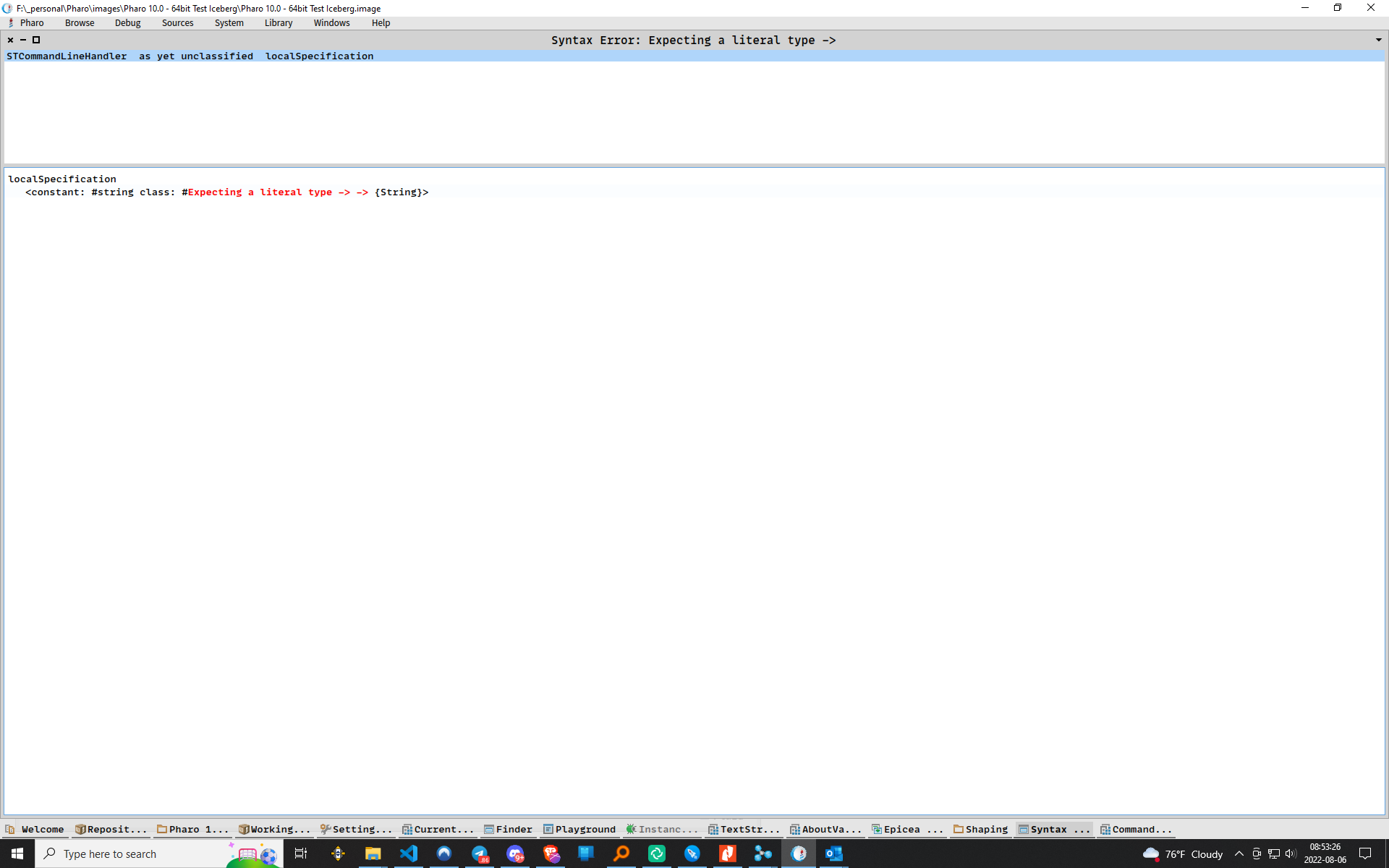
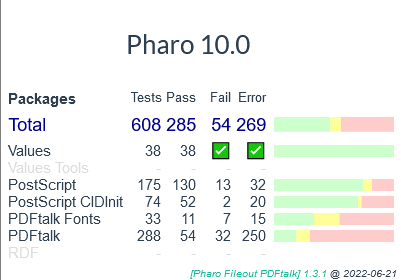
This is VWâs definition of IntegerArray: Smalltalk.Core defineClass: #IntegerArray superclass: #{Core.ArrayedCollection} indexedType: #none private: false instanceVariableNames: '' classInstanceVariableNames: '' imports: '' category: 'Collections-Arrayed' Iâm stepping through the chunks in the Changes Browser because I donât see an easier way currently. This is a separate tool from Epicea. The first chunk whose file-in fails is: IntegerArray variableByteSubclass: #ByteArray instanceVariableNames: '' classVariableNames: 'LastDecodeMap Decodings LastEncodeMap Encodings Lock' poolDictionaries: 'ForeignHeap' package: 'Shaping-Collection' I get a warning that says proceed only if you know what you are doing. Thatâs encouraging. Lol How did this definition get created in the first place? More generally and more to the point, Iâm trying to determine an efficient way to determine which classes I will always need to move from VW (like the ones I know to be uniquely mine) versus those I should never try to move from VW because Pharo already has the same by the same name or the same in function by a different nameâbut I cannot easily discover what these classes are without web searches to track down class definitions that exist for Pharo but that are not yet in Pharo because, like this one: Metacello new smalltalkhubUser: 'Pharo' project: 'MetaRepoForPharo70'; configuration: 'ArbitraryPrecisionFloat'; version: #stable; load. I have some extensions to APF in VW. I want to port those to Pharo, but the base class must already be there. APF for VW and for Pharo seems like the same code (or very close). So I tracked down the above Metacello evaluable, did it, and now I have APF in Pharo, and I can extend it with my transformed file-in. Seems I should block the VW class like this: ShapingArbitraryPrecisionFloatTransform ^PackageChange new ignoredNames: #(#{Smalltalk.ArbitraryPrecisionFloat}) And use the APF class that I load into Pharo instead. ⦠I found IntegerArray in Pharo. So I should exclude this one from the transform on the VW side too: ShapingCollectionTransform ^PackageChange new ignoredNames: #(#{Smalltalk.IntegerArray}) Right now Iâm trying to find all Pharo classes that will be bases for the extensions Iâm transforming. That could take a while. Do you have an algo you like? Is there a strategic way to load all the basic repos for Pharo? I see the nine standard repos listed by default in the virgin Repositories list. But not all Pharo code is in Repos. Some, like the APF class above, is in Metacello. As tedious as this is, itâs still much better than pure manual porting. Shaping I got about 6 seconds into the first file-in. Iâm running empty transforms on all packages. Great. You do need a ProjectChange though. Starting with empty PackageChanges is perfect. Yes, I have the one big ProjectChange with all the PackageChanges (about 25) currently empty. The problem Iâm having is using this Syntax error to determine where in the file-in the problem occurred so that I can know the package whose transform needs work. I was expecting more context. So Iâm poking around in STCommandLineHandler next with breakpoints. Open to suggestions. Strange. The #{String} syntax should have been automatically transformed to #String for Pharo⦠strange. All the namespace related issues (like this literal binding reference) should be taken care of. I had a bunch of those namespace/shared-variable bad-reference problems, which I cleared up for several hours before I was able to produce the first file-in. The transformation machinery is very strict, and helps you clean up your code. Iâd forgotten about many of the things that I was forced to fix. Iâll just debug through the file-in until I find the problem. Shaping. Iâll make my first run soon on my first package. Iâll do one package extra each time I run, building up the code. Each package will have its own <package name>Transform method, per the examples. Iâm not sure how to build these methods, except to assume that rewriting the pharo base methods is never wrong. Iâll file-in the resulting .st file to see what breaks. Then Iâll go back to the package whose .st source is not loading completely and add additional fixes (class keeps, base methods rewrites if needed and missing, method code body replacements if needed) to its transform method until it loads completely on the next run. That could take a while. Is that what you do in practice? Perfect! That is exactly how I do it. I start with an empty PackageChange. Then I add incrementally transforms until the code loads - phase one. This has been achieved for PDFtalk with the first release on GitHub. The second and final phase is to make all tests run (including the new to-write tests). This can take a while, because all syntactic and semantic differences must be addressed. Here, some cross-fertilization is possible. Yeah, and I have to be thorough finally about all my SUnit tests⦠The nice thing is, that the system is always telling you what to do. In fact, at first there are so many issues that it is a lot of fun to browse them and chose a nice one. Always the nicest or easiest bug first :-). Right. Iâm assuming the code writer is taking into account inter-package dependencies in order to get the load order right. Yes. Shaping From: christian.haider@smalltalked-visuals.com <mailto:christian.haider@smalltalked-visuals.com> <christian.haider@smalltalked-visuals.com <mailto:christian.haider@smalltalked-visuals.com> > Sent: Friday, 5 August, 2022 05:53 To: 'Any question about pharo is welcome' <pharo-users@lists.pharo.org <mailto:pharo-users@lists.pharo.org> >; 'Pharo Development List' <pharo-dev@lists.pharo.org <mailto:pharo-dev@lists.pharo.org> > Subject: [Pharo-users] Re: [Pharo-users]Porting from VW 8.3 to Pharo: pdftalkPackageChanges The full project in which the mentioned method used looks like this: PDFtalkProject ^ProjectChange name: #PDFtalk source: ((OrderedCollection new) add: (Package name: #Values); add: (Bundle name: #PDFtalk); add: (Package name: #'Values Testing'); add: (Bundle name: #'PDFtalk Testing'); add: (Package name: #'PDFtalk Demonstrations'); yourself) changes: self pdftalkPackageChanges nameMapping: (NameMapping keep: ((OrderedCollection new) add: #{Smalltalk.PDF}; add: #{PostScript.PSDictionary}; add: #{PDFtalk.PDFObject}; add: #{PDFtalk.PDFArray}; add: #{PDFtalk.PDFDictionary}; add: #{PDFtalk.PDFStream}; add: #{PDFtalk.PDFString}; add: #{PDFtalk.PDFDate}; add: #{PDFtalk.PDFTypeDefinition}; add: #{PDFtalk.PDFEncoder}; yourself) classToNames: ((Valuemap new) add: #{SubscriptOutOfBoundsError} -> #Error; add: #{NonIntegerIndexError} -> #Error; add: #{NotFoundError} -> #KeyNotFound; add: #{KeyNotFoundError} -> #KeyNotFound; yourself) namespaceToPrefixes: ((Valuemap new) add: #{Smalltalk.PostScript} -> 'PS'; add: #{Smalltalk.PDFtalk} -> 'Pt'; add: #{PDFtalk.Fonts} -> 'PtF'; add: #{PDFtalk.Fonts.OpenType} -> 'PtOT'; yourself)) In the #source: are the bundles and packages to be transformed. The #changes: (your method) specify the transforms (PackageChange) for each package explicitly. Only packages contain code and therefore, only packages need the code transformations. Bundles are transformed without transformations. (Well, the code for pre-, post- whatever blocks are transformed with the class name mappings rules). So, the mapping from packages to the corresponding PackageChange has to be stated somehow. Using a dictionary (Valuemap) for this seems also natural. The only change I might like is to use pragmas to tag the PackageChange returning methods with âtheirâ package like <package: âValues Toolsâ> or so. Putting the package reference into the PackageChange is not a good idea, because all those Objects need to be created before your can find out which package is affected. (Ok, I am creating all PackageChange objects tooâ¦). Happy hacking, Christian Von: Shaping <shaping@uurda.org <mailto:shaping@uurda.org> > Gesendet: Freitag, 5. August 2022 03:26 An: 'Any question about pharo is welcome' <pharo-users@lists.pharo.org <mailto:pharo-users@lists.pharo.org> >; 'Pharo Development List' <pharo-dev@lists.pharo.org <mailto:pharo-dev@lists.pharo.org> > Betreff: [Pharo-users] Re: [Pharo-users]Porting from VW 8.3 to Pharo: pdftalkPackageChanges This method pdftalkPackageChanges ^(Valuemap new) add: 'Values' -> self ValuesTransform; add: 'PostScript' -> self PostScriptTransform; add: 'PDFtalk Basics' -> self PDFtalkBasicsTransform; add: 'PDFtalk Typing' -> self PDFtalkTypingTransform; add: 'PDFtalk Basic Objects' -> self PDFtalkBasicObjectsTransform; add: 'PDFtalk Streams' -> self PDFtalkStreamsTransform; add: 'PDFtalk Data Structures' -> self PDFtalkDataStructuresTransform; add: 'PDFtalk Parsing' -> self PDFtalkParsingTransform; add: 'PDFtalk Colour' -> self PDFtalkColourTransform; add: 'PostScript Fonts' -> self PostScriptFontsTransform; add: 'PostScript CIDInit' -> self PostScriptCIDInitTransform; add: 'PDFtalk Fonts Basics' -> self PDFtalkFontsBasicsTransform; add: 'PDFtalk Fonts Type1' -> self PDFtalkFontsType1Transform; add: 'PDFtalk Fonts OpenType' -> self PDFtalkFontsOpenTypeTransform; add: 'PDFtalk Fonts' -> self PDFtalkFontsTransform; add: 'PDFtalk Graphics' -> self PDFtalkGraphicsTransform; add: 'PDFtalk Graphics Operations' -> self PDFtalkGraphicsOperationsTransform; add: 'PDFtalk XObjects' -> self PDFtalkXObjectsTransform; add: 'PDFtalk Images' -> self PDFtalkImagesTransform; add: 'PDFtalk Files' -> self PDFtalkFilesTransform; add: 'PDFtalk Document' -> self PDFtalkDocumentTransform; add: 'PDFtalk Rendering' -> self PDFtalkRenderingTransform; add: 'PDFtalk Shading' -> self PDFtalkShadingTransform; add: 'PDFtalk Interactive Features' -> self PDFtalkInteractiveFeaturesTransform; add: 'PDFtalk Deploying' -> self PDFtalkDeployingTransform; add: 'Values Testing' -> self ValuesTestingTransform; add: 'PDFtalk test resources' -> self PDFtalkTestResourcesTransform; add: 'PostScript Testing' -> self PostScriptTestingTransform; add: 'PostScript CIDInit Testing' -> self PostScriptCIDInitTestingTransform; add: 'PDFtalk Fonts tests' -> self PDFtalkFontsTestsTransform; add: 'PDFtalk tests' -> self PDFtalkTestsTransform; add: 'PDFtalk Demonstrations' -> self PDFtalkDemonstrationsTransform; yourself effectively looks like the head transform structure for a project, in this case all the PDFtalk stuff, which includes Values and Postscript. This is not exactly a bundle idea, is it? Itâs project spread across potentially many bundles and packages. Iâll start coding my transform with a similar method, and work down toward the details. Takes a bit to get used to all the correct, yet dangling VW methods that are useless in VW, but which will become new code in the target image and there no longer appear to be dangling (with syntax highlighting aberrations). Odd looking but completely by design. Shaping From: Shaping <shaping@uurda.org <mailto:shaping@uurda.org> > Sent: Thursday, 4 August, 2022 19:18 To: 'Any question about pharo is welcome' <pharo-users@lists.pharo.org <mailto:pharo-users@lists.pharo.org> > Subject: [Pharo-users] Re: [Pharo-users]Porting from VW 8.3 to Pharo: Pharo100 fileOutValues I will look, although this kind of always available on demand thing is too disruptive for me⦠I know what you mean. I try be disciplined about it. I really like to be able to fix typos, because there are almost always typos. But e-mail is okay. So that little example is a test that shows how the transformation is done. It converts just package Values to a Pharo-compatible file-in. My task is then to queue a bunch of ProjectChange instances like this one: SmalltalkTransform.Pharo100>> ValuesProject ^ProjectChange name: #Values source: (Array with: (Package name: #Values)) changes: (Valuemap with: 'Values' -> self ValuesTransform) Exactly but for my own packages. No bundles are transformed (just their contained packages) because Pharo doesnât have bundles. Is that right? No, bundles are handled. For real examples, you need to look at the PDFtalk transforms. Yes, Pharo does not have a concept of bundles (ordered aggregates of packages). Instead it relies on a naming convention for packages. That convention is honored in the fileout, so that packages will be partly grouped in Pharo according to the category prefix. For each VW-package, one Pharo package is created. A bundle itself is also represented as Pharo package with one class About<bundlename> with class methods for the metadata of the bundle, including a method giving you the ordered list of component packages. So, all contents and metadata of packages and bundles are transformed for Pharo. No code or info gets lost. Okay. Is method ValuesTransform ^PackageChange ignoredNames: #(#{Smalltalk.GeneralBindingReference}) bridgeClasses: (Valuemap with: #{Timestamp} -> #DateAndTime with: #{Smalltalk.ColorValue} -> #Color) localChanges: self valuesLocalTransform extensions: (Array with: (SystemClassChange className: #Color instanceChanges: (Array with: (Add method: #asColorValue code: #_ph_asColorValue))) with: (SystemClassChange className: #TextStream instanceChanges: (Array with: (Add method: #nextPutAllText: code: #_ph_nextPutAllText:)))) written specifically for that package? I would think it applies to all packages. I see some expected mappings like Timestamp to DateAndTime. Yes, this method returns a PackageChange Value describing the transformations needed to create the Pharo fileout for this specific package (inspect the return value for the fully expanded Value). Methods exist with the same name for other Smalltalks. Depending on the dialect (or version of a dialect), the transforms are different. Squeak and Pharo are quite similar, because they share a common history, but VA or Gemstone need quite different transforms. So, in general, for each package, there is one such method/Value for each target Smalltalk/version. Okay. I do not dare to extract commonalities before the machinery is really robust and stable. For now everything is neatly separate and self-contained (and probably it will stay that way, although there are lots of duplications). The mapping of class names is the responsibility of the enclosing ProjectChange Value where you define the list of source bundles/packages to transform, the PackageChanges for all packages and the mapping of âglobalâ names. (The bridge classes above are no renames, but a subclass relationship (is-a) to avoid renamings. The new class Timestamp will be created as subclass of DateAndTime which has almost the same semantics. Therefore, I can still use Timestamp which will be basically a DateAndTime now.) Okay. There is still a technical challenge here. Currently, a ProjectChange need to include all prerequisites (Values is part of the PDFtalk project and will be transformed with it). A ProjectWriter, which coordinates the transform, keeps track of the mappings when they are created (either explicitly or through a namespace renaming â see implementers of #PDFtalkProject). I would like to have this more modular: the mappings from the Values transformation should be persistently saved, so that other transformation projects can just use them, instead of including the sources into one own project. For this, I need to have renamings local to a package (where they first occur), not global on the project level. Right. For Values and Values Tests and Values Tools this works, because there are no mappings in the Values package. What about conversion of VW arrays to Pharo literal arrays? How is that done? (I think you mean dynamic arrays like {1. âabcâ size. 42} in which evaluation happens (in contrast to literal things which can be resolved already by the compiler). Yes, dynamic arrays. Not! Since a while, VW also has dynamic arrays, but not in VW 8.3 â the last publicly available version. Okay, I was wondering when that would happen. I will not shut out those users, because âopen-sourceâ would be quite absurd, if it is only available for paying customers. In 8.3, the compiler does not accept that syntax and therefore, there is no easy way to represent this in replacement code. So, no. It is not possible until Cincom releases an public version which can handle that. Okay. I recall that one of the Smalltalks (I donât recall which) had Stream semantics differing from VWâs. ⦠I just checked. VWâs #upTo: method includes the object and leaves the index after it, and Pharoâs excludes the object and leaves the index at the object. So that is some major breakage if we donât correct it. Can it be done automatically? Yes, these are the usual porting challenges and exactly the reason why this library exists :). Thank you for the question :). Yes, the stream semantics need to be fixed. The idea is that a set of transforms for this issue can be reused by others. Okay.
valuesLocalTransform
has lots of juicy bits. But this doesnât look very simple. We canât just replace an old method with a new one. We also have to write the new one to tweak how the indices are used in #upTo:, and make sure that new method gets filed-in as well into the Pharo target image. Or, we have to do this kind of change manually. Naa, itâs very easy, I think :). A PackageChange specifies transforms for classes used in the package (#localChanges) and #extensions for system classes of the target. For a class, you can have a ClassChange describing the changes to instance or class methods. A MethodChange has 4 subclasses for: - Ignore â donât write this method to the target - Add â add this new method (not in the source system) to the target - Replace â replace the body of this method with other code - Rewrite â rewrite the method source using a rewrite rule. Add and Replace need the target code. Add then always involves a new name for a method in the target. Replaces use an old name in the target with a new code body. This is stored in another method with a derived name like #_ph_upTo: . The method name is not important, because only the body of the method is used. But the name should not be used in the source â it is just a holder for the replacement code. These methods live in the specific [<Smalltalk> Fileout <Package>] package. Okay. There are lots of working(!) examples for all of those in the PDFtalk transform project. This bit (SystemClassChange className: #Color instanceChanges: (Array with: (Add method: #asColorValue code: #_ph_asColorValue))) is replacing #asColorValue with #_ph_asColorValue because some special Pharo-color conversion needs to happen. But how does #_ph_asColorValue get defined? Itâs neither in VW nor in Pharo 10. You got bitten by the old version of [Pharo Fileout Values]. Please load [Pharo Fileout PDFtalk]. There, the methods exist. Yes, I see it now. Ok. I donât have a virgin image. I have a very non-virgin image, about 27 years of development Iâm trying to port to Pharo. I donât yet have a specific interest in the PDFtalk, though I do see a need for PDF generation later, and will probably revisit that. For now, I just want my own stuff to run in Pharo. Virgin image just means that you donât need anything else. You can safely load it in you favorite special images :). I would load PDFtalk, although technically you donât need to (all the extensions to PDFtalk would be unloadable, but that doesnât affect Values). Okay. is: Load {Values Project] bundle Load {PDFtalk Project} bundle Load {Smalltalk Transform Project} bundle Load [Pharo Fileout PDFtalk] package Save, done Okay, so do I understand correctly that I need to include the PDFtalk stuff even if Iâm not interested in PDFtalk, because thatâs where a lot of the Smalltalk transformation machinery lives? Or is the PDFtalk just being used as an example for how to do a massive transformation? Or Both? No, the transformation machinery is fully independent of PDFtalk. I just tried it. The dependencies are in the specific [Pharo Fileout PDFtalk] package, since I have already quite a few replacement methods which are extensions to PDFtalk classes. Okay. PDFtalk is the focus of the project and therefore all issues are solved first with this library in mind. Therefore, bundles and namespaces are handled, for example. When you study the more interesting transformations for PDFtalk, it would be a shame not to be able to browse the methods and classes involved. So, PDFtalk is the real world reference example. And Values is the simplest example. To transform Values do: âPharo100 fileOutValuesâ The [Pharo Fileout PDFtalk] package includes the latest Values transformations. I am thinking about a better modularization⦠Also, the wiki is a bit out of control. It really needs some restructuring. In the cites wiki page, there is a link to a blog where I record the changes. This might be informative. 2. Port the Values package. This is easy, since no namespaces are involved. This first instruction after VW package setup says to port the contents of the Values package from VW to Pharo. Do you mean manually? Probably not. No, no. This has been finished in March. For each dialect, I have a GitHub repository where I release important versions: <https://github.com/PortingPDFtalk/PharoPDFtalk> https://github.com/PortingPDFtalk/PharoPDFtalk. You can find the working port as first release â <https://github.com/PortingPDFtalk/PharoPDFtalk/releases/tag/1.3.0.0> Working versionâ. There you can download the ported Values fileout with the exact description with which versions of what it was created. This should be a good starting example. Why do I need any new code installed in Pharo before I begin the transformation, if Iâm transforming code from VW to pharo? Iâm not understanding the basic constraints of the problem, even when the detailed steps are clear. No, no. You donât need anything on the Pharo side. The fileouts on GitHub are the end products of a transformation for people who donât use VisualWorks, but want to use Values in Pharo. Or help with PDFtalk by fixing some issues, so that I can write the transformations. Iâve done these steps so far: 1. Went to <https://github.com/PortingPDFtalk/PharoPDFtalk> https://github.com/PortingPDFtalk/PharoPDFtalk. Mistake :). You donât want to look at the unfinished product of the current version of thincomplete transformations for PDFtalk. Do you mean âfinishedâ here? Isnât that file-in the finished result? I thought the above links was the currently finished result (as good as it can be until the rest of the bugs are goine and tests all run). Yes, that was confusing. Thatâs why I had the early impression that Values was somehow apart of the transformation machinery. See https://wiki.pdftalk.de/doku.php?id=stateoftheport#pharo-10-0: Instead, you want to look at the unfinished product of the transformations of your projects :). 2. Saved down PDFtalk.Pharo100.st into <my Pharo 10 image directory>/pharo-local/Smalltalk-Transformation. (I figured that was a good place to save it. If anyone disagrees, or has a better or more conventional idea about where files should be saved, please say so. I setup a Pharo Git repo and played with it briefly for the first time yesterday. Iâve used Pharo off an on for 16 years, but this is the first time Iâm making a serious effort to manage source, and not throw away what Iâm working on.) 3. Filed-in PDFtalk.Pharo100.st. This went on for about 7 minutes or so. I have a hundreds if not over a thousand classes showing in Epicea. Is there anyway to get Epicea to give me a count of changes with a time-range filter? 4. Deleted (forgot) yesterdayâs, old Main practice-repo from both the image and the drive, and made a new one. I need to add to Main all the packages I just filed-in, but I donât see an efficient way to do that. I would like to use the Add Package button, but this gives a filtered list of available packages. I can filter subgroups, and then individually select each of the checkboxes to the left of each package (there is no Ctrl-A [select all] option here, which seems to be a strange omission given the potentially large number of packages involved). I see lots of prefixes for the classes just loaded. I could easily miss something if I filter/select/add one prefix-group at a time. Is there an easier way? Over in Epicea I donât see a way to push the loaded items listed to a specific repo. The first thought I have is to select all filed-in code artifacts by datetime span. I did that and saved it as an .ombu file (I have no idea what that is). I donât see a way to import that .ombu file into repo Mainâs âWorking copyâ window. It must be easy, but I donât see it. Please suggest the best way. Iâd like to know as well â I am not quite familiar with the source management concepts in Pharo. I asked in Discord. I donât understand why stuff like this is missing. The only conclusion I can draw is that no one does huge file-ins (but you do). It is planned to generate Tonel output in the future, but for now I feel safer with the traditional fileout where I can have doIts. I am not sure how Tonel reacts to crippled sources, which are normal during the development of the transformations. Shaping From: christian.haider <christian.haider@smalltalked-visuals.com <mailto:christian.haider@smalltalked-visuals.com> > Sent: Wednesday, 22 June, 2022 05:42 To: pharo-users@lists.pharo.org <mailto:pharo-users@lists.pharo.org> Subject: [Pharo-users] [PDFtalk] second fileOut for Squeak and Pharo With help from the community some issues were fixed which improved the test statistics nicely. Check it out: https://wiki.pdftalk.de/doku.php?id=portingblog#second_pdftalk_fileout_for_s... Thanks to everybody involved! Happy hacking, Christian
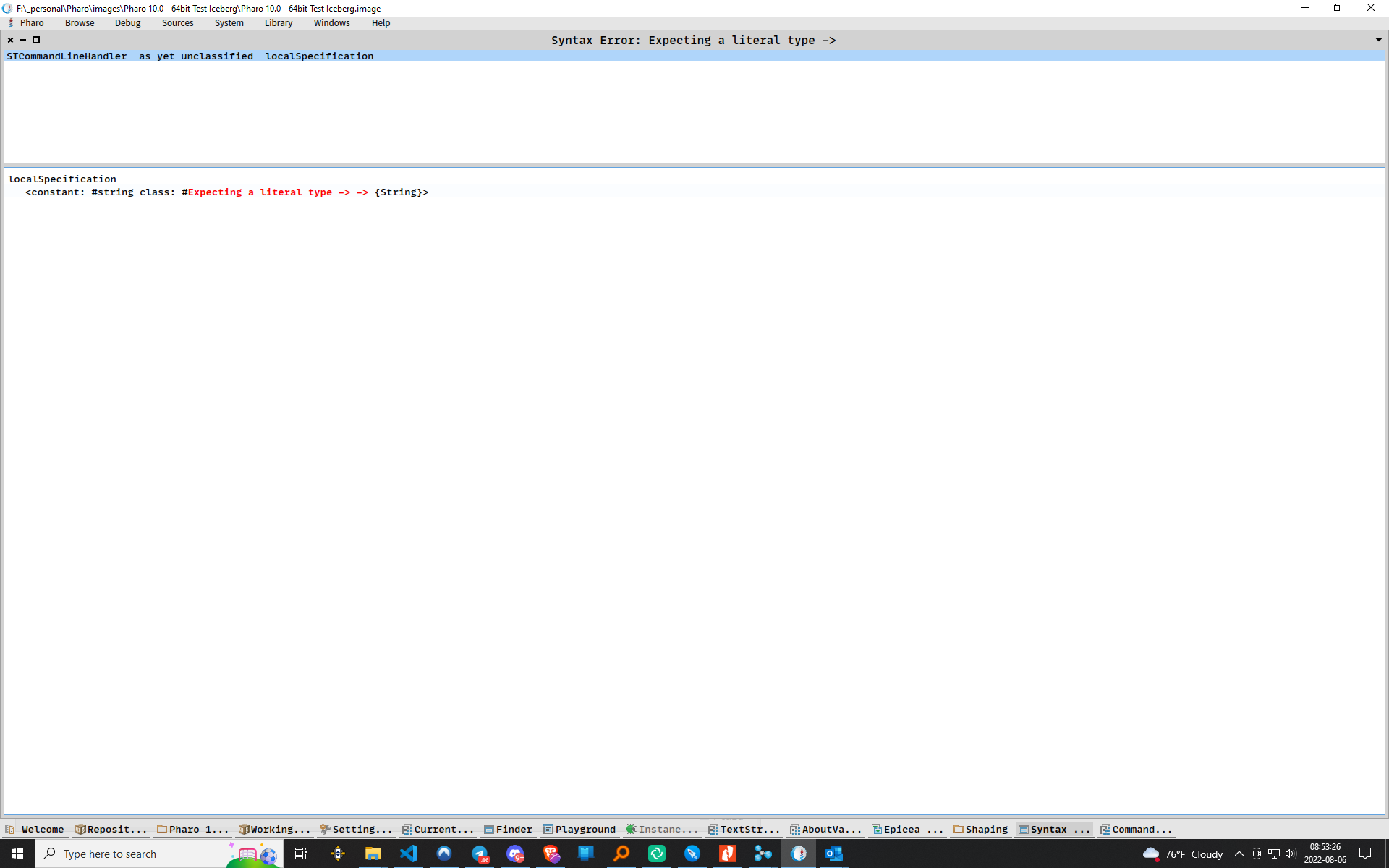
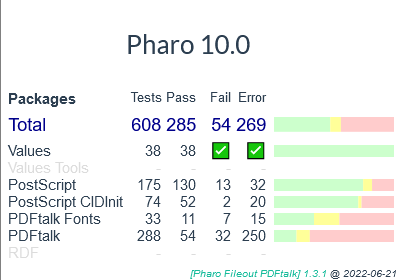

On Sat, Aug 6, 2022, 18:40 Shaping <shaping@uurda.org> wrote:
This is VWâs definition of IntegerArray:
Smalltalk.Core defineClass: #IntegerArray
superclass: #{Core.ArrayedCollection}
indexedType: #none
private: false
instanceVariableNames: ''
classInstanceVariableNames: ''
imports: ''
category: 'Collections-Arrayed'
Iâm stepping through the chunks in the Changes Browser because I donât see an easier way currently. This is a separate tool from Epicea. The first chunk whose file-in fails is:
IntegerArray
variableByteSubclass: #ByteArray
instanceVariableNames: ''
classVariableNames: 'LastDecodeMap Decodings LastEncodeMap Encodings Lock'
poolDictionaries: 'ForeignHeap'
package: 'Shaping-Collection'
I get a warning that says proceed only if you know what you are doing. Thatâs encouraging. Lol
How did this definition get created in the first place? More generally and more to the point, Iâm trying to determine an efficient way to determine which classes I will always need to move from VW (like the ones I know to be uniquely mine) versus those I should never try to move from VW because Pharo already has the same by the same name or the same in function by a different nameâbut I cannot easily discover what these classes are without web searches to track down class definitions that exist for Pharo but that are not yet in Pharo because, like this one:
Metacello new
smalltalkhubUser: 'Pharo' project: 'MetaRepoForPharo70';
configuration: 'ArbitraryPrecisionFloat';
version: #stable;
load.
I have some extensions to APF in VW. I want to port those to Pharo, but the base class must already be there. APF for VW and for Pharo seems like the same code (or very close). So I tracked down the above Metacello evaluable, did it, and now I have APF in Pharo, and I can extend it with my transformed file-in.
Seems I should block the VW class like this:
ShapingArbitraryPrecisionFloatTransform
^PackageChange new
ignoredNames: #(#{Smalltalk.ArbitraryPrecisionFloat})
And use the APF class that I load into Pharo instead.
â¦
I found IntegerArray in Pharo. So I should exclude this one from the transform on the VW side too:
ShapingCollectionTransform
^PackageChange new
ignoredNames: #(#{Smalltalk.IntegerArray})
Right now Iâm trying to find all Pharo classes that will be bases for the extensions Iâm transforming. That could take a while.
Run a script in Pharo to enumerate all classes. Then use that to see which classes you have in VW with the same name. A good strategy for problems is, when you find one, look for other examples that match the pattern. You can eliminate a lot of trouble quickly. Do you have an algo you like? Is there a strategic way to load all the
basic repos for Pharo? I see the nine standard repos listed by default in the virgin Repositories list. But not all Pharo code is in Repos. Some, like the APF class above, is in Metacello.
As tedious as this is, itâs still much better than pure manual porting.
Shaping
I got about 6 seconds into the first file-in. Iâm running empty transforms on all packages.
Great. You do need a ProjectChange though. Starting with empty PackageChanges is perfect.
Yes, I have the one big ProjectChange with all the PackageChanges (about 25) currently empty.
The problem Iâm having is using this Syntax error
to determine where in the file-in the problem occurred so that I can know the package whose transform needs work. I was expecting more context. So Iâm poking around in STCommandLineHandler next with breakpoints. Open to suggestions.
Strange. The #{String} syntax should have been automatically transformed to #String for Pharo⦠strange.
All the namespace related issues (like this literal binding reference) should be taken care of.
I had a bunch of those namespace/shared-variable bad-reference problems, which I cleared up for several hours before I was able to produce the first file-in. The transformation machinery is very strict, and helps you clean up your code. Iâd forgotten about many of the things that I was forced to fix.
Iâll just debug through the file-in until I find the problem.
Shaping.
Iâll make my first run soon on my first package. Iâll do one package extra each time I run, building up the code. Each package will have its own <package name>Transform method, per the examples. Iâm not sure how to build these methods, except to assume that rewriting the pharo base methods is never wrong. Iâll file-in the resulting .st file to see what breaks. Then Iâll go back to the package whose .st source is not loading completely and add additional fixes (class keeps, base methods rewrites if needed and missing, method code body replacements if needed) to its transform method until it loads completely on the next run. That could take a while. Is that what you do in practice?
Perfect! That is exactly how I do it.
I start with an empty PackageChange. Then I add incrementally transforms until the code loads - phase one. This has been achieved for PDFtalk with the first release on GitHub. The second and final phase is to make all tests run (including the new to-write tests). This can take a while, because all syntactic and semantic differences must be addressed. Here, some cross-fertilization is possible.
Yeah, and I have to be thorough finally about all my SUnit testsâ¦
The nice thing is, that the system is always telling you what to do. In fact, at first there are so many issues that it is a lot of fun to browse them and chose a nice one. Always the nicest or easiest bug first :-).
Right.
Iâm assuming the code writer is taking into account inter-package dependencies in order to get the load order right.
Yes.
Shaping
*From:* christian.haider@smalltalked-visuals.com < christian.haider@smalltalked-visuals.com> *Sent:* Friday, 5 August, 2022 05:53 *To:* 'Any question about pharo is welcome' <pharo-users@lists.pharo.org>; 'Pharo Development List' <pharo-dev@lists.pharo.org> *Subject:* [Pharo-users] Re: [Pharo-users]Porting from VW 8.3 to Pharo: pdftalkPackageChanges
The full project in which the mentioned method used looks like this:
PDFtalkProject
^ProjectChange
name: #PDFtalk
source: ((OrderedCollection new)
add: (Package name: #Values);
add: (Bundle name: #PDFtalk);
add: (Package name: #'Values Testing');
add: (Bundle name: #'PDFtalk Testing');
add: (Package name: #'PDFtalk Demonstrations');
yourself)
changes: self pdftalkPackageChanges
nameMapping: (NameMapping
keep: ((OrderedCollection new)
add: #{Smalltalk.PDF};
add: #{PostScript.PSDictionary};
add: #{PDFtalk.PDFObject};
add: #{PDFtalk.PDFArray};
add: #{PDFtalk.PDFDictionary};
add: #{PDFtalk.PDFStream};
add: #{PDFtalk.PDFString};
add: #{PDFtalk.PDFDate};
add: #{PDFtalk.PDFTypeDefinition};
add: #{PDFtalk.PDFEncoder};
yourself)
classToNames: ((Valuemap new)
add: #{SubscriptOutOfBoundsError} -> #Error;
add: #{NonIntegerIndexError} -> #Error;
add: #{NotFoundError} -> #KeyNotFound;
add: #{KeyNotFoundError} -> #KeyNotFound;
yourself)
namespaceToPrefixes: ((Valuemap new)
add: #{Smalltalk.PostScript} -> 'PS';
add: #{Smalltalk.PDFtalk} -> 'Pt';
add: #{PDFtalk.Fonts} -> 'PtF';
add: #{PDFtalk.Fonts.OpenType} -> 'PtOT';
yourself))
In the #source: are the bundles and packages to be transformed. The #changes: (your method) specify the transforms (PackageChange) for each package explicitly. Only packages contain code and therefore, only packages need the code transformations. Bundles are transformed without transformations. (Well, the code for pre-, post- whatever blocks are transformed with the class name mappings rules).
So, the mapping from packages to the corresponding PackageChange has to be stated somehow. Using a dictionary (Valuemap) for this seems also natural. The only change I might like is to use pragmas to tag the PackageChange returning methods with âtheirâ package like
<package: âValues Toolsâ> or so. Putting the package reference into the PackageChange is not a good idea, because all those Objects need to be created before your can find out which package is affected. (Ok, I am creating all PackageChange objects tooâ¦).
Happy hacking,
Christian
*Von:* Shaping <shaping@uurda.org> *Gesendet:* Freitag, 5. August 2022 03:26 *An:* 'Any question about pharo is welcome' <pharo-users@lists.pharo.org>; 'Pharo Development List' <pharo-dev@lists.pharo.org> *Betreff:* [Pharo-users] Re: [Pharo-users]Porting from VW 8.3 to Pharo: pdftalkPackageChanges
This method
pdftalkPackageChanges
^(Valuemap new)
add: 'Values' -> self ValuesTransform;
add: 'PostScript' -> self PostScriptTransform;
add: 'PDFtalk Basics' -> self PDFtalkBasicsTransform;
add: 'PDFtalk Typing' -> self PDFtalkTypingTransform;
add: 'PDFtalk Basic Objects' -> self PDFtalkBasicObjectsTransform;
add: 'PDFtalk Streams' -> self PDFtalkStreamsTransform;
add: 'PDFtalk Data Structures' -> self PDFtalkDataStructuresTransform;
add: 'PDFtalk Parsing' -> self PDFtalkParsingTransform;
add: 'PDFtalk Colour' -> self PDFtalkColourTransform;
add: 'PostScript Fonts' -> self PostScriptFontsTransform;
add: 'PostScript CIDInit' -> self PostScriptCIDInitTransform;
add: 'PDFtalk Fonts Basics' -> self PDFtalkFontsBasicsTransform;
add: 'PDFtalk Fonts Type1' -> self PDFtalkFontsType1Transform;
add: 'PDFtalk Fonts OpenType' -> self PDFtalkFontsOpenTypeTransform;
add: 'PDFtalk Fonts' -> self PDFtalkFontsTransform;
add: 'PDFtalk Graphics' -> self PDFtalkGraphicsTransform;
add: 'PDFtalk Graphics Operations' -> self PDFtalkGraphicsOperationsTransform;
add: 'PDFtalk XObjects' -> self PDFtalkXObjectsTransform;
add: 'PDFtalk Images' -> self PDFtalkImagesTransform;
add: 'PDFtalk Files' -> self PDFtalkFilesTransform;
add: 'PDFtalk Document' -> self PDFtalkDocumentTransform;
add: 'PDFtalk Rendering' -> self PDFtalkRenderingTransform;
add: 'PDFtalk Shading' -> self PDFtalkShadingTransform;
add: 'PDFtalk Interactive Features' -> self PDFtalkInteractiveFeaturesTransform;
add: 'PDFtalk Deploying' -> self PDFtalkDeployingTransform;
add: 'Values Testing' -> self ValuesTestingTransform;
add: 'PDFtalk test resources' -> self PDFtalkTestResourcesTransform;
add: 'PostScript Testing' -> self PostScriptTestingTransform;
add: 'PostScript CIDInit Testing' -> self PostScriptCIDInitTestingTransform;
add: 'PDFtalk Fonts tests' -> self PDFtalkFontsTestsTransform;
add: 'PDFtalk tests' -> self PDFtalkTestsTransform;
add: 'PDFtalk Demonstrations' -> self PDFtalkDemonstrationsTransform;
yourself
effectively looks like the head transform structure for a project, in this case all the PDFtalk stuff, which includes Values and Postscript.
This is not exactly a bundle idea, is it? Itâs project spread across potentially many bundles and packages.
Iâll start coding my transform with a similar method, and work down toward the details. Takes a bit to get used to all the correct, yet dangling VW methods that are useless in VW, but which will become new code in the target image and there no longer appear to be dangling (with syntax highlighting aberrations). Odd looking but completely by design.
Shaping
*From:* Shaping <shaping@uurda.org> *Sent:* Thursday, 4 August, 2022 19:18 *To:* 'Any question about pharo is welcome' <pharo-users@lists.pharo.org> *Subject:* [Pharo-users] Re: [Pharo-users]Porting from VW 8.3 to Pharo: Pharo100 fileOutValues
I will look, although this kind of always available on demand thing is too disruptive for meâ¦
I know what you mean. I try be disciplined about it. I really like to be able to fix typos, because there are almost always typos. But e-mail is okay.
So that little example is a test that shows how the transformation is done. It converts just package Values to a Pharo-compatible file-in. My task is then to queue a bunch of ProjectChange instances like this one:
SmalltalkTransform.Pharo100>>
ValuesProject
^ProjectChange
name: #Values
source: (Array with: (Package name: #Values))
changes: (Valuemap with: 'Values' -> self ValuesTransform)
Exactly
but for my own packages. No bundles are transformed (just their contained packages) because Pharo doesnât have bundles.
Is that right?
No, bundles are handled. For real examples, you need to look at the PDFtalk transforms.
Yes, Pharo does not have a concept of bundles (ordered aggregates of packages). Instead it relies on a naming convention for packages. That convention is honored in the fileout, so that packages will be partly grouped in Pharo according to the category prefix.
For each VW-package, one Pharo package is created. A bundle itself is also represented as Pharo package with one class *About<bundlename>* with class methods for the metadata of the bundle, including a method giving you the ordered list of component packages. So, all contents and metadata of packages and bundles are transformed for Pharo. No code or info gets lost.
Okay.
Is method
ValuesTransform
^PackageChange
ignoredNames: #(#{Smalltalk.GeneralBindingReference})
bridgeClasses: (Valuemap
with: #{Timestamp} -> #DateAndTime
with: #{Smalltalk.ColorValue} -> #Color)
localChanges: self valuesLocalTransform
extensions: (Array
with: (SystemClassChange
className: #Color
instanceChanges: (Array with: (Add method: #asColorValue code: #_ph_asColorValue)))
with: (SystemClassChange
className: #TextStream
instanceChanges: (Array with: (Add method: #nextPutAllText: code: #_ph_nextPutAllText:))))
written specifically for that package? I would think it applies to all packages. I see some expected mappings like Timestamp to DateAndTime.
Yes, this method returns a *PackageChange* Value describing the transformations needed to create the Pharo fileout for this specific package (inspect the return value for the fully expanded Value). Methods exist with the same name for other Smalltalks. Depending on the dialect (or version of a dialect), the transforms are different. Squeak and Pharo are quite similar, because they share a common history, but VA or Gemstone need quite different transforms.
So, in general, for each package, there is one such method/Value for each target Smalltalk/version.
Okay.
I do not dare to extract commonalities before the machinery is really robust and stable. For now everything is neatly separate and self-contained (and probably it will stay that way, although there are lots of duplications).
The mapping of class names is the responsibility of the enclosing *ProjectChange* Value where you define the list of source bundles/packages to transform, the PackageChanges for all packages and the mapping of âglobalâ names.
(The bridge classes above are no renames, but a subclass relationship (is-a) to avoid renamings. The new class Timestamp will be created as subclass of DateAndTime which has almost the same semantics. Therefore, I can still use Timestamp which will be basically a DateAndTime now.)
Okay.
There is still a technical challenge here. Currently, a ProjectChange need to include all prerequisites (Values is part of the PDFtalk project and will be transformed with it). A ProjectWriter, which coordinates the transform, keeps track of the mappings when they are created (either explicitly or through a namespace renaming â see implementers of #PDFtalkProject).
I would like to have this more modular: the mappings from the Values transformation should be persistently saved, so that other transformation projects can just use them, instead of including the sources into one own project.
For this, I need to have renamings local to a package (where they first occur), not global on the project level.
Right.
For Values and Values Tests and Values Tools this works, because there are no mappings in the Values package.
What about conversion of VW arrays to Pharo literal arrays? How is that done?
(I think you mean dynamic arrays like {1. âabcâ size. 42} in which evaluation happens (in contrast to literal things which can be resolved already by the compiler).
Yes, dynamic arrays.
Not! Since a while, VW also has dynamic arrays, but not in VW 8.3 â the last publicly available version.
Okay, I was wondering when that would happen.
I will not shut out those users, because âopen-sourceâ would be quite absurd, if it is only available for paying customers.
In 8.3, the compiler does not accept that syntax and therefore, there is no easy way to represent this in replacement code.
So, no. It is not possible until Cincom releases an public version which can handle that.
Okay.
I recall that one of the Smalltalks (I donât recall which) had Stream semantics differing from VWâs.
⦠I just checked. VWâs #upTo: method includes the object and leaves the index after it, and Pharoâs excludes the object and leaves the index at the object. So that is some major breakage if we donât correct it. Can it be done automatically?
Yes, these are the usual porting challenges and exactly the reason why this library exists J. Thank you for the question J.
Yes, the stream semantics need to be fixed. The idea is that a set of transforms for this issue can be reused by others.
Okay.
valuesLocalTransform
has lots of juicy bits. But this doesnât look very simple. We canât just replace an old method with a new one. We also have to write the new one to tweak how the indices are used in #upTo:, and make sure that new method gets filed-in as well into the Pharo target image. Or, we have to do this kind of change manually.
Naa, itâs very easy, I think J.
A *PackageChange* specifies transforms for classes used in the package (#localChanges) and #extensions for system classes of the target. For a class, you can have a *ClassChange* describing the changes to instance or class methods. A *MethodChange* has 4 subclasses for:
- *Ignore* â donât write this method to the target
- *Add* â add this new method (not in the source system) to the target
- *Replace* â replace the body of this method with other code
- *Rewrite* â rewrite the method source using a rewrite rule.
*Add* and *Replace* need the target code.
*Add* then always involves a new name for a method in the target. *Replaces* use an old name in the target with a new code body.
This is stored in another method with a derived name like #_ph_upTo: . The method name is not important, because only the body of the method is used. But the name should not be used in the source â it is just a holder for the replacement code. These methods live in the specific *[<Smalltalk> Fileout <Package>]* package.
Okay.
There are lots of working(!) examples for all of those in the PDFtalk transform project.
This bit
(SystemClassChange
className: #Color
instanceChanges: (Array with: (Add method: #asColorValue code: #_ph_asColorValue)))
is replacing #asColorValue with #_ph_asColorValue because some special Pharo-color conversion needs to happen. But how does #_ph_asColorValue get defined? Itâs neither in VW nor in Pharo 10.
You got bitten by the old version of [Pharo Fileout Values]. Please load [Pharo Fileout PDFtalk]. There, the methods exist.
Yes, I see it now.
Ok. I donât have a virgin image. I have a very non-virgin image, about 27 years of development Iâm trying to port to Pharo. I donât yet have a specific interest in the PDFtalk, though I do see a need for PDF generation later, and will probably revisit that. For now, I just want my own stuff to run in Pharo.
Virgin image just means that you donât need anything else. You can safely load it in you favorite special images J.
I would load PDFtalk, although technically you donât need to (all the extensions to PDFtalk would be unloadable, but that doesnât affect Values).
Okay.
is:
Load {Values Project] bundle
Load {PDFtalk Project} bundle
Load {Smalltalk Transform Project} bundle
Load [Pharo Fileout PDFtalk] package
Save, done
Okay, so do I understand correctly that I need to include the PDFtalk stuff even if Iâm not interested in PDFtalk, because thatâs where a lot of the Smalltalk transformation machinery lives? Or is the PDFtalk just being used as an example for how to do a massive transformation? Or Both?
No, the transformation machinery is fully independent of PDFtalk. I just tried it. The dependencies are in the specific [Pharo Fileout PDFtalk] package, since I have already quite a few replacement methods which are extensions to PDFtalk classes.
Okay.
PDFtalk is the focus of the project and therefore all issues are solved first with this library in mind. Therefore, bundles and namespaces are handled, for example. When you study the more interesting transformations for PDFtalk, it would be a shame not to be able to browse the methods and classes involved.
So, PDFtalk is the real world reference example.
And Values is the simplest example.
To transform Values do: â*Pharo100 fileOutValues*â
The [Pharo Fileout PDFtalk] package includes the latest Values transformations.
I am thinking about a better modularizationâ¦
Also, the wiki is a bit out of control. It really needs some restructuring.
In the cites wiki page, there is a link to a blog where I record the changes. This might be informative.
2. Port the Values package. This is easy, since no namespaces are involved.
This first instruction after VW package setup says to port the contents of the Values package from VW to Pharo. Do you mean manually? Probably not. No, no. This has been finished in March. For each dialect, I have a GitHub repository where I release important versions: https://github.com/PortingPDFtalk/PharoPDFtalk. You can find the working port as first release âWorking version <https://github.com/PortingPDFtalk/PharoPDFtalk/releases/tag/1.3.0.0>â. There you can download the ported Values fileout with the exact description with which versions of what it was created.This should be a good starting example.Why do I need any new code installed in Pharo before I begin the transformation, if Iâm transforming code from VW to pharo? Iâm not understanding the basic constraints of the problem, even when the detailed steps are clear. No, no. You donât need anything on the Pharo side. The fileouts on GitHub are the end products of a transformation for people who donât use VisualWorks, but want to use Values in Pharo. Or help with PDFtalk by fixing some issues, so that I can write the transformations.Iâve done these steps so far:1. Went to https://github.com/PortingPDFtalk/PharoPDFtalk.Mistake J. You donât want to look at the unfinished product of the current version of thincomplete transformations for PDFtalk.Do you mean âfinishedâ here? Isnât that file-in the finished result?I thought the above links was the currently finished result (as good as it can be until the rest of the bugs are goine and tests all run).Yes, that was confusing. Thatâs why I had the early impression that Values was somehow apart of the transformation machinery. See https://wiki.pdftalk.de/doku.php?id=stateoftheport#pharo-10-0:
Instead, you want to look at the unfinished product of the transformations of your projects J.2. Saved down PDFtalk.Pharo100.st into <my Pharo 10 image directory>/pharo-local/Smalltalk-Transformation. (I figured that was a good place to save it. If anyone disagrees, or has a better or more conventional idea about where files should be saved, please say so. I setup a Pharo Git repo and played with it briefly for the first time yesterday. Iâve used Pharo off an on for 16 years, but this is the first time Iâm making a serious effort to manage source, and not throw away what Iâm working on.)3. Filed-in PDFtalk.Pharo100.st. This went on for about 7 minutes or so. I have a hundreds if not over a thousand classes showing in Epicea. Is there anyway to get Epicea to give me a count of changes with a time-range filter? 4. Deleted (forgot) yesterdayâs, old Main practice-repo from both the image and the drive, and made a new one. I need to add to Main all the packages I just filed-in, but I donât see an efficient way to do that. I would like to use the Add Package button, but this gives a filtered list of available packages. I can filter subgroups, and then individually select each of the checkboxes to the left of each package (there is no Ctrl-A [select all] option here, which seems to be a strange omission given the potentially large number of packages involved). I see lots of prefixes for the classes just loaded. I could easily miss something if I filter/select/add one prefix-group at a time. Is there an easier way? Over in Epicea I donât see a way to push the loaded items listed to a specific repo. The first thought I have is to select all filed-in code artifacts by datetime span. I did that and saved it as an .ombu file (I have no idea what that is). I donât see a way to import that .ombu file into repo Mainâs âWorking copyâ window. It must be easy, but I donât see it. Please suggest the best way. Iâd like to know as well â I am not quite familiar with the source management concepts in Pharo.I asked in Discord. I donât understand why stuff like this is missing. The only conclusion I can draw is that no one does huge file-ins (but you do). It is planned to generate Tonel output in the future, but for now I feel safer with the traditional fileout where I can have doIts. I am not sure how Tonel reacts to crippled sources, which are normal during the development of the transformations.
Shaping
*From:* christian.haider <christian.haider@smalltalked-visuals.com> *Sent:* Wednesday, 22 June, 2022 05:42 *To:* pharo-users@lists.pharo.org *Subject:* [Pharo-users] [PDFtalk] second fileOut for Squeak and Pharo
With help from the community some issues were fixed which improved the test statistics nicely. Check it out: https://wiki.pdftalk.de/doku.php?id=portingblog#second_pdftalk_fileout_for_s...
Thanks to everybody involved!
Happy hacking, Christian
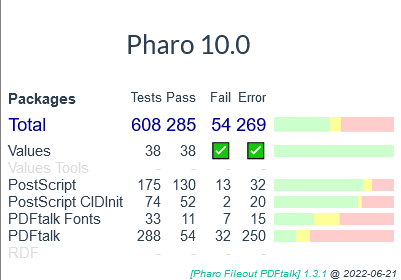
[â¦] Right now Iâm trying to find all Pharo classes that will be bases for the extensions Iâm transforming. That could take a while. Run a script in Pharo to enumerate all classes. Then use that to see which classes you have in VW with the same name. Yes, but there are classes that exist in Metacello, and donât live by default in a Pharo image. What to do in that case? I hardly know what Iâm missing. I just loaded ArbitraryPrecisionFloat from Metacello because I happen to know the code is common to VW and Pharo. . A good strategy for problems is, when you find one, look for other examples that match the pattern. You can eliminate a lot of trouble quickly. Shaping I got about 6 seconds into the first file-in. Iâm running empty transforms on all packages. Great. You do need a ProjectChange though. Starting with empty PackageChanges is perfect. Yes, I have the one big ProjectChange with all the PackageChanges (about 25) currently empty. The problem Iâm having is using this Syntax error to determine where in the file-in the problem occurred so that I can know the package whose transform needs work. I was expecting more context. So Iâm poking around in STCommandLineHandler next with breakpoints. Open to suggestions. Strange. The #{String} syntax should have been automatically transformed to #String for Pharo⦠strange. All the namespace related issues (like this literal binding reference) should be taken care of. I had a bunch of those namespace/shared-variable bad-reference problems, which I cleared up for several hours before I was able to produce the first file-in. The transformation machinery is very strict, and helps you clean up your code. Iâd forgotten about many of the things that I was forced to fix. Iâll just debug through the file-in until I find the problem. Shaping. Iâll make my first run soon on my first package. Iâll do one package extra each time I run, building up the code. Each package will have its own <package name>Transform method, per the examples. Iâm not sure how to build these methods, except to assume that rewriting the pharo base methods is never wrong. Iâll file-in the resulting .st file to see what breaks. Then Iâll go back to the package whose .st source is not loading completely and add additional fixes (class keeps, base methods rewrites if needed and missing, method code body replacements if needed) to its transform method until it loads completely on the next run. That could take a while. Is that what you do in practice? Perfect! That is exactly how I do it. I start with an empty PackageChange. Then I add incrementally transforms until the code loads - phase one. This has been achieved for PDFtalk with the first release on GitHub. The second and final phase is to make all tests run (including the new to-write tests). This can take a while, because all syntactic and semantic differences must be addressed. Here, some cross-fertilization is possible. Yeah, and I have to be thorough finally about all my SUnit tests⦠The nice thing is, that the system is always telling you what to do. In fact, at first there are so many issues that it is a lot of fun to browse them and chose a nice one. Always the nicest or easiest bug first :-). Right. Iâm assuming the code writer is taking into account inter-package dependencies in order to get the load order right. Yes. Shaping From: christian.haider@smalltalked-visuals.com <mailto:christian.haider@smalltalked-visuals.com> <christian.haider@smalltalked-visuals.com <mailto:christian.haider@smalltalked-visuals.com> > Sent: Friday, 5 August, 2022 05:53 To: 'Any question about pharo is welcome' <pharo-users@lists.pharo.org <mailto:pharo-users@lists.pharo.org> >; 'Pharo Development List' <pharo-dev@lists.pharo.org <mailto:pharo-dev@lists.pharo.org> > Subject: [Pharo-users] Re: [Pharo-users]Porting from VW 8.3 to Pharo: pdftalkPackageChanges The full project in which the mentioned method used looks like this: PDFtalkProject ^ProjectChange name: #PDFtalk source: ((OrderedCollection new) add: (Package name: #Values); add: (Bundle name: #PDFtalk); add: (Package name: #'Values Testing'); add: (Bundle name: #'PDFtalk Testing'); add: (Package name: #'PDFtalk Demonstrations'); yourself) changes: self pdftalkPackageChanges nameMapping: (NameMapping keep: ((OrderedCollection new) add: #{Smalltalk.PDF}; add: #{PostScript.PSDictionary}; add: #{PDFtalk.PDFObject}; add: #{PDFtalk.PDFArray}; add: #{PDFtalk.PDFDictionary}; add: #{PDFtalk.PDFStream}; add: #{PDFtalk.PDFString}; add: #{PDFtalk.PDFDate}; add: #{PDFtalk.PDFTypeDefinition}; add: #{PDFtalk.PDFEncoder}; yourself) classToNames: ((Valuemap new) add: #{SubscriptOutOfBoundsError} -> #Error; add: #{NonIntegerIndexError} -> #Error; add: #{NotFoundError} -> #KeyNotFound; add: #{KeyNotFoundError} -> #KeyNotFound; yourself) namespaceToPrefixes: ((Valuemap new) add: #{Smalltalk.PostScript} -> 'PS'; add: #{Smalltalk.PDFtalk} -> 'Pt'; add: #{PDFtalk.Fonts} -> 'PtF'; add: #{PDFtalk.Fonts.OpenType} -> 'PtOT'; yourself)) In the #source: are the bundles and packages to be transformed. The #changes: (your method) specify the transforms (PackageChange) for each package explicitly. Only packages contain code and therefore, only packages need the code transformations. Bundles are transformed without transformations. (Well, the code for pre-, post- whatever blocks are transformed with the class name mappings rules). So, the mapping from packages to the corresponding PackageChange has to be stated somehow. Using a dictionary (Valuemap) for this seems also natural. The only change I might like is to use pragmas to tag the PackageChange returning methods with âtheirâ package like <package: âValues Toolsâ> or so. Putting the package reference into the PackageChange is not a good idea, because all those Objects need to be created before your can find out which package is affected. (Ok, I am creating all PackageChange objects tooâ¦). Happy hacking, Christian Von: Shaping <shaping@uurda.org <mailto:shaping@uurda.org> > Gesendet: Freitag, 5. August 2022 03:26 An: 'Any question about pharo is welcome' <pharo-users@lists.pharo.org <mailto:pharo-users@lists.pharo.org> >; 'Pharo Development List' <pharo-dev@lists.pharo.org <mailto:pharo-dev@lists.pharo.org> > Betreff: [Pharo-users] Re: [Pharo-users]Porting from VW 8.3 to Pharo: pdftalkPackageChanges This method pdftalkPackageChanges ^(Valuemap new) add: 'Values' -> self ValuesTransform; add: 'PostScript' -> self PostScriptTransform; add: 'PDFtalk Basics' -> self PDFtalkBasicsTransform; add: 'PDFtalk Typing' -> self PDFtalkTypingTransform; add: 'PDFtalk Basic Objects' -> self PDFtalkBasicObjectsTransform; add: 'PDFtalk Streams' -> self PDFtalkStreamsTransform; add: 'PDFtalk Data Structures' -> self PDFtalkDataStructuresTransform; add: 'PDFtalk Parsing' -> self PDFtalkParsingTransform; add: 'PDFtalk Colour' -> self PDFtalkColourTransform; add: 'PostScript Fonts' -> self PostScriptFontsTransform; add: 'PostScript CIDInit' -> self PostScriptCIDInitTransform; add: 'PDFtalk Fonts Basics' -> self PDFtalkFontsBasicsTransform; add: 'PDFtalk Fonts Type1' -> self PDFtalkFontsType1Transform; add: 'PDFtalk Fonts OpenType' -> self PDFtalkFontsOpenTypeTransform; add: 'PDFtalk Fonts' -> self PDFtalkFontsTransform; add: 'PDFtalk Graphics' -> self PDFtalkGraphicsTransform; add: 'PDFtalk Graphics Operations' -> self PDFtalkGraphicsOperationsTransform; add: 'PDFtalk XObjects' -> self PDFtalkXObjectsTransform; add: 'PDFtalk Images' -> self PDFtalkImagesTransform; add: 'PDFtalk Files' -> self PDFtalkFilesTransform; add: 'PDFtalk Document' -> self PDFtalkDocumentTransform; add: 'PDFtalk Rendering' -> self PDFtalkRenderingTransform; add: 'PDFtalk Shading' -> self PDFtalkShadingTransform; add: 'PDFtalk Interactive Features' -> self PDFtalkInteractiveFeaturesTransform; add: 'PDFtalk Deploying' -> self PDFtalkDeployingTransform; add: 'Values Testing' -> self ValuesTestingTransform; add: 'PDFtalk test resources' -> self PDFtalkTestResourcesTransform; add: 'PostScript Testing' -> self PostScriptTestingTransform; add: 'PostScript CIDInit Testing' -> self PostScriptCIDInitTestingTransform; add: 'PDFtalk Fonts tests' -> self PDFtalkFontsTestsTransform; add: 'PDFtalk tests' -> self PDFtalkTestsTransform; add: 'PDFtalk Demonstrations' -> self PDFtalkDemonstrationsTransform; yourself effectively looks like the head transform structure for a project, in this case all the PDFtalk stuff, which includes Values and Postscript. This is not exactly a bundle idea, is it? Itâs project spread across potentially many bundles and packages. Iâll start coding my transform with a similar method, and work down toward the details. Takes a bit to get used to all the correct, yet dangling VW methods that are useless in VW, but which will become new code in the target image and there no longer appear to be dangling (with syntax highlighting aberrations). Odd looking but completely by design. Shaping From: Shaping <shaping@uurda.org <mailto:shaping@uurda.org> > Sent: Thursday, 4 August, 2022 19:18 To: 'Any question about pharo is welcome' <pharo-users@lists.pharo.org <mailto:pharo-users@lists.pharo.org> > Subject: [Pharo-users] Re: [Pharo-users]Porting from VW 8.3 to Pharo: Pharo100 fileOutValues I will look, although this kind of always available on demand thing is too disruptive for me⦠I know what you mean. I try be disciplined about it. I really like to be able to fix typos, because there are almost always typos. But e-mail is okay. So that little example is a test that shows how the transformation is done. It converts just package Values to a Pharo-compatible file-in. My task is then to queue a bunch of ProjectChange instances like this one: SmalltalkTransform.Pharo100>> ValuesProject ^ProjectChange name: #Values source: (Array with: (Package name: #Values)) changes: (Valuemap with: 'Values' -> self ValuesTransform) Exactly but for my own packages. No bundles are transformed (just their contained packages) because Pharo doesnât have bundles. Is that right? No, bundles are handled. For real examples, you need to look at the PDFtalk transforms. Yes, Pharo does not have a concept of bundles (ordered aggregates of packages). Instead it relies on a naming convention for packages. That convention is honored in the fileout, so that packages will be partly grouped in Pharo according to the category prefix. For each VW-package, one Pharo package is created. A bundle itself is also represented as Pharo package with one class About<bundlename> with class methods for the metadata of the bundle, including a method giving you the ordered list of component packages. So, all contents and metadata of packages and bundles are transformed for Pharo. No code or info gets lost. Okay. Is method ValuesTransform ^PackageChange ignoredNames: #(#{Smalltalk.GeneralBindingReference}) bridgeClasses: (Valuemap with: #{Timestamp} -> #DateAndTime with: #{Smalltalk.ColorValue} -> #Color) localChanges: self valuesLocalTransform extensions: (Array with: (SystemClassChange className: #Color instanceChanges: (Array with: (Add method: #asColorValue code: #_ph_asColorValue))) with: (SystemClassChange className: #TextStream instanceChanges: (Array with: (Add method: #nextPutAllText: code: #_ph_nextPutAllText:)))) written specifically for that package? I would think it applies to all packages. I see some expected mappings like Timestamp to DateAndTime. Yes, this method returns a PackageChange Value describing the transformations needed to create the Pharo fileout for this specific package (inspect the return value for the fully expanded Value). Methods exist with the same name for other Smalltalks. Depending on the dialect (or version of a dialect), the transforms are different. Squeak and Pharo are quite similar, because they share a common history, but VA or Gemstone need quite different transforms. So, in general, for each package, there is one such method/Value for each target Smalltalk/version. Okay. I do not dare to extract commonalities before the machinery is really robust and stable. For now everything is neatly separate and self-contained (and probably it will stay that way, although there are lots of duplications). The mapping of class names is the responsibility of the enclosing ProjectChange Value where you define the list of source bundles/packages to transform, the PackageChanges for all packages and the mapping of âglobalâ names. (The bridge classes above are no renames, but a subclass relationship (is-a) to avoid renamings. The new class Timestamp will be created as subclass of DateAndTime which has almost the same semantics. Therefore, I can still use Timestamp which will be basically a DateAndTime now.) Okay. There is still a technical challenge here. Currently, a ProjectChange need to include all prerequisites (Values is part of the PDFtalk project and will be transformed with it). A ProjectWriter, which coordinates the transform, keeps track of the mappings when they are created (either explicitly or through a namespace renaming â see implementers of #PDFtalkProject). I would like to have this more modular: the mappings from the Values transformation should be persistently saved, so that other transformation projects can just use them, instead of including the sources into one own project. For this, I need to have renamings local to a package (where they first occur), not global on the project level. Right. For Values and Values Tests and Values Tools this works, because there are no mappings in the Values package. What about conversion of VW arrays to Pharo literal arrays? How is that done? (I think you mean dynamic arrays like {1. âabcâ size. 42} in which evaluation happens (in contrast to literal things which can be resolved already by the compiler). Yes, dynamic arrays. Not! Since a while, VW also has dynamic arrays, but not in VW 8.3 â the last publicly available version. Okay, I was wondering when that would happen. I will not shut out those users, because âopen-sourceâ would be quite absurd, if it is only available for paying customers. In 8.3, the compiler does not accept that syntax and therefore, there is no easy way to represent this in replacement code. So, no. It is not possible until Cincom releases an public version which can handle that. Okay. I recall that one of the Smalltalks (I donât recall which) had Stream semantics differing from VWâs. ⦠I just checked. VWâs #upTo: method includes the object and leaves the index after it, and Pharoâs excludes the object and leaves the index at the object. So that is some major breakage if we donât correct it. Can it be done automatically? Yes, these are the usual porting challenges and exactly the reason why this library exists :). Thank you for the question :). Yes, the stream semantics need to be fixed. The idea is that a set of transforms for this issue can be reused by others. Okay.
valuesLocalTransform
has lots of juicy bits. But this doesnât look very simple. We canât just replace an old method with a new one. We also have to write the new one to tweak how the indices are used in #upTo:, and make sure that new method gets filed-in as well into the Pharo target image. Or, we have to do this kind of change manually. Naa, itâs very easy, I think :). A PackageChange specifies transforms for classes used in the package (#localChanges) and #extensions for system classes of the target. For a class, you can have a ClassChange describing the changes to instance or class methods. A MethodChange has 4 subclasses for: - Ignore â donât write this method to the target - Add â add this new method (not in the source system) to the target - Replace â replace the body of this method with other code - Rewrite â rewrite the method source using a rewrite rule. Add and Replace need the target code. Add then always involves a new name for a method in the target. Replaces use an old name in the target with a new code body. This is stored in another method with a derived name like #_ph_upTo: . The method name is not important, because only the body of the method is used. But the name should not be used in the source â it is just a holder for the replacement code. These methods live in the specific [<Smalltalk> Fileout <Package>] package. Okay. There are lots of working(!) examples for all of those in the PDFtalk transform project. This bit (SystemClassChange className: #Color instanceChanges: (Array with: (Add method: #asColorValue code: #_ph_asColorValue))) is replacing #asColorValue with #_ph_asColorValue because some special Pharo-color conversion needs to happen. But how does #_ph_asColorValue get defined? Itâs neither in VW nor in Pharo 10. You got bitten by the old version of [Pharo Fileout Values]. Please load [Pharo Fileout PDFtalk]. There, the methods exist. Yes, I see it now. Ok. I donât have a virgin image. I have a very non-virgin image, about 27 years of development Iâm trying to port to Pharo. I donât yet have a specific interest in the PDFtalk, though I do see a need for PDF generation later, and will probably revisit that. For now, I just want my own stuff to run in Pharo. Virgin image just means that you donât need anything else. You can safely load it in you favorite special images :). I would load PDFtalk, although technically you donât need to (all the extensions to PDFtalk would be unloadable, but that doesnât affect Values). Okay. is: Load {Values Project] bundle Load {PDFtalk Project} bundle Load {Smalltalk Transform Project} bundle Load [Pharo Fileout PDFtalk] package Save, done Okay, so do I understand correctly that I need to include the PDFtalk stuff even if Iâm not interested in PDFtalk, because thatâs where a lot of the Smalltalk transformation machinery lives? Or is the PDFtalk just being used as an example for how to do a massive transformation? Or Both? No, the transformation machinery is fully independent of PDFtalk. I just tried it. The dependencies are in the specific [Pharo Fileout PDFtalk] package, since I have already quite a few replacement methods which are extensions to PDFtalk classes. Okay. PDFtalk is the focus of the project and therefore all issues are solved first with this library in mind. Therefore, bundles and namespaces are handled, for example. When you study the more interesting transformations for PDFtalk, it would be a shame not to be able to browse the methods and classes involved. So, PDFtalk is the real world reference example. And Values is the simplest example. To transform Values do: âPharo100 fileOutValuesâ The [Pharo Fileout PDFtalk] package includes the latest Values transformations. I am thinking about a better modularization⦠Also, the wiki is a bit out of control. It really needs some restructuring. In the cites wiki page, there is a link to a blog where I record the changes. This might be informative. 2. Port the Values package. This is easy, since no namespaces are involved. This first instruction after VW package setup says to port the contents of the Values package from VW to Pharo. Do you mean manually? Probably not. No, no. This has been finished in March. For each dialect, I have a GitHub repository where I release important versions: <https://github.com/PortingPDFtalk/PharoPDFtalk> https://github.com/PortingPDFtalk/PharoPDFtalk. You can find the working port as first release â <https://github.com/PortingPDFtalk/PharoPDFtalk/releases/tag/1.3.0.0> Working versionâ. There you can download the ported Values fileout with the exact description with which versions of what it was created. This should be a good starting example. Why do I need any new code installed in Pharo before I begin the transformation, if Iâm transforming code from VW to pharo? Iâm not understanding the basic constraints of the problem, even when the detailed steps are clear. No, no. You donât need anything on the Pharo side. The fileouts on GitHub are the end products of a transformation for people who donât use VisualWorks, but want to use Values in Pharo. Or help with PDFtalk by fixing some issues, so that I can write the transformations. Iâve done these steps so far: 1. Went to <https://github.com/PortingPDFtalk/PharoPDFtalk> https://github.com/PortingPDFtalk/PharoPDFtalk. Mistake :). You donât want to look at the unfinished product of the current version of thincomplete transformations for PDFtalk. Do you mean âfinishedâ here? Isnât that file-in the finished result? I thought the above links was the currently finished result (as good as it can be until the rest of the bugs are goine and tests all run). Yes, that was confusing. Thatâs why I had the early impression that Values was somehow apart of the transformation machinery. See https://wiki.pdftalk.de/doku.php?id=stateoftheport#pharo-10-0: Instead, you want to look at the unfinished product of the transformations of your projects :). 2. Saved down PDFtalk.Pharo100.st <http://PDFtalk.Pharo100.st> into <my Pharo 10 image directory>/pharo-local/Smalltalk-Transformation. (I figured that was a good place to save it. If anyone disagrees, or has a better or more conventional idea about where files should be saved, please say so. I setup a Pharo Git repo and played with it briefly for the first time yesterday. Iâve used Pharo off an on for 16 years, but this is the first time Iâm making a serious effort to manage source, and not throw away what Iâm working on.) 3. Filed-in PDFtalk.Pharo100.st <http://PDFtalk.Pharo100.st> . This went on for about 7 minutes or so. I have a hundreds if not over a thousand classes showing in Epicea. Is there anyway to get Epicea to give me a count of changes with a time-range filter? 4. Deleted (forgot) yesterdayâs, old Main practice-repo from both the image and the drive, and made a new one. I need to add to Main all the packages I just filed-in, but I donât see an efficient way to do that. I would like to use the Add Package button, but this gives a filtered list of available packages. I can filter subgroups, and then individually select each of the checkboxes to the left of each package (there is no Ctrl-A [select all] option here, which seems to be a strange omission given the potentially large number of packages involved). I see lots of prefixes for the classes just loaded. I could easily miss something if I filter/select/add one prefix-group at a time. Is there an easier way? Over in Epicea I donât see a way to push the loaded items listed to a specific repo. The first thought I have is to select all filed-in code artifacts by datetime span. I did that and saved it as an .ombu file (I have no idea what that is). I donât see a way to import that .ombu file into repo Mainâs âWorking copyâ window. It must be easy, but I donât see it. Please suggest the best way. Iâd like to know as well â I am not quite familiar with the source management concepts in Pharo. I asked in Discord. I donât understand why stuff like this is missing. The only conclusion I can draw is that no one does huge file-ins (but you do). It is planned to generate Tonel output in the future, but for now I feel safer with the traditional fileout where I can have doIts. I am not sure how Tonel reacts to crippled sources, which are normal during the development of the transformations. Shaping From: christian.haider <christian.haider@smalltalked-visuals.com <mailto:christian.haider@smalltalked-visuals.com> > Sent: Wednesday, 22 June, 2022 05:42 To: pharo-users@lists.pharo.org <mailto:pharo-users@lists.pharo.org> Subject: [Pharo-users] [PDFtalk] second fileOut for Squeak and Pharo With help from the community some issues were fixed which improved the test statistics nicely. Check it out: https://wiki.pdftalk.de/doku.php?id=portingblog#second_pdftalk_fileout_for_s... Thanks to everybody involved! Happy hacking, Christian
Von: Shaping <shaping@uurda.org> Gesendet: Sonntag, 7. August 2022 03:40 An: 'Any question about pharo is welcome' <pharo-users@lists.pharo.org> Betreff: [Pharo-users] Re: [Pharo-users]Porting from VW 8.3 to Pharo: what to ignore; how to find Pharo base classes not in the base image This is VWâs definition of IntegerArray: Smalltalk.Core defineClass: #IntegerArray superclass: #{Core.ArrayedCollection} indexedType: #none private: false instanceVariableNames: '' classInstanceVariableNames: '' imports: '' category: 'Collections-Arrayed' Iâm stepping through the chunks in the Changes Browser because I donât see an easier way currently. This is a separate tool from Epicea. The first chunk whose file-in fails is: IntegerArray variableByteSubclass: #ByteArray instanceVariableNames: '' classVariableNames: 'LastDecodeMap Decodings LastEncodeMap Encodings Lock' poolDictionaries: 'ForeignHeap' package: 'Shaping-Collection' I donât understand how this definition could have been created. ByteArray is a VW system class. Such classes should not be ported anyways â alone from copyright reasons. The only addition I see is the pool ForeignHeap. I guess, that you extended ByteArray somehow and added an import ForeignHeap.* to ByteArray. Pool dictionaries are a special beast. Since the great namespace introduction, there are no pool dictionaries in VW anymore. Instead, pool dictionaries are ordinary namespaces which can be imported by a class or namespace. Imports can be either <namespace>.* (general import, which can be used for pools) and <namespace>.<class> for specific imports. Unfortunately, I have no way to tell if an import is a pool (or is there?). Conceptionally this is clean thou, since there is no difference between a pool and a namespace. Import are used so that you can use a name directly without its fully qualified namespace path. Since there are no namespaces and your own names in namespaces are automatically renamed, there is no need for those in Pharo. Still there could be real pools⦠Anyways, imports are put into the class definition as pool dictionaries by default. I think this is a tools issue where the user should be confronted with useful choices. To change the definition of a class to be written, you can add #definitionChanges: to a ClassChange. The argument is a Valuemap (Dictionary) with the constructor argument name as key and the new value. Example for inspiration (all parts used in my code): ClassChange classReference: #{Valuemap} definitionChanges: (Valuemap with: #superclass -> #EsOrderedDictionary with: #comment -> âa new class commentâ with: #instanceVariables -> #() with: #poolDictionaries -> #()) So, if your #ForeignHeap is not really a pool dictionary, you should add ClassChange classReference: #{ByteArray} definitionChanges: (Valuemap with: #poolDictionaries -> #()) I get a warning that says proceed only if you know what you are doing. Thatâs encouraging. Lol Sorry about that⦠I guess it is about the pool dictionary. But I cannot find where I throw that⦠How did this definition get created in the first place? More generally and more to the point, Iâm trying to determine an efficient way to determine which classes I will always need to move from VW (like the ones I know to be uniquely mine) versus those I should never try to move from VW because Pharo already has the same by the same name or the same in function by a different nameâbut I cannot easily discover what these classes are without web searches to track down class definitions that exist for Pharo but that are not yet in Pharo because, like this one: Metacello new smalltalkhubUser: 'Pharo' project: 'MetaRepoForPharo70'; configuration: 'ArbitraryPrecisionFloat'; version: #stable; load. I have some extensions to APF in VW. I want to port those to Pharo, but the base class must already be there. APF for VW and for Pharo seems like the same code (or very close). So I tracked down the above Metacello evaluable, did it, and now I have APF in Pharo, and I can extend it with my transformed file-in. For this, a PackageChange has a #preload. It can be filled with a dialect specific specification of what to load beforehand. I defined PharoPreload and use it in Squeak :-) (look for the references). Actually, it should be renamed to MonticelloPreload or so. What you need would be a MetacelloPreload in which you would capture the parameters needed to load that package (and implement â#writeLoadDoitOn: aStreamâ too :-) ). I need to learn more about Monticello and Metacello to design the proper preload objects⦠(or I meet somebody who known everything about it :-) . Something like MetacelloPreload smalltalkhubUser: 'Pharo' project: 'MetaRepoForPharo70' configuration: 'ArbitraryPrecisionFloat' version: #stable Seems I should block the VW class like this: ShapingArbitraryPrecisionFloatTransform ^PackageChange new ignoredNames: #(#{Smalltalk.ArbitraryPrecisionFloat}) Only if you have not extended the class. #ignoredNames: means that nothing of the class will be written out. And use the APF class that I load into Pharo instead. ⦠I found IntegerArray in Pharo. So I should exclude this one from the transform on the VW side too: ShapingCollectionTransform ^PackageChange new ignoredNames: #(#{Smalltalk.IntegerArray}) No, like above. You want your extensions to be written, I suppose. Right now Iâm trying to find all Pharo classes that will be bases for the extensions Iâm transforming. That could take a while. Do you have an algo you like? Is there a strategic way to load all the basic repos for Pharo? I see the nine standard repos listed by default in the virgin Repositories list. But not all Pharo code is in Repos. Some, like the APF class above, is in Metacello. As tedious as this is, itâs still much better than pure manual porting. :-) thanks. Shaping Christian I got about 6 seconds into the first file-in. Iâm running empty transforms on all packages. Great. You do need a ProjectChange though. Starting with empty PackageChanges is perfect. Yes, I have the one big ProjectChange with all the PackageChanges (about 25) currently empty. The problem Iâm having is using this Syntax error to determine where in the file-in the problem occurred so that I can know the package whose transform needs work. I was expecting more context. So Iâm poking around in STCommandLineHandler next with breakpoints. Open to suggestions. Strange. The #{String} syntax should have been automatically transformed to #String for Pharo⦠strange. All the namespace related issues (like this literal binding reference) should be taken care of. I had a bunch of those namespace/shared-variable bad-reference problems, which I cleared up for several hours before I was able to produce the first file-in. The transformation machinery is very strict, and helps you clean up your code. Iâd forgotten about many of the things that I was forced to fix. Iâll just debug through the file-in until I find the problem. Shaping. Iâll make my first run soon on my first package. Iâll do one package extra each time I run, building up the code. Each package will have its own <package name>Transform method, per the examples. Iâm not sure how to build these methods, except to assume that rewriting the pharo base methods is never wrong. Iâll file-in the resulting .st file to see what breaks. Then Iâll go back to the package whose .st source is not loading completely and add additional fixes (class keeps, base methods rewrites if needed and missing, method code body replacements if needed) to its transform method until it loads completely on the next run. That could take a while. Is that what you do in practice? Perfect! That is exactly how I do it. I start with an empty PackageChange. Then I add incrementally transforms until the code loads - phase one. This has been achieved for PDFtalk with the first release on GitHub. The second and final phase is to make all tests run (including the new to-write tests). This can take a while, because all syntactic and semantic differences must be addressed. Here, some cross-fertilization is possible. Yeah, and I have to be thorough finally about all my SUnit tests⦠The nice thing is, that the system is always telling you what to do. In fact, at first there are so many issues that it is a lot of fun to browse them and chose a nice one. Always the nicest or easiest bug first :-). Right. Iâm assuming the code writer is taking into account inter-package dependencies in order to get the load order right. Yes. Shaping From: christian.haider@smalltalked-visuals.com <mailto:christian.haider@smalltalked-visuals.com> <christian.haider@smalltalked-visuals.com <mailto:christian.haider@smalltalked-visuals.com> > Sent: Friday, 5 August, 2022 05:53 To: 'Any question about pharo is welcome' <pharo-users@lists.pharo.org <mailto:pharo-users@lists.pharo.org> >; 'Pharo Development List' <pharo-dev@lists.pharo.org <mailto:pharo-dev@lists.pharo.org> > Subject: [Pharo-users] Re: [Pharo-users]Porting from VW 8.3 to Pharo: pdftalkPackageChanges The full project in which the mentioned method used looks like this: PDFtalkProject ^ProjectChange name: #PDFtalk source: ((OrderedCollection new) add: (Package name: #Values); add: (Bundle name: #PDFtalk); add: (Package name: #'Values Testing'); add: (Bundle name: #'PDFtalk Testing'); add: (Package name: #'PDFtalk Demonstrations'); yourself) changes: self pdftalkPackageChanges nameMapping: (NameMapping keep: ((OrderedCollection new) add: #{Smalltalk.PDF}; add: #{PostScript.PSDictionary}; add: #{PDFtalk.PDFObject}; add: #{PDFtalk.PDFArray}; add: #{PDFtalk.PDFDictionary}; add: #{PDFtalk.PDFStream}; add: #{PDFtalk.PDFString}; add: #{PDFtalk.PDFDate}; add: #{PDFtalk.PDFTypeDefinition}; add: #{PDFtalk.PDFEncoder}; yourself) classToNames: ((Valuemap new) add: #{SubscriptOutOfBoundsError} -> #Error; add: #{NonIntegerIndexError} -> #Error; add: #{NotFoundError} -> #KeyNotFound; add: #{KeyNotFoundError} -> #KeyNotFound; yourself) namespaceToPrefixes: ((Valuemap new) add: #{Smalltalk.PostScript} -> 'PS'; add: #{Smalltalk.PDFtalk} -> 'Pt'; add: #{PDFtalk.Fonts} -> 'PtF'; add: #{PDFtalk.Fonts.OpenType} -> 'PtOT'; yourself)) In the #source: are the bundles and packages to be transformed. The #changes: (your method) specify the transforms (PackageChange) for each package explicitly. Only packages contain code and therefore, only packages need the code transformations. Bundles are transformed without transformations. (Well, the code for pre-, post- whatever blocks are transformed with the class name mappings rules). So, the mapping from packages to the corresponding PackageChange has to be stated somehow. Using a dictionary (Valuemap) for this seems also natural. The only change I might like is to use pragmas to tag the PackageChange returning methods with âtheirâ package like <package: âValues Toolsâ> or so. Putting the package reference into the PackageChange is not a good idea, because all those Objects need to be created before your can find out which package is affected. (Ok, I am creating all PackageChange objects tooâ¦). Happy hacking, Christian Von: Shaping <shaping@uurda.org <mailto:shaping@uurda.org> > Gesendet: Freitag, 5. August 2022 03:26 An: 'Any question about pharo is welcome' <pharo-users@lists.pharo.org <mailto:pharo-users@lists.pharo.org> >; 'Pharo Development List' <pharo-dev@lists.pharo.org <mailto:pharo-dev@lists.pharo.org> > Betreff: [Pharo-users] Re: [Pharo-users]Porting from VW 8.3 to Pharo: pdftalkPackageChanges This method pdftalkPackageChanges ^(Valuemap new) add: 'Values' -> self ValuesTransform; add: 'PostScript' -> self PostScriptTransform; add: 'PDFtalk Basics' -> self PDFtalkBasicsTransform; add: 'PDFtalk Typing' -> self PDFtalkTypingTransform; add: 'PDFtalk Basic Objects' -> self PDFtalkBasicObjectsTransform; add: 'PDFtalk Streams' -> self PDFtalkStreamsTransform; add: 'PDFtalk Data Structures' -> self PDFtalkDataStructuresTransform; add: 'PDFtalk Parsing' -> self PDFtalkParsingTransform; add: 'PDFtalk Colour' -> self PDFtalkColourTransform; add: 'PostScript Fonts' -> self PostScriptFontsTransform; add: 'PostScript CIDInit' -> self PostScriptCIDInitTransform; add: 'PDFtalk Fonts Basics' -> self PDFtalkFontsBasicsTransform; add: 'PDFtalk Fonts Type1' -> self PDFtalkFontsType1Transform; add: 'PDFtalk Fonts OpenType' -> self PDFtalkFontsOpenTypeTransform; add: 'PDFtalk Fonts' -> self PDFtalkFontsTransform; add: 'PDFtalk Graphics' -> self PDFtalkGraphicsTransform; add: 'PDFtalk Graphics Operations' -> self PDFtalkGraphicsOperationsTransform; add: 'PDFtalk XObjects' -> self PDFtalkXObjectsTransform; add: 'PDFtalk Images' -> self PDFtalkImagesTransform; add: 'PDFtalk Files' -> self PDFtalkFilesTransform; add: 'PDFtalk Document' -> self PDFtalkDocumentTransform; add: 'PDFtalk Rendering' -> self PDFtalkRenderingTransform; add: 'PDFtalk Shading' -> self PDFtalkShadingTransform; add: 'PDFtalk Interactive Features' -> self PDFtalkInteractiveFeaturesTransform; add: 'PDFtalk Deploying' -> self PDFtalkDeployingTransform; add: 'Values Testing' -> self ValuesTestingTransform; add: 'PDFtalk test resources' -> self PDFtalkTestResourcesTransform; add: 'PostScript Testing' -> self PostScriptTestingTransform; add: 'PostScript CIDInit Testing' -> self PostScriptCIDInitTestingTransform; add: 'PDFtalk Fonts tests' -> self PDFtalkFontsTestsTransform; add: 'PDFtalk tests' -> self PDFtalkTestsTransform; add: 'PDFtalk Demonstrations' -> self PDFtalkDemonstrationsTransform; yourself effectively looks like the head transform structure for a project, in this case all the PDFtalk stuff, which includes Values and Postscript. This is not exactly a bundle idea, is it? Itâs project spread across potentially many bundles and packages. Iâll start coding my transform with a similar method, and work down toward the details. Takes a bit to get used to all the correct, yet dangling VW methods that are useless in VW, but which will become new code in the target image and there no longer appear to be dangling (with syntax highlighting aberrations). Odd looking but completely by design. Shaping From: Shaping <shaping@uurda.org <mailto:shaping@uurda.org> > Sent: Thursday, 4 August, 2022 19:18 To: 'Any question about pharo is welcome' <pharo-users@lists.pharo.org <mailto:pharo-users@lists.pharo.org> > Subject: [Pharo-users] Re: [Pharo-users]Porting from VW 8.3 to Pharo: Pharo100 fileOutValues I will look, although this kind of always available on demand thing is too disruptive for me⦠I know what you mean. I try be disciplined about it. I really like to be able to fix typos, because there are almost always typos. But e-mail is okay. So that little example is a test that shows how the transformation is done. It converts just package Values to a Pharo-compatible file-in. My task is then to queue a bunch of ProjectChange instances like this one: SmalltalkTransform.Pharo100>> ValuesProject ^ProjectChange name: #Values source: (Array with: (Package name: #Values)) changes: (Valuemap with: 'Values' -> self ValuesTransform) Exactly but for my own packages. No bundles are transformed (just their contained packages) because Pharo doesnât have bundles. Is that right? No, bundles are handled. For real examples, you need to look at the PDFtalk transforms. Yes, Pharo does not have a concept of bundles (ordered aggregates of packages). Instead it relies on a naming convention for packages. That convention is honored in the fileout, so that packages will be partly grouped in Pharo according to the category prefix. For each VW-package, one Pharo package is created. A bundle itself is also represented as Pharo package with one class About<bundlename> with class methods for the metadata of the bundle, including a method giving you the ordered list of component packages. So, all contents and metadata of packages and bundles are transformed for Pharo. No code or info gets lost. Okay. Is method ValuesTransform ^PackageChange ignoredNames: #(#{Smalltalk.GeneralBindingReference}) bridgeClasses: (Valuemap with: #{Timestamp} -> #DateAndTime with: #{Smalltalk.ColorValue} -> #Color) localChanges: self valuesLocalTransform extensions: (Array with: (SystemClassChange className: #Color instanceChanges: (Array with: (Add method: #asColorValue code: #_ph_asColorValue))) with: (SystemClassChange className: #TextStream instanceChanges: (Array with: (Add method: #nextPutAllText: code: #_ph_nextPutAllText:)))) written specifically for that package? I would think it applies to all packages. I see some expected mappings like Timestamp to DateAndTime. Yes, this method returns a PackageChange Value describing the transformations needed to create the Pharo fileout for this specific package (inspect the return value for the fully expanded Value). Methods exist with the same name for other Smalltalks. Depending on the dialect (or version of a dialect), the transforms are different. Squeak and Pharo are quite similar, because they share a common history, but VA or Gemstone need quite different transforms. So, in general, for each package, there is one such method/Value for each target Smalltalk/version. Okay. I do not dare to extract commonalities before the machinery is really robust and stable. For now everything is neatly separate and self-contained (and probably it will stay that way, although there are lots of duplications). The mapping of class names is the responsibility of the enclosing ProjectChange Value where you define the list of source bundles/packages to transform, the PackageChanges for all packages and the mapping of âglobalâ names. (The bridge classes above are no renames, but a subclass relationship (is-a) to avoid renamings. The new class Timestamp will be created as subclass of DateAndTime which has almost the same semantics. Therefore, I can still use Timestamp which will be basically a DateAndTime now.) Okay. There is still a technical challenge here. Currently, a ProjectChange need to include all prerequisites (Values is part of the PDFtalk project and will be transformed with it). A ProjectWriter, which coordinates the transform, keeps track of the mappings when they are created (either explicitly or through a namespace renaming â see implementers of #PDFtalkProject). I would like to have this more modular: the mappings from the Values transformation should be persistently saved, so that other transformation projects can just use them, instead of including the sources into one own project. For this, I need to have renamings local to a package (where they first occur), not global on the project level. Right. For Values and Values Tests and Values Tools this works, because there are no mappings in the Values package. What about conversion of VW arrays to Pharo literal arrays? How is that done? (I think you mean dynamic arrays like {1. âabcâ size. 42} in which evaluation happens (in contrast to literal things which can be resolved already by the compiler). Yes, dynamic arrays. Not! Since a while, VW also has dynamic arrays, but not in VW 8.3 â the last publicly available version. Okay, I was wondering when that would happen. I will not shut out those users, because âopen-sourceâ would be quite absurd, if it is only available for paying customers. In 8.3, the compiler does not accept that syntax and therefore, there is no easy way to represent this in replacement code. So, no. It is not possible until Cincom releases an public version which can handle that. Okay. I recall that one of the Smalltalks (I donât recall which) had Stream semantics differing from VWâs. ⦠I just checked. VWâs #upTo: method includes the object and leaves the index after it, and Pharoâs excludes the object and leaves the index at the object. So that is some major breakage if we donât correct it. Can it be done automatically? Yes, these are the usual porting challenges and exactly the reason why this library exists :). Thank you for the question :). Yes, the stream semantics need to be fixed. The idea is that a set of transforms for this issue can be reused by others. Okay.
valuesLocalTransform
has lots of juicy bits. But this doesnât look very simple. We canât just replace an old method with a new one. We also have to write the new one to tweak how the indices are used in #upTo:, and make sure that new method gets filed-in as well into the Pharo target image. Or, we have to do this kind of change manually. Naa, itâs very easy, I think :). A PackageChange specifies transforms for classes used in the package (#localChanges) and #extensions for system classes of the target. For a class, you can have a ClassChange describing the changes to instance or class methods. A MethodChange has 4 subclasses for: - Ignore â donât write this method to the target - Add â add this new method (not in the source system) to the target - Replace â replace the body of this method with other code - Rewrite â rewrite the method source using a rewrite rule. Add and Replace need the target code. Add then always involves a new name for a method in the target. Replaces use an old name in the target with a new code body. This is stored in another method with a derived name like #_ph_upTo: . The method name is not important, because only the body of the method is used. But the name should not be used in the source â it is just a holder for the replacement code. These methods live in the specific [<Smalltalk> Fileout <Package>] package. Okay. There are lots of working(!) examples for all of those in the PDFtalk transform project. This bit (SystemClassChange className: #Color instanceChanges: (Array with: (Add method: #asColorValue code: #_ph_asColorValue))) is replacing #asColorValue with #_ph_asColorValue because some special Pharo-color conversion needs to happen. But how does #_ph_asColorValue get defined? Itâs neither in VW nor in Pharo 10. You got bitten by the old version of [Pharo Fileout Values]. Please load [Pharo Fileout PDFtalk]. There, the methods exist. Yes, I see it now. Ok. I donât have a virgin image. I have a very non-virgin image, about 27 years of development Iâm trying to port to Pharo. I donât yet have a specific interest in the PDFtalk, though I do see a need for PDF generation later, and will probably revisit that. For now, I just want my own stuff to run in Pharo. Virgin image just means that you donât need anything else. You can safely load it in you favorite special images :). I would load PDFtalk, although technically you donât need to (all the extensions to PDFtalk would be unloadable, but that doesnât affect Values). Okay. is: Load {Values Project] bundle Load {PDFtalk Project} bundle Load {Smalltalk Transform Project} bundle Load [Pharo Fileout PDFtalk] package Save, done Okay, so do I understand correctly that I need to include the PDFtalk stuff even if Iâm not interested in PDFtalk, because thatâs where a lot of the Smalltalk transformation machinery lives? Or is the PDFtalk just being used as an example for how to do a massive transformation? Or Both? No, the transformation machinery is fully independent of PDFtalk. I just tried it. The dependencies are in the specific [Pharo Fileout PDFtalk] package, since I have already quite a few replacement methods which are extensions to PDFtalk classes. Okay. PDFtalk is the focus of the project and therefore all issues are solved first with this library in mind. Therefore, bundles and namespaces are handled, for example. When you study the more interesting transformations for PDFtalk, it would be a shame not to be able to browse the methods and classes involved. So, PDFtalk is the real world reference example. And Values is the simplest example. To transform Values do: âPharo100 fileOutValuesâ The [Pharo Fileout PDFtalk] package includes the latest Values transformations. I am thinking about a better modularization⦠Also, the wiki is a bit out of control. It really needs some restructuring. In the cites wiki page, there is a link to a blog where I record the changes. This might be informative. 2. Port the Values package. This is easy, since no namespaces are involved. This first instruction after VW package setup says to port the contents of the Values package from VW to Pharo. Do you mean manually? Probably not. No, no. This has been finished in March. For each dialect, I have a GitHub repository where I release important versions: <https://github.com/PortingPDFtalk/PharoPDFtalk> https://github.com/PortingPDFtalk/PharoPDFtalk. You can find the working port as first release â <https://github.com/PortingPDFtalk/PharoPDFtalk/releases/tag/1.3.0.0> Working versionâ. There you can download the ported Values fileout with the exact description with which versions of what it was created. This should be a good starting example. Why do I need any new code installed in Pharo before I begin the transformation, if Iâm transforming code from VW to pharo? Iâm not understanding the basic constraints of the problem, even when the detailed steps are clear. No, no. You donât need anything on the Pharo side. The fileouts on GitHub are the end products of a transformation for people who donât use VisualWorks, but want to use Values in Pharo. Or help with PDFtalk by fixing some issues, so that I can write the transformations. Iâve done these steps so far: 1. Went to <https://github.com/PortingPDFtalk/PharoPDFtalk> https://github.com/PortingPDFtalk/PharoPDFtalk. Mistake :). You donât want to look at the unfinished product of the current version of thincomplete transformations for PDFtalk. Do you mean âfinishedâ here? Isnât that file-in the finished result? I thought the above links was the currently finished result (as good as it can be until the rest of the bugs are goine and tests all run). Yes, that was confusing. Thatâs why I had the early impression that Values was somehow apart of the transformation machinery. See https://wiki.pdftalk.de/doku.php?id=stateoftheport#pharo-10-0: Instead, you want to look at the unfinished product of the transformations of your projects :). 2. Saved down PDFtalk.Pharo100.st into <my Pharo 10 image directory>/pharo-local/Smalltalk-Transformation. (I figured that was a good place to save it. If anyone disagrees, or has a better or more conventional idea about where files should be saved, please say so. I setup a Pharo Git repo and played with it briefly for the first time yesterday. Iâve used Pharo off an on for 16 years, but this is the first time Iâm making a serious effort to manage source, and not throw away what Iâm working on.) 3. Filed-in PDFtalk.Pharo100.st. This went on for about 7 minutes or so. I have a hundreds if not over a thousand classes showing in Epicea. Is there anyway to get Epicea to give me a count of changes with a time-range filter? 4. Deleted (forgot) yesterdayâs, old Main practice-repo from both the image and the drive, and made a new one. I need to add to Main all the packages I just filed-in, but I donât see an efficient way to do that. I would like to use the Add Package button, but this gives a filtered list of available packages. I can filter subgroups, and then individually select each of the checkboxes to the left of each package (there is no Ctrl-A [select all] option here, which seems to be a strange omission given the potentially large number of packages involved). I see lots of prefixes for the classes just loaded. I could easily miss something if I filter/select/add one prefix-group at a time. Is there an easier way? Over in Epicea I donât see a way to push the loaded items listed to a specific repo. The first thought I have is to select all filed-in code artifacts by datetime span. I did that and saved it as an .ombu file (I have no idea what that is). I donât see a way to import that .ombu file into repo Mainâs âWorking copyâ window. It must be easy, but I donât see it. Please suggest the best way. Iâd like to know as well â I am not quite familiar with the source management concepts in Pharo. I asked in Discord. I donât understand why stuff like this is missing. The only conclusion I can draw is that no one does huge file-ins (but you do). It is planned to generate Tonel output in the future, but for now I feel safer with the traditional fileout where I can have doIts. I am not sure how Tonel reacts to crippled sources, which are normal during the development of the transformations. Shaping From: christian.haider <christian.haider@smalltalked-visuals.com <mailto:christian.haider@smalltalked-visuals.com> > Sent: Wednesday, 22 June, 2022 05:42 To: pharo-users@lists.pharo.org <mailto:pharo-users@lists.pharo.org> Subject: [Pharo-users] [PDFtalk] second fileOut for Squeak and Pharo With help from the community some issues were fixed which improved the test statistics nicely. Check it out: https://wiki.pdftalk.de/doku.php?id=portingblog#second_pdftalk_fileout_for_s... Thanks to everybody involved! Happy hacking, Christian
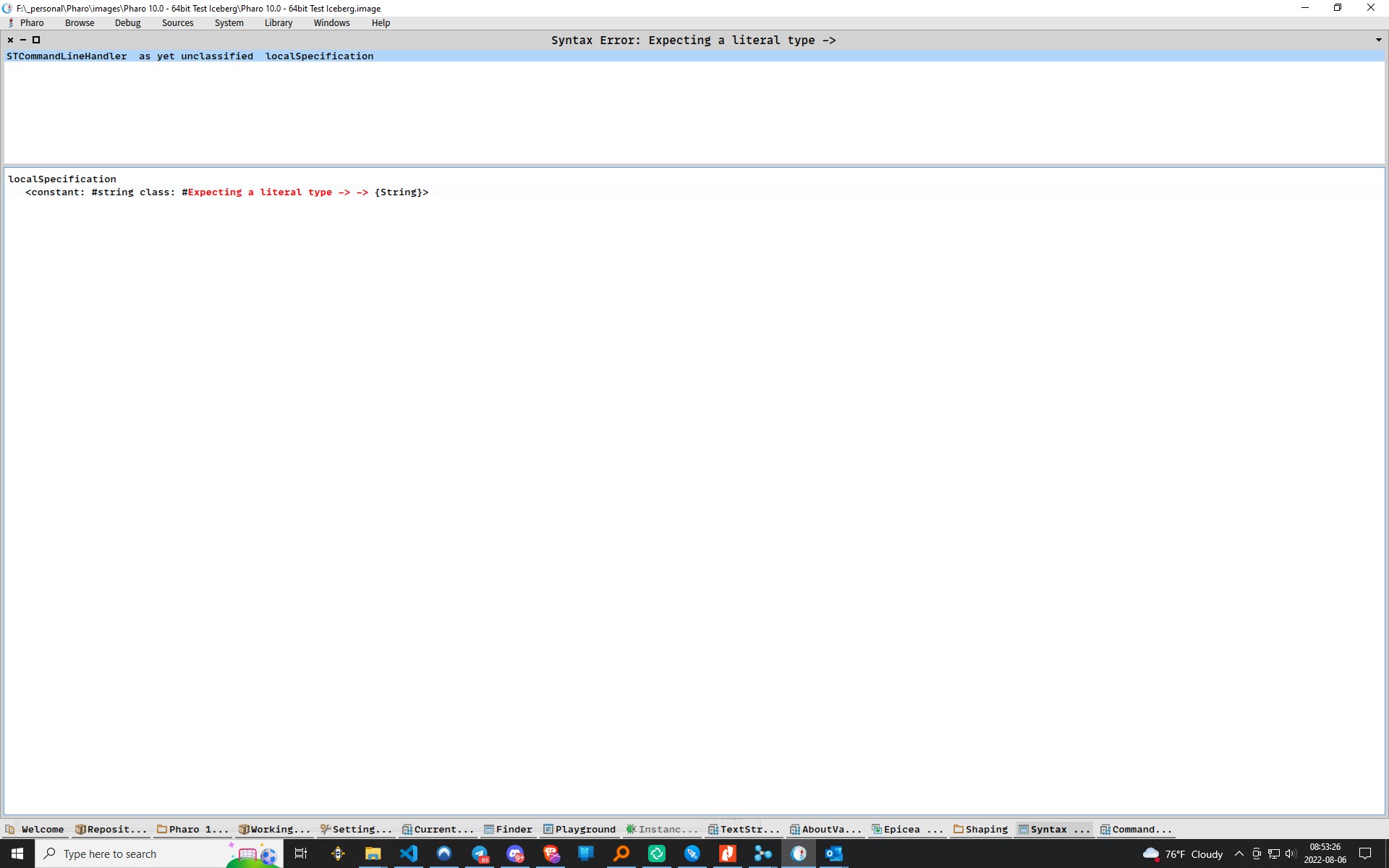
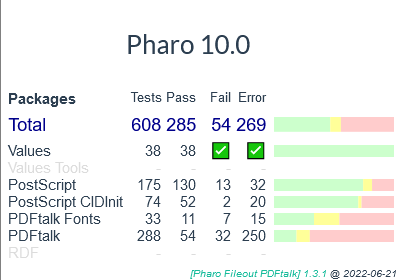
This is VWâs definition of IntegerArray: Smalltalk.Core defineClass: #IntegerArray superclass: #{Core.ArrayedCollection} indexedType: #none private: false instanceVariableNames: '' classInstanceVariableNames: '' imports: '' category: 'Collections-Arrayed' Iâm stepping through the chunks in the Changes Browser because I donât see an easier way currently. This is a separate tool from Epicea. The first chunk whose file-in fails is: IntegerArray variableByteSubclass: #ByteArray instanceVariableNames: '' classVariableNames: 'LastDecodeMap Decodings LastEncodeMap Encodings Lock' poolDictionaries: 'ForeignHeap' package: 'Shaping-Collection' I donât understand how this definition could have been created. ByteArray is a VW system class. Such classes should not be ported anyways â alone from copyright reasons. The only addition I see is the pool ForeignHeap. I guess, that you extended ByteArray somehow and added an import ForeignHeap.* to ByteArray. Yes I have: ByteArray >> asExternal ^ForeignHeap copyOfByteArray: self Also note that I have a ByteArray class override: Smalltalk.Core defineClass: #ByteArray superclass: #{Core.IntegerArray} indexedType: #bytes private: false instanceVariableNames: '' classInstanceVariableNames: '' imports: ' Shaping.ForeignHeap ' category: 'Collections-Arrayed' that imports my own ForeignHeap. I need to put that method on an existing Pharo class, which should just be its own version of ByteArray. So how do I tell my Shaping Collection package transform to ignore transformation of ByteArrayâs class definition, but preserve any methods in the same package that are extensions? Pool dictionaries are a special beast. Since the great namespace introduction, there are no pool dictionaries in VW anymore. Right. Instead, pool dictionaries are ordinary namespaces which can be imported by a class or namespace. Imports can be either <namespace>.* (general import, which can be used for pools) and <namespace>.<class> for specific imports. I have several specific <namespace>.<class> imports. Unfortunately, I have no way to tell if an import is a pool (or is there?). Conceptionally this is clean thou, since there is no difference between a pool and a namespace. Import are used so that you can use a name directly without its fully qualified namespace path. Since there are no namespaces and your own names in namespaces are automatically renamed, there is no need for those in Pharo. Still there could be real pools⦠I donât think I use any pools. Anyways, imports are put into the class definition as pool dictionaries by default. I think this is a tools issue where the user should be confronted with useful choices. To change the definition of a class to be written, you can add #definitionChanges: to a ClassChange. The argument is a Valuemap (Dictionary) with the constructor argument name as key and the new value. Example for inspiration (all parts used in my code): ClassChange classReference: #{Valuemap} definitionChanges: (Valuemap with: #superclass -> #EsOrderedDictionary with: #comment -> âa new class commentâ with: #instanceVariables -> #() with: #poolDictionaries -> #()) So, if your #ForeignHeap is not really a pool dictionary, you should add ClassChange classReference: #{ByteArray} definitionChanges: (Valuemap with: #poolDictionaries -> #()) Okay, done. Iâll try it. I get a warning that says proceed only if you know what you are doing. Thatâs encouraging. Lol Sorry about that⦠I guess it is about the pool dictionary. But I cannot find where I throw that⦠Itâs not your stuff. The warning is on the Pharo side when Iâm filing in. Iâm being warned about the dangers of redefining ByteArray. How did this definition get created in the first place? More generally and more to the point, Iâm trying to determine an efficient way to determine which classes I will always need to move from VW (like the ones I know to be uniquely mine) versus those I should never try to move from VW because Pharo already has the same by the same name or the same in function by a different nameâbut I cannot easily discover what these classes are without web searches to track down class definitions that exist for Pharo but that are not yet in Pharo, like this one: Metacello new smalltalkhubUser: 'Pharo' project: 'MetaRepoForPharo70'; configuration: 'ArbitraryPrecisionFloat'; version: #stable; load. I have some extensions to APF in VW. I want to port those to Pharo, but the base class must already be there. APF for VW and for Pharo seems like the same code (or very close). So I tracked down the above Metacello evaluable, did it, and now I have APF in Pharo, and I can extend it with my transformed file-in. For this, a PackageChange has a #preload. It can be filled with a dialect specific specification of what to load beforehand. I defined PharoPreload and use it in Squeak :-) (look for the references). Okay. Actually, it should be renamed to MonticelloPreload or so. What you need would be a MetacelloPreload in which you would capture the parameters needed to load that package (and implement â#writeLoadDoitOn: aStreamâ too :-) ). I need to learn more about Monticello and Metacello to design the proper preload objects⦠(or I meet somebody who known everything about it :-) . Something like MetacelloPreload smalltalkhubUser: 'Pharo' project: 'MetaRepoForPharo70' configuration: 'ArbitraryPrecisionFloat' version: #stable So you want to do the actual Pharo preload of the needed Pharo base class on the VW side, and write the resulting class definition to the file-out stream. Iâd have to build the above class and copy from Pharo into VW the code that does Metacello load. It may not be worth the hassle. I might need only this one missing Pharo base class, but I could be wrong about that. Perhaps there are many such classes. Seems I should block the VW class like this: ShapingArbitraryPrecisionFloatTransform ^PackageChange new ignoredNames: #(#{Smalltalk.ArbitraryPrecisionFloat}) Only if you have not extended the class. #ignoredNames: means that nothing of the class will be written out. Okay. And use the APF class that I load into Pharo instead. ⦠I found IntegerArray in Pharo. So I should exclude this one from the transform on the VW side too: ShapingCollectionTransform ^PackageChange new ignoredNames: #(#{Smalltalk.IntegerArray}) No, like above. You want your extensions to be written, I suppose. Okay. Right now Iâm trying to find all Pharo classes that will be bases for the extensions Iâm transforming. That could take a while. Do you have an algo you like? Is there a strategic way to load all the basic repos for Pharo? I see the nine standard repos listed by default in the virgin Repositoryâs list. But not all Pharo code is in Repos. Some, like the APF class above, is in Metacello. As tedious as this is, itâs still much better than pure manual porting. :-) thanks. Okay, letâs try the new addition above and see how it goesâ¦. Running with TargetSmalltalk class>> ShapingCollectionTransform ^PackageChange new add: (ClassChange classReference: #{ByteArray} definitionChanges: (Valuemap with: #poolDictionaries -> #()) ) ⦠The file-in gets past the APF stuff and is failing on setting the comment of a class that is not present. I donât see how that can happen, but the needed class def is not present in the chunk list before or after the comment: send. Shaping Christian I got about 6 seconds into the first file-in. Iâm running empty transforms on all packages. Great. You do need a ProjectChange though. Starting with empty PackageChanges is perfect. Yes, I have the one big ProjectChange with all the PackageChanges (about 25) currently empty. The problem Iâm having is using this Syntax error to determine where in the file-in the problem occurred so that I can know the package whose transform needs work. I was expecting more context. So Iâm poking around in STCommandLineHandler next with breakpoints. Open to suggestions. Strange. The #{String} syntax should have been automatically transformed to #String for Pharo⦠strange. All the namespace related issues (like this literal binding reference) should be taken care of. I had a bunch of those namespace/shared-variable bad-reference problems, which I cleared up for several hours before I was able to produce the first file-in. The transformation machinery is very strict, and helps you clean up your code. Iâd forgotten about many of the things that I was forced to fix. Iâll just debug through the file-in until I find the problem. Shaping. Iâll make my first run soon on my first package. Iâll do one package extra each time I run, building up the code. Each package will have its own <package name>Transform method, per the examples. Iâm not sure how to build these methods, except to assume that rewriting the pharo base methods is never wrong. Iâll file-in the resulting .st file to see what breaks. Then Iâll go back to the package whose .st source is not loading completely and add additional fixes (class keeps, base methods rewrites if needed and missing, method code body replacements if needed) to its transform method until it loads completely on the next run. That could take a while. Is that what you do in practice? Perfect! That is exactly how I do it. I start with an empty PackageChange. Then I add incrementally transforms until the code loads - phase one. This has been achieved for PDFtalk with the first release on GitHub. The second and final phase is to make all tests run (including the new to-write tests). This can take a while, because all syntactic and semantic differences must be addressed. Here, some cross-fertilization is possible. Yeah, and I have to be thorough finally about all my SUnit tests⦠The nice thing is, that the system is always telling you what to do. In fact, at first there are so many issues that it is a lot of fun to browse them and chose a nice one. Always the nicest or easiest bug first :-). Right. Iâm assuming the code writer is taking into account inter-package dependencies in order to get the load order right. Yes. Shaping From: christian.haider@smalltalked-visuals.com <mailto:christian.haider@smalltalked-visuals.com> <christian.haider@smalltalked-visuals.com <mailto:christian.haider@smalltalked-visuals.com> > Sent: Friday, 5 August, 2022 05:53 To: 'Any question about pharo is welcome' <pharo-users@lists.pharo.org <mailto:pharo-users@lists.pharo.org> >; 'Pharo Development List' <pharo-dev@lists.pharo.org <mailto:pharo-dev@lists.pharo.org> > Subject: [Pharo-users] Re: [Pharo-users]Porting from VW 8.3 to Pharo: pdftalkPackageChanges The full project in which the mentioned method used looks like this: PDFtalkProject ^ProjectChange name: #PDFtalk source: ((OrderedCollection new) add: (Package name: #Values); add: (Bundle name: #PDFtalk); add: (Package name: #'Values Testing'); add: (Bundle name: #'PDFtalk Testing'); add: (Package name: #'PDFtalk Demonstrations'); yourself) changes: self pdftalkPackageChanges nameMapping: (NameMapping keep: ((OrderedCollection new) add: #{Smalltalk.PDF}; add: #{PostScript.PSDictionary}; add: #{PDFtalk.PDFObject}; add: #{PDFtalk.PDFArray}; add: #{PDFtalk.PDFDictionary}; add: #{PDFtalk.PDFStream}; add: #{PDFtalk.PDFString}; add: #{PDFtalk.PDFDate}; add: #{PDFtalk.PDFTypeDefinition}; add: #{PDFtalk.PDFEncoder}; yourself) classToNames: ((Valuemap new) add: #{SubscriptOutOfBoundsError} -> #Error; add: #{NonIntegerIndexError} -> #Error; add: #{NotFoundError} -> #KeyNotFound; add: #{KeyNotFoundError} -> #KeyNotFound; yourself) namespaceToPrefixes: ((Valuemap new) add: #{Smalltalk.PostScript} -> 'PS'; add: #{Smalltalk.PDFtalk} -> 'Pt'; add: #{PDFtalk.Fonts} -> 'PtF'; add: #{PDFtalk.Fonts.OpenType} -> 'PtOT'; yourself)) In the #source: are the bundles and packages to be transformed. The #changes: (your method) specify the transforms (PackageChange) for each package explicitly. Only packages contain code and therefore, only packages need the code transformations. Bundles are transformed without transformations. (Well, the code for pre-, post- whatever blocks are transformed with the class name mappings rules). So, the mapping from packages to the corresponding PackageChange has to be stated somehow. Using a dictionary (Valuemap) for this seems also natural. The only change I might like is to use pragmas to tag the PackageChange returning methods with âtheirâ package like <package: âValues Toolsâ> or so. Putting the package reference into the PackageChange is not a good idea, because all those Objects need to be created before your can find out which package is affected. (Ok, I am creating all PackageChange objects tooâ¦). Happy hacking, Christian Von: Shaping <shaping@uurda.org <mailto:shaping@uurda.org> > Gesendet: Freitag, 5. August 2022 03:26 An: 'Any question about pharo is welcome' <pharo-users@lists.pharo.org <mailto:pharo-users@lists.pharo.org> >; 'Pharo Development List' <pharo-dev@lists.pharo.org <mailto:pharo-dev@lists.pharo.org> > Betreff: [Pharo-users] Re: [Pharo-users]Porting from VW 8.3 to Pharo: pdftalkPackageChanges This method pdftalkPackageChanges ^(Valuemap new) add: 'Values' -> self ValuesTransform; add: 'PostScript' -> self PostScriptTransform; add: 'PDFtalk Basics' -> self PDFtalkBasicsTransform; add: 'PDFtalk Typing' -> self PDFtalkTypingTransform; add: 'PDFtalk Basic Objects' -> self PDFtalkBasicObjectsTransform; add: 'PDFtalk Streams' -> self PDFtalkStreamsTransform; add: 'PDFtalk Data Structures' -> self PDFtalkDataStructuresTransform; add: 'PDFtalk Parsing' -> self PDFtalkParsingTransform; add: 'PDFtalk Colour' -> self PDFtalkColourTransform; add: 'PostScript Fonts' -> self PostScriptFontsTransform; add: 'PostScript CIDInit' -> self PostScriptCIDInitTransform; add: 'PDFtalk Fonts Basics' -> self PDFtalkFontsBasicsTransform; add: 'PDFtalk Fonts Type1' -> self PDFtalkFontsType1Transform; add: 'PDFtalk Fonts OpenType' -> self PDFtalkFontsOpenTypeTransform; add: 'PDFtalk Fonts' -> self PDFtalkFontsTransform; add: 'PDFtalk Graphics' -> self PDFtalkGraphicsTransform; add: 'PDFtalk Graphics Operations' -> self PDFtalkGraphicsOperationsTransform; add: 'PDFtalk XObjects' -> self PDFtalkXObjectsTransform; add: 'PDFtalk Images' -> self PDFtalkImagesTransform; add: 'PDFtalk Files' -> self PDFtalkFilesTransform; add: 'PDFtalk Document' -> self PDFtalkDocumentTransform; add: 'PDFtalk Rendering' -> self PDFtalkRenderingTransform; add: 'PDFtalk Shading' -> self PDFtalkShadingTransform; add: 'PDFtalk Interactive Features' -> self PDFtalkInteractiveFeaturesTransform; add: 'PDFtalk Deploying' -> self PDFtalkDeployingTransform; add: 'Values Testing' -> self ValuesTestingTransform; add: 'PDFtalk test resources' -> self PDFtalkTestResourcesTransform; add: 'PostScript Testing' -> self PostScriptTestingTransform; add: 'PostScript CIDInit Testing' -> self PostScriptCIDInitTestingTransform; add: 'PDFtalk Fonts tests' -> self PDFtalkFontsTestsTransform; add: 'PDFtalk tests' -> self PDFtalkTestsTransform; add: 'PDFtalk Demonstrations' -> self PDFtalkDemonstrationsTransform; yourself effectively looks like the head transform structure for a project, in this case all the PDFtalk stuff, which includes Values and Postscript. This is not exactly a bundle idea, is it? Itâs project spread across potentially many bundles and packages. Iâll start coding my transform with a similar method, and work down toward the details. Takes a bit to get used to all the correct, yet dangling VW methods that are useless in VW, but which will become new code in the target image and there no longer appear to be dangling (with syntax highlighting aberrations). Odd looking but completely by design. Shaping From: Shaping <shaping@uurda.org <mailto:shaping@uurda.org> > Sent: Thursday, 4 August, 2022 19:18 To: 'Any question about pharo is welcome' <pharo-users@lists.pharo.org <mailto:pharo-users@lists.pharo.org> > Subject: [Pharo-users] Re: [Pharo-users]Porting from VW 8.3 to Pharo: Pharo100 fileOutValues I will look, although this kind of always available on demand thing is too disruptive for me⦠I know what you mean. I try be disciplined about it. I really like to be able to fix typos, because there are almost always typos. But e-mail is okay. So that little example is a test that shows how the transformation is done. It converts just package Values to a Pharo-compatible file-in. My task is then to queue a bunch of ProjectChange instances like this one: SmalltalkTransform.Pharo100>> ValuesProject ^ProjectChange name: #Values source: (Array with: (Package name: #Values)) changes: (Valuemap with: 'Values' -> self ValuesTransform) Exactly but for my own packages. No bundles are transformed (just their contained packages) because Pharo doesnât have bundles. Is that right? No, bundles are handled. For real examples, you need to look at the PDFtalk transforms. Yes, Pharo does not have a concept of bundles (ordered aggregates of packages). Instead it relies on a naming convention for packages. That convention is honored in the fileout, so that packages will be partly grouped in Pharo according to the category prefix. For each VW-package, one Pharo package is created. A bundle itself is also represented as Pharo package with one class About<bundlename> with class methods for the metadata of the bundle, including a method giving you the ordered list of component packages. So, all contents and metadata of packages and bundles are transformed for Pharo. No code or info gets lost. Okay. Is method ValuesTransform ^PackageChange ignoredNames: #(#{Smalltalk.GeneralBindingReference}) bridgeClasses: (Valuemap with: #{Timestamp} -> #DateAndTime with: #{Smalltalk.ColorValue} -> #Color) localChanges: self valuesLocalTransform extensions: (Array with: (SystemClassChange className: #Color instanceChanges: (Array with: (Add method: #asColorValue code: #_ph_asColorValue))) with: (SystemClassChange className: #TextStream instanceChanges: (Array with: (Add method: #nextPutAllText: code: #_ph_nextPutAllText:)))) written specifically for that package? I would think it applies to all packages. I see some expected mappings like Timestamp to DateAndTime. Yes, this method returns a PackageChange Value describing the transformations needed to create the Pharo fileout for this specific package (inspect the return value for the fully expanded Value). Methods exist with the same name for other Smalltalks. Depending on the dialect (or version of a dialect), the transforms are different. Squeak and Pharo are quite similar, because they share a common history, but VA or Gemstone need quite different transforms. So, in general, for each package, there is one such method/Value for each target Smalltalk/version. Okay. I do not dare to extract commonalities before the machinery is really robust and stable. For now everything is neatly separate and self-contained (and probably it will stay that way, although there are lots of duplications). The mapping of class names is the responsibility of the enclosing ProjectChange Value where you define the list of source bundles/packages to transform, the PackageChanges for all packages and the mapping of âglobalâ names. (The bridge classes above are no renames, but a subclass relationship (is-a) to avoid renamings. The new class Timestamp will be created as subclass of DateAndTime which has almost the same semantics. Therefore, I can still use Timestamp which will be basically a DateAndTime now.) Okay. There is still a technical challenge here. Currently, a ProjectChange need to include all prerequisites (Values is part of the PDFtalk project and will be transformed with it). A ProjectWriter, which coordinates the transform, keeps track of the mappings when they are created (either explicitly or through a namespace renaming â see implementers of #PDFtalkProject). I would like to have this more modular: the mappings from the Values transformation should be persistently saved, so that other transformation projects can just use them, instead of including the sources into one own project. For this, I need to have renamings local to a package (where they first occur), not global on the project level. Right. For Values and Values Tests and Values Tools this works, because there are no mappings in the Values package. What about conversion of VW arrays to Pharo literal arrays? How is that done? (I think you mean dynamic arrays like {1. âabcâ size. 42} in which evaluation happens (in contrast to literal things which can be resolved already by the compiler). Yes, dynamic arrays. Not! Since a while, VW also has dynamic arrays, but not in VW 8.3 â the last publicly available version. Okay, I was wondering when that would happen. I will not shut out those users, because âopen-sourceâ would be quite absurd, if it is only available for paying customers. In 8.3, the compiler does not accept that syntax and therefore, there is no easy way to represent this in replacement code. So, no. It is not possible until Cincom releases an public version which can handle that. Okay. I recall that one of the Smalltalks (I donât recall which) had Stream semantics differing from VWâs. ⦠I just checked. VWâs #upTo: method includes the object and leaves the index after it, and Pharoâs excludes the object and leaves the index at the object. So that is some major breakage if we donât correct it. Can it be done automatically? Yes, these are the usual porting challenges and exactly the reason why this library exists :). Thank you for the question :). Yes, the stream semantics need to be fixed. The idea is that a set of transforms for this issue can be reused by others. Okay.
valuesLocalTransform
has lots of juicy bits. But this doesnât look very simple. We canât just replace an old method with a new one. We also have to write the new one to tweak how the indices are used in #upTo:, and make sure that new method gets filed-in as well into the Pharo target image. Or, we have to do this kind of change manually. Naa, itâs very easy, I think :). A PackageChange specifies transforms for classes used in the package (#localChanges) and #extensions for system classes of the target. For a class, you can have a ClassChange describing the changes to instance or class methods. A MethodChange has 4 subclasses for: - Ignore â donât write this method to the target - Add â add this new method (not in the source system) to the target - Replace â replace the body of this method with other code - Rewrite â rewrite the method source using a rewrite rule. Add and Replace need the target code. Add then always involves a new name for a method in the target. Replaces use an old name in the target with a new code body. This is stored in another method with a derived name like #_ph_upTo: . The method name is not important, because only the body of the method is used. But the name should not be used in the source â it is just a holder for the replacement code. These methods live in the specific [<Smalltalk> Fileout <Package>] package. Okay. There are lots of working(!) examples for all of those in the PDFtalk transform project. This bit (SystemClassChange className: #Color instanceChanges: (Array with: (Add method: #asColorValue code: #_ph_asColorValue))) is replacing #asColorValue with #_ph_asColorValue because some special Pharo-color conversion needs to happen. But how does #_ph_asColorValue get defined? Itâs neither in VW nor in Pharo 10. You got bitten by the old version of [Pharo Fileout Values]. Please load [Pharo Fileout PDFtalk]. There, the methods exist. Yes, I see it now. Ok. I donât have a virgin image. I have a very non-virgin image, about 27 years of development Iâm trying to port to Pharo. I donât yet have a specific interest in the PDFtalk, though I do see a need for PDF generation later, and will probably revisit that. For now, I just want my own stuff to run in Pharo. Virgin image just means that you donât need anything else. You can safely load it in you favorite special images :). I would load PDFtalk, although technically you donât need to (all the extensions to PDFtalk would be unloadable, but that doesnât affect Values). Okay. is: Load {Values Project] bundle Load {PDFtalk Project} bundle Load {Smalltalk Transform Project} bundle Load [Pharo Fileout PDFtalk] package Save, done Okay, so do I understand correctly that I need to include the PDFtalk stuff even if Iâm not interested in PDFtalk, because thatâs where a lot of the Smalltalk transformation machinery lives? Or is the PDFtalk just being used as an example for how to do a massive transformation? Or Both? No, the transformation machinery is fully independent of PDFtalk. I just tried it. The dependencies are in the specific [Pharo Fileout PDFtalk] package, since I have already quite a few replacement methods which are extensions to PDFtalk classes. Okay. PDFtalk is the focus of the project and therefore all issues are solved first with this library in mind. Therefore, bundles and namespaces are handled, for example. When you study the more interesting transformations for PDFtalk, it would be a shame not to be able to browse the methods and classes involved. So, PDFtalk is the real world reference example. And Values is the simplest example. To transform Values do: âPharo100 fileOutValuesâ The [Pharo Fileout PDFtalk] package includes the latest Values transformations. I am thinking about a better modularization⦠Also, the wiki is a bit out of control. It really needs some restructuring. In the cites wiki page, there is a link to a blog where I record the changes. This might be informative. 2. Port the Values package. This is easy, since no namespaces are involved. This first instruction after VW package setup says to port the contents of the Values package from VW to Pharo. Do you mean manually? Probably not. No, no. This has been finished in March. For each dialect, I have a GitHub repository where I release important versions: <https://github.com/PortingPDFtalk/PharoPDFtalk> https://github.com/PortingPDFtalk/PharoPDFtalk. You can find the working port as first release â <https://github.com/PortingPDFtalk/PharoPDFtalk/releases/tag/1.3.0.0> Working versionâ. There you can download the ported Values fileout with the exact description with which versions of what it was created. This should be a good starting example. Why do I need any new code installed in Pharo before I begin the transformation, if Iâm transforming code from VW to pharo? Iâm not understanding the basic constraints of the problem, even when the detailed steps are clear. No, no. You donât need anything on the Pharo side. The fileouts on GitHub are the end products of a transformation for people who donât use VisualWorks, but want to use Values in Pharo. Or help with PDFtalk by fixing some issues, so that I can write the transformations. Iâve done these steps so far: 1. Went to <https://github.com/PortingPDFtalk/PharoPDFtalk> https://github.com/PortingPDFtalk/PharoPDFtalk. Mistake :). You donât want to look at the unfinished product of the current version of thincomplete transformations for PDFtalk. Do you mean âfinishedâ here? Isnât that file-in the finished result? I thought the above links was the currently finished result (as good as it can be until the rest of the bugs are goine and tests all run). Yes, that was confusing. Thatâs why I had the early impression that Values was somehow apart of the transformation machinery. See https://wiki.pdftalk.de/doku.php?id=stateoftheport#pharo-10-0: Instead, you want to look at the unfinished product of the transformations of your projects :). 2. Saved down PDFtalk.Pharo100.st into <my Pharo 10 image directory>/pharo-local/Smalltalk-Transformation. (I figured that was a good place to save it. If anyone disagrees, or has a better or more conventional idea about where files should be saved, please say so. I setup a Pharo Git repo and played with it briefly for the first time yesterday. Iâve used Pharo off an on for 16 years, but this is the first time Iâm making a serious effort to manage source, and not throw away what Iâm working on.) 3. Filed-in PDFtalk.Pharo100.st. This went on for about 7 minutes or so. I have a hundreds if not over a thousand classes showing in Epicea. Is there anyway to get Epicea to give me a count of changes with a time-range filter? 4. Deleted (forgot) yesterdayâs, old Main practice-repo from both the image and the drive, and made a new one. I need to add to Main all the packages I just filed-in, but I donât see an efficient way to do that. I would like to use the Add Package button, but this gives a filtered list of available packages. I can filter subgroups, and then individually select each of the checkboxes to the left of each package (there is no Ctrl-A [select all] option here, which seems to be a strange omission given the potentially large number of packages involved). I see lots of prefixes for the classes just loaded. I could easily miss something if I filter/select/add one prefix-group at a time. Is there an easier way? Over in Epicea I donât see a way to push the loaded items listed to a specific repo. The first thought I have is to select all filed-in code artifacts by datetime span. I did that and saved it as an .ombu file (I have no idea what that is). I donât see a way to import that .ombu file into repo Mainâs âWorking copyâ window. It must be easy, but I donât see it. Please suggest the best way. Iâd like to know as well â I am not quite familiar with the source management concepts in Pharo. I asked in Discord. I donât understand why stuff like this is missing. The only conclusion I can draw is that no one does huge file-ins (but you do). It is planned to generate Tonel output in the future, but for now I feel safer with the traditional fileout where I can have doIts. I am not sure how Tonel reacts to crippled sources, which are normal during the development of the transformations. Shaping From: christian.haider <christian.haider@smalltalked-visuals.com <mailto:christian.haider@smalltalked-visuals.com> > Sent: Wednesday, 22 June, 2022 05:42 To: pharo-users@lists.pharo.org <mailto:pharo-users@lists.pharo.org> Subject: [Pharo-users] [PDFtalk] second fileOut for Squeak and Pharo With help from the community some issues were fixed which improved the test statistics nicely. Check it out: https://wiki.pdftalk.de/doku.php?id=portingblog#second_pdftalk_fileout_for_s... Thanks to everybody involved! Happy hacking, Christian
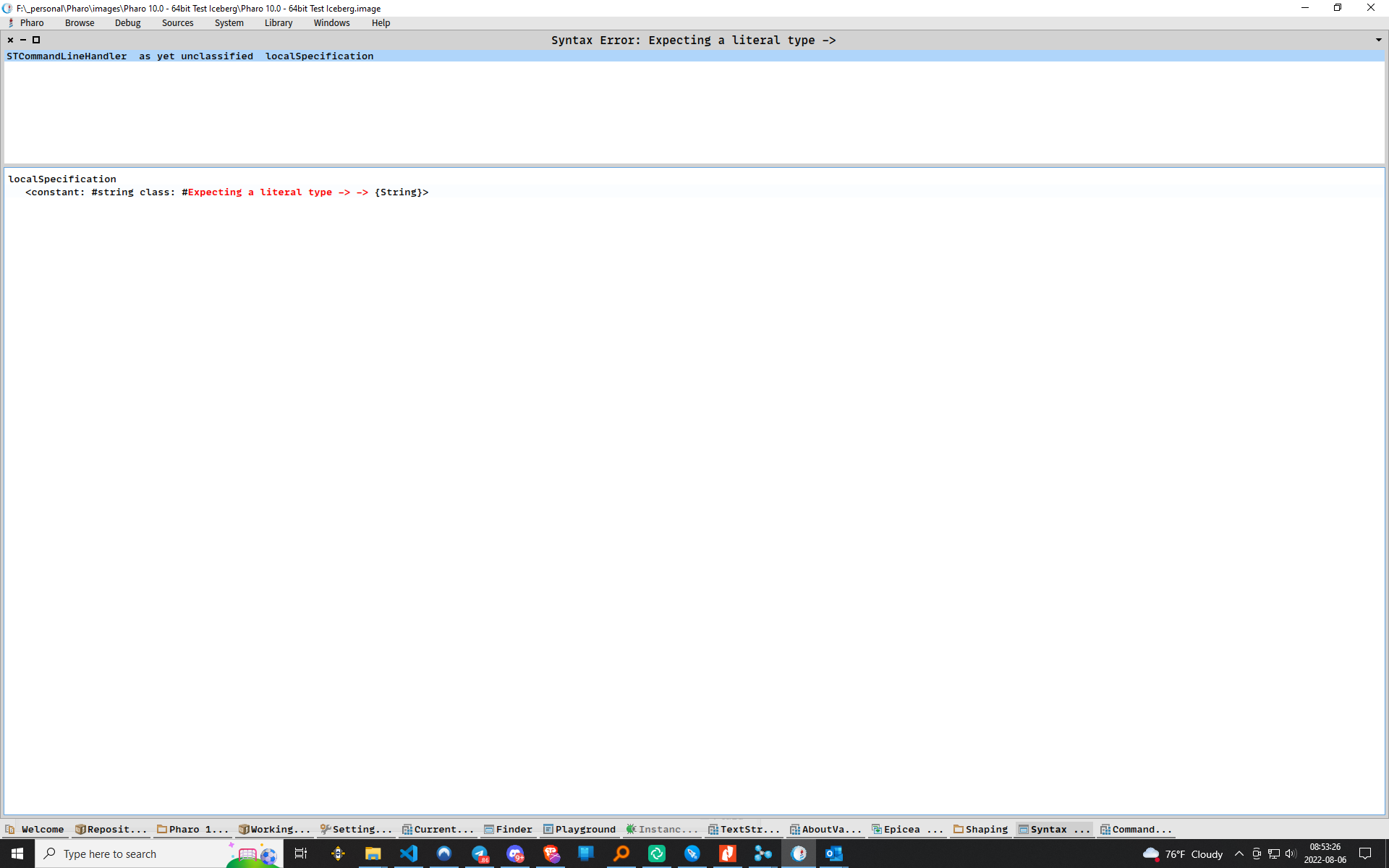
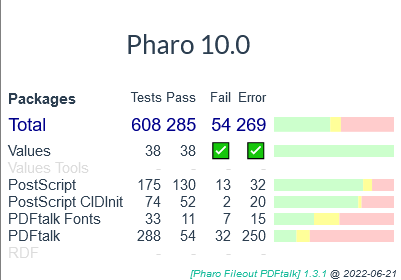
Correction: Iâm betting another DangerousClassNotifier about redefining ByteArray. I donât understand that. The Changes Browser is given a different result. The problem with the chunks occurs later and involves a different class Shaping From: Shaping <shaping@uurda.org> Sent: Sunday, 7 August, 2022 06:33 To: 'Any question about pharo is welcome' <pharo-users@lists.pharo.org> Subject: [Pharo-users] Re: [Pharo-users]Porting from VW 8.3 to Pharo: what to ignore; how to find Pharo base classes not in the base image This is VWâs definition of IntegerArray: Smalltalk.Core defineClass: #IntegerArray superclass: #{Core.ArrayedCollection} indexedType: #none private: false instanceVariableNames: '' classInstanceVariableNames: '' imports: '' category: 'Collections-Arrayed' Iâm stepping through the chunks in the Changes Browser because I donât see an easier way currently. This is a separate tool from Epicea. The first chunk whose file-in fails is: IntegerArray variableByteSubclass: #ByteArray instanceVariableNames: '' classVariableNames: 'LastDecodeMap Decodings LastEncodeMap Encodings Lock' poolDictionaries: 'ForeignHeap' package: 'Shaping-Collection' I donât understand how this definition could have been created. ByteArray is a VW system class. Such classes should not be ported anyways â alone from copyright reasons. The only addition I see is the pool ForeignHeap. I guess, that you extended ByteArray somehow and added an import ForeignHeap.* to ByteArray. Yes I have: ByteArray >> asExternal ^ForeignHeap copyOfByteArray: self Also note that I have a ByteArray class override: Smalltalk.Core defineClass: #ByteArray superclass: #{Core.IntegerArray} indexedType: #bytes private: false instanceVariableNames: '' classInstanceVariableNames: '' imports: ' Shaping.ForeignHeap ' category: 'Collections-Arrayed' that imports my own ForeignHeap. I need to put that method on an existing Pharo class, which should just be its own version of ByteArray. So how do I tell my Shaping Collection package transform to ignore transformation of ByteArrayâs class definition, but preserve any methods in the same package that are extensions? Pool dictionaries are a special beast. Since the great namespace introduction, there are no pool dictionaries in VW anymore. Right. Instead, pool dictionaries are ordinary namespaces which can be imported by a class or namespace. Imports can be either <namespace>.* (general import, which can be used for pools) and <namespace>.<class> for specific imports. I have several specific <namespace>.<class> imports. Unfortunately, I have no way to tell if an import is a pool (or is there?). Conceptionally this is clean thou, since there is no difference between a pool and a namespace. Import are used so that you can use a name directly without its fully qualified namespace path. Since there are no namespaces and your own names in namespaces are automatically renamed, there is no need for those in Pharo. Still there could be real pools⦠I donât think I use any pools. Anyways, imports are put into the class definition as pool dictionaries by default. I think this is a tools issue where the user should be confronted with useful choices. To change the definition of a class to be written, you can add #definitionChanges: to a ClassChange. The argument is a Valuemap (Dictionary) with the constructor argument name as key and the new value. Example for inspiration (all parts used in my code): ClassChange classReference: #{Valuemap} definitionChanges: (Valuemap with: #superclass -> #EsOrderedDictionary with: #comment -> âa new class commentâ with: #instanceVariables -> #() with: #poolDictionaries -> #()) So, if your #ForeignHeap is not really a pool dictionary, you should add ClassChange classReference: #{ByteArray} definitionChanges: (Valuemap with: #poolDictionaries -> #()) Okay, done. Iâll try it. I get a warning that says proceed only if you know what you are doing. Thatâs encouraging. Lol Sorry about that⦠I guess it is about the pool dictionary. But I cannot find where I throw that⦠Itâs not your stuff. The warning is on the Pharo side when Iâm filing in. Iâm being warned about the dangers of redefining ByteArray. How did this definition get created in the first place? More generally and more to the point, Iâm trying to determine an efficient way to determine which classes I will always need to move from VW (like the ones I know to be uniquely mine) versus those I should never try to move from VW because Pharo already has the same by the same name or the same in function by a different nameâbut I cannot easily discover what these classes are without web searches to track down class definitions that exist for Pharo but that are not yet in Pharo, like this one: Metacello new smalltalkhubUser: 'Pharo' project: 'MetaRepoForPharo70'; configuration: 'ArbitraryPrecisionFloat'; version: #stable; load. I have some extensions to APF in VW. I want to port those to Pharo, but the base class must already be there. APF for VW and for Pharo seems like the same code (or very close). So I tracked down the above Metacello evaluable, did it, and now I have APF in Pharo, and I can extend it with my transformed file-in. For this, a PackageChange has a #preload. It can be filled with a dialect specific specification of what to load beforehand. I defined PharoPreload and use it in Squeak :-) (look for the references). Okay. Actually, it should be renamed to MonticelloPreload or so. What you need would be a MetacelloPreload in which you would capture the parameters needed to load that package (and implement â#writeLoadDoitOn: aStreamâ too :-) ). I need to learn more about Monticello and Metacello to design the proper preload objects⦠(or I meet somebody who known everything about it :-) . Something like MetacelloPreload smalltalkhubUser: 'Pharo' project: 'MetaRepoForPharo70' configuration: 'ArbitraryPrecisionFloat' version: #stable So you want to do the actual Pharo preload of the needed Pharo base class on the VW side, and write the resulting class definition to the file-out stream. Iâd have to build the above class and copy from Pharo into VW the code that does Metacello load. It may not be worth the hassle. I might need only this one missing Pharo base class, but I could be wrong about that. Perhaps there are many such classes. Seems I should block the VW class like this: ShapingArbitraryPrecisionFloatTransform ^PackageChange new ignoredNames: #(#{Smalltalk.ArbitraryPrecisionFloat}) Only if you have not extended the class. #ignoredNames: means that nothing of the class will be written out. Okay. And use the APF class that I load into Pharo instead. ⦠I found IntegerArray in Pharo. So I should exclude this one from the transform on the VW side too: ShapingCollectionTransform ^PackageChange new ignoredNames: #(#{Smalltalk.IntegerArray}) No, like above. You want your extensions to be written, I suppose. Okay. Right now Iâm trying to find all Pharo classes that will be bases for the extensions Iâm transforming. That could take a while. Do you have an algo you like? Is there a strategic way to load all the basic repos for Pharo? I see the nine standard repos listed by default in the virgin Repositoryâs list. But not all Pharo code is in Repos. Some, like the APF class above, is in Metacello. As tedious as this is, itâs still much better than pure manual porting. :-) thanks. Okay, letâs try the new addition above and see how it goesâ¦. Running with TargetSmalltalk class>> ShapingCollectionTransform ^PackageChange new add: (ClassChange classReference: #{ByteArray} definitionChanges: (Valuemap with: #poolDictionaries -> #()) ) ⦠The file-in gets past the APF stuff and is failing on setting the comment of a class that is not present. I donât see how that can happen, but the needed class def is not present in the chunk list before or after the comment: send. Shaping Christian I got about 6 seconds into the first file-in. Iâm running empty transforms on all packages. Great. You do need a ProjectChange though. Starting with empty PackageChanges is perfect. Yes, I have the one big ProjectChange with all the PackageChanges (about 25) currently empty. The problem Iâm having is using this Syntax error to determine where in the file-in the problem occurred so that I can know the package whose transform needs work. I was expecting more context. So Iâm poking around in STCommandLineHandler next with breakpoints. Open to suggestions. Strange. The #{String} syntax should have been automatically transformed to #String for Pharo⦠strange. All the namespace related issues (like this literal binding reference) should be taken care of. I had a bunch of those namespace/shared-variable bad-reference problems, which I cleared up for several hours before I was able to produce the first file-in. The transformation machinery is very strict, and helps you clean up your code. Iâd forgotten about many of the things that I was forced to fix. Iâll just debug through the file-in until I find the problem. Shaping. Iâll make my first run soon on my first package. Iâll do one package extra each time I run, building up the code. Each package will have its own <package name>Transform method, per the examples. Iâm not sure how to build these methods, except to assume that rewriting the pharo base methods is never wrong. Iâll file-in the resulting .st file to see what breaks. Then Iâll go back to the package whose .st source is not loading completely and add additional fixes (class keeps, base methods rewrites if needed and missing, method code body replacements if needed) to its transform method until it loads completely on the next run. That could take a while. Is that what you do in practice? Perfect! That is exactly how I do it. I start with an empty PackageChange. Then I add incrementally transforms until the code loads - phase one. This has been achieved for PDFtalk with the first release on GitHub. The second and final phase is to make all tests run (including the new to-write tests). This can take a while, because all syntactic and semantic differences must be addressed. Here, some cross-fertilization is possible. Yeah, and I have to be thorough finally about all my SUnit tests⦠The nice thing is, that the system is always telling you what to do. In fact, at first there are so many issues that it is a lot of fun to browse them and chose a nice one. Always the nicest or easiest bug first :-). Right. Iâm assuming the code writer is taking into account inter-package dependencies in order to get the load order right. Yes. Shaping From: christian.haider@smalltalked-visuals.com <mailto:christian.haider@smalltalked-visuals.com> <christian.haider@smalltalked-visuals.com <mailto:christian.haider@smalltalked-visuals.com> > Sent: Friday, 5 August, 2022 05:53 To: 'Any question about pharo is welcome' <pharo-users@lists.pharo.org <mailto:pharo-users@lists.pharo.org> >; 'Pharo Development List' <pharo-dev@lists.pharo.org <mailto:pharo-dev@lists.pharo.org> > Subject: [Pharo-users] Re: [Pharo-users]Porting from VW 8.3 to Pharo: pdftalkPackageChanges The full project in which the mentioned method used looks like this: PDFtalkProject ^ProjectChange name: #PDFtalk source: ((OrderedCollection new) add: (Package name: #Values); add: (Bundle name: #PDFtalk); add: (Package name: #'Values Testing'); add: (Bundle name: #'PDFtalk Testing'); add: (Package name: #'PDFtalk Demonstrations'); yourself) changes: self pdftalkPackageChanges nameMapping: (NameMapping keep: ((OrderedCollection new) add: #{Smalltalk.PDF}; add: #{PostScript.PSDictionary}; add: #{PDFtalk.PDFObject}; add: #{PDFtalk.PDFArray}; add: #{PDFtalk.PDFDictionary}; add: #{PDFtalk.PDFStream}; add: #{PDFtalk.PDFString}; add: #{PDFtalk.PDFDate}; add: #{PDFtalk.PDFTypeDefinition}; add: #{PDFtalk.PDFEncoder}; yourself) classToNames: ((Valuemap new) add: #{SubscriptOutOfBoundsError} -> #Error; add: #{NonIntegerIndexError} -> #Error; add: #{NotFoundError} -> #KeyNotFound; add: #{KeyNotFoundError} -> #KeyNotFound; yourself) namespaceToPrefixes: ((Valuemap new) add: #{Smalltalk.PostScript} -> 'PS'; add: #{Smalltalk.PDFtalk} -> 'Pt'; add: #{PDFtalk.Fonts} -> 'PtF'; add: #{PDFtalk.Fonts.OpenType} -> 'PtOT'; yourself)) In the #source: are the bundles and packages to be transformed. The #changes: (your method) specify the transforms (PackageChange) for each package explicitly. Only packages contain code and therefore, only packages need the code transformations. Bundles are transformed without transformations. (Well, the code for pre-, post- whatever blocks are transformed with the class name mappings rules). So, the mapping from packages to the corresponding PackageChange has to be stated somehow. Using a dictionary (Valuemap) for this seems also natural. The only change I might like is to use pragmas to tag the PackageChange returning methods with âtheirâ package like <package: âValues Toolsâ> or so. Putting the package reference into the PackageChange is not a good idea, because all those Objects need to be created before your can find out which package is affected. (Ok, I am creating all PackageChange objects tooâ¦). Happy hacking, Christian Von: Shaping <shaping@uurda.org <mailto:shaping@uurda.org> > Gesendet: Freitag, 5. August 2022 03:26 An: 'Any question about pharo is welcome' <pharo-users@lists.pharo.org>; 'Pharo Development List' <pharo-dev@lists.pharo.org <mailto:pharo-dev@lists.pharo.org> > Betreff: [Pharo-users] Re: [Pharo-users]Porting from VW 8.3 to Pharo: pdftalkPackageChanges This method pdftalkPackageChanges ^(Valuemap new) add: 'Values' -> self ValuesTransform; add: 'PostScript' -> self PostScriptTransform; add: 'PDFtalk Basics' -> self PDFtalkBasicsTransform; add: 'PDFtalk Typing' -> self PDFtalkTypingTransform; add: 'PDFtalk Basic Objects' -> self PDFtalkBasicObjectsTransform; add: 'PDFtalk Streams' -> self PDFtalkStreamsTransform; add: 'PDFtalk Data Structures' -> self PDFtalkDataStructuresTransform; add: 'PDFtalk Parsing' -> self PDFtalkParsingTransform; add: 'PDFtalk Colour' -> self PDFtalkColourTransform; add: 'PostScript Fonts' -> self PostScriptFontsTransform; add: 'PostScript CIDInit' -> self PostScriptCIDInitTransform; add: 'PDFtalk Fonts Basics' -> self PDFtalkFontsBasicsTransform; add: 'PDFtalk Fonts Type1' -> self PDFtalkFontsType1Transform; add: 'PDFtalk Fonts OpenType' -> self PDFtalkFontsOpenTypeTransform; add: 'PDFtalk Fonts' -> self PDFtalkFontsTransform; add: 'PDFtalk Graphics' -> self PDFtalkGraphicsTransform; add: 'PDFtalk Graphics Operations' -> self PDFtalkGraphicsOperationsTransform; add: 'PDFtalk XObjects' -> self PDFtalkXObjectsTransform; add: 'PDFtalk Images' -> self PDFtalkImagesTransform; add: 'PDFtalk Files' -> self PDFtalkFilesTransform; add: 'PDFtalk Document' -> self PDFtalkDocumentTransform; add: 'PDFtalk Rendering' -> self PDFtalkRenderingTransform; add: 'PDFtalk Shading' -> self PDFtalkShadingTransform; add: 'PDFtalk Interactive Features' -> self PDFtalkInteractiveFeaturesTransform; add: 'PDFtalk Deploying' -> self PDFtalkDeployingTransform; add: 'Values Testing' -> self ValuesTestingTransform; add: 'PDFtalk test resources' -> self PDFtalkTestResourcesTransform; add: 'PostScript Testing' -> self PostScriptTestingTransform; add: 'PostScript CIDInit Testing' -> self PostScriptCIDInitTestingTransform; add: 'PDFtalk Fonts tests' -> self PDFtalkFontsTestsTransform; add: 'PDFtalk tests' -> self PDFtalkTestsTransform; add: 'PDFtalk Demonstrations' -> self PDFtalkDemonstrationsTransform; yourself effectively looks like the head transform structure for a project, in this case all the PDFtalk stuff, which includes Values and Postscript. This is not exactly a bundle idea, is it? Itâs project spread across potentially many bundles and packages. Iâll start coding my transform with a similar method, and work down toward the details. Takes a bit to get used to all the correct, yet dangling VW methods that are useless in VW, but which will become new code in the target image and there no longer appear to be dangling (with syntax highlighting aberrations). Odd looking but completely by design. Shaping From: Shaping <shaping@uurda.org <mailto:shaping@uurda.org> > Sent: Thursday, 4 August, 2022 19:18 To: 'Any question about pharo is welcome' <pharo-users@lists.pharo.org <mailto:pharo-users@lists.pharo.org> > Subject: [Pharo-users] Re: [Pharo-users]Porting from VW 8.3 to Pharo: Pharo100 fileOutValues I will look, although this kind of always available on demand thing is too disruptive for me⦠I know what you mean. I try be disciplined about it. I really like to be able to fix typos, because there are almost always typos. But e-mail is okay. So that little example is a test that shows how the transformation is done. It converts just package Values to a Pharo-compatible file-in. My task is then to queue a bunch of ProjectChange instances like this one: SmalltalkTransform.Pharo100>> ValuesProject ^ProjectChange name: #Values source: (Array with: (Package name: #Values)) changes: (Valuemap with: 'Values' -> self ValuesTransform) Exactly but for my own packages. No bundles are transformed (just their contained packages) because Pharo doesnât have bundles. Is that right? No, bundles are handled. For real examples, you need to look at the PDFtalk transforms. Yes, Pharo does not have a concept of bundles (ordered aggregates of packages). Instead it relies on a naming convention for packages. That convention is honored in the fileout, so that packages will be partly grouped in Pharo according to the category prefix. For each VW-package, one Pharo package is created. A bundle itself is also represented as Pharo package with one class About<bundlename> with class methods for the metadata of the bundle, including a method giving you the ordered list of component packages. So, all contents and metadata of packages and bundles are transformed for Pharo. No code or info gets lost. Okay. Is method ValuesTransform ^PackageChange ignoredNames: #(#{Smalltalk.GeneralBindingReference}) bridgeClasses: (Valuemap with: #{Timestamp} -> #DateAndTime with: #{Smalltalk.ColorValue} -> #Color) localChanges: self valuesLocalTransform extensions: (Array with: (SystemClassChange className: #Color instanceChanges: (Array with: (Add method: #asColorValue code: #_ph_asColorValue))) with: (SystemClassChange className: #TextStream instanceChanges: (Array with: (Add method: #nextPutAllText: code: #_ph_nextPutAllText:)))) written specifically for that package? I would think it applies to all packages. I see some expected mappings like Timestamp to DateAndTime. Yes, this method returns a PackageChange Value describing the transformations needed to create the Pharo fileout for this specific package (inspect the return value for the fully expanded Value). Methods exist with the same name for other Smalltalks. Depending on the dialect (or version of a dialect), the transforms are different. Squeak and Pharo are quite similar, because they share a common history, but VA or Gemstone need quite different transforms. So, in general, for each package, there is one such method/Value for each target Smalltalk/version. Okay. I do not dare to extract commonalities before the machinery is really robust and stable. For now everything is neatly separate and self-contained (and probably it will stay that way, although there are lots of duplications). The mapping of class names is the responsibility of the enclosing ProjectChange Value where you define the list of source bundles/packages to transform, the PackageChanges for all packages and the mapping of âglobalâ names. (The bridge classes above are no renames, but a subclass relationship (is-a) to avoid renamings. The new class Timestamp will be created as subclass of DateAndTime which has almost the same semantics. Therefore, I can still use Timestamp which will be basically a DateAndTime now.) Okay. There is still a technical challenge here. Currently, a ProjectChange need to include all prerequisites (Values is part of the PDFtalk project and will be transformed with it). A ProjectWriter, which coordinates the transform, keeps track of the mappings when they are created (either explicitly or through a namespace renaming â see implementers of #PDFtalkProject). I would like to have this more modular: the mappings from the Values transformation should be persistently saved, so that other transformation projects can just use them, instead of including the sources into one own project. For this, I need to have renamings local to a package (where they first occur), not global on the project level. Right. For Values and Values Tests and Values Tools this works, because there are no mappings in the Values package. What about conversion of VW arrays to Pharo literal arrays? How is that done? (I think you mean dynamic arrays like {1. âabcâ size. 42} in which evaluation happens (in contrast to literal things which can be resolved already by the compiler). Yes, dynamic arrays. Not! Since a while, VW also has dynamic arrays, but not in VW 8.3 â the last publicly available version. Okay, I was wondering when that would happen. I will not shut out those users, because âopen-sourceâ would be quite absurd, if it is only available for paying customers. In 8.3, the compiler does not accept that syntax and therefore, there is no easy way to represent this in replacement code. So, no. It is not possible until Cincom releases an public version which can handle that. Okay. I recall that one of the Smalltalks (I donât recall which) had Stream semantics differing from VWâs. ⦠I just checked. VWâs #upTo: method includes the object and leaves the index after it, and Pharoâs excludes the object and leaves the index at the object. So that is some major breakage if we donât correct it. Can it be done automatically? Yes, these are the usual porting challenges and exactly the reason why this library exists :). Thank you for the question :). Yes, the stream semantics need to be fixed. The idea is that a set of transforms for this issue can be reused by others. Okay.
valuesLocalTransform
has lots of juicy bits. But this doesnât look very simple. We canât just replace an old method with a new one. We also have to write the new one to tweak how the indices are used in #upTo:, and make sure that new method gets filed-in as well into the Pharo target image. Or, we have to do this kind of change manually. Naa, itâs very easy, I think :). A PackageChange specifies transforms for classes used in the package (#localChanges) and #extensions for system classes of the target. For a class, you can have a ClassChange describing the changes to instance or class methods. A MethodChange has 4 subclasses for: - Ignore â donât write this method to the target - Add â add this new method (not in the source system) to the target - Replace â replace the body of this method with other code - Rewrite â rewrite the method source using a rewrite rule. Add and Replace need the target code. Add then always involves a new name for a method in the target. Replaces use an old name in the target with a new code body. This is stored in another method with a derived name like #_ph_upTo: . The method name is not important, because only the body of the method is used. But the name should not be used in the source â it is just a holder for the replacement code. These methods live in the specific [<Smalltalk> Fileout <Package>] package. Okay. There are lots of working(!) examples for all of those in the PDFtalk transform project. This bit (SystemClassChange className: #Color instanceChanges: (Array with: (Add method: #asColorValue code: #_ph_asColorValue))) is replacing #asColorValue with #_ph_asColorValue because some special Pharo-color conversion needs to happen. But how does #_ph_asColorValue get defined? Itâs neither in VW nor in Pharo 10. You got bitten by the old version of [Pharo Fileout Values]. Please load [Pharo Fileout PDFtalk]. There, the methods exist. Yes, I see it now. Ok. I donât have a virgin image. I have a very non-virgin image, about 27 years of development Iâm trying to port to Pharo. I donât yet have a specific interest in the PDFtalk, though I do see a need for PDF generation later, and will probably revisit that. For now, I just want my own stuff to run in Pharo. Virgin image just means that you donât need anything else. You can safely load it in you favorite special images :). I would load PDFtalk, although technically you donât need to (all the extensions to PDFtalk would be unloadable, but that doesnât affect Values). Okay. is: Load {Values Project] bundle Load {PDFtalk Project} bundle Load {Smalltalk Transform Project} bundle Load [Pharo Fileout PDFtalk] package Save, done Okay, so do I understand correctly that I need to include the PDFtalk stuff even if Iâm not interested in PDFtalk, because thatâs where a lot of the Smalltalk transformation machinery lives? Or is the PDFtalk just being used as an example for how to do a massive transformation? Or Both? No, the transformation machinery is fully independent of PDFtalk. I just tried it. The dependencies are in the specific [Pharo Fileout PDFtalk] package, since I have already quite a few replacement methods which are extensions to PDFtalk classes. Okay. PDFtalk is the focus of the project and therefore all issues are solved first with this library in mind. Therefore, bundles and namespaces are handled, for example. When you study the more interesting transformations for PDFtalk, it would be a shame not to be able to browse the methods and classes involved. So, PDFtalk is the real world reference example. And Values is the simplest example. To transform Values do: âPharo100 fileOutValuesâ The [Pharo Fileout PDFtalk] package includes the latest Values transformations. I am thinking about a better modularization⦠Also, the wiki is a bit out of control. It really needs some restructuring. In the cites wiki page, there is a link to a blog where I record the changes. This might be informative. 2. Port the Values package. This is easy, since no namespaces are involved. This first instruction after VW package setup says to port the contents of the Values package from VW to Pharo. Do you mean manually? Probably not. No, no. This has been finished in March. For each dialect, I have a GitHub repository where I release important versions: <https://github.com/PortingPDFtalk/PharoPDFtalk> https://github.com/PortingPDFtalk/PharoPDFtalk. You can find the working port as first release â <https://github.com/PortingPDFtalk/PharoPDFtalk/releases/tag/1.3.0.0> Working versionâ. There you can download the ported Values fileout with the exact description with which versions of what it was created. This should be a good starting example. Why do I need any new code installed in Pharo before I begin the transformation, if Iâm transforming code from VW to pharo? Iâm not understanding the basic constraints of the problem, even when the detailed steps are clear. No, no. You donât need anything on the Pharo side. The fileouts on GitHub are the end products of a transformation for people who donât use VisualWorks, but want to use Values in Pharo. Or help with PDFtalk by fixing some issues, so that I can write the transformations. Iâve done these steps so far: 1. Went to <https://github.com/PortingPDFtalk/PharoPDFtalk> https://github.com/PortingPDFtalk/PharoPDFtalk. Mistake :). You donât want to look at the unfinished product of the current version of thincomplete transformations for PDFtalk. Do you mean âfinishedâ here? Isnât that file-in the finished result? I thought the above links was the currently finished result (as good as it can be until the rest of the bugs are goine and tests all run). Yes, that was confusing. Thatâs why I had the early impression that Values was somehow apart of the transformation machinery. See https://wiki.pdftalk.de/doku.php?id=stateoftheport#pharo-10-0: Instead, you want to look at the unfinished product of the transformations of your projects :). 2. Saved down PDFtalk.Pharo100.st into <my Pharo 10 image directory>/pharo-local/Smalltalk-Transformation. (I figured that was a good place to save it. If anyone disagrees, or has a better or more conventional idea about where files should be saved, please say so. I setup a Pharo Git repo and played with it briefly for the first time yesterday. Iâve used Pharo off an on for 16 years, but this is the first time Iâm making a serious effort to manage source, and not throw away what Iâm working on.) 3. Filed-in PDFtalk.Pharo100.st. This went on for about 7 minutes or so. I have a hundreds if not over a thousand classes showing in Epicea. Is there anyway to get Epicea to give me a count of changes with a time-range filter? 4. Deleted (forgot) yesterdayâs, old Main practice-repo from both the image and the drive, and made a new one. I need to add to Main all the packages I just filed-in, but I donât see an efficient way to do that. I would like to use the Add Package button, but this gives a filtered list of available packages. I can filter subgroups, and then individually select each of the checkboxes to the left of each package (there is no Ctrl-A [select all] option here, which seems to be a strange omission given the potentially large number of packages involved). I see lots of prefixes for the classes just loaded. I could easily miss something if I filter/select/add one prefix-group at a time. Is there an easier way? Over in Epicea I donât see a way to push the loaded items listed to a specific repo. The first thought I have is to select all filed-in code artifacts by datetime span. I did that and saved it as an .ombu file (I have no idea what that is). I donât see a way to import that .ombu file into repo Mainâs âWorking copyâ window. It must be easy, but I donât see it. Please suggest the best way. Iâd like to know as well â I am not quite familiar with the source management concepts in Pharo. I asked in Discord. I donât understand why stuff like this is missing. The only conclusion I can draw is that no one does huge file-ins (but you do). It is planned to generate Tonel output in the future, but for now I feel safer with the traditional fileout where I can have doIts. I am not sure how Tonel reacts to crippled sources, which are normal during the development of the transformations. Shaping From: christian.haider <christian.haider@smalltalked-visuals.com <mailto:christian.haider@smalltalked-visuals.com> > Sent: Wednesday, 22 June, 2022 05:42 To: pharo-users@lists.pharo.org <mailto:pharo-users@lists.pharo.org> Subject: [Pharo-users] [PDFtalk] second fileOut for Squeak and Pharo With help from the community some issues were fixed which improved the test statistics nicely. Check it out: https://wiki.pdftalk.de/doku.php?id=portingblog#second_pdftalk_fileout_for_s... Thanks to everybody involved! Happy hacking, Christian
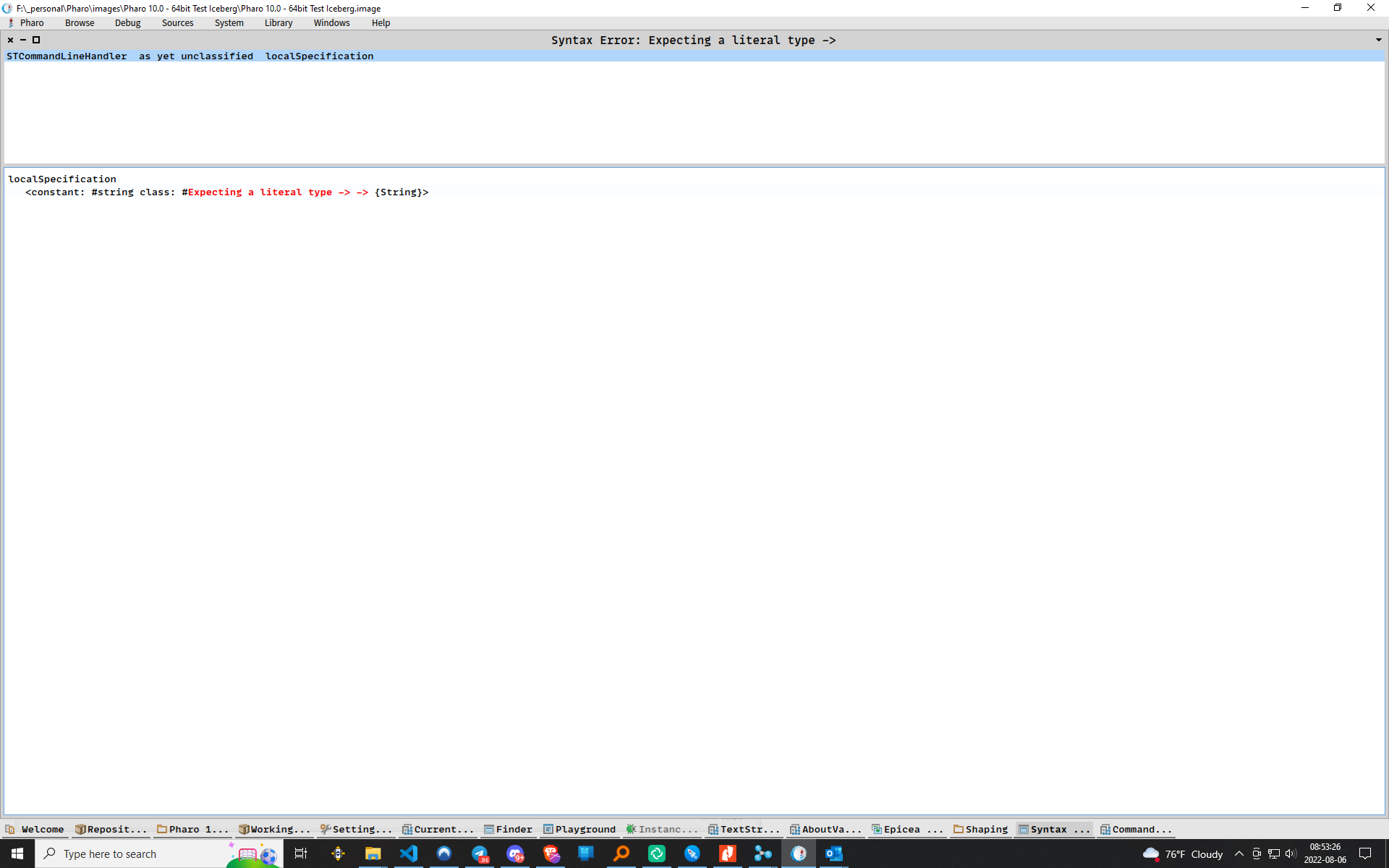
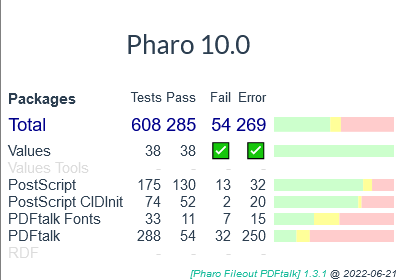
Correction: Iâm getting another DangerousClassNotifier about redefining ByteArray. I donât understand that. The Changes Browser is given a different result. The problem with the chunks occurs later and involves a different class Shaping From: Shaping <shaping@uurda.org <mailto:shaping@uurda.org> > Sent: Sunday, 7 August, 2022 06:33 To: 'Any question about pharo is welcome' <pharo-users@lists.pharo.org <mailto:pharo-users@lists.pharo.org> > Subject: [Pharo-users] Re: [Pharo-users]Porting from VW 8.3 to Pharo: what to ignore; how to find Pharo base classes not in the base image This is VWâs definition of IntegerArray: Smalltalk.Core defineClass: #IntegerArray superclass: #{Core.ArrayedCollection} indexedType: #none private: false instanceVariableNames: '' classInstanceVariableNames: '' imports: '' category: 'Collections-Arrayed' Iâm stepping through the chunks in the Changes Browser because I donât see an easier way currently. This is a separate tool from Epicea. The first chunk whose file-in fails is: IntegerArray variableByteSubclass: #ByteArray instanceVariableNames: '' classVariableNames: 'LastDecodeMap Decodings LastEncodeMap Encodings Lock' poolDictionaries: 'ForeignHeap' package: 'Shaping-Collection' I donât understand how this definition could have been created. ByteArray is a VW system class. Such classes should not be ported anyways â alone from copyright reasons. The only addition I see is the pool ForeignHeap. I guess, that you extended ByteArray somehow and added an import ForeignHeap.* to ByteArray. Yes I have: ByteArray >> asExternal ^ForeignHeap copyOfByteArray: self Also note that I have a ByteArray class override: Smalltalk.Core defineClass: #ByteArray superclass: #{Core.IntegerArray} indexedType: #bytes private: false instanceVariableNames: '' classInstanceVariableNames: '' imports: ' Shaping.ForeignHeap ' category: 'Collections-Arrayed' that imports my own ForeignHeap. I need to put that method on an existing Pharo class, which should just be its own version of ByteArray. So how do I tell my Shaping Collection package transform to ignore transformation of ByteArrayâs class definition, but preserve any methods in the same package that are extensions? Pool dictionaries are a special beast. Since the great namespace introduction, there are no pool dictionaries in VW anymore. Right. Instead, pool dictionaries are ordinary namespaces which can be imported by a class or namespace. Imports can be either <namespace>.* (general import, which can be used for pools) and <namespace>.<class> for specific imports. I have several specific <namespace>.<class> imports. Unfortunately, I have no way to tell if an import is a pool (or is there?). Conceptionally this is clean thou, since there is no difference between a pool and a namespace. Import are used so that you can use a name directly without its fully qualified namespace path. Since there are no namespaces and your own names in namespaces are automatically renamed, there is no need for those in Pharo. Still there could be real pools⦠I donât think I use any pools. Anyways, imports are put into the class definition as pool dictionaries by default. I think this is a tools issue where the user should be confronted with useful choices. To change the definition of a class to be written, you can add #definitionChanges: to a ClassChange. The argument is a Valuemap (Dictionary) with the constructor argument name as key and the new value. Example for inspiration (all parts used in my code): ClassChange classReference: #{Valuemap} definitionChanges: (Valuemap with: #superclass -> #EsOrderedDictionary with: #comment -> âa new class commentâ with: #instanceVariables -> #() with: #poolDictionaries -> #()) So, if your #ForeignHeap is not really a pool dictionary, you should add ClassChange classReference: #{ByteArray} definitionChanges: (Valuemap with: #poolDictionaries -> #()) Okay, done. Iâll try it. I get a warning that says proceed only if you know what you are doing. Thatâs encouraging. Lol Sorry about that⦠I guess it is about the pool dictionary. But I cannot find where I throw that⦠Itâs not your stuff. The warning is on the Pharo side when Iâm filing in. Iâm being warned about the dangers of redefining ByteArray. How did this definition get created in the first place? More generally and more to the point, Iâm trying to determine an efficient way to determine which classes I will always need to move from VW (like the ones I know to be uniquely mine) versus those I should never try to move from VW because Pharo already has the same by the same name or the same in function by a different nameâbut I cannot easily discover what these classes are without web searches to track down class definitions that exist for Pharo but that are not yet in Pharo, like this one: Metacello new smalltalkhubUser: 'Pharo' project: 'MetaRepoForPharo70'; configuration: 'ArbitraryPrecisionFloat'; version: #stable; load. I have some extensions to APF in VW. I want to port those to Pharo, but the base class must already be there. APF for VW and for Pharo seems like the same code (or very close). So I tracked down the above Metacello evaluable, did it, and now I have APF in Pharo, and I can extend it with my transformed file-in. For this, a PackageChange has a #preload. It can be filled with a dialect specific specification of what to load beforehand. I defined PharoPreload and use it in Squeak :-) (look for the references). Okay. Actually, it should be renamed to MonticelloPreload or so. What you need would be a MetacelloPreload in which you would capture the parameters needed to load that package (and implement â#writeLoadDoitOn: aStreamâ too :-) ). I need to learn more about Monticello and Metacello to design the proper preload objects⦠(or I meet somebody who known everything about it :-) . Something like MetacelloPreload smalltalkhubUser: 'Pharo' project: 'MetaRepoForPharo70' configuration: 'ArbitraryPrecisionFloat' version: #stable So you want to do the actual Pharo preload of the needed Pharo base class on the VW side, and write the resulting class definition to the file-out stream. Iâd have to build the above class and copy from Pharo into VW the code that does Metacello load. It may not be worth the hassle. I might need only this one missing Pharo base class, but I could be wrong about that. Perhaps there are many such classes. Seems I should block the VW class like this: ShapingArbitraryPrecisionFloatTransform ^PackageChange new ignoredNames: #(#{Smalltalk.ArbitraryPrecisionFloat}) Only if you have not extended the class. #ignoredNames: means that nothing of the class will be written out. Okay. And use the APF class that I load into Pharo instead. ⦠I found IntegerArray in Pharo. So I should exclude this one from the transform on the VW side too: ShapingCollectionTransform ^PackageChange new ignoredNames: #(#{Smalltalk.IntegerArray}) No, like above. You want your extensions to be written, I suppose. Okay. Right now Iâm trying to find all Pharo classes that will be bases for the extensions Iâm transforming. That could take a while. Do you have an algo you like? Is there a strategic way to load all the basic repos for Pharo? I see the nine standard repos listed by default in the virgin Repositoryâs list. But not all Pharo code is in Repos. Some, like the APF class above, is in Metacello. As tedious as this is, itâs still much better than pure manual porting. :-) thanks. Okay, letâs try the new addition above and see how it goesâ¦. Running with TargetSmalltalk class>> ShapingCollectionTransform ^PackageChange new add: (ClassChange classReference: #{ByteArray} definitionChanges: (Valuemap with: #poolDictionaries -> #()) ) ⦠The file-in gets past the APF stuff and is failing on setting the comment of a class that is not present. I donât see how that can happen, but the needed class def is not present in the chunk list before or after the comment: send. Shaping Christian I got about 6 seconds into the first file-in. Iâm running empty transforms on all packages. Great. You do need a ProjectChange though. Starting with empty PackageChanges is perfect. Yes, I have the one big ProjectChange with all the PackageChanges (about 25) currently empty. The problem Iâm having is using this Syntax error to determine where in the file-in the problem occurred so that I can know the package whose transform needs work. I was expecting more context. So Iâm poking around in STCommandLineHandler next with breakpoints. Open to suggestions. Strange. The #{String} syntax should have been automatically transformed to #String for Pharo⦠strange. All the namespace related issues (like this literal binding reference) should be taken care of. I had a bunch of those namespace/shared-variable bad-reference problems, which I cleared up for several hours before I was able to produce the first file-in. The transformation machinery is very strict, and helps you clean up your code. Iâd forgotten about many of the things that I was forced to fix. Iâll just debug through the file-in until I find the problem. Shaping. Iâll make my first run soon on my first package. Iâll do one package extra each time I run, building up the code. Each package will have its own <package name>Transform method, per the examples. Iâm not sure how to build these methods, except to assume that rewriting the pharo base methods is never wrong. Iâll file-in the resulting .st file to see what breaks. Then Iâll go back to the package whose .st source is not loading completely and add additional fixes (class keeps, base methods rewrites if needed and missing, method code body replacements if needed) to its transform method until it loads completely on the next run. That could take a while. Is that what you do in practice? Perfect! That is exactly how I do it. I start with an empty PackageChange. Then I add incrementally transforms until the code loads - phase one. This has been achieved for PDFtalk with the first release on GitHub. The second and final phase is to make all tests run (including the new to-write tests). This can take a while, because all syntactic and semantic differences must be addressed. Here, some cross-fertilization is possible. Yeah, and I have to be thorough finally about all my SUnit tests⦠The nice thing is, that the system is always telling you what to do. In fact, at first there are so many issues that it is a lot of fun to browse them and chose a nice one. Always the nicest or easiest bug first :-). Right. Iâm assuming the code writer is taking into account inter-package dependencies in order to get the load order right. Yes. Shaping From: christian.haider@smalltalked-visuals.com <mailto:christian.haider@smalltalked-visuals.com> <christian.haider@smalltalked-visuals.com <mailto:christian.haider@smalltalked-visuals.com> > Sent: Friday, 5 August, 2022 05:53 To: 'Any question about pharo is welcome' <pharo-users@lists.pharo.org <mailto:pharo-users@lists.pharo.org> >; 'Pharo Development List' <pharo-dev@lists.pharo.org <mailto:pharo-dev@lists.pharo.org> > Subject: [Pharo-users] Re: [Pharo-users]Porting from VW 8.3 to Pharo: pdftalkPackageChanges The full project in which the mentioned method used looks like this: PDFtalkProject ^ProjectChange name: #PDFtalk source: ((OrderedCollection new) add: (Package name: #Values); add: (Bundle name: #PDFtalk); add: (Package name: #'Values Testing'); add: (Bundle name: #'PDFtalk Testing'); add: (Package name: #'PDFtalk Demonstrations'); yourself) changes: self pdftalkPackageChanges nameMapping: (NameMapping keep: ((OrderedCollection new) add: #{Smalltalk.PDF}; add: #{PostScript.PSDictionary}; add: #{PDFtalk.PDFObject}; add: #{PDFtalk.PDFArray}; add: #{PDFtalk.PDFDictionary}; add: #{PDFtalk.PDFStream}; add: #{PDFtalk.PDFString}; add: #{PDFtalk.PDFDate}; add: #{PDFtalk.PDFTypeDefinition}; add: #{PDFtalk.PDFEncoder}; yourself) classToNames: ((Valuemap new) add: #{SubscriptOutOfBoundsError} -> #Error; add: #{NonIntegerIndexError} -> #Error; add: #{NotFoundError} -> #KeyNotFound; add: #{KeyNotFoundError} -> #KeyNotFound; yourself) namespaceToPrefixes: ((Valuemap new) add: #{Smalltalk.PostScript} -> 'PS'; add: #{Smalltalk.PDFtalk} -> 'Pt'; add: #{PDFtalk.Fonts} -> 'PtF'; add: #{PDFtalk.Fonts.OpenType} -> 'PtOT'; yourself)) In the #source: are the bundles and packages to be transformed. The #changes: (your method) specify the transforms (PackageChange) for each package explicitly. Only packages contain code and therefore, only packages need the code transformations. Bundles are transformed without transformations. (Well, the code for pre-, post- whatever blocks are transformed with the class name mappings rules). So, the mapping from packages to the corresponding PackageChange has to be stated somehow. Using a dictionary (Valuemap) for this seems also natural. The only change I might like is to use pragmas to tag the PackageChange returning methods with âtheirâ package like <package: âValues Toolsâ> or so. Putting the package reference into the PackageChange is not a good idea, because all those Objects need to be created before your can find out which package is affected. (Ok, I am creating all PackageChange objects tooâ¦). Happy hacking, Christian Von: Shaping <shaping@uurda.org <mailto:shaping@uurda.org> > Gesendet: Freitag, 5. August 2022 03:26 An: 'Any question about pharo is welcome' <pharo-users@lists.pharo.org <mailto:pharo-users@lists.pharo.org> >; 'Pharo Development List' <pharo-dev@lists.pharo.org <mailto:pharo-dev@lists.pharo.org> > Betreff: [Pharo-users] Re: [Pharo-users]Porting from VW 8.3 to Pharo: pdftalkPackageChanges This method pdftalkPackageChanges ^(Valuemap new) add: 'Values' -> self ValuesTransform; add: 'PostScript' -> self PostScriptTransform; add: 'PDFtalk Basics' -> self PDFtalkBasicsTransform; add: 'PDFtalk Typing' -> self PDFtalkTypingTransform; add: 'PDFtalk Basic Objects' -> self PDFtalkBasicObjectsTransform; add: 'PDFtalk Streams' -> self PDFtalkStreamsTransform; add: 'PDFtalk Data Structures' -> self PDFtalkDataStructuresTransform; add: 'PDFtalk Parsing' -> self PDFtalkParsingTransform; add: 'PDFtalk Colour' -> self PDFtalkColourTransform; add: 'PostScript Fonts' -> self PostScriptFontsTransform; add: 'PostScript CIDInit' -> self PostScriptCIDInitTransform; add: 'PDFtalk Fonts Basics' -> self PDFtalkFontsBasicsTransform; add: 'PDFtalk Fonts Type1' -> self PDFtalkFontsType1Transform; add: 'PDFtalk Fonts OpenType' -> self PDFtalkFontsOpenTypeTransform; add: 'PDFtalk Fonts' -> self PDFtalkFontsTransform; add: 'PDFtalk Graphics' -> self PDFtalkGraphicsTransform; add: 'PDFtalk Graphics Operations' -> self PDFtalkGraphicsOperationsTransform; add: 'PDFtalk XObjects' -> self PDFtalkXObjectsTransform; add: 'PDFtalk Images' -> self PDFtalkImagesTransform; add: 'PDFtalk Files' -> self PDFtalkFilesTransform; add: 'PDFtalk Document' -> self PDFtalkDocumentTransform; add: 'PDFtalk Rendering' -> self PDFtalkRenderingTransform; add: 'PDFtalk Shading' -> self PDFtalkShadingTransform; add: 'PDFtalk Interactive Features' -> self PDFtalkInteractiveFeaturesTransform; add: 'PDFtalk Deploying' -> self PDFtalkDeployingTransform; add: 'Values Testing' -> self ValuesTestingTransform; add: 'PDFtalk test resources' -> self PDFtalkTestResourcesTransform; add: 'PostScript Testing' -> self PostScriptTestingTransform; add: 'PostScript CIDInit Testing' -> self PostScriptCIDInitTestingTransform; add: 'PDFtalk Fonts tests' -> self PDFtalkFontsTestsTransform; add: 'PDFtalk tests' -> self PDFtalkTestsTransform; add: 'PDFtalk Demonstrations' -> self PDFtalkDemonstrationsTransform; yourself effectively looks like the head transform structure for a project, in this case all the PDFtalk stuff, which includes Values and Postscript. This is not exactly a bundle idea, is it? Itâs project spread across potentially many bundles and packages. Iâll start coding my transform with a similar method, and work down toward the details. Takes a bit to get used to all the correct, yet dangling VW methods that are useless in VW, but which will become new code in the target image and there no longer appear to be dangling (with syntax highlighting aberrations). Odd looking but completely by design. Shaping From: Shaping <shaping@uurda.org <mailto:shaping@uurda.org> > Sent: Thursday, 4 August, 2022 19:18 To: 'Any question about pharo is welcome' <pharo-users@lists.pharo.org <mailto:pharo-users@lists.pharo.org> > Subject: [Pharo-users] Re: [Pharo-users]Porting from VW 8.3 to Pharo: Pharo100 fileOutValues I will look, although this kind of always available on demand thing is too disruptive for me⦠I know what you mean. I try be disciplined about it. I really like to be able to fix typos, because there are almost always typos. But e-mail is okay. So that little example is a test that shows how the transformation is done. It converts just package Values to a Pharo-compatible file-in. My task is then to queue a bunch of ProjectChange instances like this one: SmalltalkTransform.Pharo100>> ValuesProject ^ProjectChange name: #Values source: (Array with: (Package name: #Values)) changes: (Valuemap with: 'Values' -> self ValuesTransform) Exactly but for my own packages. No bundles are transformed (just their contained packages) because Pharo doesnât have bundles. Is that right? No, bundles are handled. For real examples, you need to look at the PDFtalk transforms. Yes, Pharo does not have a concept of bundles (ordered aggregates of packages). Instead it relies on a naming convention for packages. That convention is honored in the fileout, so that packages will be partly grouped in Pharo according to the category prefix. For each VW-package, one Pharo package is created. A bundle itself is also represented as Pharo package with one class About<bundlename> with class methods for the metadata of the bundle, including a method giving you the ordered list of component packages. So, all contents and metadata of packages and bundles are transformed for Pharo. No code or info gets lost. Okay. Is method ValuesTransform ^PackageChange ignoredNames: #(#{Smalltalk.GeneralBindingReference}) bridgeClasses: (Valuemap with: #{Timestamp} -> #DateAndTime with: #{Smalltalk.ColorValue} -> #Color) localChanges: self valuesLocalTransform extensions: (Array with: (SystemClassChange className: #Color instanceChanges: (Array with: (Add method: #asColorValue code: #_ph_asColorValue))) with: (SystemClassChange className: #TextStream instanceChanges: (Array with: (Add method: #nextPutAllText: code: #_ph_nextPutAllText:)))) written specifically for that package? I would think it applies to all packages. I see some expected mappings like Timestamp to DateAndTime. Yes, this method returns a PackageChange Value describing the transformations needed to create the Pharo fileout for this specific package (inspect the return value for the fully expanded Value). Methods exist with the same name for other Smalltalks. Depending on the dialect (or version of a dialect), the transforms are different. Squeak and Pharo are quite similar, because they share a common history, but VA or Gemstone need quite different transforms. So, in general, for each package, there is one such method/Value for each target Smalltalk/version. Okay. I do not dare to extract commonalities before the machinery is really robust and stable. For now everything is neatly separate and self-contained (and probably it will stay that way, although there are lots of duplications). The mapping of class names is the responsibility of the enclosing ProjectChange Value where you define the list of source bundles/packages to transform, the PackageChanges for all packages and the mapping of âglobalâ names. (The bridge classes above are no renames, but a subclass relationship (is-a) to avoid renamings. The new class Timestamp will be created as subclass of DateAndTime which has almost the same semantics. Therefore, I can still use Timestamp which will be basically a DateAndTime now.) Okay. There is still a technical challenge here. Currently, a ProjectChange need to include all prerequisites (Values is part of the PDFtalk project and will be transformed with it). A ProjectWriter, which coordinates the transform, keeps track of the mappings when they are created (either explicitly or through a namespace renaming â see implementers of #PDFtalkProject). I would like to have this more modular: the mappings from the Values transformation should be persistently saved, so that other transformation projects can just use them, instead of including the sources into one own project. For this, I need to have renamings local to a package (where they first occur), not global on the project level. Right. For Values and Values Tests and Values Tools this works, because there are no mappings in the Values package. What about conversion of VW arrays to Pharo literal arrays? How is that done? (I think you mean dynamic arrays like {1. âabcâ size. 42} in which evaluation happens (in contrast to literal things which can be resolved already by the compiler). Yes, dynamic arrays. Not! Since a while, VW also has dynamic arrays, but not in VW 8.3 â the last publicly available version. Okay, I was wondering when that would happen. I will not shut out those users, because âopen-sourceâ would be quite absurd, if it is only available for paying customers. In 8.3, the compiler does not accept that syntax and therefore, there is no easy way to represent this in replacement code. So, no. It is not possible until Cincom releases an public version which can handle that. Okay. I recall that one of the Smalltalks (I donât recall which) had Stream semantics differing from VWâs. ⦠I just checked. VWâs #upTo: method includes the object and leaves the index after it, and Pharoâs excludes the object and leaves the index at the object. So that is some major breakage if we donât correct it. Can it be done automatically? Yes, these are the usual porting challenges and exactly the reason why this library exists :). Thank you for the question :). Yes, the stream semantics need to be fixed. The idea is that a set of transforms for this issue can be reused by others. Okay.
valuesLocalTransform
has lots of juicy bits. But this doesnât look very simple. We canât just replace an old method with a new one. We also have to write the new one to tweak how the indices are used in #upTo:, and make sure that new method gets filed-in as well into the Pharo target image. Or, we have to do this kind of change manually. Naa, itâs very easy, I think :). A PackageChange specifies transforms for classes used in the package (#localChanges) and #extensions for system classes of the target. For a class, you can have a ClassChange describing the changes to instance or class methods. A MethodChange has 4 subclasses for: - Ignore â donât write this method to the target - Add â add this new method (not in the source system) to the target - Replace â replace the body of this method with other code - Rewrite â rewrite the method source using a rewrite rule. Add and Replace need the target code. Add then always involves a new name for a method in the target. Replaces use an old name in the target with a new code body. This is stored in another method with a derived name like #_ph_upTo: . The method name is not important, because only the body of the method is used. But the name should not be used in the source â it is just a holder for the replacement code. These methods live in the specific [<Smalltalk> Fileout <Package>] package. Okay. There are lots of working(!) examples for all of those in the PDFtalk transform project. This bit (SystemClassChange className: #Color instanceChanges: (Array with: (Add method: #asColorValue code: #_ph_asColorValue))) is replacing #asColorValue with #_ph_asColorValue because some special Pharo-color conversion needs to happen. But how does #_ph_asColorValue get defined? Itâs neither in VW nor in Pharo 10. You got bitten by the old version of [Pharo Fileout Values]. Please load [Pharo Fileout PDFtalk]. There, the methods exist. Yes, I see it now. Ok. I donât have a virgin image. I have a very non-virgin image, about 27 years of development Iâm trying to port to Pharo. I donât yet have a specific interest in the PDFtalk, though I do see a need for PDF generation later, and will probably revisit that. For now, I just want my own stuff to run in Pharo. Virgin image just means that you donât need anything else. You can safely load it in you favorite special images :). I would load PDFtalk, although technically you donât need to (all the extensions to PDFtalk would be unloadable, but that doesnât affect Values). Okay. is: Load {Values Project] bundle Load {PDFtalk Project} bundle Load {Smalltalk Transform Project} bundle Load [Pharo Fileout PDFtalk] package Save, done Okay, so do I understand correctly that I need to include the PDFtalk stuff even if Iâm not interested in PDFtalk, because thatâs where a lot of the Smalltalk transformation machinery lives? Or is the PDFtalk just being used as an example for how to do a massive transformation? Or Both? No, the transformation machinery is fully independent of PDFtalk. I just tried it. The dependencies are in the specific [Pharo Fileout PDFtalk] package, since I have already quite a few replacement methods which are extensions to PDFtalk classes. Okay. PDFtalk is the focus of the project and therefore all issues are solved first with this library in mind. Therefore, bundles and namespaces are handled, for example. When you study the more interesting transformations for PDFtalk, it would be a shame not to be able to browse the methods and classes involved. So, PDFtalk is the real world reference example. And Values is the simplest example. To transform Values do: âPharo100 fileOutValuesâ The [Pharo Fileout PDFtalk] package includes the latest Values transformations. I am thinking about a better modularization⦠Also, the wiki is a bit out of control. It really needs some restructuring. In the cites wiki page, there is a link to a blog where I record the changes. This might be informative. 2. Port the Values package. This is easy, since no namespaces are involved. This first instruction after VW package setup says to port the contents of the Values package from VW to Pharo. Do you mean manually? Probably not. No, no. This has been finished in March. For each dialect, I have a GitHub repository where I release important versions: <https://github.com/PortingPDFtalk/PharoPDFtalk> https://github.com/PortingPDFtalk/PharoPDFtalk. You can find the working port as first release â <https://github.com/PortingPDFtalk/PharoPDFtalk/releases/tag/1.3.0.0> Working versionâ. There you can download the ported Values fileout with the exact description with which versions of what it was created. This should be a good starting example. Why do I need any new code installed in Pharo before I begin the transformation, if Iâm transforming code from VW to pharo? Iâm not understanding the basic constraints of the problem, even when the detailed steps are clear. No, no. You donât need anything on the Pharo side. The fileouts on GitHub are the end products of a transformation for people who donât use VisualWorks, but want to use Values in Pharo. Or help with PDFtalk by fixing some issues, so that I can write the transformations. Iâve done these steps so far: 1. Went to <https://github.com/PortingPDFtalk/PharoPDFtalk> https://github.com/PortingPDFtalk/PharoPDFtalk. Mistake :). You donât want to look at the unfinished product of the current version of thincomplete transformations for PDFtalk. Do you mean âfinishedâ here? Isnât that file-in the finished result? I thought the above links was the currently finished result (as good as it can be until the rest of the bugs are goine and tests all run). Yes, that was confusing. Thatâs why I had the early impression that Values was somehow apart of the transformation machinery. See https://wiki.pdftalk.de/doku.php?id=stateoftheport#pharo-10-0: Instead, you want to look at the unfinished product of the transformations of your projects :). 2. Saved down PDFtalk.Pharo100.st into <my Pharo 10 image directory>/pharo-local/Smalltalk-Transformation. (I figured that was a good place to save it. If anyone disagrees, or has a better or more conventional idea about where files should be saved, please say so. I setup a Pharo Git repo and played with it briefly for the first time yesterday. Iâve used Pharo off an on for 16 years, but this is the first time Iâm making a serious effort to manage source, and not throw away what Iâm working on.) 3. Filed-in PDFtalk.Pharo100.st. This went on for about 7 minutes or so. I have a hundreds if not over a thousand classes showing in Epicea. Is there anyway to get Epicea to give me a count of changes with a time-range filter? 4. Deleted (forgot) yesterdayâs, old Main practice-repo from both the image and the drive, and made a new one. I need to add to Main all the packages I just filed-in, but I donât see an efficient way to do that. I would like to use the Add Package button, but this gives a filtered list of available packages. I can filter subgroups, and then individually select each of the checkboxes to the left of each package (there is no Ctrl-A [select all] option here, which seems to be a strange omission given the potentially large number of packages involved). I see lots of prefixes for the classes just loaded. I could easily miss something if I filter/select/add one prefix-group at a time. Is there an easier way? Over in Epicea I donât see a way to push the loaded items listed to a specific repo. The first thought I have is to select all filed-in code artifacts by datetime span. I did that and saved it as an .ombu file (I have no idea what that is). I donât see a way to import that .ombu file into repo Mainâs âWorking copyâ window. It must be easy, but I donât see it. Please suggest the best way. Iâd like to know as well â I am not quite familiar with the source management concepts in Pharo. I asked in Discord. I donât understand why stuff like this is missing. The only conclusion I can draw is that no one does huge file-ins (but you do). It is planned to generate Tonel output in the future, but for now I feel safer with the traditional fileout where I can have doIts. I am not sure how Tonel reacts to crippled sources, which are normal during the development of the transformations. Shaping From: christian.haider <christian.haider@smalltalked-visuals.com <mailto:christian.haider@smalltalked-visuals.com> > Sent: Wednesday, 22 June, 2022 05:42 To: pharo-users@lists.pharo.org <mailto:pharo-users@lists.pharo.org> Subject: [Pharo-users] [PDFtalk] second fileOut for Squeak and Pharo With help from the community some issues were fixed which improved the test statistics nicely. Check it out: https://wiki.pdftalk.de/doku.php?id=portingblog#second_pdftalk_fileout_for_s... Thanks to everybody involved! Happy hacking, Christian
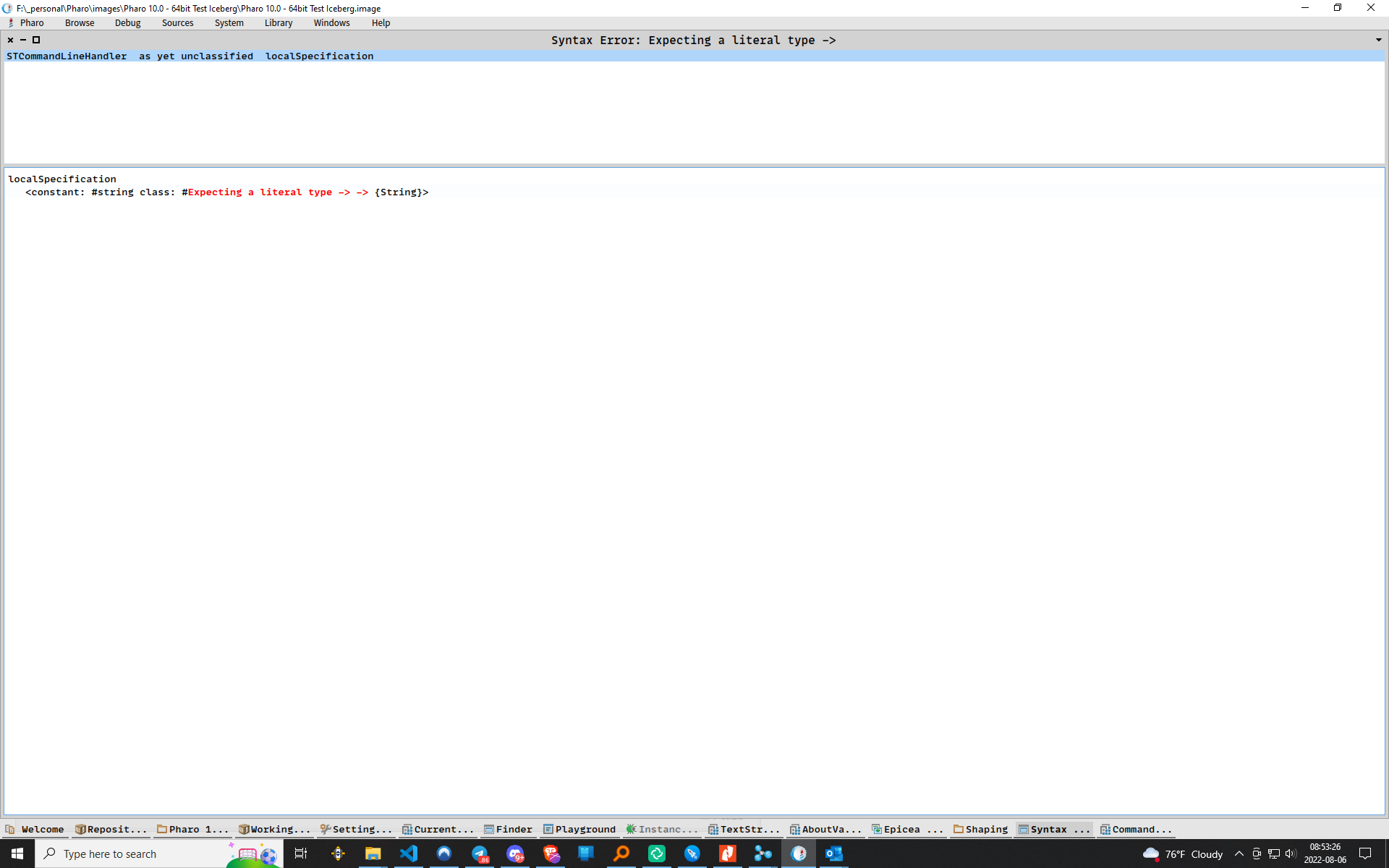
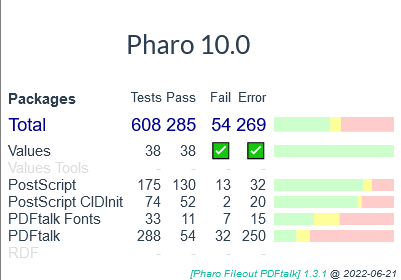
Von: Shaping <shaping@uurda.org> Gesendet: Sonntag, 7. August 2022 13:33 An: 'Any question about pharo is welcome' <pharo-users@lists.pharo.org> Betreff: [Pharo-users] Re: [Pharo-users]Porting from VW 8.3 to Pharo: what to ignore; how to find Pharo base classes not in the base image This is VWâs definition of IntegerArray: Smalltalk.Core defineClass: #IntegerArray superclass: #{Core.ArrayedCollection} indexedType: #none private: false instanceVariableNames: '' classInstanceVariableNames: '' imports: '' category: 'Collections-Arrayed' Iâm stepping through the chunks in the Changes Browser because I donât see an easier way currently. This is a separate tool from Epicea. The first chunk whose file-in fails is: IntegerArray variableByteSubclass: #ByteArray instanceVariableNames: '' classVariableNames: 'LastDecodeMap Decodings LastEncodeMap Encodings Lock' poolDictionaries: 'ForeignHeap' package: 'Shaping-Collection' I donât understand how this definition could have been created. ByteArray is a VW system class. Such classes should not be ported anyways â alone from copyright reasons. The only addition I see is the pool ForeignHeap. I guess, that you extended ByteArray somehow and added an import ForeignHeap.* to ByteArray. Yes I have: ByteArray >> asExternal ^ForeignHeap copyOfByteArray: self Also note that I have a ByteArray class override: Smalltalk.Core defineClass: #ByteArray superclass: #{Core.IntegerArray} indexedType: #bytes private: false instanceVariableNames: '' classInstanceVariableNames: '' imports: ' Shaping.ForeignHeap ' category: 'Collections-Arrayed' that imports my own ForeignHeap. I need to put that method on an existing Pharo class, which should just be its own version of ByteArray. So how do I tell my Shaping Collection package transform to ignore transformation of ByteArrayâs class definition, but preserve any methods in the same package that are extensions? It should be fine to extend the corresponding Pharo ByteArray with your methods. The problem is your overwritten class definition. Since the definition is in your package, it gets transformed as a defined class and not as an extension. But you donât need to redefine the Pharo class with a pool dictionary, since the transformations take care of the class renamings. This is a new situation for me: an override of a system class definition which must be ignored and the methods treated as extensions. Valid case. I have to think about it. On the other hand, it is bad style to override system class definitions. It is great that VW allows overrides of this kind which can be cleanly unloaded(!). I am not aware of any other Smalltalk with this capability (except maybe Gemstone). Therefore, it should really be the last resort to override system classes in the target Smalltalks. Similar cases in my code I resolved by removing the import and spelling out the full name of the referenced classes. (This might be slow when used in tight loops). Also generally bad to change your code just for a port. (ok, not generally). Or, you could ignore the class and add a SystemClassChange (for classes not defined or extended in the package) and add all your methods like: PackageChange ignoredNames: #(#{Core.ByteArray}) ⦠extensions: (Array with: (SystemClassChange className: #ByteArray instanceChanges: (Array with: (Add method: #myMethod code: #_shaping_myMethod) â¦) classChanges: (Array with: (Add method: #myClassMethod code: #_shaping_myClassMethod) â¦)) (I think that you could even use the original methods instead of the _shaping_* copies â nice. Untested though) Pool dictionaries are a special beast. Since the great namespace introduction, there are no pool dictionaries in VW anymore. Right. Instead, pool dictionaries are ordinary namespaces which can be imported by a class or namespace. Imports can be either <namespace>.* (general import, which can be used for pools) and <namespace>.<class> for specific imports. I have several specific <namespace>.<class> imports. Unfortunately, I have no way to tell if an import is a pool (or is there?). Conceptionally this is clean thou, since there is no difference between a pool and a namespace. Import are used so that you can use a name directly without its fully qualified namespace path. Since there are no namespaces and your own names in namespaces are automatically renamed, there is no need for those in Pharo. Still there could be real pools⦠I donât think I use any pools. Anyways, imports are put into the class definition as pool dictionaries by default. I think this is a tools issue where the user should be confronted with useful choices. To change the definition of a class to be written, you can add #definitionChanges: to a ClassChange. The argument is a Valuemap (Dictionary) with the constructor argument name as key and the new value. Example for inspiration (all parts used in my code): ClassChange classReference: #{Valuemap} definitionChanges: (Valuemap with: #superclass -> #EsOrderedDictionary with: #comment -> âa new class commentâ with: #instanceVariables -> #() with: #poolDictionaries -> #()) So, if your #ForeignHeap is not really a pool dictionary, you should add ClassChange classReference: #{ByteArray} definitionChanges: (Valuemap with: #poolDictionaries -> #()) Okay, done. Iâll try it. I get a warning that says proceed only if you know what you are doing. Thatâs encouraging. Lol Sorry about that⦠I guess it is about the pool dictionary. But I cannot find where I throw that⦠Itâs not your stuff. The warning is on the Pharo side when Iâm filing in. Iâm being warned about the dangers of redefining ByteArray. How did this definition get created in the first place? More generally and more to the point, Iâm trying to determine an efficient way to determine which classes I will always need to move from VW (like the ones I know to be uniquely mine) versus those I should never try to move from VW because Pharo already has the same by the same name or the same in function by a different nameâbut I cannot easily discover what these classes are without web searches to track down class definitions that exist for Pharo but that are not yet in Pharo, like this one: Metacello new smalltalkhubUser: 'Pharo' project: 'MetaRepoForPharo70'; configuration: 'ArbitraryPrecisionFloat'; version: #stable; load. I have some extensions to APF in VW. I want to port those to Pharo, but the base class must already be there. APF for VW and for Pharo seems like the same code (or very close). So I tracked down the above Metacello evaluable, did it, and now I have APF in Pharo, and I can extend it with my transformed file-in. For this, a PackageChange has a #preload. It can be filled with a dialect specific specification of what to load beforehand. I defined PharoPreload and use it in Squeak :-) (look for the references). Okay. Actually, it should be renamed to MonticelloPreload or so. What you need would be a MetacelloPreload in which you would capture the parameters needed to load that package (and implement â#writeLoadDoitOn: aStreamâ too :-) ). I need to learn more about Monticello and Metacello to design the proper preload objects⦠(or I meet somebody who known everything about it :-) . Something like MetacelloPreload smalltalkhubUser: 'Pharo' project: 'MetaRepoForPharo70' configuration: 'ArbitraryPrecisionFloat' version: #stable So you want to do the actual Pharo preload of the needed Pharo base class on the VW side, and write the resulting class definition to the file-out stream. Iâd have to build the above class and copy from Pharo into VW the code that does Metacello load. It may not be worth the hassle. I might need only this one missing Pharo base class, but I could be wrong about that. Perhaps there are many such classes. No no no. On the VW side, the following string has to be written into the fileout before the package loads (with #writeLoadDoitOn: ): âMetacello new smalltalkhubUser: 'Pharo' project: 'MetaRepoForPharo70'; configuration: 'ArbitraryPrecisionFloat'; version: #stable; load!â Since the fileout is in chunk format, you can add any doIts you want. Thatâs how I can create packages and whatnot, because I can do anything you can do in a workspace. So the DoIt above will load the required package into Pharo. With that you have nothing to do in VW. Seems I should block the VW class like this: ShapingArbitraryPrecisionFloatTransform ^PackageChange new ignoredNames: #(#{Smalltalk.ArbitraryPrecisionFloat}) Only if you have not extended the class. #ignoredNames: means that nothing of the class will be written out. Okay. And use the APF class that I load into Pharo instead. ⦠I found IntegerArray in Pharo. So I should exclude this one from the transform on the VW side too: ShapingCollectionTransform ^PackageChange new ignoredNames: #(#{Smalltalk.IntegerArray}) No, like above. You want your extensions to be written, I suppose. Okay. Right now Iâm trying to find all Pharo classes that will be bases for the extensions Iâm transforming. That could take a while. Do you have an algo you like? Is there a strategic way to load all the basic repos for Pharo? I see the nine standard repos listed by default in the virgin Repositoryâs list. But not all Pharo code is in Repos. Some, like the APF class above, is in Metacello. As tedious as this is, itâs still much better than pure manual porting. :-) thanks. Okay, letâs try the new addition above and see how it goesâ¦. Running with TargetSmalltalk class>> ShapingCollectionTransform ^PackageChange new add: (ClassChange classReference: #{ByteArray} definitionChanges: (Valuemap with: #poolDictionaries -> #()) ) ⦠The file-in gets past the APF stuff and is failing on setting the comment of a class that is not present. I donât see how that can happen, but the needed class def is not present in the chunk list before or after the comment: send. ??? Shaping Christian I got about 6 seconds into the first file-in. Iâm running empty transforms on all packages. Great. You do need a ProjectChange though. Starting with empty PackageChanges is perfect. Yes, I have the one big ProjectChange with all the PackageChanges (about 25) currently empty. The problem Iâm having is using this Syntax error to determine where in the file-in the problem occurred so that I can know the package whose transform needs work. I was expecting more context. So Iâm poking around in STCommandLineHandler next with breakpoints. Open to suggestions. Strange. The #{String} syntax should have been automatically transformed to #String for Pharo⦠strange. All the namespace related issues (like this literal binding reference) should be taken care of. I had a bunch of those namespace/shared-variable bad-reference problems, which I cleared up for several hours before I was able to produce the first file-in. The transformation machinery is very strict, and helps you clean up your code. Iâd forgotten about many of the things that I was forced to fix. Iâll just debug through the file-in until I find the problem. Shaping. Iâll make my first run soon on my first package. Iâll do one package extra each time I run, building up the code. Each package will have its own <package name>Transform method, per the examples. Iâm not sure how to build these methods, except to assume that rewriting the pharo base methods is never wrong. Iâll file-in the resulting .st file to see what breaks. Then Iâll go back to the package whose .st source is not loading completely and add additional fixes (class keeps, base methods rewrites if needed and missing, method code body replacements if needed) to its transform method until it loads completely on the next run. That could take a while. Is that what you do in practice? Perfect! That is exactly how I do it. I start with an empty PackageChange. Then I add incrementally transforms until the code loads - phase one. This has been achieved for PDFtalk with the first release on GitHub. The second and final phase is to make all tests run (including the new to-write tests). This can take a while, because all syntactic and semantic differences must be addressed. Here, some cross-fertilization is possible. Yeah, and I have to be thorough finally about all my SUnit tests⦠The nice thing is, that the system is always telling you what to do. In fact, at first there are so many issues that it is a lot of fun to browse them and chose a nice one. Always the nicest or easiest bug first :-). Right. Iâm assuming the code writer is taking into account inter-package dependencies in order to get the load order right. Yes. Shaping From: christian.haider@smalltalked-visuals.com <mailto:christian.haider@smalltalked-visuals.com> <christian.haider@smalltalked-visuals.com <mailto:christian.haider@smalltalked-visuals.com> > Sent: Friday, 5 August, 2022 05:53 To: 'Any question about pharo is welcome' <pharo-users@lists.pharo.org <mailto:pharo-users@lists.pharo.org> >; 'Pharo Development List' <pharo-dev@lists.pharo.org <mailto:pharo-dev@lists.pharo.org> > Subject: [Pharo-users] Re: [Pharo-users]Porting from VW 8.3 to Pharo: pdftalkPackageChanges The full project in which the mentioned method used looks like this: PDFtalkProject ^ProjectChange name: #PDFtalk source: ((OrderedCollection new) add: (Package name: #Values); add: (Bundle name: #PDFtalk); add: (Package name: #'Values Testing'); add: (Bundle name: #'PDFtalk Testing'); add: (Package name: #'PDFtalk Demonstrations'); yourself) changes: self pdftalkPackageChanges nameMapping: (NameMapping keep: ((OrderedCollection new) add: #{Smalltalk.PDF}; add: #{PostScript.PSDictionary}; add: #{PDFtalk.PDFObject}; add: #{PDFtalk.PDFArray}; add: #{PDFtalk.PDFDictionary}; add: #{PDFtalk.PDFStream}; add: #{PDFtalk.PDFString}; add: #{PDFtalk.PDFDate}; add: #{PDFtalk.PDFTypeDefinition}; add: #{PDFtalk.PDFEncoder}; yourself) classToNames: ((Valuemap new) add: #{SubscriptOutOfBoundsError} -> #Error; add: #{NonIntegerIndexError} -> #Error; add: #{NotFoundError} -> #KeyNotFound; add: #{KeyNotFoundError} -> #KeyNotFound; yourself) namespaceToPrefixes: ((Valuemap new) add: #{Smalltalk.PostScript} -> 'PS'; add: #{Smalltalk.PDFtalk} -> 'Pt'; add: #{PDFtalk.Fonts} -> 'PtF'; add: #{PDFtalk.Fonts.OpenType} -> 'PtOT'; yourself)) In the #source: are the bundles and packages to be transformed. The #changes: (your method) specify the transforms (PackageChange) for each package explicitly. Only packages contain code and therefore, only packages need the code transformations. Bundles are transformed without transformations. (Well, the code for pre-, post- whatever blocks are transformed with the class name mappings rules). So, the mapping from packages to the corresponding PackageChange has to be stated somehow. Using a dictionary (Valuemap) for this seems also natural. The only change I might like is to use pragmas to tag the PackageChange returning methods with âtheirâ package like <package: âValues Toolsâ> or so. Putting the package reference into the PackageChange is not a good idea, because all those Objects need to be created before your can find out which package is affected. (Ok, I am creating all PackageChange objects tooâ¦). Happy hacking, Christian Von: Shaping <shaping@uurda.org <mailto:shaping@uurda.org> > Gesendet: Freitag, 5. August 2022 03:26 An: 'Any question about pharo is welcome' <pharo-users@lists.pharo.org <mailto:pharo-users@lists.pharo.org> >; 'Pharo Development List' <pharo-dev@lists.pharo.org <mailto:pharo-dev@lists.pharo.org> > Betreff: [Pharo-users] Re: [Pharo-users]Porting from VW 8.3 to Pharo: pdftalkPackageChanges This method pdftalkPackageChanges ^(Valuemap new) add: 'Values' -> self ValuesTransform; add: 'PostScript' -> self PostScriptTransform; add: 'PDFtalk Basics' -> self PDFtalkBasicsTransform; add: 'PDFtalk Typing' -> self PDFtalkTypingTransform; add: 'PDFtalk Basic Objects' -> self PDFtalkBasicObjectsTransform; add: 'PDFtalk Streams' -> self PDFtalkStreamsTransform; add: 'PDFtalk Data Structures' -> self PDFtalkDataStructuresTransform; add: 'PDFtalk Parsing' -> self PDFtalkParsingTransform; add: 'PDFtalk Colour' -> self PDFtalkColourTransform; add: 'PostScript Fonts' -> self PostScriptFontsTransform; add: 'PostScript CIDInit' -> self PostScriptCIDInitTransform; add: 'PDFtalk Fonts Basics' -> self PDFtalkFontsBasicsTransform; add: 'PDFtalk Fonts Type1' -> self PDFtalkFontsType1Transform; add: 'PDFtalk Fonts OpenType' -> self PDFtalkFontsOpenTypeTransform; add: 'PDFtalk Fonts' -> self PDFtalkFontsTransform; add: 'PDFtalk Graphics' -> self PDFtalkGraphicsTransform; add: 'PDFtalk Graphics Operations' -> self PDFtalkGraphicsOperationsTransform; add: 'PDFtalk XObjects' -> self PDFtalkXObjectsTransform; add: 'PDFtalk Images' -> self PDFtalkImagesTransform; add: 'PDFtalk Files' -> self PDFtalkFilesTransform; add: 'PDFtalk Document' -> self PDFtalkDocumentTransform; add: 'PDFtalk Rendering' -> self PDFtalkRenderingTransform; add: 'PDFtalk Shading' -> self PDFtalkShadingTransform; add: 'PDFtalk Interactive Features' -> self PDFtalkInteractiveFeaturesTransform; add: 'PDFtalk Deploying' -> self PDFtalkDeployingTransform; add: 'Values Testing' -> self ValuesTestingTransform; add: 'PDFtalk test resources' -> self PDFtalkTestResourcesTransform; add: 'PostScript Testing' -> self PostScriptTestingTransform; add: 'PostScript CIDInit Testing' -> self PostScriptCIDInitTestingTransform; add: 'PDFtalk Fonts tests' -> self PDFtalkFontsTestsTransform; add: 'PDFtalk tests' -> self PDFtalkTestsTransform; add: 'PDFtalk Demonstrations' -> self PDFtalkDemonstrationsTransform; yourself effectively looks like the head transform structure for a project, in this case all the PDFtalk stuff, which includes Values and Postscript. This is not exactly a bundle idea, is it? Itâs project spread across potentially many bundles and packages. Iâll start coding my transform with a similar method, and work down toward the details. Takes a bit to get used to all the correct, yet dangling VW methods that are useless in VW, but which will become new code in the target image and there no longer appear to be dangling (with syntax highlighting aberrations). Odd looking but completely by design. Shaping From: Shaping <shaping@uurda.org <mailto:shaping@uurda.org> > Sent: Thursday, 4 August, 2022 19:18 To: 'Any question about pharo is welcome' <pharo-users@lists.pharo.org <mailto:pharo-users@lists.pharo.org> > Subject: [Pharo-users] Re: [Pharo-users]Porting from VW 8.3 to Pharo: Pharo100 fileOutValues I will look, although this kind of always available on demand thing is too disruptive for me⦠I know what you mean. I try be disciplined about it. I really like to be able to fix typos, because there are almost always typos. But e-mail is okay. So that little example is a test that shows how the transformation is done. It converts just package Values to a Pharo-compatible file-in. My task is then to queue a bunch of ProjectChange instances like this one: SmalltalkTransform.Pharo100>> ValuesProject ^ProjectChange name: #Values source: (Array with: (Package name: #Values)) changes: (Valuemap with: 'Values' -> self ValuesTransform) Exactly but for my own packages. No bundles are transformed (just their contained packages) because Pharo doesnât have bundles. Is that right? No, bundles are handled. For real examples, you need to look at the PDFtalk transforms. Yes, Pharo does not have a concept of bundles (ordered aggregates of packages). Instead it relies on a naming convention for packages. That convention is honored in the fileout, so that packages will be partly grouped in Pharo according to the category prefix. For each VW-package, one Pharo package is created. A bundle itself is also represented as Pharo package with one class About<bundlename> with class methods for the metadata of the bundle, including a method giving you the ordered list of component packages. So, all contents and metadata of packages and bundles are transformed for Pharo. No code or info gets lost. Okay. Is method ValuesTransform ^PackageChange ignoredNames: #(#{Smalltalk.GeneralBindingReference}) bridgeClasses: (Valuemap with: #{Timestamp} -> #DateAndTime with: #{Smalltalk.ColorValue} -> #Color) localChanges: self valuesLocalTransform extensions: (Array with: (SystemClassChange className: #Color instanceChanges: (Array with: (Add method: #asColorValue code: #_ph_asColorValue))) with: (SystemClassChange className: #TextStream instanceChanges: (Array with: (Add method: #nextPutAllText: code: #_ph_nextPutAllText:)))) written specifically for that package? I would think it applies to all packages. I see some expected mappings like Timestamp to DateAndTime. Yes, this method returns a PackageChange Value describing the transformations needed to create the Pharo fileout for this specific package (inspect the return value for the fully expanded Value). Methods exist with the same name for other Smalltalks. Depending on the dialect (or version of a dialect), the transforms are different. Squeak and Pharo are quite similar, because they share a common history, but VA or Gemstone need quite different transforms. So, in general, for each package, there is one such method/Value for each target Smalltalk/version. Okay. I do not dare to extract commonalities before the machinery is really robust and stable. For now everything is neatly separate and self-contained (and probably it will stay that way, although there are lots of duplications). The mapping of class names is the responsibility of the enclosing ProjectChange Value where you define the list of source bundles/packages to transform, the PackageChanges for all packages and the mapping of âglobalâ names. (The bridge classes above are no renames, but a subclass relationship (is-a) to avoid renamings. The new class Timestamp will be created as subclass of DateAndTime which has almost the same semantics. Therefore, I can still use Timestamp which will be basically a DateAndTime now.) Okay. There is still a technical challenge here. Currently, a ProjectChange need to include all prerequisites (Values is part of the PDFtalk project and will be transformed with it). A ProjectWriter, which coordinates the transform, keeps track of the mappings when they are created (either explicitly or through a namespace renaming â see implementers of #PDFtalkProject). I would like to have this more modular: the mappings from the Values transformation should be persistently saved, so that other transformation projects can just use them, instead of including the sources into one own project. For this, I need to have renamings local to a package (where they first occur), not global on the project level. Right. For Values and Values Tests and Values Tools this works, because there are no mappings in the Values package. What about conversion of VW arrays to Pharo literal arrays? How is that done? (I think you mean dynamic arrays like {1. âabcâ size. 42} in which evaluation happens (in contrast to literal things which can be resolved already by the compiler). Yes, dynamic arrays. Not! Since a while, VW also has dynamic arrays, but not in VW 8.3 â the last publicly available version. Okay, I was wondering when that would happen. I will not shut out those users, because âopen-sourceâ would be quite absurd, if it is only available for paying customers. In 8.3, the compiler does not accept that syntax and therefore, there is no easy way to represent this in replacement code. So, no. It is not possible until Cincom releases an public version which can handle that. Okay. I recall that one of the Smalltalks (I donât recall which) had Stream semantics differing from VWâs. ⦠I just checked. VWâs #upTo: method includes the object and leaves the index after it, and Pharoâs excludes the object and leaves the index at the object. So that is some major breakage if we donât correct it. Can it be done automatically? Yes, these are the usual porting challenges and exactly the reason why this library exists :). Thank you for the question :). Yes, the stream semantics need to be fixed. The idea is that a set of transforms for this issue can be reused by others. Okay.
valuesLocalTransform
has lots of juicy bits. But this doesnât look very simple. We canât just replace an old method with a new one. We also have to write the new one to tweak how the indices are used in #upTo:, and make sure that new method gets filed-in as well into the Pharo target image. Or, we have to do this kind of change manually. Naa, itâs very easy, I think :). A PackageChange specifies transforms for classes used in the package (#localChanges) and #extensions for system classes of the target. For a class, you can have a ClassChange describing the changes to instance or class methods. A MethodChange has 4 subclasses for: - Ignore â donât write this method to the target - Add â add this new method (not in the source system) to the target - Replace â replace the body of this method with other code - Rewrite â rewrite the method source using a rewrite rule. Add and Replace need the target code. Add then always involves a new name for a method in the target. Replaces use an old name in the target with a new code body. This is stored in another method with a derived name like #_ph_upTo: . The method name is not important, because only the body of the method is used. But the name should not be used in the source â it is just a holder for the replacement code. These methods live in the specific [<Smalltalk> Fileout <Package>] package. Okay. There are lots of working(!) examples for all of those in the PDFtalk transform project. This bit (SystemClassChange className: #Color instanceChanges: (Array with: (Add method: #asColorValue code: #_ph_asColorValue))) is replacing #asColorValue with #_ph_asColorValue because some special Pharo-color conversion needs to happen. But how does #_ph_asColorValue get defined? Itâs neither in VW nor in Pharo 10. You got bitten by the old version of [Pharo Fileout Values]. Please load [Pharo Fileout PDFtalk]. There, the methods exist. Yes, I see it now. Ok. I donât have a virgin image. I have a very non-virgin image, about 27 years of development Iâm trying to port to Pharo. I donât yet have a specific interest in the PDFtalk, though I do see a need for PDF generation later, and will probably revisit that. For now, I just want my own stuff to run in Pharo. Virgin image just means that you donât need anything else. You can safely load it in you favorite special images :). I would load PDFtalk, although technically you donât need to (all the extensions to PDFtalk would be unloadable, but that doesnât affect Values). Okay. is: Load {Values Project] bundle Load {PDFtalk Project} bundle Load {Smalltalk Transform Project} bundle Load [Pharo Fileout PDFtalk] package Save, done Okay, so do I understand correctly that I need to include the PDFtalk stuff even if Iâm not interested in PDFtalk, because thatâs where a lot of the Smalltalk transformation machinery lives? Or is the PDFtalk just being used as an example for how to do a massive transformation? Or Both? No, the transformation machinery is fully independent of PDFtalk. I just tried it. The dependencies are in the specific [Pharo Fileout PDFtalk] package, since I have already quite a few replacement methods which are extensions to PDFtalk classes. Okay. PDFtalk is the focus of the project and therefore all issues are solved first with this library in mind. Therefore, bundles and namespaces are handled, for example. When you study the more interesting transformations for PDFtalk, it would be a shame not to be able to browse the methods and classes involved. So, PDFtalk is the real world reference example. And Values is the simplest example. To transform Values do: âPharo100 fileOutValuesâ The [Pharo Fileout PDFtalk] package includes the latest Values transformations. I am thinking about a better modularization⦠Also, the wiki is a bit out of control. It really needs some restructuring. In the cites wiki page, there is a link to a blog where I record the changes. This might be informative. 2. Port the Values package. This is easy, since no namespaces are involved. This first instruction after VW package setup says to port the contents of the Values package from VW to Pharo. Do you mean manually? Probably not. No, no. This has been finished in March. For each dialect, I have a GitHub repository where I release important versions: <https://github.com/PortingPDFtalk/PharoPDFtalk> https://github.com/PortingPDFtalk/PharoPDFtalk. You can find the working port as first release â <https://github.com/PortingPDFtalk/PharoPDFtalk/releases/tag/1.3.0.0> Working versionâ. There you can download the ported Values fileout with the exact description with which versions of what it was created. This should be a good starting example. Why do I need any new code installed in Pharo before I begin the transformation, if Iâm transforming code from VW to pharo? Iâm not understanding the basic constraints of the problem, even when the detailed steps are clear. No, no. You donât need anything on the Pharo side. The fileouts on GitHub are the end products of a transformation for people who donât use VisualWorks, but want to use Values in Pharo. Or help with PDFtalk by fixing some issues, so that I can write the transformations. Iâve done these steps so far: 1. Went to <https://github.com/PortingPDFtalk/PharoPDFtalk> https://github.com/PortingPDFtalk/PharoPDFtalk. Mistake :). You donât want to look at the unfinished product of the current version of thincomplete transformations for PDFtalk. Do you mean âfinishedâ here? Isnât that file-in the finished result? I thought the above links was the currently finished result (as good as it can be until the rest of the bugs are goine and tests all run). Yes, that was confusing. Thatâs why I had the early impression that Values was somehow apart of the transformation machinery. See https://wiki.pdftalk.de/doku.php?id=stateoftheport#pharo-10-0: Instead, you want to look at the unfinished product of the transformations of your projects :). 2. Saved down PDFtalk.Pharo100.st into <my Pharo 10 image directory>/pharo-local/Smalltalk-Transformation. (I figured that was a good place to save it. If anyone disagrees, or has a better or more conventional idea about where files should be saved, please say so. I setup a Pharo Git repo and played with it briefly for the first time yesterday. Iâve used Pharo off an on for 16 years, but this is the first time Iâm making a serious effort to manage source, and not throw away what Iâm working on.) 3. Filed-in PDFtalk.Pharo100.st. This went on for about 7 minutes or so. I have a hundreds if not over a thousand classes showing in Epicea. Is there anyway to get Epicea to give me a count of changes with a time-range filter? 4. Deleted (forgot) yesterdayâs, old Main practice-repo from both the image and the drive, and made a new one. I need to add to Main all the packages I just filed-in, but I donât see an efficient way to do that. I would like to use the Add Package button, but this gives a filtered list of available packages. I can filter subgroups, and then individually select each of the checkboxes to the left of each package (there is no Ctrl-A [select all] option here, which seems to be a strange omission given the potentially large number of packages involved). I see lots of prefixes for the classes just loaded. I could easily miss something if I filter/select/add one prefix-group at a time. Is there an easier way? Over in Epicea I donât see a way to push the loaded items listed to a specific repo. The first thought I have is to select all filed-in code artifacts by datetime span. I did that and saved it as an .ombu file (I have no idea what that is). I donât see a way to import that .ombu file into repo Mainâs âWorking copyâ window. It must be easy, but I donât see it. Please suggest the best way. Iâd like to know as well â I am not quite familiar with the source management concepts in Pharo. I asked in Discord. I donât understand why stuff like this is missing. The only conclusion I can draw is that no one does huge file-ins (but you do). It is planned to generate Tonel output in the future, but for now I feel safer with the traditional fileout where I can have doIts. I am not sure how Tonel reacts to crippled sources, which are normal during the development of the transformations. Shaping From: christian.haider <christian.haider@smalltalked-visuals.com <mailto:christian.haider@smalltalked-visuals.com> > Sent: Wednesday, 22 June, 2022 05:42 To: pharo-users@lists.pharo.org <mailto:pharo-users@lists.pharo.org> Subject: [Pharo-users] [PDFtalk] second fileOut for Squeak and Pharo With help from the community some issues were fixed which improved the test statistics nicely. Check it out: https://wiki.pdftalk.de/doku.php?id=portingblog#second_pdftalk_fileout_for_s... Thanks to everybody involved! Happy hacking, Christian
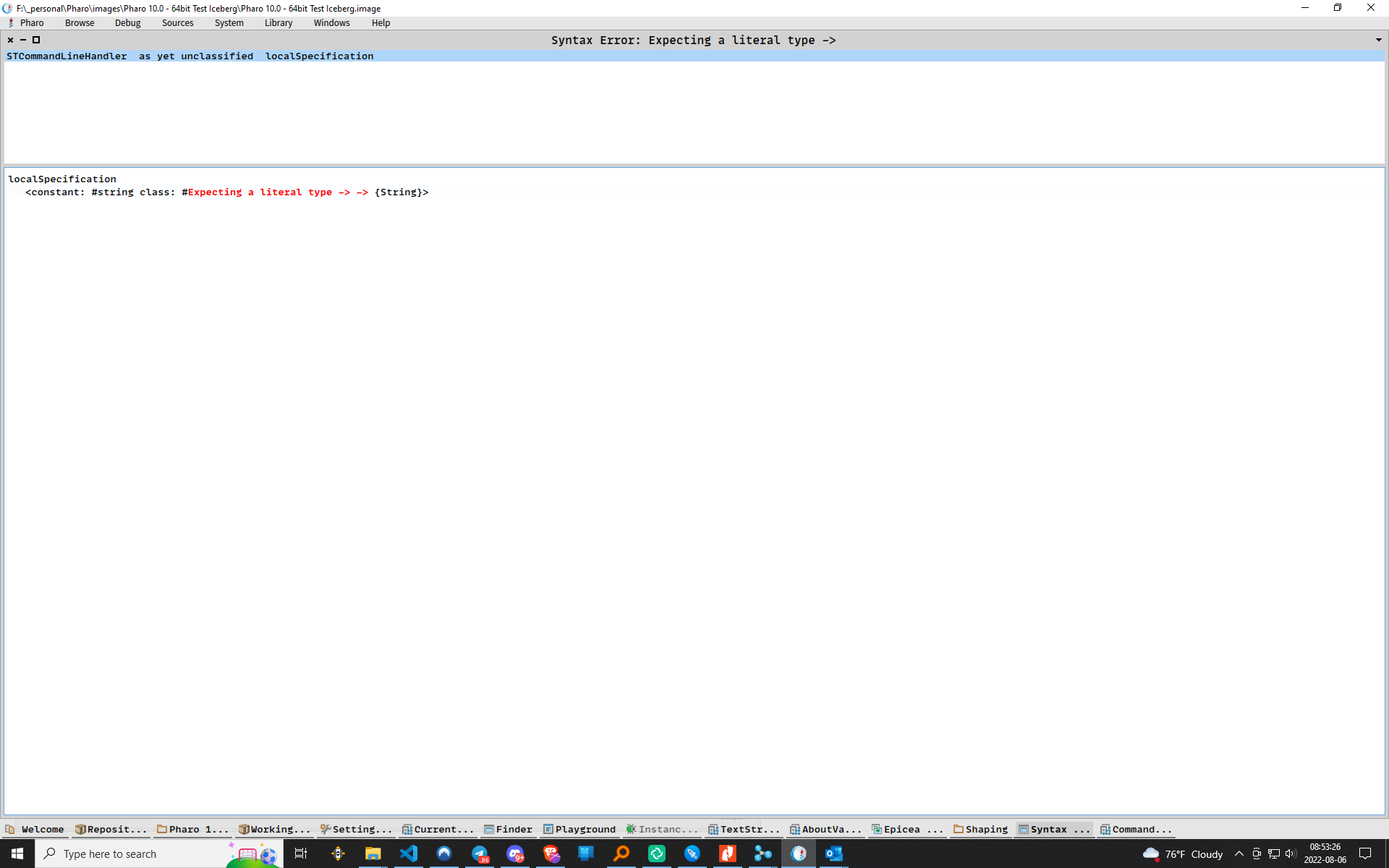
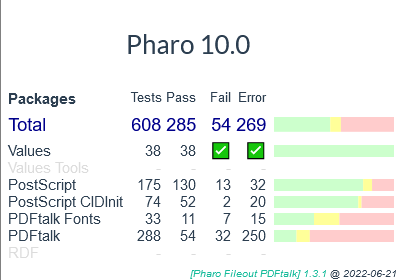
This is VWâs definition of IntegerArray: Smalltalk.Core defineClass: #IntegerArray superclass: #{Core.ArrayedCollection} indexedType: #none private: false instanceVariableNames: '' classInstanceVariableNames: '' imports: '' category: 'Collections-Arrayed' Iâm stepping through the chunks in the Changes Browser because I donât see an easier way currently. This is a separate tool from Epicea. The first chunk whose file-in fails is: IntegerArray variableByteSubclass: #ByteArray instanceVariableNames: '' classVariableNames: 'LastDecodeMap Decodings LastEncodeMap Encodings Lock' poolDictionaries: 'ForeignHeap' package: 'Shaping-Collection' I donât understand how this definition could have been created. ByteArray is a VW system class. Such classes should not be ported anyways â alone from copyright reasons. The only addition I see is the pool ForeignHeap. I guess, that you extended ByteArray somehow and added an import ForeignHeap.* to ByteArray. Yes I have: ByteArray >> asExternal ^ForeignHeap copyOfByteArray: self Also note that I have a ByteArray class override: Smalltalk.Core defineClass: #ByteArray superclass: #{Core.IntegerArray} indexedType: #bytes private: false instanceVariableNames: '' classInstanceVariableNames: '' imports: ' Shaping.ForeignHeap ' category: 'Collections-Arrayed' that imports my own ForeignHeap. I need to put that method on an existing Pharo class, which should just be its own version of ByteArray. So how do I tell my Shaping Collection package transform to ignore transformation of ByteArrayâs class definition, but preserve any methods in the same package that are extensions? It should be fine to extend the corresponding Pharo ByteArray with your methods. The problem is your overwritten class definition. Since the definition is in your package, it gets transformed as a defined class and not as an extension. But you donât need to redefine the Pharo class with a pool dictionary, since the transformations take care of the class renamings. Okay, so Iâll just undo the VW override of ByteArray, so that the transformation, as currently structured, can operate correctly. I donât need VWâs or my flavor of VWâs ForeignHeap. Pharo has its own idea of what that is, and any of my VW ForeignHeap-related method can be moved over separately. I guess I need to find the right Pharo class and try to attached the methods to that by do code rewrites. If the class doesnât exist, I can use something like my current VW ForeignHeap wrapper to reify foreign memory. Iâm not sure how the uFFI does things. I found this: http://books.pharo.org/booklet-uffi/pdf/2020-02-12-uFFI-V1.0.1 (p. 25) â Obtaining an ExternalAddress The most common way of obtaining an ExternalAddress is to receive it as the return value of a called C function. A good example is the libc function malloc(), which takes an integer specifying the desired size of a heap buffer, tries to allocate a contiguous block of memory of the size requested, and, if successful, returns a pointer to the allocated region of memory. The C declaration of such function reads as follows (from the libc manual): void *malloc( size_t size ); We only need create a uFFI binding to it by copy-pasting the declaration as follows: FFITutorial class >> malloc: aSize [ ^ self ffiCall: #( void * malloc ( size_t aSize ) ) library: LibC ] Notice that this function returns a âgeneric pointerâ, of type void * (meaning, what it points to in memory is untyped). In uFFI, this is marshalled to a ExternalAddress object. In other words, our malloc() binding yields an ExternalAddress in return (if successful). For example, if we use the above binding to ask the system to allocate a buffer of 200 bytes for us, then on return we should have an address that points somewhere in the C heap: FFITutorial malloc: 200 => (void*)@ 16r7FFBDE0DE030 But if we ask for more memory than there is currently available, malloc() will fail and return a NULL pointer instead: FFITutorial malloc: SmallInteger maxVal => (void*)@ 16r00000000 Consequently, we must always check the return value in cases like this, lest we invoke the infamous ânull pointer assignmentâ bug. â This is a new situation for me: an override of a system class definition which must be ignored and the methods treated as extensions. Yup, thatâs odd. Iâll patch around it for now. Let me know if you publish something to the public repo, or if you have file-in I can apply. Valid case. I have to think about it. On the other hand, it is bad style to override system class definitions. It is great that VW allows overrides of this kind which can be cleanly unloaded(!). I am not aware of any other Smalltalk with this capability (except maybe Gemstone). Therefore, it should really be the last resort to override system classes in the target Smalltalks. It was done for both notational convenience and speed. Otherwise, I would have needed to use the dotted notation. Iâve timed it, and it costs more microseconds than I wanted. Similar cases in my code I resolved by removing the import and spelling out the full name of the referenced classes. Yeah, see above. It does cost a little in speed. I donât recall the extra latency, but it was not insignificant, especially in high-frequency loops. I did the measurement sometime around 7.5/7.6 and have not done it since. Yes, I prefer not to crap-up a system class, but Iâm flexible when I need speed. (This might be slow when used in tight loops). Also generally bad to change your code just for a port. (ok, not generally). Or, you could ignore the class and add a SystemClassChange (for classes not defined or extended in the package) and add all your methods like: PackageChange ignoredNames: #(#{Core.ByteArray}) ⦠extensions: (Array with: (SystemClassChange className: #ByteArray instanceChanges: (Array with: (Add method: #myMethod code: #_shaping_myMethod) â¦) classChanges: (Array with: (Add method: #myClassMethod code: #_shaping_myClassMethod) â¦)) (I think that you could even use the original methods instead of the _shaping_* copies â nice. Untested though) Okay, I put that bit in the code but commented out. I canât really move that method anyway, because there is no ForeignHeap equivalent that I know yet in Pharo. As far as I can tell, Pharo doesnât try to reify as I do. It would be a separate task I would do later. Not a high priority now. [â¦] For this, a PackageChange has a #preload. It can be filled with a dialect specific specification of what to load beforehand. I defined PharoPreload and use it in Squeak :-) (look for the references). Okay. Actually, it should be renamed to MonticelloPreload or so. What you need would be a MetacelloPreload in which you would capture the parameters needed to load that package (and implement â#writeLoadDoitOn: aStreamâ too :-) ). I need to learn more about Monticello and Metacello to design the proper preload objects⦠(or I meet somebody who known everything about it :-) . Something like MetacelloPreload smalltalkhubUser: 'Pharo' project: 'MetaRepoForPharo70' configuration: 'ArbitraryPrecisionFloat' version: #stable So you want to do the actual Pharo preload of the needed Pharo base class on the VW side, and write the resulting class definition to the file-out stream. Iâd have to build the above class and copy from Pharo into VW the code that does Metacello load. It may not be worth the hassle. I might need only this one missing Pharo base class, but I could be wrong about that. Perhaps there are many such classes. No no no. On the VW side, the following string has to be written into the fileout before the package loads (with #writeLoadDoitOn: ): âMetacello new smalltalkhubUser: 'Pharo' project: 'MetaRepoForPharo70'; configuration: 'ArbitraryPrecisionFloat'; version: #stable; load!â Since the fileout is in chunk format, you can add any doIts you want. Thatâs how I can create packages and whatnot, because I can do anything you can do in a workspace. So the DoIt above will load the required package into Pharo. With that you have nothing to do in VW. Iâm trying to find the right spot in the transformation to do this. The below method is the only sender of #writeLoadDoitOn for Pharo (thereâs one for Squeak too). PharoPreload>> writePackageHeadFor: aWriter aWriter change hasPreload ifFalse: [ ^self]. aWriter change preload do: [:preload | preload writeLoadDoitOn: aWriter stream] Working down the stack we have PackageWriter>> writeHead self target writePackageHeadFor: self then Subwriter>> writeCodeComponent self writeBaseClasses âwrite pharo code that loads essential base classes <==============â self writeHead. self writeRunPrereadCode. self writeRunPreloadCode. self writeContents. self writeRunPostloadCode. self writeTail So where indicated we need to write: âMetacello new smalltalkhubUser: 'Pharo' project: 'MetaRepoForPharo70'; configuration: 'ArbitraryPrecisionFloat'; version: #stable; load!â at the arrow. So as a first go Iâve written: PackageWriter>> writeBaseClasses self target writeBaseClassesFor: self Pharo class>> writeBaseClassesFor: aWriter aWriter change hasBaseclassLoadEvaluables ifFalse: [ ^self]. aWriter change baseClassLoadEvaluables do: [:preload | preload writeLoadDoitOn: aWriter stream] PackageChange>> baseClassLoadEvaluables: baseClassLoadEvaluables ignoredNames: ingoredNames ^self baseClassLoadEvaluables: baseClassLoadEvaluables preload: nil ignoredNames: ingoredNames bridgeClasses: nil hierarchyChanges: nil localChanges: nil extensions: nil All the downstream methods have been created. baseClassLoadEvaluables will be an array of string evaluables like the above (could have a bunch of them). You can probably do a nicer job than I because you know the code better, but something like this hack could work. You might just want to do that the way you want nice and clean, and hand it back to me as a file in. Iâve not run this yet. Iâll do that in a few minutes and let you know how it goes. I can send you the complete file-out if/when it works, or you can use the above as a rough template and do it for us, and pass it back to me so that I can test it. The code will stay cleaner that way. The file-in gets past the APF stuff and is failing on setting the comment of a class that is not present. I donât see how that can happen, but the needed class def is not present in the chunk list before or after the comment: send. ??? Yeah, I donât understand it either. I get different behavior from the file in when I just run it versus manually evaluating the chunks form the Changes browser. Iâll ty it again with the new stuff for the baseClasses. Shaping I got about 6 seconds into the first file-in. Iâm running empty transforms on all packages. Great. You do need a ProjectChange though. Starting with empty PackageChanges is perfect. Yes, I have the one big ProjectChange with all the PackageChanges (about 25) currently empty. The problem Iâm having is using this Syntax error to determine where in the file-in the problem occurred so that I can know the package whose transform needs work. I was expecting more context. So Iâm poking around in STCommandLineHandler next with breakpoints. Open to suggestions. Strange. The #{String} syntax should have been automatically transformed to #String for Pharo⦠strange. All the namespace related issues (like this literal binding reference) should be taken care of. I had a bunch of those namespace/shared-variable bad-reference problems, which I cleared up for several hours before I was able to produce the first file-in. The transformation machinery is very strict, and helps you clean up your code. Iâd forgotten about many of the things that I was forced to fix. Iâll just debug through the file-in until I find the problem. Shaping. Iâll make my first run soon on my first package. Iâll do one package extra each time I run, building up the code. Each package will have its own <package name>Transform method, per the examples. Iâm not sure how to build these methods, except to assume that rewriting the pharo base methods is never wrong. Iâll file-in the resulting .st file to see what breaks. Then Iâll go back to the package whose .st source is not loading completely and add additional fixes (class keeps, base methods rewrites if needed and missing, method code body replacements if needed) to its transform method until it loads completely on the next run. That could take a while. Is that what you do in practice? Perfect! That is exactly how I do it. I start with an empty PackageChange. Then I add incrementally transforms until the code loads - phase one. This has been achieved for PDFtalk with the first release on GitHub. The second and final phase is to make all tests run (including the new to-write tests). This can take a while, because all syntactic and semantic differences must be addressed. Here, some cross-fertilization is possible. Yeah, and I have to be thorough finally about all my SUnit tests⦠The nice thing is, that the system is always telling you what to do. In fact, at first there are so many issues that it is a lot of fun to browse them and chose a nice one. Always the nicest or easiest bug first :-). Right. Iâm assuming the code writer is taking into account inter-package dependencies in order to get the load order right. Yes. Shaping From: christian.haider@smalltalked-visuals.com <mailto:christian.haider@smalltalked-visuals.com> <christian.haider@smalltalked-visuals.com <mailto:christian.haider@smalltalked-visuals.com> > Sent: Friday, 5 August, 2022 05:53 To: 'Any question about pharo is welcome' <pharo-users@lists.pharo.org <mailto:pharo-users@lists.pharo.org> >; 'Pharo Development List' <pharo-dev@lists.pharo.org <mailto:pharo-dev@lists.pharo.org> > Subject: [Pharo-users] Re: [Pharo-users]Porting from VW 8.3 to Pharo: pdftalkPackageChanges The full project in which the mentioned method used looks like this: PDFtalkProject ^ProjectChange name: #PDFtalk source: ((OrderedCollection new) add: (Package name: #Values); add: (Bundle name: #PDFtalk); add: (Package name: #'Values Testing'); add: (Bundle name: #'PDFtalk Testing'); add: (Package name: #'PDFtalk Demonstrations'); yourself) changes: self pdftalkPackageChanges nameMapping: (NameMapping keep: ((OrderedCollection new) add: #{Smalltalk.PDF}; add: #{PostScript.PSDictionary}; add: #{PDFtalk.PDFObject}; add: #{PDFtalk.PDFArray}; add: #{PDFtalk.PDFDictionary}; add: #{PDFtalk.PDFStream}; add: #{PDFtalk.PDFString}; add: #{PDFtalk.PDFDate}; add: #{PDFtalk.PDFTypeDefinition}; add: #{PDFtalk.PDFEncoder}; yourself) classToNames: ((Valuemap new) add: #{SubscriptOutOfBoundsError} -> #Error; add: #{NonIntegerIndexError} -> #Error; add: #{NotFoundError} -> #KeyNotFound; add: #{KeyNotFoundError} -> #KeyNotFound; yourself) namespaceToPrefixes: ((Valuemap new) add: #{Smalltalk.PostScript} -> 'PS'; add: #{Smalltalk.PDFtalk} -> 'Pt'; add: #{PDFtalk.Fonts} -> 'PtF'; add: #{PDFtalk.Fonts.OpenType} -> 'PtOT'; yourself)) In the #source: are the bundles and packages to be transformed. The #changes: (your method) specify the transforms (PackageChange) for each package explicitly. Only packages contain code and therefore, only packages need the code transformations. Bundles are transformed without transformations. (Well, the code for pre-, post- whatever blocks are transformed with the class name mappings rules). So, the mapping from packages to the corresponding PackageChange has to be stated somehow. Using a dictionary (Valuemap) for this seems also natural. The only change I might like is to use pragmas to tag the PackageChange returning methods with âtheirâ package like <package: âValues Toolsâ> or so. Putting the package reference into the PackageChange is not a good idea, because all those Objects need to be created before your can find out which package is affected. (Ok, I am creating all PackageChange objects tooâ¦). Happy hacking, Christian Von: Shaping <shaping@uurda.org <mailto:shaping@uurda.org> > Gesendet: Freitag, 5. August 2022 03:26 An: 'Any question about pharo is welcome' <pharo-users@lists.pharo.org <mailto:pharo-users@lists.pharo.org> >; 'Pharo Development List' <pharo-dev@lists.pharo.org <mailto:pharo-dev@lists.pharo.org> > Betreff: [Pharo-users] Re: [Pharo-users]Porting from VW 8.3 to Pharo: pdftalkPackageChanges This method pdftalkPackageChanges ^(Valuemap new) add: 'Values' -> self ValuesTransform; add: 'PostScript' -> self PostScriptTransform; add: 'PDFtalk Basics' -> self PDFtalkBasicsTransform; add: 'PDFtalk Typing' -> self PDFtalkTypingTransform; add: 'PDFtalk Basic Objects' -> self PDFtalkBasicObjectsTransform; add: 'PDFtalk Streams' -> self PDFtalkStreamsTransform; add: 'PDFtalk Data Structures' -> self PDFtalkDataStructuresTransform; add: 'PDFtalk Parsing' -> self PDFtalkParsingTransform; add: 'PDFtalk Colour' -> self PDFtalkColourTransform; add: 'PostScript Fonts' -> self PostScriptFontsTransform; add: 'PostScript CIDInit' -> self PostScriptCIDInitTransform; add: 'PDFtalk Fonts Basics' -> self PDFtalkFontsBasicsTransform; add: 'PDFtalk Fonts Type1' -> self PDFtalkFontsType1Transform; add: 'PDFtalk Fonts OpenType' -> self PDFtalkFontsOpenTypeTransform; add: 'PDFtalk Fonts' -> self PDFtalkFontsTransform; add: 'PDFtalk Graphics' -> self PDFtalkGraphicsTransform; add: 'PDFtalk Graphics Operations' -> self PDFtalkGraphicsOperationsTransform; add: 'PDFtalk XObjects' -> self PDFtalkXObjectsTransform; add: 'PDFtalk Images' -> self PDFtalkImagesTransform; add: 'PDFtalk Files' -> self PDFtalkFilesTransform; add: 'PDFtalk Document' -> self PDFtalkDocumentTransform; add: 'PDFtalk Rendering' -> self PDFtalkRenderingTransform; add: 'PDFtalk Shading' -> self PDFtalkShadingTransform; add: 'PDFtalk Interactive Features' -> self PDFtalkInteractiveFeaturesTransform; add: 'PDFtalk Deploying' -> self PDFtalkDeployingTransform; add: 'Values Testing' -> self ValuesTestingTransform; add: 'PDFtalk test resources' -> self PDFtalkTestResourcesTransform; add: 'PostScript Testing' -> self PostScriptTestingTransform; add: 'PostScript CIDInit Testing' -> self PostScriptCIDInitTestingTransform; add: 'PDFtalk Fonts tests' -> self PDFtalkFontsTestsTransform; add: 'PDFtalk tests' -> self PDFtalkTestsTransform; add: 'PDFtalk Demonstrations' -> self PDFtalkDemonstrationsTransform; yourself effectively looks like the head transform structure for a project, in this case all the PDFtalk stuff, which includes Values and Postscript. This is not exactly a bundle idea, is it? Itâs project spread across potentially many bundles and packages. Iâll start coding my transform with a similar method, and work down toward the details. Takes a bit to get used to all the correct, yet dangling VW methods that are useless in VW, but which will become new code in the target image and there no longer appear to be dangling (with syntax highlighting aberrations). Odd looking but completely by design. Shaping From: Shaping <shaping@uurda.org <mailto:shaping@uurda.org> > Sent: Thursday, 4 August, 2022 19:18 To: 'Any question about pharo is welcome' <pharo-users@lists.pharo.org <mailto:pharo-users@lists.pharo.org> > Subject: [Pharo-users] Re: [Pharo-users]Porting from VW 8.3 to Pharo: Pharo100 fileOutValues I will look, although this kind of always available on demand thing is too disruptive for me⦠I know what you mean. I try be disciplined about it. I really like to be able to fix typos, because there are almost always typos. But e-mail is okay. So that little example is a test that shows how the transformation is done. It converts just package Values to a Pharo-compatible file-in. My task is then to queue a bunch of ProjectChange instances like this one: SmalltalkTransform.Pharo100>> ValuesProject ^ProjectChange name: #Values source: (Array with: (Package name: #Values)) changes: (Valuemap with: 'Values' -> self ValuesTransform) Exactly but for my own packages. No bundles are transformed (just their contained packages) because Pharo doesnât have bundles. Is that right? No, bundles are handled. For real examples, you need to look at the PDFtalk transforms. Yes, Pharo does not have a concept of bundles (ordered aggregates of packages). Instead it relies on a naming convention for packages. That convention is honored in the fileout, so that packages will be partly grouped in Pharo according to the category prefix. For each VW-package, one Pharo package is created. A bundle itself is also represented as Pharo package with one class About<bundlename> with class methods for the metadata of the bundle, including a method giving you the ordered list of component packages. So, all contents and metadata of packages and bundles are transformed for Pharo. No code or info gets lost. Okay. Is method ValuesTransform ^PackageChange ignoredNames: #(#{Smalltalk.GeneralBindingReference}) bridgeClasses: (Valuemap with: #{Timestamp} -> #DateAndTime with: #{Smalltalk.ColorValue} -> #Color) localChanges: self valuesLocalTransform extensions: (Array with: (SystemClassChange className: #Color instanceChanges: (Array with: (Add method: #asColorValue code: #_ph_asColorValue))) with: (SystemClassChange className: #TextStream instanceChanges: (Array with: (Add method: #nextPutAllText: code: #_ph_nextPutAllText:)))) written specifically for that package? I would think it applies to all packages. I see some expected mappings like Timestamp to DateAndTime. Yes, this method returns a PackageChange Value describing the transformations needed to create the Pharo fileout for this specific package (inspect the return value for the fully expanded Value). Methods exist with the same name for other Smalltalks. Depending on the dialect (or version of a dialect), the transforms are different. Squeak and Pharo are quite similar, because they share a common history, but VA or Gemstone need quite different transforms. So, in general, for each package, there is one such method/Value for each target Smalltalk/version. Okay. I do not dare to extract commonalities before the machinery is really robust and stable. For now everything is neatly separate and self-contained (and probably it will stay that way, although there are lots of duplications). The mapping of class names is the responsibility of the enclosing ProjectChange Value where you define the list of source bundles/packages to transform, the PackageChanges for all packages and the mapping of âglobalâ names. (The bridge classes above are no renames, but a subclass relationship (is-a) to avoid renamings. The new class Timestamp will be created as subclass of DateAndTime which has almost the same semantics. Therefore, I can still use Timestamp which will be basically a DateAndTime now.) Okay. There is still a technical challenge here. Currently, a ProjectChange need to include all prerequisites (Values is part of the PDFtalk project and will be transformed with it). A ProjectWriter, which coordinates the transform, keeps track of the mappings when they are created (either explicitly or through a namespace renaming â see implementers of #PDFtalkProject). I would like to have this more modular: the mappings from the Values transformation should be persistently saved, so that other transformation projects can just use them, instead of including the sources into one own project. For this, I need to have renamings local to a package (where they first occur), not global on the project level. Right. For Values and Values Tests and Values Tools this works, because there are no mappings in the Values package. What about conversion of VW arrays to Pharo literal arrays? How is that done? (I think you mean dynamic arrays like {1. âabcâ size. 42} in which evaluation happens (in contrast to literal things which can be resolved already by the compiler). Yes, dynamic arrays. Not! Since a while, VW also has dynamic arrays, but not in VW 8.3 â the last publicly available version. Okay, I was wondering when that would happen. I will not shut out those users, because âopen-sourceâ would be quite absurd, if it is only available for paying customers. In 8.3, the compiler does not accept that syntax and therefore, there is no easy way to represent this in replacement code. So, no. It is not possible until Cincom releases an public version which can handle that. Okay. I recall that one of the Smalltalks (I donât recall which) had Stream semantics differing from VWâs. ⦠I just checked. VWâs #upTo: method includes the object and leaves the index after it, and Pharoâs excludes the object and leaves the index at the object. So that is some major breakage if we donât correct it. Can it be done automatically? Yes, these are the usual porting challenges and exactly the reason why this library exists :). Thank you for the question :). Yes, the stream semantics need to be fixed. The idea is that a set of transforms for this issue can be reused by others. Okay.
valuesLocalTransform
has lots of juicy bits. But this doesnât look very simple. We canât just replace an old method with a new one. We also have to write the new one to tweak how the indices are used in #upTo:, and make sure that new method gets filed-in as well into the Pharo target image. Or, we have to do this kind of change manually. Naa, itâs very easy, I think :). A PackageChange specifies transforms for classes used in the package (#localChanges) and #extensions for system classes of the target. For a class, you can have a ClassChange describing the changes to instance or class methods. A MethodChange has 4 subclasses for: - Ignore â donât write this method to the target - Add â add this new method (not in the source system) to the target - Replace â replace the body of this method with other code - Rewrite â rewrite the method source using a rewrite rule. Add and Replace need the target code. Add then always involves a new name for a method in the target. Replaces use an old name in the target with a new code body. This is stored in another method with a derived name like #_ph_upTo: . The method name is not important, because only the body of the method is used. But the name should not be used in the source â it is just a holder for the replacement code. These methods live in the specific [<Smalltalk> Fileout <Package>] package. Okay. There are lots of working(!) examples for all of those in the PDFtalk transform project. This bit (SystemClassChange className: #Color instanceChanges: (Array with: (Add method: #asColorValue code: #_ph_asColorValue))) is replacing #asColorValue with #_ph_asColorValue because some special Pharo-color conversion needs to happen. But how does #_ph_asColorValue get defined? Itâs neither in VW nor in Pharo 10. You got bitten by the old version of [Pharo Fileout Values]. Please load [Pharo Fileout PDFtalk]. There, the methods exist. Yes, I see it now. Ok. I donât have a virgin image. I have a very non-virgin image, about 27 years of development Iâm trying to port to Pharo. I donât yet have a specific interest in the PDFtalk, though I do see a need for PDF generation later, and will probably revisit that. For now, I just want my own stuff to run in Pharo. Virgin image just means that you donât need anything else. You can safely load it in you favorite special images :). I would load PDFtalk, although technically you donât need to (all the extensions to PDFtalk would be unloadable, but that doesnât affect Values). Okay. is: Load {Values Project] bundle Load {PDFtalk Project} bundle Load {Smalltalk Transform Project} bundle Load [Pharo Fileout PDFtalk] package Save, done Okay, so do I understand correctly that I need to include the PDFtalk stuff even if Iâm not interested in PDFtalk, because thatâs where a lot of the Smalltalk transformation machinery lives? Or is the PDFtalk just being used as an example for how to do a massive transformation? Or Both? No, the transformation machinery is fully independent of PDFtalk. I just tried it. The dependencies are in the specific [Pharo Fileout PDFtalk] package, since I have already quite a few replacement methods which are extensions to PDFtalk classes. Okay. PDFtalk is the focus of the project and therefore all issues are solved first with this library in mind. Therefore, bundles and namespaces are handled, for example. When you study the more interesting transformations for PDFtalk, it would be a shame not to be able to browse the methods and classes involved. So, PDFtalk is the real world reference example. And Values is the simplest example. To transform Values do: âPharo100 fileOutValuesâ The [Pharo Fileout PDFtalk] package includes the latest Values transformations. I am thinking about a better modularization⦠Also, the wiki is a bit out of control. It really needs some restructuring. In the cites wiki page, there is a link to a blog where I record the changes. This might be informative. 2. Port the Values package. This is easy, since no namespaces are involved. This first instruction after VW package setup says to port the contents of the Values package from VW to Pharo. Do you mean manually? Probably not. No, no. This has been finished in March. For each dialect, I have a GitHub repository where I release important versions: <https://github.com/PortingPDFtalk/PharoPDFtalk> https://github.com/PortingPDFtalk/PharoPDFtalk. You can find the working port as first release â <https://github.com/PortingPDFtalk/PharoPDFtalk/releases/tag/1.3.0.0> Working versionâ. There you can download the ported Values fileout with the exact description with which versions of what it was created. This should be a good starting example. Why do I need any new code installed in Pharo before I begin the transformation, if Iâm transforming code from VW to pharo? Iâm not understanding the basic constraints of the problem, even when the detailed steps are clear. No, no. You donât need anything on the Pharo side. The fileouts on GitHub are the end products of a transformation for people who donât use VisualWorks, but want to use Values in Pharo. Or help with PDFtalk by fixing some issues, so that I can write the transformations. Iâve done these steps so far: 1. Went to <https://github.com/PortingPDFtalk/PharoPDFtalk> https://github.com/PortingPDFtalk/PharoPDFtalk. Mistake :). You donât want to look at the unfinished product of the current version of thincomplete transformations for PDFtalk. Do you mean âfinishedâ here? Isnât that file-in the finished result? I thought the above links was the currently finished result (as good as it can be until the rest of the bugs are goine and tests all run). Yes, that was confusing. Thatâs why I had the early impression that Values was somehow apart of the transformation machinery. See https://wiki.pdftalk.de/doku.php?id=stateoftheport#pharo-10-0: Instead, you want to look at the unfinished product of the transformations of your projects :). 2. Saved down PDFtalk.Pharo100.st into <my Pharo 10 image directory>/pharo-local/Smalltalk-Transformation. (I figured that was a good place to save it. If anyone disagrees, or has a better or more conventional idea about where files should be saved, please say so. I setup a Pharo Git repo and played with it briefly for the first time yesterday. Iâve used Pharo off an on for 16 years, but this is the first time Iâm making a serious effort to manage source, and not throw away what Iâm working on.) 3. Filed-in PDFtalk.Pharo100.st. This went on for about 7 minutes or so. I have a hundreds if not over a thousand classes showing in Epicea. Is there anyway to get Epicea to give me a count of changes with a time-range filter? 4. Deleted (forgot) yesterdayâs, old Main practice-repo from both the image and the drive, and made a new one. I need to add to Main all the packages I just filed-in, but I donât see an efficient way to do that. I would like to use the Add Package button, but this gives a filtered list of available packages. I can filter subgroups, and then individually select each of the checkboxes to the left of each package (there is no Ctrl-A [select all] option here, which seems to be a strange omission given the potentially large number of packages involved). I see lots of prefixes for the classes just loaded. I could easily miss something if I filter/select/add one prefix-group at a time. Is there an easier way? Over in Epicea I donât see a way to push the loaded items listed to a specific repo. The first thought I have is to select all filed-in code artifacts by datetime span. I did that and saved it as an .ombu file (I have no idea what that is). I donât see a way to import that .ombu file into repo Mainâs âWorking copyâ window. It must be easy, but I donât see it. Please suggest the best way. Iâd like to know as well â I am not quite familiar with the source management concepts in Pharo. I asked in Discord. I donât understand why stuff like this is missing. The only conclusion I can draw is that no one does huge file-ins (but you do). It is planned to generate Tonel output in the future, but for now I feel safer with the traditional fileout where I can have doIts. I am not sure how Tonel reacts to crippled sources, which are normal during the development of the transformations. Shaping From: christian.haider <christian.haider@smalltalked-visuals.com <mailto:christian.haider@smalltalked-visuals.com> > Sent: Wednesday, 22 June, 2022 05:42 To: pharo-users@lists.pharo.org <mailto:pharo-users@lists.pharo.org> Subject: [Pharo-users] [PDFtalk] second fileOut for Squeak and Pharo With help from the community some issues were fixed which improved the test statistics nicely. Check it out: https://wiki.pdftalk.de/doku.php?id=portingblog#second_pdftalk_fileout_for_s... Thanks to everybody involved! Happy hacking, Christian
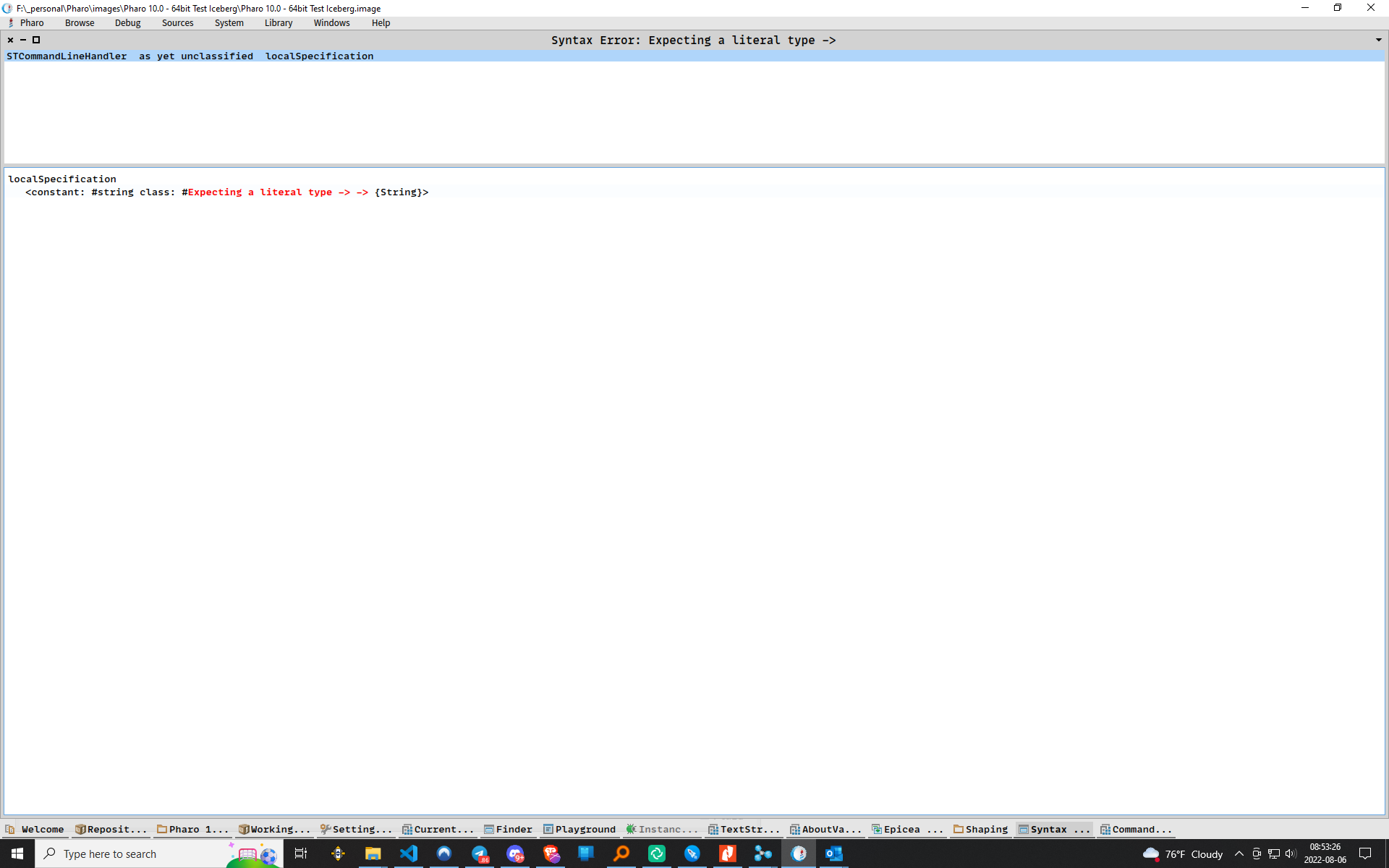
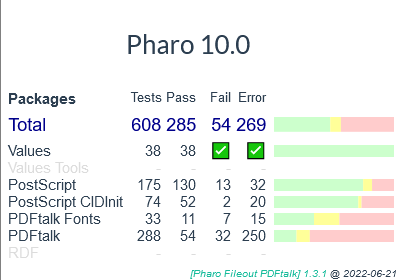
I just realized that the baseClassLoadEvaluable (to load AFP for example) needs to be the install parameter in an instance of PharoPreload. Fixing that now. Shaping This is VWâs definition of IntegerArray: Smalltalk.Core defineClass: #IntegerArray superclass: #{Core.ArrayedCollection} indexedType: #none private: false instanceVariableNames: '' classInstanceVariableNames: '' imports: '' category: 'Collections-Arrayed' Iâm stepping through the chunks in the Changes Browser because I donât see an easier way currently. This is a separate tool from Epicea. The first chunk whose file-in fails is: IntegerArray variableByteSubclass: #ByteArray instanceVariableNames: '' classVariableNames: 'LastDecodeMap Decodings LastEncodeMap Encodings Lock' poolDictionaries: 'ForeignHeap' package: 'Shaping-Collection' I donât understand how this definition could have been created. ByteArray is a VW system class. Such classes should not be ported anyways â alone from copyright reasons. The only addition I see is the pool ForeignHeap. I guess, that you extended ByteArray somehow and added an import ForeignHeap.* to ByteArray. Yes I have: ByteArray >> asExternal ^ForeignHeap copyOfByteArray: self Also note that I have a ByteArray class override: Smalltalk.Core defineClass: #ByteArray superclass: #{Core.IntegerArray} indexedType: #bytes private: false instanceVariableNames: '' classInstanceVariableNames: '' imports: ' Shaping.ForeignHeap ' category: 'Collections-Arrayed' that imports my own ForeignHeap. I need to put that method on an existing Pharo class, which should just be its own version of ByteArray. So how do I tell my Shaping Collection package transform to ignore transformation of ByteArrayâs class definition, but preserve any methods in the same package that are extensions? It should be fine to extend the corresponding Pharo ByteArray with your methods. The problem is your overwritten class definition. Since the definition is in your package, it gets transformed as a defined class and not as an extension. But you donât need to redefine the Pharo class with a pool dictionary, since the transformations take care of the class renamings. Okay, so Iâll just undo the VW override of ByteArray, so that the transformation, as currently structured, can operate correctly. I donât need VWâs or my flavor of VWâs ForeignHeap. Pharo has its own idea of what that is, and any of my VW ForeignHeap-related method can be moved over separately. I guess I need to find the right Pharo class and try to attached the methods to that by do code rewrites. If the class doesnât exist, I can use something like my current VW ForeignHeap wrapper to reify foreign memory. Iâm not sure how the uFFI does things. I found this: http://books.pharo.org/booklet-uffi/pdf/2020-02-12-uFFI-V1.0.1 (p. 25) â Obtaining an ExternalAddress The most common way of obtaining an ExternalAddress is to receive it as the return value of a called C function. A good example is the libc function malloc(), which takes an integer specifying the desired size of a heap buffer, tries to allocate a contiguous block of memory of the size requested, and, if successful, returns a pointer to the allocated region of memory. The C declaration of such function reads as follows (from the libc manual): void *malloc( size_t size ); We only need create a uFFI binding to it by copy-pasting the declaration as follows: FFITutorial class >> malloc: aSize [ ^ self ffiCall: #( void * malloc ( size_t aSize ) ) library: LibC ] Notice that this function returns a âgeneric pointerâ, of type void * (meaning, what it points to in memory is untyped). In uFFI, this is marshalled to a ExternalAddress object. In other words, our malloc() binding yields an ExternalAddress in return (if successful). For example, if we use the above binding to ask the system to allocate a buffer of 200 bytes for us, then on return we should have an address that points somewhere in the C heap: FFITutorial malloc: 200 => (void*)@ 16r7FFBDE0DE030 But if we ask for more memory than there is currently available, malloc() will fail and return a NULL pointer instead: FFITutorial malloc: SmallInteger maxVal => (void*)@ 16r00000000 Consequently, we must always check the return value in cases like this, lest we invoke the infamous ânull pointer assignmentâ bug. â This is a new situation for me: an override of a system class definition which must be ignored and the methods treated as extensions. Yup, thatâs odd. Iâll patch around it for now. Let me know if you publish something to the public repo, or if you have file-in I can apply. Valid case. I have to think about it. On the other hand, it is bad style to override system class definitions. It is great that VW allows overrides of this kind which can be cleanly unloaded(!). I am not aware of any other Smalltalk with this capability (except maybe Gemstone). Therefore, it should really be the last resort to override system classes in the target Smalltalks. It was done for both notational convenience and speed. Otherwise, I would have needed to use the dotted notation. Iâve timed it, and it costs more microseconds than I wanted. Similar cases in my code I resolved by removing the import and spelling out the full name of the referenced classes. Yeah, see above. It does cost a little in speed. I donât recall the extra latency, but it was not insignificant, especially in high-frequency loops. I did the measurement sometime around 7.5/7.6 and have not done it since. Yes, I prefer not to crap-up a system class, but Iâm flexible when I need speed. (This might be slow when used in tight loops). Also generally bad to change your code just for a port. (ok, not generally). Or, you could ignore the class and add a SystemClassChange (for classes not defined or extended in the package) and add all your methods like: PackageChange ignoredNames: #(#{Core.ByteArray}) ⦠extensions: (Array with: (SystemClassChange className: #ByteArray instanceChanges: (Array with: (Add method: #myMethod code: #_shaping_myMethod) â¦) classChanges: (Array with: (Add method: #myClassMethod code: #_shaping_myClassMethod) â¦)) (I think that you could even use the original methods instead of the _shaping_* copies â nice. Untested though) Okay, I put that bit in the code but commented out. I canât really move that method anyway, because there is no ForeignHeap equivalent that I know yet in Pharo. As far as I can tell, Pharo doesnât try to reify as I do. It would be a separate task I would do later. Not a high priority now. [â¦] For this, a PackageChange has a #preload. It can be filled with a dialect specific specification of what to load beforehand. I defined PharoPreload and use it in Squeak :-) (look for the references). Okay. Actually, it should be renamed to MonticelloPreload or so. What you need would be a MetacelloPreload in which you would capture the parameters needed to load that package (and implement â#writeLoadDoitOn: aStreamâ too :-) ). I need to learn more about Monticello and Metacello to design the proper preload objects⦠(or I meet somebody who known everything about it :-) . Something like MetacelloPreload smalltalkhubUser: 'Pharo' project: 'MetaRepoForPharo70' configuration: 'ArbitraryPrecisionFloat' version: #stable So you want to do the actual Pharo preload of the needed Pharo base class on the VW side, and write the resulting class definition to the file-out stream. Iâd have to build the above class and copy from Pharo into VW the code that does Metacello load. It may not be worth the hassle. I might need only this one missing Pharo base class, but I could be wrong about that. Perhaps there are many such classes. No no no. On the VW side, the following string has to be written into the fileout before the package loads (with #writeLoadDoitOn: ): âMetacello new smalltalkhubUser: 'Pharo' project: 'MetaRepoForPharo70'; configuration: 'ArbitraryPrecisionFloat'; version: #stable; load!â Since the fileout is in chunk format, you can add any doIts you want. Thatâs how I can create packages and whatnot, because I can do anything you can do in a workspace. So the DoIt above will load the required package into Pharo. With that you have nothing to do in VW. Iâm trying to find the right spot in the transformation to do this. The below method is the only sender of #writeLoadDoitOn for Pharo (thereâs one for Squeak too). PharoPreload>> writePackageHeadFor: aWriter aWriter change hasPreload ifFalse: [ ^self]. aWriter change preload do: [:preload | preload writeLoadDoitOn: aWriter stream] Working down the stack we have PackageWriter>> writeHead self target writePackageHeadFor: self then Subwriter>> writeCodeComponent self writeBaseClasses âwrite pharo code that loads essential base classes <==============â self writeHead. self writeRunPrereadCode. self writeRunPreloadCode. self writeContents. self writeRunPostloadCode. self writeTail So where indicated we need to write: âMetacello new smalltalkhubUser: 'Pharo' project: 'MetaRepoForPharo70'; configuration: 'ArbitraryPrecisionFloat'; version: #stable; load!â at the arrow. So as a first go Iâve written: PackageWriter>> writeBaseClasses self target writeBaseClassesFor: self Pharo class>> writeBaseClassesFor: aWriter aWriter change hasBaseclassLoadEvaluables ifFalse: [ ^self]. aWriter change baseClassLoadEvaluables do: [:preload | preload writeLoadDoitOn: aWriter stream] PackageChange>> baseClassLoadEvaluables: baseClassLoadEvaluables ignoredNames: ingoredNames ^self baseClassLoadEvaluables: baseClassLoadEvaluables preload: nil ignoredNames: ingoredNames bridgeClasses: nil hierarchyChanges: nil localChanges: nil extensions: nil All the downstream methods have been created. baseClassLoadEvaluables will be an array of string evaluables like the above (could have a bunch of them). You can probably do a nicer job than I because you know the code better, but something like this hack could work. You might just want to do that the way you want nice and clean, and hand it back to me as a file in. Iâve not run this yet. Iâll do that in a few minutes and let you know how it goes. I can send you the complete file-out if/when it works, or you can use the above as a rough template and do it for us, and pass it back to me so that I can test it. The code will stay cleaner that way. The file-in gets past the APF stuff and is failing on setting the comment of a class that is not present. I donât see how that can happen, but the needed class def is not present in the chunk list before or after the comment: send. ??? Yeah, I donât understand it either. I get different behavior from the file in when I just run it versus manually evaluating the chunks form the Changes browser. Iâll ty it again with the new stuff for the baseClasses. Shaping I got about 6 seconds into the first file-in. Iâm running empty transforms on all packages. Great. You do need a ProjectChange though. Starting with empty PackageChanges is perfect. Yes, I have the one big ProjectChange with all the PackageChanges (about 25) currently empty. The problem Iâm having is using this Syntax error to determine where in the file-in the problem occurred so that I can know the package whose transform needs work. I was expecting more context. So Iâm poking around in STCommandLineHandler next with breakpoints. Open to suggestions. Strange. The #{String} syntax should have been automatically transformed to #String for Pharo⦠strange. All the namespace related issues (like this literal binding reference) should be taken care of. I had a bunch of those namespace/shared-variable bad-reference problems, which I cleared up for several hours before I was able to produce the first file-in. The transformation machinery is very strict, and helps you clean up your code. Iâd forgotten about many of the things that I was forced to fix. Iâll just debug through the file-in until I find the problem. Shaping. Iâll make my first run soon on my first package. Iâll do one package extra each time I run, building up the code. Each package will have its own <package name>Transform method, per the examples. Iâm not sure how to build these methods, except to assume that rewriting the pharo base methods is never wrong. Iâll file-in the resulting .st file to see what breaks. Then Iâll go back to the package whose .st source is not loading completely and add additional fixes (class keeps, base methods rewrites if needed and missing, method code body replacements if needed) to its transform method until it loads completely on the next run. That could take a while. Is that what you do in practice? Perfect! That is exactly how I do it. I start with an empty PackageChange. Then I add incrementally transforms until the code loads - phase one. This has been achieved for PDFtalk with the first release on GitHub. The second and final phase is to make all tests run (including the new to-write tests). This can take a while, because all syntactic and semantic differences must be addressed. Here, some cross-fertilization is possible. Yeah, and I have to be thorough finally about all my SUnit tests⦠The nice thing is, that the system is always telling you what to do. In fact, at first there are so many issues that it is a lot of fun to browse them and chose a nice one. Always the nicest or easiest bug first :-). Right. Iâm assuming the code writer is taking into account inter-package dependencies in order to get the load order right. Yes. Shaping From: christian.haider@smalltalked-visuals.com <mailto:christian.haider@smalltalked-visuals.com> <christian.haider@smalltalked-visuals.com <mailto:christian.haider@smalltalked-visuals.com> > Sent: Friday, 5 August, 2022 05:53 To: 'Any question about pharo is welcome' <pharo-users@lists.pharo.org <mailto:pharo-users@lists.pharo.org> >; 'Pharo Development List' <pharo-dev@lists.pharo.org <mailto:pharo-dev@lists.pharo.org> > Subject: [Pharo-users] Re: [Pharo-users]Porting from VW 8.3 to Pharo: pdftalkPackageChanges The full project in which the mentioned method used looks like this: PDFtalkProject ^ProjectChange name: #PDFtalk source: ((OrderedCollection new) add: (Package name: #Values); add: (Bundle name: #PDFtalk); add: (Package name: #'Values Testing'); add: (Bundle name: #'PDFtalk Testing'); add: (Package name: #'PDFtalk Demonstrations'); yourself) changes: self pdftalkPackageChanges nameMapping: (NameMapping keep: ((OrderedCollection new) add: #{Smalltalk.PDF}; add: #{PostScript.PSDictionary}; add: #{PDFtalk.PDFObject}; add: #{PDFtalk.PDFArray}; add: #{PDFtalk.PDFDictionary}; add: #{PDFtalk.PDFStream}; add: #{PDFtalk.PDFString}; add: #{PDFtalk.PDFDate}; add: #{PDFtalk.PDFTypeDefinition}; add: #{PDFtalk.PDFEncoder}; yourself) classToNames: ((Valuemap new) add: #{SubscriptOutOfBoundsError} -> #Error; add: #{NonIntegerIndexError} -> #Error; add: #{NotFoundError} -> #KeyNotFound; add: #{KeyNotFoundError} -> #KeyNotFound; yourself) namespaceToPrefixes: ((Valuemap new) add: #{Smalltalk.PostScript} -> 'PS'; add: #{Smalltalk.PDFtalk} -> 'Pt'; add: #{PDFtalk.Fonts} -> 'PtF'; add: #{PDFtalk.Fonts.OpenType} -> 'PtOT'; yourself)) In the #source: are the bundles and packages to be transformed. The #changes: (your method) specify the transforms (PackageChange) for each package explicitly. Only packages contain code and therefore, only packages need the code transformations. Bundles are transformed without transformations. (Well, the code for pre-, post- whatever blocks are transformed with the class name mappings rules). So, the mapping from packages to the corresponding PackageChange has to be stated somehow. Using a dictionary (Valuemap) for this seems also natural. The only change I might like is to use pragmas to tag the PackageChange returning methods with âtheirâ package like <package: âValues Toolsâ> or so. Putting the package reference into the PackageChange is not a good idea, because all those Objects need to be created before your can find out which package is affected. (Ok, I am creating all PackageChange objects tooâ¦). Happy hacking, Christian Von: Shaping <shaping@uurda.org <mailto:shaping@uurda.org> > Gesendet: Freitag, 5. August 2022 03:26 An: 'Any question about pharo is welcome' <pharo-users@lists.pharo.org <mailto:pharo-users@lists.pharo.org> >; 'Pharo Development List' <pharo-dev@lists.pharo.org <mailto:pharo-dev@lists.pharo.org> > Betreff: [Pharo-users] Re: [Pharo-users]Porting from VW 8.3 to Pharo: pdftalkPackageChanges This method pdftalkPackageChanges ^(Valuemap new) add: 'Values' -> self ValuesTransform; add: 'PostScript' -> self PostScriptTransform; add: 'PDFtalk Basics' -> self PDFtalkBasicsTransform; add: 'PDFtalk Typing' -> self PDFtalkTypingTransform; add: 'PDFtalk Basic Objects' -> self PDFtalkBasicObjectsTransform; add: 'PDFtalk Streams' -> self PDFtalkStreamsTransform; add: 'PDFtalk Data Structures' -> self PDFtalkDataStructuresTransform; add: 'PDFtalk Parsing' -> self PDFtalkParsingTransform; add: 'PDFtalk Colour' -> self PDFtalkColourTransform; add: 'PostScript Fonts' -> self PostScriptFontsTransform; add: 'PostScript CIDInit' -> self PostScriptCIDInitTransform; add: 'PDFtalk Fonts Basics' -> self PDFtalkFontsBasicsTransform; add: 'PDFtalk Fonts Type1' -> self PDFtalkFontsType1Transform; add: 'PDFtalk Fonts OpenType' -> self PDFtalkFontsOpenTypeTransform; add: 'PDFtalk Fonts' -> self PDFtalkFontsTransform; add: 'PDFtalk Graphics' -> self PDFtalkGraphicsTransform; add: 'PDFtalk Graphics Operations' -> self PDFtalkGraphicsOperationsTransform; add: 'PDFtalk XObjects' -> self PDFtalkXObjectsTransform; add: 'PDFtalk Images' -> self PDFtalkImagesTransform; add: 'PDFtalk Files' -> self PDFtalkFilesTransform; add: 'PDFtalk Document' -> self PDFtalkDocumentTransform; add: 'PDFtalk Rendering' -> self PDFtalkRenderingTransform; add: 'PDFtalk Shading' -> self PDFtalkShadingTransform; add: 'PDFtalk Interactive Features' -> self PDFtalkInteractiveFeaturesTransform; add: 'PDFtalk Deploying' -> self PDFtalkDeployingTransform; add: 'Values Testing' -> self ValuesTestingTransform; add: 'PDFtalk test resources' -> self PDFtalkTestResourcesTransform; add: 'PostScript Testing' -> self PostScriptTestingTransform; add: 'PostScript CIDInit Testing' -> self PostScriptCIDInitTestingTransform; add: 'PDFtalk Fonts tests' -> self PDFtalkFontsTestsTransform; add: 'PDFtalk tests' -> self PDFtalkTestsTransform; add: 'PDFtalk Demonstrations' -> self PDFtalkDemonstrationsTransform; yourself effectively looks like the head transform structure for a project, in this case all the PDFtalk stuff, which includes Values and Postscript. This is not exactly a bundle idea, is it? Itâs project spread across potentially many bundles and packages. Iâll start coding my transform with a similar method, and work down toward the details. Takes a bit to get used to all the correct, yet dangling VW methods that are useless in VW, but which will become new code in the target image and there no longer appear to be dangling (with syntax highlighting aberrations). Odd looking but completely by design. Shaping From: Shaping <shaping@uurda.org <mailto:shaping@uurda.org> > Sent: Thursday, 4 August, 2022 19:18 To: 'Any question about pharo is welcome' <pharo-users@lists.pharo.org <mailto:pharo-users@lists.pharo.org> > Subject: [Pharo-users] Re: [Pharo-users]Porting from VW 8.3 to Pharo: Pharo100 fileOutValues I will look, although this kind of always available on demand thing is too disruptive for me⦠I know what you mean. I try be disciplined about it. I really like to be able to fix typos, because there are almost always typos. But e-mail is okay. So that little example is a test that shows how the transformation is done. It converts just package Values to a Pharo-compatible file-in. My task is then to queue a bunch of ProjectChange instances like this one: SmalltalkTransform.Pharo100>> ValuesProject ^ProjectChange name: #Values source: (Array with: (Package name: #Values)) changes: (Valuemap with: 'Values' -> self ValuesTransform) Exactly but for my own packages. No bundles are transformed (just their contained packages) because Pharo doesnât have bundles. Is that right? No, bundles are handled. For real examples, you need to look at the PDFtalk transforms. Yes, Pharo does not have a concept of bundles (ordered aggregates of packages). Instead it relies on a naming convention for packages. That convention is honored in the fileout, so that packages will be partly grouped in Pharo according to the category prefix. For each VW-package, one Pharo package is created. A bundle itself is also represented as Pharo package with one class About<bundlename> with class methods for the metadata of the bundle, including a method giving you the ordered list of component packages. So, all contents and metadata of packages and bundles are transformed for Pharo. No code or info gets lost. Okay. Is method ValuesTransform ^PackageChange ignoredNames: #(#{Smalltalk.GeneralBindingReference}) bridgeClasses: (Valuemap with: #{Timestamp} -> #DateAndTime with: #{Smalltalk.ColorValue} -> #Color) localChanges: self valuesLocalTransform extensions: (Array with: (SystemClassChange className: #Color instanceChanges: (Array with: (Add method: #asColorValue code: #_ph_asColorValue))) with: (SystemClassChange className: #TextStream instanceChanges: (Array with: (Add method: #nextPutAllText: code: #_ph_nextPutAllText:)))) written specifically for that package? I would think it applies to all packages. I see some expected mappings like Timestamp to DateAndTime. Yes, this method returns a PackageChange Value describing the transformations needed to create the Pharo fileout for this specific package (inspect the return value for the fully expanded Value). Methods exist with the same name for other Smalltalks. Depending on the dialect (or version of a dialect), the transforms are different. Squeak and Pharo are quite similar, because they share a common history, but VA or Gemstone need quite different transforms. So, in general, for each package, there is one such method/Value for each target Smalltalk/version. Okay. I do not dare to extract commonalities before the machinery is really robust and stable. For now everything is neatly separate and self-contained (and probably it will stay that way, although there are lots of duplications). The mapping of class names is the responsibility of the enclosing ProjectChange Value where you define the list of source bundles/packages to transform, the PackageChanges for all packages and the mapping of âglobalâ names. (The bridge classes above are no renames, but a subclass relationship (is-a) to avoid renamings. The new class Timestamp will be created as subclass of DateAndTime which has almost the same semantics. Therefore, I can still use Timestamp which will be basically a DateAndTime now.) Okay. There is still a technical challenge here. Currently, a ProjectChange need to include all prerequisites (Values is part of the PDFtalk project and will be transformed with it). A ProjectWriter, which coordinates the transform, keeps track of the mappings when they are created (either explicitly or through a namespace renaming â see implementers of #PDFtalkProject). I would like to have this more modular: the mappings from the Values transformation should be persistently saved, so that other transformation projects can just use them, instead of including the sources into one own project. For this, I need to have renamings local to a package (where they first occur), not global on the project level. Right. For Values and Values Tests and Values Tools this works, because there are no mappings in the Values package. What about conversion of VW arrays to Pharo literal arrays? How is that done? (I think you mean dynamic arrays like {1. âabcâ size. 42} in which evaluation happens (in contrast to literal things which can be resolved already by the compiler). Yes, dynamic arrays. Not! Since a while, VW also has dynamic arrays, but not in VW 8.3 â the last publicly available version. Okay, I was wondering when that would happen. I will not shut out those users, because âopen-sourceâ would be quite absurd, if it is only available for paying customers. In 8.3, the compiler does not accept that syntax and therefore, there is no easy way to represent this in replacement code. So, no. It is not possible until Cincom releases an public version which can handle that. Okay. I recall that one of the Smalltalks (I donât recall which) had Stream semantics differing from VWâs. ⦠I just checked. VWâs #upTo: method includes the object and leaves the index after it, and Pharoâs excludes the object and leaves the index at the object. So that is some major breakage if we donât correct it. Can it be done automatically? Yes, these are the usual porting challenges and exactly the reason why this library exists :). Thank you for the question :). Yes, the stream semantics need to be fixed. The idea is that a set of transforms for this issue can be reused by others. Okay.
valuesLocalTransform
has lots of juicy bits. But this doesnât look very simple. We canât just replace an old method with a new one. We also have to write the new one to tweak how the indices are used in #upTo:, and make sure that new method gets filed-in as well into the Pharo target image. Or, we have to do this kind of change manually. Naa, itâs very easy, I think :). A PackageChange specifies transforms for classes used in the package (#localChanges) and #extensions for system classes of the target. For a class, you can have a ClassChange describing the changes to instance or class methods. A MethodChange has 4 subclasses for: - Ignore â donât write this method to the target - Add â add this new method (not in the source system) to the target - Replace â replace the body of this method with other code - Rewrite â rewrite the method source using a rewrite rule. Add and Replace need the target code. Add then always involves a new name for a method in the target. Replaces use an old name in the target with a new code body. This is stored in another method with a derived name like #_ph_upTo: . The method name is not important, because only the body of the method is used. But the name should not be used in the source â it is just a holder for the replacement code. These methods live in the specific [<Smalltalk> Fileout <Package>] package. Okay. There are lots of working(!) examples for all of those in the PDFtalk transform project. This bit (SystemClassChange className: #Color instanceChanges: (Array with: (Add method: #asColorValue code: #_ph_asColorValue))) is replacing #asColorValue with #_ph_asColorValue because some special Pharo-color conversion needs to happen. But how does #_ph_asColorValue get defined? Itâs neither in VW nor in Pharo 10. You got bitten by the old version of [Pharo Fileout Values]. Please load [Pharo Fileout PDFtalk]. There, the methods exist. Yes, I see it now. Ok. I donât have a virgin image. I have a very non-virgin image, about 27 years of development Iâm trying to port to Pharo. I donât yet have a specific interest in the PDFtalk, though I do see a need for PDF generation later, and will probably revisit that. For now, I just want my own stuff to run in Pharo. Virgin image just means that you donât need anything else. You can safely load it in you favorite special images :). I would load PDFtalk, although technically you donât need to (all the extensions to PDFtalk would be unloadable, but that doesnât affect Values). Okay. is: Load {Values Project] bundle Load {PDFtalk Project} bundle Load {Smalltalk Transform Project} bundle Load [Pharo Fileout PDFtalk] package Save, done Okay, so do I understand correctly that I need to include the PDFtalk stuff even if Iâm not interested in PDFtalk, because thatâs where a lot of the Smalltalk transformation machinery lives? Or is the PDFtalk just being used as an example for how to do a massive transformation? Or Both? No, the transformation machinery is fully independent of PDFtalk. I just tried it. The dependencies are in the specific [Pharo Fileout PDFtalk] package, since I have already quite a few replacement methods which are extensions to PDFtalk classes. Okay. PDFtalk is the focus of the project and therefore all issues are solved first with this library in mind. Therefore, bundles and namespaces are handled, for example. When you study the more interesting transformations for PDFtalk, it would be a shame not to be able to browse the methods and classes involved. So, PDFtalk is the real world reference example. And Values is the simplest example. To transform Values do: âPharo100 fileOutValuesâ The [Pharo Fileout PDFtalk] package includes the latest Values transformations. I am thinking about a better modularization⦠Also, the wiki is a bit out of control. It really needs some restructuring. In the cites wiki page, there is a link to a blog where I record the changes. This might be informative. 2. Port the Values package. This is easy, since no namespaces are involved. This first instruction after VW package setup says to port the contents of the Values package from VW to Pharo. Do you mean manually? Probably not. No, no. This has been finished in March. For each dialect, I have a GitHub repository where I release important versions: <https://github.com/PortingPDFtalk/PharoPDFtalk> https://github.com/PortingPDFtalk/PharoPDFtalk. You can find the working port as first release â <https://github.com/PortingPDFtalk/PharoPDFtalk/releases/tag/1.3.0.0> Working versionâ. There you can download the ported Values fileout with the exact description with which versions of what it was created. This should be a good starting example. Why do I need any new code installed in Pharo before I begin the transformation, if Iâm transforming code from VW to pharo? Iâm not understanding the basic constraints of the problem, even when the detailed steps are clear. No, no. You donât need anything on the Pharo side. The fileouts on GitHub are the end products of a transformation for people who donât use VisualWorks, but want to use Values in Pharo. Or help with PDFtalk by fixing some issues, so that I can write the transformations. Iâve done these steps so far: 1. Went to <https://github.com/PortingPDFtalk/PharoPDFtalk> https://github.com/PortingPDFtalk/PharoPDFtalk. Mistake :). You donât want to look at the unfinished product of the current version of thincomplete transformations for PDFtalk. Do you mean âfinishedâ here? Isnât that file-in the finished result? I thought the above links was the currently finished result (as good as it can be until the rest of the bugs are goine and tests all run). Yes, that was confusing. Thatâs why I had the early impression that Values was somehow apart of the transformation machinery. See https://wiki.pdftalk.de/doku.php?id=stateoftheport#pharo-10-0: Instead, you want to look at the unfinished product of the transformations of your projects :). 2. Saved down PDFtalk.Pharo100.st into <my Pharo 10 image directory>/pharo-local/Smalltalk-Transformation. (I figured that was a good place to save it. If anyone disagrees, or has a better or more conventional idea about where files should be saved, please say so. I setup a Pharo Git repo and played with it briefly for the first time yesterday. Iâve used Pharo off an on for 16 years, but this is the first time Iâm making a serious effort to manage source, and not throw away what Iâm working on.) 3. Filed-in PDFtalk.Pharo100.st. This went on for about 7 minutes or so. I have a hundreds if not over a thousand classes showing in Epicea. Is there anyway to get Epicea to give me a count of changes with a time-range filter? 4. Deleted (forgot) yesterdayâs, old Main practice-repo from both the image and the drive, and made a new one. I need to add to Main all the packages I just filed-in, but I donât see an efficient way to do that. I would like to use the Add Package button, but this gives a filtered list of available packages. I can filter subgroups, and then individually select each of the checkboxes to the left of each package (there is no Ctrl-A [select all] option here, which seems to be a strange omission given the potentially large number of packages involved). I see lots of prefixes for the classes just loaded. I could easily miss something if I filter/select/add one prefix-group at a time. Is there an easier way? Over in Epicea I donât see a way to push the loaded items listed to a specific repo. The first thought I have is to select all filed-in code artifacts by datetime span. I did that and saved it as an .ombu file (I have no idea what that is). I donât see a way to import that .ombu file into repo Mainâs âWorking copyâ window. It must be easy, but I donât see it. Please suggest the best way. Iâd like to know as well â I am not quite familiar with the source management concepts in Pharo. I asked in Discord. I donât understand why stuff like this is missing. The only conclusion I can draw is that no one does huge file-ins (but you do). It is planned to generate Tonel output in the future, but for now I feel safer with the traditional fileout where I can have doIts. I am not sure how Tonel reacts to crippled sources, which are normal during the development of the transformations. Shaping From: christian.haider <christian.haider@smalltalked-visuals.com <mailto:christian.haider@smalltalked-visuals.com> > Sent: Wednesday, 22 June, 2022 05:42 To: pharo-users@lists.pharo.org <mailto:pharo-users@lists.pharo.org> Subject: [Pharo-users] [PDFtalk] second fileOut for Squeak and Pharo With help from the community some issues were fixed which improved the test statistics nicely. Check it out: https://wiki.pdftalk.de/doku.php?id=portingblog#second_pdftalk_fileout_for_s... Thanks to everybody involved! Happy hacking, Christian
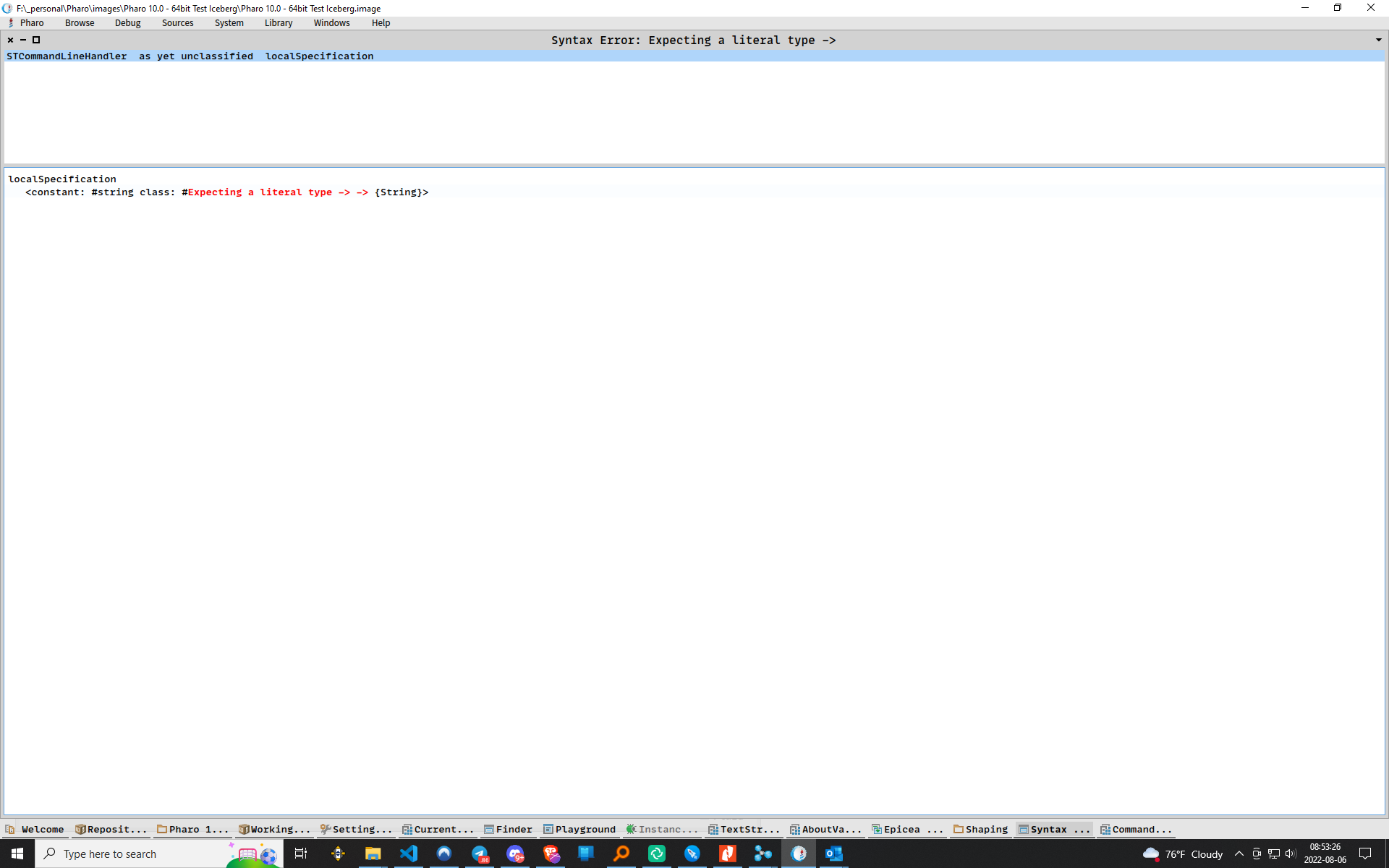
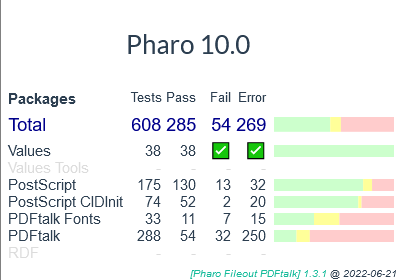
This writeLoadDoitOn: aStream aStream cr; nextPutAll: 'Installer ss'; crtab; nextPutAll: 'project: '; nextPutAll: self project printString; nextPut: $;; crtab; nextPutAll: 'install: '; nextPutAll: self install printString; nextPut: $!; cr wrote the following to the stream: ^ Installer ss project: 'ArbitraryPrecisionFloat'; install: 'MetacelloPreload smalltalkhubUser: ''Pharo'' project: ''MetaRepoForPharo70'' configuration: ''ArbitraryPrecisionFloat'' version: #stable' which doesnât compile. We just want the string after install: Shaping From: Shaping <shaping@uurda.org> Sent: Monday, 8 August, 2022 04:54 To: 'Any question about pharo is welcome' <pharo-users@lists.pharo.org> Subject: [Pharo-users] Re: [Pharo-users]Porting from VW 8.3 to Pharo: what to ignore; how to find Pharo base classes not in the base image I just realized that the baseClassLoadEvaluable (to load AFP for example) needs to be the install parameter in an instance of PharoPreload. Fixing that now. Shaping This is VWâs definition of IntegerArray: Smalltalk.Core defineClass: #IntegerArray superclass: #{Core.ArrayedCollection} indexedType: #none private: false instanceVariableNames: '' classInstanceVariableNames: '' imports: '' category: 'Collections-Arrayed' Iâm stepping through the chunks in the Changes Browser because I donât see an easier way currently. This is a separate tool from Epicea. The first chunk whose file-in fails is: IntegerArray variableByteSubclass: #ByteArray instanceVariableNames: '' classVariableNames: 'LastDecodeMap Decodings LastEncodeMap Encodings Lock' poolDictionaries: 'ForeignHeap' package: 'Shaping-Collection' I donât understand how this definition could have been created. ByteArray is a VW system class. Such classes should not be ported anyways â alone from copyright reasons. The only addition I see is the pool ForeignHeap. I guess, that you extended ByteArray somehow and added an import ForeignHeap.* to ByteArray. Yes I have: ByteArray >> asExternal ^ForeignHeap copyOfByteArray: self Also note that I have a ByteArray class override: Smalltalk.Core defineClass: #ByteArray superclass: #{Core.IntegerArray} indexedType: #bytes private: false instanceVariableNames: '' classInstanceVariableNames: '' imports: ' Shaping.ForeignHeap ' category: 'Collections-Arrayed' that imports my own ForeignHeap. I need to put that method on an existing Pharo class, which should just be its own version of ByteArray. So how do I tell my Shaping Collection package transform to ignore transformation of ByteArrayâs class definition, but preserve any methods in the same package that are extensions? It should be fine to extend the corresponding Pharo ByteArray with your methods. The problem is your overwritten class definition. Since the definition is in your package, it gets transformed as a defined class and not as an extension. But you donât need to redefine the Pharo class with a pool dictionary, since the transformations take care of the class renamings. Okay, so Iâll just undo the VW override of ByteArray, so that the transformation, as currently structured, can operate correctly. I donât need VWâs or my flavor of VWâs ForeignHeap. Pharo has its own idea of what that is, and any of my VW ForeignHeap-related method can be moved over separately. I guess I need to find the right Pharo class and try to attached the methods to that by do code rewrites. If the class doesnât exist, I can use something like my current VW ForeignHeap wrapper to reify foreign memory. Iâm not sure how the uFFI does things. I found this: http://books.pharo.org/booklet-uffi/pdf/2020-02-12-uFFI-V1.0.1 (p. 25) â Obtaining an ExternalAddress The most common way of obtaining an ExternalAddress is to receive it as the return value of a called C function. A good example is the libc function malloc(), which takes an integer specifying the desired size of a heap buffer, tries to allocate a contiguous block of memory of the size requested, and, if successful, returns a pointer to the allocated region of memory. The C declaration of such function reads as follows (from the libc manual): void *malloc( size_t size ); We only need create a uFFI binding to it by copy-pasting the declaration as follows: FFITutorial class >> malloc: aSize [ ^ self ffiCall: #( void * malloc ( size_t aSize ) ) library: LibC ] Notice that this function returns a âgeneric pointerâ, of type void * (meaning, what it points to in memory is untyped). In uFFI, this is marshalled to a ExternalAddress object. In other words, our malloc() binding yields an ExternalAddress in return (if successful). For example, if we use the above binding to ask the system to allocate a buffer of 200 bytes for us, then on return we should have an address that points somewhere in the C heap: FFITutorial malloc: 200 => (void*)@ 16r7FFBDE0DE030 But if we ask for more memory than there is currently available, malloc() will fail and return a NULL pointer instead: FFITutorial malloc: SmallInteger maxVal => (void*)@ 16r00000000 Consequently, we must always check the return value in cases like this, lest we invoke the infamous ânull pointer assignmentâ bug. â This is a new situation for me: an override of a system class definition which must be ignored and the methods treated as extensions. Yup, thatâs odd. Iâll patch around it for now. Let me know if you publish something to the public repo, or if you have file-in I can apply. Valid case. I have to think about it. On the other hand, it is bad style to override system class definitions. It is great that VW allows overrides of this kind which can be cleanly unloaded(!). I am not aware of any other Smalltalk with this capability (except maybe Gemstone). Therefore, it should really be the last resort to override system classes in the target Smalltalks. It was done for both notational convenience and speed. Otherwise, I would have needed to use the dotted notation. Iâve timed it, and it costs more microseconds than I wanted. Similar cases in my code I resolved by removing the import and spelling out the full name of the referenced classes. Yeah, see above. It does cost a little in speed. I donât recall the extra latency, but it was not insignificant, especially in high-frequency loops. I did the measurement sometime around 7.5/7.6 and have not done it since. Yes, I prefer not to crap-up a system class, but Iâm flexible when I need speed. (This might be slow when used in tight loops). Also generally bad to change your code just for a port. (ok, not generally). Or, you could ignore the class and add a SystemClassChange (for classes not defined or extended in the package) and add all your methods like: PackageChange ignoredNames: #(#{Core.ByteArray}) ⦠extensions: (Array with: (SystemClassChange className: #ByteArray instanceChanges: (Array with: (Add method: #myMethod code: #_shaping_myMethod) â¦) classChanges: (Array with: (Add method: #myClassMethod code: #_shaping_myClassMethod) â¦)) (I think that you could even use the original methods instead of the _shaping_* copies â nice. Untested though) Okay, I put that bit in the code but commented out. I canât really move that method anyway, because there is no ForeignHeap equivalent that I know yet in Pharo. As far as I can tell, Pharo doesnât try to reify as I do. It would be a separate task I would do later. Not a high priority now. [â¦] For this, a PackageChange has a #preload. It can be filled with a dialect specific specification of what to load beforehand. I defined PharoPreload and use it in Squeak :-) (look for the references). Okay. Actually, it should be renamed to MonticelloPreload or so. What you need would be a MetacelloPreload in which you would capture the parameters needed to load that package (and implement â#writeLoadDoitOn: aStreamâ too :-) ). I need to learn more about Monticello and Metacello to design the proper preload objects⦠(or I meet somebody who known everything about it :-) . Something like MetacelloPreload smalltalkhubUser: 'Pharo' project: 'MetaRepoForPharo70' configuration: 'ArbitraryPrecisionFloat' version: #stable So you want to do the actual Pharo preload of the needed Pharo base class on the VW side, and write the resulting class definition to the file-out stream. Iâd have to build the above class and copy from Pharo into VW the code that does Metacello load. It may not be worth the hassle. I might need only this one missing Pharo base class, but I could be wrong about that. Perhaps there are many such classes. No no no. On the VW side, the following string has to be written into the fileout before the package loads (with #writeLoadDoitOn: ): âMetacello new smalltalkhubUser: 'Pharo' project: 'MetaRepoForPharo70'; configuration: 'ArbitraryPrecisionFloat'; version: #stable; load!â Since the fileout is in chunk format, you can add any doIts you want. Thatâs how I can create packages and whatnot, because I can do anything you can do in a workspace. So the DoIt above will load the required package into Pharo. With that you have nothing to do in VW. Iâm trying to find the right spot in the transformation to do this. The below method is the only sender of #writeLoadDoitOn for Pharo (thereâs one for Squeak too). PharoPreload>> writePackageHeadFor: aWriter aWriter change hasPreload ifFalse: [ ^self]. aWriter change preload do: [:preload | preload writeLoadDoitOn: aWriter stream] Working down the stack we have PackageWriter>> writeHead self target writePackageHeadFor: self then Subwriter>> writeCodeComponent self writeBaseClasses âwrite pharo code that loads essential base classes <==============â self writeHead. self writeRunPrereadCode. self writeRunPreloadCode. self writeContents. self writeRunPostloadCode. self writeTail So where indicated we need to write: âMetacello new smalltalkhubUser: 'Pharo' project: 'MetaRepoForPharo70'; configuration: 'ArbitraryPrecisionFloat'; version: #stable; load!â at the arrow. So as a first go Iâve written: PackageWriter>> writeBaseClasses self target writeBaseClassesFor: self Pharo class>> writeBaseClassesFor: aWriter aWriter change hasBaseclassLoadEvaluables ifFalse: [ ^self]. aWriter change baseClassLoadEvaluables do: [:preload | preload writeLoadDoitOn: aWriter stream] PackageChange>> baseClassLoadEvaluables: baseClassLoadEvaluables ignoredNames: ingoredNames ^self baseClassLoadEvaluables: baseClassLoadEvaluables preload: nil ignoredNames: ingoredNames bridgeClasses: nil hierarchyChanges: nil localChanges: nil extensions: nil All the downstream methods have been created. baseClassLoadEvaluables will be an array of string evaluables like the above (could have a bunch of them). You can probably do a nicer job than I because you know the code better, but something like this hack could work. You might just want to do that the way you want nice and clean, and hand it back to me as a file in. Iâve not run this yet. Iâll do that in a few minutes and let you know how it goes. I can send you the complete file-out if/when it works, or you can use the above as a rough template and do it for us, and pass it back to me so that I can test it. The code will stay cleaner that way. The file-in gets past the APF stuff and is failing on setting the comment of a class that is not present. I donât see how that can happen, but the needed class def is not present in the chunk list before or after the comment: send. ??? Yeah, I donât understand it either. I get different behavior from the file in when I just run it versus manually evaluating the chunks form the Changes browser. Iâll ty it again with the new stuff for the baseClasses. Shaping I got about 6 seconds into the first file-in. Iâm running empty transforms on all packages. Great. You do need a ProjectChange though. Starting with empty PackageChanges is perfect. Yes, I have the one big ProjectChange with all the PackageChanges (about 25) currently empty. The problem Iâm having is using this Syntax error to determine where in the file-in the problem occurred so that I can know the package whose transform needs work. I was expecting more context. So Iâm poking around in STCommandLineHandler next with breakpoints. Open to suggestions. Strange. The #{String} syntax should have been automatically transformed to #String for Pharo⦠strange. All the namespace related issues (like this literal binding reference) should be taken care of. I had a bunch of those namespace/shared-variable bad-reference problems, which I cleared up for several hours before I was able to produce the first file-in. The transformation machinery is very strict, and helps you clean up your code. Iâd forgotten about many of the things that I was forced to fix. Iâll just debug through the file-in until I find the problem. Shaping. Iâll make my first run soon on my first package. Iâll do one package extra each time I run, building up the code. Each package will have its own <package name>Transform method, per the examples. Iâm not sure how to build these methods, except to assume that rewriting the pharo base methods is never wrong. Iâll file-in the resulting .st file to see what breaks. Then Iâll go back to the package whose .st source is not loading completely and add additional fixes (class keeps, base methods rewrites if needed and missing, method code body replacements if needed) to its transform method until it loads completely on the next run. That could take a while. Is that what you do in practice? Perfect! That is exactly how I do it. I start with an empty PackageChange. Then I add incrementally transforms until the code loads - phase one. This has been achieved for PDFtalk with the first release on GitHub. The second and final phase is to make all tests run (including the new to-write tests). This can take a while, because all syntactic and semantic differences must be addressed. Here, some cross-fertilization is possible. Yeah, and I have to be thorough finally about all my SUnit tests⦠The nice thing is, that the system is always telling you what to do. In fact, at first there are so many issues that it is a lot of fun to browse them and chose a nice one. Always the nicest or easiest bug first :-). Right. Iâm assuming the code writer is taking into account inter-package dependencies in order to get the load order right. Yes. Shaping From: christian.haider@smalltalked-visuals.com <mailto:christian.haider@smalltalked-visuals.com> <christian.haider@smalltalked-visuals.com <mailto:christian.haider@smalltalked-visuals.com> > Sent: Friday, 5 August, 2022 05:53 To: 'Any question about pharo is welcome' <pharo-users@lists.pharo.org <mailto:pharo-users@lists.pharo.org> >; 'Pharo Development List' <pharo-dev@lists.pharo.org <mailto:pharo-dev@lists.pharo.org> > Subject: [Pharo-users] Re: [Pharo-users]Porting from VW 8.3 to Pharo: pdftalkPackageChanges The full project in which the mentioned method used looks like this: PDFtalkProject ^ProjectChange name: #PDFtalk source: ((OrderedCollection new) add: (Package name: #Values); add: (Bundle name: #PDFtalk); add: (Package name: #'Values Testing'); add: (Bundle name: #'PDFtalk Testing'); add: (Package name: #'PDFtalk Demonstrations'); yourself) changes: self pdftalkPackageChanges nameMapping: (NameMapping keep: ((OrderedCollection new) add: #{Smalltalk.PDF}; add: #{PostScript.PSDictionary}; add: #{PDFtalk.PDFObject}; add: #{PDFtalk.PDFArray}; add: #{PDFtalk.PDFDictionary}; add: #{PDFtalk.PDFStream}; add: #{PDFtalk.PDFString}; add: #{PDFtalk.PDFDate}; add: #{PDFtalk.PDFTypeDefinition}; add: #{PDFtalk.PDFEncoder}; yourself) classToNames: ((Valuemap new) add: #{SubscriptOutOfBoundsError} -> #Error; add: #{NonIntegerIndexError} -> #Error; add: #{NotFoundError} -> #KeyNotFound; add: #{KeyNotFoundError} -> #KeyNotFound; yourself) namespaceToPrefixes: ((Valuemap new) add: #{Smalltalk.PostScript} -> 'PS'; add: #{Smalltalk.PDFtalk} -> 'Pt'; add: #{PDFtalk.Fonts} -> 'PtF'; add: #{PDFtalk.Fonts.OpenType} -> 'PtOT'; yourself)) In the #source: are the bundles and packages to be transformed. The #changes: (your method) specify the transforms (PackageChange) for each package explicitly. Only packages contain code and therefore, only packages need the code transformations. Bundles are transformed without transformations. (Well, the code for pre-, post- whatever blocks are transformed with the class name mappings rules). So, the mapping from packages to the corresponding PackageChange has to be stated somehow. Using a dictionary (Valuemap) for this seems also natural. The only change I might like is to use pragmas to tag the PackageChange returning methods with âtheirâ package like <package: âValues Toolsâ> or so. Putting the package reference into the PackageChange is not a good idea, because all those Objects need to be created before your can find out which package is affected. (Ok, I am creating all PackageChange objects tooâ¦). Happy hacking, Christian Von: Shaping <shaping@uurda.org <mailto:shaping@uurda.org> > Gesendet: Freitag, 5. August 2022 03:26 An: 'Any question about pharo is welcome' <pharo-users@lists.pharo.org <mailto:pharo-users@lists.pharo.org> >; 'Pharo Development List' <pharo-dev@lists.pharo.org <mailto:pharo-dev@lists.pharo.org> > Betreff: [Pharo-users] Re: [Pharo-users]Porting from VW 8.3 to Pharo: pdftalkPackageChanges This method pdftalkPackageChanges ^(Valuemap new) add: 'Values' -> self ValuesTransform; add: 'PostScript' -> self PostScriptTransform; add: 'PDFtalk Basics' -> self PDFtalkBasicsTransform; add: 'PDFtalk Typing' -> self PDFtalkTypingTransform; add: 'PDFtalk Basic Objects' -> self PDFtalkBasicObjectsTransform; add: 'PDFtalk Streams' -> self PDFtalkStreamsTransform; add: 'PDFtalk Data Structures' -> self PDFtalkDataStructuresTransform; add: 'PDFtalk Parsing' -> self PDFtalkParsingTransform; add: 'PDFtalk Colour' -> self PDFtalkColourTransform; add: 'PostScript Fonts' -> self PostScriptFontsTransform; add: 'PostScript CIDInit' -> self PostScriptCIDInitTransform; add: 'PDFtalk Fonts Basics' -> self PDFtalkFontsBasicsTransform; add: 'PDFtalk Fonts Type1' -> self PDFtalkFontsType1Transform; add: 'PDFtalk Fonts OpenType' -> self PDFtalkFontsOpenTypeTransform; add: 'PDFtalk Fonts' -> self PDFtalkFontsTransform; add: 'PDFtalk Graphics' -> self PDFtalkGraphicsTransform; add: 'PDFtalk Graphics Operations' -> self PDFtalkGraphicsOperationsTransform; add: 'PDFtalk XObjects' -> self PDFtalkXObjectsTransform; add: 'PDFtalk Images' -> self PDFtalkImagesTransform; add: 'PDFtalk Files' -> self PDFtalkFilesTransform; add: 'PDFtalk Document' -> self PDFtalkDocumentTransform; add: 'PDFtalk Rendering' -> self PDFtalkRenderingTransform; add: 'PDFtalk Shading' -> self PDFtalkShadingTransform; add: 'PDFtalk Interactive Features' -> self PDFtalkInteractiveFeaturesTransform; add: 'PDFtalk Deploying' -> self PDFtalkDeployingTransform; add: 'Values Testing' -> self ValuesTestingTransform; add: 'PDFtalk test resources' -> self PDFtalkTestResourcesTransform; add: 'PostScript Testing' -> self PostScriptTestingTransform; add: 'PostScript CIDInit Testing' -> self PostScriptCIDInitTestingTransform; add: 'PDFtalk Fonts tests' -> self PDFtalkFontsTestsTransform; add: 'PDFtalk tests' -> self PDFtalkTestsTransform; add: 'PDFtalk Demonstrations' -> self PDFtalkDemonstrationsTransform; yourself effectively looks like the head transform structure for a project, in this case all the PDFtalk stuff, which includes Values and Postscript. This is not exactly a bundle idea, is it? Itâs project spread across potentially many bundles and packages. Iâll start coding my transform with a similar method, and work down toward the details. Takes a bit to get used to all the correct, yet dangling VW methods that are useless in VW, but which will become new code in the target image and there no longer appear to be dangling (with syntax highlighting aberrations). Odd looking but completely by design. Shaping From: Shaping <shaping@uurda.org <mailto:shaping@uurda.org> > Sent: Thursday, 4 August, 2022 19:18 To: 'Any question about pharo is welcome' <pharo-users@lists.pharo.org <mailto:pharo-users@lists.pharo.org> > Subject: [Pharo-users] Re: [Pharo-users]Porting from VW 8.3 to Pharo: Pharo100 fileOutValues I will look, although this kind of always available on demand thing is too disruptive for me⦠I know what you mean. I try be disciplined about it. I really like to be able to fix typos, because there are almost always typos. But e-mail is okay. So that little example is a test that shows how the transformation is done. It converts just package Values to a Pharo-compatible file-in. My task is then to queue a bunch of ProjectChange instances like this one: SmalltalkTransform.Pharo100>> ValuesProject ^ProjectChange name: #Values source: (Array with: (Package name: #Values)) changes: (Valuemap with: 'Values' -> self ValuesTransform) Exactly but for my own packages. No bundles are transformed (just their contained packages) because Pharo doesnât have bundles. Is that right? No, bundles are handled. For real examples, you need to look at the PDFtalk transforms. Yes, Pharo does not have a concept of bundles (ordered aggregates of packages). Instead it relies on a naming convention for packages. That convention is honored in the fileout, so that packages will be partly grouped in Pharo according to the category prefix. For each VW-package, one Pharo package is created. A bundle itself is also represented as Pharo package with one class About<bundlename> with class methods for the metadata of the bundle, including a method giving you the ordered list of component packages. So, all contents and metadata of packages and bundles are transformed for Pharo. No code or info gets lost. Okay. Is method ValuesTransform ^PackageChange ignoredNames: #(#{Smalltalk.GeneralBindingReference}) bridgeClasses: (Valuemap with: #{Timestamp} -> #DateAndTime with: #{Smalltalk.ColorValue} -> #Color) localChanges: self valuesLocalTransform extensions: (Array with: (SystemClassChange className: #Color instanceChanges: (Array with: (Add method: #asColorValue code: #_ph_asColorValue))) with: (SystemClassChange className: #TextStream instanceChanges: (Array with: (Add method: #nextPutAllText: code: #_ph_nextPutAllText:)))) written specifically for that package? I would think it applies to all packages. I see some expected mappings like Timestamp to DateAndTime. Yes, this method returns a PackageChange Value describing the transformations needed to create the Pharo fileout for this specific package (inspect the return value for the fully expanded Value). Methods exist with the same name for other Smalltalks. Depending on the dialect (or version of a dialect), the transforms are different. Squeak and Pharo are quite similar, because they share a common history, but VA or Gemstone need quite different transforms. So, in general, for each package, there is one such method/Value for each target Smalltalk/version. Okay. I do not dare to extract commonalities before the machinery is really robust and stable. For now everything is neatly separate and self-contained (and probably it will stay that way, although there are lots of duplications). The mapping of class names is the responsibility of the enclosing ProjectChange Value where you define the list of source bundles/packages to transform, the PackageChanges for all packages and the mapping of âglobalâ names. (The bridge classes above are no renames, but a subclass relationship (is-a) to avoid renamings. The new class Timestamp will be created as subclass of DateAndTime which has almost the same semantics. Therefore, I can still use Timestamp which will be basically a DateAndTime now.) Okay. There is still a technical challenge here. Currently, a ProjectChange need to include all prerequisites (Values is part of the PDFtalk project and will be transformed with it). A ProjectWriter, which coordinates the transform, keeps track of the mappings when they are created (either explicitly or through a namespace renaming â see implementers of #PDFtalkProject). I would like to have this more modular: the mappings from the Values transformation should be persistently saved, so that other transformation projects can just use them, instead of including the sources into one own project. For this, I need to have renamings local to a package (where they first occur), not global on the project level. Right. For Values and Values Tests and Values Tools this works, because there are no mappings in the Values package. What about conversion of VW arrays to Pharo literal arrays? How is that done? (I think you mean dynamic arrays like {1. âabcâ size. 42} in which evaluation happens (in contrast to literal things which can be resolved already by the compiler). Yes, dynamic arrays. Not! Since a while, VW also has dynamic arrays, but not in VW 8.3 â the last publicly available version. Okay, I was wondering when that would happen. I will not shut out those users, because âopen-sourceâ would be quite absurd, if it is only available for paying customers. In 8.3, the compiler does not accept that syntax and therefore, there is no easy way to represent this in replacement code. So, no. It is not possible until Cincom releases an public version which can handle that. Okay. I recall that one of the Smalltalks (I donât recall which) had Stream semantics differing from VWâs. ⦠I just checked. VWâs #upTo: method includes the object and leaves the index after it, and Pharoâs excludes the object and leaves the index at the object. So that is some major breakage if we donât correct it. Can it be done automatically? Yes, these are the usual porting challenges and exactly the reason why this library exists :). Thank you for the question :). Yes, the stream semantics need to be fixed. The idea is that a set of transforms for this issue can be reused by others. Okay.
valuesLocalTransform
has lots of juicy bits. But this doesnât look very simple. We canât just replace an old method with a new one. We also have to write the new one to tweak how the indices are used in #upTo:, and make sure that new method gets filed-in as well into the Pharo target image. Or, we have to do this kind of change manually. Naa, itâs very easy, I think :). A PackageChange specifies transforms for classes used in the package (#localChanges) and #extensions for system classes of the target. For a class, you can have a ClassChange describing the changes to instance or class methods. A MethodChange has 4 subclasses for: - Ignore â donât write this method to the target - Add â add this new method (not in the source system) to the target - Replace â replace the body of this method with other code - Rewrite â rewrite the method source using a rewrite rule. Add and Replace need the target code. Add then always involves a new name for a method in the target. Replaces use an old name in the target with a new code body. This is stored in another method with a derived name like #_ph_upTo: . The method name is not important, because only the body of the method is used. But the name should not be used in the source â it is just a holder for the replacement code. These methods live in the specific [<Smalltalk> Fileout <Package>] package. Okay. There are lots of working(!) examples for all of those in the PDFtalk transform project. This bit (SystemClassChange className: #Color instanceChanges: (Array with: (Add method: #asColorValue code: #_ph_asColorValue))) is replacing #asColorValue with #_ph_asColorValue because some special Pharo-color conversion needs to happen. But how does #_ph_asColorValue get defined? Itâs neither in VW nor in Pharo 10. You got bitten by the old version of [Pharo Fileout Values]. Please load [Pharo Fileout PDFtalk]. There, the methods exist. Yes, I see it now. Ok. I donât have a virgin image. I have a very non-virgin image, about 27 years of development Iâm trying to port to Pharo. I donât yet have a specific interest in the PDFtalk, though I do see a need for PDF generation later, and will probably revisit that. For now, I just want my own stuff to run in Pharo. Virgin image just means that you donât need anything else. You can safely load it in you favorite special images :). I would load PDFtalk, although technically you donât need to (all the extensions to PDFtalk would be unloadable, but that doesnât affect Values). Okay. is: Load {Values Project] bundle Load {PDFtalk Project} bundle Load {Smalltalk Transform Project} bundle Load [Pharo Fileout PDFtalk] package Save, done Okay, so do I understand correctly that I need to include the PDFtalk stuff even if Iâm not interested in PDFtalk, because thatâs where a lot of the Smalltalk transformation machinery lives? Or is the PDFtalk just being used as an example for how to do a massive transformation? Or Both? No, the transformation machinery is fully independent of PDFtalk. I just tried it. The dependencies are in the specific [Pharo Fileout PDFtalk] package, since I have already quite a few replacement methods which are extensions to PDFtalk classes. Okay. PDFtalk is the focus of the project and therefore all issues are solved first with this library in mind. Therefore, bundles and namespaces are handled, for example. When you study the more interesting transformations for PDFtalk, it would be a shame not to be able to browse the methods and classes involved. So, PDFtalk is the real world reference example. And Values is the simplest example. To transform Values do: âPharo100 fileOutValuesâ The [Pharo Fileout PDFtalk] package includes the latest Values transformations. I am thinking about a better modularization⦠Also, the wiki is a bit out of control. It really needs some restructuring. In the cites wiki page, there is a link to a blog where I record the changes. This might be informative. 2. Port the Values package. This is easy, since no namespaces are involved. This first instruction after VW package setup says to port the contents of the Values package from VW to Pharo. Do you mean manually? Probably not. No, no. This has been finished in March. For each dialect, I have a GitHub repository where I release important versions: <https://github.com/PortingPDFtalk/PharoPDFtalk> https://github.com/PortingPDFtalk/PharoPDFtalk. You can find the working port as first release â <https://github.com/PortingPDFtalk/PharoPDFtalk/releases/tag/1.3.0.0> Working versionâ. There you can download the ported Values fileout with the exact description with which versions of what it was created. This should be a good starting example. Why do I need any new code installed in Pharo before I begin the transformation, if Iâm transforming code from VW to pharo? Iâm not understanding the basic constraints of the problem, even when the detailed steps are clear. No, no. You donât need anything on the Pharo side. The fileouts on GitHub are the end products of a transformation for people who donât use VisualWorks, but want to use Values in Pharo. Or help with PDFtalk by fixing some issues, so that I can write the transformations. Iâve done these steps so far: 1. Went to <https://github.com/PortingPDFtalk/PharoPDFtalk> https://github.com/PortingPDFtalk/PharoPDFtalk. Mistake :). You donât want to look at the unfinished product of the current version of thincomplete transformations for PDFtalk. Do you mean âfinishedâ here? Isnât that file-in the finished result? I thought the above links was the currently finished result (as good as it can be until the rest of the bugs are goine and tests all run). Yes, that was confusing. Thatâs why I had the early impression that Values was somehow apart of the transformation machinery. See https://wiki.pdftalk.de/doku.php?id=stateoftheport#pharo-10-0: Instead, you want to look at the unfinished product of the transformations of your projects :). 2. Saved down PDFtalk.Pharo100.st into <my Pharo 10 image directory>/pharo-local/Smalltalk-Transformation. (I figured that was a good place to save it. If anyone disagrees, or has a better or more conventional idea about where files should be saved, please say so. I setup a Pharo Git repo and played with it briefly for the first time yesterday. Iâve used Pharo off an on for 16 years, but this is the first time Iâm making a serious effort to manage source, and not throw away what Iâm working on.) 3. Filed-in PDFtalk.Pharo100.st. This went on for about 7 minutes or so. I have a hundreds if not over a thousand classes showing in Epicea. Is there anyway to get Epicea to give me a count of changes with a time-range filter? 4. Deleted (forgot) yesterdayâs, old Main practice-repo from both the image and the drive, and made a new one. I need to add to Main all the packages I just filed-in, but I donât see an efficient way to do that. I would like to use the Add Package button, but this gives a filtered list of available packages. I can filter subgroups, and then individually select each of the checkboxes to the left of each package (there is no Ctrl-A [select all] option here, which seems to be a strange omission given the potentially large number of packages involved). I see lots of prefixes for the classes just loaded. I could easily miss something if I filter/select/add one prefix-group at a time. Is there an easier way? Over in Epicea I donât see a way to push the loaded items listed to a specific repo. The first thought I have is to select all filed-in code artifacts by datetime span. I did that and saved it as an .ombu file (I have no idea what that is). I donât see a way to import that .ombu file into repo Mainâs âWorking copyâ window. It must be easy, but I donât see it. Please suggest the best way. Iâd like to know as well â I am not quite familiar with the source management concepts in Pharo. I asked in Discord. I donât understand why stuff like this is missing. The only conclusion I can draw is that no one does huge file-ins (but you do). It is planned to generate Tonel output in the future, but for now I feel safer with the traditional fileout where I can have doIts. I am not sure how Tonel reacts to crippled sources, which are normal during the development of the transformations. Shaping From: christian.haider <christian.haider@smalltalked-visuals.com <mailto:christian.haider@smalltalked-visuals.com> > Sent: Wednesday, 22 June, 2022 05:42 To: pharo-users@lists.pharo.org <mailto:pharo-users@lists.pharo.org> Subject: [Pharo-users] [PDFtalk] second fileOut for Squeak and Pharo With help from the community some issues were fixed which improved the test statistics nicely. Check it out: https://wiki.pdftalk.de/doku.php?id=portingblog#second_pdftalk_fileout_for_s... Thanks to everybody involved! Happy hacking, Christian
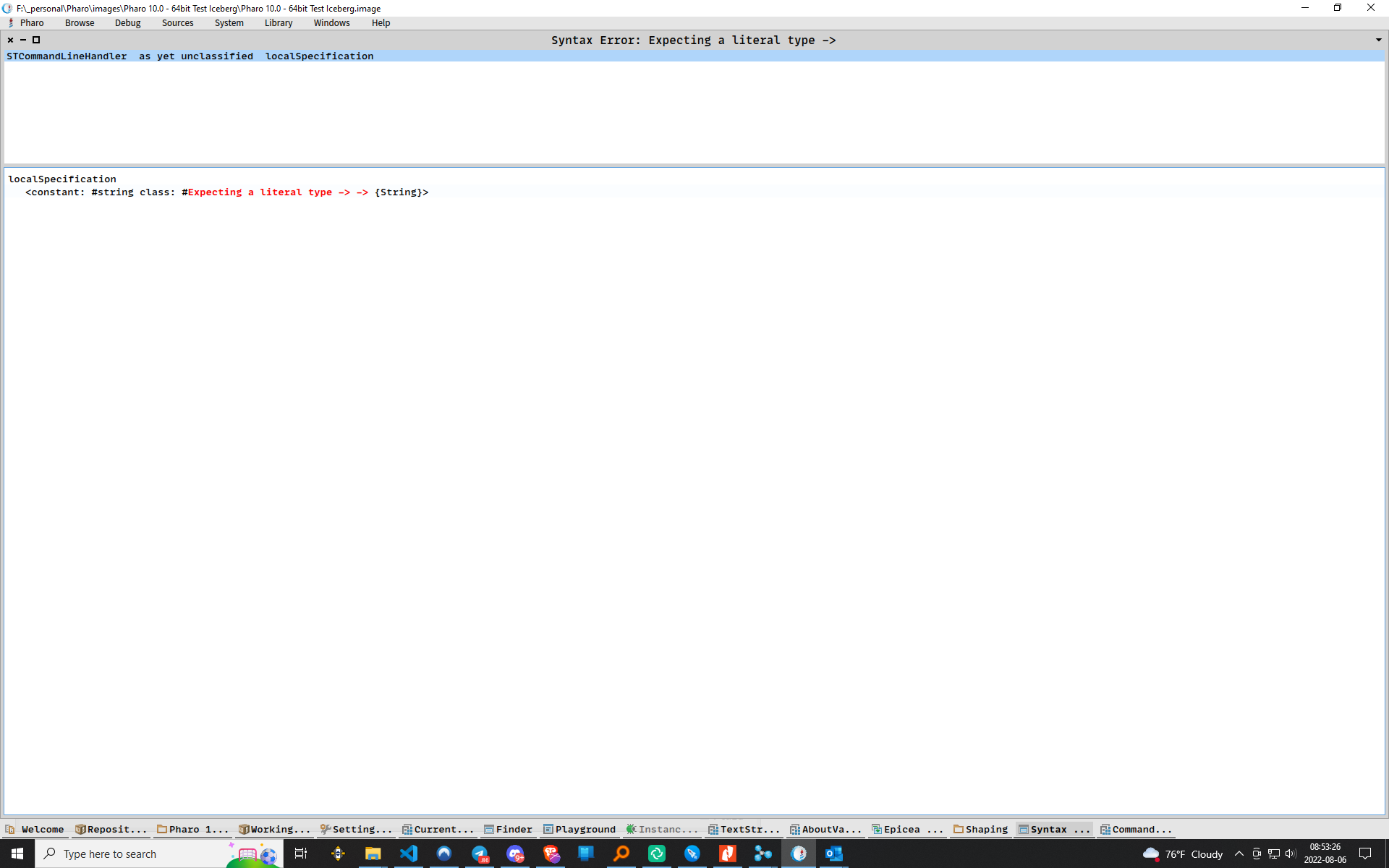
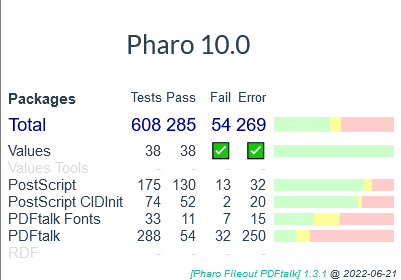
Attached is the new Transform that ultimately results in the insertion of the needed evaluable, but there is also the extra prelude âInstaller ssâ¦â. Iâm not sure what thatâs about. Shaping From: Shaping <shaping@uurda.org> Sent: Monday, 8 August, 2022 05:41 To: 'Any question about pharo is welcome' <pharo-users@lists.pharo.org> Subject: [Pharo-users] Re: [Pharo-users]Porting from VW 8.3 to Pharo: what to ignore; how to find Pharo base classes not in the base image This writeLoadDoitOn: aStream aStream cr; nextPutAll: 'Installer ss'; crtab; nextPutAll: 'project: '; nextPutAll: self project printString; nextPut: $;; crtab; nextPutAll: 'install: '; nextPutAll: self install printString; nextPut: $!; cr wrote the following to the stream: ^ Installer ss project: 'ArbitraryPrecisionFloat'; install: 'MetacelloPreload smalltalkhubUser: ''Pharo'' project: ''MetaRepoForPharo70'' configuration: ''ArbitraryPrecisionFloat'' version: #stable' which doesnât compile. We just want the string after install: Shaping From: Shaping <shaping@uurda.org <mailto:shaping@uurda.org> > Sent: Monday, 8 August, 2022 04:54 To: 'Any question about pharo is welcome' <pharo-users@lists.pharo.org <mailto:pharo-users@lists.pharo.org> > Subject: [Pharo-users] Re: [Pharo-users]Porting from VW 8.3 to Pharo: what to ignore; how to find Pharo base classes not in the base image I just realized that the baseClassLoadEvaluable (to load AFP for example) needs to be the install parameter in an instance of PharoPreload. Fixing that now. Shaping This is VWâs definition of IntegerArray: Smalltalk.Core defineClass: #IntegerArray superclass: #{Core.ArrayedCollection} indexedType: #none private: false instanceVariableNames: '' classInstanceVariableNames: '' imports: '' category: 'Collections-Arrayed' Iâm stepping through the chunks in the Changes Browser because I donât see an easier way currently. This is a separate tool from Epicea. The first chunk whose file-in fails is: IntegerArray variableByteSubclass: #ByteArray instanceVariableNames: '' classVariableNames: 'LastDecodeMap Decodings LastEncodeMap Encodings Lock' poolDictionaries: 'ForeignHeap' package: 'Shaping-Collection' I donât understand how this definition could have been created. ByteArray is a VW system class. Such classes should not be ported anyways â alone from copyright reasons. The only addition I see is the pool ForeignHeap. I guess, that you extended ByteArray somehow and added an import ForeignHeap.* to ByteArray. Yes I have: ByteArray >> asExternal ^ForeignHeap copyOfByteArray: self Also note that I have a ByteArray class override: Smalltalk.Core defineClass: #ByteArray superclass: #{Core.IntegerArray} indexedType: #bytes private: false instanceVariableNames: '' classInstanceVariableNames: '' imports: ' Shaping.ForeignHeap ' category: 'Collections-Arrayed' that imports my own ForeignHeap. I need to put that method on an existing Pharo class, which should just be its own version of ByteArray. So how do I tell my Shaping Collection package transform to ignore transformation of ByteArrayâs class definition, but preserve any methods in the same package that are extensions? It should be fine to extend the corresponding Pharo ByteArray with your methods. The problem is your overwritten class definition. Since the definition is in your package, it gets transformed as a defined class and not as an extension. But you donât need to redefine the Pharo class with a pool dictionary, since the transformations take care of the class renamings. Okay, so Iâll just undo the VW override of ByteArray, so that the transformation, as currently structured, can operate correctly. I donât need VWâs or my flavor of VWâs ForeignHeap. Pharo has its own idea of what that is, and any of my VW ForeignHeap-related method can be moved over separately. I guess I need to find the right Pharo class and try to attached the methods to that by do code rewrites. If the class doesnât exist, I can use something like my current VW ForeignHeap wrapper to reify foreign memory. Iâm not sure how the uFFI does things. I found this: http://books.pharo.org/booklet-uffi/pdf/2020-02-12-uFFI-V1.0.1 (p. 25) â Obtaining an ExternalAddress The most common way of obtaining an ExternalAddress is to receive it as the return value of a called C function. A good example is the libc function malloc(), which takes an integer specifying the desired size of a heap buffer, tries to allocate a contiguous block of memory of the size requested, and, if successful, returns a pointer to the allocated region of memory. The C declaration of such function reads as follows (from the libc manual): void *malloc( size_t size ); We only need create a uFFI binding to it by copy-pasting the declaration as follows: FFITutorial class >> malloc: aSize [ ^ self ffiCall: #( void * malloc ( size_t aSize ) ) library: LibC ] Notice that this function returns a âgeneric pointerâ, of type void * (meaning, what it points to in memory is untyped). In uFFI, this is marshalled to a ExternalAddress object. In other words, our malloc() binding yields an ExternalAddress in return (if successful). For example, if we use the above binding to ask the system to allocate a buffer of 200 bytes for us, then on return we should have an address that points somewhere in the C heap: FFITutorial malloc: 200 => (void*)@ 16r7FFBDE0DE030 But if we ask for more memory than there is currently available, malloc() will fail and return a NULL pointer instead: FFITutorial malloc: SmallInteger maxVal => (void*)@ 16r00000000 Consequently, we must always check the return value in cases like this, lest we invoke the infamous ânull pointer assignmentâ bug. â This is a new situation for me: an override of a system class definition which must be ignored and the methods treated as extensions. Yup, thatâs odd. Iâll patch around it for now. Let me know if you publish something to the public repo, or if you have file-in I can apply. Valid case. I have to think about it. On the other hand, it is bad style to override system class definitions. It is great that VW allows overrides of this kind which can be cleanly unloaded(!). I am not aware of any other Smalltalk with this capability (except maybe Gemstone). Therefore, it should really be the last resort to override system classes in the target Smalltalks. It was done for both notational convenience and speed. Otherwise, I would have needed to use the dotted notation. Iâve timed it, and it costs more microseconds than I wanted. Similar cases in my code I resolved by removing the import and spelling out the full name of the referenced classes. Yeah, see above. It does cost a little in speed. I donât recall the extra latency, but it was not insignificant, especially in high-frequency loops. I did the measurement sometime around 7.5/7.6 and have not done it since. Yes, I prefer not to crap-up a system class, but Iâm flexible when I need speed. (This might be slow when used in tight loops). Also generally bad to change your code just for a port. (ok, not generally). Or, you could ignore the class and add a SystemClassChange (for classes not defined or extended in the package) and add all your methods like: PackageChange ignoredNames: #(#{Core.ByteArray}) ⦠extensions: (Array with: (SystemClassChange className: #ByteArray instanceChanges: (Array with: (Add method: #myMethod code: #_shaping_myMethod) â¦) classChanges: (Array with: (Add method: #myClassMethod code: #_shaping_myClassMethod) â¦)) (I think that you could even use the original methods instead of the _shaping_* copies â nice. Untested though) Okay, I put that bit in the code but commented out. I canât really move that method anyway, because there is no ForeignHeap equivalent that I know yet in Pharo. As far as I can tell, Pharo doesnât try to reify as I do. It would be a separate task I would do later. Not a high priority now. [â¦] For this, a PackageChange has a #preload. It can be filled with a dialect specific specification of what to load beforehand. I defined PharoPreload and use it in Squeak :-) (look for the references). Okay. Actually, it should be renamed to MonticelloPreload or so. What you need would be a MetacelloPreload in which you would capture the parameters needed to load that package (and implement â#writeLoadDoitOn: aStreamâ too :-) ). I need to learn more about Monticello and Metacello to design the proper preload objects⦠(or I meet somebody who known everything about it :-) . Something like MetacelloPreload smalltalkhubUser: 'Pharo' project: 'MetaRepoForPharo70' configuration: 'ArbitraryPrecisionFloat' version: #stable So you want to do the actual Pharo preload of the needed Pharo base class on the VW side, and write the resulting class definition to the file-out stream. Iâd have to build the above class and copy from Pharo into VW the code that does Metacello load. It may not be worth the hassle. I might need only this one missing Pharo base class, but I could be wrong about that. Perhaps there are many such classes. No no no. On the VW side, the following string has to be written into the fileout before the package loads (with #writeLoadDoitOn: ): âMetacello new smalltalkhubUser: 'Pharo' project: 'MetaRepoForPharo70'; configuration: 'ArbitraryPrecisionFloat'; version: #stable; load!â Since the fileout is in chunk format, you can add any doIts you want. Thatâs how I can create packages and whatnot, because I can do anything you can do in a workspace. So the DoIt above will load the required package into Pharo. With that you have nothing to do in VW. Iâm trying to find the right spot in the transformation to do this. The below method is the only sender of #writeLoadDoitOn for Pharo (thereâs one for Squeak too). PharoPreload>> writePackageHeadFor: aWriter aWriter change hasPreload ifFalse: [ ^self]. aWriter change preload do: [:preload | preload writeLoadDoitOn: aWriter stream] Working down the stack we have PackageWriter>> writeHead self target writePackageHeadFor: self then Subwriter>> writeCodeComponent self writeBaseClasses âwrite pharo code that loads essential base classes <==============â self writeHead. self writeRunPrereadCode. self writeRunPreloadCode. self writeContents. self writeRunPostloadCode. self writeTail So where indicated we need to write: âMetacello new smalltalkhubUser: 'Pharo' project: 'MetaRepoForPharo70'; configuration: 'ArbitraryPrecisionFloat'; version: #stable; load!â at the arrow. So as a first go Iâve written: PackageWriter>> writeBaseClasses self target writeBaseClassesFor: self Pharo class>> writeBaseClassesFor: aWriter aWriter change hasBaseclassLoadEvaluables ifFalse: [ ^self]. aWriter change baseClassLoadEvaluables do: [:preload | preload writeLoadDoitOn: aWriter stream] PackageChange>> baseClassLoadEvaluables: baseClassLoadEvaluables ignoredNames: ingoredNames ^self baseClassLoadEvaluables: baseClassLoadEvaluables preload: nil ignoredNames: ingoredNames bridgeClasses: nil hierarchyChanges: nil localChanges: nil extensions: nil All the downstream methods have been created. baseClassLoadEvaluables will be an array of string evaluables like the above (could have a bunch of them). You can probably do a nicer job than I because you know the code better, but something like this hack could work. You might just want to do that the way you want nice and clean, and hand it back to me as a file in. Iâve not run this yet. Iâll do that in a few minutes and let you know how it goes. I can send you the complete file-out if/when it works, or you can use the above as a rough template and do it for us, and pass it back to me so that I can test it. The code will stay cleaner that way. The file-in gets past the APF stuff and is failing on setting the comment of a class that is not present. I donât see how that can happen, but the needed class def is not present in the chunk list before or after the comment: send. ??? Yeah, I donât understand it either. I get different behavior from the file in when I just run it versus manually evaluating the chunks form the Changes browser. Iâll ty it again with the new stuff for the baseClasses. Shaping I got about 6 seconds into the first file-in. Iâm running empty transforms on all packages. Great. You do need a ProjectChange though. Starting with empty PackageChanges is perfect. Yes, I have the one big ProjectChange with all the PackageChanges (about 25) currently empty. The problem Iâm having is using this Syntax error to determine where in the file-in the problem occurred so that I can know the package whose transform needs work. I was expecting more context. So Iâm poking around in STCommandLineHandler next with breakpoints. Open to suggestions. Strange. The #{String} syntax should have been automatically transformed to #String for Pharo⦠strange. All the namespace related issues (like this literal binding reference) should be taken care of. I had a bunch of those namespace/shared-variable bad-reference problems, which I cleared up for several hours before I was able to produce the first file-in. The transformation machinery is very strict, and helps you clean up your code. Iâd forgotten about many of the things that I was forced to fix. Iâll just debug through the file-in until I find the problem. Shaping. Iâll make my first run soon on my first package. Iâll do one package extra each time I run, building up the code. Each package will have its own <package name>Transform method, per the examples. Iâm not sure how to build these methods, except to assume that rewriting the pharo base methods is never wrong. Iâll file-in the resulting .st file to see what breaks. Then Iâll go back to the package whose .st source is not loading completely and add additional fixes (class keeps, base methods rewrites if needed and missing, method code body replacements if needed) to its transform method until it loads completely on the next run. That could take a while. Is that what you do in practice? Perfect! That is exactly how I do it. I start with an empty PackageChange. Then I add incrementally transforms until the code loads - phase one. This has been achieved for PDFtalk with the first release on GitHub. The second and final phase is to make all tests run (including the new to-write tests). This can take a while, because all syntactic and semantic differences must be addressed. Here, some cross-fertilization is possible. Yeah, and I have to be thorough finally about all my SUnit tests⦠The nice thing is, that the system is always telling you what to do. In fact, at first there are so many issues that it is a lot of fun to browse them and chose a nice one. Always the nicest or easiest bug first :-). Right. Iâm assuming the code writer is taking into account inter-package dependencies in order to get the load order right. Yes. Shaping From: christian.haider@smalltalked-visuals.com <mailto:christian.haider@smalltalked-visuals.com> <christian.haider@smalltalked-visuals.com <mailto:christian.haider@smalltalked-visuals.com> > Sent: Friday, 5 August, 2022 05:53 To: 'Any question about pharo is welcome' <pharo-users@lists.pharo.org <mailto:pharo-users@lists.pharo.org> >; 'Pharo Development List' <pharo-dev@lists.pharo.org <mailto:pharo-dev@lists.pharo.org> > Subject: [Pharo-users] Re: [Pharo-users]Porting from VW 8.3 to Pharo: pdftalkPackageChanges The full project in which the mentioned method used looks like this: PDFtalkProject ^ProjectChange name: #PDFtalk source: ((OrderedCollection new) add: (Package name: #Values); add: (Bundle name: #PDFtalk); add: (Package name: #'Values Testing'); add: (Bundle name: #'PDFtalk Testing'); add: (Package name: #'PDFtalk Demonstrations'); yourself) changes: self pdftalkPackageChanges nameMapping: (NameMapping keep: ((OrderedCollection new) add: #{Smalltalk.PDF}; add: #{PostScript.PSDictionary}; add: #{PDFtalk.PDFObject}; add: #{PDFtalk.PDFArray}; add: #{PDFtalk.PDFDictionary}; add: #{PDFtalk.PDFStream}; add: #{PDFtalk.PDFString}; add: #{PDFtalk.PDFDate}; add: #{PDFtalk.PDFTypeDefinition}; add: #{PDFtalk.PDFEncoder}; yourself) classToNames: ((Valuemap new) add: #{SubscriptOutOfBoundsError} -> #Error; add: #{NonIntegerIndexError} -> #Error; add: #{NotFoundError} -> #KeyNotFound; add: #{KeyNotFoundError} -> #KeyNotFound; yourself) namespaceToPrefixes: ((Valuemap new) add: #{Smalltalk.PostScript} -> 'PS'; add: #{Smalltalk.PDFtalk} -> 'Pt'; add: #{PDFtalk.Fonts} -> 'PtF'; add: #{PDFtalk.Fonts.OpenType} -> 'PtOT'; yourself)) In the #source: are the bundles and packages to be transformed. The #changes: (your method) specify the transforms (PackageChange) for each package explicitly. Only packages contain code and therefore, only packages need the code transformations. Bundles are transformed without transformations. (Well, the code for pre-, post- whatever blocks are transformed with the class name mappings rules). So, the mapping from packages to the corresponding PackageChange has to be stated somehow. Using a dictionary (Valuemap) for this seems also natural. The only change I might like is to use pragmas to tag the PackageChange returning methods with âtheirâ package like <package: âValues Toolsâ> or so. Putting the package reference into the PackageChange is not a good idea, because all those Objects need to be created before your can find out which package is affected. (Ok, I am creating all PackageChange objects tooâ¦). Happy hacking, Christian Von: Shaping <shaping@uurda.org <mailto:shaping@uurda.org> > Gesendet: Freitag, 5. August 2022 03:26 An: 'Any question about pharo is welcome' <pharo-users@lists.pharo.org <mailto:pharo-users@lists.pharo.org> >; 'Pharo Development List' <pharo-dev@lists.pharo.org <mailto:pharo-dev@lists.pharo.org> > Betreff: [Pharo-users] Re: [Pharo-users]Porting from VW 8.3 to Pharo: pdftalkPackageChanges This method pdftalkPackageChanges ^(Valuemap new) add: 'Values' -> self ValuesTransform; add: 'PostScript' -> self PostScriptTransform; add: 'PDFtalk Basics' -> self PDFtalkBasicsTransform; add: 'PDFtalk Typing' -> self PDFtalkTypingTransform; add: 'PDFtalk Basic Objects' -> self PDFtalkBasicObjectsTransform; add: 'PDFtalk Streams' -> self PDFtalkStreamsTransform; add: 'PDFtalk Data Structures' -> self PDFtalkDataStructuresTransform; add: 'PDFtalk Parsing' -> self PDFtalkParsingTransform; add: 'PDFtalk Colour' -> self PDFtalkColourTransform; add: 'PostScript Fonts' -> self PostScriptFontsTransform; add: 'PostScript CIDInit' -> self PostScriptCIDInitTransform; add: 'PDFtalk Fonts Basics' -> self PDFtalkFontsBasicsTransform; add: 'PDFtalk Fonts Type1' -> self PDFtalkFontsType1Transform; add: 'PDFtalk Fonts OpenType' -> self PDFtalkFontsOpenTypeTransform; add: 'PDFtalk Fonts' -> self PDFtalkFontsTransform; add: 'PDFtalk Graphics' -> self PDFtalkGraphicsTransform; add: 'PDFtalk Graphics Operations' -> self PDFtalkGraphicsOperationsTransform; add: 'PDFtalk XObjects' -> self PDFtalkXObjectsTransform; add: 'PDFtalk Images' -> self PDFtalkImagesTransform; add: 'PDFtalk Files' -> self PDFtalkFilesTransform; add: 'PDFtalk Document' -> self PDFtalkDocumentTransform; add: 'PDFtalk Rendering' -> self PDFtalkRenderingTransform; add: 'PDFtalk Shading' -> self PDFtalkShadingTransform; add: 'PDFtalk Interactive Features' -> self PDFtalkInteractiveFeaturesTransform; add: 'PDFtalk Deploying' -> self PDFtalkDeployingTransform; add: 'Values Testing' -> self ValuesTestingTransform; add: 'PDFtalk test resources' -> self PDFtalkTestResourcesTransform; add: 'PostScript Testing' -> self PostScriptTestingTransform; add: 'PostScript CIDInit Testing' -> self PostScriptCIDInitTestingTransform; add: 'PDFtalk Fonts tests' -> self PDFtalkFontsTestsTransform; add: 'PDFtalk tests' -> self PDFtalkTestsTransform; add: 'PDFtalk Demonstrations' -> self PDFtalkDemonstrationsTransform; yourself effectively looks like the head transform structure for a project, in this case all the PDFtalk stuff, which includes Values and Postscript. This is not exactly a bundle idea, is it? Itâs project spread across potentially many bundles and packages. Iâll start coding my transform with a similar method, and work down toward the details. Takes a bit to get used to all the correct, yet dangling VW methods that are useless in VW, but which will become new code in the target image and there no longer appear to be dangling (with syntax highlighting aberrations). Odd looking but completely by design. Shaping From: Shaping <shaping@uurda.org <mailto:shaping@uurda.org> > Sent: Thursday, 4 August, 2022 19:18 To: 'Any question about pharo is welcome' <pharo-users@lists.pharo.org <mailto:pharo-users@lists.pharo.org> > Subject: [Pharo-users] Re: [Pharo-users]Porting from VW 8.3 to Pharo: Pharo100 fileOutValues I will look, although this kind of always available on demand thing is too disruptive for me⦠I know what you mean. I try be disciplined about it. I really like to be able to fix typos, because there are almost always typos. But e-mail is okay. So that little example is a test that shows how the transformation is done. It converts just package Values to a Pharo-compatible file-in. My task is then to queue a bunch of ProjectChange instances like this one: SmalltalkTransform.Pharo100>> ValuesProject ^ProjectChange name: #Values source: (Array with: (Package name: #Values)) changes: (Valuemap with: 'Values' -> self ValuesTransform) Exactly but for my own packages. No bundles are transformed (just their contained packages) because Pharo doesnât have bundles. Is that right? No, bundles are handled. For real examples, you need to look at the PDFtalk transforms. Yes, Pharo does not have a concept of bundles (ordered aggregates of packages). Instead it relies on a naming convention for packages. That convention is honored in the fileout, so that packages will be partly grouped in Pharo according to the category prefix. For each VW-package, one Pharo package is created. A bundle itself is also represented as Pharo package with one class About<bundlename> with class methods for the metadata of the bundle, including a method giving you the ordered list of component packages. So, all contents and metadata of packages and bundles are transformed for Pharo. No code or info gets lost. Okay. Is method ValuesTransform ^PackageChange ignoredNames: #(#{Smalltalk.GeneralBindingReference}) bridgeClasses: (Valuemap with: #{Timestamp} -> #DateAndTime with: #{Smalltalk.ColorValue} -> #Color) localChanges: self valuesLocalTransform extensions: (Array with: (SystemClassChange className: #Color instanceChanges: (Array with: (Add method: #asColorValue code: #_ph_asColorValue))) with: (SystemClassChange className: #TextStream instanceChanges: (Array with: (Add method: #nextPutAllText: code: #_ph_nextPutAllText:)))) written specifically for that package? I would think it applies to all packages. I see some expected mappings like Timestamp to DateAndTime. Yes, this method returns a PackageChange Value describing the transformations needed to create the Pharo fileout for this specific package (inspect the return value for the fully expanded Value). Methods exist with the same name for other Smalltalks. Depending on the dialect (or version of a dialect), the transforms are different. Squeak and Pharo are quite similar, because they share a common history, but VA or Gemstone need quite different transforms. So, in general, for each package, there is one such method/Value for each target Smalltalk/version. Okay. I do not dare to extract commonalities before the machinery is really robust and stable. For now everything is neatly separate and self-contained (and probably it will stay that way, although there are lots of duplications). The mapping of class names is the responsibility of the enclosing ProjectChange Value where you define the list of source bundles/packages to transform, the PackageChanges for all packages and the mapping of âglobalâ names. (The bridge classes above are no renames, but a subclass relationship (is-a) to avoid renamings. The new class Timestamp will be created as subclass of DateAndTime which has almost the same semantics. Therefore, I can still use Timestamp which will be basically a DateAndTime now.) Okay. There is still a technical challenge here. Currently, a ProjectChange need to include all prerequisites (Values is part of the PDFtalk project and will be transformed with it). A ProjectWriter, which coordinates the transform, keeps track of the mappings when they are created (either explicitly or through a namespace renaming â see implementers of #PDFtalkProject). I would like to have this more modular: the mappings from the Values transformation should be persistently saved, so that other transformation projects can just use them, instead of including the sources into one own project. For this, I need to have renamings local to a package (where they first occur), not global on the project level. Right. For Values and Values Tests and Values Tools this works, because there are no mappings in the Values package. What about conversion of VW arrays to Pharo literal arrays? How is that done? (I think you mean dynamic arrays like {1. âabcâ size. 42} in which evaluation happens (in contrast to literal things which can be resolved already by the compiler). Yes, dynamic arrays. Not! Since a while, VW also has dynamic arrays, but not in VW 8.3 â the last publicly available version. Okay, I was wondering when that would happen. I will not shut out those users, because âopen-sourceâ would be quite absurd, if it is only available for paying customers. In 8.3, the compiler does not accept that syntax and therefore, there is no easy way to represent this in replacement code. So, no. It is not possible until Cincom releases an public version which can handle that. Okay. I recall that one of the Smalltalks (I donât recall which) had Stream semantics differing from VWâs. ⦠I just checked. VWâs #upTo: method includes the object and leaves the index after it, and Pharoâs excludes the object and leaves the index at the object. So that is some major breakage if we donât correct it. Can it be done automatically? Yes, these are the usual porting challenges and exactly the reason why this library exists :). Thank you for the question :). Yes, the stream semantics need to be fixed. The idea is that a set of transforms for this issue can be reused by others. Okay.
valuesLocalTransform
has lots of juicy bits. But this doesnât look very simple. We canât just replace an old method with a new one. We also have to write the new one to tweak how the indices are used in #upTo:, and make sure that new method gets filed-in as well into the Pharo target image. Or, we have to do this kind of change manually. Naa, itâs very easy, I think :). A PackageChange specifies transforms for classes used in the package (#localChanges) and #extensions for system classes of the target. For a class, you can have a ClassChange describing the changes to instance or class methods. A MethodChange has 4 subclasses for: - Ignore â donât write this method to the target - Add â add this new method (not in the source system) to the target - Replace â replace the body of this method with other code - Rewrite â rewrite the method source using a rewrite rule. Add and Replace need the target code. Add then always involves a new name for a method in the target. Replaces use an old name in the target with a new code body. This is stored in another method with a derived name like #_ph_upTo: . The method name is not important, because only the body of the method is used. But the name should not be used in the source â it is just a holder for the replacement code. These methods live in the specific [<Smalltalk> Fileout <Package>] package. Okay. There are lots of working(!) examples for all of those in the PDFtalk transform project. This bit (SystemClassChange className: #Color instanceChanges: (Array with: (Add method: #asColorValue code: #_ph_asColorValue))) is replacing #asColorValue with #_ph_asColorValue because some special Pharo-color conversion needs to happen. But how does #_ph_asColorValue get defined? Itâs neither in VW nor in Pharo 10. You got bitten by the old version of [Pharo Fileout Values]. Please load [Pharo Fileout PDFtalk]. There, the methods exist. Yes, I see it now. Ok. I donât have a virgin image. I have a very non-virgin image, about 27 years of development Iâm trying to port to Pharo. I donât yet have a specific interest in the PDFtalk, though I do see a need for PDF generation later, and will probably revisit that. For now, I just want my own stuff to run in Pharo. Virgin image just means that you donât need anything else. You can safely load it in you favorite special images :). I would load PDFtalk, although technically you donât need to (all the extensions to PDFtalk would be unloadable, but that doesnât affect Values). Okay. is: Load {Values Project] bundle Load {PDFtalk Project} bundle Load {Smalltalk Transform Project} bundle Load [Pharo Fileout PDFtalk] package Save, done Okay, so do I understand correctly that I need to include the PDFtalk stuff even if Iâm not interested in PDFtalk, because thatâs where a lot of the Smalltalk transformation machinery lives? Or is the PDFtalk just being used as an example for how to do a massive transformation? Or Both? No, the transformation machinery is fully independent of PDFtalk. I just tried it. The dependencies are in the specific [Pharo Fileout PDFtalk] package, since I have already quite a few replacement methods which are extensions to PDFtalk classes. Okay. PDFtalk is the focus of the project and therefore all issues are solved first with this library in mind. Therefore, bundles and namespaces are handled, for example. When you study the more interesting transformations for PDFtalk, it would be a shame not to be able to browse the methods and classes involved. So, PDFtalk is the real world reference example. And Values is the simplest example. To transform Values do: âPharo100 fileOutValuesâ The [Pharo Fileout PDFtalk] package includes the latest Values transformations. I am thinking about a better modularization⦠Also, the wiki is a bit out of control. It really needs some restructuring. In the cites wiki page, there is a link to a blog where I record the changes. This might be informative. 2. Port the Values package. This is easy, since no namespaces are involved. This first instruction after VW package setup says to port the contents of the Values package from VW to Pharo. Do you mean manually? Probably not. No, no. This has been finished in March. For each dialect, I have a GitHub repository where I release important versions: <https://github.com/PortingPDFtalk/PharoPDFtalk> https://github.com/PortingPDFtalk/PharoPDFtalk. You can find the working port as first release â <https://github.com/PortingPDFtalk/PharoPDFtalk/releases/tag/1.3.0.0> Working versionâ. There you can download the ported Values fileout with the exact description with which versions of what it was created. This should be a good starting example. Why do I need any new code installed in Pharo before I begin the transformation, if Iâm transforming code from VW to pharo? Iâm not understanding the basic constraints of the problem, even when the detailed steps are clear. No, no. You donât need anything on the Pharo side. The fileouts on GitHub are the end products of a transformation for people who donât use VisualWorks, but want to use Values in Pharo. Or help with PDFtalk by fixing some issues, so that I can write the transformations. Iâve done these steps so far: 1. Went to <https://github.com/PortingPDFtalk/PharoPDFtalk> https://github.com/PortingPDFtalk/PharoPDFtalk. Mistake :). You donât want to look at the unfinished product of the current version of thincomplete transformations for PDFtalk. Do you mean âfinishedâ here? Isnât that file-in the finished result? I thought the above links was the currently finished result (as good as it can be until the rest of the bugs are goine and tests all run). Yes, that was confusing. Thatâs why I had the early impression that Values was somehow apart of the transformation machinery. See https://wiki.pdftalk.de/doku.php?id=stateoftheport#pharo-10-0: Instead, you want to look at the unfinished product of the transformations of your projects :). 2. Saved down PDFtalk.Pharo100.st into <my Pharo 10 image directory>/pharo-local/Smalltalk-Transformation. (I figured that was a good place to save it. If anyone disagrees, or has a better or more conventional idea about where files should be saved, please say so. I setup a Pharo Git repo and played with it briefly for the first time yesterday. Iâve used Pharo off an on for 16 years, but this is the first time Iâm making a serious effort to manage source, and not throw away what Iâm working on.) 3. Filed-in PDFtalk.Pharo100.st. This went on for about 7 minutes or so. I have a hundreds if not over a thousand classes showing in Epicea. Is there anyway to get Epicea to give me a count of changes with a time-range filter? 4. Deleted (forgot) yesterdayâs, old Main practice-repo from both the image and the drive, and made a new one. I need to add to Main all the packages I just filed-in, but I donât see an efficient way to do that. I would like to use the Add Package button, but this gives a filtered list of available packages. I can filter subgroups, and then individually select each of the checkboxes to the left of each package (there is no Ctrl-A [select all] option here, which seems to be a strange omission given the potentially large number of packages involved). I see lots of prefixes for the classes just loaded. I could easily miss something if I filter/select/add one prefix-group at a time. Is there an easier way? Over in Epicea I donât see a way to push the loaded items listed to a specific repo. The first thought I have is to select all filed-in code artifacts by datetime span. I did that and saved it as an .ombu file (I have no idea what that is). I donât see a way to import that .ombu file into repo Mainâs âWorking copyâ window. It must be easy, but I donât see it. Please suggest the best way. Iâd like to know as well â I am not quite familiar with the source management concepts in Pharo. I asked in Discord. I donât understand why stuff like this is missing. The only conclusion I can draw is that no one does huge file-ins (but you do). It is planned to generate Tonel output in the future, but for now I feel safer with the traditional fileout where I can have doIts. I am not sure how Tonel reacts to crippled sources, which are normal during the development of the transformations. Shaping From: christian.haider <christian.haider@smalltalked-visuals.com <mailto:christian.haider@smalltalked-visuals.com> > Sent: Wednesday, 22 June, 2022 05:42 To: pharo-users@lists.pharo.org <mailto:pharo-users@lists.pharo.org> Subject: [Pharo-users] [PDFtalk] second fileOut for Squeak and Pharo With help from the community some issues were fixed which improved the test statistics nicely. Check it out: https://wiki.pdftalk.de/doku.php?id=portingblog#second_pdftalk_fileout_for_s... Thanks to everybody involved! Happy hacking, Christian
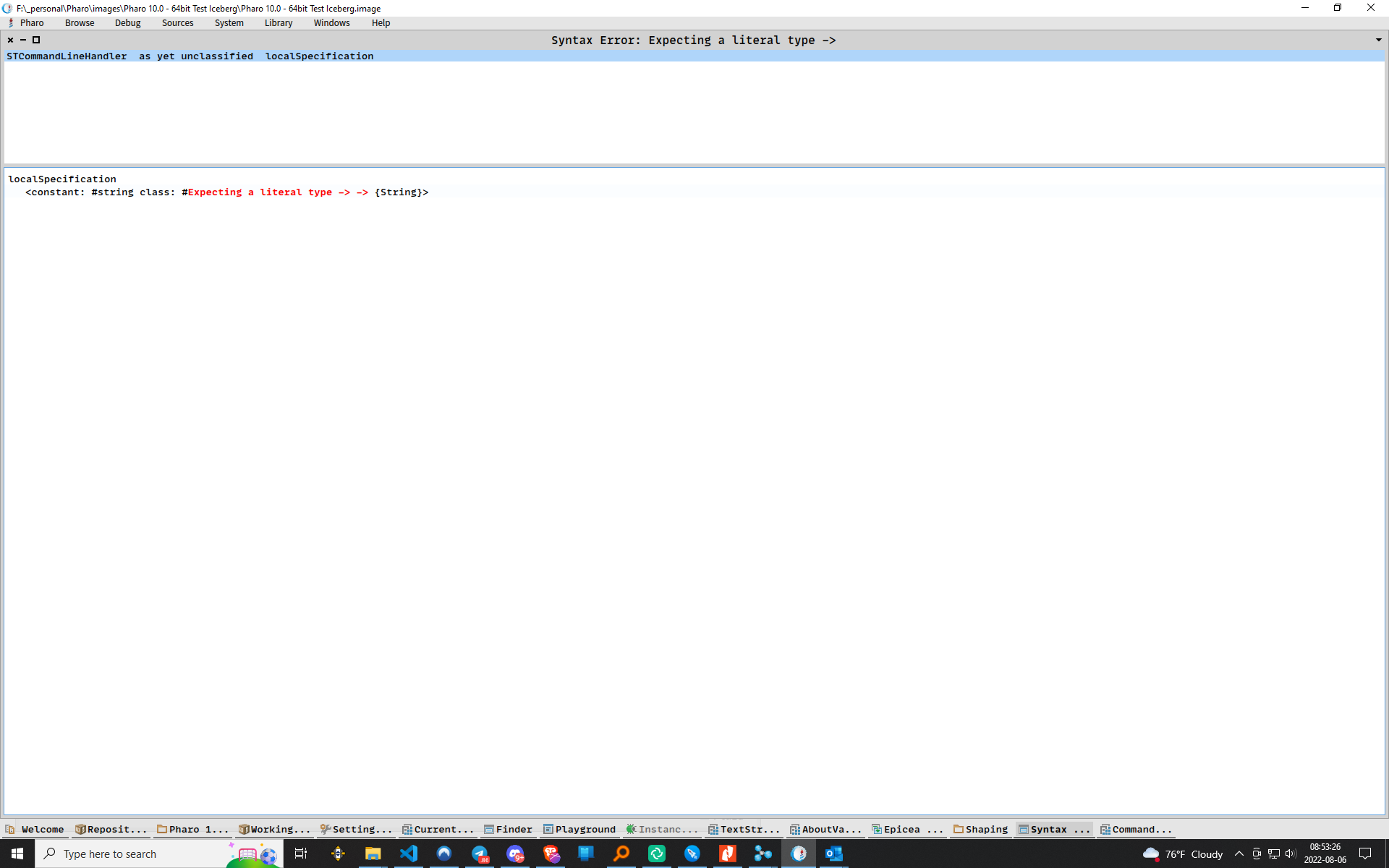
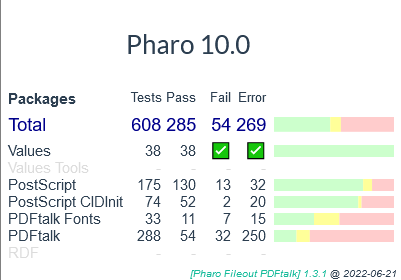
Von: Shaping <shaping@uurda.org> Gesendet: Freitag, 5. August 2022 02:18 An: 'Any question about pharo is welcome' <pharo-users@lists.pharo.org> Betreff: [Pharo-users] Re: [Pharo-users]Porting from VW 8.3 to Pharo: Pharo100 fileOutValues I will look, although this kind of always available on demand thing is too disruptive for me⦠I know what you mean. I try be disciplined about it. I really like to be able to fix typos, because there are almost always typos. But e-mail is okay. (â¦) The coolest thing would to meet for a video coding session and get your first transform project started. IMHO the most effective knowledge transfer setting â and fun as well. Other interested people could even join⦠What do you think? Christian

Hi If in the process you discover easy changes on the pharo side that can be either integrated in Pharo or packages from the Pharo side to help migration let us know. We would like to help but we are really really super full. I tried to help to package values but I did not understand the process (I know the pharo way for sure to define baseline). Now a part of the team is really concentrated to improve the VM (we would like to have a 1.5 speed up) but it requires work and concentration. We are also working on permanent space and better memory management thanks for lifeware sponsoring. Still let us know. Shaping about the spec questions esteban is on vacation and when he will reappear he will check the libgit change impacting us. Then the spec aspects. S
On 3 Aug 2022, at 16:03, Shaping <shaping@uurda.org> wrote:
Hi Christian.
Iâm trying to port from VW 8.3 to Pharo. Is there a detailed algorithm in addition to the Workflow section mentioned here?:
https://wiki.pdftalk.de/doku.php?id=pdftalknonnamespacefileout <https://wiki.pdftalk.de/doku.php?id=pdftalknonnamespacefileout>
generate the source for the target dialect from VisualWorks with the defined code transformations. Fix problems so that there are no errors or warnings. â¦
How does one generate the source (run the transformation)? Where are the aforementioned âdefined code transformationsâ, Is there an example of how to setup the declarative template needed to map VW namespace names to Pharo class prefixes?
I loaded the following packages into my VW 8.3 image:
Values Project Values Values Fileout Pharo Values Testing Values Tools Values Tools Testing
Pharo Fileout Values Pharo Transform
Smalltalk Transform Project Smalltalk Transform TestBundle Smalltalk Transform Tests Smalltalk Transform Smalltalk Transform Model Smalltalk Transform Testing Smalltalk Transform TestPackage Smalltalk Transform Tools
Any package not updated recently (in the last few months) I didnât load. Did I miss anything? 2. Port the Values package. This is easy, since no namespaces are involved.
This first instruction after VW package setup says to port the contents of the Values package from VW to Pharo. Do you mean manually? Probably not.
I feel like Iâve missed the main details of how to start the transformation. Iâd like to do a small fully contained test package with no external dependencies as a first test, probably my Magnitude or Collection packages. Suggestions are welcome. Thanks for doing this and sharing it.
Shaping
From: christian.haider <christian.haider@smalltalked-visuals.com <mailto:christian.haider@smalltalked-visuals.com>> Sent: Wednesday, 22 June, 2022 05:42 To: pharo-users@lists.pharo.org <mailto:pharo-users@lists.pharo.org> Subject: [Pharo-users] [PDFtalk] second fileOut for Squeak and Pharo
With help from the community some issues were fixed which improved the test statistics nicely. Check it out: https://wiki.pdftalk.de/doku.php?id=portingblog#second_pdftalk_fileout_for_s... <https://wiki.pdftalk.de/doku.php?id=portingblog#second_pdftalk_fileout_for_s...>
Thanks to everybody involved!
Happy hacking, Christian
participants (6)
-
 christian.haider
 -
christian.haider@smalltalked-visuals.com
-
 Marcus Denker
 -
 Richard Sargent
 -
 Shaping
 -
 stephane ducasse