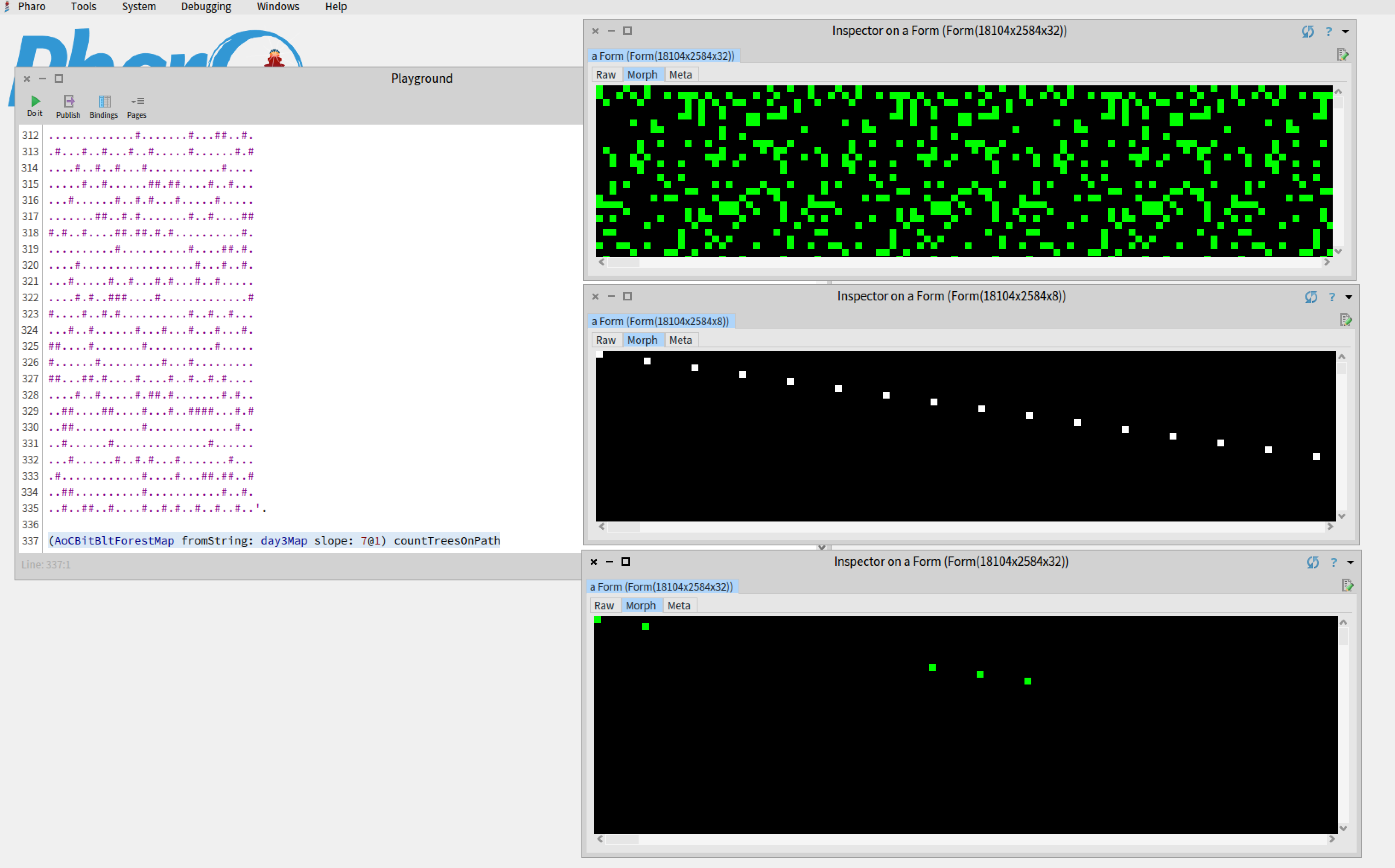
Hi all, I remember to read in the Blue Book about a Game Of Life solution based on the BitBlt operation. I wondered if it was only a smart and elegant demonstration or it may be a useful tool in the case you need parallelism, even in non-graphical contexts. I've never seen BitBlt used to solve non-graphical problems, but I don't have experience with BitBlt in my everyday work, so maybe I'm biased. I've found a paper by Leo J. Guibas and Jorge Stolfi ( https://www.cs.tufts.edu/~nr/cs257/archive/leo-guibas/language-bitmap.pdf) about a "calculus of bitmap operations" including an specific language called MUMBLE, but I suspect it is not a common use case. Anyway, I've experimented with this option to solve the Advent of Code's Day 3 challenge. The puzzle consists of counting the number of trees you will encounter traversing a given map with open squares and trees, starting at the top-left corner and following a certain slope (( https://adventofcode.com/2020/day/3). After implementing the straight-forward and iterative solution, I tried using Form instances representing the map and the slope and a BitBlt operation for ANDing both forms in order to leave only bits where you encounter a tree (see attached image). In this alternative solution I like how the iteration is replaced by only one "BitBlt>>copyBits" operation. Additionally, I understand that BitBlt operations are native primitives that could be hardware optimized. However, I didn't know how to count the resulting bits without recurring again to the iteration of the Form's bits. This is my current implementation: AoCBitBltForestMap>>countTreesOnPath | mapForm | mapForm := self form. (BitBlt toForm: mapForm) copyForm: self slopeMaskForm to: 0 @ 0 rule: Form and. ^ mapForm bits count: [ :bit | (Color colorFromPixelValue: bit depth: 32) green closeTo: 1 precision: 0.1 ] You can find all the sources at the following repository: https://github.com/luque/AdventOfCode2020 Any comments about BitBlt use cases or this specific puzzle will be of interest for me. Thank you.