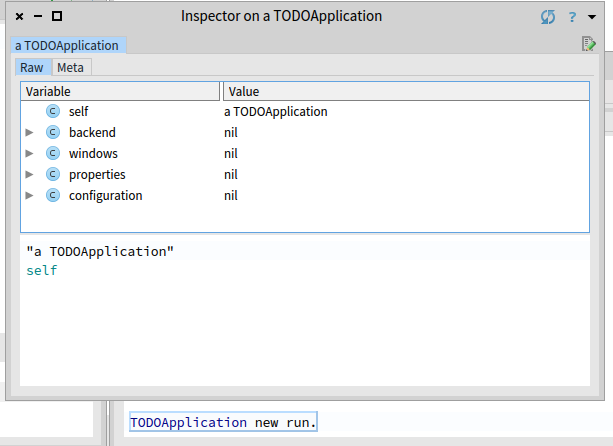
Well, the very next step in the tutorial says: How does this look? Now we can open our task list manager as follows: TODOApplication new run. However, TODOApplication has not yet been connected to anything... displaying the UI that is depicted in the tutorial is not achievable at this point... [image: image.png] So, at this point I have to stop. I've had similar issues with IMDB and other tutorials where very important steps have been left out and I cannot achieve the results depicted. Some I'm able to figure out, many others I'm just not experienced enough to know how best to proceed... sorry. Another item I noticed - as I was interested in the onActivation / onDeactivation... there appears to be a misspelling in the instvar in the SpCheckBoxTableColumn class - it says onDesactivation instead of onDeactivation - there is an added 's'. For now, I can change the tutorial to match the class - however, if you attempt to save the code in the tutorial, it would error. I'm really looking forward to completing this tutorial - there looks to be some great things I want to learn... but I can't get past the first few issues :( Russ On Sun, Aug 2, 2020 at 2:22 PM Russ Whaley <whaley.russ@gmail.com> wrote:
Here are a couple of items with my first 5 minutes with the TODO tutorial...
TODOListPresenter >> initializePresenters
todoListPresenter := self newTable addColumn: ((SpCheckBoxTableColumn evaluated: [:task | task isDone]) width: 20); addColumn: (SpStringTableColumn title: 'Title' evaluated: [:task | task title]); yourself.
self layout: (SpBoxLayout newVertical add: todoListPresenter; yourself)
In this portion (Showing Tasks) - it does not define todoListPresenter.... is it a local or a missed instVar. I tried it first as a local to enable save, but then...
TODOListPresenter >> updatePresenter
todoListPresenter items: TODOTask selectAll asOrderedCollection
todoListPresenter isn't available for updatePresenter... so I'm assuming it must be an instvar? I created accessors, then changed all the todoListPresenter references to use the accessors (below).
TODOListPresenter >> initializePresenters
self todoListPresenter: (self newTable addColumn: ((SpCheckBoxTableColumn evaluated: [:task | task isDone]) width: 20); addColumn: (SpStringTableColumn title: 'Title' evaluated: [:task | task title]); yourself).
self layout: (SpBoxLayout newVertical add: self todoListPresenter; yourself)
and...
TODOListPresenter >> updatePresenter
self todoListPresenter items: TODOTask selectAll asOrderedCollection
Also, in the first example - task isDone needs to be defined (and might be defined later in the tutorial) - I'm assuming SpCheckBoxTableColumn>>evaluated: is expecting a boolean, or do I need to convert this somehow? I can check all these things out - but just curious if I'm missing something?
TODOTask >> done
^ done
TODOTask >> isDone
^ self done
I'll go through a bit more and update you on my progress. Ted, I also hope to get to take a look at Zebra today :)
On Sun, Aug 2, 2020 at 2:07 PM Stéphane Ducasse <stephane.ducasse@inria.fr> wrote:
On 2 Aug 2020, at 19:51, tbrunz <wild.ideas@gmail.com> wrote:
I've been thinking lately that it would be nice to expand the number of Pharo tutorials we have available. But rather than (or along with) creating more "beginner" level tutorials, I'd like to see some good "intermediate" level Pharo tutorials.
Me too :)
Let's do it, then. I'll volunteer to do most of the work. :^)
I will review anything you write :)
My hope is that participating in this will make me capable of creating advanced tutorials all by myself.
I usually like to write to learn and dump what I learned.
I think that programmers who already know the Pharo syntax and messaging semantics could benefit from more advanced tutorials that demonstrate how to develop "real world" Pharo code for "real world" processing needs.
Yes yes I would love that.
That was part of my motivation for creating a Pharo app to solve the Zebra Puzzle. First, of course, I wanted to solve it. ;^)
I will send you some feeedback and PR.
What I'm talking about is something that assumes you know the language, the basics of the IDE (but not necessarily how to leverage its capabilities to aid development), and the basics of the foundation classes (but not its details). I'd like a tutorial for intermediate Pharo programmers who want to become experts with Pharo. Something that can show you how to apply the tools of the IDE and the features of the language and base classes to create solutions that solve complex problems.
do you have ideas?
I do!
As I started building the Logic Puzzle app, it occurred to me that I could probably find several different, common structures in OOP (specifically, Pharo) to add to the solution. And then each would be its own example of "what real Pharo code looks like". I.e., be good examples.
But first, I needed to explore "how to do it in Pharo" for myself, which naturally would have me working the IDE strongly.
Then I thought, the entire application can/should be an example, so it should be a tutorial.
That means that I need more than just a completed application (that's "just an example"). To be a *tutorial*, it means starting from scratch, showing how to approach the solution, how to start a Pharo app, how to use the IDE, how to write tests, how to refactor code, etc.
Then I thought, this needs a GUI. Either a Spec2 UI or a web app UI (with Seaside or Teapot). But I would need help with that! So I'll start by creating a message-based solution, and maybe get help to add a UI later.
I did some prototyping, then got what I think might be a good code structure (by version 4; it took a while to "think pure OOP"; old habits are hard to fight against). It runs, it works.
But.. Is it "good Pharo code"? I'm not experienced enough to answer that question. I need a code review, criticism, guidance. Point me in the right direction and I'll keep working on it, and start thinking about how to express the "meta" elements (how to use the IDE to make/test the code, etc.).
What does the community think of this idea?
I love it. I did Pharo by example so that I can get of rid of the beginner
parts.
After I did learning OOP and Pharo with style so that I do not have to talk
about it
again.
So definitively.
Okay, great. I'll do most of the work. But I need help...
I don't want to go any further without someone much more experienced than I am to review what I have and let me know what I'm doing right & what I'm doing "no quite so right". Yes, it runs, it works -- but that's *not* good enough. The goal here isn't to "hack out a solution and move on", the goal is to "create an example and tutorial that's high enough quality to use to teach Pharo to other people". I don't want to be teaching *my* bad habits!
Also, I know next to nothing about Spec2 or Seaside/Teapot. I just know that I need to learn it, and I need to use it to give my tutorial a UI (or two). Newcomers will show up wanting to learn Pharo, and they need to be reassured that they can create nice (enough) UIs without a huge effort. (Not everyone is a command line hacker, and end-users certainly don't want to be.)
The more I learn (from you), the more I can be independent, and the more tutorials I could produce -- without a lot of help. I'm willing to do the work, because that will help make me a Pharo "master programmer". (I don't want to be a hack, and I can't really be a trainer if I'm just a hack myself.)
I'll pay back the community by helping to attract and advance more developers' skills. I just have to have the more advanced knowledge & skills myself. So, train the (future) trainer, anyone??
-Ted
-- Sent from: http://forum.world.st/Pharo-Smalltalk-Users-f1310670.html
-------------------------------------------- Stéphane Ducasse http://stephane.ducasse.free.fr / http://www.pharo.org 03 59 35 87 52 Assistant: Aurore Dalle FAX 03 59 57 78 50 TEL 03 59 35 86 16 S. Ducasse - Inria 40, avenue Halley, Parc Scientifique de la Haute Borne, Bât.A, Park Plaza Villeneuve d'Ascq 59650 France
-- Russ Whaley whaley.russ@gmail.com
-- Russ Whaley whaley.russ@gmail.com