HI cedrick
I tried to start a booklet with Stephane but it is too complicated right now. Stephane started a simpler version.
For now saving and loading is not important. :)
Yes
I put below a summary of the reflexion/discussion I had with Max.
Thanks. Now you should publish your code. I would have preferred to work from a working code. Because now it is like poking in the dark.
Cedrick what did you get running?
Actually, I got the workflow working and the tests as you. And then I was able to run some examples (as I tried to wrote in the booklet). I just dinât know yet how to publish on GitHub and friends⦠I discussed with Max about then⦠Iâm learned a bit after how to use these tools especially for the booklet as we chattedâ¦. Then end of the semesterâ¦. No timeâ¦. Should be better soon. So sorry for that :) I join the last pdf I hadâ¦. Fuzzy (especially since I tried to include automatically classes comments) but there are details of installation and what I could make work:
- rethink persistence (process definition and orchestration, realization) => persistance is essential and was central to Aare. Beside removing Omnibase references (and implication of WfManagedObject), some of the application features were very dependant on the persistence (like logging, tracing process evolution). All of these features are to be thing again considering as much as possible a loosely coupled solution. A general purpose storage solution like Voyage could be used. At first, in image storage will be used to focus on the running aspects of the library. - rethink interaction => Designing a general interaction sub-system is probably the more challenging tasks. Aare was web based. We want workflow to be UI agnostic. Moreover, we want to associate , remove Magritte (replace UI or build an independant system based on Annoucement for instance)
Yes I agree. Now I would like to be able to - define a super simple workflow: I picked sequence: start -> task1 -> task2
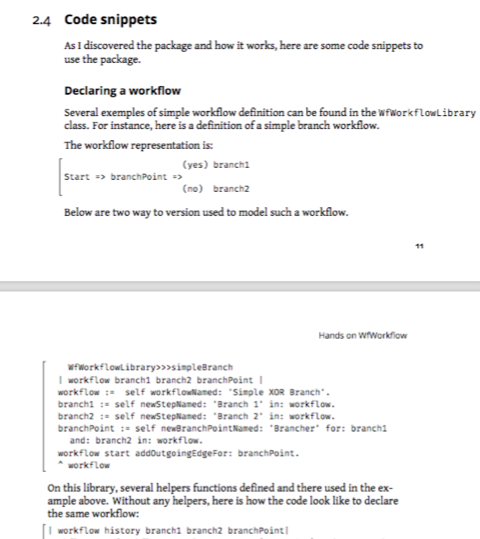
Done in WfWorkflowLibrary (with convenience method). An example in 2.4
- execute it and script it resolution.
See 2.5. My way of running them and where I stopped and is a bit stuck. To me we need now to design an interaction model (based on Annoucement ?) Running a workflow. Once a workflow is defined, to be executed, he calls the method #executeIn- newFrame. This method instanciate and populate the worklist (WfWorklist) that keep track of the state of the running workflow. workflow := WfWorkflowLibrary simpleBranch. frame := workflow executeInNewFrame. To see running activitions (activities that are started but not completed yet): frame worklist running. Once a activation is over, it has to be completed by sending the message #completed. For now, there are only manual completions but we could imag- ine in the future automatic or semi-atomatic completion based on extrenal interaction or if delegated to a program for instance. anActivation := frame worklist any. anActivation complete. "complete mannully one activation" "or" frame complete: anActivation. The workflow is running until there are no possible (accessible) activation left. This state is called implicit termination and can be checked with: frame isCompleted. Here is the code of the WfFrame»>completeAll WfFrame>>>completeAll [self workList allRunning isEmpty] whileFalse: [self completeActivation: self workList allRunning first].
I would like to understand the difference between frame and activation.
The frame is the container of the workflow resolution, the « manager » ⦠A workflow runs in a frame (subworkflows in subframes)⦠Activations are when a step (one activity defined in a workflow) is activated (we are starting for real to do the activity).
WfWorkflowManager managers workflow definitions
(static) and activations (dynamic). WfFrame is also a part of the dynamic side, connecting activations to a workflow. Workflows are hierarchical, i.e. a step can have a sub workflow (see WfWorkflowLibrary>>simpleSubflow)
Yes for now I do not want to understand this part.
You have too to get the workflow running I think.
3)
Going back to activations, here is my current understanding.
Once a step is activated (all condition on Edges leading to are true - to evaluate outgoing conditions of a step, the step execution has to be complete first) , we get an activation instance (Iâm not 100% sure how completion of an activity and outgoing conditions are managed).
As far as I understand, a step can always be activated (e.g. manually). However, activating a step propagates the values of conditions on the edges to the next steps and their activations ("dead" or "alive"). Hence, an activation responds to #isAlive with true if at leat one incoming token was true ("alive") (see WfStep>>continueInFrame:fromStep:alive: and WfActivation>>isAlive). The conditions are evaluated once #complete is sent to the activation. Activation instances are created by two ways (slightly different for the start step), but generally they are created when a step receives tokens from the outgoing edges of an upstream activation (see WfStep>>continueInFrame:fromStep:alive:).
Activations are central.
On the exemple of BLActivationHistoryItem that you gave, Iâm not sure if itâs an activation of a history item stored in the history (subclasss of WfHistory?).
My idea was that it should represent a record for an activation (there might be multiple records for a single activation). So "HistoryItem" would be the general description of a record, of which "ActivationHistoryItem" is a special case for activations (I hope that makes sense).
4) Moreover I donât see clearly the difference with a scheduler and a BP engine (they are at least really complementary). Do you see any ressemblance between Activation and ScheduledJob ?
I actually would like to have a (simple) scheduler with the BP engine :)
Well, it's certainly a matter of point of view. I would argue that an activation is something close to a "job". A "scheduled job" would be a more specific case of a "job", a job that is in a queue. An activation has no notion of scheduling but simply represents the idea of what happens when traversal between two nodes occurs. A scheduler would be one way of managing activations (WfWorklist seems pretty close to a scheduler, holding running and completed activations).
Too subtle for me.
For now, the are no real workflow engine. More a state machine providing access to activable steps (and running one⦠hence remaining ones). I/We will need a scheduler (even simple ones). Max explains below:
To me the scheduler right now is not really existing besides having a list of simultaneous/parralelized steps to realize (activated or not). Activated means currently being done.
You're right, I think. The application that Workflow was designed for required manual interaction, hence there was no need for other methods of scheduling (e.g. by time or event).
This activation role is about logging and interacting with responsible users. But it is more than that. Itâs the actual job being done.
Yes.
5)
Concerning run time modification of a process. Is it true that we can modify a currently executed workflow (steps that are not yet activated ?) ? I think that is possible (an cool). When activated, it shouldnât. Would you think it would be interesting to allow activations to be suspended/resume (frozen), cancelled ?
The history of workflows consists of copies. The steps of a workflow reference the workflow they belong to. Therefore, while it is possible to modify a workflow, modifications do not impact running workflows, as the steps of that workflow continue to reference the previous version. The model suggests that it is ok to create a new version of a workflow but not to modify existing workflows.
For now I would like to get a workflow running without modifying it
Sure. But again an interesting decision to have first. To me, what more interesting is to be able : - to cancel a task (an activation actually), - change dynamically the remaining workflow (to adapt)⦠- eventually suspend/resume (nice to time track but I also thin itâs not hard to have) I know the second point seems too early but again this is important to consider now. Designs decisions of Aare leaves some room to build more (and constrain its use). [â¦]
DomBuilder is a small package for wrapping XML-Parser. I'll publish it so you can use it.
Cedric did you got this package?
No but I didnât ask either. Itâs possible to ask Max. But I think first, as you, we need to be able to run a process.
The XML-Parser package has been significantly modified and
is now named XMLParser (you can find it in the catalog). You should make the changes necessary to use the current incarnation of XMLParser (decide for yourself whether you still need DomBuilder or not).
But this is not really important.
Yep. Cheers, Cédrick