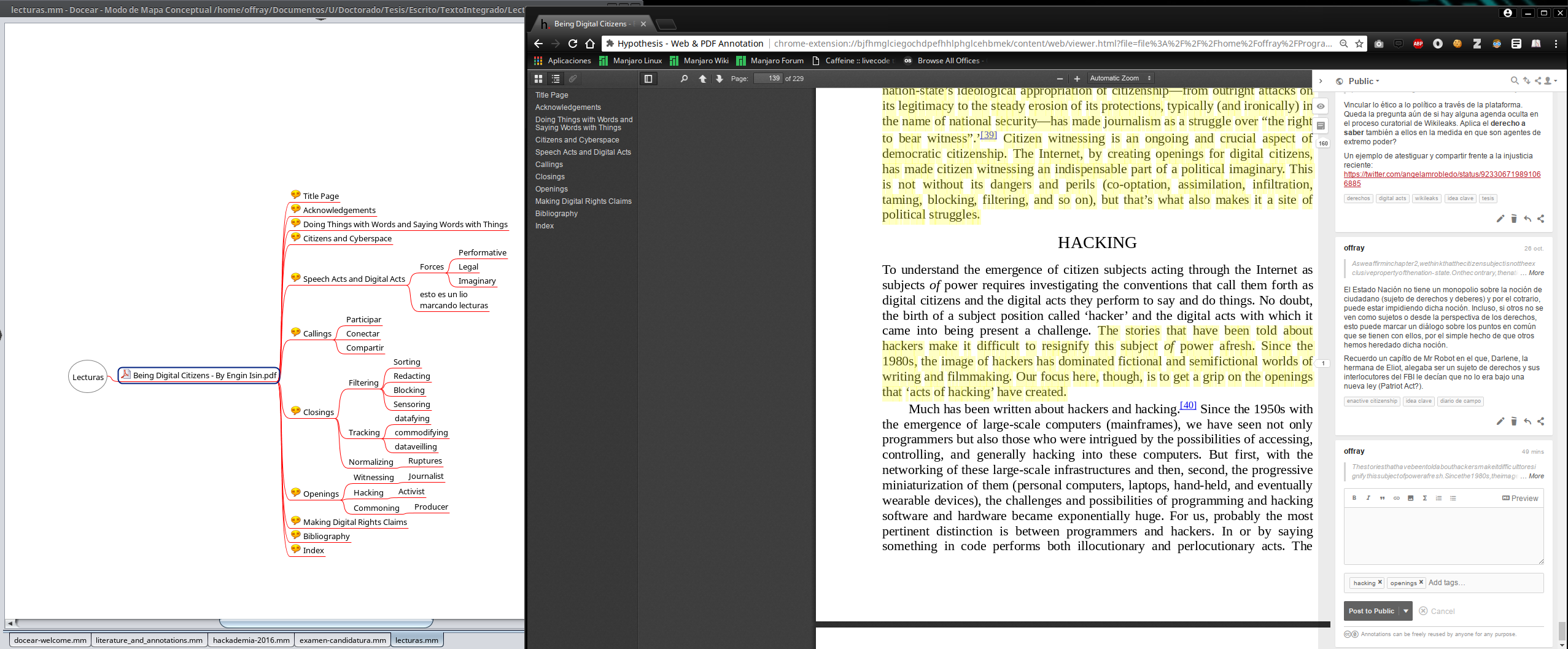
Hi Manuel, This is really interesting! I like the idea of a graph and the way ILE manages metadata importation. Grafoscopio [1][2][3], is the software I'm creating for reproducible research and literate computing (mixing prose, code, queries, data and visualizations). It has alpha support for Zotero and I think that ILE and Grafoscopio could work together to provide researcher support for creating and working with research literature. [1] http://mutabit.com/grafoscopio/index.en.html [2] http://mutabit.com/repos.fossil/alvicoda/doc/tip/index.html [3] http://joss.theoj.org/papers/c92ed13fa746bc681081f9b31678841b Now my research workflow includes Pharo, TeXStudio, Grafoscopio, Zotero, Docear[4] and Hypothesis[5] to map and annotate research literature, but there is a lot of context switching, as you point in your presentation, and lack of moldability that we could get rid of, if those tools were integrated into Pharo. To manage this, I usually have two screens (see screenshot below) where I made annotated reading (in hypothesis) and map readings (in Docear). That is because Docear is not integrated (yet) with Hypothesis, which has a superb annotation system. [4] http://www.docear.org/ [5] https://web.hypothes.is/ I would like to have a similar tree like Docear reading interface , connected with the annotated reading of hypothesis (tags and comments), inside Pharo/Grafoscopio. In my ideal workflow I would add a bibliography item to Zotero (using add item by ID or dropping the URL/PDF), open it (getting the table of contents map inside Pharo, ala Docear and thanks to Hypothesis) and I would start to annotate and tag my readings. After that, some DSL would allow me to recover, visualize and export such annotations to be put inside of or connected with a Grafoscopio notebook and there I would finish the research writing. What do you think of this workflow? Could ILE support or be part of it in some way? Once you have packaged ILE, I could help as a tester in Gnu/Linux. Cheers, Offray On 01/11/17 16:16, Manuel Leuenberger wrote:
Hi everyone,
I was experimenting in the last few weeks with my take on literature research. For me, the corpus of scientific papers form an interconnected graph, not those plain lists and tables we keep in our bibliographies. So, here is the first prototype that has Google Scholar integration for search, can fetch PDFs from IEEE and ACM, extracts metadata from PDFs - all this results in hyperlinked PDFs!
See a demo here:Â https://youtu.be/EcK3Pt_WnEw Also slides from the SCG seminar here:Â http://scg.unibe.ch/download/softwarecomposition/2017-10-31-Leuenberger-ILE....
I plan on packaging it, so that those who are interested can check it out themselves (help wanted!). Currently, it only works on macOS.
What do you think of my approach? Which use cases should be added?
Cheers, Manuel