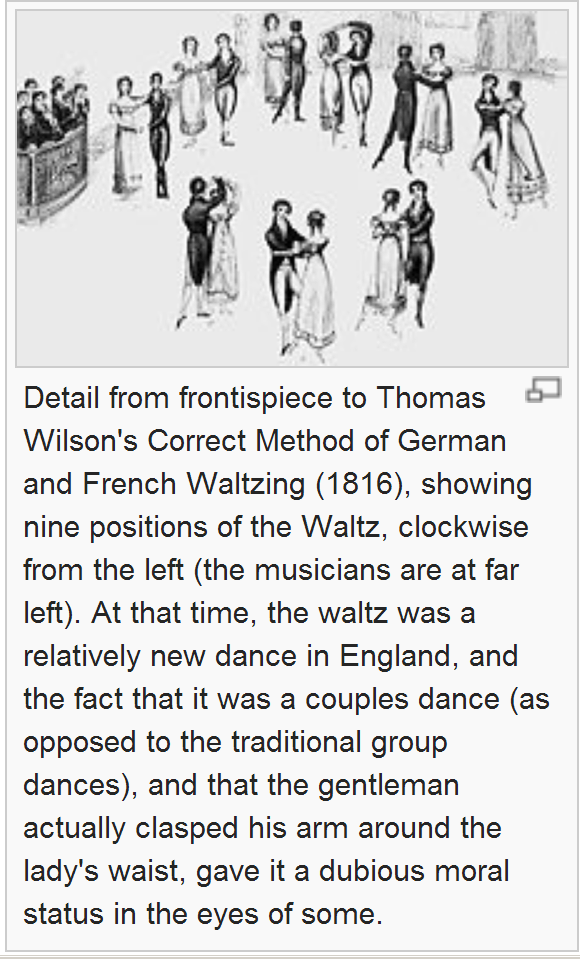
I have for some time been pondering two problems. One is to identify the fourth R in *R*eading, w*R*iting, a*R*ithmetic, and p*R*ogramming. There are many contenders for the kids' first step. I believe the English government has chosen Phyton as a first language. Scratch has a certain popularity, there are many others. My concern is "what comes next"? I want the kid to gradually build a mental model of what computing is all about. Learn a little, do a little, lean more, do more, etc. up do old age. This goes much deeper than any programming language. It's a bit as learning to read. Personally, I "broke the reading code"at an early age. Since then, I have been learning more and more. What I read today would have been incomprehensible to me 75 years ago. But my basic mental model of what reading is all about has remained unchanged. I have never had to unlearn anything. I suggest that true object orientation (not class orientation) can form the foundation for the human mental model of computing. Internalize it and live with it forever. ------------------------------------- The other problem is to find a better example for DCI presentations. It should 1. Be executable and have a cool demo effect. 2. Its domain model should be obvious from the demo. 3. It should have very few and very simple Data classes. 4. It should have a Context that is clearly and obviously separate from the Data. 5. It should scale to any number of Contexts (use cases) without changing the Data classes. ----------------------------------------- /Last night I got an idea for an example: A waltzing couple. (See the attached for a picture and Wikipedia for a movie of the use case)./ The program needs one simple class for a moveable shape and a DCI Context for each dance (waltz, foxtrot, tango, ... for two role, polonaise for more.) The example will clearly demonstrate the wisdom in separating what the system IS from what the system DOES since the simple Shape class would be overloaded with instance methods for all dances. What do you think? --Trygve -- Trygve Reenskaug mailto: trygver@ifi.uio.no Morgedalsvn. 5A http://folk.uio.no/trygver/ N-0378 Oslo http://fullOO.info Norway Tel: (+47) 22 49 57 27