Hello Steph, many thanks. It's now clear I think ð. My first understanding considering slots as objects representing instance variables wasn't bad. I wasn't sure because I was reading something to not consider slots as instance vars. Your answer lights me a lot ð. HVE Sep 22, 2024 19:18:24 stephane ducasse <stephane.ducasse@inria.fr>:
Hello Herve
I will add a description in the doc/ folder in P13 and may be P12.
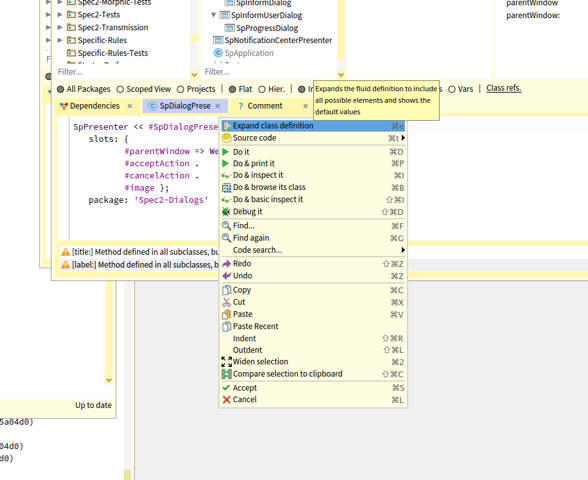
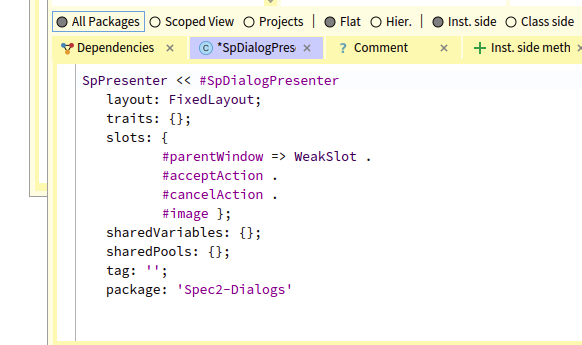
If you need you can bring the menu on the class definition (put the caret on the class name) and select expand and you will see all the definition possibilities.Â
[cid:0A8FCA81-F1A9-490A-B051-8DE6F56A4E00][Capture 2024-09-22 at 19.06.35.png][cid:0A8FCA81-F1A9-490A-B051-8DE6F56A4E00][cid:EAC3AD2D-8376-429F-A59C-EE02E4ED5275][Capture 2024-09-22 at 19.06.44.png][cid:EAC3AD2D-8376-429F-A59C-EE02E4ED5275]
- layout: is for the different class formats
For example ArrayedCollection << #Array layout: VariableLayout; tag: 'Base'; package: 'Collections-Sequenceableâ
is the same asÂ
ArrayedCollection variableSubclass: #Array instanceVariableNames: '' classVariableNames: '' package: 'Collections-Sequenceable-Base'
- traits: Â for traits
For the rest, consider that this is the same with different names (because slots are compatible with instance variables).
SoÂ
Object << #Point slots: { #x . #y }; tag: 'BasicObjects'; package: âKernel'
is the same as
Object subclass: #Point instanceVariableNames: 'x y' classVariableNames: '' package: 'Kernel-BasicObjectsâ
andÂ
WeakIdentityKeyDictionary << #ASTCache sharedVariables: { #CacheMissStrategy }; tag: 'Parser'; package: 'AST-Core'
is the same asÂ
WeakIdentityKeyDictionary subclass: #ASTCache instanceVariableNames: '' classVariableNames: 'CacheMissStrategy' package: 'AST-Core-Parser'
What you see is that we do not have to specify empty lists :)
The only mandatary information is the class name and the package
Object << #Foo package: âMyPackageâ
is a nice class definition.
The template show empty slots: {}; but this is not needed this is because some people do not like that type of slots: { };
BTW we use the new syntax in the Advanced Design Mooc and I started to migrate books too (not Pharo by Example because it is a big amount of work).Â
Tell us if this is clear for you. I plan to change the slides of the Pharo mooc (Iâm currently converting them to use a nice slide syntax) to use the fluid syntax.Â
Hi Everybody,
I try to be up-to-date with Pharo trends and releases. In Pharo 12, we are switching to use fluid class declaration. Its' not easy to find stuffs illustrating fluid API. I have spend many hours to browse Pharo documentation, Github repos, slides, MOOcs, books, papers finding a way to clearly explain this "new way" of declaring a class. All Pharo introduction resources and Pharo 12 videos do not use fluid class declaration but the "old" way. I also use (and let's say teach) Pharo in my OOP lectures ð
If you have links please send them and we will convert them.Â
If I'm not wrong, the fluid class declaration does no more explicitly deal with instance (and class) variables. Instead, it deals now with slots, tags, shared variables, traits,...At a fist look, I was understanding that slots was a dynamic way to declare instance variables.
A Slot is first an object representing an instance variable. Now by default the programmer should use a symbol so you go from
âx yâ to {#x . #y}
This syntax let us write more complex class definitions such as
SpPresenter << #SpDialogPresenter slots: { #parentWindow => WeakSlot . #acceptAction . #cancelAction . #image }; package: 'Spec2-Dialogs'
here #parentWindow => WeakSlot creates a slot of the class WeakSlot (does not count for garbage collector)
After reading some pieces of paper, and if I'm not wrong , slots are not really instance variables and shared variables are not class variables.
Avoiding the old class declaration, i.e.
     Object subclass #SomeClassName instanceVariableNames: 'instaVar1 instVar2 ...' ...
is there a simple way to add an instance (or class) variable?
you use slots: { Â . Â }; andÂ
sharedVariables: are for classVarNames: This is because sharedVariables are shared between the instance and class side and like that we do not have the confusion of class variables and metaclass instance variables.Â
For example TextConstants defines the following sharedVariables:
SharedPool << #TextConstants slots: {}; sharedVariables: { #Ctrls . #Ctrlh . #CtrlR . #CtrlG . #DefaultMarginTabsArray . #Ctrlx . #Ctrlm . #Ctrlb . #BS . #CtrlL . #CtrlA . #CtrlW . #DefaultRule . #DefaultFontFamilySize . #Ctrlr . #Ctrlg . #CtrlQ . #EndOfRun . #CtrlF . #Italic . #Basal . #Ctrlw . #Ctrll . #Ctrla . #CtrlV . #CtrlK . #Bold . #Justified . #Ctrlf . #Ctrlq . #CtrlP . #CtrlE . #LeftMarginTab . #CtrlOpenBrackets . #DefaultSpace . #Ctrlv . #Ctrlk . #CtrlU . #CtrlJ . #Ctrlp . #Ctrle . #CtrlZ . #CtrlO . #CtrlD . #DefaultBaseline . #CrossedX . #LeftFlush . #Space . #Ctrlj . #CtrlT . #CtrlI . #RightFlush . #DefaultTab . #Ctrlu . #Centered . #Ctrlz . #Ctrlo . #Ctrld . #CtrlY . #CtrlN . #CtrlC . #Enter . #DefaultLineGrid . #ESC . #Ctrlt . #Ctrli . #CtrlS . #CtrlH . #Clear . #CR . #CtrlDigits . #DefaultMask . #Ctrln . #Ctrlc . #RightMarginTab . #CtrlM . #CtrlX . #BS2 . #Tab . #TextSharedInformation . #DefaultTabsArray . #Ctrly . #CtrlB }; tag: 'Base'; package: 'Text-Core'
ArrayedCollection subclass: #Text instanceVariableNames: 'string runs' classVariableNames: '' poolDictionaries: 'TextConstants' package: 'Text-Core-Base'
is now
ArrayedCollection << #Text slots: { #string . #runs }; sharedPools: { TextConstants }; tag: 'Base'; package: 'Text-Core'
Because this is years that poolDictionaries do not exist anymore (they have SharedPool e.g. a special class holding sharedVariables)
Are instance variables gone in Pharo? I assume I missed something, but what?
No just empowered and backwards compatible.Â
Many thanks. Cheers,
Herve
Stéphane Ducasse http://stephane.ducasse.free.fr 06 30 93 66 73
"If you knew today was your last day on earth, what would you do differently? ....ESPECIALLY if, by doing something different, today might not be your last day on earth.â Calvin & Hobbes