[Pharo-project] usability of Pharo and Squeak

Hi all, I have convinced a friend to take a closer look at Pharo 1.2.1 and Dolphin Smalltalk. He is an experienced Java developer. After some time he started to complain about Pharo. I was discussing with him and now think that he has some valid points. His biggest complaint is: "Why does Pharo always show windows at sizes and positions I don't want?" I answered him: You could set the standard window size in the class RealEstateAgent and furthermore you can create or change >>initialExtent methods in every class that is involved. But his answer was: Why should I do that? It's the responsibility of an IDE. I don't want to program elementary things of my IDE. Why is there no mechanism that let a user set the sizes and positions of windows? Netbeans and Eclipse are doing that nicely. Why isn't it possible in Pharo? After that discussion I now question my own way of using Pharo and Squeak. I have created some changesets that I used to file in when using a fresh image. But that seems stupid now... His second complaint was that he doesn't like the cluttered windows. While programming he had a lot of open windows and told me that he lost overview. Especially in Pharo he is complaining about minimized windows that are hard to distinguish. He better likes Dolphin with tabbed windows that are common in other IDE's. Regards Andreas

Andreas Wacknitz wrote:
... His biggest complaint is: "Why does Pharo always show windows at sizes and positions I don't want?" ...
His second complaint was that he doesn't like the cluttered windows. While programming he had a lot of open windows and told me that he lost overview. ...
I completely agree that Pharo still has a lot of usability issues BUT in the same breath I also acknowledge that there already have been some big improvements since Pharo's inception! The cluttered windows and odd default sizes and positions, no top menu etc do look a bit strange. Another common usability issue is that buttons are often used even when a button really is not the appropriate control. -- View this message in context: http://forum.world.st/usability-of-Pharo-and-Squeak-tp3562378p3562414.html Sent from the Pharo Smalltalk mailing list archive at Nabble.com.

On Tue, May 31, 2011 at 8:18 AM, Andreas Wacknitz <A.Wacknitz@gmx.de> wrote:
Hi all,
I have convinced a friend to take a closer look at Pharo 1.2.1 and Dolphin Smalltalk. He is an experienced Java developer. After some time he started to complain about Pharo. I was discussing with him and now think that he has some valid points.
His biggest complaint is: "Why does Pharo always show windows at sizes and positions I don't want?" I answered him: You could set the standard window size in the class RealEstateAgent and furthermore you can create or change >>initialExtent methods in every class that is involved. But his answer was: Why should I do that? It's the responsibility of an IDE. I don't want to program elementary things of my IDE. Why is there no mechanism that let a user set the sizes and positions of windows? Netbeans and Eclipse are doing that nicely. Why isn't it possible in Pharo? After that discussion I now question my own way of using Pharo and Squeak. I have created some changesets that I used to file in when using a fresh image. But that seems stupid now...
His second complaint was that he doesn't like the cluttered windows. While programming he had a lot of open windows and told me that he lost overview.
This is why I've started TilingWindowManager. Could you friend give some feedback ? Laurent.
Especially in Pharo he is complaining about minimized windows that are hard to distinguish. He better likes Dolphin with tabbed windows that are common in other IDE's.
Regards Andreas
Am 31.05.2011 um 09:38 schrieb laurent laffont:
On Tue, May 31, 2011 at 8:18 AM, Andreas Wacknitz <A.Wacknitz@gmx.de> wrote: Hi all,
I have convinced a friend to take a closer look at Pharo 1.2.1 and Dolphin Smalltalk. He is an experienced Java developer. After some time he started to complain about Pharo. I was discussing with him and now think that he has some valid points.
His biggest complaint is: "Why does Pharo always show windows at sizes and positions I don't want?" I answered him: You could set the standard window size in the class RealEstateAgent and furthermore you can create or change >>initialExtent methods in every class that is involved. But his answer was: Why should I do that? It's the responsibility of an IDE. I don't want to program elementary things of my IDE. Why is there no mechanism that let a user set the sizes and positions of windows? Netbeans and Eclipse are doing that nicely. Why isn't it possible in Pharo? After that discussion I now question my own way of using Pharo and Squeak. I have created some changesets that I used to file in when using a fresh image. But that seems stupid now...
His second complaint was that he doesn't like the cluttered windows. While programming he had a lot of open windows and told me that he lost overview.
This is why I've started TilingWindowManager. Could you friend give some feedback ?
Laurent.
Laurent, I looked at TWM and it looked promising but I think it's only a complement to what I have in mind: A user should be able to save window sizes and positions as defaults. The TWM makes my life easier but still can't guess what I really want. Regards Andreas
On Sat, Jun 4, 2011 at 6:27 PM, Andreas Wacknitz <a.wacknitz@gmx.de> wrote:
Am 31.05.2011 um 09:38 schrieb laurent laffont:
On Tue, May 31, 2011 at 8:18 AM, Andreas Wacknitz <A.Wacknitz@gmx.de>wrote:
Hi all,
I have convinced a friend to take a closer look at Pharo 1.2.1 and Dolphin Smalltalk. He is an experienced Java developer. After some time he started to complain about Pharo. I was discussing with him and now think that he has some valid points.
His biggest complaint is: "Why does Pharo always show windows at sizes and positions I don't want?" I answered him: You could set the standard window size in the class RealEstateAgent and furthermore you can create or change >>initialExtent methods in every class that is involved. But his answer was: Why should I do that? It's the responsibility of an IDE. I don't want to program elementary things of my IDE. Why is there no mechanism that let a user set the sizes and positions of windows? Netbeans and Eclipse are doing that nicely. Why isn't it possible in Pharo? After that discussion I now question my own way of using Pharo and Squeak. I have created some changesets that I used to file in when using a fresh image. But that seems stupid now...
His second complaint was that he doesn't like the cluttered windows. While programming he had a lot of open windows and told me that he lost overview.
This is why I've started TilingWindowManager. Could you friend give some feedback ?
Laurent.
Laurent,
I looked at TWM and it looked promising but I think it's only a complement to what I have in mind: A user should be able to save window sizes and positions as defaults. The TWM makes my life easier but still can't guess what I really want.
Don't hesitate to contribute code :) Laurent.
Regards Andreas

Thanks andreas for your feedback. We are working hard and we are making a lot of progress. Now if people do not help then it will be slower. In Pharo our problem is not that we do not know the problems and we have a vision and a really cool and sexy one. Give us 4 engineers and two years and you will not recognize it at ALL. Now we work every day to make it better. Stef On May 31, 2011, at 8:18 AM, Andreas Wacknitz wrote:
Hi all,
I have convinced a friend to take a closer look at Pharo 1.2.1 and Dolphin Smalltalk. He is an experienced Java developer. After some time he started to complain about Pharo. I was discussing with him and now think that he has some valid points.
His biggest complaint is: "Why does Pharo always show windows at sizes and positions I don't want?" I answered him: You could set the standard window size in the class RealEstateAgent and furthermore you can create or change >>initialExtent methods in every class that is involved. But his answer was: Why should I do that? It's the responsibility of an IDE. I don't want to program elementary things of my IDE. Why is there no mechanism that let a user set the sizes and positions of windows? Netbeans and Eclipse are doing that nicely. Why isn't it possible in Pharo? After that discussion I now question my own way of using Pharo and Squeak. I have created some changesets that I used to file in when using a fresh image. But that seems stupid now...
His second complaint was that he doesn't like the cluttered windows. While programming he had a lot of open windows and told me that he lost overview. Especially in Pharo he is complaining about minimized windows that are hard to distinguish. He better likes Dolphin with tabbed windows that are common in other IDE's.
Regards Andreas
After following the discussion for some time, I have the impression that there are some smalltalkers suffering similar usability problems like my friend and me and some more or less enjoy the actual state. Dolphin 6 Professional introduced IdeaSpace. With that you can have both - single windows and tabbed windows. It's up to the user to either open windows outside IdeaSpace as independent windows or inside IdeaSpace as tabbed windows. Having the free choice is a good thing. Especially if you don't want to alienate newcomers that are used to use tabbed windows. I like this approach. I haven't looked at TWM yet due to lack of time. I am hardly able to read the mail traffic in the evenings. But I asked my friend to have a look at it. He promised to do so although it's not suited to Pharo 1.2.1. As Pharo 1.3 is not yet stable I fear that he might have new problems in other areas. What strikes me during this discussion is that nobody seem to have the same problem with window sizes and positions. I don't like RealEstateAgent and I don't think that a revamped one will solve the problems. At least as long it doesn't provide the possibility to set sizes on the fly. No algorithm can guess the requirements of all users. I also haven't heard about applications written in Squeak or Pharo and what about user thereof think about the usability. IMO there is a lack of an appropriate framework for dealing with such things. Or is everybody developing web applications nowadays? I have a hard time to promote Smalltalk because of its actual state. I always tell people about my favorite programming language, but I also tell them that alas there is no good implementation of it available. This is sad but true, even if Pharo and Squeak made big progress during the last months. Both, Squeak and Pharo, aren't products but just tools. And that makes a big difference. The commercial products have characteristics that make them not very attractive to people not yet involved. Despite Dolphin they all have dated user interfaces, too. When I try to convince people to have a look at Dolphin they typically tell me: very nice but it seems to be dead already. Regards, Andreas
and what do you do to change the situation? Stef On Jun 2, 2011, at 12:23 PM, Andreas Wacknitz wrote:
After following the discussion for some time, I have the impression that there are some smalltalkers suffering similar usability problems like my friend and me and some more or less enjoy the actual state. Dolphin 6 Professional introduced IdeaSpace. With that you can have both - single windows and tabbed windows. It's up to the user to either open windows outside IdeaSpace as independent windows or inside IdeaSpace as tabbed windows. Having the free choice is a good thing. Especially if you don't want to alienate newcomers that are used to use tabbed windows. I like this approach.
I haven't looked at TWM yet due to lack of time. I am hardly able to read the mail traffic in the evenings. But I asked my friend to have a look at it. He promised to do so although it's not suited to Pharo 1.2.1. As Pharo 1.3 is not yet stable I fear that he might have new problems in other areas.
What strikes me during this discussion is that nobody seem to have the same problem with window sizes and positions. I don't like RealEstateAgent and I don't think that a revamped one will solve the problems. At least as long it doesn't provide the possibility to set sizes on the fly. No algorithm can guess the requirements of all users. I also haven't heard about applications written in Squeak or Pharo and what about user thereof think about the usability. IMO there is a lack of an appropriate framework for dealing with such things. Or is everybody developing web applications nowadays?
I have a hard time to promote Smalltalk because of its actual state. I always tell people about my favorite programming language, but I also tell them that alas there is no good implementation of it available. This is sad but true, even if Pharo and Squeak made big progress during the last months. Both, Squeak and Pharo, aren't products but just tools. And that makes a big difference. The commercial products have characteristics that make them not very attractive to people not yet involved. Despite Dolphin they all have dated user interfaces, too. When I try to convince people to have a look at Dolphin they typically tell me: very nice but it seems to be dead already.
Regards, Andreas
Am 02.06.2011 um 13:53 schrieb Stéphane Ducasse:
and what do you do to change the situation?
I have reported what I have been told after promoting Smalltalk. Alas I neither have the luck to work with Smalltalk on my daily job nor much free time due to my family. I am not able to follow the pace Pharo is developing at. So the best thing I can do is to try to convince people to have a look at Smalltalk. But that is hard. Most developers don't even bother to have a look at it because it's not mainstream (they never heard of it). And if they do, they will complain immediately about not working on files, the user interface (strange widgets, misuse of buttons, missing integration in the host os) and lack of version management. If, in the rare case, someone takes a closer look, he will complain like my friend: annoying window sizes and positions, cluttered windows all over. The new generation of developers is used to use tabbed window IDE's like Eclipse, NetBeans and VisualStudio. Smalltalk systems have to fight against these well supported products. And furthermore I like to emphasis what I wrote before: Squeak's and Pharo's problem is also, that they are seen as tools and not products. Tools are being developed and used for a certain problem to solve. Pharo seems to have two major fields of use: 1. web development (in combination with Seaside) 2. research Of course this is fully ok because it's free and nobody can ask you or other people involved for certain enhancements. But if you want to spread the use of Smalltalk you should hear to voices from the outside. The quality of the code and Smalltalk's elegance and kind of OO are only seen after the first hurdle is being taken. And I count the user interface and the development tools as the first hurdle. In other words: It takes time to convince people that Smalltalk's way of doing things has big advantages over C# or Java. But most people don't give us the time... Regards, Andreas
On Jun 2, 2011, at 8:32 PM, Andreas Wacknitz wrote:
Am 02.06.2011 um 13:53 schrieb Stéphane Ducasse:
and what do you do to change the situation?
I have reported what I have been told after promoting Smalltalk.
I know :) I have the same.
Alas I neither have the luck to work with Smalltalk on my daily job nor much free time due to my family. I am not able to follow the pace Pharo is developing at. So the best thing I can do is to try to convince people to have a look at Smalltalk. But that is hard. Most developers don't even bother to have a look at it because it's not mainstream (they never heard of it).
Continue. This is important. Do you know that several companies are looking for Smalltalkers in germany, london....?
And if they do, they will complain immediately about not working on files, the user interface (strange widgets, misuse of buttons, missing integration in the host os) and lack of version management. If, in the rare case, someone takes a closer look, he will complain like my friend: annoying window sizes and positions, cluttered windows all over.
What you should show them is that they can change that.
The new generation of developers is used to use tabbed window IDE's like Eclipse, NetBeans and VisualStudio. Smalltalk systems have to fight against these well supported products.
yes clearly. We are slowly but steadily cleaning the UI.
And furthermore I like to emphasis what I wrote before: Squeak's and Pharo's problem is also, that they are seen as tools and not products. Tools are being developed and used for a certain problem to solve. Pharo seems to have two major fields of use: 1. web development (in combination with Seaside) 2. research
Not only this is top of the iceberg. Is ruby a tools or a product? Pharo is just a Smalltalk with an ide.
Of course this is fully ok because it's free and nobody can ask you or other people involved for certain enhancements. But if you want to spread the use of Smalltalk you should hear to voices from the outside.
We do. Note also that our level of exigence is certainly much higher than the one of non smalltalker but to go on the top of the himalaya it is better to do it step by step when you have only your feet and no rocket.
The quality of the code and Smalltalk's elegance and kind of OO are only seen after the first hurdle is being taken.
Indeed this is why even if some people did not like the code of polymorph we integrate it and we are still fixing/improving.
And I count the user interface and the development tools as the first hurdle. In other words: It takes time to convince people that Smalltalk's way of doing things has big advantages over C# or Java. But most people don't give us the time...
show them seaside. Soon with Javascript everywhere it will not even be possible :)
Regards, Andreas
For me Emacs is the best development environment, this is the vision that push me to do TWM. Laurent. On Thu, Jun 2, 2011 at 12:23 PM, Andreas Wacknitz <A.Wacknitz@gmx.de> wrote:
After following the discussion for some time, I have the impression that there are some smalltalkers suffering similar usability problems like my friend and me and some more or less enjoy the actual state. Dolphin 6 Professional introduced IdeaSpace. With that you can have both - single windows and tabbed windows. It's up to the user to either open windows outside IdeaSpace as independent windows or inside IdeaSpace as tabbed windows. Having the free choice is a good thing. Especially if you don't want to alienate newcomers that are used to use tabbed windows. I like this approach.
I haven't looked at TWM yet due to lack of time. I am hardly able to read the mail traffic in the evenings. But I asked my friend to have a look at it. He promised to do so although it's not suited to Pharo 1.2.1. As Pharo 1.3 is not yet stable I fear that he might have new problems in other areas.
What strikes me during this discussion is that nobody seem to have the same problem with window sizes and positions. I don't like RealEstateAgent and I don't think that a revamped one will solve the problems. At least as long it doesn't provide the possibility to set sizes on the fly. No algorithm can guess the requirements of all users. I also haven't heard about applications written in Squeak or Pharo and what about user thereof think about the usability. IMO there is a lack of an appropriate framework for dealing with such things. Or is everybody developing web applications nowadays?
I have a hard time to promote Smalltalk because of its actual state. I always tell people about my favorite programming language, but I also tell them that alas there is no good implementation of it available. This is sad but true, even if Pharo and Squeak made big progress during the last months. Both, Squeak and Pharo, aren't products but just tools. And that makes a big difference. The commercial products have characteristics that make them not very attractive to people not yet involved. Despite Dolphin they all have dated user interfaces, too. When I try to convince people to have a look at Dolphin they typically tell me: very nice but it seems to be dead already.
Regards, Andreas
On Thu, Jun 2, 2011 at 5:02 PM, Stéphane Ducasse <stephane.ducasse@inria.fr>wrote:
On Jun 2, 2011, at 4:47 PM, laurent laffont wrote:
For me Emacs is the best development environment, this is the vision that push me to do TWM.
I hope that we can do better.... and that this one is not invented yet.
sure :) Laurent.
Stef

Andreas, You are not alone. I too suffer from tooManyWindowsItis ... I am also doing something about it:) The project is in it's very early stages ... I'm drawing on kraft paper with fat crayons ... but I am encouraged by the results so far. The system is called tODE "the Object (centric) Development Environment" and is written in Seaside, so it is javascript/web browser based. I am developing the system in Pharo, but it is targeted as the next generation development environment for GLASS. I've enclosed a screenshot ... the system uses a single tab in the web-browser, but provides it's own www-style navigation through the Smalltalk object-space (so it is a browser inside of a browser) ... each of the tODE tabs is a view on an object and each object is wrapped by a TOObjectFrame that holds onto the tODE-specific state ... links take you to other objects ... you type Smalltalk-expressions in the input area at the top (and in the workspace tab)... I'm not a javascript guy (which is where the fat crayons come into play:)...You can inspect stacks in a "debugger", I've started work on the Metacello tab....etc. With only one window, you never have to open/close another window!:) and with infinite history (at the bottom) you never lose the ability to go back to a previous object ... The framework is very small: 21 classes in the TOOBject hierarchy and another 20 support classes, but being built on top of Seaside, it can't be called "light weight". It is designed to be easily customizable and extensible through the use of pragmas ... I have just started using the system for development (you got to eat your own dog food), but often have to fall back into Pharo, so the system is really not ready for folks to play with ... yet... I need to solve the debugger issues before I can feel comfortable with letting folks play with it:) Finally, while tODE is written on top of Seaside, I don't think that I'm leveraging Seaside for much more than rendering and javascript generation, which means that tODE could be adapted to other GUI frameworks ...I imagine ... Dale ----- Original Message -----
After following the discussion for some time, I have the impression that there are some smalltalkers suffering similar usability problems like my friend and me and some more or less enjoy the actual state. Dolphin 6 Professional introduced IdeaSpace. With that you can have both - single windows and tabbed windows. It's up to the user to either open windows outside IdeaSpace as independent windows or inside IdeaSpace as tabbed windows. Having the free choice is a good thing. Especially if you don't want to alienate newcomers that are used to use tabbed windows. I like this approach.
I haven't looked at TWM yet due to lack of time. I am hardly able to read the mail traffic in the evenings. But I asked my friend to have a look at it. He promised to do so although it's not suited to Pharo 1.2.1. As Pharo 1.3 is not yet stable I fear that he might have new problems in other areas.
What strikes me during this discussion is that nobody seem to have the same problem with window sizes and positions. I don't like RealEstateAgent and I don't think that a revamped one will solve the problems. At least as long it doesn't provide the possibility to set sizes on the fly. No algorithm can guess the requirements of all users. I also haven't heard about applications written in Squeak or Pharo and what about user thereof think about the usability. IMO there is a lack of an appropriate framework for dealing with such things. Or is everybody developing web applications nowadays?
I have a hard time to promote Smalltalk because of its actual state. I always tell people about my favorite programming language, but I also tell them that alas there is no good implementation of it available. This is sad but true, even if Pharo and Squeak made big progress during the last months. Both, Squeak and Pharo, aren't products but just tools. And that makes a big difference. The commercial products have characteristics that make them not very attractive to people not yet involved. Despite Dolphin they all have dated user interfaces, too. When I try to convince people to have a look at Dolphin they typically tell me: very nice but it seems to be dead already.
Regards, Andreas
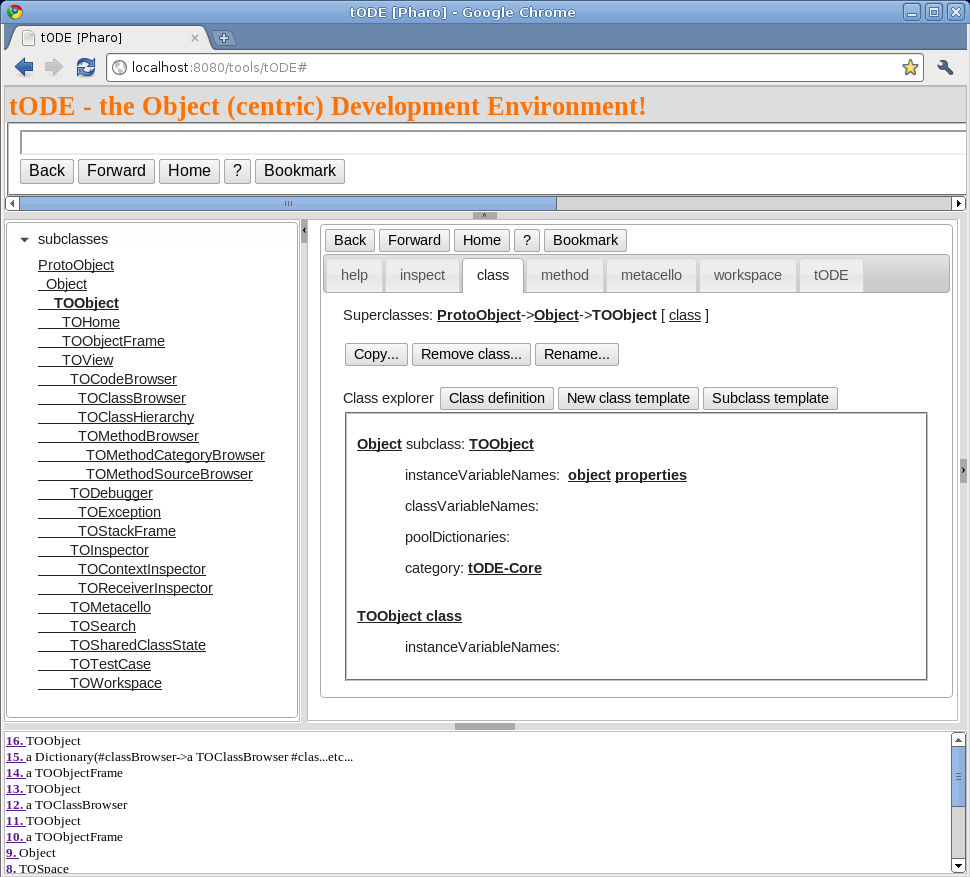

On 02.06.2011 19:07, Dale Henrichs wrote:
> Andreas,
>
> You are not alone. I too suffer from tooManyWindowsItis ... I am also doing something about it:)
Don't we all? :)
On a less ambitious note, what I've found to really help cut down on
having to deal with it in my day to day VW work, is two menu items I
added, called:
- Close Inspectors/Debuggers
- Close Senders/Implementers

Performing a task?
Open all the windows I feel like, concentrate on problem.

Done with a task?
Click the two buttons.  Evaluate whether I want the few remaining
windows. Start on next one.

(It should be noted VW have tabbed system browsers, so I usually only
have a few of those open)

Cheers,
Henry
I really like the idea Dale! I do realize you are still in the early stages but from a UI design point of view its a shame the typical back, forward, home and bookmark Internet browser buttons had to duplicated in the tODE. Since it is browser based I assume the idea is to allow developers to open as many (Internet browser) tabs as they want? Anyhow good stuff Dale :) -- View this message in context: http://forum.world.st/usability-of-Pharo-and-Squeak-tp3562378p3570224.html Sent from the Pharo Smalltalk mailing list archive at Nabble.com.
Thanks Geert....I am all thumbs when it comes to javascript (or UI design for that matter:), so there are very likely better ways to do things...for them moment I am satisfied that I have _a way_ to do things ... I needed to move to a web-browser for GLASS and I just didn't think that the window-centric model we are all familiar with would translate well into the web-browser world and I stumbled onto the current model, that does seem to fit well ... I am building in the notion of multiple "sessions" where each "session" manages the history and navigation stacks so that multiple internet browser tabs can have independent lives ... I am also interested in exploring the possibility of working with two independent smalltalk processes/images from within the same session ... I think that it would be interesting and useful for the folks that develop in Pharo and deploy in GemStone to be able to run tODE in GemStone, but be able to easily view and edit the pharo source (an vice versa) from within the same development environment ... I've already been working with one internet tab for Pharo and one for GemStone, but being able to navigate directly without the standard "copy, switch window/tab, open search, paste" steps that are usually needed ... Dale ----- Original Message -----
I really like the idea Dale! I do realize you are still in the early stages but from a UI design point of view its a shame the typical back, forward, home and bookmark Internet browser buttons had to duplicated in the tODE. Since it is browser based I assume the idea is to allow developers to open as many (Internet browser) tabs as they want? Anyhow good stuff Dale :)
-- View this message in context: http://forum.world.st/usability-of-Pharo-and-Squeak-tp3562378p3570224.html Sent from the Pharo Smalltalk mailing list archive at Nabble.com.
Am 02.06.2011 um 19:07 schrieb Dale Henrichs:
Andreas,
You are not alone. I too suffer from tooManyWindowsItis ... I am also doing something about it:)
The project is in it's very early stages ... I'm drawing on kraft paper with fat crayons ... but I am encouraged by the results so far. The system is called tODE "the Object (centric) Development Environment" and is written in Seaside, so it is javascript/web browser based. I am developing the system in Pharo, but it is targeted as the next generation development environment for GLASS.
I've enclosed a screenshot ... the system uses a single tab in the web-browser, but provides it's own www-style navigation through the Smalltalk object-space (so it is a browser inside of a browser) ... each of the tODE tabs is a view on an object and each object is wrapped by a TOObjectFrame that holds onto the tODE-specific state ... links take you to other objects ... you type Smalltalk-expressions in the input area at the top (and in the workspace tab)... I'm not a javascript guy (which is where the fat crayons come into play:)...You can inspect stacks in a "debugger", I've started work on the Metacello tab....etc.
With only one window, you never have to open/close another window!:) and with infinite history (at the bottom) you never lose the ability to go back to a previous object ...
The framework is very small: 21 classes in the TOOBject hierarchy and another 20 support classes, but being built on top of Seaside, it can't be called "light weight". It is designed to be easily customizable and extensible through the use of pragmas ...
I have just started using the system for development (you got to eat your own dog food), but often have to fall back into Pharo, so the system is really not ready for folks to play with ... yet... I need to solve the debugger issues before I can feel comfortable with letting folks play with it:)
Finally, while tODE is written on top of Seaside, I don't think that I'm leveraging Seaside for much more than rendering and javascript generation, which means that tODE could be adapted to other GUI frameworks ...I imagine ...
Dale
Hi Dale, I hope you will be successful. I don't like programming web interfaces because I am still not convinced that they are superior to traditional GUI's. Especially I don't like the mix of HMTL, JavaScript and CSS, even if you can replace HTML by Smalltalk with Seaside. And I also need to be convinced that Seaside is really such a big thing. I haven't seen advanced GUI's in Seaside yet. The examples I have seen in the Seaside book and the Seaside site are all simplistic. Maybe tODE will change my mind :D Regards Andreas
----- Original Message ----- | From: "Andreas Wacknitz" <a.wacknitz@gmx.de> | | I hope you will be successful. I don't like programming web | interfaces because I am still not convinced that they are superior | to traditional GUI's. | Especially I don't like the mix of HMTL, JavaScript and CSS, even if | you can replace HTML by Smalltalk with Seaside. | And I also need to be convinced that Seaside is really such a big | thing. I haven't seen advanced GUI's in Seaside yet. | The examples I have seen in the Seaside book and the Seaside site are | all simplistic. | Maybe tODE will change my mind :D Thanks Andreas, For advanced Seaside apps, check out NeXTPLAN[1]... As for tODE, the framework/approach isn't directly tied to Seaside ... I think tODE could be done in Morphic, but a Morphic-based tODE wouldn't serve my needs. Not only does GemStone lack a native GUI, but the GLASS applications are running on machines in a server farm somewhere and native GUIs aren't very responsive over the WAN, whereas serving pages from a remote server can provide acceptable performance. I do agree that I seem to be working with an unholy mixture of HTML, Javascript, and CSS, but Seaside does help hide the ugliness of HTML and Javascript... Dale [1] http://www.slideshare.net/esug/next-planjohanbrichau

Hi Dale and folks: First of all let me say Dale, your capacity to deliver new projects is awesome! 2011/6/3 Dale Henrichs <dhenrich@vmware.com>:
----- Original Message ----- | From: "Andreas Wacknitz" <a.wacknitz@gmx.de> | | I hope you will be successful. I don't like programming web | interfaces because I am still not convinced that they are superior | to traditional GUI's. | Especially I don't like the mix of HMTL, JavaScript and CSS, even if | you can replace HTML by Smalltalk with Seaside. | And I also need to be convinced that Seaside is really such a big | thing. I haven't seen advanced GUI's in Seaside yet. | The examples I have seen in the Seaside book and the Seaside site are | all simplistic. | Maybe tODE will change my mind :D
Thanks Andreas,
For advanced Seaside apps, check out NeXTPLAN[1]...
As for tODE, the framework/approach isn't directly tied to Seaside ... I think tODE could be done in Morphic, but a Morphic-based tODE wouldn't serve my needs. Not only does GemStone lack a native GUI, but the GLASS applications are running on machines in a server farm somewhere and native GUIs aren't very responsive over the WAN, whereas serving pages from a remote server can provide acceptable performance.
This is a great explanation. Lot of times I must explain myself (as a freelancer working for customers around the world) why I select web interfaces, this is the reason. Working with different datacenters, mix of networks and servers need to have a fast way to interact with them, and is the reason because the web is here.
I do agree that I seem to be working with an unholy mixture of HTML, Javascript, and CSS, but Seaside does help hide the ugliness of HTML and Javascript...
I'm not a javascript guy neither, but like or not, javascript is the engine that energize the web in our days, this was the main reason becuase Diego GD developed the ST2JS [1] some years ago, to program Javscript using Smalltalk. Unfortunately I had not more time, nor a way to insert in a payed project to continue this development, but I'm convinced that is a very very goof helper tool for Smalltalkers doing web development. Germán. [1] ST2JS stand for "Smalltalk to Javascript", is part of SWT (Smalltalk Web Toolkint), a tiny reference here: http://www.slideshare.net/garduino1/swt-2009
participants (8)
-
 Andreas Wacknitz
 -
Andreas Wacknitz
-
 Dale Henrichs
 -
 Geert Claes
 -
 Germán Arduino
 -
 Henrik Sperre Johansen
 -
 laurent laffont
 -
 Stéphane Ducasse