
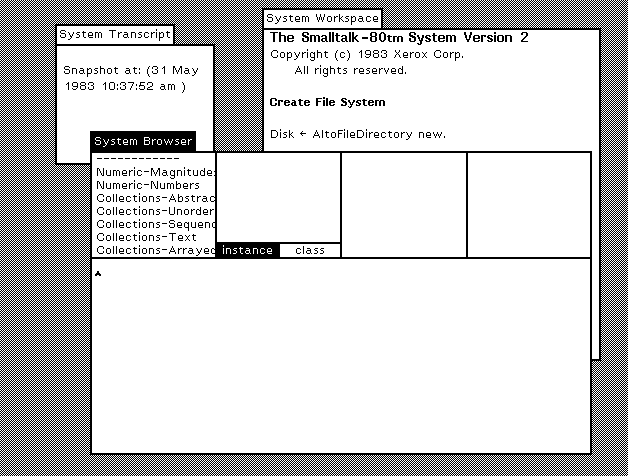

On 31 May 2013, at 10:01, Pavel Krivanek <pavel.krivanek@gmail.com> wrote:
happy nostalgia :-)
Cheers, -- Pavel <st80-19830531.png>
+1 It is amazing that so much of it still lives on. We've come a long way and the future is bright ;-) Note how also the collaboration model changed: from 'All right reserved' to MIT, from one lab to the whole world. Sven -- Sven Van Caekenberghe Proudly supporting Pharo http://pharo.org http://association.pharo.org http://consortium.pharo.org
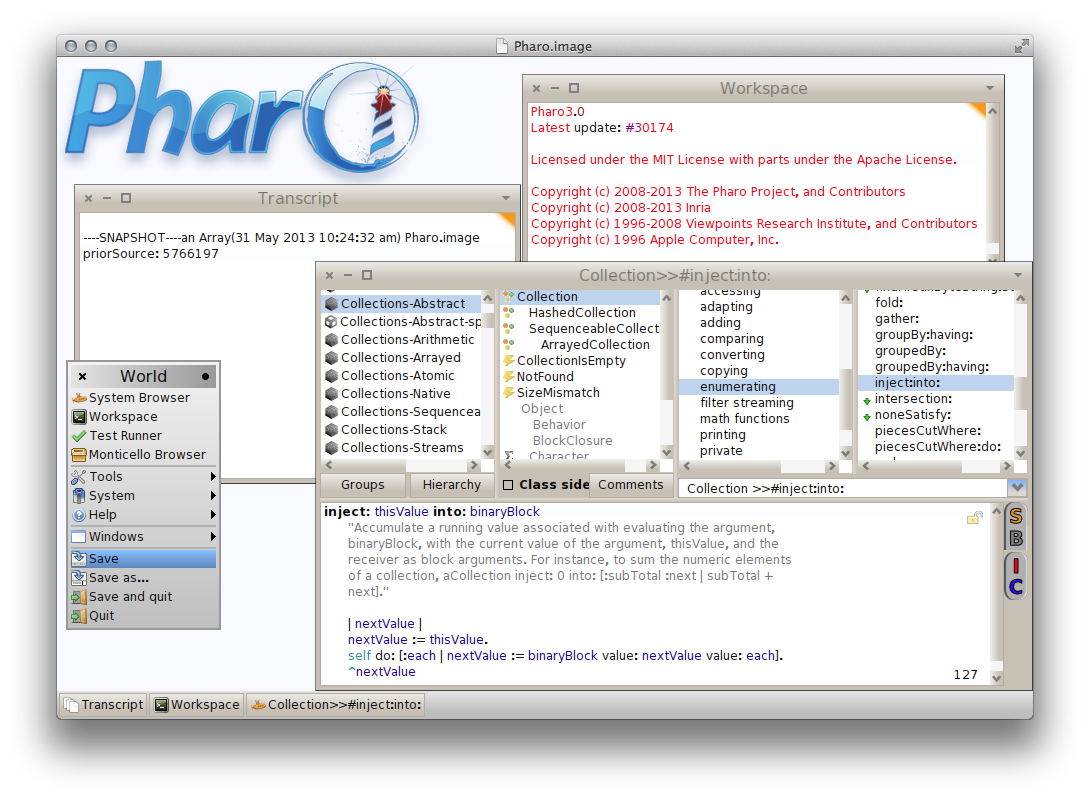

On 31 May 2013 09:31, Sven Van Caekenberghe <sven@stfx.eu> wrote:
On 31 May 2013, at 10:01, Pavel Krivanek <pavel.krivanek@gmail.com> wrote:
happy nostalgia :-)
Cheers, -- Pavel <st80-19830531.png>
+1
It is amazing that so much of it still lives on.
We've come a long way and the future is bright ;-)
Note how also the collaboration model changed: from 'All right reserved'
to MIT, from one lab to the whole world. I agree with the sentiment, but "All rights reserved" is a copyright thing, not a licence thing [1]. Pharo _still_ has "all rights reserved". It's just that Pharo doesn't need to say so because the Berne Convention makes it implicit. So it's more that the copyright is "The Pharo Project and Contributors" than "some random private corporation" that's the important part! frank [1] http://en.wikipedia.org/wiki/All_rights_reserved

Kinda ironic that I code for fun since 1988 , learned so many programming languages but only recently I heard about this interesting language called "Smalltalk". It could have ended my search very soon if I did started with smalltalk instead , but alas :D -- View this message in context: http://forum.world.st/Pharo-dev-A-screenshot-we-should-remind-today-tp469092... Sent from the Pharo Smalltalk Developers mailing list archive at Nabble.com.

On Fri, 2013-05-31 at 06:08 -0700, kilon wrote:
Kinda ironic that I code for fun since 1988 , learned so many programming languages but only recently I heard about this interesting language called "Smalltalk". It could have ended my search very soon if I did started with smalltalk instead , but alas :D
Could be worse - you could be stupid like me! I bought one of the very early PC Smalltalks (Smalltalk/V maybe?)because I'd heard it was interesting -and then never really did more than tinker with it for a few minutes. Many years later I got a job programming VisualWorks and it absolutely blew my mind wide open. Just think how many years of good programming I missed out on by not bothering to play with what I had right in front of me! Steve
Yeah indeed that is worse. But I have to confese my experience with both smalltalk and lisp (common lisp) has started with a "so what ?" experience. When I opened squeak , the IDE looked like any other ide I used, the guis was ugly, morph halos looked kinda weird. I did not understan why all the ranting that everything is a smalltalk object and of course we should not forget the usual "If your language is all that great why people are not even aware of it". Especially the last one , I have been coding for fun for more than 24 years now and never , absolutely never heard of smalltalk before. Actually the reason I discovered smalltalk was because of lisper I was chating via irc 1 + years ago. I was reading how awesome common lisp is , but of course I did hate all that parentheses. However I did decide to give it a serious try , but for me the barrier was emacs and text based interfaces, I was always a fan of GUIs, so I was chating with him saying to him how I would love to do live coding and visual coding and he replied "hey did you try squeak and smalltalk ?" , I replied back "whats that ?" and the rest is history. So to be fair he did tell me what the big deal was so I knew when I tried squeak that it was very special. Because if I have tried it by accident most likely I would have taken the same route as you and even never come back to it. The problem with smalltalk and lisp is that it takes a lot of time to realise the benefits of using such unpopular languages. Its difficult to kick out the "whats the big deal ?" attitude. -- View this message in context: http://forum.world.st/Pharo-dev-A-screenshot-we-should-remind-today-tp469092... Sent from the Pharo Smalltalk Developers mailing list archive at Nabble.com.

Takes a while indeed. On Mon, Jun 3, 2013 at 9:53 AM, kilon <thekilon@yahoo.co.uk> wrote:
Yeah indeed that is worse.
But I have to confese my experience with both smalltalk and lisp (common lisp) has started with a "so what ?" experience. When I opened squeak , the IDE looked like any other ide I used, the guis was ugly, morph halos looked kinda weird. I did not understan why all the ranting that everything is a smalltalk object and of course we should not forget the usual "If your language is all that great why people are not even aware of it".
Especially the last one , I have been coding for fun for more than 24 years now and never , absolutely never heard of smalltalk before. Actually the reason I discovered smalltalk was because of lisper I was chating via irc 1 + years ago. I was reading how awesome common lisp is , but of course I did hate all that parentheses. However I did decide to give it a serious try , but for me the barrier was emacs and text based interfaces, I was always a fan of GUIs, so I was chating with him saying to him how I would love to do live coding and visual coding and he replied "hey did you try squeak and smalltalk ?" , I replied back "whats that ?" and the rest is history.
So to be fair he did tell me what the big deal was so I knew when I tried squeak that it was very special. Because if I have tried it by accident most likely I would have taken the same route as you and even never come back to it.
The problem with smalltalk and lisp is that it takes a lot of time to realise the benefits of using such unpopular languages. Its difficult to kick out the "whats the big deal ?" attitude.
-- View this message in context: http://forum.world.st/Pharo-dev-A-screenshot-we-should-remind-today-tp469092... Sent from the Pharo Smalltalk Developers mailing list archive at Nabble.com.
participants (6)
-
 Frank Shearar
 -
 kilon
kilon -
 Pavel Krivanek
 -
 phil@highoctane.be
 -
 Stephen Taylor
 -
 Sven Van Caekenberghe