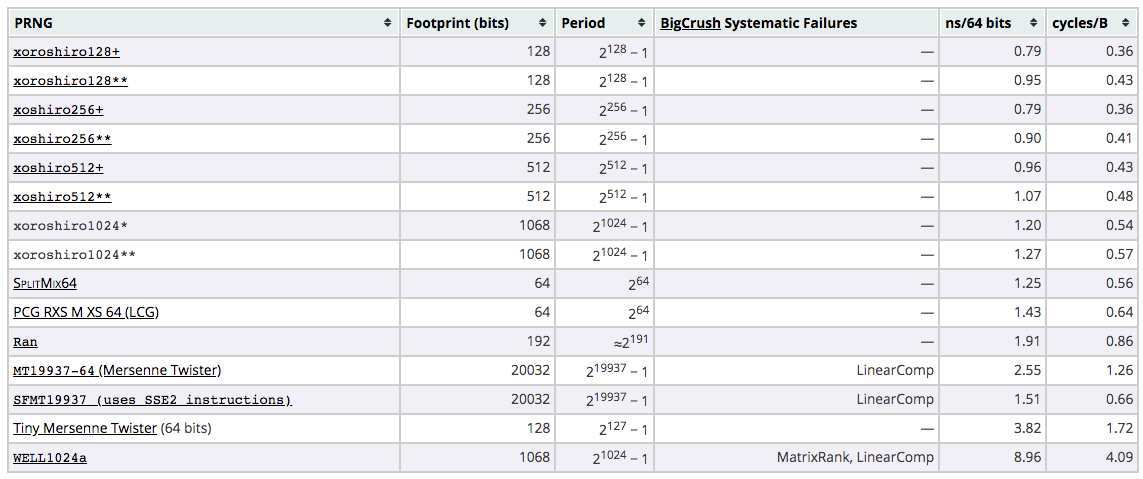
Thanks Nicolas and Henry, For now, simple alternative expressions can easily generate the values I need for my project, such as: (String new: 32) collect: [ :each | '0123456789abcdef' atRandom ] Maybe in a few months (or years!) from now I will have acquired enough ambient familiarity with Pharo to attempt a fix. But, for the time being, I'll just avoid stepping on the landmine. In doing some research on this problem I spotted this, which seemed to possibly point a way toward a cutting edge RNG implementation for Pharo: http://xoshiro.di.unimi.it/#intro [image: image.png] David On Sun, 10 Feb 2019 at 23:21, Nicolas Cellier < nicolas.cellier.aka.nice@gmail.com> wrote:
Try it in Squeak and pick the relevant methods. Open a bug report and commit the fix. Of course, original authorship will somehow be spoiled, so be kind and cite them in commit message.
Le lun. 11 févr. 2019 à 07:59, David Richards < david.i.richards.iii@gmail.com> a écrit :
Hello community.
Kindly consider:
| n i r | n := ( 2 ** 256 ) - 1 . "the largest 256-bit value" i := ( 0 to: n ) . "the interval 0 to 2**256-1" "Produce three sets of computed test results." 3 timesRepeat: [ Transcript show: ( r := i atRandom ) ; cr . Transcript show: ( r asByteArray hex ) ; cr . ]
According to comments in Pharo library code, atRandom fails for integer magnitudes greater than 2**30 . A reason for this limitation is not given, and it's not clear to a novice such as myself why the computed result of atRandom is permitted to sometimes be in conflict with the semantics of atRandom .
Can anyone provide a basic explanation of the rationale for a 'broken' atRandom ?
Alternatively, is this a known bug?
Thanks. dr