2014-11-08 13:19 GMT+01:00 Ben Coman <btc@openinworld.com>:
Thierry Goubier wrote:
Hi Ben,
2014-11-08 7:28 GMT+01:00 Ben Coman <btc@openinworld.com <mailto: btc@openinworld.com>>:
This is a general query and something I've wondered several times before in different situations, but I use OSWindow as an example since that is what I happen to be looking at this time.
For curiosity I was having a poke around OSWindow and seeing OSWindowMorphicEventHandler>>__handleEvent: morphicEvent := anEvent accept: self.
I wanted to view the code that could invoke, so I used <cmd-M> on #accept: to get the implementors, which lists 116 items, many of which are unrelated. Now its not toooo hard to "guess" which implementations are related, but it would be nicer to guess less.
...
At the same time, your issue is also with the fact that filtering the relevant #accept: implementors could be easier, and this is a GUI issue for which we already have propositions (or we can think of some).
Thierry
If you are thinking of scoped-browsing, then I think my particular case just now, that would have been a little constraining. I wasn't really on a task working with OSWindow. I was just bouncing around the system with curiousity. Needing to scope the browser before doing <cmd-M> would add some steps (i.e. friction) over just having methods named #acceptDomainSpecific: .
And I am thinking of another hypothetical case where a third party extends a visitor pattern in a separate package, so if the browser scope was limited to a particular package, then the visitor in the other package would be excluded. But if its done on methodName, a third party extension is implicitly included.
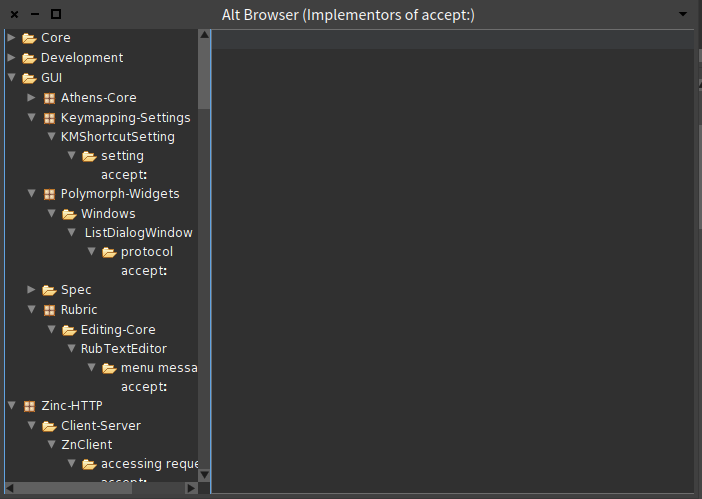
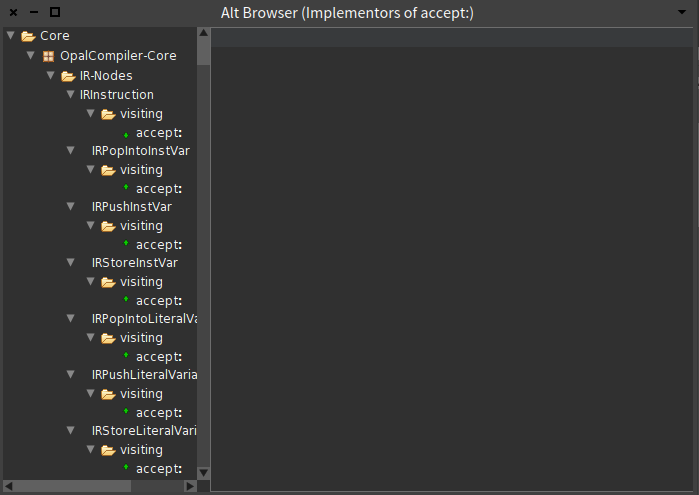
I wasn't thinking of scoped browsing; but of something else. You see, when you search for implementors in your case, the answer is this: [image: Images intégrées 1] And, what you see, is that on the left you still have the overall structure of the packages: Core->OpalCompiler-Core, etc... (with all the implementors of accept, of course). Then, you start the guessing work: It's probably not in Core, not in Developpement either, so you just close them at the top-level... And you keep closing all the categories (or packages) you are guessing as non relevant: Athens-Core, Spec, etc... [image: Images intégrées 2] You see, the scrollbar shows that you have far less results to review, making your query a lot easier. This is the kind of solution I was suggesting. Thierry
cheers -ben