Hi Dr. Dias, a WeakValueDictionary get's its values collected if they are not referenced strongly. However, the association remains there. This means that when you do: dictionary := WeakValueDictionary with: 'hello' -> nil copy. You'll have something like this: WeakValueDictionary { WeakValueAssociation { key: 'hello', value: yourObject } } Once you garbage collect, the value is holding yourObject weakly, so you'll have: WeakValueDictionary { WeakValueAssociation { key: 'hello', value: nil } } But the WeakValueAssociation will still be there. Apparently, what you want to do is to automatically clean your dictionary. Checking a Pharo60371, I see that WeakValueDictionaries do not implement this... But WeakKeyDictionary does. Take for example a look at WeakKeyDictionary>>finalizeValues. If you subscribe the WeakKeyDictionary instance to the WeakRegistry, the weak registry will send finalize values to your weak key dictionary and they will eliminate the expired associations. However, #finalizeValues is not implemented in WeakValueDictionary. Maybe we should? Or maybe you should try with Ephemerons. Guille BTW why are you using a copy of nil? you can test it with a plain new Object (i.e., Object new). It took me a couple of extra seconds to realize what you were doing. On Tue, Feb 21, 2017 at 7:57 AM, phil@highoctane.be <phil@highoctane.be> wrote:
This makes sense, no?
| dictionary | dictionary := WeakValueDictionary with: 'hello' -> nil copy. "Smalltalk garbageCollect." r:={ dictionary values includes: nil. dictionary at: 'hello'. dictionary at: 'hello' ifAbsent: [ 'absent' ]. dictionary at: 'hello' ifAbsentPut: [ 'put' ]. }. r
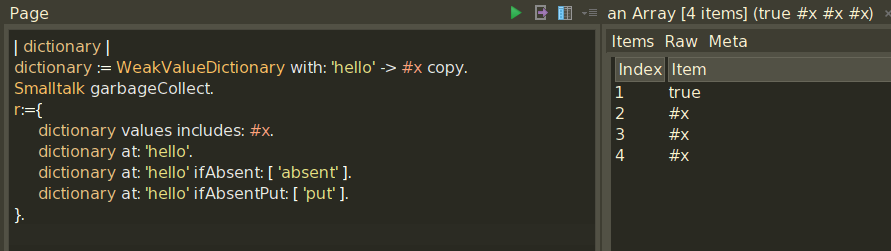
and I get this anyway when GCing and puttting #x as value
[image: Inline image 1]
Maybe checking for emptiness first is needed before going for values include:
Phil
On Mon, Feb 20, 2017 at 11:18 PM, Martin Dias <tinchodias@gmail.com> wrote:
Hi. The answer of:
| dictionary | dictionary := WeakValueDictionary with: 'hello' -> 'world' copy. Smalltalk garbageCollect. { dictionary values includes: nil. dictionary at: 'hello'. dictionary at: 'hello' ifAbsent: [ 'absent' ]. dictionary at: 'hello' ifAbsentPut: [ 'put' ]. }
is:
#(true nil nil nil)
Bug or feature? shouldn't the value be considered as absent instead of present (and nil).
cheers, MartÃn