On Sun, Aug 6, 2017 at 8:07 PM, Aliaksei Syrel <alex.syrel@gmail.com> wrote:
Hi Denis,
Thanks a lot for looking into it :) See my answers for every point below:
1) Loading in Pharo 7 signal dependency error:
That is true, but I can not do anything about it now :( OSWindow-SDL depends on Athens (while it should not). In Bloc we don't use / need Athens but because of OSWindow's dependency Athens tries to update itself. Additionally the classes you mentioned were removed from the system, while Athens adds extension methods to them => error during installation. In Pharo 6 there is no error, though.
Can you be more precise so that we can take action?
2) Text cursor up/down is not working correctly when text is wrapped.
Indeed, up/down movement is a bit tricky :) But its implementation is in fact very interesting. Take a look at this video: â Bloc-FocusNavigationLong.mov <https://drive.google.com/file/d/0B-bMBVDOi3oTVEFlemwzeTNibEk/view?usp=drive_...> â Bloc has support of element-independent *visual* focus navigation. In the editor we reuse it for the cursor (one cursor for a moment but we target to support multiple). However, because of text's special nature it is not super smooth but will be improved :)
3) I look a bit at text commands (TextEditorCommand) and found that
current KeyMapping package ($a asShortcut) is not used. Instead there is new hierarchy of BlKeyCombination.
It is a special bloc feature that requires its own announcement. As a teaser I can say that we rely on *Key* and not on *Character + modifiers* while defining shortcuts. It allows us to build any *key* combinations possible. For example we distinguish left and right shift, left and right meta, etc. Shortcuts can consist only of one Key or be just only right shift :) It is super flexible but we will come to it later ;)
Just remember that we will not add new things in Pharo if we do not remove the equivalent already in the system. I'm fed up to have three different half working mechanisms.
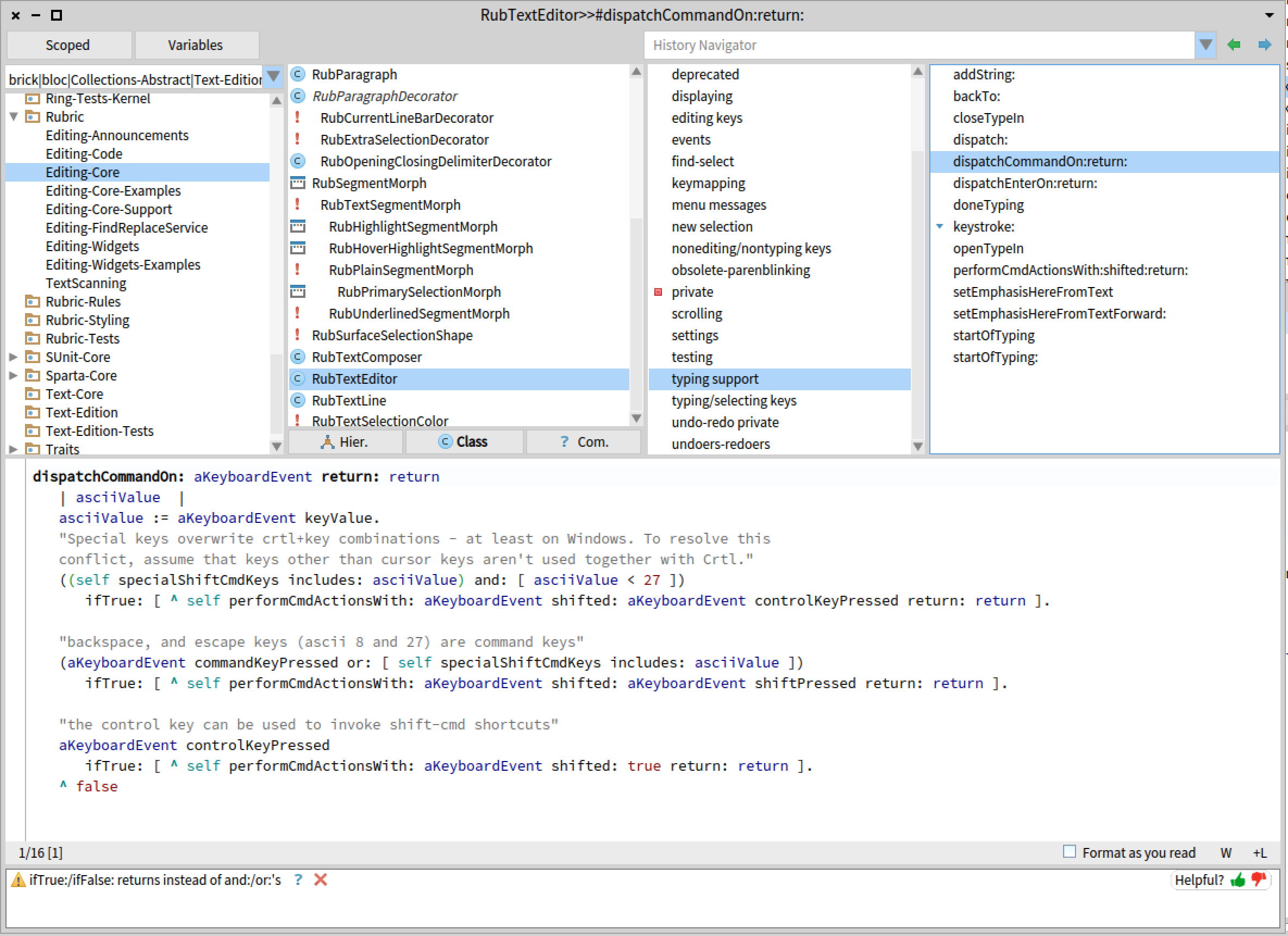
P.S. arrows are also treated at shortcuts and not as keystroke: meaning that there is no need to do this:
[image: Inline images 1]
4) I thing we should try to use Commander for new UI widgets. For example
It is very naturally applied to TextEditorCommand hierarchy. And it will automatically remove hardcoded shortcuts defined in method BrTextEditor>>onAttached:
Commander didn't yet made it into release :) Just as prove of concept I hardcoded shortcuts in onAttached: tin order to show that *they all* are in one single place. There is no other place where we check if any modifier keys pressed! It is beautiful and will allow us to ship editor with fully customisable shortcuts (nothing should stop us from having vim bindings).
Cheers, Alex
On 6 August 2017 at 19:17, Denis Kudriashov <dionisiydk@gmail.com> wrote:
Good job guys.
Here is my feedback:
1) Loading in Pharo 7 signal dependency error:
This package depends on the following classes: NewList NewListRenderer TabActionButton Tab TabBar
Then I proceed and it was loaded fine. And editor works like in demo.
2) Text cursor up/down is not working correctly when text is wrapped.
- it jumps between real text line instead of visual wrapped lines.
- it skips empty lines
- sometimes it is just not moved (not found concrete case)
3) I look a bit at text commands (TextEditorCommand) and found that current KeyMapping package ($a asShortcut) is not used. Instead there is new hierarchy of BlKeyCombination. What the reason for this?
4) I thing we should try to use Commander for new UI widgets. For example It is very naturally applied to TextEditorCommand hierarchy. And it will automatically remove hardcoded shortcuts defined in method BrTextEditor>>onAttached:
2017-08-05 0:19 GMT+02:00 Tudor Girba <tudor@tudorgirba.com>:
Hi,
We are very happy to announce the alpha version of a moldable editor built in Brick (https://github.com/pharo-graphics/Brick) which is based on Bloc (https://github.com/pharo-graphics/Bloc). This is primarily the work of Alex Syrel. The project was initially financially sponsored by ESUG and it is currently supported by feenk. And of course, the project is based on the tremendous work that went into Bloc and Brick by all contributors.
Take a look at this 2 min video: https://www.youtube.com/watch?v=2vy6VMJM9W4&feature=youtu.be
The basic editor works and it is both flexible and scalable. For example, the last example shown in the video is an editor opened on 1M characters, which is reasonably large, and as can be seen see one can interact with it as smoothly as with the one screen text. It actually works just as fine with 100M characters.
The functionality of the editor includes: rendering, line wrapping, keypress and shortcut handling, navigation, selection and text styling. Currently, the editor is 1260 lines of code including method and class comments. This is not large for a text editor and this is possible because most of the work is done by generic concepts that already exist in Bloc such as layouts and text measurements. Beside the small maintenance cost, the benefit is that we have the option to build all sorts of variations with little effort. That is why we call this a moldable text editor.
Another benefit of using elements and layouts is that we can also embed other kinds of non-text elements with little effort (such as pictures), and obtain a rich and live text editor. We already have basic examples for this behavior, and we will focus more in the next period on this area.
The next immediate step is to add syntax highlighting. Beside the text attributes problem, this issue will also exercise the thread-safety the implementation is. The underlying structure ( https://en.wikipedia.org/wiki/Rope_(data_structure)) is theoretically thread-safe, but it still needs to be proven in practice.
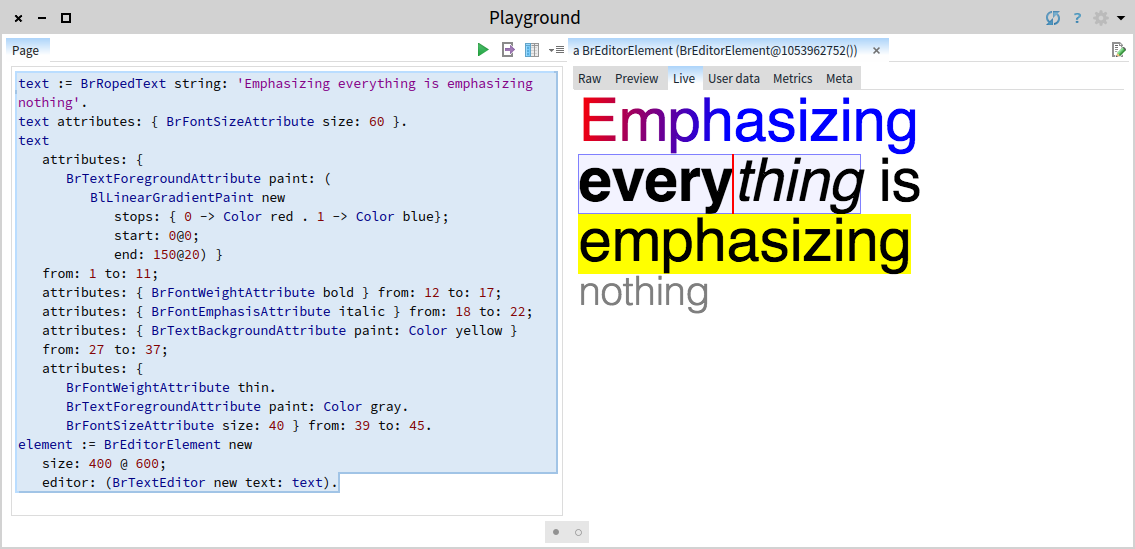
We think this is a significant step because the editor was the main piece missing in Brick and it will finally allow us to build value that can be directly perceived by regular users on top of Brick and this, in turn, will generate more traction. Please also note that because now Bloc is directly embeddable in Morphic it means that we can actually start using it right away. For example, the picture below shows the text element being shown through a live preview in the GTInspector.
[image: Playground @ ⢠a8rEditorE1ement x Page â BrRopedText string: Emphasizing everything text : nothing' text attributes: { BrFontSizeAttribute size: 66 } . text attributes: { BrTextForegroundAttri bute paint: ( BILinearGradientPaint new stops: 9 â> Color red . start: end: from: 1 to: 11; Color blue} ; attributes: { BrFontWeightAttribute bold } from: 12 attributes: { BrFontEmphasisAttribute italic from: emphasi zi ng to: 17; 18 to: 22; Raw Preview Live User data Metrics Meta Em hasizing ever thin is emphasizing nothing attributes: { BrTextBackgroundAttribute paint: Color yellow from: 27 to: 37; attributes: { BrFontWeightAttribute thin. BrTextForegroundAttribute paint: Color gray. BrFontSizeAttribute size: 40 from: 39 to: 45. element : BrEditorElement new size: 400 @ 600; edi tor: (BrTextEdi tor new text: text) .]
This is another puzzle piece towards the final goal of engineering the future of the Pharo user interface. There is still a long way to go to reach that goal, but considering the work that is behind us, that goal that looked so illusive when Alain and Stef initiated the Bloc project is now palpable.
We will continue the work on this over the next period and we expect to announce new developments soon.
If you want to play with it, you can load the code like this (works in both Pharo 6 and 7): Iceberg enableMetacelloIntegration: true. Metacello new baseline: 'Brick'; repository: 'github://pharo-graphics/Brick/src'; load: #development
Please let us know what you think.
Cheers, Alex and Doru
-- www.tudorgirba.com www.feenk.com
"What is more important: To be happy, or to make happy?"