Porting Transducers to Pharo

Hi, I am the developer of the library 'Transducers' for VisualWorks. It was formerly known as 'Reducers', but this name was a poor choice. I'd like to port it to Pharo, if there is any interest on your side. I hope to learn more about Pharo in this process, since I am mainly a VW guy. And most likely, I will come up with a bunch of questions. :-) Meanwhile, I'll cross-post the introduction from VWnc below. I'd be very happy to hear your optinions, questions and I hope we can start a fruitful discussion - even if there is not Pharo port yet. Best, Steffen Transducers are building blocks that encapsulate how to process elements of a data sequence independently of the underlying input and output source. # Overview ## Encapsulate Implementations of enumeration methods, such as #collect:, have the logic how to process a single element in common. However, that logic is reimplemented each and every time. Transducers make it explicit and facilitate re-use and coherent behavior. For example: - #collect: requires mapping: (aBlock1 map) - #select: requires filtering: (aBlock2 filter) ## Compose In practice, algorithms often require multiple processing steps, e.g., mapping only a filtered set of elements. Transducers are inherently composable, and hereby, allow to make the combination of steps explicit. Since transducers do not build intermediate collections, their composition is memory-efficient. For example: - (aBlock1 filter) * (aBlock2 map) "(1.) filter and (2.) map elements" ## Re-Use Transducers are decoupled from the input and output sources, and hence, they can be reused in different contexts. For example: - enumeration of collections - processing of streams - communicating via channels # Usage by Example We build a coin flipping experiment and count the occurrence of heads and tails. First, we associate random numbers with the sides of a coin. scale := [:x | (x * 2 + 1) floor] map. sides := #(heads tails) replace. Scale is a transducer that maps numbers x between 0 and 1 to 1 and 2. Sides is a transducer that replaces the numbers with heads an tails by lookup in an array. Next, we choose a number of samples. count := 1000 take. Count is a transducer that takes 1000 elements from a source. We keep track of the occurrences of heads an tails using a bag. collect := [:bag :c | bag add: c; yourself]. Collect is binary block (reducing function) that collects events in a bag. We assemble the experiment by transforming the block using the transducers. experiment := (scale * sides * count) transform: collect. From left to right we see the steps involved: scale, sides, count and collect. Transforming assembles these steps into a binary block (reducing function) we can use to run the experiment. samples := Random new reduce: experiment init: Bag new. Here, we use #reduce:init:, which is mostly similar to #inject:into:. To execute a transformation and a reduction together, we can use #transduce:reduce:init:. samples := Random new transduce: scale * sides * count reduce: collect init: Bag new. We can also express the experiment as data-flow using #<~. This enables us to build objects that can be re-used in other experiments. coin := sides <~ scale <~ Random new. flip := Bag <~ count. Coin is an eduction, i.e., it binds transducers to a source and understands #reduce:init: among others. Flip is a transformed reduction, i.e., it binds transducers to a reducing function and an initial value. By sending #<~, we draw further samples from flipping the coin. samples := flip <~ coin. This yields a new Bag with another 1000 samples. # Basic Concepts ## Reducing Functions A reducing function represents a single step in processing a data sequence. It takes an accumulated result and a value, and returns a new accumulated result. For example: collect := [:col :e | col add: e; yourself]. sum := #+. A reducing function can also be ternary, i.e., it takes an accumulated result, a key and a value. For example: collect := [:dic :k :v | dict at: k put: v; yourself]. Reducing functions may be equipped with an optional completing action. After finishing processing, it is invoked exactly once, e.g., to free resources. stream := [:str :e | str nextPut: each; yourself] completing: #close. absSum := #+ completing: #abs A reducing function can end processing early by signaling Reduced with a result. This mechanism also enables the treatment of infinite sources. nonNil := [:res :e | e ifNil: [Reduced signalWith: res] ifFalse: [res]]. The primary approach to process a data sequence is the reducing protocol with the messages #reduce:init: and #transduce:reduce:init: if transducers are involved. The behavior is similar to #inject:into: but in addition it takes care of: - handling binary and ternary reducing functions, - invoking the completing action after finishing, and - stopping the reduction if Reduced is signaled. The message #transduce:reduce:init: just combines the transformation and the reducing step. However, as reducing functions are step-wise in nature, an application may choose other means to process its data. ## Reducibles A data source is called reducible if it implements the reducing protocol. Default implementations are provided for collections and streams. Additionally, blocks without an argument are reducible, too. This allows to adapt to custom data sources without additional effort. For example: "XStreams adaptor" xstream := filename reading. reducible := [[xstream get] on: Incomplete do: [Reduced signal]]. "natural numbers" n := 0. reducible := [n := n+1]. ## Transducers A transducer is an object that transforms a reducing function into another. Transducers encapsulate common steps in processing data sequences, such as map, filter, concatenate, and flatten. A transducer transforms a reducing function into another via #transform: in order to add those steps. They can be composed using #* which yields a new transducer that does both transformations. Most transducers require an argument, typically blocks, symbols or numbers: square := Map function: #squared. take := Take number: 1000. To facilitate compact notation, the argument types implement corresponding methods: squareAndTake := #squared map * 1000 take. Transducers requiring no argument are singletons and can be accessed by their class name. flattenAndDedupe := Flatten * Dedupe. # Advanced Concepts ## Data flows Processing a sequence of data can often be regarded as a data flow. The operator #<~ allows define a flow from a data source through processing steps to a drain. For example: squares := Set <~ 1000 take <~ #squared map <~ (1 to: 1000). fileOut writeStream <~ #isSeparator filter <~ fileIn readStream. In both examples #<~ is only used to set up the data flow using reducing functions and transducers. In contrast to streams, transducers are completely independent from input and output sources. Hence, we have a clear separation of reading data, writing data and processing elements. - Sources know how to iterate over data with a reducing function, e.g., via #reduce:init:. - Drains know how to collect data using a reducing function. - Transducers know how to process single elements. ## Reductions A reduction binds an initial value or a block yielding an initial value to a reducing function. The idea is to define a ready-to-use process that can be applied in different contexts. Reducibles handle reductions via #reduce: and #transduce:reduce: For example: sum := #+ init: 0. sum1 := #(1 1 1) reduce: sum. sum2 := (1 to: 1000) transduce: #odd filter reduce: sum. asSet := [:set :e | set add: e; yourself] initializer: [Set new]. set1 := #(1 1 1) reduce: asSet. set2 := #(1 to: 1000) transduce: #odd filter reduce: asSet. By combining a transducer with a reduction, a process can be further modified. sumOdds := sum <~ #odd filter setOdds := asSet <~ #odd filter ## Eductions An eduction combines a reducible data sources with a transducer. The idea is to define a transformed (virtual) data source that needs not to be stored in memory. odds1 := #odd filter <~ #(1 2 3) readStream. odds2 := #odd filter <~ (1 to 1000). Depending on the underlying source, eductions can be processed once (streams, e.g., odds1) or multiple times (collections, e.g., odds2). Since no intermediate data is stored, transducers actions are lazy, i.e., they are invoked each time the eduction is processed. # Origins Transducers is based on the same-named Clojure library and its ideas. Please see: http://clojure.org/transducers

On 31 May 2017, at 14:23, Steffen Märcker <merkste@web.de> wrote:
Hi,
I am the developer of the library 'Transducers' for VisualWorks. It was formerly known as 'Reducers', but this name was a poor choice. I'd like to port it to Pharo, if there is any interest on your side. I hope to learn more about Pharo in this process, since I am mainly a VW guy. And most likely, I will come up with a bunch of questions. :-)
Meanwhile, I'll cross-post the introduction from VWnc below. I'd be very happy to hear your optinions, questions and I hope we can start a fruitful discussion - even if there is not Pharo port yet.
Best, Steffen
Hi Steffen, Looks like very interesting stuff. Would make an nice library/framework for Pharo. Sven
Transducers are building blocks that encapsulate how to process elements of a data sequence independently of the underlying input and output source.
# Overview
## Encapsulate Implementations of enumeration methods, such as #collect:, have the logic how to process a single element in common. However, that logic is reimplemented each and every time. Transducers make it explicit and facilitate re-use and coherent behavior. For example: - #collect: requires mapping: (aBlock1 map) - #select: requires filtering: (aBlock2 filter)
## Compose In practice, algorithms often require multiple processing steps, e.g., mapping only a filtered set of elements. Transducers are inherently composable, and hereby, allow to make the combination of steps explicit. Since transducers do not build intermediate collections, their composition is memory-efficient. For example: - (aBlock1 filter) * (aBlock2 map) "(1.) filter and (2.) map elements"
## Re-Use Transducers are decoupled from the input and output sources, and hence, they can be reused in different contexts. For example: - enumeration of collections - processing of streams - communicating via channels
# Usage by Example
We build a coin flipping experiment and count the occurrence of heads and tails.
First, we associate random numbers with the sides of a coin.
scale := [:x | (x * 2 + 1) floor] map. sides := #(heads tails) replace.
Scale is a transducer that maps numbers x between 0 and 1 to 1 and 2. Sides is a transducer that replaces the numbers with heads an tails by lookup in an array. Next, we choose a number of samples.
count := 1000 take.
Count is a transducer that takes 1000 elements from a source. We keep track of the occurrences of heads an tails using a bag.
collect := [:bag :c | bag add: c; yourself].
Collect is binary block (reducing function) that collects events in a bag. We assemble the experiment by transforming the block using the transducers.
experiment := (scale * sides * count) transform: collect.
From left to right we see the steps involved: scale, sides, count and collect. Transforming assembles these steps into a binary block (reducing function) we can use to run the experiment.
samples := Random new reduce: experiment init: Bag new.
Here, we use #reduce:init:, which is mostly similar to #inject:into:. To execute a transformation and a reduction together, we can use #transduce:reduce:init:.
samples := Random new transduce: scale * sides * count reduce: collect init: Bag new.
We can also express the experiment as data-flow using #<~. This enables us to build objects that can be re-used in other experiments.
coin := sides <~ scale <~ Random new. flip := Bag <~ count.
Coin is an eduction, i.e., it binds transducers to a source and understands #reduce:init: among others. Flip is a transformed reduction, i.e., it binds transducers to a reducing function and an initial value. By sending #<~, we draw further samples from flipping the coin.
samples := flip <~ coin.
This yields a new Bag with another 1000 samples.
# Basic Concepts
## Reducing Functions
A reducing function represents a single step in processing a data sequence. It takes an accumulated result and a value, and returns a new accumulated result. For example:
collect := [:col :e | col add: e; yourself]. sum := #+.
A reducing function can also be ternary, i.e., it takes an accumulated result, a key and a value. For example:
collect := [:dic :k :v | dict at: k put: v; yourself].
Reducing functions may be equipped with an optional completing action. After finishing processing, it is invoked exactly once, e.g., to free resources.
stream := [:str :e | str nextPut: each; yourself] completing: #close. absSum := #+ completing: #abs
A reducing function can end processing early by signaling Reduced with a result. This mechanism also enables the treatment of infinite sources.
nonNil := [:res :e | e ifNil: [Reduced signalWith: res] ifFalse: [res]].
The primary approach to process a data sequence is the reducing protocol with the messages #reduce:init: and #transduce:reduce:init: if transducers are involved. The behavior is similar to #inject:into: but in addition it takes care of: - handling binary and ternary reducing functions, - invoking the completing action after finishing, and - stopping the reduction if Reduced is signaled. The message #transduce:reduce:init: just combines the transformation and the reducing step.
However, as reducing functions are step-wise in nature, an application may choose other means to process its data.
## Reducibles
A data source is called reducible if it implements the reducing protocol. Default implementations are provided for collections and streams. Additionally, blocks without an argument are reducible, too. This allows to adapt to custom data sources without additional effort. For example:
"XStreams adaptor" xstream := filename reading. reducible := [[xstream get] on: Incomplete do: [Reduced signal]].
"natural numbers" n := 0. reducible := [n := n+1].
## Transducers
A transducer is an object that transforms a reducing function into another. Transducers encapsulate common steps in processing data sequences, such as map, filter, concatenate, and flatten. A transducer transforms a reducing function into another via #transform: in order to add those steps. They can be composed using #* which yields a new transducer that does both transformations. Most transducers require an argument, typically blocks, symbols or numbers:
square := Map function: #squared. take := Take number: 1000.
To facilitate compact notation, the argument types implement corresponding methods:
squareAndTake := #squared map * 1000 take.
Transducers requiring no argument are singletons and can be accessed by their class name.
flattenAndDedupe := Flatten * Dedupe.
# Advanced Concepts
## Data flows
Processing a sequence of data can often be regarded as a data flow. The operator #<~ allows define a flow from a data source through processing steps to a drain. For example:
squares := Set <~ 1000 take <~ #squared map <~ (1 to: 1000). fileOut writeStream <~ #isSeparator filter <~ fileIn readStream.
In both examples #<~ is only used to set up the data flow using reducing functions and transducers. In contrast to streams, transducers are completely independent from input and output sources. Hence, we have a clear separation of reading data, writing data and processing elements. - Sources know how to iterate over data with a reducing function, e.g., via #reduce:init:. - Drains know how to collect data using a reducing function. - Transducers know how to process single elements.
## Reductions
A reduction binds an initial value or a block yielding an initial value to a reducing function. The idea is to define a ready-to-use process that can be applied in different contexts. Reducibles handle reductions via #reduce: and #transduce:reduce: For example:
sum := #+ init: 0. sum1 := #(1 1 1) reduce: sum. sum2 := (1 to: 1000) transduce: #odd filter reduce: sum.
asSet := [:set :e | set add: e; yourself] initializer: [Set new]. set1 := #(1 1 1) reduce: asSet. set2 := #(1 to: 1000) transduce: #odd filter reduce: asSet.
By combining a transducer with a reduction, a process can be further modified.
sumOdds := sum <~ #odd filter setOdds := asSet <~ #odd filter
## Eductions
An eduction combines a reducible data sources with a transducer. The idea is to define a transformed (virtual) data source that needs not to be stored in memory.
odds1 := #odd filter <~ #(1 2 3) readStream. odds2 := #odd filter <~ (1 to 1000).
Depending on the underlying source, eductions can be processed once (streams, e.g., odds1) or multiple times (collections, e.g., odds2). Since no intermediate data is stored, transducers actions are lazy, i.e., they are invoked each time the eduction is processed.
# Origins
Transducers is based on the same-named Clojure library and its ideas. Please see: http://clojure.org/transducers

As you know I experimented with that a while ago. My code is at http://smalltalkhub.com/#!/~cdlm/Experiments/source On 31 May 2017 at 15:00, Sven Van Caekenberghe <sven@stfx.eu> wrote:
On 31 May 2017, at 14:23, Steffen Märcker <merkste@web.de> wrote:
Hi,
I am the developer of the library 'Transducers' for VisualWorks. It was formerly known as 'Reducers', but this name was a poor choice. I'd like to port it to Pharo, if there is any interest on your side. I hope to learn more about Pharo in this process, since I am mainly a VW guy. And most likely, I will come up with a bunch of questions. :-)
Meanwhile, I'll cross-post the introduction from VWnc below. I'd be very happy to hear your optinions, questions and I hope we can start a fruitful discussion - even if there is not Pharo port yet.
Best, Steffen
Hi Steffen,
Looks like very interesting stuff. Would make an nice library/framework for Pharo.
Sven
Transducers are building blocks that encapsulate how to process elements of a data sequence independently of the underlying input and output source.
# Overview
## Encapsulate Implementations of enumeration methods, such as #collect:, have the logic how to process a single element in common. However, that logic is reimplemented each and every time. Transducers make it explicit and facilitate re-use and coherent behavior. For example: - #collect: requires mapping: (aBlock1 map) - #select: requires filtering: (aBlock2 filter)
## Compose In practice, algorithms often require multiple processing steps, e.g., mapping only a filtered set of elements. Transducers are inherently composable, and hereby, allow to make the combination of steps explicit. Since transducers do not build intermediate collections, their composition is memory-efficient. For example: - (aBlock1 filter) * (aBlock2 map) "(1.) filter and (2.) map elements"
## Re-Use Transducers are decoupled from the input and output sources, and hence, they can be reused in different contexts. For example: - enumeration of collections - processing of streams - communicating via channels
# Usage by Example
We build a coin flipping experiment and count the occurrence of heads and tails.
First, we associate random numbers with the sides of a coin.
scale := [:x | (x * 2 + 1) floor] map. sides := #(heads tails) replace.
Scale is a transducer that maps numbers x between 0 and 1 to 1 and 2. Sides is a transducer that replaces the numbers with heads an tails by lookup in an array. Next, we choose a number of samples.
count := 1000 take.
Count is a transducer that takes 1000 elements from a source. We keep track of the occurrences of heads an tails using a bag.
collect := [:bag :c | bag add: c; yourself].
Collect is binary block (reducing function) that collects events in a bag. We assemble the experiment by transforming the block using the transducers.
experiment := (scale * sides * count) transform: collect.
From left to right we see the steps involved: scale, sides, count and collect. Transforming assembles these steps into a binary block (reducing function) we can use to run the experiment.
samples := Random new reduce: experiment init: Bag new.
Here, we use #reduce:init:, which is mostly similar to #inject:into:. To execute a transformation and a reduction together, we can use #transduce:reduce:init:.
samples := Random new transduce: scale * sides * count reduce: collect init: Bag new.
We can also express the experiment as data-flow using #<~. This enables us to build objects that can be re-used in other experiments.
coin := sides <~ scale <~ Random new. flip := Bag <~ count.
Coin is an eduction, i.e., it binds transducers to a source and understands #reduce:init: among others. Flip is a transformed reduction, i.e., it binds transducers to a reducing function and an initial value. By sending #<~, we draw further samples from flipping the coin.
samples := flip <~ coin.
This yields a new Bag with another 1000 samples.
# Basic Concepts
## Reducing Functions
A reducing function represents a single step in processing a data sequence. It takes an accumulated result and a value, and returns a new accumulated result. For example:
collect := [:col :e | col add: e; yourself]. sum := #+.
A reducing function can also be ternary, i.e., it takes an accumulated result, a key and a value. For example:
collect := [:dic :k :v | dict at: k put: v; yourself].
Reducing functions may be equipped with an optional completing action. After finishing processing, it is invoked exactly once, e.g., to free resources.
stream := [:str :e | str nextPut: each; yourself] completing: #close. absSum := #+ completing: #abs
A reducing function can end processing early by signaling Reduced with a result. This mechanism also enables the treatment of infinite sources.
nonNil := [:res :e | e ifNil: [Reduced signalWith: res] ifFalse: [res]].
The primary approach to process a data sequence is the reducing protocol with the messages #reduce:init: and #transduce:reduce:init: if transducers are involved. The behavior is similar to #inject:into: but in addition it takes care of: - handling binary and ternary reducing functions, - invoking the completing action after finishing, and - stopping the reduction if Reduced is signaled. The message #transduce:reduce:init: just combines the transformation and the reducing step.
However, as reducing functions are step-wise in nature, an application may choose other means to process its data.
## Reducibles
A data source is called reducible if it implements the reducing protocol. Default implementations are provided for collections and streams. Additionally, blocks without an argument are reducible, too. This allows to adapt to custom data sources without additional effort. For example:
"XStreams adaptor" xstream := filename reading. reducible := [[xstream get] on: Incomplete do: [Reduced signal]].
"natural numbers" n := 0. reducible := [n := n+1].
## Transducers
A transducer is an object that transforms a reducing function into another. Transducers encapsulate common steps in processing data sequences, such as map, filter, concatenate, and flatten. A transducer transforms a reducing function into another via #transform: in order to add those steps. They can be composed using #* which yields a new transducer that does both transformations. Most transducers require an argument, typically blocks, symbols or numbers:
square := Map function: #squared. take := Take number: 1000.
To facilitate compact notation, the argument types implement corresponding methods:
squareAndTake := #squared map * 1000 take.
Transducers requiring no argument are singletons and can be accessed by their class name.
flattenAndDedupe := Flatten * Dedupe.
# Advanced Concepts
## Data flows
Processing a sequence of data can often be regarded as a data flow. The operator #<~ allows define a flow from a data source through processing steps to a drain. For example:
squares := Set <~ 1000 take <~ #squared map <~ (1 to: 1000). fileOut writeStream <~ #isSeparator filter <~ fileIn readStream.
In both examples #<~ is only used to set up the data flow using reducing functions and transducers. In contrast to streams, transducers are completely independent from input and output sources. Hence, we have a clear separation of reading data, writing data and processing elements. - Sources know how to iterate over data with a reducing function, e.g., via #reduce:init:. - Drains know how to collect data using a reducing function. - Transducers know how to process single elements.
## Reductions
A reduction binds an initial value or a block yielding an initial value to a reducing function. The idea is to define a ready-to-use process that can be applied in different contexts. Reducibles handle reductions via #reduce: and #transduce:reduce: For example:
sum := #+ init: 0. sum1 := #(1 1 1) reduce: sum. sum2 := (1 to: 1000) transduce: #odd filter reduce: sum.
asSet := [:set :e | set add: e; yourself] initializer: [Set new]. set1 := #(1 1 1) reduce: asSet. set2 := #(1 to: 1000) transduce: #odd filter reduce: asSet.
By combining a transducer with a reduction, a process can be further modified.
sumOdds := sum <~ #odd filter setOdds := asSet <~ #odd filter
## Eductions
An eduction combines a reducible data sources with a transducer. The idea is to define a transformed (virtual) data source that needs not to be stored in memory.
odds1 := #odd filter <~ #(1 2 3) readStream. odds2 := #odd filter <~ (1 to 1000).
Depending on the underlying source, eductions can be processed once (streams, e.g., odds1) or multiple times (collections, e.g., odds2). Since no intermediate data is stored, transducers actions are lazy, i.e., they are invoked each time the eduction is processed.
# Origins
Transducers is based on the same-named Clojure library and its ideas. Please see: http://clojure.org/transducers
Hello Damien, I remember very well. How far did you get? Did you kick of a discussion on one of the Pharo lists? And did FileTree become a convenient way to exchange code between VW and Pharo? Best, Steffen Am .05.2017, 16:16 Uhr, schrieb Damien Pollet <damien.pollet+pharo@gmail.com>:
As you know I experimented with that a while ago. My code is at http://smalltalkhub.com/#!/~cdlm/Experiments/source
On 31 May 2017 at 15:00, Sven Van Caekenberghe <sven@stfx.eu> wrote:
On 31 May 2017, at 14:23, Steffen Märcker <merkste@web.de> wrote:
Hi,
I am the developer of the library 'Transducers' for VisualWorks. It was formerly known as 'Reducers', but this name was a poor choice. I'd like to port it to Pharo, if there is any interest on your side. I hope to learn more about Pharo in this process, since I am mainly a VW guy. And most likely, I will come up with a bunch of questions. :-)
Meanwhile, I'll cross-post the introduction from VWnc below. I'd be very happy to hear your optinions, questions and I hope we can start a fruitful discussion - even if there is not Pharo port yet.
Best, Steffen
Hi Steffen,
Looks like very interesting stuff. Would make an nice library/framework for Pharo.
Sven
Transducers are building blocks that encapsulate how to process elements of a data sequence independently of the underlying input and output source.
# Overview
## Encapsulate Implementations of enumeration methods, such as #collect:, have the logic how to process a single element in common. However, that logic is reimplemented each and every time. Transducers make it explicit and facilitate re-use and coherent behavior. For example: - #collect: requires mapping: (aBlock1 map) - #select: requires filtering: (aBlock2 filter)
## Compose In practice, algorithms often require multiple processing steps, e.g., mapping only a filtered set of elements. Transducers are inherently composable, and hereby, allow to make the combination of steps explicit. Since transducers do not build intermediate collections, their composition is memory-efficient. For example: - (aBlock1 filter) * (aBlock2 map) "(1.) filter and (2.) map elements"
## Re-Use Transducers are decoupled from the input and output sources, and hence, they can be reused in different contexts. For example: - enumeration of collections - processing of streams - communicating via channels
# Usage by Example
We build a coin flipping experiment and count the occurrence of heads and tails.
First, we associate random numbers with the sides of a coin.
scale := [:x | (x * 2 + 1) floor] map. sides := #(heads tails) replace.
Scale is a transducer that maps numbers x between 0 and 1 to 1 and 2. Sides is a transducer that replaces the numbers with heads an tails by lookup in an array. Next, we choose a number of samples.
count := 1000 take.
Count is a transducer that takes 1000 elements from a source. We keep track of the occurrences of heads an tails using a bag.
collect := [:bag :c | bag add: c; yourself].
Collect is binary block (reducing function) that collects events in a bag. We assemble the experiment by transforming the block using the transducers.
experiment := (scale * sides * count) transform: collect.
From left to right we see the steps involved: scale, sides, count and collect. Transforming assembles these steps into a binary block (reducing function) we can use to run the experiment.
samples := Random new reduce: experiment init: Bag new.
Here, we use #reduce:init:, which is mostly similar to #inject:into:. To execute a transformation and a reduction together, we can use #transduce:reduce:init:.
samples := Random new transduce: scale * sides * count reduce: collect init: Bag new.
We can also express the experiment as data-flow using #<~. This enables us to build objects that can be re-used in other experiments.
coin := sides <~ scale <~ Random new. flip := Bag <~ count.
Coin is an eduction, i.e., it binds transducers to a source and understands #reduce:init: among others. Flip is a transformed reduction, i.e., it binds transducers to a reducing function and an initial value. By sending #<~, we draw further samples from flipping the coin.
samples := flip <~ coin.
This yields a new Bag with another 1000 samples.
# Basic Concepts
## Reducing Functions
A reducing function represents a single step in processing a data sequence. It takes an accumulated result and a value, and returns a new accumulated result. For example:
collect := [:col :e | col add: e; yourself]. sum := #+.
A reducing function can also be ternary, i.e., it takes an accumulated result, a key and a value. For example:
collect := [:dic :k :v | dict at: k put: v; yourself].
Reducing functions may be equipped with an optional completing action. After finishing processing, it is invoked exactly once, e.g., to free resources.
stream := [:str :e | str nextPut: each; yourself] completing: #close. absSum := #+ completing: #abs
A reducing function can end processing early by signaling Reduced with a result. This mechanism also enables the treatment of infinite sources.
nonNil := [:res :e | e ifNil: [Reduced signalWith: res] ifFalse: [res]].
The primary approach to process a data sequence is the reducing protocol with the messages #reduce:init: and #transduce:reduce:init: if transducers are involved. The behavior is similar to #inject:into: but in addition it takes care of: - handling binary and ternary reducing functions, - invoking the completing action after finishing, and - stopping the reduction if Reduced is signaled. The message #transduce:reduce:init: just combines the transformation and the reducing step.
However, as reducing functions are step-wise in nature, an application may choose other means to process its data.
## Reducibles
A data source is called reducible if it implements the reducing protocol. Default implementations are provided for collections and streams. Additionally, blocks without an argument are reducible, too. This allows to adapt to custom data sources without additional effort. For example:
"XStreams adaptor" xstream := filename reading. reducible := [[xstream get] on: Incomplete do: [Reduced signal]].
"natural numbers" n := 0. reducible := [n := n+1].
## Transducers
A transducer is an object that transforms a reducing function into another. Transducers encapsulate common steps in processing data sequences, such as map, filter, concatenate, and flatten. A transducer transforms a reducing function into another via #transform: in order to add those steps. They can be composed using #* which yields a new transducer that does both transformations. Most transducers require an argument, typically blocks, symbols or numbers:
square := Map function: #squared. take := Take number: 1000.
To facilitate compact notation, the argument types implement corresponding methods:
squareAndTake := #squared map * 1000 take.
Transducers requiring no argument are singletons and can be accessed by their class name.
flattenAndDedupe := Flatten * Dedupe.
# Advanced Concepts
## Data flows
Processing a sequence of data can often be regarded as a data flow. The operator #<~ allows define a flow from a data source through processing steps to a drain. For example:
squares := Set <~ 1000 take <~ #squared map <~ (1 to: 1000). fileOut writeStream <~ #isSeparator filter <~ fileIn readStream.
In both examples #<~ is only used to set up the data flow using reducing functions and transducers. In contrast to streams, transducers are completely independent from input and output sources. Hence, we have a clear separation of reading data, writing data and processing elements. - Sources know how to iterate over data with a reducing function, e.g., via #reduce:init:. - Drains know how to collect data using a reducing function. - Transducers know how to process single elements.
## Reductions
A reduction binds an initial value or a block yielding an initial value to a reducing function. The idea is to define a ready-to-use process that can be applied in different contexts. Reducibles handle reductions via #reduce: and #transduce:reduce: For example:
sum := #+ init: 0. sum1 := #(1 1 1) reduce: sum. sum2 := (1 to: 1000) transduce: #odd filter reduce: sum.
asSet := [:set :e | set add: e; yourself] initializer: [Set new]. set1 := #(1 1 1) reduce: asSet. set2 := #(1 to: 1000) transduce: #odd filter reduce: asSet.
By combining a transducer with a reduction, a process can be further modified.
sumOdds := sum <~ #odd filter setOdds := asSet <~ #odd filter
## Eductions
An eduction combines a reducible data sources with a transducer. The idea is to define a transformed (virtual) data source that needs not to be stored in memory.
odds1 := #odd filter <~ #(1 2 3) readStream. odds2 := #odd filter <~ (1 to 1000).
Depending on the underlying source, eductions can be processed once (streams, e.g., odds1) or multiple times (collections, e.g., odds2). Since no intermediate data is stored, transducers actions are lazy, i.e., they are invoked each time the eduction is processed.
# Origins
Transducers is based on the same-named Clojure library and its ideas. Please see: http://clojure.org/transducers
I got stumped / life moved onâ¦
From the top of my head, my port was working for the most part (the tests rely on a mocking library that should be ported as well; translating to either BabyMock2 or Mocketry seems possible on the surface but there is some impedance mismatch there between the features and DSLs of those libs)
I had to do a fileout and fiddle in VW to do it in the squeak format, then had to grep/sed/hand-rewrite some non-portable stuff (replacing class references with corresponding ones, removing namespacesâ¦). For FileTree, it was conforming to a different version of Cypress than STIG; I started exploring how to fix that but lost interest. On 31 May 2017 at 16:29, Steffen Märcker <merkste@web.de> wrote:
Hello Damien,
I remember very well. How far did you get? Did you kick of a discussion on one of the Pharo lists? And did FileTree become a convenient way to exchange code between VW and Pharo?
Best, Steffen
Am .05.2017, 16:16 Uhr, schrieb Damien Pollet < damien.pollet+pharo@gmail.com>:
As you know I experimented with that a while ago. My code is at
http://smalltalkhub.com/#!/~cdlm/Experiments/source
On 31 May 2017 at 15:00, Sven Van Caekenberghe <sven@stfx.eu> wrote:
On 31 May 2017, at 14:23, Steffen Märcker <merkste@web.de> wrote:
Hi,
I am the developer of the library 'Transducers' for VisualWorks. It was formerly known as 'Reducers', but this name was a poor choice. I'd like to port it to Pharo, if there is any interest on your side. I hope to learn more about Pharo in this process, since I am mainly a VW guy. And most likely, I will come up with a bunch of questions. :-)
Meanwhile, I'll cross-post the introduction from VWnc below. I'd be very happy to hear your optinions, questions and I hope we can start a fruitful discussion - even if there is not Pharo port yet.
Best, Steffen
Hi Steffen,
Looks like very interesting stuff. Would make an nice library/framework for Pharo.
Sven
Transducers are building blocks that encapsulate how to process elements of a data sequence independently of the underlying input and output source.
# Overview
## Encapsulate Implementations of enumeration methods, such as #collect:, have the logic how to process a single element in common. However, that logic is reimplemented each and every time. Transducers make it explicit and facilitate re-use and coherent behavior. For example: - #collect: requires mapping: (aBlock1 map) - #select: requires filtering: (aBlock2 filter)
## Compose In practice, algorithms often require multiple processing steps, e.g., mapping only a filtered set of elements. Transducers are inherently composable, and hereby, allow to make the combination of steps explicit. Since transducers do not build intermediate collections, their composition is memory-efficient. For example: - (aBlock1 filter) * (aBlock2 map) "(1.) filter and (2.) map elements"
## Re-Use Transducers are decoupled from the input and output sources, and hence, they can be reused in different contexts. For example: - enumeration of collections - processing of streams - communicating via channels
# Usage by Example
We build a coin flipping experiment and count the occurrence of heads and tails.
First, we associate random numbers with the sides of a coin.
scale := [:x | (x * 2 + 1) floor] map. sides := #(heads tails) replace.
Scale is a transducer that maps numbers x between 0 and 1 to 1 and 2. Sides is a transducer that replaces the numbers with heads an tails by lookup in an array. Next, we choose a number of samples.
count := 1000 take.
Count is a transducer that takes 1000 elements from a source. We keep track of the occurrences of heads an tails using a bag.
collect := [:bag :c | bag add: c; yourself].
Collect is binary block (reducing function) that collects events in a bag. We assemble the experiment by transforming the block using the transducers.
experiment := (scale * sides * count) transform: collect.
From left to right we see the steps involved: scale, sides, count and collect. Transforming assembles these steps into a binary block (reducing function) we can use to run the experiment.
samples := Random new reduce: experiment init: Bag new.
Here, we use #reduce:init:, which is mostly similar to #inject:into:. To execute a transformation and a reduction together, we can use #transduce:reduce:init:.
samples := Random new transduce: scale * sides * count reduce: collect init: Bag new.
We can also express the experiment as data-flow using #<~. This enables us to build objects that can be re-used in other experiments.
coin := sides <~ scale <~ Random new. flip := Bag <~ count.
Coin is an eduction, i.e., it binds transducers to a source and understands #reduce:init: among others. Flip is a transformed reduction, i.e., it binds transducers to a reducing function and an initial value. By sending #<~, we draw further samples from flipping the coin.
samples := flip <~ coin.
This yields a new Bag with another 1000 samples.
# Basic Concepts
## Reducing Functions
A reducing function represents a single step in processing a data sequence. It takes an accumulated result and a value, and returns a new accumulated result. For example:
collect := [:col :e | col add: e; yourself]. sum := #+.
A reducing function can also be ternary, i.e., it takes an accumulated result, a key and a value. For example:
collect := [:dic :k :v | dict at: k put: v; yourself].
Reducing functions may be equipped with an optional completing action. After finishing processing, it is invoked exactly once, e.g., to free resources.
stream := [:str :e | str nextPut: each; yourself] completing: #close. absSum := #+ completing: #abs
A reducing function can end processing early by signaling Reduced with a result. This mechanism also enables the treatment of infinite sources.
nonNil := [:res :e | e ifNil: [Reduced signalWith: res] ifFalse: [res]].
The primary approach to process a data sequence is the reducing protocol with the messages #reduce:init: and #transduce:reduce:init: if transducers are involved. The behavior is similar to #inject:into: but in addition it takes care of: - handling binary and ternary reducing functions, - invoking the completing action after finishing, and - stopping the reduction if Reduced is signaled. The message #transduce:reduce:init: just combines the transformation and the reducing step.
However, as reducing functions are step-wise in nature, an application may choose other means to process its data.
## Reducibles
A data source is called reducible if it implements the reducing protocol. Default implementations are provided for collections and streams. Additionally, blocks without an argument are reducible, too. This allows to adapt to custom data sources without additional effort. For example:
"XStreams adaptor" xstream := filename reading. reducible := [[xstream get] on: Incomplete do: [Reduced signal]].
"natural numbers" n := 0. reducible := [n := n+1].
## Transducers
A transducer is an object that transforms a reducing function into another. Transducers encapsulate common steps in processing data sequences, such as map, filter, concatenate, and flatten. A transducer transforms a reducing function into another via #transform: in order to add those steps. They can be composed using #* which yields a new transducer that does both transformations. Most transducers require an argument, typically blocks, symbols or numbers:
square := Map function: #squared. take := Take number: 1000.
To facilitate compact notation, the argument types implement corresponding methods:
squareAndTake := #squared map * 1000 take.
Transducers requiring no argument are singletons and can be accessed by their class name.
flattenAndDedupe := Flatten * Dedupe.
# Advanced Concepts
## Data flows
Processing a sequence of data can often be regarded as a data flow. The operator #<~ allows define a flow from a data source through processing steps to a drain. For example:
squares := Set <~ 1000 take <~ #squared map <~ (1 to: 1000). fileOut writeStream <~ #isSeparator filter <~ fileIn readStream.
In both examples #<~ is only used to set up the data flow using reducing functions and transducers. In contrast to streams, transducers are completely independent from input and output sources. Hence, we have a clear separation of reading data, writing data and processing elements. - Sources know how to iterate over data with a reducing function, e.g., via #reduce:init:. - Drains know how to collect data using a reducing function. - Transducers know how to process single elements.
## Reductions
A reduction binds an initial value or a block yielding an initial value to a reducing function. The idea is to define a ready-to-use process that can be applied in different contexts. Reducibles handle reductions via #reduce: and #transduce:reduce: For example:
sum := #+ init: 0. sum1 := #(1 1 1) reduce: sum. sum2 := (1 to: 1000) transduce: #odd filter reduce: sum.
asSet := [:set :e | set add: e; yourself] initializer: [Set new]. set1 := #(1 1 1) reduce: asSet. set2 := #(1 to: 1000) transduce: #odd filter reduce: asSet.
By combining a transducer with a reduction, a process can be further modified.
sumOdds := sum <~ #odd filter setOdds := asSet <~ #odd filter
## Eductions
An eduction combines a reducible data sources with a transducer. The idea is to define a transformed (virtual) data source that needs not to be stored in memory.
odds1 := #odd filter <~ #(1 2 3) readStream. odds2 := #odd filter <~ (1 to 1000).
Depending on the underlying source, eductions can be processed once (streams, e.g., odds1) or multiple times (collections, e.g., odds2). Since no intermediate data is stored, transducers actions are lazy, i.e., they are invoked each time the eduction is processed.
# Origins
Transducers is based on the same-named Clojure library and its ideas. Please see: http://clojure.org/transducers

I second Sven. This is very exciting! Let us know when you have something ready to be tested. Alexandre -- _,.;:~^~:;._,.;:~^~:;._,.;:~^~:;._,.;:~^~:;._,.;: Alexandre Bergel http://www.bergel.eu ^~:;._,.;:~^~:;._,.;:~^~:;._,.;:~^~:;._,.;:~^~:;.
On May 31, 2017, at 9:00 AM, Sven Van Caekenberghe <sven@stfx.eu> wrote:
On 31 May 2017, at 14:23, Steffen Märcker <merkste@web.de> wrote:
Hi,
I am the developer of the library 'Transducers' for VisualWorks. It was formerly known as 'Reducers', but this name was a poor choice. I'd like to port it to Pharo, if there is any interest on your side. I hope to learn more about Pharo in this process, since I am mainly a VW guy. And most likely, I will come up with a bunch of questions. :-)
Meanwhile, I'll cross-post the introduction from VWnc below. I'd be very happy to hear your optinions, questions and I hope we can start a fruitful discussion - even if there is not Pharo port yet.
Best, Steffen
Hi Steffen,
Looks like very interesting stuff. Would make an nice library/framework for Pharo.
Sven
Transducers are building blocks that encapsulate how to process elements of a data sequence independently of the underlying input and output source.
# Overview
## Encapsulate Implementations of enumeration methods, such as #collect:, have the logic how to process a single element in common. However, that logic is reimplemented each and every time. Transducers make it explicit and facilitate re-use and coherent behavior. For example: - #collect: requires mapping: (aBlock1 map) - #select: requires filtering: (aBlock2 filter)
## Compose In practice, algorithms often require multiple processing steps, e.g., mapping only a filtered set of elements. Transducers are inherently composable, and hereby, allow to make the combination of steps explicit. Since transducers do not build intermediate collections, their composition is memory-efficient. For example: - (aBlock1 filter) * (aBlock2 map) "(1.) filter and (2.) map elements"
## Re-Use Transducers are decoupled from the input and output sources, and hence, they can be reused in different contexts. For example: - enumeration of collections - processing of streams - communicating via channels
# Usage by Example
We build a coin flipping experiment and count the occurrence of heads and tails.
First, we associate random numbers with the sides of a coin.
scale := [:x | (x * 2 + 1) floor] map. sides := #(heads tails) replace.
Scale is a transducer that maps numbers x between 0 and 1 to 1 and 2. Sides is a transducer that replaces the numbers with heads an tails by lookup in an array. Next, we choose a number of samples.
count := 1000 take.
Count is a transducer that takes 1000 elements from a source. We keep track of the occurrences of heads an tails using a bag.
collect := [:bag :c | bag add: c; yourself].
Collect is binary block (reducing function) that collects events in a bag. We assemble the experiment by transforming the block using the transducers.
experiment := (scale * sides * count) transform: collect.
From left to right we see the steps involved: scale, sides, count and collect. Transforming assembles these steps into a binary block (reducing function) we can use to run the experiment.
samples := Random new reduce: experiment init: Bag new.
Here, we use #reduce:init:, which is mostly similar to #inject:into:. To execute a transformation and a reduction together, we can use #transduce:reduce:init:.
samples := Random new transduce: scale * sides * count reduce: collect init: Bag new.
We can also express the experiment as data-flow using #<~. This enables us to build objects that can be re-used in other experiments.
coin := sides <~ scale <~ Random new. flip := Bag <~ count.
Coin is an eduction, i.e., it binds transducers to a source and understands #reduce:init: among others. Flip is a transformed reduction, i.e., it binds transducers to a reducing function and an initial value. By sending #<~, we draw further samples from flipping the coin.
samples := flip <~ coin.
This yields a new Bag with another 1000 samples.
# Basic Concepts
## Reducing Functions
A reducing function represents a single step in processing a data sequence. It takes an accumulated result and a value, and returns a new accumulated result. For example:
collect := [:col :e | col add: e; yourself]. sum := #+.
A reducing function can also be ternary, i.e., it takes an accumulated result, a key and a value. For example:
collect := [:dic :k :v | dict at: k put: v; yourself].
Reducing functions may be equipped with an optional completing action. After finishing processing, it is invoked exactly once, e.g., to free resources.
stream := [:str :e | str nextPut: each; yourself] completing: #close. absSum := #+ completing: #abs
A reducing function can end processing early by signaling Reduced with a result. This mechanism also enables the treatment of infinite sources.
nonNil := [:res :e | e ifNil: [Reduced signalWith: res] ifFalse: [res]].
The primary approach to process a data sequence is the reducing protocol with the messages #reduce:init: and #transduce:reduce:init: if transducers are involved. The behavior is similar to #inject:into: but in addition it takes care of: - handling binary and ternary reducing functions, - invoking the completing action after finishing, and - stopping the reduction if Reduced is signaled. The message #transduce:reduce:init: just combines the transformation and the reducing step.
However, as reducing functions are step-wise in nature, an application may choose other means to process its data.
## Reducibles
A data source is called reducible if it implements the reducing protocol. Default implementations are provided for collections and streams. Additionally, blocks without an argument are reducible, too. This allows to adapt to custom data sources without additional effort. For example:
"XStreams adaptor" xstream := filename reading. reducible := [[xstream get] on: Incomplete do: [Reduced signal]].
"natural numbers" n := 0. reducible := [n := n+1].
## Transducers
A transducer is an object that transforms a reducing function into another. Transducers encapsulate common steps in processing data sequences, such as map, filter, concatenate, and flatten. A transducer transforms a reducing function into another via #transform: in order to add those steps. They can be composed using #* which yields a new transducer that does both transformations. Most transducers require an argument, typically blocks, symbols or numbers:
square := Map function: #squared. take := Take number: 1000.
To facilitate compact notation, the argument types implement corresponding methods:
squareAndTake := #squared map * 1000 take.
Transducers requiring no argument are singletons and can be accessed by their class name.
flattenAndDedupe := Flatten * Dedupe.
# Advanced Concepts
## Data flows
Processing a sequence of data can often be regarded as a data flow. The operator #<~ allows define a flow from a data source through processing steps to a drain. For example:
squares := Set <~ 1000 take <~ #squared map <~ (1 to: 1000). fileOut writeStream <~ #isSeparator filter <~ fileIn readStream.
In both examples #<~ is only used to set up the data flow using reducing functions and transducers. In contrast to streams, transducers are completely independent from input and output sources. Hence, we have a clear separation of reading data, writing data and processing elements. - Sources know how to iterate over data with a reducing function, e.g., via #reduce:init:. - Drains know how to collect data using a reducing function. - Transducers know how to process single elements.
## Reductions
A reduction binds an initial value or a block yielding an initial value to a reducing function. The idea is to define a ready-to-use process that can be applied in different contexts. Reducibles handle reductions via #reduce: and #transduce:reduce: For example:
sum := #+ init: 0. sum1 := #(1 1 1) reduce: sum. sum2 := (1 to: 1000) transduce: #odd filter reduce: sum.
asSet := [:set :e | set add: e; yourself] initializer: [Set new]. set1 := #(1 1 1) reduce: asSet. set2 := #(1 to: 1000) transduce: #odd filter reduce: asSet.
By combining a transducer with a reduction, a process can be further modified.
sumOdds := sum <~ #odd filter setOdds := asSet <~ #odd filter
## Eductions
An eduction combines a reducible data sources with a transducer. The idea is to define a transformed (virtual) data source that needs not to be stored in memory.
odds1 := #odd filter <~ #(1 2 3) readStream. odds2 := #odd filter <~ (1 to 1000).
Depending on the underlying source, eductions can be processed once (streams, e.g., odds1) or multiple times (collections, e.g., odds2). Since no intermediate data is stored, transducers actions are lazy, i.e., they are invoked each time the eduction is processed.
# Origins
Transducers is based on the same-named Clojure library and its ideas. Please see: http://clojure.org/transducers
Thanks for the encouraging response! First question: Which is the recommended (friction free) way to exchange code between VW and Pharo? Cheers! Steffen Am .05.2017, 16:22 Uhr, schrieb Alexandre Bergel <alexandre.bergel@me.com>:
I second Sven. This is very exciting!
Let us know when you have something ready to be tested.
Alexandre

FileTree is the Pharo implementation of the Cypress format for packages, STIG is the implementation of Cypress for VW. The latest changes are available in <https://github.com/martinmcclure/STIG>, but it doesn't work out of the box. I'm interested in having a way to share code back and forth between Pharo and VW, currently I'm moving code from Pharo to VW, but using a modified version of the exporter available in Roassal, and the process is cumbersome. Regards! Esteban A. Maringolo 2017-05-31 11:32 GMT-03:00 Steffen Märcker <merkste@web.de>:
Thanks for the encouraging response! First question: Which is the recommended (friction free) way to exchange code between VW and Pharo?
Cheers! Steffen
Am .05.2017, 16:22 Uhr, schrieb Alexandre Bergel <alexandre.bergel@me.com>:
I second Sven. This is very exciting!
Let us know when you have something ready to be tested.
Alexandre
If I remember correctly, there is a parcel in VisualWorks to export a file out (Squeak format). @Milton, can you give a hand to Steffen? Alexandre -- _,.;:~^~:;._,.;:~^~:;._,.;:~^~:;._,.;:~^~:;._,.;: Alexandre Bergel http://www.bergel.eu ^~:;._,.;:~^~:;._,.;:~^~:;._,.;:~^~:;._,.;:~^~:;.
On May 31, 2017, at 10:32 AM, Steffen Märcker <merkste@web.de> wrote:
Thanks for the encouraging response! First question: Which is the recommended (friction free) way to exchange code between VW and Pharo?
Cheers! Steffen
Am .05.2017, 16:22 Uhr, schrieb Alexandre Bergel <alexandre.bergel@me.com>:
I second Sven. This is very exciting!
Let us know when you have something ready to be tested.
Alexandre

There is a package for that NGFileOuter or something like that on cincom store. We used it for mobydic code. On Wed, May 31, 2017 at 6:35 PM, Alexandre Bergel <alexandre.bergel@me.com> wrote:
If I remember correctly, there is a parcel in VisualWorks to export a file out (Squeak format).
@Milton, can you give a hand to Steffen?
Alexandre -- _,.;:~^~:;._,.;:~^~:;._,.;:~^~:;._,.;:~^~:;._,.;: Alexandre Bergel http://www.bergel.eu ^~:;._,.;:~^~:;._,.;:~^~:;._,.;:~^~:;._,.;:~^~:;.
On May 31, 2017, at 10:32 AM, Steffen Märcker <merkste@web.de> wrote:
Thanks for the encouraging response! First question: Which is the recommended (friction free) way to exchange code between VW and Pharo?
Cheers! Steffen
Am .05.2017, 16:22 Uhr, schrieb Alexandre Bergel <alexandre.bergel@me.com
:
I second Sven. This is very exciting!
Let us know when you have something ready to be tested.
Alexandre
Dear all, thanks for the many suggestions. I didn't had time to test all import/export ways yet. But for now, I can report on two: 1) NGFileOuter Unfortunately It raised several MNUs in my image. I'll investigate them later. 2) FileOut30 (VW Contributed) I was able to file out the code except for the package definition. Replacing {category: ''} in the class definitions with {package: 'Transducers'} fixed that. However, methods that extend existing classes did not end up in the Transducers package. Is there a similar easy change to the file-out making that happen? Also I'd like to add the package comment if that's possible. Most things appear to work as far as I can see. Two exceptions: 1) Random is a subclass of Stream in VW and in Pharo it is not. Hence, I'll have to copy some methods from Stream to Random. 2) I used #beImmutable in VW but I couldn't yet figure out how to make objects immutable in Pharo. However, until the tests are ported, I cannot guarantee. Porting the test suite will be another beast, since I rely on the excellent mocking/stubbing library DoubleAgents by Randy Coulman. I am not sure how I will handle that. In general, I think it would be really worth the effort to be ported to Pharo, too. DoubleAgents is pretty powerful and produces easy to read and understand mocking/stubbing code. Personally, I prefer it clearly, e.g., over Mocketry (no offence intended!). Attached you'll find the file-out that I loaded into Pharo. The issues above are not addressed yet. However, the following example works: | scale sides count collect experiment random samples coin flip | scale := [:x | (x * 2 + 1) floor] map. sides := #(heads tails) replace. count := 1000 take. collect := [:bag :c | bag add: c; yourself]. experiment := (scale * sides * count) transform: collect. random := #(0.1 0.3 0.4 0.5 0.6 0.7 0.8 0.9). samples := random reduce: experiment init: Bag new. samples := random transduce: scale * sides * count reduce: collect init: Bag new. coin := sides <~ scale <~ random. flip := Bag <~ count. samples := flip <~ coin. Best, Steffen Am .06.2017, 08:16 Uhr, schrieb Stephane Ducasse <stepharo.self@gmail.com>:
There is a package for that NGFileOuter or something like that on cincom store. We used it for mobydic code.
On Wed, May 31, 2017 at 6:35 PM, Alexandre Bergel <alexandre.bergel@me.com> wrote:
If I remember correctly, there is a parcel in VisualWorks to export a file out (Squeak format).
@Milton, can you give a hand to Steffen?
Alexandre -- _,.;:~^~:;._,.;:~^~:;._,.;:~^~:;._,.;:~^~:;._,.;: Alexandre Bergel http://www.bergel.eu ^~:;._,.;:~^~:;._,.;:~^~:;._,.;:~^~:;._,.;:~^~:;.
On May 31, 2017, at 10:32 AM, Steffen Märcker <merkste@web.de> wrote:
Thanks for the encouraging response! First question: Which is the recommended (friction free) way to exchange code between VW and Pharo?
Cheers! Steffen
Am .05.2017, 16:22 Uhr, schrieb Alexandre Bergel <alexandre.bergel@me.com
:
I second Sven. This is very exciting!
Let us know when you have something ready to be tested.
Alexandre

To get the extension methods into the Transducers package, the following worked for me - edit the category to have the prefix '*Transducers-' 2710c2710 < !Number methodsFor: 'transforming' stamp: ' 2/6/17 15:38'! ---
!Number methodsFor: '*Transducers-transforming' stamp: ' 2/6/17 15:38'!
On Fri, Jun 2, 2017 at 11:05 AM, Steffen Märcker <merkste@web.de> wrote:
Dear all,
thanks for the many suggestions. I didn't had time to test all import/export ways yet. But for now, I can report on two:
1) NGFileOuter Unfortunately It raised several MNUs in my image. I'll investigate them later.
2) FileOut30 (VW Contributed) I was able to file out the code except for the package definition. Replacing {category: ''} in the class definitions with {package: 'Transducers'} fixed that. However, methods that extend existing classes did not end up in the Transducers package. Is there a similar easy change to the file-out making that happen? Also I'd like to add the package comment if that's possible.
Most things appear to work as far as I can see. Two exceptions: 1) Random is a subclass of Stream in VW and in Pharo it is not. Hence, I'll have to copy some methods from Stream to Random. 2) I used #beImmutable in VW but I couldn't yet figure out how to make objects immutable in Pharo.
However, until the tests are ported, I cannot guarantee. Porting the test suite will be another beast, since I rely on the excellent mocking/stubbing library DoubleAgents by Randy Coulman. I am not sure how I will handle that. In general, I think it would be really worth the effort to be ported to Pharo, too. DoubleAgents is pretty powerful and produces easy to read and understand mocking/stubbing code. Personally, I prefer it clearly, e.g., over Mocketry (no offence intended!).
Attached you'll find the file-out that I loaded into Pharo. The issues above are not addressed yet. However, the following example works:
| scale sides count collect experiment random samples coin flip | scale := [:x | (x * 2 + 1) floor] map. sides := #(heads tails) replace. count := 1000 take. collect := [:bag :c | bag add: c; yourself]. experiment := (scale * sides * count) transform: collect. random := #(0.1 0.3 0.4 0.5 0.6 0.7 0.8 0.9).
samples := random reduce: experiment init: Bag new.
samples := random transduce: scale * sides * count reduce: collect init: Bag new.
coin := sides <~ scale <~ random. flip := Bag <~ count.
samples := flip <~ coin.
Best, Steffen
Am .06.2017, 08:16 Uhr, schrieb Stephane Ducasse <stepharo.self@gmail.com
:
There is a package for that NGFileOuter or something like that on cincom
store. We used it for mobydic code.
On Wed, May 31, 2017 at 6:35 PM, Alexandre Bergel < alexandre.bergel@me.com> wrote:
If I remember correctly, there is a parcel in VisualWorks to export a file
out (Squeak format).
@Milton, can you give a hand to Steffen?
Alexandre -- _,.;:~^~:;._,.;:~^~:;._,.;:~^~:;._,.;:~^~:;._,.;: Alexandre Bergel http://www.bergel.eu ^~:;._,.;:~^~:;._,.;:~^~:;._,.;:~^~:;._,.;:~^~:;.
On May 31, 2017, at 10:32 AM, Steffen Märcker <merkste@web.de> wrote:
Thanks for the encouraging response! First question: Which is the recommended (friction free) way to exchange code between VW and Pharo?
Cheers! Steffen
Am .05.2017, 16:22 Uhr, schrieb Alexandre Bergel < alexandre.bergel@me.com
:
I second Sven. This is very exciting!
Let us know when you have something ready to be tested.
Alexandre
Thanks, this appears to work. Attached you'll find the file-out from VisualWorks and the file-out from Pharo (includes package comment). Cheers! Steffen Am .06.2017, 20:06 Uhr, schrieb Yanni Chiu <yanni.code@gmail.com>:
To get the extension methods into the Transducers package, the following worked for me - edit the category to have the prefix '*Transducers-'
2710c2710
< !Number methodsFor: 'transforming' stamp: ' 2/6/17 15:38'!
---
!Number methodsFor: '*Transducers-transforming' stamp: ' 2/6/17 15:38'!
On Fri, Jun 2, 2017 at 11:05 AM, Steffen Märcker <merkste@web.de> wrote:
Dear all,
thanks for the many suggestions. I didn't had time to test all import/export ways yet. But for now, I can report on two:
1) NGFileOuter Unfortunately It raised several MNUs in my image. I'll investigate them later.
2) FileOut30 (VW Contributed) I was able to file out the code except for the package definition. Replacing {category: ''} in the class definitions with {package: 'Transducers'} fixed that. However, methods that extend existing classes did not end up in the Transducers package. Is there a similar easy change to the file-out making that happen? Also I'd like to add the package comment if that's possible.
Most things appear to work as far as I can see. Two exceptions: 1) Random is a subclass of Stream in VW and in Pharo it is not. Hence, I'll have to copy some methods from Stream to Random. 2) I used #beImmutable in VW but I couldn't yet figure out how to make objects immutable in Pharo.
However, until the tests are ported, I cannot guarantee. Porting the test suite will be another beast, since I rely on the excellent mocking/stubbing library DoubleAgents by Randy Coulman. I am not sure how I will handle that. In general, I think it would be really worth the effort to be ported to Pharo, too. DoubleAgents is pretty powerful and produces easy to read and understand mocking/stubbing code. Personally, I prefer it clearly, e.g., over Mocketry (no offence intended!).
Attached you'll find the file-out that I loaded into Pharo. The issues above are not addressed yet. However, the following example works:
| scale sides count collect experiment random samples coin flip | scale := [:x | (x * 2 + 1) floor] map. sides := #(heads tails) replace. count := 1000 take. collect := [:bag :c | bag add: c; yourself]. experiment := (scale * sides * count) transform: collect. random := #(0.1 0.3 0.4 0.5 0.6 0.7 0.8 0.9).
samples := random reduce: experiment init: Bag new.
samples := random transduce: scale * sides * count reduce: collect init: Bag new.
coin := sides <~ scale <~ random. flip := Bag <~ count.
samples := flip <~ coin.
Best, Steffen
Am .06.2017, 08:16 Uhr, schrieb Stephane Ducasse <stepharo.self@gmail.com
:
There is a package for that NGFileOuter or something like that on cincom
store. We used it for mobydic code.
On Wed, May 31, 2017 at 6:35 PM, Alexandre Bergel < alexandre.bergel@me.com> wrote:
If I remember correctly, there is a parcel in VisualWorks to export a file
out (Squeak format).
@Milton, can you give a hand to Steffen?
Alexandre -- _,.;:~^~:;._,.;:~^~:;._,.;:~^~:;._,.;:~^~:;._,.;: Alexandre Bergel http://www.bergel.eu ^~:;._,.;:~^~:;._,.;:~^~:;._,.;:~^~:;._,.;:~^~:;.
On May 31, 2017, at 10:32 AM, Steffen Märcker <merkste@web.de> wrote:
Thanks for the encouraging response! First question: Which is the recommended (friction free) way to exchange code between VW and Pharo?
Cheers! Steffen
Am .05.2017, 16:22 Uhr, schrieb Alexandre Bergel < alexandre.bergel@me.com
:
I second Sven. This is very exciting!
Let us know when you have something ready to be tested.
Alexandre
Dear all, attached are updated file-outs. I fixed a couple of annoyances that slipped through yesterday evening. Most notable: 1) Random generator now works. 2) Early termination via Reduced exception does MNU anymore. 3) Printing a transducer holding a block does not MNU anymore. Please, give it a spin and tell me your impressions. (At least) The coin-flipping the example from the package comment works now: scale := [:x | (x * 2 + 1) floor] map. sides := #(heads tails) replace. count := 1000 take. collect := [:bag :c | bag add: c; yourself]. experiment := (scale * sides * count) transform: collect. "experiment cannot be re-used" samples := Random new reduce: experiment init: Bag new. "transform and reduce in one step" samples := Random new transduce: scale * sides * count reduce: collect init: Bag new. "assemble coin (eduction) and flip (reduction) objects" coin := sides <~ scale <~ Random new. flip := Bag <~ count. "flip coin =)" samples := flip <~ coin. Cheers! Steffen Am .06.2017, 23:08 Uhr, schrieb Steffen Märcker <merkste@web.de>:
Thanks, this appears to work. Attached you'll find the file-out from VisualWorks and the file-out from Pharo (includes package comment).
Cheers! Steffen
Am .06.2017, 20:06 Uhr, schrieb Yanni Chiu <yanni.code@gmail.com>:
To get the extension methods into the Transducers package, the following worked for me - edit the category to have the prefix '*Transducers-'
2710c2710
< !Number methodsFor: 'transforming' stamp: ' 2/6/17 15:38'!
---
!Number methodsFor: '*Transducers-transforming' stamp: ' 2/6/17 15:38'!
On Fri, Jun 2, 2017 at 11:05 AM, Steffen Märcker <merkste@web.de> wrote:
Dear all,
thanks for the many suggestions. I didn't had time to test all import/export ways yet. But for now, I can report on two:
1) NGFileOuter Unfortunately It raised several MNUs in my image. I'll investigate them later.
2) FileOut30 (VW Contributed) I was able to file out the code except for the package definition. Replacing {category: ''} in the class definitions with {package: 'Transducers'} fixed that. However, methods that extend existing classes did not end up in the Transducers package. Is there a similar easy change to the file-out making that happen? Also I'd like to add the package comment if that's possible.
Most things appear to work as far as I can see. Two exceptions: 1) Random is a subclass of Stream in VW and in Pharo it is not. Hence, I'll have to copy some methods from Stream to Random. 2) I used #beImmutable in VW but I couldn't yet figure out how to make objects immutable in Pharo.
However, until the tests are ported, I cannot guarantee. Porting the test suite will be another beast, since I rely on the excellent mocking/stubbing library DoubleAgents by Randy Coulman. I am not sure how I will handle that. In general, I think it would be really worth the effort to be ported to Pharo, too. DoubleAgents is pretty powerful and produces easy to read and understand mocking/stubbing code. Personally, I prefer it clearly, e.g., over Mocketry (no offence intended!).
Attached you'll find the file-out that I loaded into Pharo. The issues above are not addressed yet. However, the following example works:
| scale sides count collect experiment random samples coin flip | scale := [:x | (x * 2 + 1) floor] map. sides := #(heads tails) replace. count := 1000 take. collect := [:bag :c | bag add: c; yourself]. experiment := (scale * sides * count) transform: collect. random := #(0.1 0.3 0.4 0.5 0.6 0.7 0.8 0.9).
samples := random reduce: experiment init: Bag new.
samples := random transduce: scale * sides * count reduce: collect init: Bag new.
coin := sides <~ scale <~ random. flip := Bag <~ count.
samples := flip <~ coin.
Best, Steffen
Am .06.2017, 08:16 Uhr, schrieb Stephane Ducasse <stepharo.self@gmail.com
:
There is a package for that NGFileOuter or something like that on cincom
store. We used it for mobydic code.
On Wed, May 31, 2017 at 6:35 PM, Alexandre Bergel < alexandre.bergel@me.com> wrote:
If I remember correctly, there is a parcel in VisualWorks to export a file
out (Squeak format).
@Milton, can you give a hand to Steffen?
Alexandre -- _,.;:~^~:;._,.;:~^~:;._,.;:~^~:;._,.;:~^~:;._,.;: Alexandre Bergel http://www.bergel.eu ^~:;._,.;:~^~:;._,.;:~^~:;._,.;:~^~:;._,.;:~^~:;.
On May 31, 2017, at 10:32 AM, Steffen Märcker <merkste@web.de> wrote:
Thanks for the encouraging response! First question: Which is the recommended (friction free) way to exchange code between VW and Pharo?
Cheers! Steffen
Am .05.2017, 16:22 Uhr, schrieb Alexandre Bergel < alexandre.bergel@me.com
:
I second Sven. This is very exciting!
Let us know when you have something ready to be tested.
Alexandre
We do not work with fileouts :) You should produce packages with also a configuration and published them on smalltalkhub or git and in the MetaRepository. You can also add package comments On Sat, Jun 3, 2017 at 10:29 PM, Steffen Märcker <merkste@web.de> wrote:
Dear all,
attached are updated file-outs. I fixed a couple of annoyances that slipped through yesterday evening. Most notable:
1) Random generator now works. 2) Early termination via Reduced exception does MNU anymore. 3) Printing a transducer holding a block does not MNU anymore.
Please, give it a spin and tell me your impressions. (At least) The coin-flipping the example from the package comment works now:
scale := [:x | (x * 2 + 1) floor] map. sides := #(heads tails) replace. count := 1000 take. collect := [:bag :c | bag add: c; yourself]. experiment := (scale * sides * count) transform: collect. "experiment cannot be re-used" samples := Random new reduce: experiment init: Bag new. "transform and reduce in one step" samples := Random new transduce: scale * sides * count reduce: collect init: Bag new. "assemble coin (eduction) and flip (reduction) objects" coin := sides <~ scale <~ Random new. flip := Bag <~ count. "flip coin =)" samples := flip <~ coin.
Cheers! Steffen
Am .06.2017, 23:08 Uhr, schrieb Steffen Märcker <merkste@web.de>:
Thanks, this appears to work. Attached you'll find the file-out from
VisualWorks and the file-out from Pharo (includes package comment).
Cheers! Steffen
Am .06.2017, 20:06 Uhr, schrieb Yanni Chiu <yanni.code@gmail.com>:
To get the extension methods into the Transducers package, the following
worked for me - edit the category to have the prefix '*Transducers-'
2710c2710
< !Number methodsFor: 'transforming' stamp: ' 2/6/17 15:38'!
---
!Number methodsFor: '*Transducers-transforming' stamp: ' 2/6/17 15:38'!
On Fri, Jun 2, 2017 at 11:05 AM, Steffen Märcker <merkste@web.de> wrote:
Dear all,
thanks for the many suggestions. I didn't had time to test all import/export ways yet. But for now, I can report on two:
1) NGFileOuter Unfortunately It raised several MNUs in my image. I'll investigate them later.
2) FileOut30 (VW Contributed) I was able to file out the code except for the package definition. Replacing {category: ''} in the class definitions with {package: 'Transducers'} fixed that. However, methods that extend existing classes did not end up in the Transducers package. Is there a similar easy change to the file-out making that happen? Also I'd like to add the package comment if that's possible.
Most things appear to work as far as I can see. Two exceptions: 1) Random is a subclass of Stream in VW and in Pharo it is not. Hence, I'll have to copy some methods from Stream to Random. 2) I used #beImmutable in VW but I couldn't yet figure out how to make objects immutable in Pharo.
However, until the tests are ported, I cannot guarantee. Porting the test suite will be another beast, since I rely on the excellent mocking/stubbing library DoubleAgents by Randy Coulman. I am not sure how I will handle that. In general, I think it would be really worth the effort to be ported to Pharo, too. DoubleAgents is pretty powerful and produces easy to read and understand mocking/stubbing code. Personally, I prefer it clearly, e.g., over Mocketry (no offence intended!).
Attached you'll find the file-out that I loaded into Pharo. The issues above are not addressed yet. However, the following example works:
| scale sides count collect experiment random samples coin flip | scale := [:x | (x * 2 + 1) floor] map. sides := #(heads tails) replace. count := 1000 take. collect := [:bag :c | bag add: c; yourself]. experiment := (scale * sides * count) transform: collect. random := #(0.1 0.3 0.4 0.5 0.6 0.7 0.8 0.9).
samples := random reduce: experiment init: Bag new.
samples := random transduce: scale * sides * count reduce: collect init: Bag new.
coin := sides <~ scale <~ random. flip := Bag <~ count.
samples := flip <~ coin.
Best, Steffen
Am .06.2017, 08:16 Uhr, schrieb Stephane Ducasse <stepharo.self@gmail.com
:
There is a package for that NGFileOuter or something like that on cincom
store. We used it for mobydic code.
On Wed, May 31, 2017 at 6:35 PM, Alexandre Bergel < alexandre.bergel@me.com> wrote:
If I remember correctly, there is a parcel in VisualWorks to export a file
out (Squeak format).
@Milton, can you give a hand to Steffen?
Alexandre -- _,.;:~^~:;._,.;:~^~:;._,.;:~^~:;._,.;:~^~:;._,.;: Alexandre Bergel http://www.bergel.eu ^~:;._,.;:~^~:;._,.;:~^~:;._,.;:~^~:;._,.;:~^~:;.
On May 31, 2017, at 10:32 AM, Steffen Märcker <merkste@web.de> wrote:
Thanks for the encouraging response! First question: Which is the recommended (friction free) way to exchange code between VW and Pharo?
Cheers! Steffen
Am .05.2017, 16:22 Uhr, schrieb Alexandre Bergel < alexandre.bergel@me.com
:
I second Sven. This is very exciting!
Let us know when you have something ready to be tested.
Alexandre
I assumed so. I used file-outs only to get something working quickly. =) Properly published code will follow as soon as I am more familiar with code management in Pharo. Am .06.2017, 09:05 Uhr, schrieb Stephane Ducasse <stepharo.self@gmail.com>:
We do not work with fileouts :) You should produce packages with also a configuration and published them on smalltalkhub or git and in the MetaRepository. You can also add package comments
On Sat, Jun 3, 2017 at 10:29 PM, Steffen Märcker <merkste@web.de> wrote:
Dear all,
attached are updated file-outs. I fixed a couple of annoyances that slipped through yesterday evening. Most notable:
1) Random generator now works. 2) Early termination via Reduced exception does MNU anymore. 3) Printing a transducer holding a block does not MNU anymore.
Please, give it a spin and tell me your impressions. (At least) The coin-flipping the example from the package comment works now:
scale := [:x | (x * 2 + 1) floor] map. sides := #(heads tails) replace. count := 1000 take. collect := [:bag :c | bag add: c; yourself]. experiment := (scale * sides * count) transform: collect. "experiment cannot be re-used" samples := Random new reduce: experiment init: Bag new. "transform and reduce in one step" samples := Random new transduce: scale * sides * count reduce: collect init: Bag new. "assemble coin (eduction) and flip (reduction) objects" coin := sides <~ scale <~ Random new. flip := Bag <~ count. "flip coin =)" samples := flip <~ coin.
Cheers! Steffen
Am .06.2017, 23:08 Uhr, schrieb Steffen Märcker <merkste@web.de>:
Thanks, this appears to work. Attached you'll find the file-out from
VisualWorks and the file-out from Pharo (includes package comment).
Cheers! Steffen
Am .06.2017, 20:06 Uhr, schrieb Yanni Chiu <yanni.code@gmail.com>:
To get the extension methods into the Transducers package, the following
worked for me - edit the category to have the prefix '*Transducers-'
2710c2710
< !Number methodsFor: 'transforming' stamp: ' 2/6/17 15:38'!
---
!Number methodsFor: '*Transducers-transforming' stamp: ' 2/6/17 15:38'!
On Fri, Jun 2, 2017 at 11:05 AM, Steffen Märcker <merkste@web.de> wrote:
Dear all,
thanks for the many suggestions. I didn't had time to test all import/export ways yet. But for now, I can report on two:
1) NGFileOuter Unfortunately It raised several MNUs in my image. I'll investigate them later.
2) FileOut30 (VW Contributed) I was able to file out the code except for the package definition. Replacing {category: ''} in the class definitions with {package: 'Transducers'} fixed that. However, methods that extend existing classes did not end up in the Transducers package. Is there a similar easy change to the file-out making that happen? Also I'd like to add the package comment if that's possible.
Most things appear to work as far as I can see. Two exceptions: 1) Random is a subclass of Stream in VW and in Pharo it is not. Hence, I'll have to copy some methods from Stream to Random. 2) I used #beImmutable in VW but I couldn't yet figure out how to make objects immutable in Pharo.
However, until the tests are ported, I cannot guarantee. Porting the test suite will be another beast, since I rely on the excellent mocking/stubbing library DoubleAgents by Randy Coulman. I am not sure how I will handle that. In general, I think it would be really worth the effort to be ported to Pharo, too. DoubleAgents is pretty powerful and produces easy to read and understand mocking/stubbing code. Personally, I prefer it clearly, e.g., over Mocketry (no offence intended!).
Attached you'll find the file-out that I loaded into Pharo. The issues above are not addressed yet. However, the following example works:
| scale sides count collect experiment random samples coin flip | scale := [:x | (x * 2 + 1) floor] map. sides := #(heads tails) replace. count := 1000 take. collect := [:bag :c | bag add: c; yourself]. experiment := (scale * sides * count) transform: collect. random := #(0.1 0.3 0.4 0.5 0.6 0.7 0.8 0.9).
samples := random reduce: experiment init: Bag new.
samples := random transduce: scale * sides * count reduce: collect init: Bag new.
coin := sides <~ scale <~ random. flip := Bag <~ count.
samples := flip <~ coin.
Best, Steffen
Am .06.2017, 08:16 Uhr, schrieb Stephane Ducasse <stepharo.self@gmail.com
:
There is a package for that NGFileOuter or something like that on cincom
store. We used it for mobydic code.
On Wed, May 31, 2017 at 6:35 PM, Alexandre Bergel < alexandre.bergel@me.com> wrote:
If I remember correctly, there is a parcel in VisualWorks to export a file
out (Squeak format).
@Milton, can you give a hand to Steffen?
Alexandre -- _,.;:~^~:;._,.;:~^~:;._,.;:~^~:;._,.;:~^~:;._,.;: Alexandre Bergel http://www.bergel.eu ^~:;._,.;:~^~:;._,.;:~^~:;._,.;:~^~:;._,.;:~^~:;.
On May 31, 2017, at 10:32 AM, Steffen Märcker <merkste@web.de> wrote:
Thanks for the encouraging response! First question: Which is the recommended (friction free) way to exchange code between VW and Pharo?
Cheers! Steffen
Am .05.2017, 16:22 Uhr, schrieb Alexandre Bergel < alexandre.bergel@me.com
:
I second Sven. This is very exciting!
Let us know when you have something ready to be tested.
Alexandre
Hi Steffen, 2017-06-06 7:44 GMT-03:00 Steffen Märcker <merkste@web.de>:
I assumed so. I used file-outs only to get something working quickly. =) Properly published code will follow as soon as I am more familiar with code management in Pharo.
I'm coming back to this. What was the choosen tool? I tried FileOuterNG but it doesn't work in VW PUL 8.2, and I don't understand the reasoning behind the "bindings" mappings (it fails when building the default mappings). The FileOut30 package doesn't seem to respect encodings at all. Thanks! Esteban A. Maringolo
I think I used FileOut30 and encodings were part of the adhoc fixing before loading into Pharo (using iconv certainly, but I don't recall) On 21 March 2018 at 14:29, Esteban A. Maringolo <emaringolo@gmail.com> wrote:
Hi Steffen,
2017-06-06 7:44 GMT-03:00 Steffen Märcker <merkste@web.de>:
I assumed so. I used file-outs only to get something working quickly. =) Properly published code will follow as soon as I am more familiar with code management in Pharo.
I'm coming back to this. What was the choosen tool? I tried FileOuterNG but it doesn't work in VW PUL 8.2, and I don't understand the reasoning behind the "bindings" mappings (it fails when building the default mappings).
The FileOut30 package doesn't seem to respect encodings at all.
Thanks!
Esteban A. Maringolo
Hi esteban It was to manage namespace (from memory). Stef On Wed, Mar 21, 2018 at 2:29 PM, Esteban A. Maringolo <emaringolo@gmail.com> wrote:
Hi Steffen,
2017-06-06 7:44 GMT-03:00 Steffen Märcker <merkste@web.de>:
I assumed so. I used file-outs only to get something working quickly. =) Properly published code will follow as soon as I am more familiar with code management in Pharo.
I'm coming back to this. What was the choosen tool? I tried FileOuterNG but it doesn't work in VW PUL 8.2, and I don't understand the reasoning behind the "bindings" mappings (it fails when building the default mappings).
The FileOut30 package doesn't seem to respect encodings at all.
Thanks!
Esteban A. Maringolo

You can also give a try to use SIF (Smalltalk Interchange Format) https://github.com/peteruhnak/sif There is parcel file in VW subfolder, and docs here: https://github.com/peteruhnak/sif/blob/master/docs.md I've used it about year ago for some small code exchanges; but of course you will have some issues with regards to namespaces, but it is doable. If you decide to try it please let me know if it work/didn't work for you (so I can update the github page). Peter On Wed, May 31, 2017 at 04:32:53PM +0200, Steffen Märcker wrote:
Thanks for the encouraging response! First question: Which is the recommended (friction free) way to exchange code between VW and Pharo?
Cheers! Steffen
Am .05.2017, 16:22 Uhr, schrieb Alexandre Bergel <alexandre.bergel@me.com>:
I second Sven. This is very exciting!
Let us know when you have something ready to be tested.
Alexandre
Hi steffen This is a great news. We need cool frameworks. - There is a package on cincom store to support the migration from VW to Pharo. FileOuter something. The name escapes my mind now. We updated it last year to help porting one application to Pharo. - I can help producing a nice document :) On Wed, May 31, 2017 at 2:23 PM, Steffen Märcker <merkste@web.de> wrote:
Hi,
I am the developer of the library 'Transducers' for VisualWorks. It was formerly known as 'Reducers', but this name was a poor choice. I'd like to port it to Pharo, if there is any interest on your side. I hope to learn more about Pharo in this process, since I am mainly a VW guy. And most likely, I will come up with a bunch of questions. :-)
Meanwhile, I'll cross-post the introduction from VWnc below. I'd be very happy to hear your optinions, questions and I hope we can start a fruitful discussion - even if there is not Pharo port yet.
Best, Steffen
Transducers are building blocks that encapsulate how to process elements of a data sequence independently of the underlying input and output source.
# Overview
## Encapsulate Implementations of enumeration methods, such as #collect:, have the logic how to process a single element in common. However, that logic is reimplemented each and every time. Transducers make it explicit and facilitate re-use and coherent behavior. For example: - #collect: requires mapping: (aBlock1 map) - #select: requires filtering: (aBlock2 filter)
## Compose In practice, algorithms often require multiple processing steps, e.g., mapping only a filtered set of elements. Transducers are inherently composable, and hereby, allow to make the combination of steps explicit. Since transducers do not build intermediate collections, their composition is memory-efficient. For example: - (aBlock1 filter) * (aBlock2 map) "(1.) filter and (2.) map elements"
## Re-Use Transducers are decoupled from the input and output sources, and hence, they can be reused in different contexts. For example: - enumeration of collections - processing of streams - communicating via channels
# Usage by Example
We build a coin flipping experiment and count the occurrence of heads and tails.
First, we associate random numbers with the sides of a coin.
scale := [:x | (x * 2 + 1) floor] map. sides := #(heads tails) replace.
Scale is a transducer that maps numbers x between 0 and 1 to 1 and 2. Sides is a transducer that replaces the numbers with heads an tails by lookup in an array. Next, we choose a number of samples.
count := 1000 take.
Count is a transducer that takes 1000 elements from a source. We keep track of the occurrences of heads an tails using a bag.
collect := [:bag :c | bag add: c; yourself].
Collect is binary block (reducing function) that collects events in a bag. We assemble the experiment by transforming the block using the transducers.
experiment := (scale * sides * count) transform: collect.
From left to right we see the steps involved: scale, sides, count and collect. Transforming assembles these steps into a binary block (reducing function) we can use to run the experiment.
samples := Random new reduce: experiment init: Bag new.
Here, we use #reduce:init:, which is mostly similar to #inject:into:. To execute a transformation and a reduction together, we can use #transduce:reduce:init:.
samples := Random new transduce: scale * sides * count reduce: collect init: Bag new.
We can also express the experiment as data-flow using #<~. This enables us to build objects that can be re-used in other experiments.
coin := sides <~ scale <~ Random new. flip := Bag <~ count.
Coin is an eduction, i.e., it binds transducers to a source and understands #reduce:init: among others. Flip is a transformed reduction, i.e., it binds transducers to a reducing function and an initial value. By sending #<~, we draw further samples from flipping the coin.
samples := flip <~ coin.
This yields a new Bag with another 1000 samples.
# Basic Concepts
## Reducing Functions
A reducing function represents a single step in processing a data sequence. It takes an accumulated result and a value, and returns a new accumulated result. For example:
collect := [:col :e | col add: e; yourself]. sum := #+.
A reducing function can also be ternary, i.e., it takes an accumulated result, a key and a value. For example:
collect := [:dic :k :v | dict at: k put: v; yourself].
Reducing functions may be equipped with an optional completing action. After finishing processing, it is invoked exactly once, e.g., to free resources.
stream := [:str :e | str nextPut: each; yourself] completing: #close. absSum := #+ completing: #abs
A reducing function can end processing early by signaling Reduced with a result. This mechanism also enables the treatment of infinite sources.
nonNil := [:res :e | e ifNil: [Reduced signalWith: res] ifFalse: [res]].
The primary approach to process a data sequence is the reducing protocol with the messages #reduce:init: and #transduce:reduce:init: if transducers are involved. The behavior is similar to #inject:into: but in addition it takes care of: - handling binary and ternary reducing functions, - invoking the completing action after finishing, and - stopping the reduction if Reduced is signaled. The message #transduce:reduce:init: just combines the transformation and the reducing step.
However, as reducing functions are step-wise in nature, an application may choose other means to process its data.
## Reducibles
A data source is called reducible if it implements the reducing protocol. Default implementations are provided for collections and streams. Additionally, blocks without an argument are reducible, too. This allows to adapt to custom data sources without additional effort. For example:
"XStreams adaptor" xstream := filename reading. reducible := [[xstream get] on: Incomplete do: [Reduced signal]].
"natural numbers" n := 0. reducible := [n := n+1].
## Transducers
A transducer is an object that transforms a reducing function into another. Transducers encapsulate common steps in processing data sequences, such as map, filter, concatenate, and flatten. A transducer transforms a reducing function into another via #transform: in order to add those steps. They can be composed using #* which yields a new transducer that does both transformations. Most transducers require an argument, typically blocks, symbols or numbers:
square := Map function: #squared. take := Take number: 1000.
To facilitate compact notation, the argument types implement corresponding methods:
squareAndTake := #squared map * 1000 take.
Transducers requiring no argument are singletons and can be accessed by their class name.
flattenAndDedupe := Flatten * Dedupe.
# Advanced Concepts
## Data flows
Processing a sequence of data can often be regarded as a data flow. The operator #<~ allows define a flow from a data source through processing steps to a drain. For example:
squares := Set <~ 1000 take <~ #squared map <~ (1 to: 1000). fileOut writeStream <~ #isSeparator filter <~ fileIn readStream.
In both examples #<~ is only used to set up the data flow using reducing functions and transducers. In contrast to streams, transducers are completely independent from input and output sources. Hence, we have a clear separation of reading data, writing data and processing elements. - Sources know how to iterate over data with a reducing function, e.g., via #reduce:init:. - Drains know how to collect data using a reducing function. - Transducers know how to process single elements.
## Reductions
A reduction binds an initial value or a block yielding an initial value to a reducing function. The idea is to define a ready-to-use process that can be applied in different contexts. Reducibles handle reductions via #reduce: and #transduce:reduce: For example:
sum := #+ init: 0. sum1 := #(1 1 1) reduce: sum. sum2 := (1 to: 1000) transduce: #odd filter reduce: sum.
asSet := [:set :e | set add: e; yourself] initializer: [Set new]. set1 := #(1 1 1) reduce: asSet. set2 := #(1 to: 1000) transduce: #odd filter reduce: asSet.
By combining a transducer with a reduction, a process can be further modified.
sumOdds := sum <~ #odd filter setOdds := asSet <~ #odd filter
## Eductions
An eduction combines a reducible data sources with a transducer. The idea is to define a transformed (virtual) data source that needs not to be stored in memory.
odds1 := #odd filter <~ #(1 2 3) readStream. odds2 := #odd filter <~ (1 to 1000).
Depending on the underlying source, eductions can be processed once (streams, e.g., odds1) or multiple times (collections, e.g., odds2). Since no intermediate data is stored, transducers actions are lazy, i.e., they are invoked each time the eduction is processed.
# Origins
Transducers is based on the same-named Clojure library and its ideas. Please see: http://clojure.org/transducers
Hi Stephane!
This is a great news. We need cool frameworks.
I am really curious how well it will work for others. =)
- There is a package on cincom store to support the migration from VW to Pharo. FileOuter something. The name escapes my mind now. We updated it last year to help porting one application to Pharo.
I think it is FileOuterNG (at least your name appears quit often in the commits ;-) ). Unfortunately, I didn't get it to work straight away and got some MNU. But it it is very likely, that this is my fault and I missed something important. I'll try it again later.
- I can help producing a nice document :)
Do you mean like the booklets published over the last weeks? This would be great. Do you have an idea, how to add a package comment to the simple file-out it used? I think, a simple message send should suffice. Cheers! Steffen Am .06.2017, 21:06 Uhr, schrieb Stephane Ducasse <stepharo.self@gmail.com>:
Hi steffen
On Wed, May 31, 2017 at 2:23 PM, Steffen Märcker <merkste@web.de> wrote:
Hi,
I am the developer of the library 'Transducers' for VisualWorks. It was formerly known as 'Reducers', but this name was a poor choice. I'd like to port it to Pharo, if there is any interest on your side. I hope to learn more about Pharo in this process, since I am mainly a VW guy. And most likely, I will come up with a bunch of questions. :-)
Meanwhile, I'll cross-post the introduction from VWnc below. I'd be very happy to hear your optinions, questions and I hope we can start a fruitful discussion - even if there is not Pharo port yet.
Best, Steffen
Transducers are building blocks that encapsulate how to process elements of a data sequence independently of the underlying input and output source.
# Overview
## Encapsulate Implementations of enumeration methods, such as #collect:, have the logic how to process a single element in common. However, that logic is reimplemented each and every time. Transducers make it explicit and facilitate re-use and coherent behavior. For example: - #collect: requires mapping: (aBlock1 map) - #select: requires filtering: (aBlock2 filter)
## Compose In practice, algorithms often require multiple processing steps, e.g., mapping only a filtered set of elements. Transducers are inherently composable, and hereby, allow to make the combination of steps explicit. Since transducers do not build intermediate collections, their composition is memory-efficient. For example: - (aBlock1 filter) * (aBlock2 map) "(1.) filter and (2.) map elements"
## Re-Use Transducers are decoupled from the input and output sources, and hence, they can be reused in different contexts. For example: - enumeration of collections - processing of streams - communicating via channels
# Usage by Example
We build a coin flipping experiment and count the occurrence of heads and tails.
First, we associate random numbers with the sides of a coin.
scale := [:x | (x * 2 + 1) floor] map. sides := #(heads tails) replace.
Scale is a transducer that maps numbers x between 0 and 1 to 1 and 2. Sides is a transducer that replaces the numbers with heads an tails by lookup in an array. Next, we choose a number of samples.
count := 1000 take.
Count is a transducer that takes 1000 elements from a source. We keep track of the occurrences of heads an tails using a bag.
collect := [:bag :c | bag add: c; yourself].
Collect is binary block (reducing function) that collects events in a bag. We assemble the experiment by transforming the block using the transducers.
experiment := (scale * sides * count) transform: collect.
From left to right we see the steps involved: scale, sides, count and collect. Transforming assembles these steps into a binary block (reducing function) we can use to run the experiment.
samples := Random new reduce: experiment init: Bag new.
Here, we use #reduce:init:, which is mostly similar to #inject:into:. To execute a transformation and a reduction together, we can use #transduce:reduce:init:.
samples := Random new transduce: scale * sides * count reduce: collect init: Bag new.
We can also express the experiment as data-flow using #<~. This enables us to build objects that can be re-used in other experiments.
coin := sides <~ scale <~ Random new. flip := Bag <~ count.
Coin is an eduction, i.e., it binds transducers to a source and understands #reduce:init: among others. Flip is a transformed reduction, i.e., it binds transducers to a reducing function and an initial value. By sending #<~, we draw further samples from flipping the coin.
samples := flip <~ coin.
This yields a new Bag with another 1000 samples.
# Basic Concepts
## Reducing Functions
A reducing function represents a single step in processing a data sequence. It takes an accumulated result and a value, and returns a new accumulated result. For example:
collect := [:col :e | col add: e; yourself]. sum := #+.
A reducing function can also be ternary, i.e., it takes an accumulated result, a key and a value. For example:
collect := [:dic :k :v | dict at: k put: v; yourself].
Reducing functions may be equipped with an optional completing action. After finishing processing, it is invoked exactly once, e.g., to free resources.
stream := [:str :e | str nextPut: each; yourself] completing: #close. absSum := #+ completing: #abs
A reducing function can end processing early by signaling Reduced with a result. This mechanism also enables the treatment of infinite sources.
nonNil := [:res :e | e ifNil: [Reduced signalWith: res] ifFalse: [res]].
The primary approach to process a data sequence is the reducing protocol with the messages #reduce:init: and #transduce:reduce:init: if transducers are involved. The behavior is similar to #inject:into: but in addition it takes care of: - handling binary and ternary reducing functions, - invoking the completing action after finishing, and - stopping the reduction if Reduced is signaled. The message #transduce:reduce:init: just combines the transformation and the reducing step.
However, as reducing functions are step-wise in nature, an application may choose other means to process its data.
## Reducibles
A data source is called reducible if it implements the reducing protocol. Default implementations are provided for collections and streams. Additionally, blocks without an argument are reducible, too. This allows to adapt to custom data sources without additional effort. For example:
"XStreams adaptor" xstream := filename reading. reducible := [[xstream get] on: Incomplete do: [Reduced signal]].
"natural numbers" n := 0. reducible := [n := n+1].
## Transducers
A transducer is an object that transforms a reducing function into another. Transducers encapsulate common steps in processing data sequences, such as map, filter, concatenate, and flatten. A transducer transforms a reducing function into another via #transform: in order to add those steps. They can be composed using #* which yields a new transducer that does both transformations. Most transducers require an argument, typically blocks, symbols or numbers:
square := Map function: #squared. take := Take number: 1000.
To facilitate compact notation, the argument types implement corresponding methods:
squareAndTake := #squared map * 1000 take.
Transducers requiring no argument are singletons and can be accessed by their class name.
flattenAndDedupe := Flatten * Dedupe.
# Advanced Concepts
## Data flows
Processing a sequence of data can often be regarded as a data flow. The operator #<~ allows define a flow from a data source through processing steps to a drain. For example:
squares := Set <~ 1000 take <~ #squared map <~ (1 to: 1000). fileOut writeStream <~ #isSeparator filter <~ fileIn readStream.
In both examples #<~ is only used to set up the data flow using reducing functions and transducers. In contrast to streams, transducers are completely independent from input and output sources. Hence, we have a clear separation of reading data, writing data and processing elements. - Sources know how to iterate over data with a reducing function, e.g., via #reduce:init:. - Drains know how to collect data using a reducing function. - Transducers know how to process single elements.
## Reductions
A reduction binds an initial value or a block yielding an initial value to a reducing function. The idea is to define a ready-to-use process that can be applied in different contexts. Reducibles handle reductions via #reduce: and #transduce:reduce: For example:
sum := #+ init: 0. sum1 := #(1 1 1) reduce: sum. sum2 := (1 to: 1000) transduce: #odd filter reduce: sum.
asSet := [:set :e | set add: e; yourself] initializer: [Set new]. set1 := #(1 1 1) reduce: asSet. set2 := #(1 to: 1000) transduce: #odd filter reduce: asSet.
By combining a transducer with a reduction, a process can be further modified.
sumOdds := sum <~ #odd filter setOdds := asSet <~ #odd filter
## Eductions
An eduction combines a reducible data sources with a transducer. The idea is to define a transformed (virtual) data source that needs not to be stored in memory.
odds1 := #odd filter <~ #(1 2 3) readStream. odds2 := #odd filter <~ (1 to 1000).
Depending on the underlying source, eductions can be processed once (streams, e.g., odds1) or multiple times (collections, e.g., odds2). Since no intermediate data is stored, transducers actions are lazy, i.e., they are invoked each time the eduction is processed.
# Origins
Transducers is based on the same-named Clojure library and its ideas. Please see: http://clojure.org/transducers
About NG this is strange but may be we were working on an old VW version. - I can help producing a nice document :)
Do you mean like the booklets published over the last weeks? This would be great.
yes now I do not want to help promoting a syntax that alienates me (and others because other people reported the saem to me). :) Do you have an idea, how to add a package comment to the simple file-out it
used? I think, a simple message send should suffice.
produce a monticello package, select the package and comment.
I have a design question why the library is implemented in functional style vs messages? I do not see why this is needed. To my eyes the compact notation goes against readibility of code and it feels ad-hoc in Smalltalk. I really prefer square := Map function: #squared. take := Take number: 1000. Because I know that I can read it and understand it.
From that perspective I prefer Xtreams.
Stef On Wed, May 31, 2017 at 2:23 PM, Steffen Märcker <merkste@web.de> wrote:
Hi,
I am the developer of the library 'Transducers' for VisualWorks. It was formerly known as 'Reducers', but this name was a poor choice. I'd like to port it to Pharo, if there is any interest on your side. I hope to learn more about Pharo in this process, since I am mainly a VW guy. And most likely, I will come up with a bunch of questions. :-)
Meanwhile, I'll cross-post the introduction from VWnc below. I'd be very happy to hear your optinions, questions and I hope we can start a fruitful discussion - even if there is not Pharo port yet.
Best, Steffen
Transducers are building blocks that encapsulate how to process elements of a data sequence independently of the underlying input and output source.
# Overview
## Encapsulate Implementations of enumeration methods, such as #collect:, have the logic how to process a single element in common. However, that logic is reimplemented each and every time. Transducers make it explicit and facilitate re-use and coherent behavior. For example: - #collect: requires mapping: (aBlock1 map) - #select: requires filtering: (aBlock2 filter)
## Compose In practice, algorithms often require multiple processing steps, e.g., mapping only a filtered set of elements. Transducers are inherently composable, and hereby, allow to make the combination of steps explicit. Since transducers do not build intermediate collections, their composition is memory-efficient. For example: - (aBlock1 filter) * (aBlock2 map) "(1.) filter and (2.) map elements"
## Re-Use Transducers are decoupled from the input and output sources, and hence, they can be reused in different contexts. For example: - enumeration of collections - processing of streams - communicating via channels
# Usage by Example
We build a coin flipping experiment and count the occurrence of heads and tails.
First, we associate random numbers with the sides of a coin.
scale := [:x | (x * 2 + 1) floor] map. sides := #(heads tails) replace.
Scale is a transducer that maps numbers x between 0 and 1 to 1 and 2. Sides is a transducer that replaces the numbers with heads an tails by lookup in an array. Next, we choose a number of samples.
count := 1000 take.
Count is a transducer that takes 1000 elements from a source. We keep track of the occurrences of heads an tails using a bag.
collect := [:bag :c | bag add: c; yourself].
Collect is binary block (reducing function) that collects events in a bag. We assemble the experiment by transforming the block using the transducers.
experiment := (scale * sides * count) transform: collect.
From left to right we see the steps involved: scale, sides, count and collect. Transforming assembles these steps into a binary block (reducing function) we can use to run the experiment.
samples := Random new reduce: experiment init: Bag new.
Here, we use #reduce:init:, which is mostly similar to #inject:into:. To execute a transformation and a reduction together, we can use #transduce:reduce:init:.
samples := Random new transduce: scale * sides * count reduce: collect init: Bag new.
We can also express the experiment as data-flow using #<~. This enables us to build objects that can be re-used in other experiments.
coin := sides <~ scale <~ Random new. flip := Bag <~ count.
Coin is an eduction, i.e., it binds transducers to a source and understands #reduce:init: among others. Flip is a transformed reduction, i.e., it binds transducers to a reducing function and an initial value. By sending #<~, we draw further samples from flipping the coin.
samples := flip <~ coin.
This yields a new Bag with another 1000 samples.
# Basic Concepts
## Reducing Functions
A reducing function represents a single step in processing a data sequence. It takes an accumulated result and a value, and returns a new accumulated result. For example:
collect := [:col :e | col add: e; yourself]. sum := #+.
A reducing function can also be ternary, i.e., it takes an accumulated result, a key and a value. For example:
collect := [:dic :k :v | dict at: k put: v; yourself].
Reducing functions may be equipped with an optional completing action. After finishing processing, it is invoked exactly once, e.g., to free resources.
stream := [:str :e | str nextPut: each; yourself] completing: #close. absSum := #+ completing: #abs
A reducing function can end processing early by signaling Reduced with a result. This mechanism also enables the treatment of infinite sources.
nonNil := [:res :e | e ifNil: [Reduced signalWith: res] ifFalse: [res]].
The primary approach to process a data sequence is the reducing protocol with the messages #reduce:init: and #transduce:reduce:init: if transducers are involved. The behavior is similar to #inject:into: but in addition it takes care of: - handling binary and ternary reducing functions, - invoking the completing action after finishing, and - stopping the reduction if Reduced is signaled. The message #transduce:reduce:init: just combines the transformation and the reducing step.
However, as reducing functions are step-wise in nature, an application may choose other means to process its data.
## Reducibles
A data source is called reducible if it implements the reducing protocol. Default implementations are provided for collections and streams. Additionally, blocks without an argument are reducible, too. This allows to adapt to custom data sources without additional effort. For example:
"XStreams adaptor" xstream := filename reading. reducible := [[xstream get] on: Incomplete do: [Reduced signal]].
"natural numbers" n := 0. reducible := [n := n+1].
## Transducers
A transducer is an object that transforms a reducing function into another. Transducers encapsulate common steps in processing data sequences, such as map, filter, concatenate, and flatten. A transducer transforms a reducing function into another via #transform: in order to add those steps. They can be composed using #* which yields a new transducer that does both transformations. Most transducers require an argument, typically blocks, symbols or numbers:
square := Map function: #squared. take := Take number: 1000.
To facilitate compact notation, the argument types implement corresponding methods:
squareAndTake := #squared map * 1000 take.
Transducers requiring no argument are singletons and can be accessed by their class name.
flattenAndDedupe := Flatten * Dedupe.
# Advanced Concepts
## Data flows
Processing a sequence of data can often be regarded as a data flow. The operator #<~ allows define a flow from a data source through processing steps to a drain. For example:
squares := Set <~ 1000 take <~ #squared map <~ (1 to: 1000). fileOut writeStream <~ #isSeparator filter <~ fileIn readStream.
In both examples #<~ is only used to set up the data flow using reducing functions and transducers. In contrast to streams, transducers are completely independent from input and output sources. Hence, we have a clear separation of reading data, writing data and processing elements. - Sources know how to iterate over data with a reducing function, e.g., via #reduce:init:. - Drains know how to collect data using a reducing function. - Transducers know how to process single elements.
## Reductions
A reduction binds an initial value or a block yielding an initial value to a reducing function. The idea is to define a ready-to-use process that can be applied in different contexts. Reducibles handle reductions via #reduce: and #transduce:reduce: For example:
sum := #+ init: 0. sum1 := #(1 1 1) reduce: sum. sum2 := (1 to: 1000) transduce: #odd filter reduce: sum.
asSet := [:set :e | set add: e; yourself] initializer: [Set new]. set1 := #(1 1 1) reduce: asSet. set2 := #(1 to: 1000) transduce: #odd filter reduce: asSet.
By combining a transducer with a reduction, a process can be further modified.
sumOdds := sum <~ #odd filter setOdds := asSet <~ #odd filter
## Eductions
An eduction combines a reducible data sources with a transducer. The idea is to define a transformed (virtual) data source that needs not to be stored in memory.
odds1 := #odd filter <~ #(1 2 3) readStream. odds2 := #odd filter <~ (1 to 1000).
Depending on the underlying source, eductions can be processed once (streams, e.g., odds1) or multiple times (collections, e.g., odds2). Since no intermediate data is stored, transducers actions are lazy, i.e., they are invoked each time the eduction is processed.
# Origins
Transducers is based on the same-named Clojure library and its ideas. Please see: http://clojure.org/transducers
If I recall correctly, there is an alternate protocol that looks more like xtreams or the traditional select/collect iterations. On 2 June 2017 at 21:12, Stephane Ducasse <stepharo.self@gmail.com> wrote:
I have a design question
why the library is implemented in functional style vs messages? I do not see why this is needed. To my eyes the compact notation goes against readibility of code and it feels ad-hoc in Smalltalk.
I really prefer
square := Map function: #squared. take := Take number: 1000.
Because I know that I can read it and understand it. From that perspective I prefer Xtreams.
Stef
On Wed, May 31, 2017 at 2:23 PM, Steffen Märcker <merkste@web.de> wrote:
Hi,
I am the developer of the library 'Transducers' for VisualWorks. It was formerly known as 'Reducers', but this name was a poor choice. I'd like to port it to Pharo, if there is any interest on your side. I hope to learn more about Pharo in this process, since I am mainly a VW guy. And most likely, I will come up with a bunch of questions. :-)
Meanwhile, I'll cross-post the introduction from VWnc below. I'd be very happy to hear your optinions, questions and I hope we can start a fruitful discussion - even if there is not Pharo port yet.
Best, Steffen
Transducers are building blocks that encapsulate how to process elements of a data sequence independently of the underlying input and output source.
# Overview
## Encapsulate Implementations of enumeration methods, such as #collect:, have the logic how to process a single element in common. However, that logic is reimplemented each and every time. Transducers make it explicit and facilitate re-use and coherent behavior. For example: - #collect: requires mapping: (aBlock1 map) - #select: requires filtering: (aBlock2 filter)
## Compose In practice, algorithms often require multiple processing steps, e.g., mapping only a filtered set of elements. Transducers are inherently composable, and hereby, allow to make the combination of steps explicit. Since transducers do not build intermediate collections, their composition is memory-efficient. For example: - (aBlock1 filter) * (aBlock2 map) "(1.) filter and (2.) map elements"
## Re-Use Transducers are decoupled from the input and output sources, and hence, they can be reused in different contexts. For example: - enumeration of collections - processing of streams - communicating via channels
# Usage by Example
We build a coin flipping experiment and count the occurrence of heads and tails.
First, we associate random numbers with the sides of a coin.
scale := [:x | (x * 2 + 1) floor] map. sides := #(heads tails) replace.
Scale is a transducer that maps numbers x between 0 and 1 to 1 and 2. Sides is a transducer that replaces the numbers with heads an tails by lookup in an array. Next, we choose a number of samples.
count := 1000 take.
Count is a transducer that takes 1000 elements from a source. We keep track of the occurrences of heads an tails using a bag.
collect := [:bag :c | bag add: c; yourself].
Collect is binary block (reducing function) that collects events in a bag. We assemble the experiment by transforming the block using the transducers.
experiment := (scale * sides * count) transform: collect.
From left to right we see the steps involved: scale, sides, count and collect. Transforming assembles these steps into a binary block (reducing function) we can use to run the experiment.
samples := Random new reduce: experiment init: Bag new.
Here, we use #reduce:init:, which is mostly similar to #inject:into:. To execute a transformation and a reduction together, we can use #transduce:reduce:init:.
samples := Random new transduce: scale * sides * count reduce: collect init: Bag new.
We can also express the experiment as data-flow using #<~. This enables us to build objects that can be re-used in other experiments.
coin := sides <~ scale <~ Random new. flip := Bag <~ count.
Coin is an eduction, i.e., it binds transducers to a source and understands #reduce:init: among others. Flip is a transformed reduction, i.e., it binds transducers to a reducing function and an initial value. By sending #<~, we draw further samples from flipping the coin.
samples := flip <~ coin.
This yields a new Bag with another 1000 samples.
# Basic Concepts
## Reducing Functions
A reducing function represents a single step in processing a data sequence. It takes an accumulated result and a value, and returns a new accumulated result. For example:
collect := [:col :e | col add: e; yourself]. sum := #+.
A reducing function can also be ternary, i.e., it takes an accumulated result, a key and a value. For example:
collect := [:dic :k :v | dict at: k put: v; yourself].
Reducing functions may be equipped with an optional completing action. After finishing processing, it is invoked exactly once, e.g., to free resources.
stream := [:str :e | str nextPut: each; yourself] completing: #close. absSum := #+ completing: #abs
A reducing function can end processing early by signaling Reduced with a result. This mechanism also enables the treatment of infinite sources.
nonNil := [:res :e | e ifNil: [Reduced signalWith: res] ifFalse: [res]].
The primary approach to process a data sequence is the reducing protocol with the messages #reduce:init: and #transduce:reduce:init: if transducers are involved. The behavior is similar to #inject:into: but in addition it takes care of: - handling binary and ternary reducing functions, - invoking the completing action after finishing, and - stopping the reduction if Reduced is signaled. The message #transduce:reduce:init: just combines the transformation and the reducing step.
However, as reducing functions are step-wise in nature, an application may choose other means to process its data.
## Reducibles
A data source is called reducible if it implements the reducing protocol. Default implementations are provided for collections and streams. Additionally, blocks without an argument are reducible, too. This allows to adapt to custom data sources without additional effort. For example:
"XStreams adaptor" xstream := filename reading. reducible := [[xstream get] on: Incomplete do: [Reduced signal]].
"natural numbers" n := 0. reducible := [n := n+1].
## Transducers
A transducer is an object that transforms a reducing function into another. Transducers encapsulate common steps in processing data sequences, such as map, filter, concatenate, and flatten. A transducer transforms a reducing function into another via #transform: in order to add those steps. They can be composed using #* which yields a new transducer that does both transformations. Most transducers require an argument, typically blocks, symbols or numbers:
square := Map function: #squared. take := Take number: 1000.
To facilitate compact notation, the argument types implement corresponding methods:
squareAndTake := #squared map * 1000 take.
Transducers requiring no argument are singletons and can be accessed by their class name.
flattenAndDedupe := Flatten * Dedupe.
# Advanced Concepts
## Data flows
Processing a sequence of data can often be regarded as a data flow. The operator #<~ allows define a flow from a data source through processing steps to a drain. For example:
squares := Set <~ 1000 take <~ #squared map <~ (1 to: 1000). fileOut writeStream <~ #isSeparator filter <~ fileIn readStream.
In both examples #<~ is only used to set up the data flow using reducing functions and transducers. In contrast to streams, transducers are completely independent from input and output sources. Hence, we have a clear separation of reading data, writing data and processing elements. - Sources know how to iterate over data with a reducing function, e.g., via #reduce:init:. - Drains know how to collect data using a reducing function. - Transducers know how to process single elements.
## Reductions
A reduction binds an initial value or a block yielding an initial value to a reducing function. The idea is to define a ready-to-use process that can be applied in different contexts. Reducibles handle reductions via #reduce: and #transduce:reduce: For example:
sum := #+ init: 0. sum1 := #(1 1 1) reduce: sum. sum2 := (1 to: 1000) transduce: #odd filter reduce: sum.
asSet := [:set :e | set add: e; yourself] initializer: [Set new]. set1 := #(1 1 1) reduce: asSet. set2 := #(1 to: 1000) transduce: #odd filter reduce: asSet.
By combining a transducer with a reduction, a process can be further modified.
sumOdds := sum <~ #odd filter setOdds := asSet <~ #odd filter
## Eductions
An eduction combines a reducible data sources with a transducer. The idea is to define a transformed (virtual) data source that needs not to be stored in memory.
odds1 := #odd filter <~ #(1 2 3) readStream. odds2 := #odd filter <~ (1 to 1000).
Depending on the underlying source, eductions can be processed once (streams, e.g., odds1) or multiple times (collections, e.g., odds2). Since no intermediate data is stored, transducers actions are lazy, i.e., they are invoked each time the eduction is processed.
# Origins
Transducers is based on the same-named Clojure library and its ideas. Please see: http://clojure.org/transducers
Hi Stephane & Damien! The short answer is that the compact notation turned out to work much better for me in my code, especially, if multiple transducers are involved. But that's my personal taste. You can choose which suits you better. In fact, 1000 take. just sits on top and simply calls Take number: 1000. If the need arises, we could of course factor the compact notation out into a separate package. Btw, would you prefer (Take n: 1000) over (Take number: 1000)? Damien, you're right, I experimented with additional styles. Right now, we already have in the basic Transducer package: (collection transduce: #squared map * 1000 take. "which is equal to" (collection transduce: #squared map) transduce: 1000 take. Basically, one can split #transduce:reduce:init: into single calls of #transduce:, #reduce:, and #init:, depending on the needs. I also have an (unfinished) extension, that allows to write: (collection transduce map: #squared) take: 1000. This feels familiar, but becomes a bit hard to read if more than two steps are needed. collection transduce map: #squared; take: 1000. I think, this alternative would reads nicely. But as the message chain has to modify the underlying object (an eduction), very snaky side effects may occur. E.g., consider eduction := collection transduce. squared := eduction map: #squared. take := squared take: 1000. Now, all three variables hold onto the same object, which first squares all elements and than takes the first 1000. Best, Steffen Am .06.2017, 21:28 Uhr, schrieb Damien Pollet <damien.pollet+pharo@gmail.com>:
If I recall correctly, there is an alternate protocol that looks more like xtreams or the traditional select/collect iterations.
On 2 June 2017 at 21:12, Stephane Ducasse <stepharo.self@gmail.com> wrote:
I have a design question
why the library is implemented in functional style vs messages? I do not see why this is needed. To my eyes the compact notation goes against readibility of code and it feels ad-hoc in Smalltalk.
I really prefer
square := Map function: #squared. take := Take number: 1000.
Because I know that I can read it and understand it. From that perspective I prefer Xtreams.
Stef
On Wed, May 31, 2017 at 2:23 PM, Steffen Märcker <merkste@web.de> wrote:
Hi,
I am the developer of the library 'Transducers' for VisualWorks. It was formerly known as 'Reducers', but this name was a poor choice. I'd like to port it to Pharo, if there is any interest on your side. I hope to learn more about Pharo in this process, since I am mainly a VW guy. And most likely, I will come up with a bunch of questions. :-)
Meanwhile, I'll cross-post the introduction from VWnc below. I'd be very happy to hear your optinions, questions and I hope we can start a fruitful discussion - even if there is not Pharo port yet.
Best, Steffen
Transducers are building blocks that encapsulate how to process elements of a data sequence independently of the underlying input and output source.
# Overview
## Encapsulate Implementations of enumeration methods, such as #collect:, have the logic how to process a single element in common. However, that logic is reimplemented each and every time. Transducers make it explicit and facilitate re-use and coherent behavior. For example: - #collect: requires mapping: (aBlock1 map) - #select: requires filtering: (aBlock2 filter)
## Compose In practice, algorithms often require multiple processing steps, e.g., mapping only a filtered set of elements. Transducers are inherently composable, and hereby, allow to make the combination of steps explicit. Since transducers do not build intermediate collections, their composition is memory-efficient. For example: - (aBlock1 filter) * (aBlock2 map) "(1.) filter and (2.) map elements"
## Re-Use Transducers are decoupled from the input and output sources, and hence, they can be reused in different contexts. For example: - enumeration of collections - processing of streams - communicating via channels
# Usage by Example
We build a coin flipping experiment and count the occurrence of heads and tails.
First, we associate random numbers with the sides of a coin.
scale := [:x | (x * 2 + 1) floor] map. sides := #(heads tails) replace.
Scale is a transducer that maps numbers x between 0 and 1 to 1 and 2. Sides is a transducer that replaces the numbers with heads an tails by lookup in an array. Next, we choose a number of samples.
count := 1000 take.
Count is a transducer that takes 1000 elements from a source. We keep track of the occurrences of heads an tails using a bag.
collect := [:bag :c | bag add: c; yourself].
Collect is binary block (reducing function) that collects events in a bag. We assemble the experiment by transforming the block using the transducers.
experiment := (scale * sides * count) transform: collect.
From left to right we see the steps involved: scale, sides, count and collect. Transforming assembles these steps into a binary block (reducing function) we can use to run the experiment.
samples := Random new reduce: experiment init: Bag new.
Here, we use #reduce:init:, which is mostly similar to #inject:into:. To execute a transformation and a reduction together, we can use #transduce:reduce:init:.
samples := Random new transduce: scale * sides * count reduce: collect init: Bag new.
We can also express the experiment as data-flow using #<~. This enables us to build objects that can be re-used in other experiments.
coin := sides <~ scale <~ Random new. flip := Bag <~ count.
Coin is an eduction, i.e., it binds transducers to a source and understands #reduce:init: among others. Flip is a transformed reduction, i.e., it binds transducers to a reducing function and an initial value. By sending #<~, we draw further samples from flipping the coin.
samples := flip <~ coin.
This yields a new Bag with another 1000 samples.
# Basic Concepts
## Reducing Functions
A reducing function represents a single step in processing a data sequence. It takes an accumulated result and a value, and returns a new accumulated result. For example:
collect := [:col :e | col add: e; yourself]. sum := #+.
A reducing function can also be ternary, i.e., it takes an accumulated result, a key and a value. For example:
collect := [:dic :k :v | dict at: k put: v; yourself].
Reducing functions may be equipped with an optional completing action. After finishing processing, it is invoked exactly once, e.g., to free resources.
stream := [:str :e | str nextPut: each; yourself] completing: #close. absSum := #+ completing: #abs
A reducing function can end processing early by signaling Reduced with a result. This mechanism also enables the treatment of infinite sources.
nonNil := [:res :e | e ifNil: [Reduced signalWith: res] ifFalse: [res]].
The primary approach to process a data sequence is the reducing protocol with the messages #reduce:init: and #transduce:reduce:init: if transducers are involved. The behavior is similar to #inject:into: but in addition it takes care of: - handling binary and ternary reducing functions, - invoking the completing action after finishing, and - stopping the reduction if Reduced is signaled. The message #transduce:reduce:init: just combines the transformation and the reducing step.
However, as reducing functions are step-wise in nature, an application may choose other means to process its data.
## Reducibles
A data source is called reducible if it implements the reducing protocol. Default implementations are provided for collections and streams. Additionally, blocks without an argument are reducible, too. This allows to adapt to custom data sources without additional effort. For example:
"XStreams adaptor" xstream := filename reading. reducible := [[xstream get] on: Incomplete do: [Reduced signal]].
"natural numbers" n := 0. reducible := [n := n+1].
## Transducers
A transducer is an object that transforms a reducing function into another. Transducers encapsulate common steps in processing data sequences, such as map, filter, concatenate, and flatten. A transducer transforms a reducing function into another via #transform: in order to add those steps. They can be composed using #* which yields a new transducer that does both transformations. Most transducers require an argument, typically blocks, symbols or numbers:
square := Map function: #squared. take := Take number: 1000.
To facilitate compact notation, the argument types implement corresponding methods:
squareAndTake := #squared map * 1000 take.
Transducers requiring no argument are singletons and can be accessed by their class name.
flattenAndDedupe := Flatten * Dedupe.
# Advanced Concepts
## Data flows
Processing a sequence of data can often be regarded as a data flow. The operator #<~ allows define a flow from a data source through processing steps to a drain. For example:
squares := Set <~ 1000 take <~ #squared map <~ (1 to: 1000). fileOut writeStream <~ #isSeparator filter <~ fileIn readStream.
In both examples #<~ is only used to set up the data flow using reducing functions and transducers. In contrast to streams, transducers are completely independent from input and output sources. Hence, we have a clear separation of reading data, writing data and processing elements. - Sources know how to iterate over data with a reducing function, e.g., via #reduce:init:. - Drains know how to collect data using a reducing function. - Transducers know how to process single elements.
## Reductions
A reduction binds an initial value or a block yielding an initial value to a reducing function. The idea is to define a ready-to-use process that can be applied in different contexts. Reducibles handle reductions via #reduce: and #transduce:reduce: For example:
sum := #+ init: 0. sum1 := #(1 1 1) reduce: sum. sum2 := (1 to: 1000) transduce: #odd filter reduce: sum.
asSet := [:set :e | set add: e; yourself] initializer: [Set new]. set1 := #(1 1 1) reduce: asSet. set2 := #(1 to: 1000) transduce: #odd filter reduce: asSet.
By combining a transducer with a reduction, a process can be further modified.
sumOdds := sum <~ #odd filter setOdds := asSet <~ #odd filter
## Eductions
An eduction combines a reducible data sources with a transducer. The idea is to define a transformed (virtual) data source that needs not to be stored in memory.
odds1 := #odd filter <~ #(1 2 3) readStream. odds2 := #odd filter <~ (1 to 1000).
Depending on the underlying source, eductions can be processed once (streams, e.g., odds1) or multiple times (collections, e.g., odds2). Since no intermediate data is stored, transducers actions are lazy, i.e., they are invoked each time the eduction is processed.
# Origins
Transducers is based on the same-named Clojure library and its ideas. Please see: http://clojure.org/transducers
Hi Steffen
The short answer is that the compact notation turned out to work much better for me in my code, especially, if multiple transducers are involved. But that's my personal taste. You can choose which suits you better. In fact,
1000 take.
just sits on top and simply calls
Take number: 1000.
To me this is much much better.
If the need arises, we could of course factor the compact notation out into a separate package. Good idea
Btw, would you prefer (Take n: 1000) over (Take number:
1000)?
I tend to prefer explicit selector :)
Damien, you're right, I experimented with additional styles. Right now, we already have in the basic Transducer package:
(collection transduce: #squared map * 1000 take. "which is equal to" (collection transduce: #squared map) transduce: 1000 take.
Basically, one can split #transduce:reduce:init: into single calls of #transduce:, #reduce:, and #init:, depending on the needs. I also have an (unfinished) extension, that allows to write:
(collection transduce map: #squared) take: 1000.
To me this is much mre readable. I cannot and do not want to use the other forms.
This feels familiar, but becomes a bit hard to read if more than two steps are needed.
collection transduce map: #squared; take: 1000.
Why this is would hard to read. We do that all the time everywhere.
I think, this alternative would reads nicely. But as the message chain has to modify the underlying object (an eduction), very snaky side effects may occur. E.g., consider
eduction := collection transduce. squared := eduction map: #squared. take := squared take: 1000.
Now, all three variables hold onto the same object, which first squares all elements and than takes the first 1000.
This is because the programmer did not understand what he did. No? Stef PS: I played with infinite stream and iteration back in 1993 in CLOS. Now I do not like to mix things because it breaks my flow of thinking.
Best, Steffen
Am .06.2017, 21:28 Uhr, schrieb Damien Pollet <damien.pollet+pharo@gmail.com>:
If I recall correctly, there is an alternate protocol that looks more like xtreams or the traditional select/collect iterations.
On 2 June 2017 at 21:12, Stephane Ducasse <stepharo.self@gmail.com> wrote:
I have a design question
why the library is implemented in functional style vs messages? I do not see why this is needed. To my eyes the compact notation goes against readibility of code and it feels ad-hoc in Smalltalk.
I really prefer
square := Map function: #squared. take := Take number: 1000.
Because I know that I can read it and understand it. From that perspective I prefer Xtreams.
Stef
On Wed, May 31, 2017 at 2:23 PM, Steffen Märcker <merkste@web.de> wrote:
Hi,
I am the developer of the library 'Transducers' for VisualWorks. It was formerly known as 'Reducers', but this name was a poor choice. I'd like to port it to Pharo, if there is any interest on your side. I hope to learn more about Pharo in this process, since I am mainly a VW guy. And most likely, I will come up with a bunch of questions. :-)
Meanwhile, I'll cross-post the introduction from VWnc below. I'd be very happy to hear your optinions, questions and I hope we can start a fruitful discussion - even if there is not Pharo port yet.
Best, Steffen
Transducers are building blocks that encapsulate how to process elements of a data sequence independently of the underlying input and output source.
# Overview
## Encapsulate Implementations of enumeration methods, such as #collect:, have the logic how to process a single element in common. However, that logic is reimplemented each and every time. Transducers make it explicit and facilitate re-use and coherent behavior. For example: - #collect: requires mapping: (aBlock1 map) - #select: requires filtering: (aBlock2 filter)
## Compose In practice, algorithms often require multiple processing steps, e.g., mapping only a filtered set of elements. Transducers are inherently composable, and hereby, allow to make the combination of steps explicit. Since transducers do not build intermediate collections, their composition is memory-efficient. For example: - (aBlock1 filter) * (aBlock2 map) "(1.) filter and (2.) map elements"
## Re-Use Transducers are decoupled from the input and output sources, and hence, they can be reused in different contexts. For example: - enumeration of collections - processing of streams - communicating via channels
# Usage by Example
We build a coin flipping experiment and count the occurrence of heads and tails.
First, we associate random numbers with the sides of a coin.
scale := [:x | (x * 2 + 1) floor] map. sides := #(heads tails) replace.
Scale is a transducer that maps numbers x between 0 and 1 to 1 and 2. Sides is a transducer that replaces the numbers with heads an tails by lookup in an array. Next, we choose a number of samples.
count := 1000 take.
Count is a transducer that takes 1000 elements from a source. We keep track of the occurrences of heads an tails using a bag.
collect := [:bag :c | bag add: c; yourself].
Collect is binary block (reducing function) that collects events in a bag. We assemble the experiment by transforming the block using the transducers.
experiment := (scale * sides * count) transform: collect.
From left to right we see the steps involved: scale, sides, count and collect. Transforming assembles these steps into a binary block (reducing function) we can use to run the experiment.
samples := Random new reduce: experiment init: Bag new.
Here, we use #reduce:init:, which is mostly similar to #inject:into:. To execute a transformation and a reduction together, we can use #transduce:reduce:init:.
samples := Random new transduce: scale * sides * count reduce: collect init: Bag new.
We can also express the experiment as data-flow using #<~. This enables us to build objects that can be re-used in other experiments.
coin := sides <~ scale <~ Random new. flip := Bag <~ count.
Coin is an eduction, i.e., it binds transducers to a source and understands #reduce:init: among others. Flip is a transformed reduction, i.e., it binds transducers to a reducing function and an initial value. By sending #<~, we draw further samples from flipping the coin.
samples := flip <~ coin.
This yields a new Bag with another 1000 samples.
# Basic Concepts
## Reducing Functions
A reducing function represents a single step in processing a data sequence. It takes an accumulated result and a value, and returns a new accumulated result. For example:
collect := [:col :e | col add: e; yourself]. sum := #+.
A reducing function can also be ternary, i.e., it takes an accumulated result, a key and a value. For example:
collect := [:dic :k :v | dict at: k put: v; yourself].
Reducing functions may be equipped with an optional completing action. After finishing processing, it is invoked exactly once, e.g., to free resources.
stream := [:str :e | str nextPut: each; yourself] completing: #close. absSum := #+ completing: #abs
A reducing function can end processing early by signaling Reduced with a result. This mechanism also enables the treatment of infinite sources.
nonNil := [:res :e | e ifNil: [Reduced signalWith: res] ifFalse: [res]].
The primary approach to process a data sequence is the reducing protocol with the messages #reduce:init: and #transduce:reduce:init: if transducers are involved. The behavior is similar to #inject:into: but in addition it takes care of: - handling binary and ternary reducing functions, - invoking the completing action after finishing, and - stopping the reduction if Reduced is signaled. The message #transduce:reduce:init: just combines the transformation and the reducing step.
However, as reducing functions are step-wise in nature, an application may choose other means to process its data.
## Reducibles
A data source is called reducible if it implements the reducing protocol. Default implementations are provided for collections and streams. Additionally, blocks without an argument are reducible, too. This allows to adapt to custom data sources without additional effort. For example:
"XStreams adaptor" xstream := filename reading. reducible := [[xstream get] on: Incomplete do: [Reduced signal]].
"natural numbers" n := 0. reducible := [n := n+1].
## Transducers
A transducer is an object that transforms a reducing function into another. Transducers encapsulate common steps in processing data sequences, such as map, filter, concatenate, and flatten. A transducer transforms a reducing function into another via #transform: in order to add those steps. They can be composed using #* which yields a new transducer that does both transformations. Most transducers require an argument, typically blocks, symbols or numbers:
square := Map function: #squared. take := Take number: 1000.
To facilitate compact notation, the argument types implement corresponding methods:
squareAndTake := #squared map * 1000 take.
Transducers requiring no argument are singletons and can be accessed by their class name.
flattenAndDedupe := Flatten * Dedupe.
# Advanced Concepts
## Data flows
Processing a sequence of data can often be regarded as a data flow. The operator #<~ allows define a flow from a data source through processing steps to a drain. For example:
squares := Set <~ 1000 take <~ #squared map <~ (1 to: 1000). fileOut writeStream <~ #isSeparator filter <~ fileIn readStream.
In both examples #<~ is only used to set up the data flow using reducing functions and transducers. In contrast to streams, transducers are completely independent from input and output sources. Hence, we have a clear separation of reading data, writing data and processing elements. - Sources know how to iterate over data with a reducing function, e.g., via #reduce:init:. - Drains know how to collect data using a reducing function. - Transducers know how to process single elements.
## Reductions
A reduction binds an initial value or a block yielding an initial value to a reducing function. The idea is to define a ready-to-use process that can be applied in different contexts. Reducibles handle reductions via #reduce: and #transduce:reduce: For example:
sum := #+ init: 0. sum1 := #(1 1 1) reduce: sum. sum2 := (1 to: 1000) transduce: #odd filter reduce: sum.
asSet := [:set :e | set add: e; yourself] initializer: [Set new]. set1 := #(1 1 1) reduce: asSet. set2 := #(1 to: 1000) transduce: #odd filter reduce: asSet.
By combining a transducer with a reduction, a process can be further modified.
sumOdds := sum <~ #odd filter setOdds := asSet <~ #odd filter
## Eductions
An eduction combines a reducible data sources with a transducer. The idea is to define a transformed (virtual) data source that needs not to be stored in memory.
odds1 := #odd filter <~ #(1 2 3) readStream. odds2 := #odd filter <~ (1 to 1000).
Depending on the underlying source, eductions can be processed once (streams, e.g., odds1) or multiple times (collections, e.g., odds2). Since no intermediate data is stored, transducers actions are lazy, i.e., they are invoked each time the eduction is processed.
# Origins
Transducers is based on the same-named Clojure library and its ideas. Please see: http://clojure.org/transducers

Coupling this with Olek's work on the DataFrame could really come handy. Phil On Mon, Jun 5, 2017 at 9:14 AM, Stephane Ducasse <stepharo.self@gmail.com> wrote:
Hi Steffen
The short answer is that the compact notation turned out to work much better for me in my code, especially, if multiple transducers are involved. But that's my personal taste. You can choose which suits you better. In fact,
1000 take.
just sits on top and simply calls
Take number: 1000.
To me this is much much better.
If the need arises, we could of course factor the compact notation out into a separate package. Good idea
Btw, would you prefer (Take n: 1000) over (Take number:
1000)?
I tend to prefer explicit selector :)
Damien, you're right, I experimented with additional styles. Right now, we already have in the basic Transducer package:
(collection transduce: #squared map * 1000 take. "which is equal to" (collection transduce: #squared map) transduce: 1000 take.
Basically, one can split #transduce:reduce:init: into single calls of #transduce:, #reduce:, and #init:, depending on the needs. I also have an (unfinished) extension, that allows to write:
(collection transduce map: #squared) take: 1000.
To me this is much mre readable. I cannot and do not want to use the other forms.
This feels familiar, but becomes a bit hard to read if more than two steps are needed.
collection transduce map: #squared; take: 1000.
Why this is would hard to read. We do that all the time everywhere.
I think, this alternative would reads nicely. But as the message chain has to modify the underlying object (an eduction), very snaky side effects may occur. E.g., consider
eduction := collection transduce. squared := eduction map: #squared. take := squared take: 1000.
Now, all three variables hold onto the same object, which first squares all elements and than takes the first 1000.
This is because the programmer did not understand what he did. No?
Stef
PS: I played with infinite stream and iteration back in 1993 in CLOS. Now I do not like to mix things because it breaks my flow of thinking.
Best, Steffen
Am .06.2017, 21:28 Uhr, schrieb Damien Pollet <damien.pollet+pharo@gmail.com>:
If I recall correctly, there is an alternate protocol that looks more
like
xtreams or the traditional select/collect iterations.
On 2 June 2017 at 21:12, Stephane Ducasse <stepharo.self@gmail.com> wrote:
I have a design question
why the library is implemented in functional style vs messages? I do not see why this is needed. To my eyes the compact notation goes against readibility of code and it feels ad-hoc in Smalltalk.
I really prefer
square := Map function: #squared. take := Take number: 1000.
Because I know that I can read it and understand it. From that perspective I prefer Xtreams.
Stef
On Wed, May 31, 2017 at 2:23 PM, Steffen Märcker <merkste@web.de> wrote:
Hi,
I am the developer of the library 'Transducers' for VisualWorks. It was formerly known as 'Reducers', but this name was a poor choice. I'd like to port it to Pharo, if there is any interest on your side. I hope to learn more about Pharo in this process, since I am mainly a VW guy. And most likely, I will come up with a bunch of questions. :-)
Meanwhile, I'll cross-post the introduction from VWnc below. I'd be very happy to hear your optinions, questions and I hope we can start a fruitful discussion - even if there is not Pharo port yet.
Best, Steffen
Transducers are building blocks that encapsulate how to process elements of a data sequence independently of the underlying input and output source.
# Overview
## Encapsulate Implementations of enumeration methods, such as #collect:, have the logic how to process a single element in common. However, that logic is reimplemented each and every time. Transducers make it explicit and facilitate re-use and coherent behavior. For example: - #collect: requires mapping: (aBlock1 map) - #select: requires filtering: (aBlock2 filter)
## Compose In practice, algorithms often require multiple processing steps, e.g., mapping only a filtered set of elements. Transducers are inherently composable, and hereby, allow to make the combination of steps explicit. Since transducers do not build intermediate collections, their composition is memory-efficient. For example: - (aBlock1 filter) * (aBlock2 map) "(1.) filter and (2.) map elements"
## Re-Use Transducers are decoupled from the input and output sources, and hence, they can be reused in different contexts. For example: - enumeration of collections - processing of streams - communicating via channels
# Usage by Example
We build a coin flipping experiment and count the occurrence of heads and tails.
First, we associate random numbers with the sides of a coin.
scale := [:x | (x * 2 + 1) floor] map. sides := #(heads tails) replace.
Scale is a transducer that maps numbers x between 0 and 1 to 1 and 2. Sides is a transducer that replaces the numbers with heads an tails by lookup in an array. Next, we choose a number of samples.
count := 1000 take.
Count is a transducer that takes 1000 elements from a source. We keep track of the occurrences of heads an tails using a bag.
collect := [:bag :c | bag add: c; yourself].
Collect is binary block (reducing function) that collects events in a bag. We assemble the experiment by transforming the block using the transducers.
experiment := (scale * sides * count) transform: collect.
From left to right we see the steps involved: scale, sides, count and collect. Transforming assembles these steps into a binary block (reducing function) we can use to run the experiment.
samples := Random new reduce: experiment init: Bag new.
Here, we use #reduce:init:, which is mostly similar to #inject:into:. To execute a transformation and a reduction together, we can use #transduce:reduce:init:.
samples := Random new transduce: scale * sides * count reduce: collect init: Bag new.
We can also express the experiment as data-flow using #<~. This enables us to build objects that can be re-used in other experiments.
coin := sides <~ scale <~ Random new. flip := Bag <~ count.
Coin is an eduction, i.e., it binds transducers to a source and understands #reduce:init: among others. Flip is a transformed reduction, i.e., it binds transducers to a reducing function and an initial value. By sending #<~, we draw further samples from flipping the coin.
samples := flip <~ coin.
This yields a new Bag with another 1000 samples.
# Basic Concepts
## Reducing Functions
A reducing function represents a single step in processing a data sequence. It takes an accumulated result and a value, and returns a new accumulated result. For example:
collect := [:col :e | col add: e; yourself]. sum := #+.
A reducing function can also be ternary, i.e., it takes an accumulated result, a key and a value. For example:
collect := [:dic :k :v | dict at: k put: v; yourself].
Reducing functions may be equipped with an optional completing action. After finishing processing, it is invoked exactly once, e.g., to free resources.
stream := [:str :e | str nextPut: each; yourself] completing: #close. absSum := #+ completing: #abs
A reducing function can end processing early by signaling Reduced with a result. This mechanism also enables the treatment of infinite sources.
nonNil := [:res :e | e ifNil: [Reduced signalWith: res] ifFalse: [res]].
The primary approach to process a data sequence is the reducing protocol with the messages #reduce:init: and #transduce:reduce:init: if transducers are involved. The behavior is similar to #inject:into: but in addition it takes care of: - handling binary and ternary reducing functions, - invoking the completing action after finishing, and - stopping the reduction if Reduced is signaled. The message #transduce:reduce:init: just combines the transformation and the reducing step.
However, as reducing functions are step-wise in nature, an application may choose other means to process its data.
## Reducibles
A data source is called reducible if it implements the reducing protocol. Default implementations are provided for collections and streams. Additionally, blocks without an argument are reducible, too. This allows to adapt to custom data sources without additional effort. For example:
"XStreams adaptor" xstream := filename reading. reducible := [[xstream get] on: Incomplete do: [Reduced signal]].
"natural numbers" n := 0. reducible := [n := n+1].
## Transducers
A transducer is an object that transforms a reducing function into another. Transducers encapsulate common steps in processing data sequences, such as map, filter, concatenate, and flatten. A transducer transforms a reducing function into another via #transform: in order to add those steps. They can be composed using #* which yields a new transducer that does both transformations. Most transducers require an argument, typically blocks, symbols or numbers:
square := Map function: #squared. take := Take number: 1000.
To facilitate compact notation, the argument types implement corresponding methods:
squareAndTake := #squared map * 1000 take.
Transducers requiring no argument are singletons and can be accessed by their class name.
flattenAndDedupe := Flatten * Dedupe.
# Advanced Concepts
## Data flows
Processing a sequence of data can often be regarded as a data flow. The operator #<~ allows define a flow from a data source through processing steps to a drain. For example:
squares := Set <~ 1000 take <~ #squared map <~ (1 to: 1000). fileOut writeStream <~ #isSeparator filter <~ fileIn readStream.
In both examples #<~ is only used to set up the data flow using reducing functions and transducers. In contrast to streams, transducers are completely independent from input and output sources. Hence, we have a clear separation of reading data, writing data and processing elements. - Sources know how to iterate over data with a reducing function, e.g., via #reduce:init:. - Drains know how to collect data using a reducing function. - Transducers know how to process single elements.
## Reductions
A reduction binds an initial value or a block yielding an initial value to a reducing function. The idea is to define a ready-to-use process that can be applied in different contexts. Reducibles handle reductions via #reduce: and #transduce:reduce: For example:
sum := #+ init: 0. sum1 := #(1 1 1) reduce: sum. sum2 := (1 to: 1000) transduce: #odd filter reduce: sum.
asSet := [:set :e | set add: e; yourself] initializer: [Set new]. set1 := #(1 1 1) reduce: asSet. set2 := #(1 to: 1000) transduce: #odd filter reduce: asSet.
By combining a transducer with a reduction, a process can be further modified.
sumOdds := sum <~ #odd filter setOdds := asSet <~ #odd filter
## Eductions
An eduction combines a reducible data sources with a transducer. The idea is to define a transformed (virtual) data source that needs not to be stored in memory.
odds1 := #odd filter <~ #(1 2 3) readStream. odds2 := #odd filter <~ (1 to 1000).
Depending on the underlying source, eductions can be processed once (streams, e.g., odds1) or multiple times (collections, e.g., odds2). Since no intermediate data is stored, transducers actions are lazy, i.e., they are invoked each time the eduction is processed.
# Origins
Transducers is based on the same-named Clojure library and its ideas. Please see: http://clojure.org/transducers
Hi Phil,
Coupling this with Olek's work on the DataFrame could really come handy.
I am new to this list. Could you please elaborate? Cheers! Steffen
On Mon, Jun 5, 2017 at 9:14 AM, Stephane Ducasse <stepharo.self@gmail.com> wrote:
Hi Steffen
The short answer is that the compact notation turned out to work much better for me in my code, especially, if multiple transducers are involved. But that's my personal taste. You can choose which suits you better. In fact,
1000 take.
just sits on top and simply calls
Take number: 1000.
To me this is much much better.
If the need arises, we could of course factor the compact notation out into a separate package. Good idea
Btw, would you prefer (Take n: 1000) over (Take number:
1000)?
I tend to prefer explicit selector :)
Damien, you're right, I experimented with additional styles. Right now, we already have in the basic Transducer package:
(collection transduce: #squared map * 1000 take. "which is equal to" (collection transduce: #squared map) transduce: 1000 take.
Basically, one can split #transduce:reduce:init: into single calls of #transduce:, #reduce:, and #init:, depending on the needs. I also have an (unfinished) extension, that allows to write:
(collection transduce map: #squared) take: 1000.
To me this is much mre readable. I cannot and do not want to use the other forms.
This feels familiar, but becomes a bit hard to read if more than two steps are needed.
collection transduce map: #squared; take: 1000.
Why this is would hard to read. We do that all the time everywhere.
I think, this alternative would reads nicely. But as the message chain has to modify the underlying object (an eduction), very snaky side effects may occur. E.g., consider
eduction := collection transduce. squared := eduction map: #squared. take := squared take: 1000.
Now, all three variables hold onto the same object, which first squares all elements and than takes the first 1000.
This is because the programmer did not understand what he did. No?
Stef
PS: I played with infinite stream and iteration back in 1993 in CLOS. Now I do not like to mix things because it breaks my flow of thinking.
Best, Steffen
Am .06.2017, 21:28 Uhr, schrieb Damien Pollet <damien.pollet+pharo@gmail.com>:
If I recall correctly, there is an alternate protocol that looks more
xtreams or the traditional select/collect iterations.
On 2 June 2017 at 21:12, Stephane Ducasse <stepharo.self@gmail.com> wrote:
I have a design question
why the library is implemented in functional style vs messages? I do not see why this is needed. To my eyes the compact notation goes against readibility of code and it feels ad-hoc in Smalltalk.
I really prefer
square := Map function: #squared. take := Take number: 1000.
Because I know that I can read it and understand it. From that perspective I prefer Xtreams.
Stef
On Wed, May 31, 2017 at 2:23 PM, Steffen Märcker <merkste@web.de> wrote:
Hi,
I am the developer of the library 'Transducers' for VisualWorks. It was formerly known as 'Reducers', but this name was a poor choice. I'd like to port it to Pharo, if there is any interest on your side. I hope to learn more about Pharo in this process, since I am mainly a VW guy. And most likely, I will come up with a bunch of questions. :-)
Meanwhile, I'll cross-post the introduction from VWnc below. I'd be very happy to hear your optinions, questions and I hope we can start a fruitful discussion - even if there is not Pharo port yet.
Best, Steffen
Transducers are building blocks that encapsulate how to process elements of a data sequence independently of the underlying input and output source.
# Overview
## Encapsulate Implementations of enumeration methods, such as #collect:, have the logic how to process a single element in common. However, that logic is reimplemented each and every time. Transducers make it explicit and facilitate re-use and coherent behavior. For example: - #collect: requires mapping: (aBlock1 map) - #select: requires filtering: (aBlock2 filter)
## Compose In practice, algorithms often require multiple processing steps, e.g., mapping only a filtered set of elements. Transducers are inherently composable, and hereby, allow to make the combination of steps explicit. Since transducers do not build intermediate collections, their composition is memory-efficient. For example: - (aBlock1 filter) * (aBlock2 map) "(1.) filter and (2.) map elements"
## Re-Use Transducers are decoupled from the input and output sources, and hence, they can be reused in different contexts. For example: - enumeration of collections - processing of streams - communicating via channels
# Usage by Example
We build a coin flipping experiment and count the occurrence of heads and tails.
First, we associate random numbers with the sides of a coin.
scale := [:x | (x * 2 + 1) floor] map. sides := #(heads tails) replace.
Scale is a transducer that maps numbers x between 0 and 1 to 1 and
like 2.
Sides is a transducer that replaces the numbers with heads an tails by lookup in an array. Next, we choose a number of samples.
count := 1000 take.
Count is a transducer that takes 1000 elements from a source. We keep track of the occurrences of heads an tails using a bag.
collect := [:bag :c | bag add: c; yourself].
Collect is binary block (reducing function) that collects events in a bag. We assemble the experiment by transforming the block using the transducers.
experiment := (scale * sides * count) transform: collect.
From left to right we see the steps involved: scale, sides, count and collect. Transforming assembles these steps into a binary block (reducing function) we can use to run the experiment.
samples := Random new reduce: experiment init: Bag new.
Here, we use #reduce:init:, which is mostly similar to #inject:into:. To execute a transformation and a reduction together, we can use #transduce:reduce:init:.
samples := Random new transduce: scale * sides * count reduce: collect init: Bag new.
We can also express the experiment as data-flow using #<~. This enables us to build objects that can be re-used in other experiments.
coin := sides <~ scale <~ Random new. flip := Bag <~ count.
Coin is an eduction, i.e., it binds transducers to a source and understands #reduce:init: among others. Flip is a transformed reduction, i.e., it binds transducers to a reducing function and an initial value. By sending #<~, we draw further samples from flipping the coin.
samples := flip <~ coin.
This yields a new Bag with another 1000 samples.
# Basic Concepts
## Reducing Functions
A reducing function represents a single step in processing a data sequence. It takes an accumulated result and a value, and returns a new accumulated result. For example:
collect := [:col :e | col add: e; yourself]. sum := #+.
A reducing function can also be ternary, i.e., it takes an accumulated result, a key and a value. For example:
collect := [:dic :k :v | dict at: k put: v; yourself].
Reducing functions may be equipped with an optional completing action. After finishing processing, it is invoked exactly once, e.g., to free resources.
stream := [:str :e | str nextPut: each; yourself] completing: #close. absSum := #+ completing: #abs
A reducing function can end processing early by signaling Reduced with a result. This mechanism also enables the treatment of infinite sources.
nonNil := [:res :e | e ifNil: [Reduced signalWith: res] ifFalse: [res]].
The primary approach to process a data sequence is the reducing protocol with the messages #reduce:init: and #transduce:reduce:init: if transducers are involved. The behavior is similar to #inject:into: but in addition it takes care of: - handling binary and ternary reducing functions, - invoking the completing action after finishing, and - stopping the reduction if Reduced is signaled. The message #transduce:reduce:init: just combines the transformation and the reducing step.
However, as reducing functions are step-wise in nature, an application may choose other means to process its data.
## Reducibles
A data source is called reducible if it implements the reducing protocol. Default implementations are provided for collections and streams. Additionally, blocks without an argument are reducible, too. This allows to adapt to custom data sources without additional effort. For example:
"XStreams adaptor" xstream := filename reading. reducible := [[xstream get] on: Incomplete do: [Reduced signal]].
"natural numbers" n := 0. reducible := [n := n+1].
## Transducers
A transducer is an object that transforms a reducing function into another. Transducers encapsulate common steps in processing data sequences, such as map, filter, concatenate, and flatten. A transducer transforms a reducing function into another via #transform: in order to add those steps. They can be composed using #* which yields a new transducer that does both transformations. Most transducers require an argument, typically blocks, symbols or numbers:
square := Map function: #squared. take := Take number: 1000.
To facilitate compact notation, the argument types implement corresponding methods:
squareAndTake := #squared map * 1000 take.
Transducers requiring no argument are singletons and can be accessed by their class name.
flattenAndDedupe := Flatten * Dedupe.
# Advanced Concepts
## Data flows
Processing a sequence of data can often be regarded as a data flow. The operator #<~ allows define a flow from a data source through processing steps to a drain. For example:
squares := Set <~ 1000 take <~ #squared map <~ (1 to: 1000). fileOut writeStream <~ #isSeparator filter <~ fileIn readStream.
In both examples #<~ is only used to set up the data flow using reducing functions and transducers. In contrast to streams, transducers are completely independent from input and output sources. Hence, we have a clear separation of reading data, writing data and processing elements. - Sources know how to iterate over data with a reducing function, e.g., via #reduce:init:. - Drains know how to collect data using a reducing function. - Transducers know how to process single elements.
## Reductions
A reduction binds an initial value or a block yielding an initial value to a reducing function. The idea is to define a ready-to-use process that can be applied in different contexts. Reducibles handle reductions via #reduce: and #transduce:reduce: For example:
sum := #+ init: 0. sum1 := #(1 1 1) reduce: sum. sum2 := (1 to: 1000) transduce: #odd filter reduce: sum.
asSet := [:set :e | set add: e; yourself] initializer: [Set new]. set1 := #(1 1 1) reduce: asSet. set2 := #(1 to: 1000) transduce: #odd filter reduce: asSet.
By combining a transducer with a reduction, a process can be further modified.
sumOdds := sum <~ #odd filter setOdds := asSet <~ #odd filter
## Eductions
An eduction combines a reducible data sources with a transducer. The idea is to define a transformed (virtual) data source that needs not to be stored in memory.
odds1 := #odd filter <~ #(1 2 3) readStream. odds2 := #odd filter <~ (1 to 1000).
Depending on the underlying source, eductions can be processed once (streams, e.g., odds1) or multiple times (collections, e.g., odds2). Since no intermediate data is stored, transducers actions are lazy, i.e., they are invoked each time the eduction is processed.
# Origins
Transducers is based on the same-named Clojure library and its ideas. Please see: http://clojure.org/transducers
Check https://medium.com/@i.oleks/interface-for-selecting-data-from-a-dataset-d7c6... https://medium.com/@i.oleks/an-example-of-test-driven-development-c9ce033f05... Loading a dataframe from a dataset and then using transducers for a transformation pipeline would be great. DataFrame is part of Polymath. https://github.com/PolyMathOrg/PolyMath http://www.smalltalkhub.com/#!/~PolyMath/PolyMath Phil On Tue, Jun 6, 2017 at 1:09 PM, Steffen Märcker <merkste@web.de> wrote:
Hi Phil,
Coupling this with Olek's work on the DataFrame could really come handy.
I am new to this list. Could you please elaborate?
Cheers! Steffen
On Mon, Jun 5, 2017 at 9:14 AM, Stephane Ducasse <stepharo.self@gmail.com>
wrote:
Hi Steffen
The short answer is that the compact notation turned out to work much better for me in my code, especially, if multiple transducers are involved. But that's my personal taste. You can choose which suits you better. In fact,
1000 take.
just sits on top and simply calls
Take number: 1000.
To me this is much much better.
If the need arises, we could of course factor the compact notation out into a separate package. Good idea
Btw, would you prefer (Take n: 1000) over (Take number:
1000)?
I tend to prefer explicit selector :)
Damien, you're right, I experimented with additional styles. Right now, we already have in the basic Transducer package:
(collection transduce: #squared map * 1000 take. "which is equal to" (collection transduce: #squared map) transduce: 1000 take.
Basically, one can split #transduce:reduce:init: into single calls of #transduce:, #reduce:, and #init:, depending on the needs. I also have an (unfinished) extension, that allows to write:
(collection transduce map: #squared) take: 1000.
To me this is much mre readable. I cannot and do not want to use the other forms.
This feels familiar, but becomes a bit hard to read if more than two steps are needed.
collection transduce map: #squared; take: 1000.
Why this is would hard to read. We do that all the time everywhere.
I think, this alternative would reads nicely. But as the message chain has to modify the underlying object (an eduction), very snaky side effects may occur. E.g., consider
eduction := collection transduce. squared := eduction map: #squared. take := squared take: 1000.
Now, all three variables hold onto the same object, which first squares all elements and than takes the first 1000.
This is because the programmer did not understand what he did. No?
Stef
PS: I played with infinite stream and iteration back in 1993 in CLOS. Now I do not like to mix things because it breaks my flow of thinking.
Best, Steffen
Am .06.2017, 21:28 Uhr, schrieb Damien Pollet <damien.pollet+pharo@gmail.com>:
If I recall correctly, there is an alternate protocol that looks more
xtreams or the traditional select/collect iterations.
On 2 June 2017 at 21:12, Stephane Ducasse <stepharo.self@gmail.com> wrote:
I have a design question
why the library is implemented in functional style vs messages? I do not see why this is needed. To my eyes the compact notation goes against readibility of code and it feels ad-hoc in Smalltalk.
I really prefer
square := Map function: #squared. take := Take number: 1000.
Because I know that I can read it and understand it. From that perspective I prefer Xtreams.
Stef
On Wed, May 31, 2017 at 2:23 PM, Steffen Märcker <merkste@web.de> wrote:
Hi,
I am the developer of the library 'Transducers' for VisualWorks. It was formerly known as 'Reducers', but this name was a poor choice. I'd like to port it to Pharo, if there is any interest on your side. I hope to learn more about Pharo in this process, since I am mainly a VW guy. And most likely, I will come up with a bunch of questions. :-)
Meanwhile, I'll cross-post the introduction from VWnc below. I'd be very happy to hear your optinions, questions and I hope we can start a fruitful discussion - even if there is not Pharo port yet.
Best, Steffen
Transducers are building blocks that encapsulate how to process elements of a data sequence independently of the underlying input and output source.
# Overview
## Encapsulate Implementations of enumeration methods, such as #collect:, have the logic how to process a single element in common. However, that logic is reimplemented each and every time. Transducers make it explicit and facilitate re-use and coherent behavior. For example: - #collect: requires mapping: (aBlock1 map) - #select: requires filtering: (aBlock2 filter)
## Compose In practice, algorithms often require multiple processing steps, e.g., mapping only a filtered set of elements. Transducers are inherently composable, and hereby, allow to make the combination of steps explicit. Since transducers do not build intermediate collections, their composition is memory-efficient. For example: - (aBlock1 filter) * (aBlock2 map) "(1.) filter and (2.) map elements"
## Re-Use Transducers are decoupled from the input and output sources, and hence, they can be reused in different contexts. For example: - enumeration of collections - processing of streams - communicating via channels
# Usage by Example
We build a coin flipping experiment and count the occurrence of heads and tails.
First, we associate random numbers with the sides of a coin.
scale := [:x | (x * 2 + 1) floor] map. sides := #(heads tails) replace.
Scale is a transducer that maps numbers x between 0 and 1 to 1 and
like 2.
Sides is a transducer that replaces the numbers with heads an tails by lookup in an array. Next, we choose a number of samples.
count := 1000 take.
Count is a transducer that takes 1000 elements from a source. We keep track of the occurrences of heads an tails using a bag.
collect := [:bag :c | bag add: c; yourself].
Collect is binary block (reducing function) that collects events in a bag. We assemble the experiment by transforming the block using the transducers.
experiment := (scale * sides * count) transform: collect.
From left to right we see the steps involved: scale, sides, count and collect. Transforming assembles these steps into a binary block (reducing function) we can use to run the experiment.
samples := Random new reduce: experiment init: Bag new.
Here, we use #reduce:init:, which is mostly similar to #inject:into:. To execute a transformation and a reduction together, we can use #transduce:reduce:init:.
samples := Random new transduce: scale * sides * count reduce: collect init: Bag new.
We can also express the experiment as data-flow using #<~. This enables us to build objects that can be re-used in other experiments.
coin := sides <~ scale <~ Random new. flip := Bag <~ count.
Coin is an eduction, i.e., it binds transducers to a source and understands #reduce:init: among others. Flip is a transformed reduction, i.e., it binds transducers to a reducing function and an initial value. By sending #<~, we draw further samples from flipping the coin.
samples := flip <~ coin.
This yields a new Bag with another 1000 samples.
# Basic Concepts
## Reducing Functions
A reducing function represents a single step in processing a data sequence. It takes an accumulated result and a value, and returns a new accumulated result. For example:
collect := [:col :e | col add: e; yourself]. sum := #+.
A reducing function can also be ternary, i.e., it takes an accumulated result, a key and a value. For example:
collect := [:dic :k :v | dict at: k put: v; yourself].
Reducing functions may be equipped with an optional completing action. After finishing processing, it is invoked exactly once, e.g., to free resources.
stream := [:str :e | str nextPut: each; yourself] completing: #close. absSum := #+ completing: #abs
A reducing function can end processing early by signaling Reduced with a result. This mechanism also enables the treatment of infinite sources.
nonNil := [:res :e | e ifNil: [Reduced signalWith: res] ifFalse: [res]].
The primary approach to process a data sequence is the reducing protocol with the messages #reduce:init: and #transduce:reduce:init: if transducers are involved. The behavior is similar to #inject:into: but in addition it takes care of: - handling binary and ternary reducing functions, - invoking the completing action after finishing, and - stopping the reduction if Reduced is signaled. The message #transduce:reduce:init: just combines the transformation and the reducing step.
However, as reducing functions are step-wise in nature, an application may choose other means to process its data.
## Reducibles
A data source is called reducible if it implements the reducing protocol. Default implementations are provided for collections and streams. Additionally, blocks without an argument are reducible, too. This allows to adapt to custom data sources without additional effort. For example:
"XStreams adaptor" xstream := filename reading. reducible := [[xstream get] on: Incomplete do: [Reduced signal]].
"natural numbers" n := 0. reducible := [n := n+1].
## Transducers
A transducer is an object that transforms a reducing function into another. Transducers encapsulate common steps in processing data sequences, such as map, filter, concatenate, and flatten. A transducer transforms a reducing function into another via #transform: in order to add those steps. They can be composed using #* which yields a new transducer that does both transformations. Most transducers require an argument, typically blocks, symbols or numbers:
square := Map function: #squared. take := Take number: 1000.
To facilitate compact notation, the argument types implement corresponding methods:
squareAndTake := #squared map * 1000 take.
Transducers requiring no argument are singletons and can be accessed by their class name.
flattenAndDedupe := Flatten * Dedupe.
# Advanced Concepts
## Data flows
Processing a sequence of data can often be regarded as a data flow. The operator #<~ allows define a flow from a data source through processing steps to a drain. For example:
squares := Set <~ 1000 take <~ #squared map <~ (1 to: 1000). fileOut writeStream <~ #isSeparator filter <~ fileIn readStream.
In both examples #<~ is only used to set up the data flow using reducing functions and transducers. In contrast to streams, transducers are completely independent from input and output sources. Hence, we have a clear separation of reading data, writing data and processing elements. - Sources know how to iterate over data with a reducing function, e.g., via #reduce:init:. - Drains know how to collect data using a reducing function. - Transducers know how to process single elements.
## Reductions
A reduction binds an initial value or a block yielding an initial value to a reducing function. The idea is to define a ready-to-use process that can be applied in different contexts. Reducibles handle reductions via #reduce: and #transduce:reduce: For example:
sum := #+ init: 0. sum1 := #(1 1 1) reduce: sum. sum2 := (1 to: 1000) transduce: #odd filter reduce: sum.
asSet := [:set :e | set add: e; yourself] initializer: [Set new]. set1 := #(1 1 1) reduce: asSet. set2 := #(1 to: 1000) transduce: #odd filter reduce: asSet.
By combining a transducer with a reduction, a process can be further modified.
sumOdds := sum <~ #odd filter setOdds := asSet <~ #odd filter
## Eductions
An eduction combines a reducible data sources with a transducer. The idea is to define a transformed (virtual) data source that needs not to be stored in memory.
odds1 := #odd filter <~ #(1 2 3) readStream. odds2 := #odd filter <~ (1 to 1000).
Depending on the underlying source, eductions can be processed once (streams, e.g., odds1) or multiple times (collections, e.g., odds2). Since no intermediate data is stored, transducers actions are lazy, i.e., they are invoked each time the eduction is processed.
# Origins
Transducers is based on the same-named Clojure library and its ideas. Please see: http://clojure.org/transducers
Hi!
If the need arises, we could of course factor the compact notation out into a separate package. Good idea [...] I do not want to help promoting a syntax that alienates me (and others because other people reported the saem to me).
I understand. Btw, I'd really, really appreciate if others post their thoughts and feedback here as well. Discussion helps moving things forward. =)
(collection transduce map: #squared) take: 1000.
To me this is much more readable.
Well, I'll provide that extension once it is finished.
I cannot and do not want to use the other forms.
collection transduce map: #squared; take: 1000.
But as the message chain has to modify the underlying object (an eduction), very snaky side effects my occur. E.g., consider
eduction := collection transduce. squared := eduction map: #squared. take := squared take: 1000.
Now, all three variables hold onto the same object, which first squares all elements and than takes the first 1000.
This is because the programmer did not understand what he did. No?
Sure. ;-) Nevertheless, it would be very hard to debug. All of which are the reasons I wouldn't implement that variant. ;-)
PS: I played with infinite stream and iteration back in 1993 in CLOS. Now I do not like to mix things because it breaks my flow of thinking.
I am not sure whether I understand what your mean by mixing. Concerning transducers, the ability to handle infinite sources in only a (natural) side-effect of the ability to finish reductions before all elements are processed, e.g., like #detect: and such. Best, Steffen
Hi Steffen, I am willing to help you create the package in SmalltalkHub or Github based on your files/changeset. Do you have a github and/or SmalltalkHub account? Best, Phil On Tue, Jun 6, 2017 at 1:08 PM, Steffen Märcker <merkste@web.de> wrote:
Hi!
If the need arises, we could of course factor the compact notation out into
a separate package.
Good idea [...] I do not want to help promoting a syntax that alienates me (and others because other people reported the saem to me).
I understand. Btw, I'd really, really appreciate if others post their thoughts and feedback here as well. Discussion helps moving things forward. =)
(collection transduce map: #squared) take: 1000.
To me this is much more readable.
Well, I'll provide that extension once it is finished.
I cannot and do not want to use the other forms.
collection transduce
map: #squared; take: 1000.
But as the message chain has to modify the underlying object (an eduction), very snaky side effects my occur. E.g., consider
eduction := collection transduce. squared := eduction map: #squared. take := squared take: 1000.
Now, all three variables hold onto the same object, which first squares all elements and than takes the first 1000.
This is because the programmer did not understand what he did. No?
Sure. ;-) Nevertheless, it would be very hard to debug. All of which are the reasons I wouldn't implement that variant. ;-)
PS: I played with infinite stream and iteration back in 1993 in CLOS.
Now I do not like to mix things because it breaks my flow of thinking.
I am not sure whether I understand what your mean by mixing. Concerning transducers, the ability to handle infinite sources in only a (natural) side-effect of the ability to finish reductions before all elements are processed, e.g., like #detect: and such.
Best, Steffen
Hi Phil, that's great. I do have a GitHub account (merkste) but none at SmalltalkHub. Is there a recommendable doc on how to use Git from Pharo? Best, Steffen Am .06.2017, 14:09 Uhr, schrieb phil@highoctane.be <phil@highoctane.be>:
Hi Steffen,
I am willing to help you create the package in SmalltalkHub or Github based on your files/changeset.
Do you have a github and/or SmalltalkHub account?
Best, Phil
On Tue, Jun 6, 2017 at 1:08 PM, Steffen Märcker <merkste@web.de> wrote:
Hi!
If the need arises, we could of course factor the compact notation out into
a separate package.
Good idea [...] I do not want to help promoting a syntax that alienates me (and others because other people reported the saem to me).
I understand. Btw, I'd really, really appreciate if others post their thoughts and feedback here as well. Discussion helps moving things forward. =)
(collection transduce map: #squared) take: 1000.
To me this is much more readable.
Well, I'll provide that extension once it is finished.
I cannot and do not want to use the other forms.
collection transduce
map: #squared; take: 1000.
But as the message chain has to modify the underlying object (an eduction), very snaky side effects my occur. E.g., consider
eduction := collection transduce. squared := eduction map: #squared. take := squared take: 1000.
Now, all three variables hold onto the same object, which first squares all elements and than takes the first 1000.
This is because the programmer did not understand what he did. No?
Sure. ;-) Nevertheless, it would be very hard to debug. All of which are the reasons I wouldn't implement that variant. ;-)
PS: I played with infinite stream and iteration back in 1993 in CLOS.
Now I do not like to mix things because it breaks my flow of thinking.
I am not sure whether I understand what your mean by mixing. Concerning transducers, the ability to handle infinite sources in only a (natural) side-effect of the ability to finish reductions before all elements are processed, e.g., like #detect: and such.
Best, Steffen
I wouldn't bother with SmalltalkHub at this point. Check Iceberg, it's the future: https://github.com/pharo-vcs/iceberg/ On 7 June 2017 at 11:29, Steffen Märcker <merkste@web.de> wrote:
Hi Phil,
that's great. I do have a GitHub account (merkste) but none at SmalltalkHub. Is there a recommendable doc on how to use Git from Pharo?
Best, Steffen
Am .06.2017, 14:09 Uhr, schrieb phil@highoctane.be <phil@highoctane.be>:
Hi Steffen,
I am willing to help you create the package in SmalltalkHub or Github based on your files/changeset.
Do you have a github and/or SmalltalkHub account?
Best, Phil
On Tue, Jun 6, 2017 at 1:08 PM, Steffen Märcker <merkste@web.de> wrote:
Hi!
If the need arises, we could of course factor the compact notation out into
a separate package.
Good idea
[...] I do not want to help promoting a syntax that alienates me (and others because other people reported the saem to me).
I understand. Btw, I'd really, really appreciate if others post their thoughts and feedback here as well. Discussion helps moving things forward. =)
(collection transduce map: #squared) take: 1000.
To me this is much more readable.
Well, I'll provide that extension once it is finished.
I cannot and do not want to use the other forms.
collection transduce
map: #squared;
take: 1000.
But as the message chain has to modify the underlying object (an eduction), very snaky side effects my occur. E.g., consider
eduction := collection transduce. squared := eduction map: #squared. take := squared take: 1000.
Now, all three variables hold onto the same object, which first squares all elements and than takes the first 1000.
This is because the programmer did not understand what he did. No?
Sure. ;-) Nevertheless, it would be very hard to debug. All of which are the reasons I wouldn't implement that variant. ;-)
PS: I played with infinite stream and iteration back in 1993 in CLOS.
Now I do not like to mix things because it breaks my flow of thinking.
I am not sure whether I understand what your mean by mixing. Concerning transducers, the ability to handle infinite sources in only a (natural) side-effect of the ability to finish reductions before all elements are processed, e.g., like #detect: and such.
Best, Steffen
Use Iceberg with Pharo6.0 There are techtalks videos about it. https://www.youtube.com/watch?v=AuZAFfWS34w&t=29s Phil On Wed, Jun 7, 2017 at 11:29 AM, Steffen Märcker <merkste@web.de> wrote:
Hi Phil,
that's great. I do have a GitHub account (merkste) but none at SmalltalkHub. Is there a recommendable doc on how to use Git from Pharo?
Best, Steffen
Am .06.2017, 14:09 Uhr, schrieb phil@highoctane.be <phil@highoctane.be>:
Hi Steffen,
I am willing to help you create the package in SmalltalkHub or Github based on your files/changeset.
Do you have a github and/or SmalltalkHub account?
Best, Phil
On Tue, Jun 6, 2017 at 1:08 PM, Steffen Märcker <merkste@web.de> wrote:
Hi!
If the need arises, we could of course factor the compact notation out into
a separate package.
Good idea
[...] I do not want to help promoting a syntax that alienates me (and others because other people reported the saem to me).
I understand. Btw, I'd really, really appreciate if others post their thoughts and feedback here as well. Discussion helps moving things forward. =)
(collection transduce map: #squared) take: 1000.
To me this is much more readable.
Well, I'll provide that extension once it is finished.
I cannot and do not want to use the other forms.
collection transduce
map: #squared;
take: 1000.
But as the message chain has to modify the underlying object (an eduction), very snaky side effects my occur. E.g., consider
eduction := collection transduce. squared := eduction map: #squared. take := squared take: 1000.
Now, all three variables hold onto the same object, which first squares all elements and than takes the first 1000.
This is because the programmer did not understand what he did. No?
Sure. ;-) Nevertheless, it would be very hard to debug. All of which are the reasons I wouldn't implement that variant. ;-)
PS: I played with infinite stream and iteration back in 1993 in CLOS.
Now I do not like to mix things because it breaks my flow of thinking.
I am not sure whether I understand what your mean by mixing. Concerning transducers, the ability to handle infinite sources in only a (natural) side-effect of the ability to finish reductions before all elements are processed, e.g., like #detect: and such.
Best, Steffen
Hi Steffen, I have created a repo on Github with the code and added you as an admin on it as well. https://github.com/Pharophile/Transducers I've put a README. md with your notes, and under packages/ you'll find 3 packages: Transducers-Core Transducers-Examples Transducers-Tests Tests is empty and Examples has the example from the mailing list. I ran the Renraku quality assistant tool and there are a few issues in the package. I did all of this in a Pharo 6 image using Iceberg. [image: Inline image 1] I guess that you can clone the repo using the Origin you see in the screenshot. I used https out of lazyness because I didn't wanted to deal with ssh keys etc. Tell me how it goes for you. I read your note about DoubleAgents for the tests, well, yeah this one we do not have. I read about it on the blog of its maker and it looked decent indeed. For the critics browser, it goes like this: [image: Inline image 2] Then look at the warnings. A bunch of them are non issues but there are Undeclared things in need of a fix (e.g. IndexNotFoundError) Best, Phil On Wed, Jun 7, 2017 at 11:29 AM, Steffen Märcker <merkste@web.de> wrote:
Hi Phil,
that's great. I do have a GitHub account (merkste) but none at SmalltalkHub. Is there a recommendable doc on how to use Git from Pharo?
Best, Steffen
Am .06.2017, 14:09 Uhr, schrieb phil@highoctane.be <phil@highoctane.be>:
Hi Steffen,
I am willing to help you create the package in SmalltalkHub or Github based on your files/changeset.
Do you have a github and/or SmalltalkHub account?
Best, Phil
On Tue, Jun 6, 2017 at 1:08 PM, Steffen Märcker <merkste@web.de> wrote:
Hi!
If the need arises, we could of course factor the compact notation out into
a separate package.
Good idea
[...] I do not want to help promoting a syntax that alienates me (and others because other people reported the saem to me).
I understand. Btw, I'd really, really appreciate if others post their thoughts and feedback here as well. Discussion helps moving things forward. =)
(collection transduce map: #squared) take: 1000.
To me this is much more readable.
Well, I'll provide that extension once it is finished.
I cannot and do not want to use the other forms.
collection transduce
map: #squared;
take: 1000.
But as the message chain has to modify the underlying object (an eduction), very snaky side effects my occur. E.g., consider
eduction := collection transduce. squared := eduction map: #squared. take := squared take: 1000.
Now, all three variables hold onto the same object, which first squares all elements and than takes the first 1000.
This is because the programmer did not understand what he did. No?
Sure. ;-) Nevertheless, it would be very hard to debug. All of which are the reasons I wouldn't implement that variant. ;-)
PS: I played with infinite stream and iteration back in 1993 in CLOS.
Now I do not like to mix things because it breaks my flow of thinking.
I am not sure whether I understand what your mean by mixing. Concerning transducers, the ability to handle infinite sources in only a (natural) side-effect of the ability to finish reductions before all elements are processed, e.g., like #detect: and such.
Best, Steffen
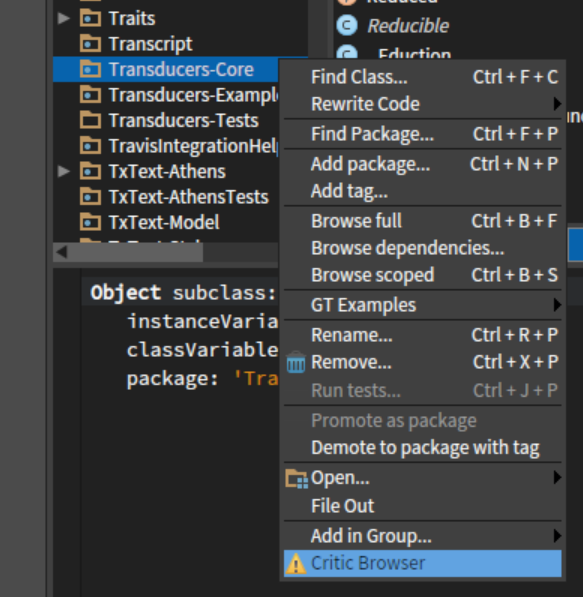
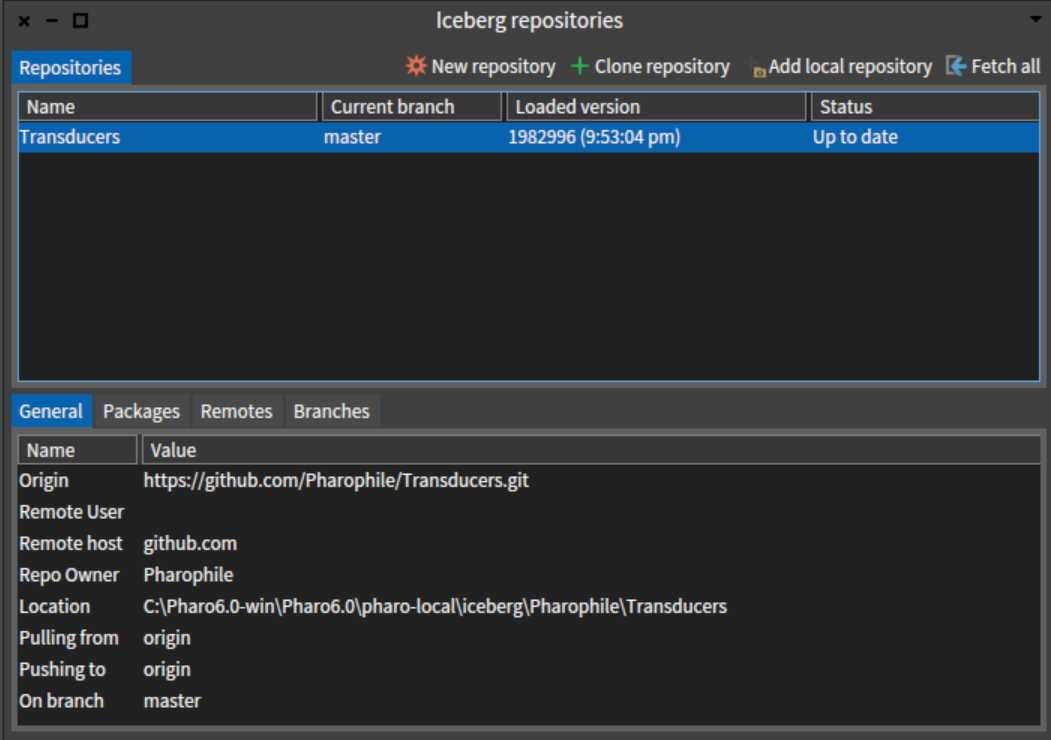

2017-06-07 22:04 GMT+02:00 phil@highoctane.be <phil@highoctane.be>:
I read your note about DoubleAgents for the tests, well, yeah this one we do not have. I read about it on the blog of its maker and it looked decent indeed.
I think Mocketry can easily replace DoubleAgents but API is different and most tests will needed rewrites
In fact, I moved from Mocketry to DoubleAgents quite some time ago... =) Am .06.2017, 23:04 Uhr, schrieb Denis Kudriashov <dionisiydk@gmail.com>:
2017-06-07 22:04 GMT+02:00 phil@highoctane.be <phil@highoctane.be>:
I read your note about DoubleAgents for the tests, well, yeah this one we do not have. I read about it on the blog of its maker and it looked decent indeed.
I think Mocketry can easily replace DoubleAgents but API is different and most tests will needed rewrites
2017-06-08 15:37 GMT+02:00 Steffen Märcker <merkste@web.de>:
In fact, I moved from Mocketry to DoubleAgents quite some time ago... =)
It was greatly updated from VW version. (look for details here http://dionisiydk.blogspot.fr/2016/04/new-version-of-mocketry-30.html)
Hi Phil, thanks a lot for your effort and valuable input. I am having a look at STIG for VW in the hope that I can set up a common repository for the VW and Pharo version. Though, the next days I won't work on the port, because I am quite busy at the moment.
Tell me how it goes for you.
I'll let you know soon.
I read your note about DoubleAgents for the tests, well, yeah this one we do not have. I read about it on the blog of its maker and it looked decent indeed.
I'll check whether a port is doable with reasonable effort and the author's blessing. =)
Then look at the warnings. A bunch of them are non issues but there are Undeclared things in need of a fix (e.g. IndexNotFoundError)
Luckily, most of them are straight forward to resolve. However, I'd really like to hear your opinion on the name clash with #reduce: in the base (see other thread). A solution could be to use double-dispatching (or similar) to distinguish between the two cases - reduce: aBlock, and - reduce: aReduction However, I have a slight preference to redefine #fold: and #reduce:, since now (as far as I can see), they are redundant. E.g., - fold: aBlock "reduce as defined right now" - reduce: aBlock init: "value "reduce starting with an initial value" - reduce: aReduction "reduce with block and value from a reduction" Kind regards, Steffen
Best, Phil
On Wed, Jun 7, 2017 at 11:29 AM, Steffen Märcker <merkste@web.de> wrote:
Hi Phil,
that's great. I do have a GitHub account (merkste) but none at SmalltalkHub. Is there a recommendable doc on how to use Git from Pharo?
Best, Steffen
Am .06.2017, 14:09 Uhr, schrieb phil@highoctane.be <phil@highoctane.be>:
Hi Steffen,
I am willing to help you create the package in SmalltalkHub or Github based on your files/changeset.
Do you have a github and/or SmalltalkHub account?
Best, Phil
On Tue, Jun 6, 2017 at 1:08 PM, Steffen Märcker <merkste@web.de> wrote:
Hi!
If the need arises, we could of course factor the compact notation out into
a separate package.
Good idea
[...] I do not want to help promoting a syntax that alienates me (and others because other people reported the saem to me).
I understand. Btw, I'd really, really appreciate if others post their thoughts and feedback here as well. Discussion helps moving things forward. =)
(collection transduce map: #squared) take: 1000.
To me this is much more readable.
Well, I'll provide that extension once it is finished.
I cannot and do not want to use the other forms.
collection transduce
map: #squared;
take: 1000.
But as the message chain has to modify the underlying object (an eduction), very snaky side effects my occur. E.g., consider
eduction := collection transduce. squared := eduction map: #squared. take := squared take: 1000.
Now, all three variables hold onto the same object, which first squares all elements and than takes the first 1000.
This is because the programmer did not understand what he did. No?
Sure. ;-) Nevertheless, it would be very hard to debug. All of which are the reasons I wouldn't implement that variant. ;-)
PS: I played with infinite stream and iteration back in 1993 in CLOS.
Now I do not like to mix things because it breaks my flow of thinking.
I am not sure whether I understand what your mean by mixing. Concerning transducers, the ability to handle infinite sources in only a (natural) side-effect of the ability to finish reductions before all elements are processed, e.g., like #detect: and such.
Best, Steffen
Hi Phil,
Tell me how it goes for you.
I played a bit with Iceberg in Pharo, managed to check out the repository, and load Transducers-Core. As a bit of a surprise, multiple packages show up in the SystemBrowser; one for each method category, e.g., Transducers-accessing and Transducers-class initialization. Is this expected? Maybe I am just missing something obvious here since I am not familiar with the tools. However, I think Iceberg will facilitate a nice way exchange code between VW an Pharo. I managed to export the packages using STIG from VW and the differences seem to be sufficiently small.
I've put a README. md with your notes, and under packages/ you'll find 3 packages:
Transducers-Core Transducers-Examples Transducers-Tests
Did you rename the main package from Transducers to Transducers-Core for a special reason? And is it a convention in Pharo to use the dash '-' instead of space to separate parts of a package name? Cheers! Steffen
On 14 June 2017 at 17:21, Steffen Märcker <merkste@web.de> wrote:
I played a bit with Iceberg in Pharo, managed to check out the repository, and load Transducers-Core. As a bit of a surprise, multiple packages show up in the SystemBrowser; one for each method category, e.g., Transducers-accessing and Transducers-class initialization. Is this expected? Maybe I am just missing something obvious here since I am not familiar with the tools.
Looks like a bug⦠not sure if I've seen this one being discussed recently or if it's a new one, though.
Did you rename the main package from Transducers to Transducers-Core for a special reason? And is it a convention in Pharo to use the dash '-' instead of space to separate parts of a package name?
Yes, that's the Pharo naming convention.
Hi, I found some name clash with the message #reduce: in Pharo. It is already declared in SequencableCollection. Additionally, Collection>>fold: just calls #reduce:, which makes the difference between folding and reducing a bit unclear. How should I handle this situation? I see the following options: - I could simply solve the situation at runtime depending on the argument (e.g., using double-dispatching). - I could check whether it might be possible to separate #fold: and #reduce: with the semantics: - reduce: starts with an initial value and the first collection item. - fold: uses no initial value and starts with the first two items. In the Transducers library, there are two variants of reduce: - #reduce:init: reduce using a block and an intial value - #reduce: reduce using a block that carries an intial value or an initializer block. Ciao, Steffen Am .05.2017, 14:23 Uhr, schrieb Steffen Märcker <merkste@web.de>:
Hi,
I am the developer of the library 'Transducers' for VisualWorks. It was formerly known as 'Reducers', but this name was a poor choice. I'd like to port it to Pharo, if there is any interest on your side. I hope to learn more about Pharo in this process, since I am mainly a VW guy. And most likely, I will come up with a bunch of questions. :-)
Meanwhile, I'll cross-post the introduction from VWnc below. I'd be very happy to hear your optinions, questions and I hope we can start a fruitful discussion - even if there is not Pharo port yet.
Best, Steffen
Transducers are building blocks that encapsulate how to process elements of a data sequence independently of the underlying input and output source.
# Overview
## Encapsulate Implementations of enumeration methods, such as #collect:, have the logic how to process a single element in common. However, that logic is reimplemented each and every time. Transducers make it explicit and facilitate re-use and coherent behavior. For example: - #collect: requires mapping: (aBlock1 map) - #select: requires filtering: (aBlock2 filter)
## Compose In practice, algorithms often require multiple processing steps, e.g., mapping only a filtered set of elements. Transducers are inherently composable, and hereby, allow to make the combination of steps explicit. Since transducers do not build intermediate collections, their composition is memory-efficient. For example: - (aBlock1 filter) * (aBlock2 map) "(1.) filter and (2.) map elements"
## Re-Use Transducers are decoupled from the input and output sources, and hence, they can be reused in different contexts. For example: - enumeration of collections - processing of streams - communicating via channels
# Usage by Example
We build a coin flipping experiment and count the occurrence of heads and tails.
First, we associate random numbers with the sides of a coin.
scale := [:x | (x * 2 + 1) floor] map. sides := #(heads tails) replace.
Scale is a transducer that maps numbers x between 0 and 1 to 1 and 2. Sides is a transducer that replaces the numbers with heads an tails by lookup in an array. Next, we choose a number of samples.
count := 1000 take.
Count is a transducer that takes 1000 elements from a source. We keep track of the occurrences of heads an tails using a bag.
collect := [:bag :c | bag add: c; yourself].
Collect is binary block (reducing function) that collects events in a bag. We assemble the experiment by transforming the block using the transducers.
experiment := (scale * sides * count) transform: collect.
From left to right we see the steps involved: scale, sides, count and collect. Transforming assembles these steps into a binary block (reducing function) we can use to run the experiment.
samples := Random new reduce: experiment init: Bag new.
Here, we use #reduce:init:, which is mostly similar to #inject:into:. To execute a transformation and a reduction together, we can use #transduce:reduce:init:.
samples := Random new transduce: scale * sides * count reduce: collect init: Bag new.
We can also express the experiment as data-flow using #<~. This enables us to build objects that can be re-used in other experiments.
coin := sides <~ scale <~ Random new. flip := Bag <~ count.
Coin is an eduction, i.e., it binds transducers to a source and understands #reduce:init: among others. Flip is a transformed reduction, i.e., it binds transducers to a reducing function and an initial value. By sending #<~, we draw further samples from flipping the coin.
samples := flip <~ coin.
This yields a new Bag with another 1000 samples.
# Basic Concepts
## Reducing Functions
A reducing function represents a single step in processing a data sequence. It takes an accumulated result and a value, and returns a new accumulated result. For example:
collect := [:col :e | col add: e; yourself]. sum := #+.
A reducing function can also be ternary, i.e., it takes an accumulated result, a key and a value. For example:
collect := [:dic :k :v | dict at: k put: v; yourself].
Reducing functions may be equipped with an optional completing action. After finishing processing, it is invoked exactly once, e.g., to free resources.
stream := [:str :e | str nextPut: each; yourself] completing: #close. absSum := #+ completing: #abs
A reducing function can end processing early by signaling Reduced with a result. This mechanism also enables the treatment of infinite sources.
nonNil := [:res :e | e ifNil: [Reduced signalWith: res] ifFalse: [res]].
The primary approach to process a data sequence is the reducing protocol with the messages #reduce:init: and #transduce:reduce:init: if transducers are involved. The behavior is similar to #inject:into: but in addition it takes care of: - handling binary and ternary reducing functions, - invoking the completing action after finishing, and - stopping the reduction if Reduced is signaled. The message #transduce:reduce:init: just combines the transformation and the reducing step.
However, as reducing functions are step-wise in nature, an application may choose other means to process its data.
## Reducibles
A data source is called reducible if it implements the reducing protocol. Default implementations are provided for collections and streams. Additionally, blocks without an argument are reducible, too. This allows to adapt to custom data sources without additional effort. For example:
"XStreams adaptor" xstream := filename reading. reducible := [[xstream get] on: Incomplete do: [Reduced signal]].
"natural numbers" n := 0. reducible := [n := n+1].
## Transducers
A transducer is an object that transforms a reducing function into another. Transducers encapsulate common steps in processing data sequences, such as map, filter, concatenate, and flatten. A transducer transforms a reducing function into another via #transform: in order to add those steps. They can be composed using #* which yields a new transducer that does both transformations. Most transducers require an argument, typically blocks, symbols or numbers:
square := Map function: #squared. take := Take number: 1000.
To facilitate compact notation, the argument types implement corresponding methods:
squareAndTake := #squared map * 1000 take.
Transducers requiring no argument are singletons and can be accessed by their class name.
flattenAndDedupe := Flatten * Dedupe.
# Advanced Concepts
## Data flows
Processing a sequence of data can often be regarded as a data flow. The operator #<~ allows define a flow from a data source through processing steps to a drain. For example:
squares := Set <~ 1000 take <~ #squared map <~ (1 to: 1000). fileOut writeStream <~ #isSeparator filter <~ fileIn readStream.
In both examples #<~ is only used to set up the data flow using reducing functions and transducers. In contrast to streams, transducers are completely independent from input and output sources. Hence, we have a clear separation of reading data, writing data and processing elements. - Sources know how to iterate over data with a reducing function, e.g., via #reduce:init:. - Drains know how to collect data using a reducing function. - Transducers know how to process single elements.
## Reductions
A reduction binds an initial value or a block yielding an initial value to a reducing function. The idea is to define a ready-to-use process that can be applied in different contexts. Reducibles handle reductions via #reduce: and #transduce:reduce: For example:
sum := #+ init: 0. sum1 := #(1 1 1) reduce: sum. sum2 := (1 to: 1000) transduce: #odd filter reduce: sum.
asSet := [:set :e | set add: e; yourself] initializer: [Set new]. set1 := #(1 1 1) reduce: asSet. set2 := #(1 to: 1000) transduce: #odd filter reduce: asSet.
By combining a transducer with a reduction, a process can be further modified.
sumOdds := sum <~ #odd filter setOdds := asSet <~ #odd filter
## Eductions
An eduction combines a reducible data sources with a transducer. The idea is to define a transformed (virtual) data source that needs not to be stored in memory.
odds1 := #odd filter <~ #(1 2 3) readStream. odds2 := #odd filter <~ (1 to 1000).
Depending on the underlying source, eductions can be processed once (streams, e.g., odds1) or multiple times (collections, e.g., odds2). Since no intermediate data is stored, transducers actions are lazy, i.e., they are invoked each time the eduction is processed.
# Origins
Transducers is based on the same-named Clojure library and its ideas. Please see: http://clojure.org/transducers
participants (10)
-
 Alexandre Bergel
 -
 Damien Pollet
 -
 Denis Kudriashov
 -
 Esteban A. Maringolo
 -
 Peter Uhnak
 -
 phil@highoctane.be
 -
 Steffen Märcker
 -
 Stephane Ducasse
 -
 Sven Van Caekenberghe
 -
 Yanni Chiu