
Hi, I'll like to know what is happening exactly in background when I'm using a symbol as in *Collection withAllSubclasses collect: #numberOfLinesOfCode*. I also want to know the other cases where I can use symbol. Is there any tutorial about using symbol? Thanks -- View this message in context: http://forum.world.st/Using-symbol-tp4916159.html Sent from the Pharo Smalltalk Users mailing list archive at Nabble.com.

Collection withAllSubclasses collect: #numberOfLinesOfCode is the equicalent to Collection withAllSubclasses collect: [:each | each numberOfLinesOfCode ] What happens below is that (unary) symbols are polymorphic with one parameters blocks, i.e. they understand cull: and value:, which is implemented as: value: anObject ^anObject perform: self. So in fact what will hapen is more like Collection withAllSubclasses collect: [:each | each perform: #numberOfLinesOfCode ] ... which is a bit slower than the traditional block version so you might want to think if that makes a difference in your case. You can use symbols whenever a unary block is expected, for example in most collection enumerating methods, such as do:, select:, reject:, allSatisfy:, detect:, ... (see 'enumerating' protocol in Collection class for more examples). All this methods send value: (or maybe cull:) to the received block argument, so you can pass an unary symbol instead (or even whatever object that understands value:). On Mon, Sep 19, 2016 at 12:12 PM, frankl1_miky <mike1corporation@gmail.com> wrote:
Hi,
I'll like to know what is happening exactly in background when I'm using a symbol as in *Collection withAllSubclasses collect: #numberOfLinesOfCode*.
I also want to know the other cases where I can use symbol.
Is there any tutorial about using symbol?
Thanks
-- View this message in context: http://forum.world.st/Using- symbol-tp4916159.html Sent from the Pharo Smalltalk Users mailing list archive at Nabble.com.

On Mon, Sep 19, 2016 at 6:12 PM, frankl1_miky <mike1corporation@gmail.com> wrote:
Hi,
I'll like to know what is happening exactly in background when I'm using a symbol as in *Collection withAllSubclasses collect: #numberOfLinesOfCode*.
Nicolas has a good answer. Now you could explore this yourself. First, as a reference inspect "Collection withAllSubclasses" on its own. Then try debugging into the expression (from the context menu in the Playground.) In particular in OrderedCollection>>collect: step-INTO "aBlock value: ....." For an even lower level (probably too low), try debugging into... OpalCompiler compile: 'Collection withAllSubclasses collect: #numberOfLinesOfCode' or more simply debug... OpalCompiler compile: '#numberOfLinesOfCode inspect'. Other things you could explore * Look at the class comment for class Symbol * Look at the tests of class SymbolTest * In the Browser with class Symbol selected, right-click and choose Analyze>Class refs. cheers -ben
I also want to know the other cases where I can use symbol.
Is there any tutorial about using symbol?
Thanks
-- View this message in context: http://forum.world.st/Using-symbol-tp4916159.html Sent from the Pharo Smalltalk Users mailing list archive at Nabble.com.

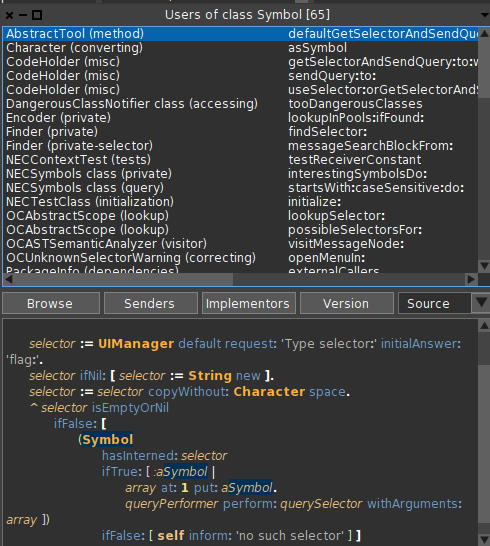
You can search for usages of Symbol. Lots of things to learn indeed. On Mon, Sep 19, 2016 at 12:12 PM, frankl1_miky <mike1corporation@gmail.com> wrote:
Hi,
I'll like to know what is happening exactly in background when I'm using a symbol as in *Collection withAllSubclasses collect: #numberOfLinesOfCode*.
I also want to know the other cases where I can use symbol.
Is there any tutorial about using symbol?
Thanks
-- View this message in context: http://forum.world.st/Using- symbol-tp4916159.html Sent from the Pharo Smalltalk Users mailing list archive at Nabble.com.
participants (4)
-
 Ben Coman
 -
 frankl1_miky
 -
 Nicolas Passerini
 -
 phil@highoctane.be