Books about Pharo

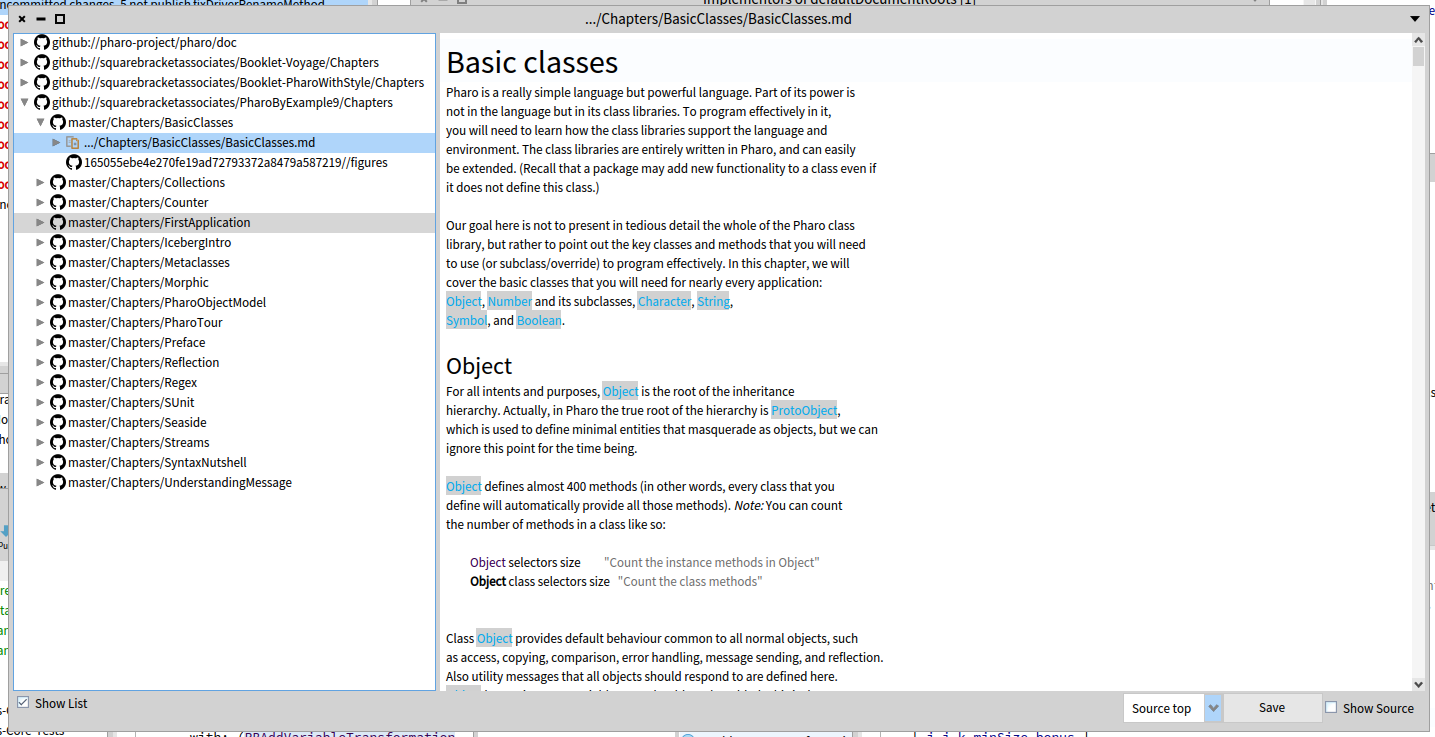
Hi Richard I did not see your original post because I messed up with my account. But thanks for your email :) Now the cool stuff if that we can also read the books from within Pharo. We should improve the Microdown renderer and suddenly we will get shiny cool documentation. S
This is a new thread because it's not limited to any specific topic.
If you have questions about Pharo, especially "how do I do <this> in Pharo", you can always ask in this mailing list. You can, if you like playing Russian Roulette, ask a Large Language Model "AI".
But there is an amazing resource you should really trye.
books.pharo.org
Did you ever wonder where the manual for Pharo was? That's where. The site lists a bunch of Pharo books and booklets, all of which have free PDFs except for two of the books. In particular, you'll always want the most recent edition of "Pharo by Example" handy.
These books are really useful. They are written by people know know their material thoroughly and do a good job of explaining it. If you want to make any serious use of Pharo, or even to have more happiness than headaches just playing with it, you owe it to yourself to get the free PDFs What do we owe the authors? Well, if you're not trying to make one pension support four people, you owe them the purchase of some of the books. Me, I'm giving them thanks, praise, and a heartfelt recommendation.
Seriously, these books represent a HUGE amount of work and "you are a fool to yourself and a burden to others" if you don't take advantage of this great resource.

Pretty cool! One of my ideas with Grafoscopio was to be able to read interactive documentation inside Pharo, which was obtained in a pretty primitive way. Now I have moved to Lepiter as a GUI of our documentation workflows and Markdeep as a default format for storage and web rendering. But seeing the advances in Microdown and its interactive viewer is pretty inspiring. I hope to check some Pharo books prepackaged with upcoming releases. Keep the good work, Offray On 14/03/24 9:40, stephane ducasse wrote:
Hi Richard
I did not see your original post because I messed up with my account. But thanks for your email :)
Now the cool stuff if that we can also read the books from within Pharo. We should improve the Microdown renderer and suddenly we will get shiny cool documentation.
S
This is a new thread because it's not limited to any specific topic.
If you have questions about Pharo, especially "how do I do <this> in Pharo", you can always ask in this mailing list. You can, if you like playing Russian Roulette, ask a Large Language Model "AI".
But there is an amazing resource you should really trye.
books.pharo.org
Did you ever wonder where the manual for Pharo was? That's where. The site lists a bunch of Pharo books and booklets, all of which have free PDFs except for two of the books. In particular, you'll always want the most recent edition of "Pharo by Example" handy.
These books are really useful. They are written by people know know their material thoroughly and do a good job of explaining it. If you want to make any serious use of Pharo, or even to have more happiness than headaches just playing with it, you owe it to yourself to get the free PDFs What do we owe the authors? Well, if you're not trying to make one pension support four people, you owe them the purchase of some of the books. Me, I'm giving them thanks, praise, and a heartfelt recommendation.
Seriously, these books represent a HUGE amount of work and "you are a fool to yourself and a burden to others" if you don't take advantage of this great resource.
I released yesterday the version 9.0.1 of pillar for Pharo 11. And I will restart a new iteration on Microdown. - better support for math - introducing > and more as time allows. S
On 27 Mar 2024, at 01:25, Offray Vladimir Luna Cárdenas <offray.luna@mutabit.com> wrote:
Pretty cool!
One of my ideas with Grafoscopio was to be able to read interactive documentation inside Pharo, which was obtained in a pretty primitive way. Now I have moved to Lepiter as a GUI of our documentation workflows and Markdeep as a default format for storage and web rendering. But seeing the advances in Microdown and its interactive viewer is pretty inspiring. I hope to check some Pharo books prepackaged with upcoming releases.
Keep the good work,
Offray
On 14/03/24 9:40, stephane ducasse wrote:
Hi Richard
I did not see your original post because I messed up with my account. But thanks for your email :)
Now the cool stuff if that we can also read the books from within Pharo. We should improve the Microdown renderer and suddenly we will get shiny cool documentation.
S
This is a new thread because it's not limited to any specific topic.
If you have questions about Pharo, especially "how do I do <this> in Pharo", you can always ask in this mailing list. You can, if you like playing Russian Roulette, ask a Large Language Model "AI".
But there is an amazing resource you should really trye.
books.pharo.org
Did you ever wonder where the manual for Pharo was? That's where. The site lists a bunch of Pharo books and booklets, all of which have free PDFs except for two of the books. In particular, you'll always want the most recent edition of "Pharo by Example" handy.
These books are really useful. They are written by people know know their material thoroughly and do a good job of explaining it. If you want to make any serious use of Pharo, or even to have more happiness than headaches just playing with it, you owe it to yourself to get the free PDFs What do we owe the authors? Well, if you're not trying to make one pension support four people, you owe them the purchase of some of the books. Me, I'm giving them thanks, praise, and a heartfelt recommendation.
Seriously, these books represent a HUGE amount of work and "you are a fool to yourself and a burden to others" if you don't take advantage of this great resource.
Stéphane Ducasse http://stephane.ducasse.free.fr 06 30 93 66 73 "If you knew today was your last day on earth, what would you do differently? ....ESPECIALLY if, by doing something different, today might not be your last day on earth.â Calvin & Hobbes
On the next iteration for Microdown you may find Djot [1] interesting, as it is also trying to be familiar to Markdown users, while fixing the several of its shortcomings and making parsers easier to build, by having a clearer non-ambiguous syntax, that doesn't require look ahead mechanisms. I think that Djot may share the Microdow design principles stated at [2] regarding [2a] familiarity to Markdown [2b] Small uniform core and [2c] extensibility. Umm... I wonder, given that one of the selling points of Djot is the easiness of implementing parsers, how difficult could be to implement a Djot parser and connect it to the Pillar infrastructure? Following the idea quoted at the beginning blog post at [3] trying to " to create a light markup syntax that keeps what is good about Markdown, while revising some of the features that have led to bloat and complexity" and finding the sweet spot between popular options and added value, without being tied by popularity or the past, is a worth exploration. It help us, as a community, to reach the people where they are. Even more considering how Markdown is a popular but clumsy standard de facto (<flame> kind of the Git/GitHub of the light Markup languages, promoted greatly by its GitHub usage </flame>). In my case, given the constrains in computer labs where installing Pandoc can be cumbersome, using Markdeep has been an important time saver, even if we need to fork[4] its main repository to document publicly its possibilities and shortcomings. A natively fully supported and well defined light format in Pharo, like Microdown or Djot, could help us a lot in our documentation workflows, given our limited resources[^a]. And, because of the shared design sensibilities behind both formats, I would like to have Microdown more inspired in Djot than in "wild Markdown". The efforts in having a "popular alike" format totally supported in the image are greatly appreciated. Cheers, Offray == Links and footnotes [1] https://djot.net/ [2] https://rmod-files.lille.inria.fr/Team/Texts/Papers/Duca20a-Microdown-IWST.p... [3] https://www.jonashietala.se/blog/2024/02/02/blogging_in_djot_instead_of_mark... [4] https://github.com/ruidajo/markdeep/ [^a]: I'm half of the population of the two active Smalltalkers/Pharoers in my country, working in the language part time. We need to cleverly combine resources with a low complexity/expressivity ratio, that's where our combination of tools like Pharo/GT, Fossil, Markdeep, Pandoc comes from. On 27/03/24 2:48, stephane ducasse wrote:
I released yesterday the version 9.0.1 of pillar for Pharo 11. And I will restart a new iteration on Microdown. - better support for math - introducing > and more as time allows.
S
On 27 Mar 2024, at 01:25, Offray Vladimir Luna Cárdenas <offray.luna@mutabit.com> wrote:
Pretty cool!
One of my ideas with Grafoscopio was to be able to read interactive documentation inside Pharo, which was obtained in a pretty primitive way. Now I have moved to Lepiter as a GUI of our documentation workflows and Markdeep as a default format for storage and web rendering. But seeing the advances in Microdown and its interactive viewer is pretty inspiring. I hope to check some Pharo books prepackaged with upcoming releases.
Keep the good work,
Offray
On 14/03/24 9:40, stephane ducasse wrote:
Hi Richard
I did not see your original post because I messed up with my account. But thanks for your email :)
Now the cool stuff if that we can also read the books from within Pharo. We should improve the Microdown renderer and suddenly we will get shiny cool documentation.
S
This is a new thread because it's not limited to any specific topic.
If you have questions about Pharo, especially "how do I do <this> in Pharo", you can always ask in this mailing list. Â You can, if you like playing Russian Roulette, ask a Large Language Model "AI".
But there is an amazing resource you should really trye.
books.pharo.org
Did you ever wonder where the manual for Pharo was? That's where. Â The site lists a bunch of Pharo books and booklets, all of which have free PDFs except for two of the books. In particular, you'll always want the most recent edition of "Pharo by Example" handy.
These books are really useful.  They are written by people know know their material thoroughly and do a good job of explaining it.  If you want to make any serious use of Pharo, or even to have more happiness than headaches just playing with it, you owe it to yourself to get the free PDFs  What do we owe the authors?  Well, if you're not trying to make one pension support four people, you owe them the purchase of some of the books.  Me, I'm giving them thanks, praise, and a heartfelt recommendation.
Seriously, these books represent a HUGE amount of work and "you are a fool to yourself and a burden to others" if you don't take advantage of this great resource.
Stéphane Ducasse http://stephane.ducasse.free.fr 06 30 93 66 73
"If you knew today was your last day on earth, what would you do differently? ....ESPECIALLY if, by doing something different, today might not be your last day on earth.â Calvin & Hobbes
Thanks for the pointer!!! For me Iâm lacking time to improve Microdown, so I will focus on the features I have on my todo - > support - $ $ and $$ - I got some ideas about a nice extension mechanism :) quite cool in fact Doing a parser is not that simple. In microdown dev I integrated the latest version of the paragraph parser made by Kasper and now I will check it for real. I briefly checked it and :) well microdown is much much simpler and also more powerful when it is related to environment arguments (quite cool to have reference to figs, math expressions, extensibility). Now I will review it carefully and pick what I find useful. I will start to improve the readme because microdown is quite sexy at the end and all the books Iâm producing are done with it. S
On 31 Mar 2024, at 20:22, Offray Vladimir Luna Cárdenas <offray.luna@mutabit.com> wrote:
On the next iteration for Microdown you may find Djot [1] interesting, as it is also trying to be familiar to Markdown users, while fixing the several of its shortcomings and making parsers easier to build, by having a clearer non-ambiguous syntax, that doesn't require look ahead mechanisms. I think that Djot may share the Microdow design principles stated at [2] regarding [2a] familiarity to Markdown [2b] Small uniform core and [2c] extensibility. Umm... I wonder, given that one of the selling points of Djot is the easiness of implementing parsers, how difficult could be to implement a Djot parser and connect it to the Pillar infrastructure?
Following the idea quoted at the beginning blog post at [3] trying to " to create a light markup syntax that keeps what is good about Markdown, while revising some of the features that have led to bloat and complexity" and finding the sweet spot between popular options and added value, without being tied by popularity or the past, is a worth exploration. It help us, as a community, to reach the people where they are. Even more considering how Markdown is a popular but clumsy standard de facto (<flame> kind of the Git/GitHub of the light Markup languages, promoted greatly by its GitHub usage </flame>).
In my case, given the constrains in computer labs where installing Pandoc can be cumbersome, using Markdeep has been an important time saver, even if we need to fork[4] its main repository to document publicly its possibilities and shortcomings. A natively fully supported and well defined light format in Pharo, like Microdown or Djot, could help us a lot in our documentation workflows, given our limited resources[^a]. And, because of the shared design sensibilities behind both formats, I would like to have Microdown more inspired in Djot than in "wild Markdown". The efforts in having a "popular alike" format totally supported in the image are greatly appreciated.
Cheers,
Offray
== Links and footnotes
[1] https://djot.net/ [2] https://rmod-files.lille.inria.fr/Team/Texts/Papers/Duca20a-Microdown-IWST.p... [3] https://www.jonashietala.se/blog/2024/02/02/blogging_in_djot_instead_of_mark... [4] https://github.com/ruidajo/markdeep/
[^a]: I'm half of the population of the two active Smalltalkers/Pharoers in my country, working in the language part time. We need to cleverly combine resources with a low complexity/expressivity ratio, that's where our combination of tools like Pharo/GT, Fossil, Markdeep, Pandoc comes from.
On 27/03/24 2:48, stephane ducasse wrote:
I released yesterday the version 9.0.1 of pillar for Pharo 11. And I will restart a new iteration on Microdown. - better support for math - introducing > and more as time allows.
S
On 27 Mar 2024, at 01:25, Offray Vladimir Luna Cárdenas <offray.luna@mutabit.com> <mailto:offray.luna@mutabit.com> wrote:
Pretty cool!
One of my ideas with Grafoscopio was to be able to read interactive documentation inside Pharo, which was obtained in a pretty primitive way. Now I have moved to Lepiter as a GUI of our documentation workflows and Markdeep as a default format for storage and web rendering. But seeing the advances in Microdown and its interactive viewer is pretty inspiring. I hope to check some Pharo books prepackaged with upcoming releases.
Keep the good work,
Offray
On 14/03/24 9:40, stephane ducasse wrote:
Hi Richard
I did not see your original post because I messed up with my account. But thanks for your email :)
Now the cool stuff if that we can also read the books from within Pharo. We should improve the Microdown renderer and suddenly we will get shiny cool documentation.
S
This is a new thread because it's not limited to any specific topic.
If you have questions about Pharo, especially "how do I do <this> in Pharo", you can always ask in this mailing list. You can, if you like playing Russian Roulette, ask a Large Language Model "AI".
But there is an amazing resource you should really trye.
books.pharo.org
Did you ever wonder where the manual for Pharo was? That's where. The site lists a bunch of Pharo books and booklets, all of which have free PDFs except for two of the books. In particular, you'll always want the most recent edition of "Pharo by Example" handy.
These books are really useful. They are written by people know know their material thoroughly and do a good job of explaining it. If you want to make any serious use of Pharo, or even to have more happiness than headaches just playing with it, you owe it to yourself to get the free PDFs What do we owe the authors? Well, if you're not trying to make one pension support four people, you owe them the purchase of some of the books. Me, I'm giving them thanks, praise, and a heartfelt recommendation.
Seriously, these books represent a HUGE amount of work and "you are a fool to yourself and a burden to others" if you don't take advantage of this great resource.
Stéphane Ducasse http://stephane.ducasse.free.fr <http://stephane.ducasse.free.fr/> 06 30 93 66 73
"If you knew today was your last day on earth, what would you do differently? ....ESPECIALLY if, by doing something different, today might not be your last day on earth.â Calvin & Hobbes
Stéphane Ducasse http://stephane.ducasse.free.fr 06 30 93 66 73 "If you knew today was your last day on earth, what would you do differently? ....ESPECIALLY if, by doing something different, today might not be your last day on earth.â Calvin & Hobbes
participants (2)
-
 Offray Vladimir Luna Cárdenas
 -
 stephane ducasse