
Dear all, after using Smalltalk for several years I developed a passion for the language (how not to?), and Pharo is just so great to develop with. So thank you guys for keeping this wonderful project running. Unfortunately, it is not easy to always point out why Smalltalk should be employed as "main development language" in a team or for a project. In the last discussion of this sort I was confronted with the question "where are we going to get new smalltalk developers if our startup grows or if you go?". Well, I had no good answer to that. What would have you answered? Cheers, Paulo

Hi Paulo, That is a really good question and I hope to do it justice. What if you chose Elixir, Ruby, Closure, Go or Pony or Smalltalk - where would you get developers? There is some validity to this question as it can be hard to get developers but in Smalltalkâs case there is a heritage that can help with that more so than say others that are too new to have a large community following and of course a reputation. Smalltalk has a reputation as a very productive environment and on average a better class (pardon the pun) of developers. There is something about Smalltalk developers that in my experience outshines developers from other backgrounds. Personally Iâd see Smalltalk as a draw card to join a company but Iâm biased. While it is important in a startup to attract good developers I would say that âgoodâ developers are more interested in the problem being solved than specifically the language being used. The goal w be to get something out and make revenue. You will most likely re-write at a future point that makes sense using what you have learned anyways. Of all the languages I have used over 30 years I find Smalltalk the easiest to pick up and run w so should you leave others should be able to continue in your absence. Besides depending on their position and background you w want them to own the solution and if changing language is part of that then so be it. That said, if they use Smalltalk for any reasonable amount of time and in anger Iâd be surprised if they like you didnât come to love it. In a nutshell - language choice is the least of your worries - James Sent from my Commodore 64
On 19 Oct 2017, at 6:04 pm, Paulo R. Dellani <dellani@pobox.com> wrote:
Dear all,
after using Smalltalk for several years I developed a passion for the language (how not to?), and Pharo is just so great to develop with. So thank you guys for keeping this wonderful project running.
Unfortunately, it is not easy to always point out why Smalltalk should be employed as "main development language" in a team or for a project. In the last discussion of this sort I was confronted with the question "where are we going to get new smalltalk developers if our startup grows or if you go?". Well, I had no good answer to that. What would have you answered?
Cheers,
Paulo

Hi Paulo, I think this is not the right question to ask. The problem is not "Where to find Smalltalk developers?", the problem is rather "How much effort does it take to help a good experienced OO developer to transition to Smalltalk?" OO developers have to steadily gain and learn new technologies and frameworks... So why not Smalltalk? Those developers that are not willing to learn a new language just because they consider the trade-offs of not finding a job in that field that easily, might not be the best choice for your team anyway... That is my experience... I know more developers missing the "Smalltalk experience" than those hating Smalltalk once they left a team... Sebastian On 2017-10-19 12:04 AM, Paulo R. Dellani wrote:
Dear all,
after using Smalltalk for several years I developed a passion for the language (how not to?), and Pharo is just so great to develop with. So thank you guys for keeping this wonderful project running.
Unfortunately, it is not easy to always point out why Smalltalk should be employed as "main development language" in a team or for a project. In the last discussion of this sort I was confronted with the question "where are we going to get new smalltalk developers if our startup grows or if you go?". Well, I had no good answer to that. What would have you answered?
Cheers,
Paulo

On 19-10-17 09:04, Paulo R. Dellani wrote:
Unfortunately, it is not easy to always point out why Smalltalk should be employed as "main development language" in a team or for a project. In the last discussion of this sort I was confronted with the question "where are we going to get new smalltalk developers if our startup grows or if you go?". Well, I had no good answer to that. What would have you answered?
Regularly I go to the Esug Conference and the Pharo Days, and this year I had to cancel plans to go to Smalltalks. Those are places where I talk to smalltalkers, new and experienced. Every year there are good developers there who are looking for work, as intern, as a contractor or as an employee. By being there regularly I know who to talk to for different kinds of jobs, and for recommendations. Once in a while I also visit RMoD and HPI, to talk with people teaching smalltalk. The Pharo consortium maintains a list of consultants doing smalltalk work. For a company dependent on Smalltalk, I'd develop a systematic approach to ensuring attractiveness to smalltalk developers. Participation in the Pharo Consortium and presenting at conferences about open source contributions would be part of that, as might be defining research topics or summer jobs for students. Stephan

One way to address this issue is to factor in your development grooming of young Smalltalk developers, which can act as pool of potential full developers for your project. If you can add some of your domain specific issues to their grooming, you could increase your project HR safety quite a lot. Davorin Rusevljan On Thu, Oct 19, 2017 at 9:04 AM, Paulo R. Dellani <dellani@pobox.com> wrote:
Dear all,
after using Smalltalk for several years I developed a passion for the language (how not to?), and Pharo is just so great to develop with. So thank you guys for keeping this wonderful project running.
Unfortunately, it is not easy to always point out why Smalltalk should be employed as "main development language" in a team or for a project. In the last discussion of this sort I was confronted with the question "where are we going to get new smalltalk developers if our startup grows or if you go?". Well, I had no good answer to that. What would have you answered?
Cheers,
Paulo

Hello Paulo, its a problem to get Smalltalkers - simple as it is. I had contacts with Smalltalkers who wanted to do Smalltalk-"only" jobs - thats impossible to guarantee in a smaller company and perhaps a mind I would not expect from Smalltalker. And the point about "Main Development Language" ... well, the other developers have also their "beloved" language and it would be a much better idea to put their "loved" together with your "loved" language. There are *very* good reason out there to write Windows FAT-Clients in .NET languages or even Mac/Linux/Windows Clients with Xamarin/Microsoft tools or even Java-world languages and HTML-Clients with some good JS-libraries. You have to have very good reasons (and this is NOT productivity) to argue against this and tell the other developers, that you develop superior solutions just because you are doing Smalltalk. This may be true for very specific libraries (and thats not only Roassal) - not available in other systems - but in the normal case, they will simply win (because of the huge amount software written in other languages). The only Smalltalk technology I found out to be worthwhile fighting for (because other are not able to offer a similar solution) today is an object oriented database (e.g. Gemstone/S). Perhaps the Smalltalk community should concentrate on the idea to make their technology open/accessable for other languages in an easy way. This is especially true for database vendors. Database vendors offering Java, C# and python object support and Smalltalk as an integrated script language - that could be a very good argument and a place where Smalltalk can survive. So, the answer is: don't depend on the language, look for developers working with more than one language and insert Smalltalk technology where you *really* get benefit. And the area where Smalltalk is so much better is getting smaller and smaller these days. Marten Am 19.10.2017 um 09:04 schrieb Paulo R. Dellani:
Dear all,
after using Smalltalk for several years I developed a passion for the language (how not to?), and Pharo is just so great to develop with. So thank you guys for keeping this wonderful project running.
Unfortunately, it is not easy to always point out why Smalltalk should be employed as "main development language" in a team or for a project. In the last discussion of this sort I was confronted with the question "where are we going to get new smalltalk developers if our startup grows or if you go?". Well, I had no good answer to that. What would have you answered?
Cheers,
Paulo
-- Marten Feldtmann

First of all: I'd say the question itself is not a question but an excuse. I am not arguing there are enough Smalltalkers or cheap ones. But I think the question is just a way of saying "we don't want to do it for reasons that we ourselves cannot really express". If you are a good developer, learning Smalltalk is easy. If you are a good developer you've heard the sentence "we've taken the goos parts from x,y,z and Smalltalk" at least twice a year. So you most likely would like to learn it anyways. A shortage of developers doesn't exist. What exists is an unwillingness of companies to get people trained in a technology. If Smalltalk was cool and great in their opinion, they wouldn't care. It's that simple. As a consultant, I've heard that argument so often. Not ferom Startups, but from insurance companies, Banks or Car manufacturers who spend millions on useless, endless meetings and stuff instead of just hiring somebody to teach a couple of developers Smalltalk. It's just a lie: the shortage of Smalltalk developers is not a problem. And, to be honest: what is it we actually are better in by using Smalltalk? Can we build cool looking web apps in extremely short time? No. Can we build mobile Apps with little effort? No. Does our Smalltalk ship lots of great libraries for all kinds of things that are not availabel in similar quality in any other language? Are we lying when we say we are so extremely over-productive as compared to other languages? I know, all that live debugging stuff and such is great and it is much faster to find & fix a bug in Smalltalk than in any other environment I've used so far. But that is really only true for business code. When I need to connect to things or want to build a modern GUI or a web application with a great look&feel, I am nowhere near productive, because I simply have to build my own stuff or learn how to use other external resources. If I want to build something for a mobile device, I will only hear that somebody somewhere has done it before. No docs, no proof, no ready-made tool for me. Shortage of developers is not really the problem. If Smalltalk was as cool as we like to make ourselves believe, this problem would be non-existent. If somebody took out their iPad and told an audience: "We did this in Smalltalk in 40% of the time it would have taken in Swift", and if that something was a must-have for people, things would be much easier. But nobody has. I am absolutely over-exaggerating, because I make my living with an SaaS product written in Smalltalk (not Pharo). I have lots of fun with Smalltalk and - as you - am convince that many parts of what we've done so far would've taken much longer or even be impossible in other languages. But the advantage was eaten by our extremely steep learning curve for web technologies and for building something that works almost as well as tools like Angular or jQuery Mobile. Smalltalk is cool, and the day somebody shows me something like Google's flutter in Smalltalk, I am ready to bet a lot on a bright future for Smalltalk. But until then, I'd say these arguments about productivity are just us trying to make ourselves believe we're still the top of the food chain. We've done that for almost thirty years now and still aren't ready to stop it. But we've been lying to ourselves and still do so. I don't think there is a point in discussing about the usefulness of a language using an argument like the number or ready-made developers. That is just an argument they know you can't win. The real question is and should be: what is the benefit of using Smalltalk. Our productivity argument is a lie as soon as we have to build something that uses or runs on technology that has been invented after 1990. Okay, shoot ;-) Joachim -- ----------------------------------------------------------------------- Objektfabrik Joachim Tuchel mailto:jtuchel@objektfabrik.de Fliederweg 1Â Â Â Â Â Â Â Â Â Â Â Â Â http://www.objektfabrik.de D-71640 Ludwigsburg http://joachimtuchel.wordpress.com Telefon: +49 7141 56 10 86 0Â Â Â Â Â Fax: +49 7141 56 10 86 1
I think you have nailed it, Joachim! The development environment is per se very productive and easy to use and learn but at the moment you need something that isn't present in your code library, things can get very hard. Well, that's not really new and not only a problem that concerns Smalltalk, but with the greater number of developers in other languages chances are that someone already wrote some code concerning your needs. Well I will go back to my coding here now ;-) Cheers, Paulo On 10/20/2017 09:23 AM, jtuchel@objektfabrik.de wrote:
First of all: I'd say the question itself is not a question but an excuse. I am not arguing there are enough Smalltalkers or cheap ones. But I think the question is just a way of saying "we don't want to do it for reasons that we ourselves cannot really express". If you are a good developer, learning Smalltalk is easy. If you are a good developer you've heard the sentence "we've taken the goos parts from x,y,z and Smalltalk" at least twice a year. So you most likely would like to learn it anyways.
A shortage of developers doesn't exist. What exists is an unwillingness of companies to get people trained in a technology. If Smalltalk was cool and great in their opinion, they wouldn't care. It's that simple. As a consultant, I've heard that argument so often. Not ferom Startups, but from insurance companies, Banks or Car manufacturers who spend millions on useless, endless meetings and stuff instead of just hiring somebody to teach a couple of developers Smalltalk. It's just a lie: the shortage of Smalltalk developers is not a problem.
And, to be honest: what is it we actually are better in by using Smalltalk? Can we build cool looking web apps in extremely short time? No. Can we build mobile Apps with little effort? No. Does our Smalltalk ship lots of great libraries for all kinds of things that are not availabel in similar quality in any other language? Are we lying when we say we are so extremely over-productive as compared to other languages?
I know, all that live debugging stuff and such is great and it is much faster to find & fix a bug in Smalltalk than in any other environment I've used so far. But that is really only true for business code. When I need to connect to things or want to build a modern GUI or a web application with a great look&feel, I am nowhere near productive, because I simply have to build my own stuff or learn how to use other external resources. If I want to build something for a mobile device, I will only hear that somebody somewhere has done it before. No docs, no proof, no ready-made tool for me.
Shortage of developers is not really the problem. If Smalltalk was as cool as we like to make ourselves believe, this problem would be non-existent. If somebody took out their iPad and told an audience: "We did this in Smalltalk in 40% of the time it would have taken in Swift", and if that something was a must-have for people, things would be much easier. But nobody has.
I am absolutely over-exaggerating, because I make my living with an SaaS product written in Smalltalk (not Pharo). I have lots of fun with Smalltalk and - as you - am convince that many parts of what we've done so far would've taken much longer or even be impossible in other languages. But the advantage was eaten by our extremely steep learning curve for web technologies and for building something that works almost as well as tools like Angular or jQuery Mobile.
Smalltalk is cool, and the day somebody shows me something like Google's flutter in Smalltalk, I am ready to bet a lot on a bright future for Smalltalk. But until then, I'd say these arguments about productivity are just us trying to make ourselves believe we're still the top of the food chain. We've done that for almost thirty years now and still aren't ready to stop it. But we've been lying to ourselves and still do so.
I don't think there is a point in discussing about the usefulness of a language using an argument like the number or ready-made developers. That is just an argument they know you can't win. The real question is and should be: what is the benefit of using Smalltalk. Our productivity argument is a lie as soon as we have to build something that uses or runs on technology that has been invented after 1990.
Okay, shoot ;-)
Joachim
On 20-10-17 09:23, jtuchel@objektfabrik.de wrote:
And, to be honest: what is it we actually are better in by using Smalltalk?
Making software that stays maintainable. It might be survivor bias, but smalltalk systems continue to be maintained by far smaller groups of developers than competing technologies. Stephan

Thank you Joachim! That is the most honest assessment of the situation of Smalltalk in 2017 that I have ever seen. And I agree with you 100%. We need a new Smalltalk which is both "cool" and can seamlessly integrate with all of the latest web technologies. I will be releasing a new Smalltalk framework very shortly called "Smalltalk Express". The interpreter is written in the "Go" language and can run on all of the major web platforms such as Google, Heroku, etc. I use Pharo to manage the Smalltalk code. Here is a new blog that I have started to discuss the project. https://smalltalkexpress.quora.com/ Also, I have reserved the web address "smalltalk.express" for use once the code goes live. There is a video in the blog post so you can get an idea of where things stand right now. -- Peter On Fri, Oct 20, 2017 at 3:23 AM, jtuchel@objektfabrik.de < jtuchel@objektfabrik.de> wrote:
First of all: I'd say the question itself is not a question but an excuse. I am not arguing there are enough Smalltalkers or cheap ones. But I think the question is just a way of saying "we don't want to do it for reasons that we ourselves cannot really express". If you are a good developer, learning Smalltalk is easy. If you are a good developer you've heard the sentence "we've taken the goos parts from x,y,z and Smalltalk" at least twice a year. So you most likely would like to learn it anyways.
A shortage of developers doesn't exist. What exists is an unwillingness of companies to get people trained in a technology. If Smalltalk was cool and great in their opinion, they wouldn't care. It's that simple. As a consultant, I've heard that argument so often. Not ferom Startups, but from insurance companies, Banks or Car manufacturers who spend millions on useless, endless meetings and stuff instead of just hiring somebody to teach a couple of developers Smalltalk. It's just a lie: the shortage of Smalltalk developers is not a problem.
And, to be honest: what is it we actually are better in by using Smalltalk? Can we build cool looking web apps in extremely short time? No. Can we build mobile Apps with little effort? No. Does our Smalltalk ship lots of great libraries for all kinds of things that are not availabel in similar quality in any other language? Are we lying when we say we are so extremely over-productive as compared to other languages?
I know, all that live debugging stuff and such is great and it is much faster to find & fix a bug in Smalltalk than in any other environment I've used so far. But that is really only true for business code. When I need to connect to things or want to build a modern GUI or a web application with a great look&feel, I am nowhere near productive, because I simply have to build my own stuff or learn how to use other external resources. If I want to build something for a mobile device, I will only hear that somebody somewhere has done it before. No docs, no proof, no ready-made tool for me.
Shortage of developers is not really the problem. If Smalltalk was as cool as we like to make ourselves believe, this problem would be non-existent. If somebody took out their iPad and told an audience: "We did this in Smalltalk in 40% of the time it would have taken in Swift", and if that something was a must-have for people, things would be much easier. But nobody has.
I am absolutely over-exaggerating, because I make my living with an SaaS product written in Smalltalk (not Pharo). I have lots of fun with Smalltalk and - as you - am convince that many parts of what we've done so far would've taken much longer or even be impossible in other languages. But the advantage was eaten by our extremely steep learning curve for web technologies and for building something that works almost as well as tools like Angular or jQuery Mobile.
Smalltalk is cool, and the day somebody shows me something like Google's flutter in Smalltalk, I am ready to bet a lot on a bright future for Smalltalk. But until then, I'd say these arguments about productivity are just us trying to make ourselves believe we're still the top of the food chain. We've done that for almost thirty years now and still aren't ready to stop it. But we've been lying to ourselves and still do so.
I don't think there is a point in discussing about the usefulness of a language using an argument like the number or ready-made developers. That is just an argument they know you can't win. The real question is and should be: what is the benefit of using Smalltalk. Our productivity argument is a lie as soon as we have to build something that uses or runs on technology that has been invented after 1990.
Okay, shoot ;-)
Joachim
-- ----------------------------------------------------------------------- Objektfabrik Joachim Tuchel mailto:jtuchel@objektfabrik.de Fliederweg 1 http://www.objektfabrik.de D-71640 Ludwigsburg http://joachimtuchel.wordpress.com Telefon: +49 7141 56 10 86 0 Fax: +49 7141 56 10 86 1
Peter, our mail provider decided to move all of the pharo mailing list messages to the spam folder, so I haven't seen many messages in the last days. I was already starting to wonder why nobody ever answered my posts ;-) Your smalltalk express idea sounds interesting. I look forward to trying it. Joachim Am 20.10.17 um 16:21 schrieb Peter Fisk:
Thank you Joachim!
That is the most honest assessment of the situation of Smalltalk in 2017 that I have ever seen.
And I agree with you 100%.
We need a new Smalltalk which is both "cool" and can seamlessly integrate with all of the latest web technologies.
I will be releasing a new Smalltalk framework very shortly called "Smalltalk Express".
The interpreter is written in the "Go" language and can run on all of the major web platforms such as Google, Heroku, etc.
I use Pharo to manage the Smalltalk code.
Here is a new blog that I have started to discuss the project.
https://smalltalkexpress.quora.com/
Also, I have reserved the web address "smalltalk.express" for use once the code goes live.
There is a video in the blog post so you can get an idea of where things stand right now.
-- Peter
On Fri, Oct 20, 2017 at 3:23 AM, jtuchel@objektfabrik.de <mailto:jtuchel@objektfabrik.de> <jtuchel@objektfabrik.de <mailto:jtuchel@objektfabrik.de>> wrote:
First of all: I'd say the question itself is not a question but an excuse. I am not arguing there are enough Smalltalkers or cheap ones. But I think the question is just a way of saying "we don't want to do it for reasons that we ourselves cannot really express". If you are a good developer, learning Smalltalk is easy. If you are a good developer you've heard the sentence "we've taken the goos parts from x,y,z and Smalltalk" at least twice a year. So you most likely would like to learn it anyways.
A shortage of developers doesn't exist. What exists is an unwillingness of companies to get people trained in a technology. If Smalltalk was cool and great in their opinion, they wouldn't care. It's that simple. As a consultant, I've heard that argument so often. Not ferom Startups, but from insurance companies, Banks or Car manufacturers who spend millions on useless, endless meetings and stuff instead of just hiring somebody to teach a couple of developers Smalltalk. It's just a lie: the shortage of Smalltalk developers is not a problem.
And, to be honest: what is it we actually are better in by using Smalltalk? Can we build cool looking web apps in extremely short time? No. Can we build mobile Apps with little effort? No. Does our Smalltalk ship lots of great libraries for all kinds of things that are not availabel in similar quality in any other language? Are we lying when we say we are so extremely over-productive as compared to other languages?
I know, all that live debugging stuff and such is great and it is much faster to find & fix a bug in Smalltalk than in any other environment I've used so far. But that is really only true for business code. When I need to connect to things or want to build a modern GUI or a web application with a great look&feel, I am nowhere near productive, because I simply have to build my own stuff or learn how to use other external resources. If I want to build something for a mobile device, I will only hear that somebody somewhere has done it before. No docs, no proof, no ready-made tool for me.
Shortage of developers is not really the problem. If Smalltalk was as cool as we like to make ourselves believe, this problem would be non-existent. If somebody took out their iPad and told an audience: "We did this in Smalltalk in 40% of the time it would have taken in Swift", and if that something was a must-have for people, things would be much easier. But nobody has.
I am absolutely over-exaggerating, because I make my living with an SaaS product written in Smalltalk (not Pharo). I have lots of fun with Smalltalk and - as you - am convince that many parts of what we've done so far would've taken much longer or even be impossible in other languages. But the advantage was eaten by our extremely steep learning curve for web technologies and for building something that works almost as well as tools like Angular or jQuery Mobile.
Smalltalk is cool, and the day somebody shows me something like Google's flutter in Smalltalk, I am ready to bet a lot on a bright future for Smalltalk. But until then, I'd say these arguments about productivity are just us trying to make ourselves believe we're still the top of the food chain. We've done that for almost thirty years now and still aren't ready to stop it. But we've been lying to ourselves and still do so.
I don't think there is a point in discussing about the usefulness of a language using an argument like the number or ready-made developers. That is just an argument they know you can't win. The real question is and should be: what is the benefit of using Smalltalk. Our productivity argument is a lie as soon as we have to build something that uses or runs on technology that has been invented after 1990.
Okay, shoot ;-)
Joachim
-- ----------------------------------------------------------------------- Objektfabrik Joachim Tuchel     mailto:jtuchel@objektfabrik.de <mailto:jtuchel@objektfabrik.de> Fliederweg 1 http://www.objektfabrik.de D-71640 Ludwigsburg http://joachimtuchel.wordpress.com <http://joachimtuchel.wordpress.com> Telefon: +49 7141 56 10 86 0 <tel:%2B49%207141%2056%2010%2086%200>   Fax: +49 7141 56 10 86 1 <tel:%2B49%207141%2056%2010%2086%201>
-- ----------------------------------------------------------------------- Objektfabrik Joachim Tuchel mailto:jtuchel@objektfabrik.de Fliederweg 1Â Â Â Â Â Â Â Â Â Â Â Â Â http://www.objektfabrik.de D-71640 Ludwigsburg http://joachimtuchel.wordpress.com Telefon: +49 7141 56 10 86 0Â Â Â Â Â Fax: +49 7141 56 10 86 1
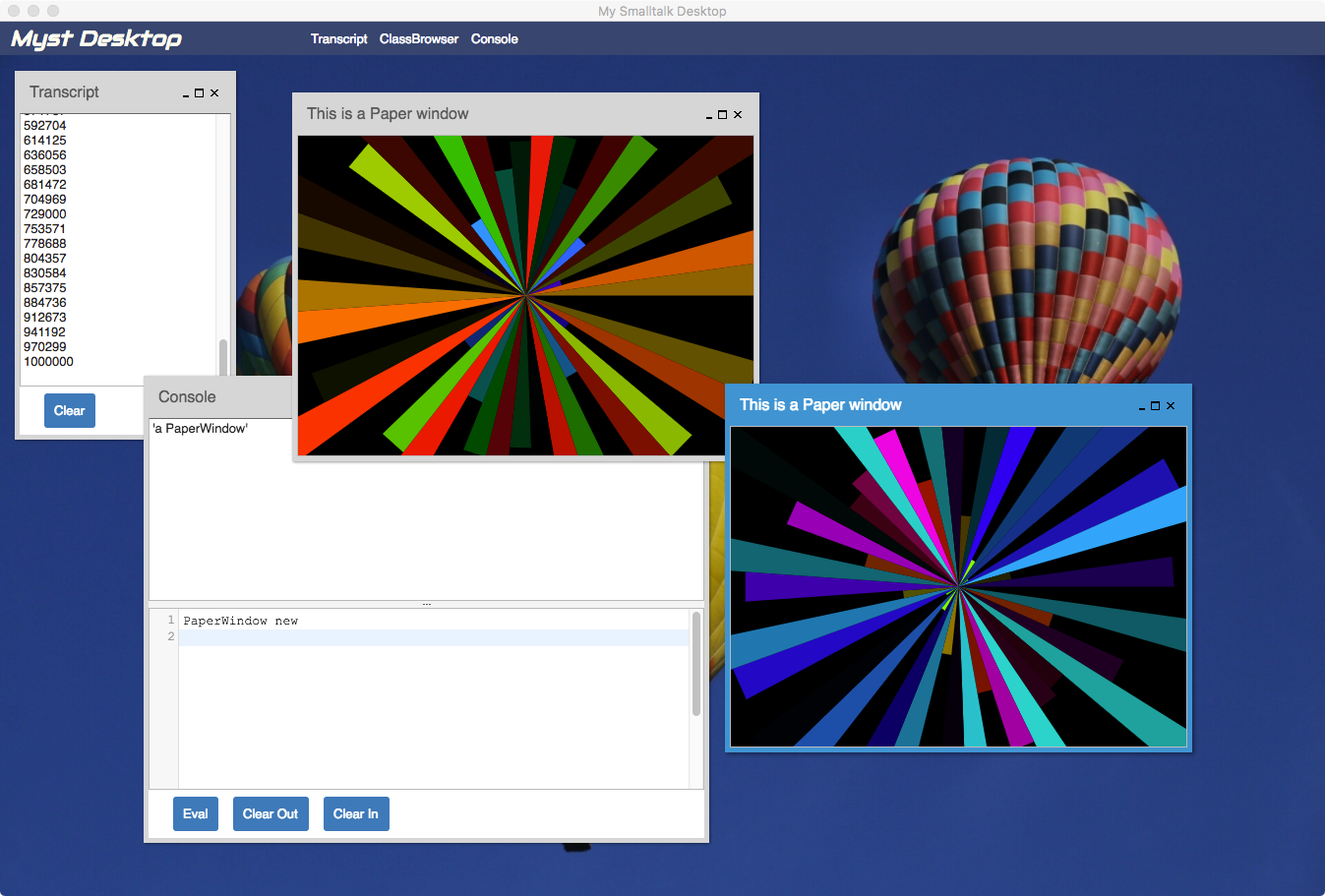
https://youtu.be/S4E4tW0deIg Hello Joachim, This is my first post since 2017-10-20, so that may explain some of the missing replies ;). âSmalltalk Express is syntax compatible with Pharo although much of the class structure is very different because of the foundation technologies. I will add a blog post soon to explain the differences. Above is an image and a short video showing a test of the desktop version with some animations. In the next few days, I hope to have another demo ready of Smalltalk running inside a Facebook page. Once that is working, I can use the Google server to connect client game apps using sockets. We all know that Smalltalk is a great language. If we can make it available where people spend their time (Facebook, Google), I am sure that it will become popular again. Maybe we can even connect Smalltalk applications through Twitter :) Here is my latest blog post. https://smalltalkexpress.quora.com/Graphic-Animation-for-Games-and-Education -- Peter On Mon, Nov 6, 2017 at 2:11 AM, jtuchel@objektfabrik.de < jtuchel@objektfabrik.de> wrote:
Peter,
our mail provider decided to move all of the pharo mailing list messages to the spam folder, so I haven't seen many messages in the last days. I was already starting to wonder why nobody ever answered my posts ;-)
Your smalltalk express idea sounds interesting. I look forward to trying it.
Joachim
Am 20.10.17 um 16:21 schrieb Peter Fisk:
Thank you Joachim!
That is the most honest assessment of the situation of Smalltalk in 2017 that I have ever seen.
And I agree with you 100%.
We need a new Smalltalk which is both "cool" and can seamlessly integrate with all of the latest web technologies.
I will be releasing a new Smalltalk framework very shortly called "Smalltalk Express".
The interpreter is written in the "Go" language and can run on all of the major web platforms such as Google, Heroku, etc.
I use Pharo to manage the Smalltalk code.
Here is a new blog that I have started to discuss the project.
https://smalltalkexpress.quora.com/
Also, I have reserved the web address "smalltalk.express" for use once the code goes live.
There is a video in the blog post so you can get an idea of where things stand right now.
-- Peter
On Fri, Oct 20, 2017 at 3:23 AM, jtuchel@objektfabrik.de < jtuchel@objektfabrik.de> wrote:
First of all: I'd say the question itself is not a question but an excuse. I am not arguing there are enough Smalltalkers or cheap ones. But I think the question is just a way of saying "we don't want to do it for reasons that we ourselves cannot really express". If you are a good developer, learning Smalltalk is easy. If you are a good developer you've heard the sentence "we've taken the goos parts from x,y,z and Smalltalk" at least twice a year. So you most likely would like to learn it anyways.
A shortage of developers doesn't exist. What exists is an unwillingness of companies to get people trained in a technology. If Smalltalk was cool and great in their opinion, they wouldn't care. It's that simple. As a consultant, I've heard that argument so often. Not ferom Startups, but from insurance companies, Banks or Car manufacturers who spend millions on useless, endless meetings and stuff instead of just hiring somebody to teach a couple of developers Smalltalk. It's just a lie: the shortage of Smalltalk developers is not a problem.
And, to be honest: what is it we actually are better in by using Smalltalk? Can we build cool looking web apps in extremely short time? No. Can we build mobile Apps with little effort? No. Does our Smalltalk ship lots of great libraries for all kinds of things that are not availabel in similar quality in any other language? Are we lying when we say we are so extremely over-productive as compared to other languages?
I know, all that live debugging stuff and such is great and it is much faster to find & fix a bug in Smalltalk than in any other environment I've used so far. But that is really only true for business code. When I need to connect to things or want to build a modern GUI or a web application with a great look&feel, I am nowhere near productive, because I simply have to build my own stuff or learn how to use other external resources. If I want to build something for a mobile device, I will only hear that somebody somewhere has done it before. No docs, no proof, no ready-made tool for me.
Shortage of developers is not really the problem. If Smalltalk was as cool as we like to make ourselves believe, this problem would be non-existent. If somebody took out their iPad and told an audience: "We did this in Smalltalk in 40% of the time it would have taken in Swift", and if that something was a must-have for people, things would be much easier. But nobody has.
I am absolutely over-exaggerating, because I make my living with an SaaS product written in Smalltalk (not Pharo). I have lots of fun with Smalltalk and - as you - am convince that many parts of what we've done so far would've taken much longer or even be impossible in other languages. But the advantage was eaten by our extremely steep learning curve for web technologies and for building something that works almost as well as tools like Angular or jQuery Mobile.
Smalltalk is cool, and the day somebody shows me something like Google's flutter in Smalltalk, I am ready to bet a lot on a bright future for Smalltalk. But until then, I'd say these arguments about productivity are just us trying to make ourselves believe we're still the top of the food chain. We've done that for almost thirty years now and still aren't ready to stop it. But we've been lying to ourselves and still do so.
I don't think there is a point in discussing about the usefulness of a language using an argument like the number or ready-made developers. That is just an argument they know you can't win. The real question is and should be: what is the benefit of using Smalltalk. Our productivity argument is a lie as soon as we have to build something that uses or runs on technology that has been invented after 1990.
Okay, shoot ;-)
Joachim
-- ----------------------------------------------------------------------- Objektfabrik Joachim Tuchel mailto:jtuchel@objektfabrik.de Fliederweg 1 http://www.objektfabrik.de D-71640 Ludwigsburg http://joachimtuchel.wordpress.com Telefon: +49 7141 56 10 86 0 Fax: +49 7141 56 10 86 1
-- ----------------------------------------------------------------------- Objektfabrik Joachim Tuchel mailto:jtuchel@objektfabrik.de <jtuchel@objektfabrik.de> Fliederweg 1 http://www.objektfabrik.de D-71640 Ludwigsburg http://joachimtuchel.wordpress.com Telefon: +49 7141 56 10 86 0 Fax: +49 7141 56 10 86 1

PharoJS is working to give you that mobile app/browser app experience. As with others, we're not there yet, but getting there. See http://pharojs.org The 67% loved means that 67% of people using Smalltalk (or perhaps have ever used it) want to continue - so it's presumably a high percentage of a smallish number of people. On 20 October 2017 at 03:23, jtuchel@objektfabrik.de < jtuchel@objektfabrik.de> wrote:
First of all: I'd say the question itself is not a question but an excuse. I am not arguing there are enough Smalltalkers or cheap ones. But I think the question is just a way of saying "we don't want to do it for reasons that we ourselves cannot really express". If you are a good developer, learning Smalltalk is easy. If you are a good developer you've heard the sentence "we've taken the goos parts from x,y,z and Smalltalk" at least twice a year. So you most likely would like to learn it anyways.
A shortage of developers doesn't exist. What exists is an unwillingness of companies to get people trained in a technology. If Smalltalk was cool and great in their opinion, they wouldn't care. It's that simple. As a consultant, I've heard that argument so often. Not ferom Startups, but from insurance companies, Banks or Car manufacturers who spend millions on useless, endless meetings and stuff instead of just hiring somebody to teach a couple of developers Smalltalk. It's just a lie: the shortage of Smalltalk developers is not a problem.
And, to be honest: what is it we actually are better in by using Smalltalk? Can we build cool looking web apps in extremely short time? No. Can we build mobile Apps with little effort? No. Does our Smalltalk ship lots of great libraries for all kinds of things that are not availabel in similar quality in any other language? Are we lying when we say we are so extremely over-productive as compared to other languages?
I know, all that live debugging stuff and such is great and it is much faster to find & fix a bug in Smalltalk than in any other environment I've used so far. But that is really only true for business code. When I need to connect to things or want to build a modern GUI or a web application with a great look&feel, I am nowhere near productive, because I simply have to build my own stuff or learn how to use other external resources. If I want to build something for a mobile device, I will only hear that somebody somewhere has done it before. No docs, no proof, no ready-made tool for me.
Shortage of developers is not really the problem. If Smalltalk was as cool as we like to make ourselves believe, this problem would be non-existent. If somebody took out their iPad and told an audience: "We did this in Smalltalk in 40% of the time it would have taken in Swift", and if that something was a must-have for people, things would be much easier. But nobody has.
I am absolutely over-exaggerating, because I make my living with an SaaS product written in Smalltalk (not Pharo). I have lots of fun with Smalltalk and - as you - am convince that many parts of what we've done so far would've taken much longer or even be impossible in other languages. But the advantage was eaten by our extremely steep learning curve for web technologies and for building something that works almost as well as tools like Angular or jQuery Mobile.
Smalltalk is cool, and the day somebody shows me something like Google's flutter in Smalltalk, I am ready to bet a lot on a bright future for Smalltalk. But until then, I'd say these arguments about productivity are just us trying to make ourselves believe we're still the top of the food chain. We've done that for almost thirty years now and still aren't ready to stop it. But we've been lying to ourselves and still do so.
I don't think there is a point in discussing about the usefulness of a language using an argument like the number or ready-made developers. That is just an argument they know you can't win. The real question is and should be: what is the benefit of using Smalltalk. Our productivity argument is a lie as soon as we have to build something that uses or runs on technology that has been invented after 1990.
Okay, shoot ;-)
Joachim
-- ----------------------------------------------------------------------- Objektfabrik Joachim Tuchel mailto:jtuchel@objektfabrik.de Fliederweg 1 http://www.objektfabrik.de D-71640 Ludwigsburg http://joachimtuchel.wordpress.com Telefon: +49 7141 56 10 86 0 Fax: +49 7141 56 10 86 1

Thereâs other questions that are relevant to me: Do I give a f*** about cool looking web apps? No, I donât use web apps if in any way I can avoid it. Do I give a f*** about mobile apps? No, the screenâs too small to read anything longer than a twit, or anyone with anything worthwhile to say. Do I give a f*** about the number of libraries in other languages? No, because most of them are crap in every language Iâve had to work in, and the base languages are crap so they have to keep changing radically, and libraries and frameworks therefore also have to and never get any better. The few that are worthwhile I can almost always use from Smalltalk without a problem (read, Blender, ACT-R and Synapse, since every other library/framework Iâve used outside Smalltalk has been a waste of time). Do I give a f*** about implementing a complex piece of machine learning software in 22 hours, compared to 3 months for the Java version? Well, actually yes, I do, because that was 3 months of my life down the toilet for something that is too slow to be useful in Java. Any argument depends on your priorities. Iâve written tons of web apps, because I needed to get paid. Iâve written better shitty mobile apps than the average shitty mobile apps. However, Iâm not going to do any of that any longer in crap that never improves, because after 26 years the irritability it produces is more than itâs worth. A few weeks ago, a recruiter that specializes in Smalltalk called me about a job, although they were well aware I live 1500 miles away from the city I lived in when I had worked through them, to see if Iâd be willing to move back there for a job. That sounds like another âthere arenât enough Smalltalk developersâ, but it wasnât, because the job wasnât writing Smalltalk. It was writing Java. The person hiring, though, wouldnât look at anyone who didnât write Smalltalk, because âpeople who grew up with Java donât know how to write codeâ. I donât agree with that, Iâve known a (very few) good Java developers. I would say, though, that Iâve known far more incompetent ones than good ones, and I canât think of any incompetent Smalltalk developers off the top of my head. Nor have I ever heard a developer in Smalltalk, or Haskell, or LISP, or even C, complain about how hard maintaining state is or coming up with various hacks to avoid it, which seems to be the main point of every JavaScript based âtechnologyâ. An application is by definition a state-machine, which implies plenty about JS developers on the whole. If youâre a good developer you can write good code in (nearly) anything.  My question then is why would you want to write in crap?  The better question is why arenât there more good developers in any language? Every project I have been able to do in Smalltalk, though, has had one thing in common, the âshit has to workâ. Companies do use it, in fact I could name 4 large enterprises Iâve worked for whoâve written their own dialects, and they all use it only when âshit has to workâ. They know itâs more productive, they also know using it for more things would increase the availability of Smalltalk developers. Why do they not do it? One reason, though it takes a while to recognize it, because management doesnât admit even to themselves why they do it, or not very often. Being inefficient, as long as it doesnât âreallyâ matter, is an advantage to large enterprises because they have resources smaller competitors donât. Why donât their competitors do it? Because they canât see past an hourly rate, whatâs fashionable, or just new, or because their customers canât.  Put more generally, average stupidity that isnât corrected by the market. Fashion affects smaller companies more than larger ones, because they canât afford a few customers walking away because they wanted an app in Electron, even if they canât give any relevant reason for wanting it, and even the samples on the Electron site donât work. Enterprises can, and do use Smalltalk when it matters. When it doesnât, itâs to their advantage to promote things that are inefficient, buggy and unreliable. Cost is relevant, but not in the simple way people look at things. A crucial but rarely mentioned perspective on its relevance is that while Java based software runs TV set top boxes, Smalltalk based software runs things like medical equipment, automated defense systems, tanks, etc. Cost becomes largely irrelevant when âshit has to workâ. Productivity is primarily relevant to less talented developers, in an inversely sense, since unproductive environments and attitudes have a leveling tendency in general, and more specifically make accomplishing what the less talented are capable of in any environment sufficiently laborious for them to have a role. Capability in Smalltalk, as implied by the person hiring for the Java role I mentioned, is a fairly decent means of judging whether someone is a so-so developer or a good one. The productivity argument is realistically only relevant in the context of an already higher hourly cost. Given that it is relevant at that point, companies that know Smalltalk is more productive would use it outside things that have to be 100%, if their own productivity were relevant to the same degree that competitorsâ productivity is inversely relevant. All these ways of looking at it are contingent perspectives though. Yes, if the number of libraries is relevant to you, Smalltalk is less attractive, but thatâs only a contingent phenomenon based on the relative popularity of Java and JavaScript, as a result it canât be used as explanatory for that popularity. All the ways of looking at it that are fully determinate are determinate via contingencies of that kind, which for the most part are precisely the other perspectives, including productivity, cost, availability of developers, etc. None of them is in itself anything but a result of the others. If availability of developers is contingent on popularity (and further, popularity contingent on industry attitudes), to use an example already mentioned in Joachimâs post, then his simultaneous posit of library availability is if anything more contingent on the same popularity, so positing it as a cause and not a result, or merely a correlate, of popularity is incoherent. We can go one step further, and demonstrate that even when large enterprises make something that works reliably available, they fail to promote and support it, which destroys the market for reliable tooling by simultaneously owning it while not promoting it, something IBM is particularly good at. But IBM canât (and if they canât, neither can any other company) operate that way without the tacit agreement of the industry. To understand it in a more general way, software development has to be looked at in the context where it occurs, and how itâs determined to a large degree by that context, with a specific difference. That difference is itself implicit in the context, i.e. capitalism, but only purely effective in software development. Itâs a result of virtualization as an implicit goal of capitalism, and the disruptions implicit in the virtual but so far only realized completely in software. In terms of that understanding, the analysis of virtualization and disruption as inherent to capitalism is better accomplished in Kapital than in any more recent work. Or you can simply decide, as Iâve done recently, that working in ways and with tools that prevent doing good work in a reasonable timeframe isnât worthwhile to you, no matter how popular those ways and tools might be, or what the posited reasons are, since at the end popularity is only insofar as it already is. What those tools and methods are depends to a degree on your priorities, but if developers are engineers those priorities canât be completely arbitrary. Engineers are defined by their ability to make things work. Software as virtual is inherently disruptive, and the software industry disrupts itself too often and too easily to build on anything. A further disruption caused by developers, as engineers, refusing to work with crap that doesnât, i.e. insisting on being engineers, while in itself merely an aggravation of the disruptive tendencies, might have an inverse result. Using a stable core of technologies as the basis for a more volatile set of products, in the way nearly every other industry does, is the best means we know of to build things both flexibly and reasonably efficiently.  The computer hardware industry is the extreme example of this, while the software industry is the extreme contradiction. From: Pharo-users <pharo-users-bounces@lists.pharo.org> on behalf of David Mason <dmason@ryerson.ca> Reply-To: Any question about pharo is welcome <pharo-users@lists.pharo.org> Date: Tuesday, October 24, 2017 at 11:52 AM To: Any question about pharo is welcome <pharo-users@lists.pharo.org> Subject: Re: [Pharo-users] Smalltalk Argument PharoJS is working to give you that mobile app/browser app experience. As with others, we're not there yet, but getting there. See http://pharojs.org The 67% loved means that 67% of people using Smalltalk (or perhaps have ever used it) want to continue - so it's presumably a high percentage of a smallish number of people. On 20 October 2017 at 03:23, jtuchel@objektfabrik.de <jtuchel@objektfabrik.de> wrote: First of all: I'd say the question itself is not a question but an excuse. I am not arguing there are enough Smalltalkers or cheap ones. But I think the question is just a way of saying "we don't want to do it for reasons that we ourselves cannot really express". If you are a good developer, learning Smalltalk is easy. If you are a good developer you've heard the sentence "we've taken the goos parts from x,y,z and Smalltalk" at least twice a year. So you most likely would like to learn it anyways. A shortage of developers doesn't exist. What exists is an unwillingness of companies to get people trained in a technology. If Smalltalk was cool and great in their opinion, they wouldn't care. It's that simple. As a consultant, I've heard that argument so often. Not ferom Startups, but from insurance companies, Banks or Car manufacturers who spend millions on useless, endless meetings and stuff instead of just hiring somebody to teach a couple of developers Smalltalk. It's just a lie: the shortage of Smalltalk developers is not a problem. And, to be honest: what is it we actually are better in by using Smalltalk? Can we build cool looking web apps in extremely short time? No. Can we build mobile Apps with little effort? No. Does our Smalltalk ship lots of great libraries for all kinds of things that are not availabel in similar quality in any other language? Are we lying when we say we are so extremely over-productive as compared to other languages? I know, all that live debugging stuff and such is great and it is much faster to find & fix a bug in Smalltalk than in any other environment I've used so far. But that is really only true for business code. When I need to connect to things or want to build a modern GUI or a web application with a great look&feel, I am nowhere near productive, because I simply have to build my own stuff or learn how to use other external resources. If I want to build something for a mobile device, I will only hear that somebody somewhere has done it before. No docs, no proof, no ready-made tool for me. Shortage of developers is not really the problem. If Smalltalk was as cool as we like to make ourselves believe, this problem would be non-existent. If somebody took out their iPad and told an audience: "We did this in Smalltalk in 40% of the time it would have taken in Swift", and if that something was a must-have for people, things would be much easier. But nobody has. I am absolutely over-exaggerating, because I make my living with an SaaS product written in Smalltalk (not Pharo). I have lots of fun with Smalltalk and - as you - am convince that many parts of what we've done so far would've taken much longer or even be impossible in other languages. But the advantage was eaten by our extremely steep learning curve for web technologies and for building something that works almost as well as tools like Angular or jQuery Mobile. Smalltalk is cool, and the day somebody shows me something like Google's flutter in Smalltalk, I am ready to bet a lot on a bright future for Smalltalk. But until then, I'd say these arguments about productivity are just us trying to make ourselves believe we're still the top of the food chain. We've done that for almost thirty years now and still aren't ready to stop it. But we've been lying to ourselves and still do so. I don't think there is a point in discussing about the usefulness of a language using an argument like the number or ready-made developers. That is just an argument they know you can't win. The real question is and should be: what is the benefit of using Smalltalk. Our productivity argument is a lie as soon as we have to build something that uses or runs on technology that has been invented after 1990. Okay, shoot ;-) Joachim -- ----------------------------------------------------------------------- Objektfabrik Joachim Tuchel mailto:jtuchel@objektfabrik.de Fliederweg 1 http://www.objektfabrik.de D-71640 Ludwigsburg http://joachimtuchel.wordpress.com Telefon: +49 7141 56 10 86 0 Fax: +49 7141 56 10 86 1

Itâs well said, I donât give a f*** about other languages. NSA-proof, anonymized 2048-bit key rendezvoused connection framework in 33 classes. Includes user definable cipher and encoder. SmalltalkHub talkin ParrotTalk. http://www.squeaksource.com/Cryptography/ParrotTalk-HenryHouse.3.mcz - HH On Wed, Oct 25, 2017 at 18:46, Andrew Glynn <[aglynn42@gmail.com]("mailto:aglynn42@gmail.com")> wrote:
Thereâs other questions that are relevant to me:
Do I give a f*** about cool looking web apps? No, I donât use web apps if in any way I can avoid it.
Do I give a f*** about mobile apps? No, the screenâs too small to read anything longer than a twit, or anyone with anything worthwhile to say.
Do I give a f*** about the number of libraries in other languages? No, because most of them are crap in every language Iâve had to work in, and the base languages are crap so they have to keep changing radically, and libraries and frameworks therefore also have to and never get any better. The few that are worthwhile I can almost always use from Smalltalk without a problem (read, Blender, ACT-R and Synapse, since every other library/framework Iâve used outside Smalltalk has been a waste of time).
Do I give a f*** about implementing a complex piece of machine learning software in 22 hours, compared to 3 months for the Java version? Well, actually yes, I do, because that was 3 months of my life down the toilet for something that is too slow to be useful in Java.
Any argument depends on your priorities. Iâve written tons of web apps, because I needed to get paid. Iâve written better shitty mobile apps than the average shitty mobile apps. However, Iâm not going to do any of that any longer in crap that never improves, because after 26 years the irritability it produces is more than itâs worth.
A few weeks ago, a recruiter that specializes in Smalltalk called me about a job, although they were well aware I live 1500 miles away from the city I lived in when I had worked through them, to see if Iâd be willing to move back there for a job. That sounds like another âthere arenât enough Smalltalk developers", but it wasnât, because the job wasnât writing Smalltalk. It was writing Java.
The person hiring, though, wouldnât look at anyone who didnât write Smalltalk, because "people who grew up with Java donât know how to write code". I donât agree with that, Iâve known a (very few) good Java developers. I would say, though, that Iâve known far more incompetent ones than good ones, and I canât think of any incompetent Smalltalk developers off the top of my head.
Nor have I ever heard a developer in Smalltalk, or Haskell, or LISP, or even C, complain about how hard maintaining state is or coming up with various hacks to avoid it, which seems to be the main point of every JavaScript based âtechnologyâ. An application is by definition a state-machine, which implies plenty about JS developers on the whole.
If youâre a good developer you can write good code in (nearly) anything. My question then is why would you want to write in crap? The better question is why arenât there more good developers in any language?
Every project I have been able to do in Smalltalk, though, has had one thing in common, the "shit has to work". Companies do use it, in fact I could name 4 large enterprises Iâve worked for whoâve written their own dialects, and they all use it only when "shit has to work". They know itâs more productive, they also know using it for more things would increase the availability of Smalltalk developers.
Why do they not do it? One reason, though it takes a while to recognize it, because management doesnât admit even to themselves why they do it, or not very often. Being inefficient, as long as it doesnât âreallyâ matter, is an advantage to large enterprises because they have resources smaller competitors donât.
Why donât their competitors do it? Because they canât see past an hourly rate, whatâs fashionable, or just new, or because their customers canât. Put more generally, average stupidity that isnât corrected by the market. Fashion affects smaller companies more than larger ones, because they canât afford a few customers walking away because they wanted an app in Electron, even if they canât give any relevant reason for wanting it, and even the samples on the Electron site donât work.
Enterprises can, and do use Smalltalk when it matters. When it doesnât, itâs to their advantage to promote things that are inefficient, buggy and unreliable.
Cost is relevant, but not in the simple way people look at things. A crucial but rarely mentioned perspective on its relevance is that while Java based software runs TV set top boxes, Smalltalk based software runs things like medical equipment, automated defense systems, tanks, etc. Cost becomes largely irrelevant when âshit has to workâ.
Productivity is primarily relevant to less talented developers, in an inversely sense, since unproductive environments and attitudes have a leveling tendency in general, and more specifically make accomplishing what the less talented are capable of in any environment sufficiently laborious for them to have a role. Capability in Smalltalk, as implied by the person hiring for the Java role I mentioned, is a fairly decent means of judging whether someone is a so-so developer or a good one.
The productivity argument is realistically only relevant in the context of an already higher hourly cost. Given that it is relevant at that point, companies that know Smalltalk is more productive would use it outside things that have to be 100%, if their own productivity were relevant to the same degree that competitorsâ productivity is inversely relevant.
All these ways of looking at it are contingent perspectives though. Yes, if the number of libraries is relevant to you, Smalltalk is less attractive, but thatâs only a contingent phenomenon based on the relative popularity of Java and JavaScript, as a result it canât be used as explanatory for that popularity. All the ways of looking at it that are fully determinate are determinate via contingencies of that kind, which for the most part are precisely the other perspectives, including productivity, cost, availability of developers, etc. None of them is in itself anything but a result of the others.
If availability of developers is contingent on popularity (and further, popularity contingent on industry attitudes), to use an example already mentioned in Joachimâs post, then his simultaneous posit of library availability is if anything more contingent on the same popularity, so positing it as a cause and not a result, or merely a correlate, of popularity is incoherent. We can go one step further, and demonstrate that even when large enterprises make something that works reliably available, they fail to promote and support it, which destroys the market for reliable tooling by simultaneously owning it while not promoting it, something IBM is particularly good at. But IBM canât (and if they canât, neither can any other company) operate that way without the tacit agreement of the industry.
To understand it in a more general way, software development has to be looked at in the context where it occurs, and how itâs determined to a large degree by that context, with a specific difference. That difference is itself implicit in the context, i.e. capitalism, but only purely effective in software development. Itâs a result of virtualization as an implicit goal of capitalism, and the disruptions implicit in the virtual but so far only realized completely in software. In terms of that understanding, the analysis of virtualization and disruption as inherent to capitalism is better accomplished in Kapital than in any more recent work.
Or you can simply decide, as Iâve done recently, that working in ways and with tools that prevent doing good work in a reasonable timeframe isnât worthwhile to you, no matter how popular those ways and tools might be, or what the posited reasons are, since at the end popularity is only insofar as it already is. What those tools and methods are depends to a degree on your priorities, but if developers are engineers those priorities canât be completely arbitrary. Engineers are defined by their ability to make things work.
Software as virtual is inherently disruptive, and the software industry disrupts itself too often and too easily to build on anything. A further disruption caused by developers, as engineers, refusing to work with crap that doesnât, i.e. insisting on being engineers, while in itself merely an aggravation of the disruptive tendencies, might have an inverse result.
Using a stable core of technologies as the basis for a more volatile set of products, in the way nearly every other industry does, is the best means we know of to build things both flexibly and reasonably efficiently. The computer hardware industry is the extreme example of this, while the software industry is the extreme contradiction.
From: Pharo-users <pharo-users-bounces@lists.pharo.org> on behalf of David Mason <dmason@ryerson.ca> Reply-To: Any question about pharo is welcome <pharo-users@lists.pharo.org> Date: Tuesday, October 24, 2017 at 11:52 AM To: Any question about pharo is welcome <pharo-users@lists.pharo.org> Subject: Re: [Pharo-users] Smalltalk Argument
PharoJS is working to give you that mobile app/browser app experience. As with others, weâre not there yet, but getting there. See [http://pharojs.org]("http://pharojs.org")
The 67% loved means that 67% of people using Smalltalk (or perhaps have ever used it) want to continue - so itâs presumably a high percentage of a smallish number of people.
On 20 October 2017 at 03:23, [jtuchel@objektfabrik.de]("mailto:jtuchel@objektfabrik.de") <[jtuchel@objektfabrik.de]("mailto:jtuchel@objektfabrik.de")> wrote:
First of all: Iâd say the question itself is not a question but an excuse. I am not arguing there are enough Smalltalkers or cheap ones. But I think the question is just a way of saying "we donât want to do it for reasons that we ourselves cannot really express". If you are a good developer, learning Smalltalk is easy. If you are a good developer youâve heard the sentence "weâve taken the goos parts from x,y,z and Smalltalk" at least twice a year. So you most likely would like to learn it anyways.
A shortage of developers doesnât exist. What exists is an unwillingness of companies to get people trained in a technology. If Smalltalk was cool and great in their opinion, they wouldnât care. Itâs that simple. As a consultant, Iâve heard that argument so often. Not ferom Startups, but from insurance companies, Banks or Car manufacturers who spend millions on useless, endless meetings and stuff instead of just hiring somebody to teach a couple of developers Smalltalk. Itâs just a lie: the shortage of Smalltalk developers is not a problem.
And, to be honest: what is it we actually are better in by using Smalltalk? Can we build cool looking web apps in extremely short time? No. Can we build mobile Apps with little effort? No. Does our Smalltalk ship lots of great libraries for all kinds of things that are not availabel in similar quality in any other language? Are we lying when we say we are so extremely over-productive as compared to other languages?
I know, all that live debugging stuff and such is great and it is much faster to find & fix a bug in Smalltalk than in any other environment Iâve used so far. But that is really only true for business code. When I need to connect to things or want to build a modern GUI or a web application with a great look&feel, I am nowhere near productive, because I simply have to build my own stuff or learn how to use other external resources. If I want to build something for a mobile device, I will only hear that somebody somewhere has done it before. No docs, no proof, no ready-made tool for me.
Shortage of developers is not really the problem. If Smalltalk was as cool as we like to make ourselves believe, this problem would be non-existent. If somebody took out their iPad and told an audience: "We did this in Smalltalk in 40% of the time it would have taken in Swift", and if that something was a must-have for people, things would be much easier. But nobody has.
I am absolutely over-exaggerating, because I make my living with an SaaS product written in Smalltalk (not Pharo). I have lots of fun with Smalltalk and - as you - am convince that many parts of what weâve done so far wouldâve taken much longer or even be impossible in other languages. But the advantage was eaten by our extremely steep learning curve for web technologies and for building something that works almost as well as tools like Angular or jQuery Mobile.
Smalltalk is cool, and the day somebody shows me something like Googleâs flutter in Smalltalk, I am ready to bet a lot on a bright future for Smalltalk. But until then, Iâd say these arguments about productivity are just us trying to make ourselves believe weâre still the top of the food chain. Weâve done that for almost thirty years now and still arenât ready to stop it. But weâve been lying to ourselves and still do so.
I donât think there is a point in discussing about the usefulness of a language using an argument like the number or ready-made developers. That is just an argument they know you canât win. The real question is and should be: what is the benefit of using Smalltalk. Our productivity argument is a lie as soon as we have to build something that uses or runs on technology that has been invented after 1990.
Okay, shoot ;-)
Joachim
â ââââââââââââââââââââââââ Objektfabrik Joachim Tuchel mailto:[jtuchel@objektfabrik.de]("mailto:jtuchel@objektfabrik.de") Fliederweg 1 [http://www.objektfabrik.de]("http://www.objektfabrik.de") D-71640 Ludwigsburg [http://joachimtuchel.wordpress.com]("http://joachimtuchel.wordpress.com") Telefon: [+49 7141 56 10 86 0]("tel:%2B49%207141%2056%2010%2086%200") Fax: [+49 7141 56 10 86 1]("tel:%2B49%207141%2056%2010%2086%201")

I like that piece a lot, seeing exactly the described situation in large enterprises. I made a strategic decision to go with Pharo for the long run for my solutions because it is a stable base on which to build (ok, there are evolutions, but fundamentally, I can rely on it being under control and can maintain solutions in a version). The rationale is that at a deep level I am really fed up with having to deal with accidental complexity (now having to deal with Spark/Scala/sbt/Java/maven stuff) that makes the dev focus 80% technology drag and 20% net business contribution. One key thing is that a team needs guidance and Smalltalk makes it easier due to well known ways of doing things. Now we miss the boat on mobile and bigdata, but this is solvable. If we had an open Java bridge (and some people in the community have it for Pharo but do not open source it - so this is eminently doable) + Pharo as an embeddable piece (e.g. like Tcl and Lua) and not a big executable we would have a way to embed Pharo in a lot of places (e.g. in the Hadoop ecosystem where fast starting VMs and small footprint would make the cluster capacity x2 or x3 vs uberjars all over the place) this would be a real disruption. Think about being able to call Pharo from JNA https://github.com/java-native-access/jna the same way we use C with UFFI. Smalltalk argument for me is that it makes development bearable (even fun and enjoyable would I say) vs the other stacks. That matters. Phil On Thu, Oct 26, 2017 at 12:46 AM, Andrew Glynn <aglynn42@gmail.com> wrote:
Thereâs other questions that are relevant to me:
Do I give a f*** about cool looking web apps? No, I donât use web apps if in any way I can avoid it.
Do I give a f*** about mobile apps? No, the screenâs too small to read anything longer than a twit, or anyone with anything worthwhile to say.
Do I give a f*** about the number of libraries in other languages? No, because most of them are crap in every language Iâve had to work in, and the base languages are crap so they have to keep changing radically, and libraries and frameworks therefore also have to and never get any better. The few that are worthwhile I can almost always use from Smalltalk without a problem (read, Blender, ACT-R and Synapse, since every other library/framework Iâve used outside Smalltalk has been a waste of time).
Do I give a f*** about implementing a complex piece of machine learning software in 22 hours, compared to 3 months for the Java version? Well, actually yes, I do, because that was 3 months of my life down the toilet for something that is too slow to be useful in Java.
Any argument depends on your priorities. Iâve written tons of web apps, because I needed to get paid. Iâve written better shitty mobile apps than the average shitty mobile apps. However, Iâm not going to do any of that any longer in crap that never improves, because after 26 years the irritability it produces is more than itâs worth.
A few weeks ago, a recruiter that specializes in Smalltalk called me about a job, although they were well aware I live 1500 miles away from the city I lived in when I had worked through them, to see if Iâd be willing to move back there for a job. That sounds like another âthere arenât enough Smalltalk developersâ, but it wasnât, because the job wasnât writing Smalltalk. It was writing Java.
The person hiring, though, wouldnât look at anyone who didnât write Smalltalk, because âpeople who grew up with Java donât know how to write codeâ. I donât agree with that, Iâve known a (very few) good Java developers. I would say, though, that Iâve known far more incompetent ones than good ones, and I canât think of any incompetent Smalltalk developers off the top of my head.
Nor have I ever heard a developer in Smalltalk, or Haskell, or LISP, or even C, complain about how hard maintaining state is or coming up with various hacks to avoid it, which seems to be the main point of every JavaScript based âtechnologyâ. An application is by definition a state-machine, which implies plenty about JS developers on the whole.
If youâre a good developer you can write good code in (nearly) anything. My question then is why would you want to write in crap? The better question is why arenât there more good developers in *any* language?
Every project I have been able to do in Smalltalk, though, has had one thing in common, the âshit has to workâ. Companies do use it, in fact I could name 4 large enterprises Iâve worked for whoâve written their own dialects, and they all use it only when âshit has to workâ. They know itâs more productive, they also know using it for more things would increase the availability of Smalltalk developers.
Why do they not do it? One reason, though it takes a while to recognize it, because management doesnât admit even to themselves why they do it, or not very often. Being inefficient, as long as it doesnât âreallyâ matter, is an advantage to large enterprises because they have resources smaller competitors donât.
Why donât their competitors do it? Because they canât see past an hourly rate, whatâs fashionable, or just new, or because their customers canât. Put more generally, average stupidity that isnât corrected by the market. Fashion affects smaller companies more than larger ones, because they canât afford a few customers walking away because they wanted an app in Electron, even if they canât give any relevant reason for wanting it, and even the samples on the Electron site donât work.
Enterprises can, and do use Smalltalk when it matters. When it doesnât, itâs to their advantage to promote things that are inefficient, buggy and unreliable.
Cost is relevant, but not in the simple way people look at things. A crucial but rarely mentioned perspective on its relevance is that while Java based software runs TV set top boxes, Smalltalk based software runs things like medical equipment, automated defense systems, tanks, etc. Cost becomes largely irrelevant when âshit has to workâ.
Productivity is primarily relevant to less talented developers, in an inversely sense, since unproductive environments and attitudes have a leveling tendency in general, and more specifically make accomplishing what the less talented are capable of in any environment sufficiently laborious for them to have a role. Capability in Smalltalk, as implied by the person hiring for the Java role I mentioned, is a fairly decent means of judging whether someone is a so-so developer or a good one.
The productivity argument is realistically only relevant in the context of an already higher hourly cost. Given that it is relevant at that point, companies that know Smalltalk is more productive would use it outside things that have to be 100%, *if* their own productivity were relevant to the same degree that competitorsâ productivity is inversely relevant.
All these ways of looking at it are contingent perspectives though. Yes, if the number of libraries is relevant to you, Smalltalk is less attractive, but thatâs only a contingent phenomenon based on the relative popularity of Java and JavaScript, as a result it canât be used as explanatory *for* that popularity. All the ways of looking at it that are fully determinate are determinate via contingencies of that kind, which for the most part *are* precisely the other perspectives, including productivity, cost, availability of developers, etc. None of them is *in itself* anything but a result of the others.
If availability of developers is contingent on popularity (and further, popularity contingent on industry attitudes), to use an example already mentioned in Joachimâs post, then his simultaneous posit of library availability is if anything more contingent on the same popularity, so positing it as a cause and not a result, or merely a correlate, of popularity is incoherent. We can go one step further, and demonstrate that even when large enterprises make something that works reliably available, they fail to promote and support it, which destroys the market for reliable tooling by simultaneously owning it while not promoting it, something IBM is particularly good at. But IBM canât (and if they canât, neither can any other company) operate that way without the tacit agreement of the industry.
To understand it in a more general way, software development has to be looked at in the context where it occurs, and how itâs determined to a large degree by that context, with a specific difference. That difference is itself implicit in the context, i.e. capitalism, but only *purely *effective in software development. Itâs a result of virtualization as an implicit goal of capitalism, and the disruptions implicit in the virtual but so far only realized completely in software. In terms of that understanding, the analysis of virtualization and disruption as inherent to capitalism is better accomplished in Kapital than in any more recent work.
Or you can simply decide, as Iâve done recently, that working in ways and with tools that prevent doing good work in a reasonable timeframe isnât worthwhile *to you,* no matter how popular those ways and tools might be, or what the posited reasons are, since at the end popularity is only insofar as it *already* is. What those tools and methods are depends to a degree on your priorities, but if developers are *engineers* those priorities canât be completely arbitrary. Engineers are defined by their ability to make things work.
Software as virtual is inherently disruptive, and the software industry disrupts itself too often and too easily to build on anything. A further disruption caused by developers, *as* engineers, refusing to work with crap that *doesnât*, i.e. insisting on being engineers, while in itself merely an aggravation of the disruptive tendencies, might have an inverse result.
Using a stable core of technologies as the basis for a more volatile set of products, in the way nearly every other industry does, is the best means we know of to build things both flexibly and reasonably efficiently. The computer hardware industry is the extreme example of this, while the software industry is the extreme contradiction.
*From: *Pharo-users <pharo-users-bounces@lists.pharo.org> on behalf of David Mason <dmason@ryerson.ca> *Reply-To: *Any question about pharo is welcome < pharo-users@lists.pharo.org> *Date: *Tuesday, October 24, 2017 at 11:52 AM *To: *Any question about pharo is welcome <pharo-users@lists.pharo.org> *Subject: *Re: [Pharo-users] Smalltalk Argument
PharoJS is working to give you that mobile app/browser app experience. As with others, we're not there yet, but getting there. See http://pharojs.org
The 67% loved means that 67% of people using Smalltalk (or perhaps have ever used it) want to continue - so it's presumably a high percentage of a smallish number of people.
On 20 October 2017 at 03:23, jtuchel@objektfabrik.de < jtuchel@objektfabrik.de> wrote:
First of all: I'd say the question itself is not a question but an excuse. I am not arguing there are enough Smalltalkers or cheap ones. But I think the question is just a way of saying "we don't want to do it for reasons that we ourselves cannot really express". If you are a good developer, learning Smalltalk is easy. If you are a good developer you've heard the sentence "we've taken the goos parts from x,y,z and Smalltalk" at least twice a year. So you most likely would like to learn it anyways.
A shortage of developers doesn't exist. What exists is an unwillingness of companies to get people trained in a technology. If Smalltalk was cool and great in their opinion, they wouldn't care. It's that simple. As a consultant, I've heard that argument so often. Not ferom Startups, but from insurance companies, Banks or Car manufacturers who spend millions on useless, endless meetings and stuff instead of just hiring somebody to teach a couple of developers Smalltalk. It's just a lie: the shortage of Smalltalk developers is not a problem.
And, to be honest: what is it we actually are better in by using Smalltalk? Can we build cool looking web apps in extremely short time? No. Can we build mobile Apps with little effort? No. Does our Smalltalk ship lots of great libraries for all kinds of things that are not availabel in similar quality in any other language? Are we lying when we say we are so extremely over-productive as compared to other languages?
I know, all that live debugging stuff and such is great and it is much faster to find & fix a bug in Smalltalk than in any other environment I've used so far. But that is really only true for business code. When I need to connect to things or want to build a modern GUI or a web application with a great look&feel, I am nowhere near productive, because I simply have to build my own stuff or learn how to use other external resources. If I want to build something for a mobile device, I will only hear that somebody somewhere has done it before. No docs, no proof, no ready-made tool for me.
Shortage of developers is not really the problem. If Smalltalk was as cool as we like to make ourselves believe, this problem would be non-existent. If somebody took out their iPad and told an audience: "We did this in Smalltalk in 40% of the time it would have taken in Swift", and if that something was a must-have for people, things would be much easier. But nobody has.
I am absolutely over-exaggerating, because I make my living with an SaaS product written in Smalltalk (not Pharo). I have lots of fun with Smalltalk and - as you - am convince that many parts of what we've done so far would've taken much longer or even be impossible in other languages. But the advantage was eaten by our extremely steep learning curve for web technologies and for building something that works almost as well as tools like Angular or jQuery Mobile.
Smalltalk is cool, and the day somebody shows me something like Google's flutter in Smalltalk, I am ready to bet a lot on a bright future for Smalltalk. But until then, I'd say these arguments about productivity are just us trying to make ourselves believe we're still the top of the food chain. We've done that for almost thirty years now and still aren't ready to stop it. But we've been lying to ourselves and still do so.
I don't think there is a point in discussing about the usefulness of a language using an argument like the number or ready-made developers. That is just an argument they know you can't win. The real question is and should be: what is the benefit of using Smalltalk. Our productivity argument is a lie as soon as we have to build something that uses or runs on technology that has been invented after 1990.
Okay, shoot ;-)
Joachim
-- ----------------------------------------------------------------------- Objektfabrik Joachim Tuchel mailto:jtuchel@objektfabrik.de Fliederweg 1 http://www.objektfabrik.de D-71640 Ludwigsburg http://joachimtuchel.wordpress.com Telefon: +49 7141 56 10 86 0 Fax: +49 7141 56 10 86 1
This is a goal of ParrotTalk, to bring bit-compatible communications to Squeak, Pharo and Java. This is not an invocation bridge you speak of but a communications bridge to be able to run against Hadoop or whichever big data needs integration with (Kafka). I had hoped it might be adopted for such. Yet again this is not exactly what you were looking for but yet interesting perhaps? - HH On Thu, Oct 26, 2017 at 02:17, phil@highoctane.be <[phil@highoctane.be]("mailto:phil@highoctane.be")> wrote:
I like that piece a lot, seeing exactly the described situation in large enterprises.
I made a strategic decision to go with Pharo for the long run for my solutions because it is a stable base on which to build (ok, there are evolutions, but fundamentally, I can rely on it being under control and can maintain solutions in a version).
The rationale is that at a deep level I am really fed up with having to deal with accidental complexity (now having to deal with Spark/Scala/sbt/Java/maven stuff) that makes the dev focus 80% technology drag and 20% net business contribution.
One key thing is that a team needs guidance and Smalltalk makes it easier due to well known ways of doing things.
Now we miss the boat on mobile and bigdata, but this is solvable.
If we had an open Java bridge (and some people in the community have it for Pharo but do not open source it - so this is eminently doable) + Pharo as an embeddable piece (e.g. like Tcl and Lua) and not a big executable we would have a way to embed Pharo in a lot of places (e.g. in the Hadoop ecosystem where fast starting VMs and small footprint would make the cluster capacity x2 or x3 vs uberjars all over the place) this would be a real disruption.
Think about being able to call Pharo from JNA [https://github.com/java-native-access/jna]("https://github.com/java-native-access/jna") the same way we use C with UFFI.
Smalltalk argument for me is that it makes development bearable (even fun and enjoyable would I say) vs the other stacks. That matters.
Phil
On Thu, Oct 26, 2017 at 12:46 AM, Andrew Glynn <[aglynn42@gmail.com]("mailto:aglynn42@gmail.com")> wrote:
Thereâs other questions that are relevant to me:
Do I give a f*** about cool looking web apps? No, I donât use web apps if in any way I can avoid it.
Do I give a f*** about mobile apps? No, the screenâs too small to read anything longer than a twit, or anyone with anything worthwhile to say.
Do I give a f*** about the number of libraries in other languages? No, because most of them are crap in every language Iâve had to work in, and the base languages are crap so they have to keep changing radically, and libraries and frameworks therefore also have to and never get any better. The few that are worthwhile I can almost always use from Smalltalk without a problem (read, Blender, ACT-R and Synapse, since every other library/framework Iâve used outside Smalltalk has been a waste of time).
Do I give a f*** about implementing a complex piece of machine learning software in 22 hours, compared to 3 months for the Java version? Well, actually yes, I do, because that was 3 months of my life down the toilet for something that is too slow to be useful in Java.
Any argument depends on your priorities. Iâve written tons of web apps, because I needed to get paid. Iâve written better shitty mobile apps than the average shitty mobile apps. However, Iâm not going to do any of that any longer in crap that never improves, because after 26 years the irritability it produces is more than itâs worth.
A few weeks ago, a recruiter that specializes in Smalltalk called me about a job, although they were well aware I live 1500 miles away from the city I lived in when I had worked through them, to see if Iâd be willing to move back there for a job. That sounds like another âthere arenât enough Smalltalk developers", but it wasnât, because the job wasnât writing Smalltalk. It was writing Java.
The person hiring, though, wouldnât look at anyone who didnât write Smalltalk, because "people who grew up with Java donât know how to write code". I donât agree with that, Iâve known a (very few) good Java developers. I would say, though, that Iâve known far more incompetent ones than good ones, and I canât think of any incompetent Smalltalk developers off the top of my head.
Nor have I ever heard a developer in Smalltalk, or Haskell, or LISP, or even C, complain about how hard maintaining state is or coming up with various hacks to avoid it, which seems to be the main point of every JavaScript based âtechnologyâ. An application is by definition a state-machine, which implies plenty about JS developers on the whole.
If youâre a good developer you can write good code in (nearly) anything. My question then is why would you want to write in crap? The better question is why arenât there more good developers in any language?
Every project I have been able to do in Smalltalk, though, has had one thing in common, the "shit has to work". Companies do use it, in fact I could name 4 large enterprises Iâve worked for whoâve written their own dialects, and they all use it only when "shit has to work". They know itâs more productive, they also know using it for more things would increase the availability of Smalltalk developers.
Why do they not do it? One reason, though it takes a while to recognize it, because management doesnât admit even to themselves why they do it, or not very often. Being inefficient, as long as it doesnât âreallyâ matter, is an advantage to large enterprises because they have resources smaller competitors donât.
Why donât their competitors do it? Because they canât see past an hourly rate, whatâs fashionable, or just new, or because their customers canât. Put more generally, average stupidity that isnât corrected by the market. Fashion affects smaller companies more than larger ones, because they canât afford a few customers walking away because they wanted an app in Electron, even if they canât give any relevant reason for wanting it, and even the samples on the Electron site donât work.
Enterprises can, and do use Smalltalk when it matters. When it doesnât, itâs to their advantage to promote things that are inefficient, buggy and unreliable.
Cost is relevant, but not in the simple way people look at things. A crucial but rarely mentioned perspective on its relevance is that while Java based software runs TV set top boxes, Smalltalk based software runs things like medical equipment, automated defense systems, tanks, etc. Cost becomes largely irrelevant when âshit has to workâ.
Productivity is primarily relevant to less talented developers, in an inversely sense, since unproductive environments and attitudes have a leveling tendency in general, and more specifically make accomplishing what the less talented are capable of in any environment sufficiently laborious for them to have a role. Capability in Smalltalk, as implied by the person hiring for the Java role I mentioned, is a fairly decent means of judging whether someone is a so-so developer or a good one.
The productivity argument is realistically only relevant in the context of an already higher hourly cost. Given that it is relevant at that point, companies that know Smalltalk is more productive would use it outside things that have to be 100%, if their own productivity were relevant to the same degree that competitorsâ productivity is inversely relevant.
All these ways of looking at it are contingent perspectives though. Yes, if the number of libraries is relevant to you, Smalltalk is less attractive, but thatâs only a contingent phenomenon based on the relative popularity of Java and JavaScript, as a result it canât be used as explanatory for that popularity. All the ways of looking at it that are fully determinate are determinate via contingencies of that kind, which for the most part are precisely the other perspectives, including productivity, cost, availability of developers, etc. None of them is in itself anything but a result of the others.
If availability of developers is contingent on popularity (and further, popularity contingent on industry attitudes), to use an example already mentioned in Joachimâs post, then his simultaneous posit of library availability is if anything more contingent on the same popularity, so positing it as a cause and not a result, or merely a correlate, of popularity is incoherent. We can go one step further, and demonstrate that even when large enterprises make something that works reliably available, they fail to promote and support it, which destroys the market for reliable tooling by simultaneously owning it while not promoting it, something IBM is particularly good at. But IBM canât (and if they canât, neither can any other company) operate that way without the tacit agreement of the industry.
To understand it in a more general way, software development has to be looked at in the context where it occurs, and how itâs determined to a large degree by that context, with a specific difference. That difference is itself implicit in the context, i.e. capitalism, but only purely effective in software development. Itâs a result of virtualization as an implicit goal of capitalism, and the disruptions implicit in the virtual but so far only realized completely in software. In terms of that understanding, the analysis of virtualization and disruption as inherent to capitalism is better accomplished in Kapital than in any more recent work.
Or you can simply decide, as Iâve done recently, that working in ways and with tools that prevent doing good work in a reasonable timeframe isnât worthwhile to you, no matter how popular those ways and tools might be, or what the posited reasons are, since at the end popularity is only insofar as it already is. What those tools and methods are depends to a degree on your priorities, but if developers are engineers those priorities canât be completely arbitrary. Engineers are defined by their ability to make things work.
Software as virtual is inherently disruptive, and the software industry disrupts itself too often and too easily to build on anything. A further disruption caused by developers, as engineers, refusing to work with crap that doesnât, i.e. insisting on being engineers, while in itself merely an aggravation of the disruptive tendencies, might have an inverse result.
Using a stable core of technologies as the basis for a more volatile set of products, in the way nearly every other industry does, is the best means we know of to build things both flexibly and reasonably efficiently. The computer hardware industry is the extreme example of this, while the software industry is the extreme contradiction.
From: Pharo-users <[pharo-users-bounces@lists.pharo.org]("mailto:pharo-users-bounces@lists.pharo.org")> on behalf of David Mason <[dmason@ryerson.ca]("mailto:dmason@ryerson.ca")> Reply-To: Any question about pharo is welcome <[pharo-users@lists.pharo.org]("mailto:pharo-users@lists.pharo.org")> Date: Tuesday, October 24, 2017 at 11:52 AM To: Any question about pharo is welcome <[pharo-users@lists.pharo.org]("mailto:pharo-users@lists.pharo.org")> Subject: Re: [Pharo-users] Smalltalk Argument
PharoJS is working to give you that mobile app/browser app experience. As with others, we're not there yet, but getting there. See [http://pharojs.org]("http://pharojs.org")
The 67% loved means that 67% of people using Smalltalk (or perhaps have ever used it) want to continue - so it's presumably a high percentage of a smallish number of people.
On 20 October 2017 at 03:23, [jtuchel@objektfabrik.de]("mailto:jtuchel@objektfabrik.de") <[jtuchel@objektfabrik.de]("mailto:jtuchel@objektfabrik.de")> wrote:
First of all: I'd say the question itself is not a question but an excuse. I am not arguing there are enough Smalltalkers or cheap ones. But I think the question is just a way of saying "we don't want to do it for reasons that we ourselves cannot really express". If you are a good developer, learning Smalltalk is easy. If you are a good developer you've heard the sentence "we've taken the goos parts from x,y,z and Smalltalk" at least twice a year. So you most likely would like to learn it anyways.
A shortage of developers doesn't exist. What exists is an unwillingness of companies to get people trained in a technology. If Smalltalk was cool and great in their opinion, they wouldn't care. It's that simple. As a consultant, I've heard that argument so often. Not ferom Startups, but from insurance companies, Banks or Car manufacturers who spend millions on useless, endless meetings and stuff instead of just hiring somebody to teach a couple of developers Smalltalk. It's just a lie: the shortage of Smalltalk developers is not a problem.
And, to be honest: what is it we actually are better in by using Smalltalk? Can we build cool looking web apps in extremely short time? No. Can we build mobile Apps with little effort? No. Does our Smalltalk ship lots of great libraries for all kinds of things that are not availabel in similar quality in any other language? Are we lying when we say we are so extremely over-productive as compared to other languages?
I know, all that live debugging stuff and such is great and it is much faster to find & fix a bug in Smalltalk than in any other environment I've used so far. But that is really only true for business code. When I need to connect to things or want to build a modern GUI or a web application with a great look&feel, I am nowhere near productive, because I simply have to build my own stuff or learn how to use other external resources. If I want to build something for a mobile device, I will only hear that somebody somewhere has done it before. No docs, no proof, no ready-made tool for me.
Shortage of developers is not really the problem. If Smalltalk was as cool as we like to make ourselves believe, this problem would be non-existent. If somebody took out their iPad and told an audience: "We did this in Smalltalk in 40% of the time it would have taken in Swift", and if that something was a must-have for people, things would be much easier. But nobody has.
I am absolutely over-exaggerating, because I make my living with an SaaS product written in Smalltalk (not Pharo). I have lots of fun with Smalltalk and - as you - am convince that many parts of what we've done so far would've taken much longer or even be impossible in other languages. But the advantage was eaten by our extremely steep learning curve for web technologies and for building something that works almost as well as tools like Angular or jQuery Mobile.
Smalltalk is cool, and the day somebody shows me something like Google's flutter in Smalltalk, I am ready to bet a lot on a bright future for Smalltalk. But until then, I'd say these arguments about productivity are just us trying to make ourselves believe we're still the top of the food chain. We've done that for almost thirty years now and still aren't ready to stop it. But we've been lying to ourselves and still do so.
I don't think there is a point in discussing about the usefulness of a language using an argument like the number or ready-made developers. That is just an argument they know you can't win. The real question is and should be: what is the benefit of using Smalltalk. Our productivity argument is a lie as soon as we have to build something that uses or runs on technology that has been invented after 1990.
Okay, shoot ;-)
Joachim
â ââââââââââââââââââââââââ Objektfabrik Joachim Tuchel mailto:[jtuchel@objektfabrik.de]("mailto:jtuchel@objektfabrik.de") Fliederweg 1 [http://www.objektfabrik.de]("http://www.objektfabrik.de") D-71640 Ludwigsburg [http://joachimtuchel.wordpress.com]("http://joachimtuchel.wordpress.com") Telefon: [+49 7141 56 10 86 0]("tel:%2B49%207141%2056%2010%2086%200") Fax: [+49 7141 56 10 86 1]("tel:%2B49%207141%2056%2010%2086%201")
Sure. Current main issue is to have Pharo work with Kerberos as secured Hadoop uses the UGI (UserGroupInformation) thing and that is a black hole of crypto things. How would you see ParrotTalk work? I made a XmppTalk thing (binding for libstrophe) for having Pharo images and other stuff talk together (currently using OpenFire/Gajim/Profanity) FWIW See https://docs.google.com/presentation/d/1HTG3GB3xdwlje8wADZPjUQNIyA6tmuxyZz1U... libstrophe does the SSL thing under the hood (using OpenSSL) and is actively maintained. https://github.com/strophe/libstrophe/blob/master/src/tls_openssl.c And I currently work with Kafka so, Pharo as a consumer or producer, sure am interested. But need Kerberos support. Tell me more about your vision. Even better, draw it in some way :-) Phil On Thu, Oct 26, 2017 at 8:43 AM, henry <henry@callistohouse.club> wrote:
This is a goal of ParrotTalk, to bring bit-compatible communications to Squeak, Pharo and Java. This is not an invocation bridge you speak of but a communications bridge to be able to run against Hadoop or whichever big data needs integration with (Kafka). I had hoped it might be adopted for such. Yet again this is not exactly what you were looking for but yet interesting perhaps?
- HH
On Thu, Oct 26, 2017 at 02:17, phil@highoctane.be <phil@highoctane.be> wrote:
I like that piece a lot, seeing exactly the described situation in large enterprises.
I made a strategic decision to go with Pharo for the long run for my solutions because it is a stable base on which to build (ok, there are evolutions, but fundamentally, I can rely on it being under control and can maintain solutions in a version).
The rationale is that at a deep level I am really fed up with having to deal with accidental complexity (now having to deal with Spark/Scala/sbt/Java/maven stuff) that makes the dev focus 80% technology drag and 20% net business contribution.
One key thing is that a team needs guidance and Smalltalk makes it easier due to well known ways of doing things.
Now we miss the boat on mobile and bigdata, but this is solvable.
If we had an open Java bridge (and some people in the community have it for Pharo but do not open source it - so this is eminently doable) + Pharo as an embeddable piece (e.g. like Tcl and Lua) and not a big executable we would have a way to embed Pharo in a lot of places (e.g. in the Hadoop ecosystem where fast starting VMs and small footprint would make the cluster capacity x2 or x3 vs uberjars all over the place) this would be a real disruption.
Think about being able to call Pharo from JNA https://github.com/java- native-access/jna the same way we use C with UFFI.
Smalltalk argument for me is that it makes development bearable (even fun and enjoyable would I say) vs the other stacks. That matters.
Phil
On Thu, Oct 26, 2017 at 12:46 AM, Andrew Glynn <aglynn42@gmail.com> wrote:
Thereâs other questions that are relevant to me:
Do I give a f*** about cool looking web apps? No, I donât use web apps if in any way I can avoid it.
Do I give a f*** about mobile apps? No, the screenâs too small to read anything longer than a twit, or anyone with anything worthwhile to say.
Do I give a f*** about the number of libraries in other languages? No, because most of them are crap in every language Iâve had to work in, and the base languages are crap so they have to keep changing radically, and libraries and frameworks therefore also have to and never get any better. The few that are worthwhile I can almost always use from Smalltalk without a problem (read, Blender, ACT-R and Synapse, since every other library/framework Iâve used outside Smalltalk has been a waste of time).
Do I give a f*** about implementing a complex piece of machine learning software in 22 hours, compared to 3 months for the Java version? Well, actually yes, I do, because that was 3 months of my life down the toilet for something that is too slow to be useful in Java.
Any argument depends on your priorities. Iâve written tons of web apps, because I needed to get paid. Iâve written better shitty mobile apps than the average shitty mobile apps. However, Iâm not going to do any of that any longer in crap that never improves, because after 26 years the irritability it produces is more than itâs worth.
A few weeks ago, a recruiter that specializes in Smalltalk called me about a job, although they were well aware I live 1500 miles away from the city I lived in when I had worked through them, to see if Iâd be willing to move back there for a job. That sounds like another âthere arenât enough Smalltalk developers", but it wasnât, because the job wasnât writing Smalltalk. It was writing Java.
The person hiring, though, wouldnât look at anyone who didnât write Smalltalk, because "people who grew up with Java donât know how to write code". I donât agree with that, Iâve known a (very few) good Java developers. I would say, though, that Iâve known far more incompetent ones than good ones, and I canât think of any incompetent Smalltalk developers off the top of my head.
Nor have I ever heard a developer in Smalltalk, or Haskell, or LISP, or even C, complain about how hard maintaining state is or coming up with various hacks to avoid it, which seems to be the main point of every JavaScript based âtechnologyâ. An application is by definition a state-machine, which implies plenty about JS developers on the whole.
If youâre a good developer you can write good code in (nearly) anything. My question then is why would you want to write in crap? The better question is why arenât there more good developers in *any* language?
Every project I have been able to do in Smalltalk, though, has had one thing in common, the "shit has to work". Companies do use it, in fact I could name 4 large enterprises Iâve worked for whoâve written their own dialects, and they all use it only when "shit has to work". They know itâs more productive, they also know using it for more things would increase the availability of Smalltalk developers.
Why do they not do it? One reason, though it takes a while to recognize it, because management doesnât admit even to themselves why they do it, or not very often. Being inefficient, as long as it doesnât âreallyâ matter, is an advantage to large enterprises because they have resources smaller competitors donât.
Why donât their competitors do it? Because they canât see past an hourly rate, whatâs fashionable, or just new, or because their customers canât. Put more generally, average stupidity that isnât corrected by the market. Fashion affects smaller companies more than larger ones, because they canât afford a few customers walking away because they wanted an app in Electron, even if they canât give any relevant reason for wanting it, and even the samples on the Electron site donât work.
Enterprises can, and do use Smalltalk when it matters. When it doesnât, itâs to their advantage to promote things that are inefficient, buggy and unreliable.
Cost is relevant, but not in the simple way people look at things. A crucial but rarely mentioned perspective on its relevance is that while Java based software runs TV set top boxes, Smalltalk based software runs things like medical equipment, automated defense systems, tanks, etc. Cost becomes largely irrelevant when âshit has to workâ.
Productivity is primarily relevant to less talented developers, in an inversely sense, since unproductive environments and attitudes have a leveling tendency in general, and more specifically make accomplishing what the less talented are capable of in any environment sufficiently laborious for them to have a role. Capability in Smalltalk, as implied by the person hiring for the Java role I mentioned, is a fairly decent means of judging whether someone is a so-so developer or a good one.
The productivity argument is realistically only relevant in the context of an already higher hourly cost. Given that it is relevant at that point, companies that know Smalltalk is more productive would use it outside things that have to be 100%, *if* their own productivity were relevant to the same degree that competitorsâ productivity is inversely relevant.
All these ways of looking at it are contingent perspectives though. Yes, if the number of libraries is relevant to you, Smalltalk is less attractive, but thatâs only a contingent phenomenon based on the relative popularity of Java and JavaScript, as a result it canât be used as explanatory *for* that popularity. All the ways of looking at it that are fully determinate are determinate via contingencies of that kind, which for the most part *are* precisely the other perspectives, including productivity, cost, availability of developers, etc. None of them is *in itself* anything but a result of the others.
If availability of developers is contingent on popularity (and further, popularity contingent on industry attitudes), to use an example already mentioned in Joachimâs post, then his simultaneous posit of library availability is if anything more contingent on the same popularity, so positing it as a cause and not a result, or merely a correlate, of popularity is incoherent. We can go one step further, and demonstrate that even when large enterprises make something that works reliably available, they fail to promote and support it, which destroys the market for reliable tooling by simultaneously owning it while not promoting it, something IBM is particularly good at. But IBM canât (and if they canât, neither can any other company) operate that way without the tacit agreement of the industry.
To understand it in a more general way, software development has to be looked at in the context where it occurs, and how itâs determined to a large degree by that context, with a specific difference. That difference is itself implicit in the context, i.e. capitalism, but only *purely *effective in software development. Itâs a result of virtualization as an implicit goal of capitalism, and the disruptions implicit in the virtual but so far only realized completely in software. In terms of that understanding, the analysis of virtualization and disruption as inherent to capitalism is better accomplished in Kapital than in any more recent work.
Or you can simply decide, as Iâve done recently, that working in ways and with tools that prevent doing good work in a reasonable timeframe isnât worthwhile *to you,* no matter how popular those ways and tools might be, or what the posited reasons are, since at the end popularity is only insofar as it *already* is. What those tools and methods are depends to a degree on your priorities, but if developers are *engineers* those priorities canât be completely arbitrary. Engineers are defined by their ability to make things work.
Software as virtual is inherently disruptive, and the software industry disrupts itself too often and too easily to build on anything. A further disruption caused by developers, *as* engineers, refusing to work with crap that *doesnât*, i.e. insisting on being engineers, while in itself merely an aggravation of the disruptive tendencies, might have an inverse result.
Using a stable core of technologies as the basis for a more volatile set of products, in the way nearly every other industry does, is the best means we know of to build things both flexibly and reasonably efficiently. The computer hardware industry is the extreme example of this, while the software industry is the extreme contradiction.
*From: *Pharo-users <pharo-users-bounces@lists.pharo.org> on behalf of David Mason <dmason@ryerson.ca> *Reply-To: *Any question about pharo is welcome < pharo-users@lists.pharo.org> *Date: *Tuesday, October 24, 2017 at 11:52 AM *To: *Any question about pharo is welcome <pharo-users@lists.pharo.org> *Subject: *Re: [Pharo-users] Smalltalk Argument
PharoJS is working to give you that mobile app/browser app experience. As with others, we're not there yet, but getting there. See http://pharojs.org
The 67% loved means that 67% of people using Smalltalk (or perhaps have ever used it) want to continue - so it's presumably a high percentage of a smallish number of people.
On 20 October 2017 at 03:23, jtuchel@objektfabrik.de < jtuchel@objektfabrik.de> wrote:
First of all: I'd say the question itself is not a question but an excuse. I am not arguing there are enough Smalltalkers or cheap ones. But I think the question is just a way of saying "we don't want to do it for reasons that we ourselves cannot really express". If you are a good developer, learning Smalltalk is easy. If you are a good developer you've heard the sentence "we've taken the goos parts from x,y,z and Smalltalk" at least twice a year. So you most likely would like to learn it anyways.
A shortage of developers doesn't exist. What exists is an unwillingness of companies to get people trained in a technology. If Smalltalk was cool and great in their opinion, they wouldn't care. It's that simple. As a consultant, I've heard that argument so often. Not ferom Startups, but from insurance companies, Banks or Car manufacturers who spend millions on useless, endless meetings and stuff instead of just hiring somebody to teach a couple of developers Smalltalk. It's just a lie: the shortage of Smalltalk developers is not a problem.
And, to be honest: what is it we actually are better in by using Smalltalk? Can we build cool looking web apps in extremely short time? No. Can we build mobile Apps with little effort? No. Does our Smalltalk ship lots of great libraries for all kinds of things that are not availabel in similar quality in any other language? Are we lying when we say we are so extremely over-productive as compared to other languages?
I know, all that live debugging stuff and such is great and it is much faster to find & fix a bug in Smalltalk than in any other environment I've used so far. But that is really only true for business code. When I need to connect to things or want to build a modern GUI or a web application with a great look&feel, I am nowhere near productive, because I simply have to build my own stuff or learn how to use other external resources. If I want to build something for a mobile device, I will only hear that somebody somewhere has done it before. No docs, no proof, no ready-made tool for me.
Shortage of developers is not really the problem. If Smalltalk was as cool as we like to make ourselves believe, this problem would be non-existent. If somebody took out their iPad and told an audience: "We did this in Smalltalk in 40% of the time it would have taken in Swift", and if that something was a must-have for people, things would be much easier. But nobody has.
I am absolutely over-exaggerating, because I make my living with an SaaS product written in Smalltalk (not Pharo). I have lots of fun with Smalltalk and - as you - am convince that many parts of what we've done so far would've taken much longer or even be impossible in other languages. But the advantage was eaten by our extremely steep learning curve for web technologies and for building something that works almost as well as tools like Angular or jQuery Mobile.
Smalltalk is cool, and the day somebody shows me something like Google's flutter in Smalltalk, I am ready to bet a lot on a bright future for Smalltalk. But until then, I'd say these arguments about productivity are just us trying to make ourselves believe we're still the top of the food chain. We've done that for almost thirty years now and still aren't ready to stop it. But we've been lying to ourselves and still do so.
I don't think there is a point in discussing about the usefulness of a language using an argument like the number or ready-made developers. That is just an argument they know you can't win. The real question is and should be: what is the benefit of using Smalltalk. Our productivity argument is a lie as soon as we have to build something that uses or runs on technology that has been invented after 1990.
Okay, shoot ;-)
Joachim
â ââââââââââââââââââââââââ Objektfabrik Joachim Tuchel mailto:jtuchel@objektfabrik.de Fliederweg 1 http://www.objektfabrik.de D-71640 Ludwigsburg http://joachimtuchel.wordpress.com Telefon: +49 7141 56 10 86 0 Fax: +49 7141 56 10 86 1
Perhaps not, or not yet. Perhaps it is the communications foundation for an always-on cloud/bigData control layer. I would position ParrotTalk as a Kerberos transport. ParrotTalk does 2048-bin key negotiation and subsequent encryption/encoding, both user-supplied. Please see the attached diagram, co-locating ParrotTalk with my other components. ParrotTalk does not do user authentication/authorization. Which means to me that I should consider Kerberos authorization/authentication to establish as an integratable transport to play in bigData. This means you still need a Kerberos client and I need a Kerberos client. How do we start? - HH PS: I did much work integrating Kafka into a framework. I was thinking of inserting msg sending replication to a partition count of replicate queues for sending and receiving Hubbub traffic, thus inserting right where Kerberos is in the diagram. I would love to see client coupling for Kerberos, Kafka and Hadoop, while I figure out proper security to make that group happy with this as a possible control layer solution, forking off jobs. On Thu, Oct 26, 2017 at 03:14, phil@highoctane.be <[phil@highoctane.be]("mailto:phil@highoctane.be")> wrote:
Sure. Current main issue is to have Pharo work with Kerberos as secured Hadoop uses the UGI (UserGroupInformation) thing and that is a black hole of crypto things.
How would you see ParrotTalk work?
I made a XmppTalk thing (binding for libstrophe) for having Pharo images and other stuff talk together (currently using OpenFire/Gajim/Profanity) FWIW
libstrophe does the SSL thing under the hood (using OpenSSL) and is actively maintained. [https://github.com/strophe/libstrophe/blob/master/src/tls_openssl.c]("https://github.com/strophe/libstrophe/blob/master/src/tls_openssl.c")
And I currently work with Kafka so, Pharo as a consumer or producer, sure am interested. But need Kerberos support.
Tell me more about your vision. Even better, draw it in some way :-)
Phil
On Thu, Oct 26, 2017 at 8:43 AM, henry <[henry@callistohouse.club]("mailto:henry@callistohouse.club")> wrote:
This is a goal of ParrotTalk, to bring bit-compatible communications to Squeak, Pharo and Java. This is not an invocation bridge you speak of but a communications bridge to be able to run against Hadoop or whichever big data needs integration with (Kafka). I had hoped it might be adopted for such. Yet again this is not exactly what you were looking for but yet interesting perhaps?
- HH
On Thu, Oct 26, 2017 at 02:17, [phil@highoctane.be]("mailto:phil@highoctane.be") <phil@highoctane.be> wrote:
I like that piece a lot, seeing exactly the described situation in large enterprises.
I made a strategic decision to go with Pharo for the long run for my solutions because it is a stable base on which to build (ok, there are evolutions, but fundamentally, I can rely on it being under control and can maintain solutions in a version).
The rationale is that at a deep level I am really fed up with having to deal with accidental complexity (now having to deal with Spark/Scala/sbt/Java/maven stuff) that makes the dev focus 80% technology drag and 20% net business contribution.
One key thing is that a team needs guidance and Smalltalk makes it easier due to well known ways of doing things.
Now we miss the boat on mobile and bigdata, but this is solvable.
If we had an open Java bridge (and some people in the community have it for Pharo but do not open source it - so this is eminently doable) + Pharo as an embeddable piece (e.g. like Tcl and Lua) and not a big executable we would have a way to embed Pharo in a lot of places (e.g. in the Hadoop ecosystem where fast starting VMs and small footprint would make the cluster capacity x2 or x3 vs uberjars all over the place) this would be a real disruption.
Think about being able to call Pharo from JNA https://github.com/java-native-access/jna the same way we use C with UFFI.
Smalltalk argument for me is that it makes development bearable (even fun and enjoyable would I say) vs the other stacks. That matters.
Phil
On Thu, Oct 26, 2017 at 12:46 AM, Andrew Glynn <aglynn42@gmail.com> wrote:
Thereâs other questions that are relevant to me:
Do I give a f*** about cool looking web apps? No, I donât use web apps if in any way I can avoid it.
Do I give a f*** about mobile apps? No, the screenâs too small to read anything longer than a twit, or anyone with anything worthwhile to say.
Do I give a f*** about the number of libraries in other languages? No, because most of them are crap in every language Iâve had to work in, and the base languages are crap so they have to keep changing radically, and libraries and frameworks therefore also have to and never get any better. The few that are worthwhile I can almost always use from Smalltalk without a problem (read, Blender, ACT-R and Synapse, since every other library/framework Iâve used outside Smalltalk has been a waste of time).
Do I give a f*** about implementing a complex piece of machine learning software in 22 hours, compared to 3 months for the Java version? Well, actually yes, I do, because that was 3 months of my life down the toilet for something that is too slow to be useful in Java.
Any argument depends on your priorities. Iâve written tons of web apps, because I needed to get paid. Iâve written better shitty mobile apps than the average shitty mobile apps. However, Iâm not going to do any of that any longer in crap that never improves, because after 26 years the irritability it produces is more than itâs worth.
A few weeks ago, a recruiter that specializes in Smalltalk called me about a job, although they were well aware I live 1500 miles away from the city I lived in when I had worked through them, to see if Iâd be willing to move back there for a job. That sounds like another âthere arenât enough Smalltalk developers", but it wasnât, because the job wasnât writing Smalltalk. It was writing Java.
The person hiring, though, wouldnât look at anyone who didnât write Smalltalk, because "people who grew up with Java donât know how to write code". I donât agree with that, Iâve known a (very few) good Java developers. I would say, though, that Iâve known far more incompetent ones than good ones, and I canât think of any incompetent Smalltalk developers off the top of my head.
Nor have I ever heard a developer in Smalltalk, or Haskell, or LISP, or even C, complain about how hard maintaining state is or coming up with various hacks to avoid it, which seems to be the main point of every JavaScript based âtechnologyâ. An application is by definition a state-machine, which implies plenty about JS developers on the whole.
If youâre a good developer you can write good code in (nearly) anything. My question then is why would you want to write in crap? The better question is why arenât there more good developers in any language?
Every project I have been able to do in Smalltalk, though, has had one thing in common, the "shit has to work". Companies do use it, in fact I could name 4 large enterprises Iâve worked for whoâve written their own dialects, and they all use it only when "shit has to work". They know itâs more productive, they also know using it for more things would increase the availability of Smalltalk developers.
Why do they not do it? One reason, though it takes a while to recognize it, because management doesnât admit even to themselves why they do it, or not very often. Being inefficient, as long as it doesnât âreallyâ matter, is an advantage to large enterprises because they have resources smaller competitors donât.
Why donât their competitors do it? Because they canât see past an hourly rate, whatâs fashionable, or just new, or because their customers canât. Put more generally, average stupidity that isnât corrected by the market. Fashion affects smaller companies more than larger ones, because they canât afford a few customers walking away because they wanted an app in Electron, even if they canât give any relevant reason for wanting it, and even the samples on the Electron site donât work.
Enterprises can, and do use Smalltalk when it matters. When it doesnât, itâs to their advantage to promote things that are inefficient, buggy and unreliable.
Cost is relevant, but not in the simple way people look at things. A crucial but rarely mentioned perspective on its relevance is that while Java based software runs TV set top boxes, Smalltalk based software runs things like medical equipment, automated defense systems, tanks, etc. Cost becomes largely irrelevant when âshit has to workâ.
Productivity is primarily relevant to less talented developers, in an inversely sense, since unproductive environments and attitudes have a leveling tendency in general, and more specifically make accomplishing what the less talented are capable of in any environment sufficiently laborious for them to have a role. Capability in Smalltalk, as implied by the person hiring for the Java role I mentioned, is a fairly decent means of judging whether someone is a so-so developer or a good one.
The productivity argument is realistically only relevant in the context of an already higher hourly cost. Given that it is relevant at that point, companies that know Smalltalk is more productive would use it outside things that have to be 100%, if their own productivity were relevant to the same degree that competitorsâ productivity is inversely relevant.
All these ways of looking at it are contingent perspectives though. Yes, if the number of libraries is relevant to you, Smalltalk is less attractive, but thatâs only a contingent phenomenon based on the relative popularity of Java and JavaScript, as a result it canât be used as explanatory for that popularity. All the ways of looking at it that are fully determinate are determinate via contingencies of that kind, which for the most part are precisely the other perspectives, including productivity, cost, availability of developers, etc. None of them is in itself anything but a result of the others.
If availability of developers is contingent on popularity (and further, popularity contingent on industry attitudes), to use an example already mentioned in Joachimâs post, then his simultaneous posit of library availability is if anything more contingent on the same popularity, so positing it as a cause and not a result, or merely a correlate, of popularity is incoherent. We can go one step further, and demonstrate that even when large enterprises make something that works reliably available, they fail to promote and support it, which destroys the market for reliable tooling by simultaneously owning it while not promoting it, something IBM is particularly good at. But IBM canât (and if they canât, neither can any other company) operate that way without the tacit agreement of the industry.
To understand it in a more general way, software development has to be looked at in the context where it occurs, and how itâs determined to a large degree by that context, with a specific difference. That difference is itself implicit in the context, i.e. capitalism, but only purely effective in software development. Itâs a result of virtualization as an implicit goal of capitalism, and the disruptions implicit in the virtual but so far only realized completely in software. In terms of that understanding, the analysis of virtualization and disruption as inherent to capitalism is better accomplished in Kapital than in any more recent work.
Or you can simply decide, as Iâve done recently, that working in ways and with tools that prevent doing good work in a reasonable timeframe isnât worthwhile to you, no matter how popular those ways and tools might be, or what the posited reasons are, since at the end popularity is only insofar as it already is. What those tools and methods are depends to a degree on your priorities, but if developers are engineers those priorities canât be completely arbitrary. Engineers are defined by their ability to make things work.
Software as virtual is inherently disruptive, and the software industry disrupts itself too often and too easily to build on anything. A further disruption caused by developers, as engineers, refusing to work with crap that doesnât, i.e. insisting on being engineers, while in itself merely an aggravation of the disruptive tendencies, might have an inverse result.
Using a stable core of technologies as the basis for a more volatile set of products, in the way nearly every other industry does, is the best means we know of to build things both flexibly and reasonably efficiently. The computer hardware industry is the extreme example of this, while the software industry is the extreme contradiction.
From: Pharo-users <pharo-users-bounces@lists.pharo.org> on behalf of David Mason <dmason@ryerson.ca> Reply-To: Any question about pharo is welcome <pharo-users@lists.pharo.org> Date: Tuesday, October 24, 2017 at 11:52 AM To: Any question about pharo is welcome <pharo-users@lists.pharo.org> Subject: Re: [Pharo-users] Smalltalk Argument
PharoJS is working to give you that mobile app/browser app experience. As with others, we're not there yet, but getting there. See http://pharojs.org
The 67% loved means that 67% of people using Smalltalk (or perhaps have ever used it) want to continue - so it's presumably a high percentage of a smallish number of people.
On 20 October 2017 at 03:23, jtuchel@objektfabrik.de <jtuchel@objektfabrik.de> wrote:
First of all: I'd say the question itself is not a question but an excuse. I am not arguing there are enough Smalltalkers or cheap ones. But I think the question is just a way of saying "we don't want to do it for reasons that we ourselves cannot really express". If you are a good developer, learning Smalltalk is easy. If you are a good developer you've heard the sentence "we've taken the goos parts from x,y,z and Smalltalk" at least twice a year. So you most likely would like to learn it anyways.
A shortage of developers doesn't exist. What exists is an unwillingness of companies to get people trained in a technology. If Smalltalk was cool and great in their opinion, they wouldn't care. It's that simple. As a consultant, I've heard that argument so often. Not ferom Startups, but from insurance companies, Banks or Car manufacturers who spend millions on useless, endless meetings and stuff instead of just hiring somebody to teach a couple of developers Smalltalk. It's just a lie: the shortage of Smalltalk developers is not a problem.
And, to be honest: what is it we actually are better in by using Smalltalk? Can we build cool looking web apps in extremely short time? No. Can we build mobile Apps with little effort? No. Does our Smalltalk ship lots of great libraries for all kinds of things that are not availabel in similar quality in any other language? Are we lying when we say we are so extremely over-productive as compared to other languages?
I know, all that live debugging stuff and such is great and it is much faster to find & fix a bug in Smalltalk than in any other environment I've used so far. But that is really only true for business code. When I need to connect to things or want to build a modern GUI or a web application with a great look&feel, I am nowhere near productive, because I simply have to build my own stuff or learn how to use other external resources. If I want to build something for a mobile device, I will only hear that somebody somewhere has done it before. No docs, no proof, no ready-made tool for me.
Shortage of developers is not really the problem. If Smalltalk was as cool as we like to make ourselves believe, this problem would be non-existent. If somebody took out their iPad and told an audience: "We did this in Smalltalk in 40% of the time it would have taken in Swift", and if that something was a must-have for people, things would be much easier. But nobody has.
I am absolutely over-exaggerating, because I make my living with an SaaS product written in Smalltalk (not Pharo). I have lots of fun with Smalltalk and - as you - am convince that many parts of what we've done so far would've taken much longer or even be impossible in other languages. But the advantage was eaten by our extremely steep learning curve for web technologies and for building something that works almost as well as tools like Angular or jQuery Mobile.
Smalltalk is cool, and the day somebody shows me something like Google's flutter in Smalltalk, I am ready to bet a lot on a bright future for Smalltalk. But until then, I'd say these arguments about productivity are just us trying to make ourselves believe we're still the top of the food chain. We've done that for almost thirty years now and still aren't ready to stop it. But we've been lying to ourselves and still do so.
I don't think there is a point in discussing about the usefulness of a language using an argument like the number or ready-made developers. That is just an argument they know you can't win. The real question is and should be: what is the benefit of using Smalltalk. Our productivity argument is a lie as soon as we have to build something that uses or runs on technology that has been invented after 1990.
Okay, shoot ;-)
Joachim
â ââââââââââââââââââââââââ Objektfabrik Joachim Tuchel mailto:jtuchel@objektfabrik.de Fliederweg 1 http://www.objektfabrik.de D-71640 Ludwigsburg http://joachimtuchel.wordpress.com Telefon: +49 7141 56 10 86 0 Fax: +49 7141 56 10 86 1
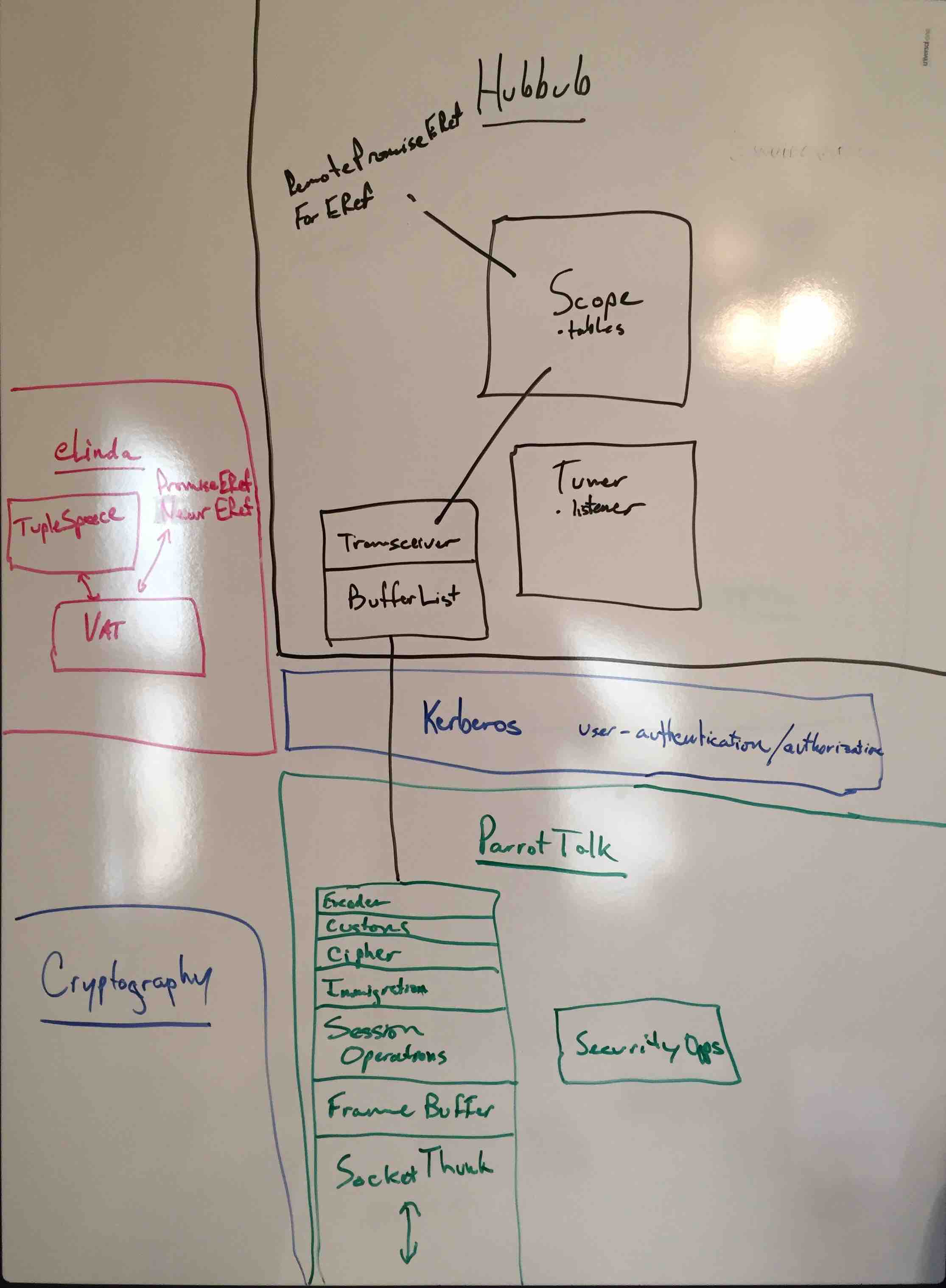
I try posting with a smaller image. [hubbub.jpg] - HH
-------- Original Message -------- Subject: Re: [Pharo-users] Smalltalk Argument Local Time: October 26, 2017 8:52 AM UTC Time: October 26, 2017 12:52 PM From: henry@callistohouse.club To: phil@highoctane.be <phil@highoctane.be>, Any question about pharo is welcome <pharo-users@lists.pharo.org>
Perhaps not, or not yet. Perhaps it is the communications foundation for an always-on cloud/bigData control layer.
I would position ParrotTalk as a Kerberos transport. ParrotTalk does 2048-bin key negotiation and subsequent encryption/encoding, both user-supplied.
Please see the attached diagram, co-locating ParrotTalk with my other components.
ParrotTalk does not do user authentication/authorization. Which means to me that I should consider Kerberos authorization/authentication to establish as an integratable transport to play in bigData.
This means you still need a Kerberos client and I need a Kerberos client. How do we start?
- HH
PS: I did much work integrating Kafka into a framework. I was thinking of inserting msg sending replication to a partition count of replicate queues for sending and receiving Hubbub traffic, thus inserting right where Kerberos is in the diagram. I would love to see client coupling for Kerberos, Kafka and Hadoop, while I figure out proper security to make that group happy with this as a possible control layer solution, forking off jobs.
On Thu, Oct 26, 2017 at 03:14, phil@highoctane.be <[phil@highoctane.be]("mailto:phil@highoctane.be")> wrote:
Sure. Current main issue is to have Pharo work with Kerberos as secured Hadoop uses the UGI (UserGroupInformation) thing and that is a black hole of crypto things.
How would you see ParrotTalk work?
I made a XmppTalk thing (binding for libstrophe) for having Pharo images and other stuff talk together (currently using OpenFire/Gajim/Profanity) FWIW
libstrophe does the SSL thing under the hood (using OpenSSL) and is actively maintained. [https://github.com/strophe/libstrophe/blob/master/src/tls_openssl.c]("https://github.com/strophe/libstrophe/blob/master/src/tls_openssl.c")
And I currently work with Kafka so, Pharo as a consumer or producer, sure am interested. But need Kerberos support.
Tell me more about your vision. Even better, draw it in some way :-)
Phil
On Thu, Oct 26, 2017 at 8:43 AM, henry <[henry@callistohouse.club]("mailto:henry@callistohouse.club")> wrote:
This is a goal of ParrotTalk, to bring bit-compatible communications to Squeak, Pharo and Java. This is not an invocation bridge you speak of but a communications bridge to be able to run against Hadoop or whichever big data needs integration with (Kafka). I had hoped it might be adopted for such. Yet again this is not exactly what you were looking for but yet interesting perhaps?
- HH
On Thu, Oct 26, 2017 at 02:17, [phil@highoctane.be]("mailto:phil@highoctane.be") <phil@highoctane.be> wrote:
I like that piece a lot, seeing exactly the described situation in large enterprises.
I made a strategic decision to go with Pharo for the long run for my solutions because it is a stable base on which to build (ok, there are evolutions, but fundamentally, I can rely on it being under control and can maintain solutions in a version).
The rationale is that at a deep level I am really fed up with having to deal with accidental complexity (now having to deal with Spark/Scala/sbt/Java/maven stuff) that makes the dev focus 80% technology drag and 20% net business contribution.
One key thing is that a team needs guidance and Smalltalk makes it easier due to well known ways of doing things.
Now we miss the boat on mobile and bigdata, but this is solvable.
If we had an open Java bridge (and some people in the community have it for Pharo but do not open source it - so this is eminently doable) + Pharo as an embeddable piece (e.g. like Tcl and Lua) and not a big executable we would have a way to embed Pharo in a lot of places (e.g. in the Hadoop ecosystem where fast starting VMs and small footprint would make the cluster capacity x2 or x3 vs uberjars all over the place) this would be a real disruption.
Think about being able to call Pharo from JNA https://github.com/java-native-access/jna the same way we use C with UFFI.
Smalltalk argument for me is that it makes development bearable (even fun and enjoyable would I say) vs the other stacks. That matters.
Phil
On Thu, Oct 26, 2017 at 12:46 AM, Andrew Glynn <aglynn42@gmail.com> wrote:
Thereâs other questions that are relevant to me:
Do I give a f*** about cool looking web apps? No, I donât use web apps if in any way I can avoid it.
Do I give a f*** about mobile apps? No, the screenâs too small to read anything longer than a twit, or anyone with anything worthwhile to say.
Do I give a f*** about the number of libraries in other languages? No, because most of them are crap in every language Iâve had to work in, and the base languages are crap so they have to keep changing radically, and libraries and frameworks therefore also have to and never get any better. The few that are worthwhile I can almost always use from Smalltalk without a problem (read, Blender, ACT-R and Synapse, since every other library/framework Iâve used outside Smalltalk has been a waste of time).
Do I give a f*** about implementing a complex piece of machine learning software in 22 hours, compared to 3 months for the Java version? Well, actually yes, I do, because that was 3 months of my life down the toilet for something that is too slow to be useful in Java.
Any argument depends on your priorities. Iâve written tons of web apps, because I needed to get paid. Iâve written better shitty mobile apps than the average shitty mobile apps. However, Iâm not going to do any of that any longer in crap that never improves, because after 26 years the irritability it produces is more than itâs worth.
A few weeks ago, a recruiter that specializes in Smalltalk called me about a job, although they were well aware I live 1500 miles away from the city I lived in when I had worked through them, to see if Iâd be willing to move back there for a job. That sounds like another âthere arenât enough Smalltalk developers", but it wasnât, because the job wasnât writing Smalltalk. It was writing Java.
The person hiring, though, wouldnât look at anyone who didnât write Smalltalk, because "people who grew up with Java donât know how to write code". I donât agree with that, Iâve known a (very few) good Java developers. I would say, though, that Iâve known far more incompetent ones than good ones, and I canât think of any incompetent Smalltalk developers off the top of my head.
Nor have I ever heard a developer in Smalltalk, or Haskell, or LISP, or even C, complain about how hard maintaining state is or coming up with various hacks to avoid it, which seems to be the main point of every JavaScript based âtechnologyâ. An application is by definition a state-machine, which implies plenty about JS developers on the whole.
If youâre a good developer you can write good code in (nearly) anything. My question then is why would you want to write in crap? The better question is why arenât there more good developers in any language?
Every project I have been able to do in Smalltalk, though, has had one thing in common, the "shit has to work". Companies do use it, in fact I could name 4 large enterprises Iâve worked for whoâve written their own dialects, and they all use it only when "shit has to work". They know itâs more productive, they also know using it for more things would increase the availability of Smalltalk developers.
Why do they not do it? One reason, though it takes a while to recognize it, because management doesnât admit even to themselves why they do it, or not very often. Being inefficient, as long as it doesnât âreallyâ matter, is an advantage to large enterprises because they have resources smaller competitors donât.
Why donât their competitors do it? Because they canât see past an hourly rate, whatâs fashionable, or just new, or because their customers canât. Put more generally, average stupidity that isnât corrected by the market. Fashion affects smaller companies more than larger ones, because they canât afford a few customers walking away because they wanted an app in Electron, even if they canât give any relevant reason for wanting it, and even the samples on the Electron site donât work.
Enterprises can, and do use Smalltalk when it matters. When it doesnât, itâs to their advantage to promote things that are inefficient, buggy and unreliable.
Cost is relevant, but not in the simple way people look at things. A crucial but rarely mentioned perspective on its relevance is that while Java based software runs TV set top boxes, Smalltalk based software runs things like medical equipment, automated defense systems, tanks, etc. Cost becomes largely irrelevant when âshit has to workâ.
Productivity is primarily relevant to less talented developers, in an inversely sense, since unproductive environments and attitudes have a leveling tendency in general, and more specifically make accomplishing what the less talented are capable of in any environment sufficiently laborious for them to have a role. Capability in Smalltalk, as implied by the person hiring for the Java role I mentioned, is a fairly decent means of judging whether someone is a so-so developer or a good one.
The productivity argument is realistically only relevant in the context of an already higher hourly cost. Given that it is relevant at that point, companies that know Smalltalk is more productive would use it outside things that have to be 100%, if their own productivity were relevant to the same degree that competitorsâ productivity is inversely relevant.
All these ways of looking at it are contingent perspectives though. Yes, if the number of libraries is relevant to you, Smalltalk is less attractive, but thatâs only a contingent phenomenon based on the relative popularity of Java and JavaScript, as a result it canât be used as explanatory for that popularity. All the ways of looking at it that are fully determinate are determinate via contingencies of that kind, which for the most part are precisely the other perspectives, including productivity, cost, availability of developers, etc. None of them is in itself anything but a result of the others.
If availability of developers is contingent on popularity (and further, popularity contingent on industry attitudes), to use an example already mentioned in Joachimâs post, then his simultaneous posit of library availability is if anything more contingent on the same popularity, so positing it as a cause and not a result, or merely a correlate, of popularity is incoherent. We can go one step further, and demonstrate that even when large enterprises make something that works reliably available, they fail to promote and support it, which destroys the market for reliable tooling by simultaneously owning it while not promoting it, something IBM is particularly good at. But IBM canât (and if they canât, neither can any other company) operate that way without the tacit agreement of the industry.
To understand it in a more general way, software development has to be looked at in the context where it occurs, and how itâs determined to a large degree by that context, with a specific difference. That difference is itself implicit in the context, i.e. capitalism, but only purely effective in software development. Itâs a result of virtualization as an implicit goal of capitalism, and the disruptions implicit in the virtual but so far only realized completely in software. In terms of that understanding, the analysis of virtualization and disruption as inherent to capitalism is better accomplished in Kapital than in any more recent work.
Or you can simply decide, as Iâve done recently, that working in ways and with tools that prevent doing good work in a reasonable timeframe isnât worthwhile to you, no matter how popular those ways and tools might be, or what the posited reasons are, since at the end popularity is only insofar as it already is. What those tools and methods are depends to a degree on your priorities, but if developers are engineers those priorities canât be completely arbitrary. Engineers are defined by their ability to make things work.
Software as virtual is inherently disruptive, and the software industry disrupts itself too often and too easily to build on anything. A further disruption caused by developers, as engineers, refusing to work with crap that doesnât, i.e. insisting on being engineers, while in itself merely an aggravation of the disruptive tendencies, might have an inverse result.
Using a stable core of technologies as the basis for a more volatile set of products, in the way nearly every other industry does, is the best means we know of to build things both flexibly and reasonably efficiently. The computer hardware industry is the extreme example of this, while the software industry is the extreme contradiction.
From: Pharo-users <pharo-users-bounces@lists.pharo.org> on behalf of David Mason <dmason@ryerson.ca> Reply-To: Any question about pharo is welcome <pharo-users@lists.pharo.org> Date: Tuesday, October 24, 2017 at 11:52 AM To: Any question about pharo is welcome <pharo-users@lists.pharo.org> Subject: Re: [Pharo-users] Smalltalk Argument
PharoJS is working to give you that mobile app/browser app experience. As with others, we're not there yet, but getting there. See http://pharojs.org
The 67% loved means that 67% of people using Smalltalk (or perhaps have ever used it) want to continue - so it's presumably a high percentage of a smallish number of people.
On 20 October 2017 at 03:23, jtuchel@objektfabrik.de <jtuchel@objektfabrik.de> wrote:
First of all: I'd say the question itself is not a question but an excuse. I am not arguing there are enough Smalltalkers or cheap ones. But I think the question is just a way of saying "we don't want to do it for reasons that we ourselves cannot really express". If you are a good developer, learning Smalltalk is easy. If you are a good developer you've heard the sentence "we've taken the goos parts from x,y,z and Smalltalk" at least twice a year. So you most likely would like to learn it anyways.
A shortage of developers doesn't exist. What exists is an unwillingness of companies to get people trained in a technology. If Smalltalk was cool and great in their opinion, they wouldn't care. It's that simple. As a consultant, I've heard that argument so often. Not ferom Startups, but from insurance companies, Banks or Car manufacturers who spend millions on useless, endless meetings and stuff instead of just hiring somebody to teach a couple of developers Smalltalk. It's just a lie: the shortage of Smalltalk developers is not a problem.
And, to be honest: what is it we actually are better in by using Smalltalk? Can we build cool looking web apps in extremely short time? No. Can we build mobile Apps with little effort? No. Does our Smalltalk ship lots of great libraries for all kinds of things that are not availabel in similar quality in any other language? Are we lying when we say we are so extremely over-productive as compared to other languages?
I know, all that live debugging stuff and such is great and it is much faster to find & fix a bug in Smalltalk than in any other environment I've used so far. But that is really only true for business code. When I need to connect to things or want to build a modern GUI or a web application with a great look&feel, I am nowhere near productive, because I simply have to build my own stuff or learn how to use other external resources. If I want to build something for a mobile device, I will only hear that somebody somewhere has done it before. No docs, no proof, no ready-made tool for me.
Shortage of developers is not really the problem. If Smalltalk was as cool as we like to make ourselves believe, this problem would be non-existent. If somebody took out their iPad and told an audience: "We did this in Smalltalk in 40% of the time it would have taken in Swift", and if that something was a must-have for people, things would be much easier. But nobody has.
I am absolutely over-exaggerating, because I make my living with an SaaS product written in Smalltalk (not Pharo). I have lots of fun with Smalltalk and - as you - am convince that many parts of what we've done so far would've taken much longer or even be impossible in other languages. But the advantage was eaten by our extremely steep learning curve for web technologies and for building something that works almost as well as tools like Angular or jQuery Mobile.
Smalltalk is cool, and the day somebody shows me something like Google's flutter in Smalltalk, I am ready to bet a lot on a bright future for Smalltalk. But until then, I'd say these arguments about productivity are just us trying to make ourselves believe we're still the top of the food chain. We've done that for almost thirty years now and still aren't ready to stop it. But we've been lying to ourselves and still do so.
I don't think there is a point in discussing about the usefulness of a language using an argument like the number or ready-made developers. That is just an argument they know you can't win. The real question is and should be: what is the benefit of using Smalltalk. Our productivity argument is a lie as soon as we have to build something that uses or runs on technology that has been invented after 1990.
Okay, shoot ;-)
Joachim
â ââââââââââââââââââââââââ Objektfabrik Joachim Tuchel mailto:jtuchel@objektfabrik.de Fliederweg 1 http://www.objektfabrik.de D-71640 Ludwigsburg http://joachimtuchel.wordpress.com Telefon: +49 7141 56 10 86 0 Fax: +49 7141 56 10 86 1
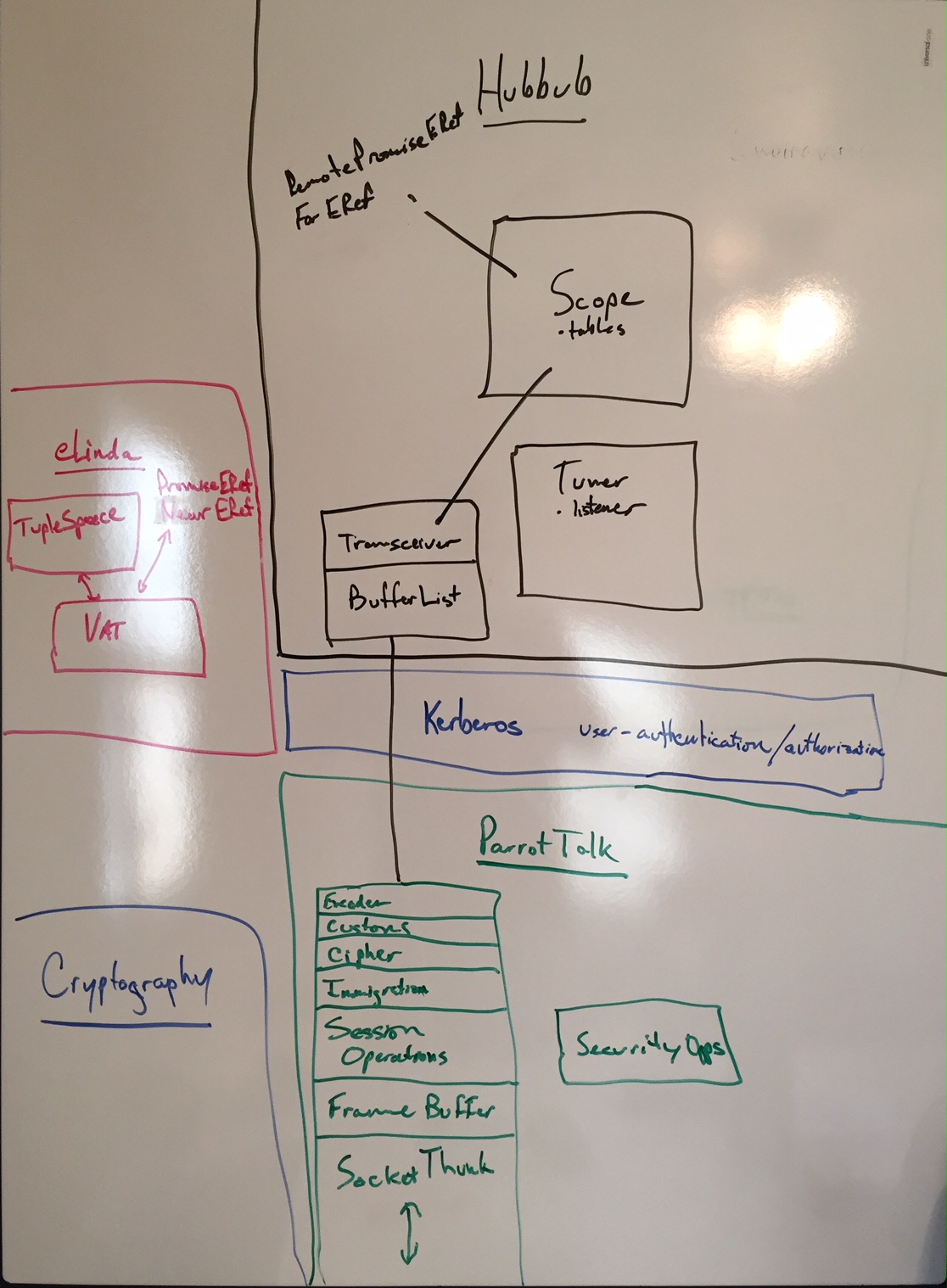
I think another good service to integrate well to is Elastic Search. Of the 4 types of integration, I vote for and step forward to volunteer to help Kerberos integration in Pharo. What to do? - HH On Thu, Oct 26, 2017 at 09:06, henry <[henry@callistohouse.club]("mailto:henry@callistohouse.club")> wrote:
I try posting with a smaller image.
["hubbub.jpg"]
- HH
âââ Original Message âââ Subject: Re: [Pharo-users] Smalltalk Argument Local Time: October 26, 2017 8:52 AM UTC Time: October 26, 2017 12:52 PM From: henry@callistohouse.club To: phil@highoctane.be <phil@highoctane.be>, Any question about pharo is welcome <pharo-users@lists.pharo.org>
Perhaps not, or not yet. Perhaps it is the communications foundation for an always-on cloud/bigData control layer.
I would position ParrotTalk as a Kerberos transport. ParrotTalk does 2048-bin key negotiation and subsequent encryption/encoding, both user-supplied.
Please see the attached diagram, co-locating ParrotTalk with my other components.
ParrotTalk does not do user authentication/authorization. Which means to me that I should consider Kerberos authorization/authentication to establish as an integratable transport to play in bigData.
This means you still need a Kerberos client and I need a Kerberos client. How do we start?
- HH
PS: I did much work integrating Kafka into a framework. I was thinking of inserting msg sending replication to a partition count of replicate queues for sending and receiving Hubbub traffic, thus inserting right where Kerberos is in the diagram. I would love to see client coupling for Kerberos, Kafka and Hadoop, while I figure out proper security to make that group happy with this as a possible control layer solution, forking off jobs.
On Thu, Oct 26, 2017 at 03:14, phil@highoctane.be <[phil@highoctane.be](""mailto:phil@highoctane.be"")> wrote:
Sure. Current main issue is to have Pharo work with Kerberos as secured Hadoop uses the UGI (UserGroupInformation) thing and that is a black hole of crypto things.
How would you see ParrotTalk work?
I made a XmppTalk thing (binding for libstrophe) for having Pharo images and other stuff talk together (currently using OpenFire/Gajim/Profanity) FWIW
libstrophe does the SSL thing under the hood (using OpenSSL) and is actively maintained. [https://github.com/strophe/libstrophe/blob/master/src/tls_openssl.c](""https://github.com/strophe/libstrophe/blob/master/src/tls_openssl.c"")
And I currently work with Kafka so, Pharo as a consumer or producer, sure am interested. But need Kerberos support.
Tell me more about your vision. Even better, draw it in some way :-)
Phil
On Thu, Oct 26, 2017 at 8:43 AM, henry <[henry@callistohouse.club](""mailto:henry@callistohouse.club"")> wrote:
This is a goal of ParrotTalk, to bring bit-compatible communications to Squeak, Pharo and Java. This is not an invocation bridge you speak of but a communications bridge to be able to run against Hadoop or whichever big data needs integration with (Kafka). I had hoped it might be adopted for such. Yet again this is not exactly what you were looking for but yet interesting perhaps?
- HH
On Thu, Oct 26, 2017 at 02:17, [phil@highoctane.be](""mailto:phil@highoctane.be"") <phil@highoctane.be> wrote:
I like that piece a lot, seeing exactly the described situation in large enterprises.
I made a strategic decision to go with Pharo for the long run for my solutions because it is a stable base on which to build (ok, there are evolutions, but fundamentally, I can rely on it being under control and can maintain solutions in a version).
The rationale is that at a deep level I am really fed up with having to deal with accidental complexity (now having to deal with Spark/Scala/sbt/Java/maven stuff) that makes the dev focus 80% technology drag and 20% net business contribution.
One key thing is that a team needs guidance and Smalltalk makes it easier due to well known ways of doing things.
Now we miss the boat on mobile and bigdata, but this is solvable.
If we had an open Java bridge (and some people in the community have it for Pharo but do not open source it - so this is eminently doable) + Pharo as an embeddable piece (e.g. like Tcl and Lua) and not a big executable we would have a way to embed Pharo in a lot of places (e.g. in the Hadoop ecosystem where fast starting VMs and small footprint would make the cluster capacity x2 or x3 vs uberjars all over the place) this would be a real disruption.
Think about being able to call Pharo from JNA https://github.com/java-native-access/jna the same way we use C with UFFI.
Smalltalk argument for me is that it makes development bearable (even fun and enjoyable would I say) vs the other stacks. That matters.
Phil
On Thu, Oct 26, 2017 at 12:46 AM, Andrew Glynn <aglynn42@gmail.com> wrote:
Thereâs other questions that are relevant to me:
Do I give a f*** about cool looking web apps? No, I donât use web apps if in any way I can avoid it.
Do I give a f*** about mobile apps? No, the screenâs too small to read anything longer than a twit, or anyone with anything worthwhile to say.
Do I give a f*** about the number of libraries in other languages? No, because most of them are crap in every language Iâve had to work in, and the base languages are crap so they have to keep changing radically, and libraries and frameworks therefore also have to and never get any better. The few that are worthwhile I can almost always use from Smalltalk without a problem (read, Blender, ACT-R and Synapse, since every other library/framework Iâve used outside Smalltalk has been a waste of time).
Do I give a f*** about implementing a complex piece of machine learning software in 22 hours, compared to 3 months for the Java version? Well, actually yes, I do, because that was 3 months of my life down the toilet for something that is too slow to be useful in Java.
Any argument depends on your priorities. Iâve written tons of web apps, because I needed to get paid. Iâve written better shitty mobile apps than the average shitty mobile apps. However, Iâm not going to do any of that any longer in crap that never improves, because after 26 years the irritability it produces is more than itâs worth.
A few weeks ago, a recruiter that specializes in Smalltalk called me about a job, although they were well aware I live 1500 miles away from the city I lived in when I had worked through them, to see if Iâd be willing to move back there for a job. That sounds like another âthere arenât enough Smalltalk developers", but it wasnât, because the job wasnât writing Smalltalk. It was writing Java.
The person hiring, though, wouldnât look at anyone who didnât write Smalltalk, because "people who grew up with Java donât know how to write code". I donât agree with that, Iâve known a (very few) good Java developers. I would say, though, that Iâve known far more incompetent ones than good ones, and I canât think of any incompetent Smalltalk developers off the top of my head.
Nor have I ever heard a developer in Smalltalk, or Haskell, or LISP, or even C, complain about how hard maintaining state is or coming up with various hacks to avoid it, which seems to be the main point of every JavaScript based âtechnologyâ. An application is by definition a state-machine, which implies plenty about JS developers on the whole.
If youâre a good developer you can write good code in (nearly) anything. My question then is why would you want to write in crap? The better question is why arenât there more good developers in any language?
Every project I have been able to do in Smalltalk, though, has had one thing in common, the "shit has to work". Companies do use it, in fact I could name 4 large enterprises Iâve worked for whoâve written their own dialects, and they all use it only when "shit has to work". They know itâs more productive, they also know using it for more things would increase the availability of Smalltalk developers.
Why do they not do it? One reason, though it takes a while to recognize it, because management doesnât admit even to themselves why they do it, or not very often. Being inefficient, as long as it doesnât âreallyâ matter, is an advantage to large enterprises because they have resources smaller competitors donât.
Why donât their competitors do it? Because they canât see past an hourly rate, whatâs fashionable, or just new, or because their customers canât. Put more generally, average stupidity that isnât corrected by the market. Fashion affects smaller companies more than larger ones, because they canât afford a few customers walking away because they wanted an app in Electron, even if they canât give any relevant reason for wanting it, and even the samples on the Electron site donât work.
Enterprises can, and do use Smalltalk when it matters. When it doesnât, itâs to their advantage to promote things that are inefficient, buggy and unreliable.
Cost is relevant, but not in the simple way people look at things. A crucial but rarely mentioned perspective on its relevance is that while Java based software runs TV set top boxes, Smalltalk based software runs things like medical equipment, automated defense systems, tanks, etc. Cost becomes largely irrelevant when âshit has to workâ.
Productivity is primarily relevant to less talented developers, in an inversely sense, since unproductive environments and attitudes have a leveling tendency in general, and more specifically make accomplishing what the less talented are capable of in any environment sufficiently laborious for them to have a role. Capability in Smalltalk, as implied by the person hiring for the Java role I mentioned, is a fairly decent means of judging whether someone is a so-so developer or a good one.
The productivity argument is realistically only relevant in the context of an already higher hourly cost. Given that it is relevant at that point, companies that know Smalltalk is more productive would use it outside things that have to be 100%, if their own productivity were relevant to the same degree that competitorsâ productivity is inversely relevant.
All these ways of looking at it are contingent perspectives though. Yes, if the number of libraries is relevant to you, Smalltalk is less attractive, but thatâs only a contingent phenomenon based on the relative popularity of Java and JavaScript, as a result it canât be used as explanatory for that popularity. All the ways of looking at it that are fully determinate are determinate via contingencies of that kind, which for the most part are precisely the other perspectives, including productivity, cost, availability of developers, etc. None of them is in itself anything but a result of the others.
If availability of developers is contingent on popularity (and further, popularity contingent on industry attitudes), to use an example already mentioned in Joachimâs post, then his simultaneous posit of library availability is if anything more contingent on the same popularity, so positing it as a cause and not a result, or merely a correlate, of popularity is incoherent. We can go one step further, and demonstrate that even when large enterprises make something that works reliably available, they fail to promote and support it, which destroys the market for reliable tooling by simultaneously owning it while not promoting it, something IBM is particularly good at. But IBM canât (and if they canât, neither can any other company) operate that way without the tacit agreement of the industry.
To understand it in a more general way, software development has to be looked at in the context where it occurs, and how itâs determined to a large degree by that context, with a specific difference. That difference is itself implicit in the context, i.e. capitalism, but only purely effective in software development. Itâs a result of virtualization as an implicit goal of capitalism, and the disruptions implicit in the virtual but so far only realized completely in software. In terms of that understanding, the analysis of virtualization and disruption as inherent to capitalism is better accomplished in Kapital than in any more recent work.
Or you can simply decide, as Iâve done recently, that working in ways and with tools that prevent doing good work in a reasonable timeframe isnât worthwhile to you, no matter how popular those ways and tools might be, or what the posited reasons are, since at the end popularity is only insofar as it already is. What those tools and methods are depends to a degree on your priorities, but if developers are engineers those priorities canât be completely arbitrary. Engineers are defined by their ability to make things work.
Software as virtual is inherently disruptive, and the software industry disrupts itself too often and too easily to build on anything. A further disruption caused by developers, as engineers, refusing to work with crap that doesnât, i.e. insisting on being engineers, while in itself merely an aggravation of the disruptive tendencies, might have an inverse result.
Using a stable core of technologies as the basis for a more volatile set of products, in the way nearly every other industry does, is the best means we know of to build things both flexibly and reasonably efficiently. The computer hardware industry is the extreme example of this, while the software industry is the extreme contradiction.
From: Pharo-users <pharo-users-bounces@lists.pharo.org> on behalf of David Mason <dmason@ryerson.ca> Reply-To: Any question about pharo is welcome <pharo-users@lists.pharo.org> Date: Tuesday, October 24, 2017 at 11:52 AM To: Any question about pharo is welcome <pharo-users@lists.pharo.org> Subject: Re: [Pharo-users] Smalltalk Argument
PharoJS is working to give you that mobile app/browser app experience. As with others, weâre not there yet, but getting there. See http://pharojs.org
The 67% loved means that 67% of people using Smalltalk (or perhaps have ever used it) want to continue - so itâs presumably a high percentage of a smallish number of people.
On 20 October 2017 at 03:23, jtuchel@objektfabrik.de <jtuchel@objektfabrik.de> wrote:
First of all: Iâd say the question itself is not a question but an excuse. I am not arguing there are enough Smalltalkers or cheap ones. But I think the question is just a way of saying "we donât want to do it for reasons that we ourselves cannot really express". If you are a good developer, learning Smalltalk is easy. If you are a good developer youâve heard the sentence "weâve taken the goos parts from x,y,z and Smalltalk" at least twice a year. So you most likely would like to learn it anyways.
A shortage of developers doesnât exist. What exists is an unwillingness of companies to get people trained in a technology. If Smalltalk was cool and great in their opinion, they wouldnât care. Itâs that simple. As a consultant, Iâve heard that argument so often. Not ferom Startups, but from insurance companies, Banks or Car manufacturers who spend millions on useless, endless meetings and stuff instead of just hiring somebody to teach a couple of developers Smalltalk. Itâs just a lie: the shortage of Smalltalk developers is not a problem.
And, to be honest: what is it we actually are better in by using Smalltalk? Can we build cool looking web apps in extremely short time? No. Can we build mobile Apps with little effort? No. Does our Smalltalk ship lots of great libraries for all kinds of things that are not availabel in similar quality in any other language? Are we lying when we say we are so extremely over-productive as compared to other languages?
I know, all that live debugging stuff and such is great and it is much faster to find & fix a bug in Smalltalk than in any other environment Iâve used so far. But that is really only true for business code. When I need to connect to things or want to build a modern GUI or a web application with a great look&feel, I am nowhere near productive, because I simply have to build my own stuff or learn how to use other external resources. If I want to build something for a mobile device, I will only hear that somebody somewhere has done it before. No docs, no proof, no ready-made tool for me.
Shortage of developers is not really the problem. If Smalltalk was as cool as we like to make ourselves believe, this problem would be non-existent. If somebody took out their iPad and told an audience: "We did this in Smalltalk in 40% of the time it would have taken in Swift", and if that something was a must-have for people, things would be much easier. But nobody has.
I am absolutely over-exaggerating, because I make my living with an SaaS product written in Smalltalk (not Pharo). I have lots of fun with Smalltalk and - as you - am convince that many parts of what weâve done so far wouldâve taken much longer or even be impossible in other languages. But the advantage was eaten by our extremely steep learning curve for web technologies and for building something that works almost as well as tools like Angular or jQuery Mobile.
Smalltalk is cool, and the day somebody shows me something like Googleâs flutter in Smalltalk, I am ready to bet a lot on a bright future for Smalltalk. But until then, Iâd say these arguments about productivity are just us trying to make ourselves believe weâre still the top of the food chain. Weâve done that for almost thirty years now and still arenât ready to stop it. But weâve been lying to ourselves and still do so.
I donât think there is a point in discussing about the usefulness of a language using an argument like the number or ready-made developers. That is just an argument they know you canât win. The real question is and should be: what is the benefit of using Smalltalk. Our productivity argument is a lie as soon as we have to build something that uses or runs on technology that has been invented after 1990.
Okay, shoot ;-)
Joachim
â ââââââââââââââââââââââââ Objektfabrik Joachim Tuchel mailto:jtuchel@objektfabrik.de Fliederweg 1 http://www.objektfabrik.de D-71640 Ludwigsburg http://joachimtuchel.wordpress.com Telefon: +49 7141 56 10 86 0 Fax: +49 7141 56 10 86 1
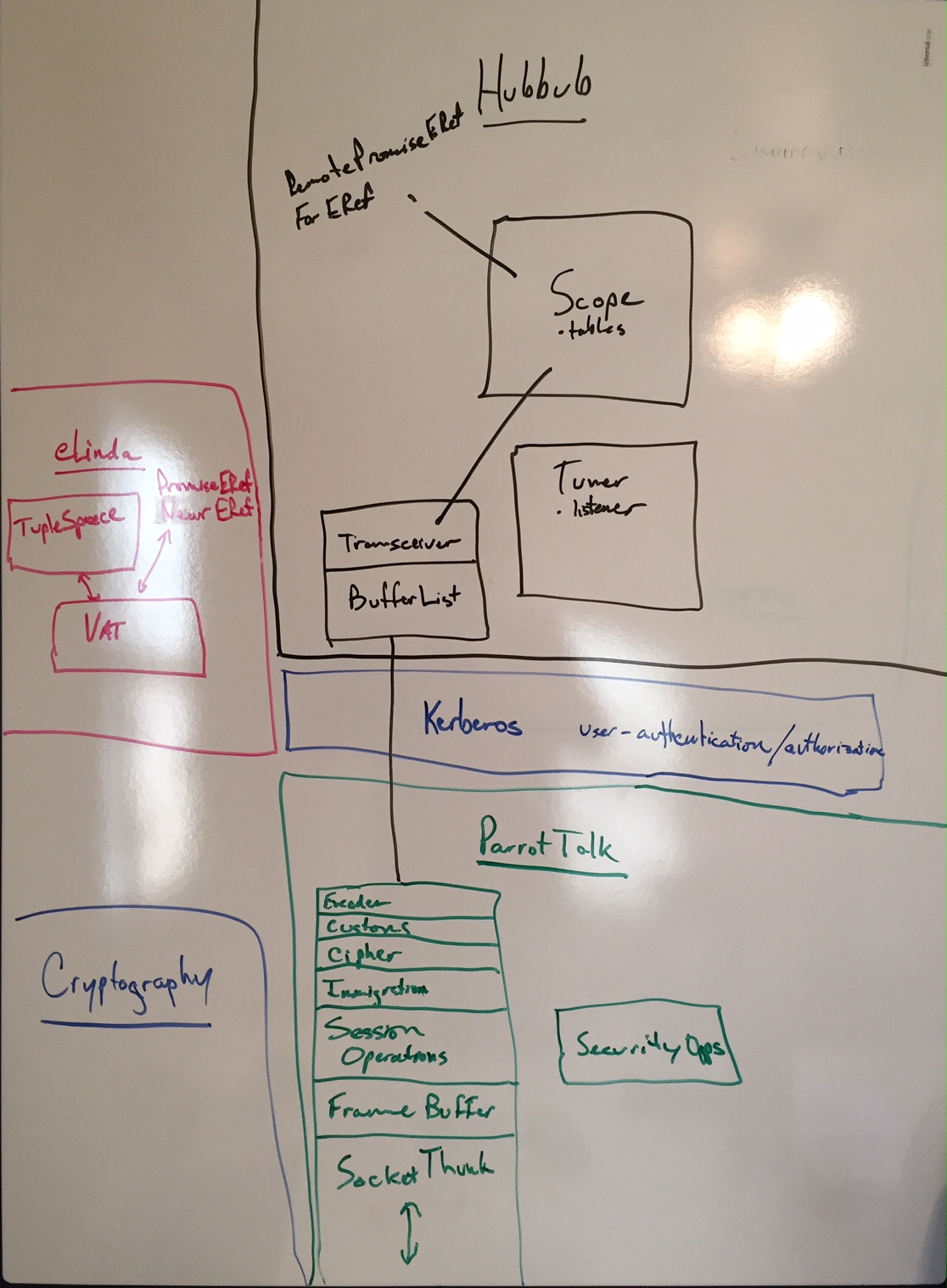
Here is a truer diagram of what I want to do. Sideways? [hubbub.jpg] - HH
-------- Original Message -------- Subject: Re: [Pharo-users] Smalltalk Argument Local Time: October 26, 2017 9:15 AM UTC Time: October 26, 2017 1:15 PM From: henry@callistohouse.club To: henry <henry@callistohouse.club> phil@highoctane.be <phil@highoctane.be>, Any question about pharo is welcome <pharo-users@lists.pharo.org>
I think another good service to integrate well to is Elastic Search.
Of the 4 types of integration, I vote for and step forward to volunteer to help Kerberos integration in Pharo. What to do?
- HH
On Thu, Oct 26, 2017 at 09:06, henry <[henry@callistohouse.club]("mailto:henry@callistohouse.club")> wrote:
âââ Original Message âââ Subject: Re: [Pharo-users] Smalltalk Argument Local Time: October 26, 2017 8:52 AM UTC Time: October 26, 2017 12:52 PM From: henry@callistohouse.club To: phil@highoctane.be <phil@highoctane.be>, Any question about pharo is welcome <pharo-users@lists.pharo.org>
Perhaps not, or not yet. Perhaps it is the communications foundation for an always-on cloud/bigData control layer.
I would position ParrotTalk as a Kerberos transport. ParrotTalk does 2048-bin key negotiation and subsequent encryption/encoding, both user-supplied.
Please see the attached diagram, co-locating ParrotTalk with my other components.
ParrotTalk does not do user authentication/authorization. Which means to me that I should consider Kerberos authorization/authentication to establish as an integratable transport to play in bigData.
This means you still need a Kerberos client and I need a Kerberos client. How do we start?
- HH
PS: I did much work integrating Kafka into a framework. I was thinking of inserting msg sending replication to a partition count of replicate queues for sending and receiving Hubbub traffic, thus inserting right where Kerberos is in the diagram. I would love to see client coupling for Kerberos, Kafka and Hadoop, while I figure out proper security to make that group happy with this as a possible control layer solution, forking off jobs.
On Thu, Oct 26, 2017 at 03:14, phil@highoctane.be <[phil@highoctane.be](""mailto:phil@highoctane.be"")> wrote:
Sure. Current main issue is to have Pharo work with Kerberos as secured Hadoop uses the UGI (UserGroupInformation) thing and that is a black hole of crypto things.
How would you see ParrotTalk work?
I made a XmppTalk thing (binding for libstrophe) for having Pharo images and other stuff talk together (currently using OpenFire/Gajim/Profanity) FWIW
libstrophe does the SSL thing under the hood (using OpenSSL) and is actively maintained. [https://github.com/strophe/libstrophe/blob/master/src/tls_openssl.c](""https://github.com/strophe/libstrophe/blob/master/src/tls_openssl.c"")
And I currently work with Kafka so, Pharo as a consumer or producer, sure am interested. But need Kerberos support.
Tell me more about your vision. Even better, draw it in some way :-)
Phil
On Thu, Oct 26, 2017 at 8:43 AM, henry <[henry@callistohouse.club](""mailto:henry@callistohouse.club"")> wrote:
This is a goal of ParrotTalk, to bring bit-compatible communications to Squeak, Pharo and Java. This is not an invocation bridge you speak of but a communications bridge to be able to run against Hadoop or whichever big data needs integration with (Kafka). I had hoped it might be adopted for such. Yet again this is not exactly what you were looking for but yet interesting perhaps?
- HH
On Thu, Oct 26, 2017 at 02:17, [phil@highoctane.be](""mailto:phil@highoctane.be"") <phil@highoctane.be> wrote:
I like that piece a lot, seeing exactly the described situation in large enterprises.
I made a strategic decision to go with Pharo for the long run for my solutions because it is a stable base on which to build (ok, there are evolutions, but fundamentally, I can rely on it being under control and can maintain solutions in a version).
The rationale is that at a deep level I am really fed up with having to deal with accidental complexity (now having to deal with Spark/Scala/sbt/Java/maven stuff) that makes the dev focus 80% technology drag and 20% net business contribution.
One key thing is that a team needs guidance and Smalltalk makes it easier due to well known ways of doing things.
Now we miss the boat on mobile and bigdata, but this is solvable.
If we had an open Java bridge (and some people in the community have it for Pharo but do not open source it - so this is eminently doable) + Pharo as an embeddable piece (e.g. like Tcl and Lua) and not a big executable we would have a way to embed Pharo in a lot of places (e.g. in the Hadoop ecosystem where fast starting VMs and small footprint would make the cluster capacity x2 or x3 vs uberjars all over the place) this would be a real disruption.
Think about being able to call Pharo from JNA https://github.com/java-native-access/jna the same way we use C with UFFI.
Smalltalk argument for me is that it makes development bearable (even fun and enjoyable would I say) vs the other stacks. That matters.
Phil
On Thu, Oct 26, 2017 at 12:46 AM, Andrew Glynn <aglynn42@gmail.com> wrote:
Thereâs other questions that are relevant to me:
Do I give a f*** about cool looking web apps? No, I donât use web apps if in any way I can avoid it.
Do I give a f*** about mobile apps? No, the screenâs too small to read anything longer than a twit, or anyone with anything worthwhile to say.
Do I give a f*** about the number of libraries in other languages? No, because most of them are crap in every language Iâve had to work in, and the base languages are crap so they have to keep changing radically, and libraries and frameworks therefore also have to and never get any better. The few that are worthwhile I can almost always use from Smalltalk without a problem (read, Blender, ACT-R and Synapse, since every other library/framework Iâve used outside Smalltalk has been a waste of time).
Do I give a f*** about implementing a complex piece of machine learning software in 22 hours, compared to 3 months for the Java version? Well, actually yes, I do, because that was 3 months of my life down the toilet for something that is too slow to be useful in Java.
Any argument depends on your priorities. Iâve written tons of web apps, because I needed to get paid. Iâve written better shitty mobile apps than the average shitty mobile apps. However, Iâm not going to do any of that any longer in crap that never improves, because after 26 years the irritability it produces is more than itâs worth.
A few weeks ago, a recruiter that specializes in Smalltalk called me about a job, although they were well aware I live 1500 miles away from the city I lived in when I had worked through them, to see if Iâd be willing to move back there for a job. That sounds like another âthere arenât enough Smalltalk developers", but it wasnât, because the job wasnât writing Smalltalk. It was writing Java.
The person hiring, though, wouldnât look at anyone who didnât write Smalltalk, because "people who grew up with Java donât know how to write code". I donât agree with that, Iâve known a (very few) good Java developers. I would say, though, that Iâve known far more incompetent ones than good ones, and I canât think of any incompetent Smalltalk developers off the top of my head.
Nor have I ever heard a developer in Smalltalk, or Haskell, or LISP, or even C, complain about how hard maintaining state is or coming up with various hacks to avoid it, which seems to be the main point of every JavaScript based âtechnologyâ. An application is by definition a state-machine, which implies plenty about JS developers on the whole.
If youâre a good developer you can write good code in (nearly) anything. My question then is why would you want to write in crap? The better question is why arenât there more good developers in any language?
Every project I have been able to do in Smalltalk, though, has had one thing in common, the "shit has to work". Companies do use it, in fact I could name 4 large enterprises Iâve worked for whoâve written their own dialects, and they all use it only when "shit has to work". They know itâs more productive, they also know using it for more things would increase the availability of Smalltalk developers.
Why do they not do it? One reason, though it takes a while to recognize it, because management doesnât admit even to themselves why they do it, or not very often. Being inefficient, as long as it doesnât âreallyâ matter, is an advantage to large enterprises because they have resources smaller competitors donât.
Why donât their competitors do it? Because they canât see past an hourly rate, whatâs fashionable, or just new, or because their customers canât. Put more generally, average stupidity that isnât corrected by the market. Fashion affects smaller companies more than larger ones, because they canât afford a few customers walking away because they wanted an app in Electron, even if they canât give any relevant reason for wanting it, and even the samples on the Electron site donât work.
Enterprises can, and do use Smalltalk when it matters. When it doesnât, itâs to their advantage to promote things that are inefficient, buggy and unreliable.
Cost is relevant, but not in the simple way people look at things. A crucial but rarely mentioned perspective on its relevance is that while Java based software runs TV set top boxes, Smalltalk based software runs things like medical equipment, automated defense systems, tanks, etc. Cost becomes largely irrelevant when âshit has to workâ.
Productivity is primarily relevant to less talented developers, in an inversely sense, since unproductive environments and attitudes have a leveling tendency in general, and more specifically make accomplishing what the less talented are capable of in any environment sufficiently laborious for them to have a role. Capability in Smalltalk, as implied by the person hiring for the Java role I mentioned, is a fairly decent means of judging whether someone is a so-so developer or a good one.
The productivity argument is realistically only relevant in the context of an already higher hourly cost. Given that it is relevant at that point, companies that know Smalltalk is more productive would use it outside things that have to be 100%, if their own productivity were relevant to the same degree that competitorsâ productivity is inversely relevant.
All these ways of looking at it are contingent perspectives though. Yes, if the number of libraries is relevant to you, Smalltalk is less attractive, but thatâs only a contingent phenomenon based on the relative popularity of Java and JavaScript, as a result it canât be used as explanatory for that popularity. All the ways of looking at it that are fully determinate are determinate via contingencies of that kind, which for the most part are precisely the other perspectives, including productivity, cost, availability of developers, etc. None of them is in itself anything but a result of the others.
If availability of developers is contingent on popularity (and further, popularity contingent on industry attitudes), to use an example already mentioned in Joachimâs post, then his simultaneous posit of library availability is if anything more contingent on the same popularity, so positing it as a cause and not a result, or merely a correlate, of popularity is incoherent. We can go one step further, and demonstrate that even when large enterprises make something that works reliably available, they fail to promote and support it, which destroys the market for reliable tooling by simultaneously owning it while not promoting it, something IBM is particularly good at. But IBM canât (and if they canât, neither can any other company) operate that way without the tacit agreement of the industry.
To understand it in a more general way, software development has to be looked at in the context where it occurs, and how itâs determined to a large degree by that context, with a specific difference. That difference is itself implicit in the context, i.e. capitalism, but only purely effective in software development. Itâs a result of virtualization as an implicit goal of capitalism, and the disruptions implicit in the virtual but so far only realized completely in software. In terms of that understanding, the analysis of virtualization and disruption as inherent to capitalism is better accomplished in Kapital than in any more recent work.
Or you can simply decide, as Iâve done recently, that working in ways and with tools that prevent doing good work in a reasonable timeframe isnât worthwhile to you, no matter how popular those ways and tools might be, or what the posited reasons are, since at the end popularity is only insofar as it already is. What those tools and methods are depends to a degree on your priorities, but if developers are engineers those priorities canât be completely arbitrary. Engineers are defined by their ability to make things work.
Software as virtual is inherently disruptive, and the software industry disrupts itself too often and too easily to build on anything. A further disruption caused by developers, as engineers, refusing to work with crap that doesnât, i.e. insisting on being engineers, while in itself merely an aggravation of the disruptive tendencies, might have an inverse result.
Using a stable core of technologies as the basis for a more volatile set of products, in the way nearly every other industry does, is the best means we know of to build things both flexibly and reasonably efficiently. The computer hardware industry is the extreme example of this, while the software industry is the extreme contradiction.
From: Pharo-users <pharo-users-bounces@lists.pharo.org> on behalf of David Mason <dmason@ryerson.ca> Reply-To: Any question about pharo is welcome <pharo-users@lists.pharo.org> Date: Tuesday, October 24, 2017 at 11:52 AM To: Any question about pharo is welcome <pharo-users@lists.pharo.org> Subject: Re: [Pharo-users] Smalltalk Argument
PharoJS is working to give you that mobile app/browser app experience. As with others, weâre not there yet, but getting there. See http://pharojs.org
The 67% loved means that 67% of people using Smalltalk (or perhaps have ever used it) want to continue - so itâs presumably a high percentage of a smallish number of people.
On 20 October 2017 at 03:23, jtuchel@objektfabrik.de <jtuchel@objektfabrik.de> wrote:
First of all: Iâd say the question itself is not a question but an excuse. I am not arguing there are enough Smalltalkers or cheap ones. But I think the question is just a way of saying "we donât want to do it for reasons that we ourselves cannot really express". If you are a good developer, learning Smalltalk is easy. If you are a good developer youâve heard the sentence "weâve taken the goos parts from x,y,z and Smalltalk" at least twice a year. So you most likely would like to learn it anyways.
A shortage of developers doesnât exist. What exists is an unwillingness of companies to get people trained in a technology. If Smalltalk was cool and great in their opinion, they wouldnât care. Itâs that simple. As a consultant, Iâve heard that argument so often. Not ferom Startups, but from insurance companies, Banks or Car manufacturers who spend millions on useless, endless meetings and stuff instead of just hiring somebody to teach a couple of developers Smalltalk. Itâs just a lie: the shortage of Smalltalk developers is not a problem.
And, to be honest: what is it we actually are better in by using Smalltalk? Can we build cool looking web apps in extremely short time? No. Can we build mobile Apps with little effort? No. Does our Smalltalk ship lots of great libraries for all kinds of things that are not availabel in similar quality in any other language? Are we lying when we say we are so extremely over-productive as compared to other languages?
I know, all that live debugging stuff and such is great and it is much faster to find & fix a bug in Smalltalk than in any other environment Iâve used so far. But that is really only true for business code. When I need to connect to things or want to build a modern GUI or a web application with a great look&feel, I am nowhere near productive, because I simply have to build my own stuff or learn how to use other external resources. If I want to build something for a mobile device, I will only hear that somebody somewhere has done it before. No docs, no proof, no ready-made tool for me.
Shortage of developers is not really the problem. If Smalltalk was as cool as we like to make ourselves believe, this problem would be non-existent. If somebody took out their iPad and told an audience: "We did this in Smalltalk in 40% of the time it would have taken in Swift", and if that something was a must-have for people, things would be much easier. But nobody has.
I am absolutely over-exaggerating, because I make my living with an SaaS product written in Smalltalk (not Pharo). I have lots of fun with Smalltalk and - as you - am convince that many parts of what weâve done so far wouldâve taken much longer or even be impossible in other languages. But the advantage was eaten by our extremely steep learning curve for web technologies and for building something that works almost as well as tools like Angular or jQuery Mobile.
Smalltalk is cool, and the day somebody shows me something like Googleâs flutter in Smalltalk, I am ready to bet a lot on a bright future for Smalltalk. But until then, Iâd say these arguments about productivity are just us trying to make ourselves believe weâre still the top of the food chain. Weâve done that for almost thirty years now and still arenât ready to stop it. But weâve been lying to ourselves and still do so.
I donât think there is a point in discussing about the usefulness of a language using an argument like the number or ready-made developers. That is just an argument they know you canât win. The real question is and should be: what is the benefit of using Smalltalk. Our productivity argument is a lie as soon as we have to build something that uses or runs on technology that has been invented after 1990.
Okay, shoot ;-)
Joachim
â ââââââââââââââââââââââââ Objektfabrik Joachim Tuchel mailto:jtuchel@objektfabrik.de Fliederweg 1 http://www.objektfabrik.de D-71640 Ludwigsburg http://joachimtuchel.wordpress.com Telefon: +49 7141 56 10 86 0 Fax: +49 7141 56 10 86 1
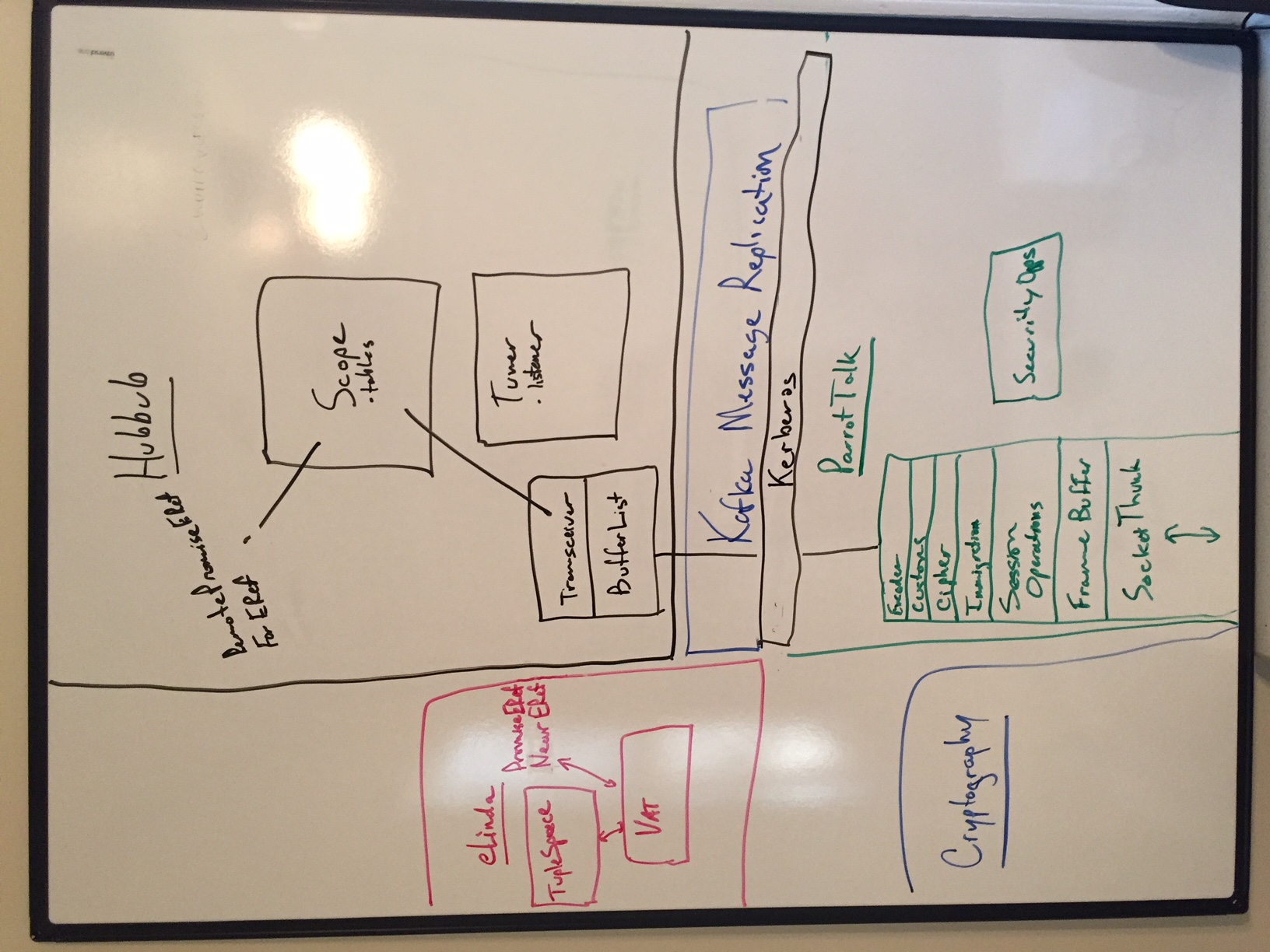
A Kerberos effort will have to be a group effort. Sideways to my main focus and your allâs main focii. - HH On Thu, Oct 26, 2017 at 09:15, henry <[henry@callistohouse.club]("mailto:henry@callistohouse.club")> wrote:
I think another good service to integrate well to is Elastic Search.
Of the 4 types of integration, I vote for and step forward to volunteer to help Kerberos integration in Pharo. What to do?
- HH
On Thu, Oct 26, 2017 at 09:06, henry <[henry@callistohouse.club](""mailto:henry@callistohouse.club"")> wrote:
I try posting with a smaller image.
[""hubbub.jpg""]
- HH
âââ Original Message âââ Subject: Re: [Pharo-users] Smalltalk Argument Local Time: October 26, 2017 8:52 AM UTC Time: October 26, 2017 12:52 PM From: henry@callistohouse.club To: phil@highoctane.be <phil@highoctane.be>, Any question about pharo is welcome <pharo-users@lists.pharo.org>
Perhaps not, or not yet. Perhaps it is the communications foundation for an always-on cloud/bigData control layer.
I would position ParrotTalk as a Kerberos transport. ParrotTalk does 2048-bin key negotiation and subsequent encryption/encoding, both user-supplied.
Please see the attached diagram, co-locating ParrotTalk with my other components.
ParrotTalk does not do user authentication/authorization. Which means to me that I should consider Kerberos authorization/authentication to establish as an integratable transport to play in bigData.
This means you still need a Kerberos client and I need a Kerberos client. How do we start?
- HH
PS: I did much work integrating Kafka into a framework. I was thinking of inserting msg sending replication to a partition count of replicate queues for sending and receiving Hubbub traffic, thus inserting right where Kerberos is in the diagram. I would love to see client coupling for Kerberos, Kafka and Hadoop, while I figure out proper security to make that group happy with this as a possible control layer solution, forking off jobs.
On Thu, Oct 26, 2017 at 03:14, phil@highoctane.be <[phil@highoctane.be]("""mailto:phil@highoctane.be""")> wrote:
Sure. Current main issue is to have Pharo work with Kerberos as secured Hadoop uses the UGI (UserGroupInformation) thing and that is a black hole of crypto things.
How would you see ParrotTalk work?
I made a XmppTalk thing (binding for libstrophe) for having Pharo images and other stuff talk together (currently using OpenFire/Gajim/Profanity) FWIW
libstrophe does the SSL thing under the hood (using OpenSSL) and is actively maintained. [https://github.com/strophe/libstrophe/blob/master/src/tls_openssl.c]("""https://github.com/strophe/libstrophe/blob/master/src/tls_openssl.c""")
And I currently work with Kafka so, Pharo as a consumer or producer, sure am interested. But need Kerberos support.
Tell me more about your vision. Even better, draw it in some way :-)
Phil
On Thu, Oct 26, 2017 at 8:43 AM, henry <[henry@callistohouse.club]("""mailto:henry@callistohouse.club""")> wrote:
This is a goal of ParrotTalk, to bring bit-compatible communications to Squeak, Pharo and Java. This is not an invocation bridge you speak of but a communications bridge to be able to run against Hadoop or whichever big data needs integration with (Kafka). I had hoped it might be adopted for such. Yet again this is not exactly what you were looking for but yet interesting perhaps?
- HH
On Thu, Oct 26, 2017 at 02:17, [phil@highoctane.be]("""mailto:phil@highoctane.be""") <phil@highoctane.be> wrote:
I like that piece a lot, seeing exactly the described situation in large enterprises.
I made a strategic decision to go with Pharo for the long run for my solutions because it is a stable base on which to build (ok, there are evolutions, but fundamentally, I can rely on it being under control and can maintain solutions in a version).
The rationale is that at a deep level I am really fed up with having to deal with accidental complexity (now having to deal with Spark/Scala/sbt/Java/maven stuff) that makes the dev focus 80% technology drag and 20% net business contribution.
One key thing is that a team needs guidance and Smalltalk makes it easier due to well known ways of doing things.
Now we miss the boat on mobile and bigdata, but this is solvable.
If we had an open Java bridge (and some people in the community have it for Pharo but do not open source it - so this is eminently doable) + Pharo as an embeddable piece (e.g. like Tcl and Lua) and not a big executable we would have a way to embed Pharo in a lot of places (e.g. in the Hadoop ecosystem where fast starting VMs and small footprint would make the cluster capacity x2 or x3 vs uberjars all over the place) this would be a real disruption.
Think about being able to call Pharo from JNA https://github.com/java-native-access/jna the same way we use C with UFFI.
Smalltalk argument for me is that it makes development bearable (even fun and enjoyable would I say) vs the other stacks. That matters.
Phil
On Thu, Oct 26, 2017 at 12:46 AM, Andrew Glynn <aglynn42@gmail.com> wrote:
Thereâs other questions that are relevant to me:
Do I give a f*** about cool looking web apps? No, I donât use web apps if in any way I can avoid it.
Do I give a f*** about mobile apps? No, the screenâs too small to read anything longer than a twit, or anyone with anything worthwhile to say.
Do I give a f*** about the number of libraries in other languages? No, because most of them are crap in every language Iâve had to work in, and the base languages are crap so they have to keep changing radically, and libraries and frameworks therefore also have to and never get any better. The few that are worthwhile I can almost always use from Smalltalk without a problem (read, Blender, ACT-R and Synapse, since every other library/framework Iâve used outside Smalltalk has been a waste of time).
Do I give a f*** about implementing a complex piece of machine learning software in 22 hours, compared to 3 months for the Java version? Well, actually yes, I do, because that was 3 months of my life down the toilet for something that is too slow to be useful in Java.
Any argument depends on your priorities. Iâve written tons of web apps, because I needed to get paid. Iâve written better shitty mobile apps than the average shitty mobile apps. However, Iâm not going to do any of that any longer in crap that never improves, because after 26 years the irritability it produces is more than itâs worth.
A few weeks ago, a recruiter that specializes in Smalltalk called me about a job, although they were well aware I live 1500 miles away from the city I lived in when I had worked through them, to see if Iâd be willing to move back there for a job. That sounds like another âthere arenât enough Smalltalk developers", but it wasnât, because the job wasnât writing Smalltalk. It was writing Java.
The person hiring, though, wouldnât look at anyone who didnât write Smalltalk, because "people who grew up with Java donât know how to write code". I donât agree with that, Iâve known a (very few) good Java developers. I would say, though, that Iâve known far more incompetent ones than good ones, and I canât think of any incompetent Smalltalk developers off the top of my head.
Nor have I ever heard a developer in Smalltalk, or Haskell, or LISP, or even C, complain about how hard maintaining state is or coming up with various hacks to avoid it, which seems to be the main point of every JavaScript based âtechnologyâ. An application is by definition a state-machine, which implies plenty about JS developers on the whole.
If youâre a good developer you can write good code in (nearly) anything. My question then is why would you want to write in crap? The better question is why arenât there more good developers in any language?
Every project I have been able to do in Smalltalk, though, has had one thing in common, the "shit has to work". Companies do use it, in fact I could name 4 large enterprises Iâve worked for whoâve written their own dialects, and they all use it only when "shit has to work". They know itâs more productive, they also know using it for more things would increase the availability of Smalltalk developers.
Why do they not do it? One reason, though it takes a while to recognize it, because management doesnât admit even to themselves why they do it, or not very often. Being inefficient, as long as it doesnât âreallyâ matter, is an advantage to large enterprises because they have resources smaller competitors donât.
Why donât their competitors do it? Because they canât see past an hourly rate, whatâs fashionable, or just new, or because their customers canât. Put more generally, average stupidity that isnât corrected by the market. Fashion affects smaller companies more than larger ones, because they canât afford a few customers walking away because they wanted an app in Electron, even if they canât give any relevant reason for wanting it, and even the samples on the Electron site donât work.
Enterprises can, and do use Smalltalk when it matters. When it doesnât, itâs to their advantage to promote things that are inefficient, buggy and unreliable.
Cost is relevant, but not in the simple way people look at things. A crucial but rarely mentioned perspective on its relevance is that while Java based software runs TV set top boxes, Smalltalk based software runs things like medical equipment, automated defense systems, tanks, etc. Cost becomes largely irrelevant when âshit has to workâ.
Productivity is primarily relevant to less talented developers, in an inversely sense, since unproductive environments and attitudes have a leveling tendency in general, and more specifically make accomplishing what the less talented are capable of in any environment sufficiently laborious for them to have a role. Capability in Smalltalk, as implied by the person hiring for the Java role I mentioned, is a fairly decent means of judging whether someone is a so-so developer or a good one.
The productivity argument is realistically only relevant in the context of an already higher hourly cost. Given that it is relevant at that point, companies that know Smalltalk is more productive would use it outside things that have to be 100%, if their own productivity were relevant to the same degree that competitorsâ productivity is inversely relevant.
All these ways of looking at it are contingent perspectives though. Yes, if the number of libraries is relevant to you, Smalltalk is less attractive, but thatâs only a contingent phenomenon based on the relative popularity of Java and JavaScript, as a result it canât be used as explanatory for that popularity. All the ways of looking at it that are fully determinate are determinate via contingencies of that kind, which for the most part are precisely the other perspectives, including productivity, cost, availability of developers, etc. None of them is in itself anything but a result of the others.
If availability of developers is contingent on popularity (and further, popularity contingent on industry attitudes), to use an example already mentioned in Joachimâs post, then his simultaneous posit of library availability is if anything more contingent on the same popularity, so positing it as a cause and not a result, or merely a correlate, of popularity is incoherent. We can go one step further, and demonstrate that even when large enterprises make something that works reliably available, they fail to promote and support it, which destroys the market for reliable tooling by simultaneously owning it while not promoting it, something IBM is particularly good at. But IBM canât (and if they canât, neither can any other company) operate that way without the tacit agreement of the industry.
To understand it in a more general way, software development has to be looked at in the context where it occurs, and how itâs determined to a large degree by that context, with a specific difference. That difference is itself implicit in the context, i.e. capitalism, but only purely effective in software development. Itâs a result of virtualization as an implicit goal of capitalism, and the disruptions implicit in the virtual but so far only realized completely in software. In terms of that understanding, the analysis of virtualization and disruption as inherent to capitalism is better accomplished in Kapital than in any more recent work.
Or you can simply decide, as Iâve done recently, that working in ways and with tools that prevent doing good work in a reasonable timeframe isnât worthwhile to you, no matter how popular those ways and tools might be, or what the posited reasons are, since at the end popularity is only insofar as it already is. What those tools and methods are depends to a degree on your priorities, but if developers are engineers those priorities canât be completely arbitrary. Engineers are defined by their ability to make things work.
Software as virtual is inherently disruptive, and the software industry disrupts itself too often and too easily to build on anything. A further disruption caused by developers, as engineers, refusing to work with crap that doesnât, i.e. insisting on being engineers, while in itself merely an aggravation of the disruptive tendencies, might have an inverse result.
Using a stable core of technologies as the basis for a more volatile set of products, in the way nearly every other industry does, is the best means we know of to build things both flexibly and reasonably efficiently. The computer hardware industry is the extreme example of this, while the software industry is the extreme contradiction.
From: Pharo-users <pharo-users-bounces@lists.pharo.org> on behalf of David Mason <dmason@ryerson.ca> Reply-To: Any question about pharo is welcome <pharo-users@lists.pharo.org> Date: Tuesday, October 24, 2017 at 11:52 AM To: Any question about pharo is welcome <pharo-users@lists.pharo.org> Subject: Re: [Pharo-users] Smalltalk Argument
PharoJS is working to give you that mobile app/browser app experience. As with others, weâre not there yet, but getting there. See http://pharojs.org
The 67% loved means that 67% of people using Smalltalk (or perhaps have ever used it) want to continue - so itâs presumably a high percentage of a smallish number of people.
On 20 October 2017 at 03:23, jtuchel@objektfabrik.de <jtuchel@objektfabrik.de> wrote:
First of all: Iâd say the question itself is not a question but an excuse. I am not arguing there are enough Smalltalkers or cheap ones. But I think the question is just a way of saying "we donât want to do it for reasons that we ourselves cannot really express". If you are a good developer, learning Smalltalk is easy. If you are a good developer youâve heard the sentence "weâve taken the goos parts from x,y,z and Smalltalk" at least twice a year. So you most likely would like to learn it anyways.
A shortage of developers doesnât exist. What exists is an unwillingness of companies to get people trained in a technology. If Smalltalk was cool and great in their opinion, they wouldnât care. Itâs that simple. As a consultant, Iâve heard that argument so often. Not ferom Startups, but from insurance companies, Banks or Car manufacturers who spend millions on useless, endless meetings and stuff instead of just hiring somebody to teach a couple of developers Smalltalk. Itâs just a lie: the shortage of Smalltalk developers is not a problem.
And, to be honest: what is it we actually are better in by using Smalltalk? Can we build cool looking web apps in extremely short time? No. Can we build mobile Apps with little effort? No. Does our Smalltalk ship lots of great libraries for all kinds of things that are not availabel in similar quality in any other language? Are we lying when we say we are so extremely over-productive as compared to other languages?
I know, all that live debugging stuff and such is great and it is much faster to find & fix a bug in Smalltalk than in any other environment Iâve used so far. But that is really only true for business code. When I need to connect to things or want to build a modern GUI or a web application with a great look&feel, I am nowhere near productive, because I simply have to build my own stuff or learn how to use other external resources. If I want to build something for a mobile device, I will only hear that somebody somewhere has done it before. No docs, no proof, no ready-made tool for me.
Shortage of developers is not really the problem. If Smalltalk was as cool as we like to make ourselves believe, this problem would be non-existent. If somebody took out their iPad and told an audience: "We did this in Smalltalk in 40% of the time it would have taken in Swift", and if that something was a must-have for people, things would be much easier. But nobody has.
I am absolutely over-exaggerating, because I make my living with an SaaS product written in Smalltalk (not Pharo). I have lots of fun with Smalltalk and - as you - am convince that many parts of what weâve done so far wouldâve taken much longer or even be impossible in other languages. But the advantage was eaten by our extremely steep learning curve for web technologies and for building something that works almost as well as tools like Angular or jQuery Mobile.
Smalltalk is cool, and the day somebody shows me something like Googleâs flutter in Smalltalk, I am ready to bet a lot on a bright future for Smalltalk. But until then, Iâd say these arguments about productivity are just us trying to make ourselves believe weâre still the top of the food chain. Weâve done that for almost thirty years now and still arenât ready to stop it. But weâve been lying to ourselves and still do so.
I donât think there is a point in discussing about the usefulness of a language using an argument like the number or ready-made developers. That is just an argument they know you canât win. The real question is and should be: what is the benefit of using Smalltalk. Our productivity argument is a lie as soon as we have to build something that uses or runs on technology that has been invented after 1990.
Okay, shoot ;-)
Joachim
â ââââââââââââââââââââââââ Objektfabrik Joachim Tuchel mailto:jtuchel@objektfabrik.de Fliederweg 1 http://www.objektfabrik.de D-71640 Ludwigsburg http://joachimtuchel.wordpress.com Telefon: +49 7141 56 10 86 0 Fax: +49 7141 56 10 86 1
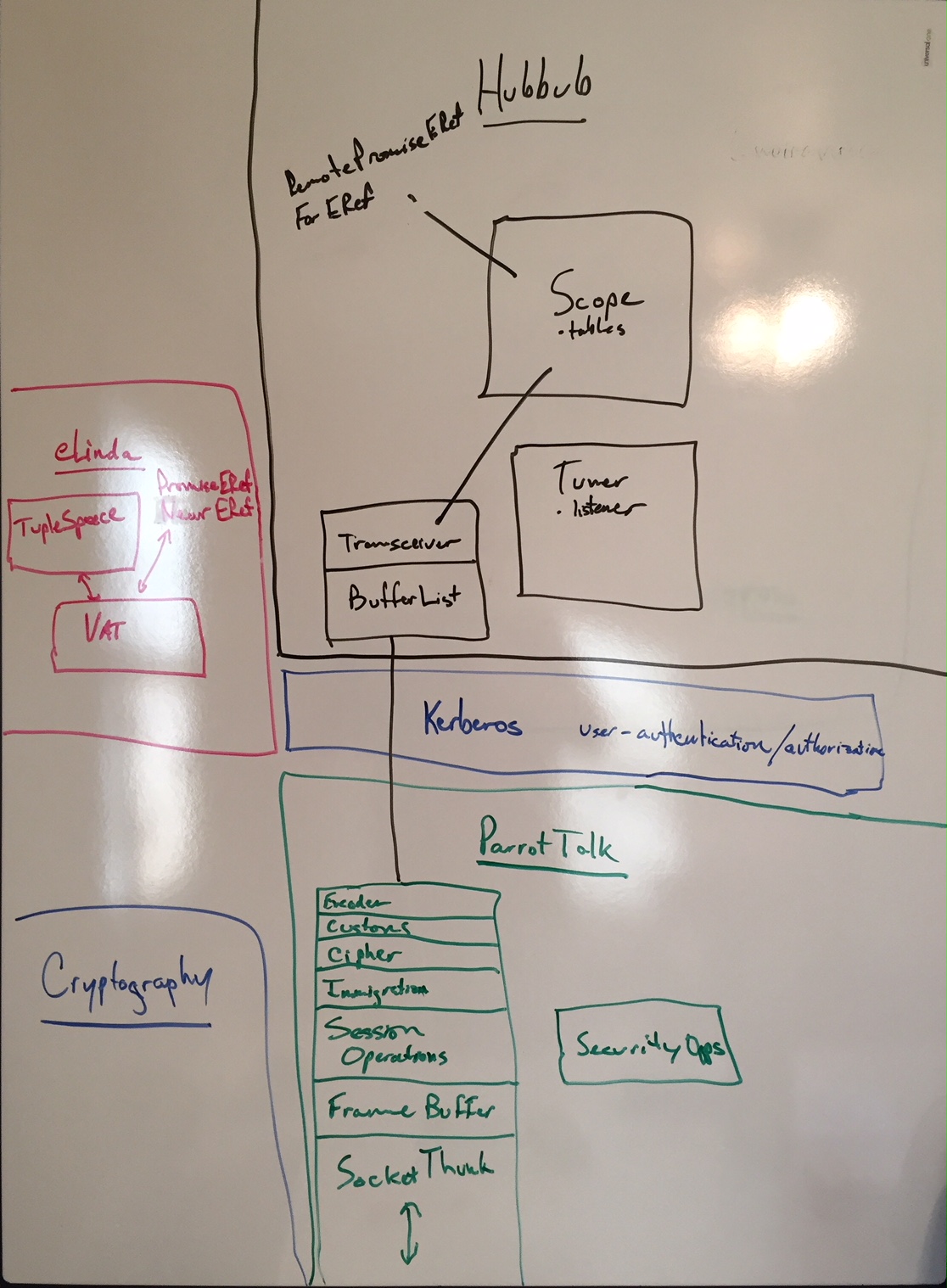
The question I propose you is what is necessary to make Pharo eligible to participate in cloud/BigData? - HH On Thu, Oct 26, 2017 at 10:38, henry <[henry@callistohouse.club]("mailto:henry@callistohouse.club")> wrote:
A Kerberos effort will have to be a group effort. Sideways to my main focus and your allâs main focii.
- HH
On Thu, Oct 26, 2017 at 09:15, henry <[henry@callistohouse.club](""mailto:henry@callistohouse.club"")> wrote:
I think another good service to integrate well to is Elastic Search.
Of the 4 types of integration, I vote for and step forward to volunteer to help Kerberos integration in Pharo. What to do?
- HH
On Thu, Oct 26, 2017 at 09:06, henry <[henry@callistohouse.club]("""mailto:henry@callistohouse.club""")> wrote:
I try posting with a smaller image.
["""hubbub.jpg"""]
- HH
âââ Original Message âââ Subject: Re: [Pharo-users] Smalltalk Argument Local Time: October 26, 2017 8:52 AM UTC Time: October 26, 2017 12:52 PM From: henry@callistohouse.club To: phil@highoctane.be <phil@highoctane.be>, Any question about pharo is welcome <pharo-users@lists.pharo.org>
Perhaps not, or not yet. Perhaps it is the communications foundation for an always-on cloud/bigData control layer.
I would position ParrotTalk as a Kerberos transport. ParrotTalk does 2048-bin key negotiation and subsequent encryption/encoding, both user-supplied.
Please see the attached diagram, co-locating ParrotTalk with my other components.
ParrotTalk does not do user authentication/authorization. Which means to me that I should consider Kerberos authorization/authentication to establish as an integratable transport to play in bigData.
This means you still need a Kerberos client and I need a Kerberos client. How do we start?
- HH
PS: I did much work integrating Kafka into a framework. I was thinking of inserting msg sending replication to a partition count of replicate queues for sending and receiving Hubbub traffic, thus inserting right where Kerberos is in the diagram. I would love to see client coupling for Kerberos, Kafka and Hadoop, while I figure out proper security to make that group happy with this as a possible control layer solution, forking off jobs.
On Thu, Oct 26, 2017 at 03:14, phil@highoctane.be <[phil@highoctane.be](""""mailto:phil@highoctane.be"""")> wrote:
Sure. Current main issue is to have Pharo work with Kerberos as secured Hadoop uses the UGI (UserGroupInformation) thing and that is a black hole of crypto things.
How would you see ParrotTalk work?
I made a XmppTalk thing (binding for libstrophe) for having Pharo images and other stuff talk together (currently using OpenFire/Gajim/Profanity) FWIW
libstrophe does the SSL thing under the hood (using OpenSSL) and is actively maintained. [https://github.com/strophe/libstrophe/blob/master/src/tls_openssl.c](""""https://github.com/strophe/libstrophe/blob/master/src/tls_openssl.c"""")
And I currently work with Kafka so, Pharo as a consumer or producer, sure am interested. But need Kerberos support.
Tell me more about your vision. Even better, draw it in some way :-)
Phil
On Thu, Oct 26, 2017 at 8:43 AM, henry <[henry@callistohouse.club](""""mailto:henry@callistohouse.club"""")> wrote:
This is a goal of ParrotTalk, to bring bit-compatible communications to Squeak, Pharo and Java. This is not an invocation bridge you speak of but a communications bridge to be able to run against Hadoop or whichever big data needs integration with (Kafka). I had hoped it might be adopted for such. Yet again this is not exactly what you were looking for but yet interesting perhaps?
- HH
On Thu, Oct 26, 2017 at 02:17, [phil@highoctane.be](""""mailto:phil@highoctane.be"""") <phil@highoctane.be> wrote:
I like that piece a lot, seeing exactly the described situation in large enterprises.
I made a strategic decision to go with Pharo for the long run for my solutions because it is a stable base on which to build (ok, there are evolutions, but fundamentally, I can rely on it being under control and can maintain solutions in a version).
The rationale is that at a deep level I am really fed up with having to deal with accidental complexity (now having to deal with Spark/Scala/sbt/Java/maven stuff) that makes the dev focus 80% technology drag and 20% net business contribution.
One key thing is that a team needs guidance and Smalltalk makes it easier due to well known ways of doing things.
Now we miss the boat on mobile and bigdata, but this is solvable.
If we had an open Java bridge (and some people in the community have it for Pharo but do not open source it - so this is eminently doable) + Pharo as an embeddable piece (e.g. like Tcl and Lua) and not a big executable we would have a way to embed Pharo in a lot of places (e.g. in the Hadoop ecosystem where fast starting VMs and small footprint would make the cluster capacity x2 or x3 vs uberjars all over the place) this would be a real disruption.
Think about being able to call Pharo from JNA https://github.com/java-native-access/jna the same way we use C with UFFI.
Smalltalk argument for me is that it makes development bearable (even fun and enjoyable would I say) vs the other stacks. That matters.
Phil
On Thu, Oct 26, 2017 at 12:46 AM, Andrew Glynn <aglynn42@gmail.com> wrote:
Thereâs other questions that are relevant to me:
Do I give a f*** about cool looking web apps? No, I donât use web apps if in any way I can avoid it.
Do I give a f*** about mobile apps? No, the screenâs too small to read anything longer than a twit, or anyone with anything worthwhile to say.
Do I give a f*** about the number of libraries in other languages? No, because most of them are crap in every language Iâve had to work in, and the base languages are crap so they have to keep changing radically, and libraries and frameworks therefore also have to and never get any better. The few that are worthwhile I can almost always use from Smalltalk without a problem (read, Blender, ACT-R and Synapse, since every other library/framework Iâve used outside Smalltalk has been a waste of time).
Do I give a f*** about implementing a complex piece of machine learning software in 22 hours, compared to 3 months for the Java version? Well, actually yes, I do, because that was 3 months of my life down the toilet for something that is too slow to be useful in Java.
Any argument depends on your priorities. Iâve written tons of web apps, because I needed to get paid. Iâve written better shitty mobile apps than the average shitty mobile apps. However, Iâm not going to do any of that any longer in crap that never improves, because after 26 years the irritability it produces is more than itâs worth.
A few weeks ago, a recruiter that specializes in Smalltalk called me about a job, although they were well aware I live 1500 miles away from the city I lived in when I had worked through them, to see if Iâd be willing to move back there for a job. That sounds like another âthere arenât enough Smalltalk developers", but it wasnât, because the job wasnât writing Smalltalk. It was writing Java.
The person hiring, though, wouldnât look at anyone who didnât write Smalltalk, because "people who grew up with Java donât know how to write code". I donât agree with that, Iâve known a (very few) good Java developers. I would say, though, that Iâve known far more incompetent ones than good ones, and I canât think of any incompetent Smalltalk developers off the top of my head.
Nor have I ever heard a developer in Smalltalk, or Haskell, or LISP, or even C, complain about how hard maintaining state is or coming up with various hacks to avoid it, which seems to be the main point of every JavaScript based âtechnologyâ. An application is by definition a state-machine, which implies plenty about JS developers on the whole.
If youâre a good developer you can write good code in (nearly) anything. My question then is why would you want to write in crap? The better question is why arenât there more good developers in any language?
Every project I have been able to do in Smalltalk, though, has had one thing in common, the "shit has to work". Companies do use it, in fact I could name 4 large enterprises Iâve worked for whoâve written their own dialects, and they all use it only when "shit has to work". They know itâs more productive, they also know using it for more things would increase the availability of Smalltalk developers.
Why do they not do it? One reason, though it takes a while to recognize it, because management doesnât admit even to themselves why they do it, or not very often. Being inefficient, as long as it doesnât âreallyâ matter, is an advantage to large enterprises because they have resources smaller competitors donât.
Why donât their competitors do it? Because they canât see past an hourly rate, whatâs fashionable, or just new, or because their customers canât. Put more generally, average stupidity that isnât corrected by the market. Fashion affects smaller companies more than larger ones, because they canât afford a few customers walking away because they wanted an app in Electron, even if they canât give any relevant reason for wanting it, and even the samples on the Electron site donât work.
Enterprises can, and do use Smalltalk when it matters. When it doesnât, itâs to their advantage to promote things that are inefficient, buggy and unreliable.
Cost is relevant, but not in the simple way people look at things. A crucial but rarely mentioned perspective on its relevance is that while Java based software runs TV set top boxes, Smalltalk based software runs things like medical equipment, automated defense systems, tanks, etc. Cost becomes largely irrelevant when âshit has to workâ.
Productivity is primarily relevant to less talented developers, in an inversely sense, since unproductive environments and attitudes have a leveling tendency in general, and more specifically make accomplishing what the less talented are capable of in any environment sufficiently laborious for them to have a role. Capability in Smalltalk, as implied by the person hiring for the Java role I mentioned, is a fairly decent means of judging whether someone is a so-so developer or a good one.
The productivity argument is realistically only relevant in the context of an already higher hourly cost. Given that it is relevant at that point, companies that know Smalltalk is more productive would use it outside things that have to be 100%, if their own productivity were relevant to the same degree that competitorsâ productivity is inversely relevant.
All these ways of looking at it are contingent perspectives though. Yes, if the number of libraries is relevant to you, Smalltalk is less attractive, but thatâs only a contingent phenomenon based on the relative popularity of Java and JavaScript, as a result it canât be used as explanatory for that popularity. All the ways of looking at it that are fully determinate are determinate via contingencies of that kind, which for the most part are precisely the other perspectives, including productivity, cost, availability of developers, etc. None of them is in itself anything but a result of the others.
If availability of developers is contingent on popularity (and further, popularity contingent on industry attitudes), to use an example already mentioned in Joachimâs post, then his simultaneous posit of library availability is if anything more contingent on the same popularity, so positing it as a cause and not a result, or merely a correlate, of popularity is incoherent. We can go one step further, and demonstrate that even when large enterprises make something that works reliably available, they fail to promote and support it, which destroys the market for reliable tooling by simultaneously owning it while not promoting it, something IBM is particularly good at. But IBM canât (and if they canât, neither can any other company) operate that way without the tacit agreement of the industry.
To understand it in a more general way, software development has to be looked at in the context where it occurs, and how itâs determined to a large degree by that context, with a specific difference. That difference is itself implicit in the context, i.e. capitalism, but only purely effective in software development. Itâs a result of virtualization as an implicit goal of capitalism, and the disruptions implicit in the virtual but so far only realized completely in software. In terms of that understanding, the analysis of virtualization and disruption as inherent to capitalism is better accomplished in Kapital than in any more recent work.
Or you can simply decide, as Iâve done recently, that working in ways and with tools that prevent doing good work in a reasonable timeframe isnât worthwhile to you, no matter how popular those ways and tools might be, or what the posited reasons are, since at the end popularity is only insofar as it already is. What those tools and methods are depends to a degree on your priorities, but if developers are engineers those priorities canât be completely arbitrary. Engineers are defined by their ability to make things work.
Software as virtual is inherently disruptive, and the software industry disrupts itself too often and too easily to build on anything. A further disruption caused by developers, as engineers, refusing to work with crap that doesnât, i.e. insisting on being engineers, while in itself merely an aggravation of the disruptive tendencies, might have an inverse result.
Using a stable core of technologies as the basis for a more volatile set of products, in the way nearly every other industry does, is the best means we know of to build things both flexibly and reasonably efficiently. The computer hardware industry is the extreme example of this, while the software industry is the extreme contradiction.
From: Pharo-users <pharo-users-bounces@lists.pharo.org> on behalf of David Mason <dmason@ryerson.ca> Reply-To: Any question about pharo is welcome <pharo-users@lists.pharo.org> Date: Tuesday, October 24, 2017 at 11:52 AM To: Any question about pharo is welcome <pharo-users@lists.pharo.org> Subject: Re: [Pharo-users] Smalltalk Argument
PharoJS is working to give you that mobile app/browser app experience. As with others, weâre not there yet, but getting there. See http://pharojs.org
The 67% loved means that 67% of people using Smalltalk (or perhaps have ever used it) want to continue - so itâs presumably a high percentage of a smallish number of people.
On 20 October 2017 at 03:23, jtuchel@objektfabrik.de <jtuchel@objektfabrik.de> wrote:
First of all: Iâd say the question itself is not a question but an excuse. I am not arguing there are enough Smalltalkers or cheap ones. But I think the question is just a way of saying "we donât want to do it for reasons that we ourselves cannot really express". If you are a good developer, learning Smalltalk is easy. If you are a good developer youâve heard the sentence "weâve taken the goos parts from x,y,z and Smalltalk" at least twice a year. So you most likely would like to learn it anyways.
A shortage of developers doesnât exist. What exists is an unwillingness of companies to get people trained in a technology. If Smalltalk was cool and great in their opinion, they wouldnât care. Itâs that simple. As a consultant, Iâve heard that argument so often. Not ferom Startups, but from insurance companies, Banks or Car manufacturers who spend millions on useless, endless meetings and stuff instead of just hiring somebody to teach a couple of developers Smalltalk. Itâs just a lie: the shortage of Smalltalk developers is not a problem.
And, to be honest: what is it we actually are better in by using Smalltalk? Can we build cool looking web apps in extremely short time? No. Can we build mobile Apps with little effort? No. Does our Smalltalk ship lots of great libraries for all kinds of things that are not availabel in similar quality in any other language? Are we lying when we say we are so extremely over-productive as compared to other languages?
I know, all that live debugging stuff and such is great and it is much faster to find & fix a bug in Smalltalk than in any other environment Iâve used so far. But that is really only true for business code. When I need to connect to things or want to build a modern GUI or a web application with a great look&feel, I am nowhere near productive, because I simply have to build my own stuff or learn how to use other external resources. If I want to build something for a mobile device, I will only hear that somebody somewhere has done it before. No docs, no proof, no ready-made tool for me.
Shortage of developers is not really the problem. If Smalltalk was as cool as we like to make ourselves believe, this problem would be non-existent. If somebody took out their iPad and told an audience: "We did this in Smalltalk in 40% of the time it would have taken in Swift", and if that something was a must-have for people, things would be much easier. But nobody has.
I am absolutely over-exaggerating, because I make my living with an SaaS product written in Smalltalk (not Pharo). I have lots of fun with Smalltalk and - as you - am convince that many parts of what weâve done so far wouldâve taken much longer or even be impossible in other languages. But the advantage was eaten by our extremely steep learning curve for web technologies and for building something that works almost as well as tools like Angular or jQuery Mobile.
Smalltalk is cool, and the day somebody shows me something like Googleâs flutter in Smalltalk, I am ready to bet a lot on a bright future for Smalltalk. But until then, Iâd say these arguments about productivity are just us trying to make ourselves believe weâre still the top of the food chain. Weâve done that for almost thirty years now and still arenât ready to stop it. But weâve been lying to ourselves and still do so.
I donât think there is a point in discussing about the usefulness of a language using an argument like the number or ready-made developers. That is just an argument they know you canât win. The real question is and should be: what is the benefit of using Smalltalk. Our productivity argument is a lie as soon as we have to build something that uses or runs on technology that has been invented after 1990.
Okay, shoot ;-)
Joachim
â ââââââââââââââââââââââââ Objektfabrik Joachim Tuchel mailto:jtuchel@objektfabrik.de Fliederweg 1 http://www.objektfabrik.de D-71640 Ludwigsburg http://joachimtuchel.wordpress.com Telefon: +49 7141 56 10 86 0 Fax: +49 7141 56 10 86 1
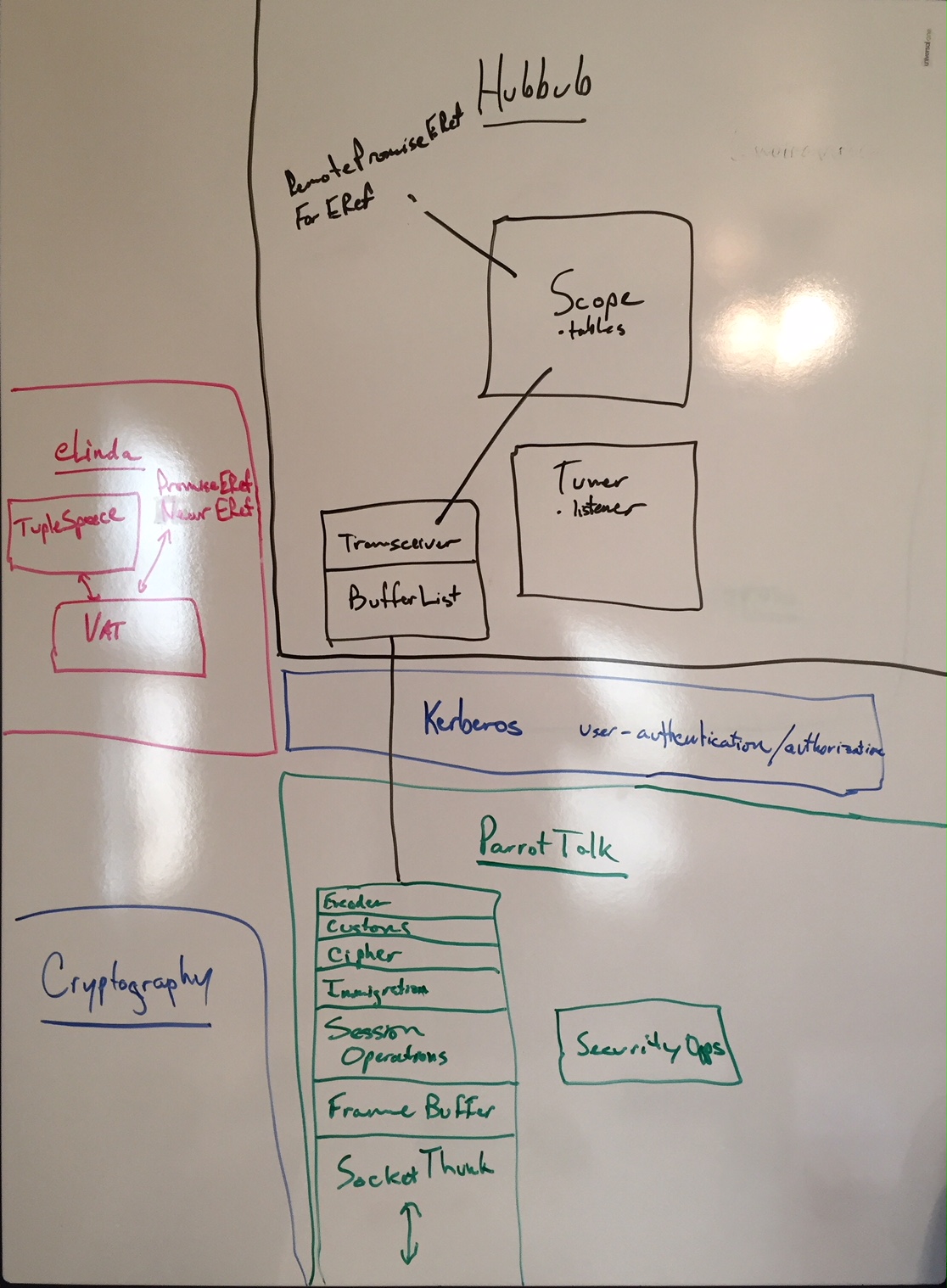
This all sounds very interesting. What is the idea? Wrap libkrb5 through UFFI or implement it in Smalltalk? On 10/26/2017 04:38 PM, henry wrote:
A Kerberos effort will have to be a group effort. Sideways to my main focus and your allâs main focii.
- HH
On Thu, Oct 26, 2017 at 09:15, henry <henry@callistohouse.club <%22mailto:henry@callistohouse.club%22>> wrote:
I think another good service to integrate well to is Elastic Search.
Of the 4 types of integration, I vote for and step forward to volunteer to help Kerberos integration in Pharo. What to do?
- HH
On Thu, Oct 26, 2017 at 09:06, henry <henry@callistohouse.club <%22%22mailto:henry@callistohouse.club%22%22>> wrote:
I try posting with a smaller image.
""hubbub.jpg""
- HH
âââ Original Message âââ Subject: Re: [Pharo-users] Smalltalk Argument Local Time: October 26, 2017 8:52 AM UTC Time: October 26, 2017 12:52 PM From: henry@callistohouse.club To: phil@highoctane.be <phil@highoctane.be>, Any question about pharo is welcome <pharo-users@lists.pharo.org>
Perhaps not, or not yet. Perhaps it is the communications foundation for an always-on cloud/bigData control layer.
I would position ParrotTalk as a Kerberos transport. ParrotTalk does 2048-bin key negotiation and subsequent encryption/encoding, both user-supplied.Â
Please see the attached diagram, co-locating ParrotTalk with my other components.
ParrotTalk does not do user authentication/authorization. Which means to me that I should consider Kerberos authorization/authentication to establish as an integratable transport to play in bigData.
This means you still need a Kerberos client and I need a Kerberos client. How do we start?
- HH
PS: I did much work integrating Kafka into a framework. I was thinking of inserting msg sending replication to a partition count of replicate queues for sending and receiving Hubbub traffic, thus inserting right where Kerberos is in the diagram. I would love to see client coupling for Kerberos, Kafka and Hadoop, while I figure out proper security to make that group happy with this as a possible control layer solution, forking off jobs.
On Thu, Oct 26, 2017 at 03:14, phil@highoctane.be <phil@highoctane.be <%22%22%22mailto:phil@highoctane.be%22%22%22>> wrote:
Sure. Current main issue is to have Pharo work with Kerberos as secured Hadoop uses the UGI (UserGroupInformation) thing and that is a black hole of crypto things.Â
How would you see ParrotTalk work?Â
I made a XmppTalk thing (binding for libstrophe) for having Pharo images and other stuff talk together (currently using OpenFire/Gajim/Profanity) FWIW
See https://docs.google.com/presentation/d/1HTG3GB3xdwlje8wADZPjUQNIyA6tmuxyZz1U... <%22%22%22https://docs.google.com/presentation/d/1HTG3GB3xdwlje8wADZPjUQNIyA6tmuxyZz1U...>
libstrophe does the SSL thing under the hood (using OpenSSL) and is actively maintained. https://github.com/strophe/libstrophe/blob/master/src/tls_openssl.c <%22%22%22https://github.com/strophe/libstrophe/blob/master/src/tls_openssl.c%22%22%22>
And I currently work with Kafka so, Pharo as a consumer or producer, sure am interested. But need Kerberos support.
Tell me more about your vision. Even better, draw it in some way :-)
Phil
On Thu, Oct 26, 2017 at 8:43 AM, henry <henry@callistohouse.club <%22%22%22mailto:henry@callistohouse.club%22%22%22>> wrote:
This is a goal of ParrotTalk, to bring bit-compatible communications to Squeak, Pharo and Java. This is not an invocation bridge you speak of but a communications bridge to be able to run against Hadoop or whichever big data needs integration with (Kafka). I had hoped it might be adopted for such. Yet again this is not exactly what you were looking for but yet interesting perhaps?
- HH
On Thu, Oct 26, 2017 at 02:17, phil@highoctane.be <%22%22%22mailto:phil@highoctane.be%22%22%22> <phil@highoctane.be> wrote:
I like that piece a lot, seeing exactly the described situation in large enterprises.
I made a strategic decision to go with Pharo for the long run for my solutions because it is a stable base on which to build (ok, there are evolutions, but fundamentally, I can rely on it being under control and can maintain solutions in a version).
The rationale is that at a deep level I am really fed up with having to deal with accidental complexity (now having to deal with Spark/Scala/sbt/Java/maven stuff) that makes the dev focus 80% technology drag and 20% net business contribution.
One key thing is that a team needs guidance and Smalltalk makes it easier due to well known ways of doing things.
Now we miss the boat on mobile and bigdata, but this is solvable.Â
If we had an open Java bridge (and some people in the community have it for Pharo but do not open source it - so this is eminently doable) + Pharo as an embeddable piece (e.g. like Tcl and Lua) and not a big executable we would have a way to embed Pharo in a lot of places (e.g. in the Hadoop ecosystem where fast starting VMs and small footprint would make the cluster capacity x2 or x3 vs uberjars all over the place) Â this would be a real disruption.
Think about being able to call Pharo from JNAÂ https://github.com/java-native-access/jna the same way we use C with UFFI.
Smalltalk argument for me is that it makes development bearable (even fun and enjoyable would I say) vs the other stacks. That matters.
Phil
I have no idea which is best. For being able to say we use industry standard Kerberos, calling an accepted implementation seems wise, like OpenSSL support. - HH On Thu, Oct 26, 2017 at 11:39, Paulo R. Dellani <dellani@pobox.com> wrote:
This all sounds very interesting. What is the idea? Wrap libkrb5 through UFFI or implement it in Smalltalk?
On 10/26/2017 04:38 PM, henry wrote:
A Kerberos effort will have to be a group effort. Sideways to my main focus and your allâs main focii.
- HH
On Thu, Oct 26, 2017 at 09:15, henry <[henry@callistohouse.club](%22mailto:henry@callistohouse.club%22)> wrote:
I think another good service to integrate well to is Elastic Search.
Of the 4 types of integration, I vote for and step forward to volunteer to help Kerberos integration in Pharo. What to do?
- HH
On Thu, Oct 26, 2017 at 09:06, henry <[henry@callistohouse.club](%22%22mailto:henry@callistohouse.club%22%22)> wrote:
I try posting with a smaller image.
[""hubbub.jpg""]
- HH
âââ Original Message âââ Subject: Re: [Pharo-users] Smalltalk Argument Local Time: October 26, 2017 8:52 AM UTC Time: October 26, 2017 12:52 PM From: henry@callistohouse.club To: phil@highoctane.be [<phil@highoctane.be>](mailto:phil@highoctane.be), Any question about pharo is welcome [<pharo-users@lists.pharo.org>](mailto:pharo-users@lists.pharo.org)
Perhaps not, or not yet. Perhaps it is the communications foundation for an always-on cloud/bigData control layer.
I would position ParrotTalk as a Kerberos transport. ParrotTalk does 2048-bin key negotiation and subsequent encryption/encoding, both user-supplied.
Please see the attached diagram, co-locating ParrotTalk with my other components.
ParrotTalk does not do user authentication/authorization. Which means to me that I should consider Kerberos authorization/authentication to establish as an integratable transport to play in bigData.
This means you still need a Kerberos client and I need a Kerberos client. How do we start?
- HH
PS: I did much work integrating Kafka into a framework. I was thinking of inserting msg sending replication to a partition count of replicate queues for sending and receiving Hubbub traffic, thus inserting right where Kerberos is in the diagram. I would love to see client coupling for Kerberos, Kafka and Hadoop, while I figure out proper security to make that group happy with this as a possible control layer solution, forking off jobs.
On Thu, Oct 26, 2017 at 03:14, phil@highoctane.be <[phil@highoctane.be](%22%22%22mailto:phil@highoctane.be%22%22%22)> wrote:
Sure. Current main issue is to have Pharo work with Kerberos as secured Hadoop uses the UGI (UserGroupInformation) thing and that is a black hole of crypto things.
How would you see ParrotTalk work?
I made a XmppTalk thing (binding for libstrophe) for having Pharo images and other stuff talk together (currently using OpenFire/Gajim/Profanity) FWIW
libstrophe does the SSL thing under the hood (using OpenSSL) and is actively maintained. [https://github.com/strophe/libstrophe/blob/master/src/tls_openssl.c](%22%22%22https://github.com/strophe/libstrophe/blob/master/src/tls_openssl.c%22%22%22)
And I currently work with Kafka so, Pharo as a consumer or producer, sure am interested. But need Kerberos support.
Tell me more about your vision. Even better, draw it in some way :-)
Phil
On Thu, Oct 26, 2017 at 8:43 AM, henry <[henry@callistohouse.club](%22%22%22mailto:henry@callistohouse.club%22%22%22)> wrote:
This is a goal of ParrotTalk, to bring bit-compatible communications to Squeak, Pharo and Java. This is not an invocation bridge you speak of but a communications bridge to be able to run against Hadoop or whichever big data needs integration with (Kafka). I had hoped it might be adopted for such. Yet again this is not exactly what you were looking for but yet interesting perhaps?
- HH
On Thu, Oct 26, 2017 at 02:17, [phil@highoctane.be](%22%22%22mailto:phil@highoctane.be%22%22%22) < phil@highoctane.be> wrote:
I like that piece a lot, seeing exactly the described situation in large enterprises.
I made a strategic decision to go with Pharo for the long run for my solutions because it is a stable base on which to build (ok, there are evolutions, but fundamentally, I can rely on it being under control and can maintain solutions in a version).
The rationale is that at a deep level I am really fed up with having to deal with accidental complexity (now having to deal with Spark/Scala/sbt/Java/maven stuff) that makes the dev focus 80% technology drag and 20% net business contribution.
One key thing is that a team needs guidance and Smalltalk makes it easier due to well known ways of doing things.
Now we miss the boat on mobile and bigdata, but this is solvable.
If we had an open Java bridge (and some people in the community have it for Pharo but do not open source it - so this is eminently doable) + Pharo as an embeddable piece (e.g. like Tcl and Lua) and not a big executable we would have a way to embed Pharo in a lot of places (e.g. in the Hadoop ecosystem where fast starting VMs and small footprint would make the cluster capacity x2 or x3 vs uberjars all over the place) this would be a real disruption.
Think about being able to call Pharo from JNA https://github.com/java-native-access/jna the same way we use C with UFFI.
Smalltalk argument for me is that it makes development bearable (even fun and enjoyable would I say) vs the other stacks. That matters.
Phil
There are two key Kerberos implementations one can use with Hadoop. One is the FreeIpa/RedHat IdM. The other is ActiveDirectory. I am using FreeIPA which bundles MIT Kerberos/389/sssd and more for making a CA etc. Works wonderfullý well. AD is well ... part of the corporate landdscape. Most of Kerberos needs are done with Java in Hadoop. But details are buried in private Sun classes.. Google Madness beyond the gate hadoop for some Lovecraftian quotes describing the situation along educated info. Phil On Thu, Oct 26, 2017 at 6:23 PM, henry <henry@callistohouse.club> wrote:
I have no idea which is best. For being able to say we use industry standard Kerberos, calling an accepted implementation seems wise, like OpenSSL support.
- HH
On Thu, Oct 26, 2017 at 11:39, Paulo R. Dellani <dellani@pobox.com> wrote:
This all sounds very interesting. What is the idea? Wrap libkrb5 through UFFI or implement it in Smalltalk?
On 10/26/2017 04:38 PM, henry wrote:
A Kerberos effort will have to be a group effort. Sideways to my main focus and your allâs main focii.
- HH
On Thu, Oct 26, 2017 at 09:15, henry <henry@callistohouse.club> wrote:
I think another good service to integrate well to is Elastic Search.
Of the 4 types of integration, I vote for and step forward to volunteer to help Kerberos integration in Pharo. What to do?
- HH
On Thu, Oct 26, 2017 at 09:06, henry <henry@callistohouse.club> wrote:
I try posting with a smaller image.
[image: ""hubbub.jpg""]
- HH
âââ Original Message âââ Subject: Re: [Pharo-users] Smalltalk Argument Local Time: October 26, 2017 8:52 AM UTC Time: October 26, 2017 12:52 PM From: henry@callistohouse.club To: phil@highoctane.be <phil@highoctane.be> <phil@highoctane.be>, Any question about pharo is welcome <pharo-users@lists.pharo.org> <pharo-users@lists.pharo.org>
Perhaps not, or not yet. Perhaps it is the communications foundation for an always-on cloud/bigData control layer.
I would position ParrotTalk as a Kerberos transport. ParrotTalk does 2048-bin key negotiation and subsequent encryption/encoding, both user-supplied.
Please see the attached diagram, co-locating ParrotTalk with my other components.
ParrotTalk does not do user authentication/authorization. Which means to me that I should consider Kerberos authorization/authentication to establish as an integratable transport to play in bigData.
This means you still need a Kerberos client and I need a Kerberos client. How do we start?
- HH
PS: I did much work integrating Kafka into a framework. I was thinking of inserting msg sending replication to a partition count of replicate queues for sending and receiving Hubbub traffic, thus inserting right where Kerberos is in the diagram. I would love to see client coupling for Kerberos, Kafka and Hadoop, while I figure out proper security to make that group happy with this as a possible control layer solution, forking off jobs.
On Thu, Oct 26, 2017 at 03:14, phil@highoctane.be <phil@highoctane.be> wrote:
Sure. Current main issue is to have Pharo work with Kerberos as secured Hadoop uses the UGI (UserGroupInformation) thing and that is a black hole of crypto things.
How would you see ParrotTalk work?
I made a XmppTalk thing (binding for libstrophe) for having Pharo images and other stuff talk together (currently using OpenFire/Gajim/Profanity) FWIW
See https://docs.google.com/presentation/d/1HTG3GB3xdwlje8wADZPjUQNIyA6tm uxyZz1UaX5ikEU/edit?usp=sharing
libstrophe does the SSL thing under the hood (using OpenSSL) and is actively maintained. https://github.com/strophe/libstrophe/blob/master/src/tls_openssl.c
And I currently work with Kafka so, Pharo as a consumer or producer, sure am interested. But need Kerberos support.
Tell me more about your vision. Even better, draw it in some way :-)
Phil
On Thu, Oct 26, 2017 at 8:43 AM, henry <henry@callistohouse.club> wrote:
This is a goal of ParrotTalk, to bring bit-compatible communications to Squeak, Pharo and Java. This is not an invocation bridge you speak of but a communications bridge to be able to run against Hadoop or whichever big data needs integration with (Kafka). I had hoped it might be adopted for such. Yet again this is not exactly what you were looking for but yet interesting perhaps?
- HH
On Thu, Oct 26, 2017 at 02:17, phil@highoctane.be < phil@highoctane.be> wrote:
I like that piece a lot, seeing exactly the described situation in large enterprises.
I made a strategic decision to go with Pharo for the long run for my solutions because it is a stable base on which to build (ok, there are evolutions, but fundamentally, I can rely on it being under control and can maintain solutions in a version).
The rationale is that at a deep level I am really fed up with having to deal with accidental complexity (now having to deal with Spark/Scala/sbt/Java/maven stuff) that makes the dev focus 80% technology drag and 20% net business contribution.
One key thing is that a team needs guidance and Smalltalk makes it easier due to well known ways of doing things.
Now we miss the boat on mobile and bigdata, but this is solvable.
If we had an open Java bridge (and some people in the community have it for Pharo but do not open source it - so this is eminently doable) + Pharo as an embeddable piece (e.g. like Tcl and Lua) and not a big executable we would have a way to embed Pharo in a lot of places (e.g. in the Hadoop ecosystem where fast starting VMs and small footprint would make the cluster capacity x2 or x3 vs uberjars all over the place) this would be a real disruption.
Think about being able to call Pharo from JNA https://github.com/java-na tive-access/jna the same way we use C with UFFI.
Smalltalk argument for me is that it makes development bearable (even fun and enjoyable would I say) vs the other stacks. That matters.
Phil
I refer to it as âCraptive Directoryâ, the only reliable way Iâve found to use it is to federate it via WSO2 IS or OpenIDM. You forgot Sunâs implementation, btw, which is cleaner than either. Sent from Mail for Windows 10 From: phil@highoctane.be Sent: Thursday, October 26, 2017 6:07 PM To: henry; Any question about pharo is welcome Subject: Re: [Pharo-users] Smalltalk Argument There are two key Kerberos implementations one can use with Hadoop. One is the FreeIpa/RedHat IdM. The other is ActiveDirectory. I am using FreeIPA which bundles MIT Kerberos/389/sssd and more for making a CA etc. Works wonderfullý well. AD is well ... part of the corporate landdscape. Most of Kerberos needs are done with Java in Hadoop. But details are buried in private Sun classes.. Google Madness beyond the gate hadoop for some Lovecraftian quotes describing the situation along educated info. Phil On Thu, Oct 26, 2017 at 6:23 PM, henry <henry@callistohouse.club> wrote: I have no idea which is best. For being able to say we use industry standard Kerberos, calling an accepted implementation seems wise, like OpenSSL support. - HH On Thu, Oct 26, 2017 at 11:39, Paulo R. Dellani <dellani@pobox.com> wrote: This all sounds very interesting. What is the idea? Wrap libkrb5 through UFFI or implement it in Smalltalk? On 10/26/2017 04:38 PM, henry wrote: A Kerberos effort will have to be a group effort. Sideways to my main focus and your allâs main focii. - HH On Thu, Oct 26, 2017 at 09:15, henry <henry@callistohouse.club> wrote: I think another good service to integrate well to is Elastic Search. Of the 4 types of integration, I vote for and step forward to volunteer to help Kerberos integration in Pharo. What to do? - HH On Thu, Oct 26, 2017 at 09:06, henry <henry@callistohouse.club> wrote: I try posting with a smaller image. - HH âââ Original Message âââ Subject: Re: [Pharo-users] Smalltalk Argument Local Time: October 26, 2017 8:52 AM UTC Time: October 26, 2017 12:52 PM From: henry@callistohouse.club To: phil@highoctane.be <phil@highoctane.be>, Any question about pharo is welcome <pharo-users@lists.pharo.org> Perhaps not, or not yet. Perhaps it is the communications foundation for an always-on cloud/bigData control layer. I would position ParrotTalk as a Kerberos transport. ParrotTalk does 2048-bin key negotiation and subsequent encryption/encoding, both user-supplied. Please see the attached diagram, co-locating ParrotTalk with my other components. ParrotTalk does not do user authentication/authorization. Which means to me that I should consider Kerberos authorization/authentication to establish as an integratable transport to play in bigData. This means you still need a Kerberos client and I need a Kerberos client. How do we start? - HH PS: I did much work integrating Kafka into a framework. I was thinking of inserting msg sending replication to a partition count of replicate queues for sending and receiving Hubbub traffic, thus inserting right where Kerberos is in the diagram. I would love to see client coupling for Kerberos, Kafka and Hadoop, while I figure out proper security to make that group happy with this as a possible control layer solution, forking off jobs. On Thu, Oct 26, 2017 at 03:14, phil@highoctane.be <phil@highoctane.be> wrote: Sure. Current main issue is to have Pharo work with Kerberos as secured Hadoop uses the UGI (UserGroupInformation) thing and that is a black hole of crypto things. How would you see ParrotTalk work? I made a XmppTalk thing (binding for libstrophe) for having Pharo images and other stuff talk together (currently using OpenFire/Gajim/Profanity) FWIW See https://docs.google.com/presentation/d/1HTG3GB3xdwlje8wADZPjUQNIyA6tmuxyZz1U... libstrophe does the SSL thing under the hood (using OpenSSL) and is actively maintained. https://github.com/strophe/libstrophe/blob/master/src/tls_openssl.c And I currently work with Kafka so, Pharo as a consumer or producer, sure am interested. But need Kerberos support. Tell me more about your vision. Even better, draw it in some way :-) Phil On Thu, Oct 26, 2017 at 8:43 AM, henry <henry@callistohouse.club> wrote: This is a goal of ParrotTalk, to bring bit-compatible communications to Squeak, Pharo and Java. This is not an invocation bridge you speak of but a communications bridge to be able to run against Hadoop or whichever big data needs integration with (Kafka). I had hoped it might be adopted for such. Yet again this is not exactly what you were looking for but yet interesting perhaps? - HH On Thu, Oct 26, 2017 at 02:17, phil@highoctane.be < phil@highoctane.be> wrote: I like that piece a lot, seeing exactly the described situation in large enterprises. I made a strategic decision to go with Pharo for the long run for my solutions because it is a stable base on which to build (ok, there are evolutions, but fundamentally, I can rely on it being under control and can maintain solutions in a version). The rationale is that at a deep level I am really fed up with having to deal with accidental complexity (now having to deal with Spark/Scala/sbt/Java/maven stuff) that makes the dev focus 80% technology drag and 20% net business contribution. One key thing is that a team needs guidance and Smalltalk makes it easier due to well known ways of doing things. Now we miss the boat on mobile and bigdata, but this is solvable. If we had an open Java bridge (and some people in the community have it for Pharo but do not open source it - so this is eminently doable) + Pharo as an embeddable piece (e.g. like Tcl and Lua) and not a big executable we would have a way to embed Pharo in a lot of places (e.g. in the Hadoop ecosystem where fast starting VMs and small footprint would make the cluster capacity x2 or x3 vs uberjars all over the place)  this would be a real disruption. Think about being able to call Pharo from JNA https://github.com/java-native-access/jna the same way we use C with UFFI. Smalltalk argument for me is that it makes development bearable (even fun and enjoyable would I say) vs the other stacks. That matters. Phil
One thing Iâm working on is a bridge between Pharo and F-Script. F-Script is, basically, a Smalltalk dialect, as is obvious from the screenshot. However for MacOS and iOS, it allows you to bypass the static Objective-C API interface and debug / modify or even write applications directly in the system. To do that you âinjectâ F-Script into the OS. The ability to so has a specific implication, though. MacOS and iOS are themselves written in and as a dialect of Smalltalk. (were it simply an overlay on Objective-C, it wouldnât be able to do things that are impossible in Objective-C, and it wouldnât need to be âinjectedâ in order to run). Every implementation of Objective-C , bar GNUâs useless imitation, compiles to Smalltalk. No surprise that Appleâs does, as well. In any event, it will allow Pharo code to be mapped to MacOS and iOS objects, injected into the system dynamically, and modified / debugged dynamically using the Pharo tools. The result, at least as far as iOS is concerned, may make Pharo actually the most powerful way to program it, well beyond XCode alone, along with doing the same for MacOS. Android is another issue, although the Raspbian port of Pharo should be relatively easy to port to it. For me, unless someone had a use case, I donât have one myself for Android. Iâve tried nearly every version, because Iâd love to support an OSS ecosystem, unfortunately using it compared to the iPhone is still like driving a Fiero based kit car compared to an actual Ferrari. As far as JNI, while I see your point, JNI is such a PITA that few Java developers know it. My usual workaround is to use Stamp and Synapse, which has the further advantage of allowing Java to âthrottleâ data that the JVM canât deal with at full speed. As far as dealing with other JVM languages, PetitParser or SmaCC can generate bytecode rather than Java or other JVM code, and that allows libs to be written that utilize Synapse to talk to Pharo. It isnât necessarily an ideal solution, but a possible one without having to support umpteen environments. Another potential way of accomplishing that is to use NetRexx, a declarative JVM language, which is both easy and terse, and like SQL, generates the actual bytecode rather than precompiling to it. For instance, imagine the code needed for a simple âhello worldâ in Java, then compare: Say âhello worldâ Since it generates virtually the same bytecode, it may be an easy way to do it. With the last statement, that expresses really well the exact reason I no longer want to work in most other environments ð. Tc Andrew Sent from Mail for Windows 10 From: phil@highoctane.be Sent: Thursday, October 26, 2017 2:19 AM To: Any question about pharo is welcome Subject: Re: [Pharo-users] Smalltalk Argument I like that piece a lot, seeing exactly the described situation in large enterprises. I made a strategic decision to go with Pharo for the long run for my solutions because it is a stable base on which to build (ok, there are evolutions, but fundamentally, I can rely on it being under control and can maintain solutions in a version). The rationale is that at a deep level I am really fed up with having to deal with accidental complexity (now having to deal with Spark/Scala/sbt/Java/maven stuff) that makes the dev focus 80% technology drag and 20% net business contribution. One key thing is that a team needs guidance and Smalltalk makes it easier due to well known ways of doing things. Now we miss the boat on mobile and bigdata, but this is solvable. If we had an open Java bridge (and some people in the community have it for Pharo but do not open source it - so this is eminently doable) + Pharo as an embeddable piece (e.g. like Tcl and Lua) and not a big executable we would have a way to embed Pharo in a lot of places (e.g. in the Hadoop ecosystem where fast starting VMs and small footprint would make the cluster capacity x2 or x3 vs uberjars all over the place)  this would be a real disruption. Think about being able to call Pharo from JNA https://github.com/java-native-access/jna the same way we use C with UFFI. Smalltalk argument for me is that it makes development bearable (even fun and enjoyable would I say) vs the other stacks. That matters. Phil On Thu, Oct 26, 2017 at 12:46 AM, Andrew Glynn <aglynn42@gmail.com> wrote: Thereâs other questions that are relevant to me:  Do I give a f*** about cool looking web apps? No, I donât use web apps if in any way I can avoid it.  Do I give a f*** about mobile apps? No, the screenâs too small to read anything longer than a twit, or anyone with anything worthwhile to say.  Do I give a f*** about the number of libraries in other languages? No, because most of them are crap in every language Iâve had to work in, and the base languages are crap so they have to keep changing radically, and libraries and frameworks therefore also have to and never get any better. The few that are worthwhile I can almost always use from Smalltalk without a problem (read, Blender, ACT-R and Synapse, since every other library/framework Iâve used outside Smalltalk has been a waste of time).  Do I give a f*** about implementing a complex piece of machine learning software in 22 hours, compared to 3 months for the Java version? Well, actually yes, I do, because that was 3 months of my life down the toilet for something that is too slow to be useful in Java.  Any argument depends on your priorities. Iâve written tons of web apps, because I needed to get paid. Iâve written better shitty mobile apps than the average shitty mobile apps. However, Iâm not going to do any of that any longer in crap that never improves, because after 26 years the irritability it produces is more than itâs worth.  A few weeks ago, a recruiter that specializes in Smalltalk called me about a job, although they were well aware I live 1500 miles away from the city I lived in when I had worked through them, to see if Iâd be willing to move back there for a job. That sounds like another âthere arenât enough Smalltalk developersâ, but it wasnât, because the job wasnât writing Smalltalk. It was writing Java.  The person hiring, though, wouldnât look at anyone who didnât write Smalltalk, because âpeople who grew up with Java donât know how to write codeâ. I donât agree with that, Iâve known a (very few) good Java developers. I would say, though, that Iâve known far more incompetent ones than good ones, and I canât think of any incompetent Smalltalk developers off the top of my head.  Nor have I ever heard a developer in Smalltalk, or Haskell, or LISP, or even C, complain about how hard maintaining state is or coming up with various hacks to avoid it, which seems to be the main point of every JavaScript based âtechnologyâ. An application is by definition a state-machine, which implies plenty about JS developers on the whole.  If youâre a good developer you can write good code in (nearly) anything. My question then is why would you want to write in crap? The better question is why arenât there more good developers in any language?  Every project I have been able to do in Smalltalk, though, has had one thing in common, the âshit has to workâ. Companies do use it, in fact I could name 4 large enterprises Iâve worked for whoâve written their own dialects, and they all use it only when âshit has to workâ. They know itâs more productive, they also know using it for more things would increase the availability of Smalltalk developers.  Why do they not do it? One reason, though it takes a while to recognize it, because management doesnât admit even to themselves why they do it, or not very often. Being inefficient, as long as it doesnât âreallyâ matter, is an advantage to large enterprises because they have resources smaller competitors donât.  Why donât their competitors do it? Because they canât see past an hourly rate, whatâs fashionable, or just new, or because their customers canât. Put more generally, average stupidity that isnât corrected by the market. Fashion affects smaller companies more than larger ones, because they canât afford a few customers walking away because they wanted an app in Electron, even if they canât give any relevant reason for wanting it, and even the samples on the Electron site donât work.  Enterprises can, and do use Smalltalk when it matters. When it doesnât, itâs to their advantage to promote things that are inefficient, buggy and unreliable.  Cost is relevant, but not in the simple way people look at things. A crucial but rarely mentioned perspective on its relevance is that while Java based software runs TV set top boxes, Smalltalk based software runs things like medical equipment, automated defense systems, tanks, etc. Cost becomes largely irrelevant when âshit has to workâ.  Productivity is primarily relevant to less talented developers, in an inversely sense, since unproductive environments and attitudes have a leveling tendency in general, and more specifically make accomplishing what the less talented are capable of in any environment sufficiently laborious for them to have a role. Capability in Smalltalk, as implied by the person hiring for the Java role I mentioned, is a fairly decent means of judging whether someone is a so-so developer or a good one.  The productivity argument is realistically only relevant in the context of an already higher hourly cost. Given that it is relevant at that point, companies that know Smalltalk is more productive would use it outside things that have to be 100%, if their own productivity were relevant to the same degree that competitorsâ productivity is inversely relevant.  All these ways of looking at it are contingent perspectives though. Yes, if the number of libraries is relevant to you, Smalltalk is less attractive, but thatâs only a contingent phenomenon based on the relative popularity of Java and JavaScript, as a result it canât be used as explanatory for that popularity. All the ways of looking at it that are fully determinate are determinate via contingencies of that kind, which for the most part are precisely the other perspectives, including productivity, cost, availability of developers, etc. None of them is in itself anything but a result of the others.  If availability of developers is contingent on popularity (and further, popularity contingent on industry attitudes), to use an example already mentioned in Joachimâs post, then his simultaneous posit of library availability is if anything more contingent on the same popularity, so positing it as a cause and not a result, or merely a correlate, of popularity is incoherent. We can go one step further, and demonstrate that even when large enterprises make something that works reliably available, they fail to promote and support it, which destroys the market for reliable tooling by simultaneously owning it while not promoting it, something IBM is particularly good at. But IBM canât (and if they canât, neither can any other company) operate that way without the tacit agreement of the industry.  To understand it in a more general way, software development has to be looked at in the context where it occurs, and how itâs determined to a large degree by that context, with a specific difference. That difference is itself implicit in the context, i.e. capitalism, but only purely effective in software development. Itâs a result of virtualization as an implicit goal of capitalism, and the disruptions implicit in the virtual but so far only realized completely in software. In terms of that understanding, the analysis of virtualization and disruption as inherent to capitalism is better accomplished in Kapital than in any more recent work.  Or you can simply decide, as Iâve done recently, that working in ways and with tools that prevent doing good work in a reasonable timeframe isnât worthwhile to you, no matter how popular those ways and tools might be, or what the posited reasons are, since at the end popularity is only insofar as it already is. What those tools and methods are depends to a degree on your priorities, but if developers are engineers those priorities canât be completely arbitrary. Engineers are defined by their ability to make things work.  Software as virtual is inherently disruptive, and the software industry disrupts itself too often and too easily to build on anything. A further disruption caused by developers, as engineers, refusing to work with crap that doesnât, i.e. insisting on being engineers, while in itself merely an aggravation of the disruptive tendencies, might have an inverse result.  Using a stable core of technologies as the basis for a more volatile set of products, in the way nearly every other industry does, is the best means we know of to build things both flexibly and reasonably efficiently. The computer hardware industry is the extreme example of this, while the software industry is the extreme contradiction.  From: Pharo-users <pharo-users-bounces@lists.pharo.org> on behalf of David Mason <dmason@ryerson.ca> Reply-To: Any question about pharo is welcome <pharo-users@lists.pharo.org> Date: Tuesday, October 24, 2017 at 11:52 AM To: Any question about pharo is welcome <pharo-users@lists.pharo.org> Subject: Re: [Pharo-users] Smalltalk Argument  PharoJS is working to give you that mobile app/browser app experience. As with others, we're not there yet, but getting there. See http://pharojs.org  The 67% loved means that 67% of people using Smalltalk (or perhaps have ever used it) want to continue - so it's presumably a high percentage of a smallish number of people.  On 20 October 2017 at 03:23, jtuchel@objektfabrik.de <jtuchel@objektfabrik.de> wrote: First of all: I'd say the question itself is not a question but an excuse. I am not arguing there are enough Smalltalkers or cheap ones. But I think the question is just a way of saying "we don't want to do it for reasons that we ourselves cannot really express". If you are a good developer, learning Smalltalk is easy. If you are a good developer you've heard the sentence "we've taken the goos parts from x,y,z and Smalltalk" at least twice a year. So you most likely would like to learn it anyways. A shortage of developers doesn't exist. What exists is an unwillingness of companies to get people trained in a technology. If Smalltalk was cool and great in their opinion, they wouldn't care. It's that simple. As a consultant, I've heard that argument so often. Not ferom Startups, but from insurance companies, Banks or Car manufacturers who spend millions on useless, endless meetings and stuff instead of just hiring somebody to teach a couple of developers Smalltalk. It's just a lie: the shortage of Smalltalk developers is not a problem. And, to be honest: what is it we actually are better in by using Smalltalk? Can we build cool looking web apps in extremely short time? No. Can we build mobile Apps with little effort? No. Does our Smalltalk ship lots of great libraries for all kinds of things that are not availabel in similar quality in any other language? Are we lying when we say we are so extremely over-productive as compared to other languages? I know, all that live debugging stuff and such is great and it is much faster to find & fix a bug in Smalltalk than in any other environment I've used so far. But that is really only true for business code. When I need to connect to things or want to build a modern GUI or a web application with a great look&feel, I am nowhere near productive, because I simply have to build my own stuff or learn how to use other external resources. If I want to build something for a mobile device, I will only hear that somebody somewhere has done it before. No docs, no proof, no ready-made tool for me. Shortage of developers is not really the problem. If Smalltalk was as cool as we like to make ourselves believe, this problem would be non-existent. If somebody took out their iPad and told an audience: "We did this in Smalltalk in 40% of the time it would have taken in Swift", and if that something was a must-have for people, things would be much easier. But nobody has. I am absolutely over-exaggerating, because I make my living with an SaaS product written in Smalltalk (not Pharo). I have lots of fun with Smalltalk and - as you - am convince that many parts of what we've done so far would've taken much longer or even be impossible in other languages. But the advantage was eaten by our extremely steep learning curve for web technologies and for building something that works almost as well as tools like Angular or jQuery Mobile. Smalltalk is cool, and the day somebody shows me something like Google's flutter in Smalltalk, I am ready to bet a lot on a bright future for Smalltalk. But until then, I'd say these arguments about productivity are just us trying to make ourselves believe we're still the top of the food chain. We've done that for almost thirty years now and still aren't ready to stop it. But we've been lying to ourselves and still do so. I don't think there is a point in discussing about the usefulness of a language using an argument like the number or ready-made developers. That is just an argument they know you can't win. The real question is and should be: what is the benefit of using Smalltalk. Our productivity argument is a lie as soon as we have to build something that uses or runs on technology that has been invented after 1990. Okay, shoot ;-) Joachim -- ----------------------------------------------------------------------- Objektfabrik Joachim Tuchel     mailto:jtuchel@objektfabrik.de Fliederweg 1             http://www.objektfabrik.de D-71640 Ludwigsburg         http://joachimtuchel.wordpress.com Telefon: +49 7141 56 10 86 0     Fax: +49 7141 56 10 86 1 Â

On Sat, Oct 28, 2017 at 8:30 AM, Andrew Glynn <aglynn42@gmail.com> wrote:
One thing Iâm working on is a bridge between Pharo and F-Script. F-Script is, basically, a Smalltalk dialect, as is obvious from the screenshot. However for MacOS and iOS, it allows you to bypass the static Objective-C API interface and debug / modify or even write applications directly in the system. To do that you âinjectâ F-Script into the OS. The ability to so has a specific implication, though. MacOS and iOS are themselves written in and as a dialect of Smalltalk. (were it simply an overlay on Objective-C, it wouldnât be able to do things that are impossible in Objective-C, and it wouldnât need to be âinjectedâ in order to run). Every implementation of Objective-C , bar GNUâs useless imitation, compiles to Smalltalk. No surprise that Appleâs does, as well.
In any event, it will allow Pharo code to be mapped to MacOS and iOS objects, injected into the system dynamically, and modified / debugged dynamically using the Pharo tools. The result, at least as far as iOS is concerned, may make Pharo actually the most powerful way to program it, well beyond XCode alone, along with doing the same for MacOS.
It would be really interesting to see a blog post and/or video of working like this with OS level objects. Also its something that might capture the curiosity of hackers outside the Pharo community. cheers -ben

Hi andrew you should contact esteban because he is writing an objective-C bridge. Stef On Sat, Oct 28, 2017 at 2:30 AM, Andrew Glynn <aglynn42@gmail.com> wrote:
One thing Iâm working on is a bridge between Pharo and F-Script. F-Script is, basically, a Smalltalk dialect, as is obvious from the screenshot. However for MacOS and iOS, it allows you to bypass the static Objective-C API interface and debug / modify or even write applications directly in the system. To do that you âinjectâ F-Script into the OS. The ability to so has a specific implication, though. MacOS and iOS are themselves written in and as a dialect of Smalltalk. (were it simply an overlay on Objective-C, it wouldnât be able to do things that are impossible in Objective-C, and it wouldnât need to be âinjectedâ in order to run). Every implementation of Objective-C , bar GNUâs useless imitation, compiles to Smalltalk. No surprise that Appleâs does, as well.
In any event, it will allow Pharo code to be mapped to MacOS and iOS objects, injected into the system dynamically, and modified / debugged dynamically using the Pharo tools. The result, at least as far as iOS is concerned, may make Pharo actually the most powerful way to program it, well beyond XCode alone, along with doing the same for MacOS. Android is another issue, although the Raspbian port of Pharo should be relatively easy to port to it. For me, unless someone had a use case, I donât have one myself for Android. Iâve tried nearly every version, because Iâd love to support an OSS ecosystem, unfortunately using it compared to the iPhone is still like driving a Fiero based kit car compared to an actual Ferrari.
As far as JNI, while I see your point, JNI is such a PITA that few Java developers know it. My usual workaround is to use Stamp and Synapse, which has the further advantage of allowing Java to âthrottleâ data that the JVM canât deal with at full speed.
As far as dealing with other JVM languages, PetitParser or SmaCC can generate bytecode rather than Java or other JVM code, and that allows libs to be written that utilize Synapse to talk to Pharo. It isnât necessarily an ideal solution, but a possible one without having to support umpteen environments. Another potential way of accomplishing that is to use NetRexx, a declarative JVM language, which is both easy and terse, and like SQL, generates the actual bytecode rather than precompiling to it. For instance, imagine the code needed for a simple âhello worldâ in Java, then compare:
Say âhello worldâ
Since it generates virtually the same bytecode, it may be an easy way to do it.
With the last statement, that expresses really well the exact reason I no longer want to work in most other environments ð.
Tc
Andrew
Sent from Mail <https://go.microsoft.com/fwlink/?LinkId=550986> for Windows 10
*From: *phil@highoctane.be *Sent: *Thursday, October 26, 2017 2:19 AM *To: *Any question about pharo is welcome <pharo-users@lists.pharo.org> *Subject: *Re: [Pharo-users] Smalltalk Argument
I like that piece a lot, seeing exactly the described situation in large enterprises.
I made a strategic decision to go with Pharo for the long run for my solutions because it is a stable base on which to build (ok, there are evolutions, but fundamentally, I can rely on it being under control and can maintain solutions in a version).
The rationale is that at a deep level I am really fed up with having to deal with accidental complexity (now having to deal with Spark/Scala/sbt/Java/maven stuff) that makes the dev focus 80% technology drag and 20% net business contribution.
One key thing is that a team needs guidance and Smalltalk makes it easier due to well known ways of doing things.
Now we miss the boat on mobile and bigdata, but this is solvable.
If we had an open Java bridge (and some people in the community have it for Pharo but do not open source it - so this is eminently doable) + Pharo as an embeddable piece (e.g. like Tcl and Lua) and not a big executable we would have a way to embed Pharo in a lot of places (e.g. in the Hadoop ecosystem where fast starting VMs and small footprint would make the cluster capacity x2 or x3 vs uberjars all over the place) this would be a real disruption.
Think about being able to call Pharo from JNA https://github.com/java- native-access/jna the same way we use C with UFFI.
Smalltalk argument for me is that it makes development bearable (even fun and enjoyable would I say) vs the other stacks. That matters.
Phil
On Thu, Oct 26, 2017 at 12:46 AM, Andrew Glynn <aglynn42@gmail.com> wrote:
Thereâs other questions that are relevant to me:
Do I give a f*** about cool looking web apps? No, I donât use web apps if in any way I can avoid it.
Do I give a f*** about mobile apps? No, the screenâs too small to read anything longer than a twit, or anyone with anything worthwhile to say.
Do I give a f*** about the number of libraries in other languages? No, because most of them are crap in every language Iâve had to work in, and the base languages are crap so they have to keep changing radically, and libraries and frameworks therefore also have to and never get any better. The few that are worthwhile I can almost always use from Smalltalk without a problem (read, Blender, ACT-R and Synapse, since every other library/framework Iâve used outside Smalltalk has been a waste of time).
Do I give a f*** about implementing a complex piece of machine learning software in 22 hours, compared to 3 months for the Java version? Well, actually yes, I do, because that was 3 months of my life down the toilet for something that is too slow to be useful in Java.
Any argument depends on your priorities. Iâve written tons of web apps, because I needed to get paid. Iâve written better shitty mobile apps than the average shitty mobile apps. However, Iâm not going to do any of that any longer in crap that never improves, because after 26 years the irritability it produces is more than itâs worth.
A few weeks ago, a recruiter that specializes in Smalltalk called me about a job, although they were well aware I live 1500 miles away from the city I lived in when I had worked through them, to see if Iâd be willing to move back there for a job. That sounds like another âthere arenât enough Smalltalk developersâ, but it wasnât, because the job wasnât writing Smalltalk. It was writing Java.
The person hiring, though, wouldnât look at anyone who didnât write Smalltalk, because âpeople who grew up with Java donât know how to write codeâ. I donât agree with that, Iâve known a (very few) good Java developers. I would say, though, that Iâve known far more incompetent ones than good ones, and I canât think of any incompetent Smalltalk developers off the top of my head.
Nor have I ever heard a developer in Smalltalk, or Haskell, or LISP, or even C, complain about how hard maintaining state is or coming up with various hacks to avoid it, which seems to be the main point of every JavaScript based âtechnologyâ. An application is by definition a state-machine, which implies plenty about JS developers on the whole.
If youâre a good developer you can write good code in (nearly) anything. My question then is why would you want to write in crap? The better question is why arenât there more good developers in *any* language?
Every project I have been able to do in Smalltalk, though, has had one thing in common, the âshit has to workâ. Companies do use it, in fact I could name 4 large enterprises Iâve worked for whoâve written their own dialects, and they all use it only when âshit has to workâ. They know itâs more productive, they also know using it for more things would increase the availability of Smalltalk developers.
Why do they not do it? One reason, though it takes a while to recognize it, because management doesnât admit even to themselves why they do it, or not very often. Being inefficient, as long as it doesnât âreallyâ matter, is an advantage to large enterprises because they have resources smaller competitors donât.
Why donât their competitors do it? Because they canât see past an hourly rate, whatâs fashionable, or just new, or because their customers canât. Put more generally, average stupidity that isnât corrected by the market. Fashion affects smaller companies more than larger ones, because they canât afford a few customers walking away because they wanted an app in Electron, even if they canât give any relevant reason for wanting it, and even the samples on the Electron site donât work.
Enterprises can, and do use Smalltalk when it matters. When it doesnât, itâs to their advantage to promote things that are inefficient, buggy and unreliable.
Cost is relevant, but not in the simple way people look at things. A crucial but rarely mentioned perspective on its relevance is that while Java based software runs TV set top boxes, Smalltalk based software runs things like medical equipment, automated defense systems, tanks, etc. Cost becomes largely irrelevant when âshit has to workâ.
Productivity is primarily relevant to less talented developers, in an inversely sense, since unproductive environments and attitudes have a leveling tendency in general, and more specifically make accomplishing what the less talented are capable of in any environment sufficiently laborious for them to have a role. Capability in Smalltalk, as implied by the person hiring for the Java role I mentioned, is a fairly decent means of judging whether someone is a so-so developer or a good one.
The productivity argument is realistically only relevant in the context of an already higher hourly cost. Given that it is relevant at that point, companies that know Smalltalk is more productive would use it outside things that have to be 100%, *if* their own productivity were relevant to the same degree that competitorsâ productivity is inversely relevant.
All these ways of looking at it are contingent perspectives though. Yes, if the number of libraries is relevant to you, Smalltalk is less attractive, but thatâs only a contingent phenomenon based on the relative popularity of Java and JavaScript, as a result it canât be used as explanatory *for* that popularity. All the ways of looking at it that are fully determinate are determinate via contingencies of that kind, which for the most part *are* precisely the other perspectives, including productivity, cost, availability of developers, etc. None of them is *in itself* anything but a result of the others.
If availability of developers is contingent on popularity (and further, popularity contingent on industry attitudes), to use an example already mentioned in Joachimâs post, then his simultaneous posit of library availability is if anything more contingent on the same popularity, so positing it as a cause and not a result, or merely a correlate, of popularity is incoherent. We can go one step further, and demonstrate that even when large enterprises make something that works reliably available, they fail to promote and support it, which destroys the market for reliable tooling by simultaneously owning it while not promoting it, something IBM is particularly good at. But IBM canât (and if they canât, neither can any other company) operate that way without the tacit agreement of the industry.
To understand it in a more general way, software development has to be looked at in the context where it occurs, and how itâs determined to a large degree by that context, with a specific difference. That difference is itself implicit in the context, i.e. capitalism, but only *purely *effective in software development. Itâs a result of virtualization as an implicit goal of capitalism, and the disruptions implicit in the virtual but so far only realized completely in software. In terms of that understanding, the analysis of virtualization and disruption as inherent to capitalism is better accomplished in Kapital than in any more recent work.
Or you can simply decide, as Iâve done recently, that working in ways and with tools that prevent doing good work in a reasonable timeframe isnât worthwhile *to you,* no matter how popular those ways and tools might be, or what the posited reasons are, since at the end popularity is only insofar as it *already* is. What those tools and methods are depends to a degree on your priorities, but if developers are *engineers* those priorities canât be completely arbitrary. Engineers are defined by their ability to make things work.
Software as virtual is inherently disruptive, and the software industry disrupts itself too often and too easily to build on anything. A further disruption caused by developers, *as* engineers, refusing to work with crap that *doesnât*, i.e. insisting on being engineers, while in itself merely an aggravation of the disruptive tendencies, might have an inverse result.
Using a stable core of technologies as the basis for a more volatile set of products, in the way nearly every other industry does, is the best means we know of to build things both flexibly and reasonably efficiently. The computer hardware industry is the extreme example of this, while the software industry is the extreme contradiction.
*From: *Pharo-users <pharo-users-bounces@lists.pharo.org> on behalf of David Mason <dmason@ryerson.ca> *Reply-To: *Any question about pharo is welcome < pharo-users@lists.pharo.org> *Date: *Tuesday, October 24, 2017 at 11:52 AM *To: *Any question about pharo is welcome <pharo-users@lists.pharo.org> *Subject: *Re: [Pharo-users] Smalltalk Argument
PharoJS is working to give you that mobile app/browser app experience. As with others, we're not there yet, but getting there. See http://pharojs.org
The 67% loved means that 67% of people using Smalltalk (or perhaps have ever used it) want to continue - so it's presumably a high percentage of a smallish number of people.
On 20 October 2017 at 03:23, jtuchel@objektfabrik.de < jtuchel@objektfabrik.de> wrote:
First of all: I'd say the question itself is not a question but an excuse. I am not arguing there are enough Smalltalkers or cheap ones. But I think the question is just a way of saying "we don't want to do it for reasons that we ourselves cannot really express". If you are a good developer, learning Smalltalk is easy. If you are a good developer you've heard the sentence "we've taken the goos parts from x,y,z and Smalltalk" at least twice a year. So you most likely would like to learn it anyways.
A shortage of developers doesn't exist. What exists is an unwillingness of companies to get people trained in a technology. If Smalltalk was cool and great in their opinion, they wouldn't care. It's that simple. As a consultant, I've heard that argument so often. Not ferom Startups, but from insurance companies, Banks or Car manufacturers who spend millions on useless, endless meetings and stuff instead of just hiring somebody to teach a couple of developers Smalltalk. It's just a lie: the shortage of Smalltalk developers is not a problem.
And, to be honest: what is it we actually are better in by using Smalltalk? Can we build cool looking web apps in extremely short time? No. Can we build mobile Apps with little effort? No. Does our Smalltalk ship lots of great libraries for all kinds of things that are not availabel in similar quality in any other language? Are we lying when we say we are so extremely over-productive as compared to other languages?
I know, all that live debugging stuff and such is great and it is much faster to find & fix a bug in Smalltalk than in any other environment I've used so far. But that is really only true for business code. When I need to connect to things or want to build a modern GUI or a web application with a great look&feel, I am nowhere near productive, because I simply have to build my own stuff or learn how to use other external resources. If I want to build something for a mobile device, I will only hear that somebody somewhere has done it before. No docs, no proof, no ready-made tool for me.
Shortage of developers is not really the problem. If Smalltalk was as cool as we like to make ourselves believe, this problem would be non-existent. If somebody took out their iPad and told an audience: "We did this in Smalltalk in 40% of the time it would have taken in Swift", and if that something was a must-have for people, things would be much easier. But nobody has.
I am absolutely over-exaggerating, because I make my living with an SaaS product written in Smalltalk (not Pharo). I have lots of fun with Smalltalk and - as you - am convince that many parts of what we've done so far would've taken much longer or even be impossible in other languages. But the advantage was eaten by our extremely steep learning curve for web technologies and for building something that works almost as well as tools like Angular or jQuery Mobile.
Smalltalk is cool, and the day somebody shows me something like Google's flutter in Smalltalk, I am ready to bet a lot on a bright future for Smalltalk. But until then, I'd say these arguments about productivity are just us trying to make ourselves believe we're still the top of the food chain. We've done that for almost thirty years now and still aren't ready to stop it. But we've been lying to ourselves and still do so.
I don't think there is a point in discussing about the usefulness of a language using an argument like the number or ready-made developers. That is just an argument they know you can't win. The real question is and should be: what is the benefit of using Smalltalk. Our productivity argument is a lie as soon as we have to build something that uses or runs on technology that has been invented after 1990.
Okay, shoot ;-)
Joachim
-- ----------------------------------------------------------------------- Objektfabrik Joachim Tuchel mailto:jtuchel@objektfabrik.de Fliederweg 1 http://www.objektfabrik.de D-71640 Ludwigsburg http://joachimtuchel.wordpress.com Telefon: +49 7141 56 10 86 0 Fax: +49 7141 56 10 86 1
Hi andrew please take a project that would help to bring more companies and that you want to push and push it with us :). Stef On Sat, Oct 28, 2017 at 11:05 AM, Stephane Ducasse <stepharo.self@gmail.com> wrote:
Hi andrew
you should contact esteban because he is writing an objective-C bridge.
Stef
On Sat, Oct 28, 2017 at 2:30 AM, Andrew Glynn <aglynn42@gmail.com> wrote:
One thing Iâm working on is a bridge between Pharo and F-Script. F-Script is, basically, a Smalltalk dialect, as is obvious from the screenshot. However for MacOS and iOS, it allows you to bypass the static Objective-C API interface and debug / modify or even write applications directly in the system. To do that you âinjectâ F-Script into the OS. The ability to so has a specific implication, though. MacOS and iOS are themselves written in and as a dialect of Smalltalk. (were it simply an overlay on Objective-C, it wouldnât be able to do things that are impossible in Objective-C, and it wouldnât need to be âinjectedâ in order to run). Every implementation of Objective-C , bar GNUâs useless imitation, compiles to Smalltalk. No surprise that Appleâs does, as well.
In any event, it will allow Pharo code to be mapped to MacOS and iOS objects, injected into the system dynamically, and modified / debugged dynamically using the Pharo tools. The result, at least as far as iOS is concerned, may make Pharo actually the most powerful way to program it, well beyond XCode alone, along with doing the same for MacOS. Android is another issue, although the Raspbian port of Pharo should be relatively easy to port to it. For me, unless someone had a use case, I donât have one myself for Android. Iâve tried nearly every version, because Iâd love to support an OSS ecosystem, unfortunately using it compared to the iPhone is still like driving a Fiero based kit car compared to an actual Ferrari.
As far as JNI, while I see your point, JNI is such a PITA that few Java developers know it. My usual workaround is to use Stamp and Synapse, which has the further advantage of allowing Java to âthrottleâ data that the JVM canât deal with at full speed.
As far as dealing with other JVM languages, PetitParser or SmaCC can generate bytecode rather than Java or other JVM code, and that allows libs to be written that utilize Synapse to talk to Pharo. It isnât necessarily an ideal solution, but a possible one without having to support umpteen environments. Another potential way of accomplishing that is to use NetRexx, a declarative JVM language, which is both easy and terse, and like SQL, generates the actual bytecode rather than precompiling to it. For instance, imagine the code needed for a simple âhello worldâ in Java, then compare:
Say âhello worldâ
Since it generates virtually the same bytecode, it may be an easy way to do it.
With the last statement, that expresses really well the exact reason I no longer want to work in most other environments ð.
Tc
Andrew
Sent from Mail <https://go.microsoft.com/fwlink/?LinkId=550986> for Windows 10
*From: *phil@highoctane.be *Sent: *Thursday, October 26, 2017 2:19 AM *To: *Any question about pharo is welcome <pharo-users@lists.pharo.org> *Subject: *Re: [Pharo-users] Smalltalk Argument
I like that piece a lot, seeing exactly the described situation in large enterprises.
I made a strategic decision to go with Pharo for the long run for my solutions because it is a stable base on which to build (ok, there are evolutions, but fundamentally, I can rely on it being under control and can maintain solutions in a version).
The rationale is that at a deep level I am really fed up with having to deal with accidental complexity (now having to deal with Spark/Scala/sbt/Java/maven stuff) that makes the dev focus 80% technology drag and 20% net business contribution.
One key thing is that a team needs guidance and Smalltalk makes it easier due to well known ways of doing things.
Now we miss the boat on mobile and bigdata, but this is solvable.
If we had an open Java bridge (and some people in the community have it for Pharo but do not open source it - so this is eminently doable) + Pharo as an embeddable piece (e.g. like Tcl and Lua) and not a big executable we would have a way to embed Pharo in a lot of places (e.g. in the Hadoop ecosystem where fast starting VMs and small footprint would make the cluster capacity x2 or x3 vs uberjars all over the place) this would be a real disruption.
Think about being able to call Pharo from JNA https://github.com/java-na tive-access/jna the same way we use C with UFFI.
Smalltalk argument for me is that it makes development bearable (even fun and enjoyable would I say) vs the other stacks. That matters.
Phil
On Thu, Oct 26, 2017 at 12:46 AM, Andrew Glynn <aglynn42@gmail.com> wrote:
Thereâs other questions that are relevant to me:
Do I give a f*** about cool looking web apps? No, I donât use web apps if in any way I can avoid it.
Do I give a f*** about mobile apps? No, the screenâs too small to read anything longer than a twit, or anyone with anything worthwhile to say.
Do I give a f*** about the number of libraries in other languages? No, because most of them are crap in every language Iâve had to work in, and the base languages are crap so they have to keep changing radically, and libraries and frameworks therefore also have to and never get any better. The few that are worthwhile I can almost always use from Smalltalk without a problem (read, Blender, ACT-R and Synapse, since every other library/framework Iâve used outside Smalltalk has been a waste of time).
Do I give a f*** about implementing a complex piece of machine learning software in 22 hours, compared to 3 months for the Java version? Well, actually yes, I do, because that was 3 months of my life down the toilet for something that is too slow to be useful in Java.
Any argument depends on your priorities. Iâve written tons of web apps, because I needed to get paid. Iâve written better shitty mobile apps than the average shitty mobile apps. However, Iâm not going to do any of that any longer in crap that never improves, because after 26 years the irritability it produces is more than itâs worth.
A few weeks ago, a recruiter that specializes in Smalltalk called me about a job, although they were well aware I live 1500 miles away from the city I lived in when I had worked through them, to see if Iâd be willing to move back there for a job. That sounds like another âthere arenât enough Smalltalk developersâ, but it wasnât, because the job wasnât writing Smalltalk. It was writing Java.
The person hiring, though, wouldnât look at anyone who didnât write Smalltalk, because âpeople who grew up with Java donât know how to write codeâ. I donât agree with that, Iâve known a (very few) good Java developers. I would say, though, that Iâve known far more incompetent ones than good ones, and I canât think of any incompetent Smalltalk developers off the top of my head.
Nor have I ever heard a developer in Smalltalk, or Haskell, or LISP, or even C, complain about how hard maintaining state is or coming up with various hacks to avoid it, which seems to be the main point of every JavaScript based âtechnologyâ. An application is by definition a state-machine, which implies plenty about JS developers on the whole.
If youâre a good developer you can write good code in (nearly) anything. My question then is why would you want to write in crap? The better question is why arenât there more good developers in *any* language?
Every project I have been able to do in Smalltalk, though, has had one thing in common, the âshit has to workâ. Companies do use it, in fact I could name 4 large enterprises Iâve worked for whoâve written their own dialects, and they all use it only when âshit has to workâ. They know itâs more productive, they also know using it for more things would increase the availability of Smalltalk developers.
Why do they not do it? One reason, though it takes a while to recognize it, because management doesnât admit even to themselves why they do it, or not very often. Being inefficient, as long as it doesnât âreallyâ matter, is an advantage to large enterprises because they have resources smaller competitors donât.
Why donât their competitors do it? Because they canât see past an hourly rate, whatâs fashionable, or just new, or because their customers canât. Put more generally, average stupidity that isnât corrected by the market. Fashion affects smaller companies more than larger ones, because they canât afford a few customers walking away because they wanted an app in Electron, even if they canât give any relevant reason for wanting it, and even the samples on the Electron site donât work.
Enterprises can, and do use Smalltalk when it matters. When it doesnât, itâs to their advantage to promote things that are inefficient, buggy and unreliable.
Cost is relevant, but not in the simple way people look at things. A crucial but rarely mentioned perspective on its relevance is that while Java based software runs TV set top boxes, Smalltalk based software runs things like medical equipment, automated defense systems, tanks, etc. Cost becomes largely irrelevant when âshit has to workâ.
Productivity is primarily relevant to less talented developers, in an inversely sense, since unproductive environments and attitudes have a leveling tendency in general, and more specifically make accomplishing what the less talented are capable of in any environment sufficiently laborious for them to have a role. Capability in Smalltalk, as implied by the person hiring for the Java role I mentioned, is a fairly decent means of judging whether someone is a so-so developer or a good one.
The productivity argument is realistically only relevant in the context of an already higher hourly cost. Given that it is relevant at that point, companies that know Smalltalk is more productive would use it outside things that have to be 100%, *if* their own productivity were relevant to the same degree that competitorsâ productivity is inversely relevant.
All these ways of looking at it are contingent perspectives though. Yes, if the number of libraries is relevant to you, Smalltalk is less attractive, but thatâs only a contingent phenomenon based on the relative popularity of Java and JavaScript, as a result it canât be used as explanatory *for* that popularity. All the ways of looking at it that are fully determinate are determinate via contingencies of that kind, which for the most part *are* precisely the other perspectives, including productivity, cost, availability of developers, etc. None of them is *in itself* anything but a result of the others.
If availability of developers is contingent on popularity (and further, popularity contingent on industry attitudes), to use an example already mentioned in Joachimâs post, then his simultaneous posit of library availability is if anything more contingent on the same popularity, so positing it as a cause and not a result, or merely a correlate, of popularity is incoherent. We can go one step further, and demonstrate that even when large enterprises make something that works reliably available, they fail to promote and support it, which destroys the market for reliable tooling by simultaneously owning it while not promoting it, something IBM is particularly good at. But IBM canât (and if they canât, neither can any other company) operate that way without the tacit agreement of the industry.
To understand it in a more general way, software development has to be looked at in the context where it occurs, and how itâs determined to a large degree by that context, with a specific difference. That difference is itself implicit in the context, i.e. capitalism, but only *purely *effective in software development. Itâs a result of virtualization as an implicit goal of capitalism, and the disruptions implicit in the virtual but so far only realized completely in software. In terms of that understanding, the analysis of virtualization and disruption as inherent to capitalism is better accomplished in Kapital than in any more recent work.
Or you can simply decide, as Iâve done recently, that working in ways and with tools that prevent doing good work in a reasonable timeframe isnât worthwhile *to you,* no matter how popular those ways and tools might be, or what the posited reasons are, since at the end popularity is only insofar as it *already* is. What those tools and methods are depends to a degree on your priorities, but if developers are *engineers* those priorities canât be completely arbitrary. Engineers are defined by their ability to make things work.
Software as virtual is inherently disruptive, and the software industry disrupts itself too often and too easily to build on anything. A further disruption caused by developers, *as* engineers, refusing to work with crap that *doesnât*, i.e. insisting on being engineers, while in itself merely an aggravation of the disruptive tendencies, might have an inverse result.
Using a stable core of technologies as the basis for a more volatile set of products, in the way nearly every other industry does, is the best means we know of to build things both flexibly and reasonably efficiently. The computer hardware industry is the extreme example of this, while the software industry is the extreme contradiction.
*From: *Pharo-users <pharo-users-bounces@lists.pharo.org> on behalf of David Mason <dmason@ryerson.ca> *Reply-To: *Any question about pharo is welcome < pharo-users@lists.pharo.org> *Date: *Tuesday, October 24, 2017 at 11:52 AM *To: *Any question about pharo is welcome <pharo-users@lists.pharo.org> *Subject: *Re: [Pharo-users] Smalltalk Argument
PharoJS is working to give you that mobile app/browser app experience. As with others, we're not there yet, but getting there. See http://pharojs.org
The 67% loved means that 67% of people using Smalltalk (or perhaps have ever used it) want to continue - so it's presumably a high percentage of a smallish number of people.
On 20 October 2017 at 03:23, jtuchel@objektfabrik.de < jtuchel@objektfabrik.de> wrote:
First of all: I'd say the question itself is not a question but an excuse. I am not arguing there are enough Smalltalkers or cheap ones. But I think the question is just a way of saying "we don't want to do it for reasons that we ourselves cannot really express". If you are a good developer, learning Smalltalk is easy. If you are a good developer you've heard the sentence "we've taken the goos parts from x,y,z and Smalltalk" at least twice a year. So you most likely would like to learn it anyways.
A shortage of developers doesn't exist. What exists is an unwillingness of companies to get people trained in a technology. If Smalltalk was cool and great in their opinion, they wouldn't care. It's that simple. As a consultant, I've heard that argument so often. Not ferom Startups, but from insurance companies, Banks or Car manufacturers who spend millions on useless, endless meetings and stuff instead of just hiring somebody to teach a couple of developers Smalltalk. It's just a lie: the shortage of Smalltalk developers is not a problem.
And, to be honest: what is it we actually are better in by using Smalltalk? Can we build cool looking web apps in extremely short time? No. Can we build mobile Apps with little effort? No. Does our Smalltalk ship lots of great libraries for all kinds of things that are not availabel in similar quality in any other language? Are we lying when we say we are so extremely over-productive as compared to other languages?
I know, all that live debugging stuff and such is great and it is much faster to find & fix a bug in Smalltalk than in any other environment I've used so far. But that is really only true for business code. When I need to connect to things or want to build a modern GUI or a web application with a great look&feel, I am nowhere near productive, because I simply have to build my own stuff or learn how to use other external resources. If I want to build something for a mobile device, I will only hear that somebody somewhere has done it before. No docs, no proof, no ready-made tool for me.
Shortage of developers is not really the problem. If Smalltalk was as cool as we like to make ourselves believe, this problem would be non-existent. If somebody took out their iPad and told an audience: "We did this in Smalltalk in 40% of the time it would have taken in Swift", and if that something was a must-have for people, things would be much easier. But nobody has.
I am absolutely over-exaggerating, because I make my living with an SaaS product written in Smalltalk (not Pharo). I have lots of fun with Smalltalk and - as you - am convince that many parts of what we've done so far would've taken much longer or even be impossible in other languages. But the advantage was eaten by our extremely steep learning curve for web technologies and for building something that works almost as well as tools like Angular or jQuery Mobile.
Smalltalk is cool, and the day somebody shows me something like Google's flutter in Smalltalk, I am ready to bet a lot on a bright future for Smalltalk. But until then, I'd say these arguments about productivity are just us trying to make ourselves believe we're still the top of the food chain. We've done that for almost thirty years now and still aren't ready to stop it. But we've been lying to ourselves and still do so.
I don't think there is a point in discussing about the usefulness of a language using an argument like the number or ready-made developers. That is just an argument they know you can't win. The real question is and should be: what is the benefit of using Smalltalk. Our productivity argument is a lie as soon as we have to build something that uses or runs on technology that has been invented after 1990.
Okay, shoot ;-)
Joachim
-- ----------------------------------------------------------------------- Objektfabrik Joachim Tuchel mailto:jtuchel@objektfabrik.de Fliederweg 1 http://www.objektfabrik.de D-71640 Ludwigsburg http://joachimtuchel.wordpress.com Telefon: +49 7141 56 10 86 0 Fax: +49 7141 56 10 86 1
Writing that kind of code is another of the reasons I decided I donât want to work in anything else ð. Maybe more important than some of the others, both to myself and to other users. Iâve gained so much personally, mostly for nothing, even just considering the relatively few projects I have been able to work on in Pharo and previously in Squeak, VW and VA. Unfortunately in most I havenât been able to make the code public, since they were for entities like the government, DoD, etc. Not that VA attracts me quite so much to give back all that strongly, when a license is $8500+. Were it possible to give back to VA C++ or VA Java, it might be different, but neither were OSS although they werenât expensive. More relevantly, both are now abandonware (hence my comment about IBM, which is applicable to OS/2 as well, although that has quietly had a 5.0 version released in June of this year). I would, though, love a chance to give back to Pharo primarily, although I may port anything relevant to Squeak, and if I have sufficient time port it to VW, which although not OSS is at least affordable to most developers. Iâm nearly there on a couple of projects â one Iâm testing and making final tweaks, another is about 2/3dâs of the way. The first project you (and others on the list) may be more immediately interested in testing, since it requires little to no additional work to use it, and even if not perfect, since itâs intended to directly help work you are doing in Pharo, it may worthwhile. Iâm hoping to have it ready for public consumption by the middle of November. On a different but related topic, the article I wrote got a fair amount of interest considering I donât write nearly as well as Kenneth, for example. Including direct interest from some well known industry people, which canât hurt. In an indirect way it may even be helpful, but not in the real, direct way decent code is. Capabilities that wonât be available in anything else in an really usable way (because to be efficient they depend on capabilities not found in anything else), and in any case nowhere near as useful in anything else, will hopefully be more use than any article can be, never mind one I wrote, not just to me but also to other Pharo users and to Pharo itself. Cheers Andrew Glynn Sent from Mail for Windows 10 From: Stephane Ducasse Sent: Saturday, October 28, 2017 5:09 AM To: Any question about pharo is welcome Subject: Re: [Pharo-users] Smalltalk Argument Hi andrew please take a project that would help to bring more companies and that you want to push and push it with us :). Stef On Sat, Oct 28, 2017 at 11:05 AM, Stephane Ducasse <stepharo.self@gmail.com> wrote: Hi andrew you should contact esteban because he is writing an objective-C bridge. Stef On Sat, Oct 28, 2017 at 2:30 AM, Andrew Glynn <aglynn42@gmail.com> wrote: One thing Iâm working on is a bridge between Pharo and F-Script. F-Script is, basically, a Smalltalk dialect, as is obvious from the screenshot. However for MacOS and iOS, it allows you to bypass the static Objective-C API interface and debug / modify or even write applications directly in the system. To do that you âinjectâ F-Script into the OS. The ability to so has a specific implication, though. MacOS and iOS are themselves written in and as a dialect of Smalltalk. (were it simply an overlay on Objective-C, it wouldnât be able to do things that are impossible in Objective-C, and it wouldnât need to be âinjectedâ in order to run). Every implementation of Objective-C , bar GNUâs useless imitation, compiles to Smalltalk. No surprise that Appleâs does, as well.  In any event, it will allow Pharo code to be mapped to MacOS and iOS objects, injected into the system dynamically, and modified / debugged dynamically using the Pharo tools. The result, at least as far as iOS is concerned, may make Pharo actually the most powerful way to program it, well beyond XCode alone, along with doing the same for MacOS. Android is another issue, although the Raspbian port of Pharo should be relatively easy to port to it. For me, unless someone had a use case, I donât have one myself for Android. Iâve tried nearly every version, because Iâd love to support an OSS ecosystem, unfortunately using it compared to the iPhone is still like driving a Fiero based kit car compared to an actual Ferrari.  As far as JNI, while I see your point, JNI is such a PITA that few Java developers know it. My usual workaround is to use Stamp and Synapse, which has the further advantage of allowing Java to âthrottleâ data that the JVM canât deal with at full speed.  As far as dealing with other JVM languages, PetitParser or SmaCC can generate bytecode rather than Java or other JVM code, and that allows libs to be written that utilize Synapse to talk to Pharo. It isnât necessarily an ideal solution, but a possible one without having to support umpteen environments. Another potential way of accomplishing that is to use NetRexx, a declarative JVM language, which is both easy and terse, and like SQL, generates the actual bytecode rather than precompiling to it. For instance, imagine the code needed for a simple âhello worldâ in Java, then compare:  Say âhello worldâ  Since it generates virtually the same bytecode, it may be an easy way to do it.  With the last statement, that expresses really well the exact reason I no longer want to work in most other environments ð.  Tc Andrew    Sent from Mail for Windows 10  From: phil@highoctane.be Sent: Thursday, October 26, 2017 2:19 AM To: Any question about pharo is welcome Subject: Re: [Pharo-users] Smalltalk Argument  I like that piece a lot, seeing exactly the described situation in large enterprises.  I made a strategic decision to go with Pharo for the long run for my solutions because it is a stable base on which to build (ok, there are evolutions, but fundamentally, I can rely on it being under control and can maintain solutions in a version).  The rationale is that at a deep level I am really fed up with having to deal with accidental complexity (now having to deal with Spark/Scala/sbt/Java/maven stuff) that makes the dev focus 80% technology drag and 20% net business contribution.  One key thing is that a team needs guidance and Smalltalk makes it easier due to well known ways of doing things.  Now we miss the boat on mobile and bigdata, but this is solvable.  If we had an open Java bridge (and some people in the community have it for Pharo but do not open source it - so this is eminently doable) + Pharo as an embeddable piece (e.g. like Tcl and Lua) and not a big executable we would have a way to embed Pharo in a lot of places (e.g. in the Hadoop ecosystem where fast starting VMs and small footprint would make the cluster capacity x2 or x3 vs uberjars all over the place)  this would be a real disruption.  Think about being able to call Pharo from JNA https://github.com/java-native-access/jna the same way we use C with UFFI.  Smalltalk argument for me is that it makes development bearable (even fun and enjoyable would I say) vs the other stacks. That matters.  Phil         On Thu, Oct 26, 2017 at 12:46 AM, Andrew Glynn <aglynn42@gmail.com> wrote: Thereâs other questions that are relevant to me:  Do I give a f*** about cool looking web apps? No, I donât use web apps if in any way I can avoid it.  Do I give a f*** about mobile apps? No, the screenâs too small to read anything longer than a twit, or anyone with anything worthwhile to say.  Do I give a f*** about the number of libraries in other languages? No, because most of them are crap in every language Iâve had to work in, and the base languages are crap so they have to keep changing radically, and libraries and frameworks therefore also have to and never get any better. The few that are worthwhile I can almost always use from Smalltalk without a problem (read, Blender, ACT-R and Synapse, since every other library/framework Iâve used outside Smalltalk has been a waste of time).  Do I give a f*** about implementing a complex piece of machine learning software in 22 hours, compared to 3 months for the Java version? Well, actually yes, I do, because that was 3 months of my life down the toilet for something that is too slow to be useful in Java.  Any argument depends on your priorities. Iâve written tons of web apps, because I needed to get paid. Iâve written better shitty mobile apps than the average shitty mobile apps. However, Iâm not going to do any of that any longer in crap that never improves, because after 26 years the irritability it produces is more than itâs worth.  A few weeks ago, a recruiter that specializes in Smalltalk called me about a job, although they were well aware I live 1500 miles away from the city I lived in when I had worked through them, to see if Iâd be willing to move back there for a job. That sounds like another âthere arenât enough Smalltalk developersâ, but it wasnât, because the job wasnât writing Smalltalk. It was writing Java.  The person hiring, though, wouldnât look at anyone who didnât write Smalltalk, because âpeople who grew up with Java donât know how to write codeâ. I donât agree with that, Iâve known a (very few) good Java developers. I would say, though, that Iâve known far more incompetent ones than good ones, and I canât think of any incompetent Smalltalk developers off the top of my head.  Nor have I ever heard a developer in Smalltalk, or Haskell, or LISP, or even C, complain about how hard maintaining state is or coming up with various hacks to avoid it, which seems to be the main point of every JavaScript based âtechnologyâ. An application is by definition a state-machine, which implies plenty about JS developers on the whole.  If youâre a good developer you can write good code in (nearly) anything. My question then is why would you want to write in crap? The better question is why arenât there more good developers in any language?  Every project I have been able to do in Smalltalk, though, has had one thing in common, the âshit has to workâ. Companies do use it, in fact I could name 4 large enterprises Iâve worked for whoâve written their own dialects, and they all use it only when âshit has to workâ. They know itâs more productive, they also know using it for more things would increase the availability of Smalltalk developers.  Why do they not do it? One reason, though it takes a while to recognize it, because management doesnât admit even to themselves why they do it, or not very often. Being inefficient, as long as it doesnât âreallyâ matter, is an advantage to large enterprises because they have resources smaller competitors donât.  Why donât their competitors do it? Because they canât see past an hourly rate, whatâs fashionable, or just new, or because their customers canât. Put more generally, average stupidity that isnât corrected by the market. Fashion affects smaller companies more than larger ones, because they canât afford a few customers walking away because they wanted an app in Electron, even if they canât give any relevant reason for wanting it, and even the samples on the Electron site donât work.  Enterprises can, and do use Smalltalk when it matters. When it doesnât, itâs to their advantage to promote things that are inefficient, buggy and unreliable.  Cost is relevant, but not in the simple way people look at things. A crucial but rarely mentioned perspective on its relevance is that while Java based software runs TV set top boxes, Smalltalk based software runs things like medical equipment, automated defense systems, tanks, etc. Cost becomes largely irrelevant when âshit has to workâ.  Productivity is primarily relevant to less talented developers, in an inversely sense, since unproductive environments and attitudes have a leveling tendency in general, and more specifically make accomplishing what the less talented are capable of in any environment sufficiently laborious for them to have a role. Capability in Smalltalk, as implied by the person hiring for the Java role I mentioned, is a fairly decent means of judging whether someone is a so-so developer or a good one.  The productivity argument is realistically only relevant in the context of an already higher hourly cost. Given that it is relevant at that point, companies that know Smalltalk is more productive would use it outside things that have to be 100%, if their own productivity were relevant to the same degree that competitorsâ productivity is inversely relevant.  All these ways of looking at it are contingent perspectives though. Yes, if the number of libraries is relevant to you, Smalltalk is less attractive, but thatâs only a contingent phenomenon based on the relative popularity of Java and JavaScript, as a result it canât be used as explanatory for that popularity. All the ways of looking at it that are fully determinate are determinate via contingencies of that kind, which for the most part are precisely the other perspectives, including productivity, cost, availability of developers, etc. None of them is in itself anything but a result of the others.  If availability of developers is contingent on popularity (and further, popularity contingent on industry attitudes), to use an example already mentioned in Joachimâs post, then his simultaneous posit of library availability is if anything more contingent on the same popularity, so positing it as a cause and not a result, or merely a correlate, of popularity is incoherent. We can go one step further, and demonstrate that even when large enterprises make something that works reliably available, they fail to promote and support it, which destroys the market for reliable tooling by simultaneously owning it while not promoting it, something IBM is particularly good at. But IBM canât (and if they canât, neither can any other company) operate that way without the tacit agreement of the industry.  To understand it in a more general way, software development has to be looked at in the context where it occurs, and how itâs determined to a large degree by that context, with a specific difference. That difference is itself implicit in the context, i.e. capitalism, but only purely effective in software development. Itâs a result of virtualization as an implicit goal of capitalism, and the disruptions implicit in the virtual but so far only realized completely in software. In terms of that understanding, the analysis of virtualization and disruption as inherent to capitalism is better accomplished in Kapital than in any more recent work.  Or you can simply decide, as Iâve done recently, that working in ways and with tools that prevent doing good work in a reasonable timeframe isnât worthwhile to you, no matter how popular those ways and tools might be, or what the posited reasons are, since at the end popularity is only insofar as it already is. What those tools and methods are depends to a degree on your priorities, but if developers are engineers those priorities canât be completely arbitrary. Engineers are defined by their ability to make things work.  Software as virtual is inherently disruptive, and the software industry disrupts itself too often and too easily to build on anything. A further disruption caused by developers, as engineers, refusing to work with crap that doesnât, i.e. insisting on being engineers, while in itself merely an aggravation of the disruptive tendencies, might have an inverse result.  Using a stable core of technologies as the basis for a more volatile set of products, in the way nearly every other industry does, is the best means we know of to build things both flexibly and reasonably efficiently. The computer hardware industry is the extreme example of this, while the software industry is the extreme contradiction.  From: Pharo-users <pharo-users-bounces@lists.pharo.org> on behalf of David Mason <dmason@ryerson.ca> Reply-To: Any question about pharo is welcome <pharo-users@lists.pharo.org> Date: Tuesday, October 24, 2017 at 11:52 AM To: Any question about pharo is welcome <pharo-users@lists.pharo.org> Subject: Re: [Pharo-users] Smalltalk Argument  PharoJS is working to give you that mobile app/browser app experience. As with others, we're not there yet, but getting there. See http://pharojs.org  The 67% loved means that 67% of people using Smalltalk (or perhaps have ever used it) want to continue - so it's presumably a high percentage of a smallish number of people.  On 20 October 2017 at 03:23, jtuchel@objektfabrik.de <jtuchel@objektfabrik.de> wrote: First of all: I'd say the question itself is not a question but an excuse. I am not arguing there are enough Smalltalkers or cheap ones. But I think the question is just a way of saying "we don't want to do it for reasons that we ourselves cannot really express". If you are a good developer, learning Smalltalk is easy. If you are a good developer you've heard the sentence "we've taken the goos parts from x,y,z and Smalltalk" at least twice a year. So you most likely would like to learn it anyways. A shortage of developers doesn't exist. What exists is an unwillingness of companies to get people trained in a technology. If Smalltalk was cool and great in their opinion, they wouldn't care. It's that simple. As a consultant, I've heard that argument so often. Not ferom Startups, but from insurance companies, Banks or Car manufacturers who spend millions on useless, endless meetings and stuff instead of just hiring somebody to teach a couple of developers Smalltalk. It's just a lie: the shortage of Smalltalk developers is not a problem. And, to be honest: what is it we actually are better in by using Smalltalk? Can we build cool looking web apps in extremely short time? No. Can we build mobile Apps with little effort? No. Does our Smalltalk ship lots of great libraries for all kinds of things that are not availabel in similar quality in any other language? Are we lying when we say we are so extremely over-productive as compared to other languages? I know, all that live debugging stuff and such is great and it is much faster to find & fix a bug in Smalltalk than in any other environment I've used so far. But that is really only true for business code. When I need to connect to things or want to build a modern GUI or a web application with a great look&feel, I am nowhere near productive, because I simply have to build my own stuff or learn how to use other external resources. If I want to build something for a mobile device, I will only hear that somebody somewhere has done it before. No docs, no proof, no ready-made tool for me. Shortage of developers is not really the problem. If Smalltalk was as cool as we like to make ourselves believe, this problem would be non-existent. If somebody took out their iPad and told an audience: "We did this in Smalltalk in 40% of the time it would have taken in Swift", and if that something was a must-have for people, things would be much easier. But nobody has. I am absolutely over-exaggerating, because I make my living with an SaaS product written in Smalltalk (not Pharo). I have lots of fun with Smalltalk and - as you - am convince that many parts of what we've done so far would've taken much longer or even be impossible in other languages. But the advantage was eaten by our extremely steep learning curve for web technologies and for building something that works almost as well as tools like Angular or jQuery Mobile. Smalltalk is cool, and the day somebody shows me something like Google's flutter in Smalltalk, I am ready to bet a lot on a bright future for Smalltalk. But until then, I'd say these arguments about productivity are just us trying to make ourselves believe we're still the top of the food chain. We've done that for almost thirty years now and still aren't ready to stop it. But we've been lying to ourselves and still do so. I don't think there is a point in discussing about the usefulness of a language using an argument like the number or ready-made developers. That is just an argument they know you can't win. The real question is and should be: what is the benefit of using Smalltalk. Our productivity argument is a lie as soon as we have to build something that uses or runs on technology that has been invented after 1990. Okay, shoot ;-) Joachim -- ----------------------------------------------------------------------- Objektfabrik Joachim Tuchel     mailto:jtuchel@objektfabrik.de Fliederweg 1             http://www.objektfabrik.de D-71640 Ludwigsburg         http://joachimtuchel.wordpress.com Telefon: +49 7141 56 10 86 0     Fax: +49 7141 56 10 86 1   Â
Hi Andrew, Are you working to bring a Capabilities model to Pharo? This is precisely what I am working to bring with Hubbub, running on top of my ParrotTalk. I derived these from erights.org's ELib and have been working on them for many years. Now that ParrotTalk has stabilized (layer 5) I am shifting to implementing marshalling of layer 6 objects using STON all to run on top of ParrotTalk. Once I get marshalling with scope substitutions, I will debug Hubbub to offer distributed Capabilities. What work are you undertaking? Regards, - HH
-------- Original Message -------- Subject: Re: [Pharo-users] Actual Code to Improve the Pharo environment Local Time: October 28, 2017 9:12 AM UTC Time: October 28, 2017 1:12 PM From: aglynn42@gmail.com To: Any question about pharo is welcome <pharo-users@lists.pharo.org>
Writing that kind of code is another of the reasons I decided I donât want to work in anything else ð. Maybe more important than some of the others, both to myself and to other users.
Iâve gained so much personally, mostly for nothing, even just considering the relatively few projects I have been able to work on in Pharo and previously in Squeak, VW and VA. Unfortunately in most I havenât been able to make the code public, since they were for entities like the government, DoD, etc.
Not that VA attracts me quite so much to give back all that strongly, when a license is $8500+. Were it possible to give back to VA C++ or VA Java, it might be different, but neither were OSS although they werenât expensive. More relevantly, both are now abandonware (hence my comment about IBM, which is applicable to OS/2 as well, although that has quietly had a 5.0 version released in June of this year).
I would, though, love a chance to give back to Pharo primarily, although I may port anything relevant to Squeak, and if I have sufficient time port it to VW, which although not OSS is at least affordable to most developers.
Iâm nearly there on a couple of projects â one Iâm testing and making final tweaks, another is about 2/3dâs of the way.
The first project you (and others on the list) may be more immediately interested in testing, since it requires little to no additional work to use it, and even if not perfect, since itâs intended to directly help work you are doing in Pharo, it may worthwhile. Iâm hoping to have it ready for public consumption by the middle of November.
On a different but related topic, the article I wrote got a fair amount of interest considering I donât write nearly as well as Kenneth, for example. Including direct interest from some well known industry people, which canât hurt. In an indirect way it may even be helpful, but not in the real, direct way decent code is.
Capabilities that wonât be available in anything else in an really usable way (because to be efficient they depend on capabilities not found in anything else), and in any case nowhere near as useful in anything else, will hopefully be more use than any article can be, never mind one I wrote, not just to me but also to other Pharo users and to Pharo itself.
Cheers
Andrew Glynn
Sent from [Mail](https://go.microsoft.com/fwlink/?LinkId=550986) for Windows 10
From: [Stephane Ducasse](mailto:stepharo.self@gmail.com) Sent: Saturday, October 28, 2017 5:09 AM To: [Any question about pharo is welcome](mailto:pharo-users@lists.pharo.org) Subject: Re: [Pharo-users] Smalltalk Argument
Hi andrew
please take a project that would help to bring more companies and that you want to push and push it with us :).
Stef
On Sat, Oct 28, 2017 at 11:05 AM, Stephane Ducasse <stepharo.self@gmail.com> wrote:
Hi andrew
you should contact esteban because he is writing an objective-C bridge.
Stef
On Sat, Oct 28, 2017 at 2:30 AM, Andrew Glynn <aglynn42@gmail.com> wrote:
One thing Iâm working on is a bridge between Pharo and F-Script. F-Script is, basically, a Smalltalk dialect, as is obvious from the screenshot. However for MacOS and iOS, it allows you to bypass the static Objective-C API interface and debug / modify or even write applications directly in the system. To do that you âinjectâ F-Script into the OS. The ability to so has a specific implication, though. MacOS and iOS are themselves written in and as a dialect of Smalltalk. (were it simply an overlay on Objective-C, it wouldnât be able to do things that are impossible in Objective-C, and it wouldnât need to be âinjectedâ in order to run). Every implementation of Objective-C , bar GNUâs useless imitation, compiles to Smalltalk. No surprise that Appleâs does, as well.
In any event, it will allow Pharo code to be mapped to MacOS and iOS objects, injected into the system dynamically, and modified / debugged dynamically using the Pharo tools. The result, at least as far as iOS is concerned, may make Pharo actually the most powerful way to program it, well beyond XCode alone, along with doing the same for MacOS. Android is another issue, although the Raspbian port of Pharo should be relatively easy to port to it. For me, unless someone had a use case, I donât have one myself for Android. Iâve tried nearly every version, because Iâd love to support an OSS ecosystem, unfortunately using it compared to the iPhone is still like driving a Fiero based kit car compared to an actual Ferrari.
As far as JNI, while I see your point, JNI is such a PITA that few Java developers know it. My usual workaround is to use Stamp and Synapse, which has the further advantage of allowing Java to âthrottleâ data that the JVM canât deal with at full speed.
As far as dealing with other JVM languages, PetitParser or SmaCC can generate bytecode rather than Java or other JVM code, and that allows libs to be written that utilize Synapse to talk to Pharo. It isnât necessarily an ideal solution, but a possible one without having to support umpteen environments. Another potential way of accomplishing that is to use NetRexx, a declarative JVM language, which is both easy and terse, and like SQL, generates the actual bytecode rather than precompiling to it. For instance, imagine the code needed for a simple âhello worldâ in Java, then compare:
Say âhello worldâ
Since it generates virtually the same bytecode, it may be an easy way to do it.
With the last statement, that expresses really well the exact reason I no longer want to work in most other environments ð.
Tc
Andrew
Sent from [Mail](https://go.microsoft.com/fwlink/?LinkId=550986) for Windows 10
From: phil@highoctane.be Sent: Thursday, October 26, 2017 2:19 AM To: [Any question about pharo is welcome](mailto:pharo-users@lists.pharo.org)
Subject: Re: [Pharo-users] Smalltalk Argument
I like that piece a lot, seeing exactly the described situation in large enterprises.
I made a strategic decision to go with Pharo for the long run for my solutions because it is a stable base on which to build (ok, there are evolutions, but fundamentally, I can rely on it being under control and can maintain solutions in a version).
The rationale is that at a deep level I am really fed up with having to deal with accidental complexity (now having to deal with Spark/Scala/sbt/Java/maven stuff) that makes the dev focus 80% technology drag and 20% net business contribution.
One key thing is that a team needs guidance and Smalltalk makes it easier due to well known ways of doing things.
Now we miss the boat on mobile and bigdata, but this is solvable.
If we had an open Java bridge (and some people in the community have it for Pharo but do not open source it - so this is eminently doable) + Pharo as an embeddable piece (e.g. like Tcl and Lua) and not a big executable we would have a way to embed Pharo in a lot of places (e.g. in the Hadoop ecosystem where fast starting VMs and small footprint would make the cluster capacity x2 or x3 vs uberjars all over the place) this would be a real disruption.
Think about being able to call Pharo from JNA https://github.com/java-native-access/jna the same way we use C with UFFI.
Smalltalk argument for me is that it makes development bearable (even fun and enjoyable would I say) vs the other stacks. That matters.
Phil
On Thu, Oct 26, 2017 at 12:46 AM, Andrew Glynn <aglynn42@gmail.com> wrote:
Thereâs other questions that are relevant to me:
Do I give a f*** about cool looking web apps? No, I donât use web apps if in any way I can avoid it.
Do I give a f*** about mobile apps? No, the screenâs too small to read anything longer than a twit, or anyone with anything worthwhile to say.
Do I give a f*** about the number of libraries in other languages? No, because most of them are crap in every language Iâve had to work in, and the base languages are crap so they have to keep changing radically, and libraries and frameworks therefore also have to and never get any better. The few that are worthwhile I can almost always use from Smalltalk without a problem (read, Blender, ACT-R and Synapse, since every other library/framework Iâve used outside Smalltalk has been a waste of time).
Do I give a f*** about implementing a complex piece of machine learning software in 22 hours, compared to 3 months for the Java version? Well, actually yes, I do, because that was 3 months of my life down the toilet for something that is too slow to be useful in Java.
Any argument depends on your priorities. Iâve written tons of web apps, because I needed to get paid. Iâve written better shitty mobile apps than the average shitty mobile apps. However, Iâm not going to do any of that any longer in crap that never improves, because after 26 years the irritability it produces is more than itâs worth.
A few weeks ago, a recruiter that specializes in Smalltalk called me about a job, although they were well aware I live 1500 miles away from the city I lived in when I had worked through them, to see if Iâd be willing to move back there for a job. That sounds like another âthere arenât enough Smalltalk developersâ, but it wasnât, because the job wasnât writing Smalltalk. It was writing Java.
The person hiring, though, wouldnât look at anyone who didnât write Smalltalk, because âpeople who grew up with Java donât know how to write codeâ. I donât agree with that, Iâve known a (very few) good Java developers. I would say, though, that Iâve known far more incompetent ones than good ones, and I canât think of any incompetent Smalltalk developers off the top of my head.
Nor have I ever heard a developer in Smalltalk, or Haskell, or LISP, or even C, complain about how hard maintaining state is or coming up with various hacks to avoid it, which seems to be the main point of every JavaScript based âtechnologyâ. An application is by definition a state-machine, which implies plenty about JS developers on the whole.
If youâre a good developer you can write good code in (nearly) anything. My question then is why would you want to write in crap? The better question is why arenât there more good developers in any language?
Every project I have been able to do in Smalltalk, though, has had one thing in common, the âshit has to workâ. Companies do use it, in fact I could name 4 large enterprises Iâve worked for whoâve written their own dialects, and they all use it only when âshit has to workâ. They know itâs more productive, they also know using it for more things would increase the availability of Smalltalk developers.
Why do they not do it? One reason, though it takes a while to recognize it, because management doesnât admit even to themselves why they do it, or not very often. Being inefficient, as long as it doesnât âreallyâ matter, is an advantage to large enterprises because they have resources smaller competitors donât.
Why donât their competitors do it? Because they canât see past an hourly rate, whatâs fashionable, or just new, or because their customers canât. Put more generally, average stupidity that isnât corrected by the market. Fashion affects smaller companies more than larger ones, because they canât afford a few customers walking away because they wanted an app in Electron, even if they canât give any relevant reason for wanting it, and even the samples on the Electron site donât work.
Enterprises can, and do use Smalltalk when it matters. When it doesnât, itâs to their advantage to promote things that are inefficient, buggy and unreliable.
Cost is relevant, but not in the simple way people look at things. A crucial but rarely mentioned perspective on its relevance is that while Java based software runs TV set top boxes, Smalltalk based software runs things like medical equipment, automated defense systems, tanks, etc. Cost becomes largely irrelevant when âshit has to workâ.
Productivity is primarily relevant to less talented developers, in an inversely sense, since unproductive environments and attitudes have a leveling tendency in general, and more specifically make accomplishing what the less talented are capable of in any environment sufficiently laborious for them to have a role. Capability in Smalltalk, as implied by the person hiring for the Java role I mentioned, is a fairly decent means of judging whether someone is a so-so developer or a good one.
The productivity argument is realistically only relevant in the context of an already higher hourly cost. Given that it is relevant at that point, companies that know Smalltalk is more productive would use it outside things that have to be 100%, if their own productivity were relevant to the same degree that competitorsâ productivity is inversely relevant.
All these ways of looking at it are contingent perspectives though. Yes, if the number of libraries is relevant to you, Smalltalk is less attractive, but thatâs only a contingent phenomenon based on the relative popularity of Java and JavaScript, as a result it canât be used as explanatory for that popularity. All the ways of looking at it that are fully determinate are determinate via contingencies of that kind, which for the most part are precisely the other perspectives, including productivity, cost, availability of developers, etc. None of them is in itself anything but a result of the others.
If availability of developers is contingent on popularity (and further, popularity contingent on industry attitudes), to use an example already mentioned in Joachimâs post, then his simultaneous posit of library availability is if anything more contingent on the same popularity, so positing it as a cause and not a result, or merely a correlate, of popularity is incoherent. We can go one step further, and demonstrate that even when large enterprises make something that works reliably available, they fail to promote and support it, which destroys the market for reliable tooling by simultaneously owning it while not promoting it, something IBM is particularly good at. But IBM canât (and if they canât, neither can any other company) operate that way without the tacit agreement of the industry.
To understand it in a more general way, software development has to be looked at in the context where it occurs, and how itâs determined to a large degree by that context, with a specific difference. That difference is itself implicit in the context, i.e. capitalism, but only purely effective in software development. Itâs a result of virtualization as an implicit goal of capitalism, and the disruptions implicit in the virtual but so far only realized completely in software. In terms of that understanding, the analysis of virtualization and disruption as inherent to capitalism is better accomplished in Kapital than in any more recent work.
Or you can simply decide, as Iâve done recently, that working in ways and with tools that prevent doing good work in a reasonable timeframe isnât worthwhile to you, no matter how popular those ways and tools might be, or what the posited reasons are, since at the end popularity is only insofar as it already is. What those tools and methods are depends to a degree on your priorities, but if developers are engineers those priorities canât be completely arbitrary. Engineers are defined by their ability to make things work.
Software as virtual is inherently disruptive, and the software industry disrupts itself too often and too easily to build on anything. A further disruption caused by developers, as engineers, refusing to work with crap that doesnât, i.e. insisting on being engineers, while in itself merely an aggravation of the disruptive tendencies, might have an inverse result.
Using a stable core of technologies as the basis for a more volatile set of products, in the way nearly every other industry does, is the best means we know of to build things both flexibly and reasonably efficiently. The computer hardware industry is the extreme example of this, while the software industry is the extreme contradiction.
From: Pharo-users <pharo-users-bounces@lists.pharo.org> on behalf of David Mason <dmason@ryerson.ca> Reply-To: Any question about pharo is welcome <pharo-users@lists.pharo.org> Date: Tuesday, October 24, 2017 at 11:52 AM To: Any question about pharo is welcome <pharo-users@lists.pharo.org> Subject: Re: [Pharo-users] Smalltalk Argument
PharoJS is working to give you that mobile app/browser app experience. As with others, we're not there yet, but getting there. See http://pharojs.org
The 67% loved means that 67% of people using Smalltalk (or perhaps have ever used it) want to continue - so it's presumably a high percentage of a smallish number of people.
On 20 October 2017 at 03:23, jtuchel@objektfabrik.de <jtuchel@objektfabrik.de> wrote:
First of all: I'd say the question itself is not a question but an excuse. I am not arguing there are enough Smalltalkers or cheap ones. But I think the question is just a way of saying "we don't want to do it for reasons that we ourselves cannot really express". If you are a good developer, learning Smalltalk is easy. If you are a good developer you've heard the sentence "we've taken the goos parts from x,y,z and Smalltalk" at least twice a year. So you most likely would like to learn it anyways.
A shortage of developers doesn't exist. What exists is an unwillingness of companies to get people trained in a technology. If Smalltalk was cool and great in their opinion, they wouldn't care. It's that simple. As a consultant, I've heard that argument so often. Not ferom Startups, but from insurance companies, Banks or Car manufacturers who spend millions on useless, endless meetings and stuff instead of just hiring somebody to teach a couple of developers Smalltalk. It's just a lie: the shortage of Smalltalk developers is not a problem.
And, to be honest: what is it we actually are better in by using Smalltalk? Can we build cool looking web apps in extremely short time? No. Can we build mobile Apps with little effort? No. Does our Smalltalk ship lots of great libraries for all kinds of things that are not availabel in similar quality in any other language? Are we lying when we say we are so extremely over-productive as compared to other languages?
I know, all that live debugging stuff and such is great and it is much faster to find & fix a bug in Smalltalk than in any other environment I've used so far. But that is really only true for business code. When I need to connect to things or want to build a modern GUI or a web application with a great look&feel, I am nowhere near productive, because I simply have to build my own stuff or learn how to use other external resources. If I want to build something for a mobile device, I will only hear that somebody somewhere has done it before. No docs, no proof, no ready-made tool for me.
Shortage of developers is not really the problem. If Smalltalk was as cool as we like to make ourselves believe, this problem would be non-existent. If somebody took out their iPad and told an audience: "We did this in Smalltalk in 40% of the time it would have taken in Swift", and if that something was a must-have for people, things would be much easier. But nobody has.
I am absolutely over-exaggerating, because I make my living with an SaaS product written in Smalltalk (not Pharo). I have lots of fun with Smalltalk and - as you - am convince that many parts of what we've done so far would've taken much longer or even be impossible in other languages. But the advantage was eaten by our extremely steep learning curve for web technologies and for building something that works almost as well as tools like Angular or jQuery Mobile.
Smalltalk is cool, and the day somebody shows me something like Google's flutter in Smalltalk, I am ready to bet a lot on a bright future for Smalltalk. But until then, I'd say these arguments about productivity are just us trying to make ourselves believe we're still the top of the food chain. We've done that for almost thirty years now and still aren't ready to stop it. But we've been lying to ourselves and still do so.
I don't think there is a point in discussing about the usefulness of a language using an argument like the number or ready-made developers. That is just an argument they know you can't win. The real question is and should be: what is the benefit of using Smalltalk. Our productivity argument is a lie as soon as we have to build something that uses or runs on technology that has been invented after 1990.
Okay, shoot ;-)
Joachim
-- ----------------------------------------------------------------------- Objektfabrik Joachim Tuchel mailto:jtuchel@objektfabrik.de Fliederweg 1 http://www.objektfabrik.de D-71640 Ludwigsburg http://joachimtuchel.wordpress.com Telefon: [+49 7141 56 10 86 0](tel:%2B49%207141%2056%2010%2086%200) Fax: [+49 7141 56 10 86 1](tel:%2B49%207141%2056%2010%2086%201)
Iâm not working on that specifically, although what I am working on could definitely use that and vice versa, which would increase the capabilities of each. One thing Iâm working on is using Vert.x for service registration and discovery, mapped to Apache River (JINI) to propagate that over non-local network segments that require fully authenticated security (as a result, it also provides things such as Kerberos to Pharo apps). The mapping between the two is very straightforward, almost direct, but Iâve added the Synapse micro service bus to control data flows and secure access to remote services. It enables things like automatic configuration/integration of Pharo based mobile apps with newer cars that support that kind of autoconfiguration, since they all use JINI to do so. Thus a Pharo mobile or IoT app can automatically be configured to work with any of the carâs subsystems that are relevant to it. JINI is far more used than people realize, partly because it âjust worksâ and as a result doesnât get the public âsqueaky wheelâ effect. The fact that the authors of Vert.x reimplemented half of the features of JINI, in a less comprehensive and less reliable way, rather than just using it (especially considering itâs open source) shows the degree to which that effect is operative. Thereâs probably a couple dozen other general use cases where the integration will allow Pharo apps to âjust workâ in a JINI or Vert.x environment, as well as thousands of industry/company specific ones. Iâd have to mode-switch to think of them off the top of my head though ð. Andrew Sent from Mail for Windows 10 From: henry Sent: Saturday, October 28, 2017 10:02 AM To: Any question about pharo is welcome Subject: Re: [Pharo-users] Actual Code to Improve the Pharo environment Hi Andrew, Are you working to bring a Capabilities model to Pharo? This is precisely what I am working to bring with Hubbub, running on top of my ParrotTalk. I derived these from erights.org's ELib and have been working on them for many years. Now that ParrotTalk has stabilized (layer 5) I am shifting to implementing marshalling of layer 6 objects using STON all to run on top of ParrotTalk. Once I get marshalling with scope substitutions, I will debug Hubbub to offer distributed Capabilities. What work are you undertaking? Regards, - HH -------- Original Message -------- Subject: Re: [Pharo-users] Actual Code to Improve the Pharo environment Local Time: October 28, 2017 9:12 AM UTC Time: October 28, 2017 1:12 PM From: aglynn42@gmail.com To: Any question about pharo is welcome <pharo-users@lists.pharo.org> Writing that kind of code is another of the reasons I decided I donât want to work in anything else ð. Maybe more important than some of the others, both to myself and to other users.  Iâve gained so much personally, mostly for nothing, even just considering the relatively few projects I have been able to work on in Pharo and previously in Squeak, VW and VA. Unfortunately in most I havenât been able to make the code public, since they were for entities like the government, DoD, etc.   Not that VA attracts me quite so much to give back all that strongly, when a license is $8500+.  Were it possible to give back to VA C++ or VA Java, it might be different, but neither were OSS although they werenât expensive.  More relevantly, both are now abandonware (hence my comment about IBM, which is applicable to OS/2 as well, although that has quietly had a 5.0 version released in June of this year).  I would, though, love a chance to give back to Pharo primarily, although I may port anything relevant to Squeak, and if I have sufficient time port it to VW, which although not OSS is at least affordable to most developers.  Iâm nearly there on a couple of projects â one Iâm testing and making final tweaks, another is about 2/3dâs of the way.  The first project you (and others on the list) may be more immediately interested in testing, since it requires little to no additional work to use it, and even if not perfect, since itâs intended to directly help work you are doing in Pharo, it may worthwhile. Iâm hoping to have it ready for public consumption by the middle of November.  On a different but related topic, the article I wrote got a fair amount of interest considering I donât write nearly as well as Kenneth, for example. Including direct interest from some well known industry people, which canât hurt. In an indirect way it may even be helpful, but not in the real, direct way decent code is.  Capabilities that wonât be available in anything else in an really usable way (because to be efficient they depend on capabilities not found in anything else), and in any case nowhere near as useful in anything else, will hopefully be more use than any article can be, never mind one I wrote, not just to me but also to other Pharo users and to Pharo itself.  Cheers Andrew Glynn   Sent from Mail for Windows 10  From: Stephane Ducasse Sent: Saturday, October 28, 2017 5:09 AM To: Any question about pharo is welcome Subject: Re: [Pharo-users] Smalltalk Argument  Hi andrew  please take a project that would help to bring more companies and that you want to push and push it with us :).   Stef   On Sat, Oct 28, 2017 at 11:05 AM, Stephane Ducasse <stepharo.self@gmail.com> wrote: Hi andrew  you should contact esteban because he is writing an objective-C bridge.  Stef  On Sat, Oct 28, 2017 at 2:30 AM, Andrew Glynn <aglynn42@gmail.com> wrote: One thing Iâm working on is a bridge between Pharo and F-Script. F-Script is, basically, a Smalltalk dialect, as is obvious from the screenshot. However for MacOS and iOS, it allows you to bypass the static Objective-C API interface and debug / modify or even write applications directly in the system. To do that you âinjectâ F-Script into the OS. The ability to so has a specific implication, though. MacOS and iOS are themselves written in and as a dialect of Smalltalk. (were it simply an overlay on Objective-C, it wouldnât be able to do things that are impossible in Objective-C, and it wouldnât need to be âinjectedâ in order to run). Every implementation of Objective-C , bar GNUâs useless imitation, compiles to Smalltalk. No surprise that Appleâs does, as well.  In any event, it will allow Pharo code to be mapped to MacOS and iOS objects, injected into the system dynamically, and modified / debugged dynamically using the Pharo tools. The result, at least as far as iOS is concerned, may make Pharo actually the most powerful way to program it, well beyond XCode alone, along with doing the same for MacOS. Android is another issue, although the Raspbian port of Pharo should be relatively easy to port to it. For me, unless someone had a use case, I donât have one myself for Android. Iâve tried nearly every version, because Iâd love to support an OSS ecosystem, unfortunately using it compared to the iPhone is still like driving a Fiero based kit car compared to an actual Ferrari.  As far as JNI, while I see your point, JNI is such a PITA that few Java developers know it. My usual workaround is to use Stamp and Synapse, which has the further advantage of allowing Java to âthrottleâ data that the JVM canât deal with at full speed.  As far as dealing with other JVM languages, PetitParser or SmaCC can generate bytecode rather than Java or other JVM code, and that allows libs to be written that utilize Synapse to talk to Pharo. It isnât necessarily an ideal solution, but a possible one without having to support umpteen environments. Another potential way of accomplishing that is to use NetRexx, a declarative JVM language, which is both easy and terse, and like SQL, generates the actual bytecode rather than precompiling to it. For instance, imagine the code needed for a simple âhello worldâ in Java, then compare:  Say âhello worldâ  Since it generates virtually the same bytecode, it may be an easy way to do it.  With the last statement, that expresses really well the exact reason I no longer want to work in most other environments ð.  Tc Andrew    Sent from Mail for Windows 10  From: phil@highoctane.be Sent: Thursday, October 26, 2017 2:19 AM To: Any question about pharo is welcome Subject: Re: [Pharo-users] Smalltalk Argument  I like that piece a lot, seeing exactly the described situation in large enterprises.  I made a strategic decision to go with Pharo for the long run for my solutions because it is a stable base on which to build (ok, there are evolutions, but fundamentally, I can rely on it being under control and can maintain solutions in a version).  The rationale is that at a deep level I am really fed up with having to deal with accidental complexity (now having to deal with Spark/Scala/sbt/Java/maven stuff) that makes the dev focus 80% technology drag and 20% net business contribution.  One key thing is that a team needs guidance and Smalltalk makes it easier due to well known ways of doing things.  Now we miss the boat on mobile and bigdata, but this is solvable.  If we had an open Java bridge (and some people in the community have it for Pharo but do not open source it - so this is eminently doable) + Pharo as an embeddable piece (e.g. like Tcl and Lua) and not a big executable we would have a way to embed Pharo in a lot of places (e.g. in the Hadoop ecosystem where fast starting VMs and small footprint would make the cluster capacity x2 or x3 vs uberjars all over the place)  this would be a real disruption.  Think about being able to call Pharo from JNA https://github.com/java-native-access/jna the same way we use C with UFFI.  Smalltalk argument for me is that it makes development bearable (even fun and enjoyable would I say) vs the other stacks. That matters.  Phil         On Thu, Oct 26, 2017 at 12:46 AM, Andrew Glynn <aglynn42@gmail.com> wrote: Thereâs other questions that are relevant to me:  Do I give a f*** about cool looking web apps? No, I donât use web apps if in any way I can avoid it.  Do I give a f*** about mobile apps? No, the screenâs too small to read anything longer than a twit, or anyone with anything worthwhile to say.  Do I give a f*** about the number of libraries in other languages? No, because most of them are crap in every language Iâve had to work in, and the base languages are crap so they have to keep changing radically, and libraries and frameworks therefore also have to and never get any better. The few that are worthwhile I can almost always use from Smalltalk without a problem (read, Blender, ACT-R and Synapse, since every other library/framework Iâve used outside Smalltalk has been a waste of time).  Do I give a f*** about implementing a complex piece of machine learning software in 22 hours, compared to 3 months for the Java version? Well, actually yes, I do, because that was 3 months of my life down the toilet for something that is too slow to be useful in Java.  Any argument depends on your priorities. Iâve written tons of web apps, because I needed to get paid. Iâve written better shitty mobile apps than the average shitty mobile apps. However, Iâm not going to do any of that any longer in crap that never improves, because after 26 years the irritability it produces is more than itâs worth.  A few weeks ago, a recruiter that specializes in Smalltalk called me about a job, although they were well aware I live 1500 miles away from the city I lived in when I had worked through them, to see if Iâd be willing to move back there for a job. That sounds like another âthere arenât enough Smalltalk developersâ, but it wasnât, because the job wasnât writing Smalltalk. It was writing Java.  The person hiring, though, wouldnât look at anyone who didnât write Smalltalk, because âpeople who grew up with Java donât know how to write codeâ. I donât agree with that, Iâve known a (very few) good Java developers. I would say, though, that Iâve known far more incompetent ones than good ones, and I canât think of any incompetent Smalltalk developers off the top of my head.  Nor have I ever heard a developer in Smalltalk, or Haskell, or LISP, or even C, complain about how hard maintaining state is or coming up with various hacks to avoid it, which seems to be the main point of every JavaScript based âtechnologyâ. An application is by definition a state-machine, which implies plenty about JS developers on the whole.  If youâre a good developer you can write good code in (nearly) anything. My question then is why would you want to write in crap? The better question is why arenât there more good developers in any language?  Every project I have been able to do in Smalltalk, though, has had one thing in common, the âshit has to workâ. Companies do use it, in fact I could name 4 large enterprises Iâve worked for whoâve written their own dialects, and they all use it only when âshit has to workâ. They know itâs more productive, they also know using it for more things would increase the availability of Smalltalk developers.  Why do they not do it? One reason, though it takes a while to recognize it, because management doesnât admit even to themselves why they do it, or not very often. Being inefficient, as long as it doesnât âreallyâ matter, is an advantage to large enterprises because they have resources smaller competitors donât.  Why donât their competitors do it? Because they canât see past an hourly rate, whatâs fashionable, or just new, or because their customers canât. Put more generally, average stupidity that isnât corrected by the market. Fashion affects smaller companies more than larger ones, because they canât afford a few customers walking away because they wanted an app in Electron, even if they canât give any relevant reason for wanting it, and even the samples on the Electron site donât work.  Enterprises can, and do use Smalltalk when it matters. When it doesnât, itâs to their advantage to promote things that are inefficient, buggy and unreliable.  Cost is relevant, but not in the simple way people look at things. A crucial but rarely mentioned perspective on its relevance is that while Java based software runs TV set top boxes, Smalltalk based software runs things like medical equipment, automated defense systems, tanks, etc. Cost becomes largely irrelevant when âshit has to workâ.  Productivity is primarily relevant to less talented developers, in an inversely sense, since unproductive environments and attitudes have a leveling tendency in general, and more specifically make accomplishing what the less talented are capable of in any environment sufficiently laborious for them to have a role. Capability in Smalltalk, as implied by the person hiring for the Java role I mentioned, is a fairly decent means of judging whether someone is a so-so developer or a good one.  The productivity argument is realistically only relevant in the context of an already higher hourly cost. Given that it is relevant at that point, companies that know Smalltalk is more productive would use it outside things that have to be 100%, if their own productivity were relevant to the same degree that competitorsâ productivity is inversely relevant.  All these ways of looking at it are contingent perspectives though. Yes, if the number of libraries is relevant to you, Smalltalk is less attractive, but thatâs only a contingent phenomenon based on the relative popularity of Java and JavaScript, as a result it canât be used as explanatory for that popularity. All the ways of looking at it that are fully determinate are determinate via contingencies of that kind, which for the most part are precisely the other perspectives, including productivity, cost, availability of developers, etc. None of them is in itself anything but a result of the others.  If availability of developers is contingent on popularity (and further, popularity contingent on industry attitudes), to use an example already mentioned in Joachimâs post, then his simultaneous posit of library availability is if anything more contingent on the same popularity, so positing it as a cause and not a result, or merely a correlate, of popularity is incoherent. We can go one step further, and demonstrate that even when large enterprises make something that works reliably available, they fail to promote and support it, which destroys the market for reliable tooling by simultaneously owning it while not promoting it, something IBM is particularly good at. But IBM canât (and if they canât, neither can any other company) operate that way without the tacit agreement of the industry.  To understand it in a more general way, software development has to be looked at in the context where it occurs, and how itâs determined to a large degree by that context, with a specific difference. That difference is itself implicit in the context, i.e. capitalism, but only purely effective in software development. Itâs a result of virtualization as an implicit goal of capitalism, and the disruptions implicit in the virtual but so far only realized completely in software. In terms of that understanding, the analysis of virtualization and disruption as inherent to capitalism is better accomplished in Kapital than in any more recent work.  Or you can simply decide, as Iâve done recently, that working in ways and with tools that prevent doing good work in a reasonable timeframe isnât worthwhile to you, no matter how popular those ways and tools might be, or what the posited reasons are, since at the end popularity is only insofar as it already is. What those tools and methods are depends to a degree on your priorities, but if developers are engineers those priorities canât be completely arbitrary. Engineers are defined by their ability to make things work.  Software as virtual is inherently disruptive, and the software industry disrupts itself too often and too easily to build on anything. A further disruption caused by developers, as engineers, refusing to work with crap that doesnât, i.e. insisting on being engineers, while in itself merely an aggravation of the disruptive tendencies, might have an inverse result.  Using a stable core of technologies as the basis for a more volatile set of products, in the way nearly every other industry does, is the best means we know of to build things both flexibly and reasonably efficiently. The computer hardware industry is the extreme example of this, while the software industry is the extreme contradiction.  From: Pharo-users <pharo-users-bounces@lists.pharo.org> on behalf of David Mason <dmason@ryerson.ca> Reply-To: Any question about pharo is welcome <pharo-users@lists.pharo.org> Date: Tuesday, October 24, 2017 at 11:52 AM To: Any question about pharo is welcome <pharo-users@lists.pharo.org> Subject: Re: [Pharo-users] Smalltalk Argument  PharoJS is working to give you that mobile app/browser app experience. As with others, we're not there yet, but getting there. See http://pharojs.org  The 67% loved means that 67% of people using Smalltalk (or perhaps have ever used it) want to continue - so it's presumably a high percentage of a smallish number of people.  On 20 October 2017 at 03:23, jtuchel@objektfabrik.de <jtuchel@objektfabrik.de> wrote: First of all: I'd say the question itself is not a question but an excuse. I am not arguing there are enough Smalltalkers or cheap ones. But I think the question is just a way of saying "we don't want to do it for reasons that we ourselves cannot really express". If you are a good developer, learning Smalltalk is easy. If you are a good developer you've heard the sentence "we've taken the goos parts from x,y,z and Smalltalk" at least twice a year. So you most likely would like to learn it anyways. A shortage of developers doesn't exist. What exists is an unwillingness of companies to get people trained in a technology. If Smalltalk was cool and great in their opinion, they wouldn't care. It's that simple. As a consultant, I've heard that argument so often. Not ferom Startups, but from insurance companies, Banks or Car manufacturers who spend millions on useless, endless meetings and stuff instead of just hiring somebody to teach a couple of developers Smalltalk. It's just a lie: the shortage of Smalltalk developers is not a problem. And, to be honest: what is it we actually are better in by using Smalltalk? Can we build cool looking web apps in extremely short time? No. Can we build mobile Apps with little effort? No. Does our Smalltalk ship lots of great libraries for all kinds of things that are not availabel in similar quality in any other language? Are we lying when we say we are so extremely over-productive as compared to other languages? I know, all that live debugging stuff and such is great and it is much faster to find & fix a bug in Smalltalk than in any other environment I've used so far. But that is really only true for business code. When I need to connect to things or want to build a modern GUI or a web application with a great look&feel, I am nowhere near productive, because I simply have to build my own stuff or learn how to use other external resources. If I want to build something for a mobile device, I will only hear that somebody somewhere has done it before. No docs, no proof, no ready-made tool for me. Shortage of developers is not really the problem. If Smalltalk was as cool as we like to make ourselves believe, this problem would be non-existent. If somebody took out their iPad and told an audience: "We did this in Smalltalk in 40% of the time it would have taken in Swift", and if that something was a must-have for people, things would be much easier. But nobody has. I am absolutely over-exaggerating, because I make my living with an SaaS product written in Smalltalk (not Pharo). I have lots of fun with Smalltalk and - as you - am convince that many parts of what we've done so far would've taken much longer or even be impossible in other languages. But the advantage was eaten by our extremely steep learning curve for web technologies and for building something that works almost as well as tools like Angular or jQuery Mobile. Smalltalk is cool, and the day somebody shows me something like Google's flutter in Smalltalk, I am ready to bet a lot on a bright future for Smalltalk. But until then, I'd say these arguments about productivity are just us trying to make ourselves believe we're still the top of the food chain. We've done that for almost thirty years now and still aren't ready to stop it. But we've been lying to ourselves and still do so. I don't think there is a point in discussing about the usefulness of a language using an argument like the number or ready-made developers. That is just an argument they know you can't win. The real question is and should be: what is the benefit of using Smalltalk. Our productivity argument is a lie as soon as we have to build something that uses or runs on technology that has been invented after 1990. Okay, shoot ;-) Joachim -- ----------------------------------------------------------------------- Objektfabrik Joachim Tuchel     mailto:jtuchel@objektfabrik.de Fliederweg 1             http://www.objektfabrik.de D-71640 Ludwigsburg         http://joachimtuchel.wordpress.com Telefon: +49 7141 56 10 86 0     Fax: +49 7141 56 10 86 1      Â
I used to use JINI, a fine system. I didnât know it had been rereleased as Apache River, Iâve been out of it awhile. This was the broker system that got me interested in Linda. Now I have an eventual Linda project called eLinda, which you can find in the Cryptography repository, no prerequisites needed. - HH On Sat, Oct 28, 2017 at 11:25, Andrew Glynn <aglynn42@gmail.com> wrote:
Iâm not working on that specifically, although what I am working on could definitely use that and vice versa, which would increase the capabilities of each.
One thing Iâm working on is using Vert.x for service registration and discovery, mapped to Apache River (JINI) to propagate that over non-local network segments that require fully authenticated security (as a result, it also provides things such as Kerberos to Pharo apps). The mapping between the two is very straightforward, almost direct, but Iâve added the Synapse micro service bus to control data flows and secure access to remote services.
It enables things like automatic configuration/integration of Pharo based mobile apps with newer cars that support that kind of autoconfiguration, since they all use JINI to do so. Thus a Pharo mobile or IoT app can automatically be configured to work with any of the carâs subsystems that are relevant to it.
JINI is far more used than people realize, partly because it âjust worksâ and as a result doesnât get the public âsqueaky wheelâ effect. The fact that the authors of Vert.x reimplemented half of the features of JINI, in a less comprehensive and less reliable way, rather than just using it (especially considering itâs open source) shows the degree to which that effect is operative.
Thereâs probably a couple dozen other general use cases where the integration will allow Pharo apps to âjust workâ in a JINI or Vert.x environment, as well as thousands of industry/company specific ones. Iâd have to mode-switch to think of them off the top of my head though ð.
Andrew
Sent from [Mail](https://go.microsoft.com/fwlink/?LinkId=550986) for Windows 10
From: [henry](mailto:henry@callistohouse.club) Sent: Saturday, October 28, 2017 10:02 AM To: [Any question about pharo is welcome](mailto:pharo-users@lists.pharo.org) Subject: Re: [Pharo-users] Actual Code to Improve the Pharo environment
Hi Andrew,
Are you working to bring a Capabilities model to Pharo? This is precisely what I am working to bring with Hubbub, running on top of my ParrotTalk. I derived these from erights.org's ELib and have been working on them for many years. Now that ParrotTalk has stabilized (layer 5) I am shifting to implementing marshalling of layer 6 objects using STON all to run on top of ParrotTalk. Once I get marshalling with scope substitutions, I will debug Hubbub to offer distributed Capabilities.
What work are you undertaking?
Regards,
- HH
-------- Original Message --------
Subject: Re: [Pharo-users] Actual Code to Improve the Pharo environment
Local Time: October 28, 2017 9:12 AM
UTC Time: October 28, 2017 1:12 PM
From: aglynn42@gmail.com
To: Any question about pharo is welcome <pharo-users@lists.pharo.org>
Writing that kind of code is another of the reasons I decided I donât want to work in anything else ð. Maybe more important than some of the others, both to myself and to other users.
Iâve gained so much personally, mostly for nothing, even just considering the relatively few projects I have been able to work on in Pharo and previously in Squeak, VW and VA. Unfortunately in most I havenât been able to make the code public, since they were for entities like the government, DoD, etc.
Not that VA attracts me quite so much to give back all that strongly, when a license is $8500+. Were it possible to give back to VA C++ or VA Java, it might be different, but neither were OSS although they werenât expensive. More relevantly, both are now abandonware (hence my comment about IBM, which is applicable to OS/2 as well, although that has quietly had a 5.0 version released in June of this year).
I would, though, love a chance to give back to Pharo primarily, although I may port anything relevant to Squeak, and if I have sufficient time port it to VW, which although not OSS is at least affordable to most developers.
Iâm nearly there on a couple of projects â one Iâm testing and making final tweaks, another is about 2/3dâs of the way.
The first project you (and others on the list) may be more immediately interested in testing, since it requires little to no additional work to use it, and even if not perfect, since itâs intended to directly help work you are doing in Pharo, it may worthwhile. Iâm hoping to have it ready for public consumption by the middle of November.
On a different but related topic, the article I wrote got a fair amount of interest considering I donât write nearly as well as Kenneth, for example. Including direct interest from some well known industry people, which canât hurt. In an indirect way it may even be helpful, but not in the real, direct way decent code is.
Capabilities that wonât be available in anything else in an really usable way (because to be efficient they depend on capabilities not found in anything else), and in any case nowhere near as useful in anything else, will hopefully be more use than any article can be, never mind one I wrote, not just to me but also to other Pharo users and to Pharo itself.
Cheers
Andrew Glynn
Sent from [Mail](https://go.microsoft.com/fwlink/?LinkId=550986) for Windows 10
From: [Stephane Ducasse](mailto:stepharo.self@gmail.com)
Sent: Saturday, October 28, 2017 5:09 AM
To: [Any question about pharo is welcome](mailto:pharo-users@lists.pharo.org)
Subject: Re: [Pharo-users] Smalltalk Argument
Hi andrew
please take a project that would help to bring more companies and that you want to push and push it with us :).
Stef
On Sat, Oct 28, 2017 at 11:05 AM, Stephane Ducasse <stepharo.self@gmail.com> wrote:
Hi andrew
you should contact esteban because he is writing an objective-C bridge.
Stef
On Sat, Oct 28, 2017 at 2:30 AM, Andrew Glynn <aglynn42@gmail.com> wrote:
One thing Iâm working on is a bridge between Pharo and F-Script. F-Script is, basically, a Smalltalk dialect, as is obvious from the screenshot. However for MacOS and iOS, it allows you to bypass the static Objective-C API interface and debug / modify or even write applications directly in the system. To do that you âinjectâ F-Script into the OS. The ability to so has a specific implication, though. MacOS and iOS are themselves written in and as a dialect of Smalltalk. (were it simply an overlay on Objective-C, it wouldnât be able to do things that are impossible in Objective-C, and it wouldnât need to be âinjectedâ in order to run). Every implementation of Objective-C , bar GNUâs useless imitation, compiles to Smalltalk. No surprise that Appleâs does, as well.
In any event, it will allow Pharo code to be mapped to MacOS and iOS objects, injected into the system dynamically, and modified / debugged dynamically using the Pharo tools. The result, at least as far as iOS is concerned, may make Pharo actually the most powerful way to program it, well beyond XCode alone, along with doing the same for MacOS. Android is another issue, although the Raspbian port of Pharo should be relatively easy to port to it. For me, unless someone had a use case, I donât have one myself for Android. Iâve tried nearly every version, because Iâd love to support an OSS ecosystem, unfortunately using it compared to the iPhone is still like driving a Fiero based kit car compared to an actual Ferrari.
As far as JNI, while I see your point, JNI is such a PITA that few Java developers know it. My usual workaround is to use Stamp and Synapse, which has the further advantage of allowing Java to âthrottleâ data that the JVM canât deal with at full speed.
As far as dealing with other JVM languages, PetitParser or SmaCC can generate bytecode rather than Java or other JVM code, and that allows libs to be written that utilize Synapse to talk to Pharo. It isnât necessarily an ideal solution, but a possible one without having to support umpteen environments. Another potential way of accomplishing that is to use NetRexx, a declarative JVM language, which is both easy and terse, and like SQL, generates the actual bytecode rather than precompiling to it. For instance, imagine the code needed for a simple âhello worldâ in Java, then compare:
Say âhello worldâ
Since it generates virtually the same bytecode, it may be an easy way to do it.
With the last statement, that expresses really well the exact reason I no longer want to work in most other environments ð.
Tc
Andrew
Sent from [Mail](https://go.microsoft.com/fwlink/?LinkId=550986) for Windows 10
From: phil@highoctane.be
Sent: Thursday, October 26, 2017 2:19 AM
To: [Any question about pharo is welcome](mailto:pharo-users@lists.pharo.org)
Subject: Re: [Pharo-users] Smalltalk Argument
I like that piece a lot, seeing exactly the described situation in large enterprises.
I made a strategic decision to go with Pharo for the long run for my solutions because it is a stable base on which to build (ok, there are evolutions, but fundamentally, I can rely on it being under control and can maintain solutions in a version).
The rationale is that at a deep level I am really fed up with having to deal with accidental complexity (now having to deal with Spark/Scala/sbt/Java/maven stuff) that makes the dev focus 80% technology drag and 20% net business contribution.
One key thing is that a team needs guidance and Smalltalk makes it easier due to well known ways of doing things.
Now we miss the boat on mobile and bigdata, but this is solvable.
If we had an open Java bridge (and some people in the community have it for Pharo but do not open source it - so this is eminently doable) + Pharo as an embeddable piece (e.g. like Tcl and Lua) and not a big executable we would have a way to embed Pharo in a lot of places (e.g. in the Hadoop ecosystem where fast starting VMs and small footprint would make the cluster capacity x2 or x3 vs uberjars all over the place) this would be a real disruption.
Think about being able to call Pharo from JNA https://github.com/java-native-access/jna the same way we use C with UFFI.
Smalltalk argument for me is that it makes development bearable (even fun and enjoyable would I say) vs the other stacks. That matters.
Phil
On Thu, Oct 26, 2017 at 12:46 AM, Andrew Glynn <aglynn42@gmail.com> wrote:
Thereâs other questions that are relevant to me:
Do I give a f*** about cool looking web apps? No, I donât use web apps if in any way I can avoid it.
Do I give a f*** about mobile apps? No, the screenâs too small to read anything longer than a twit, or anyone with anything worthwhile to say.
Do I give a f*** about the number of libraries in other languages? No, because most of them are crap in every language Iâve had to work in, and the base languages are crap so they have to keep changing radically, and libraries and frameworks therefore also have to and never get any better. The few that are worthwhile I can almost always use from Smalltalk without a problem (read, Blender, ACT-R and Synapse, since every other library/framework Iâve used outside Smalltalk has been a waste of time).
Do I give a f*** about implementing a complex piece of machine learning software in 22 hours, compared to 3 months for the Java version? Well, actually yes, I do, because that was 3 months of my life down the toilet for something that is too slow to be useful in Java.
Any argument depends on your priorities. Iâve written tons of web apps, because I needed to get paid. Iâve written better shitty mobile apps than the average shitty mobile apps. However, Iâm not going to do any of that any longer in crap that never improves, because after 26 years the irritability it produces is more than itâs worth.
A few weeks ago, a recruiter that specializes in Smalltalk called me about a job, although they were well aware I live 1500 miles away from the city I lived in when I had worked through them, to see if Iâd be willing to move back there for a job. That sounds like another âthere arenât enough Smalltalk developers", but it wasnât, because the job wasnât writing Smalltalk. It was writing Java.
The person hiring, though, wouldnât look at anyone who didnât write Smalltalk, because "people who grew up with Java donât know how to write code". I donât agree with that, Iâve known a (very few) good Java developers. I would say, though, that Iâve known far more incompetent ones than good ones, and I canât think of any incompetent Smalltalk developers off the top of my head.
Nor have I ever heard a developer in Smalltalk, or Haskell, or LISP, or even C, complain about how hard maintaining state is or coming up with various hacks to avoid it, which seems to be the main point of every JavaScript based âtechnologyâ. An application is by definition a state-machine, which implies plenty about JS developers on the whole.
If youâre a good developer you can write good code in (nearly) anything. My question then is why would you want to write in crap? The better question is why arenât there more good developers in any language?
Every project I have been able to do in Smalltalk, though, has had one thing in common, the "shit has to work". Companies do use it, in fact I could name 4 large enterprises Iâve worked for whoâve written their own dialects, and they all use it only when "shit has to work". They know itâs more productive, they also know using it for more things would increase the availability of Smalltalk developers.
Why do they not do it? One reason, though it takes a while to recognize it, because management doesnât admit even to themselves why they do it, or not very often. Being inefficient, as long as it doesnât âreallyâ matter, is an advantage to large enterprises because they have resources smaller competitors donât.
Why donât their competitors do it? Because they canât see past an hourly rate, whatâs fashionable, or just new, or because their customers canât. Put more generally, average stupidity that isnât corrected by the market. Fashion affects smaller companies more than larger ones, because they canât afford a few customers walking away because they wanted an app in Electron, even if they canât give any relevant reason for wanting it, and even the samples on the Electron site donât work.
Enterprises can, and do use Smalltalk when it matters. When it doesnât, itâs to their advantage to promote things that are inefficient, buggy and unreliable.
Cost is relevant, but not in the simple way people look at things. A crucial but rarely mentioned perspective on its relevance is that while Java based software runs TV set top boxes, Smalltalk based software runs things like medical equipment, automated defense systems, tanks, etc. Cost becomes largely irrelevant when âshit has to workâ.
Productivity is primarily relevant to less talented developers, in an inversely sense, since unproductive environments and attitudes have a leveling tendency in general, and more specifically make accomplishing what the less talented are capable of in any environment sufficiently laborious for them to have a role. Capability in Smalltalk, as implied by the person hiring for the Java role I mentioned, is a fairly decent means of judging whether someone is a so-so developer or a good one.
The productivity argument is realistically only relevant in the context of an already higher hourly cost. Given that it is relevant at that point, companies that know Smalltalk is more productive would use it outside things that have to be 100%, if their own productivity were relevant to the same degree that competitorsâ productivity is inversely relevant.
All these ways of looking at it are contingent perspectives though. Yes, if the number of libraries is relevant to you, Smalltalk is less attractive, but thatâs only a contingent phenomenon based on the relative popularity of Java and JavaScript, as a result it canât be used as explanatory for that popularity. All the ways of looking at it that are fully determinate are determinate via contingencies of that kind, which for the most part are precisely the other perspectives, including productivity, cost, availability of developers, etc. None of them is in itself anything but a result of the others.
If availability of developers is contingent on popularity (and further, popularity contingent on industry attitudes), to use an example already mentioned in Joachimâs post, then his simultaneous posit of library availability is if anything more contingent on the same popularity, so positing it as a cause and not a result, or merely a correlate, of popularity is incoherent. We can go one step further, and demonstrate that even when large enterprises make something that works reliably available, they fail to promote and support it, which destroys the market for reliable tooling by simultaneously owning it while not promoting it, something IBM is particularly good at. But IBM canât (and if they canât, neither can any other company) operate that way without the tacit agreement of the industry.
To understand it in a more general way, software development has to be looked at in the context where it occurs, and how itâs determined to a large degree by that context, with a specific difference. That difference is itself implicit in the context, i.e. capitalism, but only purely effective in software development. Itâs a result of virtualization as an implicit goal of capitalism, and the disruptions implicit in the virtual but so far only realized completely in software. In terms of that understanding, the analysis of virtualization and disruption as inherent to capitalism is better accomplished in Kapital than in any more recent work.
Or you can simply decide, as Iâve done recently, that working in ways and with tools that prevent doing good work in a reasonable timeframe isnât worthwhile to you, no matter how popular those ways and tools might be, or what the posited reasons are, since at the end popularity is only insofar as it already is. What those tools and methods are depends to a degree on your priorities, but if developers are engineers those priorities canât be completely arbitrary. Engineers are defined by their ability to make things work.
Software as virtual is inherently disruptive, and the software industry disrupts itself too often and too easily to build on anything. A further disruption caused by developers, as engineers, refusing to work with crap that doesnât, i.e. insisting on being engineers, while in itself merely an aggravation of the disruptive tendencies, might have an inverse result.
Using a stable core of technologies as the basis for a more volatile set of products, in the way nearly every other industry does, is the best means we know of to build things both flexibly and reasonably efficiently. The computer hardware industry is the extreme example of this, while the software industry is the extreme contradiction.
From: Pharo-users <pharo-users-bounces@lists.pharo.org> on behalf of David Mason <dmason@ryerson.ca> Reply-To: Any question about pharo is welcome <pharo-users@lists.pharo.org> Date: Tuesday, October 24, 2017 at 11:52 AM To: Any question about pharo is welcome <pharo-users@lists.pharo.org> Subject: Re: [Pharo-users] Smalltalk Argument
PharoJS is working to give you that mobile app/browser app experience. As with others, we're not there yet, but getting there. See http://pharojs.org
The 67% loved means that 67% of people using Smalltalk (or perhaps have ever used it) want to continue - so it's presumably a high percentage of a smallish number of people.
On 20 October 2017 at 03:23, jtuchel@objektfabrik.de <jtuchel@objektfabrik.de> wrote:
First of all: I'd say the question itself is not a question but an excuse. I am not arguing there are enough Smalltalkers or cheap ones. But I think the question is just a way of saying "we don't want to do it for reasons that we ourselves cannot really express". If you are a good developer, learning Smalltalk is easy. If you are a good developer you've heard the sentence "we've taken the goos parts from x,y,z and Smalltalk" at least twice a year. So you most likely would like to learn it anyways.
A shortage of developers doesn't exist. What exists is an unwillingness of companies to get people trained in a technology. If Smalltalk was cool and great in their opinion, they wouldn't care. It's that simple. As a consultant, I've heard that argument so often. Not ferom Startups, but from insurance companies, Banks or Car manufacturers who spend millions on useless, endless meetings and stuff instead of just hiring somebody to teach a couple of developers Smalltalk. It's just a lie: the shortage of Smalltalk developers is not a problem.
And, to be honest: what is it we actually are better in by using Smalltalk?
Can we build cool looking web apps in extremely short time? No.
Can we build mobile Apps with little effort? No.
Does our Smalltalk ship lots of great libraries for all kinds of things that are not availabel in similar quality in any other language?
Are we lying when we say we are so extremely over-productive as compared to other languages?
I know, all that live debugging stuff and such is great and it is much faster to find & fix a bug in Smalltalk than in any other environment I've used so far. But that is really only true for business code. When I need to connect to things or want to build a modern GUI or a web application with a great look&feel, I am nowhere near productive, because I simply have to build my own stuff or learn how to use other external resources. If I want to build something for a mobile device, I will only hear that somebody somewhere has done it before. No docs, no proof, no ready-made tool for me.
Shortage of developers is not really the problem. If Smalltalk was as cool as we like to make ourselves believe, this problem would be non-existent. If somebody took out their iPad and told an audience: "We did this in Smalltalk in 40% of the time it would have taken in Swift", and if that something was a must-have for people, things would be much easier. But nobody has.
I am absolutely over-exaggerating, because I make my living with an SaaS product written in Smalltalk (not Pharo). I have lots of fun with Smalltalk and - as you - am convince that many parts of what we've done so far would've taken much longer or even be impossible in other languages. But the advantage was eaten by our extremely steep learning curve for web technologies and for building something that works almost as well as tools like Angular or jQuery Mobile.
Smalltalk is cool, and the day somebody shows me something like Google's flutter in Smalltalk, I am ready to bet a lot on a bright future for Smalltalk. But until then, I'd say these arguments about productivity are just us trying to make ourselves believe we're still the top of the food chain. We've done that for almost thirty years now and still aren't ready to stop it. But we've been lying to ourselves and still do so.
I don't think there is a point in discussing about the usefulness of a language using an argument like the number or ready-made developers. That is just an argument they know you can't win. The real question is and should be: what is the benefit of using Smalltalk. Our productivity argument is a lie as soon as we have to build something that uses or runs on technology that has been invented after 1990.
Okay, shoot ;-)
Joachim
-- ----------------------------------------------------------------------- Objektfabrik Joachim Tuchel mailto:jtuchel@objektfabrik.de Fliederweg 1 http://www.objektfabrik.de D-71640 Ludwigsburg http://joachimtuchel.wordpress.com Telefon: [+49 7141 56 10 86 0](tel:%2B49%207141%2056%2010%2086%200) Fax: [+49 7141 56 10 86 1](tel:%2B49%207141%2056%2010%2086%201)
Here is a diagram of the various components I am working on integrating,. [hubbub.jpg] - HH
-------- Original Message -------- Subject: Re: [Pharo-users] Actual Code to Improve the Pharo environment Local Time: October 28, 2017 1:23 PM UTC Time: October 28, 2017 5:23 PM From: henry@callistohouse.club To: Andrew Glynn <aglynn42@gmail.com>, Any question about pharo iswelcome <pharo-users@lists.pharo.org>
I used to use JINI, a fine system. I didnât know it had been rereleased as Apache River, Iâve been out of it awhile. This was the broker system that got me interested in Linda. Now I have an eventual Linda project called eLinda, which you can find in the Cryptography repository, no prerequisites needed.
- HH
On Sat, Oct 28, 2017 at 11:25, Andrew Glynn <aglynn42@gmail.com> wrote:
Iâm not working on that specifically, although what I am working on could definitely use that and vice versa, which would increase the capabilities of each.
One thing Iâm working on is using Vert.x for service registration and discovery, mapped to Apache River (JINI) to propagate that over non-local network segments that require fully authenticated security (as a result, it also provides things such as Kerberos to Pharo apps). The mapping between the two is very straightforward, almost direct, but Iâve added the Synapse micro service bus to control data flows and secure access to remote services.
It enables things like automatic configuration/integration of Pharo based mobile apps with newer cars that support that kind of autoconfiguration, since they all use JINI to do so. Thus a Pharo mobile or IoT app can automatically be configured to work with any of the carâs subsystems that are relevant to it.
JINI is far more used than people realize, partly because it âjust worksâ and as a result doesnât get the public âsqueaky wheelâ effect. The fact that the authors of Vert.x reimplemented half of the features of JINI, in a less comprehensive and less reliable way, rather than just using it (especially considering itâs open source) shows the degree to which that effect is operative.
Thereâs probably a couple dozen other general use cases where the integration will allow Pharo apps to âjust workâ in a JINI or Vert.x environment, as well as thousands of industry/company specific ones. Iâd have to mode-switch to think of them off the top of my head though ð.
Andrew
Sent from [Mail](https://go.microsoft.com/fwlink/?LinkId=550986) for Windows 10
From: [henry](mailto:henry@callistohouse.club) Sent: Saturday, October 28, 2017 10:02 AM To: [Any question about pharo is welcome](mailto:pharo-users@lists.pharo.org) Subject: Re: [Pharo-users] Actual Code to Improve the Pharo environment
Hi Andrew,
Are you working to bring a Capabilities model to Pharo? This is precisely what I am working to bring with Hubbub, running on top of my ParrotTalk. I derived these from erights.org's ELib and have been working on them for many years. Now that ParrotTalk has stabilized (layer 5) I am shifting to implementing marshalling of layer 6 objects using STON all to run on top of ParrotTalk. Once I get marshalling with scope substitutions, I will debug Hubbub to offer distributed Capabilities.
What work are you undertaking?
Regards,
- HH
-------- Original Message --------
Subject: Re: [Pharo-users] Actual Code to Improve the Pharo environment
Local Time: October 28, 2017 9:12 AM
UTC Time: October 28, 2017 1:12 PM
From: aglynn42@gmail.com
To: Any question about pharo is welcome <pharo-users@lists.pharo.org>
Writing that kind of code is another of the reasons I decided I donât want to work in anything else ð. Maybe more important than some of the others, both to myself and to other users.
Iâve gained so much personally, mostly for nothing, even just considering the relatively few projects I have been able to work on in Pharo and previously in Squeak, VW and VA. Unfortunately in most I havenât been able to make the code public, since they were for entities like the government, DoD, etc.
Not that VA attracts me quite so much to give back all that strongly, when a license is $8500+. Were it possible to give back to VA C++ or VA Java, it might be different, but neither were OSS although they werenât expensive. More relevantly, both are now abandonware (hence my comment about IBM, which is applicable to OS/2 as well, although that has quietly had a 5.0 version released in June of this year).
I would, though, love a chance to give back to Pharo primarily, although I may port anything relevant to Squeak, and if I have sufficient time port it to VW, which although not OSS is at least affordable to most developers.
Iâm nearly there on a couple of projects â one Iâm testing and making final tweaks, another is about 2/3dâs of the way.
The first project you (and others on the list) may be more immediately interested in testing, since it requires little to no additional work to use it, and even if not perfect, since itâs intended to directly help work you are doing in Pharo, it may worthwhile. Iâm hoping to have it ready for public consumption by the middle of November.
On a different but related topic, the article I wrote got a fair amount of interest considering I donât write nearly as well as Kenneth, for example. Including direct interest from some well known industry people, which canât hurt. In an indirect way it may even be helpful, but not in the real, direct way decent code is.
Capabilities that wonât be available in anything else in an really usable way (because to be efficient they depend on capabilities not found in anything else), and in any case nowhere near as useful in anything else, will hopefully be more use than any article can be, never mind one I wrote, not just to me but also to other Pharo users and to Pharo itself.
Cheers
Andrew Glynn
Sent from [Mail](https://go.microsoft.com/fwlink/?LinkId=550986) for Windows 10
From: [Stephane Ducasse](mailto:stepharo.self@gmail.com)
Sent: Saturday, October 28, 2017 5:09 AM
To: [Any question about pharo is welcome](mailto:pharo-users@lists.pharo.org)
Subject: Re: [Pharo-users] Smalltalk Argument
Hi andrew
please take a project that would help to bring more companies and that you want to push and push it with us :).
Stef
On Sat, Oct 28, 2017 at 11:05 AM, Stephane Ducasse <stepharo.self@gmail.com> wrote:
Hi andrew
you should contact esteban because he is writing an objective-C bridge.
Stef
On Sat, Oct 28, 2017 at 2:30 AM, Andrew Glynn <aglynn42@gmail.com> wrote:
One thing Iâm working on is a bridge between Pharo and F-Script. F-Script is, basically, a Smalltalk dialect, as is obvious from the screenshot. However for MacOS and iOS, it allows you to bypass the static Objective-C API interface and debug / modify or even write applications directly in the system. To do that you âinjectâ F-Script into the OS. The ability to so has a specific implication, though. MacOS and iOS are themselves written in and as a dialect of Smalltalk. (were it simply an overlay on Objective-C, it wouldnât be able to do things that are impossible in Objective-C, and it wouldnât need to be âinjectedâ in order to run). Every implementation of Objective-C , bar GNUâs useless imitation, compiles to Smalltalk. No surprise that Appleâs does, as well.
In any event, it will allow Pharo code to be mapped to MacOS and iOS objects, injected into the system dynamically, and modified / debugged dynamically using the Pharo tools. The result, at least as far as iOS is concerned, may make Pharo actually the most powerful way to program it, well beyond XCode alone, along with doing the same for MacOS. Android is another issue, although the Raspbian port of Pharo should be relatively easy to port to it. For me, unless someone had a use case, I donât have one myself for Android. Iâve tried nearly every version, because Iâd love to support an OSS ecosystem, unfortunately using it compared to the iPhone is still like driving a Fiero based kit car compared to an actual Ferrari.
As far as JNI, while I see your point, JNI is such a PITA that few Java developers know it. My usual workaround is to use Stamp and Synapse, which has the further advantage of allowing Java to âthrottleâ data that the JVM canât deal with at full speed.
As far as dealing with other JVM languages, PetitParser or SmaCC can generate bytecode rather than Java or other JVM code, and that allows libs to be written that utilize Synapse to talk to Pharo. It isnât necessarily an ideal solution, but a possible one without having to support umpteen environments. Another potential way of accomplishing that is to use NetRexx, a declarative JVM language, which is both easy and terse, and like SQL, generates the actual bytecode rather than precompiling to it. For instance, imagine the code needed for a simple âhello worldâ in Java, then compare:
Say âhello worldâ
Since it generates virtually the same bytecode, it may be an easy way to do it.
With the last statement, that expresses really well the exact reason I no longer want to work in most other environments ð.
Tc
Andrew
Sent from [Mail](https://go.microsoft.com/fwlink/?LinkId=550986) for Windows 10
From: phil@highoctane.be
Sent: Thursday, October 26, 2017 2:19 AM
To: [Any question about pharo is welcome](mailto:pharo-users@lists.pharo.org)
Subject: Re: [Pharo-users] Smalltalk Argument
I like that piece a lot, seeing exactly the described situation in large enterprises.
I made a strategic decision to go with Pharo for the long run for my solutions because it is a stable base on which to build (ok, there are evolutions, but fundamentally, I can rely on it being under control and can maintain solutions in a version).
The rationale is that at a deep level I am really fed up with having to deal with accidental complexity (now having to deal with Spark/Scala/sbt/Java/maven stuff) that makes the dev focus 80% technology drag and 20% net business contribution.
One key thing is that a team needs guidance and Smalltalk makes it easier due to well known ways of doing things.
Now we miss the boat on mobile and bigdata, but this is solvable.
If we had an open Java bridge (and some people in the community have it for Pharo but do not open source it - so this is eminently doable) + Pharo as an embeddable piece (e.g. like Tcl and Lua) and not a big executable we would have a way to embed Pharo in a lot of places (e.g. in the Hadoop ecosystem where fast starting VMs and small footprint would make the cluster capacity x2 or x3 vs uberjars all over the place) this would be a real disruption.
Think about being able to call Pharo from JNA https://github.com/java-native-access/jna the same way we use C with UFFI.
Smalltalk argument for me is that it makes development bearable (even fun and enjoyable would I say) vs the other stacks. That matters.
Phil
On Thu, Oct 26, 2017 at 12:46 AM, Andrew Glynn <aglynn42@gmail.com> wrote:
Thereâs other questions that are relevant to me:
Do I give a f*** about cool looking web apps? No, I donât use web apps if in any way I can avoid it.
Do I give a f*** about mobile apps? No, the screenâs too small to read anything longer than a twit, or anyone with anything worthwhile to say.
Do I give a f*** about the number of libraries in other languages? No, because most of them are crap in every language Iâve had to work in, and the base languages are crap so they have to keep changing radically, and libraries and frameworks therefore also have to and never get any better. The few that are worthwhile I can almost always use from Smalltalk without a problem (read, Blender, ACT-R and Synapse, since every other library/framework Iâve used outside Smalltalk has been a waste of time).
Do I give a f*** about implementing a complex piece of machine learning software in 22 hours, compared to 3 months for the Java version? Well, actually yes, I do, because that was 3 months of my life down the toilet for something that is too slow to be useful in Java.
Any argument depends on your priorities. Iâve written tons of web apps, because I needed to get paid. Iâve written better shitty mobile apps than the average shitty mobile apps. However, Iâm not going to do any of that any longer in crap that never improves, because after 26 years the irritability it produces is more than itâs worth.
A few weeks ago, a recruiter that specializes in Smalltalk called me about a job, although they were well aware I live 1500 miles away from the city I lived in when I had worked through them, to see if Iâd be willing to move back there for a job. That sounds like another âthere arenât enough Smalltalk developers", but it wasnât, because the job wasnât writing Smalltalk. It was writing Java.
The person hiring, though, wouldnât look at anyone who didnât write Smalltalk, because "people who grew up with Java donât know how to write code". I donât agree with that, Iâve known a (very few) good Java developers. I would say, though, that Iâve known far more incompetent ones than good ones, and I canât think of any incompetent Smalltalk developers off the top of my head.
Nor have I ever heard a developer in Smalltalk, or Haskell, or LISP, or even C, complain about how hard maintaining state is or coming up with various hacks to avoid it, which seems to be the main point of every JavaScript based âtechnologyâ. An application is by definition a state-machine, which implies plenty about JS developers on the whole.
If youâre a good developer you can write good code in (nearly) anything. My question then is why would you want to write in crap? The better question is why arenât there more good developers in any language?
Every project I have been able to do in Smalltalk, though, has had one thing in common, the "shit has to work". Companies do use it, in fact I could name 4 large enterprises Iâve worked for whoâve written their own dialects, and they all use it only when "shit has to work". They know itâs more productive, they also know using it for more things would increase the availability of Smalltalk developers.
Why do they not do it? One reason, though it takes a while to recognize it, because management doesnât admit even to themselves why they do it, or not very often. Being inefficient, as long as it doesnât âreallyâ matter, is an advantage to large enterprises because they have resources smaller competitors donât.
Why donât their competitors do it? Because they canât see past an hourly rate, whatâs fashionable, or just new, or because their customers canât. Put more generally, average stupidity that isnât corrected by the market. Fashion affects smaller companies more than larger ones, because they canât afford a few customers walking away because they wanted an app in Electron, even if they canât give any relevant reason for wanting it, and even the samples on the Electron site donât work.
Enterprises can, and do use Smalltalk when it matters. When it doesnât, itâs to their advantage to promote things that are inefficient, buggy and unreliable.
Cost is relevant, but not in the simple way people look at things. A crucial but rarely mentioned perspective on its relevance is that while Java based software runs TV set top boxes, Smalltalk based software runs things like medical equipment, automated defense systems, tanks, etc. Cost becomes largely irrelevant when âshit has to workâ.
Productivity is primarily relevant to less talented developers, in an inversely sense, since unproductive environments and attitudes have a leveling tendency in general, and more specifically make accomplishing what the less talented are capable of in any environment sufficiently laborious for them to have a role. Capability in Smalltalk, as implied by the person hiring for the Java role I mentioned, is a fairly decent means of judging whether someone is a so-so developer or a good one.
The productivity argument is realistically only relevant in the context of an already higher hourly cost. Given that it is relevant at that point, companies that know Smalltalk is more productive would use it outside things that have to be 100%, if their own productivity were relevant to the same degree that competitorsâ productivity is inversely relevant.
All these ways of looking at it are contingent perspectives though. Yes, if the number of libraries is relevant to you, Smalltalk is less attractive, but thatâs only a contingent phenomenon based on the relative popularity of Java and JavaScript, as a result it canât be used as explanatory for that popularity. All the ways of looking at it that are fully determinate are determinate via contingencies of that kind, which for the most part are precisely the other perspectives, including productivity, cost, availability of developers, etc. None of them is in itself anything but a result of the others.
If availability of developers is contingent on popularity (and further, popularity contingent on industry attitudes), to use an example already mentioned in Joachimâs post, then his simultaneous posit of library availability is if anything more contingent on the same popularity, so positing it as a cause and not a result, or merely a correlate, of popularity is incoherent. We can go one step further, and demonstrate that even when large enterprises make something that works reliably available, they fail to promote and support it, which destroys the market for reliable tooling by simultaneously owning it while not promoting it, something IBM is particularly good at. But IBM canât (and if they canât, neither can any other company) operate that way without the tacit agreement of the industry.
To understand it in a more general way, software development has to be looked at in the context where it occurs, and how itâs determined to a large degree by that context, with a specific difference. That difference is itself implicit in the context, i.e. capitalism, but only purely effective in software development. Itâs a result of virtualization as an implicit goal of capitalism, and the disruptions implicit in the virtual but so far only realized completely in software. In terms of that understanding, the analysis of virtualization and disruption as inherent to capitalism is better accomplished in Kapital than in any more recent work.
Or you can simply decide, as Iâve done recently, that working in ways and with tools that prevent doing good work in a reasonable timeframe isnât worthwhile to you, no matter how popular those ways and tools might be, or what the posited reasons are, since at the end popularity is only insofar as it already is. What those tools and methods are depends to a degree on your priorities, but if developers are engineers those priorities canât be completely arbitrary. Engineers are defined by their ability to make things work.
Software as virtual is inherently disruptive, and the software industry disrupts itself too often and too easily to build on anything. A further disruption caused by developers, as engineers, refusing to work with crap that doesnât, i.e. insisting on being engineers, while in itself merely an aggravation of the disruptive tendencies, might have an inverse result.
Using a stable core of technologies as the basis for a more volatile set of products, in the way nearly every other industry does, is the best means we know of to build things both flexibly and reasonably efficiently. The computer hardware industry is the extreme example of this, while the software industry is the extreme contradiction.
From: Pharo-users <pharo-users-bounces@lists.pharo.org> on behalf of David Mason <dmason@ryerson.ca> Reply-To: Any question about pharo is welcome <pharo-users@lists.pharo.org> Date: Tuesday, October 24, 2017 at 11:52 AM To: Any question about pharo is welcome <pharo-users@lists.pharo.org> Subject: Re: [Pharo-users] Smalltalk Argument
PharoJS is working to give you that mobile app/browser app experience. As with others, we're not there yet, but getting there. See http://pharojs.org
The 67% loved means that 67% of people using Smalltalk (or perhaps have ever used it) want to continue - so it's presumably a high percentage of a smallish number of people.
On 20 October 2017 at 03:23, jtuchel@objektfabrik.de <jtuchel@objektfabrik.de> wrote:
First of all: I'd say the question itself is not a question but an excuse. I am not arguing there are enough Smalltalkers or cheap ones. But I think the question is just a way of saying "we don't want to do it for reasons that we ourselves cannot really express". If you are a good developer, learning Smalltalk is easy. If you are a good developer you've heard the sentence "we've taken the goos parts from x,y,z and Smalltalk" at least twice a year. So you most likely would like to learn it anyways.
A shortage of developers doesn't exist. What exists is an unwillingness of companies to get people trained in a technology. If Smalltalk was cool and great in their opinion, they wouldn't care. It's that simple. As a consultant, I've heard that argument so often. Not ferom Startups, but from insurance companies, Banks or Car manufacturers who spend millions on useless, endless meetings and stuff instead of just hiring somebody to teach a couple of developers Smalltalk. It's just a lie: the shortage of Smalltalk developers is not a problem.
And, to be honest: what is it we actually are better in by using Smalltalk?
Can we build cool looking web apps in extremely short time? No.
Can we build mobile Apps with little effort? No.
Does our Smalltalk ship lots of great libraries for all kinds of things that are not availabel in similar quality in any other language?
Are we lying when we say we are so extremely over-productive as compared to other languages?
I know, all that live debugging stuff and such is great and it is much faster to find & fix a bug in Smalltalk than in any other environment I've used so far. But that is really only true for business code. When I need to connect to things or want to build a modern GUI or a web application with a great look&feel, I am nowhere near productive, because I simply have to build my own stuff or learn how to use other external resources. If I want to build something for a mobile device, I will only hear that somebody somewhere has done it before. No docs, no proof, no ready-made tool for me.
Shortage of developers is not really the problem. If Smalltalk was as cool as we like to make ourselves believe, this problem would be non-existent. If somebody took out their iPad and told an audience: "We did this in Smalltalk in 40% of the time it would have taken in Swift", and if that something was a must-have for people, things would be much easier. But nobody has.
I am absolutely over-exaggerating, because I make my living with an SaaS product written in Smalltalk (not Pharo). I have lots of fun with Smalltalk and - as you - am convince that many parts of what we've done so far would've taken much longer or even be impossible in other languages. But the advantage was eaten by our extremely steep learning curve for web technologies and for building something that works almost as well as tools like Angular or jQuery Mobile.
Smalltalk is cool, and the day somebody shows me something like Google's flutter in Smalltalk, I am ready to bet a lot on a bright future for Smalltalk. But until then, I'd say these arguments about productivity are just us trying to make ourselves believe we're still the top of the food chain. We've done that for almost thirty years now and still aren't ready to stop it. But we've been lying to ourselves and still do so.
I don't think there is a point in discussing about the usefulness of a language using an argument like the number or ready-made developers. That is just an argument they know you can't win. The real question is and should be: what is the benefit of using Smalltalk. Our productivity argument is a lie as soon as we have to build something that uses or runs on technology that has been invented after 1990.
Okay, shoot ;-)
Joachim
-- ----------------------------------------------------------------------- Objektfabrik Joachim Tuchel mailto:jtuchel@objektfabrik.de Fliederweg 1 http://www.objektfabrik.de D-71640 Ludwigsburg http://joachimtuchel.wordpress.com Telefon: [+49 7141 56 10 86 0](tel:%2B49%207141%2056%2010%2086%200) Fax: [+49 7141 56 10 86 1](tel:%2B49%207141%2056%2010%2086%201)
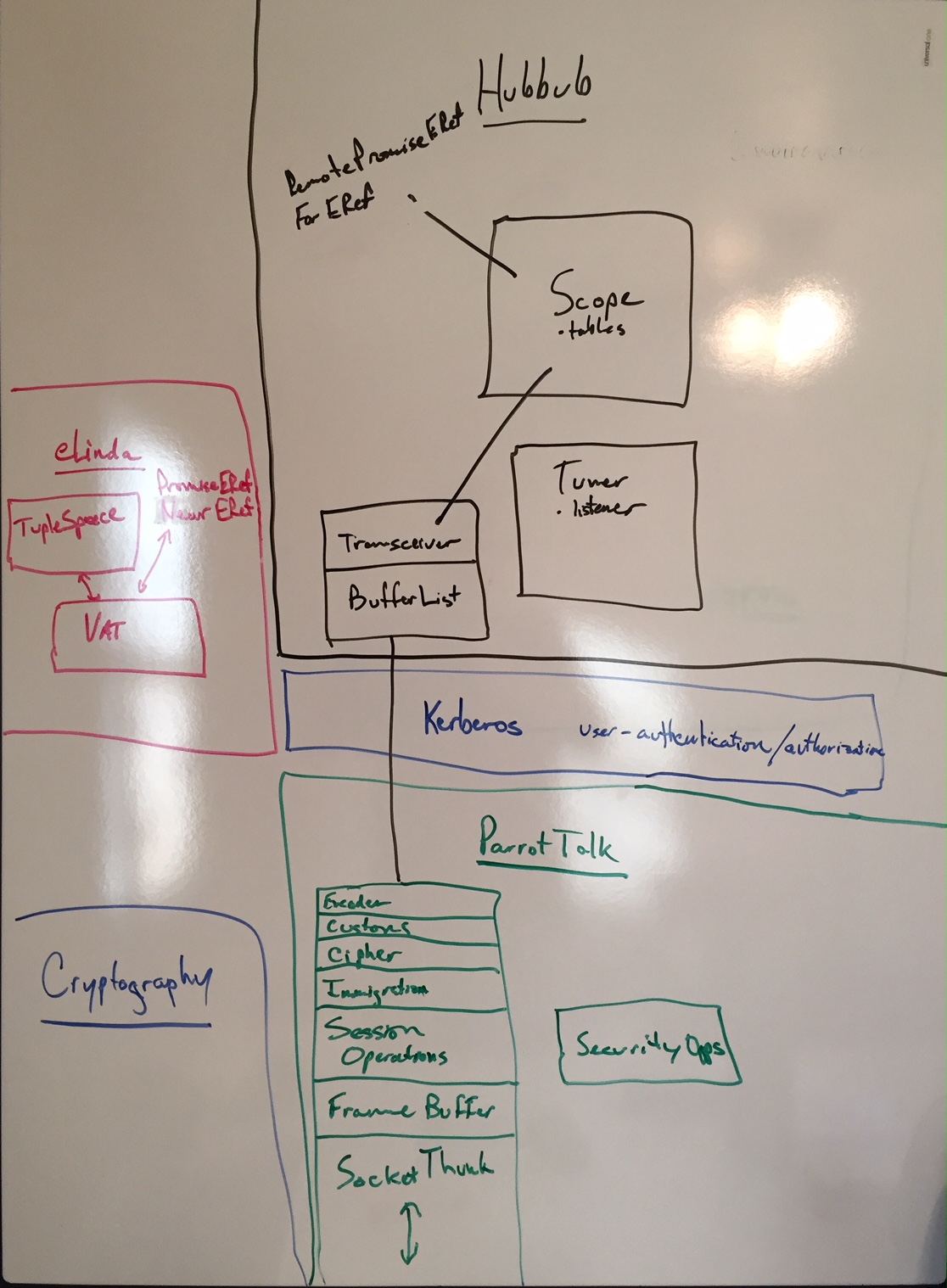
Ok tell us when you release something. having a little example would be really nice. On Sat, Oct 28, 2017 at 5:25 PM, Andrew Glynn <aglynn42@gmail.com> wrote:
Iâm not working on that specifically, although what I am working on could definitely use that and vice versa, which would increase the capabilities of each.
One thing Iâm working on is using Vert.x for service registration and discovery, mapped to Apache River (JINI) to propagate that over non-local network segments that require fully authenticated security (as a result, it also provides things such as Kerberos to Pharo apps). The mapping between the two is very straightforward, almost direct, but Iâve added the Synapse micro service bus to control data flows and secure access to remote services.
It enables things like automatic configuration/integration of Pharo based mobile apps with newer cars that support that kind of autoconfiguration, since they all use JINI to do so. Thus a Pharo mobile or IoT app can automatically be configured to work with any of the carâs subsystems that are relevant to it.
JINI is far more used than people realize, partly because it âjust worksâ and as a result doesnât get the public âsqueaky wheelâ effect. The fact that the authors of Vert.x reimplemented half of the features of JINI, in a less comprehensive and less reliable way, rather than just using it (especially considering itâs open source) shows the degree to which that effect is operative.
Thereâs probably a couple dozen other general use cases where the integration will allow Pharo apps to âjust workâ in a JINI or Vert.x environment, as well as thousands of industry/company specific ones. Iâd have to mode-switch to think of them off the top of my head though ð.
Andrew
Sent from Mail <https://go.microsoft.com/fwlink/?LinkId=550986> for Windows 10
*From: *henry <henry@callistohouse.club> *Sent: *Saturday, October 28, 2017 10:02 AM *To: *Any question about pharo is welcome <pharo-users@lists.pharo.org> *Subject: *Re: [Pharo-users] Actual Code to Improve the Pharo environment
Hi Andrew,
Are you working to bring a Capabilities model to Pharo? This is precisely what I am working to bring with Hubbub, running on top of my ParrotTalk. I derived these from erights.org's ELib and have been working on them for many years. Now that ParrotTalk has stabilized (layer 5) I am shifting to implementing marshalling of layer 6 objects using STON all to run on top of ParrotTalk. Once I get marshalling with scope substitutions, I will debug Hubbub to offer distributed Capabilities.
What work are you undertaking?
Regards,
- HH
-------- Original Message --------
Subject: Re: [Pharo-users] Actual Code to Improve the Pharo environment
Local Time: October 28, 2017 9:12 AM
UTC Time: October 28, 2017 1:12 PM
From: aglynn42@gmail.com
To: Any question about pharo is welcome <pharo-users@lists.pharo.org>
Writing that kind of code is another of the reasons I decided I donât want to work in anything else ð. Maybe more important than some of the others, both to myself and to other users.
Iâve gained so much personally, mostly for nothing, even just considering the relatively few projects I *have* been able to work on in Pharo and previously in Squeak, VW and VA. Unfortunately in most I havenât been able to make the code public, since they were for entities like the government, DoD, etc.
Not that VA attracts me quite so much to give back all that strongly, when a license is $8500+. Were it possible to give back to VA C++ or VA Java, it might be different, but neither were OSS although they werenât expensive. More relevantly, both are now abandonware (hence my comment about IBM, which is applicable to OS/2 as well, although that has quietly had a 5.0 version released in June of this year).
I would, though, love a chance to give back to Pharo primarily, although I may port anything relevant to Squeak, and if I have sufficient time port it to VW, which although not OSS is at least affordable to most developers.
Iâm nearly there on a couple of projects â one Iâm testing and making final tweaks, another is about 2/3dâs of the way.
The first project you (and others on the list) may be more immediately interested in testing, since it requires little to no additional work to use it, and even if not perfect, since itâs intended to directly help work you *are* doing in Pharo, it may worthwhile. Iâm hoping to have it ready for public consumption by the middle of November.
On a different but related topic, the article I wrote got a fair amount of interest considering I donât write nearly as well as Kenneth, for example. Including direct interest from some well known industry people, which canât hurt. In an indirect way it may even be helpful, but not in the real, direct way decent code is.
Capabilities that wonât be available in anything else in an really usable way (because to be efficient they depend on capabilities not found in anything else), and in any case nowhere near as useful in anything else, will hopefully be more use than any article can be, never mind one I wrote, not just to me but also to other Pharo users and to Pharo itself.
Cheers
Andrew Glynn
Sent from Mail <https://go.microsoft.com/fwlink/?LinkId=550986> for Windows 10
*From: *Stephane Ducasse <stepharo.self@gmail.com>
*Sent: *Saturday, October 28, 2017 5:09 AM
*To: *Any question about pharo is welcome <pharo-users@lists.pharo.org>
*Subject: *Re: [Pharo-users] Smalltalk Argument
Hi andrew
please take a project that would help to bring more companies and that you want to push and push it with us :).
Stef
On Sat, Oct 28, 2017 at 11:05 AM, Stephane Ducasse < stepharo.self@gmail.com> wrote:
Hi andrew
you should contact esteban because he is writing an objective-C bridge.
Stef
On Sat, Oct 28, 2017 at 2:30 AM, Andrew Glynn <aglynn42@gmail.com> wrote:
One thing Iâm working on is a bridge between Pharo and F-Script. F-Script is, basically, a Smalltalk dialect, as is obvious from the screenshot. However for MacOS and iOS, it allows you to bypass the static Objective-C API interface and debug / modify or even write applications directly in the system. To do that you âinjectâ F-Script into the OS. The ability to so has a specific implication, though. MacOS and iOS are themselves written in and as a dialect of Smalltalk. (were it simply an overlay on Objective-C, it wouldnât be able to do things that are impossible in Objective-C, and it wouldnât need to be âinjectedâ in order to run). Every implementation of Objective-C , bar GNUâs useless imitation, compiles to Smalltalk. No surprise that Appleâs does, as well.
In any event, it will allow Pharo code to be mapped to MacOS and iOS objects, injected into the system dynamically, and modified / debugged dynamically using the Pharo tools. The result, at least as far as iOS is concerned, may make Pharo actually the most powerful way to program it, well beyond XCode alone, along with doing the same for MacOS. Android is another issue, although the Raspbian port of Pharo should be relatively easy to port to it. For me, unless someone had a use case, I donât have one myself for Android. Iâve tried nearly every version, because Iâd love to support an OSS ecosystem, unfortunately using it compared to the iPhone is still like driving a Fiero based kit car compared to an actual Ferrari.
As far as JNI, while I see your point, JNI is such a PITA that few Java developers know it. My usual workaround is to use Stamp and Synapse, which has the further advantage of allowing Java to âthrottleâ data that the JVM canât deal with at full speed.
As far as dealing with other JVM languages, PetitParser or SmaCC can generate bytecode rather than Java or other JVM code, and that allows libs to be written that utilize Synapse to talk to Pharo. It isnât necessarily an ideal solution, but a possible one without having to support umpteen environments. Another potential way of accomplishing that is to use NetRexx, a declarative JVM language, which is both easy and terse, and like SQL, generates the actual bytecode rather than precompiling to it. For instance, imagine the code needed for a simple âhello worldâ in Java, then compare:
Say âhello worldâ
Since it generates virtually the same bytecode, it may be an easy way to do it.
With the last statement, that expresses really well the exact reason I no longer want to work in most other environments ð.
Tc
Andrew
Sent from Mail <https://go.microsoft.com/fwlink/?LinkId=550986> for Windows 10
*From: *phil@highoctane.be
*Sent: *Thursday, October 26, 2017 2:19 AM
*To: *Any question about pharo is welcome <pharo-users@lists.pharo.org>
*Subject: *Re: [Pharo-users] Smalltalk Argument
I like that piece a lot, seeing exactly the described situation in large enterprises.
I made a strategic decision to go with Pharo for the long run for my solutions because it is a stable base on which to build (ok, there are evolutions, but fundamentally, I can rely on it being under control and can maintain solutions in a version).
The rationale is that at a deep level I am really fed up with having to deal with accidental complexity (now having to deal with Spark/Scala/sbt/Java/maven stuff) that makes the dev focus 80% technology drag and 20% net business contribution.
One key thing is that a team needs guidance and Smalltalk makes it easier due to well known ways of doing things.
Now we miss the boat on mobile and bigdata, but this is solvable.
If we had an open Java bridge (and some people in the community have it for Pharo but do not open source it - so this is eminently doable) + Pharo as an embeddable piece (e.g. like Tcl and Lua) and not a big executable we would have a way to embed Pharo in a lot of places (e.g. in the Hadoop ecosystem where fast starting VMs and small footprint would make the cluster capacity x2 or x3 vs uberjars all over the place) this would be a real disruption.
Think about being able to call Pharo from JNA https://github.com/java- native-access/jna the same way we use C with UFFI.
Smalltalk argument for me is that it makes development bearable (even fun and enjoyable would I say) vs the other stacks. That matters.
Phil
On Thu, Oct 26, 2017 at 12:46 AM, Andrew Glynn <aglynn42@gmail.com> wrote:
Thereâs other questions that are relevant to me:
Do I give a f*** about cool looking web apps? No, I donât use web apps if in any way I can avoid it.
Do I give a f*** about mobile apps? No, the screenâs too small to read anything longer than a twit, or anyone with anything worthwhile to say.
Do I give a f*** about the number of libraries in other languages? No, because most of them are crap in every language Iâve had to work in, and the base languages are crap so they have to keep changing radically, and libraries and frameworks therefore also have to and never get any better. The few that are worthwhile I can almost always use from Smalltalk without a problem (read, Blender, ACT-R and Synapse, since every other library/framework Iâve used outside Smalltalk has been a waste of time).
Do I give a f*** about implementing a complex piece of machine learning software in 22 hours, compared to 3 months for the Java version? Well, actually yes, I do, because that was 3 months of my life down the toilet for something that is too slow to be useful in Java.
Any argument depends on your priorities. Iâve written tons of web apps, because I needed to get paid. Iâve written better shitty mobile apps than the average shitty mobile apps. However, Iâm not going to do any of that any longer in crap that never improves, because after 26 years the irritability it produces is more than itâs worth.
A few weeks ago, a recruiter that specializes in Smalltalk called me about a job, although they were well aware I live 1500 miles away from the city I lived in when I had worked through them, to see if Iâd be willing to move back there for a job. That sounds like another âthere arenât enough Smalltalk developersâ, but it wasnât, because the job wasnât writing Smalltalk. It was writing Java.
The person hiring, though, wouldnât look at anyone who didnât write Smalltalk, because âpeople who grew up with Java donât know how to write codeâ. I donât agree with that, Iâve known a (very few) good Java developers. I would say, though, that Iâve known far more incompetent ones than good ones, and I canât think of any incompetent Smalltalk developers off the top of my head.
Nor have I ever heard a developer in Smalltalk, or Haskell, or LISP, or even C, complain about how hard maintaining state is or coming up with various hacks to avoid it, which seems to be the main point of every JavaScript based âtechnologyâ. An application is by definition a state-machine, which implies plenty about JS developers on the whole.
If youâre a good developer you can write good code in (nearly) anything. My question then is why would you want to write in crap? The better question is why arenât there more good developers in *any* language?
Every project I have been able to do in Smalltalk, though, has had one thing in common, the âshit has to workâ. Companies do use it, in fact I could name 4 large enterprises Iâve worked for whoâve written their own dialects, and they all use it only when âshit has to workâ. They know itâs more productive, they also know using it for more things would increase the availability of Smalltalk developers.
Why do they not do it? One reason, though it takes a while to recognize it, because management doesnât admit even to themselves why they do it, or not very often. Being inefficient, as long as it doesnât âreallyâ matter, is an advantage to large enterprises because they have resources smaller competitors donât.
Why donât their competitors do it? Because they canât see past an hourly rate, whatâs fashionable, or just new, or because their customers canât. Put more generally, average stupidity that isnât corrected by the market. Fashion affects smaller companies more than larger ones, because they canât afford a few customers walking away because they wanted an app in Electron, even if they canât give any relevant reason for wanting it, and even the samples on the Electron site donât work.
Enterprises can, and do use Smalltalk when it matters. When it doesnât, itâs to their advantage to promote things that are inefficient, buggy and unreliable.
Cost is relevant, but not in the simple way people look at things. A crucial but rarely mentioned perspective on its relevance is that while Java based software runs TV set top boxes, Smalltalk based software runs things like medical equipment, automated defense systems, tanks, etc. Cost becomes largely irrelevant when âshit has to workâ.
Productivity is primarily relevant to less talented developers, in an inversely sense, since unproductive environments and attitudes have a leveling tendency in general, and more specifically make accomplishing what the less talented are capable of in any environment sufficiently laborious for them to have a role. Capability in Smalltalk, as implied by the person hiring for the Java role I mentioned, is a fairly decent means of judging whether someone is a so-so developer or a good one.
The productivity argument is realistically only relevant in the context of an already higher hourly cost. Given that it is relevant at that point, companies that know Smalltalk is more productive would use it outside things that have to be 100%, *if* their own productivity were relevant to the same degree that competitorsâ productivity is inversely relevant.
All these ways of looking at it are contingent perspectives though. Yes, if the number of libraries is relevant to you, Smalltalk is less attractive, but thatâs only a contingent phenomenon based on the relative popularity of Java and JavaScript, as a result it canât be used as explanatory *for* that popularity. All the ways of looking at it that are fully determinate are determinate via contingencies of that kind, which for the most part *are* precisely the other perspectives, including productivity, cost, availability of developers, etc. None of them is *in itself* anything but a result of the others.
If availability of developers is contingent on popularity (and further, popularity contingent on industry attitudes), to use an example already mentioned in Joachimâs post, then his simultaneous posit of library availability is if anything more contingent on the same popularity, so positing it as a cause and not a result, or merely a correlate, of popularity is incoherent. We can go one step further, and demonstrate that even when large enterprises make something that works reliably available, they fail to promote and support it, which destroys the market for reliable tooling by simultaneously owning it while not promoting it, something IBM is particularly good at. But IBM canât (and if they canât, neither can any other company) operate that way without the tacit agreement of the industry.
To understand it in a more general way, software development has to be looked at in the context where it occurs, and how itâs determined to a large degree by that context, with a specific difference. That difference is itself implicit in the context, i.e. capitalism, but only *purely *effective in software development. Itâs a result of virtualization as an implicit goal of capitalism, and the disruptions implicit in the virtual but so far only realized completely in software. In terms of that understanding, the analysis of virtualization and disruption as inherent to capitalism is better accomplished in Kapital than in any more recent work.
Or you can simply decide, as Iâve done recently, that working in ways and with tools that prevent doing good work in a reasonable timeframe isnât worthwhile *to you,* no matter how popular those ways and tools might be, or what the posited reasons are, since at the end popularity is only insofar as it *already* is. What those tools and methods are depends to a degree on your priorities, but if developers are *engineers* those priorities canât be completely arbitrary. Engineers are defined by their ability to make things work.
Software as virtual is inherently disruptive, and the software industry disrupts itself too often and too easily to build on anything. A further disruption caused by developers, *as* engineers, refusing to work with crap that *doesnât*, i.e. insisting on being engineers, while in itself merely an aggravation of the disruptive tendencies, might have an inverse result.
Using a stable core of technologies as the basis for a more volatile set of products, in the way nearly every other industry does, is the best means we know of to build things both flexibly and reasonably efficiently. The computer hardware industry is the extreme example of this, while the software industry is the extreme contradiction.
*From: *Pharo-users <pharo-users-bounces@lists.pharo.org> on behalf of David Mason <dmason@ryerson.ca> *Reply-To: *Any question about pharo is welcome < pharo-users@lists.pharo.org> *Date: *Tuesday, October 24, 2017 at 11:52 AM *To: *Any question about pharo is welcome <pharo-users@lists.pharo.org> *Subject: *Re: [Pharo-users] Smalltalk Argument
PharoJS is working to give you that mobile app/browser app experience. As with others, we're not there yet, but getting there. See http://pharojs.org
The 67% loved means that 67% of people using Smalltalk (or perhaps have ever used it) want to continue - so it's presumably a high percentage of a smallish number of people.
On 20 October 2017 at 03:23, jtuchel@objektfabrik.de < jtuchel@objektfabrik.de> wrote:
First of all: I'd say the question itself is not a question but an excuse. I am not arguing there are enough Smalltalkers or cheap ones. But I think the question is just a way of saying "we don't want to do it for reasons that we ourselves cannot really express". If you are a good developer, learning Smalltalk is easy. If you are a good developer you've heard the sentence "we've taken the goos parts from x,y,z and Smalltalk" at least twice a year. So you most likely would like to learn it anyways.
A shortage of developers doesn't exist. What exists is an unwillingness of companies to get people trained in a technology. If Smalltalk was cool and great in their opinion, they wouldn't care. It's that simple. As a consultant, I've heard that argument so often. Not ferom Startups, but from insurance companies, Banks or Car manufacturers who spend millions on useless, endless meetings and stuff instead of just hiring somebody to teach a couple of developers Smalltalk. It's just a lie: the shortage of Smalltalk developers is not a problem.
And, to be honest: what is it we actually are better in by using Smalltalk?
Can we build cool looking web apps in extremely short time? No.
Can we build mobile Apps with little effort? No.
Does our Smalltalk ship lots of great libraries for all kinds of things that are not availabel in similar quality in any other language?
Are we lying when we say we are so extremely over-productive as compared to other languages?
I know, all that live debugging stuff and such is great and it is much faster to find & fix a bug in Smalltalk than in any other environment I've used so far. But that is really only true for business code. When I need to connect to things or want to build a modern GUI or a web application with a great look&feel, I am nowhere near productive, because I simply have to build my own stuff or learn how to use other external resources. If I want to build something for a mobile device, I will only hear that somebody somewhere has done it before. No docs, no proof, no ready-made tool for me.
Shortage of developers is not really the problem. If Smalltalk was as cool as we like to make ourselves believe, this problem would be non-existent. If somebody took out their iPad and told an audience: "We did this in Smalltalk in 40% of the time it would have taken in Swift", and if that something was a must-have for people, things would be much easier. But nobody has.
I am absolutely over-exaggerating, because I make my living with an SaaS product written in Smalltalk (not Pharo). I have lots of fun with Smalltalk and - as you - am convince that many parts of what we've done so far would've taken much longer or even be impossible in other languages. But the advantage was eaten by our extremely steep learning curve for web technologies and for building something that works almost as well as tools like Angular or jQuery Mobile.
Smalltalk is cool, and the day somebody shows me something like Google's flutter in Smalltalk, I am ready to bet a lot on a bright future for Smalltalk. But until then, I'd say these arguments about productivity are just us trying to make ourselves believe we're still the top of the food chain. We've done that for almost thirty years now and still aren't ready to stop it. But we've been lying to ourselves and still do so.
I don't think there is a point in discussing about the usefulness of a language using an argument like the number or ready-made developers. That is just an argument they know you can't win. The real question is and should be: what is the benefit of using Smalltalk. Our productivity argument is a lie as soon as we have to build something that uses or runs on technology that has been invented after 1990.
Okay, shoot ;-)
Joachim
-- ----------------------------------------------------------------------- Objektfabrik Joachim Tuchel mailto:jtuchel@objektfabrik.de Fliederweg 1 http://www.objektfabrik.de D-71640 Ludwigsburg http://joachimtuchel.wordpress.com Telefon: +49 7141 56 10 86 0 Fax: +49 7141 56 10 86 1
I will, although in some ways the two may be more complementary than anything. Sent from Mail for Windows 10 From: Stephane Ducasse Sent: Saturday, October 28, 2017 5:06 AM To: Any question about pharo is welcome Subject: Re: [Pharo-users] Smalltalk Argument Hi andrew you should contact esteban because he is writing an objective-C bridge. Stef On Sat, Oct 28, 2017 at 2:30 AM, Andrew Glynn <aglynn42@gmail.com> wrote: One thing Iâm working on is a bridge between Pharo and F-Script. F-Script is, basically, a Smalltalk dialect, as is obvious from the screenshot. However for MacOS and iOS, it allows you to bypass the static Objective-C API interface and debug / modify or even write applications directly in the system. To do that you âinjectâ F-Script into the OS. The ability to so has a specific implication, though. MacOS and iOS are themselves written in and as a dialect of Smalltalk. (were it simply an overlay on Objective-C, it wouldnât be able to do things that are impossible in Objective-C, and it wouldnât need to be âinjectedâ in order to run). Every implementation of Objective-C , bar GNUâs useless imitation, compiles to Smalltalk. No surprise that Appleâs does, as well.  In any event, it will allow Pharo code to be mapped to MacOS and iOS objects, injected into the system dynamically, and modified / debugged dynamically using the Pharo tools. The result, at least as far as iOS is concerned, may make Pharo actually the most powerful way to program it, well beyond XCode alone, along with doing the same for MacOS. Android is another issue, although the Raspbian port of Pharo should be relatively easy to port to it. For me, unless someone had a use case, I donât have one myself for Android. Iâve tried nearly every version, because Iâd love to support an OSS ecosystem, unfortunately using it compared to the iPhone is still like driving a Fiero based kit car compared to an actual Ferrari.  As far as JNI, while I see your point, JNI is such a PITA that few Java developers know it. My usual workaround is to use Stamp and Synapse, which has the further advantage of allowing Java to âthrottleâ data that the JVM canât deal with at full speed.  As far as dealing with other JVM languages, PetitParser or SmaCC can generate bytecode rather than Java or other JVM code, and that allows libs to be written that utilize Synapse to talk to Pharo. It isnât necessarily an ideal solution, but a possible one without having to support umpteen environments. Another potential way of accomplishing that is to use NetRexx, a declarative JVM language, which is both easy and terse, and like SQL, generates the actual bytecode rather than precompiling to it. For instance, imagine the code needed for a simple âhello worldâ in Java, then compare:  Say âhello worldâ  Since it generates virtually the same bytecode, it may be an easy way to do it.  With the last statement, that expresses really well the exact reason I no longer want to work in most other environments ð.  Tc Andrew    Sent from Mail for Windows 10  From: phil@highoctane.be Sent: Thursday, October 26, 2017 2:19 AM To: Any question about pharo is welcome Subject: Re: [Pharo-users] Smalltalk Argument  I like that piece a lot, seeing exactly the described situation in large enterprises.  I made a strategic decision to go with Pharo for the long run for my solutions because it is a stable base on which to build (ok, there are evolutions, but fundamentally, I can rely on it being under control and can maintain solutions in a version).  The rationale is that at a deep level I am really fed up with having to deal with accidental complexity (now having to deal with Spark/Scala/sbt/Java/maven stuff) that makes the dev focus 80% technology drag and 20% net business contribution.  One key thing is that a team needs guidance and Smalltalk makes it easier due to well known ways of doing things.  Now we miss the boat on mobile and bigdata, but this is solvable.  If we had an open Java bridge (and some people in the community have it for Pharo but do not open source it - so this is eminently doable) + Pharo as an embeddable piece (e.g. like Tcl and Lua) and not a big executable we would have a way to embed Pharo in a lot of places (e.g. in the Hadoop ecosystem where fast starting VMs and small footprint would make the cluster capacity x2 or x3 vs uberjars all over the place)  this would be a real disruption.  Think about being able to call Pharo from JNA https://github.com/java-native-access/jna the same way we use C with UFFI.  Smalltalk argument for me is that it makes development bearable (even fun and enjoyable would I say) vs the other stacks. That matters.  Phil         On Thu, Oct 26, 2017 at 12:46 AM, Andrew Glynn <aglynn42@gmail.com> wrote: Thereâs other questions that are relevant to me:  Do I give a f*** about cool looking web apps? No, I donât use web apps if in any way I can avoid it.  Do I give a f*** about mobile apps? No, the screenâs too small to read anything longer than a twit, or anyone with anything worthwhile to say.  Do I give a f*** about the number of libraries in other languages? No, because most of them are crap in every language Iâve had to work in, and the base languages are crap so they have to keep changing radically, and libraries and frameworks therefore also have to and never get any better. The few that are worthwhile I can almost always use from Smalltalk without a problem (read, Blender, ACT-R and Synapse, since every other library/framework Iâve used outside Smalltalk has been a waste of time).  Do I give a f*** about implementing a complex piece of machine learning software in 22 hours, compared to 3 months for the Java version? Well, actually yes, I do, because that was 3 months of my life down the toilet for something that is too slow to be useful in Java.  Any argument depends on your priorities. Iâve written tons of web apps, because I needed to get paid. Iâve written better shitty mobile apps than the average shitty mobile apps. However, Iâm not going to do any of that any longer in crap that never improves, because after 26 years the irritability it produces is more than itâs worth.  A few weeks ago, a recruiter that specializes in Smalltalk called me about a job, although they were well aware I live 1500 miles away from the city I lived in when I had worked through them, to see if Iâd be willing to move back there for a job. That sounds like another âthere arenât enough Smalltalk developersâ, but it wasnât, because the job wasnât writing Smalltalk. It was writing Java.  The person hiring, though, wouldnât look at anyone who didnât write Smalltalk, because âpeople who grew up with Java donât know how to write codeâ. I donât agree with that, Iâve known a (very few) good Java developers. I would say, though, that Iâve known far more incompetent ones than good ones, and I canât think of any incompetent Smalltalk developers off the top of my head.  Nor have I ever heard a developer in Smalltalk, or Haskell, or LISP, or even C, complain about how hard maintaining state is or coming up with various hacks to avoid it, which seems to be the main point of every JavaScript based âtechnologyâ. An application is by definition a state-machine, which implies plenty about JS developers on the whole.  If youâre a good developer you can write good code in (nearly) anything. My question then is why would you want to write in crap? The better question is why arenât there more good developers in any language?  Every project I have been able to do in Smalltalk, though, has had one thing in common, the âshit has to workâ. Companies do use it, in fact I could name 4 large enterprises Iâve worked for whoâve written their own dialects, and they all use it only when âshit has to workâ. They know itâs more productive, they also know using it for more things would increase the availability of Smalltalk developers.  Why do they not do it? One reason, though it takes a while to recognize it, because management doesnât admit even to themselves why they do it, or not very often. Being inefficient, as long as it doesnât âreallyâ matter, is an advantage to large enterprises because they have resources smaller competitors donât.  Why donât their competitors do it? Because they canât see past an hourly rate, whatâs fashionable, or just new, or because their customers canât. Put more generally, average stupidity that isnât corrected by the market. Fashion affects smaller companies more than larger ones, because they canât afford a few customers walking away because they wanted an app in Electron, even if they canât give any relevant reason for wanting it, and even the samples on the Electron site donât work.  Enterprises can, and do use Smalltalk when it matters. When it doesnât, itâs to their advantage to promote things that are inefficient, buggy and unreliable.  Cost is relevant, but not in the simple way people look at things. A crucial but rarely mentioned perspective on its relevance is that while Java based software runs TV set top boxes, Smalltalk based software runs things like medical equipment, automated defense systems, tanks, etc. Cost becomes largely irrelevant when âshit has to workâ.  Productivity is primarily relevant to less talented developers, in an inversely sense, since unproductive environments and attitudes have a leveling tendency in general, and more specifically make accomplishing what the less talented are capable of in any environment sufficiently laborious for them to have a role. Capability in Smalltalk, as implied by the person hiring for the Java role I mentioned, is a fairly decent means of judging whether someone is a so-so developer or a good one.  The productivity argument is realistically only relevant in the context of an already higher hourly cost. Given that it is relevant at that point, companies that know Smalltalk is more productive would use it outside things that have to be 100%, if their own productivity were relevant to the same degree that competitorsâ productivity is inversely relevant.  All these ways of looking at it are contingent perspectives though. Yes, if the number of libraries is relevant to you, Smalltalk is less attractive, but thatâs only a contingent phenomenon based on the relative popularity of Java and JavaScript, as a result it canât be used as explanatory for that popularity. All the ways of looking at it that are fully determinate are determinate via contingencies of that kind, which for the most part are precisely the other perspectives, including productivity, cost, availability of developers, etc. None of them is in itself anything but a result of the others.  If availability of developers is contingent on popularity (and further, popularity contingent on industry attitudes), to use an example already mentioned in Joachimâs post, then his simultaneous posit of library availability is if anything more contingent on the same popularity, so positing it as a cause and not a result, or merely a correlate, of popularity is incoherent. We can go one step further, and demonstrate that even when large enterprises make something that works reliably available, they fail to promote and support it, which destroys the market for reliable tooling by simultaneously owning it while not promoting it, something IBM is particularly good at. But IBM canât (and if they canât, neither can any other company) operate that way without the tacit agreement of the industry.  To understand it in a more general way, software development has to be looked at in the context where it occurs, and how itâs determined to a large degree by that context, with a specific difference. That difference is itself implicit in the context, i.e. capitalism, but only purely effective in software development. Itâs a result of virtualization as an implicit goal of capitalism, and the disruptions implicit in the virtual but so far only realized completely in software. In terms of that understanding, the analysis of virtualization and disruption as inherent to capitalism is better accomplished in Kapital than in any more recent work.  Or you can simply decide, as Iâve done recently, that working in ways and with tools that prevent doing good work in a reasonable timeframe isnât worthwhile to you, no matter how popular those ways and tools might be, or what the posited reasons are, since at the end popularity is only insofar as it already is. What those tools and methods are depends to a degree on your priorities, but if developers are engineers those priorities canât be completely arbitrary. Engineers are defined by their ability to make things work.  Software as virtual is inherently disruptive, and the software industry disrupts itself too often and too easily to build on anything. A further disruption caused by developers, as engineers, refusing to work with crap that doesnât, i.e. insisting on being engineers, while in itself merely an aggravation of the disruptive tendencies, might have an inverse result.  Using a stable core of technologies as the basis for a more volatile set of products, in the way nearly every other industry does, is the best means we know of to build things both flexibly and reasonably efficiently. The computer hardware industry is the extreme example of this, while the software industry is the extreme contradiction.  From: Pharo-users <pharo-users-bounces@lists.pharo.org> on behalf of David Mason <dmason@ryerson.ca> Reply-To: Any question about pharo is welcome <pharo-users@lists.pharo.org> Date: Tuesday, October 24, 2017 at 11:52 AM To: Any question about pharo is welcome <pharo-users@lists.pharo.org> Subject: Re: [Pharo-users] Smalltalk Argument  PharoJS is working to give you that mobile app/browser app experience. As with others, we're not there yet, but getting there. See http://pharojs.org  The 67% loved means that 67% of people using Smalltalk (or perhaps have ever used it) want to continue - so it's presumably a high percentage of a smallish number of people.  On 20 October 2017 at 03:23, jtuchel@objektfabrik.de <jtuchel@objektfabrik.de> wrote: First of all: I'd say the question itself is not a question but an excuse. I am not arguing there are enough Smalltalkers or cheap ones. But I think the question is just a way of saying "we don't want to do it for reasons that we ourselves cannot really express". If you are a good developer, learning Smalltalk is easy. If you are a good developer you've heard the sentence "we've taken the goos parts from x,y,z and Smalltalk" at least twice a year. So you most likely would like to learn it anyways. A shortage of developers doesn't exist. What exists is an unwillingness of companies to get people trained in a technology. If Smalltalk was cool and great in their opinion, they wouldn't care. It's that simple. As a consultant, I've heard that argument so often. Not ferom Startups, but from insurance companies, Banks or Car manufacturers who spend millions on useless, endless meetings and stuff instead of just hiring somebody to teach a couple of developers Smalltalk. It's just a lie: the shortage of Smalltalk developers is not a problem. And, to be honest: what is it we actually are better in by using Smalltalk? Can we build cool looking web apps in extremely short time? No. Can we build mobile Apps with little effort? No. Does our Smalltalk ship lots of great libraries for all kinds of things that are not availabel in similar quality in any other language? Are we lying when we say we are so extremely over-productive as compared to other languages? I know, all that live debugging stuff and such is great and it is much faster to find & fix a bug in Smalltalk than in any other environment I've used so far. But that is really only true for business code. When I need to connect to things or want to build a modern GUI or a web application with a great look&feel, I am nowhere near productive, because I simply have to build my own stuff or learn how to use other external resources. If I want to build something for a mobile device, I will only hear that somebody somewhere has done it before. No docs, no proof, no ready-made tool for me. Shortage of developers is not really the problem. If Smalltalk was as cool as we like to make ourselves believe, this problem would be non-existent. If somebody took out their iPad and told an audience: "We did this in Smalltalk in 40% of the time it would have taken in Swift", and if that something was a must-have for people, things would be much easier. But nobody has. I am absolutely over-exaggerating, because I make my living with an SaaS product written in Smalltalk (not Pharo). I have lots of fun with Smalltalk and - as you - am convince that many parts of what we've done so far would've taken much longer or even be impossible in other languages. But the advantage was eaten by our extremely steep learning curve for web technologies and for building something that works almost as well as tools like Angular or jQuery Mobile. Smalltalk is cool, and the day somebody shows me something like Google's flutter in Smalltalk, I am ready to bet a lot on a bright future for Smalltalk. But until then, I'd say these arguments about productivity are just us trying to make ourselves believe we're still the top of the food chain. We've done that for almost thirty years now and still aren't ready to stop it. But we've been lying to ourselves and still do so. I don't think there is a point in discussing about the usefulness of a language using an argument like the number or ready-made developers. That is just an argument they know you can't win. The real question is and should be: what is the benefit of using Smalltalk. Our productivity argument is a lie as soon as we have to build something that uses or runs on technology that has been invented after 1990. Okay, shoot ;-) Joachim -- ----------------------------------------------------------------------- Objektfabrik Joachim Tuchel     mailto:jtuchel@objektfabrik.de Fliederweg 1             http://www.objektfabrik.de D-71640 Ludwigsburg         http://joachimtuchel.wordpress.com Telefon: +49 7141 56 10 86 0     Fax: +49 7141 56 10 86 1   Â

On Oct 28, 2017, at 2:05 AM, Stephane Ducasse <stepharo.self@gmail.com> wrote:
Hi andrew
you should contact esteban because he is writing an objective-C bridge.
Stef
Another one? I think we've written half a dozen now, no? There is some code in the VM libs that allows calling out. I worked on one with Avi for a bit about ten years ago. The callbacks/delegate bit was always problematic. It is one thing to call Objective C (really easy) but another thing to integrate with Cocoa and accept callbacks while keeping the VM live. I would really love one that let me write Cocoa from Pharo (especially iPhone apps). I do wonder if this new capability with Objective C blocks wouldn't maybe make things easier. http://www.friday.com/bbum/2011/03/17/ios-4-3-imp_implementationwithblock/
Phil, Am 26.10.17 um 08:17 schrieb phil@highoctane.be:
Now we miss the boat on mobile and bigdata, but this is solvable.
You know, "It's solvable, and it's even easy in Smalltalk" has been what we've been shouting down at those worms in the C++/Java swamp for decades. We just never really proved it. We also missed the boat on web. Seaside was the last real innovation in that field, almost 15 years ago. When Javascript took over the frontend, we lost pace.
If we had an open Java bridge (and some people in the community have it for Pharo but do not open source it - so this is eminently doable) + Pharo as an embeddable piece (e.g. like Tcl and Lua) and not a big executable we would have a way to embed Pharo in a lot of places (e.g. in the Hadoop ecosystem where fast starting VMs and small footprint would make the cluster capacity x2 or x3 vs uberjars all over the place) Â this would be a real disruption.
To it sounds like a big ball of mud to me, but that is opinion ;-)
Think about being able to call Pharo from JNA https://github.com/java-native-access/jna the same way we use C with UFFI.
Smalltalk argument for me is that it makes development bearable (even fun and enjoyable would I say) vs the other stacks. That matters.
Yep. As long as there is no mobile, web or big data involved ;-) To me that is not enough for convincing project managers these days, because web, mobile and big data as well ass AI (oh, is that probably no. 4 on our list of missed boats?) are the topics of what we consider future-proof projects... I am not only dissing the Pharo community here, this is a problem for all Smalltalk vendors in my opinion. Joachim -- ----------------------------------------------------------------------- Objektfabrik Joachim Tuchel mailto:jtuchel@objektfabrik.de Fliederweg 1Â Â Â Â Â Â Â Â Â Â Â Â Â http://www.objektfabrik.de D-71640 Ludwigsburg http://joachimtuchel.wordpress.com Telefon: +49 7141 56 10 86 0Â Â Â Â Â Fax: +49 7141 56 10 86 1

Another way of promoting Pharo is copying its advantages to other languages. The ideal way is for people to get straight to Pharo and fall in love with it. But sometimes this may be possible for several reasons. The most usual being that people simple are not in the mood of learning a new language unless they have to. As the saying goes "People love progress , its just that they equally hate change" Introducing similar features to another language, like I did with introducing live coding enviroment to Python with direct reference back to Pharo is a very good way to promote the language. Just because you cannot code in Pharo at your work does not mean you cannot code the Pharo way. Just put a huge tag in your documentation, comments and anywhere you mention your code "inspired by Pharo ( https://pharo.org)" and you will get their attention whether they like the idea of learning a new language or not. Its like watching an ad, using sex, humour and even unrelated stuff to grab your attention to a product. The idea here is to get the attention, once you do that, the rest follows. A huge problem with Smalltalk in general is that even though every language, enviroment, tool, IDE has been copying it , it is rarely mentioned. If it did , I have no doubt it would have been masively more popular than it is right now. On Mon, Nov 6, 2017 at 9:22 AM jtuchel@objektfabrik.de < jtuchel@objektfabrik.de> wrote:
Phil,
Am 26.10.17 um 08:17 schrieb phil@highoctane.be:
Now we miss the boat on mobile and bigdata, but this is solvable.
You know, "It's solvable, and it's even easy in Smalltalk" has been what we've been shouting down at those worms in the C++/Java swamp for decades. We just never really proved it. We also missed the boat on web. Seaside was the last real innovation in that field, almost 15 years ago. When Javascript took over the frontend, we lost pace.
If we had an open Java bridge (and some people in the community have it for Pharo but do not open source it - so this is eminently doable) + Pharo as an embeddable piece (e.g. like Tcl and Lua) and not a big executable we would have a way to embed Pharo in a lot of places (e.g. in the Hadoop ecosystem where fast starting VMs and small footprint would make the cluster capacity x2 or x3 vs uberjars all over the place) this would be a real disruption.
To it sounds like a big ball of mud to me, but that is opinion ;-)
Think about being able to call Pharo from JNA https://github.com/java-native-access/jna the same way we use C with
UFFI.
Smalltalk argument for me is that it makes development bearable (even fun and enjoyable would I say) vs the other stacks. That matters.
Yep. As long as there is no mobile, web or big data involved ;-) To me that is not enough for convincing project managers these days, because web, mobile and big data as well ass AI (oh, is that probably no. 4 on our list of missed boats?) are the topics of what we consider future-proof projects... I am not only dissing the Pharo community here, this is a problem for all Smalltalk vendors in my opinion.
Joachim
-- ----------------------------------------------------------------------- Objektfabrik Joachim Tuchel mailto:jtuchel@objektfabrik.de Fliederweg 1 http://www.objektfabrik.de D-71640 Ludwigsburg http://joachimtuchel.wordpress.com Telefon: +49 7141 56 10 86 0 Fax: +49 7141 56 10 86 1
Btw, I think we gained pace when JS took over the front end, but lost visibility. Nothing is slower than coding a client/server app with the front end in JS. The âriseâ of JS is a side effect of the fact that the web was designed, built and continues to be built by âcodersâ who donât know enough to be called amateurs. What puts 'codersâ off though is related to way JS is and (mostly doesnât) work. You canât just sit down and âhack onâ Smalltalk until it âsorta kindaâ does what you want. You canât grab code from some random website and âfiddle with itâ until it âsorta kindaâ works. âCodersâ canât make it âsorta kindaâ work, and they donât know how to write code that works. One of the better JS programmers Iâve worked with said at one point âEngineers canât write JavaScript because it doesnât fit their mentality. I used to be a retoucher, Iâd spend hours and hours getting one pixel right. Thereâs no good reason that one pixel had to be that way, but the image didnât âgoâ otherwise. JavaScript is like that, you spend hours and hours messing with it, getting it to work, and at the end you donât know why it works, nor why it didnât. Thatâs not an engineerâs mindset.â Do aviation engineers choose tools based on âpopularityâ? At the same time, would you want your next flight to be on an aircraft running on JavaScript? I wouldnât eat from a microwave running JavaScript. Iâd rather be an engineer than a popularity contestant or a fashion victim. In any case, more often than not itâs management that chooses technologies, generally based on who they have lunch with more than anything else. Andrew Sent from Mail for Windows 10 From: Dimitris Chloupis Sent: Monday, November 6, 2017 2:35 AM To: Any question about pharo is welcome Subject: Re: [Pharo-users] Smalltalk Argument Another way of promoting Pharo is copying its advantages to other languages. The ideal way is for people to get straight to Pharo and fall in love with it. But sometimes this may be possible for several reasons. The most usual being that people simple are not in the mood of learning a new language unless they have to. As the saying goes "People love progress , its just that they equally hate change" Introducing similar features to another language, like I did with introducing live coding enviroment to Python with direct reference back to Pharo is a very good way to promote the language. Just because you cannot code in Pharo at your work does not mean you cannot code the Pharo way. Just put a huge tag in your documentation, comments and anywhere you mention your code "inspired by Pharo ( https://pharo.org)" and you will get their attention whether they like the idea of learning a new language or not. Its like watching an ad, using sex, humour and even unrelated stuff to grab your attention to a product. The idea here is to get the attention, once you do that, the rest follows. A huge problem with Smalltalk in general is that even though every language, enviroment, tool, IDE has been copying it , it is rarely mentioned. If it did , I have no doubt it would have been masively more popular than it is right now. On Mon, Nov 6, 2017 at 9:22 AM jtuchel@objektfabrik.de <jtuchel@objektfabrik.de> wrote: Phil, Am 26.10.17 um 08:17 schrieb phil@highoctane.be:
Now we miss the boat on mobile and bigdata, but this is solvable.
You know, "It's solvable, and it's even easy in Smalltalk" has been what we've been shouting down at those worms in the C++/Java swamp for decades. We just never really proved it. We also missed the boat on web. Seaside was the last real innovation in that field, almost 15 years ago. When Javascript took over the frontend, we lost pace.
If we had an open Java bridge (and some people in the community have it for Pharo but do not open source it - so this is eminently doable) + Pharo as an embeddable piece (e.g. like Tcl and Lua) and not a big executable we would have a way to embed Pharo in a lot of places (e.g. in the Hadoop ecosystem where fast starting VMs and small footprint would make the cluster capacity x2 or x3 vs uberjars all over the place) Â this would be a real disruption.
To it sounds like a big ball of mud to me, but that is opinion ;-)
Think about being able to call Pharo from JNA https://github.com/java-native-access/jna the same way we use C with UFFI.
Smalltalk argument for me is that it makes development bearable (even fun and enjoyable would I say) vs the other stacks. That matters.
Yep. As long as there is no mobile, web or big data involved ;-) To me that is not enough for convincing project managers these days, because web, mobile and big data as well ass AI (oh, is that probably no. 4 on our list of missed boats?) are the topics of what we consider future-proof projects... I am not only dissing the Pharo community here, this is a problem for all Smalltalk vendors in my opinion. Joachim -- ----------------------------------------------------------------------- Objektfabrik Joachim Tuchel     mailto:jtuchel@objektfabrik.de Fliederweg 1             http://www.objektfabrik.de D-71640 Ludwigsburg         http://joachimtuchel.wordpress.com Telefon: +49 7141 56 10 86 0     Fax: +49 7141 56 10 86 1
all people like popular choices, including engineers. Engineers may be more careful but they are not known exactly for their talent to innovate. We are pact animals, we are social animals. This is far from a coding problem, its pretty much coded right inside our DNA, not just for us but also for any other animal. And we have our trends too, our resistance to git is an excellent example. A general fixation of avoiding files and especially text files. The unreasonable argument that you need an image to preserve a live coding enviroment. The idea that just because you have access to the complete source code , life becomes easier for some weird way as if people are likely to mess with the internals of a system. That for some weird reason you cannot have access to source code in other languages or that is hard to do so. The notion that live coding is only possible or only easy in Smalltalk. That reimplementing everything in Smalltalk is a great idea. That minimal syntax equals softer learning curve. That Smalltalk is the only sensible way of doing OOP. Finally but not least, "Alan Kay is god". People love to stick to their beliefs (me included) and not feel comfortable questioning them. It's no surpise it tooks us hundrends of thousands of years to get to this point. JS is chosen as a language for the same reason its so hated, its third party libraries. As coders we have to rely a lot more to libraries than we have to rely on languages. Sure a language can solve many potential problem but a powerful library support can practically give you code on a plate. Hence also why JS is practically non existant outside web dev and that is pretty rare for a language. So sure popularity plays a major role but in the end the preference for JS is not insanity, its the right choice for what it focuses on. A difficult/ not that well designed language + big library support will always be easier to use than a super ease elegant language without such big library support. The time when we were relying on our code and our own libraries has passed long time ago. On Mon, Nov 6, 2017 at 10:37 AM Andrew Glynn <aglynn42@gmail.com> wrote:
Btw, I think we gained *pace* when JS took over the front end, but lost visibility. Nothing is slower than coding a client/server app with the front end in JS. The âriseâ of JS is a side effect of the fact that the web was designed, built and continues to be built by âcodersâ who donât know enough to be called amateurs.
What puts 'codersâ off though is related to way JS is and (mostly doesnât) work. You canât just sit down and âhack onâ Smalltalk until it âsorta kindaâ does what you want. You canât grab code from some random website and âfiddle with itâ until it âsorta kindaâ works. âCodersâ *canât* make it âsorta kindaâ work, and they donât know how to *write* code that works.
One of the better JS programmers Iâve worked with said at one point âEngineers canât write JavaScript because it doesnât fit their mentality. I used to be a retoucher, Iâd spend hours and hours getting one pixel right. Thereâs no good reason that one pixel had to be that way, but the image didnât âgoâ otherwise. JavaScript is like that, you spend hours and hours messing with it, getting it to work, and at the end you donât know why it works, nor why it didnât. Thatâs not an engineerâs mindset.â
Do aviation engineers choose tools based on âpopularityâ? At the same time, would you want your next flight to be on an aircraft running on JavaScript? I wouldnât eat from a microwave running JavaScript.
Iâd rather be an engineer than a popularity contestant or a fashion victim.
In any case, more often than not itâs management that chooses technologies, generally based on who they have lunch with more than anything else.
Andrew
Sent from Mail <https://go.microsoft.com/fwlink/?LinkId=550986> for Windows 10
*From: *Dimitris Chloupis <kilon.alios@gmail.com> *Sent: *Monday, November 6, 2017 2:35 AM
*To: *Any question about pharo is welcome <pharo-users@lists.pharo.org> *Subject: *Re: [Pharo-users] Smalltalk Argument
Another way of promoting Pharo is copying its advantages to other languages. The ideal way is for people to get straight to Pharo and fall in love with it. But sometimes this may be possible for several reasons. The most usual being that people simple are not in the mood of learning a new language unless they have to. As the saying goes "People love progress , its just that they equally hate change"
Introducing similar features to another language, like I did with introducing live coding enviroment to Python with direct reference back to Pharo is a very good way to promote the language. Just because you cannot code in Pharo at your work does not mean you cannot code the Pharo way. Just put a huge tag in your documentation, comments and anywhere you mention your code "inspired by Pharo ( https://pharo.org)" and you will get their attention whether they like the idea of learning a new language or not.
Its like watching an ad, using sex, humour and even unrelated stuff to grab your attention to a product. The idea here is to get the attention, once you do that, the rest follows.
A huge problem with Smalltalk in general is that even though every language, enviroment, tool, IDE has been copying it , it is rarely mentioned. If it did , I have no doubt it would have been masively more popular than it is right now.
On Mon, Nov 6, 2017 at 9:22 AM jtuchel@objektfabrik.de < jtuchel@objektfabrik.de> wrote:
Phil,
Am 26.10.17 um 08:17 schrieb phil@highoctane.be:
Now we miss the boat on mobile and bigdata, but this is solvable.
You know, "It's solvable, and it's even easy in Smalltalk" has been what we've been shouting down at those worms in the C++/Java swamp for decades. We just never really proved it. We also missed the boat on web. Seaside was the last real innovation in that field, almost 15 years ago. When Javascript took over the frontend, we lost pace.
If we had an open Java bridge (and some people in the community have it for Pharo but do not open source it - so this is eminently doable) + Pharo as an embeddable piece (e.g. like Tcl and Lua) and not a big executable we would have a way to embed Pharo in a lot of places (e.g. in the Hadoop ecosystem where fast starting VMs and small footprint would make the cluster capacity x2 or x3 vs uberjars all over the place) this would be a real disruption.
To it sounds like a big ball of mud to me, but that is opinion ;-)
Think about being able to call Pharo from JNA https://github.com/java-native-access/jna the same way we use C with
UFFI.
Smalltalk argument for me is that it makes development bearable (even fun and enjoyable would I say) vs the other stacks. That matters.
Yep. As long as there is no mobile, web or big data involved ;-) To me that is not enough for convincing project managers these days, because web, mobile and big data as well ass AI (oh, is that probably no. 4 on our list of missed boats?) are the topics of what we consider future-proof projects... I am not only dissing the Pharo community here, this is a problem for all Smalltalk vendors in my opinion.
Joachim
-- ----------------------------------------------------------------------- Objektfabrik Joachim Tuchel mailto:jtuchel@objektfabrik.de Fliederweg 1 http://www.objektfabrik.de D-71640 Ludwigsburg http://joachimtuchel.wordpress.com Telefon: +49 7141 56 10 86 0 Fax: +49 7141 56 10 86 1

Hi Dimitris, you have pointed out some good thoughts. However, for me any technical thing can have two aspects: - solve a problem, provide a product which has value (for get things done) - take the concepts (of applied technics and computer science forward) For me, both things are important. Experience from doing gives new impulses for better concepts, better concepts may help to solve unsolvable problems. I like your example of libraries. Yes, I think too reinventing everything is not necessary. But I believe libraries as âliveâ objects providing protocol and capabilities would be an important improvement. For me, Morphic in itâs essence could be great for the AR world to come. So in principle I agree with you, but I hope that we not stop to search also for better concepts in a world, where privacy and self will is called in the age of big data and AI. Just my personal view ð Cheers Hans
Am 06.11.2017 um 11:28 schrieb Dimitris Chloupis <kilon.alios@gmail.com>:
all people like popular choices, including engineers.
Engineers may be more careful but they are not known exactly for their talent to innovate.
We are pact animals, we are social animals.
This is far from a coding problem, its pretty much coded right inside our DNA, not just for us but also for any other animal.
And we have our trends too, our resistance to git is an excellent example. A general fixation of avoiding files and especially text files. The unreasonable argument that you need an image to preserve a live coding enviroment. The idea that just because you have access to the complete source code , life becomes easier for some weird way as if people are likely to mess with the internals of a system. That for some weird reason you cannot have access to source code in other languages or that is hard to do so. The notion that live coding is only possible or only easy in Smalltalk. That reimplementing everything in Smalltalk is a great idea. That minimal syntax equals softer learning curve. That Smalltalk is the only sensible way of doing OOP.
Finally but not least, "Alan Kay is god".
People love to stick to their beliefs (me included) and not feel comfortable questioning them. It's no surpise it tooks us hundrends of thousands of years to get to this point.
JS is chosen as a language for the same reason its so hated, its third party libraries. As coders we have to rely a lot more to libraries than we have to rely on languages. Sure a language can solve many potential problem but a powerful library support can practically give you code on a plate. Hence also why JS is practically non existant outside web dev and that is pretty rare for a language.
So sure popularity plays a major role but in the end the preference for JS is not insanity, its the right choice for what it focuses on. A difficult/ not that well designed language + big library support will always be easier to use than a super ease elegant language without such big library support. The time when we were relying on our code and our own libraries has passed long time ago.
On Mon, Nov 6, 2017 at 10:37 AM Andrew Glynn <aglynn42@gmail.com> wrote: Btw, I think we gained pace when JS took over the front end, but lost visibility. Nothing is slower than coding a client/server app with the front end in JS. The âriseâ of JS is a side effect of the fact that the web was designed, built and continues to be built by âcodersâ who donât know enough to be called amateurs.
What puts 'codersâ off though is related to way JS is and (mostly doesnât) work. You canât just sit down and âhack onâ Smalltalk until it âsorta kindaâ does what you want. You canât grab code from some random website and âfiddle with itâ until it âsorta kindaâ works. âCodersâ canât make it âsorta kindaâ work, and they donât know how to write code that works.
One of the better JS programmers Iâve worked with said at one point âEngineers canât write JavaScript because it doesnât fit their mentality. I used to be a retoucher, Iâd spend hours and hours getting one pixel right. Thereâs no good reason that one pixel had to be that way, but the image didnât âgoâ otherwise. JavaScript is like that, you spend hours and hours messing with it, getting it to work, and at the end you donât know why it works, nor why it didnât. Thatâs not an engineerâs mindset.â
Do aviation engineers choose tools based on âpopularityâ? At the same time, would you want your next flight to be on an aircraft running on JavaScript? I wouldnât eat from a microwave running JavaScript.
Iâd rather be an engineer than a popularity contestant or a fashion victim.
In any case, more often than not itâs management that chooses technologies, generally based on who they have lunch with more than anything else.
Andrew
Sent from Mail for Windows 10
From: Dimitris Chloupis Sent: Monday, November 6, 2017 2:35 AM
To: Any question about pharo is welcome Subject: Re: [Pharo-users] Smalltalk Argument
Another way of promoting Pharo is copying its advantages to other languages. The ideal way is for people to get straight to Pharo and fall in love with it. But sometimes this may be possible for several reasons. The most usual being that people simple are not in the mood of learning a new language unless they have to. As the saying goes "People love progress , its just that they equally hate change"
Introducing similar features to another language, like I did with introducing live coding enviroment to Python with direct reference back to Pharo is a very good way to promote the language. Just because you cannot code in Pharo at your work does not mean you cannot code the Pharo way. Just put a huge tag in your documentation, comments and anywhere you mention your code "inspired by Pharo ( https://pharo.org)" and you will get their attention whether they like the idea of learning a new language or not.
Its like watching an ad, using sex, humour and even unrelated stuff to grab your attention to a product. The idea here is to get the attention, once you do that, the rest follows.
A huge problem with Smalltalk in general is that even though every language, enviroment, tool, IDE has been copying it , it is rarely mentioned. If it did , I have no doubt it would have been masively more popular than it is right now.
On Mon, Nov 6, 2017 at 9:22 AM jtuchel@objektfabrik.de <jtuchel@objektfabrik.de> wrote:
Phil,
Am 26.10.17 um 08:17 schrieb phil@highoctane.be:
Now we miss the boat on mobile and bigdata, but this is solvable.
You know, "It's solvable, and it's even easy in Smalltalk" has been what we've been shouting down at those worms in the C++/Java swamp for decades. We just never really proved it. We also missed the boat on web. Seaside was the last real innovation in that field, almost 15 years ago. When Javascript took over the frontend, we lost pace.
If we had an open Java bridge (and some people in the community have it for Pharo but do not open source it - so this is eminently doable) + Pharo as an embeddable piece (e.g. like Tcl and Lua) and not a big executable we would have a way to embed Pharo in a lot of places (e.g. in the Hadoop ecosystem where fast starting VMs and small footprint would make the cluster capacity x2 or x3 vs uberjars all over the place) this would be a real disruption.
To it sounds like a big ball of mud to me, but that is opinion ;-)
Think about being able to call Pharo from JNA https://github.com/java-native-access/jna the same way we use C with UFFI.
Smalltalk argument for me is that it makes development bearable (even fun and enjoyable would I say) vs the other stacks. That matters.
Yep. As long as there is no mobile, web or big data involved ;-) To me that is not enough for convincing project managers these days, because web, mobile and big data as well ass AI (oh, is that probably no. 4 on our list of missed boats?) are the topics of what we consider future-proof projects... I am not only dissing the Pharo community here, this is a problem for all Smalltalk vendors in my opinion.
Joachim
-- ----------------------------------------------------------------------- Objektfabrik Joachim Tuchel mailto:jtuchel@objektfabrik.de Fliederweg 1 http://www.objektfabrik.de D-71640 Ludwigsburg http://joachimtuchel.wordpress.com Telefon: +49 7141 56 10 86 0 Fax: +49 7141 56 10 86 1
Engineers donât innovate often in core technologies, because theyâre careful. Of course that also means they generally make terrible marketers ð. They also donât generally compete, which is part of the problem in this industry. The semiconductor industry, for instance, provides money to an independent institute, ISMI, that advances the core technologies they all use. We do love shiny new toys though, thatâs half the reason we became engineers. You donât âneedâ an image by any means, but the fact that my live coding environments in Eclipse have been running, hiding behind modal dialogs, for 332, 468, and 992 hours respectively, due to constantly comparison between in-memory data and on-disk data combined with a crappy eventing model, implies that itâs at the very least much easier. Granted theyâre building parts of a huge program, an ERP, and using JPA with it. Still, I have 3 Eclipse environments on 3 Sun servers with 64 threads each that have been untouchable for many days. Smalltalk is âaâ way, a way that doesnât have the massive discrepancies between its syntactical appearance and dynamic implementation that C++ and Java suffer from, discrepancies that dynamically propagate depending on different libraries, frameworks, internal system states and external environments. Python is another way, it has plenty of strengths. Its weakness is that it doesnât scale in terms of either data size or complexity. Odoo is a great case, most usable ERP out there for the end user, but if you try to run more than a few of the 40 odd modules it craps out. Largely thatâs lack of time or investment, if you havenât the latter, you need the former. IMO Python is closer to Smalltalk than GNU Smalltalk. But why compete? Where Python has strengths I use it, where there are reliable, stable technologies in Java I use them (Synapse and JINI are two main ones). If I have to do work in a browser I have to write JS, I just donât try to do things itâs not reliably capable of. If Iâm using ACT-R for modeling, I use LISP, for Wordnet I use Prolog. Writing any language in another, especially a language like C, is not going to work well in the long term, because while writing the language, one canât be in that languageâs proper mindset. As a result Ruby looks like Smalltalk but works like Java, except a Java without the massive investment that make actual Java somewhat reliable. Funny you mentioned Alan Kay, given I had a disagreement with him last night. His argument was that we need to think beyond Smalltalk, beyond anything out there at the moment. My argument was that we havenât yet caught up to Smalltalk, never mind LISP, and that despite nearly everything we use having originated in those, most donât even recognize it. Weâre nowhere near ready for a new paradigm when we havenât digested the old one yet. It was a polite disagreement. Nevertheless, AFAIK only God is God, and I donât speak with him personally all that regularly ð. Pharo is far from the Smallltalk I began with in â88. Morphic is well beyond MVC and the improvements to it, combined with the things built on it, are keys to why I use Pharo. The JIT compiler is a another big improvement, which originated with Strongtalk - the PoC for the Java JIT compiler written by Sun. But when my first language, Forth, is still better than 90% of the ânewâ languages out there, using those new languages as core technologies is problematic. New is better only if its actually better. Andrew Sent from Mail for Windows 10 From: Dimitris Chloupis Sent: Monday, November 6, 2017 5:29 AM To: Any question about pharo is welcome Subject: Re: [Pharo-users] Smalltalk Argument all people like popular choices, including engineers. Engineers may be more careful but they are not known exactly for their talent to innovate. We are pact animals, we are social animals. This is far from a coding problem, its pretty much coded right inside our DNA, not just for us but also for any other animal. And we have our trends too, our resistance to git is an excellent example. A general fixation of avoiding files and especially text files. The unreasonable argument that you need an image to preserve a live coding enviroment. The idea that just because you have access to the complete source code , life becomes easier for some weird way as if people are likely to mess with the internals of a system. That for some weird reason you cannot have access to source code in other languages or that is hard to do so. The notion that live coding is only possible or only easy in Smalltalk. That reimplementing everything in Smalltalk is a great idea. That minimal syntax equals softer learning curve. That Smalltalk is the only sensible way of doing OOP. Finally but not least, "Alan Kay is god".  People love to stick to their beliefs (me included) and not feel comfortable questioning them. It's no surpise it tooks us hundrends of thousands of years to get to this point. JS is chosen as a language for the same reason its so hated, its third party libraries. As coders we have to rely a lot more to libraries than we have to rely on languages. Sure a language can solve many potential problem but a powerful library support can practically give you code on a plate. Hence also why JS is practically non existant outside web dev and that is pretty rare for a language. So sure popularity plays a major role but in the end the preference for JS is not insanity, its the right choice for what it focuses on. A difficult/ not that well designed language + big library support will always be easier to use than a super ease elegant language without such big library support. The time when we were relying on our code and our own libraries has passed long time ago.   On Mon, Nov 6, 2017 at 10:37 AM Andrew Glynn <aglynn42@gmail.com> wrote: Btw, I think we gained pace when JS took over the front end, but lost visibility. Nothing is slower than coding a client/server app with the front end in JS. The âriseâ of JS is a side effect of the fact that the web was designed, built and continues to be built by âcodersâ who donât know enough to be called amateurs.  What puts 'codersâ off though is related to way JS is and (mostly doesnât) work. You canât just sit down and âhack onâ Smalltalk until it âsorta kindaâ does what you want. You canât grab code from some random website and âfiddle with itâ until it âsorta kindaâ works. âCodersâ canât make it âsorta kindaâ work, and they donât know how to write code that works.  One of the better JS programmers Iâve worked with said at one point âEngineers canât write JavaScript because it doesnât fit their mentality. I used to be a retoucher, Iâd spend hours and hours getting one pixel right. Thereâs no good reason that one pixel had to be that way, but the image didnât âgoâ otherwise. JavaScript is like that, you spend hours and hours messing with it, getting it to work, and at the end you donât know why it works, nor why it didnât. Thatâs not an engineerâs mindset.â  Do aviation engineers choose tools based on âpopularityâ? At the same time, would you want your next flight to be on an aircraft running on JavaScript? I wouldnât eat from a microwave running JavaScript.  Iâd rather be an engineer than a popularity contestant or a fashion victim.  In any case, more often than not itâs management that chooses technologies, generally based on who they have lunch with more than anything else.  Andrew  Sent from Mail for Windows 10  From: Dimitris Chloupis Sent: Monday, November 6, 2017 2:35 AM To: Any question about pharo is welcome Subject: Re: [Pharo-users] Smalltalk Argument  Another way of promoting Pharo is copying its advantages to other languages. The ideal way is for people to get straight to Pharo and fall in love with it. But sometimes this may be possible for several reasons. The most usual being that people simple are not in the mood of learning a new language unless they have to. As the saying goes "People love progress , its just that they equally hate change"  Introducing similar features to another language, like I did with introducing live coding enviroment to Python with direct reference back to Pharo is a very good way to promote the language. Just because you cannot code in Pharo at your work does not mean you cannot code the Pharo way. Just put a huge tag in your documentation, comments and anywhere you mention your code "inspired by Pharo ( https://pharo.org)" and you will get their attention whether they like the idea of learning a new language or not.  Its like watching an ad, using sex, humour and even unrelated stuff to grab your attention to a product. The idea here is to get the attention, once you do that, the rest follows.  A huge problem with Smalltalk in general is that even though every language, enviroment, tool, IDE has been copying it , it is rarely mentioned. If it did , I have no doubt it would have been masively more popular than it is right now.  On Mon, Nov 6, 2017 at 9:22 AM jtuchel@objektfabrik.de <jtuchel@objektfabrik.de> wrote: Phil, Am 26.10.17 um 08:17 schrieb phil@highoctane.be:
Now we miss the boat on mobile and bigdata, but this is solvable.
You know, "It's solvable, and it's even easy in Smalltalk" has been what we've been shouting down at those worms in the C++/Java swamp for decades. We just never really proved it. We also missed the boat on web. Seaside was the last real innovation in that field, almost 15 years ago. When Javascript took over the frontend, we lost pace.
If we had an open Java bridge (and some people in the community have it for Pharo but do not open source it - so this is eminently doable) + Pharo as an embeddable piece (e.g. like Tcl and Lua) and not a big executable we would have a way to embed Pharo in a lot of places (e.g. in the Hadoop ecosystem where fast starting VMs and small footprint would make the cluster capacity x2 or x3 vs uberjars all over the place) Â this would be a real disruption.
To it sounds like a big ball of mud to me, but that is opinion ;-)
Think about being able to call Pharo from JNA https://github.com/java-native-access/jna the same way we use C with UFFI.
Smalltalk argument for me is that it makes development bearable (even fun and enjoyable would I say) vs the other stacks. That matters.
Yep. As long as there is no mobile, web or big data involved ;-) To me that is not enough for convincing project managers these days, because web, mobile and big data as well ass AI (oh, is that probably no. 4 on our list of missed boats?) are the topics of what we consider future-proof projects... I am not only dissing the Pharo community here, this is a problem for all Smalltalk vendors in my opinion. Joachim -- ----------------------------------------------------------------------- Objektfabrik Joachim Tuchel     mailto:jtuchel@objektfabrik.de Fliederweg 1             http://www.objektfabrik.de D-71640 Ludwigsburg         http://joachimtuchel.wordpress.com Telefon: +49 7141 56 10 86 0     Fax: +49 7141 56 10 86 1 Â
I like your depiction of the situation and arguments, Andrew. The inherent volatility of the software industry due to its tendency to self disruption, as you pointed out, is fertile ground to all kinds of crap, but we as developers should keep our eyes wide open and look for the pearls and gems that grow here and there, like Pharo Smalltalk. Of course my "vision", as a Smalltalker is inherently biased, but as you said, when "shit has to work", I think that we have good cards at our hands. So yesterday we had another meeting and I think I could make a good point for Smalltalk, thanks to all your arguments here at the list. But surely the absolute killer argument is that "this shit really works" :-) As pointed out by several of you, integration is key. For my particular present case, I could successfully integrate the developed tools in the system, a medical imaging processing pipeline, through the command line and the filesystem - so no need for fancy looking web apps at the moment, but it surely will not hurt to have this possibilities - it would be cool to run part of the code at the front end (internet browser), in our case, some pre-processing of medical data before it is sent to the "main processing pipeline" (just one practical example of many other possible applications). This particular task could be done with Javascript, but I am afraid that the necessary libraries are not so good.. Cheers, Paulo On 10/26/2017 12:46 AM, Andrew Glynn wrote:
Thereâs other questions that are relevant to me:
Â
Do I give a f*** about cool looking web apps? No, I donât use web apps if in any way I can avoid it.
Â
Do I give a f*** about mobile apps? No, the screenâs too small to read anything longer than a twit, or anyone with anything worthwhile to say.
Â
Do I give a f*** about the number of libraries in other languages? No, because most of them are crap in every language Iâve had to work in, and the base languages are crap so they have to keep changing radically, and libraries and frameworks therefore also have to and never get any better. The few that are worthwhile I can almost always use from Smalltalk without a problem (read, Blender, ACT-R and Synapse, since every other library/framework Iâve used outside Smalltalk has been a waste of time).Â
Â
Do I give a f*** about implementing a complex piece of machine learning software in 22 hours, compared to 3 months for the Java version? Well, actually yes, I do, because that was 3 months of my life down the toilet for something that is too slow to be useful in Java.
Â
Any argument depends on your priorities. Iâve written tons of web apps, because I needed to get paid. Iâve written better shitty mobile apps than the average shitty mobile apps. However, Iâm not going to do any of that any longer in crap that never improves, because after 26 years the irritability it produces is more than itâs worth.Â
Â
A few weeks ago, a recruiter that specializes in Smalltalk called me about a job, although they were well aware I live 1500 miles away from the city I lived in when I had worked through them, to see if Iâd be willing to move back there for a job. That sounds like another âthere arenât enough Smalltalk developersâ, but it wasnât, because the job wasnât writing Smalltalk. It was writing Java.
Â
The person hiring, though, wouldnât look at anyone who didnât write Smalltalk, because âpeople who grew up with Java donât know how to write codeâ. I donât agree with that, Iâve known a (very few) good Java developers. I would say, though, that Iâve known far more incompetent ones than good ones, and I canât think of any incompetent Smalltalk developers off the top of my head.Â
Â
Nor have I ever heard a developer in Smalltalk, or Haskell, or LISP, or even C, complain about how hard maintaining state is or coming up with various hacks to avoid it, which seems to be the main point of every JavaScript based âtechnologyâ. An application is by definition a state-machine, which implies plenty about JS developers on the whole.
Â
If youâre a good developer you can write good code in (nearly) anything. Â My question then is why would you want to write in crap? Â The better question is why arenât there more good developers in /any/ language?
Â
Every project I have been able to do in Smalltalk, though, has had one thing in common, the âshit has to workâ. Companies do use it, in fact I could name 4 large enterprises Iâve worked for whoâve written their own dialects, and they all use it only when âshit has to workâ. They know itâs more productive, they also know using it for more things would increase the availability of Smalltalk developers.Â
Â
Why do they not do it? One reason, though it takes a while to recognize it, because management doesnât admit even to themselves why they do it, or not very often. Being inefficient, as long as it doesnât âreallyâ matter, is an advantage to large enterprises because they have resources smaller competitors donât.Â
Â
Why donât their competitors do it? Because they canât see past an hourly rate, whatâs fashionable, or just new, or because their customers canât.  Put more generally, average stupidity that isnât corrected by the market. Fashion affects smaller companies more than larger ones, because they canât afford a few customers walking away because they wanted an app in Electron, even if they canât give any relevant reason for wanting it, and even the samples on the Electron site donât work.Â
Â
Enterprises can, and do use Smalltalk when it matters. When it doesnât, itâs to their advantage to promote things that are inefficient, buggy and unreliable.
Â
Cost is relevant, but not in the simple way people look at things. A crucial but rarely mentioned perspective on its relevance is that while Java based software runs TV set top boxes, Smalltalk based software runs things like medical equipment, automated defense systems, tanks, etc. Cost becomes largely irrelevant when âshit has to workâ.Â
Â
Productivity is primarily relevant to less talented developers, in an inversely sense, since unproductive environments and attitudes have a leveling tendency in general, and more specifically make accomplishing what the less talented are capable of in any environment sufficiently laborious for them to have a role. Capability in Smalltalk, as implied by the person hiring for the Java role I mentioned, is a fairly decent means of judging whether someone is a so-so developer or a good one.
Â
The productivity argument is realistically only relevant in the context of an already higher hourly cost. Given that it is relevant at that point, companies that know Smalltalk is more productive would use it outside things that have to be 100%, /if/ their own productivity were relevant to the same degree that competitorsâ productivity is inversely relevant.
Â
All these ways of looking at it are contingent perspectives though. Yes, if the number of libraries is relevant to you, Smalltalk is less attractive, but thatâs only a contingent phenomenon based on the relative popularity of Java and JavaScript, as a result it canât be used as explanatory /for/ that popularity. All the ways of looking at it that are fully determinate are determinate via contingencies of that kind, which for the most part /are/ precisely the other perspectives, including productivity, cost, availability of developers, etc. None of them is /in itself/ anything but a result of the others.Â
Â
If availability of developers is contingent on popularity (and further, popularity contingent on industry attitudes), to use an example already mentioned in Joachimâs post, then his simultaneous posit of library availability is if anything more contingent on the same popularity, so positing it as a cause and not a result, or merely a correlate, of popularity is incoherent. We can go one step further, and demonstrate that even when large enterprises make something that works reliably available, they fail to promote and support it, which destroys the market for reliable tooling by simultaneously owning it while not promoting it, something IBM is particularly good at. But IBM canât (and if they canât, neither can any other company) operate that way without the tacit agreement of the industry.Â
Â
To understand it in a more general way, software development has to be looked at in the context where it occurs, and how itâs determined to a large degree by that context, with a specific difference. That difference is itself implicit in the context, i.e. capitalism, but only /purely /effective in software development. Itâs a result of virtualization as an implicit goal of capitalism, and the disruptions implicit in the virtual but so far only realized completely in software. In terms of that understanding, the analysis of virtualization and disruption as inherent to capitalism is better accomplished in Kapital than in any more recent work.
Â
Or you can simply decide, as Iâve done recently, that working in ways and with tools that prevent doing good work in a reasonable timeframe isnât worthwhile /to you,/ no matter how popular those ways and tools might be, or what the posited reasons are, since at the end popularity is only insofar as it /already/ is. What those tools and methods are depends to a degree on your priorities, but if developers are /engineers/ those priorities canât be completely arbitrary. Engineers are defined by their ability to make things work.
Â
Software as virtual is inherently disruptive, and the software industry disrupts itself too often and too easily to build on anything. A further disruption caused by developers, /as/ engineers, refusing to work with crap that /doesnât/, i.e. insisting on being engineers, while in itself merely an aggravation of the disruptive tendencies, might have an inverse result.
Â
Using a stable core of technologies as the basis for a more volatile set of products, in the way nearly every other industry does, is the best means we know of to build things both flexibly and reasonably efficiently. Â The computer hardware industry is the extreme example of this, while the software industry is the extreme contradiction.
Â
*From: *Pharo-users <pharo-users-bounces@lists.pharo.org> on behalf of David Mason <dmason@ryerson.ca> *Reply-To: *Any question about pharo is welcome <pharo-users@lists.pharo.org> *Date: *Tuesday, October 24, 2017 at 11:52 AM *To: *Any question about pharo is welcome <pharo-users@lists.pharo.org> *Subject: *Re: [Pharo-users] Smalltalk Argument
Â
PharoJS is working to give you that mobile app/browser app experience. As with others, we're not there yet, but getting there. See http://pharojs.org
Â
The 67% loved means that 67% of people using Smalltalk (or perhaps have ever used it) want to continue - so it's presumably a high percentage of a smallish number of people.
Â
On 20 October 2017 at 03:23, jtuchel@objektfabrik.de <mailto:jtuchel@objektfabrik.de> <jtuchel@objektfabrik.de <mailto:jtuchel@objektfabrik.de>> wrote:
First of all: I'd say the question itself is not a question but an excuse. I am not arguing there are enough Smalltalkers or cheap ones. But I think the question is just a way of saying "we don't want to do it for reasons that we ourselves cannot really express". If you are a good developer, learning Smalltalk is easy. If you are a good developer you've heard the sentence "we've taken the goos parts from x,y,z and Smalltalk" at least twice a year. So you most likely would like to learn it anyways.
A shortage of developers doesn't exist. What exists is an unwillingness of companies to get people trained in a technology. If Smalltalk was cool and great in their opinion, they wouldn't care. It's that simple. As a consultant, I've heard that argument so often. Not ferom Startups, but from insurance companies, Banks or Car manufacturers who spend millions on useless, endless meetings and stuff instead of just hiring somebody to teach a couple of developers Smalltalk. It's just a lie: the shortage of Smalltalk developers is not a problem.
And, to be honest: what is it we actually are better in by using Smalltalk? Can we build cool looking web apps in extremely short time? No. Can we build mobile Apps with little effort? No. Does our Smalltalk ship lots of great libraries for all kinds of things that are not availabel in similar quality in any other language? Are we lying when we say we are so extremely over-productive as compared to other languages?
I know, all that live debugging stuff and such is great and it is much faster to find & fix a bug in Smalltalk than in any other environment I've used so far. But that is really only true for business code. When I need to connect to things or want to build a modern GUI or a web application with a great look&feel, I am nowhere near productive, because I simply have to build my own stuff or learn how to use other external resources. If I want to build something for a mobile device, I will only hear that somebody somewhere has done it before. No docs, no proof, no ready-made tool for me.
Shortage of developers is not really the problem. If Smalltalk was as cool as we like to make ourselves believe, this problem would be non-existent. If somebody took out their iPad and told an audience: "We did this in Smalltalk in 40% of the time it would have taken in Swift", and if that something was a must-have for people, things would be much easier. But nobody has.
I am absolutely over-exaggerating, because I make my living with an SaaS product written in Smalltalk (not Pharo). I have lots of fun with Smalltalk and - as you - am convince that many parts of what we've done so far would've taken much longer or even be impossible in other languages. But the advantage was eaten by our extremely steep learning curve for web technologies and for building something that works almost as well as tools like Angular or jQuery Mobile.
Smalltalk is cool, and the day somebody shows me something like Google's flutter in Smalltalk, I am ready to bet a lot on a bright future for Smalltalk. But until then, I'd say these arguments about productivity are just us trying to make ourselves believe we're still the top of the food chain. We've done that for almost thirty years now and still aren't ready to stop it. But we've been lying to ourselves and still do so.
I don't think there is a point in discussing about the usefulness of a language using an argument like the number or ready-made developers. That is just an argument they know you can't win. The real question is and should be: what is the benefit of using Smalltalk. Our productivity argument is a lie as soon as we have to build something that uses or runs on technology that has been invented after 1990.
Okay, shoot ;-)
Joachim
-- ----------------------------------------------------------------------- Objektfabrik Joachim Tuchel     mailto:jtuchel@objektfabrik.de <mailto:jtuchel@objektfabrik.de> Fliederweg 1             http://www.objektfabrik.de D-71640 Ludwigsburg         http://joachimtuchel.wordpress.com Telefon: +49 7141 56 10 86 0 <tel:%2B49%207141%2056%2010%2086%200>     Fax: +49 7141 56 10 86 1 <tel:%2B49%207141%2056%2010%2086%201>
Â
On Thu, Oct 26, 2017 at 3:40 PM, Paulo R. Dellani <dellani@pobox.com> wrote:
I like your depiction of the situation and arguments, Andrew.
The inherent volatility of the software industry due to its tendency to self disruption, as you pointed out, is fertile ground to all kinds of crap, but we as developers should keep our eyes wide open and look for the pearls and gems that grow here and there, like Pharo Smalltalk.
Of course my "vision", as a Smalltalker is inherently biased, but as you said, when "shit has to work", I think that we have good cards at our hands.
If that is a key requirement, share these with your stakeholders... * GemStone:64 Update and Roadmap https://www.youtube.com/watch?v=ejtXqJoSrb4&list=PLJ5nSnWzQXi_THfKwhzxFwbXy0... * Running Pharo on the GemStone VM https://www.youtube.com/watch?v=TkvjUXn3tGs&list=PLJ5nSnWzQXi_THfKwhzxFwbXy0... "Develop on Pharo, Deploy on Gemstone" seems to be a growing meme.
So yesterday we had another meeting and I think I could make a good point for Smalltalk, thanks to all your arguments here at the list. But surely the absolute killer argument is that "this shit really works" :-)
As pointed out by several of you, integration is key. For my particular present case, I could successfully integrate the developed tools in the system, a medical imaging processing pipeline,
Juan might be able to advise on the suitability of Smalltalk for image processing... * https://news.squeak.org/2017/05/24/satellogic-hyperspectral-cameras-geometri... * https://www.nature.com/articles/n-12305964 Regarding the reality of Pharo having less libraries than mainstream languages. I am reminded of this interesting perspective... * https://www.joelonsoftware.com/2001/10/14/in-defense-of-not-invented-here-sy... that reuse is not always an advantage. Certainly FFI provides access to a large selection of pre-made libraries - but it opens applications to memory protection faults and other quirks that make debugging more difficult. As always, its "horses for courses". cheers -ben
Andrew, Am 26.10.17 um 00:46 schrieb Andrew Glynn:
Thereâs other questions that are relevant to me:
I am glad you opened your words with this sentence. Other peoples' mileages may vary a lot.
Do I give a f*** about cool looking web apps? No, I donât use web apps if in any way I can avoid it.
Some people can't. I can't. I am making my living with a web based application. And I like it.
Do I give a f*** about mobile apps? No, the screenâs too small to read anything longer than a twit, or anyone with anything worthwhile to say.>
So you are in the lucky position that neither mobile nor web nor integration matters to you or you have enough resources to do all that stuff yourself. I am envyous. I need to build web pages and people ask me whether we can ship an iPhone App. I do customer-facing stuff and sex sells much more than we like to think. Your comments on the crappiness of libs in other languages is a great fit for Smalltalk. Not invented here, therefor rubbish. We came a long way with this way of thinking. But these rubbish makers dance circles around us while we try to do our first hello world for an iPad. They laugh at us when we try to reinvent MVC on top of Seaside (although MVC is closesly related to Smalltalk). Because they are back home and watch Netflix while we debug our homegrown base libraries that are, of course, much better than theirs because they are written in Smalltalk. I am not arguing that maintaining Smalltalk code is far superior to most technolgies out there. But depending on the needs of our projects we have to learn and use those crappy technologies to accomplish what they offer. Because, sometimes (especially if you have to pay bills), an existing library with flaws is better than none. So if I have to use Javascript or C# or Dart or Swift to do the frontend part of my system, is there still much benefit in using these together with Smalltalk? Or is there - at least from a manager's point of view - not a reasonable amount of sense in choosing the frontend technology also for the logic and compensate the loss in productivity with a gain in avoided complexity? Your answer delivers a lot of food for thought, but I don't buy all of it. And I don't expect you to buy all of mine ;-) Joachim
Do I give a f*** about the number of libraries in other languages? No, because most of them are crap in every language Iâve had to work in, and the base languages are crap so they have to keep changing radically, and libraries and frameworks therefore also have to and never get any better. The few that are worthwhile I can almost always use from Smalltalk without a problem (read, Blender, ACT-R and Synapse, since every other library/framework Iâve used outside Smalltalk has been a waste of time).
Do I give a f*** about implementing a complex piece of machine learning software in 22 hours, compared to 3 months for the Java version? Well, actually yes, I do, because that was 3 months of my life down the toilet for something that is too slow to be useful in Java.
Any argument depends on your priorities. Iâve written tons of web apps, because I needed to get paid. Iâve written better shitty mobile apps than the average shitty mobile apps. However, Iâm not going to do any of that any longer in crap that never improves, because after 26 years the irritability it produces is more than itâs worth.
A few weeks ago, a recruiter that specializes in Smalltalk called me about a job, although they were well aware I live 1500 miles away from the city I lived in when I had worked through them, to see if Iâd be willing to move back there for a job. That sounds like another âthere arenât enough Smalltalk developersâ, but it wasnât, because the job wasnât writing Smalltalk. It was writing Java.
The person hiring, though, wouldnât look at anyone who didnât write Smalltalk, because âpeople who grew up with Java donât know how to write codeâ. I donât agree with that, Iâve known a (very few) good Java developers. I would say, though, that Iâve known far more incompetent ones than good ones, and I canât think of any incompetent Smalltalk developers off the top of my head.
Nor have I ever heard a developer in Smalltalk, or Haskell, or LISP, or even C, complain about how hard maintaining state is or coming up with various hacks to avoid it, which seems to be the main point of every JavaScript based âtechnologyâ. An application is by definition a state-machine, which implies plenty about JS developers on the whole.
If youâre a good developer you can write good code in (nearly) anything. Â My question then is why would you want to write in crap? Â The better question is why arenât there more good developers in /any/ language?
Every project I have been able to do in Smalltalk, though, has had one thing in common, the âshit has to workâ. Companies do use it, in fact I could name 4 large enterprises Iâve worked for whoâve written their own dialects, and they all use it only when âshit has to workâ. They know itâs more productive, they also know using it for more things would increase the availability of Smalltalk developers.
Why do they not do it? One reason, though it takes a while to recognize it, because management doesnât admit even to themselves why they do it, or not very often. Being inefficient, as long as it doesnât âreallyâ matter, is an advantage to large enterprises because they have resources smaller competitors donât.
Why donât their competitors do it? Because they canât see past an hourly rate, whatâs fashionable, or just new, or because their customers canât.  Put more generally, average stupidity that isnât corrected by the market. Fashion affects smaller companies more than larger ones, because they canât afford a few customers walking away because they wanted an app in Electron, even if they canât give any relevant reason for wanting it, and even the samples on the Electron site donât work.
Enterprises can, and do use Smalltalk when it matters. When it doesnât, itâs to their advantage to promote things that are inefficient, buggy and unreliable.
Cost is relevant, but not in the simple way people look at things. A crucial but rarely mentioned perspective on its relevance is that while Java based software runs TV set top boxes, Smalltalk based software runs things like medical equipment, automated defense systems, tanks, etc. Cost becomes largely irrelevant when âshit has to workâ.
Productivity is primarily relevant to less talented developers, in an inversely sense, since unproductive environments and attitudes have a leveling tendency in general, and more specifically make accomplishing what the less talented are capable of in any environment sufficiently laborious for them to have a role. Capability in Smalltalk, as implied by the person hiring for the Java role I mentioned, is a fairly decent means of judging whether someone is a so-so developer or a good one.
The productivity argument is realistically only relevant in the context of an already higher hourly cost. Given that it is relevant at that point, companies that know Smalltalk is more productive would use it outside things that have to be 100%, /if/ their own productivity were relevant to the same degree that competitorsâ productivity is inversely relevant.
All these ways of looking at it are contingent perspectives though. Yes, if the number of libraries is relevant to you, Smalltalk is less attractive, but thatâs only a contingent phenomenon based on the relative popularity of Java and JavaScript, as a result it canât be used as explanatory /for/ that popularity. All the ways of looking at it that are fully determinate are determinate via contingencies of that kind, which for the most part /are/ precisely the other perspectives, including productivity, cost, availability of developers, etc. None of them is /in itself/ anything but a result of the others.
If availability of developers is contingent on popularity (and further, popularity contingent on industry attitudes), to use an example already mentioned in Joachimâs post, then his simultaneous posit of library availability is if anything more contingent on the same popularity, so positing it as a cause and not a result, or merely a correlate, of popularity is incoherent. We can go one step further, and demonstrate that even when large enterprises make something that works reliably available, they fail to promote and support it, which destroys the market for reliable tooling by simultaneously owning it while not promoting it, something IBM is particularly good at. But IBM canât (and if they canât, neither can any other company) operate that way without the tacit agreement of the industry.
To understand it in a more general way, software development has to be looked at in the context where it occurs, and how itâs determined to a large degree by that context, with a specific difference. That difference is itself implicit in the context, i.e. capitalism, but only /purely /effective in software development. Itâs a result of virtualization as an implicit goal of capitalism, and the disruptions implicit in the virtual but so far only realized completely in software. In terms of that understanding, the analysis of virtualization and disruption as inherent to capitalism is better accomplished in Kapital than in any more recent work.
Or you can simply decide, as Iâve done recently, that working in ways and with tools that prevent doing good work in a reasonable timeframe isnât worthwhile /to you,/ no matter how popular those ways and tools might be, or what the posited reasons are, since at the end popularity is only insofar as it /already/ is. What those tools and methods are depends to a degree on your priorities, but if developers are /engineers/ those priorities canât be completely arbitrary. Engineers are defined by their ability to make things work.
Software as virtual is inherently disruptive, and the software industry disrupts itself too often and too easily to build on anything. A further disruption caused by developers, /as/ engineers, refusing to work with crap that /doesnât/, i.e. insisting on being engineers, while in itself merely an aggravation of the disruptive tendencies, might have an inverse result.
Using a stable core of technologies as the basis for a more volatile set of products, in the way nearly every other industry does, is the best means we know of to build things both flexibly and reasonably efficiently. Â The computer hardware industry is the extreme example of this, while the software industry is the extreme contradiction.
*From: *Pharo-users <pharo-users-bounces@lists.pharo.org> on behalf of David Mason <dmason@ryerson.ca> *Reply-To: *Any question about pharo is welcome <pharo-users@lists.pharo.org> *Date: *Tuesday, October 24, 2017 at 11:52 AM *To: *Any question about pharo is welcome <pharo-users@lists.pharo.org> *Subject: *Re: [Pharo-users] Smalltalk Argument
PharoJS is working to give you that mobile app/browser app experience. As with others, we're not there yet, but getting there. See http://pharojs.org
The 67% loved means that 67% of people using Smalltalk (or perhaps have ever used it) want to continue - so it's presumably a high percentage of a smallish number of people.
On 20 October 2017 at 03:23, jtuchel@objektfabrik.de <mailto:jtuchel@objektfabrik.de> <jtuchel@objektfabrik.de <mailto:jtuchel@objektfabrik.de>> wrote:
First of all: I'd say the question itself is not a question but an excuse. I am not arguing there are enough Smalltalkers or cheap ones. But I think the question is just a way of saying "we don't want to do it for reasons that we ourselves cannot really express". If you are a good developer, learning Smalltalk is easy. If you are a good developer you've heard the sentence "we've taken the goos parts from x,y,z and Smalltalk" at least twice a year. So you most likely would like to learn it anyways.
A shortage of developers doesn't exist. What exists is an unwillingness of companies to get people trained in a technology. If Smalltalk was cool and great in their opinion, they wouldn't care. It's that simple. As a consultant, I've heard that argument so often. Not ferom Startups, but from insurance companies, Banks or Car manufacturers who spend millions on useless, endless meetings and stuff instead of just hiring somebody to teach a couple of developers Smalltalk. It's just a lie: the shortage of Smalltalk developers is not a problem.
And, to be honest: what is it we actually are better in by using Smalltalk? Can we build cool looking web apps in extremely short time? No. Can we build mobile Apps with little effort? No. Does our Smalltalk ship lots of great libraries for all kinds of things that are not availabel in similar quality in any other language? Are we lying when we say we are so extremely over-productive as compared to other languages?
I know, all that live debugging stuff and such is great and it is much faster to find & fix a bug in Smalltalk than in any other environment I've used so far. But that is really only true for business code. When I need to connect to things or want to build a modern GUI or a web application with a great look&feel, I am nowhere near productive, because I simply have to build my own stuff or learn how to use other external resources. If I want to build something for a mobile device, I will only hear that somebody somewhere has done it before. No docs, no proof, no ready-made tool for me.
Shortage of developers is not really the problem. If Smalltalk was as cool as we like to make ourselves believe, this problem would be non-existent. If somebody took out their iPad and told an audience: "We did this in Smalltalk in 40% of the time it would have taken in Swift", and if that something was a must-have for people, things would be much easier. But nobody has.
I am absolutely over-exaggerating, because I make my living with an SaaS product written in Smalltalk (not Pharo). I have lots of fun with Smalltalk and - as you - am convince that many parts of what we've done so far would've taken much longer or even be impossible in other languages. But the advantage was eaten by our extremely steep learning curve for web technologies and for building something that works almost as well as tools like Angular or jQuery Mobile.
Smalltalk is cool, and the day somebody shows me something like Google's flutter in Smalltalk, I am ready to bet a lot on a bright future for Smalltalk. But until then, I'd say these arguments about productivity are just us trying to make ourselves believe we're still the top of the food chain. We've done that for almost thirty years now and still aren't ready to stop it. But we've been lying to ourselves and still do so.
I don't think there is a point in discussing about the usefulness of a language using an argument like the number or ready-made developers. That is just an argument they know you can't win. The real question is and should be: what is the benefit of using Smalltalk. Our productivity argument is a lie as soon as we have to build something that uses or runs on technology that has been invented after 1990.
Okay, shoot ;-)
Joachim
-- ----------------------------------------------------------------------- Objektfabrik Joachim Tuchel   mailto:jtuchel@objektfabrik.de <mailto:jtuchel@objektfabrik.de> Fliederweg 1 http://www.objektfabrik.de D-71640 Ludwigsburg http://joachimtuchel.wordpress.com Telefon: +49 7141 56 10 86 0 <tel:%2B49%207141%2056%2010%2086%200>     Fax: +49 7141 56 10 86 1 <tel:%2B49%207141%2056%2010%2086%201>
-- ----------------------------------------------------------------------- Objektfabrik Joachim Tuchel mailto:jtuchel@objektfabrik.de Fliederweg 1Â Â Â Â Â Â Â Â Â Â Â Â Â http://www.objektfabrik.de D-71640 Ludwigsburg http://joachimtuchel.wordpress.com Telefon: +49 7141 56 10 86 0Â Â Â Â Â Fax: +49 7141 56 10 86 1
Well all languages have well designed and badly designed libraries , in Pharo you dont even have to look hard just take a look at Morph and Object class and awe at all those irrelevant methods trying to cram in features you will probably never use. Especially my experience with Morphic has been as nightmarish as my experience with MFC. And MFC is a C++ library and made by Microsoft. On the other hand QT is a brilliantly designed GUI API (again for C++) and dont even get me started on DELPHI libraries which to this day I consider top when it comes to OO libraries. together with its IDE (but I never liked its language). Web dev may be a messy field mainly because it has grown too fast, after the web explosion , based on problematic concepts but desktop libraries and as a consequence mobile dev libraries (iOS is a variable of MacoOS, Android a variant of Linux) in a much , much better position and some of them have stellar designs. Mainly because are far more mature with decades of extremely active development. Of course many of those great design are the result of a reaction to bad designs and lessons learned from other APIs. There is no good design without a redesign. My personal opinion is that as pessimistic it may sound, Smalltalk has very little to offer in the library front. The language is still stellar and live environment is a great concept but from there on there is a decline. Sure if your are low demand kind of person on the library front and dont mind implementing stuff by yourself you wont mind the lack of libraries but most coders , me included , dont have this luxury. Especially making a living with a language is a completely different story from learning it as a hobby, I think and that's a personal opinion, that Smalltalk goes the wrong direction. It tries to be a do it all language, but we already have an army of do it all languages. I think it would excel as the backbone in big complex projects. Like the Moose project is doing with code analysis and visualization. I think this is an excellent direction to go with Smalltalk. Reflection is the big strength of Smalltalk the ability to communicate with its code in a direct matter. So I think that a Smalltalk implementation that can analyze and visualize code written in other languages would have been a pretty serious reason for people to learn Smalltalk. I am very happy to see Pharo go towards that direction and yes I would definitely recommend it without hesitation for code analysis and project management tool. Its no coincidence that we have seen a serious growth in our community. When I joined back in 2011 we all were posting at pharo-dev, pharo-users was a dead zone and then the community grow larger and larger we soon may need a third mailing list. Code complexity is an issues for all large projects and tools that help manage this without having to convert to another language are very popular. On Thu, Oct 26, 2017 at 3:14 PM jtuchel@objektfabrik.de < jtuchel@objektfabrik.de> wrote:
Andrew,
Am 26.10.17 um 00:46 schrieb Andrew Glynn:
Thereâs other questions that are relevant to me:
I am glad you opened your words with this sentence. Other peoples' mileages may vary a lot.
Do I give a f*** about cool looking web apps? No, I donât use web apps if in any way I can avoid it.
Some people can't. I can't. I am making my living with a web based application. And I like it.
Do I give a f*** about mobile apps? No, the screenâs too small to read anything longer than a twit, or anyone with anything worthwhile to say.>
So you are in the lucky position that neither mobile nor web nor integration matters to you or you have enough resources to do all that stuff yourself. I am envyous. I need to build web pages and people ask me whether we can ship an iPhone App. I do customer-facing stuff and sex sells much more than we like to think.
Your comments on the crappiness of libs in other languages is a great fit for Smalltalk. Not invented here, therefor rubbish. We came a long way with this way of thinking. But these rubbish makers dance circles around us while we try to do our first hello world for an iPad. They laugh at us when we try to reinvent MVC on top of Seaside (although MVC is closesly related to Smalltalk). Because they are back home and watch Netflix while we debug our homegrown base libraries that are, of course, much better than theirs because they are written in Smalltalk.
I am not arguing that maintaining Smalltalk code is far superior to most technolgies out there. But depending on the needs of our projects we have to learn and use those crappy technologies to accomplish what they offer. Because, sometimes (especially if you have to pay bills), an existing library with flaws is better than none.
So if I have to use Javascript or C# or Dart or Swift to do the frontend part of my system, is there still much benefit in using these together with Smalltalk? Or is there - at least from a manager's point of view - not a reasonable amount of sense in choosing the frontend technology also for the logic and compensate the loss in productivity with a gain in avoided complexity?
Your answer delivers a lot of food for thought, but I don't buy all of it. And I don't expect you to buy all of mine ;-)
Joachim
Do I give a f*** about the number of libraries in other languages? No, because most of them are crap in every language Iâve had to work in, and the base languages are crap so they have to keep changing radically, and libraries and frameworks therefore also have to and never get any better. The few that are worthwhile I can almost always use from Smalltalk without a problem (read, Blender, ACT-R and Synapse, since every other library/framework Iâve used outside Smalltalk has been a waste of time).
Do I give a f*** about implementing a complex piece of machine learning software in 22 hours, compared to 3 months for the Java version? Well, actually yes, I do, because that was 3 months of my life down the toilet for something that is too slow to be useful in Java.
Any argument depends on your priorities. Iâve written tons of web apps, because I needed to get paid. Iâve written better shitty mobile apps than the average shitty mobile apps. However, Iâm not going to do any of that any longer in crap that never improves, because after 26 years the irritability it produces is more than itâs worth.
A few weeks ago, a recruiter that specializes in Smalltalk called me about a job, although they were well aware I live 1500 miles away from the city I lived in when I had worked through them, to see if Iâd be willing to move back there for a job. That sounds like another âthere arenât enough Smalltalk developersâ, but it wasnât, because the job wasnât writing Smalltalk. It was writing Java.
The person hiring, though, wouldnât look at anyone who didnât write Smalltalk, because âpeople who grew up with Java donât know how to write codeâ. I donât agree with that, Iâve known a (very few) good Java developers. I would say, though, that Iâve known far more incompetent ones than good ones, and I canât think of any incompetent Smalltalk developers off the top of my head.
Nor have I ever heard a developer in Smalltalk, or Haskell, or LISP, or even C, complain about how hard maintaining state is or coming up with various hacks to avoid it, which seems to be the main point of every JavaScript based âtechnologyâ. An application is by definition a state-machine, which implies plenty about JS developers on the whole.
If youâre a good developer you can write good code in (nearly) anything. My question then is why would you want to write in crap? The better question is why arenât there more good developers in *any* language?
Every project I have been able to do in Smalltalk, though, has had one thing in common, the âshit has to workâ. Companies do use it, in fact I could name 4 large enterprises Iâve worked for whoâve written their own dialects, and they all use it only when âshit has to workâ. They know itâs more productive, they also know using it for more things would increase the availability of Smalltalk developers.
Why do they not do it? One reason, though it takes a while to recognize it, because management doesnât admit even to themselves why they do it, or not very often. Being inefficient, as long as it doesnât âreallyâ matter, is an advantage to large enterprises because they have resources smaller competitors donât.
Why donât their competitors do it? Because they canât see past an hourly rate, whatâs fashionable, or just new, or because their customers canât. Put more generally, average stupidity that isnât corrected by the market. Fashion affects smaller companies more than larger ones, because they canât afford a few customers walking away because they wanted an app in Electron, even if they canât give any relevant reason for wanting it, and even the samples on the Electron site donât work.
Enterprises can, and do use Smalltalk when it matters. When it doesnât, itâs to their advantage to promote things that are inefficient, buggy and unreliable.
Cost is relevant, but not in the simple way people look at things. A crucial but rarely mentioned perspective on its relevance is that while Java based software runs TV set top boxes, Smalltalk based software runs things like medical equipment, automated defense systems, tanks, etc. Cost becomes largely irrelevant when âshit has to workâ.
Productivity is primarily relevant to less talented developers, in an inversely sense, since unproductive environments and attitudes have a leveling tendency in general, and more specifically make accomplishing what the less talented are capable of in any environment sufficiently laborious for them to have a role. Capability in Smalltalk, as implied by the person hiring for the Java role I mentioned, is a fairly decent means of judging whether someone is a so-so developer or a good one.
The productivity argument is realistically only relevant in the context of an already higher hourly cost. Given that it is relevant at that point, companies that know Smalltalk is more productive would use it outside things that have to be 100%, *if* their own productivity were relevant to the same degree that competitorsâ productivity is inversely relevant.
All these ways of looking at it are contingent perspectives though. Yes, if the number of libraries is relevant to you, Smalltalk is less attractive, but thatâs only a contingent phenomenon based on the relative popularity of Java and JavaScript, as a result it canât be used as explanatory *for* that popularity. All the ways of looking at it that are fully determinate are determinate via contingencies of that kind, which for the most part *are* precisely the other perspectives, including productivity, cost, availability of developers, etc. None of them is *in itself* anything but a result of the others.
If availability of developers is contingent on popularity (and further, popularity contingent on industry attitudes), to use an example already mentioned in Joachimâs post, then his simultaneous posit of library availability is if anything more contingent on the same popularity, so positing it as a cause and not a result, or merely a correlate, of popularity is incoherent. We can go one step further, and demonstrate that even when large enterprises make something that works reliably available, they fail to promote and support it, which destroys the market for reliable tooling by simultaneously owning it while not promoting it, something IBM is particularly good at. But IBM canât (and if they canât, neither can any other company) operate that way without the tacit agreement of the industry.
To understand it in a more general way, software development has to be looked at in the context where it occurs, and how itâs determined to a large degree by that context, with a specific difference. That difference is itself implicit in the context, i.e. capitalism, but only *purely *effective in software development. Itâs a result of virtualization as an implicit goal of capitalism, and the disruptions implicit in the virtual but so far only realized completely in software. In terms of that understanding, the analysis of virtualization and disruption as inherent to capitalism is better accomplished in Kapital than in any more recent work.
Or you can simply decide, as Iâve done recently, that working in ways and with tools that prevent doing good work in a reasonable timeframe isnât worthwhile *to you,* no matter how popular those ways and tools might be, or what the posited reasons are, since at the end popularity is only insofar as it *already* is. What those tools and methods are depends to a degree on your priorities, but if developers are *engineers* those priorities canât be completely arbitrary. Engineers are defined by their ability to make things work.
Software as virtual is inherently disruptive, and the software industry disrupts itself too often and too easily to build on anything. A further disruption caused by developers, *as* engineers, refusing to work with crap that *doesnât*, i.e. insisting on being engineers, while in itself merely an aggravation of the disruptive tendencies, might have an inverse result.
Using a stable core of technologies as the basis for a more volatile set of products, in the way nearly every other industry does, is the best means we know of to build things both flexibly and reasonably efficiently. The computer hardware industry is the extreme example of this, while the software industry is the extreme contradiction.
*From: *Pharo-users <pharo-users-bounces@lists.pharo.org> <pharo-users-bounces@lists.pharo.org> on behalf of David Mason <dmason@ryerson.ca> <dmason@ryerson.ca> *Reply-To: *Any question about pharo is welcome <pharo-users@lists.pharo.org> <pharo-users@lists.pharo.org> *Date: *Tuesday, October 24, 2017 at 11:52 AM *To: *Any question about pharo is welcome <pharo-users@lists.pharo.org> <pharo-users@lists.pharo.org> *Subject: *Re: [Pharo-users] Smalltalk Argument
PharoJS is working to give you that mobile app/browser app experience. As with others, we're not there yet, but getting there. See http://pharojs.org
The 67% loved means that 67% of people using Smalltalk (or perhaps have ever used it) want to continue - so it's presumably a high percentage of a smallish number of people.
On 20 October 2017 at 03:23, jtuchel@objektfabrik.de < jtuchel@objektfabrik.de> wrote:
First of all: I'd say the question itself is not a question but an excuse. I am not arguing there are enough Smalltalkers or cheap ones. But I think the question is just a way of saying "we don't want to do it for reasons that we ourselves cannot really express". If you are a good developer, learning Smalltalk is easy. If you are a good developer you've heard the sentence "we've taken the goos parts from x,y,z and Smalltalk" at least twice a year. So you most likely would like to learn it anyways.
A shortage of developers doesn't exist. What exists is an unwillingness of companies to get people trained in a technology. If Smalltalk was cool and great in their opinion, they wouldn't care. It's that simple. As a consultant, I've heard that argument so often. Not ferom Startups, but from insurance companies, Banks or Car manufacturers who spend millions on useless, endless meetings and stuff instead of just hiring somebody to teach a couple of developers Smalltalk. It's just a lie: the shortage of Smalltalk developers is not a problem.
And, to be honest: what is it we actually are better in by using Smalltalk? Can we build cool looking web apps in extremely short time? No. Can we build mobile Apps with little effort? No. Does our Smalltalk ship lots of great libraries for all kinds of things that are not availabel in similar quality in any other language? Are we lying when we say we are so extremely over-productive as compared to other languages?
I know, all that live debugging stuff and such is great and it is much faster to find & fix a bug in Smalltalk than in any other environment I've used so far. But that is really only true for business code. When I need to connect to things or want to build a modern GUI or a web application with a great look&feel, I am nowhere near productive, because I simply have to build my own stuff or learn how to use other external resources. If I want to build something for a mobile device, I will only hear that somebody somewhere has done it before. No docs, no proof, no ready-made tool for me.
Shortage of developers is not really the problem. If Smalltalk was as cool as we like to make ourselves believe, this problem would be non-existent. If somebody took out their iPad and told an audience: "We did this in Smalltalk in 40% of the time it would have taken in Swift", and if that something was a must-have for people, things would be much easier. But nobody has.
I am absolutely over-exaggerating, because I make my living with an SaaS product written in Smalltalk (not Pharo). I have lots of fun with Smalltalk and - as you - am convince that many parts of what we've done so far would've taken much longer or even be impossible in other languages. But the advantage was eaten by our extremely steep learning curve for web technologies and for building something that works almost as well as tools like Angular or jQuery Mobile.
Smalltalk is cool, and the day somebody shows me something like Google's flutter in Smalltalk, I am ready to bet a lot on a bright future for Smalltalk. But until then, I'd say these arguments about productivity are just us trying to make ourselves believe we're still the top of the food chain. We've done that for almost thirty years now and still aren't ready to stop it. But we've been lying to ourselves and still do so.
I don't think there is a point in discussing about the usefulness of a language using an argument like the number or ready-made developers. That is just an argument they know you can't win. The real question is and should be: what is the benefit of using Smalltalk. Our productivity argument is a lie as soon as we have to build something that uses or runs on technology that has been invented after 1990.
Okay, shoot ;-)
Joachim
-- ----------------------------------------------------------------------- Objektfabrik Joachim Tuchel mailto:jtuchel@objektfabrik.de Fliederweg 1 http://www.objektfabrik.de D-71640 Ludwigsburg http://joachimtuchel.wordpress.com Telefon: +49 7141 56 10 86 0 <%2B49%207141%2056%2010%2086%200> Fax: +49 7141 56 10 86 1 <%2B49%207141%2056%2010%2086%201>
-- ----------------------------------------------------------------------- Objektfabrik Joachim Tuchel mailto:jtuchel@objektfabrik.de <jtuchel@objektfabrik.de> Fliederweg 1 http://www.objektfabrik.de D-71640 Ludwigsburg http://joachimtuchel.wordpress.com Telefon: +49 7141 56 10 86 0 Fax: +49 7141 56 10 86 1
Your points are, as usual, very accurate. However the percentage of rarely used methods in JavaEE makes those in Morphic look nearly irrelevant. The more important question for me is whether they interfere or not. Sent from Mail for Windows 10 From: Dimitris Chloupis Sent: Thursday, October 26, 2017 8:54 AM To: Any question about pharo is welcome Subject: Re: [Pharo-users] Smalltalk Argument Well all languages have well designed and badly designed libraries , in Pharo you dont even have to look hard just take a look at Morph and Object class and awe at all those irrelevant methods trying to cram in features you will probably never use. Especially my experience with Morphic has been as nightmarish as my experience with MFC. And MFC is a C++ library and made by Microsoft. On the other hand QT is a brilliantly designed GUI API (again for C++) and dont even get me started on DELPHI libraries which to this day I consider top when it comes to OO libraries. together with its IDE (but I never liked its language). Web dev may be a messy field mainly because it has grown too fast, after the web explosion , based on problematic concepts but desktop libraries and as a consequence mobile dev libraries (iOS is a variable of MacoOS, Android a variant of Linux) in a much , much better position and some of them have stellar designs. Mainly because are far more mature with decades of extremely active development. Of course many of those great design are the result of a reaction to bad designs and lessons learned from other APIs. There is no good design without a redesign. My personal opinion is that as pessimistic it may sound, Smalltalk has very little to offer in the library front. The language is still stellar and live environment is a great concept but from there on there is a decline. Sure if your are low demand kind of person on the library front and dont mind implementing stuff by yourself you wont mind the lack of libraries but most coders , me included , dont have this luxury. Especially making a living with a language is a completely different story from learning it as a hobby, I think and that's a personal opinion, that Smalltalk goes the wrong direction. It tries to be a do it all language, but we already have an army of do it all languages. I think it would excel as the backbone in big complex projects. Like the Moose project is doing with code analysis and visualization. I think this is an excellent direction to go with Smalltalk. Reflection is the big strength of Smalltalk the ability to communicate with its code in a direct matter. So I think that a Smalltalk implementation that can analyze and visualize code written in other languages would have been a pretty serious reason for people to learn Smalltalk. I am very happy to see Pharo go towards that direction and yes I would definitely recommend it without hesitation for code analysis and project management tool. Its no coincidence that we have seen a serious growth in our community. When I joined back in 2011 we all were posting at pharo-dev, pharo-users was a dead zone and then the community grow larger and larger we soon may need a third mailing list. Code complexity is an issues for all large projects and tools that help manage this without having to convert to another language are very popular.   On Thu, Oct 26, 2017 at 3:14 PM jtuchel@objektfabrik.de <jtuchel@objektfabrik.de> wrote: Andrew, Am 26.10.17 um 00:46 schrieb Andrew Glynn: Thereâs other questions that are relevant to me: I am glad you opened your words with this sentence. Other peoples' mileages may vary a lot.
Do I give a f*** about cool looking web apps? No, I donât use web apps if in any way I can avoid it.
Some people can't. I can't. I am making my living with a web based application. And I like it. Â
Do I give a f*** about mobile apps? No, the screenâs too small to read anything longer than a twit, or anyone with anything worthwhile to say.> So you are in the lucky position that neither mobile nor web nor integration matters to you or you have enough resources to do all that stuff yourself. I am envyous. I need to build web pages and people ask me whether we can ship an iPhone App. I do customer-facing stuff and sex sells much more than we like to think.
Your comments on the crappiness of libs in other languages is a great fit for Smalltalk. Not invented here, therefor rubbish. We came a long way with this way of thinking. But these rubbish makers dance circles around us while we try to do our first hello world for an iPad. They laugh at us when we try to reinvent MVC on top of Seaside (although MVC is closesly related to Smalltalk). Because they are back home and watch Netflix while we debug our homegrown base libraries that are, of course, much better than theirs because they are written in Smalltalk. I am not arguing that maintaining Smalltalk code is far superior to most technolgies out there. But depending on the needs of our projects we have to learn and use those crappy technologies to accomplish what they offer. Because, sometimes (especially if you have to pay bills), an existing library with flaws is better than none. So if I have to use Javascript or C# or Dart or Swift to do the frontend part of my system, is there still much benefit in using these together with Smalltalk? Or is there - at least from a manager's point of view - not a reasonable amount of sense in choosing the frontend technology also for the logic and compensate the loss in productivity with a gain in avoided complexity? Your answer delivers a lot of food for thought, but I don't buy all of it. And I don't expect you to buy all of mine ;-) Joachim   Do I give a f*** about the number of libraries in other languages? No, because most of them are crap in every language Iâve had to work in, and the base languages are crap so they have to keep changing radically, and libraries and frameworks therefore also have to and never get any better. The few that are worthwhile I can almost always use from Smalltalk without a problem (read, Blender, ACT-R and Synapse, since every other library/framework Iâve used outside Smalltalk has been a waste of time).  Do I give a f*** about implementing a complex piece of machine learning software in 22 hours, compared to 3 months for the Java version? Well, actually yes, I do, because that was 3 months of my life down the toilet for something that is too slow to be useful in Java.  Any argument depends on your priorities. Iâve written tons of web apps, because I needed to get paid. Iâve written better shitty mobile apps than the average shitty mobile apps. However, Iâm not going to do any of that any longer in crap that never improves, because after 26 years the irritability it produces is more than itâs worth.  A few weeks ago, a recruiter that specializes in Smalltalk called me about a job, although they were well aware I live 1500 miles away from the city I lived in when I had worked through them, to see if Iâd be willing to move back there for a job. That sounds like another âthere arenât enough Smalltalk developersâ, but it wasnât, because the job wasnât writing Smalltalk. It was writing Java.  The person hiring, though, wouldnât look at anyone who didnât write Smalltalk, because âpeople who grew up with Java donât know how to write codeâ. I donât agree with that, Iâve known a (very few) good Java developers. I would say, though, that Iâve known far more incompetent ones than good ones, and I canât think of any incompetent Smalltalk developers off the top of my head.  Nor have I ever heard a developer in Smalltalk, or Haskell, or LISP, or even C, complain about how hard maintaining state is or coming up with various hacks to avoid it, which seems to be the main point of every JavaScript based âtechnologyâ. An application is by definition a state-machine, which implies plenty about JS developers on the whole.  If youâre a good developer you can write good code in (nearly) anything. My question then is why would you want to write in crap? The better question is why arenât there more good developers in any language?  Every project I have been able to do in Smalltalk, though, has had one thing in common, the âshit has to workâ. Companies do use it, in fact I could name 4 large enterprises Iâve worked for whoâve written their own dialects, and they all use it only when âshit has to workâ. They know itâs more productive, they also know using it for more things would increase the availability of Smalltalk developers.  Why do they not do it? One reason, though it takes a while to recognize it, because management doesnât admit even to themselves why they do it, or not very often. Being inefficient, as long as it doesnât âreallyâ matter, is an advantage to large enterprises because they have resources smaller competitors donât.  Why donât their competitors do it? Because they canât see past an hourly rate, whatâs fashionable, or just new, or because their customers canât. Put more generally, average stupidity that isnât corrected by the market. Fashion affects smaller companies more than larger ones, because they canât afford a few customers walking away because they wanted an app in Electron, even if they canât give any relevant reason for wanting it, and even the samples on the Electron site donât work.  Enterprises can, and do use Smalltalk when it matters. When it doesnât, itâs to their advantage to promote things that are inefficient, buggy and unreliable.  Cost is relevant, but not in the simple way people look at things. A crucial but rarely mentioned perspective on its relevance is that while Java based software runs TV set top boxes, Smalltalk based software runs things like medical equipment, automated defense systems, tanks, etc. Cost becomes largely irrelevant when âshit has to workâ.  Productivity is primarily relevant to less talented developers, in an inversely sense, since unproductive environments and attitudes have a leveling tendency in general, and more specifically make accomplishing what the less talented are capable of in any environment sufficiently laborious for them to have a role. Capability in Smalltalk, as implied by the person hiring for the Java role I mentioned, is a fairly decent means of judging whether someone is a so-so developer or a good one.  The productivity argument is realistically only relevant in the context of an already higher hourly cost. Given that it is relevant at that point, companies that know Smalltalk is more productive would use it outside things that have to be 100%, if their own productivity were relevant to the same degree that competitorsâ productivity is inversely relevant.  All these ways of looking at it are contingent perspectives though. Yes, if the number of libraries is relevant to you, Smalltalk is less attractive, but thatâs only a contingent phenomenon based on the relative popularity of Java and JavaScript, as a result it canât be used as explanatory for that popularity. All the ways of looking at it that are fully determinate are determinate via contingencies of that kind, which for the most part are precisely the other perspectives, including productivity, cost, availability of developers, etc. None of them is in itself anything but a result of the others.  If availability of developers is contingent on popularity (and further, popularity contingent on industry attitudes), to use an example already mentioned in Joachimâs post, then his simultaneous posit of library availability is if anything more contingent on the same popularity, so positing it as a cause and not a result, or merely a correlate, of popularity is incoherent. We can go one step further, and demonstrate that even when large enterprises make something that works reliably available, they fail to promote and support it, which destroys the market for reliable tooling by simultaneously owning it while not promoting it, something IBM is particularly good at. But IBM canât (and if they canât, neither can any other company) operate that way without the tacit agreement of the industry.  To understand it in a more general way, software development has to be looked at in the context where it occurs, and how itâs determined to a large degree by that context, with a specific difference. That difference is itself implicit in the context, i.e. capitalism, but only purely effective in software development. Itâs a result of virtualization as an implicit goal of capitalism, and the disruptions implicit in the virtual but so far only realized completely in software. In terms of that understanding, the analysis of virtualization and disruption as inherent to capitalism is better accomplished in Kapital than in any more recent work.  Or you can simply decide, as Iâve done recently, that working in ways and with tools that prevent doing good work in a reasonable timeframe isnât worthwhile to you, no matter how popular those ways and tools might be, or what the posited reasons are, since at the end popularity is only insofar as it already is. What those tools and methods are depends to a degree on your priorities, but if developers are engineers those priorities canât be completely arbitrary. Engineers are defined by their ability to make things work.  Software as virtual is inherently disruptive, and the software industry disrupts itself too often and too easily to build on anything. A further disruption caused by developers, as engineers, refusing to work with crap that doesnât, i.e. insisting on being engineers, while in itself merely an aggravation of the disruptive tendencies, might have an inverse result.  Using a stable core of technologies as the basis for a more volatile set of products, in the way nearly every other industry does, is the best means we know of to build things both flexibly and reasonably efficiently. The computer hardware industry is the extreme example of this, while the software industry is the extreme contradiction.  From: Pharo-users <pharo-users-bounces@lists.pharo.org> on behalf of David Mason <dmason@ryerson.ca> Reply-To: Any question about pharo is welcome <pharo-users@lists.pharo.org> Date: Tuesday, October 24, 2017 at 11:52 AM To: Any question about pharo is welcome <pharo-users@lists.pharo.org> Subject: Re: [Pharo-users] Smalltalk Argument  PharoJS is working to give you that mobile app/browser app experience. As with others, we're not there yet, but getting there. See http://pharojs.org  The 67% loved means that 67% of people using Smalltalk (or perhaps have ever used it) want to continue - so it's presumably a high percentage of a smallish number of people.  On 20 October 2017 at 03:23, jtuchel@objektfabrik.de <jtuchel@objektfabrik.de> wrote: First of all: I'd say the question itself is not a question but an excuse. I am not arguing there are enough Smalltalkers or cheap ones. But I think the question is just a way of saying "we don't want to do it for reasons that we ourselves cannot really express". If you are a good developer, learning Smalltalk is easy. If you are a good developer you've heard the sentence "we've taken the goos parts from x,y,z and Smalltalk" at least twice a year. So you most likely would like to learn it anyways. A shortage of developers doesn't exist. What exists is an unwillingness of companies to get people trained in a technology. If Smalltalk was cool and great in their opinion, they wouldn't care. It's that simple. As a consultant, I've heard that argument so often. Not ferom Startups, but from insurance companies, Banks or Car manufacturers who spend millions on useless, endless meetings and stuff instead of just hiring somebody to teach a couple of developers Smalltalk. It's just a lie: the shortage of Smalltalk developers is not a problem. And, to be honest: what is it we actually are better in by using Smalltalk? Can we build cool looking web apps in extremely short time? No. Can we build mobile Apps with little effort? No. Does our Smalltalk ship lots of great libraries for all kinds of things that are not availabel in similar quality in any other language? Are we lying when we say we are so extremely over-productive as compared to other languages? I know, all that live debugging stuff and such is great and it is much faster to find & fix a bug in Smalltalk than in any other environment I've used so far. But that is really only true for business code. When I need to connect to things or want to build a modern GUI or a web application with a great look&feel, I am nowhere near productive, because I simply have to build my own stuff or learn how to use other external resources. If I want to build something for a mobile device, I will only hear that somebody somewhere has done it before. No docs, no proof, no ready-made tool for me. Shortage of developers is not really the problem. If Smalltalk was as cool as we like to make ourselves believe, this problem would be non-existent. If somebody took out their iPad and told an audience: "We did this in Smalltalk in 40% of the time it would have taken in Swift", and if that something was a must-have for people, things would be much easier. But nobody has. I am absolutely over-exaggerating, because I make my living with an SaaS product written in Smalltalk (not Pharo). I have lots of fun with Smalltalk and - as you - am convince that many parts of what we've done so far would've taken much longer or even be impossible in other languages. But the advantage was eaten by our extremely steep learning curve for web technologies and for building something that works almost as well as tools like Angular or jQuery Mobile. Smalltalk is cool, and the day somebody shows me something like Google's flutter in Smalltalk, I am ready to bet a lot on a bright future for Smalltalk. But until then, I'd say these arguments about productivity are just us trying to make ourselves believe we're still the top of the food chain. We've done that for almost thirty years now and still aren't ready to stop it. But we've been lying to ourselves and still do so. I don't think there is a point in discussing about the usefulness of a language using an argument like the number or ready-made developers. That is just an argument they know you can't win. The real question is and should be: what is the benefit of using Smalltalk. Our productivity argument is a lie as soon as we have to build something that uses or runs on technology that has been invented after 1990. Okay, shoot ;-) Joachim -- ----------------------------------------------------------------------- Objektfabrik Joachim Tuchel     mailto:jtuchel@objektfabrik.de Fliederweg 1             http://www.objektfabrik.de D-71640 Ludwigsburg         http://joachimtuchel.wordpress.com Telefon: +49 7141 56 10 86 0     Fax: +49 7141 56 10 86 1  -- ----------------------------------------------------------------------- Objektfabrik Joachim Tuchel mailto:jtuchel@objektfabrik.de Fliederweg 1             http://www.objektfabrik.de D-71640 Ludwigsburg http://joachimtuchel.wordpress.com Telefon: +49 7141 56 10 86 0     Fax: +49 7141 56 10 86 1
Web dev is a messy field. Not because it has grown too fast, but because it was designed by amateurs, developed by amateurs, and continues to be so, while depending on an underlying expertly designed system, the internet. You can see the results in REST / ROA. Neither could work at all without the underlying stateful, complex (in terms of behavior), and very well written code that runs DNS, the main registrars, TCP/IP itself (which is not, like REST, a very limited protocol turned into an interface), etc. One hilarious aspect of REST is that, due to being HTTP redone, it continues to have the POST method, which happens to contradict ROA completely, yet they were defined together by the same person. Sent from Mail for Windows 10 From: Dimitris Chloupis Sent: Thursday, October 26, 2017 8:54 AM To: Any question about pharo is welcome Subject: Re: [Pharo-users] Smalltalk Argument Well all languages have well designed and badly designed libraries , in Pharo you dont even have to look hard just take a look at Morph and Object class and awe at all those irrelevant methods trying to cram in features you will probably never use. Especially my experience with Morphic has been as nightmarish as my experience with MFC. And MFC is a C++ library and made by Microsoft. On the other hand QT is a brilliantly designed GUI API (again for C++) and dont even get me started on DELPHI libraries which to this day I consider top when it comes to OO libraries. together with its IDE (but I never liked its language). Web dev may be a messy field mainly because it has grown too fast, after the web explosion , based on problematic concepts but desktop libraries and as a consequence mobile dev libraries (iOS is a variable of MacoOS, Android a variant of Linux) in a much , much better position and some of them have stellar designs. Mainly because are far more mature with decades of extremely active development. Of course many of those great design are the result of a reaction to bad designs and lessons learned from other APIs. There is no good design without a redesign. My personal opinion is that as pessimistic it may sound, Smalltalk has very little to offer in the library front. The language is still stellar and live environment is a great concept but from there on there is a decline. Sure if your are low demand kind of person on the library front and dont mind implementing stuff by yourself you wont mind the lack of libraries but most coders , me included , dont have this luxury. Especially making a living with a language is a completely different story from learning it as a hobby, I think and that's a personal opinion, that Smalltalk goes the wrong direction. It tries to be a do it all language, but we already have an army of do it all languages. I think it would excel as the backbone in big complex projects. Like the Moose project is doing with code analysis and visualization. I think this is an excellent direction to go with Smalltalk. Reflection is the big strength of Smalltalk the ability to communicate with its code in a direct matter. So I think that a Smalltalk implementation that can analyze and visualize code written in other languages would have been a pretty serious reason for people to learn Smalltalk. I am very happy to see Pharo go towards that direction and yes I would definitely recommend it without hesitation for code analysis and project management tool. Its no coincidence that we have seen a serious growth in our community. When I joined back in 2011 we all were posting at pharo-dev, pharo-users was a dead zone and then the community grow larger and larger we soon may need a third mailing list. Code complexity is an issues for all large projects and tools that help manage this without having to convert to another language are very popular.   On Thu, Oct 26, 2017 at 3:14 PM jtuchel@objektfabrik.de <jtuchel@objektfabrik.de> wrote: Andrew, Am 26.10.17 um 00:46 schrieb Andrew Glynn: Thereâs other questions that are relevant to me: I am glad you opened your words with this sentence. Other peoples' mileages may vary a lot.
Do I give a f*** about cool looking web apps? No, I donât use web apps if in any way I can avoid it.
Some people can't. I can't. I am making my living with a web based application. And I like it. Â
Do I give a f*** about mobile apps? No, the screenâs too small to read anything longer than a twit, or anyone with anything worthwhile to say.> So you are in the lucky position that neither mobile nor web nor integration matters to you or you have enough resources to do all that stuff yourself. I am envyous. I need to build web pages and people ask me whether we can ship an iPhone App. I do customer-facing stuff and sex sells much more than we like to think.
Your comments on the crappiness of libs in other languages is a great fit for Smalltalk. Not invented here, therefor rubbish. We came a long way with this way of thinking. But these rubbish makers dance circles around us while we try to do our first hello world for an iPad. They laugh at us when we try to reinvent MVC on top of Seaside (although MVC is closesly related to Smalltalk). Because they are back home and watch Netflix while we debug our homegrown base libraries that are, of course, much better than theirs because they are written in Smalltalk. I am not arguing that maintaining Smalltalk code is far superior to most technolgies out there. But depending on the needs of our projects we have to learn and use those crappy technologies to accomplish what they offer. Because, sometimes (especially if you have to pay bills), an existing library with flaws is better than none. So if I have to use Javascript or C# or Dart or Swift to do the frontend part of my system, is there still much benefit in using these together with Smalltalk? Or is there - at least from a manager's point of view - not a reasonable amount of sense in choosing the frontend technology also for the logic and compensate the loss in productivity with a gain in avoided complexity? Your answer delivers a lot of food for thought, but I don't buy all of it. And I don't expect you to buy all of mine ;-) Joachim   Do I give a f*** about the number of libraries in other languages? No, because most of them are crap in every language Iâve had to work in, and the base languages are crap so they have to keep changing radically, and libraries and frameworks therefore also have to and never get any better. The few that are worthwhile I can almost always use from Smalltalk without a problem (read, Blender, ACT-R and Synapse, since every other library/framework Iâve used outside Smalltalk has been a waste of time).  Do I give a f*** about implementing a complex piece of machine learning software in 22 hours, compared to 3 months for the Java version? Well, actually yes, I do, because that was 3 months of my life down the toilet for something that is too slow to be useful in Java.  Any argument depends on your priorities. Iâve written tons of web apps, because I needed to get paid. Iâve written better shitty mobile apps than the average shitty mobile apps. However, Iâm not going to do any of that any longer in crap that never improves, because after 26 years the irritability it produces is more than itâs worth.  A few weeks ago, a recruiter that specializes in Smalltalk called me about a job, although they were well aware I live 1500 miles away from the city I lived in when I had worked through them, to see if Iâd be willing to move back there for a job. That sounds like another âthere arenât enough Smalltalk developersâ, but it wasnât, because the job wasnât writing Smalltalk. It was writing Java.  The person hiring, though, wouldnât look at anyone who didnât write Smalltalk, because âpeople who grew up with Java donât know how to write codeâ. I donât agree with that, Iâve known a (very few) good Java developers. I would say, though, that Iâve known far more incompetent ones than good ones, and I canât think of any incompetent Smalltalk developers off the top of my head.  Nor have I ever heard a developer in Smalltalk, or Haskell, or LISP, or even C, complain about how hard maintaining state is or coming up with various hacks to avoid it, which seems to be the main point of every JavaScript based âtechnologyâ. An application is by definition a state-machine, which implies plenty about JS developers on the whole.  If youâre a good developer you can write good code in (nearly) anything. My question then is why would you want to write in crap? The better question is why arenât there more good developers in any language?  Every project I have been able to do in Smalltalk, though, has had one thing in common, the âshit has to workâ. Companies do use it, in fact I could name 4 large enterprises Iâve worked for whoâve written their own dialects, and they all use it only when âshit has to workâ. They know itâs more productive, they also know using it for more things would increase the availability of Smalltalk developers.  Why do they not do it? One reason, though it takes a while to recognize it, because management doesnât admit even to themselves why they do it, or not very often. Being inefficient, as long as it doesnât âreallyâ matter, is an advantage to large enterprises because they have resources smaller competitors donât.  Why donât their competitors do it? Because they canât see past an hourly rate, whatâs fashionable, or just new, or because their customers canât. Put more generally, average stupidity that isnât corrected by the market. Fashion affects smaller companies more than larger ones, because they canât afford a few customers walking away because they wanted an app in Electron, even if they canât give any relevant reason for wanting it, and even the samples on the Electron site donât work.  Enterprises can, and do use Smalltalk when it matters. When it doesnât, itâs to their advantage to promote things that are inefficient, buggy and unreliable.  Cost is relevant, but not in the simple way people look at things. A crucial but rarely mentioned perspective on its relevance is that while Java based software runs TV set top boxes, Smalltalk based software runs things like medical equipment, automated defense systems, tanks, etc. Cost becomes largely irrelevant when âshit has to workâ.  Productivity is primarily relevant to less talented developers, in an inversely sense, since unproductive environments and attitudes have a leveling tendency in general, and more specifically make accomplishing what the less talented are capable of in any environment sufficiently laborious for them to have a role. Capability in Smalltalk, as implied by the person hiring for the Java role I mentioned, is a fairly decent means of judging whether someone is a so-so developer or a good one.  The productivity argument is realistically only relevant in the context of an already higher hourly cost. Given that it is relevant at that point, companies that know Smalltalk is more productive would use it outside things that have to be 100%, if their own productivity were relevant to the same degree that competitorsâ productivity is inversely relevant.  All these ways of looking at it are contingent perspectives though. Yes, if the number of libraries is relevant to you, Smalltalk is less attractive, but thatâs only a contingent phenomenon based on the relative popularity of Java and JavaScript, as a result it canât be used as explanatory for that popularity. All the ways of looking at it that are fully determinate are determinate via contingencies of that kind, which for the most part are precisely the other perspectives, including productivity, cost, availability of developers, etc. None of them is in itself anything but a result of the others.  If availability of developers is contingent on popularity (and further, popularity contingent on industry attitudes), to use an example already mentioned in Joachimâs post, then his simultaneous posit of library availability is if anything more contingent on the same popularity, so positing it as a cause and not a result, or merely a correlate, of popularity is incoherent. We can go one step further, and demonstrate that even when large enterprises make something that works reliably available, they fail to promote and support it, which destroys the market for reliable tooling by simultaneously owning it while not promoting it, something IBM is particularly good at. But IBM canât (and if they canât, neither can any other company) operate that way without the tacit agreement of the industry.  To understand it in a more general way, software development has to be looked at in the context where it occurs, and how itâs determined to a large degree by that context, with a specific difference. That difference is itself implicit in the context, i.e. capitalism, but only purely effective in software development. Itâs a result of virtualization as an implicit goal of capitalism, and the disruptions implicit in the virtual but so far only realized completely in software. In terms of that understanding, the analysis of virtualization and disruption as inherent to capitalism is better accomplished in Kapital than in any more recent work.  Or you can simply decide, as Iâve done recently, that working in ways and with tools that prevent doing good work in a reasonable timeframe isnât worthwhile to you, no matter how popular those ways and tools might be, or what the posited reasons are, since at the end popularity is only insofar as it already is. What those tools and methods are depends to a degree on your priorities, but if developers are engineers those priorities canât be completely arbitrary. Engineers are defined by their ability to make things work.  Software as virtual is inherently disruptive, and the software industry disrupts itself too often and too easily to build on anything. A further disruption caused by developers, as engineers, refusing to work with crap that doesnât, i.e. insisting on being engineers, while in itself merely an aggravation of the disruptive tendencies, might have an inverse result.  Using a stable core of technologies as the basis for a more volatile set of products, in the way nearly every other industry does, is the best means we know of to build things both flexibly and reasonably efficiently. The computer hardware industry is the extreme example of this, while the software industry is the extreme contradiction.  From: Pharo-users <pharo-users-bounces@lists.pharo.org> on behalf of David Mason <dmason@ryerson.ca> Reply-To: Any question about pharo is welcome <pharo-users@lists.pharo.org> Date: Tuesday, October 24, 2017 at 11:52 AM To: Any question about pharo is welcome <pharo-users@lists.pharo.org> Subject: Re: [Pharo-users] Smalltalk Argument  PharoJS is working to give you that mobile app/browser app experience. As with others, we're not there yet, but getting there. See http://pharojs.org  The 67% loved means that 67% of people using Smalltalk (or perhaps have ever used it) want to continue - so it's presumably a high percentage of a smallish number of people.  On 20 October 2017 at 03:23, jtuchel@objektfabrik.de <jtuchel@objektfabrik.de> wrote: First of all: I'd say the question itself is not a question but an excuse. I am not arguing there are enough Smalltalkers or cheap ones. But I think the question is just a way of saying "we don't want to do it for reasons that we ourselves cannot really express". If you are a good developer, learning Smalltalk is easy. If you are a good developer you've heard the sentence "we've taken the goos parts from x,y,z and Smalltalk" at least twice a year. So you most likely would like to learn it anyways. A shortage of developers doesn't exist. What exists is an unwillingness of companies to get people trained in a technology. If Smalltalk was cool and great in their opinion, they wouldn't care. It's that simple. As a consultant, I've heard that argument so often. Not ferom Startups, but from insurance companies, Banks or Car manufacturers who spend millions on useless, endless meetings and stuff instead of just hiring somebody to teach a couple of developers Smalltalk. It's just a lie: the shortage of Smalltalk developers is not a problem. And, to be honest: what is it we actually are better in by using Smalltalk? Can we build cool looking web apps in extremely short time? No. Can we build mobile Apps with little effort? No. Does our Smalltalk ship lots of great libraries for all kinds of things that are not availabel in similar quality in any other language? Are we lying when we say we are so extremely over-productive as compared to other languages? I know, all that live debugging stuff and such is great and it is much faster to find & fix a bug in Smalltalk than in any other environment I've used so far. But that is really only true for business code. When I need to connect to things or want to build a modern GUI or a web application with a great look&feel, I am nowhere near productive, because I simply have to build my own stuff or learn how to use other external resources. If I want to build something for a mobile device, I will only hear that somebody somewhere has done it before. No docs, no proof, no ready-made tool for me. Shortage of developers is not really the problem. If Smalltalk was as cool as we like to make ourselves believe, this problem would be non-existent. If somebody took out their iPad and told an audience: "We did this in Smalltalk in 40% of the time it would have taken in Swift", and if that something was a must-have for people, things would be much easier. But nobody has. I am absolutely over-exaggerating, because I make my living with an SaaS product written in Smalltalk (not Pharo). I have lots of fun with Smalltalk and - as you - am convince that many parts of what we've done so far would've taken much longer or even be impossible in other languages. But the advantage was eaten by our extremely steep learning curve for web technologies and for building something that works almost as well as tools like Angular or jQuery Mobile. Smalltalk is cool, and the day somebody shows me something like Google's flutter in Smalltalk, I am ready to bet a lot on a bright future for Smalltalk. But until then, I'd say these arguments about productivity are just us trying to make ourselves believe we're still the top of the food chain. We've done that for almost thirty years now and still aren't ready to stop it. But we've been lying to ourselves and still do so. I don't think there is a point in discussing about the usefulness of a language using an argument like the number or ready-made developers. That is just an argument they know you can't win. The real question is and should be: what is the benefit of using Smalltalk. Our productivity argument is a lie as soon as we have to build something that uses or runs on technology that has been invented after 1990. Okay, shoot ;-) Joachim -- ----------------------------------------------------------------------- Objektfabrik Joachim Tuchel     mailto:jtuchel@objektfabrik.de Fliederweg 1             http://www.objektfabrik.de D-71640 Ludwigsburg         http://joachimtuchel.wordpress.com Telefon: +49 7141 56 10 86 0     Fax: +49 7141 56 10 86 1  -- ----------------------------------------------------------------------- Objektfabrik Joachim Tuchel mailto:jtuchel@objektfabrik.de Fliederweg 1             http://www.objektfabrik.de D-71640 Ludwigsburg http://joachimtuchel.wordpress.com Telefon: +49 7141 56 10 86 0     Fax: +49 7141 56 10 86 1
On Sat, Oct 28, 2017 at 6:10 AM Andrew Glynn <aglynn42@gmail.com> wrote:
Web dev is a messy field. Not because it has grown too fast, but because it was designed by amateurs, developed by amateurs, and continues to be so, while depending on an underlying expertly designed system, the internet.
Non sense. Companies have been heavily involved in the developing of the web since day one. Javascript was not designed by an amateur and pretty much no web dev technologies out there not only are produced since day 1 from professional coders , web standards committess played a crucial role in the developing of web technologies. The web has always been a huge cash cow. The very fact that Javascript has the name Java is not as many developers will be quick to point unrelated Java. It is very much related. . Sun for a considerable amount of time was working on Javascript as a scripting engine targeting the web working hand in hand with Java. The relationship was sort lived but for a very long time Java was the de facto language for developing powerful web application / websites. The well known Java applets that exist even today. The reason why the web followed its own road is quite sensible. The internet was viewed as nothing more than a display of documents and made sense to use a document format (HTML) for it at the time. It was easy and accesible to anyone. None could predict the explosion of the web at the time and the future needs for much greater degree of dynamism. Neither could I and I am vicious critic of web dev. The technology evolved very fast that not even up for debate, good designs require redesigns. Redesigns require time. The web was nothing really new neither was the internet. BBS were dominating online communication and function in a very similar way that the web did later on providing, email, messages, forumes, download directories, blog posts, articles and a wealth of information through the use of a model and a regular telophone line. BBS were based on desktop technology and far better designed but they could not keep up with the incrasing demands of massive online communication so the web and the internet ignated even though internet was create far earlier than BBS. Much less likely to find cat videos because BBS was based on P2P kind of technology and was working on very limited hardware where every byte was precious. It was the failure of desktop technologies to adjust to the need for a web that lead to its seperate evolution. Java was the only language that took a serious interest into web developing and even Java was unwilling to adjust to the needs of the web leading to the massive failure of the Java applet. On the other hand Flash that was specifically designed for the web , flourished for many years till HTML and JS finally caught up. Amateurs also play a very importan role in the evolution of graphics and guis. Teenage hackers were the ones to ignite the trend of computer graphics that lead to the establishment of GUI and 3d graphics as well as computer audio even though those technologies have existed far earlier it was their innovation that managed to take advantage of clever solution to overcome extreme limitations of the hardware. This happened through the developing of "demos" giving rise to a completely new community of extrmely knowledgable amateurs knows as "demoscene" and hackers. 3d graphics to this day remain the most fast moving / evolving field of computer science challanged only by AI. Plus Amateurs play a vital role in many other fields like Astronomy , their contribution is so substabtial that many celestial bodies are named after them. Amateurs have usually far higher level of knowledge of a field mainly because they tend to avoid specialisation and they do not operate on the time constraints or have to fight a backward thinking management department that want to do things "the popular" way. For similar reason they pay far more respect to designs as well. So it was both the failure of desktop to take into serious consideration the new web needs and the rapid evolution of the web based on the format that it was already problematic. It was companies themselves that hindered and keep hindering its evolution with being stuck on bad design for the shake of backward compatibility. On the other hand desktop has it own share of ugliness and "amateurism" biggest example being MFC , Microsoft's Official GUI API, that was so ugly and heavily disliked that none even question the existence of HTML because no coder in his right mind could consider imposing such a terrible design to a new technology. On similar note web is not all that bad, JS has heavily improved as a language , HTML has become extremely flexible and there are many well designed libraries like Bootstrap , D3 etc . Also desktop language learned their lesson and now fully embreace web dev at least on the back end. Finally nowdays we see the merging of web and desktop technlogies (and the branch of desktop development known as "mobile development") that has brought more sanity and uniformity into the development process. Unfortunately companies still play a very big role in the glacial evolution of the web that is fortunately dimisihing with the emergence of free software.

Thanks a lot Paulo for starting this thread and all the participants for the clever and enlightening answers. I just want to add my two cents. On 26/10/17 07:53, Dimitris Chloupis wrote:
My personal opinion is that as pessimistic it may sound, Smalltalk has very little to offer in the library front. The language is still stellar and live environment is a great concept but from there on there is a decline. Sure if your are low demand kind of person on the library front and dont mind implementing stuff by yourself you wont mind the lack of libraries but most coders , me included , dont have this luxury. Especially making a living with a language is a completely different story from learning it as a hobby,Â
I think and that's a personal opinion, that Smalltalk goes the wrong direction. It tries to be a do it all language, but we already have an army of do it all languages. I think it would excel as the backbone in big complex projects. Like the Moose project is doing with code analysis and visualization. I think this is an excellent direction to go with Smalltalk. Reflection is the big strength of Smalltalk the ability to communicate with its code in a direct matter. So I think that a Smalltalk implementation that can analyze and visualize code written in other languages would have been a pretty serious reason for people to learn Smalltalk.Â
I am very happy to see Pharo go towards that direction and yes I would definitely recommend it without hesitation for code analysis and project management tool. Its no coincidence that we have seen a serious growth in our community. When I joined back in 2011 we all were posting at pharo-dev, pharo-users was a dead zone and then the community grow larger and larger we soon may need a third mailing list.Â
Code complexity is an issues for all large projects and tools that help manage this without having to convert to another language are very popular.
About finding niche where you can learn Pharo and make a living from it, I think that I may be behind a sweet spot in the field of reproducible research and data storytelling and visualization, for different fields like activism, journalism, science and engineering. I'm "working in my PhD", so I don't get paid for using Pharo & friends (well if fact I'm in a loan to finish my PhD), but using Pharo have allowed my to get more dynamic results that with previous technologies (mostly Python and Web ones). By being able to prototype quickly I have improved my research experience and results, which is a way to improve research (self) funding. Also, activists, journalist, researchers and other novices interested in data storytelling and visualization, care little about popularity of the language or being able to make apps (mobile or web). What they care is about being able to tell the story and Pharo, agile visualization and moldable tools, have a lot to offer in this front. They're easy to learn and to adapt to fit the needs of the problems behind those stories, as we have done with Grafoscopio[1]. So, is nice to be part of a "trend", (data science, reproducible research, data storytelling and data visualization) but not being part of one that doesn't give you the freedom to use tools that matter to you, because of the ideas they embody and the added value they create for you and your community. [1] http://mutabit.com/grafoscopio/index.en.html Also, being in Latin America, means that we can bootstrap ourselves into alternative futures by using alternative (digital) infrastructures and tools, without to much worry about the deep investments in money and/or expertise on bloated/popular technologies (we don't have such investments here!). We can learn from the experience of the "Global North", without following that path, but by taking a critical approach to it (for example regarding overcomplex, non-dynamic, bloated technologies). On the community front, I think is important to do something to break the circular logic of popularity: Smalltalk is unpopular, so we don't get developers, so we don't have libraries, and this makes such tech unpopular. We're a nascent community of data storytellers and activists learning how to use Pharo to tell our voices and how to modify the tools to tell them in more potent/fluid ways. We have done this mostly by ourselves, without any support from industry or government and mostly none from academy. Despite of the fragility of our hackerspace[2], this has been done in a consistent way since almost two years[3] (I started to learn Pharo, in a sparse way, 3 years ago). So, there are ways to break the circular logic and bootstrap communities around the advantages of the Pharo/Smalltalk environment in places where it can be aligned to the trends but also take a critical approach to them by providing added value. [2] http://hackbo.co/ [3] http://mutabit.com/dataweek/ So finding a niche and bootstrapping tools and communities in it, seems a way to deploy the Smalltalk Argument by example into the world, which is a pretty powerful way to argument against skeptics. Cheers, Offray
I have heard this summarized by the term: "build it and they will come". I think the data visualization aspect is where Pharo entering BigData space could really payoff. That comes down to data manipulation. Can Pharo read Avro? - HH On Sun, Oct 29, 2017 at 14:00, Offray Vladimir Luna Cárdenas <offray.luna@mutabit.com> wrote:
Thanks a lot Paulo for starting this thread and all the participants for the clever and enlightening answers. I just want to add my two cents. On 26/10/17 07:53, Dimitris Chloupis wrote: > > My personal opinion is that as pessimistic it may sound, Smalltalk has > very little to offer in the library front. The language is still > stellar and live environment is a great concept but from there on > there is a decline. Sure if your are low demand kind of person on the > library front and dont mind implementing stuff by yourself you wont > mind the lack of libraries but most coders , me included , dont have > this luxury. Especially making a living with a language is a > completely different story from learning it as a hobby, > > I think and that's a personal opinion, that Smalltalk goes the wrong > direction. It tries to be a do it all language, but we already have an > army of do it all languages. I think it would excel as the backbone in > big complex projects. Like the Moose project is doing with code > analysis and visualization. I think this is an excellent direction to > go with Smalltalk. Reflection is the big strength of Smalltalk the > ability to communicate with its code in a direct matter. So I think > that a Smalltalk implementation that can analyze and visualize code > written in other languages would have been a pretty serious reason for > people to learn Smalltalk. > > I am very happy to see Pharo go towards that direction and yes I would > definitely recommend it without hesitation for code analysis and > project management tool. Its no coincidence that we have seen a > serious growth in our community. When I joined back in 2011 we all > were posting at pharo-dev, pharo-users was a dead zone and then the > community grow larger and larger we soon may need a third mailing list. > > Code complexity is an issues for all large projects and tools that > help manage this without having to convert to another language are > very popular. About finding niche where you can learn Pharo and make a living from it, I think that I may be behind a sweet spot in the field of reproducible research and data storytelling and visualization, for different fields like activism, journalism, science and engineering. I'm "working in my PhD", so I don't get paid for using Pharo & friends (well if fact I'm in a loan to finish my PhD), but using Pharo have allowed my to get more dynamic results that with previous technologies (mostly Python and Web ones). By being able to prototype quickly I have improved my research experience and results, which is a way to improve research (self) funding. Also, activists, journalist, researchers and other novices interested in data storytelling and visualization, care little about popularity of the language or being able to make apps (mobile or web). What they care is about being able to tell the story and Pharo, agile visualization and moldable tools, have a lot to offer in this front. They're easy to learn and to adapt to fit the needs of the problems behind those stories, as we have done with Grafoscopio[1]. So, is nice to be part of a "trend", (data science, reproducible research, data storytelling and data visualization) but not being part of one that doesn't give you the freedom to use tools that matter to you, because of the ideas they embody and the added value they create for you and your community. [1] http://mutabit.com/grafoscopio/index.en.html Also, being in Latin America, means that we can bootstrap ourselves into alternative futures by using alternative (digital) infrastructures and tools, without to much worry about the deep investments in money and/or expertise on bloated/popular technologies (we don't have such investments here!). We can learn from the experience of the "Global North", without following that path, but by taking a critical approach to it (for example regarding overcomplex, non-dynamic, bloated technologies). On the community front, I think is important to do something to break the circular logic of popularity: Smalltalk is unpopular, so we don't get developers, so we don't have libraries, and this makes such tech unpopular. We're a nascent community of data storytellers and activists learning how to use Pharo to tell our voices and how to modify the tools to tell them in more potent/fluid ways. We have done this mostly by ourselves, without any support from industry or government and mostly none from academy. Despite of the fragility of our hackerspace[2], this has been done in a consistent way since almost two years[3] (I started to learn Pharo, in a sparse way, 3 years ago). So, there are ways to break the circular logic and bootstrap communities around the advantages of the Pharo/Smalltalk environment in places where it can be aligned to the trends but also take a critical approach to them by providing added value. [2] http://hackbo.co/ [3] http://mutabit.com/dataweek/ So finding a niche and bootstrapping tools and communities in it, seems a way to deploy the Smalltalk Argument by example into the world, which is a pretty powerful way to argument against skeptics. Cheers, Offray
Well is more "build and they will come, if you build also a community who will come", which is hard, but data storytelling and visualization as filed and dynamic moldable tools give us a advantage point to tackle such hard problems. Cheers, Offray On 29/10/17 13:13, henry wrote:
I have heard this summarized by the term: "build it and they will come". I think the data visualization aspect is where Pharo entering BigData space could really payoff. That comes down to data manipulation. Can Pharo read Avro?
- HH
On Sun, Oct 29, 2017 at 14:00, Offray Vladimir Luna Cárdenas <offray.luna@mutabit.com <mailto:offray.luna@mutabit.com>> wrote:
Thanks a lot Paulo for starting this thread and all the participants for the clever and enlightening answers. I just want to add my two cents. On 26/10/17 07:53, Dimitris Chloupis wrote: > > My personal opinion is that as pessimistic it may sound, Smalltalk has > very little to offer in the library front. The language is still > stellar and live environment is a great concept but from there on > there is a decline. Sure if your are low demand kind of person on the > library front and dont mind implementing stuff by yourself you wont > mind the lack of libraries but most coders , me included , dont have
this luxury. Especially making a living with a language is a > completely different story from learning it as a hobby, > > I think and that's a personal opinion, that Smalltalk goes the wrong > direction. It tries to be a do it all language, but we already have an > army of do it all languages. I think it would excel as the backbone in > big complex projects. Like the Moose project is doing with code > analysis and visualization. I think this is an excellent direction to > go with Smalltalk. Reflection is the big strength of Smalltalk the > ability to communicate with its code in a direct matter. So I think > that a Smalltalk implementation that can analyze and visualize code > written in other languages would have been a pretty serious reason for > people to learn Smalltalk. > > I am very happy to see Pharo go towards that direction and yes I would > definitely recommend it without hesitation for code analysis and > project management tool. Its no coincidence that we have seen a > serious growth in our community. When I joined back in 2011 we all > were posting at pharo-dev, pharo-users was a dead zone and then the > community grow larger and larger we soon may need a third mailing list. > > Code complexity is an issues for all large projects and tools that > help manage this without having to convert to another language are > very popular. About finding niche where you can learn Pharo and make a living from it, I think that I may be behind a sweet spot in the field of reproducible research and data storytelling and visualization, for different fields like activism, journalism, science and engineering. I'm "working in my PhD", so I don't get paid for using Pharo & friends (well if fact I'm in a loan to finish my PhD), but using Pharo have allowed my to get more dynamic results that with previous technologies (mostly Python and Web ones). By being able to prototype quickly I have improved my research experience and results, which is a way to improve research (self) funding. Also, activists, journalist, researchers and other novices interested in data storytelling and visualization, care little about popularity of the language or being able to make apps (mobile or web). What they care is about being able to tell the story and Pharo, agile visualization and moldable tools, have a lot to offer in this front. They're easy to learn and to adapt to fit the needs of the problems behind those stories, as we have done with Grafoscopio[1]. So, is nice to be part of a "trend", (data science, reproducible research, data storytelling and data visualization) but not being part of one that doesn't give you the freedom to use tools that matter to you, because of the ideas they embody and the added value they create for you and your community. [1] http://mutabit.com/grafoscopio/index.en.html Also, being in Latin America, means that we can bootstrap ourselves into alternative futures by using alternative (digital) infrastructures and tools, without to much worry about the deep investments in money and/or expertise on bloated/popular technologies (we don't have such investments here!). We can learn from the experience of the "Global North", without following that path, but by taking a critical approach to it (for example regarding overcomplex, non-dynamic, bloated technologies). On the community front, I think is important to do something to break the circular logic of popularity: Smalltalk is unpopular, so we don't get developers, so we don't have libraries, and this makes such tech unpopular. We're a nascent community of data storytellers and activists learning how to use Pharo to tell our voices and how to modify the tools to tell them in more potent/fluid ways. We have done this mostly by ourselves, without any support from industry or government and mostly none from academy. Despite of the fragility of our hackerspace[2], this has been done in a consistent way since almost two years[3] (I started to learn Pharo, in a sparse way, 3 years ago). So, there are ways to break the circular logic and bootstrap communities around the advantages of the Pharo/Smalltalk environment in places where it can be aligned to the trends but also take a critical approach to them by providing added value. [2] http://hackbo.co/ [3] http://mutabit.com/dataweek/ So finding a niche and bootstrapping tools and communities in it, seems a way to deploy the Smalltalk Argument by example into the world, which is a pretty powerful way to argument against skeptics. Cheers, Offray
How could I get started documenting my components with Grafoscopio? I am interested in learning. I just got ASN.1 lengths right, in Java. I am looking to Pharo and Java with an encrypted connection between them. - HH On Sun, Oct 29, 2017 at 16:59, Offray Vladimir Luna Cárdenas <[offray.luna@mutabit.com]("mailto:offray.luna@mutabit.com")> wrote:
Well is more "build and they will come, if you build also a community who will come", which is hard, but data storytelling and visualization as filed and dynamic moldable tools give us a advantage point to tackle such hard problems.
Cheers,
Offray
On 29/10/17 13:13, henry wrote:
I have heard this summarized by the term: "build it and they will come". I think the data visualization aspect is where Pharo entering BigData space could really payoff. That comes down to data manipulation. Can Pharo read Avro?
- HH
On Sun, Oct 29, 2017 at 14:00, Offray Vladimir Luna Cárdenas < [offray.luna@mutabit.com]("mailto:offray.luna@mutabit.com")> wrote:
Thanks a lot Paulo for starting this thread and all the participants for the clever and enlightening answers. I just want to add my two cents. On 26/10/17 07:53, Dimitris Chloupis wrote: > > My personal opinion is that as pessimistic it may sound, Smalltalk has > very little to offer in the library front. The language is still > stellar and live environment is a great concept but from there on > there is a decline. Sure if your are low demand kind of person on the > library front and dont mind implementing stuff by yourself you wont > mind the lack of libraries but most coders , me included , dont have > this luxury. Especially making a living with a language is a > completely different story from learning it as a hobby, > > I think and thatâs a personal opinion, that Smalltalk goes the wrong > direction. It tries to be a do it all language, but we already have an > army of do it all languages. I think it would excel as the backbone in > big complex projects. Like the Moose project is doing with code > analysis and visualization. I think this is an excellent direction to > go with Smalltalk. Reflection is the big strength of Smalltalk the > ability to communicate with its code in a direct matter. So I think > that a Smalltalk implementation that can analyze and visualize code > written in other languages would have been a pretty serious reason for > people to learn Smalltalk. > > I am very happy to see Pharo go towards that direction and yes I would > definitely recommend it without hesitation for code analysis and > project management tool. Its no coincidence that we have seen a > serious growth in our community. When I joined back in 2011 we all > were posting at pharo-dev, pharo-users was a dead zone and then the > community grow larger and larger we soon may need a third mailing list. > > Code complexity is an issues for all large projects and tools that > help manage this without having to convert to another language are > very popular. About finding niche where you can learn Pharo and make a living from it, I think that I may be behind a sweet spot in the field of reproducible research and data storytelling and visualization, for different fields like activism, journalism, science and engineering. Iâm "working in my PhD", so I donât get paid for using Pharo & friends (well if fact Iâm in a loan to finish my PhD), but using Pharo have allowed my to get more dynamic results that with previous technologies (mostly Python and Web ones). By being able to prototype quickly I have improved my research experience and results, which is a way to improve research (self) funding. Also, activists, journalist, researchers and other novices interested in data storytelling and visualization, care little about popularity of the language or being able to make apps (mobile or web). What they care is about being able to tell the story and Pharo, agile visualization and moldable tools, have a lot to offer in this front. Theyâre easy to learn and to adapt to fit the needs of the problems behind those stories, as we have done with Grafoscopio[1]. So, is nice to be part of a "trend", (data science, reproducible research, data storytelling and data visualization) but not being part of one that doesnât give you the freedom to use tools that matter to you, because of the ideas they embody and the added value they create for you and your community. [1] [http://mutabit.com/grafoscopio/index.en.html]("http://mutabit.com/grafoscopio/index.en.html") Also, being in Latin America, means that we can bootstrap ourselves into alternative futures by using alternative (digital) infrastructures and tools, without to much worry about the deep investments in money and/or expertise on bloated/popular technologies (we donât have such investments here!). We can learn from the experience of the "Global North", without following that path, but by taking a critical approach to it (for example regarding overcomplex, non-dynamic, bloated technologies). On the community front, I think is important to do something to break the circular logic of popularity: Smalltalk is unpopular, so we donât get developers, so we donât have libraries, and this makes such tech unpopular. Weâre a nascent community of data storytellers and activists learning how to use Pharo to tell our voices and how to modify the tools to tell them in more potent/fluid ways. We have done this mostly by ourselves, without any support from industry or government and mostly none from academy. Despite of the fragility of our hackerspace[2], this has been done in a consistent way since almost two years[3] (I started to learn Pharo, in a sparse way, 3 years ago). So, there are ways to break the circular logic and bootstrap communities around the advantages of the Pharo/Smalltalk environment in places where it can be aligned to the trends but also take a critical approach to them by providing added value. [2] [http://hackbo.co/]("http://hackbo.co/") [3] [http://mutabit.com/dataweek/]("http://mutabit.com/dataweek/") So finding a niche and bootstrapping tools and communities in it, seems a way to deploy the Smalltalk Argument by example into the world, which is a pretty powerful way to argument against skeptics. Cheers, Offray
Read the User Manual [1] to install it and learn the basics of its workings. Once you have created your first document or hit the first bump, ask on this list. I will be around ;-). [1] http://mutabit.com/repos.fossil/grafoscopio/doc/tip/Docs/En/Books/Manual/man... Cheers, Offray On 29/10/17 17:00, henry wrote:
How could I get started documenting my components with Grafoscopio? I am interested in learning.
I just got ASN.1 lengths right, in Java. I am looking to Pharo and Java with an encrypted connection between them.
- HH
On Sun, Oct 29, 2017 at 16:59, Offray Vladimir Luna Cárdenas <offray.luna@mutabit.com <%22mailto:offray.luna@mutabit.com%22>> wrote:
Well is more "build and they will come, if you build also a community who will come", which is hard, but data storytelling and visualization as filed and dynamic moldable tools give us a advantage point to tackle such hard problems.
Cheers,
Offray
On 29/10/17 13:13, henry wrote:
I have heard this summarized by the term: "build it and they will come". I think the data visualization aspect is where Pharo entering BigData space could really payoff. That comes down to data manipulation. Can Pharo read Avro?
- HH
On Sun, Oct 29, 2017 at 14:00, Offray Vladimir Luna Cárdenas < offray.luna@mutabit.com <%22mailto:offray.luna@mutabit.com%22>> wrote:
Thanks a lot Paulo for starting this thread and all the participants for the clever and enlightening answers. I just want to add my two cents. On 26/10/17 07:53, Dimitris Chloupis wrote: > > My personal opinion is that as pessimistic it may sound, Smalltalk has > very little to offer in the library front. The language is still > stellar and live environment is a great concept but from there on > there is a decline. Sure if your are low demand kind of person on the > library front and dont mind implementing stuff by yourself you wont > mind the lack of libraries but most coders , me included , dont have > this luxury. Especially making a living with a language is a > completely different story from learning it as a hobby, > > I think and thatâs a personal opinion, that Smalltalk goes the wrong > direction. It tries to be a do it all language, but we already have an > army of do it all languages. I think it would excel as the backbone in > big complex projects. Like the Moose project is doing with code > analysis and visualization. I think this is an excellent direction to > go with Smalltalk. Reflection is the big strength of Smalltalk the > ability to communicate with its code in a direct matter. So I think > that a Smalltalk implementation that can analyze and visualize code > written in other languages would have been a pretty serious reason for > people to learn Smalltalk. > > I am very happy to see Pharo go towards that direction and yes I would > definitely recommend it without hesitation for code analysis and > project management tool. Its no coincidence that we have seen a > serious growth in our community. When I joined back in 2011 we all > were posting at pharo-dev, pharo-users was a dead zone and then the > community grow larger and larger we soon may need a third mailing list. > > Code complexity is an issues for all large projects and tools that > help manage this without having to convert to another language are > very popular. About finding niche where you can learn Pharo and make a living from it, I think that I may be behind a sweet spot in the field of reproducible research and data storytelling and visualization, for different fields like activism, journalism, science and engineering. Iâm "working in my PhD", so I donât get paid for using Pharo & friends (well if fact Iâm in a loan to finish my PhD), but using Pharo have allowed my to get more dynamic results that with previous technologies (mostly Python and Web ones). By being able to prototype quickly I have improved my research experience and results, which is a way to improve research (self) funding. Also, activists, journalist, researchers and other novices interested in data storytelling and visualization, care little about popularity of the language or being able to make apps (mobile or web). What they care is about being able to tell the story and Pharo, agile visualization and moldable tools, have a lot to offer in this front. Theyâre easy to learn and to adapt to fit the needs of the problems behind those stories, as we have done with Grafoscopio[1]. So, is nice to be part of a "trend", (data science, reproducible research, data storytelling and data visualization) but not being part of one that doesnât give you the freedom to use tools that matter to you, because of the ideas they embody and the added value they create for you and your community. [1] http://mutabit.com/grafoscopio/index.en.html Also, being in Latin America, means that we can bootstrap ourselves into alternative futures by using alternative (digital) infrastructures and tools, without to much worry about the deep investments in money and/or expertise on bloated/popular technologies (we donât have such investments here!). We can learn from the experience of the "Global North", without following that path, but by taking a critical approach to it (for example regarding overcomplex, non-dynamic, bloated technologies). On the community front, I think is important to do something to break the circular logic of popularity: Smalltalk is unpopular, so we donât get developers, so we donât have libraries, and this makes such tech unpopular. Weâre a nascent community of data storytellers and activists learning how to use Pharo to tell our voices and how to modify the tools to tell them in more potent/fluid ways. We have done this mostly by ourselves, without any support from industry or government and mostly none from academy. Despite of the fragility of our hackerspace[2], this has been done in a consistent way since almost two years[3] (I started to learn Pharo, in a sparse way, 3 years ago). So, there are ways to break the circular logic and bootstrap communities around the advantages of the Pharo/Smalltalk environment in places where it can be aligned to the trends but also take a critical approach to them by providing added value. [2] http://hackbo.co/ [3] http://mutabit.com/dataweek/ So finding a niche and bootstrapping tools and communities in it, seems a way to deploy the Smalltalk Argument by example into the world, which is a pretty powerful way to argument against skeptics. Cheers, Offray
Pharo can read Avro when this will be UFFI'ed https://avro.apache.org/docs/1.7.3/api/c/index.html But that is eminently doable. Phiil On Sun, Oct 29, 2017 at 7:13 PM, henry <henry@callistohouse.club> wrote:
I have heard this summarized by the term: "build it and they will come". I think the data visualization aspect is where Pharo entering BigData space could really payoff. That comes down to data manipulation. Can Pharo read Avro?
- HH
On Sun, Oct 29, 2017 at 14:00, Offray Vladimir Luna Cárdenas < offray.luna@mutabit.com> wrote:
Thanks a lot Paulo for starting this thread and all the participants for the clever and enlightening answers. I just want to add my two cents. On 26/10/17 07:53, Dimitris Chloupis wrote: > > My personal opinion is that as pessimistic it may sound, Smalltalk has > very little to offer in the library front. The language is still > stellar and live environment is a great concept but from there on > there is a decline. Sure if your are low demand kind of person on the > library front and dont mind implementing stuff by yourself you wont > mind the lack of libraries but most coders , me included , dont have > this luxury. Especially making a living with a language is a > completely different story from learning it as a hobby, >
I think and that's a personal opinion, that Smalltalk goes the wrong > direction. It tries to be a do it all language, but we already have an > army of do it all languages. I think it would excel as the backbone in > big complex projects. Like the Moose project is doing with code > analysis and visualization. I think this is an excellent direction to > go with Smalltalk. Reflection is the big strength of Smalltalk the > ability to communicate with its code in a direct matter. So I think > that a Smalltalk implementation that can analyze and visualize code > written in other languages would have been a pretty serious reason for > people to learn Smalltalk. > > I am very happy to see Pharo go towards that direction and yes I would > definitely recommend it without hesitation for code analysis and > project management tool. Its no coincidence that we have seen a > serious growth in our community. When I joined back in 2011 we all > were posting at pharo-dev, pharo-users was a dead zone and then the > community grow larger and larger we soon may need a third mailing list. > > Code complexity is an issues for all large projects and tools that > help manage this without having to convert to another language are > very popular. About finding niche where you can learn Pharo and make a living from it, I think that I may be behind a sweet spot in the field of reproducible research and data storytelling and visualization, for different fields like activism, journalism, science and engineering. I'm "working in my PhD", so I don't get paid for using Pharo & friends (well if fact I'm in a loan to finish my PhD), but using Pharo have allowed my to get more dynamic results that with previous technologies (mostly Python and Web ones). By being able to prototype quickly I have improved my research experience and results, which is a way to improve research (self) funding. Also, activists, journalist, researchers and other novices interested in data storytelling and visualization, care little about popularity of the language or being able to make apps (mobile or web). What they care is about being able to tell the story and Pharo, agile visualization and moldable tools, have a lot to offer in this front. They're easy to learn and to adapt to fit the needs of the problems behind those stories, as we have done with Grafoscopio[1]. So, is nice to be part of a "trend", (data science, reproducible research, data storytelling and data visualization) but not being part of one that doesn't give you the freedom to use tools that matter to you, because of the ideas they embody and the added value they create for you and your community. [1] http://mutabit.com/ grafoscopio/index.en.html Also, being in Latin America, means that we can bootstrap ourselves into alternative futures by using alternative (digital) infrastructures and tools, without to much worry about the deep investments in money and/or expertise on bloated/popular technologies (we don't have such investments here!). We can learn from the experience of the "Global North", without following that path, but by taking a critical approach to it (for example regarding overcomplex, non-dynamic, bloated technologies). On the community front, I think is important to do something to break the circular logic of popularity: Smalltalk is unpopular, so we don't get developers, so we don't have libraries, and this makes such tech unpopular. We're a nascent community of data storytellers and activists learning how to use Pharo to tell our voices and how to modify the tools to tell them in more potent/fluid ways. We have done this mostly by ourselves, without any support from industry or government and mostly none from academy. Despite of the fragility of our hackerspace[2], this has been done in a consistent way since almost two years[3] (I started to learn Pharo, in a sparse way, 3 years ago). So, there are ways to break the circular logic and bootstrap communities around the advantages of the Pharo/Smalltalk environment in places where it can be aligned to the trends but also take a critical approach to them by providing added value. [2] http://hackbo.co/ [3] http://mutabit.com/dataweek/ So finding a niche and bootstrapping tools and communities in it, seems a way to deploy the Smalltalk Argument by example into the world, which is a pretty powerful way to argument against skeptics. Cheers, Offray
Interesting. Very. Thank you. - HH On Sun, Oct 29, 2017 at 17:17, phil@highoctane.be <[phil@highoctane.be]("mailto:phil@highoctane.be")> wrote:
Pharo can read Avro when this will be UFFI'ed
But that is eminently doable.
Phiil
On Sun, Oct 29, 2017 at 7:13 PM, henry <[henry@callistohouse.club]("mailto:henry@callistohouse.club")> wrote:
I have heard this summarized by the term: "build it and they will come". I think the data visualization aspect is where Pharo entering BigData space could really payoff. That comes down to data manipulation. Can Pharo read Avro?
- HH
On Sun, Oct 29, 2017 at 14:00, Offray Vladimir Luna Cárdenas <[offray.luna@mutabit.com]("mailto:offray.luna@mutabit.com")> wrote:
Thanks a lot Paulo for starting this thread and all the participants for the clever and enlightening answers. I just want to add my two cents. On 26/10/17 07:53, Dimitris Chloupis wrote: > > My personal opinion is that as pessimistic it may sound, Smalltalk has > very little to offer in the library front. The language is still > stellar and live environment is a great concept but from there on > there is a decline. Sure if your are low demand kind of person on the > library front and dont mind implementing stuff by yourself you wont > mind the lack of libraries but most coders , me included , dont have > this luxury. Especially making a living with a language is a > completely different story from learning it as a hobby, > > I think and that's a personal opinion, that Smalltalk goes the wrong > direction. It tries to be a do it all language, but we already have an > army of do it all languages. I think it would excel as the backbone in > big complex projects. Like the Moose project is doing with code > analysis and visualization. I think this is an excellent direction to > go with Smalltalk. Reflection is the big strength of Smalltalk the > ability to communicate with its code in a direct matter. So I think > that a Smalltalk implementation that can analyze and visualize code > written in other languages would have been a pretty serious reason for > people to learn Smalltalk. > > I am very happy to see Pharo go towards that direction and yes I would > definitely recommend it without hesitation for code analysis and > project management tool. Its no coincidence that we have seen a > serious growth in our community. When I joined back in 2011 we all > were posting at pharo-dev, pharo-users was a dead zone and then the > community grow larger and larger we soon may need a third mailing list. > > Code complexity is an issues for all large projects and tools that > help manage this without having to convert to another language are > very popular. About finding niche where you can learn Pharo and make a living from it, I think that I may be behind a sweet spot in the field of reproducible research and data storytelling and visualization, for different fields like activism, journalism, science and engineering. I'm "working in my PhD", so I don't get paid for using Pharo & friends (well if fact I'm in a loan to finish my PhD), but using Pharo have allowed my to get more dynamic results that with previous technologies (mostly Python and Web ones). By being able to prototype quickly I have improved my research experience and results, which is a way to improve research (self) funding. Also, activists, journalist, researchers and other novices interested in data storytelling and visualization, care little about popularity of the language or being able to make apps (mobile or web). What they care is about being able to tell the story and Pharo, agile visualization and moldable tools, have a lot to offer in this front. They're easy to learn and to adapt to fit the needs of the problems behind those stories, as we have done with Grafoscopio[1]. So, is nice to be part of a "trend", (data science, reproducible research, data storytelling and data visualization) but not being part of one that doesn't give you the freedom to use tools that matter to you, because of the ideas they embody and the added value they create for you and your community. [1] [http://mutabit.com/grafoscopio/index.en.html]("http://mutabit.com/grafoscopio/index.en.html") Also, being in Latin America, means that we can bootstrap ourselves into alternative futures by using alternative (digital) infrastructures and tools, without to much worry about the deep investments in money and/or expertise on bloated/popular technologies (we don't have such investments here!). We can learn from the experience of the "Global North", without following that path, but by taking a critical approach to it (for example regarding overcomplex, non-dynamic, bloated technologies). On the community front, I think is important to do something to break the circular logic of popularity: Smalltalk is unpopular, so we don't get developers, so we don't have libraries, and this makes such tech unpopular. We're a nascent community of data storytellers and activists learning how to use Pharo to tell our voices and how to modify the tools to tell them in more potent/fluid ways. We have done this mostly by ourselves, without any support from industry or government and mostly none from academy. Despite of the fragility of our hackerspace[2], this has been done in a consistent way since almost two years[3] (I started to learn Pharo, in a sparse way, 3 years ago). So, there are ways to break the circular logic and bootstrap communities around the advantages of the Pharo/Smalltalk environment in places where it can be aligned to the trends but also take a critical approach to them by providing added value. [2] [http://hackbo.co/]("http://hackbo.co/") [3] [http://mutabit.com/dataweek/]("http://mutabit.com/dataweek/")So finding a niche and bootstrapping tools and communities in it, seems a way to deploy the Smalltalk Argument by example into the world, which is a pretty powerful way to argument against skeptics. Cheers, Offray
Iâm not claiming I donât or havenât been affected, only that I no long allow myself to be. Does that cause issues? Of course. But Iâd rather deal with those than do things I donât enjoy. However I only got to that point after 26 years in the industry, so I donât expect that everyone will feel that way. Cheers Andrew Sent from Mail for Windows 10 From: jtuchel@objektfabrik.de Sent: Thursday, October 26, 2017 8:14 AM To: pharo-users@lists.pharo.org Subject: Re: [Pharo-users] Smalltalk Argument Andrew, Am 26.10.17 um 00:46 schrieb Andrew Glynn: Thereâs other questions that are relevant to me: I am glad you opened your words with this sentence. Other peoples' mileages may vary a lot.
Do I give a f*** about cool looking web apps? No, I donât use web apps if in any way I can avoid it.
Some people can't. I can't. I am making my living with a web based application. And I like it. Â
Do I give a f*** about mobile apps? No, the screenâs too small to read anything longer than a twit, or anyone with anything worthwhile to say.>
So you are in the lucky position that neither mobile nor web nor integration matters to you or you have enough resources to do all that stuff yourself. I am envyous. I need to build web pages and people ask me whether we can ship an iPhone App. I do customer-facing stuff and sex sells much more than we like to think. Your comments on the crappiness of libs in other languages is a great fit for Smalltalk. Not invented here, therefor rubbish. We came a long way with this way of thinking. But these rubbish makers dance circles around us while we try to do our first hello world for an iPad. They laugh at us when we try to reinvent MVC on top of Seaside (although MVC is closesly related to Smalltalk). Because they are back home and watch Netflix while we debug our homegrown base libraries that are, of course, much better than theirs because they are written in Smalltalk. I am not arguing that maintaining Smalltalk code is far superior to most technolgies out there. But depending on the needs of our projects we have to learn and use those crappy technologies to accomplish what they offer. Because, sometimes (especially if you have to pay bills), an existing library with flaws is better than none. So if I have to use Javascript or C# or Dart or Swift to do the frontend part of my system, is there still much benefit in using these together with Smalltalk? Or is there - at least from a manager's point of view - not a reasonable amount of sense in choosing the frontend technology also for the logic and compensate the loss in productivity with a gain in avoided complexity? Your answer delivers a lot of food for thought, but I don't buy all of it. And I don't expect you to buy all of mine ;-) Joachim   Do I give a f*** about the number of libraries in other languages? No, because most of them are crap in every language Iâve had to work in, and the base languages are crap so they have to keep changing radically, and libraries and frameworks therefore also have to and never get any better. The few that are worthwhile I can almost always use from Smalltalk without a problem (read, Blender, ACT-R and Synapse, since every other library/framework Iâve used outside Smalltalk has been a waste of time).  Do I give a f*** about implementing a complex piece of machine learning software in 22 hours, compared to 3 months for the Java version? Well, actually yes, I do, because that was 3 months of my life down the toilet for something that is too slow to be useful in Java.  Any argument depends on your priorities. Iâve written tons of web apps, because I needed to get paid. Iâve written better shitty mobile apps than the average shitty mobile apps. However, Iâm not going to do any of that any longer in crap that never improves, because after 26 years the irritability it produces is more than itâs worth.  A few weeks ago, a recruiter that specializes in Smalltalk called me about a job, although they were well aware I live 1500 miles away from the city I lived in when I had worked through them, to see if Iâd be willing to move back there for a job. That sounds like another âthere arenât enough Smalltalk developersâ, but it wasnât, because the job wasnât writing Smalltalk. It was writing Java.  The person hiring, though, wouldnât look at anyone who didnât write Smalltalk, because âpeople who grew up with Java donât know how to write codeâ. I donât agree with that, Iâve known a (very few) good Java developers. I would say, though, that Iâve known far more incompetent ones than good ones, and I canât think of any incompetent Smalltalk developers off the top of my head.  Nor have I ever heard a developer in Smalltalk, or Haskell, or LISP, or even C, complain about how hard maintaining state is or coming up with various hacks to avoid it, which seems to be the main point of every JavaScript based âtechnologyâ. An application is by definition a state-machine, which implies plenty about JS developers on the whole.  If youâre a good developer you can write good code in (nearly) anything.  My question then is why would you want to write in crap?  The better question is why arenât there more good developers in any language?  Every project I have been able to do in Smalltalk, though, has had one thing in common, the âshit has to workâ. Companies do use it, in fact I could name 4 large enterprises Iâve worked for whoâve written their own dialects, and they all use it only when âshit has to workâ. They know itâs more productive, they also know using it for more things would increase the availability of Smalltalk developers.  Why do they not do it? One reason, though it takes a while to recognize it, because management doesnât admit even to themselves why they do it, or not very often. Being inefficient, as long as it doesnât âreallyâ matter, is an advantage to large enterprises because they have resources smaller competitors donât.  Why donât their competitors do it? Because they canât see past an hourly rate, whatâs fashionable, or just new, or because their customers canât.  Put more generally, average stupidity that isnât corrected by the market. Fashion affects smaller companies more than larger ones, because they canât afford a few customers walking away because they wanted an app in Electron, even if they canât give any relevant reason for wanting it, and even the samples on the Electron site donât work.  Enterprises can, and do use Smalltalk when it matters. When it doesnât, itâs to their advantage to promote things that are inefficient, buggy and unreliable.  Cost is relevant, but not in the simple way people look at things. A crucial but rarely mentioned perspective on its relevance is that while Java based software runs TV set top boxes, Smalltalk based software runs things like medical equipment, automated defense systems, tanks, etc. Cost becomes largely irrelevant when âshit has to workâ.  Productivity is primarily relevant to less talented developers, in an inversely sense, since unproductive environments and attitudes have a leveling tendency in general, and more specifically make accomplishing what the less talented are capable of in any environment sufficiently laborious for them to have a role. Capability in Smalltalk, as implied by the person hiring for the Java role I mentioned, is a fairly decent means of judging whether someone is a so-so developer or a good one.  The productivity argument is realistically only relevant in the context of an already higher hourly cost. Given that it is relevant at that point, companies that know Smalltalk is more productive would use it outside things that have to be 100%, if their own productivity were relevant to the same degree that competitorsâ productivity is inversely relevant.  All these ways of looking at it are contingent perspectives though. Yes, if the number of libraries is relevant to you, Smalltalk is less attractive, but thatâs only a contingent phenomenon based on the relative popularity of Java and JavaScript, as a result it canât be used as explanatory for that popularity. All the ways of looking at it that are fully determinate are determinate via contingencies of that kind, which for the most part are precisely the other perspectives, including productivity, cost, availability of developers, etc. None of them is in itself anything but a result of the others.  If availability of developers is contingent on popularity (and further, popularity contingent on industry attitudes), to use an example already mentioned in Joachimâs post, then his simultaneous posit of library availability is if anything more contingent on the same popularity, so positing it as a cause and not a result, or merely a correlate, of popularity is incoherent. We can go one step further, and demonstrate that even when large enterprises make something that works reliably available, they fail to promote and support it, which destroys the market for reliable tooling by simultaneously owning it while not promoting it, something IBM is particularly good at. But IBM canât (and if they canât, neither can any other company) operate that way without the tacit agreement of the industry.  To understand it in a more general way, software development has to be looked at in the context where it occurs, and how itâs determined to a large degree by that context, with a specific difference. That difference is itself implicit in the context, i.e. capitalism, but only purely effective in software development. Itâs a result of virtualization as an implicit goal of capitalism, and the disruptions implicit in the virtual but so far only realized completely in software. In terms of that understanding, the analysis of virtualization and disruption as inherent to capitalism is better accomplished in Kapital than in any more recent work.  Or you can simply decide, as Iâve done recently, that working in ways and with tools that prevent doing good work in a reasonable timeframe isnât worthwhile to you, no matter how popular those ways and tools might be, or what the posited reasons are, since at the end popularity is only insofar as it already is. What those tools and methods are depends to a degree on your priorities, but if developers are engineers those priorities canât be completely arbitrary. Engineers are defined by their ability to make things work.  Software as virtual is inherently disruptive, and the software industry disrupts itself too often and too easily to build on anything. A further disruption caused by developers, as engineers, refusing to work with crap that doesnât, i.e. insisting on being engineers, while in itself merely an aggravation of the disruptive tendencies, might have an inverse result.  Using a stable core of technologies as the basis for a more volatile set of products, in the way nearly every other industry does, is the best means we know of to build things both flexibly and reasonably efficiently.  The computer hardware industry is the extreme example of this, while the software industry is the extreme contradiction.  From: Pharo-users <pharo-users-bounces@lists.pharo.org> on behalf of David Mason <dmason@ryerson.ca> Reply-To: Any question about pharo is welcome <pharo-users@lists.pharo.org> Date: Tuesday, October 24, 2017 at 11:52 AM To: Any question about pharo is welcome <pharo-users@lists.pharo.org> Subject: Re: [Pharo-users] Smalltalk Argument  PharoJS is working to give you that mobile app/browser app experience. As with others, we're not there yet, but getting there. See http://pharojs.org  The 67% loved means that 67% of people using Smalltalk (or perhaps have ever used it) want to continue - so it's presumably a high percentage of a smallish number of people.  On 20 October 2017 at 03:23, jtuchel@objektfabrik.de <jtuchel@objektfabrik.de> wrote: First of all: I'd say the question itself is not a question but an excuse. I am not arguing there are enough Smalltalkers or cheap ones. But I think the question is just a way of saying "we don't want to do it for reasons that we ourselves cannot really express". If you are a good developer, learning Smalltalk is easy. If you are a good developer you've heard the sentence "we've taken the goos parts from x,y,z and Smalltalk" at least twice a year. So you most likely would like to learn it anyways. A shortage of developers doesn't exist. What exists is an unwillingness of companies to get people trained in a technology. If Smalltalk was cool and great in their opinion, they wouldn't care. It's that simple. As a consultant, I've heard that argument so often. Not ferom Startups, but from insurance companies, Banks or Car manufacturers who spend millions on useless, endless meetings and stuff instead of just hiring somebody to teach a couple of developers Smalltalk. It's just a lie: the shortage of Smalltalk developers is not a problem. And, to be honest: what is it we actually are better in by using Smalltalk? Can we build cool looking web apps in extremely short time? No. Can we build mobile Apps with little effort? No. Does our Smalltalk ship lots of great libraries for all kinds of things that are not availabel in similar quality in any other language? Are we lying when we say we are so extremely over-productive as compared to other languages? I know, all that live debugging stuff and such is great and it is much faster to find & fix a bug in Smalltalk than in any other environment I've used so far. But that is really only true for business code. When I need to connect to things or want to build a modern GUI or a web application with a great look&feel, I am nowhere near productive, because I simply have to build my own stuff or learn how to use other external resources. If I want to build something for a mobile device, I will only hear that somebody somewhere has done it before. No docs, no proof, no ready-made tool for me. Shortage of developers is not really the problem. If Smalltalk was as cool as we like to make ourselves believe, this problem would be non-existent. If somebody took out their iPad and told an audience: "We did this in Smalltalk in 40% of the time it would have taken in Swift", and if that something was a must-have for people, things would be much easier. But nobody has. I am absolutely over-exaggerating, because I make my living with an SaaS product written in Smalltalk (not Pharo). I have lots of fun with Smalltalk and - as you - am convince that many parts of what we've done so far would've taken much longer or even be impossible in other languages. But the advantage was eaten by our extremely steep learning curve for web technologies and for building something that works almost as well as tools like Angular or jQuery Mobile. Smalltalk is cool, and the day somebody shows me something like Google's flutter in Smalltalk, I am ready to bet a lot on a bright future for Smalltalk. But until then, I'd say these arguments about productivity are just us trying to make ourselves believe we're still the top of the food chain. We've done that for almost thirty years now and still aren't ready to stop it. But we've been lying to ourselves and still do so. I don't think there is a point in discussing about the usefulness of a language using an argument like the number or ready-made developers. That is just an argument they know you can't win. The real question is and should be: what is the benefit of using Smalltalk. Our productivity argument is a lie as soon as we have to build something that uses or runs on technology that has been invented after 1990. Okay, shoot ;-) Joachim -- ----------------------------------------------------------------------- Objektfabrik Joachim Tuchel     mailto:jtuchel@objektfabrik.de Fliederweg 1             http://www.objektfabrik.de D-71640 Ludwigsburg         http://joachimtuchel.wordpress.com Telefon: +49 7141 56 10 86 0     Fax: +49 7141 56 10 86 1  -- ----------------------------------------------------------------------- Objektfabrik Joachim Tuchel mailto:jtuchel@objektfabrik.de Fliederweg 1             http://www.objektfabrik.de D-71640 Ludwigsburg http://joachimtuchel.wordpress.com Telefon: +49 7141 56 10 86 0     Fax: +49 7141 56 10 86 1
How is there no steering committee to accumulate wrapping 3rd party libraries in Alien to gain benefits of code in other languages? Do not assume that code is not extremely well written in that particular language for that particular task and that particular deployment mechanism. Can Pharo be called as a shared library from Java JNA? - HH On Fri, Oct 27, 2017 at 15:47, Andrew Glynn <aglynn42@gmail.com> wrote:
Iâm not claiming I donât or havenât been affected, only that I no long allow myself to be. Does that cause issues? Of course. But Iâd rather deal with those than do things I donât enjoy. However I only got to that point after 26 years in the industry, so I donât expect that everyone will feel that way.
Cheers
Andrew
Sent from [Mail](https://go.microsoft.com/fwlink/?LinkId=550986) for Windows 10
From: jtuchel@objektfabrik.de Sent: Thursday, October 26, 2017 8:14 AM To: pharo-users@lists.pharo.org Subject: Re: [Pharo-users] Smalltalk Argument
Andrew,
Am 26.10.17 um 00:46 schrieb Andrew Glynn:
Thereâs other questions that are relevant to me:
I am glad you opened your words with this sentence. Other peoples' mileages may vary a lot.
Do I give a f*** about cool looking web apps? No, I donât use web apps if in any way I can avoid it.
Some people can't. I can't. I am making my living with a web based application. And I like it.
Do I give a f*** about mobile apps? No, the screenâs too small to read anything longer than a twit, or anyone with anything worthwhile to say.>
So you are in the lucky position that neither mobile nor web nor integration matters to you or you have enough resources to do all that stuff yourself. I am envyous. I need to build web pages and people ask me whether we can ship an iPhone App. I do customer-facing stuff and sex sells much more than we like to think.
Your comments on the crappiness of libs in other languages is a great fit for Smalltalk. Not invented here, therefor rubbish. We came a long way with this way of thinking. But these rubbish makers dance circles around us while we try to do our first hello world for an iPad. They laugh at us when we try to reinvent MVC on top of Seaside (although MVC is closesly related to Smalltalk). Because they are back home and watch Netflix while we debug our homegrown base libraries that are, of course, much better than theirs because they are written in Smalltalk.
I am not arguing that maintaining Smalltalk code is far superior to most technolgies out there. But depending on the needs of our projects we have to learn and use those crappy technologies to accomplish what they offer. Because, sometimes (especially if you have to pay bills), an existing library with flaws is better than none.
So if I have to use Javascript or C# or Dart or Swift to do the frontend part of my system, is there still much benefit in using these together with Smalltalk? Or is there - at least from a manager's point of view - not a reasonable amount of sense in choosing the frontend technology also for the logic and compensate the loss in productivity with a gain in avoided complexity?
Your answer delivers a lot of food for thought, but I don't buy all of it. And I don't expect you to buy all of mine ;-)
Joachim
Do I give a f*** about the number of libraries in other languages? No, because most of them are crap in every language Iâve had to work in, and the base languages are crap so they have to keep changing radically, and libraries and frameworks therefore also have to and never get any better. The few that are worthwhile I can almost always use from Smalltalk without a problem (read, Blender, ACT-R and Synapse, since every other library/framework Iâve used outside Smalltalk has been a waste of time).
Do I give a f*** about implementing a complex piece of machine learning software in 22 hours, compared to 3 months for the Java version? Well, actually yes, I do, because that was 3 months of my life down the toilet for something that is too slow to be useful in Java.
Any argument depends on your priorities. Iâve written tons of web apps, because I needed to get paid. Iâve written better shitty mobile apps than the average shitty mobile apps. However, Iâm not going to do any of that any longer in crap that never improves, because after 26 years the irritability it produces is more than itâs worth.
A few weeks ago, a recruiter that specializes in Smalltalk called me about a job, although they were well aware I live 1500 miles away from the city I lived in when I had worked through them, to see if Iâd be willing to move back there for a job. That sounds like another âthere arenât enough Smalltalk developers", but it wasnât, because the job wasnât writing Smalltalk. It was writing Java.
The person hiring, though, wouldnât look at anyone who didnât write Smalltalk, because "people who grew up with Java donât know how to write code". I donât agree with that, Iâve known a (very few) good Java developers. I would say, though, that Iâve known far more incompetent ones than good ones, and I canât think of any incompetent Smalltalk developers off the top of my head.
Nor have I ever heard a developer in Smalltalk, or Haskell, or LISP, or even C, complain about how hard maintaining state is or coming up with various hacks to avoid it, which seems to be the main point of every JavaScript based âtechnologyâ. An application is by definition a state-machine, which implies plenty about JS developers on the whole.
If youâre a good developer you can write good code in (nearly) anything. My question then is why would you want to write in crap? The better question is why arenât there more good developers in any language?
Every project I have been able to do in Smalltalk, though, has had one thing in common, the "shit has to work". Companies do use it, in fact I could name 4 large enterprises Iâve worked for whoâve written their own dialects, and they all use it only when "shit has to work". They know itâs more productive, they also know using it for more things would increase the availability of Smalltalk developers.
Why do they not do it? One reason, though it takes a while to recognize it, because management doesnât admit even to themselves why they do it, or not very often. Being inefficient, as long as it doesnât âreallyâ matter, is an advantage to large enterprises because they have resources smaller competitors donât.
Why donât their competitors do it? Because they canât see past an hourly rate, whatâs fashionable, or just new, or because their customers canât. Put more generally, average stupidity that isnât corrected by the market. Fashion affects smaller companies more than larger ones, because they canât afford a few customers walking away because they wanted an app in Electron, even if they canât give any relevant reason for wanting it, and even the samples on the Electron site donât work.
Enterprises can, and do use Smalltalk when it matters. When it doesnât, itâs to their advantage to promote things that are inefficient, buggy and unreliable.
Cost is relevant, but not in the simple way people look at things. A crucial but rarely mentioned perspective on its relevance is that while Java based software runs TV set top boxes, Smalltalk based software runs things like medical equipment, automated defense systems, tanks, etc. Cost becomes largely irrelevant when âshit has to workâ.
Productivity is primarily relevant to less talented developers, in an inversely sense, since unproductive environments and attitudes have a leveling tendency in general, and more specifically make accomplishing what the less talented are capable of in any environment sufficiently laborious for them to have a role. Capability in Smalltalk, as implied by the person hiring for the Java role I mentioned, is a fairly decent means of judging whether someone is a so-so developer or a good one.
The productivity argument is realistically only relevant in the context of an already higher hourly cost. Given that it is relevant at that point, companies that know Smalltalk is more productive would use it outside things that have to be 100%, if their own productivity were relevant to the same degree that competitorsâ productivity is inversely relevant.
All these ways of looking at it are contingent perspectives though. Yes, if the number of libraries is relevant to you, Smalltalk is less attractive, but thatâs only a contingent phenomenon based on the relative popularity of Java and JavaScript, as a result it canât be used as explanatory for that popularity. All the ways of looking at it that are fully determinate are determinate via contingencies of that kind, which for the most part are precisely the other perspectives, including productivity, cost, availability of developers, etc. None of them is in itself anything but a result of the others.
If availability of developers is contingent on popularity (and further, popularity contingent on industry attitudes), to use an example already mentioned in Joachimâs post, then his simultaneous posit of library availability is if anything more contingent on the same popularity, so positing it as a cause and not a result, or merely a correlate, of popularity is incoherent. We can go one step further, and demonstrate that even when large enterprises make something that works reliably available, they fail to promote and support it, which destroys the market for reliable tooling by simultaneously owning it while not promoting it, something IBM is particularly good at. But IBM canât (and if they canât, neither can any other company) operate that way without the tacit agreement of the industry.
To understand it in a more general way, software development has to be looked at in the context where it occurs, and how itâs determined to a large degree by that context, with a specific difference. That difference is itself implicit in the context, i.e. capitalism, but only purely effective in software development. Itâs a result of virtualization as an implicit goal of capitalism, and the disruptions implicit in the virtual but so far only realized completely in software. In terms of that understanding, the analysis of virtualization and disruption as inherent to capitalism is better accomplished in Kapital than in any more recent work.
Or you can simply decide, as Iâve done recently, that working in ways and with tools that prevent doing good work in a reasonable timeframe isnât worthwhile to you, no matter how popular those ways and tools might be, or what the posited reasons are, since at the end popularity is only insofar as it already is. What those tools and methods are depends to a degree on your priorities, but if developers are engineers those priorities canât be completely arbitrary. Engineers are defined by their ability to make things work.
Software as virtual is inherently disruptive, and the software industry disrupts itself too often and too easily to build on anything. A further disruption caused by developers, as engineers, refusing to work with crap that doesnât, i.e. insisting on being engineers, while in itself merely an aggravation of the disruptive tendencies, might have an inverse result.
Using a stable core of technologies as the basis for a more volatile set of products, in the way nearly every other industry does, is the best means we know of to build things both flexibly and reasonably efficiently. The computer hardware industry is the extreme example of this, while the software industry is the extreme contradiction.
From: Pharo-users [<pharo-users-bounces@lists.pharo.org>](mailto:pharo-users-bounces@lists.pharo.org) on behalf of David Mason [<dmason@ryerson.ca>](mailto:dmason@ryerson.ca) Reply-To: Any question about pharo is welcome [<pharo-users@lists.pharo.org>](mailto:pharo-users@lists.pharo.org) Date: Tuesday, October 24, 2017 at 11:52 AM To: Any question about pharo is welcome [<pharo-users@lists.pharo.org>](mailto:pharo-users@lists.pharo.org) Subject: Re: [Pharo-users] Smalltalk Argument
PharoJS is working to give you that mobile app/browser app experience. As with others, we're not there yet, but getting there. See http://pharojs.org
The 67% loved means that 67% of people using Smalltalk (or perhaps have ever used it) want to continue - so it's presumably a high percentage of a smallish number of people.
On 20 October 2017 at 03:23, jtuchel@objektfabrik.de <jtuchel@objektfabrik.de> wrote:
First of all: I'd say the question itself is not a question but an excuse. I am not arguing there are enough Smalltalkers or cheap ones. But I think the question is just a way of saying "we don't want to do it for reasons that we ourselves cannot really express". If you are a good developer, learning Smalltalk is easy. If you are a good developer you've heard the sentence "we've taken the goos parts from x,y,z and Smalltalk" at least twice a year. So you most likely would like to learn it anyways.
A shortage of developers doesn't exist. What exists is an unwillingness of companies to get people trained in a technology. If Smalltalk was cool and great in their opinion, they wouldn't care. It's that simple. As a consultant, I've heard that argument so often. Not ferom Startups, but from insurance companies, Banks or Car manufacturers who spend millions on useless, endless meetings and stuff instead of just hiring somebody to teach a couple of developers Smalltalk. It's just a lie: the shortage of Smalltalk developers is not a problem.
And, to be honest: what is it we actually are better in by using Smalltalk? Can we build cool looking web apps in extremely short time? No. Can we build mobile Apps with little effort? No. Does our Smalltalk ship lots of great libraries for all kinds of things that are not availabel in similar quality in any other language? Are we lying when we say we are so extremely over-productive as compared to other languages?
I know, all that live debugging stuff and such is great and it is much faster to find & fix a bug in Smalltalk than in any other environment I've used so far. But that is really only true for business code. When I need to connect to things or want to build a modern GUI or a web application with a great look&feel, I am nowhere near productive, because I simply have to build my own stuff or learn how to use other external resources. If I want to build something for a mobile device, I will only hear that somebody somewhere has done it before. No docs, no proof, no ready-made tool for me.
Shortage of developers is not really the problem. If Smalltalk was as cool as we like to make ourselves believe, this problem would be non-existent. If somebody took out their iPad and told an audience: "We did this in Smalltalk in 40% of the time it would have taken in Swift", and if that something was a must-have for people, things would be much easier. But nobody has.
I am absolutely over-exaggerating, because I make my living with an SaaS product written in Smalltalk (not Pharo). I have lots of fun with Smalltalk and - as you - am convince that many parts of what we've done so far would've taken much longer or even be impossible in other languages. But the advantage was eaten by our extremely steep learning curve for web technologies and for building something that works almost as well as tools like Angular or jQuery Mobile.
Smalltalk is cool, and the day somebody shows me something like Google's flutter in Smalltalk, I am ready to bet a lot on a bright future for Smalltalk. But until then, I'd say these arguments about productivity are just us trying to make ourselves believe we're still the top of the food chain. We've done that for almost thirty years now and still aren't ready to stop it. But we've been lying to ourselves and still do so.
I don't think there is a point in discussing about the usefulness of a language using an argument like the number or ready-made developers. That is just an argument they know you can't win. The real question is and should be: what is the benefit of using Smalltalk. Our productivity argument is a lie as soon as we have to build something that uses or runs on technology that has been invented after 1990.
Okay, shoot ;-)
Joachim
-- ----------------------------------------------------------------------- Objektfabrik Joachim Tuchel mailto:jtuchel@objektfabrik.de Fliederweg 1 http://www.objektfabrik.de D-71640 Ludwigsburg http://joachimtuchel.wordpress.com Telefon: [+49 7141 56 10 86 0](tel:%2B49%207141%2056%2010%2086%200) Fax: [+49 7141 56 10 86 1](tel:%2B49%207141%2056%2010%2086%201)
--
-----------------------------------------------------------------------
Objektfabrik Joachim Tuchel mailto:jtuchel@objektfabrik.de
Fliederweg 1 http://www.objektfabrik.de
D-71640 Ludwigsburg http://joachimtuchel.wordpress.com
Telefon: +49 7141 56 10 86 0 Fax: +49 7141 56 10 86 1
How about Kerberos? Can we get a team to look closely at bringing integration for enterprise users? That would be helpful, or can you just put it behind a Kerberos wrapper? If that would work, collecting a demo, that could unlock more corporate wallets , for investment. - HH On Fri, Oct 27, 2017 at 16:41, henry <[henry@callistohouse.club]("mailto:henry@callistohouse.club")> wrote:
How is there no steering committee to accumulate wrapping 3rd party libraries in Alien to gain benefits of code in other languages? Do not assume that code is not extremely well written in that particular language for that particular task and that particular deployment mechanism.
Can Pharo be called as a shared library from Java JNA?
- HH
On Fri, Oct 27, 2017 at 15:47, Andrew Glynn <[aglynn42@gmail.com]("mailto:aglynn42@gmail.com")> wrote:
Iâm not claiming I donât or havenât been affected, only that I no long allow myself to be. Does that cause issues? Of course. But Iâd rather deal with those than do things I donât enjoy. However I only got to that point after 26 years in the industry, so I donât expect that everyone will feel that way.
Cheers
Andrew
Sent from [Mail]("https://go.microsoft.com/fwlink/?LinkId=550986") for Windows 10
From: [jtuchel@objektfabrik.de]("mailto:jtuchel@objektfabrik.de") Sent: Thursday, October 26, 2017 8:14 AM To: [pharo-users@lists.pharo.org]("mailto:pharo-users@lists.pharo.org") Subject: Re: [Pharo-users] Smalltalk Argument
Andrew,
Am 26.10.17 um 00:46 schrieb Andrew Glynn:
Thereâs other questions that are relevant to me:
I am glad you opened your words with this sentence. Other peoplesâ mileages may vary a lot.
Do I give a f*** about cool looking web apps? No, I donât use web apps if in any way I can avoid it.
Some people canât. I canât. I am making my living with a web based application. And I like it.
Do I give a f*** about mobile apps? No, the screenâs too small to read anything longer than a twit, or anyone with anything worthwhile to say.>
So you are in the lucky position that neither mobile nor web nor integration matters to you or you have enough resources to do all that stuff yourself. I am envyous. I need to build web pages and people ask me whether we can ship an iPhone App. I do customer-facing stuff and sex sells much more than we like to think.
Your comments on the crappiness of libs in other languages is a great fit for Smalltalk. Not invented here, therefor rubbish. We came a long way with this way of thinking. But these rubbish makers dance circles around us while we try to do our first hello world for an iPad. They laugh at us when we try to reinvent MVC on top of Seaside (although MVC is closesly related to Smalltalk). Because they are back home and watch Netflix while we debug our homegrown base libraries that are, of course, much better than theirs because they are written in Smalltalk.
I am not arguing that maintaining Smalltalk code is far superior to most technolgies out there. But depending on the needs of our projects we have to learn and use those crappy technologies to accomplish what they offer. Because, sometimes (especially if you have to pay bills), an existing library with flaws is better than none.
So if I have to use Javascript or C# or Dart or Swift to do the frontend part of my system, is there still much benefit in using these together with Smalltalk? Or is there - at least from a managerâs point of view - not a reasonable amount of sense in choosing the frontend technology also for the logic and compensate the loss in productivity with a gain in avoided complexity?
Your answer delivers a lot of food for thought, but I donât buy all of it. And I donât expect you to buy all of mine ;-)
Joachim
Do I give a f*** about the number of libraries in other languages? No, because most of them are crap in every language Iâve had to work in, and the base languages are crap so they have to keep changing radically, and libraries and frameworks therefore also have to and never get any better. The few that are worthwhile I can almost always use from Smalltalk without a problem (read, Blender, ACT-R and Synapse, since every other library/framework Iâve used outside Smalltalk has been a waste of time).
Do I give a f*** about implementing a complex piece of machine learning software in 22 hours, compared to 3 months for the Java version? Well, actually yes, I do, because that was 3 months of my life down the toilet for something that is too slow to be useful in Java.
Any argument depends on your priorities. Iâve written tons of web apps, because I needed to get paid. Iâve written better shitty mobile apps than the average shitty mobile apps. However, Iâm not going to do any of that any longer in crap that never improves, because after 26 years the irritability it produces is more than itâs worth.
A few weeks ago, a recruiter that specializes in Smalltalk called me about a job, although they were well aware I live 1500 miles away from the city I lived in when I had worked through them, to see if Iâd be willing to move back there for a job. That sounds like another âthere arenât enough Smalltalk developers", but it wasnât, because the job wasnât writing Smalltalk. It was writing Java.
The person hiring, though, wouldnât look at anyone who didnât write Smalltalk, because "people who grew up with Java donât know how to write code". I donât agree with that, Iâve known a (very few) good Java developers. I would say, though, that Iâve known far more incompetent ones than good ones, and I canât think of any incompetent Smalltalk developers off the top of my head.
Nor have I ever heard a developer in Smalltalk, or Haskell, or LISP, or even C, complain about how hard maintaining state is or coming up with various hacks to avoid it, which seems to be the main point of every JavaScript based âtechnologyâ. An application is by definition a state-machine, which implies plenty about JS developers on the whole.
If youâre a good developer you can write good code in (nearly) anything. My question then is why would you want to write in crap? The better question is why arenât there more good developers in any language?
Every project I have been able to do in Smalltalk, though, has had one thing in common, the "shit has to work". Companies do use it, in fact I could name 4 large enterprises Iâve worked for whoâve written their own dialects, and they all use it only when "shit has to work". They know itâs more productive, they also know using it for more things would increase the availability of Smalltalk developers.
Why do they not do it? One reason, though it takes a while to recognize it, because management doesnât admit even to themselves why they do it, or not very often. Being inefficient, as long as it doesnât âreallyâ matter, is an advantage to large enterprises because they have resources smaller competitors donât.
Why donât their competitors do it? Because they canât see past an hourly rate, whatâs fashionable, or just new, or because their customers canât. Put more generally, average stupidity that isnât corrected by the market. Fashion affects smaller companies more than larger ones, because they canât afford a few customers walking away because they wanted an app in Electron, even if they canât give any relevant reason for wanting it, and even the samples on the Electron site donât work.
Enterprises can, and do use Smalltalk when it matters. When it doesnât, itâs to their advantage to promote things that are inefficient, buggy and unreliable.
Cost is relevant, but not in the simple way people look at things. A crucial but rarely mentioned perspective on its relevance is that while Java based software runs TV set top boxes, Smalltalk based software runs things like medical equipment, automated defense systems, tanks, etc. Cost becomes largely irrelevant when âshit has to workâ.
Productivity is primarily relevant to less talented developers, in an inversely sense, since unproductive environments and attitudes have a leveling tendency in general, and more specifically make accomplishing what the less talented are capable of in any environment sufficiently laborious for them to have a role. Capability in Smalltalk, as implied by the person hiring for the Java role I mentioned, is a fairly decent means of judging whether someone is a so-so developer or a good one.
The productivity argument is realistically only relevant in the context of an already higher hourly cost. Given that it is relevant at that point, companies that know Smalltalk is more productive would use it outside things that have to be 100%, if their own productivity were relevant to the same degree that competitorsâ productivity is inversely relevant.
All these ways of looking at it are contingent perspectives though. Yes, if the number of libraries is relevant to you, Smalltalk is less attractive, but thatâs only a contingent phenomenon based on the relative popularity of Java and JavaScript, as a result it canât be used as explanatory for that popularity. All the ways of looking at it that are fully determinate are determinate via contingencies of that kind, which for the most part are precisely the other perspectives, including productivity, cost, availability of developers, etc. None of them is in itself anything but a result of the others.
If availability of developers is contingent on popularity (and further, popularity contingent on industry attitudes), to use an example already mentioned in Joachimâs post, then his simultaneous posit of library availability is if anything more contingent on the same popularity, so positing it as a cause and not a result, or merely a correlate, of popularity is incoherent. We can go one step further, and demonstrate that even when large enterprises make something that works reliably available, they fail to promote and support it, which destroys the market for reliable tooling by simultaneously owning it while not promoting it, something IBM is particularly good at. But IBM canât (and if they canât, neither can any other company) operate that way without the tacit agreement of the industry.
To understand it in a more general way, software development has to be looked at in the context where it occurs, and how itâs determined to a large degree by that context, with a specific difference. That difference is itself implicit in the context, i.e. capitalism, but only purely effective in software development. Itâs a result of virtualization as an implicit goal of capitalism, and the disruptions implicit in the virtual but so far only realized completely in software. In terms of that understanding, the analysis of virtualization and disruption as inherent to capitalism is better accomplished in Kapital than in any more recent work.
Or you can simply decide, as Iâve done recently, that working in ways and with tools that prevent doing good work in a reasonable timeframe isnât worthwhile to you, no matter how popular those ways and tools might be, or what the posited reasons are, since at the end popularity is only insofar as it already is. What those tools and methods are depends to a degree on your priorities, but if developers are engineers those priorities canât be completely arbitrary. Engineers are defined by their ability to make things work.
Software as virtual is inherently disruptive, and the software industry disrupts itself too often and too easily to build on anything. A further disruption caused by developers, as engineers, refusing to work with crap that doesnât, i.e. insisting on being engineers, while in itself merely an aggravation of the disruptive tendencies, might have an inverse result.
Using a stable core of technologies as the basis for a more volatile set of products, in the way nearly every other industry does, is the best means we know of to build things both flexibly and reasonably efficiently. The computer hardware industry is the extreme example of this, while the software industry is the extreme contradiction.
From: Pharo-users [<pharo-users-bounces@lists.pharo.org>]("mailto:pharo-users-bounces@lists.pharo.org") on behalf of David Mason [<dmason@ryerson.ca>]("mailto:dmason@ryerson.ca") Reply-To: Any question about pharo is welcome [<pharo-users@lists.pharo.org>]("mailto:pharo-users@lists.pharo.org") Date: Tuesday, October 24, 2017 at 11:52 AM To: Any question about pharo is welcome [<pharo-users@lists.pharo.org>]("mailto:pharo-users@lists.pharo.org") Subject: Re: [Pharo-users] Smalltalk Argument
PharoJS is working to give you that mobile app/browser app experience. As with others, weâre not there yet, but getting there. See [http://pharojs.org]("http://pharojs.org")
The 67% loved means that 67% of people using Smalltalk (or perhaps have ever used it) want to continue - so itâs presumably a high percentage of a smallish number of people.
On 20 October 2017 at 03:23, [jtuchel@objektfabrik.de]("mailto:jtuchel@objektfabrik.de") <[jtuchel@objektfabrik.de]("mailto:jtuchel@objektfabrik.de")> wrote:
First of all: Iâd say the question itself is not a question but an excuse. I am not arguing there are enough Smalltalkers or cheap ones. But I think the question is just a way of saying "we donât want to do it for reasons that we ourselves cannot really express". If you are a good developer, learning Smalltalk is easy. If you are a good developer youâve heard the sentence "weâve taken the goos parts from x,y,z and Smalltalk" at least twice a year. So you most likely would like to learn it anyways.
A shortage of developers doesnât exist. What exists is an unwillingness of companies to get people trained in a technology. If Smalltalk was cool and great in their opinion, they wouldnât care. Itâs that simple. As a consultant, Iâve heard that argument so often. Not ferom Startups, but from insurance companies, Banks or Car manufacturers who spend millions on useless, endless meetings and stuff instead of just hiring somebody to teach a couple of developers Smalltalk. Itâs just a lie: the shortage of Smalltalk developers is not a problem.
And, to be honest: what is it we actually are better in by using Smalltalk? Can we build cool looking web apps in extremely short time? No. Can we build mobile Apps with little effort? No. Does our Smalltalk ship lots of great libraries for all kinds of things that are not availabel in similar quality in any other language? Are we lying when we say we are so extremely over-productive as compared to other languages?
I know, all that live debugging stuff and such is great and it is much faster to find & fix a bug in Smalltalk than in any other environment Iâve used so far. But that is really only true for business code. When I need to connect to things or want to build a modern GUI or a web application with a great look&feel, I am nowhere near productive, because I simply have to build my own stuff or learn how to use other external resources. If I want to build something for a mobile device, I will only hear that somebody somewhere has done it before. No docs, no proof, no ready-made tool for me.
Shortage of developers is not really the problem. If Smalltalk was as cool as we like to make ourselves believe, this problem would be non-existent. If somebody took out their iPad and told an audience: "We did this in Smalltalk in 40% of the time it would have taken in Swift", and if that something was a must-have for people, things would be much easier. But nobody has.
I am absolutely over-exaggerating, because I make my living with an SaaS product written in Smalltalk (not Pharo). I have lots of fun with Smalltalk and - as you - am convince that many parts of what weâve done so far wouldâve taken much longer or even be impossible in other languages. But the advantage was eaten by our extremely steep learning curve for web technologies and for building something that works almost as well as tools like Angular or jQuery Mobile.
Smalltalk is cool, and the day somebody shows me something like Googleâs flutter in Smalltalk, I am ready to bet a lot on a bright future for Smalltalk. But until then, Iâd say these arguments about productivity are just us trying to make ourselves believe weâre still the top of the food chain. Weâve done that for almost thirty years now and still arenât ready to stop it. But weâve been lying to ourselves and still do so.
I donât think there is a point in discussing about the usefulness of a language using an argument like the number or ready-made developers. That is just an argument they know you canât win. The real question is and should be: what is the benefit of using Smalltalk. Our productivity argument is a lie as soon as we have to build something that uses or runs on technology that has been invented after 1990.
Okay, shoot ;-)
Joachim
â ââââââââââââââââââââââââ Objektfabrik Joachim Tuchel mailto:[jtuchel@objektfabrik.de]("mailto:jtuchel@objektfabrik.de") Fliederweg 1 [http://www.objektfabrik.de]("http://www.objektfabrik.de") D-71640 Ludwigsburg [http://joachimtuchel.wordpress.com]("http://joachimtuchel.wordpress.com") Telefon: [+49 7141 56 10 86 0]("tel:%2B49%207141%2056%2010%2086%200") Fax: [+49 7141 56 10 86 1]("tel:%2B49%207141%2056%2010%2086%201")
â
ââââââââââââââââââââââââ
Objektfabrik Joachim Tuchel [mailto:jtuchel@objektfabrik.de]("mailto:jtuchel@objektfabrik.de")
Fliederweg 1 [http://www.objektfabrik.de]("http://www.objektfabrik.de")
D-71640 Ludwigsburg [http://joachimtuchel.wordpress.com]("http://joachimtuchel.wordpress.com")
Telefon: +49 7141 56 10 86 0 Fax: +49 7141 56 10 86 1
Elastic search JSON integration would be another good one. I heard there was a Kafka integration, is that true? Where could I find that, I used to use Kafka. Kafka is a great event channel for input to BigData. Using Kafka, it is well in crafting a Lamda Architecture. Imagine Pharo where Storm resides. - HH On Fri, Oct 27, 2017 at 16:51, henry <[henry@callistohouse.club]("mailto:henry@callistohouse.club")> wrote:
How about Kerberos? Can we get a team to look closely at bringing integration for enterprise users? That would be helpful, or can you just put it behind a Kerberos wrapper? If that would work, collecting a demo, that could unlock more corporate wallets , for investment.
- HH
On Fri, Oct 27, 2017 at 16:41, henry <[henry@callistohouse.club](""mailto:henry@callistohouse.club"")> wrote:
How is there no steering committee to accumulate wrapping 3rd party libraries in Alien to gain benefits of code in other languages? Do not assume that code is not extremely well written in that particular language for that particular task and that particular deployment mechanism.
Can Pharo be called as a shared library from Java JNA?
- HH
On Fri, Oct 27, 2017 at 15:47, Andrew Glynn <[aglynn42@gmail.com](""mailto:aglynn42@gmail.com"")> wrote:
Iâm not claiming I donât or havenât been affected, only that I no long allow myself to be. Does that cause issues? Of course. But Iâd rather deal with those than do things I donât enjoy. However I only got to that point after 26 years in the industry, so I donât expect that everyone will feel that way.
Cheers
Andrew
Sent from [Mail](""https://go.microsoft.com/fwlink/?LinkId=550986"") for Windows 10
From: [jtuchel@objektfabrik.de](""mailto:jtuchel@objektfabrik.de"") Sent: Thursday, October 26, 2017 8:14 AM To: [pharo-users@lists.pharo.org](""mailto:pharo-users@lists.pharo.org"") Subject: Re: [Pharo-users] Smalltalk Argument
Andrew,
Am 26.10.17 um 00:46 schrieb Andrew Glynn:
Thereâs other questions that are relevant to me:
I am glad you opened your words with this sentence. Other peoplesâ mileages may vary a lot.
Do I give a f*** about cool looking web apps? No, I donât use web apps if in any way I can avoid it.
Some people canât. I canât. I am making my living with a web based application. And I like it.
Do I give a f*** about mobile apps? No, the screenâs too small to read anything longer than a twit, or anyone with anything worthwhile to say.>
So you are in the lucky position that neither mobile nor web nor integration matters to you or you have enough resources to do all that stuff yourself. I am envyous. I need to build web pages and people ask me whether we can ship an iPhone App. I do customer-facing stuff and sex sells much more than we like to think.
Your comments on the crappiness of libs in other languages is a great fit for Smalltalk. Not invented here, therefor rubbish. We came a long way with this way of thinking. But these rubbish makers dance circles around us while we try to do our first hello world for an iPad. They laugh at us when we try to reinvent MVC on top of Seaside (although MVC is closesly related to Smalltalk). Because they are back home and watch Netflix while we debug our homegrown base libraries that are, of course, much better than theirs because they are written in Smalltalk.
I am not arguing that maintaining Smalltalk code is far superior to most technolgies out there. But depending on the needs of our projects we have to learn and use those crappy technologies to accomplish what they offer. Because, sometimes (especially if you have to pay bills), an existing library with flaws is better than none.
So if I have to use Javascript or C# or Dart or Swift to do the frontend part of my system, is there still much benefit in using these together with Smalltalk? Or is there - at least from a managerâs point of view - not a reasonable amount of sense in choosing the frontend technology also for the logic and compensate the loss in productivity with a gain in avoided complexity?
Your answer delivers a lot of food for thought, but I donât buy all of it. And I donât expect you to buy all of mine ;-)
Joachim
Do I give a f*** about the number of libraries in other languages? No, because most of them are crap in every language Iâve had to work in, and the base languages are crap so they have to keep changing radically, and libraries and frameworks therefore also have to and never get any better. The few that are worthwhile I can almost always use from Smalltalk without a problem (read, Blender, ACT-R and Synapse, since every other library/framework Iâve used outside Smalltalk has been a waste of time).
Do I give a f*** about implementing a complex piece of machine learning software in 22 hours, compared to 3 months for the Java version? Well, actually yes, I do, because that was 3 months of my life down the toilet for something that is too slow to be useful in Java.
Any argument depends on your priorities. Iâve written tons of web apps, because I needed to get paid. Iâve written better shitty mobile apps than the average shitty mobile apps. However, Iâm not going to do any of that any longer in crap that never improves, because after 26 years the irritability it produces is more than itâs worth.
A few weeks ago, a recruiter that specializes in Smalltalk called me about a job, although they were well aware I live 1500 miles away from the city I lived in when I had worked through them, to see if Iâd be willing to move back there for a job. That sounds like another âthere arenât enough Smalltalk developers", but it wasnât, because the job wasnât writing Smalltalk. It was writing Java.
The person hiring, though, wouldnât look at anyone who didnât write Smalltalk, because "people who grew up with Java donât know how to write code". I donât agree with that, Iâve known a (very few) good Java developers. I would say, though, that Iâve known far more incompetent ones than good ones, and I canât think of any incompetent Smalltalk developers off the top of my head.
Nor have I ever heard a developer in Smalltalk, or Haskell, or LISP, or even C, complain about how hard maintaining state is or coming up with various hacks to avoid it, which seems to be the main point of every JavaScript based âtechnologyâ. An application is by definition a state-machine, which implies plenty about JS developers on the whole.
If youâre a good developer you can write good code in (nearly) anything. My question then is why would you want to write in crap? The better question is why arenât there more good developers in any language?
Every project I have been able to do in Smalltalk, though, has had one thing in common, the "shit has to work". Companies do use it, in fact I could name 4 large enterprises Iâve worked for whoâve written their own dialects, and they all use it only when "shit has to work". They know itâs more productive, they also know using it for more things would increase the availability of Smalltalk developers.
Why do they not do it? One reason, though it takes a while to recognize it, because management doesnât admit even to themselves why they do it, or not very often. Being inefficient, as long as it doesnât âreallyâ matter, is an advantage to large enterprises because they have resources smaller competitors donât.
Why donât their competitors do it? Because they canât see past an hourly rate, whatâs fashionable, or just new, or because their customers canât. Put more generally, average stupidity that isnât corrected by the market. Fashion affects smaller companies more than larger ones, because they canât afford a few customers walking away because they wanted an app in Electron, even if they canât give any relevant reason for wanting it, and even the samples on the Electron site donât work.
Enterprises can, and do use Smalltalk when it matters. When it doesnât, itâs to their advantage to promote things that are inefficient, buggy and unreliable.
Cost is relevant, but not in the simple way people look at things. A crucial but rarely mentioned perspective on its relevance is that while Java based software runs TV set top boxes, Smalltalk based software runs things like medical equipment, automated defense systems, tanks, etc. Cost becomes largely irrelevant when âshit has to workâ.
Productivity is primarily relevant to less talented developers, in an inversely sense, since unproductive environments and attitudes have a leveling tendency in general, and more specifically make accomplishing what the less talented are capable of in any environment sufficiently laborious for them to have a role. Capability in Smalltalk, as implied by the person hiring for the Java role I mentioned, is a fairly decent means of judging whether someone is a so-so developer or a good one.
The productivity argument is realistically only relevant in the context of an already higher hourly cost. Given that it is relevant at that point, companies that know Smalltalk is more productive would use it outside things that have to be 100%, if their own productivity were relevant to the same degree that competitorsâ productivity is inversely relevant.
All these ways of looking at it are contingent perspectives though. Yes, if the number of libraries is relevant to you, Smalltalk is less attractive, but thatâs only a contingent phenomenon based on the relative popularity of Java and JavaScript, as a result it canât be used as explanatory for that popularity. All the ways of looking at it that are fully determinate are determinate via contingencies of that kind, which for the most part are precisely the other perspectives, including productivity, cost, availability of developers, etc. None of them is in itself anything but a result of the others.
If availability of developers is contingent on popularity (and further, popularity contingent on industry attitudes), to use an example already mentioned in Joachimâs post, then his simultaneous posit of library availability is if anything more contingent on the same popularity, so positing it as a cause and not a result, or merely a correlate, of popularity is incoherent. We can go one step further, and demonstrate that even when large enterprises make something that works reliably available, they fail to promote and support it, which destroys the market for reliable tooling by simultaneously owning it while not promoting it, something IBM is particularly good at. But IBM canât (and if they canât, neither can any other company) operate that way without the tacit agreement of the industry.
To understand it in a more general way, software development has to be looked at in the context where it occurs, and how itâs determined to a large degree by that context, with a specific difference. That difference is itself implicit in the context, i.e. capitalism, but only purely effective in software development. Itâs a result of virtualization as an implicit goal of capitalism, and the disruptions implicit in the virtual but so far only realized completely in software. In terms of that understanding, the analysis of virtualization and disruption as inherent to capitalism is better accomplished in Kapital than in any more recent work.
Or you can simply decide, as Iâve done recently, that working in ways and with tools that prevent doing good work in a reasonable timeframe isnât worthwhile to you, no matter how popular those ways and tools might be, or what the posited reasons are, since at the end popularity is only insofar as it already is. What those tools and methods are depends to a degree on your priorities, but if developers are engineers those priorities canât be completely arbitrary. Engineers are defined by their ability to make things work.
Software as virtual is inherently disruptive, and the software industry disrupts itself too often and too easily to build on anything. A further disruption caused by developers, as engineers, refusing to work with crap that doesnât, i.e. insisting on being engineers, while in itself merely an aggravation of the disruptive tendencies, might have an inverse result.
Using a stable core of technologies as the basis for a more volatile set of products, in the way nearly every other industry does, is the best means we know of to build things both flexibly and reasonably efficiently. The computer hardware industry is the extreme example of this, while the software industry is the extreme contradiction.
From: Pharo-users [<pharo-users-bounces@lists.pharo.org>](""mailto:pharo-users-bounces@lists.pharo.org"") on behalf of David Mason [<dmason@ryerson.ca>](""mailto:dmason@ryerson.ca"") Reply-To: Any question about pharo is welcome [<pharo-users@lists.pharo.org>](""mailto:pharo-users@lists.pharo.org"") Date: Tuesday, October 24, 2017 at 11:52 AM To: Any question about pharo is welcome [<pharo-users@lists.pharo.org>](""mailto:pharo-users@lists.pharo.org"") Subject: Re: [Pharo-users] Smalltalk Argument
PharoJS is working to give you that mobile app/browser app experience. As with others, weâre not there yet, but getting there. See [http://pharojs.org](""http://pharojs.org"")
The 67% loved means that 67% of people using Smalltalk (or perhaps have ever used it) want to continue - so itâs presumably a high percentage of a smallish number of people.
On 20 October 2017 at 03:23, [jtuchel@objektfabrik.de](""mailto:jtuchel@objektfabrik.de"") <[jtuchel@objektfabrik.de](""mailto:jtuchel@objektfabrik.de"")> wrote:
First of all: Iâd say the question itself is not a question but an excuse. I am not arguing there are enough Smalltalkers or cheap ones. But I think the question is just a way of saying "we donât want to do it for reasons that we ourselves cannot really express". If you are a good developer, learning Smalltalk is easy. If you are a good developer youâve heard the sentence "weâve taken the goos parts from x,y,z and Smalltalk" at least twice a year. So you most likely would like to learn it anyways.
A shortage of developers doesnât exist. What exists is an unwillingness of companies to get people trained in a technology. If Smalltalk was cool and great in their opinion, they wouldnât care. Itâs that simple. As a consultant, Iâve heard that argument so often. Not ferom Startups, but from insurance companies, Banks or Car manufacturers who spend millions on useless, endless meetings and stuff instead of just hiring somebody to teach a couple of developers Smalltalk. Itâs just a lie: the shortage of Smalltalk developers is not a problem.
And, to be honest: what is it we actually are better in by using Smalltalk? Can we build cool looking web apps in extremely short time? No. Can we build mobile Apps with little effort? No. Does our Smalltalk ship lots of great libraries for all kinds of things that are not availabel in similar quality in any other language? Are we lying when we say we are so extremely over-productive as compared to other languages?
I know, all that live debugging stuff and such is great and it is much faster to find & fix a bug in Smalltalk than in any other environment Iâve used so far. But that is really only true for business code. When I need to connect to things or want to build a modern GUI or a web application with a great look&feel, I am nowhere near productive, because I simply have to build my own stuff or learn how to use other external resources. If I want to build something for a mobile device, I will only hear that somebody somewhere has done it before. No docs, no proof, no ready-made tool for me.
Shortage of developers is not really the problem. If Smalltalk was as cool as we like to make ourselves believe, this problem would be non-existent. If somebody took out their iPad and told an audience: "We did this in Smalltalk in 40% of the time it would have taken in Swift", and if that something was a must-have for people, things would be much easier. But nobody has.
I am absolutely over-exaggerating, because I make my living with an SaaS product written in Smalltalk (not Pharo). I have lots of fun with Smalltalk and - as you - am convince that many parts of what weâve done so far wouldâve taken much longer or even be impossible in other languages. But the advantage was eaten by our extremely steep learning curve for web technologies and for building something that works almost as well as tools like Angular or jQuery Mobile.
Smalltalk is cool, and the day somebody shows me something like Googleâs flutter in Smalltalk, I am ready to bet a lot on a bright future for Smalltalk. But until then, Iâd say these arguments about productivity are just us trying to make ourselves believe weâre still the top of the food chain. Weâve done that for almost thirty years now and still arenât ready to stop it. But weâve been lying to ourselves and still do so.
I donât think there is a point in discussing about the usefulness of a language using an argument like the number or ready-made developers. That is just an argument they know you canât win. The real question is and should be: what is the benefit of using Smalltalk. Our productivity argument is a lie as soon as we have to build something that uses or runs on technology that has been invented after 1990.
Okay, shoot ;-)
Joachim
â ââââââââââââââââââââââââ Objektfabrik Joachim Tuchel mailto:[jtuchel@objektfabrik.de](""mailto:jtuchel@objektfabrik.de"") Fliederweg 1 [http://www.objektfabrik.de](""http://www.objektfabrik.de"") D-71640 Ludwigsburg [http://joachimtuchel.wordpress.com](""http://joachimtuchel.wordpress.com"") Telefon: [+49 7141 56 10 86 0](""tel:%2B49%207141%2056%2010%2086%200"") Fax: [+49 7141 56 10 86 1](""tel:%2B49%207141%2056%2010%2086%201"")
â
ââââââââââââââââââââââââ
Objektfabrik Joachim Tuchel [mailto:jtuchel@objektfabrik.de](""mailto:jtuchel@objektfabrik.de"")
Fliederweg 1 [http://www.objektfabrik.de](""http://www.objektfabrik.de"")
D-71640 Ludwigsburg [http://joachimtuchel.wordpress.com](""http://joachimtuchel.wordpress.com"")
Telefon: +49 7141 56 10 86 0 Fax: +49 7141 56 10 86 1
An easy way of accomplishing what you want is to use Stamp to communicate with Synapse. It also has the advantage of being able to throttle queries that are too fast for the JVM to process. Iâve used precisely that method a number of times to connect to Hadoop. Sent from Mail for Windows 10 From: henry Sent: Friday, October 27, 2017 5:03 PM To: Any question about pharo is welcome Subject: Re: [Pharo-users] Smalltalk Argument Elastic search JSON integration would be another good one. I heard there was a Kafka integration, is that true? Where could I find that, I used to use Kafka. Kafka is a great event channel for input to BigData. Using Kafka, it is well in crafting a Lamda Architecture. Imagine Pharo where Storm resides. - HH On Fri, Oct 27, 2017 at 16:51, henry <henry@callistohouse.club> wrote:  How about Kerberos? Can we get a team to look closely at bringing integration for enterprise users? That would be helpful, or can you just put it behind a Kerberos wrapper? If that would work, collecting a demo, that could unlock more corporate wallets , for investment. - HH On Fri, Oct 27, 2017 at 16:41, henry <henry@callistohouse.club> wrote: How is there no steering committee to accumulate wrapping 3rd party libraries in Alien to gain benefits of code in other languages? Do not assume that code is not extremely well written in that particular language for that particular task and that particular deployment mechanism. Can Pharo be called as a shared library from Java JNA? - HH On Fri, Oct 27, 2017 at 15:47, Andrew Glynn <aglynn42@gmail.com> wrote: Iâm not claiming I donât or havenât been affected, only that I no long allow myself to be. Does that cause issues? Of course. But Iâd rather deal with those than do things I donât enjoy. However I only got to that point after 26 years in the industry, so I donât expect that everyone will feel that way.  Cheers Andrew  Sent from Mail for Windows 10  From: jtuchel@objektfabrik.de Sent: Thursday, October 26, 2017 8:14 AM To: pharo-users@lists.pharo.org Subject: Re: [Pharo-users] Smalltalk Argument  Andrew, Am 26.10.17 um 00:46 schrieb Andrew Glynn: Thereâs other questions that are relevant to me: I am glad you opened your words with this sentence. Other peoplesâ mileages may vary a lot.
Do I give a f*** about cool looking web apps? No, I donât use web apps if in any way I can avoid it.  Some people canât. I canât. I am making my living with a web based application. And I like it.  Do I give a f*** about mobile apps? No, the screenâs too small to read anything longer than a twit, or anyone with anything worthwhile to say.>
So you are in the lucky position that neither mobile nor web nor integration matters to you or you have enough resources to do all that stuff yourself. I am envyous. I need to build web pages and people ask me whether we can ship an iPhone App. I do customer-facing stuff and sex sells much more than we like to think. Your comments on the crappiness of libs in other languages is a great fit for Smalltalk. Not invented here, therefor rubbish. We came a long way with this way of thinking. But these rubbish makers dance circles around us while we try to do our first hello world for an iPad. They laugh at us when we try to reinvent MVC on top of Seaside (although MVC is closesly related to Smalltalk). Because they are back home and watch Netflix while we debug our homegrown base libraries that are, of course, much better than theirs because they are written in Smalltalk. I am not arguing that maintaining Smalltalk code is far superior to most technolgies out there. But depending on the needs of our projects we have to learn and use those crappy technologies to accomplish what they offer. Because, sometimes (especially if you have to pay bills), an existing library with flaws is better than none. So if I have to use Javascript or C# or Dart or Swift to do the frontend part of my system, is there still much benefit in using these together with Smalltalk? Or is there - at least from a managerâs point of view - not a reasonable amount of sense in choosing the frontend technology also for the logic and compensate the loss in productivity with a gain in avoided complexity? Your answer delivers a lot of food for thought, but I donât buy all of it. And I donât expect you to buy all of mine ;-) Joachim   Do I give a f*** about the number of libraries in other languages? No, because most of them are crap in every language Iâve had to work in, and the base languages are crap so they have to keep changing radically, and libraries and frameworks therefore also have to and never get any better. The few that are worthwhile I can almost always use from Smalltalk without a problem (read, Blender, ACT-R and Synapse, since every other library/framework Iâve used outside Smalltalk has been a waste of time).  Do I give a f*** about implementing a complex piece of machine learning software in 22 hours, compared to 3 months for the Java version? Well, actually yes, I do, because that was 3 months of my life down the toilet for something that is too slow to be useful in Java.  Any argument depends on your priorities. Iâve written tons of web apps, because I needed to get paid. Iâve written better shitty mobile apps than the average shitty mobile apps. However, Iâm not going to do any of that any longer in crap that never improves, because after 26 years the irritability it produces is more than itâs worth.  A few weeks ago, a recruiter that specializes in Smalltalk called me about a job, although they were well aware I live 1500 miles away from the city I lived in when I had worked through them, to see if Iâd be willing to move back there for a job. That sounds like another âthere arenât enough Smalltalk developers", but it wasnât, because the job wasnât writing Smalltalk. It was writing Java.  The person hiring, though, wouldnât look at anyone who didnât write Smalltalk, because "people who grew up with Java donât know how to write code". I donât agree with that, Iâve known a (very few) good Java developers. I would say, though, that Iâve known far more incompetent ones than good ones, and I canât think of any incompetent Smalltalk developers off the top of my head.  Nor have I ever heard a developer in Smalltalk, or Haskell, or LISP, or even C, complain about how hard maintaining state is or coming up with various hacks to avoid it, which seems to be the main point of every JavaScript based âtechnologyâ. An application is by definition a state-machine, which implies plenty about JS developers on the whole.  If youâre a good developer you can write good code in (nearly) anything.  My question then is why would you want to write in crap?  The better question is why arenât there more good developers in any language?  Every project I have been able to do in Smalltalk, though, has had one thing in common, the "shit has to work". Companies do use it, in fact I could name 4 large enterprises Iâve worked for whoâve written their own dialects, and they all use it only when "shit has to work". They know itâs more productive, they also know using it for more things would increase the availability of Smalltalk developers.  Why do they not do it? One reason, though it takes a while to recognize it, because management doesnât admit even to themselves why they do it, or not very often. Being inefficient, as long as it doesnât âreallyâ matter, is an advantage to large enterprises because they have resources smaller competitors donât.  Why donât their competitors do it? Because they canât see past an hourly rate, whatâs fashionable, or just new, or because their customers canât.  Put more generally, average stupidity that isnât corrected by the market. Fashion affects smaller companies more than larger ones, because they canât afford a few customers walking away because they wanted an app in Electron, even if they canât give any relevant reason for wanting it, and even the samples on the Electron site donât work.  Enterprises can, and do use Smalltalk when it matters. When it doesnât, itâs to their advantage to promote things that are inefficient, buggy and unreliable.  Cost is relevant, but not in the simple way people look at things. A crucial but rarely mentioned perspective on its relevance is that while Java based software runs TV set top boxes, Smalltalk based software runs things like medical equipment, automated defense systems, tanks, etc. Cost becomes largely irrelevant when âshit has to workâ.  Productivity is primarily relevant to less talented developers, in an inversely sense, since unproductive environments and attitudes have a leveling tendency in general, and more specifically make accomplishing what the less talented are capable of in any environment sufficiently laborious for them to have a role. Capability in Smalltalk, as implied by the person hiring for the Java role I mentioned, is a fairly decent means of judging whether someone is a so-so developer or a good one.  The productivity argument is realistically only relevant in the context of an already higher hourly cost. Given that it is relevant at that point, companies that know Smalltalk is more productive would use it outside things that have to be 100%, if their own productivity were relevant to the same degree that competitorsâ productivity is inversely relevant.  All these ways of looking at it are contingent perspectives though. Yes, if the number of libraries is relevant to you, Smalltalk is less attractive, but thatâs only a contingent phenomenon based on the relative popularity of Java and JavaScript, as a result it canât be used as explanatory for that popularity. All the ways of looking at it that are fully determinate are determinate via contingencies of that kind, which for the most part are precisely the other perspectives, including productivity, cost, availability of developers, etc. None of them is in itself anything but a result of the others.  If availability of developers is contingent on popularity (and further, popularity contingent on industry attitudes), to use an example already mentioned in Joachimâs post, then his simultaneous posit of library availability is if anything more contingent on the same popularity, so positing it as a cause and not a result, or merely a correlate, of popularity is incoherent. We can go one step further, and demonstrate that even when large enterprises make something that works reliably available, they fail to promote and support it, which destroys the market for reliable tooling by simultaneously owning it while not promoting it, something IBM is particularly good at. But IBM canât (and if they canât, neither can any other company) operate that way without the tacit agreement of the industry.  To understand it in a more general way, software development has to be looked at in the context where it occurs, and how itâs determined to a large degree by that context, with a specific difference. That difference is itself implicit in the context, i.e. capitalism, but only purely effective in software development. Itâs a result of virtualization as an implicit goal of capitalism, and the disruptions implicit in the virtual but so far only realized completely in software. In terms of that understanding, the analysis of virtualization and disruption as inherent to capitalism is better accomplished in Kapital than in any more recent work.  Or you can simply decide, as Iâve done recently, that working in ways and with tools that prevent doing good work in a reasonable timeframe isnât worthwhile to you, no matter how popular those ways and tools might be, or what the posited reasons are, since at the end popularity is only insofar as it already is. What those tools and methods are depends to a degree on your priorities, but if developers are engineers those priorities canât be completely arbitrary. Engineers are defined by their ability to make things work.  Software as virtual is inherently disruptive, and the software industry disrupts itself too often and too easily to build on anything. A further disruption caused by developers, as engineers, refusing to work with crap that doesnât, i.e. insisting on being engineers, while in itself merely an aggravation of the disruptive tendencies, might have an inverse result.  Using a stable core of technologies as the basis for a more volatile set of products, in the way nearly every other industry does, is the best means we know of to build things both flexibly and reasonably efficiently.  The computer hardware industry is the extreme example of this, while the software industry is the extreme contradiction.  From: Pharo-users <pharo-users-bounces@lists.pharo.org> on behalf of David Mason <dmason@ryerson.ca> Reply-To: Any question about pharo is welcome <pharo-users@lists.pharo.org> Date: Tuesday, October 24, 2017 at 11:52 AM To: Any question about pharo is welcome <pharo-users@lists.pharo.org> Subject: Re: [Pharo-users] Smalltalk Argument  PharoJS is working to give you that mobile app/browser app experience. As with others, weâre not there yet, but getting there. See http://pharojs.org  The 67% loved means that 67% of people using Smalltalk (or perhaps have ever used it) want to continue - so itâs presumably a high percentage of a smallish number of people.  On 20 October 2017 at 03:23, jtuchel@objektfabrik.de <jtuchel@objektfabrik.de> wrote: First of all: Iâd say the question itself is not a question but an excuse. I am not arguing there are enough Smalltalkers or cheap ones. But I think the question is just a way of saying "we donât want to do it for reasons that we ourselves cannot really express". If you are a good developer, learning Smalltalk is easy. If you are a good developer youâve heard the sentence "weâve taken the goos parts from x,y,z and Smalltalk" at least twice a year. So you most likely would like to learn it anyways. A shortage of developers doesnât exist. What exists is an unwillingness of companies to get people trained in a technology. If Smalltalk was cool and great in their opinion, they wouldnât care. Itâs that simple. As a consultant, Iâve heard that argument so often. Not ferom Startups, but from insurance companies, Banks or Car manufacturers who spend millions on useless, endless meetings and stuff instead of just hiring somebody to teach a couple of developers Smalltalk. Itâs just a lie: the shortage of Smalltalk developers is not a problem. And, to be honest: what is it we actually are better in by using Smalltalk? Can we build cool looking web apps in extremely short time? No. Can we build mobile Apps with little effort? No. Does our Smalltalk ship lots of great libraries for all kinds of things that are not availabel in similar quality in any other language? Are we lying when we say we are so extremely over-productive as compared to other languages? I know, all that live debugging stuff and such is great and it is much faster to find & fix a bug in Smalltalk than in any other environment Iâve used so far. But that is really only true for business code. When I need to connect to things or want to build a modern GUI or a web application with a great look&feel, I am nowhere near productive, because I simply have to build my own stuff or learn how to use other external resources. If I want to build something for a mobile device, I will only hear that somebody somewhere has done it before. No docs, no proof, no ready-made tool for me. Shortage of developers is not really the problem. If Smalltalk was as cool as we like to make ourselves believe, this problem would be non-existent. If somebody took out their iPad and told an audience: "We did this in Smalltalk in 40% of the time it would have taken in Swift", and if that something was a must-have for people, things would be much easier. But nobody has. I am absolutely over-exaggerating, because I make my living with an SaaS product written in Smalltalk (not Pharo). I have lots of fun with Smalltalk and - as you - am convince that many parts of what weâve done so far wouldâve taken much longer or even be impossible in other languages. But the advantage was eaten by our extremely steep learning curve for web technologies and for building something that works almost as well as tools like Angular or jQuery Mobile. Smalltalk is cool, and the day somebody shows me something like Googleâs flutter in Smalltalk, I am ready to bet a lot on a bright future for Smalltalk. But until then, Iâd say these arguments about productivity are just us trying to make ourselves believe weâre still the top of the food chain. Weâve done that for almost thirty years now and still arenât ready to stop it. But weâve been lying to ourselves and still do so. I donât think there is a point in discussing about the usefulness of a language using an argument like the number or ready-made developers. That is just an argument they know you canât win. The real question is and should be: what is the benefit of using Smalltalk. Our productivity argument is a lie as soon as we have to build something that uses or runs on technology that has been invented after 1990. Okay, shoot ;-) Joachim â ââââââââââââââââââââââââ Objektfabrik Joachim Tuchel     mailto:jtuchel@objektfabrik.de Fliederweg 1             http://www.objektfabrik.de D-71640 Ludwigsburg         http://joachimtuchel.wordpress.com Telefon: +49 7141 56 10 86 0     Fax: +49 7141 56 10 86 1   â ââââââââââââââââââââââââ Objektfabrik Joachim Tuchel         mailto:jtuchel@objektfabrik.de Fliederweg 1             http://www.objektfabrik.de D-71640 Ludwigsburg                 http://joachimtuchel.wordpress.com Telefon: +49 7141 56 10 86 0     Fax: +49 7141 56 10 86 1  Â
And btw, Kafka, like Storm and Spark, is a very limited, and very slow way of accessing Hadoop data stores. Sent from Mail for Windows 10 From: henry Sent: Friday, October 27, 2017 5:03 PM To: Any question about pharo is welcome Subject: Re: [Pharo-users] Smalltalk Argument Elastic search JSON integration would be another good one. I heard there was a Kafka integration, is that true? Where could I find that, I used to use Kafka. Kafka is a great event channel for input to BigData. Using Kafka, it is well in crafting a Lamda Architecture. Imagine Pharo where Storm resides. - HH On Fri, Oct 27, 2017 at 16:51, henry <henry@callistohouse.club> wrote:  How about Kerberos? Can we get a team to look closely at bringing integration for enterprise users? That would be helpful, or can you just put it behind a Kerberos wrapper? If that would work, collecting a demo, that could unlock more corporate wallets , for investment. - HH On Fri, Oct 27, 2017 at 16:41, henry <henry@callistohouse.club> wrote: How is there no steering committee to accumulate wrapping 3rd party libraries in Alien to gain benefits of code in other languages? Do not assume that code is not extremely well written in that particular language for that particular task and that particular deployment mechanism. Can Pharo be called as a shared library from Java JNA? - HH On Fri, Oct 27, 2017 at 15:47, Andrew Glynn <aglynn42@gmail.com> wrote: Iâm not claiming I donât or havenât been affected, only that I no long allow myself to be. Does that cause issues? Of course. But Iâd rather deal with those than do things I donât enjoy. However I only got to that point after 26 years in the industry, so I donât expect that everyone will feel that way.  Cheers Andrew  Sent from Mail for Windows 10  From: jtuchel@objektfabrik.de Sent: Thursday, October 26, 2017 8:14 AM To: pharo-users@lists.pharo.org Subject: Re: [Pharo-users] Smalltalk Argument  Andrew, Am 26.10.17 um 00:46 schrieb Andrew Glynn: Thereâs other questions that are relevant to me: I am glad you opened your words with this sentence. Other peoplesâ mileages may vary a lot.
Do I give a f*** about cool looking web apps? No, I donât use web apps if in any way I can avoid it.  Some people canât. I canât. I am making my living with a web based application. And I like it.  Do I give a f*** about mobile apps? No, the screenâs too small to read anything longer than a twit, or anyone with anything worthwhile to say.>
So you are in the lucky position that neither mobile nor web nor integration matters to you or you have enough resources to do all that stuff yourself. I am envyous. I need to build web pages and people ask me whether we can ship an iPhone App. I do customer-facing stuff and sex sells much more than we like to think. Your comments on the crappiness of libs in other languages is a great fit for Smalltalk. Not invented here, therefor rubbish. We came a long way with this way of thinking. But these rubbish makers dance circles around us while we try to do our first hello world for an iPad. They laugh at us when we try to reinvent MVC on top of Seaside (although MVC is closesly related to Smalltalk). Because they are back home and watch Netflix while we debug our homegrown base libraries that are, of course, much better than theirs because they are written in Smalltalk. I am not arguing that maintaining Smalltalk code is far superior to most technolgies out there. But depending on the needs of our projects we have to learn and use those crappy technologies to accomplish what they offer. Because, sometimes (especially if you have to pay bills), an existing library with flaws is better than none. So if I have to use Javascript or C# or Dart or Swift to do the frontend part of my system, is there still much benefit in using these together with Smalltalk? Or is there - at least from a managerâs point of view - not a reasonable amount of sense in choosing the frontend technology also for the logic and compensate the loss in productivity with a gain in avoided complexity? Your answer delivers a lot of food for thought, but I donât buy all of it. And I donât expect you to buy all of mine ;-) Joachim   Do I give a f*** about the number of libraries in other languages? No, because most of them are crap in every language Iâve had to work in, and the base languages are crap so they have to keep changing radically, and libraries and frameworks therefore also have to and never get any better. The few that are worthwhile I can almost always use from Smalltalk without a problem (read, Blender, ACT-R and Synapse, since every other library/framework Iâve used outside Smalltalk has been a waste of time).  Do I give a f*** about implementing a complex piece of machine learning software in 22 hours, compared to 3 months for the Java version? Well, actually yes, I do, because that was 3 months of my life down the toilet for something that is too slow to be useful in Java.  Any argument depends on your priorities. Iâve written tons of web apps, because I needed to get paid. Iâve written better shitty mobile apps than the average shitty mobile apps. However, Iâm not going to do any of that any longer in crap that never improves, because after 26 years the irritability it produces is more than itâs worth.  A few weeks ago, a recruiter that specializes in Smalltalk called me about a job, although they were well aware I live 1500 miles away from the city I lived in when I had worked through them, to see if Iâd be willing to move back there for a job. That sounds like another âthere arenât enough Smalltalk developers", but it wasnât, because the job wasnât writing Smalltalk. It was writing Java.  The person hiring, though, wouldnât look at anyone who didnât write Smalltalk, because "people who grew up with Java donât know how to write code". I donât agree with that, Iâve known a (very few) good Java developers. I would say, though, that Iâve known far more incompetent ones than good ones, and I canât think of any incompetent Smalltalk developers off the top of my head.  Nor have I ever heard a developer in Smalltalk, or Haskell, or LISP, or even C, complain about how hard maintaining state is or coming up with various hacks to avoid it, which seems to be the main point of every JavaScript based âtechnologyâ. An application is by definition a state-machine, which implies plenty about JS developers on the whole.  If youâre a good developer you can write good code in (nearly) anything.  My question then is why would you want to write in crap?  The better question is why arenât there more good developers in any language?  Every project I have been able to do in Smalltalk, though, has had one thing in common, the "shit has to work". Companies do use it, in fact I could name 4 large enterprises Iâve worked for whoâve written their own dialects, and they all use it only when "shit has to work". They know itâs more productive, they also know using it for more things would increase the availability of Smalltalk developers.  Why do they not do it? One reason, though it takes a while to recognize it, because management doesnât admit even to themselves why they do it, or not very often. Being inefficient, as long as it doesnât âreallyâ matter, is an advantage to large enterprises because they have resources smaller competitors donât.  Why donât their competitors do it? Because they canât see past an hourly rate, whatâs fashionable, or just new, or because their customers canât.  Put more generally, average stupidity that isnât corrected by the market. Fashion affects smaller companies more than larger ones, because they canât afford a few customers walking away because they wanted an app in Electron, even if they canât give any relevant reason for wanting it, and even the samples on the Electron site donât work.  Enterprises can, and do use Smalltalk when it matters. When it doesnât, itâs to their advantage to promote things that are inefficient, buggy and unreliable.  Cost is relevant, but not in the simple way people look at things. A crucial but rarely mentioned perspective on its relevance is that while Java based software runs TV set top boxes, Smalltalk based software runs things like medical equipment, automated defense systems, tanks, etc. Cost becomes largely irrelevant when âshit has to workâ.  Productivity is primarily relevant to less talented developers, in an inversely sense, since unproductive environments and attitudes have a leveling tendency in general, and more specifically make accomplishing what the less talented are capable of in any environment sufficiently laborious for them to have a role. Capability in Smalltalk, as implied by the person hiring for the Java role I mentioned, is a fairly decent means of judging whether someone is a so-so developer or a good one.  The productivity argument is realistically only relevant in the context of an already higher hourly cost. Given that it is relevant at that point, companies that know Smalltalk is more productive would use it outside things that have to be 100%, if their own productivity were relevant to the same degree that competitorsâ productivity is inversely relevant.  All these ways of looking at it are contingent perspectives though. Yes, if the number of libraries is relevant to you, Smalltalk is less attractive, but thatâs only a contingent phenomenon based on the relative popularity of Java and JavaScript, as a result it canât be used as explanatory for that popularity. All the ways of looking at it that are fully determinate are determinate via contingencies of that kind, which for the most part are precisely the other perspectives, including productivity, cost, availability of developers, etc. None of them is in itself anything but a result of the others.  If availability of developers is contingent on popularity (and further, popularity contingent on industry attitudes), to use an example already mentioned in Joachimâs post, then his simultaneous posit of library availability is if anything more contingent on the same popularity, so positing it as a cause and not a result, or merely a correlate, of popularity is incoherent. We can go one step further, and demonstrate that even when large enterprises make something that works reliably available, they fail to promote and support it, which destroys the market for reliable tooling by simultaneously owning it while not promoting it, something IBM is particularly good at. But IBM canât (and if they canât, neither can any other company) operate that way without the tacit agreement of the industry.  To understand it in a more general way, software development has to be looked at in the context where it occurs, and how itâs determined to a large degree by that context, with a specific difference. That difference is itself implicit in the context, i.e. capitalism, but only purely effective in software development. Itâs a result of virtualization as an implicit goal of capitalism, and the disruptions implicit in the virtual but so far only realized completely in software. In terms of that understanding, the analysis of virtualization and disruption as inherent to capitalism is better accomplished in Kapital than in any more recent work.  Or you can simply decide, as Iâve done recently, that working in ways and with tools that prevent doing good work in a reasonable timeframe isnât worthwhile to you, no matter how popular those ways and tools might be, or what the posited reasons are, since at the end popularity is only insofar as it already is. What those tools and methods are depends to a degree on your priorities, but if developers are engineers those priorities canât be completely arbitrary. Engineers are defined by their ability to make things work.  Software as virtual is inherently disruptive, and the software industry disrupts itself too often and too easily to build on anything. A further disruption caused by developers, as engineers, refusing to work with crap that doesnât, i.e. insisting on being engineers, while in itself merely an aggravation of the disruptive tendencies, might have an inverse result.  Using a stable core of technologies as the basis for a more volatile set of products, in the way nearly every other industry does, is the best means we know of to build things both flexibly and reasonably efficiently.  The computer hardware industry is the extreme example of this, while the software industry is the extreme contradiction.  From: Pharo-users <pharo-users-bounces@lists.pharo.org> on behalf of David Mason <dmason@ryerson.ca> Reply-To: Any question about pharo is welcome <pharo-users@lists.pharo.org> Date: Tuesday, October 24, 2017 at 11:52 AM To: Any question about pharo is welcome <pharo-users@lists.pharo.org> Subject: Re: [Pharo-users] Smalltalk Argument  PharoJS is working to give you that mobile app/browser app experience. As with others, weâre not there yet, but getting there. See http://pharojs.org  The 67% loved means that 67% of people using Smalltalk (or perhaps have ever used it) want to continue - so itâs presumably a high percentage of a smallish number of people.  On 20 October 2017 at 03:23, jtuchel@objektfabrik.de <jtuchel@objektfabrik.de> wrote: First of all: Iâd say the question itself is not a question but an excuse. I am not arguing there are enough Smalltalkers or cheap ones. But I think the question is just a way of saying "we donât want to do it for reasons that we ourselves cannot really express". If you are a good developer, learning Smalltalk is easy. If you are a good developer youâve heard the sentence "weâve taken the goos parts from x,y,z and Smalltalk" at least twice a year. So you most likely would like to learn it anyways. A shortage of developers doesnât exist. What exists is an unwillingness of companies to get people trained in a technology. If Smalltalk was cool and great in their opinion, they wouldnât care. Itâs that simple. As a consultant, Iâve heard that argument so often. Not ferom Startups, but from insurance companies, Banks or Car manufacturers who spend millions on useless, endless meetings and stuff instead of just hiring somebody to teach a couple of developers Smalltalk. Itâs just a lie: the shortage of Smalltalk developers is not a problem. And, to be honest: what is it we actually are better in by using Smalltalk? Can we build cool looking web apps in extremely short time? No. Can we build mobile Apps with little effort? No. Does our Smalltalk ship lots of great libraries for all kinds of things that are not availabel in similar quality in any other language? Are we lying when we say we are so extremely over-productive as compared to other languages? I know, all that live debugging stuff and such is great and it is much faster to find & fix a bug in Smalltalk than in any other environment Iâve used so far. But that is really only true for business code. When I need to connect to things or want to build a modern GUI or a web application with a great look&feel, I am nowhere near productive, because I simply have to build my own stuff or learn how to use other external resources. If I want to build something for a mobile device, I will only hear that somebody somewhere has done it before. No docs, no proof, no ready-made tool for me. Shortage of developers is not really the problem. If Smalltalk was as cool as we like to make ourselves believe, this problem would be non-existent. If somebody took out their iPad and told an audience: "We did this in Smalltalk in 40% of the time it would have taken in Swift", and if that something was a must-have for people, things would be much easier. But nobody has. I am absolutely over-exaggerating, because I make my living with an SaaS product written in Smalltalk (not Pharo). I have lots of fun with Smalltalk and - as you - am convince that many parts of what weâve done so far wouldâve taken much longer or even be impossible in other languages. But the advantage was eaten by our extremely steep learning curve for web technologies and for building something that works almost as well as tools like Angular or jQuery Mobile. Smalltalk is cool, and the day somebody shows me something like Googleâs flutter in Smalltalk, I am ready to bet a lot on a bright future for Smalltalk. But until then, Iâd say these arguments about productivity are just us trying to make ourselves believe weâre still the top of the food chain. Weâve done that for almost thirty years now and still arenât ready to stop it. But weâve been lying to ourselves and still do so. I donât think there is a point in discussing about the usefulness of a language using an argument like the number or ready-made developers. That is just an argument they know you canât win. The real question is and should be: what is the benefit of using Smalltalk. Our productivity argument is a lie as soon as we have to build something that uses or runs on technology that has been invented after 1990. Okay, shoot ;-) Joachim â ââââââââââââââââââââââââ Objektfabrik Joachim Tuchel     mailto:jtuchel@objektfabrik.de Fliederweg 1             http://www.objektfabrik.de D-71640 Ludwigsburg         http://joachimtuchel.wordpress.com Telefon: +49 7141 56 10 86 0     Fax: +49 7141 56 10 86 1   â ââââââââââââââââââââââââ Objektfabrik Joachim Tuchel         mailto:jtuchel@objektfabrik.de Fliederweg 1             http://www.objektfabrik.de D-71640 Ludwigsburg                 http://joachimtuchel.wordpress.com Telefon: +49 7141 56 10 86 0     Fax: +49 7141 56 10 86 1  Â
Unfortunately I canât make it available since it was a government project, but I used Pharo to do streaming analytics on XML streams from Cisco ASRâs, and the analyzed data was streamed directly to Hadoop, which was magnitudes faster than Spark, Storm or Kafka, never mind HDB or the PostgreSQL overlay. Sent from Mail for Windows 10 From: henry Sent: Friday, October 27, 2017 5:03 PM To: Any question about pharo is welcome Subject: Re: [Pharo-users] Smalltalk Argument Elastic search JSON integration would be another good one. I heard there was a Kafka integration, is that true? Where could I find that, I used to use Kafka. Kafka is a great event channel for input to BigData. Using Kafka, it is well in crafting a Lamda Architecture. Imagine Pharo where Storm resides. - HH On Fri, Oct 27, 2017 at 16:51, henry <henry@callistohouse.club> wrote:  How about Kerberos? Can we get a team to look closely at bringing integration for enterprise users? That would be helpful, or can you just put it behind a Kerberos wrapper? If that would work, collecting a demo, that could unlock more corporate wallets , for investment. - HH On Fri, Oct 27, 2017 at 16:41, henry <henry@callistohouse.club> wrote: How is there no steering committee to accumulate wrapping 3rd party libraries in Alien to gain benefits of code in other languages? Do not assume that code is not extremely well written in that particular language for that particular task and that particular deployment mechanism. Can Pharo be called as a shared library from Java JNA? - HH On Fri, Oct 27, 2017 at 15:47, Andrew Glynn <aglynn42@gmail.com> wrote: Iâm not claiming I donât or havenât been affected, only that I no long allow myself to be. Does that cause issues? Of course. But Iâd rather deal with those than do things I donât enjoy. However I only got to that point after 26 years in the industry, so I donât expect that everyone will feel that way.  Cheers Andrew  Sent from Mail for Windows 10  From: jtuchel@objektfabrik.de Sent: Thursday, October 26, 2017 8:14 AM To: pharo-users@lists.pharo.org Subject: Re: [Pharo-users] Smalltalk Argument  Andrew, Am 26.10.17 um 00:46 schrieb Andrew Glynn: Thereâs other questions that are relevant to me: I am glad you opened your words with this sentence. Other peoplesâ mileages may vary a lot.
Do I give a f*** about cool looking web apps? No, I donât use web apps if in any way I can avoid it.  Some people canât. I canât. I am making my living with a web based application. And I like it.  Do I give a f*** about mobile apps? No, the screenâs too small to read anything longer than a twit, or anyone with anything worthwhile to say.>
So you are in the lucky position that neither mobile nor web nor integration matters to you or you have enough resources to do all that stuff yourself. I am envyous. I need to build web pages and people ask me whether we can ship an iPhone App. I do customer-facing stuff and sex sells much more than we like to think. Your comments on the crappiness of libs in other languages is a great fit for Smalltalk. Not invented here, therefor rubbish. We came a long way with this way of thinking. But these rubbish makers dance circles around us while we try to do our first hello world for an iPad. They laugh at us when we try to reinvent MVC on top of Seaside (although MVC is closesly related to Smalltalk). Because they are back home and watch Netflix while we debug our homegrown base libraries that are, of course, much better than theirs because they are written in Smalltalk. I am not arguing that maintaining Smalltalk code is far superior to most technolgies out there. But depending on the needs of our projects we have to learn and use those crappy technologies to accomplish what they offer. Because, sometimes (especially if you have to pay bills), an existing library with flaws is better than none. So if I have to use Javascript or C# or Dart or Swift to do the frontend part of my system, is there still much benefit in using these together with Smalltalk? Or is there - at least from a managerâs point of view - not a reasonable amount of sense in choosing the frontend technology also for the logic and compensate the loss in productivity with a gain in avoided complexity? Your answer delivers a lot of food for thought, but I donât buy all of it. And I donât expect you to buy all of mine ;-) Joachim   Do I give a f*** about the number of libraries in other languages? No, because most of them are crap in every language Iâve had to work in, and the base languages are crap so they have to keep changing radically, and libraries and frameworks therefore also have to and never get any better. The few that are worthwhile I can almost always use from Smalltalk without a problem (read, Blender, ACT-R and Synapse, since every other library/framework Iâve used outside Smalltalk has been a waste of time).  Do I give a f*** about implementing a complex piece of machine learning software in 22 hours, compared to 3 months for the Java version? Well, actually yes, I do, because that was 3 months of my life down the toilet for something that is too slow to be useful in Java.  Any argument depends on your priorities. Iâve written tons of web apps, because I needed to get paid. Iâve written better shitty mobile apps than the average shitty mobile apps. However, Iâm not going to do any of that any longer in crap that never improves, because after 26 years the irritability it produces is more than itâs worth.  A few weeks ago, a recruiter that specializes in Smalltalk called me about a job, although they were well aware I live 1500 miles away from the city I lived in when I had worked through them, to see if Iâd be willing to move back there for a job. That sounds like another âthere arenât enough Smalltalk developers", but it wasnât, because the job wasnât writing Smalltalk. It was writing Java.  The person hiring, though, wouldnât look at anyone who didnât write Smalltalk, because "people who grew up with Java donât know how to write code". I donât agree with that, Iâve known a (very few) good Java developers. I would say, though, that Iâve known far more incompetent ones than good ones, and I canât think of any incompetent Smalltalk developers off the top of my head.  Nor have I ever heard a developer in Smalltalk, or Haskell, or LISP, or even C, complain about how hard maintaining state is or coming up with various hacks to avoid it, which seems to be the main point of every JavaScript based âtechnologyâ. An application is by definition a state-machine, which implies plenty about JS developers on the whole.  If youâre a good developer you can write good code in (nearly) anything.  My question then is why would you want to write in crap?  The better question is why arenât there more good developers in any language?  Every project I have been able to do in Smalltalk, though, has had one thing in common, the "shit has to work". Companies do use it, in fact I could name 4 large enterprises Iâve worked for whoâve written their own dialects, and they all use it only when "shit has to work". They know itâs more productive, they also know using it for more things would increase the availability of Smalltalk developers.  Why do they not do it? One reason, though it takes a while to recognize it, because management doesnât admit even to themselves why they do it, or not very often. Being inefficient, as long as it doesnât âreallyâ matter, is an advantage to large enterprises because they have resources smaller competitors donât.  Why donât their competitors do it? Because they canât see past an hourly rate, whatâs fashionable, or just new, or because their customers canât.  Put more generally, average stupidity that isnât corrected by the market. Fashion affects smaller companies more than larger ones, because they canât afford a few customers walking away because they wanted an app in Electron, even if they canât give any relevant reason for wanting it, and even the samples on the Electron site donât work.  Enterprises can, and do use Smalltalk when it matters. When it doesnât, itâs to their advantage to promote things that are inefficient, buggy and unreliable.  Cost is relevant, but not in the simple way people look at things. A crucial but rarely mentioned perspective on its relevance is that while Java based software runs TV set top boxes, Smalltalk based software runs things like medical equipment, automated defense systems, tanks, etc. Cost becomes largely irrelevant when âshit has to workâ.  Productivity is primarily relevant to less talented developers, in an inversely sense, since unproductive environments and attitudes have a leveling tendency in general, and more specifically make accomplishing what the less talented are capable of in any environment sufficiently laborious for them to have a role. Capability in Smalltalk, as implied by the person hiring for the Java role I mentioned, is a fairly decent means of judging whether someone is a so-so developer or a good one.  The productivity argument is realistically only relevant in the context of an already higher hourly cost. Given that it is relevant at that point, companies that know Smalltalk is more productive would use it outside things that have to be 100%, if their own productivity were relevant to the same degree that competitorsâ productivity is inversely relevant.  All these ways of looking at it are contingent perspectives though. Yes, if the number of libraries is relevant to you, Smalltalk is less attractive, but thatâs only a contingent phenomenon based on the relative popularity of Java and JavaScript, as a result it canât be used as explanatory for that popularity. All the ways of looking at it that are fully determinate are determinate via contingencies of that kind, which for the most part are precisely the other perspectives, including productivity, cost, availability of developers, etc. None of them is in itself anything but a result of the others.  If availability of developers is contingent on popularity (and further, popularity contingent on industry attitudes), to use an example already mentioned in Joachimâs post, then his simultaneous posit of library availability is if anything more contingent on the same popularity, so positing it as a cause and not a result, or merely a correlate, of popularity is incoherent. We can go one step further, and demonstrate that even when large enterprises make something that works reliably available, they fail to promote and support it, which destroys the market for reliable tooling by simultaneously owning it while not promoting it, something IBM is particularly good at. But IBM canât (and if they canât, neither can any other company) operate that way without the tacit agreement of the industry.  To understand it in a more general way, software development has to be looked at in the context where it occurs, and how itâs determined to a large degree by that context, with a specific difference. That difference is itself implicit in the context, i.e. capitalism, but only purely effective in software development. Itâs a result of virtualization as an implicit goal of capitalism, and the disruptions implicit in the virtual but so far only realized completely in software. In terms of that understanding, the analysis of virtualization and disruption as inherent to capitalism is better accomplished in Kapital than in any more recent work.  Or you can simply decide, as Iâve done recently, that working in ways and with tools that prevent doing good work in a reasonable timeframe isnât worthwhile to you, no matter how popular those ways and tools might be, or what the posited reasons are, since at the end popularity is only insofar as it already is. What those tools and methods are depends to a degree on your priorities, but if developers are engineers those priorities canât be completely arbitrary. Engineers are defined by their ability to make things work.  Software as virtual is inherently disruptive, and the software industry disrupts itself too often and too easily to build on anything. A further disruption caused by developers, as engineers, refusing to work with crap that doesnât, i.e. insisting on being engineers, while in itself merely an aggravation of the disruptive tendencies, might have an inverse result.  Using a stable core of technologies as the basis for a more volatile set of products, in the way nearly every other industry does, is the best means we know of to build things both flexibly and reasonably efficiently.  The computer hardware industry is the extreme example of this, while the software industry is the extreme contradiction.  From: Pharo-users <pharo-users-bounces@lists.pharo.org> on behalf of David Mason <dmason@ryerson.ca> Reply-To: Any question about pharo is welcome <pharo-users@lists.pharo.org> Date: Tuesday, October 24, 2017 at 11:52 AM To: Any question about pharo is welcome <pharo-users@lists.pharo.org> Subject: Re: [Pharo-users] Smalltalk Argument  PharoJS is working to give you that mobile app/browser app experience. As with others, weâre not there yet, but getting there. See http://pharojs.org  The 67% loved means that 67% of people using Smalltalk (or perhaps have ever used it) want to continue - so itâs presumably a high percentage of a smallish number of people.  On 20 October 2017 at 03:23, jtuchel@objektfabrik.de <jtuchel@objektfabrik.de> wrote: First of all: Iâd say the question itself is not a question but an excuse. I am not arguing there are enough Smalltalkers or cheap ones. But I think the question is just a way of saying "we donât want to do it for reasons that we ourselves cannot really express". If you are a good developer, learning Smalltalk is easy. If you are a good developer youâve heard the sentence "weâve taken the goos parts from x,y,z and Smalltalk" at least twice a year. So you most likely would like to learn it anyways. A shortage of developers doesnât exist. What exists is an unwillingness of companies to get people trained in a technology. If Smalltalk was cool and great in their opinion, they wouldnât care. Itâs that simple. As a consultant, Iâve heard that argument so often. Not ferom Startups, but from insurance companies, Banks or Car manufacturers who spend millions on useless, endless meetings and stuff instead of just hiring somebody to teach a couple of developers Smalltalk. Itâs just a lie: the shortage of Smalltalk developers is not a problem. And, to be honest: what is it we actually are better in by using Smalltalk? Can we build cool looking web apps in extremely short time? No. Can we build mobile Apps with little effort? No. Does our Smalltalk ship lots of great libraries for all kinds of things that are not availabel in similar quality in any other language? Are we lying when we say we are so extremely over-productive as compared to other languages? I know, all that live debugging stuff and such is great and it is much faster to find & fix a bug in Smalltalk than in any other environment Iâve used so far. But that is really only true for business code. When I need to connect to things or want to build a modern GUI or a web application with a great look&feel, I am nowhere near productive, because I simply have to build my own stuff or learn how to use other external resources. If I want to build something for a mobile device, I will only hear that somebody somewhere has done it before. No docs, no proof, no ready-made tool for me. Shortage of developers is not really the problem. If Smalltalk was as cool as we like to make ourselves believe, this problem would be non-existent. If somebody took out their iPad and told an audience: "We did this in Smalltalk in 40% of the time it would have taken in Swift", and if that something was a must-have for people, things would be much easier. But nobody has. I am absolutely over-exaggerating, because I make my living with an SaaS product written in Smalltalk (not Pharo). I have lots of fun with Smalltalk and - as you - am convince that many parts of what weâve done so far wouldâve taken much longer or even be impossible in other languages. But the advantage was eaten by our extremely steep learning curve for web technologies and for building something that works almost as well as tools like Angular or jQuery Mobile. Smalltalk is cool, and the day somebody shows me something like Googleâs flutter in Smalltalk, I am ready to bet a lot on a bright future for Smalltalk. But until then, Iâd say these arguments about productivity are just us trying to make ourselves believe weâre still the top of the food chain. Weâve done that for almost thirty years now and still arenât ready to stop it. But weâve been lying to ourselves and still do so. I donât think there is a point in discussing about the usefulness of a language using an argument like the number or ready-made developers. That is just an argument they know you canât win. The real question is and should be: what is the benefit of using Smalltalk. Our productivity argument is a lie as soon as we have to build something that uses or runs on technology that has been invented after 1990. Okay, shoot ;-) Joachim â ââââââââââââââââââââââââ Objektfabrik Joachim Tuchel     mailto:jtuchel@objektfabrik.de Fliederweg 1             http://www.objektfabrik.de D-71640 Ludwigsburg         http://joachimtuchel.wordpress.com Telefon: +49 7141 56 10 86 0     Fax: +49 7141 56 10 86 1   â ââââââââââââââââââââââââ Objektfabrik Joachim Tuchel         mailto:jtuchel@objektfabrik.de Fliederweg 1             http://www.objektfabrik.de D-71640 Ludwigsburg                 http://joachimtuchel.wordpress.com Telefon: +49 7141 56 10 86 0     Fax: +49 7141 56 10 86 1  Â
The Kafka integration is right in the Pharo catalog. Sent from Mail for Windows 10 From: henry Sent: Friday, October 27, 2017 5:03 PM To: Any question about pharo is welcome Subject: Re: [Pharo-users] Smalltalk Argument Elastic search JSON integration would be another good one. I heard there was a Kafka integration, is that true? Where could I find that, I used to use Kafka. Kafka is a great event channel for input to BigData. Using Kafka, it is well in crafting a Lamda Architecture. Imagine Pharo where Storm resides. - HH On Fri, Oct 27, 2017 at 16:51, henry <henry@callistohouse.club> wrote:  How about Kerberos? Can we get a team to look closely at bringing integration for enterprise users? That would be helpful, or can you just put it behind a Kerberos wrapper? If that would work, collecting a demo, that could unlock more corporate wallets , for investment. - HH On Fri, Oct 27, 2017 at 16:41, henry <henry@callistohouse.club> wrote: How is there no steering committee to accumulate wrapping 3rd party libraries in Alien to gain benefits of code in other languages? Do not assume that code is not extremely well written in that particular language for that particular task and that particular deployment mechanism. Can Pharo be called as a shared library from Java JNA? - HH On Fri, Oct 27, 2017 at 15:47, Andrew Glynn <aglynn42@gmail.com> wrote: Iâm not claiming I donât or havenât been affected, only that I no long allow myself to be. Does that cause issues? Of course. But Iâd rather deal with those than do things I donât enjoy. However I only got to that point after 26 years in the industry, so I donât expect that everyone will feel that way.  Cheers Andrew  Sent from Mail for Windows 10  From: jtuchel@objektfabrik.de Sent: Thursday, October 26, 2017 8:14 AM To: pharo-users@lists.pharo.org Subject: Re: [Pharo-users] Smalltalk Argument  Andrew, Am 26.10.17 um 00:46 schrieb Andrew Glynn: Thereâs other questions that are relevant to me: I am glad you opened your words with this sentence. Other peoplesâ mileages may vary a lot.
Do I give a f*** about cool looking web apps? No, I donât use web apps if in any way I can avoid it.  Some people canât. I canât. I am making my living with a web based application. And I like it.  Do I give a f*** about mobile apps? No, the screenâs too small to read anything longer than a twit, or anyone with anything worthwhile to say.>
So you are in the lucky position that neither mobile nor web nor integration matters to you or you have enough resources to do all that stuff yourself. I am envyous. I need to build web pages and people ask me whether we can ship an iPhone App. I do customer-facing stuff and sex sells much more than we like to think. Your comments on the crappiness of libs in other languages is a great fit for Smalltalk. Not invented here, therefor rubbish. We came a long way with this way of thinking. But these rubbish makers dance circles around us while we try to do our first hello world for an iPad. They laugh at us when we try to reinvent MVC on top of Seaside (although MVC is closesly related to Smalltalk). Because they are back home and watch Netflix while we debug our homegrown base libraries that are, of course, much better than theirs because they are written in Smalltalk. I am not arguing that maintaining Smalltalk code is far superior to most technolgies out there. But depending on the needs of our projects we have to learn and use those crappy technologies to accomplish what they offer. Because, sometimes (especially if you have to pay bills), an existing library with flaws is better than none. So if I have to use Javascript or C# or Dart or Swift to do the frontend part of my system, is there still much benefit in using these together with Smalltalk? Or is there - at least from a managerâs point of view - not a reasonable amount of sense in choosing the frontend technology also for the logic and compensate the loss in productivity with a gain in avoided complexity? Your answer delivers a lot of food for thought, but I donât buy all of it. And I donât expect you to buy all of mine ;-) Joachim   Do I give a f*** about the number of libraries in other languages? No, because most of them are crap in every language Iâve had to work in, and the base languages are crap so they have to keep changing radically, and libraries and frameworks therefore also have to and never get any better. The few that are worthwhile I can almost always use from Smalltalk without a problem (read, Blender, ACT-R and Synapse, since every other library/framework Iâve used outside Smalltalk has been a waste of time).  Do I give a f*** about implementing a complex piece of machine learning software in 22 hours, compared to 3 months for the Java version? Well, actually yes, I do, because that was 3 months of my life down the toilet for something that is too slow to be useful in Java.  Any argument depends on your priorities. Iâve written tons of web apps, because I needed to get paid. Iâve written better shitty mobile apps than the average shitty mobile apps. However, Iâm not going to do any of that any longer in crap that never improves, because after 26 years the irritability it produces is more than itâs worth.  A few weeks ago, a recruiter that specializes in Smalltalk called me about a job, although they were well aware I live 1500 miles away from the city I lived in when I had worked through them, to see if Iâd be willing to move back there for a job. That sounds like another âthere arenât enough Smalltalk developers", but it wasnât, because the job wasnât writing Smalltalk. It was writing Java.  The person hiring, though, wouldnât look at anyone who didnât write Smalltalk, because "people who grew up with Java donât know how to write code". I donât agree with that, Iâve known a (very few) good Java developers. I would say, though, that Iâve known far more incompetent ones than good ones, and I canât think of any incompetent Smalltalk developers off the top of my head.  Nor have I ever heard a developer in Smalltalk, or Haskell, or LISP, or even C, complain about how hard maintaining state is or coming up with various hacks to avoid it, which seems to be the main point of every JavaScript based âtechnologyâ. An application is by definition a state-machine, which implies plenty about JS developers on the whole.  If youâre a good developer you can write good code in (nearly) anything.  My question then is why would you want to write in crap?  The better question is why arenât there more good developers in any language?  Every project I have been able to do in Smalltalk, though, has had one thing in common, the "shit has to work". Companies do use it, in fact I could name 4 large enterprises Iâve worked for whoâve written their own dialects, and they all use it only when "shit has to work". They know itâs more productive, they also know using it for more things would increase the availability of Smalltalk developers.  Why do they not do it? One reason, though it takes a while to recognize it, because management doesnât admit even to themselves why they do it, or not very often. Being inefficient, as long as it doesnât âreallyâ matter, is an advantage to large enterprises because they have resources smaller competitors donât.  Why donât their competitors do it? Because they canât see past an hourly rate, whatâs fashionable, or just new, or because their customers canât.  Put more generally, average stupidity that isnât corrected by the market. Fashion affects smaller companies more than larger ones, because they canât afford a few customers walking away because they wanted an app in Electron, even if they canât give any relevant reason for wanting it, and even the samples on the Electron site donât work.  Enterprises can, and do use Smalltalk when it matters. When it doesnât, itâs to their advantage to promote things that are inefficient, buggy and unreliable.  Cost is relevant, but not in the simple way people look at things. A crucial but rarely mentioned perspective on its relevance is that while Java based software runs TV set top boxes, Smalltalk based software runs things like medical equipment, automated defense systems, tanks, etc. Cost becomes largely irrelevant when âshit has to workâ.  Productivity is primarily relevant to less talented developers, in an inversely sense, since unproductive environments and attitudes have a leveling tendency in general, and more specifically make accomplishing what the less talented are capable of in any environment sufficiently laborious for them to have a role. Capability in Smalltalk, as implied by the person hiring for the Java role I mentioned, is a fairly decent means of judging whether someone is a so-so developer or a good one.  The productivity argument is realistically only relevant in the context of an already higher hourly cost. Given that it is relevant at that point, companies that know Smalltalk is more productive would use it outside things that have to be 100%, if their own productivity were relevant to the same degree that competitorsâ productivity is inversely relevant.  All these ways of looking at it are contingent perspectives though. Yes, if the number of libraries is relevant to you, Smalltalk is less attractive, but thatâs only a contingent phenomenon based on the relative popularity of Java and JavaScript, as a result it canât be used as explanatory for that popularity. All the ways of looking at it that are fully determinate are determinate via contingencies of that kind, which for the most part are precisely the other perspectives, including productivity, cost, availability of developers, etc. None of them is in itself anything but a result of the others.  If availability of developers is contingent on popularity (and further, popularity contingent on industry attitudes), to use an example already mentioned in Joachimâs post, then his simultaneous posit of library availability is if anything more contingent on the same popularity, so positing it as a cause and not a result, or merely a correlate, of popularity is incoherent. We can go one step further, and demonstrate that even when large enterprises make something that works reliably available, they fail to promote and support it, which destroys the market for reliable tooling by simultaneously owning it while not promoting it, something IBM is particularly good at. But IBM canât (and if they canât, neither can any other company) operate that way without the tacit agreement of the industry.  To understand it in a more general way, software development has to be looked at in the context where it occurs, and how itâs determined to a large degree by that context, with a specific difference. That difference is itself implicit in the context, i.e. capitalism, but only purely effective in software development. Itâs a result of virtualization as an implicit goal of capitalism, and the disruptions implicit in the virtual but so far only realized completely in software. In terms of that understanding, the analysis of virtualization and disruption as inherent to capitalism is better accomplished in Kapital than in any more recent work.  Or you can simply decide, as Iâve done recently, that working in ways and with tools that prevent doing good work in a reasonable timeframe isnât worthwhile to you, no matter how popular those ways and tools might be, or what the posited reasons are, since at the end popularity is only insofar as it already is. What those tools and methods are depends to a degree on your priorities, but if developers are engineers those priorities canât be completely arbitrary. Engineers are defined by their ability to make things work.  Software as virtual is inherently disruptive, and the software industry disrupts itself too often and too easily to build on anything. A further disruption caused by developers, as engineers, refusing to work with crap that doesnât, i.e. insisting on being engineers, while in itself merely an aggravation of the disruptive tendencies, might have an inverse result.  Using a stable core of technologies as the basis for a more volatile set of products, in the way nearly every other industry does, is the best means we know of to build things both flexibly and reasonably efficiently.  The computer hardware industry is the extreme example of this, while the software industry is the extreme contradiction.  From: Pharo-users <pharo-users-bounces@lists.pharo.org> on behalf of David Mason <dmason@ryerson.ca> Reply-To: Any question about pharo is welcome <pharo-users@lists.pharo.org> Date: Tuesday, October 24, 2017 at 11:52 AM To: Any question about pharo is welcome <pharo-users@lists.pharo.org> Subject: Re: [Pharo-users] Smalltalk Argument  PharoJS is working to give you that mobile app/browser app experience. As with others, weâre not there yet, but getting there. See http://pharojs.org  The 67% loved means that 67% of people using Smalltalk (or perhaps have ever used it) want to continue - so itâs presumably a high percentage of a smallish number of people.  On 20 October 2017 at 03:23, jtuchel@objektfabrik.de <jtuchel@objektfabrik.de> wrote: First of all: Iâd say the question itself is not a question but an excuse. I am not arguing there are enough Smalltalkers or cheap ones. But I think the question is just a way of saying "we donât want to do it for reasons that we ourselves cannot really express". If you are a good developer, learning Smalltalk is easy. If you are a good developer youâve heard the sentence "weâve taken the goos parts from x,y,z and Smalltalk" at least twice a year. So you most likely would like to learn it anyways. A shortage of developers doesnât exist. What exists is an unwillingness of companies to get people trained in a technology. If Smalltalk was cool and great in their opinion, they wouldnât care. Itâs that simple. As a consultant, Iâve heard that argument so often. Not ferom Startups, but from insurance companies, Banks or Car manufacturers who spend millions on useless, endless meetings and stuff instead of just hiring somebody to teach a couple of developers Smalltalk. Itâs just a lie: the shortage of Smalltalk developers is not a problem. And, to be honest: what is it we actually are better in by using Smalltalk? Can we build cool looking web apps in extremely short time? No. Can we build mobile Apps with little effort? No. Does our Smalltalk ship lots of great libraries for all kinds of things that are not availabel in similar quality in any other language? Are we lying when we say we are so extremely over-productive as compared to other languages? I know, all that live debugging stuff and such is great and it is much faster to find & fix a bug in Smalltalk than in any other environment Iâve used so far. But that is really only true for business code. When I need to connect to things or want to build a modern GUI or a web application with a great look&feel, I am nowhere near productive, because I simply have to build my own stuff or learn how to use other external resources. If I want to build something for a mobile device, I will only hear that somebody somewhere has done it before. No docs, no proof, no ready-made tool for me. Shortage of developers is not really the problem. If Smalltalk was as cool as we like to make ourselves believe, this problem would be non-existent. If somebody took out their iPad and told an audience: "We did this in Smalltalk in 40% of the time it would have taken in Swift", and if that something was a must-have for people, things would be much easier. But nobody has. I am absolutely over-exaggerating, because I make my living with an SaaS product written in Smalltalk (not Pharo). I have lots of fun with Smalltalk and - as you - am convince that many parts of what weâve done so far wouldâve taken much longer or even be impossible in other languages. But the advantage was eaten by our extremely steep learning curve for web technologies and for building something that works almost as well as tools like Angular or jQuery Mobile. Smalltalk is cool, and the day somebody shows me something like Googleâs flutter in Smalltalk, I am ready to bet a lot on a bright future for Smalltalk. But until then, Iâd say these arguments about productivity are just us trying to make ourselves believe weâre still the top of the food chain. Weâve done that for almost thirty years now and still arenât ready to stop it. But weâve been lying to ourselves and still do so. I donât think there is a point in discussing about the usefulness of a language using an argument like the number or ready-made developers. That is just an argument they know you canât win. The real question is and should be: what is the benefit of using Smalltalk. Our productivity argument is a lie as soon as we have to build something that uses or runs on technology that has been invented after 1990. Okay, shoot ;-) Joachim â ââââââââââââââââââââââââ Objektfabrik Joachim Tuchel     mailto:jtuchel@objektfabrik.de Fliederweg 1             http://www.objektfabrik.de D-71640 Ludwigsburg         http://joachimtuchel.wordpress.com Telefon: +49 7141 56 10 86 0     Fax: +49 7141 56 10 86 1   â ââââââââââââââââââââââââ Objektfabrik Joachim Tuchel         mailto:jtuchel@objektfabrik.de Fliederweg 1             http://www.objektfabrik.de D-71640 Ludwigsburg                 http://joachimtuchel.wordpress.com Telefon: +49 7141 56 10 86 0     Fax: +49 7141 56 10 86 1  Â
I looked and was not able to find it. Which version of Pharo are we talking about? What is the name of the kafka integration? - HH
-------- Original Message -------- Subject: RE: [Pharo-users] Smalltalk Argument Local Time: October 27, 2017 11:10 PM UTC Time: October 28, 2017 3:10 AM From: aglynn42@gmail.com To: henry <henry@callistohouse.club>, Any question about pharo iswelcome <pharo-users@lists.pharo.org>
The Kafka integration is right in the Pharo catalog.
Sent from [Mail](https://go.microsoft.com/fwlink/?LinkId=550986) for Windows 10
From: [henry](mailto:henry@callistohouse.club) Sent: Friday, October 27, 2017 5:03 PM To: [Any question about pharo is welcome](mailto:pharo-users@lists.pharo.org) Subject: Re: [Pharo-users] Smalltalk Argument
Elastic search JSON integration would be another good one. I heard there was a Kafka integration, is that true? Where could I find that, I used to use Kafka.
Kafka is a great event channel for input to BigData. Using Kafka, it is well in crafting a Lamda Architecture. Imagine Pharo where Storm resides.
[webkit-fake-url://502df029-af7a-484e-b157-43970b30a0a1/imagejpeg]
- HH
On Fri, Oct 27, 2017 at 16:51, henry <henry@callistohouse.club> wrote:
How about Kerberos? Can we get a team to look closely at bringing integration for enterprise users? That would be helpful, or can you just put it behind a Kerberos wrapper? If that would work, collecting a demo, that could unlock more corporate wallets , for investment.
- HH
On Fri, Oct 27, 2017 at 16:41, henry <[henry@callistohouse.club](%22mailto:henry@callistohouse.club%22)> wrote:
How is there no steering committee to accumulate wrapping 3rd party libraries in Alien to gain benefits of code in other languages? Do not assume that code is not extremely well written in that particular language for that particular task and that particular deployment mechanism.
Can Pharo be called as a shared library from Java JNA?
- HH
On Fri, Oct 27, 2017 at 15:47, Andrew Glynn <[aglynn42@gmail.com](%22mailto:aglynn42@gmail.com%22)> wrote:
Iâm not claiming I donât or havenât been affected, only that I no long allow myself to be. Does that cause issues? Of course. But Iâd rather deal with those than do things I donât enjoy. However I only got to that point after 26 years in the industry, so I donât expect that everyone will feel that way.
Cheers
Andrew
Sent from [Mail](%22https:/go.microsoft.com/fwlink/?LinkId=550986%22) for Windows 10
From: [jtuchel@objektfabrik.de](%22mailto:jtuchel@objektfabrik.de%22) Sent: Thursday, October 26, 2017 8:14 AM To: [pharo-users@lists.pharo.org](%22mailto:pharo-users@lists.pharo.org%22) Subject: Re: [Pharo-users] Smalltalk Argument
Andrew,
Am 26.10.17 um 00:46 schrieb Andrew Glynn:
Thereâs other questions that are relevant to me:
I am glad you opened your words with this sentence. Other peoplesâ mileages may vary a lot.
Do I give a f*** about cool looking web apps? No, I donât use web apps if in any way I can avoid it.
Some people canât. I canât. I am making my living with a web based application. And I like it.
Do I give a f*** about mobile apps? No, the screenâs too small to read anything longer than a twit, or anyone with anything worthwhile to say.>
So you are in the lucky position that neither mobile nor web nor integration matters to you or you have enough resources to do all that stuff yourself. I am envyous. I need to build web pages and people ask me whether we can ship an iPhone App. I do customer-facing stuff and sex sells much more than we like to think.
Your comments on the crappiness of libs in other languages is a great fit for Smalltalk. Not invented here, therefor rubbish. We came a long way with this way of thinking. But these rubbish makers dance circles around us while we try to do our first hello world for an iPad. They laugh at us when we try to reinvent MVC on top of Seaside (although MVC is closesly related to Smalltalk). Because they are back home and watch Netflix while we debug our homegrown base libraries that are, of course, much better than theirs because they are written in Smalltalk.
I am not arguing that maintaining Smalltalk code is far superior to most technolgies out there. But depending on the needs of our projects we have to learn and use those crappy technologies to accomplish what they offer. Because, sometimes (especially if you have to pay bills), an existing library with flaws is better than none.
So if I have to use Javascript or C# or Dart or Swift to do the frontend part of my system, is there still much benefit in using these together with Smalltalk? Or is there - at least from a managerâs point of view - not a reasonable amount of sense in choosing the frontend technology also for the logic and compensate the loss in productivity with a gain in avoided complexity?
Your answer delivers a lot of food for thought, but I donât buy all of it. And I donât expect you to buy all of mine ;-)
Joachim
Do I give a f*** about the number of libraries in other languages? No, because most of them are crap in every language Iâve had to work in, and the base languages are crap so they have to keep changing radically, and libraries and frameworks therefore also have to and never get any better. The few that are worthwhile I can almost always use from Smalltalk without a problem (read, Blender, ACT-R and Synapse, since every other library/framework Iâve used outside Smalltalk has been a waste of time).
Do I give a f*** about implementing a complex piece of machine learning software in 22 hours, compared to 3 months for the Java version? Well, actually yes, I do, because that was 3 months of my life down the toilet for something that is too slow to be useful in Java.
Any argument depends on your priorities. Iâve written tons of web apps, because I needed to get paid. Iâve written better shitty mobile apps than the average shitty mobile apps. However, Iâm not going to do any of that any longer in crap that never improves, because after 26 years the irritability it produces is more than itâs worth.
A few weeks ago, a recruiter that specializes in Smalltalk called me about a job, although they were well aware I live 1500 miles away from the city I lived in when I had worked through them, to see if Iâd be willing to move back there for a job. That sounds like another âthere arenât enough Smalltalk developers", but it wasnât, because the job wasnât writing Smalltalk. It was writing Java.
The person hiring, though, wouldnât look at anyone who didnât write Smalltalk, because "people who grew up with Java donât know how to write code". I donât agree with that, Iâve known a (very few) good Java developers. I would say, though, that Iâve known far more incompetent ones than good ones, and I canât think of any incompetent Smalltalk developers off the top of my head.
Nor have I ever heard a developer in Smalltalk, or Haskell, or LISP, or even C, complain about how hard maintaining state is or coming up with various hacks to avoid it, which seems to be the main point of every JavaScript based âtechnologyâ. An application is by definition a state-machine, which implies plenty about JS developers on the whole.
If youâre a good developer you can write good code in (nearly) anything. My question then is why would you want to write in crap? The better question is why arenât there more good developers in any language?
Every project I have been able to do in Smalltalk, though, has had one thing in common, the "shit has to work". Companies do use it, in fact I could name 4 large enterprises Iâve worked for whoâve written their own dialects, and they all use it only when "shit has to work". They know itâs more productive, they also know using it for more things would increase the availability of Smalltalk developers.
Why do they not do it? One reason, though it takes a while to recognize it, because management doesnât admit even to themselves why they do it, or not very often. Being inefficient, as long as it doesnât âreallyâ matter, is an advantage to large enterprises because they have resources smaller competitors donât.
Why donât their competitors do it? Because they canât see past an hourly rate, whatâs fashionable, or just new, or because their customers canât. Put more generally, average stupidity that isnât corrected by the market. Fashion affects smaller companies more than larger ones, because they canât afford a few customers walking away because they wanted an app in Electron, even if they canât give any relevant reason for wanting it, and even the samples on the Electron site donât work.
Enterprises can, and do use Smalltalk when it matters. When it doesnât, itâs to their advantage to promote things that are inefficient, buggy and unreliable.
Cost is relevant, but not in the simple way people look at things. A crucial but rarely mentioned perspective on its relevance is that while Java based software runs TV set top boxes, Smalltalk based software runs things like medical equipment, automated defense systems, tanks, etc. Cost becomes largely irrelevant when âshit has to workâ.
Productivity is primarily relevant to less talented developers, in an inversely sense, since unproductive environments and attitudes have a leveling tendency in general, and more specifically make accomplishing what the less talented are capable of in any environment sufficiently laborious for them to have a role. Capability in Smalltalk, as implied by the person hiring for the Java role I mentioned, is a fairly decent means of judging whether someone is a so-so developer or a good one.
The productivity argument is realistically only relevant in the context of an already higher hourly cost. Given that it is relevant at that point, companies that know Smalltalk is more productive would use it outside things that have to be 100%, if their own productivity were relevant to the same degree that competitorsâ productivity is inversely relevant.
All these ways of looking at it are contingent perspectives though. Yes, if the number of libraries is relevant to you, Smalltalk is less attractive, but thatâs only a contingent phenomenon based on the relative popularity of Java and JavaScript, as a result it canât be used as explanatory for that popularity. All the ways of looking at it that are fully determinate are determinate via contingencies of that kind, which for the most part are precisely the other perspectives, including productivity, cost, availability of developers, etc. None of them is in itself anything but a result of the others.
If availability of developers is contingent on popularity (and further, popularity contingent on industry attitudes), to use an example already mentioned in Joachimâs post, then his simultaneous posit of library availability is if anything more contingent on the same popularity, so positing it as a cause and not a result, or merely a correlate, of popularity is incoherent. We can go one step further, and demonstrate that even when large enterprises make something that works reliably available, they fail to promote and support it, which destroys the market for reliable tooling by simultaneously owning it while not promoting it, something IBM is particularly good at. But IBM canât (and if they canât, neither can any other company) operate that way without the tacit agreement of the industry.
To understand it in a more general way, software development has to be looked at in the context where it occurs, and how itâs determined to a large degree by that context, with a specific difference. That difference is itself implicit in the context, i.e. capitalism, but only purely effective in software development. Itâs a result of virtualization as an implicit goal of capitalism, and the disruptions implicit in the virtual but so far only realized completely in software. In terms of that understanding, the analysis of virtualization and disruption as inherent to capitalism is better accomplished in Kapital than in any more recent work.
Or you can simply decide, as Iâve done recently, that working in ways and with tools that prevent doing good work in a reasonable timeframe isnât worthwhile to you, no matter how popular those ways and tools might be, or what the posited reasons are, since at the end popularity is only insofar as it already is. What those tools and methods are depends to a degree on your priorities, but if developers are engineers those priorities canât be completely arbitrary. Engineers are defined by their ability to make things work.
Software as virtual is inherently disruptive, and the software industry disrupts itself too often and too easily to build on anything. A further disruption caused by developers, as engineers, refusing to work with crap that doesnât, i.e. insisting on being engineers, while in itself merely an aggravation of the disruptive tendencies, might have an inverse result.
Using a stable core of technologies as the basis for a more volatile set of products, in the way nearly every other industry does, is the best means we know of to build things both flexibly and reasonably efficiently. The computer hardware industry is the extreme example of this, while the software industry is the extreme contradiction.
From: Pharo-users [<pharo-users-bounces@lists.pharo.org>](%22mailto:pharo-users-bounces@lists.pharo.org%22) on behalf of David Mason [<dmason@ryerson.ca>](%22mailto:dmason@ryerson.ca%22) Reply-To: Any question about pharo is welcome [<pharo-users@lists.pharo.org>](%22mailto:pharo-users@lists.pharo.org%22) Date: Tuesday, October 24, 2017 at 11:52 AM To: Any question about pharo is welcome [<pharo-users@lists.pharo.org>](%22mailto:pharo-users@lists.pharo.org%22) Subject: Re: [Pharo-users] Smalltalk Argument
PharoJS is working to give you that mobile app/browser app experience. As with others, weâre not there yet, but getting there. See [http://pharojs.org](%22http:/pharojs.org%22)
The 67% loved means that 67% of people using Smalltalk (or perhaps have ever used it) want to continue - so itâs presumably a high percentage of a smallish number of people.
On 20 October 2017 at 03:23, [jtuchel@objektfabrik.de](%22mailto:jtuchel@objektfabrik.de%22) <[jtuchel@objektfabrik.de](%22mailto:jtuchel@objektfabrik.de%22)> wrote:
First of all: Iâd say the question itself is not a question but an excuse. I am not arguing there are enough Smalltalkers or cheap ones. But I think the question is just a way of saying "we donât want to do it for reasons that we ourselves cannot really express". If you are a good developer, learning Smalltalk is easy. If you are a good developer youâve heard the sentence "weâve taken the goos parts from x,y,z and Smalltalk" at least twice a year. So you most likely would like to learn it anyways.
A shortage of developers doesnât exist. What exists is an unwillingness of companies to get people trained in a technology. If Smalltalk was cool and great in their opinion, they wouldnât care. Itâs that simple. As a consultant, Iâve heard that argument so often. Not ferom Startups, but from insurance companies, Banks or Car manufacturers who spend millions on useless, endless meetings and stuff instead of just hiring somebody to teach a couple of developers Smalltalk. Itâs just a lie: the shortage of Smalltalk developers is not a problem.
And, to be honest: what is it we actually are better in by using Smalltalk? Can we build cool looking web apps in extremely short time? No. Can we build mobile Apps with little effort? No. Does our Smalltalk ship lots of great libraries for all kinds of things that are not availabel in similar quality in any other language? Are we lying when we say we are so extremely over-productive as compared to other languages?
I know, all that live debugging stuff and such is great and it is much faster to find & fix a bug in Smalltalk than in any other environment Iâve used so far. But that is really only true for business code. When I need to connect to things or want to build a modern GUI or a web application with a great look&feel, I am nowhere near productive, because I simply have to build my own stuff or learn how to use other external resources. If I want to build something for a mobile device, I will only hear that somebody somewhere has done it before. No docs, no proof, no ready-made tool for me.
Shortage of developers is not really the problem. If Smalltalk was as cool as we like to make ourselves believe, this problem would be non-existent. If somebody took out their iPad and told an audience: "We did this in Smalltalk in 40% of the time it would have taken in Swift", and if that something was a must-have for people, things would be much easier. But nobody has.
I am absolutely over-exaggerating, because I make my living with an SaaS product written in Smalltalk (not Pharo). I have lots of fun with Smalltalk and - as you - am convince that many parts of what weâve done so far wouldâve taken much longer or even be impossible in other languages. But the advantage was eaten by our extremely steep learning curve for web technologies and for building something that works almost as well as tools like Angular or jQuery Mobile.
Smalltalk is cool, and the day somebody shows me something like Googleâs flutter in Smalltalk, I am ready to bet a lot on a bright future for Smalltalk. But until then, Iâd say these arguments about productivity are just us trying to make ourselves believe weâre still the top of the food chain. Weâve done that for almost thirty years now and still arenât ready to stop it. But weâve been lying to ourselves and still do so.
I donât think there is a point in discussing about the usefulness of a language using an argument like the number or ready-made developers. That is just an argument they know you canât win. The real question is and should be: what is the benefit of using Smalltalk. Our productivity argument is a lie as soon as we have to build something that uses or runs on technology that has been invented after 1990.
Okay, shoot ;-)
Joachim
â ââââââââââââââââââââââââ Objektfabrik Joachim Tuchel mailto:[jtuchel@objektfabrik.de](%22mailto:jtuchel@objektfabrik.de%22) Fliederweg 1 [http://www.objektfabrik.de](%22http:/www.objektfabrik.de%22) D-71640 Ludwigsburg [http://joachimtuchel.wordpress.com](%22http:/joachimtuchel.wordpress.com%22) Telefon: [+49 7141 56 10 86 0](%22tel:%2B49%207141%2056%2010%2086%200%22) Fax: [+49 7141 56 10 86 1](%22tel:%2B49%207141%2056%2010%2086%201%22)
â
ââââââââââââââââââââââââ
Objektfabrik Joachim Tuchel [mailto:jtuchel@objektfabrik.de](%22mailto:jtuchel@objektfabrik.de%22)
Fliederweg 1 [http://www.objektfabrik.de](%22http:/www.objektfabrik.de%22)
D-71640 Ludwigsburg [http://joachimtuchel.wordpress.com](%22http:/joachimtuchel.wordpress.com%22)
Telefon: +49 7141 56 10 86 0 Fax: +49 7141 56 10 86 1
Btw, I donât need to assume itâs not well written. Iâve both tested it and looked at the code. And in the vast majority of cases, Itâs not. Sent from Mail for Windows 10 From: henry Sent: Friday, October 27, 2017 5:03 PM To: Any question about pharo is welcome Subject: Re: [Pharo-users] Smalltalk Argument Elastic search JSON integration would be another good one. I heard there was a Kafka integration, is that true? Where could I find that, I used to use Kafka. Kafka is a great event channel for input to BigData. Using Kafka, it is well in crafting a Lamda Architecture. Imagine Pharo where Storm resides. - HH On Fri, Oct 27, 2017 at 16:51, henry <henry@callistohouse.club> wrote:  How about Kerberos? Can we get a team to look closely at bringing integration for enterprise users? That would be helpful, or can you just put it behind a Kerberos wrapper? If that would work, collecting a demo, that could unlock more corporate wallets , for investment. - HH On Fri, Oct 27, 2017 at 16:41, henry <henry@callistohouse.club> wrote: How is there no steering committee to accumulate wrapping 3rd party libraries in Alien to gain benefits of code in other languages? Do not assume that code is not extremely well written in that particular language for that particular task and that particular deployment mechanism. Can Pharo be called as a shared library from Java JNA? - HH On Fri, Oct 27, 2017 at 15:47, Andrew Glynn <aglynn42@gmail.com> wrote: Iâm not claiming I donât or havenât been affected, only that I no long allow myself to be. Does that cause issues? Of course. But Iâd rather deal with those than do things I donât enjoy. However I only got to that point after 26 years in the industry, so I donât expect that everyone will feel that way.  Cheers Andrew  Sent from Mail for Windows 10  From: jtuchel@objektfabrik.de Sent: Thursday, October 26, 2017 8:14 AM To: pharo-users@lists.pharo.org Subject: Re: [Pharo-users] Smalltalk Argument  Andrew, Am 26.10.17 um 00:46 schrieb Andrew Glynn: Thereâs other questions that are relevant to me: I am glad you opened your words with this sentence. Other peoplesâ mileages may vary a lot.
Do I give a f*** about cool looking web apps? No, I donât use web apps if in any way I can avoid it.  Some people canât. I canât. I am making my living with a web based application. And I like it.  Do I give a f*** about mobile apps? No, the screenâs too small to read anything longer than a twit, or anyone with anything worthwhile to say.>
So you are in the lucky position that neither mobile nor web nor integration matters to you or you have enough resources to do all that stuff yourself. I am envyous. I need to build web pages and people ask me whether we can ship an iPhone App. I do customer-facing stuff and sex sells much more than we like to think. Your comments on the crappiness of libs in other languages is a great fit for Smalltalk. Not invented here, therefor rubbish. We came a long way with this way of thinking. But these rubbish makers dance circles around us while we try to do our first hello world for an iPad. They laugh at us when we try to reinvent MVC on top of Seaside (although MVC is closesly related to Smalltalk). Because they are back home and watch Netflix while we debug our homegrown base libraries that are, of course, much better than theirs because they are written in Smalltalk. I am not arguing that maintaining Smalltalk code is far superior to most technolgies out there. But depending on the needs of our projects we have to learn and use those crappy technologies to accomplish what they offer. Because, sometimes (especially if you have to pay bills), an existing library with flaws is better than none. So if I have to use Javascript or C# or Dart or Swift to do the frontend part of my system, is there still much benefit in using these together with Smalltalk? Or is there - at least from a managerâs point of view - not a reasonable amount of sense in choosing the frontend technology also for the logic and compensate the loss in productivity with a gain in avoided complexity? Your answer delivers a lot of food for thought, but I donât buy all of it. And I donât expect you to buy all of mine ;-) Joachim   Do I give a f*** about the number of libraries in other languages? No, because most of them are crap in every language Iâve had to work in, and the base languages are crap so they have to keep changing radically, and libraries and frameworks therefore also have to and never get any better. The few that are worthwhile I can almost always use from Smalltalk without a problem (read, Blender, ACT-R and Synapse, since every other library/framework Iâve used outside Smalltalk has been a waste of time).  Do I give a f*** about implementing a complex piece of machine learning software in 22 hours, compared to 3 months for the Java version? Well, actually yes, I do, because that was 3 months of my life down the toilet for something that is too slow to be useful in Java.  Any argument depends on your priorities. Iâve written tons of web apps, because I needed to get paid. Iâve written better shitty mobile apps than the average shitty mobile apps. However, Iâm not going to do any of that any longer in crap that never improves, because after 26 years the irritability it produces is more than itâs worth.  A few weeks ago, a recruiter that specializes in Smalltalk called me about a job, although they were well aware I live 1500 miles away from the city I lived in when I had worked through them, to see if Iâd be willing to move back there for a job. That sounds like another âthere arenât enough Smalltalk developers", but it wasnât, because the job wasnât writing Smalltalk. It was writing Java.  The person hiring, though, wouldnât look at anyone who didnât write Smalltalk, because "people who grew up with Java donât know how to write code". I donât agree with that, Iâve known a (very few) good Java developers. I would say, though, that Iâve known far more incompetent ones than good ones, and I canât think of any incompetent Smalltalk developers off the top of my head.  Nor have I ever heard a developer in Smalltalk, or Haskell, or LISP, or even C, complain about how hard maintaining state is or coming up with various hacks to avoid it, which seems to be the main point of every JavaScript based âtechnologyâ. An application is by definition a state-machine, which implies plenty about JS developers on the whole.  If youâre a good developer you can write good code in (nearly) anything.  My question then is why would you want to write in crap?  The better question is why arenât there more good developers in any language?  Every project I have been able to do in Smalltalk, though, has had one thing in common, the "shit has to work". Companies do use it, in fact I could name 4 large enterprises Iâve worked for whoâve written their own dialects, and they all use it only when "shit has to work". They know itâs more productive, they also know using it for more things would increase the availability of Smalltalk developers.  Why do they not do it? One reason, though it takes a while to recognize it, because management doesnât admit even to themselves why they do it, or not very often. Being inefficient, as long as it doesnât âreallyâ matter, is an advantage to large enterprises because they have resources smaller competitors donât.  Why donât their competitors do it? Because they canât see past an hourly rate, whatâs fashionable, or just new, or because their customers canât.  Put more generally, average stupidity that isnât corrected by the market. Fashion affects smaller companies more than larger ones, because they canât afford a few customers walking away because they wanted an app in Electron, even if they canât give any relevant reason for wanting it, and even the samples on the Electron site donât work.  Enterprises can, and do use Smalltalk when it matters. When it doesnât, itâs to their advantage to promote things that are inefficient, buggy and unreliable.  Cost is relevant, but not in the simple way people look at things. A crucial but rarely mentioned perspective on its relevance is that while Java based software runs TV set top boxes, Smalltalk based software runs things like medical equipment, automated defense systems, tanks, etc. Cost becomes largely irrelevant when âshit has to workâ.  Productivity is primarily relevant to less talented developers, in an inversely sense, since unproductive environments and attitudes have a leveling tendency in general, and more specifically make accomplishing what the less talented are capable of in any environment sufficiently laborious for them to have a role. Capability in Smalltalk, as implied by the person hiring for the Java role I mentioned, is a fairly decent means of judging whether someone is a so-so developer or a good one.  The productivity argument is realistically only relevant in the context of an already higher hourly cost. Given that it is relevant at that point, companies that know Smalltalk is more productive would use it outside things that have to be 100%, if their own productivity were relevant to the same degree that competitorsâ productivity is inversely relevant.  All these ways of looking at it are contingent perspectives though. Yes, if the number of libraries is relevant to you, Smalltalk is less attractive, but thatâs only a contingent phenomenon based on the relative popularity of Java and JavaScript, as a result it canât be used as explanatory for that popularity. All the ways of looking at it that are fully determinate are determinate via contingencies of that kind, which for the most part are precisely the other perspectives, including productivity, cost, availability of developers, etc. None of them is in itself anything but a result of the others.  If availability of developers is contingent on popularity (and further, popularity contingent on industry attitudes), to use an example already mentioned in Joachimâs post, then his simultaneous posit of library availability is if anything more contingent on the same popularity, so positing it as a cause and not a result, or merely a correlate, of popularity is incoherent. We can go one step further, and demonstrate that even when large enterprises make something that works reliably available, they fail to promote and support it, which destroys the market for reliable tooling by simultaneously owning it while not promoting it, something IBM is particularly good at. But IBM canât (and if they canât, neither can any other company) operate that way without the tacit agreement of the industry.  To understand it in a more general way, software development has to be looked at in the context where it occurs, and how itâs determined to a large degree by that context, with a specific difference. That difference is itself implicit in the context, i.e. capitalism, but only purely effective in software development. Itâs a result of virtualization as an implicit goal of capitalism, and the disruptions implicit in the virtual but so far only realized completely in software. In terms of that understanding, the analysis of virtualization and disruption as inherent to capitalism is better accomplished in Kapital than in any more recent work.  Or you can simply decide, as Iâve done recently, that working in ways and with tools that prevent doing good work in a reasonable timeframe isnât worthwhile to you, no matter how popular those ways and tools might be, or what the posited reasons are, since at the end popularity is only insofar as it already is. What those tools and methods are depends to a degree on your priorities, but if developers are engineers those priorities canât be completely arbitrary. Engineers are defined by their ability to make things work.  Software as virtual is inherently disruptive, and the software industry disrupts itself too often and too easily to build on anything. A further disruption caused by developers, as engineers, refusing to work with crap that doesnât, i.e. insisting on being engineers, while in itself merely an aggravation of the disruptive tendencies, might have an inverse result.  Using a stable core of technologies as the basis for a more volatile set of products, in the way nearly every other industry does, is the best means we know of to build things both flexibly and reasonably efficiently.  The computer hardware industry is the extreme example of this, while the software industry is the extreme contradiction.  From: Pharo-users <pharo-users-bounces@lists.pharo.org> on behalf of David Mason <dmason@ryerson.ca> Reply-To: Any question about pharo is welcome <pharo-users@lists.pharo.org> Date: Tuesday, October 24, 2017 at 11:52 AM To: Any question about pharo is welcome <pharo-users@lists.pharo.org> Subject: Re: [Pharo-users] Smalltalk Argument  PharoJS is working to give you that mobile app/browser app experience. As with others, weâre not there yet, but getting there. See http://pharojs.org  The 67% loved means that 67% of people using Smalltalk (or perhaps have ever used it) want to continue - so itâs presumably a high percentage of a smallish number of people.  On 20 October 2017 at 03:23, jtuchel@objektfabrik.de <jtuchel@objektfabrik.de> wrote: First of all: Iâd say the question itself is not a question but an excuse. I am not arguing there are enough Smalltalkers or cheap ones. But I think the question is just a way of saying "we donât want to do it for reasons that we ourselves cannot really express". If you are a good developer, learning Smalltalk is easy. If you are a good developer youâve heard the sentence "weâve taken the goos parts from x,y,z and Smalltalk" at least twice a year. So you most likely would like to learn it anyways. A shortage of developers doesnât exist. What exists is an unwillingness of companies to get people trained in a technology. If Smalltalk was cool and great in their opinion, they wouldnât care. Itâs that simple. As a consultant, Iâve heard that argument so often. Not ferom Startups, but from insurance companies, Banks or Car manufacturers who spend millions on useless, endless meetings and stuff instead of just hiring somebody to teach a couple of developers Smalltalk. Itâs just a lie: the shortage of Smalltalk developers is not a problem. And, to be honest: what is it we actually are better in by using Smalltalk? Can we build cool looking web apps in extremely short time? No. Can we build mobile Apps with little effort? No. Does our Smalltalk ship lots of great libraries for all kinds of things that are not availabel in similar quality in any other language? Are we lying when we say we are so extremely over-productive as compared to other languages? I know, all that live debugging stuff and such is great and it is much faster to find & fix a bug in Smalltalk than in any other environment Iâve used so far. But that is really only true for business code. When I need to connect to things or want to build a modern GUI or a web application with a great look&feel, I am nowhere near productive, because I simply have to build my own stuff or learn how to use other external resources. If I want to build something for a mobile device, I will only hear that somebody somewhere has done it before. No docs, no proof, no ready-made tool for me. Shortage of developers is not really the problem. If Smalltalk was as cool as we like to make ourselves believe, this problem would be non-existent. If somebody took out their iPad and told an audience: "We did this in Smalltalk in 40% of the time it would have taken in Swift", and if that something was a must-have for people, things would be much easier. But nobody has. I am absolutely over-exaggerating, because I make my living with an SaaS product written in Smalltalk (not Pharo). I have lots of fun with Smalltalk and - as you - am convince that many parts of what weâve done so far wouldâve taken much longer or even be impossible in other languages. But the advantage was eaten by our extremely steep learning curve for web technologies and for building something that works almost as well as tools like Angular or jQuery Mobile. Smalltalk is cool, and the day somebody shows me something like Googleâs flutter in Smalltalk, I am ready to bet a lot on a bright future for Smalltalk. But until then, Iâd say these arguments about productivity are just us trying to make ourselves believe weâre still the top of the food chain. Weâve done that for almost thirty years now and still arenât ready to stop it. But weâve been lying to ourselves and still do so. I donât think there is a point in discussing about the usefulness of a language using an argument like the number or ready-made developers. That is just an argument they know you canât win. The real question is and should be: what is the benefit of using Smalltalk. Our productivity argument is a lie as soon as we have to build something that uses or runs on technology that has been invented after 1990. Okay, shoot ;-) Joachim â ââââââââââââââââââââââââ Objektfabrik Joachim Tuchel     mailto:jtuchel@objektfabrik.de Fliederweg 1             http://www.objektfabrik.de D-71640 Ludwigsburg         http://joachimtuchel.wordpress.com Telefon: +49 7141 56 10 86 0     Fax: +49 7141 56 10 86 1   â ââââââââââââââââââââââââ Objektfabrik Joachim Tuchel         mailto:jtuchel@objektfabrik.de Fliederweg 1             http://www.objektfabrik.de D-71640 Ludwigsburg                 http://joachimtuchel.wordpress.com Telefon: +49 7141 56 10 86 0     Fax: +49 7141 56 10 86 1  Â
Thereâs a million ways of accomplishing such things, but you need to pick the appropriate way to do it, given restrictions in Pharo and limitations in whatâs itâs calling. You can utilize Kafka or Kerberos authentication via Synapse, for instance, you can access virtually any authentication mechanism via WSO2 IS (itself built on Synapse). Another way of accessing the same things (plus numerous others) is via Vert.x, also directly supported from the Pharo catalog. Iâve used that methodology as well, though I had to overcome Vert.xâs own limitations by mapping it to the more capable Apache River (formerly JINI). You can access Hadoop / Cassandra / MongoDB via the same methods Kafka, Storm and Spark do, without the problems introduced by the JVM. MongoDB and Cassandra have libraries already available in Pharo, and they work better than those available elsewhere. There are even ways to directly access the Open Telephony API in ERLAN. Sometimes you need to be creative, and every time you need to understand the strengths and limitations of both what youâre using, and what youâre accessing. Sent from Mail for Windows 10 From: henry Sent: Friday, October 27, 2017 5:03 PM To: Any question about pharo is welcome Subject: Re: [Pharo-users] Smalltalk Argument Elastic search JSON integration would be another good one. I heard there was a Kafka integration, is that true? Where could I find that, I used to use Kafka. Kafka is a great event channel for input to BigData. Using Kafka, it is well in crafting a Lamda Architecture. Imagine Pharo where Storm resides. - HH On Fri, Oct 27, 2017 at 16:51, henry <henry@callistohouse.club> wrote:  How about Kerberos? Can we get a team to look closely at bringing integration for enterprise users? That would be helpful, or can you just put it behind a Kerberos wrapper? If that would work, collecting a demo, that could unlock more corporate wallets , for investment. - HH On Fri, Oct 27, 2017 at 16:41, henry <henry@callistohouse.club> wrote: How is there no steering committee to accumulate wrapping 3rd party libraries in Alien to gain benefits of code in other languages? Do not assume that code is not extremely well written in that particular language for that particular task and that particular deployment mechanism. Can Pharo be called as a shared library from Java JNA? - HH On Fri, Oct 27, 2017 at 15:47, Andrew Glynn <aglynn42@gmail.com> wrote: Iâm not claiming I donât or havenât been affected, only that I no long allow myself to be. Does that cause issues? Of course. But Iâd rather deal with those than do things I donât enjoy. However I only got to that point after 26 years in the industry, so I donât expect that everyone will feel that way.  Cheers Andrew  Sent from Mail for Windows 10  From: jtuchel@objektfabrik.de Sent: Thursday, October 26, 2017 8:14 AM To: pharo-users@lists.pharo.org Subject: Re: [Pharo-users] Smalltalk Argument  Andrew, Am 26.10.17 um 00:46 schrieb Andrew Glynn: Thereâs other questions that are relevant to me: I am glad you opened your words with this sentence. Other peoplesâ mileages may vary a lot.
Do I give a f*** about cool looking web apps? No, I donât use web apps if in any way I can avoid it.  Some people canât. I canât. I am making my living with a web based application. And I like it.  Do I give a f*** about mobile apps? No, the screenâs too small to read anything longer than a twit, or anyone with anything worthwhile to say.>
So you are in the lucky position that neither mobile nor web nor integration matters to you or you have enough resources to do all that stuff yourself. I am envyous. I need to build web pages and people ask me whether we can ship an iPhone App. I do customer-facing stuff and sex sells much more than we like to think. Your comments on the crappiness of libs in other languages is a great fit for Smalltalk. Not invented here, therefor rubbish. We came a long way with this way of thinking. But these rubbish makers dance circles around us while we try to do our first hello world for an iPad. They laugh at us when we try to reinvent MVC on top of Seaside (although MVC is closesly related to Smalltalk). Because they are back home and watch Netflix while we debug our homegrown base libraries that are, of course, much better than theirs because they are written in Smalltalk. I am not arguing that maintaining Smalltalk code is far superior to most technolgies out there. But depending on the needs of our projects we have to learn and use those crappy technologies to accomplish what they offer. Because, sometimes (especially if you have to pay bills), an existing library with flaws is better than none. So if I have to use Javascript or C# or Dart or Swift to do the frontend part of my system, is there still much benefit in using these together with Smalltalk? Or is there - at least from a managerâs point of view - not a reasonable amount of sense in choosing the frontend technology also for the logic and compensate the loss in productivity with a gain in avoided complexity? Your answer delivers a lot of food for thought, but I donât buy all of it. And I donât expect you to buy all of mine ;-) Joachim   Do I give a f*** about the number of libraries in other languages? No, because most of them are crap in every language Iâve had to work in, and the base languages are crap so they have to keep changing radically, and libraries and frameworks therefore also have to and never get any better. The few that are worthwhile I can almost always use from Smalltalk without a problem (read, Blender, ACT-R and Synapse, since every other library/framework Iâve used outside Smalltalk has been a waste of time).  Do I give a f*** about implementing a complex piece of machine learning software in 22 hours, compared to 3 months for the Java version? Well, actually yes, I do, because that was 3 months of my life down the toilet for something that is too slow to be useful in Java.  Any argument depends on your priorities. Iâve written tons of web apps, because I needed to get paid. Iâve written better shitty mobile apps than the average shitty mobile apps. However, Iâm not going to do any of that any longer in crap that never improves, because after 26 years the irritability it produces is more than itâs worth.  A few weeks ago, a recruiter that specializes in Smalltalk called me about a job, although they were well aware I live 1500 miles away from the city I lived in when I had worked through them, to see if Iâd be willing to move back there for a job. That sounds like another âthere arenât enough Smalltalk developers", but it wasnât, because the job wasnât writing Smalltalk. It was writing Java.  The person hiring, though, wouldnât look at anyone who didnât write Smalltalk, because "people who grew up with Java donât know how to write code". I donât agree with that, Iâve known a (very few) good Java developers. I would say, though, that Iâve known far more incompetent ones than good ones, and I canât think of any incompetent Smalltalk developers off the top of my head.  Nor have I ever heard a developer in Smalltalk, or Haskell, or LISP, or even C, complain about how hard maintaining state is or coming up with various hacks to avoid it, which seems to be the main point of every JavaScript based âtechnologyâ. An application is by definition a state-machine, which implies plenty about JS developers on the whole.  If youâre a good developer you can write good code in (nearly) anything.  My question then is why would you want to write in crap?  The better question is why arenât there more good developers in any language?  Every project I have been able to do in Smalltalk, though, has had one thing in common, the "shit has to work". Companies do use it, in fact I could name 4 large enterprises Iâve worked for whoâve written their own dialects, and they all use it only when "shit has to work". They know itâs more productive, they also know using it for more things would increase the availability of Smalltalk developers.  Why do they not do it? One reason, though it takes a while to recognize it, because management doesnât admit even to themselves why they do it, or not very often. Being inefficient, as long as it doesnât âreallyâ matter, is an advantage to large enterprises because they have resources smaller competitors donât.  Why donât their competitors do it? Because they canât see past an hourly rate, whatâs fashionable, or just new, or because their customers canât.  Put more generally, average stupidity that isnât corrected by the market. Fashion affects smaller companies more than larger ones, because they canât afford a few customers walking away because they wanted an app in Electron, even if they canât give any relevant reason for wanting it, and even the samples on the Electron site donât work.  Enterprises can, and do use Smalltalk when it matters. When it doesnât, itâs to their advantage to promote things that are inefficient, buggy and unreliable.  Cost is relevant, but not in the simple way people look at things. A crucial but rarely mentioned perspective on its relevance is that while Java based software runs TV set top boxes, Smalltalk based software runs things like medical equipment, automated defense systems, tanks, etc. Cost becomes largely irrelevant when âshit has to workâ.  Productivity is primarily relevant to less talented developers, in an inversely sense, since unproductive environments and attitudes have a leveling tendency in general, and more specifically make accomplishing what the less talented are capable of in any environment sufficiently laborious for them to have a role. Capability in Smalltalk, as implied by the person hiring for the Java role I mentioned, is a fairly decent means of judging whether someone is a so-so developer or a good one.  The productivity argument is realistically only relevant in the context of an already higher hourly cost. Given that it is relevant at that point, companies that know Smalltalk is more productive would use it outside things that have to be 100%, if their own productivity were relevant to the same degree that competitorsâ productivity is inversely relevant.  All these ways of looking at it are contingent perspectives though. Yes, if the number of libraries is relevant to you, Smalltalk is less attractive, but thatâs only a contingent phenomenon based on the relative popularity of Java and JavaScript, as a result it canât be used as explanatory for that popularity. All the ways of looking at it that are fully determinate are determinate via contingencies of that kind, which for the most part are precisely the other perspectives, including productivity, cost, availability of developers, etc. None of them is in itself anything but a result of the others.  If availability of developers is contingent on popularity (and further, popularity contingent on industry attitudes), to use an example already mentioned in Joachimâs post, then his simultaneous posit of library availability is if anything more contingent on the same popularity, so positing it as a cause and not a result, or merely a correlate, of popularity is incoherent. We can go one step further, and demonstrate that even when large enterprises make something that works reliably available, they fail to promote and support it, which destroys the market for reliable tooling by simultaneously owning it while not promoting it, something IBM is particularly good at. But IBM canât (and if they canât, neither can any other company) operate that way without the tacit agreement of the industry.  To understand it in a more general way, software development has to be looked at in the context where it occurs, and how itâs determined to a large degree by that context, with a specific difference. That difference is itself implicit in the context, i.e. capitalism, but only purely effective in software development. Itâs a result of virtualization as an implicit goal of capitalism, and the disruptions implicit in the virtual but so far only realized completely in software. In terms of that understanding, the analysis of virtualization and disruption as inherent to capitalism is better accomplished in Kapital than in any more recent work.  Or you can simply decide, as Iâve done recently, that working in ways and with tools that prevent doing good work in a reasonable timeframe isnât worthwhile to you, no matter how popular those ways and tools might be, or what the posited reasons are, since at the end popularity is only insofar as it already is. What those tools and methods are depends to a degree on your priorities, but if developers are engineers those priorities canât be completely arbitrary. Engineers are defined by their ability to make things work.  Software as virtual is inherently disruptive, and the software industry disrupts itself too often and too easily to build on anything. A further disruption caused by developers, as engineers, refusing to work with crap that doesnât, i.e. insisting on being engineers, while in itself merely an aggravation of the disruptive tendencies, might have an inverse result.  Using a stable core of technologies as the basis for a more volatile set of products, in the way nearly every other industry does, is the best means we know of to build things both flexibly and reasonably efficiently.  The computer hardware industry is the extreme example of this, while the software industry is the extreme contradiction.  From: Pharo-users <pharo-users-bounces@lists.pharo.org> on behalf of David Mason <dmason@ryerson.ca> Reply-To: Any question about pharo is welcome <pharo-users@lists.pharo.org> Date: Tuesday, October 24, 2017 at 11:52 AM To: Any question about pharo is welcome <pharo-users@lists.pharo.org> Subject: Re: [Pharo-users] Smalltalk Argument  PharoJS is working to give you that mobile app/browser app experience. As with others, weâre not there yet, but getting there. See http://pharojs.org  The 67% loved means that 67% of people using Smalltalk (or perhaps have ever used it) want to continue - so itâs presumably a high percentage of a smallish number of people.  On 20 October 2017 at 03:23, jtuchel@objektfabrik.de <jtuchel@objektfabrik.de> wrote: First of all: Iâd say the question itself is not a question but an excuse. I am not arguing there are enough Smalltalkers or cheap ones. But I think the question is just a way of saying "we donât want to do it for reasons that we ourselves cannot really express". If you are a good developer, learning Smalltalk is easy. If you are a good developer youâve heard the sentence "weâve taken the goos parts from x,y,z and Smalltalk" at least twice a year. So you most likely would like to learn it anyways. A shortage of developers doesnât exist. What exists is an unwillingness of companies to get people trained in a technology. If Smalltalk was cool and great in their opinion, they wouldnât care. Itâs that simple. As a consultant, Iâve heard that argument so often. Not ferom Startups, but from insurance companies, Banks or Car manufacturers who spend millions on useless, endless meetings and stuff instead of just hiring somebody to teach a couple of developers Smalltalk. Itâs just a lie: the shortage of Smalltalk developers is not a problem. And, to be honest: what is it we actually are better in by using Smalltalk? Can we build cool looking web apps in extremely short time? No. Can we build mobile Apps with little effort? No. Does our Smalltalk ship lots of great libraries for all kinds of things that are not availabel in similar quality in any other language? Are we lying when we say we are so extremely over-productive as compared to other languages? I know, all that live debugging stuff and such is great and it is much faster to find & fix a bug in Smalltalk than in any other environment Iâve used so far. But that is really only true for business code. When I need to connect to things or want to build a modern GUI or a web application with a great look&feel, I am nowhere near productive, because I simply have to build my own stuff or learn how to use other external resources. If I want to build something for a mobile device, I will only hear that somebody somewhere has done it before. No docs, no proof, no ready-made tool for me. Shortage of developers is not really the problem. If Smalltalk was as cool as we like to make ourselves believe, this problem would be non-existent. If somebody took out their iPad and told an audience: "We did this in Smalltalk in 40% of the time it would have taken in Swift", and if that something was a must-have for people, things would be much easier. But nobody has. I am absolutely over-exaggerating, because I make my living with an SaaS product written in Smalltalk (not Pharo). I have lots of fun with Smalltalk and - as you - am convince that many parts of what weâve done so far wouldâve taken much longer or even be impossible in other languages. But the advantage was eaten by our extremely steep learning curve for web technologies and for building something that works almost as well as tools like Angular or jQuery Mobile. Smalltalk is cool, and the day somebody shows me something like Googleâs flutter in Smalltalk, I am ready to bet a lot on a bright future for Smalltalk. But until then, Iâd say these arguments about productivity are just us trying to make ourselves believe weâre still the top of the food chain. Weâve done that for almost thirty years now and still arenât ready to stop it. But weâve been lying to ourselves and still do so. I donât think there is a point in discussing about the usefulness of a language using an argument like the number or ready-made developers. That is just an argument they know you canât win. The real question is and should be: what is the benefit of using Smalltalk. Our productivity argument is a lie as soon as we have to build something that uses or runs on technology that has been invented after 1990. Okay, shoot ;-) Joachim â ââââââââââââââââââââââââ Objektfabrik Joachim Tuchel     mailto:jtuchel@objektfabrik.de Fliederweg 1             http://www.objektfabrik.de D-71640 Ludwigsburg         http://joachimtuchel.wordpress.com Telefon: +49 7141 56 10 86 0     Fax: +49 7141 56 10 86 1   â ââââââââââââââââââââââââ Objektfabrik Joachim Tuchel         mailto:jtuchel@objektfabrik.de Fliederweg 1             http://www.objektfabrik.de D-71640 Ludwigsburg                 http://joachimtuchel.wordpress.com Telefon: +49 7141 56 10 86 0     Fax: +49 7141 56 10 86 1  Â
I used Kafka as was illustrated in the image, as a durable event source for BigData to RDB, Hadoop and other facilities. Our Kafka consumers were writing into Hadoop and had no concept of map/reduce. I agree that if we had a map/reduce feature then Pharo could operate against HDB and Hadoop in the Hadoop constellation of tools. That would be powerful. I need and wish to ask your opinion, for steering Pharo into an enterprise solution, what features does Pharo need to be a better player? - HH
-------- Original Message -------- Subject: RE: [Pharo-users] Smalltalk Argument Local Time: October 27, 2017 11:10 PM UTC Time: October 28, 2017 3:10 AM From: aglynn42@gmail.com To: henry <henry@callistohouse.club>, Any question about pharo iswelcome <pharo-users@lists.pharo.org>
Thereâs a million ways of accomplishing such things, but you need to pick the appropriate way to do it, given restrictions in Pharo and limitations in whatâs itâs calling.
You can utilize Kafka or Kerberos authentication via Synapse, for instance, you can access virtually any authentication mechanism via WSO2 IS (itself built on Synapse).
Another way of accessing the same things (plus numerous others) is via Vert.x, also directly supported from the Pharo catalog. Iâve used that methodology as well, though I had to overcome Vert.xâs own limitations by mapping it to the more capable Apache River (formerly JINI).
You can access Hadoop / Cassandra / MongoDB via the same methods Kafka, Storm and Spark do, without the problems introduced by the JVM. MongoDB and Cassandra have libraries already available in Pharo, and they work better than those available elsewhere.
There are even ways to directly access the Open Telephony API in ERLAN.
Sometimes you need to be creative, and every time you need to understand the strengths and limitations of both what youâre using, and what youâre accessing.
Sent from [Mail](https://go.microsoft.com/fwlink/?LinkId=550986) for Windows 10
From: [henry](mailto:henry@callistohouse.club) Sent: Friday, October 27, 2017 5:03 PM To: [Any question about pharo is welcome](mailto:pharo-users@lists.pharo.org) Subject: Re: [Pharo-users] Smalltalk Argument
Elastic search JSON integration would be another good one. I heard there was a Kafka integration, is that true? Where could I find that, I used to use Kafka.
Kafka is a great event channel for input to BigData. Using Kafka, it is well in crafting a Lamda Architecture. Imagine Pharo where Storm resides.
[webkit-fake-url://502df029-af7a-484e-b157-43970b30a0a1/imagejpeg]
- HH
On Fri, Oct 27, 2017 at 16:51, henry <henry@callistohouse.club> wrote:
How about Kerberos? Can we get a team to look closely at bringing integration for enterprise users? That would be helpful, or can you just put it behind a Kerberos wrapper? If that would work, collecting a demo, that could unlock more corporate wallets , for investment.
- HH
On Fri, Oct 27, 2017 at 16:41, henry <[henry@callistohouse.club](%22mailto:henry@callistohouse.club%22)> wrote:
How is there no steering committee to accumulate wrapping 3rd party libraries in Alien to gain benefits of code in other languages? Do not assume that code is not extremely well written in that particular language for that particular task and that particular deployment mechanism.
Can Pharo be called as a shared library from Java JNA?
- HH
On Fri, Oct 27, 2017 at 15:47, Andrew Glynn <[aglynn42@gmail.com](%22mailto:aglynn42@gmail.com%22)> wrote:
Iâm not claiming I donât or havenât been affected, only that I no long allow myself to be. Does that cause issues? Of course. But Iâd rather deal with those than do things I donât enjoy. However I only got to that point after 26 years in the industry, so I donât expect that everyone will feel that way.
Cheers
Andrew
Sent from [Mail](%22https:/go.microsoft.com/fwlink/?LinkId=550986%22) for Windows 10
From: [jtuchel@objektfabrik.de](%22mailto:jtuchel@objektfabrik.de%22) Sent: Thursday, October 26, 2017 8:14 AM To: [pharo-users@lists.pharo.org](%22mailto:pharo-users@lists.pharo.org%22) Subject: Re: [Pharo-users] Smalltalk Argument
Andrew,
Am 26.10.17 um 00:46 schrieb Andrew Glynn:
Thereâs other questions that are relevant to me:
I am glad you opened your words with this sentence. Other peoplesâ mileages may vary a lot.
Do I give a f*** about cool looking web apps? No, I donât use web apps if in any way I can avoid it.
Some people canât. I canât. I am making my living with a web based application. And I like it.
Do I give a f*** about mobile apps? No, the screenâs too small to read anything longer than a twit, or anyone with anything worthwhile to say.>
So you are in the lucky position that neither mobile nor web nor integration matters to you or you have enough resources to do all that stuff yourself. I am envyous. I need to build web pages and people ask me whether we can ship an iPhone App. I do customer-facing stuff and sex sells much more than we like to think.
Your comments on the crappiness of libs in other languages is a great fit for Smalltalk. Not invented here, therefor rubbish. We came a long way with this way of thinking. But these rubbish makers dance circles around us while we try to do our first hello world for an iPad. They laugh at us when we try to reinvent MVC on top of Seaside (although MVC is closesly related to Smalltalk). Because they are back home and watch Netflix while we debug our homegrown base libraries that are, of course, much better than theirs because they are written in Smalltalk.
I am not arguing that maintaining Smalltalk code is far superior to most technolgies out there. But depending on the needs of our projects we have to learn and use those crappy technologies to accomplish what they offer. Because, sometimes (especially if you have to pay bills), an existing library with flaws is better than none.
So if I have to use Javascript or C# or Dart or Swift to do the frontend part of my system, is there still much benefit in using these together with Smalltalk? Or is there - at least from a managerâs point of view - not a reasonable amount of sense in choosing the frontend technology also for the logic and compensate the loss in productivity with a gain in avoided complexity?
Your answer delivers a lot of food for thought, but I donât buy all of it. And I donât expect you to buy all of mine ;-)
Joachim
Do I give a f*** about the number of libraries in other languages? No, because most of them are crap in every language Iâve had to work in, and the base languages are crap so they have to keep changing radically, and libraries and frameworks therefore also have to and never get any better. The few that are worthwhile I can almost always use from Smalltalk without a problem (read, Blender, ACT-R and Synapse, since every other library/framework Iâve used outside Smalltalk has been a waste of time).
Do I give a f*** about implementing a complex piece of machine learning software in 22 hours, compared to 3 months for the Java version? Well, actually yes, I do, because that was 3 months of my life down the toilet for something that is too slow to be useful in Java.
Any argument depends on your priorities. Iâve written tons of web apps, because I needed to get paid. Iâve written better shitty mobile apps than the average shitty mobile apps. However, Iâm not going to do any of that any longer in crap that never improves, because after 26 years the irritability it produces is more than itâs worth.
A few weeks ago, a recruiter that specializes in Smalltalk called me about a job, although they were well aware I live 1500 miles away from the city I lived in when I had worked through them, to see if Iâd be willing to move back there for a job. That sounds like another âthere arenât enough Smalltalk developers", but it wasnât, because the job wasnât writing Smalltalk. It was writing Java.
The person hiring, though, wouldnât look at anyone who didnât write Smalltalk, because "people who grew up with Java donât know how to write code". I donât agree with that, Iâve known a (very few) good Java developers. I would say, though, that Iâve known far more incompetent ones than good ones, and I canât think of any incompetent Smalltalk developers off the top of my head.
Nor have I ever heard a developer in Smalltalk, or Haskell, or LISP, or even C, complain about how hard maintaining state is or coming up with various hacks to avoid it, which seems to be the main point of every JavaScript based âtechnologyâ. An application is by definition a state-machine, which implies plenty about JS developers on the whole.
If youâre a good developer you can write good code in (nearly) anything. My question then is why would you want to write in crap? The better question is why arenât there more good developers in any language?
Every project I have been able to do in Smalltalk, though, has had one thing in common, the "shit has to work". Companies do use it, in fact I could name 4 large enterprises Iâve worked for whoâve written their own dialects, and they all use it only when "shit has to work". They know itâs more productive, they also know using it for more things would increase the availability of Smalltalk developers.
Why do they not do it? One reason, though it takes a while to recognize it, because management doesnât admit even to themselves why they do it, or not very often. Being inefficient, as long as it doesnât âreallyâ matter, is an advantage to large enterprises because they have resources smaller competitors donât.
Why donât their competitors do it? Because they canât see past an hourly rate, whatâs fashionable, or just new, or because their customers canât. Put more generally, average stupidity that isnât corrected by the market. Fashion affects smaller companies more than larger ones, because they canât afford a few customers walking away because they wanted an app in Electron, even if they canât give any relevant reason for wanting it, and even the samples on the Electron site donât work.
Enterprises can, and do use Smalltalk when it matters. When it doesnât, itâs to their advantage to promote things that are inefficient, buggy and unreliable.
Cost is relevant, but not in the simple way people look at things. A crucial but rarely mentioned perspective on its relevance is that while Java based software runs TV set top boxes, Smalltalk based software runs things like medical equipment, automated defense systems, tanks, etc. Cost becomes largely irrelevant when âshit has to workâ.
Productivity is primarily relevant to less talented developers, in an inversely sense, since unproductive environments and attitudes have a leveling tendency in general, and more specifically make accomplishing what the less talented are capable of in any environment sufficiently laborious for them to have a role. Capability in Smalltalk, as implied by the person hiring for the Java role I mentioned, is a fairly decent means of judging whether someone is a so-so developer or a good one.
The productivity argument is realistically only relevant in the context of an already higher hourly cost. Given that it is relevant at that point, companies that know Smalltalk is more productive would use it outside things that have to be 100%, if their own productivity were relevant to the same degree that competitorsâ productivity is inversely relevant.
All these ways of looking at it are contingent perspectives though. Yes, if the number of libraries is relevant to you, Smalltalk is less attractive, but thatâs only a contingent phenomenon based on the relative popularity of Java and JavaScript, as a result it canât be used as explanatory for that popularity. All the ways of looking at it that are fully determinate are determinate via contingencies of that kind, which for the most part are precisely the other perspectives, including productivity, cost, availability of developers, etc. None of them is in itself anything but a result of the others.
If availability of developers is contingent on popularity (and further, popularity contingent on industry attitudes), to use an example already mentioned in Joachimâs post, then his simultaneous posit of library availability is if anything more contingent on the same popularity, so positing it as a cause and not a result, or merely a correlate, of popularity is incoherent. We can go one step further, and demonstrate that even when large enterprises make something that works reliably available, they fail to promote and support it, which destroys the market for reliable tooling by simultaneously owning it while not promoting it, something IBM is particularly good at. But IBM canât (and if they canât, neither can any other company) operate that way without the tacit agreement of the industry.
To understand it in a more general way, software development has to be looked at in the context where it occurs, and how itâs determined to a large degree by that context, with a specific difference. That difference is itself implicit in the context, i.e. capitalism, but only purely effective in software development. Itâs a result of virtualization as an implicit goal of capitalism, and the disruptions implicit in the virtual but so far only realized completely in software. In terms of that understanding, the analysis of virtualization and disruption as inherent to capitalism is better accomplished in Kapital than in any more recent work.
Or you can simply decide, as Iâve done recently, that working in ways and with tools that prevent doing good work in a reasonable timeframe isnât worthwhile to you, no matter how popular those ways and tools might be, or what the posited reasons are, since at the end popularity is only insofar as it already is. What those tools and methods are depends to a degree on your priorities, but if developers are engineers those priorities canât be completely arbitrary. Engineers are defined by their ability to make things work.
Software as virtual is inherently disruptive, and the software industry disrupts itself too often and too easily to build on anything. A further disruption caused by developers, as engineers, refusing to work with crap that doesnât, i.e. insisting on being engineers, while in itself merely an aggravation of the disruptive tendencies, might have an inverse result.
Using a stable core of technologies as the basis for a more volatile set of products, in the way nearly every other industry does, is the best means we know of to build things both flexibly and reasonably efficiently. The computer hardware industry is the extreme example of this, while the software industry is the extreme contradiction.
From: Pharo-users [<pharo-users-bounces@lists.pharo.org>](%22mailto:pharo-users-bounces@lists.pharo.org%22) on behalf of David Mason [<dmason@ryerson.ca>](%22mailto:dmason@ryerson.ca%22) Reply-To: Any question about pharo is welcome [<pharo-users@lists.pharo.org>](%22mailto:pharo-users@lists.pharo.org%22) Date: Tuesday, October 24, 2017 at 11:52 AM To: Any question about pharo is welcome [<pharo-users@lists.pharo.org>](%22mailto:pharo-users@lists.pharo.org%22) Subject: Re: [Pharo-users] Smalltalk Argument
PharoJS is working to give you that mobile app/browser app experience. As with others, weâre not there yet, but getting there. See [http://pharojs.org](%22http:/pharojs.org%22)
The 67% loved means that 67% of people using Smalltalk (or perhaps have ever used it) want to continue - so itâs presumably a high percentage of a smallish number of people.
On 20 October 2017 at 03:23, [jtuchel@objektfabrik.de](%22mailto:jtuchel@objektfabrik.de%22) <[jtuchel@objektfabrik.de](%22mailto:jtuchel@objektfabrik.de%22)> wrote:
First of all: Iâd say the question itself is not a question but an excuse. I am not arguing there are enough Smalltalkers or cheap ones. But I think the question is just a way of saying "we donât want to do it for reasons that we ourselves cannot really express". If you are a good developer, learning Smalltalk is easy. If you are a good developer youâve heard the sentence "weâve taken the goos parts from x,y,z and Smalltalk" at least twice a year. So you most likely would like to learn it anyways.
A shortage of developers doesnât exist. What exists is an unwillingness of companies to get people trained in a technology. If Smalltalk was cool and great in their opinion, they wouldnât care. Itâs that simple. As a consultant, Iâve heard that argument so often. Not ferom Startups, but from insurance companies, Banks or Car manufacturers who spend millions on useless, endless meetings and stuff instead of just hiring somebody to teach a couple of developers Smalltalk. Itâs just a lie: the shortage of Smalltalk developers is not a problem.
And, to be honest: what is it we actually are better in by using Smalltalk? Can we build cool looking web apps in extremely short time? No. Can we build mobile Apps with little effort? No. Does our Smalltalk ship lots of great libraries for all kinds of things that are not availabel in similar quality in any other language? Are we lying when we say we are so extremely over-productive as compared to other languages?
I know, all that live debugging stuff and such is great and it is much faster to find & fix a bug in Smalltalk than in any other environment Iâve used so far. But that is really only true for business code. When I need to connect to things or want to build a modern GUI or a web application with a great look&feel, I am nowhere near productive, because I simply have to build my own stuff or learn how to use other external resources. If I want to build something for a mobile device, I will only hear that somebody somewhere has done it before. No docs, no proof, no ready-made tool for me.
Shortage of developers is not really the problem. If Smalltalk was as cool as we like to make ourselves believe, this problem would be non-existent. If somebody took out their iPad and told an audience: "We did this in Smalltalk in 40% of the time it would have taken in Swift", and if that something was a must-have for people, things would be much easier. But nobody has.
I am absolutely over-exaggerating, because I make my living with an SaaS product written in Smalltalk (not Pharo). I have lots of fun with Smalltalk and - as you - am convince that many parts of what weâve done so far wouldâve taken much longer or even be impossible in other languages. But the advantage was eaten by our extremely steep learning curve for web technologies and for building something that works almost as well as tools like Angular or jQuery Mobile.
Smalltalk is cool, and the day somebody shows me something like Googleâs flutter in Smalltalk, I am ready to bet a lot on a bright future for Smalltalk. But until then, Iâd say these arguments about productivity are just us trying to make ourselves believe weâre still the top of the food chain. Weâve done that for almost thirty years now and still arenât ready to stop it. But weâve been lying to ourselves and still do so.
I donât think there is a point in discussing about the usefulness of a language using an argument like the number or ready-made developers. That is just an argument they know you canât win. The real question is and should be: what is the benefit of using Smalltalk. Our productivity argument is a lie as soon as we have to build something that uses or runs on technology that has been invented after 1990.
Okay, shoot ;-)
Joachim
â ââââââââââââââââââââââââ Objektfabrik Joachim Tuchel mailto:[jtuchel@objektfabrik.de](%22mailto:jtuchel@objektfabrik.de%22) Fliederweg 1 [http://www.objektfabrik.de](%22http:/www.objektfabrik.de%22) D-71640 Ludwigsburg [http://joachimtuchel.wordpress.com](%22http:/joachimtuchel.wordpress.com%22) Telefon: [+49 7141 56 10 86 0](%22tel:%2B49%207141%2056%2010%2086%200%22) Fax: [+49 7141 56 10 86 1](%22tel:%2B49%207141%2056%2010%2086%201%22)
â
ââââââââââââââââââââââââ
Objektfabrik Joachim Tuchel [mailto:jtuchel@objektfabrik.de](%22mailto:jtuchel@objektfabrik.de%22)
Fliederweg 1 [http://www.objektfabrik.de](%22http:/www.objektfabrik.de%22)
D-71640 Ludwigsburg [http://joachimtuchel.wordpress.com](%22http:/joachimtuchel.wordpress.com%22)
Telefon: +49 7141 56 10 86 0 Fax: +49 7141 56 10 86 1
Last point. Blocks are already better lambdas than lambdas in Java. Have a look at this code from rxJava, which includes the Java 8 lambda version and a Java 7 version using an anonymous inner class: Java 8 code package rxjava.examples; import io.reactivex.*; public class HelloWorld { public static void main(String[] args) { Flowable.just("Hello world").subscribe(System.out::println); } } Java 7 code import io.reactivex.functions.Consumer; Flowable.just("Hello world") .subscribe(new Consumer<String>() { @Override public void accept(String s) { System.out.println(s); } }); Are they equivalent? How would you know? In fact, they arenât, worse, the results of the difference depend on the target, whether itâs Java SE (including Spring based apps) or JavaEE. The Java 8 version doesnât create an anonymous inner class but a generically named class with generically named methods. As a result, it will be most often faster. However itâs less safe, because particularly in clustered environments, and unpredictably, it can create conflicts due to the same generic names being used by two different JVMâs. The Java 7 version will be as fast, in JavaEE, and safer. In Java SE theyâre close to equivalently safe, but the Java 7 version will be significantly slower in most cases. RxJava itself, as well, is unnecessary in Pharo, since the Announcer already implements the same pattern, and does so in a more efficient and more consistent way. Sent from Mail for Windows 10 From: henry Sent: Friday, October 27, 2017 5:03 PM To: Any question about pharo is welcome Subject: Re: [Pharo-users] Smalltalk Argument Elastic search JSON integration would be another good one. I heard there was a Kafka integration, is that true? Where could I find that, I used to use Kafka. Kafka is a great event channel for input to BigData. Using Kafka, it is well in crafting a Lamda Architecture. Imagine Pharo where Storm resides. - HH On Fri, Oct 27, 2017 at 16:51, henry <henry@callistohouse.club> wrote:  How about Kerberos? Can we get a team to look closely at bringing integration for enterprise users? That would be helpful, or can you just put it behind a Kerberos wrapper? If that would work, collecting a demo, that could unlock more corporate wallets , for investment. - HH On Fri, Oct 27, 2017 at 16:41, henry <henry@callistohouse.club> wrote: How is there no steering committee to accumulate wrapping 3rd party libraries in Alien to gain benefits of code in other languages? Do not assume that code is not extremely well written in that particular language for that particular task and that particular deployment mechanism. Can Pharo be called as a shared library from Java JNA? - HH On Fri, Oct 27, 2017 at 15:47, Andrew Glynn <aglynn42@gmail.com> wrote: Iâm not claiming I donât or havenât been affected, only that I no long allow myself to be. Does that cause issues? Of course. But Iâd rather deal with those than do things I donât enjoy. However I only got to that point after 26 years in the industry, so I donât expect that everyone will feel that way.  Cheers Andrew  Sent from Mail for Windows 10  From: jtuchel@objektfabrik.de Sent: Thursday, October 26, 2017 8:14 AM To: pharo-users@lists.pharo.org Subject: Re: [Pharo-users] Smalltalk Argument  Andrew, Am 26.10.17 um 00:46 schrieb Andrew Glynn: Thereâs other questions that are relevant to me: I am glad you opened your words with this sentence. Other peoplesâ mileages may vary a lot.
Do I give a f*** about cool looking web apps? No, I donât use web apps if in any way I can avoid it.  Some people canât. I canât. I am making my living with a web based application. And I like it.  Do I give a f*** about mobile apps? No, the screenâs too small to read anything longer than a twit, or anyone with anything worthwhile to say.>
So you are in the lucky position that neither mobile nor web nor integration matters to you or you have enough resources to do all that stuff yourself. I am envyous. I need to build web pages and people ask me whether we can ship an iPhone App. I do customer-facing stuff and sex sells much more than we like to think. Your comments on the crappiness of libs in other languages is a great fit for Smalltalk. Not invented here, therefor rubbish. We came a long way with this way of thinking. But these rubbish makers dance circles around us while we try to do our first hello world for an iPad. They laugh at us when we try to reinvent MVC on top of Seaside (although MVC is closesly related to Smalltalk). Because they are back home and watch Netflix while we debug our homegrown base libraries that are, of course, much better than theirs because they are written in Smalltalk. I am not arguing that maintaining Smalltalk code is far superior to most technolgies out there. But depending on the needs of our projects we have to learn and use those crappy technologies to accomplish what they offer. Because, sometimes (especially if you have to pay bills), an existing library with flaws is better than none. So if I have to use Javascript or C# or Dart or Swift to do the frontend part of my system, is there still much benefit in using these together with Smalltalk? Or is there - at least from a managerâs point of view - not a reasonable amount of sense in choosing the frontend technology also for the logic and compensate the loss in productivity with a gain in avoided complexity? Your answer delivers a lot of food for thought, but I donât buy all of it. And I donât expect you to buy all of mine ;-) Joachim   Do I give a f*** about the number of libraries in other languages? No, because most of them are crap in every language Iâve had to work in, and the base languages are crap so they have to keep changing radically, and libraries and frameworks therefore also have to and never get any better. The few that are worthwhile I can almost always use from Smalltalk without a problem (read, Blender, ACT-R and Synapse, since every other library/framework Iâve used outside Smalltalk has been a waste of time).  Do I give a f*** about implementing a complex piece of machine learning software in 22 hours, compared to 3 months for the Java version? Well, actually yes, I do, because that was 3 months of my life down the toilet for something that is too slow to be useful in Java.  Any argument depends on your priorities. Iâve written tons of web apps, because I needed to get paid. Iâve written better shitty mobile apps than the average shitty mobile apps. However, Iâm not going to do any of that any longer in crap that never improves, because after 26 years the irritability it produces is more than itâs worth.  A few weeks ago, a recruiter that specializes in Smalltalk called me about a job, although they were well aware I live 1500 miles away from the city I lived in when I had worked through them, to see if Iâd be willing to move back there for a job. That sounds like another âthere arenât enough Smalltalk developers", but it wasnât, because the job wasnât writing Smalltalk. It was writing Java.  The person hiring, though, wouldnât look at anyone who didnât write Smalltalk, because "people who grew up with Java donât know how to write code". I donât agree with that, Iâve known a (very few) good Java developers. I would say, though, that Iâve known far more incompetent ones than good ones, and I canât think of any incompetent Smalltalk developers off the top of my head.  Nor have I ever heard a developer in Smalltalk, or Haskell, or LISP, or even C, complain about how hard maintaining state is or coming up with various hacks to avoid it, which seems to be the main point of every JavaScript based âtechnologyâ. An application is by definition a state-machine, which implies plenty about JS developers on the whole.  If youâre a good developer you can write good code in (nearly) anything.  My question then is why would you want to write in crap?  The better question is why arenât there more good developers in any language?  Every project I have been able to do in Smalltalk, though, has had one thing in common, the "shit has to work". Companies do use it, in fact I could name 4 large enterprises Iâve worked for whoâve written their own dialects, and they all use it only when "shit has to work". They know itâs more productive, they also know using it for more things would increase the availability of Smalltalk developers.  Why do they not do it? One reason, though it takes a while to recognize it, because management doesnât admit even to themselves why they do it, or not very often. Being inefficient, as long as it doesnât âreallyâ matter, is an advantage to large enterprises because they have resources smaller competitors donât.  Why donât their competitors do it? Because they canât see past an hourly rate, whatâs fashionable, or just new, or because their customers canât.  Put more generally, average stupidity that isnât corrected by the market. Fashion affects smaller companies more than larger ones, because they canât afford a few customers walking away because they wanted an app in Electron, even if they canât give any relevant reason for wanting it, and even the samples on the Electron site donât work.  Enterprises can, and do use Smalltalk when it matters. When it doesnât, itâs to their advantage to promote things that are inefficient, buggy and unreliable.  Cost is relevant, but not in the simple way people look at things. A crucial but rarely mentioned perspective on its relevance is that while Java based software runs TV set top boxes, Smalltalk based software runs things like medical equipment, automated defense systems, tanks, etc. Cost becomes largely irrelevant when âshit has to workâ.  Productivity is primarily relevant to less talented developers, in an inversely sense, since unproductive environments and attitudes have a leveling tendency in general, and more specifically make accomplishing what the less talented are capable of in any environment sufficiently laborious for them to have a role. Capability in Smalltalk, as implied by the person hiring for the Java role I mentioned, is a fairly decent means of judging whether someone is a so-so developer or a good one.  The productivity argument is realistically only relevant in the context of an already higher hourly cost. Given that it is relevant at that point, companies that know Smalltalk is more productive would use it outside things that have to be 100%, if their own productivity were relevant to the same degree that competitorsâ productivity is inversely relevant.  All these ways of looking at it are contingent perspectives though. Yes, if the number of libraries is relevant to you, Smalltalk is less attractive, but thatâs only a contingent phenomenon based on the relative popularity of Java and JavaScript, as a result it canât be used as explanatory for that popularity. All the ways of looking at it that are fully determinate are determinate via contingencies of that kind, which for the most part are precisely the other perspectives, including productivity, cost, availability of developers, etc. None of them is in itself anything but a result of the others.  If availability of developers is contingent on popularity (and further, popularity contingent on industry attitudes), to use an example already mentioned in Joachimâs post, then his simultaneous posit of library availability is if anything more contingent on the same popularity, so positing it as a cause and not a result, or merely a correlate, of popularity is incoherent. We can go one step further, and demonstrate that even when large enterprises make something that works reliably available, they fail to promote and support it, which destroys the market for reliable tooling by simultaneously owning it while not promoting it, something IBM is particularly good at. But IBM canât (and if they canât, neither can any other company) operate that way without the tacit agreement of the industry.  To understand it in a more general way, software development has to be looked at in the context where it occurs, and how itâs determined to a large degree by that context, with a specific difference. That difference is itself implicit in the context, i.e. capitalism, but only purely effective in software development. Itâs a result of virtualization as an implicit goal of capitalism, and the disruptions implicit in the virtual but so far only realized completely in software. In terms of that understanding, the analysis of virtualization and disruption as inherent to capitalism is better accomplished in Kapital than in any more recent work.  Or you can simply decide, as Iâve done recently, that working in ways and with tools that prevent doing good work in a reasonable timeframe isnât worthwhile to you, no matter how popular those ways and tools might be, or what the posited reasons are, since at the end popularity is only insofar as it already is. What those tools and methods are depends to a degree on your priorities, but if developers are engineers those priorities canât be completely arbitrary. Engineers are defined by their ability to make things work.  Software as virtual is inherently disruptive, and the software industry disrupts itself too often and too easily to build on anything. A further disruption caused by developers, as engineers, refusing to work with crap that doesnât, i.e. insisting on being engineers, while in itself merely an aggravation of the disruptive tendencies, might have an inverse result.  Using a stable core of technologies as the basis for a more volatile set of products, in the way nearly every other industry does, is the best means we know of to build things both flexibly and reasonably efficiently.  The computer hardware industry is the extreme example of this, while the software industry is the extreme contradiction.  From: Pharo-users <pharo-users-bounces@lists.pharo.org> on behalf of David Mason <dmason@ryerson.ca> Reply-To: Any question about pharo is welcome <pharo-users@lists.pharo.org> Date: Tuesday, October 24, 2017 at 11:52 AM To: Any question about pharo is welcome <pharo-users@lists.pharo.org> Subject: Re: [Pharo-users] Smalltalk Argument  PharoJS is working to give you that mobile app/browser app experience. As with others, weâre not there yet, but getting there. See http://pharojs.org  The 67% loved means that 67% of people using Smalltalk (or perhaps have ever used it) want to continue - so itâs presumably a high percentage of a smallish number of people.  On 20 October 2017 at 03:23, jtuchel@objektfabrik.de <jtuchel@objektfabrik.de> wrote: First of all: Iâd say the question itself is not a question but an excuse. I am not arguing there are enough Smalltalkers or cheap ones. But I think the question is just a way of saying "we donât want to do it for reasons that we ourselves cannot really express". If you are a good developer, learning Smalltalk is easy. If you are a good developer youâve heard the sentence "weâve taken the goos parts from x,y,z and Smalltalk" at least twice a year. So you most likely would like to learn it anyways. A shortage of developers doesnât exist. What exists is an unwillingness of companies to get people trained in a technology. If Smalltalk was cool and great in their opinion, they wouldnât care. Itâs that simple. As a consultant, Iâve heard that argument so often. Not ferom Startups, but from insurance companies, Banks or Car manufacturers who spend millions on useless, endless meetings and stuff instead of just hiring somebody to teach a couple of developers Smalltalk. Itâs just a lie: the shortage of Smalltalk developers is not a problem. And, to be honest: what is it we actually are better in by using Smalltalk? Can we build cool looking web apps in extremely short time? No. Can we build mobile Apps with little effort? No. Does our Smalltalk ship lots of great libraries for all kinds of things that are not availabel in similar quality in any other language? Are we lying when we say we are so extremely over-productive as compared to other languages? I know, all that live debugging stuff and such is great and it is much faster to find & fix a bug in Smalltalk than in any other environment Iâve used so far. But that is really only true for business code. When I need to connect to things or want to build a modern GUI or a web application with a great look&feel, I am nowhere near productive, because I simply have to build my own stuff or learn how to use other external resources. If I want to build something for a mobile device, I will only hear that somebody somewhere has done it before. No docs, no proof, no ready-made tool for me. Shortage of developers is not really the problem. If Smalltalk was as cool as we like to make ourselves believe, this problem would be non-existent. If somebody took out their iPad and told an audience: "We did this in Smalltalk in 40% of the time it would have taken in Swift", and if that something was a must-have for people, things would be much easier. But nobody has. I am absolutely over-exaggerating, because I make my living with an SaaS product written in Smalltalk (not Pharo). I have lots of fun with Smalltalk and - as you - am convince that many parts of what weâve done so far wouldâve taken much longer or even be impossible in other languages. But the advantage was eaten by our extremely steep learning curve for web technologies and for building something that works almost as well as tools like Angular or jQuery Mobile. Smalltalk is cool, and the day somebody shows me something like Googleâs flutter in Smalltalk, I am ready to bet a lot on a bright future for Smalltalk. But until then, Iâd say these arguments about productivity are just us trying to make ourselves believe weâre still the top of the food chain. Weâve done that for almost thirty years now and still arenât ready to stop it. But weâve been lying to ourselves and still do so. I donât think there is a point in discussing about the usefulness of a language using an argument like the number or ready-made developers. That is just an argument they know you canât win. The real question is and should be: what is the benefit of using Smalltalk. Our productivity argument is a lie as soon as we have to build something that uses or runs on technology that has been invented after 1990. Okay, shoot ;-) Joachim â ââââââââââââââââââââââââ Objektfabrik Joachim Tuchel     mailto:jtuchel@objektfabrik.de Fliederweg 1             http://www.objektfabrik.de D-71640 Ludwigsburg         http://joachimtuchel.wordpress.com Telefon: +49 7141 56 10 86 0     Fax: +49 7141 56 10 86 1   â ââââââââââââââââââââââââ Objektfabrik Joachim Tuchel         mailto:jtuchel@objektfabrik.de Fliederweg 1             http://www.objektfabrik.de D-71640 Ludwigsburg                 http://joachimtuchel.wordpress.com Telefon: +49 7141 56 10 86 0     Fax: +49 7141 56 10 86 1  Â
I referred to a Lambda Architecture, not the availability of Lambdas in the language. Pharo has the best with BlockClosures. - HH
-------- Original Message -------- Subject: RE: [Pharo-users] Smalltalk Argument Local Time: October 27, 2017 11:10 PM UTC Time: October 28, 2017 3:10 AM From: aglynn42@gmail.com To: henry <henry@callistohouse.club>, Any question about pharo iswelcome <pharo-users@lists.pharo.org>
Last point. Blocks are already better lambdas than lambdas in Java.
Have a look at this code from rxJava, which includes the Java 8 lambda version and a Java 7 version using an anonymous inner class:
Java 8 code
package
rxjava.examples
;
import
io.reactivex.*
;
public
class
HelloWorld
{
public
static
void
main
(
String
[]
args
) {
Flowable
.
just(
"
Hello world
"
)
.
subscribe(
System
.
out
::
println);
}
}
Java 7 code
import
io.reactivex.functions.Consumer
;
Flowable
.
just(
"
Hello world
"
)
.subscribe(
new
Consumer<
String
() {
@Override
public
void
accept
(
String
s
) {
System
.
out
.
println(s);
}
});
Are they equivalent? How would you know?
In fact, they arenât, worse, the results of the difference depend on the target, whether itâs Java SE (including Spring based apps) or JavaEE.
The Java 8 version doesnât create an anonymous inner class but a generically named class with generically named methods. As a result, it will be most often faster. However itâs less safe, because particularly in clustered environments, and unpredictably, it can create conflicts due to the same generic names being used by two different JVMâs. The Java 7 version will be as fast, in JavaEE, and safer. In Java SE theyâre close to equivalently safe, but the Java 7 version will be significantly slower in most cases.
RxJava itself, as well, is unnecessary in Pharo, since the Announcer already implements the same pattern, and does so in a more efficient and more consistent way.
Sent from [Mail](https://go.microsoft.com/fwlink/?LinkId=550986) for Windows 10
From: [henry](mailto:henry@callistohouse.club) Sent: Friday, October 27, 2017 5:03 PM To: [Any question about pharo is welcome](mailto:pharo-users@lists.pharo.org) Subject: Re: [Pharo-users] Smalltalk Argument
Elastic search JSON integration would be another good one. I heard there was a Kafka integration, is that true? Where could I find that, I used to use Kafka.
Kafka is a great event channel for input to BigData. Using Kafka, it is well in crafting a Lamda Architecture. Imagine Pharo where Storm resides.
[webkit-fake-url://502df029-af7a-484e-b157-43970b30a0a1/imagejpeg]
- HH
On Fri, Oct 27, 2017 at 16:51, henry <henry@callistohouse.club> wrote:
How about Kerberos? Can we get a team to look closely at bringing integration for enterprise users? That would be helpful, or can you just put it behind a Kerberos wrapper? If that would work, collecting a demo, that could unlock more corporate wallets , for investment.
- HH
On Fri, Oct 27, 2017 at 16:41, henry <[henry@callistohouse.club](%22mailto:henry@callistohouse.club%22)> wrote:
How is there no steering committee to accumulate wrapping 3rd party libraries in Alien to gain benefits of code in other languages? Do not assume that code is not extremely well written in that particular language for that particular task and that particular deployment mechanism.
Can Pharo be called as a shared library from Java JNA?
- HH
On Fri, Oct 27, 2017 at 15:47, Andrew Glynn <[aglynn42@gmail.com](%22mailto:aglynn42@gmail.com%22)> wrote:
Iâm not claiming I donât or havenât been affected, only that I no long allow myself to be. Does that cause issues? Of course. But Iâd rather deal with those than do things I donât enjoy. However I only got to that point after 26 years in the industry, so I donât expect that everyone will feel that way.
Cheers
Andrew
Sent from [Mail](%22https:/go.microsoft.com/fwlink/?LinkId=550986%22) for Windows 10
From: [jtuchel@objektfabrik.de](%22mailto:jtuchel@objektfabrik.de%22) Sent: Thursday, October 26, 2017 8:14 AM To: [pharo-users@lists.pharo.org](%22mailto:pharo-users@lists.pharo.org%22) Subject: Re: [Pharo-users] Smalltalk Argument
Andrew,
Am 26.10.17 um 00:46 schrieb Andrew Glynn:
Thereâs other questions that are relevant to me:
I am glad you opened your words with this sentence. Other peoplesâ mileages may vary a lot.
Do I give a f*** about cool looking web apps? No, I donât use web apps if in any way I can avoid it.
Some people canât. I canât. I am making my living with a web based application. And I like it.
Do I give a f*** about mobile apps? No, the screenâs too small to read anything longer than a twit, or anyone with anything worthwhile to say.>
So you are in the lucky position that neither mobile nor web nor integration matters to you or you have enough resources to do all that stuff yourself. I am envyous. I need to build web pages and people ask me whether we can ship an iPhone App. I do customer-facing stuff and sex sells much more than we like to think.
Your comments on the crappiness of libs in other languages is a great fit for Smalltalk. Not invented here, therefor rubbish. We came a long way with this way of thinking. But these rubbish makers dance circles around us while we try to do our first hello world for an iPad. They laugh at us when we try to reinvent MVC on top of Seaside (although MVC is closesly related to Smalltalk). Because they are back home and watch Netflix while we debug our homegrown base libraries that are, of course, much better than theirs because they are written in Smalltalk.
I am not arguing that maintaining Smalltalk code is far superior to most technolgies out there. But depending on the needs of our projects we have to learn and use those crappy technologies to accomplish what they offer. Because, sometimes (especially if you have to pay bills), an existing library with flaws is better than none.
So if I have to use Javascript or C# or Dart or Swift to do the frontend part of my system, is there still much benefit in using these together with Smalltalk? Or is there - at least from a managerâs point of view - not a reasonable amount of sense in choosing the frontend technology also for the logic and compensate the loss in productivity with a gain in avoided complexity?
Your answer delivers a lot of food for thought, but I donât buy all of it. And I donât expect you to buy all of mine ;-)
Joachim
Do I give a f*** about the number of libraries in other languages? No, because most of them are crap in every language Iâve had to work in, and the base languages are crap so they have to keep changing radically, and libraries and frameworks therefore also have to and never get any better. The few that are worthwhile I can almost always use from Smalltalk without a problem (read, Blender, ACT-R and Synapse, since every other library/framework Iâve used outside Smalltalk has been a waste of time).
Do I give a f*** about implementing a complex piece of machine learning software in 22 hours, compared to 3 months for the Java version? Well, actually yes, I do, because that was 3 months of my life down the toilet for something that is too slow to be useful in Java.
Any argument depends on your priorities. Iâve written tons of web apps, because I needed to get paid. Iâve written better shitty mobile apps than the average shitty mobile apps. However, Iâm not going to do any of that any longer in crap that never improves, because after 26 years the irritability it produces is more than itâs worth.
A few weeks ago, a recruiter that specializes in Smalltalk called me about a job, although they were well aware I live 1500 miles away from the city I lived in when I had worked through them, to see if Iâd be willing to move back there for a job. That sounds like another âthere arenât enough Smalltalk developers", but it wasnât, because the job wasnât writing Smalltalk. It was writing Java.
The person hiring, though, wouldnât look at anyone who didnât write Smalltalk, because "people who grew up with Java donât know how to write code". I donât agree with that, Iâve known a (very few) good Java developers. I would say, though, that Iâve known far more incompetent ones than good ones, and I canât think of any incompetent Smalltalk developers off the top of my head.
Nor have I ever heard a developer in Smalltalk, or Haskell, or LISP, or even C, complain about how hard maintaining state is or coming up with various hacks to avoid it, which seems to be the main point of every JavaScript based âtechnologyâ. An application is by definition a state-machine, which implies plenty about JS developers on the whole.
If youâre a good developer you can write good code in (nearly) anything. My question then is why would you want to write in crap? The better question is why arenât there more good developers in any language?
Every project I have been able to do in Smalltalk, though, has had one thing in common, the "shit has to work". Companies do use it, in fact I could name 4 large enterprises Iâve worked for whoâve written their own dialects, and they all use it only when "shit has to work". They know itâs more productive, they also know using it for more things would increase the availability of Smalltalk developers.
Why do they not do it? One reason, though it takes a while to recognize it, because management doesnât admit even to themselves why they do it, or not very often. Being inefficient, as long as it doesnât âreallyâ matter, is an advantage to large enterprises because they have resources smaller competitors donât.
Why donât their competitors do it? Because they canât see past an hourly rate, whatâs fashionable, or just new, or because their customers canât. Put more generally, average stupidity that isnât corrected by the market. Fashion affects smaller companies more than larger ones, because they canât afford a few customers walking away because they wanted an app in Electron, even if they canât give any relevant reason for wanting it, and even the samples on the Electron site donât work.
Enterprises can, and do use Smalltalk when it matters. When it doesnât, itâs to their advantage to promote things that are inefficient, buggy and unreliable.
Cost is relevant, but not in the simple way people look at things. A crucial but rarely mentioned perspective on its relevance is that while Java based software runs TV set top boxes, Smalltalk based software runs things like medical equipment, automated defense systems, tanks, etc. Cost becomes largely irrelevant when âshit has to workâ.
Productivity is primarily relevant to less talented developers, in an inversely sense, since unproductive environments and attitudes have a leveling tendency in general, and more specifically make accomplishing what the less talented are capable of in any environment sufficiently laborious for them to have a role. Capability in Smalltalk, as implied by the person hiring for the Java role I mentioned, is a fairly decent means of judging whether someone is a so-so developer or a good one.
The productivity argument is realistically only relevant in the context of an already higher hourly cost. Given that it is relevant at that point, companies that know Smalltalk is more productive would use it outside things that have to be 100%, if their own productivity were relevant to the same degree that competitorsâ productivity is inversely relevant.
All these ways of looking at it are contingent perspectives though. Yes, if the number of libraries is relevant to you, Smalltalk is less attractive, but thatâs only a contingent phenomenon based on the relative popularity of Java and JavaScript, as a result it canât be used as explanatory for that popularity. All the ways of looking at it that are fully determinate are determinate via contingencies of that kind, which for the most part are precisely the other perspectives, including productivity, cost, availability of developers, etc. None of them is in itself anything but a result of the others.
If availability of developers is contingent on popularity (and further, popularity contingent on industry attitudes), to use an example already mentioned in Joachimâs post, then his simultaneous posit of library availability is if anything more contingent on the same popularity, so positing it as a cause and not a result, or merely a correlate, of popularity is incoherent. We can go one step further, and demonstrate that even when large enterprises make something that works reliably available, they fail to promote and support it, which destroys the market for reliable tooling by simultaneously owning it while not promoting it, something IBM is particularly good at. But IBM canât (and if they canât, neither can any other company) operate that way without the tacit agreement of the industry.
To understand it in a more general way, software development has to be looked at in the context where it occurs, and how itâs determined to a large degree by that context, with a specific difference. That difference is itself implicit in the context, i.e. capitalism, but only purely effective in software development. Itâs a result of virtualization as an implicit goal of capitalism, and the disruptions implicit in the virtual but so far only realized completely in software. In terms of that understanding, the analysis of virtualization and disruption as inherent to capitalism is better accomplished in Kapital than in any more recent work.
Or you can simply decide, as Iâve done recently, that working in ways and with tools that prevent doing good work in a reasonable timeframe isnât worthwhile to you, no matter how popular those ways and tools might be, or what the posited reasons are, since at the end popularity is only insofar as it already is. What those tools and methods are depends to a degree on your priorities, but if developers are engineers those priorities canât be completely arbitrary. Engineers are defined by their ability to make things work.
Software as virtual is inherently disruptive, and the software industry disrupts itself too often and too easily to build on anything. A further disruption caused by developers, as engineers, refusing to work with crap that doesnât, i.e. insisting on being engineers, while in itself merely an aggravation of the disruptive tendencies, might have an inverse result.
Using a stable core of technologies as the basis for a more volatile set of products, in the way nearly every other industry does, is the best means we know of to build things both flexibly and reasonably efficiently. The computer hardware industry is the extreme example of this, while the software industry is the extreme contradiction.
From: Pharo-users [<pharo-users-bounces@lists.pharo.org>](%22mailto:pharo-users-bounces@lists.pharo.org%22) on behalf of David Mason [<dmason@ryerson.ca>](%22mailto:dmason@ryerson.ca%22) Reply-To: Any question about pharo is welcome [<pharo-users@lists.pharo.org>](%22mailto:pharo-users@lists.pharo.org%22) Date: Tuesday, October 24, 2017 at 11:52 AM To: Any question about pharo is welcome [<pharo-users@lists.pharo.org>](%22mailto:pharo-users@lists.pharo.org%22) Subject: Re: [Pharo-users] Smalltalk Argument
PharoJS is working to give you that mobile app/browser app experience. As with others, weâre not there yet, but getting there. See [http://pharojs.org](%22http:/pharojs.org%22)
The 67% loved means that 67% of people using Smalltalk (or perhaps have ever used it) want to continue - so itâs presumably a high percentage of a smallish number of people.
On 20 October 2017 at 03:23, [jtuchel@objektfabrik.de](%22mailto:jtuchel@objektfabrik.de%22) <[jtuchel@objektfabrik.de](%22mailto:jtuchel@objektfabrik.de%22)> wrote:
First of all: Iâd say the question itself is not a question but an excuse. I am not arguing there are enough Smalltalkers or cheap ones. But I think the question is just a way of saying "we donât want to do it for reasons that we ourselves cannot really express". If you are a good developer, learning Smalltalk is easy. If you are a good developer youâve heard the sentence "weâve taken the goos parts from x,y,z and Smalltalk" at least twice a year. So you most likely would like to learn it anyways.
A shortage of developers doesnât exist. What exists is an unwillingness of companies to get people trained in a technology. If Smalltalk was cool and great in their opinion, they wouldnât care. Itâs that simple. As a consultant, Iâve heard that argument so often. Not ferom Startups, but from insurance companies, Banks or Car manufacturers who spend millions on useless, endless meetings and stuff instead of just hiring somebody to teach a couple of developers Smalltalk. Itâs just a lie: the shortage of Smalltalk developers is not a problem.
And, to be honest: what is it we actually are better in by using Smalltalk? Can we build cool looking web apps in extremely short time? No. Can we build mobile Apps with little effort? No. Does our Smalltalk ship lots of great libraries for all kinds of things that are not availabel in similar quality in any other language? Are we lying when we say we are so extremely over-productive as compared to other languages?
I know, all that live debugging stuff and such is great and it is much faster to find & fix a bug in Smalltalk than in any other environment Iâve used so far. But that is really only true for business code. When I need to connect to things or want to build a modern GUI or a web application with a great look&feel, I am nowhere near productive, because I simply have to build my own stuff or learn how to use other external resources. If I want to build something for a mobile device, I will only hear that somebody somewhere has done it before. No docs, no proof, no ready-made tool for me.
Shortage of developers is not really the problem. If Smalltalk was as cool as we like to make ourselves believe, this problem would be non-existent. If somebody took out their iPad and told an audience: "We did this in Smalltalk in 40% of the time it would have taken in Swift", and if that something was a must-have for people, things would be much easier. But nobody has.
I am absolutely over-exaggerating, because I make my living with an SaaS product written in Smalltalk (not Pharo). I have lots of fun with Smalltalk and - as you - am convince that many parts of what weâve done so far wouldâve taken much longer or even be impossible in other languages. But the advantage was eaten by our extremely steep learning curve for web technologies and for building something that works almost as well as tools like Angular or jQuery Mobile.
Smalltalk is cool, and the day somebody shows me something like Googleâs flutter in Smalltalk, I am ready to bet a lot on a bright future for Smalltalk. But until then, Iâd say these arguments about productivity are just us trying to make ourselves believe weâre still the top of the food chain. Weâve done that for almost thirty years now and still arenât ready to stop it. But weâve been lying to ourselves and still do so.
I donât think there is a point in discussing about the usefulness of a language using an argument like the number or ready-made developers. That is just an argument they know you canât win. The real question is and should be: what is the benefit of using Smalltalk. Our productivity argument is a lie as soon as we have to build something that uses or runs on technology that has been invented after 1990.
Okay, shoot ;-)
Joachim
â ââââââââââââââââââââââââ Objektfabrik Joachim Tuchel mailto:[jtuchel@objektfabrik.de](%22mailto:jtuchel@objektfabrik.de%22) Fliederweg 1 [http://www.objektfabrik.de](%22http:/www.objektfabrik.de%22) D-71640 Ludwigsburg [http://joachimtuchel.wordpress.com](%22http:/joachimtuchel.wordpress.com%22) Telefon: [+49 7141 56 10 86 0](%22tel:%2B49%207141%2056%2010%2086%200%22) Fax: [+49 7141 56 10 86 1](%22tel:%2B49%207141%2056%2010%2086%201%22)
â
ââââââââââââââââââââââââ
Objektfabrik Joachim Tuchel [mailto:jtuchel@objektfabrik.de](%22mailto:jtuchel@objektfabrik.de%22)
Fliederweg 1 [http://www.objektfabrik.de](%22http:/www.objektfabrik.de%22)
D-71640 Ludwigsburg [http://joachimtuchel.wordpress.com](%22http:/joachimtuchel.wordpress.com%22)
Telefon: +49 7141 56 10 86 0 Fax: +49 7141 56 10 86 1
Hadoop, if one wanted to utilize it in a similar way to Spark, Storm, Kafka, HDB, or the PostgreSQL overlay (the latter can be done now using either Garage + GLORP, or slightly faster using the newer GLORP PostgreSQL integration), might be best implemented as a SQL driver. Using GLORP with Garage via the other methods mentioned would give a similar ability to avoid map/reduce. Map/reduce, though, is 2/3âds of the advantage of Hadoop, so avoiding it seems counterproductive if writing new code (simply using the PostgreSQL requires no new code). Granted, thinking how to do numerous things that have well known SQL solutions is not necessarily easy via map/reduce, which somewhat explains the proliferation of ways of avoiding it. On the other hand, not using it somewhat cripples the effectiveness of Hadoop, which is exacerbated by the concurrency limitations of using a JVM language, whether Java, Scala, or anything else that compiles to JVM bytecode. Sent from Mail for Windows 10 From: henry Sent: Friday, October 27, 2017 5:03 PM To: Any question about pharo is welcome Subject: Re: [Pharo-users] Smalltalk Argument Elastic search JSON integration would be another good one. I heard there was a Kafka integration, is that true? Where could I find that, I used to use Kafka. Kafka is a great event channel for input to BigData. Using Kafka, it is well in crafting a Lamda Architecture. Imagine Pharo where Storm resides. - HH On Fri, Oct 27, 2017 at 16:51, henry <henry@callistohouse.club> wrote:  How about Kerberos? Can we get a team to look closely at bringing integration for enterprise users? That would be helpful, or can you just put it behind a Kerberos wrapper? If that would work, collecting a demo, that could unlock more corporate wallets , for investment. - HH On Fri, Oct 27, 2017 at 16:41, henry <henry@callistohouse.club> wrote: How is there no steering committee to accumulate wrapping 3rd party libraries in Alien to gain benefits of code in other languages? Do not assume that code is not extremely well written in that particular language for that particular task and that particular deployment mechanism. Can Pharo be called as a shared library from Java JNA? - HH On Fri, Oct 27, 2017 at 15:47, Andrew Glynn <aglynn42@gmail.com> wrote: Iâm not claiming I donât or havenât been affected, only that I no long allow myself to be. Does that cause issues? Of course. But Iâd rather deal with those than do things I donât enjoy. However I only got to that point after 26 years in the industry, so I donât expect that everyone will feel that way.  Cheers Andrew  Sent from Mail for Windows 10  From: jtuchel@objektfabrik.de Sent: Thursday, October 26, 2017 8:14 AM To: pharo-users@lists.pharo.org Subject: Re: [Pharo-users] Smalltalk Argument  Andrew, Am 26.10.17 um 00:46 schrieb Andrew Glynn: Thereâs other questions that are relevant to me: I am glad you opened your words with this sentence. Other peoplesâ mileages may vary a lot.
Do I give a f*** about cool looking web apps? No, I donât use web apps if in any way I can avoid it.  Some people canât. I canât. I am making my living with a web based application. And I like it.  Do I give a f*** about mobile apps? No, the screenâs too small to read anything longer than a twit, or anyone with anything worthwhile to say.>
So you are in the lucky position that neither mobile nor web nor integration matters to you or you have enough resources to do all that stuff yourself. I am envyous. I need to build web pages and people ask me whether we can ship an iPhone App. I do customer-facing stuff and sex sells much more than we like to think. Your comments on the crappiness of libs in other languages is a great fit for Smalltalk. Not invented here, therefor rubbish. We came a long way with this way of thinking. But these rubbish makers dance circles around us while we try to do our first hello world for an iPad. They laugh at us when we try to reinvent MVC on top of Seaside (although MVC is closesly related to Smalltalk). Because they are back home and watch Netflix while we debug our homegrown base libraries that are, of course, much better than theirs because they are written in Smalltalk. I am not arguing that maintaining Smalltalk code is far superior to most technolgies out there. But depending on the needs of our projects we have to learn and use those crappy technologies to accomplish what they offer. Because, sometimes (especially if you have to pay bills), an existing library with flaws is better than none. So if I have to use Javascript or C# or Dart or Swift to do the frontend part of my system, is there still much benefit in using these together with Smalltalk? Or is there - at least from a managerâs point of view - not a reasonable amount of sense in choosing the frontend technology also for the logic and compensate the loss in productivity with a gain in avoided complexity? Your answer delivers a lot of food for thought, but I donât buy all of it. And I donât expect you to buy all of mine ;-) Joachim   Do I give a f*** about the number of libraries in other languages? No, because most of them are crap in every language Iâve had to work in, and the base languages are crap so they have to keep changing radically, and libraries and frameworks therefore also have to and never get any better. The few that are worthwhile I can almost always use from Smalltalk without a problem (read, Blender, ACT-R and Synapse, since every other library/framework Iâve used outside Smalltalk has been a waste of time).  Do I give a f*** about implementing a complex piece of machine learning software in 22 hours, compared to 3 months for the Java version? Well, actually yes, I do, because that was 3 months of my life down the toilet for something that is too slow to be useful in Java.  Any argument depends on your priorities. Iâve written tons of web apps, because I needed to get paid. Iâve written better shitty mobile apps than the average shitty mobile apps. However, Iâm not going to do any of that any longer in crap that never improves, because after 26 years the irritability it produces is more than itâs worth.  A few weeks ago, a recruiter that specializes in Smalltalk called me about a job, although they were well aware I live 1500 miles away from the city I lived in when I had worked through them, to see if Iâd be willing to move back there for a job. That sounds like another âthere arenât enough Smalltalk developers", but it wasnât, because the job wasnât writing Smalltalk. It was writing Java.  The person hiring, though, wouldnât look at anyone who didnât write Smalltalk, because "people who grew up with Java donât know how to write code". I donât agree with that, Iâve known a (very few) good Java developers. I would say, though, that Iâve known far more incompetent ones than good ones, and I canât think of any incompetent Smalltalk developers off the top of my head.  Nor have I ever heard a developer in Smalltalk, or Haskell, or LISP, or even C, complain about how hard maintaining state is or coming up with various hacks to avoid it, which seems to be the main point of every JavaScript based âtechnologyâ. An application is by definition a state-machine, which implies plenty about JS developers on the whole.  If youâre a good developer you can write good code in (nearly) anything.  My question then is why would you want to write in crap?  The better question is why arenât there more good developers in any language?  Every project I have been able to do in Smalltalk, though, has had one thing in common, the "shit has to work". Companies do use it, in fact I could name 4 large enterprises Iâve worked for whoâve written their own dialects, and they all use it only when "shit has to work". They know itâs more productive, they also know using it for more things would increase the availability of Smalltalk developers.  Why do they not do it? One reason, though it takes a while to recognize it, because management doesnât admit even to themselves why they do it, or not very often. Being inefficient, as long as it doesnât âreallyâ matter, is an advantage to large enterprises because they have resources smaller competitors donât.  Why donât their competitors do it? Because they canât see past an hourly rate, whatâs fashionable, or just new, or because their customers canât.  Put more generally, average stupidity that isnât corrected by the market. Fashion affects smaller companies more than larger ones, because they canât afford a few customers walking away because they wanted an app in Electron, even if they canât give any relevant reason for wanting it, and even the samples on the Electron site donât work.  Enterprises can, and do use Smalltalk when it matters. When it doesnât, itâs to their advantage to promote things that are inefficient, buggy and unreliable.  Cost is relevant, but not in the simple way people look at things. A crucial but rarely mentioned perspective on its relevance is that while Java based software runs TV set top boxes, Smalltalk based software runs things like medical equipment, automated defense systems, tanks, etc. Cost becomes largely irrelevant when âshit has to workâ.  Productivity is primarily relevant to less talented developers, in an inversely sense, since unproductive environments and attitudes have a leveling tendency in general, and more specifically make accomplishing what the less talented are capable of in any environment sufficiently laborious for them to have a role. Capability in Smalltalk, as implied by the person hiring for the Java role I mentioned, is a fairly decent means of judging whether someone is a so-so developer or a good one.  The productivity argument is realistically only relevant in the context of an already higher hourly cost. Given that it is relevant at that point, companies that know Smalltalk is more productive would use it outside things that have to be 100%, if their own productivity were relevant to the same degree that competitorsâ productivity is inversely relevant.  All these ways of looking at it are contingent perspectives though. Yes, if the number of libraries is relevant to you, Smalltalk is less attractive, but thatâs only a contingent phenomenon based on the relative popularity of Java and JavaScript, as a result it canât be used as explanatory for that popularity. All the ways of looking at it that are fully determinate are determinate via contingencies of that kind, which for the most part are precisely the other perspectives, including productivity, cost, availability of developers, etc. None of them is in itself anything but a result of the others.  If availability of developers is contingent on popularity (and further, popularity contingent on industry attitudes), to use an example already mentioned in Joachimâs post, then his simultaneous posit of library availability is if anything more contingent on the same popularity, so positing it as a cause and not a result, or merely a correlate, of popularity is incoherent. We can go one step further, and demonstrate that even when large enterprises make something that works reliably available, they fail to promote and support it, which destroys the market for reliable tooling by simultaneously owning it while not promoting it, something IBM is particularly good at. But IBM canât (and if they canât, neither can any other company) operate that way without the tacit agreement of the industry.  To understand it in a more general way, software development has to be looked at in the context where it occurs, and how itâs determined to a large degree by that context, with a specific difference. That difference is itself implicit in the context, i.e. capitalism, but only purely effective in software development. Itâs a result of virtualization as an implicit goal of capitalism, and the disruptions implicit in the virtual but so far only realized completely in software. In terms of that understanding, the analysis of virtualization and disruption as inherent to capitalism is better accomplished in Kapital than in any more recent work.  Or you can simply decide, as Iâve done recently, that working in ways and with tools that prevent doing good work in a reasonable timeframe isnât worthwhile to you, no matter how popular those ways and tools might be, or what the posited reasons are, since at the end popularity is only insofar as it already is. What those tools and methods are depends to a degree on your priorities, but if developers are engineers those priorities canât be completely arbitrary. Engineers are defined by their ability to make things work.  Software as virtual is inherently disruptive, and the software industry disrupts itself too often and too easily to build on anything. A further disruption caused by developers, as engineers, refusing to work with crap that doesnât, i.e. insisting on being engineers, while in itself merely an aggravation of the disruptive tendencies, might have an inverse result.  Using a stable core of technologies as the basis for a more volatile set of products, in the way nearly every other industry does, is the best means we know of to build things both flexibly and reasonably efficiently.  The computer hardware industry is the extreme example of this, while the software industry is the extreme contradiction.  From: Pharo-users <pharo-users-bounces@lists.pharo.org> on behalf of David Mason <dmason@ryerson.ca> Reply-To: Any question about pharo is welcome <pharo-users@lists.pharo.org> Date: Tuesday, October 24, 2017 at 11:52 AM To: Any question about pharo is welcome <pharo-users@lists.pharo.org> Subject: Re: [Pharo-users] Smalltalk Argument  PharoJS is working to give you that mobile app/browser app experience. As with others, weâre not there yet, but getting there. See http://pharojs.org  The 67% loved means that 67% of people using Smalltalk (or perhaps have ever used it) want to continue - so itâs presumably a high percentage of a smallish number of people.  On 20 October 2017 at 03:23, jtuchel@objektfabrik.de <jtuchel@objektfabrik.de> wrote: First of all: Iâd say the question itself is not a question but an excuse. I am not arguing there are enough Smalltalkers or cheap ones. But I think the question is just a way of saying "we donât want to do it for reasons that we ourselves cannot really express". If you are a good developer, learning Smalltalk is easy. If you are a good developer youâve heard the sentence "weâve taken the goos parts from x,y,z and Smalltalk" at least twice a year. So you most likely would like to learn it anyways. A shortage of developers doesnât exist. What exists is an unwillingness of companies to get people trained in a technology. If Smalltalk was cool and great in their opinion, they wouldnât care. Itâs that simple. As a consultant, Iâve heard that argument so often. Not ferom Startups, but from insurance companies, Banks or Car manufacturers who spend millions on useless, endless meetings and stuff instead of just hiring somebody to teach a couple of developers Smalltalk. Itâs just a lie: the shortage of Smalltalk developers is not a problem. And, to be honest: what is it we actually are better in by using Smalltalk? Can we build cool looking web apps in extremely short time? No. Can we build mobile Apps with little effort? No. Does our Smalltalk ship lots of great libraries for all kinds of things that are not availabel in similar quality in any other language? Are we lying when we say we are so extremely over-productive as compared to other languages? I know, all that live debugging stuff and such is great and it is much faster to find & fix a bug in Smalltalk than in any other environment Iâve used so far. But that is really only true for business code. When I need to connect to things or want to build a modern GUI or a web application with a great look&feel, I am nowhere near productive, because I simply have to build my own stuff or learn how to use other external resources. If I want to build something for a mobile device, I will only hear that somebody somewhere has done it before. No docs, no proof, no ready-made tool for me. Shortage of developers is not really the problem. If Smalltalk was as cool as we like to make ourselves believe, this problem would be non-existent. If somebody took out their iPad and told an audience: "We did this in Smalltalk in 40% of the time it would have taken in Swift", and if that something was a must-have for people, things would be much easier. But nobody has. I am absolutely over-exaggerating, because I make my living with an SaaS product written in Smalltalk (not Pharo). I have lots of fun with Smalltalk and - as you - am convince that many parts of what weâve done so far wouldâve taken much longer or even be impossible in other languages. But the advantage was eaten by our extremely steep learning curve for web technologies and for building something that works almost as well as tools like Angular or jQuery Mobile. Smalltalk is cool, and the day somebody shows me something like Googleâs flutter in Smalltalk, I am ready to bet a lot on a bright future for Smalltalk. But until then, Iâd say these arguments about productivity are just us trying to make ourselves believe weâre still the top of the food chain. Weâve done that for almost thirty years now and still arenât ready to stop it. But weâve been lying to ourselves and still do so. I donât think there is a point in discussing about the usefulness of a language using an argument like the number or ready-made developers. That is just an argument they know you canât win. The real question is and should be: what is the benefit of using Smalltalk. Our productivity argument is a lie as soon as we have to build something that uses or runs on technology that has been invented after 1990. Okay, shoot ;-) Joachim â ââââââââââââââââââââââââ Objektfabrik Joachim Tuchel     mailto:jtuchel@objektfabrik.de Fliederweg 1             http://www.objektfabrik.de D-71640 Ludwigsburg         http://joachimtuchel.wordpress.com Telefon: +49 7141 56 10 86 0     Fax: +49 7141 56 10 86 1   â ââââââââââââââââââââââââ Objektfabrik Joachim Tuchel         mailto:jtuchel@objektfabrik.de Fliederweg 1             http://www.objektfabrik.de D-71640 Ludwigsburg                 http://joachimtuchel.wordpress.com Telefon: +49 7141 56 10 86 0     Fax: +49 7141 56 10 86 1  Â
Iâve never needed or seen any reason to implement MVC on Seaside, since it has a superior model to begin with. It would seem to me like implementing Vert.x over JINI, rather than the inverse. Iâm curious though why you see a need to do so, i.e. what requirements youâre being given that make it necessary. Sent from Mail for Windows 10 From: jtuchel@objektfabrik.de Sent: Thursday, October 26, 2017 8:14 AM To: pharo-users@lists.pharo.org Subject: Re: [Pharo-users] Smalltalk Argument Andrew, Am 26.10.17 um 00:46 schrieb Andrew Glynn: Thereâs other questions that are relevant to me: I am glad you opened your words with this sentence. Other peoples' mileages may vary a lot.
Do I give a f*** about cool looking web apps? No, I donât use web apps if in any way I can avoid it.
Some people can't. I can't. I am making my living with a web based application. And I like it. Â
Do I give a f*** about mobile apps? No, the screenâs too small to read anything longer than a twit, or anyone with anything worthwhile to say.>
So you are in the lucky position that neither mobile nor web nor integration matters to you or you have enough resources to do all that stuff yourself. I am envyous. I need to build web pages and people ask me whether we can ship an iPhone App. I do customer-facing stuff and sex sells much more than we like to think. Your comments on the crappiness of libs in other languages is a great fit for Smalltalk. Not invented here, therefor rubbish. We came a long way with this way of thinking. But these rubbish makers dance circles around us while we try to do our first hello world for an iPad. They laugh at us when we try to reinvent MVC on top of Seaside (although MVC is closesly related to Smalltalk). Because they are back home and watch Netflix while we debug our homegrown base libraries that are, of course, much better than theirs because they are written in Smalltalk. I am not arguing that maintaining Smalltalk code is far superior to most technolgies out there. But depending on the needs of our projects we have to learn and use those crappy technologies to accomplish what they offer. Because, sometimes (especially if you have to pay bills), an existing library with flaws is better than none. So if I have to use Javascript or C# or Dart or Swift to do the frontend part of my system, is there still much benefit in using these together with Smalltalk? Or is there - at least from a manager's point of view - not a reasonable amount of sense in choosing the frontend technology also for the logic and compensate the loss in productivity with a gain in avoided complexity? Your answer delivers a lot of food for thought, but I don't buy all of it. And I don't expect you to buy all of mine ;-) Joachim   Do I give a f*** about the number of libraries in other languages? No, because most of them are crap in every language Iâve had to work in, and the base languages are crap so they have to keep changing radically, and libraries and frameworks therefore also have to and never get any better. The few that are worthwhile I can almost always use from Smalltalk without a problem (read, Blender, ACT-R and Synapse, since every other library/framework Iâve used outside Smalltalk has been a waste of time).  Do I give a f*** about implementing a complex piece of machine learning software in 22 hours, compared to 3 months for the Java version? Well, actually yes, I do, because that was 3 months of my life down the toilet for something that is too slow to be useful in Java.  Any argument depends on your priorities. Iâve written tons of web apps, because I needed to get paid. Iâve written better shitty mobile apps than the average shitty mobile apps. However, Iâm not going to do any of that any longer in crap that never improves, because after 26 years the irritability it produces is more than itâs worth.  A few weeks ago, a recruiter that specializes in Smalltalk called me about a job, although they were well aware I live 1500 miles away from the city I lived in when I had worked through them, to see if Iâd be willing to move back there for a job. That sounds like another âthere arenât enough Smalltalk developersâ, but it wasnât, because the job wasnât writing Smalltalk. It was writing Java.  The person hiring, though, wouldnât look at anyone who didnât write Smalltalk, because âpeople who grew up with Java donât know how to write codeâ. I donât agree with that, Iâve known a (very few) good Java developers. I would say, though, that Iâve known far more incompetent ones than good ones, and I canât think of any incompetent Smalltalk developers off the top of my head.  Nor have I ever heard a developer in Smalltalk, or Haskell, or LISP, or even C, complain about how hard maintaining state is or coming up with various hacks to avoid it, which seems to be the main point of every JavaScript based âtechnologyâ. An application is by definition a state-machine, which implies plenty about JS developers on the whole.  If youâre a good developer you can write good code in (nearly) anything.  My question then is why would you want to write in crap?  The better question is why arenât there more good developers in any language?  Every project I have been able to do in Smalltalk, though, has had one thing in common, the âshit has to workâ. Companies do use it, in fact I could name 4 large enterprises Iâve worked for whoâve written their own dialects, and they all use it only when âshit has to workâ. They know itâs more productive, they also know using it for more things would increase the availability of Smalltalk developers.  Why do they not do it? One reason, though it takes a while to recognize it, because management doesnât admit even to themselves why they do it, or not very often. Being inefficient, as long as it doesnât âreallyâ matter, is an advantage to large enterprises because they have resources smaller competitors donât.  Why donât their competitors do it? Because they canât see past an hourly rate, whatâs fashionable, or just new, or because their customers canât.  Put more generally, average stupidity that isnât corrected by the market. Fashion affects smaller companies more than larger ones, because they canât afford a few customers walking away because they wanted an app in Electron, even if they canât give any relevant reason for wanting it, and even the samples on the Electron site donât work.  Enterprises can, and do use Smalltalk when it matters. When it doesnât, itâs to their advantage to promote things that are inefficient, buggy and unreliable.  Cost is relevant, but not in the simple way people look at things. A crucial but rarely mentioned perspective on its relevance is that while Java based software runs TV set top boxes, Smalltalk based software runs things like medical equipment, automated defense systems, tanks, etc. Cost becomes largely irrelevant when âshit has to workâ.  Productivity is primarily relevant to less talented developers, in an inversely sense, since unproductive environments and attitudes have a leveling tendency in general, and more specifically make accomplishing what the less talented are capable of in any environment sufficiently laborious for them to have a role. Capability in Smalltalk, as implied by the person hiring for the Java role I mentioned, is a fairly decent means of judging whether someone is a so-so developer or a good one.  The productivity argument is realistically only relevant in the context of an already higher hourly cost. Given that it is relevant at that point, companies that know Smalltalk is more productive would use it outside things that have to be 100%, if their own productivity were relevant to the same degree that competitorsâ productivity is inversely relevant.  All these ways of looking at it are contingent perspectives though. Yes, if the number of libraries is relevant to you, Smalltalk is less attractive, but thatâs only a contingent phenomenon based on the relative popularity of Java and JavaScript, as a result it canât be used as explanatory for that popularity. All the ways of looking at it that are fully determinate are determinate via contingencies of that kind, which for the most part are precisely the other perspectives, including productivity, cost, availability of developers, etc. None of them is in itself anything but a result of the others.  If availability of developers is contingent on popularity (and further, popularity contingent on industry attitudes), to use an example already mentioned in Joachimâs post, then his simultaneous posit of library availability is if anything more contingent on the same popularity, so positing it as a cause and not a result, or merely a correlate, of popularity is incoherent. We can go one step further, and demonstrate that even when large enterprises make something that works reliably available, they fail to promote and support it, which destroys the market for reliable tooling by simultaneously owning it while not promoting it, something IBM is particularly good at. But IBM canât (and if they canât, neither can any other company) operate that way without the tacit agreement of the industry.  To understand it in a more general way, software development has to be looked at in the context where it occurs, and how itâs determined to a large degree by that context, with a specific difference. That difference is itself implicit in the context, i.e. capitalism, but only purely effective in software development. Itâs a result of virtualization as an implicit goal of capitalism, and the disruptions implicit in the virtual but so far only realized completely in software. In terms of that understanding, the analysis of virtualization and disruption as inherent to capitalism is better accomplished in Kapital than in any more recent work.  Or you can simply decide, as Iâve done recently, that working in ways and with tools that prevent doing good work in a reasonable timeframe isnât worthwhile to you, no matter how popular those ways and tools might be, or what the posited reasons are, since at the end popularity is only insofar as it already is. What those tools and methods are depends to a degree on your priorities, but if developers are engineers those priorities canât be completely arbitrary. Engineers are defined by their ability to make things work.  Software as virtual is inherently disruptive, and the software industry disrupts itself too often and too easily to build on anything. A further disruption caused by developers, as engineers, refusing to work with crap that doesnât, i.e. insisting on being engineers, while in itself merely an aggravation of the disruptive tendencies, might have an inverse result.  Using a stable core of technologies as the basis for a more volatile set of products, in the way nearly every other industry does, is the best means we know of to build things both flexibly and reasonably efficiently.  The computer hardware industry is the extreme example of this, while the software industry is the extreme contradiction.  From: Pharo-users <pharo-users-bounces@lists.pharo.org> on behalf of David Mason <dmason@ryerson.ca> Reply-To: Any question about pharo is welcome <pharo-users@lists.pharo.org> Date: Tuesday, October 24, 2017 at 11:52 AM To: Any question about pharo is welcome <pharo-users@lists.pharo.org> Subject: Re: [Pharo-users] Smalltalk Argument  PharoJS is working to give you that mobile app/browser app experience. As with others, we're not there yet, but getting there. See http://pharojs.org  The 67% loved means that 67% of people using Smalltalk (or perhaps have ever used it) want to continue - so it's presumably a high percentage of a smallish number of people.  On 20 October 2017 at 03:23, jtuchel@objektfabrik.de <jtuchel@objektfabrik.de> wrote: First of all: I'd say the question itself is not a question but an excuse. I am not arguing there are enough Smalltalkers or cheap ones. But I think the question is just a way of saying "we don't want to do it for reasons that we ourselves cannot really express". If you are a good developer, learning Smalltalk is easy. If you are a good developer you've heard the sentence "we've taken the goos parts from x,y,z and Smalltalk" at least twice a year. So you most likely would like to learn it anyways. A shortage of developers doesn't exist. What exists is an unwillingness of companies to get people trained in a technology. If Smalltalk was cool and great in their opinion, they wouldn't care. It's that simple. As a consultant, I've heard that argument so often. Not ferom Startups, but from insurance companies, Banks or Car manufacturers who spend millions on useless, endless meetings and stuff instead of just hiring somebody to teach a couple of developers Smalltalk. It's just a lie: the shortage of Smalltalk developers is not a problem. And, to be honest: what is it we actually are better in by using Smalltalk? Can we build cool looking web apps in extremely short time? No. Can we build mobile Apps with little effort? No. Does our Smalltalk ship lots of great libraries for all kinds of things that are not availabel in similar quality in any other language? Are we lying when we say we are so extremely over-productive as compared to other languages? I know, all that live debugging stuff and such is great and it is much faster to find & fix a bug in Smalltalk than in any other environment I've used so far. But that is really only true for business code. When I need to connect to things or want to build a modern GUI or a web application with a great look&feel, I am nowhere near productive, because I simply have to build my own stuff or learn how to use other external resources. If I want to build something for a mobile device, I will only hear that somebody somewhere has done it before. No docs, no proof, no ready-made tool for me. Shortage of developers is not really the problem. If Smalltalk was as cool as we like to make ourselves believe, this problem would be non-existent. If somebody took out their iPad and told an audience: "We did this in Smalltalk in 40% of the time it would have taken in Swift", and if that something was a must-have for people, things would be much easier. But nobody has. I am absolutely over-exaggerating, because I make my living with an SaaS product written in Smalltalk (not Pharo). I have lots of fun with Smalltalk and - as you - am convince that many parts of what we've done so far would've taken much longer or even be impossible in other languages. But the advantage was eaten by our extremely steep learning curve for web technologies and for building something that works almost as well as tools like Angular or jQuery Mobile. Smalltalk is cool, and the day somebody shows me something like Google's flutter in Smalltalk, I am ready to bet a lot on a bright future for Smalltalk. But until then, I'd say these arguments about productivity are just us trying to make ourselves believe we're still the top of the food chain. We've done that for almost thirty years now and still aren't ready to stop it. But we've been lying to ourselves and still do so. I don't think there is a point in discussing about the usefulness of a language using an argument like the number or ready-made developers. That is just an argument they know you can't win. The real question is and should be: what is the benefit of using Smalltalk. Our productivity argument is a lie as soon as we have to build something that uses or runs on technology that has been invented after 1990. Okay, shoot ;-) Joachim -- ----------------------------------------------------------------------- Objektfabrik Joachim Tuchel     mailto:jtuchel@objektfabrik.de Fliederweg 1             http://www.objektfabrik.de D-71640 Ludwigsburg         http://joachimtuchel.wordpress.com Telefon: +49 7141 56 10 86 0     Fax: +49 7141 56 10 86 1  -- ----------------------------------------------------------------------- Objektfabrik Joachim Tuchel mailto:jtuchel@objektfabrik.de Fliederweg 1             http://www.objektfabrik.de D-71640 Ludwigsburg http://joachimtuchel.wordpress.com Telefon: +49 7141 56 10 86 0     Fax: +49 7141 56 10 86 1
One point: ânot invented hereâ, though related to my notion of âbuilding on rather than building withâ, is not exactly the same. There are instances where itâs valid, unfortunately that helps to give the impression that invalid but related ideas are also valid. Cisco for instance is an extreme of ânot invented hereâ. In terms of designing an ASR-9010, thatâs valid, in terms of building their own website, not so much. As a metaphor, consider the difference between hand built, perhaps small relative volume, but still mass produced cars, such as Jaguar pre-Fordâs buyout, and truly small volume niche cars, such as Lamborghiniâs. Jaguars simply gained a rep for being unreliable and very difficult to work on, and the company nearly went out of business. Lamborghini on the other hand has a multi-year waiting list to buy their cars, despite the enormous cost, and that you have to pay that cost just to get on the waiting list. Progressing to more complex and more crucial systems, would you want the Defense Automation System in the F-35 written in JavaScript? To make the reasoning more obvious - that system automatically uses every available weapon on the plane to defend itself without pilot involvement, and can even take over control in order to perform evasive actions beyond the capabilities of most human pilots. In turn, the above implies that on the sub-millisecond level, it has to be able to distinguish between enemy and friendly objects, via nothing but 15 x 3-part sensors. If it seems a little dicey in any system, how would you want to implement it in JavaScript, or GO, or any number of other recent languages? And what libraries would you trust in terms of implementing it in any language? Cheers Andrew Sent from Mail for Windows 10 From: jtuchel@objektfabrik.de Sent: Thursday, October 26, 2017 8:14 AM To: pharo-users@lists.pharo.org Subject: Re: [Pharo-users] Smalltalk Argument Andrew, Am 26.10.17 um 00:46 schrieb Andrew Glynn: Thereâs other questions that are relevant to me: I am glad you opened your words with this sentence. Other peoples' mileages may vary a lot.
Do I give a f*** about cool looking web apps? No, I donât use web apps if in any way I can avoid it.
Some people can't. I can't. I am making my living with a web based application. And I like it. Â
Do I give a f*** about mobile apps? No, the screenâs too small to read anything longer than a twit, or anyone with anything worthwhile to say.>
So you are in the lucky position that neither mobile nor web nor integration matters to you or you have enough resources to do all that stuff yourself. I am envyous. I need to build web pages and people ask me whether we can ship an iPhone App. I do customer-facing stuff and sex sells much more than we like to think. Your comments on the crappiness of libs in other languages is a great fit for Smalltalk. Not invented here, therefor rubbish. We came a long way with this way of thinking. But these rubbish makers dance circles around us while we try to do our first hello world for an iPad. They laugh at us when we try to reinvent MVC on top of Seaside (although MVC is closesly related to Smalltalk). Because they are back home and watch Netflix while we debug our homegrown base libraries that are, of course, much better than theirs because they are written in Smalltalk. I am not arguing that maintaining Smalltalk code is far superior to most technolgies out there. But depending on the needs of our projects we have to learn and use those crappy technologies to accomplish what they offer. Because, sometimes (especially if you have to pay bills), an existing library with flaws is better than none. So if I have to use Javascript or C# or Dart or Swift to do the frontend part of my system, is there still much benefit in using these together with Smalltalk? Or is there - at least from a manager's point of view - not a reasonable amount of sense in choosing the frontend technology also for the logic and compensate the loss in productivity with a gain in avoided complexity? Your answer delivers a lot of food for thought, but I don't buy all of it. And I don't expect you to buy all of mine ;-) Joachim   Do I give a f*** about the number of libraries in other languages? No, because most of them are crap in every language Iâve had to work in, and the base languages are crap so they have to keep changing radically, and libraries and frameworks therefore also have to and never get any better. The few that are worthwhile I can almost always use from Smalltalk without a problem (read, Blender, ACT-R and Synapse, since every other library/framework Iâve used outside Smalltalk has been a waste of time).  Do I give a f*** about implementing a complex piece of machine learning software in 22 hours, compared to 3 months for the Java version? Well, actually yes, I do, because that was 3 months of my life down the toilet for something that is too slow to be useful in Java.  Any argument depends on your priorities. Iâve written tons of web apps, because I needed to get paid. Iâve written better shitty mobile apps than the average shitty mobile apps. However, Iâm not going to do any of that any longer in crap that never improves, because after 26 years the irritability it produces is more than itâs worth.  A few weeks ago, a recruiter that specializes in Smalltalk called me about a job, although they were well aware I live 1500 miles away from the city I lived in when I had worked through them, to see if Iâd be willing to move back there for a job. That sounds like another âthere arenât enough Smalltalk developersâ, but it wasnât, because the job wasnât writing Smalltalk. It was writing Java.  The person hiring, though, wouldnât look at anyone who didnât write Smalltalk, because âpeople who grew up with Java donât know how to write codeâ. I donât agree with that, Iâve known a (very few) good Java developers. I would say, though, that Iâve known far more incompetent ones than good ones, and I canât think of any incompetent Smalltalk developers off the top of my head.  Nor have I ever heard a developer in Smalltalk, or Haskell, or LISP, or even C, complain about how hard maintaining state is or coming up with various hacks to avoid it, which seems to be the main point of every JavaScript based âtechnologyâ. An application is by definition a state-machine, which implies plenty about JS developers on the whole.  If youâre a good developer you can write good code in (nearly) anything.  My question then is why would you want to write in crap?  The better question is why arenât there more good developers in any language?  Every project I have been able to do in Smalltalk, though, has had one thing in common, the âshit has to workâ. Companies do use it, in fact I could name 4 large enterprises Iâve worked for whoâve written their own dialects, and they all use it only when âshit has to workâ. They know itâs more productive, they also know using it for more things would increase the availability of Smalltalk developers.  Why do they not do it? One reason, though it takes a while to recognize it, because management doesnât admit even to themselves why they do it, or not very often. Being inefficient, as long as it doesnât âreallyâ matter, is an advantage to large enterprises because they have resources smaller competitors donât.  Why donât their competitors do it? Because they canât see past an hourly rate, whatâs fashionable, or just new, or because their customers canât.  Put more generally, average stupidity that isnât corrected by the market. Fashion affects smaller companies more than larger ones, because they canât afford a few customers walking away because they wanted an app in Electron, even if they canât give any relevant reason for wanting it, and even the samples on the Electron site donât work.  Enterprises can, and do use Smalltalk when it matters. When it doesnât, itâs to their advantage to promote things that are inefficient, buggy and unreliable.  Cost is relevant, but not in the simple way people look at things. A crucial but rarely mentioned perspective on its relevance is that while Java based software runs TV set top boxes, Smalltalk based software runs things like medical equipment, automated defense systems, tanks, etc. Cost becomes largely irrelevant when âshit has to workâ.  Productivity is primarily relevant to less talented developers, in an inversely sense, since unproductive environments and attitudes have a leveling tendency in general, and more specifically make accomplishing what the less talented are capable of in any environment sufficiently laborious for them to have a role. Capability in Smalltalk, as implied by the person hiring for the Java role I mentioned, is a fairly decent means of judging whether someone is a so-so developer or a good one.  The productivity argument is realistically only relevant in the context of an already higher hourly cost. Given that it is relevant at that point, companies that know Smalltalk is more productive would use it outside things that have to be 100%, if their own productivity were relevant to the same degree that competitorsâ productivity is inversely relevant.  All these ways of looking at it are contingent perspectives though. Yes, if the number of libraries is relevant to you, Smalltalk is less attractive, but thatâs only a contingent phenomenon based on the relative popularity of Java and JavaScript, as a result it canât be used as explanatory for that popularity. All the ways of looking at it that are fully determinate are determinate via contingencies of that kind, which for the most part are precisely the other perspectives, including productivity, cost, availability of developers, etc. None of them is in itself anything but a result of the others.  If availability of developers is contingent on popularity (and further, popularity contingent on industry attitudes), to use an example already mentioned in Joachimâs post, then his simultaneous posit of library availability is if anything more contingent on the same popularity, so positing it as a cause and not a result, or merely a correlate, of popularity is incoherent. We can go one step further, and demonstrate that even when large enterprises make something that works reliably available, they fail to promote and support it, which destroys the market for reliable tooling by simultaneously owning it while not promoting it, something IBM is particularly good at. But IBM canât (and if they canât, neither can any other company) operate that way without the tacit agreement of the industry.  To understand it in a more general way, software development has to be looked at in the context where it occurs, and how itâs determined to a large degree by that context, with a specific difference. That difference is itself implicit in the context, i.e. capitalism, but only purely effective in software development. Itâs a result of virtualization as an implicit goal of capitalism, and the disruptions implicit in the virtual but so far only realized completely in software. In terms of that understanding, the analysis of virtualization and disruption as inherent to capitalism is better accomplished in Kapital than in any more recent work.  Or you can simply decide, as Iâve done recently, that working in ways and with tools that prevent doing good work in a reasonable timeframe isnât worthwhile to you, no matter how popular those ways and tools might be, or what the posited reasons are, since at the end popularity is only insofar as it already is. What those tools and methods are depends to a degree on your priorities, but if developers are engineers those priorities canât be completely arbitrary. Engineers are defined by their ability to make things work.  Software as virtual is inherently disruptive, and the software industry disrupts itself too often and too easily to build on anything. A further disruption caused by developers, as engineers, refusing to work with crap that doesnât, i.e. insisting on being engineers, while in itself merely an aggravation of the disruptive tendencies, might have an inverse result.  Using a stable core of technologies as the basis for a more volatile set of products, in the way nearly every other industry does, is the best means we know of to build things both flexibly and reasonably efficiently.  The computer hardware industry is the extreme example of this, while the software industry is the extreme contradiction.  From: Pharo-users <pharo-users-bounces@lists.pharo.org> on behalf of David Mason <dmason@ryerson.ca> Reply-To: Any question about pharo is welcome <pharo-users@lists.pharo.org> Date: Tuesday, October 24, 2017 at 11:52 AM To: Any question about pharo is welcome <pharo-users@lists.pharo.org> Subject: Re: [Pharo-users] Smalltalk Argument  PharoJS is working to give you that mobile app/browser app experience. As with others, we're not there yet, but getting there. See http://pharojs.org  The 67% loved means that 67% of people using Smalltalk (or perhaps have ever used it) want to continue - so it's presumably a high percentage of a smallish number of people.  On 20 October 2017 at 03:23, jtuchel@objektfabrik.de <jtuchel@objektfabrik.de> wrote: First of all: I'd say the question itself is not a question but an excuse. I am not arguing there are enough Smalltalkers or cheap ones. But I think the question is just a way of saying "we don't want to do it for reasons that we ourselves cannot really express". If you are a good developer, learning Smalltalk is easy. If you are a good developer you've heard the sentence "we've taken the goos parts from x,y,z and Smalltalk" at least twice a year. So you most likely would like to learn it anyways. A shortage of developers doesn't exist. What exists is an unwillingness of companies to get people trained in a technology. If Smalltalk was cool and great in their opinion, they wouldn't care. It's that simple. As a consultant, I've heard that argument so often. Not ferom Startups, but from insurance companies, Banks or Car manufacturers who spend millions on useless, endless meetings and stuff instead of just hiring somebody to teach a couple of developers Smalltalk. It's just a lie: the shortage of Smalltalk developers is not a problem. And, to be honest: what is it we actually are better in by using Smalltalk? Can we build cool looking web apps in extremely short time? No. Can we build mobile Apps with little effort? No. Does our Smalltalk ship lots of great libraries for all kinds of things that are not availabel in similar quality in any other language? Are we lying when we say we are so extremely over-productive as compared to other languages? I know, all that live debugging stuff and such is great and it is much faster to find & fix a bug in Smalltalk than in any other environment I've used so far. But that is really only true for business code. When I need to connect to things or want to build a modern GUI or a web application with a great look&feel, I am nowhere near productive, because I simply have to build my own stuff or learn how to use other external resources. If I want to build something for a mobile device, I will only hear that somebody somewhere has done it before. No docs, no proof, no ready-made tool for me. Shortage of developers is not really the problem. If Smalltalk was as cool as we like to make ourselves believe, this problem would be non-existent. If somebody took out their iPad and told an audience: "We did this in Smalltalk in 40% of the time it would have taken in Swift", and if that something was a must-have for people, things would be much easier. But nobody has. I am absolutely over-exaggerating, because I make my living with an SaaS product written in Smalltalk (not Pharo). I have lots of fun with Smalltalk and - as you - am convince that many parts of what we've done so far would've taken much longer or even be impossible in other languages. But the advantage was eaten by our extremely steep learning curve for web technologies and for building something that works almost as well as tools like Angular or jQuery Mobile. Smalltalk is cool, and the day somebody shows me something like Google's flutter in Smalltalk, I am ready to bet a lot on a bright future for Smalltalk. But until then, I'd say these arguments about productivity are just us trying to make ourselves believe we're still the top of the food chain. We've done that for almost thirty years now and still aren't ready to stop it. But we've been lying to ourselves and still do so. I don't think there is a point in discussing about the usefulness of a language using an argument like the number or ready-made developers. That is just an argument they know you can't win. The real question is and should be: what is the benefit of using Smalltalk. Our productivity argument is a lie as soon as we have to build something that uses or runs on technology that has been invented after 1990. Okay, shoot ;-) Joachim -- ----------------------------------------------------------------------- Objektfabrik Joachim Tuchel     mailto:jtuchel@objektfabrik.de Fliederweg 1             http://www.objektfabrik.de D-71640 Ludwigsburg         http://joachimtuchel.wordpress.com Telefon: +49 7141 56 10 86 0     Fax: +49 7141 56 10 86 1  -- ----------------------------------------------------------------------- Objektfabrik Joachim Tuchel mailto:jtuchel@objektfabrik.de Fliederweg 1             http://www.objektfabrik.de D-71640 Ludwigsburg http://joachimtuchel.wordpress.com Telefon: +49 7141 56 10 86 0     Fax: +49 7141 56 10 86 1
I would have followed the Python approach. When Guido created Python , it did not try to convince his co-workers about how superior it was compared to other languages. At the time he did not intend to use it even as programming language. That worked to his advantage. Instead it used it for small tasks, usually tiny command line utilities that none would notice. But some did notice and expressed interest , they tried Python for small tiny tasks again mainly command line utilities. The co workers came back with suggestions how to improve it and the rest as they say itâs history. Any project has cracks that you can squeeze another language , the curious will the express interest and wonder âwhat this Pharo is ?â. I think that probably the best way to promote a language instead of trying to convince them how great it is. When language is used for such small tasks none will ask where they will find Smalltalk devs because itâs easy to learn any language for very simple tasks. Humans are curious by nature and they love a nice mystery. You donât have to convert an entire project to Pharo, the import thing is to ignite interest. Or as the saying goes âactions speak louder than wordsâ ;) On Thu, 19 Oct 2017 at 10:05, Paulo R. Dellani <dellani@pobox.com> wrote:
Dear all,
after using Smalltalk for several years I developed a passion for the language (how not to?), and Pharo is just so great to develop with. So thank you guys for keeping this wonderful project running.
Unfortunately, it is not easy to always point out why Smalltalk should be employed as "main development language" in a team or for a project. In the last discussion of this sort I was confronted with the question "where are we going to get new smalltalk developers if our startup grows or if you go?". Well, I had no good answer to that. What would have you answered?
Cheers,
Paulo

I'm sure this comes up with many less main stream languages - I think there is a strong argument (particularly if we get the GitHub piece operating smoothly) that the language is so simple that what you creating is domain understanding (not language/tools prowess). Any good developer (particularly a Ruby, Groovy, JS, Objective C or even Python) dev will find Smalltalk a doddle. The complexity is actually in the domain. We also have a vibrant and active community that has been around a long time and is willing to help as well as lots of free online training materials. Put another way - you can use a language like Java but if you left, the complexity of build and deployment and understanding the domain is a huge hurdle even though it's s popular language. I've dipped in and out of Smalltalk throughout my career and a few years ago came back after 10+ years (so had basically forgotten most of it) and was stunned that I was productive in that team after 1 day once they showed me how to inspect items in the UI and navigate to tests. I've never encountered that on a project before. Tim Sent from my iPhone
On 19 Oct 2017, at 08:04, Paulo R. Dellani <dellani@pobox.com> wrote:
Dear all,
after using Smalltalk for several years I developed a passion for the language (how not to?), and Pharo is just so great to develop with. So thank you guys for keeping this wonderful project running.
Unfortunately, it is not easy to always point out why Smalltalk should be employed as "main development language" in a team or for a project. In the last discussion of this sort I was confronted with the question "where are we going to get new smalltalk developers if our startup grows or if you go?". Well, I had no good answer to that. What would have you answered?
Cheers,
Paulo
This is super easy. - You ask here, - Second then you try to grab the best open-minded guys you know and they will use the super cool mooc and learn Pharo in a week or two. You can tell them that we are not teaching Pharo and still students good in Java learn it before their internships. For a good dev it takes really no time to catch up. Stef On Thu, Oct 19, 2017 at 9:04 AM, Paulo R. Dellani <dellani@pobox.com> wrote:
Dear all,
after using Smalltalk for several years I developed a passion for the language (how not to?), and Pharo is just so great to develop with. So thank you guys for keeping this wonderful project running.
Unfortunately, it is not easy to always point out why Smalltalk should be employed as "main development language" in a team or for a project. In the last discussion of this sort I was confronted with the question "where are we going to get new smalltalk developers if our startup grows or if you go?". Well, I had no good answer to that. What would have you answered?
Cheers,
Paulo

In addition to the excellent replies you have already received I would like to offer this from Stack Overflow. In their 2017 Developer Survey, Smalltalk was the second most loved language at 67% of developers surveyed. This is a regular occurrence. Now if you look at the rest of the survey you will see that these are not people using Smalltalk in their job. Smalltalk doesn't appear elsewhere in the survey. It isn't on the radar. However, developers love Smalltalk. Should a shop be open minded enough to use Smalltalk, I do not think it would be difficult to find people who would love to have that opportunity. A good developer can become proficient at Smalltalk in a reasonable amount of time. In addition to the natural virtues of Smalltalk. You also have wonderful communities eager and ready to help people join the family and become productive. The Pharo and Squeak mailing lists are very friendly, with plenty of extremely knowledgeable programmers ready to help. The other nice thing about Smalltalk is that it has history. It is not a fad. It is not an immature child. Many Smalltalkers have more years experience in Smalltalk than some of the creators of other languages have birthdays. There is a vast amount of knowledge and experience in this community that doesn't exist in most places. Because of this environment, an experienced programmer can receive wisdom and understanding and become a better programmer. Do not underestimate the value of gray beard Smalltalkers. A person can read the survey and come away thinking that Smalltalk is irrelevant. It is very relevant. It just isn't as visible as other languages clamoring for the spotlight. It is mature. It doesn't care to be the cool kid. Yes, OSS Smalltalks have some weaknesses that are actively being worked on. We haven't arrived. But we are well on the journey. And to quote our favorite prophet Alan Kay, "The best way to predict the future is to invent it." Join us. Help invent the future. Use Pharo to invent the future you want. There are people out there who want to be a part of this. But they have to pay the bills. Help more people pay the bills with Smalltalk. :) Jimmie On 10/19/2017 02:04 AM, Paulo R. Dellani wrote:
Dear all,
after using Smalltalk for several years I developed a passion for the language (how not to?), and Pharo is just so great to develop with. So thank you guys for keeping this wonderful project running.
Unfortunately, it is not easy to always point out why Smalltalk should be employed as "main development language" in a team or for a project. In the last discussion of this sort I was confronted with the question "where are we going to get new smalltalk developers if our startup grows or if you go?". Well, I had no good answer to that. What would have you answered?
Cheers,
Paulo
On Thu, Oct 19, 2017 at 3:04 PM, Paulo R. Dellani <dellani@pobox.com> wrote:
Dear all,
after using Smalltalk for several years I developed a passion for the language (how not to?), and Pharo is just so great to develop with. So thank you guys for keeping this wonderful project running.
Unfortunately, it is not easy to always point out why Smalltalk should be employed as "main development language" in a team or for a project. In the last discussion of this sort I was confronted with the question "where are we going to get new smalltalk developers if our startup grows or if you go?". Well, I had no good answer to that. What would have you answered?
Cheers,
Paulo
When Smalltalk comes up on reddit, news.ycombinator, etc, I often see comments "Used Smalltalk 10 years ago, loved it, but not in my day job for years ..." The guess the lack of a good business oriented OSS Smalltalk years ago may be to blame. Only supposition, but with the long history of Smalltalker, the pool to draw from may be greater than first apparent. The main problem may be that these people are not searching for Smalltalk jobs due to the perceived availability of jobs. There would obviously be some lag, but for longer term planning, talk to your local education providers about introducing Smalltalk as the "best" environment for teaching OO, and then take the talented students from there. Consider contacting the academic partners here... http://consortium.pharo.org/ Another approach depending on the project structure might be to "just" prototype in Smalltalk (because its highly productive to explore a domain with its built in data persistence) and per Fred Brooks plan to throw it away to cleanly implement in a mainstream language once you "know" what needs to be done. I remember seeing one case reported here that the prototype worked so well that the client didn't bother with the second step. cheers -ben
Dear Ben, Jimmie, Stephane, Tim, Dimitris, Marten, Davorin, Stephan, Sebastian and James, thank you for your feedback! Your excellent replies will sure help me with my "Smalltalk Argument". Obviously the language cannot be employed to efficiently implement solutions for problems in all domains, but it cannot simply be ruled out just because it is not so visible as other languages clamoring for the spotlight, as Jimmie pointed out. So far I got good results that can talk for themselves thanks to Pharo/Smalltalk. So the problem here, I believe, is really Smalltalk not being the "cool kid in town", which leads to a misperception of the language by the non-versed. This can be certainly be blamed to the lack of a good business oriented OSS Smalltalk years ago, as Ben guessed, but certainly there are other factors, which are not the scope of this discussion. The fact that a good OO-software developer can learn and start to get productive in Smalltalk in a relatively short amount of time, as pointed out by several of you, will make a good argument against the concerns of my colleagues here, which are mainly non-software developers. And surely the willingness to learn a new language is a sign to be looked at in a candidate, as pointed by you too. The second most loved language by 67% of developers surveyed cannot simply be ruled out because of unfounded concerns. (Thanks again for the information, Jimmie). I think there is really a great potential here, and surely there is a greater pool of developer candidates to "draw from" than one can initially imagine/see. Cheers, Paulo On 10/20/2017 12:17 AM, Ben Coman wrote:
On Thu, Oct 19, 2017 at 3:04 PM, Paulo R. Dellani <dellani@pobox.com <mailto:dellani@pobox.com>> wrote:
Dear all,
after using Smalltalk for several years I developed a passion for the language (how not to?), and Pharo is just so great to develop with. So thank you guys for keeping this wonderful project running.
Unfortunately, it is not easy to always point out why Smalltalk should be employed as "main development language" in a team or for a project. In the last discussion of this sort I was confronted with the question "where are we going to get new smalltalk developers if our startup grows or if you go?". Well, I had no good answer to that. What would have you answered?
Cheers,
Paulo
When Smalltalk comes up on reddit, news.ycombinator, etc, I often see comments "Used Smalltalk 10 years ago, loved it, but not in my day job for years ..." The guess the lack of a good business oriented OSS Smalltalk years ago may be to blame. Only supposition, but with the long history of Smalltalker, the pool to draw from may be greater than first apparent. The main problem may be that these people are not searching for Smalltalk jobs due to the perceived availability of jobs.
There would obviously be some lag, but for longer term planning, talk to your local education providers about introducing Smalltalk as the "best" environment for teaching OO, and then take the talented students from there. Consider contacting the academic partners here... http://consortium.pharo.org/
Another approach depending on the project structure might be to "just" prototype in Smalltalk (because its highly productive to explore a domain with its built in data persistence) and per Fred Brooks plan to throw it away to cleanly implement in a mainstream language once you "know" what needs to be done.  I remember seeing one case reported here that the prototype worked so well that the client didn't bother with the second step.
cheers -ben
I do not want to spoil the party (perhaps I've done this already) - but has anyone done a serious inspection of this number: 67%. They have interviewed 64000 persons and 67% of the people should "love" Smalltalk? Come on, that seems to be not possible. Perhaps 67% of the user already using Smalltalk "love" that. By the way - the most loved platform is Linux (69%) ... Marten Am 20.10.2017 um 09:19 schrieb Paulo R. Dellani:
The second most loved language by 67% of developers surveyed cannot simply be ruled out because of unfounded concerns. (Thanks again for the
-- Marten Feldtmann
I also do not believe my eyes: https://insights.stackoverflow.com/survey/2017#most-loved-dreaded-and-wanted On 10/20/2017 10:20 AM, Marten Feldtmann wrote:
I do not want to spoil the party (perhaps I've done this already) - but has anyone done a serious inspection of this number: 67%.
They have interviewed 64000 persons and 67% of the people should "love" Smalltalk? Come on, that seems to be not possible. Perhaps 67% of the user already using Smalltalk "love" that.
By the way - the most loved platform is Linux (69%) ...
Marten
Am 20.10.2017 um 09:19 schrieb Paulo R. Dellani:
The second most loved language by 67% of developers surveyed cannot simply be ruled out because of unfounded concerns. (Thanks again for the
Actually you need to read the small letters bellow the graph "% of developers who are developing with the language or technology and have expressed interest in continuing to develop with it" which means basically "Smalltalkers love Smalltalk !!!|" . Actually I am surpised its only 67% of Smalltalkers that actually love Smalltalk and that Rust comes first. I was expecting a 90%. But then Rust has been the most hyped language these past few years. But does not change the fact that maybe 99% of the coders have not even heard of Smalltalk and a 60% of Rust. The bottom line is that the excuses for not using a language can no longer stand in 2017 (1) But I wont find coders for it (2) But I wont find libraries for it (3) But I wont find documentation for it Let's take (1) , why you even need to find someone that already knows the language? Do we realise there are people with zero coding experience that have made built milti million dollar empires . Almost 2 decades ago I remember reading about q surfer that loved to surf but also made surf boards. So inside his naiveness said "well let's make an e-shop" and he made alone one of the first e-shops selling surf boards and he made millions. So we have this guy that knows nothing about coding, I think I remember him saying that he did not even know how to use a computer before, on one side that in a period of few years has made a multi million dollars software. On the other side we have experienced coders, that most likely have battled with code bases of millions of lines of code , university degree, masters and doctorate and they cannot do what a surfer did ? Seriously.... (2) That's my favourite , libraries. We live in 2017 when even my grandmother's language run on JVM and has JS compiler and we still debate libraries availability ? Seriously. You can use ANY library from ANY language and is not even hard. I made Pharo use Python libraries and it took me a few hundreds lines of code just to make a simple socket bridge. (3) This one is the most logical, even when I i started coding in Pharo and to be fair Pharo was still on very early releases there was minimal documentation and the one I found was outdated. Still no problemo, I am a coder, I can read code. You will be reading tons and tons of code anyway, documentation in any language will never take you far. Why ? Because the vast majority of users prefer the easy and generic features. A minority of people dive deep into a library and the ones they do rare document it. You are more likely to find specialised information in mailing and forums than in documentation documents. Of course even there you may get no answer so you end up testing and learning yourself. Wont mattter even if it is Java. Plus there are tons and ton of project made in languages very unpopular that did great, Ruby On Rails is an example. One library it was all it took to put Ruby on map. Even C was introduce through the Unix operating system. New language, out of nowhere and wait those people using an unknown language wanted to make one of the best OSes of all time. So no, even though I rarely get into a language debate because of how religious people , there is no for not using Pharo but any unpopular language out there. Because in the end what it will matter the most is the determination of the coder to output efficient code. If you are passionate about something nothing can stop you and especially these bad excuses. Pretty much the most important ingredient for any very successful software product. On Fri, Oct 20, 2017 at 11:37 AM Paulo R. Dellani <dellani@pobox.com> wrote:
I also do not believe my eyes:
https://insights.stackoverflow.com/survey/2017#most-loved-dreaded-and-wanted
On 10/20/2017 10:20 AM, Marten Feldtmann wrote:
I do not want to spoil the party (perhaps I've done this already) - but has anyone done a serious inspection of this number: 67%.
They have interviewed 64000 persons and 67% of the people should "love" Smalltalk? Come on, that seems to be not possible. Perhaps 67% of the user already using Smalltalk "love" that.
By the way - the most loved platform is Linux (69%) ...
Marten
Am 20.10.2017 um 09:19 schrieb Paulo R. Dellani:
The second most loved language by 67% of developers surveyed cannot simply be ruled out because of unfounded concerns. (Thanks again for the

2017-10-20 10:20 GMT+02:00 Marten Feldtmann <itlists@schrievkrom.de>:
I do not want to spoil the party (perhaps I've done this already) - but has anyone done a serious inspection of this number: 67%.
They have interviewed 64000 persons and 67% of the people should "love" Smalltalk? Come on, that seems to be not possible. Perhaps 67% of the user already using Smalltalk "love" that.
As far as I understand it, the question was different. They asked, if you use Smalltalk, would you like to use it the next year too (or something like that). Then the number makes more sense. -- Pavel
By the way - the most loved platform is Linux (69%) ...
Marten
Am 20.10.2017 um 09:19 schrieb Paulo R. Dellani:
The second most loved language by 67% of developers surveyed cannot
simply
be ruled out because of unfounded concerns. (Thanks again for the
-- Marten Feldtmann
On 10/20/2017 10:38 AM, Pavel Krivanek wrote:
2017-10-20 10:20 GMT+02:00 Marten Feldtmann <itlists@schrievkrom.de <mailto:itlists@schrievkrom.de>>:
I do not want to spoil the party (perhaps I've done this already) - but has anyone done a serious inspection of this number: 67%.
They have interviewed 64000 persons and 67% of the people should "love" Smalltalk? Come on, that seems to be not possible. Perhaps 67% of the user already using Smalltalk "love" that.
As far as I understand it, the question was different. They asked, if you use Smalltalk, would you like to use it the next year too (or something like that). Then the number makes more sense.
You are right, look at the legend of the graphic: "% of developers who are developing with the language or technology and have expressed interest in continuing to develop with it" Cheers, Paulo

To quote from The Wisdom of the Crowd <https://hackernoon.com/the-wisdom-of-the-crowd-c7aff954bd5f> : The crowd is indeed wise. This wisdom shows up in the latest StackOverflow survey <https://insights.stackoverflow.com/survey/2017#technology-most-loved-dreaded...> , as well. Under âMost Loved Languages,â Smalltalk shows up in clear second place (after Rust and before TypeScript, Swift, Go, Python, Elixir, and C#). This shows that people whoâve used Smalltalk love the language and are loyal to it. It also shows, by inference, that the programming community is not aware of how good Smalltalk is. Most in the community wallow in ignorance over it. /If they were to try Smalltalk programming, the language would very likely become popular./ itlists@schrievkrom.de wrote
I do not want to spoil the party (perhaps I've done this already) - but has anyone done a serious inspection of this number: 67%.
They have interviewed 64000 persons and 67% of the people should "love" Smalltalk? Come on, that seems to be not possible. Perhaps 67% of the user already using Smalltalk "love" that.
By the way - the most loved platform is Linux (69%) ...
Marten
Am 20.10.2017 um 09:19 schrieb Paulo R. Dellani:
The second most loved language by 67% of developers surveyed cannot simply be ruled out because of unfounded concerns. (Thanks again for the
-- Marten Feldtmann
-- Sent from: http://forum.world.st/Pharo-Smalltalk-Users-f1310670.html
Hi all, an argument for Smalltalk, an discussion coming up many times in my history. It is also something I'm asking myself from time to time. It is very actual in the moment. Many good arguments were mentioned this discussion. I want to provide you my 2 cents on this. First, I'm taking the view of an hobby enthusiast. That's were I started. All the time I was excited by the Smalltalk concept. Live debugging, VM system, the possibility to look at and understand every code from systems completely new to me was so great. No installation, and nice people in the community. Conclusion: I want to do all in Smalltalk. Elegance is what rules only. Now, I'm in the perspective of an employed software developer. Everywhere that crazy C++, sometimes Fortran or C. Delphi. The people told "that's old, that was the beginning years ago, that is given, we have nothing else". And we have no time to redesign or port to something better, so fate catched us and we have to continue on the road to hell..... Most of my life colleagues were physicists who learned C++ for its thesis, or engineers of the embedded domain. No or only a few computer scientists. The rule now on these days: get ready, it should work somehow, costs. Elegance or sound design is no value. Not at this time. SW is just a part of my component as any screw and nail too. Continuing as a team leader. My goal is to fit budget. I have some time, and I have some people in the team. And I have to report and sell to my manager above me. I'm looking for get the job done, but I have also some strategic view. I've read some articles about this new .Net, with big potential, many libraries. Easy Web. Web is the future. I ask my team how to solve the task. Ony guy talks about Pearl. I hat Pearl. Another colleagues tells something about Smalltalk. Never heared of it, I ask if this is compatible to .Net.... My rules of success are in what I belief - and what can I sell to my big boss. And I belief only what I see... I could continue this. My point is: the Smalltalk Argument is depending on the perspective. And therefore, to communicate and argue about Smalltalk is what the receiver of the argument needs. Superiour technique can be an argument, but not always. Missing developer can be an argument, but not in every company and every project. My personal conclusion and look to Smalltalk is this: - for my soul which want to bring science and technology to the future, I look at the elegance and power of Smalltalk. That's why I'm looking at TeaTime and OpenCroquet again in the age of AR. - if I want to learn from top coders, the way of developing in Smalltalk (live debugging) - if I want to get a job done (for example a web site), I'm looking what the world offers me. And it may not be Smalltalk. In my current work, Game Engines matter. So coding a Game Engine in Smalltalk ? May be, but there are a lot of good products already... Having said that, the Smalltalk Argument has to sides, and they have both their value: - Smalltalk as an technique, as a matter of research and getting things better, an philosophy - Smalltalk as a product for people who want things get done. My personal opinion is that sometimes the point Smalltalk (or better now: Pharo) as a product is not so much in concern as it could. Pharo evolved wonderfully, the consortium and the organisation and the community have the right direction, yes. But as an industrial user of software I only can hope: keep the Smalltalk as a Product in the same focus as Smalltalk as the better technology. And product means: look at the needs the product is indented for, look at the "market". What are the problems out there ? If you can fit the needs, and provide a productive and integrable technology, you need no argument for Smalltalk. Off topic: thanks for the big effort of the community, it is really really fun today to work on and with Pharo. Much happend, and much is possible ;) Cheers Hans -- Sent from: http://forum.world.st/Pharo-Smalltalk-Users-f1310670.html
Hi all, an argument for Smalltalk, an discussion coming up many times in my history. It is also something I'm asking myself from time to time. It is very actual in the moment. Many good arguments were mentioned this discussion. I want to provide you my 2 cents on this. First, I'm taking the view of an hobby enthusiast. That's were I started. All the time I was excited by the Smalltalk concept. Live debugging, VM system, the possibility to look at and understand every code from systems completely new to me was so great. No installation, and nice people in the community. Conclusion: I want to do all in Smalltalk. Elegance is what rules only. Now, I'm in the perspective of an employed software developer. Everywhere that crazy C++, sometimes Fortran or C. Delphi. The people told "that's old, that was the beginning years ago, that is given, we have nothing else". And we have no time to redesign or port to something better, so fate catched us and we have to continue on the road to hell..... Most of my life colleagues were physicists who learned C++ for its thesis, or engineers of the embedded domain. No or only a few computer scientists. The rule now on these days: get ready, it should work somehow, costs. Elegance or sound design is no value. Not at this time. SW is just a part of my component as any screw and nail too. Continuing as a team leader. My goal is to fit budget. I have some time, and I have some people in the team. And I have to report and sell to my manager above me. I'm looking for get the job done, but I have also some strategic view. I've read some articles about this new .Net, with big potential, many libraries. Easy Web. Web is the future. I ask my team how to solve the task. Ony guy talks about Pearl. I hat Pearl. Another colleagues tells something about Smalltalk. Never heared of it, I ask if this is compatible to .Net.... My rules of success are in what I belief - and what can I sell to my big boss. And I belief only what I see... I could continue this. My point is: the Smalltalk Argument is depending on the perspective. And therefore, to communicate and argue about Smalltalk is what the receiver of the argument needs. Superiour technique can be an argument, but not always. Missing developer can be an argument, but not in every company and every project. My personal conclusion and look to Smalltalk is this: - for my soul which want to bring science and technology to the future, I look at the elegance and power of Smalltalk. That's why I'm looking at TeaTime and OpenCroquet again in the age of AR. - if I want to learn from top coders, the way of developing in Smalltalk (live debugging) - if I want to get a job done (for example a web site), I'm looking what the world offers me. And it may not be Smalltalk. In my current work, Game Engines matter. So coding a Game Engine in Smalltalk ? May be, but there are a lot of good products already... Having said that, the Smalltalk Argument has to sides, and they have both their value: - Smalltalk as an technique, as a matter of research and getting things better, an philosophy - Smalltalk as a product for people who want things get done. My personal opinion is that sometimes the point Smalltalk (or better now: Pharo) as a product is not so much in concern as it could. Pharo evolved wonderfully, the consortium and the organisation and the community have the right direction, yes. But as an industrial user of software I only can hope: keep the Smalltalk as a Product in the same focus as Smalltalk as the better technology. And product means: look at the needs the product is indented for, look at the "market". What are the problems out there ? If you can fit the needs, and provide a productive and integrable technology, you need no argument for Smalltalk. Off topic: thanks for the big effort of the community, it is really really fun today to work on and with Pharo. Much happend, and much is possible ;) Cheers Hans -- Sent from: http://forum.world.st/Pharo-Smalltalk-Users-f1310670.html
participants (24)
-
 Andrew Glynn
 -
 Ben Coman
 -
 David Mason
 -
 Davorin Rusevljan
 -
 Dimitris Chloupis
 -
 Hans
Hans -
Hans N Beck
-
 henry
henry -
 horrido
 -
 itlists@schrievkrom.de
 -
 James Ladd
 -
 Jimmie Houchin
 -
 jtuchel@objektfabrik.de
 -
Marten Feldtmann
-
 Offray Vladimir Luna Cárdenas
 -
 Paulo R. Dellani
 -
 Pavel Krivanek
 -
 Peter Fisk
 -
 phil@highoctane.be
 -
 Sebastian Heidbrink
 -
 stephan
 -
 Stephane Ducasse
 -
 Tim Mackinnon
 -
 Todd Blanchard