Why can't a Bag answer as a dictionary?

I was surprised to find that a Bag canât convert to a dictionary - e.g. Bag new addAll: 'aabbbbcdddâ; asDictionary Gives an error - Dnu #key It looks to me like Bag is inheriting a bad version of #associationsDo: and instead could simply forward it to #doWithOccurences: instead? I know Bag is not used that much - but it comes up a lot in programming exercises. Tim

Why would that work ? What would you expect the output to be ? Try: #(1 2 3) asDictionary it fails in exactly the same way. You need key/value pairs (Associations). These do work Bag new add: #foo->100; asDictionary. Bag new addAll: 'ABABABAAAA'; valuesAndCounts.
On 6 Mar 2019, at 14:25, Tim Mackinnon <tim@testit.works> wrote:
I was surprised to find that a Bag canât convert to a dictionary - e.g.
Bag new addAll: 'aabbbbcdddâ; asDictionary
Gives an error - Dnu #key
It looks to me like Bag is inheriting a bad version of #associationsDo: and instead could simply forward it to #doWithOccurences: instead?
I know Bag is not used that much - but it comes up a lot in programming exercises.
Tim

Doubtless the original poster expected aBag asDictionary to answer a dictionary mapping the (distinct) elements of the bag to their counts. Mathematically, a bag can usefully be seen as a partial function from a set U to the positive integers, and a dictionary with U keys and positive integer values is precisely that. It's really not unreasonable to expect that, considering that there *is* a method that does just what the OP wanted: #valuesAndCounts. It's rather dangerous to expose private state like that, but it is not a private method. I would expect asDictionary ^contents copy On Thu, 7 Mar 2019 at 02:54, Sven Van Caekenberghe <sven@stfx.eu> wrote:
Why would that work ? What would you expect the output to be ?
Try:
#(1 2 3) asDictionary
it fails in exactly the same way. You need key/value pairs (Associations).
These do work
Bag new add: #foo->100; asDictionary.
Bag new addAll: 'ABABABAAAA'; valuesAndCounts.
On 6 Mar 2019, at 14:25, Tim Mackinnon <tim@testit.works> wrote:
I was surprised to find that a Bag canât convert to a dictionary - e.g.
Bag new addAll: 'aabbbbcdddâ; asDictionary
Gives an error - Dnu #key
It looks to me like Bag is inheriting a bad version of #associationsDo: and instead could simply forward it to #doWithOccurences: instead?
I know Bag is not used that much - but it comes up a lot in programming exercises.
Tim
As Richard said - as a bag is relationship between keys and frequencies, I would expect it to be able to convert to a dictionary. It displays in an inspector just like a Dictionary - which is why I figured I could convert to pass it back to the exercise that was written with Dictionaries in mind. The code to fix it is quite simple, but on these kinds of things - I thought it worth checking before submitting a PR. Tim
On 6 Mar 2019, at 13:53, Sven Van Caekenberghe <sven@stfx.eu> wrote:
Why would that work ? What would you expect the output to be ?
Try:
#(1 2 3) asDictionary
it fails in exactly the same way. You need key/value pairs (Associations).
These do work
Bag new add: #foo->100; asDictionary.
Bag new addAll: 'ABABABAAAA'; valuesAndCounts.
On 6 Mar 2019, at 14:25, Tim Mackinnon <tim@testit.works> wrote:
I was surprised to find that a Bag canât convert to a dictionary - e.g.
Bag new addAll: 'aabbbbcdddâ; asDictionary
Gives an error - Dnu #key
It looks to me like Bag is inheriting a bad version of #associationsDo: and instead could simply forward it to #doWithOccurences: instead?
I know Bag is not used that much - but it comes up a lot in programming exercises.
Tim
I was just explaining how it is now, what I think the rationale is behind it. I understand #asDictionary as working on a collection of pairs/associations (because it basically goes to #withAll:). A bag is just a collection that is optimised for many duplicates, the fact that you have values and counts is more an implementation detail than an intrinsic property. The conversion that you want, and that already exists in #valuesAndCounts is one interpretation of what a bag is, not the only one. A bag is foremost a collection of things. I am not immediately convinced that #valuesAndCounts should be the default #asDictionary interpretation. What about the inverse for example ? { #foo->2. #bar->3 } asDictionary asBag. But this is certainly an interesting discussion.
On 6 Mar 2019, at 16:23, Tim Mackinnon <tim@testit.works> wrote:
As Richard said - as a bag is relationship between keys and frequencies, I would expect it to be able to convert to a dictionary.
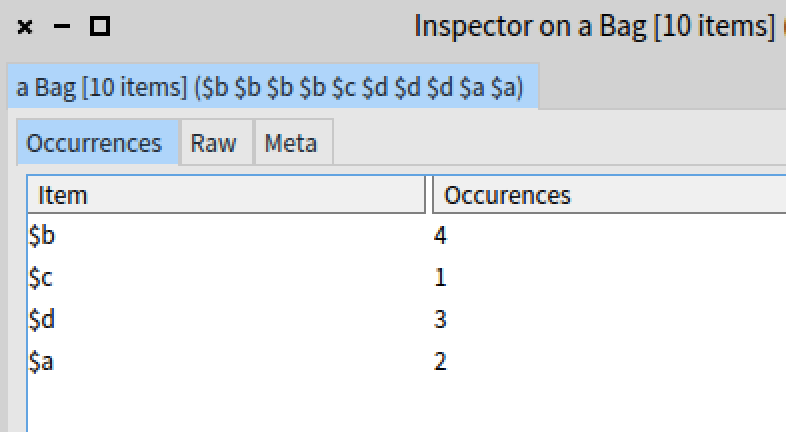
It displays in an inspector just like a Dictionary - which is why I figured I could convert to pass it back to the exercise that was written with Dictionaries in mind.
<PastedGraphic-3.png>
The code to fix it is quite simple, but on these kinds of things - I thought it worth checking before submitting a PR.
Tim
On 6 Mar 2019, at 13:53, Sven Van Caekenberghe <sven@stfx.eu> wrote:
Why would that work ? What would you expect the output to be ?
Try:
#(1 2 3) asDictionary
it fails in exactly the same way. You need key/value pairs (Associations).
These do work
Bag new add: #foo->100; asDictionary.
Bag new addAll: 'ABABABAAAA'; valuesAndCounts.
On 6 Mar 2019, at 14:25, Tim Mackinnon <tim@testit.works> wrote:
I was surprised to find that a Bag canât convert to a dictionary - e.g.
Bag new addAll: 'aabbbbcdddâ; asDictionary
Gives an error - Dnu #key
It looks to me like Bag is inheriting a bad version of #associationsDo: and instead could simply forward it to #doWithOccurences: instead?
I know Bag is not used that much - but it comes up a lot in programming exercises.
Tim

And when asking the object: #(1 2 4 5 6 7 2 1 4 3) asBag isDictionary we get false. So, not, not a dictionary. I still have been using #valuesAndCounts to get the dictionary out of a bag on several occasions. And is useful indeed. #(1 2 4 5 6 7 2 1 4 3) asBag occurrencesOf: 2 and #(1 2 4 5 6 7 2 1 4 3) asBag valuesAndCounts at: 2 seem pretty much the same. But in this age of streams/reactive streams and lazy evaluations, what do we have in Pharo on that front? Phil On Wed, Mar 6, 2019 at 4:49 PM Sven Van Caekenberghe <sven@stfx.eu> wrote:
I was just explaining how it is now, what I think the rationale is behind it.
I understand #asDictionary as working on a collection of pairs/associations (because it basically goes to #withAll:).
A bag is just a collection that is optimised for many duplicates, the fact that you have values and counts is more an implementation detail than an intrinsic property.
The conversion that you want, and that already exists in #valuesAndCounts is one interpretation of what a bag is, not the only one. A bag is foremost a collection of things.
I am not immediately convinced that #valuesAndCounts should be the default #asDictionary interpretation.
What about the inverse for example ?
{ #foo->2. #bar->3 } asDictionary asBag.
But this is certainly an interesting discussion.
On 6 Mar 2019, at 16:23, Tim Mackinnon <tim@testit.works> wrote:
As Richard said - as a bag is relationship between keys and frequencies, I would expect it to be able to convert to a dictionary.
It displays in an inspector just like a Dictionary - which is why I figured I could convert to pass it back to the exercise that was written with Dictionaries in mind.
<PastedGraphic-3.png>
The code to fix it is quite simple, but on these kinds of things - I thought it worth checking before submitting a PR.
Tim
On 6 Mar 2019, at 13:53, Sven Van Caekenberghe <sven@stfx.eu> wrote:
Why would that work ? What would you expect the output to be ?
Try:
#(1 2 3) asDictionary
it fails in exactly the same way. You need key/value pairs (Associations).
These do work
Bag new add: #foo->100; asDictionary.
Bag new addAll: 'ABABABAAAA'; valuesAndCounts.
On 6 Mar 2019, at 14:25, Tim Mackinnon <tim@testit.works> wrote:
I was surprised to find that a Bag canât convert to a dictionary - e.g.
Bag new addAll: 'aabbbbcdddâ; asDictionary
Gives an error - Dnu #key
It looks to me like Bag is inheriting a bad version of #associationsDo: and instead could simply forward it to #doWithOccurences: instead?
I know Bag is not used that much - but it comes up a lot in programming exercises.
Tim
I still am tempted to make asDictionary work - because the the moment you get a #key , DNU error - which is definitely not right. So should Bag asDictionary give you a reasonable dictionary, or should it throw a proper exception - something like: DomainError signal: â#asDictionary not supported, use #valueAndCountsâ Is that better - or do we accept that it inherits it from Collection and so can do something useful? Tim
On 6 Mar 2019, at 18:11, phil@highoctane.be wrote:
And when asking the object:
#(1 2 4 5 6 7 2 1 4 3) asBag isDictionary
we get false. So, not, not a dictionary.
I still have been using #valuesAndCounts to get the dictionary out of a bag on several occasions.
And is useful indeed.
#(1 2 4 5 6 7 2 1 4 3) asBag occurrencesOf: 2
and
#(1 2 4 5 6 7 2 1 4 3) asBag valuesAndCounts at: 2
seem pretty much the same.
But in this age of streams/reactive streams and lazy evaluations, what do we have in Pharo on that front?
Phil
On Wed, Mar 6, 2019 at 4:49 PM Sven Van Caekenberghe <sven@stfx.eu <mailto:sven@stfx.eu>> wrote: I was just explaining how it is now, what I think the rationale is behind it.
I understand #asDictionary as working on a collection of pairs/associations (because it basically goes to #withAll:).
A bag is just a collection that is optimised for many duplicates, the fact that you have values and counts is more an implementation detail than an intrinsic property.
The conversion that you want, and that already exists in #valuesAndCounts is one interpretation of what a bag is, not the only one. A bag is foremost a collection of things.
I am not immediately convinced that #valuesAndCounts should be the default #asDictionary interpretation.
What about the inverse for example ?
{ #foo->2. #bar->3 } asDictionary asBag.
But this is certainly an interesting discussion.
On 6 Mar 2019, at 16:23, Tim Mackinnon <tim@testit.works> wrote:
As Richard said - as a bag is relationship between keys and frequencies, I would expect it to be able to convert to a dictionary.
It displays in an inspector just like a Dictionary - which is why I figured I could convert to pass it back to the exercise that was written with Dictionaries in mind.
<PastedGraphic-3.png>
The code to fix it is quite simple, but on these kinds of things - I thought it worth checking before submitting a PR.
Tim
On 6 Mar 2019, at 13:53, Sven Van Caekenberghe <sven@stfx.eu <mailto:sven@stfx.eu>> wrote:
Why would that work ? What would you expect the output to be ?
Try:
#(1 2 3) asDictionary
it fails in exactly the same way. You need key/value pairs (Associations).
These do work
Bag new add: #foo->100; asDictionary.
Bag new addAll: 'ABABABAAAA'; valuesAndCounts.
On 6 Mar 2019, at 14:25, Tim Mackinnon <tim@testit.works> wrote:
I was surprised to find that a Bag canât convert to a dictionary - e.g.
Bag new addAll: 'aabbbbcdddâ; asDictionary
Gives an error - Dnu #key
It looks to me like Bag is inheriting a bad version of #associationsDo: and instead could simply forward it to #doWithOccurences: instead?
I know Bag is not used that much - but it comes up a lot in programming exercises.
Tim
I am still not convinced.
On 6 Mar 2019, at 19:24, Tim Mackinnon <tim@testit.works> wrote:
I still am tempted to make asDictionary work - because the the moment you get a #key , DNU error - which is definitely not right.
The error might not be super clear, but it is not wrong, the elements of your collection do not respond to #key, a necessity to create a dictionary from a collection of associations/pairs. Also, if you modify #asDictionary like that, then <some bag> as: #Dictionary will still fail. This is all not so simple as it seems.
So should Bag asDictionary give you a reasonable dictionary, or should it throw a proper exception - something like:
DomainError signal: â#asDictionary not supported, use #valueAndCountsâ
Is that better - or do we accept that it inherits it from Collection and so can do something useful?
Tim
On 6 Mar 2019, at 18:11, phil@highoctane.be wrote:
And when asking the object:
#(1 2 4 5 6 7 2 1 4 3) asBag isDictionary
we get false. So, not, not a dictionary.
I still have been using #valuesAndCounts to get the dictionary out of a bag on several occasions.
And is useful indeed.
#(1 2 4 5 6 7 2 1 4 3) asBag occurrencesOf: 2
and
#(1 2 4 5 6 7 2 1 4 3) asBag valuesAndCounts at: 2
seem pretty much the same.
But in this age of streams/reactive streams and lazy evaluations, what do we have in Pharo on that front?
Phil
On Wed, Mar 6, 2019 at 4:49 PM Sven Van Caekenberghe <sven@stfx.eu> wrote: I was just explaining how it is now, what I think the rationale is behind it.
I understand #asDictionary as working on a collection of pairs/associations (because it basically goes to #withAll:).
A bag is just a collection that is optimised for many duplicates, the fact that you have values and counts is more an implementation detail than an intrinsic property.
The conversion that you want, and that already exists in #valuesAndCounts is one interpretation of what a bag is, not the only one. A bag is foremost a collection of things.
I am not immediately convinced that #valuesAndCounts should be the default #asDictionary interpretation.
What about the inverse for example ?
{ #foo->2. #bar->3 } asDictionary asBag.
But this is certainly an interesting discussion.
On 6 Mar 2019, at 16:23, Tim Mackinnon <tim@testit.works> wrote:
As Richard said - as a bag is relationship between keys and frequencies, I would expect it to be able to convert to a dictionary.
It displays in an inspector just like a Dictionary - which is why I figured I could convert to pass it back to the exercise that was written with Dictionaries in mind.
<PastedGraphic-3.png>
The code to fix it is quite simple, but on these kinds of things - I thought it worth checking before submitting a PR.
Tim
On 6 Mar 2019, at 13:53, Sven Van Caekenberghe <sven@stfx.eu> wrote:
Why would that work ? What would you expect the output to be ?
Try:
#(1 2 3) asDictionary
it fails in exactly the same way. You need key/value pairs (Associations).
These do work
Bag new add: #foo->100; asDictionary.
Bag new addAll: 'ABABABAAAA'; valuesAndCounts.
On 6 Mar 2019, at 14:25, Tim Mackinnon <tim@testit.works> wrote:
I was surprised to find that a Bag canât convert to a dictionary - e.g.
Bag new addAll: 'aabbbbcdddâ; asDictionary
Gives an error - Dnu #key
It looks to me like Bag is inheriting a bad version of #associationsDo: and instead could simply forward it to #doWithOccurences: instead?
I know Bag is not used that much - but it comes up a lot in programming exercises.
Tim
Handling <some bag> as: Dictionary is really quite straightforward. Add a one-line method to Bag: Bag>> associationsDo: aBlock contents associationsDo: aBlock. This is a good idea anyway, because currently there is a bug where aBag associationsDo: aBlock fails to pass Associations to aBlock. Once you have done that, 'abracadabra' asBag as: Dictionary just works. This one simple addition - makes aBag associationsDo: aBlock work when it didn't before - makes aBag asDictionary work - makes aBag as: Dictionary work - makes Dictionary newFrom: aBag work On Thu, 7 Mar 2019 at 07:35, Sven Van Caekenberghe <sven@stfx.eu> wrote:
I am still not convinced.
On 6 Mar 2019, at 19:24, Tim Mackinnon <tim@testit.works> wrote:
I still am tempted to make asDictionary work - because the the moment you get a #key , DNU error - which is definitely not right.
The error might not be super clear, but it is not wrong, the elements of your collection do not respond to #key, a necessity to create a dictionary from a collection of associations/pairs.
Also, if you modify #asDictionary like that, then
<some bag> as: #Dictionary
will still fail.
This is all not so simple as it seems.
So should Bag asDictionary give you a reasonable dictionary, or should it throw a proper exception - something like:
DomainError signal: â#asDictionary not supported, use #valueAndCountsâ
Is that better - or do we accept that it inherits it from Collection and so can do something useful?
Tim
On 6 Mar 2019, at 18:11, phil@highoctane.be wrote:
And when asking the object:
#(1 2 4 5 6 7 2 1 4 3) asBag isDictionary
we get false. So, not, not a dictionary.
I still have been using #valuesAndCounts to get the dictionary out of a bag on several occasions.
And is useful indeed.
#(1 2 4 5 6 7 2 1 4 3) asBag occurrencesOf: 2
and
#(1 2 4 5 6 7 2 1 4 3) asBag valuesAndCounts at: 2
seem pretty much the same.
But in this age of streams/reactive streams and lazy evaluations, what do we have in Pharo on that front?
Phil
On Wed, Mar 6, 2019 at 4:49 PM Sven Van Caekenberghe <sven@stfx.eu> wrote: I was just explaining how it is now, what I think the rationale is behind it.
I understand #asDictionary as working on a collection of pairs/associations (because it basically goes to #withAll:).
A bag is just a collection that is optimised for many duplicates, the fact that you have values and counts is more an implementation detail than an intrinsic property.
The conversion that you want, and that already exists in #valuesAndCounts is one interpretation of what a bag is, not the only one. A bag is foremost a collection of things.
I am not immediately convinced that #valuesAndCounts should be the default #asDictionary interpretation.
What about the inverse for example ?
{ #foo->2. #bar->3 } asDictionary asBag.
But this is certainly an interesting discussion.
On 6 Mar 2019, at 16:23, Tim Mackinnon <tim@testit.works> wrote:
As Richard said - as a bag is relationship between keys and frequencies, I would expect it to be able to convert to a dictionary.
It displays in an inspector just like a Dictionary - which is why I figured I could convert to pass it back to the exercise that was written with Dictionaries in mind.
<PastedGraphic-3.png>
The code to fix it is quite simple, but on these kinds of things - I thought it worth checking before submitting a PR.
Tim
On 6 Mar 2019, at 13:53, Sven Van Caekenberghe <sven@stfx.eu> wrote:
Why would that work ? What would you expect the output to be ?
Try:
#(1 2 3) asDictionary
it fails in exactly the same way. You need key/value pairs (Associations).
These do work
Bag new add: #foo->100; asDictionary.
Bag new addAll: 'ABABABAAAA'; valuesAndCounts.
On 6 Mar 2019, at 14:25, Tim Mackinnon <tim@testit.works> wrote:
I was surprised to find that a Bag canât convert to a dictionary - e.g.
Bag new addAll: 'aabbbbcdddâ; asDictionary
Gives an error - Dnu #key
It looks to me like Bag is inheriting a bad version of #associationsDo: and instead could simply forward it to #doWithOccurences: instead?
I know Bag is not used that much - but it comes up a lot in programming exercises.
Tim

On Wed, Mar 6, 2019 at 10:25 AM Tim Mackinnon <tim@testit.works> wrote:
I still am tempted to make asDictionary work - because the the moment you get a #key , DNU error - which is definitely not right.
This argument gives me the willies. Sorry. I can see an argument that a sequenceable collection can implement a meaningful #asDictionary, using #keysAndValuesDo:. The key is the index of each element, so it makes sense. But, #asDictionary for a non-sequenceable collection doesn't make sense (other than for Dictionary and its variants, obviously). What would the keys be from a Set, for example? Bag>>#asDictionary makes sense if (and in my opinion, only if) you define it to rely on the internal implementation. #valuesAndCounts make sense because it doesn't rely on internal implementation details to define it, although it typically is implemented to use those internal implementation details. I think expressing it as a conversion is a poor choice. Asking it for a different representation is good. [And as an aside, given that the API expresses #occurrencesOf:, #valuesAndCounts might have been better named #valuesAndOccurrences (and perhaps "With" rather than "And").]
So should Bag asDictionary give you a reasonable dictionary, or should it throw a proper exception - something like:
DomainError signal: â#asDictionary not supported, use #valueAndCountsâ
Is that better - or do we accept that it inherits it from Collection and so can do something useful?
Tim
On 6 Mar 2019, at 18:11, phil@highoctane.be wrote:
And when asking the object:
#(1 2 4 5 6 7 2 1 4 3) asBag isDictionary
we get false. So, not, not a dictionary.
I still have been using #valuesAndCounts to get the dictionary out of a bag on several occasions.
And is useful indeed.
#(1 2 4 5 6 7 2 1 4 3) asBag occurrencesOf: 2
and
#(1 2 4 5 6 7 2 1 4 3) asBag valuesAndCounts at: 2
seem pretty much the same.
But in this age of streams/reactive streams and lazy evaluations, what do we have in Pharo on that front?
Phil
On Wed, Mar 6, 2019 at 4:49 PM Sven Van Caekenberghe <sven@stfx.eu> wrote:
I was just explaining how it is now, what I think the rationale is behind it.
I understand #asDictionary as working on a collection of pairs/associations (because it basically goes to #withAll:).
A bag is just a collection that is optimised for many duplicates, the fact that you have values and counts is more an implementation detail than an intrinsic property.
The conversion that you want, and that already exists in #valuesAndCounts is one interpretation of what a bag is, not the only one. A bag is foremost a collection of things.
I am not immediately convinced that #valuesAndCounts should be the default #asDictionary interpretation.
What about the inverse for example ?
{ #foo->2. #bar->3 } asDictionary asBag.
But this is certainly an interesting discussion.
On 6 Mar 2019, at 16:23, Tim Mackinnon <tim@testit.works> wrote:
As Richard said - as a bag is relationship between keys and frequencies, I would expect it to be able to convert to a dictionary.
It displays in an inspector just like a Dictionary - which is why I figured I could convert to pass it back to the exercise that was written with Dictionaries in mind.
<PastedGraphic-3.png>
The code to fix it is quite simple, but on these kinds of things - I thought it worth checking before submitting a PR.
Tim
On 6 Mar 2019, at 13:53, Sven Van Caekenberghe <sven@stfx.eu> wrote:
Why would that work ? What would you expect the output to be ?
Try:
#(1 2 3) asDictionary
it fails in exactly the same way. You need key/value pairs (Associations).
These do work
Bag new add: #foo->100; asDictionary.
Bag new addAll: 'ABABABAAAA'; valuesAndCounts.
On 6 Mar 2019, at 14:25, Tim Mackinnon <tim@testit.works> wrote:
I was surprised to find that a Bag canât convert to a dictionary - e.g.
Bag new addAll: 'aabbbbcdddâ; asDictionary
Gives an error - Dnu #key
It looks to me like Bag is inheriting a bad version of #associationsDo: and instead could simply forward it to #doWithOccurences: instead?
I know Bag is not used that much - but it comes up a lot in programming exercises.
Tim
To me, a bag is first and foremost a multiset. Yes, it's a collection, but it's not *just* a collection. It's a very specific kind of collection with a very salient "characteristic function". In my own Smalltalk library, #asDictionary isn't even *defined* on things that are not dictionaries or some kind of mapping, because let's face it, a dictionary *isn't* a collection of Associations, and trying to make it look like one made Smalltalk-80 rather inconsistent. For example, if a dictionary were a collection of associations, you would expect (Dictionary with: #a -> 1 with: #b -> 2) includes: #a -> 1 to be true. No, it's false. You would expect (Dictionary with: #a -> 1 with: #b -> 2) asArray to be (a->1 b->2). No, it's (1 2). In order to avoid major confusion, I had to learn never to think of Associations in connection with Dictionaries. So I expect #asDictionary to have something to do with #keysAndValuesDo:. or something like that. For {1->2. 3->4} asDictionary I would have to write Dictionary withAllAssociations: {1->2. 3->4} except that I never actually found a use for it. #valuesAndCounts is a method that violates good OO practice, because it exposes (what you'd expect to be) private state. For example, b := 'abracadabra' asBag. b valuesAndCounts at: $a put: 'BOOM!'. b select, Print It, BOOM!. It should *copy* the dictionary. On Thu, 7 Mar 2019 at 04:50, Sven Van Caekenberghe <sven@stfx.eu> wrote:
I was just explaining how it is now, what I think the rationale is behind it.
I understand #asDictionary as working on a collection of pairs/associations (because it basically goes to #withAll:).
A bag is just a collection that is optimised for many duplicates, the fact that you have values and counts is more an implementation detail than an intrinsic property.
The conversion that you want, and that already exists in #valuesAndCounts is one interpretation of what a bag is, not the only one. A bag is foremost a collection of things.
I am not immediately convinced that #valuesAndCounts should be the default #asDictionary interpretation.
What about the inverse for example ?
{ #foo->2. #bar->3 } asDictionary asBag.
But this is certainly an interesting discussion.
On 6 Mar 2019, at 16:23, Tim Mackinnon <tim@testit.works> wrote:
As Richard said - as a bag is relationship between keys and frequencies, I would expect it to be able to convert to a dictionary.
It displays in an inspector just like a Dictionary - which is why I figured I could convert to pass it back to the exercise that was written with Dictionaries in mind.
<PastedGraphic-3.png>
The code to fix it is quite simple, but on these kinds of things - I thought it worth checking before submitting a PR.
Tim
On 6 Mar 2019, at 13:53, Sven Van Caekenberghe <sven@stfx.eu> wrote:
Why would that work ? What would you expect the output to be ?
Try:
#(1 2 3) asDictionary
it fails in exactly the same way. You need key/value pairs (Associations).
These do work
Bag new add: #foo->100; asDictionary.
Bag new addAll: 'ABABABAAAA'; valuesAndCounts.
On 6 Mar 2019, at 14:25, Tim Mackinnon <tim@testit.works> wrote:
I was surprised to find that a Bag canât convert to a dictionary - e.g.
Bag new addAll: 'aabbbbcdddâ; asDictionary
Gives an error - Dnu #key
It looks to me like Bag is inheriting a bad version of #associationsDo: and instead could simply forward it to #doWithOccurences: instead?
I know Bag is not used that much - but it comes up a lot in programming exercises.
Tim

This is exactly how I think and feel about bags. Thanks Richard. Am .03.2019, 01:35 Uhr, schrieb Richard O'Keefe <raoknz@gmail.com>:
To me, a bag is first and foremost a multiset. Yes, it's a collection, but it's not *just* a collection. It's a very specific kind of collection with a very salient "characteristic function".
In my own Smalltalk library, #asDictionary isn't even *defined* on things that are not dictionaries or some kind of mapping, because let's face it, a dictionary *isn't* a collection of Associations, and trying to make it look like one made Smalltalk-80 rather inconsistent. For example, if a dictionary were a collection of associations, you would expect (Dictionary with: #a -> 1 with: #b -> 2) includes: #a -> 1 to be true. No, it's false. You would expect (Dictionary with: #a -> 1 with: #b -> 2) asArray to be (a->1 b->2). No, it's (1 2). In order to avoid major confusion, I had to learn never to think of Associations in connection with Dictionaries. So I expect #asDictionary to have something to do with #keysAndValuesDo:. or something like that.
For {1->2. 3->4} asDictionary I would have to write Dictionary withAllAssociations: {1->2. 3->4} except that I never actually found a use for it.
#valuesAndCounts is a method that violates good OO practice, because it exposes (what you'd expect to be) private state. For example, b := 'abracadabra' asBag. b valuesAndCounts at: $a put: 'BOOM!'. b select, Print It, BOOM!. It should *copy* the dictionary.
On Thu, 7 Mar 2019 at 04:50, Sven Van Caekenberghe <sven@stfx.eu> wrote:
I was just explaining how it is now, what I think the rationale is behind it.
I understand #asDictionary as working on a collection of pairs/associations (because it basically goes to #withAll:).
A bag is just a collection that is optimised for many duplicates, the fact that you have values and counts is more an implementation detail than an intrinsic property.
The conversion that you want, and that already exists in #valuesAndCounts is one interpretation of what a bag is, not the only one. A bag is foremost a collection of things.
I am not immediately convinced that #valuesAndCounts should be the default #asDictionary interpretation.
What about the inverse for example ?
{ #foo->2. #bar->3 } asDictionary asBag.
But this is certainly an interesting discussion.
On 6 Mar 2019, at 16:23, Tim Mackinnon <tim@testit.works> wrote:
As Richard said - as a bag is relationship between keys and frequencies, I would expect it to be able to convert to a dictionary.
It displays in an inspector just like a Dictionary - which is why I figured I could convert to pass it back to the exercise that was written with Dictionaries in mind.
<PastedGraphic-3.png>
The code to fix it is quite simple, but on these kinds of things - I thought it worth checking before submitting a PR.
Tim
On 6 Mar 2019, at 13:53, Sven Van Caekenberghe <sven@stfx.eu> wrote:
Why would that work ? What would you expect the output to be ?
Try:
#(1 2 3) asDictionary
it fails in exactly the same way. You need key/value pairs (Associations).
These do work
Bag new add: #foo->100; asDictionary.
Bag new addAll: 'ABABABAAAA'; valuesAndCounts.
On 6 Mar 2019, at 14:25, Tim Mackinnon <tim@testit.works> wrote:
I was surprised to find that a Bag canât convert to a dictionary - e.g.
Bag new addAll: 'aabbbbcdddâ; asDictionary
Gives an error - Dnu #key
It looks to me like Bag is inheriting a bad version of #associationsDo: and instead could simply forward it to #doWithOccurences: instead?
I know Bag is not used that much - but it comes up a lot in programming exercises.
Tim

participants (7)
-
 Cédrick Béler
 -
 phil@highoctane.be
 -
 Richard O'Keefe
 -
 Richard Sargent
 -
 Steffen Märcker
 -
 Sven Van Caekenberghe
 -
 Tim Mackinnon