Moving/rolling average implementations ?

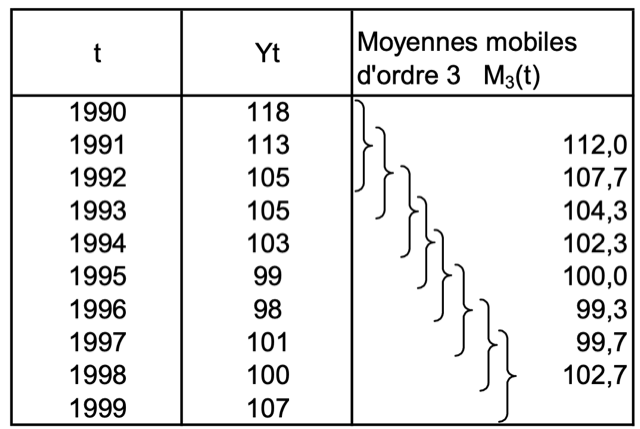
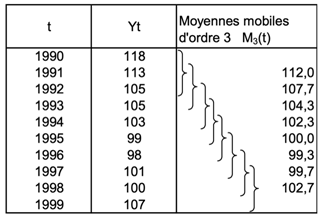
Hi, I wanted to do a moving/rolling average on raw data [1]. I havenât find code for that (maybe this is done in polymath though). So I ended writing that (I thing this is SMA): SequenceableCollection>>movingAverage: anOrder "Answer the moving or rolling average for anOrder window" | retval size x y | anOrder <= 0 ifTrue: [ Error signal: 'the order must be positive']. size := self size - anOrder. size negative ifTrue: [ Error signal: 'the collection size is too small']. retval := self species ofSize: size + 1. x := 1. y := anOrder. [y <= self size ] whileTrue: [ retval at: x put: (self copyFrom: x to: y) average x := x + 1. y := y + 1 ]. ^retval Not perfect but seems to works quite well (thatâs probably better to remove copyFrom: and use some kind of buffer instead). Any interest in that ? If any existing code too, Iâll be interested especially for other implementation (weighted, exponential) ? (#(118 113 105 105 103 99 98 101 100 107) movingAverage: 3) collect: [:v | v asScaledDecimal: 1 ] . "an Array(112.0s1 107.7s1 104.3s1 102.3s1 100.0s1 99.3s1 99.7s1 102.7s1)" Cheers, Cédrick [1] https://www.meilleursbrokers.com/techniques-de-trading/moyennes-mobiles.html <https://www.meilleursbrokers.com/techniques-de-trading/moyennes-mobiles.html> (in French but is understandable)

Hi Cédrick, for smallCharts, I had to implement the same, but for stock market time series, which are a bit bigger than your example (like creating a 38 day moving average over 5 years). Always copying the values to average is far too slow in this case. My solution is to add up the first n (for an n-movAvg) numbers and remember the sum. The new average point is of course the sum divided by n. For the next point you subtract the first number from the sum and add the next (1 + n th) number to the sum. Happy hacking, Christian Von: Pharo-users <pharo-users-bounces@lists.pharo.org> Im Auftrag von Cédrick Béler Gesendet: Mittwoch, 8. April 2020 10:07 An: Any question about pharo is welcome <pharo-users@lists.pharo.org> Betreff: [Pharo-users] Moving/rolling average implementations ? Hi, I wanted to do a moving/rolling average on raw data [1]. I havenât find code for that (maybe this is done in polymath though). So I ended writing that (I thing this is SMA): SequenceableCollection>>movingAverage: anOrder "Answer the moving or rolling average for anOrder window" | retval size x y | anOrder <= 0 ifTrue: [ Error signal: 'the order must be positive']. size := self size - anOrder. size negative ifTrue: [ Error signal: 'the collection size is too small']. retval := self species ofSize: size + 1. x := 1. y := anOrder. [y <= self size ] whileTrue: [ retval at: x put: (self copyFrom: x to: y) average x := x + 1. y := y + 1 ]. ^retval Not perfect but seems to works quite well (thatâs probably better to remove copyFrom: and use some kind of buffer instead). Any interest in that ? If any existing code too, Iâll be interested especially for other implementation (weighted, exponential) ? (#(118 113 105 105 103 99 98 101 100 107) movingAverage: 3) collect: [:v | v asScaledDecimal: 1 ] . "an Array(112.0s1 107.7s1 104.3s1 102.3s1 100.0s1 99.3s1 99.7s1 102.7s1)" Cheers, Cédrick [1] https://www.meilleursbrokers.com/techniques-de-trading/moyennes-mobiles.html (in French but is understandable)

I note that "self species ofSize: n" is not generally a good idea. Consider ByteArray, ShortIntegerArray, WordArray. Computing rolling means of these is perfectly sensible, but the results will not fit into an array of the same species. I'd stick with Array. The suggestion about subtracting an old element and adding a new one is great for integers, but for floating-point numbers risks accumulating errors. The On Wed, 8 Apr 2020 at 20:07, Cédrick Béler <cdrick65@gmail.com> wrote:
Hi,
I wanted to do a moving/rolling average on raw data [1]. I havenât find code for that (maybe this is done in polymath though).
So I ended writing that (I thing this is SMA):
SequenceableCollection>>movingAverage: anOrder "Answer the moving or rolling average for anOrder window"
| retval size x y | anOrder <= 0 ifTrue: [ Error signal: 'the order must be positive']. size := self size - anOrder. size negative ifTrue: [ Error signal: 'the collection size is too small']. retval := self species ofSize: size + 1.
x := 1. y := anOrder. [y <= self size ] whileTrue: [ retval at: x put: (self copyFrom: x to: y) average x := x + 1. y := y + 1 ]. ^retval
Not perfect but seems to works quite well (thatâs probably better to remove copyFrom: and use some kind of buffer instead).
Any interest in that ? If any existing code too, Iâll be interested especially for other implementation (weighted, exponential) ?
(#(118 113 105 105 103 99 98 101 100 107) movingAverage: 3) collect: [:v | v asScaledDecimal: 1 ] .
"an Array(112.0s1 107.7s1 104.3s1 102.3s1 100.0s1 99.3s1 99.7s1 102.7s1)"
Cheers, Cédrick
[1] https://www.meilleursbrokers.com/techniques-de-trading/moyennes-mobiles.html (in French but is understandable)
I donât see how rounding errors could accumulate, if you keep the sum and not the average. The rounding errors should be neutral, because each element is added once and subtracted once. If + and â is symmetrical in this respect, rounding inaccuracies should balance out. Cheers, Christian Von: Pharo-users <pharo-users-bounces@lists.pharo.org> Im Auftrag von Richard O'Keefe Gesendet: Donnerstag, 9. April 2020 05:26 An: Any question about pharo is welcome <pharo-users@lists.pharo.org> Betreff: Re: [Pharo-users] Moving/rolling average implementations ? I note that "self species ofSize: n" is not generally a good idea. Consider ByteArray, ShortIntegerArray, WordArray. Computing rolling means of these is perfectly sensible, but the results will not fit into an array of the same species. I'd stick with Array. The suggestion about subtracting an old element and adding a new one is great for integers, but for floating-point numbers risks accumulating errors. The On Wed, 8 Apr 2020 at 20:07, Cédrick Béler <cdrick65@gmail.com <mailto:cdrick65@gmail.com> > wrote: Hi, I wanted to do a moving/rolling average on raw data [1]. I havenât find code for that (maybe this is done in polymath though). So I ended writing that (I thing this is SMA): SequenceableCollection>>movingAverage: anOrder "Answer the moving or rolling average for anOrder window" | retval size x y | anOrder <= 0 ifTrue: [ Error signal: 'the order must be positive']. size := self size - anOrder. size negative ifTrue: [ Error signal: 'the collection size is too small']. retval := self species ofSize: size + 1. x := 1. y := anOrder. [y <= self size ] whileTrue: [ retval at: x put: (self copyFrom: x to: y) average x := x + 1. y := y + 1 ]. ^retval Not perfect but seems to works quite well (thatâs probably better to remove copyFrom: and use some kind of buffer instead). Any interest in that ? If any existing code too, Iâll be interested especially for other implementation (weighted, exponential) ? (#(118 113 105 105 103 99 98 101 100 107) movingAverage: 3) collect: [:v | v asScaledDecimal: 1 ] . "an Array(112.0s1 107.7s1 104.3s1 102.3s1 100.0s1 99.3s1 99.7s1 102.7s1)" Cheers, Cédrick [1] https://www.meilleursbrokers.com/techniques-de-trading/moyennes-mobiles.html (in French but is understandable)
Hi Richard and Christian, thanks for the comments/suggestions. For the "self species ofSize⦠», I got inspiration from the image like with #overlappingPairsCollect: As for float rounding errors, that interesting to consider indeed. Iâll try a buffer variant. Some related questions for my OO culture ;-) : #average is defined in Collection⦠That makes me wonder (especially in Collection hierarchy) that some methods are not applicable to some subclass. I think this is a common problem with inheritance ? Whatâs the way to deal with that ? Traits ? I found #shouldNotImplement that is used 106 times in one P8 image. Is it a good/favored pattern to prevent usage of such methods ? Cheers, Cédrick PS: would such method be a candidate for integration in base image ? If yes, I could try a PR.
Let's take the inheritance issue first. Yes, Collection has some subclasses where #average makes no sense, such as String. If any subclass of Collection should have #average, it is Array, as #(1 2 3 4) average makes perfect sense. BUT #($a $b $c $d) average makes exactly as much sense as 'abcd' average. So we have - subclasses where a method never makes sense (String) - subclasses where a method always makes sense (ByteArray) - subclasses where a method may or may not make sense (Array). Traits will not help at all with the third category. Historic Smalltalk practice has been to define methods like String>>average self shouldNotImplement. to "cancel" inappropriate methods to deal with the "never" subclasses, but that still does not help with the "maybe" ones. In my own code I try very hard to ensure that a method is available in a class if and only if the class can have instances where the method makes sense. That is, I try to make sure that #respondsTo: is "honest". It is not always practical. This is not a problem that is peculiar to Smalltalk. Java and C# and C++ and you-name-it also have the "maybe" problem, where a method seems to be available for an object but thanks to its state it is not. As long as sending a message to an inappropriate object (whether due to its class or its state) results in *some* exception, do we really have a problem? 'abcd' average 'abcd' asArray average result in the same error. Now for the roundoff error issue. Oh dear, we really need to do a much better job educating programmers about floating point, we really do. In real number arithmetic, (a + b) - a = b is always true. In floating-point arithmetic it is not. This is easiest to see in cases like (1.0e20 + 1.0) - 1.0e20 where Pharo answers 0.0 instead of 1.0. Less extreme cases still give you roundoff error. Much has been written about how to stably update mean, variance, &c. The simplest thing is to use Welford's algorithm for the weighted mean, using weight +1 to add the new element and -1 to remove the old. On Thu, 9 Apr 2020 at 19:33, Christian Haider < christian.haider@smalltalked-visuals.com> wrote:
I donât see how rounding errors could accumulate, if you keep the sum and not the average.
The rounding errors should be neutral, because each element is added once and subtracted once.
If + and â is symmetrical in this respect, rounding inaccuracies should balance out.
Cheers,
Christian
*Von:* Pharo-users <pharo-users-bounces@lists.pharo.org> *Im Auftrag von *Richard O'Keefe *Gesendet:* Donnerstag, 9. April 2020 05:26 *An:* Any question about pharo is welcome <pharo-users@lists.pharo.org> *Betreff:* Re: [Pharo-users] Moving/rolling average implementations ?
I note that "self species ofSize: n" is not generally a good idea.
Consider ByteArray, ShortIntegerArray, WordArray.
Computing rolling means of these is perfectly sensible,
but the results will not fit into an array of the same species.
I'd stick with Array.
The suggestion about subtracting an old element and adding a new
one is great for integers, but for floating-point numbers risks
accumulating errors.
The
On Wed, 8 Apr 2020 at 20:07, Cédrick Béler <cdrick65@gmail.com> wrote:
Hi,
I wanted to do a moving/rolling average on raw data [1].
I havenât find code for that (maybe this is done in polymath though).
So I ended writing that (I thing this is SMA):
SequenceableCollection>>movingAverage: anOrder "Answer the moving or rolling average for anOrder window"
| retval size x y |
anOrder <= 0 ifTrue: [ Error signal: 'the order must be positive'].
size := self size - anOrder.
size negative ifTrue: [ Error signal: 'the collection size is too small'].
retval := self species ofSize: size + 1.
x := 1.
y := anOrder.
[y <= self size ] whileTrue: [
retval at: x put: (self copyFrom: x to: y) average
x := x + 1. y := y + 1
].
^retval
Not perfect but seems to works quite well (thatâs probably better to remove copyFrom: and use some kind of buffer instead).
Any interest in that ? If any existing code too, Iâll be interested especially for other implementation (weighted, exponential) ?
(#(118 113 105 105 103 99 98 101 100 107) movingAverage: 3) collect: [:v | v asScaledDecimal: 1 ] .
"an Array(112.0s1 107.7s1 104.3s1 102.3s1 100.0s1 99.3s1 99.7s1 102.7s1)"
Cheers,
Cédrick
[1] https://www.meilleursbrokers.com/techniques-de-trading/moyennes-mobiles.html (in French but is understandable)
Superb, thank you Richard, very interesting answer :) For the rounding issue, since I got bitten once, I most of the time use ScaleDecimal instead of floats for data anyway. Cheers, Cédrick
Le 10 avr. 2020 à 05:04, Richard O'Keefe <raoknz@gmail.com> a écrit :
Let's take the inheritance issue first. Yes, Collection has some subclasses where #average makes no sense, such as String. If any subclass of Collection should have #average, it is Array, as #(1 2 3 4) average makes perfect sense. BUT #($a $b $c $d) average makes exactly as much sense as 'abcd' average. So we have - subclasses where a method never makes sense (String) - subclasses where a method always makes sense (ByteArray) - subclasses where a method may or may not make sense (Array). Traits will not help at all with the third category. Historic Smalltalk practice has been to define methods like String>>average self shouldNotImplement. to "cancel" inappropriate methods to deal with the "never" subclasses, but that still does not help with the "maybe" ones.
In my own code I try very hard to ensure that a method is available in a class if and only if the class can have instances where the method makes sense. That is, I try to make sure that #respondsTo: is "honest". It is not always practical.
This is not a problem that is peculiar to Smalltalk. Java and C# and C++ and you-name-it also have the "maybe" problem, where a method seems to be available for an object but thanks to its state it is not.
As long as sending a message to an inappropriate object (whether due to its class or its state) results in *some* exception, do we really have a problem? 'abcd' average 'abcd' asArray average result in the same error.
Now for the roundoff error issue.
Oh dear, we really need to do a much better job educating programmers about floating point, we really do. In real number arithmetic, (a + b) - a = b is always true. In floating-point arithmetic it is not. This is easiest to see in cases like (1.0e20 + 1.0) - 1.0e20 where Pharo answers 0.0 instead of 1.0. Less extreme cases still give you roundoff error.
Much has been written about how to stably update mean, variance, &c. The simplest thing is to use Welford's algorithm for the weighted mean, using weight +1 to add the new element and -1 to remove the old.
On Thu, 9 Apr 2020 at 19:33, Christian Haider <christian.haider@smalltalked-visuals.com <mailto:christian.haider@smalltalked-visuals.com>> wrote: I donât see how rounding errors could accumulate, if you keep the sum and not the average.
The rounding errors should be neutral, because each element is added once and subtracted once.
If + and â is symmetrical in this respect, rounding inaccuracies should balance out.
Cheers,
Christian
Von: Pharo-users <pharo-users-bounces@lists.pharo.org <mailto:pharo-users-bounces@lists.pharo.org>> Im Auftrag von Richard O'Keefe Gesendet: Donnerstag, 9. April 2020 05:26 An: Any question about pharo is welcome <pharo-users@lists.pharo.org <mailto:pharo-users@lists.pharo.org>> Betreff: Re: [Pharo-users] Moving/rolling average implementations ?
I note that "self species ofSize: n" is not generally a good idea.
Consider ByteArray, ShortIntegerArray, WordArray.
Computing rolling means of these is perfectly sensible,
but the results will not fit into an array of the same species.
I'd stick with Array.
The suggestion about subtracting an old element and adding a new
one is great for integers, but for floating-point numbers risks
accumulating errors.
The
On Wed, 8 Apr 2020 at 20:07, Cédrick Béler <cdrick65@gmail.com <mailto:cdrick65@gmail.com>> wrote:
Hi,
I wanted to do a moving/rolling average on raw data [1].
I havenât find code for that (maybe this is done in polymath though).
So I ended writing that (I thing this is SMA):
SequenceableCollection>>movingAverage: anOrder "Answer the moving or rolling average for anOrder window"
| retval size x y |
anOrder <= 0 ifTrue: [ Error signal: 'the order must be positive'].
size := self size - anOrder.
size negative ifTrue: [ Error signal: 'the collection size is too small'].
retval := self species ofSize: size + 1.
x := 1.
y := anOrder.
[y <= self size ] whileTrue: [
retval at: x put: (self copyFrom: x to: y) average
x := x + 1. y := y + 1
].
^retval
Not perfect but seems to works quite well (thatâs probably better to remove copyFrom: and use some kind of buffer instead).
Any interest in that ? If any existing code too, Iâll be interested especially for other implementation (weighted, exponential) ?
<image001.png>
(#(118 113 105 105 103 99 98 101 100 107) movingAverage: 3) collect: [:v | v asScaledDecimal: 1 ] .
"an Array(112.0s1 107.7s1 104.3s1 102.3s1 100.0s1 99.3s1 99.7s1 102.7s1)"
Cheers,
Cédrick
[1] https://www.meilleursbrokers.com/techniques-de-trading/moyennes-mobiles.html <https://www.meilleursbrokers.com/techniques-de-trading/moyennes-mobiles.html> (in French but is understandable)
I have coded and benchmarked 8 different running mean algorithms. In the presence of inexact numbers it is not as accurate as redoing the sums, but it's pretty close, and it's fast. If "width" is not an integer or is out of range, an error will be reported by #new: or #at:[put:]. It's based on Welford's stable update. Of course this approach does NOT work for trimmed or Winsorised means or for medians or any kind of robust estimate of location. SequenceableCollection methods for: 'summarising' runningMeans: width |a m d| a := Array new: self size - width + 1. m := 0. 1 to: width do: [:i | m := (self at: i) + m]. m := m / width. d := 1. a at: d put: m. width + 1 to: self size do: [:i | m := ((self at: i) - (self at: d)) / width + m. d := d + 1. a at: d put: m]. ^a
Beautiful ^^ I would vote for inclusion in the base image ? With your explanation as comments. Iâll play with it. Thanks Cedrick
Le 12 avr. 2020 à 12:19, Richard O'Keefe <raoknz@gmail.com> a écrit :
 I have coded and benchmarked 8 different running mean algorithms. In the presence of inexact numbers it is not as accurate as redoing the sums, but it's pretty close, and it's fast. If "width" is not an integer or is out of range, an error will be reported by #new: or #at:[put:]. It's based on Welford's stable update.
Of course this approach does NOT work for trimmed or Winsorised means or for medians or any kind of robust estimate of location.
SequenceableCollection methods for: 'summarising' runningMeans: width |a m d| a := Array new: self size - width + 1. m := 0. 1 to: width do: [:i | m := (self at: i) + m]. m := m / width. d := 1. a at: d put: m. width + 1 to: self size do: [:i | m := ((self at: i) - (self at: d)) / width + m. d := d + 1. a at: d put: m]. ^a

On 12 Apr 2020, at 13:53, Cédrick Béler <cdrick65@gmail.com> wrote:
Beautiful ^^
I also like it. But why the single letter variable names ? Why not: SequenceableCollection>>#runningMeans: width | means sum index | means := Array new: self size - width + 1. sum := 0. 1 to: width do: [ :each | sum := sum + (self at: each) ]. index := 1. means at: index put: sum / width. width + 1 to: self size do: [ :each | sum := sum - (self at: index) + (self at: each). index := index + 1. means at: index put: sum / width ]. ^ means A good comment, a correct initial bounds check and unit tests are also needed.
I would vote for inclusion in the base image ? With your explanation as comments.
Iâll play with it.
Thanks Cedrick
Le 12 avr. 2020 à 12:19, Richard O'Keefe <raoknz@gmail.com> a écrit :
 I have coded and benchmarked 8 different running mean algorithms. In the presence of inexact numbers it is not as accurate as redoing the sums, but it's pretty close, and it's fast. If "width" is not an integer or is out of range, an error will be reported by #new: or #at:[put:]. It's based on Welford's stable update.
Of course this approach does NOT work for trimmed or Winsorised means or for medians or any kind of robust estimate of location.
SequenceableCollection methods for: 'summarising' runningMeans: width |a m d| a := Array new: self size - width + 1. m := 0. 1 to: width do: [:i | m := (self at: i) + m]. m := m / width. d := 1. a at: d put: m. width + 1 to: self size do: [:i | m := ((self at: i) - (self at: d)) / width + m. d := d + 1. a at: d put: m]. ^a
Fully agree on proper names. === I donât know if this is because of free confinement time but I can keep on asking questions so I share some I hope will make sense (for the sake of discussion). For instance, I'm wondering if tests on conditions so as to raise proper exceptions is a good practice (for instance if the width object does not make sense, like a float) #doesNotMakeSense btw would be a cool name for the « maybe » cases Richard was talking. Then I asked myself what are the drawbacks (especially on performance) on adding extra information to source code (a bit like longer variable names) ? There is the raw code and the sources code file that helps separating concerns. At least we donât mind at all having longer literals (variables names, â¦). I cannot help is what about pragmas. I kind see roughly how they work. But is it possible to distinguish between runtime / source only pragmas (not sure Iâm clear here but it seems to me that some are important for documentation purposes that are not needed at runtime) ? Also, Iâve never really liked method categories. I donât really see how there are implemented but they donât feel nice to me. Could they be only pragmas ? Happy eater Sunday, stay all preserved (sad day for the game of life), Cédrick
Le 12 avr. 2020 à 14:22, Sven Van Caekenberghe <sven@stfx.eu> a écrit :
On 12 Apr 2020, at 13:53, Cédrick Béler <cdrick65@gmail.com> wrote:
Beautiful ^^
I also like it.
But why the single letter variable names ? Why not:
SequenceableCollection>>#runningMeans: width | means sum index | means := Array new: self size - width + 1. sum := 0. 1 to: width do: [ :each | sum := sum + (self at: each) ]. index := 1. means at: index put: sum / width. width + 1 to: self size do: [ :each | sum := sum - (self at: index) + (self at: each). index := index + 1. means at: index put: sum / width ]. ^ means
A good comment, a correct initial bounds check and unit tests are also needed.
I would vote for inclusion in the base image ? With your explanation as comments.
Iâll play with it.
Thanks Cedrick
Le 12 avr. 2020 à 12:19, Richard O'Keefe <raoknz@gmail.com> a écrit :
 I have coded and benchmarked 8 different running mean algorithms. In the presence of inexact numbers it is not as accurate as redoing the sums, but it's pretty close, and it's fast. If "width" is not an integer or is out of range, an error will be reported by #new: or #at:[put:]. It's based on Welford's stable update.
Of course this approach does NOT work for trimmed or Winsorised means or for medians or any kind of robust estimate of location.
SequenceableCollection methods for: 'summarising' runningMeans: width |a m d| a := Array new: self size - width + 1. m := 0. 1 to: width do: [:i | m := (self at: i) + m]. m := m / width. d := 1. a at: d put: m. width + 1 to: self size do: [:i | m := ((self at: i) - (self at: d)) / width + m. d := d + 1. a at: d put: m]. ^a
Concerning method categories: VIsualAge Smalltalk manages without them. Of all the Smalltalk systems available to me, it's the only one where I don't enjoy using the browser. It carves up the world of methods another way, which I find of little or no help. That in no way detracts from it being a solid system fit for its intended uses. GNU Smalltalk uses <category: 'whatever'> pragmas to put methods into categories. Used consistently and well, method categories are not only a navigation aid, helping you to find methods you do not know the names of, but a helpful documentation aid. For example, #runningMeans: is in the 'summarising' category. In my Smalltalk, that means - it inspects every element of the collection - it does not change the collection - the result is somehow a summary or distillation of the elements Of course, to get the most from method categories, the method categories need to be documented, and you need to keep them as up to date as any other part of the source code. I can say that the discipline of trying to come up with meaningful categories and use them consistently has improved the quality of my code. On Mon, 13 Apr 2020 at 00:38, Cédrick Béler <cdrick65@gmail.com> wrote:
Fully agree on proper names.
=== I donât know if this is because of free confinement time but I can keep on asking questions so I share some I hope will make sense (for the sake of discussion).
For instance, I'm wondering if tests on conditions so as to raise proper exceptions is a good practice (for instance if the width object does not make sense, like a float) #doesNotMakeSense btw would be a cool name for the « maybe » cases Richard was talking.
Then I asked myself what are the drawbacks (especially on performance) on adding extra information to source code (a bit like longer variable names) ?
There is the raw code and the sources code file that helps separating concerns. At least we donât mind at all having longer literals (variables names, â¦).
I cannot help is what about pragmas. I kind see roughly how they work. But is it possible to distinguish between runtime / source only pragmas (not sure Iâm clear here but it seems to me that some are important for documentation purposes that are not needed at runtime) ?
Also, Iâve never really liked method categories. I donât really see how there are implemented but they donât feel nice to me. Could they be only pragmas ?
Happy eater Sunday, stay all preserved (sad day for the game of life),
Cédrick
Le 12 avr. 2020 à 14:22, Sven Van Caekenberghe <sven@stfx.eu> a écrit :
On 12 Apr 2020, at 13:53, Cédrick Béler <cdrick65@gmail.com> wrote:
Beautiful ^^
I also like it.
But why the single letter variable names ? Why not:
SequenceableCollection>>#runningMeans: width | means sum index | means := Array new: self size - width + 1. sum := 0. 1 to: width do: [ :each | sum := sum + (self at: each) ]. index := 1. means at: index put: sum / width. width + 1 to: self size do: [ :each | sum := sum - (self at: index) + (self at: each). index := index + 1. means at: index put: sum / width ]. ^ means
A good comment, a correct initial bounds check and unit tests are also needed.
I would vote for inclusion in the base image ? With your explanation as comments.
Iâll play with it.
Thanks Cedrick
Le 12 avr. 2020 à 12:19, Richard O'Keefe <raoknz@gmail.com> a écrit :
 I have coded and benchmarked 8 different running mean algorithms. In the presence of inexact numbers it is not as accurate as redoing the sums, but it's pretty close, and it's fast. If "width" is not an integer or is out of range, an error will be reported by #new: or #at:[put:]. It's based on Welford's stable update.
Of course this approach does NOT work for trimmed or Winsorised means or for medians or any kind of robust estimate of location.
SequenceableCollection methods for: 'summarising' runningMeans: width |a m d| a := Array new: self size - width + 1. m := 0. 1 to: width do: [:i | m := (self at: i) + m]. m := m / width. d := 1. a at: d put: m. width + 1 to: self size do: [:i | m := ((self at: i) - (self at: d)) / width + m. d := d + 1. a at: d put: m]. ^a
Used consistently and well, method categories are not only a navigation aid, helping you to find methods you do not know the names of, but a helpful documentation aid. For example, #runningMeans: is in the 'summarising' category. In my Smalltalk, that means - it inspects every element of the collection - it does not change the collection - the result is somehow a summary or distillation of the elements
Great. If only categories were more first class, we could store such information. I agree that a proper name is important but this is kind of hell to do bu yourself as minait no help.
From you definition, I see that the category can be associated to tests that might eventually auto categorize.
Anyway, with such artefact, this is before being a tool artefact, a discipline one (convetions). I just have headaches each time I have to write my categories ^^especially with the UI. Shouldnât category by more like tags ? And first class object (more source oriented even if some could be helpful at runtime like private methods) ? Cheers, Cédrick
Of course, to get the most from method categories, the method categories need to be documented, and you need to keep them as up to date as any other part of the source code.
I can say that the discipline of trying to come up with meaningful categories and use them consistently has improved the quality of my code.
On Mon, 13 Apr 2020 at 00:38, Cédrick Béler <cdrick65@gmail.com> wrote:
Fully agree on proper names.
=== I donât know if this is because of free confinement time but I can keep on asking questions so I share some I hope will make sense (for the sake of discussion).
For instance, I'm wondering if tests on conditions so as to raise proper exceptions is a good practice (for instance if the width object does not make sense, like a float) #doesNotMakeSense btw would be a cool name for the « maybe » cases Richard was talking.
Then I asked myself what are the drawbacks (especially on performance) on adding extra information to source code (a bit like longer variable names) ?
There is the raw code and the sources code file that helps separating concerns. At least we donât mind at all having longer literals (variables names, â¦).
I cannot help is what about pragmas. I kind see roughly how they work. But is it possible to distinguish between runtime / source only pragmas (not sure Iâm clear here but it seems to me that some are important for documentation purposes that are not needed at runtime) ?
Also, Iâve never really liked method categories. I donât really see how there are implemented but they donât feel nice to me. Could they be only pragmas ?
Happy eater Sunday, stay all preserved (sad day for the game of life),
Cédrick
Le 12 avr. 2020 à 14:22, Sven Van Caekenberghe <sven@stfx.eu> a écrit :
On 12 Apr 2020, at 13:53, Cédrick Béler <cdrick65@gmail.com> wrote:
Beautiful ^^
I also like it.
But why the single letter variable names ? Why not:
SequenceableCollection>>#runningMeans: width | means sum index | means := Array new: self size - width + 1. sum := 0. 1 to: width do: [ :each | sum := sum + (self at: each) ]. index := 1. means at: index put: sum / width. width + 1 to: self size do: [ :each | sum := sum - (self at: index) + (self at: each). index := index + 1. means at: index put: sum / width ]. ^ means
A good comment, a correct initial bounds check and unit tests are also needed.
I would vote for inclusion in the base image ? With your explanation as comments.
Iâll play with it.
Thanks Cedrick
Le 12 avr. 2020 à 12:19, Richard O'Keefe <raoknz@gmail.com> a écrit :
 I have coded and benchmarked 8 different running mean algorithms. In the presence of inexact numbers it is not as accurate as redoing the sums, but it's pretty close, and it's fast. If "width" is not an integer or is out of range, an error will be reported by #new: or #at:[put:]. It's based on Welford's stable update.
Of course this approach does NOT work for trimmed or Winsorised means or for medians or any kind of robust estimate of location.
SequenceableCollection methods for: 'summarising' runningMeans: width |a m d| a := Array new: self size - width + 1. m := 0. 1 to: width do: [:i | m := (self at: i) + m]. m := m / width. d := 1. a at: d put: m. width + 1 to: self size do: [:i | m := ((self at: i) - (self at: d)) / width + m. d := d + 1. a at: d put: m]. ^a

El 13 abr 2020, a las 11:17, Cédrick Béler <cdrick65@gmail.com> escribió:
Used consistently and well, method categories are not only a navigation aid, helping you to find methods you do not know the names of, but a helpful documentation aid. For example, #runningMeans: is in the 'summarising' category. In my Smalltalk, that means - it inspects every element of the collection - it does not change the collection - the result is somehow a summary or distillation of the elements
Great. If only categories were more first class, we could store such information.
Haha just said the same in the other thread ^^. Sorry for the noise
(this is not really noise, at least useful one ie. an information like the +1 :) ) At least, I think we need « standard » protocols list, at least for the most used ones. Some conventions too. For instance, all the initialize* (+ class side)⦠I can cope with that but this is clearly a brain stopper for me :grinning:. Were they some attempts to define such standard list / best practices for protocols ? I guess this is a huge task but one important one. Regarding implementations, it might be hard to change too much for compatibility reasons (nb: exercice for later => get all protocols name of an image) @++ Cédrick
Le 13 avr. 2020 à 12:03, Guillermo Polito <guillermopolito@gmail.com> a écrit :
El 13 abr 2020, a las 11:17, Cédrick Béler <cdrick65@gmail.com> escribió:
Used consistently and well, method categories are not only a navigation aid, helping you to find methods you do not know the names of, but a helpful documentation aid. For example, #runningMeans: is in the 'summarising' category. In my Smalltalk, that means - it inspects every element of the collection - it does not change the collection - the result is somehow a summary or distillation of the elements
Great. If only categories were more first class, we could store such information.
Haha just said the same in the other thread ^^. Sorry for the noise
El 13 abr 2020, a las 11:00, Richard O'Keefe <raoknz@gmail.com> escribió:
Concerning method categories: VIsualAge Smalltalk manages without them. Of all the Smalltalk systems available to me, it's the only one where I don't enjoy using the browser. It carves up the world of methods another way, which I find of little or no help. That in no way detracts from it being a solid system fit for its intended uses.
GNU Smalltalk uses <category: 'whatever'> pragmas to put methods into categories.
Used consistently and well, method categories are not only a navigation aid, helping you to find methods you do not know the names of, but a helpful documentation aid. For example, #runningMeans: is in the 'summarising' category. In my Smalltalk, that means - it inspects every element of the collection - it does not change the collection - the result is somehow a summary or distillation of the elements Of course, to get the most from method categories, the method categories need to be documented, and you need to keep them as up to date as any other part of the source code.
It would be interesting if protocols had comments :)
I can say that the discipline of trying to come up with meaningful categories and use them consistently has improved the quality of my code.
On Mon, 13 Apr 2020 at 00:38, Cédrick Béler <cdrick65@gmail.com> wrote:
Fully agree on proper names.
=== I donât know if this is because of free confinement time but I can keep on asking questions so I share some I hope will make sense (for the sake of discussion).
For instance, I'm wondering if tests on conditions so as to raise proper exceptions is a good practice (for instance if the width object does not make sense, like a float) #doesNotMakeSense btw would be a cool name for the « maybe » cases Richard was talking.
Then I asked myself what are the drawbacks (especially on performance) on adding extra information to source code (a bit like longer variable names) ?
There is the raw code and the sources code file that helps separating concerns. At least we donât mind at all having longer literals (variables names, â¦).
I cannot help is what about pragmas. I kind see roughly how they work. But is it possible to distinguish between runtime / source only pragmas (not sure Iâm clear here but it seems to me that some are important for documentation purposes that are not needed at runtime) ?
Also, Iâve never really liked method categories. I donât really see how there are implemented but they donât feel nice to me. Could they be only pragmas ?
Happy eater Sunday, stay all preserved (sad day for the game of life),
Cédrick
Le 12 avr. 2020 à 14:22, Sven Van Caekenberghe <sven@stfx.eu> a écrit :
On 12 Apr 2020, at 13:53, Cédrick Béler <cdrick65@gmail.com> wrote:
Beautiful ^^
I also like it.
But why the single letter variable names ? Why not:
SequenceableCollection>>#runningMeans: width | means sum index | means := Array new: self size - width + 1. sum := 0. 1 to: width do: [ :each | sum := sum + (self at: each) ]. index := 1. means at: index put: sum / width. width + 1 to: self size do: [ :each | sum := sum - (self at: index) + (self at: each). index := index + 1. means at: index put: sum / width ]. ^ means
A good comment, a correct initial bounds check and unit tests are also needed.
I would vote for inclusion in the base image ? With your explanation as comments.
Iâll play with it.
Thanks Cedrick
Le 12 avr. 2020 à 12:19, Richard O'Keefe <raoknz@gmail.com> a écrit :
 I have coded and benchmarked 8 different running mean algorithms. In the presence of inexact numbers it is not as accurate as redoing the sums, but it's pretty close, and it's fast. If "width" is not an integer or is out of range, an error will be reported by #new: or #at:[put:]. It's based on Welford's stable update.
Of course this approach does NOT work for trimmed or Winsorised means or for medians or any kind of robust estimate of location.
SequenceableCollection methods for: 'summarising' runningMeans: width |a m d| a := Array new: self size - width + 1. m := 0. 1 to: width do: [:i | m := (self at: i) + m]. m := m / width. d := 1. a at: d put: m. width + 1 to: self size do: [:i | m := ((self at: i) - (self at: d)) / width + m. d := d + 1. a at: d put: m]. ^a
I did mention that it was one of eight implementations that I tried. In fact you broke it with your change. It is important ***NOT*** to keep a running sum but a running MEAN. The line m := ((self at: i) - (self at: d)) / width + m was written that way for a reason. I did think of renaming the variables for general use, but decided to display the actual code that I tested. If you want polished code, here it is. runningMeans: width "This returns an array of running means as if the receiver were broken into overlapping segments 'width' long and the mean of each calculated. This uses an adaptation of Welford's algorithm for stably updating the mean; it is important to maintain a current MEAN not a current SUM. This has been tested against 7 other algorithms. It was the most accurate of the faster ones. The result is an Array no matter what kind of sequence the receiver is. If the receiver is a tree (like a virtual concatenation) or a singly or doubly linked list you should convert the receiver to an Array first. Note that there is no explicit check that width is an Integer or is in range; none is needed because those checks happen anyway." |result mean resultIndex| result := Array new: self size - width + 1. mean := 0. 1 to: width do: [:i | mean := (self at: i) + mean]. mean := mean / width. resultIndex := 1. result at: resultIndex put: mean. width + 1 to: self size do: [:i | mean := ((self at: i) - (self at: resultIndex)) / width + mean. resultIndex := resultIndex + 1. result at: resultIndex put: mean]. ^result On Mon, 13 Apr 2020 at 00:23, Sven Van Caekenberghe <sven@stfx.eu> wrote:
On 12 Apr 2020, at 13:53, Cédrick Béler <cdrick65@gmail.com> wrote:
Beautiful ^^
I also like it.
But why the single letter variable names ? Why not:
SequenceableCollection>>#runningMeans: width | means sum index | means := Array new: self size - width + 1. sum := 0. 1 to: width do: [ :each | sum := sum + (self at: each) ]. index := 1. means at: index put: sum / width. width + 1 to: self size do: [ :each | sum := sum - (self at: index) + (self at: each). index := index + 1. means at: index put: sum / width ]. ^ means
A good comment, a correct initial bounds check and unit tests are also needed.
I would vote for inclusion in the base image ? With your explanation as comments.
Iâll play with it.
Thanks Cedrick
Le 12 avr. 2020 à 12:19, Richard O'Keefe <raoknz@gmail.com> a écrit :
 I have coded and benchmarked 8 different running mean algorithms. In the presence of inexact numbers it is not as accurate as redoing the sums, but it's pretty close, and it's fast. If "width" is not an integer or is out of range, an error will be reported by #new: or #at:[put:]. It's based on Welford's stable update.
Of course this approach does NOT work for trimmed or Winsorised means or for medians or any kind of robust estimate of location.
SequenceableCollection methods for: 'summarising' runningMeans: width |a m d| a := Array new: self size - width + 1. m := 0. 1 to: width do: [:i | m := (self at: i) + m]. m := m / width. d := 1. a at: d put: m. width + 1 to: self size do: [:i | m := ((self at: i) - (self at: d)) / width + m. d := d + 1. a at: d put: m]. ^a
What about this test (in OrderedCollectionTest - it suggests a Trait too) ? testRunningMeans | result col | col := #(1 1 2 2 3 3) asOrderedCollection. result := col runningMeans: 2. self assert: (result = {1. (3/2). 2. (5/2). 3}). self assert: (result class = Array). self assert: result size <= (col size). "Running means with 1 has little interest ?" self should: [ col runningMeans: 7 ] raise: SubscriptOutOfBounds. self should: [ col runningMeans: -2 ] raise: SubscriptOutOfBounds. self should: [ col runningMeans: 1.3 ] raise: Error withExceptionDo: [ :anException | self assert: anException messageText equals: 'primitive #basicNew: in Array class failedâ ] Cheers, Cédrick
Le 13 avr. 2020 à 04:47, Richard O'Keefe <raoknz@gmail.com> a écrit :
I did mention that it was one of eight implementations that I tried. In fact you broke it with your change. It is important ***NOT*** to keep a running sum but a running MEAN. The line m := ((self at: i) - (self at: d)) / width + m was written that way for a reason.
I did think of renaming the variables for general use, but decided to display the actual code that I tested. If you want polished code, here it is.
runningMeans: width "This returns an array of running means as if the receiver were broken into overlapping segments 'width' long and the mean of each calculated. This uses an adaptation of Welford's algorithm for stably updating the mean; it is important to maintain a current MEAN not a current SUM. This has been tested against 7 other algorithms. It was the most accurate of the faster ones. The result is an Array no matter what kind of sequence the receiver is. If the receiver is a tree (like a virtual concatenation) or a singly or doubly linked list you should convert the receiver to an Array first. Note that there is no explicit check that width is an Integer or is in range; none is needed because those checks happen anyway." |result mean resultIndex| result := Array new: self size - width + 1. mean := 0. 1 to: width do: [:i | mean := (self at: i) + mean]. mean := mean / width. resultIndex := 1. result at: resultIndex put: mean. width + 1 to: self size do: [:i | mean := ((self at: i) - (self at: resultIndex)) / width + mean. resultIndex := resultIndex + 1. result at: resultIndex put: mean]. ^result
On Mon, 13 Apr 2020 at 00:23, Sven Van Caekenberghe <sven@stfx.eu> wrote:
On 12 Apr 2020, at 13:53, Cédrick Béler <cdrick65@gmail.com> wrote:
Beautiful ^^
I also like it.
But why the single letter variable names ? Why not:
SequenceableCollection>>#runningMeans: width | means sum index | means := Array new: self size - width + 1. sum := 0. 1 to: width do: [ :each | sum := sum + (self at: each) ]. index := 1. means at: index put: sum / width. width + 1 to: self size do: [ :each | sum := sum - (self at: index) + (self at: each). index := index + 1. means at: index put: sum / width ]. ^ means
A good comment, a correct initial bounds check and unit tests are also needed.
I would vote for inclusion in the base image ? With your explanation as comments.
Iâll play with it.
Thanks Cedrick
Le 12 avr. 2020 à 12:19, Richard O'Keefe <raoknz@gmail.com> a écrit :
 I have coded and benchmarked 8 different running mean algorithms. In the presence of inexact numbers it is not as accurate as redoing the sums, but it's pretty close, and it's fast. If "width" is not an integer or is out of range, an error will be reported by #new: or #at:[put:]. It's based on Welford's stable update.
Of course this approach does NOT work for trimmed or Winsorised means or for medians or any kind of robust estimate of location.
SequenceableCollection methods for: 'summarising' runningMeans: width |a m d| a := Array new: self size - width + 1. m := 0. 1 to: width do: [:i | m := (self at: i) + m]. m := m / width. d := 1. a at: d put: m. width + 1 to: self size do: [:i | m := ((self at: i) - (self at: d)) / width + m. d := d + 1. a at: d put: m]. ^a
And maybe another one to show deviation problem ? testRunningMeansDeviation | result1 result2 col1 col2 | col1 := #(0.3s1 1s1 0.1s1 0.3s1 1s1 0.1s1 0.3s1 1s1 0.1s1). result1 := col1 runningMeans: 2. col2 := #(0.3 1 0.1 0.3 1 0.1 0.3 1 0.1). result2 := col2 runningMeans: 2. self assert: result1 first equals: result1 fourth. "presence of a rounding error" self deny: result2 first equals: result2 fourth. self assert: result2 first closeTo: result2 fourth.
Le 13 avr. 2020 à 10:48, Cédrick Béler <cdrick65@gmail.com> a écrit :
What about this test (in OrderedCollectionTest - it suggests a Trait too) ?
testRunningMeans
| result col | col := #(1 1 2 2 3 3) asOrderedCollection. result := col runningMeans: 2.
self assert: (result = {1. (3/2). 2. (5/2). 3}).
self assert: (result class = Array).
self assert: result size <= (col size). "Running means with 1 has little interest ?"
self should: [ col runningMeans: 7 ] raise: SubscriptOutOfBounds. self should: [ col runningMeans: -2 ] raise: SubscriptOutOfBounds. self should: [ col runningMeans: 1.3 ] raise: Error withExceptionDo: [ :anException | self assert: anException messageText equals: 'primitive #basicNew: in Array class failedâ ]
Cheers, Cédrick
Le 13 avr. 2020 à 04:47, Richard O'Keefe <raoknz@gmail.com> a écrit :
I did mention that it was one of eight implementations that I tried. In fact you broke it with your change. It is important ***NOT*** to keep a running sum but a running MEAN. The line m := ((self at: i) - (self at: d)) / width + m was written that way for a reason.
I did think of renaming the variables for general use, but decided to display the actual code that I tested. If you want polished code, here it is.
runningMeans: width "This returns an array of running means as if the receiver were broken into overlapping segments 'width' long and the mean of each calculated. This uses an adaptation of Welford's algorithm for stably updating the mean; it is important to maintain a current MEAN not a current SUM. This has been tested against 7 other algorithms. It was the most accurate of the faster ones. The result is an Array no matter what kind of sequence the receiver is. If the receiver is a tree (like a virtual concatenation) or a singly or doubly linked list you should convert the receiver to an Array first. Note that there is no explicit check that width is an Integer or is in range; none is needed because those checks happen anyway." |result mean resultIndex| result := Array new: self size - width + 1. mean := 0. 1 to: width do: [:i | mean := (self at: i) + mean]. mean := mean / width. resultIndex := 1. result at: resultIndex put: mean. width + 1 to: self size do: [:i | mean := ((self at: i) - (self at: resultIndex)) / width + mean. resultIndex := resultIndex + 1. result at: resultIndex put: mean]. ^result
On Mon, 13 Apr 2020 at 00:23, Sven Van Caekenberghe <sven@stfx.eu> wrote:
On 12 Apr 2020, at 13:53, Cédrick Béler <cdrick65@gmail.com> wrote:
Beautiful ^^
I also like it.
But why the single letter variable names ? Why not:
SequenceableCollection>>#runningMeans: width | means sum index | means := Array new: self size - width + 1. sum := 0. 1 to: width do: [ :each | sum := sum + (self at: each) ]. index := 1. means at: index put: sum / width. width + 1 to: self size do: [ :each | sum := sum - (self at: index) + (self at: each). index := index + 1. means at: index put: sum / width ]. ^ means
A good comment, a correct initial bounds check and unit tests are also needed.
I would vote for inclusion in the base image ? With your explanation as comments.
Iâll play with it.
Thanks Cedrick
Le 12 avr. 2020 à 12:19, Richard O'Keefe <raoknz@gmail.com> a écrit :
 I have coded and benchmarked 8 different running mean algorithms. In the presence of inexact numbers it is not as accurate as redoing the sums, but it's pretty close, and it's fast. If "width" is not an integer or is out of range, an error will be reported by #new: or #at:[put:]. It's based on Welford's stable update.
Of course this approach does NOT work for trimmed or Winsorised means or for medians or any kind of robust estimate of location.
SequenceableCollection methods for: 'summarising' runningMeans: width |a m d| a := Array new: self size - width + 1. m := 0. 1 to: width do: [:i | m := (self at: i) + m]. m := m / width. d := 1. a at: d put: m. width + 1 to: self size do: [:i | m := ((self at: i) - (self at: d)) / width + m. d := d + 1. a at: d put: m]. ^a
participants (5)
-
 Christian Haider
 -
 Cédrick Béler
 -
 Guillermo Polito
 -
 Richard O'Keefe
 -
 Sven Van Caekenberghe