
Many seemed to like the idea of a Pharo wiki , I like it too. I created one, can be found here and super easy to contribute to. https://github.com/SquareBracketAssociates/PharoWiki Will keep this thread for alerting for important updates to wiki. Have fun :)
I also turned it to be published as a webpage, its can be viewed from this link https://squarebracketassociates.github.io/PharoWiki/ On Sat, Aug 19, 2017 at 11:54 PM Dimitris Chloupis <kilon.alios@gmail.com> wrote:
Many seemed to like the idea of a Pharo wiki , I like it too. I created one, can be found here and super easy to contribute to.
https://github.com/SquareBracketAssociates/PharoWiki
Will keep this thread for alerting for important updates to wiki. Have fun :)

I added some links to books and blogs. On Sat, Aug 19, 2017 at 11:20 PM, Dimitris Chloupis <kilon.alios@gmail.com> wrote:
I also turned it to be published as a webpage, its can be viewed from this link
https://squarebracketassociates.github.io/PharoWiki/
On Sat, Aug 19, 2017 at 11:54 PM Dimitris Chloupis <kilon.alios@gmail.com> wrote:
Many seemed to like the idea of a Pharo wiki , I like it too. I created one, can be found here and super easy to contribute to.
https://github.com/SquareBracketAssociates/PharoWiki
Will keep this thread for alerting for important updates to wiki. Have fun :)
Thanks mate :) I really appreciate it On Sun, 20 Aug 2017 at 12:25, Stephane Ducasse <stepharo.self@gmail.com> wrote:
I added some links to books and blogs.
On Sat, Aug 19, 2017 at 11:20 PM, Dimitris Chloupis <kilon.alios@gmail.com> wrote:
I also turned it to be published as a webpage, its can be viewed from this link
https://squarebracketassociates.github.io/PharoWiki/
On Sat, Aug 19, 2017 at 11:54 PM Dimitris Chloupis < kilon.alios@gmail.com> wrote:
Many seemed to like the idea of a Pharo wiki , I like it too. I created one, can be found here and super easy to contribute to.
https://github.com/SquareBracketAssociates/PharoWiki
Will keep this thread for alerting for important updates to wiki. Have
fun
:)

Stephane Ducasse wrote:
I added some links to books and blogs.
On Sat, Aug 19, 2017 at 11:20 PM, Dimitris Chloupis <kilon.alios@gmail.com> wrote:
I also turned it to be published as a webpage, its can be viewed from this link
Seems like another github-account-only solution, is it?
On Sat, Aug 19, 2017 at 11:54 PM Dimitris Chloupis<kilon.alios@gmail.com> wrote:
Many seemed to like the idea of a Pharo wiki , I like it too. I created one, can be found here and super easy to contribute to.
https://github.com/SquareBracketAssociates/PharoWiki
Will keep this thread for alerting for important updates to wiki. Have fun :)
yeap its github only, though none stops your from forking it and sending me pull request from whatever source you want On Sun, Aug 20, 2017 at 4:47 PM Herby VojÄÃk <herby@mailbox.sk> wrote:
Stephane Ducasse wrote:
I added some links to books and blogs.
On Sat, Aug 19, 2017 at 11:20 PM, Dimitris Chloupis <kilon.alios@gmail.com> wrote:
I also turned it to be published as a webpage, its can be viewed from this link
Seems like another github-account-only solution, is it?
On Sat, Aug 19, 2017 at 11:54 PM Dimitris Chloupis< kilon.alios@gmail.com> wrote:
Many seemed to like the idea of a Pharo wiki , I like it too. I created one, can be found here and super easy to contribute to.
https://github.com/SquareBracketAssociates/PharoWiki
Will keep this thread for alerting for important updates to wiki. Have fun :)
Oh thanks for reminding me, there is no make a github account for those not familair with github / git you make any submission you want here in this thread and I will port it to wiki with copy paste and a bit of structuring :) As I said this wiki is very unofficial so anything will be accepted as long as of course its related to Pharo On Sun, Aug 20, 2017 at 4:57 PM Dimitris Chloupis <kilon.alios@gmail.com> wrote:
yeap its github only, though none stops your from forking it and sending me pull request from whatever source you want
On Sun, Aug 20, 2017 at 4:47 PM Herby VojÄÃk <herby@mailbox.sk> wrote:
Stephane Ducasse wrote:
I added some links to books and blogs.
On Sat, Aug 19, 2017 at 11:20 PM, Dimitris Chloupis <kilon.alios@gmail.com> wrote:
I also turned it to be published as a webpage, its can be viewed from this link
Seems like another github-account-only solution, is it?
On Sat, Aug 19, 2017 at 11:54 PM Dimitris Chloupis< kilon.alios@gmail.com> wrote:
Many seemed to like the idea of a Pharo wiki , I like it too. I created one, can be found here and super easy to contribute to.
https://github.com/SquareBracketAssociates/PharoWiki
Will keep this thread for alerting for important updates to wiki. Have fun :)

On 8/20/17, Dimitris Chloupis <kilon.alios@gmail.com> wrote: ......
you make any submission you want here in this thread and I will port it to wiki with copy paste and a bit of structuring :)
Dimitris, Could you please do add a link in https://github.com/SquareBracketAssociates/PharoWiki to Torsten's wiki http://wiki.astares.com/pharo It has over 500 pages with good content I was not aware of.... Thanks, Hannes
And add the overview to Grafoscopio Aug 20, 2017 [Pharo-users] [Ann] [Grafoscopio] New release with major improvements On 8/21/17, H. Hirzel <hannes.hirzel@gmail.com> wrote:
On 8/20/17, Dimitris Chloupis <kilon.alios@gmail.com> wrote: ......
you make any submission you want here in this thread and I will port it to wiki with copy paste and a bit of structuring :)
Dimitris,
Could you please do add a link in https://github.com/SquareBracketAssociates/PharoWiki
to Torsten's wiki
It has over 500 pages with good content I was not aware of....
Thanks, Hannes
absolutely , I will add Torsten's wonderful wiki and Grafoscopio details, keep them coming :) Anything I miss, please alert me as Hizrel just did , I want to link to anything Pharo related ,lets bring everything under one roof ;) On Mon, Aug 21, 2017 at 9:15 AM H. Hirzel <hannes.hirzel@gmail.com> wrote:
And add the overview to Grafoscopio
Aug 20, 2017 [Pharo-users] [Ann] [Grafoscopio] New release with major improvements
On 8/21/17, H. Hirzel <hannes.hirzel@gmail.com> wrote:
On 8/20/17, Dimitris Chloupis <kilon.alios@gmail.com> wrote: ......
you make any submission you want here in this thread and I will port it to wiki with copy paste and a bit of structuring :)
Dimitris,
Could you please do add a link in https://github.com/SquareBracketAssociates/PharoWiki
to Torsten's wiki
It has over 500 pages with good content I was not aware of....
Thanks, Hannes
This code snippet below gives a list of all Pharo 6.0 catalog entries CatalogProvider default retrieveProjects select: [ :x | (x at: 'repositoryUrl') = 'http://smalltalkhub.com/mc/Pharo/MetaRepoForPharo60/main' ]. On 8/21/17, Dimitris Chloupis <kilon.alios@gmail.com> wrote:
absolutely , I will add Torsten's wonderful wiki and Grafoscopio details, keep them coming :)
Anything I miss, please alert me as Hizrel just did , I want to link to anything Pharo related ,lets bring everything under one roof ;)
On Mon, Aug 21, 2017 at 9:15 AM H. Hirzel <hannes.hirzel@gmail.com> wrote:
And add the overview to Grafoscopio
Aug 20, 2017 [Pharo-users] [Ann] [Grafoscopio] New release with major improvements
On 8/21/17, H. Hirzel <hannes.hirzel@gmail.com> wrote:
On 8/20/17, Dimitris Chloupis <kilon.alios@gmail.com> wrote: ......
you make any submission you want here in this thread and I will port it to wiki with copy paste and a bit of structuring :)
Dimitris,
Could you please do add a link in https://github.com/SquareBracketAssociates/PharoWiki
to Torsten's wiki
It has over 500 pages with good content I was not aware of....
Thanks, Hannes
And this one produces a catalog list in markdown format "Produce a list of Pharo 6 catalog entries (tag: 'Pharo 6.0')" | catalog | catalog := CatalogProvider default retrieveProjects select: [ :x | (x at: 'repositoryUrl') = 'http://smalltalkhub.com/mc/Pharo/MetaRepoForPharo60/main' ]. Transcript show: '# Pharo 6 catalog list'; cr. (catalog asSortedCollection: [ :a :b | (a at: 'name') < (b at: 'name') ]) do: [ :entry | Transcript show: '## ', (entry at: 'name') ; cr; show: (entry at: 'description'); cr;cr. Transcript show: 'keywords: '. (entry at: 'keywords') sorted do: [ :keyword | Transcript show: keyword; space ]. Transcript cr; cr]. Transcript show: '# Pharo 6 catalog list - description is missing'; cr. (catalog asSortedCollection: [ :a :b | (a at: 'name') < (b at: 'name') ]) do: [:entry | (entry at: 'description') ifNil: [ Transcript show: '- ', (entry at: 'name'); cr ] ]. ................................................................................................ # Pharo 6 catalog list ## Animation Adds a delay operator turning any message send into a smooth transition. keywords: animation fun time ## Artefact Artefact is a library to generate PDF documents. It provides a document model and support the generation of PDF keywords: PDF document layout ## AstaresDistribution Several Pharo goodies like Pomodoro, DesktopManager, QuickAccess, HubCap, ScriptManager, ... written by Torsten Bergmann (astares.com) bundled for easy installation keywords: custom distribution goodies pharo ## Atlas A Python bridge (IPC - stream sockets) for Pharo, allowing Pharo to use Python libraries , mix with Python code and vice versa keywords: Atlas IPC atlas pharo python sockets ## BitmapCharacterSet BitmapCharacterSet is a set for characters that uses a bitmap for storing wide characters and an array of truth values for byte characters. Used by XMLParser. keywords: character collection set unicode ## Bootstrap "Bootstrap for Seaside" is a project combining Seaside and Twitter Bootstrap and easily use them to write professional looking web applications. keywords: Bootstrap HTML Seaside query web ## Bugzilla Pharo wrapper for Bugzilla REST API keywords: api bugzilla rest ## CPPBridge CPP is a library that allows Pharo to share memory with a C++ application. This means that both can share the exact same data and modify it. This also can allow Pharo and C++ to exacute one another library and code. Example provided keywords: ++ ++ C IPC bridge c cpp file mapped memory shared ## Calypso Calypso is a new system browser based on new navigation model keywords: IDE systemBrowser ## CheatSheet Pharo Cheat Sheet. Project main page: *http://www.smalltalkhub.com/#!/~PharoExtras/CheatSheet* keywords: examples syntax ## ChronosManager ChronosManager is a time managment tool based on the pomodoro technique offering a stopwatch and timer for keeping track of time with tasks and goals keywords: ChronosManager managment pomodoro time ## Citezen Citezen is a library to parse, query and manage bibtex scientific citations. keywords: bibtex latex parser printer query ## CommandShell nil keywords: ## Commander Commander models application actions as first class objects. Every action is implemented as separate command class (subclass of CmdCommand) with #execute method and all state required for execution. Commands are reusable objects and applications provide various ways to access them. Such information is attached to command classes as activator objects. Currently there are three types of activators: - CmdShortcutCommandActivator - CmdContextMenuCommandActivator - CmdDragAndDropCommandActivator Activators are declared in command class side methods marked with pragma #commandActivator. For example following method will allow RenamePackageCommand to be executed by shortcut in possible system browser: RenamePackageCommand class>>packageBrowserShortcutActivator <commandActivator> ^CmdShortcutCommandActivator by: $r meta for: PackageBrowserContext And for context menu: RenamePackageCommand class>>packageBrowserMenuActivator <commandActivator> ^CmdContextMenuCommandActivator byRootGroupItemFor: PackageBrowserContext Activators are always declared with application context where they can be applied (PackageBrowserContext in example). Application should provide such contexts as subclasses of CmdToolContext with information about application state. Every widget can bring own context to interact with application as separate tool. For example system browser shows multiple panes which provide package context, class context and method context. And depending on context browser shows different menu and provides different shortcuts keywords: command command pattern tools ## Community Community is a project to add some world menues to easily access some community pages keywords: community pharo ## Complex Math-Complex brings back to Pharo the complex numbers like (1+2i) which used to be in Squeak Kernel. keywords: complex math number ## DacapoEnergyConsumption This project run the Dacapo benchmarks, and monitor the energy consumption of the CPU. It is for research purposes. keywords: consumption energy java ## DarkMetalTheme An alternative to DarkTheme, DarkMetalTheme offers "metalic" tonalities :) keywords: theme ui ## DebuggerCritiques Add inlined critiques into Pharo debugger keywords: critiques debugger smallLint ## DesktopManager A goodie to be able to manage multiple desktops in Pharo. keywords: desktop goodie pharo tools ## DiscordSt DiscordSt is a library for Discord service, see https://discordapp.com for basic information about Discord and https://discordapp.com/developers/docs/intro for developer information. The stable version supports Discord Webhooks. See https://github.com/JurajKubelka/DiscordSt for examples. keywords: api chat client discord rest web webhook ## EventRecorder Record and replay screen events. keywords: recording screen ## FamixDiff nil keywords: ## FlatQA Hi, I'm your personal quality assistant. I run Smalllint rules on the code that you modify, and notify you about quality changes. https://github.com/Uko/QualityAssistant#qualityassistant keywords: automatic critics quality smallint validation ## FogBugz Access to FogBugz from within Pharo environment. keywords: fun web ## Garage Garage is the relational database driver for Pharo. Garage provides a common API to connect with several database servers in a coherent way (JDBC like). Along with Garage, we provide implementations of several database drivers. keywords: api database drivers ## GarageGlorp This configuration loads the Garage database drivers along with the Glorp Object-Relational Mapper. It is a convenience configuration used to load both projects using a single config. keywords: database driver orm persistence ## Gettext Gettext is an implementaion of https://www.gnu.org/software/gettext, the standard l17n package. keywords: gettext i18n internationalization l10n localization ## Ghost nil keywords: ## GitFileTree GitFileTree is an integration of Git commands below Monticello, allowing a very simple and powerfull integration with a git repository for tracking Monticello packages, allowing for example one to work from github.com (including with configurations support) without any use of the command line and with perfect support of whatever is the structure of the project under git. Works with any possible organisation of the git repository related to the package (single language, multi language, single package, multiple packages, single remote repo, multiple remote repositories, branches, you name it). GitFileTree: is integrated into FileTree, but not easily available. This configuration allow for a one step loading with the dependencies. keywords: FileTree Monticello OSProcess OSSubprocess Packages Pharo5 Pharo6 git ## GitHubAPI A GitHub API Wrapper for Pharo to easily access informations from GitHub right from your Pharo image. keywords: api git github ## GitHubcello Have it happened to you that you have your project on GitHub and it has a baseline but now you have to write down the Metacello script to load it? Not any more! Simply paste your repo URI into GTSpotter, wait a bit, select the baseline you want to load, and you're done! https://github.com/Uko/GitHubcello#githubcello- keywords: github metacello spotter ## GlorpSQLite GlorpSQLite is the integration of Glorp with SQLite. This configuration loads UDBC, which contains SQLite, then loads Glorp. Once GlorpSQLite is loaded, provided Pharo can find the SQLite so/dylib/dll file on your system, start Test Runner and run the tests. keywords: database orm persistence relational ## Grafoscopio Grafoscopio is a tool to create interactive notebooks and documentation for computer narratives and data visualization. They are structured as outlines/trees containing textual and code nodes that can be exported to several formats: LaTeX, HTML and pdf (via pandoc). It can be used in several endeavors like: reproductible open research and science, data journalism, data activism among others keywords: data-activism data-journalism data-science data-visualization documentation interactive-notebook markdown markup open-data open-research open-science reproducible-research ## Grease The Grease Portability Library keywords: framework portability ## Grid This package provides a grid (2D array) implementation. keywords: 2D-array collection container matrix ## Hashids Hashids allow you to create URL friendly ids from sequential integer ids. NB it is should not be considered as encryption but it does provide a lightweight obfuscation of the underlying id. https://github.com/alacap/hashids-pharo keywords: hashing ## Hubcap nil keywords: ## INIFile A Parser for .INI files (as usually used on Windows) keywords: configurations ini settings windows ## Iceberg Iceberg is a set of tools that allow one to handle git repositories directly from a Pharo image. keywords: git vcs version control ## LightPhaser nil keywords: ## MacroRecorder MacroRecorder is a tool that allows the developer to (i) record a sequence of transformations while they are applied a first time, either manually or with the assistance of refactoring tools; (ii) store and parameterize the transformations to allow their generalization; and (iii) apply automatically the sequence of transformations afterwards on different code locations. For the last step, the developer could explicitly point to the entities to transform. keywords: code change code manipulation programming by demonstration source code transformations ## MatchTool MatchTool is a simple UI for experimenting with the matching functionality of pattern code. MatchTool can be open from the World Menu > Tools category. More information can be read from within the tool by pressing help button. keywords: code inspect match pattern rewrite rules ## MessageFlowBrowser A message flow browse to browser senders, implementors and messages of methods in a single window and folow the message flow keywords: browser messageflow methods tools ## Mocketry Mocketry is mock objects framework. It provides simplest way to stub any message to any object and to verify any occurred behaviour. mock := Mock new. mock stub someMessage willReturn: 1000. mock someMessage should be: 1000. mock should receive someMessage. rect := 0@0 corner: 2@3. rect stub width willReturn: 1000. rect area should be: 3000 "area = width * height". rect should receive width. keywords: BDD SUnit TDD framework mocks ## MooseProject MooseProject is a library to store many differents versions for a project. It will persist everything on the disk and allow you easily to recover the model associated to the desired version keywords: Moose project version ## Mustache nil keywords: ## NPMJS Spotter search of NPM packages keywords: javascript nodejs ## Neo4reSt Neo4reSt is a rest client of Neo4j graph database. (http://neo4j.org/) Neo4reSt will provide: - Raw rest client - Wrapper client which handles JSON well - Object level wrapper classes (Node, Relationship, Property) keywords: Neo4j database graph persistence ## NeoCSV CSV (Comma Separated Values) is a popular data-interchange format. NeoCSV is an elegant and efficient standalone framework to read and write CSV converting to or from Smalltalk objects. keywords: ascii comma-separated-values csv fields format input output records rfc-4180 tab-separated-values tabular-data text tsv ## NeoJSON JSON (JavaScript Object Notation) is a popular data-interchange format. NeoJSON is an elegant and efficient standalone Smalltalk framework to read and write JSON converting to or from Smalltalk objects. keywords: encoding format input javascript json output serialization text ## Nginx Utility project to work with nginx from Pharo image (Windows only so far) keywords: nginx server web windows ## OSLinuxCentOS A part of the OS-XXX series to easier work with native operating system platforms. Here for using CentOS Linux environments in Pharo. keywords: centos linux native os unix ## OSLinuxUbuntu A part of the OS-XXX series to easier work with native operating system platforms. Here for using Ubuntu Linux environments in Pharo. keywords: linux native os ubuntu unix ## OSOSX nil keywords: ## OSProcess nil keywords: ## OSRaspbian A part of the OS-XXX series to easier work with native operating system platforms. Here for using Raspbian environments in Pharo. keywords: linux native os raspbian unix ## OSUnix A part of the OS-XXX series to easier work with native operating system platforms. Here for using Unix environments in Pharo. keywords: native os unix ## OSWindows API wrappers and tools for the Windows operating system keywords: api native win32 windows ## ObjectStatistics ObjectStatistics is tool to analyse set of objects by computing different kind of metrics and look at them from different angles. Imaging that we have collection of message sends and we want to know number of message sends in dimension of receiver, receiver class and message selector. We have different angles to look at this data: from receiver class to selector and receiver or from selector to receiver class and receiver or any other combination. We also could analyze different kind of metrics which could be computed on given objects. It could be number of unique receivers, execution time, executed lines of code, etc. This package implements computation of object statistics over declared metrics and dimensions space. Described example could be look like: stat := ObjectStatistics. stat countAllAs: 'sends'; countDifferent: [ :message | message receiver ] as: 'instances'. stat dimension: [ :message | message receiver class ] named: 'classes'; with: [ stat dimension: [ :message | message selector ] named: 'msgs'; with: [ stat dimension: [ :r | r ] named: 'receivers'; ignoreMetrics: #('instances')]]; dimension: [ :message | message selector ] named: 'msgs'; with: [ stat dimension: [ :message | message receiver class ] named: 'classes'; with: [ stat dimension: [ :r | r ] named: 'receivers']]. stat accumulateAll: messageSends. keywords: analysis framework ## ObjectTravel ObjectTravel implements traversal of full object graph. It enumerates each reference in breadth-first direction and visit every reference only once. traveler := ObjectTraveler on: 10@30. traveler moveToNextReference. "true". traveler currentReference. "10" traveler nextReference. "30" traveler := ObjectTraveler on: #(10 20 30). traveler nextReference "10" traveler nextReference "20" Also ObjectTravel can replace references with new values: traveler replaceCurrentReferenceWith: #newReference. keywords: objectsTraversal stream tool ## Octopus A pharo tool that utilises Pillar library to process pillar text copied to the clipboard and convert it to HTML keywords: HTML markdown pillar ## OrderPreservingDictionary This package has two ordered dictionary classes that behave like OrderedDictionary and OrderedIdentityDictionary in Pharo but are portable to Squeak and Gemstone, and other ordered dictionary classes needed by XMLParser. keywords: collection dictionary order-preserving ordered ## Orion Orion is an interactive prototyping tool for reengineering, to simulate changes and compare their impact on multiple versions of software source code models. keywords: Moose delta model versioning ## Pastell Pastell is an add-on for XMLParser which adds some methods that make navigation of an XML DOM tree much easier, it is a XMLPath-like library. keywords: xml xpath ## PharoSprint The Pharo community regularly organize Pharo Sprint events. The Pharo Sprint is a regular (monthly) event when developers and users meet together to fix bugs. This usually takes place in a physical location, but people are welcomed to participate from any place. This is a great opportunity for novices to get involved and learn from experts! For more information: http://bit.ly/SprintWeb and http://pharo.org/contribute-events keywords: Bug Discord FogBugz PharoSprint Sprint SprintDay ## Pillar Pillar is a wiki-like syntax, its document model, a parser for it, and a set of exporters (e.g., HTML, LaTeX, Markdown...). Pillar is primarily used as the wiki syntax behind the *Pier CMS>http://piercms.com*. Pillar is also being used to write books: e.g., *the Enterprise Pharo book>http://books.pharo.org/*. keywords: book document html latex markdown pier wiki ## PlotMorph PlotMorph is a nice plotting system. It can plot multiple series with different graphical attributes. keywords: Morph UI graph plotting point series ## PolyMath Tools for scientific computation in Smalltalk keywords: ODE mathematics science ## Pomodoro A pomodoro timer keywords: GTD morphic pomodoro ## PunQLite UnQLite binding for Pharo Smalltalk. UnQLite is a fast, lightweight, portable, embedded KVS with a simple scripting engine (Jx9). By using PunQLite, you can store/load lots of data as if just using a normal Dictionary. PunQLite uses UnQLite shared library. If you have no time to compile, just get pre-built binary from the github project page (https://github.com/mumez/PunQLite). keywords: KVS NoSQL UFFI UnQLite database persistence ## QualityAssistant Hi, I'm your personal quality assistant. I run Smalllint rules on the code that you modify, and notify you about quality changes. https://github.com/Uko/QualityAssistant#qualityassistant keywords: automatic critics quality smallint validation ## QuickAccess A manager for scripts with Quick access. keywords: fun web ## RProjectConnector nil keywords: ## RediStick RediStick is a redis client which supports auto-reconnecting. Other features: - Minimum dependencies (runs on Pharo without other libraries) - Supports unicode strings keywords: KVS NoSQL Redis database persistence ## ReferenceFinder Finds reference paths between objects to help find memory leaks. keywords: memory objects references tracing ## RegexTools A tool to test and verify regular expressions keywords: regex utilities ## Roassal2 Roassal is an agile visualization engine. Roassal graphically renders objects using short and expressive Smalltalk expressions. A large set of interaction facilities are provided for a better user experience. Painting, brushing, interconnecting, zooming, drag and dropping will just make you more intimate with any arbitrary object model. keywords: charting data visualization ## SRT2VTT This package convert SRT to VTT (subtitles for videos plugins) keywords: browser plugin srt videos vtt web ## ScriptManager A simple tool to manage scripts. Still based on Morphic. We would recommend users to switch to QuickAccess which is a better script manager than this tool. keywords: fun script ## Seaside3 The framework for developing sophisticated web applications in Smalltalk. See http://www.seaside.st keywords: framework seaside web ## SimilarityFlooding This project is an implementation of a FAMIX model difference algorithm based on Similarity Flooding algorithm as defined by Sergey Melnik, Hector Garcia-Molina, and Erhard Rahm in 'Similarity flooding: A versatile graph matching algorithm and its application to schema matching' and in the technical report associated. Check the github repository for documentation [https://github.com/juliendelplanque/SFDiff]. keywords: FAMIX SFDiff difference model similarity similarity flooding ## Spy2 Spy2 is a profiling framework. You can easily create profilers. You can have a look at a description http://bergel.eu/download/papers/Berg10f-Spy.pdf The Hapao test coverage tool is included. keywords: Hapao Memory Performance Profiling Roassal Spy ## Stamp Stamp is an implementation of STOMP 1.2, a protocol to access message oriented middleware like RabbitMQ. keywords: client format messaging middleware queueing rabbitmq stomp ## StateSpecs StateSpecs is object state specification framework. It describes particular object states by first class specifications. For example there are SpecOfCollectionItem, SpecOfObjectClass and SpecOfObjectSuperclass. They can match and validate given objects. In case when object is not satisfied specification you will get failure result with detailed information about problem. spec matches: anObject. spec validate: anObject. "it returns validation result which can be success or particular failure" To easily create specifications and validate objects by them StateSpecs provides two kind DSL: should expressions and "word" classes. First allows you to write "assertions": 1 should be: 2 1 should equal: 10 And second allows you to instantiate specs by natural readable words: Kind of: Number Instance of: String Equal to: 'test' keywords: BDD SUnit TDD framework validation ## Ston Smalltalk Object Notation (STON) is a lightweight, text-based, human-readable data interchange format for class-based object-oriented languages like Smalltalk. It can be used to serialize domain level objects, either for persistency or network transport. As its name suggests, it is based on JSON (Javascript Object Notation). It adds symbols as a primitive value, class tags for object values and references. keywords: encoding format input json output serialization ston text ## SublimishTheme A dark theme for Pharo. If you like Sublime then you'll like Sublimish theme. Project main page: *https://github.com/sebastianconcept/SublimishTheme* keywords: GUI IDE ## Tarantalk Tarantalk is a Tarantool (Lua with DBMS) connector. You can: - Store/load tuples. - Find tuples by multiple indices - Evaluate Lua programs keywords: KVS Lua NoSQL Tarantool Tuple database persistence ## Tarantube Tarantool message queue wrapper based on Tarantalk. - Supporting FIFO queue with priority, TTL, TTR, delay and sub queues. - Need to install Tarantool + Tarantool queue module (https://github.com/tarantool/queue) keywords: Lua MQ NoSQL Tarantalk Tarantool queue ## Tealight Tealight is a project defining a few extensions to the Teapot framework to make the (tea) time you spend with the Pharo Teapot system even easier.. keywords: api git github ## Teapot Teapot is micro web framework on top of the Zinc HTTP components, that focuses on simplicity and ease of use. keywords: framework http micro sinatra web ## TestsUsageAnalyser nil keywords: ## Trie This package provides a trie implementation (as developed by Benoit St-Jean. See https://en.wikipedia.org/wiki/Trie keywords: collection containers retrieval trie ## Units Units is a simple and powerful library to manage different units. keywords: Comparison Meter Points Units ## VMProfiler VMProfiler is a sampling profiler tracking down where the time is spent in the VM when executing a specific portion of code. It computes where the time is spent in the compiled C code of the VM, in the VM plugins and in the native functions. The results are available as a statistical report. keywords: cog jit profiling virtual machine ## VerStix A Vert.x TCP EventBus client for Pharo Smalltalk. You can: - interact with various Vert.x components (Web, Auth, DB, MQ, etc). - interact with other Smalltalk images - interact with various languages which support Vert.x EventBus keywords: microservices network vertx ## VistaCursors Provide a better looking cursor (similar to Windows Vista). keywords: cursor theming ui windows ## VoyageMongo Voyage-Mongo is an object persistence layer made for easy the work with *MongoDB>http://www.mongodb.org*. It is an "ODM" (Object-Document Mapper), in the same spirit of the ORMs for relational approaches. keywords: database mongodb nosql persistence ## VoyageUnqlite Voyage-UnQLite is an object persistence layer made for easy the work with *UnQLite>https://unqlite.org*. It is an "ODM" (Object-Document Mapper), in the same spirit of the ORMs for relational approaches. keywords: database nosql persistence unqlite ## WKHTML2PDF Render HTML into PDF and various image formats using the (external) Qt WebKit rendering engine directly from Pharo. keywords: html pdf reporting ## WebBrowser General and platform independent WebBrowser access for Pharo 4.0 onwards based on NativeBoost, for Pharo 5.0 onwards based on UFFI keywords: internet platform url utility web webbrowser ## XMI A XMI wrapper for Pharo to easily access XML Metadata informations. keywords: omg uml xmi xml ## XMLParser XMLParser provides validating SAX and DOM parsers for well-formed XML documents on Pharo, Squeak, and Gemstone. It also provides a DOM API for manipulating documents, namespace support, and an optional XMLWriter for writing documents. Validation and namespace checking are enabled by default, but not resolution of external entities. Implements: http://www.w3.org/TR/REC-xml/ http://www.w3.org/TR/REC-xml-names/ http://www.w3.org/TR/xml-id/ http://www.w3.org/TR/xmlbase/ https://www.w3.org/TR/xml-c14n keywords: DOM DTD HTML SAX XHTML XML document markup parser validation web ## XMLParserHTML XMLParserHTML provides SAX and DOM parsers for HTML that convert possibly malformed HTML into well-formed XML. keywords: DOM HTML SAX document markup parser web ## XMLParserStAX XMLParserStAX is a pull parser for XMLParser that provides a streaming interface for "pulling" XML events and also supports pull-style DOM parsing for dynamically converting events into DOM nodes. keywords: DOM DTD HTML StAX XHTML XML XMLPullParser document markup parser pull pull-parser validation web ## XMLWriter XMLWriter allows you to generate well-formed XML documents using an API based on Seaside's canvas and tag brushes so all tags will be nested properly and not left unclosed. keywords: HTML XHTML XML document markup web writer ## XPath An XPath library for Pharo, Squeak, and Gemstone leveraging the XML parsing capabilities of XMLParser. Supports XPath 1.0 syntax with extensions. keywords: DOM HTML XHTML XML XPath document markup parser query web ## ZTimestamp The ZTimestamp project groups a number of classes that form an addition/alternative to DateAndTime/Timestamp. The core ZTimestamp class represents a point in time, with second precision and always in the UTC/GTM/Zulu timezone. It is faster and smaller. ZTimestampFormat is a formatter and parser that is example based. ZTimezone uses the standard Olsone timezone database to compute the offset for local time at specific points in time for a specified timezone. ZTimestampSNTPClient is an SNTP client to check the local clock against network time servers. This project is small and has no further dependencies. It runs in Pharo 2 and 3. keywords: chronology date formatting parsing sntp time timestamp timezone ## ZincHTTPComponents Zinc HTTP Components is an open source Smalltalk framework to deal with HTTP. It models most concepts of HTTP and its related standards and offers both client and server functionality. One of its key goals is to offer understandability (Smalltalkâs design principle number one). Anyone with a basic understanding of Smalltalk and the HTTP principles should be able to understand what is going on and learn, by looking at the implementation. keywords: character-encoding client http internet mime-type networking request response server url # Pharo 6 catalog list - description is missing - CommandShell - FamixDiff - Ghost - Hubcap - LightPhaser - Mustache - OSOSX - OSProcess - RProjectConnector - TestsUsageAnalyser On 8/21/17, H. Hirzel <hannes.hirzel@gmail.com> wrote:
This code snippet below gives a list of all Pharo 6.0 catalog entries
CatalogProvider default retrieveProjects select: [ :x | (x at: 'repositoryUrl') = 'http://smalltalkhub.com/mc/Pharo/MetaRepoForPharo60/main' ].
On 8/21/17, Dimitris Chloupis <kilon.alios@gmail.com> wrote:
absolutely , I will add Torsten's wonderful wiki and Grafoscopio details, keep them coming :)
Anything I miss, please alert me as Hizrel just did , I want to link to anything Pharo related ,lets bring everything under one roof ;)
On Mon, Aug 21, 2017 at 9:15 AM H. Hirzel <hannes.hirzel@gmail.com> wrote:
And add the overview to Grafoscopio
Aug 20, 2017 [Pharo-users] [Ann] [Grafoscopio] New release with major improvements
On 8/21/17, H. Hirzel <hannes.hirzel@gmail.com> wrote:
On 8/20/17, Dimitris Chloupis <kilon.alios@gmail.com> wrote: ......
you make any submission you want here in this thread and I will port it to wiki with copy paste and a bit of structuring :)
Dimitris,
Could you please do add a link in https://github.com/SquareBracketAssociates/PharoWiki
to Torsten's wiki
It has over 500 pages with good content I was not aware of....
Thanks, Hannes
Please add the reference to the PetitParser2 book https://kursjan.github.io/petitparser2/pillar-book/build/book.html On 8/21/17, H. Hirzel <hannes.hirzel@gmail.com> wrote:
And this one produces a catalog list in markdown format
"Produce a list of Pharo 6 catalog entries (tag: 'Pharo 6.0')" | catalog | catalog := CatalogProvider default retrieveProjects select: [ :x | (x at: 'repositoryUrl') = 'http://smalltalkhub.com/mc/Pharo/MetaRepoForPharo60/main' ].
Transcript show: '# Pharo 6 catalog list'; cr.
(catalog asSortedCollection: [ :a :b | (a at: 'name') < (b at: 'name') ]) do: [ :entry | Transcript show: '## ', (entry at: 'name') ; cr; show: (entry at: 'description'); cr;cr. Transcript show: 'keywords: '. (entry at: 'keywords') sorted do: [ :keyword | Transcript show: keyword; space ]. Transcript cr; cr].
Transcript show: '# Pharo 6 catalog list - description is missing'; cr.
(catalog asSortedCollection: [ :a :b | (a at: 'name') < (b at: 'name') ]) do: [:entry | (entry at: 'description') ifNil: [ Transcript show: '- ', (entry at: 'name'); cr ] ].
................................................................................................
# Pharo 6 catalog list ## Animation Adds a delay operator turning any message send into a smooth transition.
keywords: animation fun time
## Artefact Artefact is a library to generate PDF documents. It provides a document model and support the generation of PDF
keywords: PDF document layout
## AstaresDistribution Several Pharo goodies like Pomodoro, DesktopManager, QuickAccess, HubCap, ScriptManager, ... written by Torsten Bergmann (astares.com) bundled for easy installation
keywords: custom distribution goodies pharo
## Atlas A Python bridge (IPC - stream sockets) for Pharo, allowing Pharo to use Python libraries , mix with Python code and vice versa
keywords: Atlas IPC atlas pharo python sockets
## BitmapCharacterSet BitmapCharacterSet is a set for characters that uses a bitmap for storing wide characters and an array of truth values for byte characters. Used by XMLParser.
keywords: character collection set unicode
## Bootstrap "Bootstrap for Seaside" is a project combining Seaside and Twitter Bootstrap and easily use them to write professional looking web applications.
keywords: Bootstrap HTML Seaside query web
## Bugzilla Pharo wrapper for Bugzilla REST API
keywords: api bugzilla rest
## CPPBridge CPP is a library that allows Pharo to share memory with a C++ application. This means that both can share the exact same data and modify it. This also can allow Pharo and C++ to exacute one another library and code. Example provided
keywords: ++ ++ C IPC bridge c cpp file mapped memory shared
## Calypso Calypso is a new system browser based on new navigation model
keywords: IDE systemBrowser
## CheatSheet
Pharo Cheat Sheet.
Project main page: *http://www.smalltalkhub.com/#!/~PharoExtras/CheatSheet*
keywords: examples syntax
## ChronosManager ChronosManager is a time managment tool based on the pomodoro technique offering a stopwatch and timer for keeping track of time with tasks and goals
keywords: ChronosManager managment pomodoro time
## Citezen Citezen is a library to parse, query and manage bibtex scientific citations.
keywords: bibtex latex parser printer query
## CommandShell nil
keywords:
## Commander Commander models application actions as first class objects.
Every action is implemented as separate command class (subclass of CmdCommand) with #execute method and all state required for execution.
Commands are reusable objects and applications provide various ways to access them. Such information is attached to command classes as activator objects. Currently there are three types of activators: - CmdShortcutCommandActivator - CmdContextMenuCommandActivator - CmdDragAndDropCommandActivator
Activators are declared in command class side methods marked with pragma #commandActivator. For example following method will allow RenamePackageCommand to be executed by shortcut in possible system browser: RenamePackageCommand class>>packageBrowserShortcutActivator <commandActivator> ^CmdShortcutCommandActivator by: $r meta for: PackageBrowserContext And for context menu: RenamePackageCommand class>>packageBrowserMenuActivator <commandActivator> ^CmdContextMenuCommandActivator byRootGroupItemFor: PackageBrowserContext Activators are always declared with application context where they can be applied (PackageBrowserContext in example). Application should provide such contexts as subclasses of CmdToolContext with information about application state. Every widget can bring own context to interact with application as separate tool. For example system browser shows multiple panes which provide package context, class context and method context. And depending on context browser shows different menu and provides different shortcuts
keywords: command command pattern tools
## Community Community is a project to add some world menues to easily access some community pages
keywords: community pharo
## Complex Math-Complex brings back to Pharo the complex numbers like (1+2i) which used to be in Squeak Kernel.
keywords: complex math number
## DacapoEnergyConsumption This project run the Dacapo benchmarks, and monitor the energy consumption of the CPU. It is for research purposes.
keywords: consumption energy java
## DarkMetalTheme An alternative to DarkTheme, DarkMetalTheme offers "metalic" tonalities :)
keywords: theme ui
## DebuggerCritiques Add inlined critiques into Pharo debugger
keywords: critiques debugger smallLint
## DesktopManager A goodie to be able to manage multiple desktops in Pharo.
keywords: desktop goodie pharo tools
## DiscordSt DiscordSt is a library for Discord service, see https://discordapp.com for basic information about Discord and https://discordapp.com/developers/docs/intro for developer information.
The stable version supports Discord Webhooks. See https://github.com/JurajKubelka/DiscordSt for examples.
keywords: api chat client discord rest web webhook
## EventRecorder Record and replay screen events.
keywords: recording screen
## FamixDiff nil
keywords:
## FlatQA Hi, I'm your personal quality assistant. I run Smalllint rules on the code that you modify, and notify you about quality changes. https://github.com/Uko/QualityAssistant#qualityassistant
keywords: automatic critics quality smallint validation
## FogBugz Access to FogBugz from within Pharo environment.
keywords: fun web
## Garage Garage is the relational database driver for Pharo. Garage provides a common API to connect with several database servers in a coherent way (JDBC like). Along with Garage, we provide implementations of several database drivers.
keywords: api database drivers
## GarageGlorp This configuration loads the Garage database drivers along with the Glorp Object-Relational Mapper. It is a convenience configuration used to load both projects using a single config.
keywords: database driver orm persistence
## Gettext Gettext is an implementaion of https://www.gnu.org/software/gettext, the standard l17n package.
keywords: gettext i18n internationalization l10n localization
## Ghost nil
keywords:
## GitFileTree GitFileTree is an integration of Git commands below Monticello, allowing a very simple and powerfull integration with a git repository for tracking Monticello packages, allowing for example one to work from github.com (including with configurations support) without any use of the command line and with perfect support of whatever is the structure of the project under git.
Works with any possible organisation of the git repository related to the package (single language, multi language, single package, multiple packages, single remote repo, multiple remote repositories, branches, you name it).
GitFileTree: is integrated into FileTree, but not easily available. This configuration allow for a one step loading with the dependencies.
keywords: FileTree Monticello OSProcess OSSubprocess Packages Pharo5 Pharo6 git
## GitHubAPI A GitHub API Wrapper for Pharo to easily access informations from GitHub right from your Pharo image.
keywords: api git github
## GitHubcello Have it happened to you that you have your project on GitHub and it has a baseline but now you have to write down the Metacello script to load it? Not any more! Simply paste your repo URI into GTSpotter, wait a bit, select the baseline you want to load, and you're done! https://github.com/Uko/GitHubcello#githubcello-
keywords: github metacello spotter
## GlorpSQLite GlorpSQLite is the integration of Glorp with SQLite. This configuration loads UDBC, which contains SQLite, then loads Glorp. Once GlorpSQLite is loaded, provided Pharo can find the SQLite so/dylib/dll file on your system, start Test Runner and run the tests.
keywords: database orm persistence relational
## Grafoscopio Grafoscopio is a tool to create interactive notebooks and documentation for computer narratives and data visualization. They are structured as outlines/trees containing textual and code nodes that can be exported to several formats: LaTeX, HTML and pdf (via pandoc). It can be used in several endeavors like: reproductible open research and science, data journalism, data activism among others
keywords: data-activism data-journalism data-science data-visualization documentation interactive-notebook markdown markup open-data open-research open-science reproducible-research
## Grease The Grease Portability Library
keywords: framework portability
## Grid This package provides a grid (2D array) implementation.
keywords: 2D-array collection container matrix
## Hashids Hashids allow you to create URL friendly ids from sequential integer ids. NB it is should not be considered as encryption but it does provide a lightweight obfuscation of the underlying id. https://github.com/alacap/hashids-pharo
keywords: hashing
## Hubcap nil
keywords:
## INIFile A Parser for .INI files (as usually used on Windows)
keywords: configurations ini settings windows
## Iceberg Iceberg is a set of tools that allow one to handle git repositories directly from a Pharo image.
keywords: git vcs version control
## LightPhaser nil
keywords:
## MacroRecorder MacroRecorder is a tool that allows the developer to (i) record a sequence of transformations while they are applied a first time, either manually or with the assistance of refactoring tools; (ii) store and parameterize the transformations to allow their generalization; and (iii) apply automatically the sequence of transformations afterwards on different code locations.
For the last step, the developer could explicitly point to the entities to transform.
keywords: code change code manipulation programming by demonstration source code transformations
## MatchTool MatchTool is a simple UI for experimenting with the matching functionality of pattern code. MatchTool can be open from the World Menu > Tools category. More information can be read from within the tool by pressing help button.
keywords: code inspect match pattern rewrite rules
## MessageFlowBrowser A message flow browse to browser senders, implementors and messages of methods in a single window and folow the message flow
keywords: browser messageflow methods tools
## Mocketry Mocketry is mock objects framework. It provides simplest way to stub any message to any object and to verify any occurred behaviour.
mock := Mock new. mock stub someMessage willReturn: 1000.
mock someMessage should be: 1000. mock should receive someMessage.
rect := 0@0 corner: 2@3. rect stub width willReturn: 1000.
rect area should be: 3000 "area = width * height". rect should receive width.
keywords: BDD SUnit TDD framework mocks
## MooseProject MooseProject is a library to store many differents versions for a project. It will persist everything on the disk and allow you easily to recover the model associated to the desired version
keywords: Moose project version
## Mustache nil
keywords:
## NPMJS Spotter search of NPM packages
keywords: javascript nodejs
## Neo4reSt Neo4reSt is a rest client of Neo4j graph database. (http://neo4j.org/)
Neo4reSt will provide:
- Raw rest client - Wrapper client which handles JSON well - Object level wrapper classes (Node, Relationship, Property)
keywords: Neo4j database graph persistence
## NeoCSV CSV (Comma Separated Values) is a popular data-interchange format. NeoCSV is an elegant and efficient standalone framework to read and write CSV converting to or from Smalltalk objects.
keywords: ascii comma-separated-values csv fields format input output records rfc-4180 tab-separated-values tabular-data text tsv
## NeoJSON JSON (JavaScript Object Notation) is a popular data-interchange format. NeoJSON is an elegant and efficient standalone Smalltalk framework to read and write JSON converting to or from Smalltalk objects.
keywords: encoding format input javascript json output serialization text
## Nginx Utility project to work with nginx from Pharo image (Windows only so far)
keywords: nginx server web windows
## OSLinuxCentOS A part of the OS-XXX series to easier work with native operating system platforms. Here for using CentOS Linux environments in Pharo.
keywords: centos linux native os unix
## OSLinuxUbuntu A part of the OS-XXX series to easier work with native operating system platforms. Here for using Ubuntu Linux environments in Pharo.
keywords: linux native os ubuntu unix
## OSOSX nil
keywords:
## OSProcess nil
keywords:
## OSRaspbian A part of the OS-XXX series to easier work with native operating system platforms. Here for using Raspbian environments in Pharo.
keywords: linux native os raspbian unix
## OSUnix A part of the OS-XXX series to easier work with native operating system platforms. Here for using Unix environments in Pharo.
keywords: native os unix
## OSWindows API wrappers and tools for the Windows operating system
keywords: api native win32 windows
## ObjectStatistics ObjectStatistics is tool to analyse set of objects by computing different kind of metrics and look at them from different angles. Imaging that we have collection of message sends and we want to know number of message sends in dimension of receiver, receiver class and message selector. We have different angles to look at this data: from receiver class to selector and receiver or from selector to receiver class and receiver or any other combination. We also could analyze different kind of metrics which could be computed on given objects. It could be number of unique receivers, execution time, executed lines of code, etc. This package implements computation of object statistics over declared metrics and dimensions space. Described example could be look like:
stat := ObjectStatistics. stat countAllAs: 'sends'; countDifferent: [ :message | message receiver ] as: 'instances'. stat dimension: [ :message | message receiver class ] named: 'classes'; with: [ stat dimension: [ :message | message selector ] named: 'msgs'; with: [ stat dimension: [ :r | r ] named: 'receivers'; ignoreMetrics: #('instances')]]; dimension: [ :message | message selector ] named: 'msgs'; with: [ stat dimension: [ :message | message receiver class ] named: 'classes'; with: [ stat dimension: [ :r | r ] named: 'receivers']].
stat accumulateAll: messageSends.
keywords: analysis framework
## ObjectTravel ObjectTravel implements traversal of full object graph. It enumerates each reference in breadth-first direction and visit every reference only once.
traveler := ObjectTraveler on: 10@30. traveler moveToNextReference. "true". traveler currentReference. "10" traveler nextReference. "30"
traveler := ObjectTraveler on: #(10 20 30). traveler nextReference "10" traveler nextReference "20"
Also ObjectTravel can replace references with new values:
traveler replaceCurrentReferenceWith: #newReference.
keywords: objectsTraversal stream tool
## Octopus A pharo tool that utilises Pillar library to process pillar text copied to the clipboard and convert it to HTML
keywords: HTML markdown pillar
## OrderPreservingDictionary This package has two ordered dictionary classes that behave like OrderedDictionary and OrderedIdentityDictionary in Pharo but are portable to Squeak and Gemstone, and other ordered dictionary classes needed by XMLParser.
keywords: collection dictionary order-preserving ordered
## Orion Orion is an interactive prototyping tool for reengineering, to simulate changes and compare their impact on multiple versions of software source code models.
keywords: Moose delta model versioning
## Pastell Pastell is an add-on for XMLParser which adds some methods that make navigation of an XML DOM tree much easier, it is a XMLPath-like library.
keywords: xml xpath
## PharoSprint The Pharo community regularly organize Pharo Sprint events. The Pharo Sprint is a regular (monthly) event when developers and users meet together to fix bugs. This usually takes place in a physical location, but people are welcomed to participate from any place. This is a great opportunity for novices to get involved and learn from experts!
For more information: http://bit.ly/SprintWeb and http://pharo.org/contribute-events
keywords: Bug Discord FogBugz PharoSprint Sprint SprintDay
## Pillar Pillar is a wiki-like syntax, its document model, a parser for it, and a set of exporters (e.g., HTML, LaTeX, Markdown...). Pillar is primarily used as the wiki syntax behind the *Pier CMS>http://piercms.com*. Pillar is also being used to write books: e.g., *the Enterprise Pharo book>http://books.pharo.org/*.
keywords: book document html latex markdown pier wiki
## PlotMorph PlotMorph is a nice plotting system. It can plot multiple series with different graphical attributes.
keywords: Morph UI graph plotting point series
## PolyMath Tools for scientific computation in Smalltalk
keywords: ODE mathematics science
## Pomodoro A pomodoro timer
keywords: GTD morphic pomodoro
## PunQLite UnQLite binding for Pharo Smalltalk. UnQLite is a fast, lightweight, portable, embedded KVS with a simple scripting engine (Jx9). By using PunQLite, you can store/load lots of data as if just using a normal Dictionary.
PunQLite uses UnQLite shared library. If you have no time to compile, just get pre-built binary from the github project page (https://github.com/mumez/PunQLite).
keywords: KVS NoSQL UFFI UnQLite database persistence
## QualityAssistant Hi, I'm your personal quality assistant. I run Smalllint rules on the code that you modify, and notify you about quality changes. https://github.com/Uko/QualityAssistant#qualityassistant
keywords: automatic critics quality smallint validation
## QuickAccess A manager for scripts with Quick access.
keywords: fun web
## RProjectConnector nil
keywords:
## RediStick RediStick is a redis client which supports auto-reconnecting.
Other features: - Minimum dependencies (runs on Pharo without other libraries) - Supports unicode strings
keywords: KVS NoSQL Redis database persistence
## ReferenceFinder Finds reference paths between objects to help find memory leaks.
keywords: memory objects references tracing
## RegexTools A tool to test and verify regular expressions
keywords: regex utilities
## Roassal2 Roassal is an agile visualization engine. Roassal graphically renders objects using short and expressive Smalltalk expressions. A large set of interaction facilities are provided for a better user experience. Painting, brushing, interconnecting, zooming, drag and dropping will just make you more intimate with any arbitrary object model.
keywords: charting data visualization
## SRT2VTT This package convert SRT to VTT (subtitles for videos plugins)
keywords: browser plugin srt videos vtt web
## ScriptManager A simple tool to manage scripts. Still based on Morphic. We would recommend users to switch to QuickAccess which is a better script manager than this tool.
keywords: fun script
## Seaside3 The framework for developing sophisticated web applications in Smalltalk. See http://www.seaside.st
keywords: framework seaside web
## SimilarityFlooding This project is an implementation of a FAMIX model difference algorithm based on Similarity Flooding algorithm as defined by Sergey Melnik, Hector Garcia-Molina, and Erhard Rahm in 'Similarity flooding: A versatile graph matching algorithm and its application to schema matching' and in the technical report associated. Check the github repository for documentation [https://github.com/juliendelplanque/SFDiff].
keywords: FAMIX SFDiff difference model similarity similarity flooding
## Spy2 Spy2 is a profiling framework. You can easily create profilers. You can have a look at a description http://bergel.eu/download/papers/Berg10f-Spy.pdf
The Hapao test coverage tool is included.
keywords: Hapao Memory Performance Profiling Roassal Spy
## Stamp Stamp is an implementation of STOMP 1.2, a protocol to access message oriented middleware like RabbitMQ.
keywords: client format messaging middleware queueing rabbitmq stomp
## StateSpecs StateSpecs is object state specification framework. It describes particular object states by first class specifications. For example there are SpecOfCollectionItem, SpecOfObjectClass and SpecOfObjectSuperclass. They can match and validate given objects. In case when object is not satisfied specification you will get failure result with detailed information about problem.
spec matches: anObject. spec validate: anObject. "it returns validation result which can be success or particular failure"
To easily create specifications and validate objects by them StateSpecs provides two kind DSL: should expressions and "word" classes. First allows you to write "assertions":
1 should be: 2 1 should equal: 10
And second allows you to instantiate specs by natural readable words:
Kind of: Number Instance of: String Equal to: 'test'
keywords: BDD SUnit TDD framework validation
## Ston Smalltalk Object Notation (STON) is a lightweight, text-based, human-readable data interchange format for class-based object-oriented languages like Smalltalk. It can be used to serialize domain level objects, either for persistency or network transport. As its name suggests, it is based on JSON (Javascript Object Notation). It adds symbols as a primitive value, class tags for object values and references.
keywords: encoding format input json output serialization ston text
## SublimishTheme
A dark theme for Pharo. If you like Sublime then you'll like Sublimish theme. Project main page: *https://github.com/sebastianconcept/SublimishTheme*
keywords: GUI IDE
## Tarantalk Tarantalk is a Tarantool (Lua with DBMS) connector.
You can: - Store/load tuples. - Find tuples by multiple indices - Evaluate Lua programs
keywords: KVS Lua NoSQL Tarantool Tuple database persistence
## Tarantube Tarantool message queue wrapper based on Tarantalk.
- Supporting FIFO queue with priority, TTL, TTR, delay and sub queues. - Need to install Tarantool + Tarantool queue module (https://github.com/tarantool/queue)
keywords: Lua MQ NoSQL Tarantalk Tarantool queue
## Tealight Tealight is a project defining a few extensions to the Teapot framework to make the (tea) time you spend with the Pharo Teapot system even easier..
keywords: api git github
## Teapot Teapot is micro web framework on top of the Zinc HTTP components, that focuses on simplicity and ease of use.
keywords: framework http micro sinatra web
## TestsUsageAnalyser nil
keywords:
## Trie This package provides a trie implementation (as developed by Benoit St-Jean. See https://en.wikipedia.org/wiki/Trie
keywords: collection containers retrieval trie
## Units Units is a simple and powerful library to manage different units.
keywords: Comparison Meter Points Units
## VMProfiler VMProfiler is a sampling profiler tracking down where the time is spent in the VM when executing a specific portion of code. It computes where the time is spent in the compiled C code of the VM, in the VM plugins and in the native functions. The results are available as a statistical report.
keywords: cog jit profiling virtual machine
## VerStix A Vert.x TCP EventBus client for Pharo Smalltalk.
You can: - interact with various Vert.x components (Web, Auth, DB, MQ, etc). - interact with other Smalltalk images - interact with various languages which support Vert.x EventBus
keywords: microservices network vertx
## VistaCursors Provide a better looking cursor (similar to Windows Vista).
keywords: cursor theming ui windows
## VoyageMongo Voyage-Mongo is an object persistence layer made for easy the work with *MongoDB>http://www.mongodb.org*. It is an "ODM" (Object-Document Mapper), in the same spirit of the ORMs for relational approaches.
keywords: database mongodb nosql persistence
## VoyageUnqlite Voyage-UnQLite is an object persistence layer made for easy the work with *UnQLite>https://unqlite.org*. It is an "ODM" (Object-Document Mapper), in the same spirit of the ORMs for relational approaches.
keywords: database nosql persistence unqlite
## WKHTML2PDF Render HTML into PDF and various image formats using the (external) Qt WebKit rendering engine directly from Pharo.
keywords: html pdf reporting
## WebBrowser General and platform independent WebBrowser access for Pharo 4.0 onwards based on NativeBoost, for Pharo 5.0 onwards based on UFFI
keywords: internet platform url utility web webbrowser
## XMI A XMI wrapper for Pharo to easily access XML Metadata informations.
keywords: omg uml xmi xml
## XMLParser XMLParser provides validating SAX and DOM parsers for well-formed XML documents on Pharo, Squeak, and Gemstone. It also provides a DOM API for manipulating documents, namespace support, and an optional XMLWriter for writing documents. Validation and namespace checking are enabled by default, but not resolution of external entities.
Implements: http://www.w3.org/TR/REC-xml/ http://www.w3.org/TR/REC-xml-names/ http://www.w3.org/TR/xml-id/ http://www.w3.org/TR/xmlbase/ https://www.w3.org/TR/xml-c14n
keywords: DOM DTD HTML SAX XHTML XML document markup parser validation web
## XMLParserHTML XMLParserHTML provides SAX and DOM parsers for HTML that convert possibly malformed HTML into well-formed XML.
keywords: DOM HTML SAX document markup parser web
## XMLParserStAX XMLParserStAX is a pull parser for XMLParser that provides a streaming interface for "pulling" XML events and also supports pull-style DOM parsing for dynamically converting events into DOM nodes.
keywords: DOM DTD HTML StAX XHTML XML XMLPullParser document markup parser pull pull-parser validation web
## XMLWriter XMLWriter allows you to generate well-formed XML documents using an API based on Seaside's canvas and tag brushes so all tags will be nested properly and not left unclosed.
keywords: HTML XHTML XML document markup web writer
## XPath An XPath library for Pharo, Squeak, and Gemstone leveraging the XML parsing capabilities of XMLParser. Supports XPath 1.0 syntax with extensions.
keywords: DOM HTML XHTML XML XPath document markup parser query web
## ZTimestamp The ZTimestamp project groups a number of classes that form an addition/alternative to DateAndTime/Timestamp. The core ZTimestamp class represents a point in time, with second precision and always in the UTC/GTM/Zulu timezone. It is faster and smaller. ZTimestampFormat is a formatter and parser that is example based. ZTimezone uses the standard Olsone timezone database to compute the offset for local time at specific points in time for a specified timezone. ZTimestampSNTPClient is an SNTP client to check the local clock against network time servers. This project is small and has no further dependencies. It runs in Pharo 2 and 3.
keywords: chronology date formatting parsing sntp time timestamp timezone
## ZincHTTPComponents Zinc HTTP Components is an open source Smalltalk framework to deal with HTTP. It models most concepts of HTTP and its related standards and offers both client and server functionality. One of its key goals is to offer understandability (Smalltalkâs design principle number one). Anyone with a basic understanding of Smalltalk and the HTTP principles should be able to understand what is going on and learn, by looking at the implementation.
keywords: character-encoding client http internet mime-type networking request response server url
# Pharo 6 catalog list - description is missing - CommandShell - FamixDiff - Ghost - Hubcap - LightPhaser - Mustache - OSOSX - OSProcess - RProjectConnector - TestsUsageAnalyser
On 8/21/17, H. Hirzel <hannes.hirzel@gmail.com> wrote:
This code snippet below gives a list of all Pharo 6.0 catalog entries
CatalogProvider default retrieveProjects select: [ :x | (x at: 'repositoryUrl') = 'http://smalltalkhub.com/mc/Pharo/MetaRepoForPharo60/main' ].
On 8/21/17, Dimitris Chloupis <kilon.alios@gmail.com> wrote:
absolutely , I will add Torsten's wonderful wiki and Grafoscopio details, keep them coming :)
Anything I miss, please alert me as Hizrel just did , I want to link to anything Pharo related ,lets bring everything under one roof ;)
On Mon, Aug 21, 2017 at 9:15 AM H. Hirzel <hannes.hirzel@gmail.com> wrote:
And add the overview to Grafoscopio
Aug 20, 2017 [Pharo-users] [Ann] [Grafoscopio] New release with major improvements
On 8/21/17, H. Hirzel <hannes.hirzel@gmail.com> wrote:
On 8/20/17, Dimitris Chloupis <kilon.alios@gmail.com> wrote: ......
you make any submission you want here in this thread and I will port it to wiki with copy paste and a bit of structuring :)
Dimitris,
Could you please do add a link in https://github.com/SquareBracketAssociates/PharoWiki
to Torsten's wiki
It has over 500 pages with good content I was not aware of....
Thanks, Hannes
Ok I restructured the wiki , giving it a table of contents. Added Pharo 6 Catalog projects Added PettitParser2 Added a sections for How tos , and a couple of them Added a news section Added a link to Grafoscopio homepage at its Catalaog section Added a wikis section with a link to Astares Pharo wiki Keep your suggestions coming , thank you Hirzel https://squarebracketassociates.github.io/PharoWiki/ On Mon, Aug 21, 2017 at 7:19 PM H. Hirzel <hannes.hirzel@gmail.com> wrote:
Please add the reference to the PetitParser2 book
https://kursjan.github.io/petitparser2/pillar-book/build/book.html
On 8/21/17, H. Hirzel <hannes.hirzel@gmail.com> wrote:
And this one produces a catalog list in markdown format
"Produce a list of Pharo 6 catalog entries (tag: 'Pharo 6.0')" | catalog | catalog := CatalogProvider default retrieveProjects select: [ :x | (x at: 'repositoryUrl') = 'http://smalltalkhub.com/mc/Pharo/MetaRepoForPharo60/main' ].
Transcript show: '# Pharo 6 catalog list'; cr.
(catalog asSortedCollection: [ :a :b | (a at: 'name') < (b at: 'name') ]) do: [ :entry | Transcript show: '## ', (entry at: 'name') ; cr; show: (entry at: 'description'); cr;cr. Transcript show: 'keywords: '. (entry at: 'keywords') sorted do: [ :keyword | Transcript show: keyword; space ]. Transcript cr; cr].
Transcript show: '# Pharo 6 catalog list - description is missing'; cr.
(catalog asSortedCollection: [ :a :b | (a at: 'name') < (b at: 'name') ]) do: [:entry | (entry at: 'description') ifNil: [ Transcript show: '- ', (entry at: 'name'); cr ] ].
................................................................................................
# Pharo 6 catalog list ## Animation Adds a delay operator turning any message send into a smooth transition.
keywords: animation fun time
## Artefact Artefact is a library to generate PDF documents. It provides a document model and support the generation of PDF
keywords: PDF document layout
## AstaresDistribution Several Pharo goodies like Pomodoro, DesktopManager, QuickAccess, HubCap, ScriptManager, ... written by Torsten Bergmann (astares.com) bundled for easy installation
keywords: custom distribution goodies pharo
## Atlas A Python bridge (IPC - stream sockets) for Pharo, allowing Pharo to use Python libraries , mix with Python code and vice versa
keywords: Atlas IPC atlas pharo python sockets
## BitmapCharacterSet BitmapCharacterSet is a set for characters that uses a bitmap for storing wide characters and an array of truth values for byte characters. Used by XMLParser.
keywords: character collection set unicode
## Bootstrap "Bootstrap for Seaside" is a project combining Seaside and Twitter Bootstrap and easily use them to write professional looking web applications.
keywords: Bootstrap HTML Seaside query web
## Bugzilla Pharo wrapper for Bugzilla REST API
keywords: api bugzilla rest
## CPPBridge CPP is a library that allows Pharo to share memory with a C++ application. This means that both can share the exact same data and modify it. This also can allow Pharo and C++ to exacute one another library and code. Example provided
keywords: ++ ++ C IPC bridge c cpp file mapped memory shared
## Calypso Calypso is a new system browser based on new navigation model
keywords: IDE systemBrowser
## CheatSheet
Pharo Cheat Sheet.
Project main page: *
http://www.smalltalkhub.com/#!/~PharoExtras/CheatSheet*
keywords: examples syntax
## ChronosManager ChronosManager is a time managment tool based on the pomodoro technique offering a stopwatch and timer for keeping track of time with tasks and goals
keywords: ChronosManager managment pomodoro time
## Citezen Citezen is a library to parse, query and manage bibtex scientific citations.
keywords: bibtex latex parser printer query
## CommandShell nil
keywords:
## Commander Commander models application actions as first class objects.
Every action is implemented as separate command class (subclass of CmdCommand) with #execute method and all state required for execution.
Commands are reusable objects and applications provide various ways to access them. Such information is attached to command classes as activator objects. Currently there are three types of activators: - CmdShortcutCommandActivator - CmdContextMenuCommandActivator - CmdDragAndDropCommandActivator
Activators are declared in command class side methods marked with pragma #commandActivator. For example following method will allow RenamePackageCommand to be executed by shortcut in possible system browser: RenamePackageCommand class>>packageBrowserShortcutActivator <commandActivator> ^CmdShortcutCommandActivator by: $r meta for:
PackageBrowserContext
And for context menu: RenamePackageCommand class>>packageBrowserMenuActivator <commandActivator> ^CmdContextMenuCommandActivator byRootGroupItemFor: PackageBrowserContext Activators are always declared with application context where they can be applied (PackageBrowserContext in example). Application should provide such contexts as subclasses of CmdToolContext with information about application state. Every widget can bring own context to interact with application as separate tool. For example system browser shows multiple panes which provide package context, class context and method context. And depending on context browser shows different menu and provides different shortcuts
keywords: command command pattern tools
## Community Community is a project to add some world menues to easily access some community pages
keywords: community pharo
## Complex Math-Complex brings back to Pharo the complex numbers like (1+2i) which used to be in Squeak Kernel.
keywords: complex math number
## DacapoEnergyConsumption This project run the Dacapo benchmarks, and monitor the energy consumption of the CPU. It is for research purposes.
keywords: consumption energy java
## DarkMetalTheme An alternative to DarkTheme, DarkMetalTheme offers "metalic" tonalities :)
keywords: theme ui
## DebuggerCritiques Add inlined critiques into Pharo debugger
keywords: critiques debugger smallLint
## DesktopManager A goodie to be able to manage multiple desktops in Pharo.
keywords: desktop goodie pharo tools
## DiscordSt DiscordSt is a library for Discord service, see https://discordapp.com for basic information about Discord and https://discordapp.com/developers/docs/intro for developer information.
The stable version supports Discord Webhooks. See https://github.com/JurajKubelka/DiscordSt for examples.
keywords: api chat client discord rest web webhook
## EventRecorder Record and replay screen events.
keywords: recording screen
## FamixDiff nil
keywords:
## FlatQA Hi, I'm your personal quality assistant. I run Smalllint rules on the code that you modify, and notify you about quality changes. https://github.com/Uko/QualityAssistant#qualityassistant
keywords: automatic critics quality smallint validation
## FogBugz Access to FogBugz from within Pharo environment.
keywords: fun web
## Garage Garage is the relational database driver for Pharo. Garage provides a common API to connect with several database servers in a coherent way (JDBC like). Along with Garage, we provide implementations of several database drivers.
keywords: api database drivers
## GarageGlorp This configuration loads the Garage database drivers along with the Glorp Object-Relational Mapper. It is a convenience configuration used to load both projects using a single config.
keywords: database driver orm persistence
## Gettext Gettext is an implementaion of https://www.gnu.org/software/gettext, the standard l17n package.
keywords: gettext i18n internationalization l10n localization
## Ghost nil
keywords:
## GitFileTree GitFileTree is an integration of Git commands below Monticello, allowing a very simple and powerfull integration with a git repository for tracking Monticello packages, allowing for example one to work from github.com (including with configurations support) without any use of the command line and with perfect support of whatever is the structure of the project under git.
Works with any possible organisation of the git repository related to the package (single language, multi language, single package, multiple packages, single remote repo, multiple remote repositories, branches, you name it).
GitFileTree: is integrated into FileTree, but not easily available. This configuration allow for a one step loading with the dependencies.
keywords: FileTree Monticello OSProcess OSSubprocess Packages Pharo5 Pharo6 git
## GitHubAPI A GitHub API Wrapper for Pharo to easily access informations from GitHub right from your Pharo image.
keywords: api git github
## GitHubcello Have it happened to you that you have your project on GitHub and it has a baseline but now you have to write down the Metacello script to load it? Not any more! Simply paste your repo URI into GTSpotter, wait a bit, select the baseline you want to load, and you're done! https://github.com/Uko/GitHubcello#githubcello-
keywords: github metacello spotter
## GlorpSQLite GlorpSQLite is the integration of Glorp with SQLite. This configuration loads UDBC, which contains SQLite, then loads Glorp. Once GlorpSQLite is loaded, provided Pharo can find the SQLite so/dylib/dll file on your system, start Test Runner and run the tests.
keywords: database orm persistence relational
## Grafoscopio Grafoscopio is a tool to create interactive notebooks and documentation for computer narratives and data visualization. They are structured as outlines/trees containing textual and code nodes that can be exported to several formats: LaTeX, HTML and pdf (via pandoc). It can be used in several endeavors like: reproductible open research and science, data journalism, data activism among others
keywords: data-activism data-journalism data-science data-visualization documentation interactive-notebook markdown markup open-data open-research open-science reproducible-research
## Grease The Grease Portability Library
keywords: framework portability
## Grid This package provides a grid (2D array) implementation.
keywords: 2D-array collection container matrix
## Hashids Hashids allow you to create URL friendly ids from sequential integer ids. NB it is should not be considered as encryption but it does provide a lightweight obfuscation of the underlying id. https://github.com/alacap/hashids-pharo
keywords: hashing
## Hubcap nil
keywords:
## INIFile A Parser for .INI files (as usually used on Windows)
keywords: configurations ini settings windows
## Iceberg Iceberg is a set of tools that allow one to handle git repositories directly from a Pharo image.
keywords: git vcs version control
## LightPhaser nil
keywords:
## MacroRecorder MacroRecorder is a tool that allows the developer to (i) record a sequence of transformations while they are applied a first time, either manually or with the assistance of refactoring tools; (ii) store and parameterize the transformations to allow their generalization; and (iii) apply automatically the sequence of transformations afterwards on different code locations.
For the last step, the developer could explicitly point to the entities to transform.
keywords: code change code manipulation programming by demonstration source code transformations
## MatchTool MatchTool is a simple UI for experimenting with the matching functionality of pattern code. MatchTool can be open from the World Menu > Tools category. More information can be read from within the tool by pressing help button.
keywords: code inspect match pattern rewrite rules
## MessageFlowBrowser A message flow browse to browser senders, implementors and messages of methods in a single window and folow the message flow
keywords: browser messageflow methods tools
## Mocketry Mocketry is mock objects framework. It provides simplest way to stub any message to any object and to verify any occurred behaviour.
mock := Mock new. mock stub someMessage willReturn: 1000.
mock someMessage should be: 1000. mock should receive someMessage.
rect := 0@0 corner: 2@3. rect stub width willReturn: 1000.
rect area should be: 3000 "area = width * height". rect should receive width.
keywords: BDD SUnit TDD framework mocks
## MooseProject MooseProject is a library to store many differents versions for a project. It will persist everything on the disk and allow you easily to recover the model associated to the desired version
keywords: Moose project version
## Mustache nil
keywords:
## NPMJS Spotter search of NPM packages
keywords: javascript nodejs
## Neo4reSt Neo4reSt is a rest client of Neo4j graph database. (http://neo4j.org/)
Neo4reSt will provide:
- Raw rest client - Wrapper client which handles JSON well - Object level wrapper classes (Node, Relationship, Property)
keywords: Neo4j database graph persistence
## NeoCSV CSV (Comma Separated Values) is a popular data-interchange format. NeoCSV is an elegant and efficient standalone framework to read and write CSV converting to or from Smalltalk objects.
keywords: ascii comma-separated-values csv fields format input output records rfc-4180 tab-separated-values tabular-data text tsv
## NeoJSON JSON (JavaScript Object Notation) is a popular data-interchange format. NeoJSON is an elegant and efficient standalone Smalltalk framework to read and write JSON converting to or from Smalltalk objects.
keywords: encoding format input javascript json output serialization text
## Nginx Utility project to work with nginx from Pharo image (Windows only so far)
keywords: nginx server web windows
## OSLinuxCentOS A part of the OS-XXX series to easier work with native operating system platforms. Here for using CentOS Linux environments in Pharo.
keywords: centos linux native os unix
## OSLinuxUbuntu A part of the OS-XXX series to easier work with native operating system platforms. Here for using Ubuntu Linux environments in Pharo.
keywords: linux native os ubuntu unix
## OSOSX nil
keywords:
## OSProcess nil
keywords:
## OSRaspbian A part of the OS-XXX series to easier work with native operating system platforms. Here for using Raspbian environments in Pharo.
keywords: linux native os raspbian unix
## OSUnix A part of the OS-XXX series to easier work with native operating system platforms. Here for using Unix environments in Pharo.
keywords: native os unix
## OSWindows API wrappers and tools for the Windows operating system
keywords: api native win32 windows
## ObjectStatistics ObjectStatistics is tool to analyse set of objects by computing different kind of metrics and look at them from different angles. Imaging that we have collection of message sends and we want to know number of message sends in dimension of receiver, receiver class and message selector. We have different angles to look at this data: from receiver class to selector and receiver or from selector to receiver class and receiver or any other combination. We also could analyze different kind of metrics which could be computed on given objects. It could be number of unique receivers, execution time, executed lines of code, etc. This package implements computation of object statistics over declared metrics and dimensions space. Described example could be look like:
stat := ObjectStatistics. stat countAllAs: 'sends'; countDifferent: [ :message | message receiver ] as: 'instances'. stat dimension: [ :message | message receiver class ] named: 'classes'; with: [ stat dimension: [ :message | message selector ] named: 'msgs'; with: [ stat dimension: [ :r | r ] named: 'receivers'; ignoreMetrics: #('instances')]]; dimension: [ :message | message selector ] named: 'msgs'; with: [ stat dimension: [ :message | message receiver class ] named: 'classes'; with: [ stat dimension: [ :r | r ] named: 'receivers']].
stat accumulateAll: messageSends.
keywords: analysis framework
## ObjectTravel ObjectTravel implements traversal of full object graph. It enumerates each reference in breadth-first direction and visit every reference only once.
traveler := ObjectTraveler on: 10@30. traveler moveToNextReference. "true". traveler currentReference. "10" traveler nextReference. "30"
traveler := ObjectTraveler on: #(10 20 30). traveler nextReference "10" traveler nextReference "20"
Also ObjectTravel can replace references with new values:
traveler replaceCurrentReferenceWith: #newReference.
keywords: objectsTraversal stream tool
## Octopus A pharo tool that utilises Pillar library to process pillar text copied to the clipboard and convert it to HTML
keywords: HTML markdown pillar
## OrderPreservingDictionary This package has two ordered dictionary classes that behave like OrderedDictionary and OrderedIdentityDictionary in Pharo but are portable to Squeak and Gemstone, and other ordered dictionary classes needed by XMLParser.
keywords: collection dictionary order-preserving ordered
## Orion Orion is an interactive prototyping tool for reengineering, to simulate changes and compare their impact on multiple versions of software source code models.
keywords: Moose delta model versioning
## Pastell Pastell is an add-on for XMLParser which adds some methods that make navigation of an XML DOM tree much easier, it is a XMLPath-like library.
keywords: xml xpath
## PharoSprint The Pharo community regularly organize Pharo Sprint events. The Pharo Sprint is a regular (monthly) event when developers and users meet together to fix bugs. This usually takes place in a physical location, but people are welcomed to participate from any place. This is a great opportunity for novices to get involved and learn from experts!
For more information: http://bit.ly/SprintWeb and http://pharo.org/contribute-events
keywords: Bug Discord FogBugz PharoSprint Sprint SprintDay
## Pillar Pillar is a wiki-like syntax, its document model, a parser for it, and a set of exporters (e.g., HTML, LaTeX, Markdown...). Pillar is primarily used as the wiki syntax behind the *Pier CMS>http://piercms.com*. Pillar is also being used to write books: e.g., *the Enterprise Pharo book>http://books.pharo.org/*.
keywords: book document html latex markdown pier wiki
## PlotMorph PlotMorph is a nice plotting system. It can plot multiple series with different graphical attributes.
keywords: Morph UI graph plotting point series
## PolyMath Tools for scientific computation in Smalltalk
keywords: ODE mathematics science
## Pomodoro A pomodoro timer
keywords: GTD morphic pomodoro
## PunQLite UnQLite binding for Pharo Smalltalk. UnQLite is a fast, lightweight, portable, embedded KVS with a simple scripting engine (Jx9). By using PunQLite, you can store/load lots of data as if just using a normal Dictionary.
PunQLite uses UnQLite shared library. If you have no time to compile, just get pre-built binary from the github project page (https://github.com/mumez/PunQLite).
keywords: KVS NoSQL UFFI UnQLite database persistence
## QualityAssistant Hi, I'm your personal quality assistant. I run Smalllint rules on the code that you modify, and notify you about quality changes. https://github.com/Uko/QualityAssistant#qualityassistant
keywords: automatic critics quality smallint validation
## QuickAccess A manager for scripts with Quick access.
keywords: fun web
## RProjectConnector nil
keywords:
## RediStick RediStick is a redis client which supports auto-reconnecting.
Other features: - Minimum dependencies (runs on Pharo without other libraries) - Supports unicode strings
keywords: KVS NoSQL Redis database persistence
## ReferenceFinder Finds reference paths between objects to help find memory leaks.
keywords: memory objects references tracing
## RegexTools A tool to test and verify regular expressions
keywords: regex utilities
## Roassal2 Roassal is an agile visualization engine. Roassal graphically renders objects using short and expressive Smalltalk expressions. A large set of interaction facilities are provided for a better user experience. Painting, brushing, interconnecting, zooming, drag and dropping will just make you more intimate with any arbitrary object model.
keywords: charting data visualization
## SRT2VTT This package convert SRT to VTT (subtitles for videos plugins)
keywords: browser plugin srt videos vtt web
## ScriptManager A simple tool to manage scripts. Still based on Morphic. We would recommend users to switch to QuickAccess which is a better script manager than this tool.
keywords: fun script
## Seaside3 The framework for developing sophisticated web applications in Smalltalk. See http://www.seaside.st
keywords: framework seaside web
## SimilarityFlooding This project is an implementation of a FAMIX model difference algorithm based on Similarity Flooding algorithm as defined by Sergey Melnik, Hector Garcia-Molina, and Erhard Rahm in 'Similarity flooding: A versatile graph matching algorithm and its application to schema matching' and in the technical report associated. Check the github repository for documentation [https://github.com/juliendelplanque/SFDiff].
keywords: FAMIX SFDiff difference model similarity similarity flooding
## Spy2 Spy2 is a profiling framework. You can easily create profilers. You can have a look at a description http://bergel.eu/download/papers/Berg10f-Spy.pdf
The Hapao test coverage tool is included.
keywords: Hapao Memory Performance Profiling Roassal Spy
## Stamp Stamp is an implementation of STOMP 1.2, a protocol to access message oriented middleware like RabbitMQ.
keywords: client format messaging middleware queueing rabbitmq stomp
## StateSpecs StateSpecs is object state specification framework. It describes particular object states by first class specifications. For example there are SpecOfCollectionItem, SpecOfObjectClass and SpecOfObjectSuperclass. They can match and validate given objects. In case when object is not satisfied specification you will get failure result with detailed information about problem.
spec matches: anObject. spec validate: anObject. "it returns validation result which can be success or particular failure"
To easily create specifications and validate objects by them StateSpecs provides two kind DSL: should expressions and "word" classes. First allows you to write "assertions":
1 should be: 2 1 should equal: 10
And second allows you to instantiate specs by natural readable words:
Kind of: Number Instance of: String Equal to: 'test'
keywords: BDD SUnit TDD framework validation
## Ston Smalltalk Object Notation (STON) is a lightweight, text-based, human-readable data interchange format for class-based object-oriented languages like Smalltalk. It can be used to serialize domain level objects, either for persistency or network transport. As its name suggests, it is based on JSON (Javascript Object Notation). It adds symbols as a primitive value, class tags for object values and references.
keywords: encoding format input json output serialization ston text
## SublimishTheme
A dark theme for Pharo. If you like Sublime then you'll like Sublimish theme. Project main page: *https://github.com/sebastianconcept/SublimishTheme*
keywords: GUI IDE
## Tarantalk Tarantalk is a Tarantool (Lua with DBMS) connector.
You can: - Store/load tuples. - Find tuples by multiple indices - Evaluate Lua programs
keywords: KVS Lua NoSQL Tarantool Tuple database persistence
## Tarantube Tarantool message queue wrapper based on Tarantalk.
- Supporting FIFO queue with priority, TTL, TTR, delay and sub queues. - Need to install Tarantool + Tarantool queue module (https://github.com/tarantool/queue)
keywords: Lua MQ NoSQL Tarantalk Tarantool queue
## Tealight Tealight is a project defining a few extensions to the Teapot framework to make the (tea) time you spend with the Pharo Teapot system even easier..
keywords: api git github
## Teapot Teapot is micro web framework on top of the Zinc HTTP components, that focuses on simplicity and ease of use.
keywords: framework http micro sinatra web
## TestsUsageAnalyser nil
keywords:
## Trie This package provides a trie implementation (as developed by Benoit St-Jean. See https://en.wikipedia.org/wiki/Trie
keywords: collection containers retrieval trie
## Units Units is a simple and powerful library to manage different units.
keywords: Comparison Meter Points Units
## VMProfiler VMProfiler is a sampling profiler tracking down where the time is spent in the VM when executing a specific portion of code. It computes where the time is spent in the compiled C code of the VM, in the VM plugins and in the native functions. The results are available as a statistical report.
keywords: cog jit profiling virtual machine
## VerStix A Vert.x TCP EventBus client for Pharo Smalltalk.
You can: - interact with various Vert.x components (Web, Auth, DB, MQ, etc). - interact with other Smalltalk images - interact with various languages which support Vert.x EventBus
keywords: microservices network vertx
## VistaCursors Provide a better looking cursor (similar to Windows Vista).
keywords: cursor theming ui windows
## VoyageMongo Voyage-Mongo is an object persistence layer made for easy the work with *MongoDB>http://www.mongodb.org*. It is an "ODM" (Object-Document Mapper), in the same spirit of the ORMs for relational approaches.
keywords: database mongodb nosql persistence
## VoyageUnqlite Voyage-UnQLite is an object persistence layer made for easy the work with *UnQLite>https://unqlite.org*. It is an "ODM" (Object-Document Mapper), in the same spirit of the ORMs for relational approaches.
keywords: database nosql persistence unqlite
## WKHTML2PDF Render HTML into PDF and various image formats using the (external) Qt WebKit rendering engine directly from Pharo.
keywords: html pdf reporting
## WebBrowser General and platform independent WebBrowser access for Pharo 4.0 onwards based on NativeBoost, for Pharo 5.0 onwards based on UFFI
keywords: internet platform url utility web webbrowser
## XMI A XMI wrapper for Pharo to easily access XML Metadata informations.
keywords: omg uml xmi xml
## XMLParser XMLParser provides validating SAX and DOM parsers for well-formed XML documents on Pharo, Squeak, and Gemstone. It also provides a DOM API for manipulating documents, namespace support, and an optional XMLWriter for writing documents. Validation and namespace checking are enabled by default, but not resolution of external entities.
Implements: http://www.w3.org/TR/REC-xml/ http://www.w3.org/TR/REC-xml-names/ http://www.w3.org/TR/xml-id/ http://www.w3.org/TR/xmlbase/ https://www.w3.org/TR/xml-c14n
keywords: DOM DTD HTML SAX XHTML XML document markup parser validation web
## XMLParserHTML XMLParserHTML provides SAX and DOM parsers for HTML that convert possibly malformed HTML into well-formed XML.
keywords: DOM HTML SAX document markup parser web
## XMLParserStAX XMLParserStAX is a pull parser for XMLParser that provides a streaming interface for "pulling" XML events and also supports pull-style DOM parsing for dynamically converting events into DOM nodes.
keywords: DOM DTD HTML StAX XHTML XML XMLPullParser document markup parser pull pull-parser validation web
## XMLWriter XMLWriter allows you to generate well-formed XML documents using an API based on Seaside's canvas and tag brushes so all tags will be nested properly and not left unclosed.
keywords: HTML XHTML XML document markup web writer
## XPath An XPath library for Pharo, Squeak, and Gemstone leveraging the XML parsing capabilities of XMLParser. Supports XPath 1.0 syntax with extensions.
keywords: DOM HTML XHTML XML XPath document markup parser query web
## ZTimestamp The ZTimestamp project groups a number of classes that form an addition/alternative to DateAndTime/Timestamp. The core ZTimestamp class represents a point in time, with second precision and always in the UTC/GTM/Zulu timezone. It is faster and smaller. ZTimestampFormat is a formatter and parser that is example based. ZTimezone uses the standard Olsone timezone database to compute the offset for local time at specific points in time for a specified timezone. ZTimestampSNTPClient is an SNTP client to check the local clock against network time servers. This project is small and has no further dependencies. It runs in Pharo 2 and 3.
keywords: chronology date formatting parsing sntp time timestamp timezone
## ZincHTTPComponents Zinc HTTP Components is an open source Smalltalk framework to deal with HTTP. It models most concepts of HTTP and its related standards and offers both client and server functionality. One of its key goals is to offer understandability (Smalltalkâs design principle number one). Anyone with a basic understanding of Smalltalk and the HTTP principles should be able to understand what is going on and learn, by looking at the implementation.
keywords: character-encoding client http internet mime-type networking request response server url
# Pharo 6 catalog list - description is missing - CommandShell - FamixDiff - Ghost - Hubcap - LightPhaser - Mustache - OSOSX - OSProcess - RProjectConnector - TestsUsageAnalyser
On 8/21/17, H. Hirzel <hannes.hirzel@gmail.com> wrote:
This code snippet below gives a list of all Pharo 6.0 catalog entries
CatalogProvider default retrieveProjects select: [ :x | (x at: 'repositoryUrl') = 'http://smalltalkhub.com/mc/Pharo/MetaRepoForPharo60/main' ].
On 8/21/17, Dimitris Chloupis <kilon.alios@gmail.com> wrote:
absolutely , I will add Torsten's wonderful wiki and Grafoscopio details, keep them coming :)
Anything I miss, please alert me as Hizrel just did , I want to link to anything Pharo related ,lets bring everything under one roof ;)
On Mon, Aug 21, 2017 at 9:15 AM H. Hirzel <hannes.hirzel@gmail.com> wrote:
And add the overview to Grafoscopio
Aug 20, 2017 [Pharo-users] [Ann] [Grafoscopio] New release with major improvements
On 8/21/17, H. Hirzel <hannes.hirzel@gmail.com> wrote:
On 8/20/17, Dimitris Chloupis <kilon.alios@gmail.com> wrote: ......
you make any submission you want here in this thread and I will
port
it to wiki with copy paste and a bit of structuring :)
Dimitris,
Could you please do add a link in https://github.com/SquareBracketAssociates/PharoWiki
to Torsten's wiki
It has over 500 pages with good content I was not aware of....
Thanks, Hannes
You should add the script that generate the list of catalog items so that we can update it. On Tue, Aug 22, 2017 at 8:18 PM, Dimitris Chloupis <kilon.alios@gmail.com> wrote:
Ok I restructured the wiki , giving it a table of contents.
Added Pharo 6 Catalog projects Added PettitParser2 Added a sections for How tos , and a couple of them Added a news section Added a link to Grafoscopio homepage at its Catalaog section Added a wikis section with a link to Astares Pharo wiki
Keep your suggestions coming , thank you Hirzel
https://squarebracketassociates.github.io/PharoWiki/
On Mon, Aug 21, 2017 at 7:19 PM H. Hirzel <hannes.hirzel@gmail.com> wrote:
Please add the reference to the PetitParser2 book
https://kursjan.github.io/petitparser2/pillar-book/build/book.html
On 8/21/17, H. Hirzel <hannes.hirzel@gmail.com> wrote:
And this one produces a catalog list in markdown format
"Produce a list of Pharo 6 catalog entries (tag: 'Pharo 6.0')" | catalog | catalog := CatalogProvider default retrieveProjects select: [ :x | (x at: 'repositoryUrl') = 'http://smalltalkhub.com/mc/Pharo/MetaRepoForPharo60/main' ].
Transcript show: '# Pharo 6 catalog list'; cr.
(catalog asSortedCollection: [ :a :b | (a at: 'name') < (b at: 'name') ]) do: [ :entry | Transcript show: '## ', (entry at: 'name') ; cr; show: (entry at: 'description'); cr;cr. Transcript show: 'keywords: '. (entry at: 'keywords') sorted do: [ :keyword | Transcript show: keyword; space ]. Transcript cr; cr].
Transcript show: '# Pharo 6 catalog list - description is missing'; cr.
(catalog asSortedCollection: [ :a :b | (a at: 'name') < (b at: 'name') ]) do: [:entry | (entry at: 'description') ifNil: [ Transcript show: '- ', (entry at: 'name'); cr ] ].
................................................................................................
# Pharo 6 catalog list ## Animation Adds a delay operator turning any message send into a smooth transition.
keywords: animation fun time
## Artefact Artefact is a library to generate PDF documents. It provides a document model and support the generation of PDF
keywords: PDF document layout
## AstaresDistribution Several Pharo goodies like Pomodoro, DesktopManager, QuickAccess, HubCap, ScriptManager, ... written by Torsten Bergmann (astares.com) bundled for easy installation
keywords: custom distribution goodies pharo
## Atlas A Python bridge (IPC - stream sockets) for Pharo, allowing Pharo to use Python libraries , mix with Python code and vice versa
keywords: Atlas IPC atlas pharo python sockets
## BitmapCharacterSet BitmapCharacterSet is a set for characters that uses a bitmap for storing wide characters and an array of truth values for byte characters. Used by XMLParser.
keywords: character collection set unicode
## Bootstrap "Bootstrap for Seaside" is a project combining Seaside and Twitter Bootstrap and easily use them to write professional looking web applications.
keywords: Bootstrap HTML Seaside query web
## Bugzilla Pharo wrapper for Bugzilla REST API
keywords: api bugzilla rest
## CPPBridge CPP is a library that allows Pharo to share memory with a C++ application. This means that both can share the exact same data and modify it. This also can allow Pharo and C++ to exacute one another library and code. Example provided
keywords: ++ ++ C IPC bridge c cpp file mapped memory shared
## Calypso Calypso is a new system browser based on new navigation model
keywords: IDE systemBrowser
## CheatSheet
Pharo Cheat Sheet.
Project main page: *http://www.smalltalkhub.com/#!/~PharoExtras/CheatSheet*
keywords: examples syntax
## ChronosManager ChronosManager is a time managment tool based on the pomodoro technique offering a stopwatch and timer for keeping track of time with tasks and goals
keywords: ChronosManager managment pomodoro time
## Citezen Citezen is a library to parse, query and manage bibtex scientific citations.
keywords: bibtex latex parser printer query
## CommandShell nil
keywords:
## Commander Commander models application actions as first class objects.
Every action is implemented as separate command class (subclass of CmdCommand) with #execute method and all state required for execution.
Commands are reusable objects and applications provide various ways to access them. Such information is attached to command classes as activator objects. Currently there are three types of activators: - CmdShortcutCommandActivator - CmdContextMenuCommandActivator - CmdDragAndDropCommandActivator
Activators are declared in command class side methods marked with pragma #commandActivator. For example following method will allow RenamePackageCommand to be executed by shortcut in possible system browser: RenamePackageCommand class>>packageBrowserShortcutActivator <commandActivator> ^CmdShortcutCommandActivator by: $r meta for: PackageBrowserContext And for context menu: RenamePackageCommand class>>packageBrowserMenuActivator <commandActivator> ^CmdContextMenuCommandActivator byRootGroupItemFor: PackageBrowserContext Activators are always declared with application context where they can be applied (PackageBrowserContext in example). Application should provide such contexts as subclasses of CmdToolContext with information about application state. Every widget can bring own context to interact with application as separate tool. For example system browser shows multiple panes which provide package context, class context and method context. And depending on context browser shows different menu and provides different shortcuts
keywords: command command pattern tools
## Community Community is a project to add some world menues to easily access some community pages
keywords: community pharo
## Complex Math-Complex brings back to Pharo the complex numbers like (1+2i) which used to be in Squeak Kernel.
keywords: complex math number
## DacapoEnergyConsumption This project run the Dacapo benchmarks, and monitor the energy consumption of the CPU. It is for research purposes.
keywords: consumption energy java
## DarkMetalTheme An alternative to DarkTheme, DarkMetalTheme offers "metalic" tonalities :)
keywords: theme ui
## DebuggerCritiques Add inlined critiques into Pharo debugger
keywords: critiques debugger smallLint
## DesktopManager A goodie to be able to manage multiple desktops in Pharo.
keywords: desktop goodie pharo tools
## DiscordSt DiscordSt is a library for Discord service, see https://discordapp.com for basic information about Discord and https://discordapp.com/developers/docs/intro for developer information.
The stable version supports Discord Webhooks. See https://github.com/JurajKubelka/DiscordSt for examples.
keywords: api chat client discord rest web webhook
## EventRecorder Record and replay screen events.
keywords: recording screen
## FamixDiff nil
keywords:
## FlatQA Hi, I'm your personal quality assistant. I run Smalllint rules on the code that you modify, and notify you about quality changes. https://github.com/Uko/QualityAssistant#qualityassistant
keywords: automatic critics quality smallint validation
## FogBugz Access to FogBugz from within Pharo environment.
keywords: fun web
## Garage Garage is the relational database driver for Pharo. Garage provides a common API to connect with several database servers in a coherent way (JDBC like). Along with Garage, we provide implementations of several database drivers.
keywords: api database drivers
## GarageGlorp This configuration loads the Garage database drivers along with the Glorp Object-Relational Mapper. It is a convenience configuration used to load both projects using a single config.
keywords: database driver orm persistence
## Gettext Gettext is an implementaion of https://www.gnu.org/software/gettext, the standard l17n package.
keywords: gettext i18n internationalization l10n localization
## Ghost nil
keywords:
## GitFileTree GitFileTree is an integration of Git commands below Monticello, allowing a very simple and powerfull integration with a git repository for tracking Monticello packages, allowing for example one to work from github.com (including with configurations support) without any use of the command line and with perfect support of whatever is the structure of the project under git.
Works with any possible organisation of the git repository related to the package (single language, multi language, single package, multiple packages, single remote repo, multiple remote repositories, branches, you name it).
GitFileTree: is integrated into FileTree, but not easily available. This configuration allow for a one step loading with the dependencies.
keywords: FileTree Monticello OSProcess OSSubprocess Packages Pharo5 Pharo6 git
## GitHubAPI A GitHub API Wrapper for Pharo to easily access informations from GitHub right from your Pharo image.
keywords: api git github
## GitHubcello Have it happened to you that you have your project on GitHub and it has a baseline but now you have to write down the Metacello script to load it? Not any more! Simply paste your repo URI into GTSpotter, wait a bit, select the baseline you want to load, and you're done! https://github.com/Uko/GitHubcello#githubcello-
keywords: github metacello spotter
## GlorpSQLite GlorpSQLite is the integration of Glorp with SQLite. This configuration loads UDBC, which contains SQLite, then loads Glorp. Once GlorpSQLite is loaded, provided Pharo can find the SQLite so/dylib/dll file on your system, start Test Runner and run the tests.
keywords: database orm persistence relational
## Grafoscopio Grafoscopio is a tool to create interactive notebooks and documentation for computer narratives and data visualization. They are structured as outlines/trees containing textual and code nodes that can be exported to several formats: LaTeX, HTML and pdf (via pandoc). It can be used in several endeavors like: reproductible open research and science, data journalism, data activism among others
keywords: data-activism data-journalism data-science data-visualization documentation interactive-notebook markdown markup open-data open-research open-science reproducible-research
## Grease The Grease Portability Library
keywords: framework portability
## Grid This package provides a grid (2D array) implementation.
keywords: 2D-array collection container matrix
## Hashids Hashids allow you to create URL friendly ids from sequential integer ids. NB it is should not be considered as encryption but it does provide a lightweight obfuscation of the underlying id. https://github.com/alacap/hashids-pharo
keywords: hashing
## Hubcap nil
keywords:
## INIFile A Parser for .INI files (as usually used on Windows)
keywords: configurations ini settings windows
## Iceberg Iceberg is a set of tools that allow one to handle git repositories directly from a Pharo image.
keywords: git vcs version control
## LightPhaser nil
keywords:
## MacroRecorder MacroRecorder is a tool that allows the developer to (i) record a sequence of transformations while they are applied a first time, either manually or with the assistance of refactoring tools; (ii) store and parameterize the transformations to allow their generalization; and (iii) apply automatically the sequence of transformations afterwards on different code locations.
For the last step, the developer could explicitly point to the entities to transform.
keywords: code change code manipulation programming by demonstration source code transformations
## MatchTool MatchTool is a simple UI for experimenting with the matching functionality of pattern code. MatchTool can be open from the World Menu > Tools category. More information can be read from within the tool by pressing help button.
keywords: code inspect match pattern rewrite rules
## MessageFlowBrowser A message flow browse to browser senders, implementors and messages of methods in a single window and folow the message flow
keywords: browser messageflow methods tools
## Mocketry Mocketry is mock objects framework. It provides simplest way to stub any message to any object and to verify any occurred behaviour.
mock := Mock new. mock stub someMessage willReturn: 1000.
mock someMessage should be: 1000. mock should receive someMessage.
rect := 0@0 corner: 2@3. rect stub width willReturn: 1000.
rect area should be: 3000 "area = width * height". rect should receive width.
keywords: BDD SUnit TDD framework mocks
## MooseProject MooseProject is a library to store many differents versions for a project. It will persist everything on the disk and allow you easily to recover the model associated to the desired version
keywords: Moose project version
## Mustache nil
keywords:
## NPMJS Spotter search of NPM packages
keywords: javascript nodejs
## Neo4reSt Neo4reSt is a rest client of Neo4j graph database. (http://neo4j.org/)
Neo4reSt will provide:
- Raw rest client - Wrapper client which handles JSON well - Object level wrapper classes (Node, Relationship, Property)
keywords: Neo4j database graph persistence
## NeoCSV CSV (Comma Separated Values) is a popular data-interchange format. NeoCSV is an elegant and efficient standalone framework to read and write CSV converting to or from Smalltalk objects.
keywords: ascii comma-separated-values csv fields format input output records rfc-4180 tab-separated-values tabular-data text tsv
## NeoJSON JSON (JavaScript Object Notation) is a popular data-interchange format. NeoJSON is an elegant and efficient standalone Smalltalk framework to read and write JSON converting to or from Smalltalk objects.
keywords: encoding format input javascript json output serialization text
## Nginx Utility project to work with nginx from Pharo image (Windows only so far)
keywords: nginx server web windows
## OSLinuxCentOS A part of the OS-XXX series to easier work with native operating system platforms. Here for using CentOS Linux environments in Pharo.
keywords: centos linux native os unix
## OSLinuxUbuntu A part of the OS-XXX series to easier work with native operating system platforms. Here for using Ubuntu Linux environments in Pharo.
keywords: linux native os ubuntu unix
## OSOSX nil
keywords:
## OSProcess nil
keywords:
## OSRaspbian A part of the OS-XXX series to easier work with native operating system platforms. Here for using Raspbian environments in Pharo.
keywords: linux native os raspbian unix
## OSUnix A part of the OS-XXX series to easier work with native operating system platforms. Here for using Unix environments in Pharo.
keywords: native os unix
## OSWindows API wrappers and tools for the Windows operating system
keywords: api native win32 windows
## ObjectStatistics ObjectStatistics is tool to analyse set of objects by computing different kind of metrics and look at them from different angles. Imaging that we have collection of message sends and we want to know number of message sends in dimension of receiver, receiver class and message selector. We have different angles to look at this data: from receiver class to selector and receiver or from selector to receiver class and receiver or any other combination. We also could analyze different kind of metrics which could be computed on given objects. It could be number of unique receivers, execution time, executed lines of code, etc. This package implements computation of object statistics over declared metrics and dimensions space. Described example could be look like:
stat := ObjectStatistics. stat countAllAs: 'sends'; countDifferent: [ :message | message receiver ] as: 'instances'. stat dimension: [ :message | message receiver class ] named: 'classes'; with: [ stat dimension: [ :message | message selector ] named: 'msgs'; with: [ stat dimension: [ :r | r ] named: 'receivers'; ignoreMetrics: #('instances')]]; dimension: [ :message | message selector ] named: 'msgs'; with: [ stat dimension: [ :message | message receiver class ] named: 'classes'; with: [ stat dimension: [ :r | r ] named: 'receivers']].
stat accumulateAll: messageSends.
keywords: analysis framework
## ObjectTravel ObjectTravel implements traversal of full object graph. It enumerates each reference in breadth-first direction and visit every reference only once.
traveler := ObjectTraveler on: 10@30. traveler moveToNextReference. "true". traveler currentReference. "10" traveler nextReference. "30"
traveler := ObjectTraveler on: #(10 20 30). traveler nextReference "10" traveler nextReference "20"
Also ObjectTravel can replace references with new values:
traveler replaceCurrentReferenceWith: #newReference.
keywords: objectsTraversal stream tool
## Octopus A pharo tool that utilises Pillar library to process pillar text copied to the clipboard and convert it to HTML
keywords: HTML markdown pillar
## OrderPreservingDictionary This package has two ordered dictionary classes that behave like OrderedDictionary and OrderedIdentityDictionary in Pharo but are portable to Squeak and Gemstone, and other ordered dictionary classes needed by XMLParser.
keywords: collection dictionary order-preserving ordered
## Orion Orion is an interactive prototyping tool for reengineering, to simulate changes and compare their impact on multiple versions of software source code models.
keywords: Moose delta model versioning
## Pastell Pastell is an add-on for XMLParser which adds some methods that make navigation of an XML DOM tree much easier, it is a XMLPath-like library.
keywords: xml xpath
## PharoSprint The Pharo community regularly organize Pharo Sprint events. The Pharo Sprint is a regular (monthly) event when developers and users meet together to fix bugs. This usually takes place in a physical location, but people are welcomed to participate from any place. This is a great opportunity for novices to get involved and learn from experts!
For more information: http://bit.ly/SprintWeb and http://pharo.org/contribute-events
keywords: Bug Discord FogBugz PharoSprint Sprint SprintDay
## Pillar Pillar is a wiki-like syntax, its document model, a parser for it, and a set of exporters (e.g., HTML, LaTeX, Markdown...). Pillar is primarily used as the wiki syntax behind the *Pier CMS>http://piercms.com*. Pillar is also being used to write books: e.g., *the Enterprise Pharo book>http://books.pharo.org/*.
keywords: book document html latex markdown pier wiki
## PlotMorph PlotMorph is a nice plotting system. It can plot multiple series with different graphical attributes.
keywords: Morph UI graph plotting point series
## PolyMath Tools for scientific computation in Smalltalk
keywords: ODE mathematics science
## Pomodoro A pomodoro timer
keywords: GTD morphic pomodoro
## PunQLite UnQLite binding for Pharo Smalltalk. UnQLite is a fast, lightweight, portable, embedded KVS with a simple scripting engine (Jx9). By using PunQLite, you can store/load lots of data as if just using a normal Dictionary.
PunQLite uses UnQLite shared library. If you have no time to compile, just get pre-built binary from the github project page (https://github.com/mumez/PunQLite).
keywords: KVS NoSQL UFFI UnQLite database persistence
## QualityAssistant Hi, I'm your personal quality assistant. I run Smalllint rules on the code that you modify, and notify you about quality changes. https://github.com/Uko/QualityAssistant#qualityassistant
keywords: automatic critics quality smallint validation
## QuickAccess A manager for scripts with Quick access.
keywords: fun web
## RProjectConnector nil
keywords:
## RediStick RediStick is a redis client which supports auto-reconnecting.
Other features: - Minimum dependencies (runs on Pharo without other libraries) - Supports unicode strings
keywords: KVS NoSQL Redis database persistence
## ReferenceFinder Finds reference paths between objects to help find memory leaks.
keywords: memory objects references tracing
## RegexTools A tool to test and verify regular expressions
keywords: regex utilities
## Roassal2 Roassal is an agile visualization engine. Roassal graphically renders objects using short and expressive Smalltalk expressions. A large set of interaction facilities are provided for a better user experience. Painting, brushing, interconnecting, zooming, drag and dropping will just make you more intimate with any arbitrary object model.
keywords: charting data visualization
## SRT2VTT This package convert SRT to VTT (subtitles for videos plugins)
keywords: browser plugin srt videos vtt web
## ScriptManager A simple tool to manage scripts. Still based on Morphic. We would recommend users to switch to QuickAccess which is a better script manager than this tool.
keywords: fun script
## Seaside3 The framework for developing sophisticated web applications in Smalltalk. See http://www.seaside.st
keywords: framework seaside web
## SimilarityFlooding This project is an implementation of a FAMIX model difference algorithm based on Similarity Flooding algorithm as defined by Sergey Melnik, Hector Garcia-Molina, and Erhard Rahm in 'Similarity flooding: A versatile graph matching algorithm and its application to schema matching' and in the technical report associated. Check the github repository for documentation [https://github.com/juliendelplanque/SFDiff].
keywords: FAMIX SFDiff difference model similarity similarity flooding
## Spy2 Spy2 is a profiling framework. You can easily create profilers. You can have a look at a description http://bergel.eu/download/papers/Berg10f-Spy.pdf
The Hapao test coverage tool is included.
keywords: Hapao Memory Performance Profiling Roassal Spy
## Stamp Stamp is an implementation of STOMP 1.2, a protocol to access message oriented middleware like RabbitMQ.
keywords: client format messaging middleware queueing rabbitmq stomp
## StateSpecs StateSpecs is object state specification framework. It describes particular object states by first class specifications. For example there are SpecOfCollectionItem, SpecOfObjectClass and SpecOfObjectSuperclass. They can match and validate given objects. In case when object is not satisfied specification you will get failure result with detailed information about problem.
spec matches: anObject. spec validate: anObject. "it returns validation result which can be success or particular failure"
To easily create specifications and validate objects by them StateSpecs provides two kind DSL: should expressions and "word" classes. First allows you to write "assertions":
1 should be: 2 1 should equal: 10
And second allows you to instantiate specs by natural readable words:
Kind of: Number Instance of: String Equal to: 'test'
keywords: BDD SUnit TDD framework validation
## Ston Smalltalk Object Notation (STON) is a lightweight, text-based, human-readable data interchange format for class-based object-oriented languages like Smalltalk. It can be used to serialize domain level objects, either for persistency or network transport. As its name suggests, it is based on JSON (Javascript Object Notation). It adds symbols as a primitive value, class tags for object values and references.
keywords: encoding format input json output serialization ston text
## SublimishTheme
A dark theme for Pharo. If you like Sublime then you'll like Sublimish theme. Project main page: *https://github.com/sebastianconcept/SublimishTheme*
keywords: GUI IDE
## Tarantalk Tarantalk is a Tarantool (Lua with DBMS) connector.
You can: - Store/load tuples. - Find tuples by multiple indices - Evaluate Lua programs
keywords: KVS Lua NoSQL Tarantool Tuple database persistence
## Tarantube Tarantool message queue wrapper based on Tarantalk.
- Supporting FIFO queue with priority, TTL, TTR, delay and sub queues. - Need to install Tarantool + Tarantool queue module (https://github.com/tarantool/queue)
keywords: Lua MQ NoSQL Tarantalk Tarantool queue
## Tealight Tealight is a project defining a few extensions to the Teapot framework to make the (tea) time you spend with the Pharo Teapot system even easier..
keywords: api git github
## Teapot Teapot is micro web framework on top of the Zinc HTTP components, that focuses on simplicity and ease of use.
keywords: framework http micro sinatra web
## TestsUsageAnalyser nil
keywords:
## Trie This package provides a trie implementation (as developed by Benoit St-Jean. See https://en.wikipedia.org/wiki/Trie
keywords: collection containers retrieval trie
## Units Units is a simple and powerful library to manage different units.
keywords: Comparison Meter Points Units
## VMProfiler VMProfiler is a sampling profiler tracking down where the time is spent in the VM when executing a specific portion of code. It computes where the time is spent in the compiled C code of the VM, in the VM plugins and in the native functions. The results are available as a statistical report.
keywords: cog jit profiling virtual machine
## VerStix A Vert.x TCP EventBus client for Pharo Smalltalk.
You can: - interact with various Vert.x components (Web, Auth, DB, MQ, etc). - interact with other Smalltalk images - interact with various languages which support Vert.x EventBus
keywords: microservices network vertx
## VistaCursors Provide a better looking cursor (similar to Windows Vista).
keywords: cursor theming ui windows
## VoyageMongo Voyage-Mongo is an object persistence layer made for easy the work with *MongoDB>http://www.mongodb.org*. It is an "ODM" (Object-Document Mapper), in the same spirit of the ORMs for relational approaches.
keywords: database mongodb nosql persistence
## VoyageUnqlite Voyage-UnQLite is an object persistence layer made for easy the work with *UnQLite>https://unqlite.org*. It is an "ODM" (Object-Document Mapper), in the same spirit of the ORMs for relational approaches.
keywords: database nosql persistence unqlite
## WKHTML2PDF Render HTML into PDF and various image formats using the (external) Qt WebKit rendering engine directly from Pharo.
keywords: html pdf reporting
## WebBrowser General and platform independent WebBrowser access for Pharo 4.0 onwards based on NativeBoost, for Pharo 5.0 onwards based on UFFI
keywords: internet platform url utility web webbrowser
## XMI A XMI wrapper for Pharo to easily access XML Metadata informations.
keywords: omg uml xmi xml
## XMLParser XMLParser provides validating SAX and DOM parsers for well-formed XML documents on Pharo, Squeak, and Gemstone. It also provides a DOM API for manipulating documents, namespace support, and an optional XMLWriter for writing documents. Validation and namespace checking are enabled by default, but not resolution of external entities.
Implements: http://www.w3.org/TR/REC-xml/ http://www.w3.org/TR/REC-xml-names/ http://www.w3.org/TR/xml-id/ http://www.w3.org/TR/xmlbase/ https://www.w3.org/TR/xml-c14n
keywords: DOM DTD HTML SAX XHTML XML document markup parser validation web
## XMLParserHTML XMLParserHTML provides SAX and DOM parsers for HTML that convert possibly malformed HTML into well-formed XML.
keywords: DOM HTML SAX document markup parser web
## XMLParserStAX XMLParserStAX is a pull parser for XMLParser that provides a streaming interface for "pulling" XML events and also supports pull-style DOM parsing for dynamically converting events into DOM nodes.
keywords: DOM DTD HTML StAX XHTML XML XMLPullParser document markup parser pull pull-parser validation web
## XMLWriter XMLWriter allows you to generate well-formed XML documents using an API based on Seaside's canvas and tag brushes so all tags will be nested properly and not left unclosed.
keywords: HTML XHTML XML document markup web writer
## XPath An XPath library for Pharo, Squeak, and Gemstone leveraging the XML parsing capabilities of XMLParser. Supports XPath 1.0 syntax with extensions.
keywords: DOM HTML XHTML XML XPath document markup parser query web
## ZTimestamp The ZTimestamp project groups a number of classes that form an addition/alternative to DateAndTime/Timestamp. The core ZTimestamp class represents a point in time, with second precision and always in the UTC/GTM/Zulu timezone. It is faster and smaller. ZTimestampFormat is a formatter and parser that is example based. ZTimezone uses the standard Olsone timezone database to compute the offset for local time at specific points in time for a specified timezone. ZTimestampSNTPClient is an SNTP client to check the local clock against network time servers. This project is small and has no further dependencies. It runs in Pharo 2 and 3.
keywords: chronology date formatting parsing sntp time timestamp timezone
## ZincHTTPComponents Zinc HTTP Components is an open source Smalltalk framework to deal with HTTP. It models most concepts of HTTP and its related standards and offers both client and server functionality. One of its key goals is to offer understandability (Smalltalkâs design principle number one). Anyone with a basic understanding of Smalltalk and the HTTP principles should be able to understand what is going on and learn, by looking at the implementation.
keywords: character-encoding client http internet mime-type networking request response server url
# Pharo 6 catalog list - description is missing - CommandShell - FamixDiff - Ghost - Hubcap - LightPhaser - Mustache - OSOSX - OSProcess - RProjectConnector - TestsUsageAnalyser
On 8/21/17, H. Hirzel <hannes.hirzel@gmail.com> wrote:
This code snippet below gives a list of all Pharo 6.0 catalog entries
CatalogProvider default retrieveProjects select: [ :x | (x at: 'repositoryUrl') = 'http://smalltalkhub.com/mc/Pharo/MetaRepoForPharo60/main' ].
On 8/21/17, Dimitris Chloupis <kilon.alios@gmail.com> wrote:
absolutely , I will add Torsten's wonderful wiki and Grafoscopio details, keep them coming :)
Anything I miss, please alert me as Hizrel just did , I want to link to anything Pharo related ,lets bring everything under one roof ;)
On Mon, Aug 21, 2017 at 9:15 AM H. Hirzel <hannes.hirzel@gmail.com> wrote:
And add the overview to Grafoscopio
Aug 20, 2017 [Pharo-users] [Ann] [Grafoscopio] New release with major improvements
On 8/21/17, H. Hirzel <hannes.hirzel@gmail.com> wrote:
On 8/20/17, Dimitris Chloupis <kilon.alios@gmail.com> wrote: ......
you make any submission you want here in this thread and I will port it to wiki with copy paste and a bit of structuring :)
Dimitris,
Could you please do add a link in https://github.com/SquareBracketAssociates/PharoWiki
to Torsten's wiki
It has over 500 pages with good content I was not aware of....
Thanks, Hannes
absolutely done ! https://github.com/SquareBracketAssociates/PharoWiki/blob/master/contents/pr... On Tue, Aug 22, 2017 at 10:28 PM Stephane Ducasse <stepharo.self@gmail.com> wrote:
You should add the script that generate the list of catalog items so that we can update it.
On Tue, Aug 22, 2017 at 8:18 PM, Dimitris Chloupis <kilon.alios@gmail.com> wrote:
Ok I restructured the wiki , giving it a table of contents.
Added Pharo 6 Catalog projects Added PettitParser2 Added a sections for How tos , and a couple of them Added a news section Added a link to Grafoscopio homepage at its Catalaog section Added a wikis section with a link to Astares Pharo wiki
Keep your suggestions coming , thank you Hirzel
https://squarebracketassociates.github.io/PharoWiki/
On Mon, Aug 21, 2017 at 7:19 PM H. Hirzel <hannes.hirzel@gmail.com> wrote:
Please add the reference to the PetitParser2 book
https://kursjan.github.io/petitparser2/pillar-book/build/book.html
On 8/21/17, H. Hirzel <hannes.hirzel@gmail.com> wrote:
And this one produces a catalog list in markdown format
"Produce a list of Pharo 6 catalog entries (tag: 'Pharo 6.0')" | catalog | catalog := CatalogProvider default retrieveProjects select: [ :x | (x at: 'repositoryUrl') = 'http://smalltalkhub.com/mc/Pharo/MetaRepoForPharo60/main' ].
Transcript show: '# Pharo 6 catalog list'; cr.
(catalog asSortedCollection: [ :a :b | (a at: 'name') < (b at: 'name') ]) do: [ :entry | Transcript show: '## ', (entry at: 'name') ; cr; show: (entry at: 'description'); cr;cr. Transcript show: 'keywords: '. (entry at: 'keywords') sorted do: [ :keyword | Transcript show: keyword; space ]. Transcript cr; cr].
Transcript show: '# Pharo 6 catalog list - description is missing';
cr.
(catalog asSortedCollection: [ :a :b | (a at: 'name') < (b at: 'name') ]) do: [:entry | (entry at: 'description') ifNil: [ Transcript show: '- ', (entry at: 'name'); cr ] ].
................................................................................................
# Pharo 6 catalog list ## Animation Adds a delay operator turning any message send into a smooth
transition.
keywords: animation fun time
## Artefact Artefact is a library to generate PDF documents. It provides a document model and support the generation of PDF
keywords: PDF document layout
## AstaresDistribution Several Pharo goodies like Pomodoro, DesktopManager, QuickAccess, HubCap, ScriptManager, ... written by Torsten Bergmann (astares.com) bundled for easy installation
keywords: custom distribution goodies pharo
## Atlas A Python bridge (IPC - stream sockets) for Pharo, allowing Pharo to use Python libraries , mix with Python code and vice versa
keywords: Atlas IPC atlas pharo python sockets
## BitmapCharacterSet BitmapCharacterSet is a set for characters that uses a bitmap for storing wide characters and an array of truth values for byte characters. Used by XMLParser.
keywords: character collection set unicode
## Bootstrap "Bootstrap for Seaside" is a project combining Seaside and Twitter Bootstrap and easily use them to write professional looking web applications.
keywords: Bootstrap HTML Seaside query web
## Bugzilla Pharo wrapper for Bugzilla REST API
keywords: api bugzilla rest
## CPPBridge CPP is a library that allows Pharo to share memory with a C++ application. This means that both can share the exact same data and modify it. This also can allow Pharo and C++ to exacute one another library and code. Example provided
keywords: ++ ++ C IPC bridge c cpp file mapped memory shared
## Calypso Calypso is a new system browser based on new navigation model
keywords: IDE systemBrowser
## CheatSheet
Pharo Cheat Sheet.
Project main page: *http://www.smalltalkhub.com/#!/~PharoExtras/CheatSheet*
keywords: examples syntax
## ChronosManager ChronosManager is a time managment tool based on the pomodoro technique offering a stopwatch and timer for keeping track of time with tasks and goals
keywords: ChronosManager managment pomodoro time
## Citezen Citezen is a library to parse, query and manage bibtex scientific citations.
keywords: bibtex latex parser printer query
## CommandShell nil
keywords:
## Commander Commander models application actions as first class objects.
Every action is implemented as separate command class (subclass of CmdCommand) with #execute method and all state required for execution.
Commands are reusable objects and applications provide various ways to access them. Such information is attached to command classes as activator objects. Currently there are three types of activators: - CmdShortcutCommandActivator - CmdContextMenuCommandActivator - CmdDragAndDropCommandActivator
Activators are declared in command class side methods marked with pragma #commandActivator. For example following method will allow RenamePackageCommand to be executed by shortcut in possible system browser: RenamePackageCommand class>>packageBrowserShortcutActivator <commandActivator> ^CmdShortcutCommandActivator by: $r meta for: PackageBrowserContext And for context menu: RenamePackageCommand class>>packageBrowserMenuActivator <commandActivator> ^CmdContextMenuCommandActivator byRootGroupItemFor: PackageBrowserContext Activators are always declared with application context where they can be applied (PackageBrowserContext in example). Application should provide such contexts as subclasses of CmdToolContext with information about application state. Every widget can bring own context to interact with application as separate tool. For example system browser shows multiple panes which provide package context, class context and method context. And depending on context browser shows different menu and provides different shortcuts
keywords: command command pattern tools
## Community Community is a project to add some world menues to easily access some community pages
keywords: community pharo
## Complex Math-Complex brings back to Pharo the complex numbers like (1+2i) which used to be in Squeak Kernel.
keywords: complex math number
## DacapoEnergyConsumption This project run the Dacapo benchmarks, and monitor the energy consumption of the CPU. It is for research purposes.
keywords: consumption energy java
## DarkMetalTheme An alternative to DarkTheme, DarkMetalTheme offers "metalic"
tonalities
:)
keywords: theme ui
## DebuggerCritiques Add inlined critiques into Pharo debugger
keywords: critiques debugger smallLint
## DesktopManager A goodie to be able to manage multiple desktops in Pharo.
keywords: desktop goodie pharo tools
## DiscordSt DiscordSt is a library for Discord service, see https://discordapp.com for basic information about Discord and https://discordapp.com/developers/docs/intro for developer information.
The stable version supports Discord Webhooks. See https://github.com/JurajKubelka/DiscordSt for examples.
keywords: api chat client discord rest web webhook
## EventRecorder Record and replay screen events.
keywords: recording screen
## FamixDiff nil
keywords:
## FlatQA Hi, I'm your personal quality assistant. I run Smalllint rules on the code that you modify, and notify you about quality changes. https://github.com/Uko/QualityAssistant#qualityassistant
keywords: automatic critics quality smallint validation
## FogBugz Access to FogBugz from within Pharo environment.
keywords: fun web
## Garage Garage is the relational database driver for Pharo. Garage provides a common API to connect with several database servers in a coherent way (JDBC like). Along with Garage, we provide implementations of several database drivers.
keywords: api database drivers
## GarageGlorp This configuration loads the Garage database drivers along with the Glorp Object-Relational Mapper. It is a convenience configuration used to load both projects using a single config.
keywords: database driver orm persistence
## Gettext Gettext is an implementaion of https://www.gnu.org/software/gettext, the standard l17n package.
keywords: gettext i18n internationalization l10n localization
## Ghost nil
keywords:
## GitFileTree GitFileTree is an integration of Git commands below Monticello, allowing a very simple and powerfull integration with a git repository for tracking Monticello packages, allowing for example one to work from github.com (including with configurations support) without any use of the command line and with perfect support of whatever is the structure of the project under git.
Works with any possible organisation of the git repository related to the package (single language, multi language, single package, multiple packages, single remote repo, multiple remote repositories, branches, you name it).
GitFileTree: is integrated into FileTree, but not easily available. This configuration allow for a one step loading with the dependencies.
keywords: FileTree Monticello OSProcess OSSubprocess Packages Pharo5 Pharo6 git
## GitHubAPI A GitHub API Wrapper for Pharo to easily access informations from GitHub right from your Pharo image.
keywords: api git github
## GitHubcello Have it happened to you that you have your project on GitHub and it has a baseline but now you have to write down the Metacello script to load it? Not any more! Simply paste your repo URI into GTSpotter, wait a bit, select the baseline you want to load, and you're done! https://github.com/Uko/GitHubcello#githubcello-
keywords: github metacello spotter
## GlorpSQLite GlorpSQLite is the integration of Glorp with SQLite. This configuration loads UDBC, which contains SQLite, then loads Glorp. Once GlorpSQLite is loaded, provided Pharo can find the SQLite so/dylib/dll file on your system, start Test Runner and run the tests.
keywords: database orm persistence relational
## Grafoscopio Grafoscopio is a tool to create interactive notebooks and documentation for computer narratives and data visualization. They are structured as outlines/trees containing textual and code nodes that can be exported to several formats: LaTeX, HTML and pdf (via pandoc). It can be used in several endeavors like: reproductible open research and science, data journalism, data activism among others
keywords: data-activism data-journalism data-science data-visualization documentation interactive-notebook markdown markup open-data open-research open-science reproducible-research
## Grease The Grease Portability Library
keywords: framework portability
## Grid This package provides a grid (2D array) implementation.
keywords: 2D-array collection container matrix
## Hashids Hashids allow you to create URL friendly ids from sequential integer ids. NB it is should not be considered as encryption but it does provide a lightweight obfuscation of the underlying id. https://github.com/alacap/hashids-pharo
keywords: hashing
## Hubcap nil
keywords:
## INIFile A Parser for .INI files (as usually used on Windows)
keywords: configurations ini settings windows
## Iceberg Iceberg is a set of tools that allow one to handle git repositories directly from a Pharo image.
keywords: git vcs version control
## LightPhaser nil
keywords:
## MacroRecorder MacroRecorder is a tool that allows the developer to (i) record a sequence of transformations while they are applied a first time, either manually or with the assistance of refactoring tools; (ii) store and parameterize the transformations to allow their generalization; and (iii) apply automatically the sequence of transformations afterwards on different code locations.
For the last step, the developer could explicitly point to the entities to transform.
keywords: code change code manipulation programming by demonstration source code transformations
## MatchTool MatchTool is a simple UI for experimenting with the matching functionality of pattern code. MatchTool can be open from the World Menu > Tools category. More information can be read from within the tool by pressing help button.
keywords: code inspect match pattern rewrite rules
## MessageFlowBrowser A message flow browse to browser senders, implementors and messages of methods in a single window and folow the message flow
keywords: browser messageflow methods tools
## Mocketry Mocketry is mock objects framework. It provides simplest way to stub any message to any object and to verify any occurred behaviour.
mock := Mock new. mock stub someMessage willReturn: 1000.
mock someMessage should be: 1000. mock should receive someMessage.
rect := 0@0 corner: 2@3. rect stub width willReturn: 1000.
rect area should be: 3000 "area = width * height". rect should receive width.
keywords: BDD SUnit TDD framework mocks
## MooseProject MooseProject is a library to store many differents versions for a project. It will persist everything on the disk and allow you easily to recover the model associated to the desired version
keywords: Moose project version
## Mustache nil
keywords:
## NPMJS Spotter search of NPM packages
keywords: javascript nodejs
## Neo4reSt Neo4reSt is a rest client of Neo4j graph database. (http://neo4j.org/ )
Neo4reSt will provide:
- Raw rest client - Wrapper client which handles JSON well - Object level wrapper classes (Node, Relationship, Property)
keywords: Neo4j database graph persistence
## NeoCSV CSV (Comma Separated Values) is a popular data-interchange format. NeoCSV is an elegant and efficient standalone framework to read and write CSV converting to or from Smalltalk objects.
keywords: ascii comma-separated-values csv fields format input output records rfc-4180 tab-separated-values tabular-data text tsv
## NeoJSON JSON (JavaScript Object Notation) is a popular data-interchange format. NeoJSON is an elegant and efficient standalone Smalltalk framework to read and write JSON converting to or from Smalltalk objects.
keywords: encoding format input javascript json output serialization text
## Nginx Utility project to work with nginx from Pharo image (Windows only so far)
keywords: nginx server web windows
## OSLinuxCentOS A part of the OS-XXX series to easier work with native operating system platforms. Here for using CentOS Linux environments in Pharo.
keywords: centos linux native os unix
## OSLinuxUbuntu A part of the OS-XXX series to easier work with native operating system platforms. Here for using Ubuntu Linux environments in Pharo.
keywords: linux native os ubuntu unix
## OSOSX nil
keywords:
## OSProcess nil
keywords:
## OSRaspbian A part of the OS-XXX series to easier work with native operating system platforms. Here for using Raspbian environments in Pharo.
keywords: linux native os raspbian unix
## OSUnix A part of the OS-XXX series to easier work with native operating system platforms. Here for using Unix environments in Pharo.
keywords: native os unix
## OSWindows API wrappers and tools for the Windows operating system
keywords: api native win32 windows
## ObjectStatistics ObjectStatistics is tool to analyse set of objects by computing different kind of metrics and look at them from different angles. Imaging that we have collection of message sends and we want to know number of message sends in dimension of receiver, receiver class and message selector. We have different angles to look at this data: from receiver class to selector and receiver or from selector to receiver class and receiver or any other combination. We also could analyze different kind of metrics which could be computed on given objects. It could be number of unique receivers, execution time, executed lines of code, etc. This package implements computation of object statistics over declared metrics and dimensions space. Described example could be look like:
stat := ObjectStatistics. stat countAllAs: 'sends'; countDifferent: [ :message | message receiver ] as: 'instances'. stat dimension: [ :message | message receiver class ] named: 'classes'; with: [ stat dimension: [ :message | message selector ] named: 'msgs'; with: [ stat dimension: [ :r | r ] named: 'receivers'; ignoreMetrics: #('instances')]]; dimension: [ :message | message selector ] named: 'msgs'; with: [ stat dimension: [ :message | message receiver class ] named: 'classes'; with: [ stat dimension: [ :r | r ] named: 'receivers']].
stat accumulateAll: messageSends.
keywords: analysis framework
## ObjectTravel ObjectTravel implements traversal of full object graph. It enumerates each reference in breadth-first direction and visit every reference only once.
traveler := ObjectTraveler on: 10@30. traveler moveToNextReference. "true". traveler currentReference. "10" traveler nextReference. "30"
traveler := ObjectTraveler on: #(10 20 30). traveler nextReference "10" traveler nextReference "20"
Also ObjectTravel can replace references with new values:
traveler replaceCurrentReferenceWith: #newReference.
keywords: objectsTraversal stream tool
## Octopus A pharo tool that utilises Pillar library to process pillar text copied to the clipboard and convert it to HTML
keywords: HTML markdown pillar
## OrderPreservingDictionary This package has two ordered dictionary classes that behave like OrderedDictionary and OrderedIdentityDictionary in Pharo but are portable to Squeak and Gemstone, and other ordered dictionary classes needed by XMLParser.
keywords: collection dictionary order-preserving ordered
## Orion Orion is an interactive prototyping tool for reengineering, to simulate changes and compare their impact on multiple versions of software source code models.
keywords: Moose delta model versioning
## Pastell Pastell is an add-on for XMLParser which adds some methods that make navigation of an XML DOM tree much easier, it is a XMLPath-like library.
keywords: xml xpath
## PharoSprint The Pharo community regularly organize Pharo Sprint events. The Pharo Sprint is a regular (monthly) event when developers and users meet together to fix bugs. This usually takes place in a physical location, but people are welcomed to participate from any place. This is a great opportunity for novices to get involved and learn from experts!
For more information: http://bit.ly/SprintWeb and http://pharo.org/contribute-events
keywords: Bug Discord FogBugz PharoSprint Sprint SprintDay
## Pillar Pillar is a wiki-like syntax, its document model, a parser for it, and a set of exporters (e.g., HTML, LaTeX, Markdown...). Pillar is primarily used as the wiki syntax behind the *Pier CMS>http://piercms.com*. Pillar is also being used to write books: e.g., *the Enterprise Pharo book>http://books.pharo.org/*.
keywords: book document html latex markdown pier wiki
## PlotMorph PlotMorph is a nice plotting system. It can plot multiple series with different graphical attributes.
keywords: Morph UI graph plotting point series
## PolyMath Tools for scientific computation in Smalltalk
keywords: ODE mathematics science
## Pomodoro A pomodoro timer
keywords: GTD morphic pomodoro
## PunQLite UnQLite binding for Pharo Smalltalk. UnQLite is a fast, lightweight, portable, embedded KVS with a simple scripting engine (Jx9). By using PunQLite, you can store/load lots of data as if just using a normal Dictionary.
PunQLite uses UnQLite shared library. If you have no time to compile, just get pre-built binary from the github project page (https://github.com/mumez/PunQLite).
keywords: KVS NoSQL UFFI UnQLite database persistence
## QualityAssistant Hi, I'm your personal quality assistant. I run Smalllint rules on the code that you modify, and notify you about quality changes. https://github.com/Uko/QualityAssistant#qualityassistant
keywords: automatic critics quality smallint validation
## QuickAccess A manager for scripts with Quick access.
keywords: fun web
## RProjectConnector nil
keywords:
## RediStick RediStick is a redis client which supports auto-reconnecting.
Other features: - Minimum dependencies (runs on Pharo without other libraries) - Supports unicode strings
keywords: KVS NoSQL Redis database persistence
## ReferenceFinder Finds reference paths between objects to help find memory leaks.
keywords: memory objects references tracing
## RegexTools A tool to test and verify regular expressions
keywords: regex utilities
## Roassal2 Roassal is an agile visualization engine. Roassal graphically renders objects using short and expressive Smalltalk expressions. A large set of interaction facilities are provided for a better user experience. Painting, brushing, interconnecting, zooming, drag and dropping will just make you more intimate with any arbitrary object model.
keywords: charting data visualization
## SRT2VTT This package convert SRT to VTT (subtitles for videos plugins)
keywords: browser plugin srt videos vtt web
## ScriptManager A simple tool to manage scripts. Still based on Morphic. We would recommend users to switch to QuickAccess which is a better script manager than this tool.
keywords: fun script
## Seaside3 The framework for developing sophisticated web applications in Smalltalk. See http://www.seaside.st
keywords: framework seaside web
## SimilarityFlooding This project is an implementation of a FAMIX model difference algorithm based on Similarity Flooding algorithm as defined by Sergey Melnik, Hector Garcia-Molina, and Erhard Rahm in 'Similarity flooding: A versatile graph matching algorithm and its application to schema matching' and in the technical report associated. Check the github repository for documentation [https://github.com/juliendelplanque/SFDiff].
keywords: FAMIX SFDiff difference model similarity similarity flooding
## Spy2 Spy2 is a profiling framework. You can easily create profilers. You can have a look at a description http://bergel.eu/download/papers/Berg10f-Spy.pdf
The Hapao test coverage tool is included.
keywords: Hapao Memory Performance Profiling Roassal Spy
## Stamp Stamp is an implementation of STOMP 1.2, a protocol to access message oriented middleware like RabbitMQ.
keywords: client format messaging middleware queueing rabbitmq stomp
## StateSpecs StateSpecs is object state specification framework. It describes particular object states by first class specifications. For example there are SpecOfCollectionItem, SpecOfObjectClass and SpecOfObjectSuperclass. They can match and validate given objects. In case when object is not satisfied specification you will get failure result with detailed information about problem.
spec matches: anObject. spec validate: anObject. "it returns validation result which can be success or particular failure"
To easily create specifications and validate objects by them StateSpecs provides two kind DSL: should expressions and "word" classes. First allows you to write "assertions":
1 should be: 2 1 should equal: 10
And second allows you to instantiate specs by natural readable words:
Kind of: Number Instance of: String Equal to: 'test'
keywords: BDD SUnit TDD framework validation
## Ston Smalltalk Object Notation (STON) is a lightweight, text-based, human-readable data interchange format for class-based object-oriented languages like Smalltalk. It can be used to serialize domain level objects, either for persistency or network transport. As its name suggests, it is based on JSON (Javascript Object Notation). It adds symbols as a primitive value, class tags for object values and references.
keywords: encoding format input json output serialization ston text
## SublimishTheme
A dark theme for Pharo. If you like Sublime then you'll like Sublimish theme. Project main page: * https://github.com/sebastianconcept/SublimishTheme*
keywords: GUI IDE
## Tarantalk Tarantalk is a Tarantool (Lua with DBMS) connector.
You can: - Store/load tuples. - Find tuples by multiple indices - Evaluate Lua programs
keywords: KVS Lua NoSQL Tarantool Tuple database persistence
## Tarantube Tarantool message queue wrapper based on Tarantalk.
- Supporting FIFO queue with priority, TTL, TTR, delay and sub queues. - Need to install Tarantool + Tarantool queue module (https://github.com/tarantool/queue)
keywords: Lua MQ NoSQL Tarantalk Tarantool queue
## Tealight Tealight is a project defining a few extensions to the Teapot framework to make the (tea) time you spend with the Pharo Teapot system even easier..
keywords: api git github
## Teapot Teapot is micro web framework on top of the Zinc HTTP components, that focuses on simplicity and ease of use.
keywords: framework http micro sinatra web
## TestsUsageAnalyser nil
keywords:
## Trie This package provides a trie implementation (as developed by Benoit St-Jean. See https://en.wikipedia.org/wiki/Trie
keywords: collection containers retrieval trie
## Units Units is a simple and powerful library to manage different units.
keywords: Comparison Meter Points Units
## VMProfiler VMProfiler is a sampling profiler tracking down where the time is spent in the VM when executing a specific portion of code. It computes where the time is spent in the compiled C code of the VM, in the VM plugins and in the native functions. The results are available as a statistical report.
keywords: cog jit profiling virtual machine
## VerStix A Vert.x TCP EventBus client for Pharo Smalltalk.
You can: - interact with various Vert.x components (Web, Auth, DB, MQ, etc). - interact with other Smalltalk images - interact with various languages which support Vert.x EventBus
keywords: microservices network vertx
## VistaCursors Provide a better looking cursor (similar to Windows Vista).
keywords: cursor theming ui windows
## VoyageMongo Voyage-Mongo is an object persistence layer made for easy the work with *MongoDB>http://www.mongodb.org*. It is an "ODM" (Object-Document Mapper), in the same spirit of the ORMs for relational approaches.
keywords: database mongodb nosql persistence
## VoyageUnqlite Voyage-UnQLite is an object persistence layer made for easy the work with *UnQLite>https://unqlite.org*. It is an "ODM" (Object-Document Mapper), in the same spirit of the ORMs for relational approaches.
keywords: database nosql persistence unqlite
## WKHTML2PDF Render HTML into PDF and various image formats using the (external) Qt WebKit rendering engine directly from Pharo.
keywords: html pdf reporting
## WebBrowser General and platform independent WebBrowser access for Pharo 4.0 onwards based on NativeBoost, for Pharo 5.0 onwards based on UFFI
keywords: internet platform url utility web webbrowser
## XMI A XMI wrapper for Pharo to easily access XML Metadata informations.
keywords: omg uml xmi xml
## XMLParser XMLParser provides validating SAX and DOM parsers for well-formed XML documents on Pharo, Squeak, and Gemstone. It also provides a DOM API for manipulating documents, namespace support, and an optional XMLWriter for writing documents. Validation and namespace checking are enabled by default, but not resolution of external entities.
Implements: http://www.w3.org/TR/REC-xml/ http://www.w3.org/TR/REC-xml-names/ http://www.w3.org/TR/xml-id/ http://www.w3.org/TR/xmlbase/ https://www.w3.org/TR/xml-c14n
keywords: DOM DTD HTML SAX XHTML XML document markup parser validation web
## XMLParserHTML XMLParserHTML provides SAX and DOM parsers for HTML that convert possibly malformed HTML into well-formed XML.
keywords: DOM HTML SAX document markup parser web
## XMLParserStAX XMLParserStAX is a pull parser for XMLParser that provides a streaming interface for "pulling" XML events and also supports pull-style DOM parsing for dynamically converting events into DOM nodes.
keywords: DOM DTD HTML StAX XHTML XML XMLPullParser document markup parser pull pull-parser validation web
## XMLWriter XMLWriter allows you to generate well-formed XML documents using an API based on Seaside's canvas and tag brushes so all tags will be nested properly and not left unclosed.
keywords: HTML XHTML XML document markup web writer
## XPath An XPath library for Pharo, Squeak, and Gemstone leveraging the XML parsing capabilities of XMLParser. Supports XPath 1.0 syntax with extensions.
keywords: DOM HTML XHTML XML XPath document markup parser query web
## ZTimestamp The ZTimestamp project groups a number of classes that form an addition/alternative to DateAndTime/Timestamp. The core ZTimestamp class represents a point in time, with second precision and always in the UTC/GTM/Zulu timezone. It is faster and smaller. ZTimestampFormat is a formatter and parser that is example based. ZTimezone uses the standard Olsone timezone database to compute the offset for local time at specific points in time for a specified timezone. ZTimestampSNTPClient is an SNTP client to check the local clock against network time servers. This project is small and has no further dependencies. It runs in Pharo 2 and 3.
keywords: chronology date formatting parsing sntp time timestamp timezone
## ZincHTTPComponents Zinc HTTP Components is an open source Smalltalk framework to deal with HTTP. It models most concepts of HTTP and its related standards and offers both client and server functionality. One of its key goals is to offer understandability (Smalltalkâs design principle number one). Anyone with a basic understanding of Smalltalk and the HTTP principles should be able to understand what is going on and learn, by looking at the implementation.
keywords: character-encoding client http internet mime-type networking request response server url
# Pharo 6 catalog list - description is missing - CommandShell - FamixDiff - Ghost - Hubcap - LightPhaser - Mustache - OSOSX - OSProcess - RProjectConnector - TestsUsageAnalyser
On 8/21/17, H. Hirzel <hannes.hirzel@gmail.com> wrote:
This code snippet below gives a list of all Pharo 6.0 catalog entries
CatalogProvider default retrieveProjects select: [ :x | (x at: 'repositoryUrl') = 'http://smalltalkhub.com/mc/Pharo/MetaRepoForPharo60/main' ].
On 8/21/17, Dimitris Chloupis <kilon.alios@gmail.com> wrote:
absolutely , I will add Torsten's wonderful wiki and Grafoscopio details, keep them coming :)
Anything I miss, please alert me as Hizrel just did , I want to link to anything Pharo related ,lets bring everything under one roof ;)
On Mon, Aug 21, 2017 at 9:15 AM H. Hirzel <hannes.hirzel@gmail.com> wrote:
And add the overview to Grafoscopio
Aug 20, 2017 [Pharo-users] [Ann] [Grafoscopio] New release with major improvements
On 8/21/17, H. Hirzel <hannes.hirzel@gmail.com> wrote:
On 8/20/17, Dimitris Chloupis <kilon.alios@gmail.com> wrote: ......
you make any submission you want here in this thread and I will port it to wiki with copy paste and a bit of structuring :)
Dimitris,
Could you please do add a link in https://github.com/SquareBracketAssociates/PharoWiki
to Torsten's wiki
It has over 500 pages with good content I was not aware of....
Thanks, Hannes
Another thing to add link to https://github.com/dionisiydk/TelePharo with short description Complete toolset for remote development of Pharo images. It includes: remote playground remote browser remote debugger remote inspector remote process browser On 8/22/17, Dimitris Chloupis <kilon.alios@gmail.com> wrote:
absolutely
done !
https://github.com/SquareBracketAssociates/PharoWiki/blob/master/contents/pr...
On Tue, Aug 22, 2017 at 10:28 PM Stephane Ducasse <stepharo.self@gmail.com> wrote:
You should add the script that generate the list of catalog items so that we can update it.
On Tue, Aug 22, 2017 at 8:18 PM, Dimitris Chloupis <kilon.alios@gmail.com> wrote:
Ok I restructured the wiki , giving it a table of contents.
Added Pharo 6 Catalog projects Added PettitParser2 Added a sections for How tos , and a couple of them Added a news section Added a link to Grafoscopio homepage at its Catalaog section Added a wikis section with a link to Astares Pharo wiki
Keep your suggestions coming , thank you Hirzel
https://squarebracketassociates.github.io/PharoWiki/
On Mon, Aug 21, 2017 at 7:19 PM H. Hirzel <hannes.hirzel@gmail.com> wrote:
Please add the reference to the PetitParser2 book
https://kursjan.github.io/petitparser2/pillar-book/build/book.html
On 8/21/17, H. Hirzel <hannes.hirzel@gmail.com> wrote:
And this one produces a catalog list in markdown format
"Produce a list of Pharo 6 catalog entries (tag: 'Pharo 6.0')" | catalog | catalog := CatalogProvider default retrieveProjects select: [ :x | (x at: 'repositoryUrl') = 'http://smalltalkhub.com/mc/Pharo/MetaRepoForPharo60/main' ].
Transcript show: '# Pharo 6 catalog list'; cr.
(catalog asSortedCollection: [ :a :b | (a at: 'name') < (b at: 'name') ]) do: [ :entry | Transcript show: '## ', (entry at: 'name') ; cr; show: (entry at: 'description'); cr;cr. Transcript show: 'keywords: '. (entry at: 'keywords') sorted do: [ :keyword | Transcript show: keyword; space ]. Transcript cr; cr].
Transcript show: '# Pharo 6 catalog list - description is missing';
cr.
(catalog asSortedCollection: [ :a :b | (a at: 'name') < (b at: 'name') ]) do: [:entry | (entry at: 'description') ifNil: [ Transcript show: '- ', (entry at: 'name'); cr ] ].
................................................................................................
# Pharo 6 catalog list ## Animation Adds a delay operator turning any message send into a smooth
transition.
keywords: animation fun time
## Artefact Artefact is a library to generate PDF documents. It provides a document model and support the generation of PDF
keywords: PDF document layout
## AstaresDistribution Several Pharo goodies like Pomodoro, DesktopManager, QuickAccess, HubCap, ScriptManager, ... written by Torsten Bergmann (astares.com) bundled for easy installation
keywords: custom distribution goodies pharo
## Atlas A Python bridge (IPC - stream sockets) for Pharo, allowing Pharo to use Python libraries , mix with Python code and vice versa
keywords: Atlas IPC atlas pharo python sockets
## BitmapCharacterSet BitmapCharacterSet is a set for characters that uses a bitmap for storing wide characters and an array of truth values for byte characters. Used by XMLParser.
keywords: character collection set unicode
## Bootstrap "Bootstrap for Seaside" is a project combining Seaside and Twitter Bootstrap and easily use them to write professional looking web applications.
keywords: Bootstrap HTML Seaside query web
## Bugzilla Pharo wrapper for Bugzilla REST API
keywords: api bugzilla rest
## CPPBridge CPP is a library that allows Pharo to share memory with a C++ application. This means that both can share the exact same data and modify it. This also can allow Pharo and C++ to exacute one another library and code. Example provided
keywords: ++ ++ C IPC bridge c cpp file mapped memory shared
## Calypso Calypso is a new system browser based on new navigation model
keywords: IDE systemBrowser
## CheatSheet
Pharo Cheat Sheet.
Project main page: *http://www.smalltalkhub.com/#!/~PharoExtras/CheatSheet*
keywords: examples syntax
## ChronosManager ChronosManager is a time managment tool based on the pomodoro technique offering a stopwatch and timer for keeping track of time with tasks and goals
keywords: ChronosManager managment pomodoro time
## Citezen Citezen is a library to parse, query and manage bibtex scientific citations.
keywords: bibtex latex parser printer query
## CommandShell nil
keywords:
## Commander Commander models application actions as first class objects.
Every action is implemented as separate command class (subclass of CmdCommand) with #execute method and all state required for execution.
Commands are reusable objects and applications provide various ways to access them. Such information is attached to command classes as activator objects. Currently there are three types of activators: - CmdShortcutCommandActivator - CmdContextMenuCommandActivator - CmdDragAndDropCommandActivator
Activators are declared in command class side methods marked with pragma #commandActivator. For example following method will allow RenamePackageCommand to be executed by shortcut in possible system browser: RenamePackageCommand class>>packageBrowserShortcutActivator <commandActivator> ^CmdShortcutCommandActivator by: $r meta for: PackageBrowserContext And for context menu: RenamePackageCommand class>>packageBrowserMenuActivator <commandActivator> ^CmdContextMenuCommandActivator byRootGroupItemFor: PackageBrowserContext Activators are always declared with application context where they can be applied (PackageBrowserContext in example). Application should provide such contexts as subclasses of CmdToolContext with information about application state. Every widget can bring own context to interact with application as separate tool. For example system browser shows multiple panes which provide package context, class context and method context. And depending on context browser shows different menu and provides different shortcuts
keywords: command command pattern tools
## Community Community is a project to add some world menues to easily access some community pages
keywords: community pharo
## Complex Math-Complex brings back to Pharo the complex numbers like (1+2i) which used to be in Squeak Kernel.
keywords: complex math number
## DacapoEnergyConsumption This project run the Dacapo benchmarks, and monitor the energy consumption of the CPU. It is for research purposes.
keywords: consumption energy java
## DarkMetalTheme An alternative to DarkTheme, DarkMetalTheme offers "metalic"
tonalities
:)
keywords: theme ui
## DebuggerCritiques Add inlined critiques into Pharo debugger
keywords: critiques debugger smallLint
## DesktopManager A goodie to be able to manage multiple desktops in Pharo.
keywords: desktop goodie pharo tools
## DiscordSt DiscordSt is a library for Discord service, see https://discordapp.com for basic information about Discord and https://discordapp.com/developers/docs/intro for developer information.
The stable version supports Discord Webhooks. See https://github.com/JurajKubelka/DiscordSt for examples.
keywords: api chat client discord rest web webhook
## EventRecorder Record and replay screen events.
keywords: recording screen
## FamixDiff nil
keywords:
## FlatQA Hi, I'm your personal quality assistant. I run Smalllint rules on the code that you modify, and notify you about quality changes. https://github.com/Uko/QualityAssistant#qualityassistant
keywords: automatic critics quality smallint validation
## FogBugz Access to FogBugz from within Pharo environment.
keywords: fun web
## Garage Garage is the relational database driver for Pharo. Garage provides a common API to connect with several database servers in a coherent way (JDBC like). Along with Garage, we provide implementations of several database drivers.
keywords: api database drivers
## GarageGlorp This configuration loads the Garage database drivers along with the Glorp Object-Relational Mapper. It is a convenience configuration used to load both projects using a single config.
keywords: database driver orm persistence
## Gettext Gettext is an implementaion of https://www.gnu.org/software/gettext, the standard l17n package.
keywords: gettext i18n internationalization l10n localization
## Ghost nil
keywords:
## GitFileTree GitFileTree is an integration of Git commands below Monticello, allowing a very simple and powerfull integration with a git repository for tracking Monticello packages, allowing for example one to work from github.com (including with configurations support) without any use of the command line and with perfect support of whatever is the structure of the project under git.
Works with any possible organisation of the git repository related to the package (single language, multi language, single package, multiple packages, single remote repo, multiple remote repositories, branches, you name it).
GitFileTree: is integrated into FileTree, but not easily available. This configuration allow for a one step loading with the dependencies.
keywords: FileTree Monticello OSProcess OSSubprocess Packages Pharo5 Pharo6 git
## GitHubAPI A GitHub API Wrapper for Pharo to easily access informations from GitHub right from your Pharo image.
keywords: api git github
## GitHubcello Have it happened to you that you have your project on GitHub and it has a baseline but now you have to write down the Metacello script to load it? Not any more! Simply paste your repo URI into GTSpotter, wait a bit, select the baseline you want to load, and you're done! https://github.com/Uko/GitHubcello#githubcello-
keywords: github metacello spotter
## GlorpSQLite GlorpSQLite is the integration of Glorp with SQLite. This configuration loads UDBC, which contains SQLite, then loads Glorp. Once GlorpSQLite is loaded, provided Pharo can find the SQLite so/dylib/dll file on your system, start Test Runner and run the tests.
keywords: database orm persistence relational
## Grafoscopio Grafoscopio is a tool to create interactive notebooks and documentation for computer narratives and data visualization. They are structured as outlines/trees containing textual and code nodes that can be exported to several formats: LaTeX, HTML and pdf (via pandoc). It can be used in several endeavors like: reproductible open research and science, data journalism, data activism among others
keywords: data-activism data-journalism data-science data-visualization documentation interactive-notebook markdown markup open-data open-research open-science reproducible-research
## Grease The Grease Portability Library
keywords: framework portability
## Grid This package provides a grid (2D array) implementation.
keywords: 2D-array collection container matrix
## Hashids Hashids allow you to create URL friendly ids from sequential integer ids. NB it is should not be considered as encryption but it does provide a lightweight obfuscation of the underlying id. https://github.com/alacap/hashids-pharo
keywords: hashing
## Hubcap nil
keywords:
## INIFile A Parser for .INI files (as usually used on Windows)
keywords: configurations ini settings windows
## Iceberg Iceberg is a set of tools that allow one to handle git repositories directly from a Pharo image.
keywords: git vcs version control
## LightPhaser nil
keywords:
## MacroRecorder MacroRecorder is a tool that allows the developer to (i) record a sequence of transformations while they are applied a first time, either manually or with the assistance of refactoring tools; (ii) store and parameterize the transformations to allow their generalization; and (iii) apply automatically the sequence of transformations afterwards on different code locations.
For the last step, the developer could explicitly point to the entities to transform.
keywords: code change code manipulation programming by demonstration source code transformations
## MatchTool MatchTool is a simple UI for experimenting with the matching functionality of pattern code. MatchTool can be open from the World Menu > Tools category. More information can be read from within the tool by pressing help button.
keywords: code inspect match pattern rewrite rules
## MessageFlowBrowser A message flow browse to browser senders, implementors and messages of methods in a single window and folow the message flow
keywords: browser messageflow methods tools
## Mocketry Mocketry is mock objects framework. It provides simplest way to stub any message to any object and to verify any occurred behaviour.
mock := Mock new. mock stub someMessage willReturn: 1000.
mock someMessage should be: 1000. mock should receive someMessage.
rect := 0@0 corner: 2@3. rect stub width willReturn: 1000.
rect area should be: 3000 "area = width * height". rect should receive width.
keywords: BDD SUnit TDD framework mocks
## MooseProject MooseProject is a library to store many differents versions for a project. It will persist everything on the disk and allow you easily to recover the model associated to the desired version
keywords: Moose project version
## Mustache nil
keywords:
## NPMJS Spotter search of NPM packages
keywords: javascript nodejs
## Neo4reSt Neo4reSt is a rest client of Neo4j graph database. (http://neo4j.org/ )
Neo4reSt will provide:
- Raw rest client - Wrapper client which handles JSON well - Object level wrapper classes (Node, Relationship, Property)
keywords: Neo4j database graph persistence
## NeoCSV CSV (Comma Separated Values) is a popular data-interchange format. NeoCSV is an elegant and efficient standalone framework to read and write CSV converting to or from Smalltalk objects.
keywords: ascii comma-separated-values csv fields format input output records rfc-4180 tab-separated-values tabular-data text tsv
## NeoJSON JSON (JavaScript Object Notation) is a popular data-interchange format. NeoJSON is an elegant and efficient standalone Smalltalk framework to read and write JSON converting to or from Smalltalk objects.
keywords: encoding format input javascript json output serialization text
## Nginx Utility project to work with nginx from Pharo image (Windows only so far)
keywords: nginx server web windows
## OSLinuxCentOS A part of the OS-XXX series to easier work with native operating system platforms. Here for using CentOS Linux environments in Pharo.
keywords: centos linux native os unix
## OSLinuxUbuntu A part of the OS-XXX series to easier work with native operating system platforms. Here for using Ubuntu Linux environments in Pharo.
keywords: linux native os ubuntu unix
## OSOSX nil
keywords:
## OSProcess nil
keywords:
## OSRaspbian A part of the OS-XXX series to easier work with native operating system platforms. Here for using Raspbian environments in Pharo.
keywords: linux native os raspbian unix
## OSUnix A part of the OS-XXX series to easier work with native operating system platforms. Here for using Unix environments in Pharo.
keywords: native os unix
## OSWindows API wrappers and tools for the Windows operating system
keywords: api native win32 windows
## ObjectStatistics ObjectStatistics is tool to analyse set of objects by computing different kind of metrics and look at them from different angles. Imaging that we have collection of message sends and we want to know number of message sends in dimension of receiver, receiver class and message selector. We have different angles to look at this data: from receiver class to selector and receiver or from selector to receiver class and receiver or any other combination. We also could analyze different kind of metrics which could be computed on given objects. It could be number of unique receivers, execution time, executed lines of code, etc. This package implements computation of object statistics over declared metrics and dimensions space. Described example could be look like:
stat := ObjectStatistics. stat countAllAs: 'sends'; countDifferent: [ :message | message receiver ] as: 'instances'. stat dimension: [ :message | message receiver class ] named: 'classes'; with: [ stat dimension: [ :message | message selector ] named: 'msgs'; with: [ stat dimension: [ :r | r ] named: 'receivers'; ignoreMetrics: #('instances')]]; dimension: [ :message | message selector ] named: 'msgs'; with: [ stat dimension: [ :message | message receiver class ] named: 'classes'; with: [ stat dimension: [ :r | r ] named: 'receivers']].
stat accumulateAll: messageSends.
keywords: analysis framework
## ObjectTravel ObjectTravel implements traversal of full object graph. It enumerates each reference in breadth-first direction and visit every reference only once.
traveler := ObjectTraveler on: 10@30. traveler moveToNextReference. "true". traveler currentReference. "10" traveler nextReference. "30"
traveler := ObjectTraveler on: #(10 20 30). traveler nextReference "10" traveler nextReference "20"
Also ObjectTravel can replace references with new values:
traveler replaceCurrentReferenceWith: #newReference.
keywords: objectsTraversal stream tool
## Octopus A pharo tool that utilises Pillar library to process pillar text copied to the clipboard and convert it to HTML
keywords: HTML markdown pillar
## OrderPreservingDictionary This package has two ordered dictionary classes that behave like OrderedDictionary and OrderedIdentityDictionary in Pharo but are portable to Squeak and Gemstone, and other ordered dictionary classes needed by XMLParser.
keywords: collection dictionary order-preserving ordered
## Orion Orion is an interactive prototyping tool for reengineering, to simulate changes and compare their impact on multiple versions of software source code models.
keywords: Moose delta model versioning
## Pastell Pastell is an add-on for XMLParser which adds some methods that make navigation of an XML DOM tree much easier, it is a XMLPath-like library.
keywords: xml xpath
## PharoSprint The Pharo community regularly organize Pharo Sprint events. The Pharo Sprint is a regular (monthly) event when developers and users meet together to fix bugs. This usually takes place in a physical location, but people are welcomed to participate from any place. This is a great opportunity for novices to get involved and learn from experts!
For more information: http://bit.ly/SprintWeb and http://pharo.org/contribute-events
keywords: Bug Discord FogBugz PharoSprint Sprint SprintDay
## Pillar Pillar is a wiki-like syntax, its document model, a parser for it, and a set of exporters (e.g., HTML, LaTeX, Markdown...). Pillar is primarily used as the wiki syntax behind the *Pier CMS>http://piercms.com*. Pillar is also being used to write books: e.g., *the Enterprise Pharo book>http://books.pharo.org/*.
keywords: book document html latex markdown pier wiki
## PlotMorph PlotMorph is a nice plotting system. It can plot multiple series with different graphical attributes.
keywords: Morph UI graph plotting point series
## PolyMath Tools for scientific computation in Smalltalk
keywords: ODE mathematics science
## Pomodoro A pomodoro timer
keywords: GTD morphic pomodoro
## PunQLite UnQLite binding for Pharo Smalltalk. UnQLite is a fast, lightweight, portable, embedded KVS with a simple scripting engine (Jx9). By using PunQLite, you can store/load lots of data as if just using a normal Dictionary.
PunQLite uses UnQLite shared library. If you have no time to compile, just get pre-built binary from the github project page (https://github.com/mumez/PunQLite).
keywords: KVS NoSQL UFFI UnQLite database persistence
## QualityAssistant Hi, I'm your personal quality assistant. I run Smalllint rules on the code that you modify, and notify you about quality changes. https://github.com/Uko/QualityAssistant#qualityassistant
keywords: automatic critics quality smallint validation
## QuickAccess A manager for scripts with Quick access.
keywords: fun web
## RProjectConnector nil
keywords:
## RediStick RediStick is a redis client which supports auto-reconnecting.
Other features: - Minimum dependencies (runs on Pharo without other libraries) - Supports unicode strings
keywords: KVS NoSQL Redis database persistence
## ReferenceFinder Finds reference paths between objects to help find memory leaks.
keywords: memory objects references tracing
## RegexTools A tool to test and verify regular expressions
keywords: regex utilities
## Roassal2 Roassal is an agile visualization engine. Roassal graphically renders objects using short and expressive Smalltalk expressions. A large set of interaction facilities are provided for a better user experience. Painting, brushing, interconnecting, zooming, drag and dropping will just make you more intimate with any arbitrary object model.
keywords: charting data visualization
## SRT2VTT This package convert SRT to VTT (subtitles for videos plugins)
keywords: browser plugin srt videos vtt web
## ScriptManager A simple tool to manage scripts. Still based on Morphic. We would recommend users to switch to QuickAccess which is a better script manager than this tool.
keywords: fun script
## Seaside3 The framework for developing sophisticated web applications in Smalltalk. See http://www.seaside.st
keywords: framework seaside web
## SimilarityFlooding This project is an implementation of a FAMIX model difference algorithm based on Similarity Flooding algorithm as defined by Sergey Melnik, Hector Garcia-Molina, and Erhard Rahm in 'Similarity flooding: A versatile graph matching algorithm and its application to schema matching' and in the technical report associated. Check the github repository for documentation [https://github.com/juliendelplanque/SFDiff].
keywords: FAMIX SFDiff difference model similarity similarity flooding
## Spy2 Spy2 is a profiling framework. You can easily create profilers. You can have a look at a description http://bergel.eu/download/papers/Berg10f-Spy.pdf
The Hapao test coverage tool is included.
keywords: Hapao Memory Performance Profiling Roassal Spy
## Stamp Stamp is an implementation of STOMP 1.2, a protocol to access message oriented middleware like RabbitMQ.
keywords: client format messaging middleware queueing rabbitmq stomp
## StateSpecs StateSpecs is object state specification framework. It describes particular object states by first class specifications. For example there are SpecOfCollectionItem, SpecOfObjectClass and SpecOfObjectSuperclass. They can match and validate given objects. In case when object is not satisfied specification you will get failure result with detailed information about problem.
spec matches: anObject. spec validate: anObject. "it returns validation result which can be success or particular failure"
To easily create specifications and validate objects by them StateSpecs provides two kind DSL: should expressions and "word" classes. First allows you to write "assertions":
1 should be: 2 1 should equal: 10
And second allows you to instantiate specs by natural readable words:
Kind of: Number Instance of: String Equal to: 'test'
keywords: BDD SUnit TDD framework validation
## Ston Smalltalk Object Notation (STON) is a lightweight, text-based, human-readable data interchange format for class-based object-oriented languages like Smalltalk. It can be used to serialize domain level objects, either for persistency or network transport. As its name suggests, it is based on JSON (Javascript Object Notation). It adds symbols as a primitive value, class tags for object values and references.
keywords: encoding format input json output serialization ston text
## SublimishTheme
A dark theme for Pharo. If you like Sublime then you'll like Sublimish theme. Project main page: * https://github.com/sebastianconcept/SublimishTheme*
keywords: GUI IDE
## Tarantalk Tarantalk is a Tarantool (Lua with DBMS) connector.
You can: - Store/load tuples. - Find tuples by multiple indices - Evaluate Lua programs
keywords: KVS Lua NoSQL Tarantool Tuple database persistence
## Tarantube Tarantool message queue wrapper based on Tarantalk.
- Supporting FIFO queue with priority, TTL, TTR, delay and sub queues. - Need to install Tarantool + Tarantool queue module (https://github.com/tarantool/queue)
keywords: Lua MQ NoSQL Tarantalk Tarantool queue
## Tealight Tealight is a project defining a few extensions to the Teapot framework to make the (tea) time you spend with the Pharo Teapot system even easier..
keywords: api git github
## Teapot Teapot is micro web framework on top of the Zinc HTTP components, that focuses on simplicity and ease of use.
keywords: framework http micro sinatra web
## TestsUsageAnalyser nil
keywords:
## Trie This package provides a trie implementation (as developed by Benoit St-Jean. See https://en.wikipedia.org/wiki/Trie
keywords: collection containers retrieval trie
## Units Units is a simple and powerful library to manage different units.
keywords: Comparison Meter Points Units
## VMProfiler VMProfiler is a sampling profiler tracking down where the time is spent in the VM when executing a specific portion of code. It computes where the time is spent in the compiled C code of the VM, in the VM plugins and in the native functions. The results are available as a statistical report.
keywords: cog jit profiling virtual machine
## VerStix A Vert.x TCP EventBus client for Pharo Smalltalk.
You can: - interact with various Vert.x components (Web, Auth, DB, MQ, etc). - interact with other Smalltalk images - interact with various languages which support Vert.x EventBus
keywords: microservices network vertx
## VistaCursors Provide a better looking cursor (similar to Windows Vista).
keywords: cursor theming ui windows
## VoyageMongo Voyage-Mongo is an object persistence layer made for easy the work with *MongoDB>http://www.mongodb.org*. It is an "ODM" (Object-Document Mapper), in the same spirit of the ORMs for relational approaches.
keywords: database mongodb nosql persistence
## VoyageUnqlite Voyage-UnQLite is an object persistence layer made for easy the work with *UnQLite>https://unqlite.org*. It is an "ODM" (Object-Document Mapper), in the same spirit of the ORMs for relational approaches.
keywords: database nosql persistence unqlite
## WKHTML2PDF Render HTML into PDF and various image formats using the (external) Qt WebKit rendering engine directly from Pharo.
keywords: html pdf reporting
## WebBrowser General and platform independent WebBrowser access for Pharo 4.0 onwards based on NativeBoost, for Pharo 5.0 onwards based on UFFI
keywords: internet platform url utility web webbrowser
## XMI A XMI wrapper for Pharo to easily access XML Metadata informations.
keywords: omg uml xmi xml
## XMLParser XMLParser provides validating SAX and DOM parsers for well-formed XML documents on Pharo, Squeak, and Gemstone. It also provides a DOM API for manipulating documents, namespace support, and an optional XMLWriter for writing documents. Validation and namespace checking are enabled by default, but not resolution of external entities.
Implements: http://www.w3.org/TR/REC-xml/ http://www.w3.org/TR/REC-xml-names/ http://www.w3.org/TR/xml-id/ http://www.w3.org/TR/xmlbase/ https://www.w3.org/TR/xml-c14n
keywords: DOM DTD HTML SAX XHTML XML document markup parser validation web
## XMLParserHTML XMLParserHTML provides SAX and DOM parsers for HTML that convert possibly malformed HTML into well-formed XML.
keywords: DOM HTML SAX document markup parser web
## XMLParserStAX XMLParserStAX is a pull parser for XMLParser that provides a streaming interface for "pulling" XML events and also supports pull-style DOM parsing for dynamically converting events into DOM nodes.
keywords: DOM DTD HTML StAX XHTML XML XMLPullParser document markup parser pull pull-parser validation web
## XMLWriter XMLWriter allows you to generate well-formed XML documents using an API based on Seaside's canvas and tag brushes so all tags will be nested properly and not left unclosed.
keywords: HTML XHTML XML document markup web writer
## XPath An XPath library for Pharo, Squeak, and Gemstone leveraging the XML parsing capabilities of XMLParser. Supports XPath 1.0 syntax with extensions.
keywords: DOM HTML XHTML XML XPath document markup parser query web
## ZTimestamp The ZTimestamp project groups a number of classes that form an addition/alternative to DateAndTime/Timestamp. The core ZTimestamp class represents a point in time, with second precision and always in the UTC/GTM/Zulu timezone. It is faster and smaller. ZTimestampFormat is a formatter and parser that is example based. ZTimezone uses the standard Olsone timezone database to compute the offset for local time at specific points in time for a specified timezone. ZTimestampSNTPClient is an SNTP client to check the local clock against network time servers. This project is small and has no further dependencies. It runs in Pharo 2 and 3.
keywords: chronology date formatting parsing sntp time timestamp timezone
## ZincHTTPComponents Zinc HTTP Components is an open source Smalltalk framework to deal with HTTP. It models most concepts of HTTP and its related standards and offers both client and server functionality. One of its key goals is to offer understandability (Smalltalkâs design principle number one). Anyone with a basic understanding of Smalltalk and the HTTP principles should be able to understand what is going on and learn, by looking at the implementation.
keywords: character-encoding client http internet mime-type networking request response server url
# Pharo 6 catalog list - description is missing - CommandShell - FamixDiff - Ghost - Hubcap - LightPhaser - Mustache - OSOSX - OSProcess - RProjectConnector - TestsUsageAnalyser
On 8/21/17, H. Hirzel <hannes.hirzel@gmail.com> wrote:
This code snippet below gives a list of all Pharo 6.0 catalog entries
CatalogProvider default retrieveProjects select: [ :x | (x at: 'repositoryUrl') = 'http://smalltalkhub.com/mc/Pharo/MetaRepoForPharo60/main' ].
On 8/21/17, Dimitris Chloupis <kilon.alios@gmail.com> wrote:
absolutely , I will add Torsten's wonderful wiki and Grafoscopio details, keep them coming :)
Anything I miss, please alert me as Hizrel just did , I want to link to anything Pharo related ,lets bring everything under one roof ;)
On Mon, Aug 21, 2017 at 9:15 AM H. Hirzel <hannes.hirzel@gmail.com> wrote:
And add the overview to Grafoscopio
Aug 20, 2017 [Pharo-users] [Ann] [Grafoscopio] New release with major improvements
On 8/21/17, H. Hirzel <hannes.hirzel@gmail.com> wrote:
On 8/20/17, Dimitris Chloupis <kilon.alios@gmail.com> wrote: ......
you make any submission you want here in this thread and I will port it to wiki with copy paste and a bit of structuring :)
Dimitris,
Could you please do add a link in https://github.com/SquareBracketAssociates/PharoWiki
to Torsten's wiki
It has over 500 pages with good content I was not aware of....
Thanks, Hannes
Actually I have already done this https://github.com/SquareBracketAssociates/PharoWiki/blob/master/contents/pr... when he announced the project on the mailing list, but thanks for trying to inform me, I appreciate it. I will try to update the wiki each time something new pops up in the mailing list that is usable which means a) new project b) some kind of news of general interest about pharo c) some kind of documentation (article, pdf, power point, blog post etc) about pharo or third party library/tool On Thu, Aug 24, 2017 at 3:38 PM H. Hirzel <hannes.hirzel@gmail.com> wrote:
Another thing to add
link to https://github.com/dionisiydk/TelePharo
with short description
Complete toolset for remote development of Pharo images. It includes:
remote playground remote browser remote debugger remote inspector remote process browser
On 8/22/17, Dimitris Chloupis <kilon.alios@gmail.com> wrote:
absolutely
done !
https://github.com/SquareBracketAssociates/PharoWiki/blob/master/contents/pr...
On Tue, Aug 22, 2017 at 10:28 PM Stephane Ducasse <
stepharo.self@gmail.com>
wrote:
You should add the script that generate the list of catalog items so that we can update it.
On Tue, Aug 22, 2017 at 8:18 PM, Dimitris Chloupis <kilon.alios@gmail.com> wrote:
Ok I restructured the wiki , giving it a table of contents.
Added Pharo 6 Catalog projects Added PettitParser2 Added a sections for How tos , and a couple of them Added a news section Added a link to Grafoscopio homepage at its Catalaog section Added a wikis section with a link to Astares Pharo wiki
Keep your suggestions coming , thank you Hirzel
https://squarebracketassociates.github.io/PharoWiki/
On Mon, Aug 21, 2017 at 7:19 PM H. Hirzel <hannes.hirzel@gmail.com> wrote:
Please add the reference to the PetitParser2 book
https://kursjan.github.io/petitparser2/pillar-book/build/book.html
On 8/21/17, H. Hirzel <hannes.hirzel@gmail.com> wrote:
And this one produces a catalog list in markdown format
"Produce a list of Pharo 6 catalog entries (tag: 'Pharo 6.0')" | catalog | catalog := CatalogProvider default retrieveProjects select: [ :x | (x at: 'repositoryUrl') = 'http://smalltalkhub.com/mc/Pharo/MetaRepoForPharo60/main' ].
Transcript show: '# Pharo 6 catalog list'; cr.
(catalog asSortedCollection: [ :a :b | (a at: 'name') < (b at: 'name') ]) do: [ :entry | Transcript show: '## ', (entry at: 'name') ; cr; show: (entry at: 'description'); cr;cr. Transcript show: 'keywords: '. (entry at: 'keywords') sorted do: [ :keyword | Transcript show: keyword; space ]. Transcript cr; cr].
Transcript show: '# Pharo 6 catalog list - description is missing';
cr.
(catalog asSortedCollection: [ :a :b | (a at: 'name') < (b at: 'name') ]) do: [:entry | (entry at: 'description') ifNil: [ Transcript show:
'-
', (entry at: 'name'); cr ] ].
................................................................................................
# Pharo 6 catalog list ## Animation Adds a delay operator turning any message send into a smooth
transition.
keywords: animation fun time
## Artefact Artefact is a library to generate PDF documents. It provides a document model and support the generation of PDF
keywords: PDF document layout
## AstaresDistribution Several Pharo goodies like Pomodoro, DesktopManager, QuickAccess, HubCap, ScriptManager, ... written by Torsten Bergmann (
astares.com)
bundled for easy installation
keywords: custom distribution goodies pharo
## Atlas A Python bridge (IPC - stream sockets) for Pharo, allowing Pharo to use Python libraries , mix with Python code and vice versa
keywords: Atlas IPC atlas pharo python sockets
## BitmapCharacterSet BitmapCharacterSet is a set for characters that uses a bitmap for storing wide characters and an array of truth values for byte characters. Used by XMLParser.
keywords: character collection set unicode
## Bootstrap "Bootstrap for Seaside" is a project combining Seaside and Twitter Bootstrap and easily use them to write professional looking web applications.
keywords: Bootstrap HTML Seaside query web
## Bugzilla Pharo wrapper for Bugzilla REST API
keywords: api bugzilla rest
## CPPBridge CPP is a library that allows Pharo to share memory with a C++ application. This means that both can share the exact same data and modify it. This also can allow Pharo and C++ to exacute one another library and code. Example provided
keywords: ++ ++ C IPC bridge c cpp file mapped memory shared
## Calypso Calypso is a new system browser based on new navigation model
keywords: IDE systemBrowser
## CheatSheet
Pharo Cheat Sheet.
Project main page: *http://www.smalltalkhub.com/#!/~PharoExtras/CheatSheet*
keywords: examples syntax
## ChronosManager ChronosManager is a time managment tool based on the pomodoro technique offering a stopwatch and timer for keeping track of time with tasks and goals
keywords: ChronosManager managment pomodoro time
## Citezen Citezen is a library to parse, query and manage bibtex scientific citations.
keywords: bibtex latex parser printer query
## CommandShell nil
keywords:
## Commander Commander models application actions as first class objects.
Every action is implemented as separate command class (subclass of CmdCommand) with #execute method and all state required for execution.
Commands are reusable objects and applications provide various ways to access them. Such information is attached to command classes as activator objects. Currently there are three types of activators: - CmdShortcutCommandActivator - CmdContextMenuCommandActivator - CmdDragAndDropCommandActivator
Activators are declared in command class side methods marked with pragma #commandActivator. For example following method will allow RenamePackageCommand to be executed by shortcut in possible system browser: RenamePackageCommand class>>packageBrowserShortcutActivator <commandActivator> ^CmdShortcutCommandActivator by: $r meta for: PackageBrowserContext And for context menu: RenamePackageCommand class>>packageBrowserMenuActivator <commandActivator> ^CmdContextMenuCommandActivator byRootGroupItemFor: PackageBrowserContext Activators are always declared with application context where they can be applied (PackageBrowserContext in example). Application should provide such contexts as subclasses of CmdToolContext with information about application state. Every widget can bring own context to interact with application as separate tool. For example system browser shows multiple panes which provide package context, class context and method context. And depending on context browser shows different menu and provides different shortcuts
keywords: command command pattern tools
## Community Community is a project to add some world menues to easily access some community pages
keywords: community pharo
## Complex Math-Complex brings back to Pharo the complex numbers like (1+2i) which used to be in Squeak Kernel.
keywords: complex math number
## DacapoEnergyConsumption This project run the Dacapo benchmarks, and monitor the energy consumption of the CPU. It is for research purposes.
keywords: consumption energy java
## DarkMetalTheme An alternative to DarkTheme, DarkMetalTheme offers "metalic" tonalities :)
keywords: theme ui
## DebuggerCritiques Add inlined critiques into Pharo debugger
keywords: critiques debugger smallLint
## DesktopManager A goodie to be able to manage multiple desktops in Pharo.
keywords: desktop goodie pharo tools
## DiscordSt DiscordSt is a library for Discord service, see https://discordapp.com for basic information about Discord and https://discordapp.com/developers/docs/intro for developer information.
The stable version supports Discord Webhooks. See https://github.com/JurajKubelka/DiscordSt for examples.
keywords: api chat client discord rest web webhook
## EventRecorder Record and replay screen events.
keywords: recording screen
## FamixDiff nil
keywords:
## FlatQA Hi, I'm your personal quality assistant. I run Smalllint rules on the code that you modify, and notify you about quality changes. https://github.com/Uko/QualityAssistant#qualityassistant
keywords: automatic critics quality smallint validation
## FogBugz Access to FogBugz from within Pharo environment.
keywords: fun web
## Garage Garage is the relational database driver for Pharo. Garage provides a common API to connect with several database servers in a coherent way (JDBC like). Along with Garage, we provide implementations of several database drivers.
keywords: api database drivers
## GarageGlorp This configuration loads the Garage database drivers along with the Glorp Object-Relational Mapper. It is a convenience configuration used to load both projects using a single config.
keywords: database driver orm persistence
## Gettext Gettext is an implementaion of https://www.gnu.org/software/gettext, the standard l17n package.
keywords: gettext i18n internationalization l10n localization
## Ghost nil
keywords:
## GitFileTree GitFileTree is an integration of Git commands below Monticello, allowing a very simple and powerfull integration with a git repository for tracking Monticello packages, allowing for example one to work from github.com (including with configurations support) without any use of the command line and with perfect support of whatever is the structure of the project under git.
Works with any possible organisation of the git repository related to the package (single language, multi language, single package, multiple packages, single remote repo, multiple remote repositories, branches, you name it).
GitFileTree: is integrated into FileTree, but not easily available. This configuration allow for a one step loading with the dependencies.
keywords: FileTree Monticello OSProcess OSSubprocess Packages Pharo5 Pharo6 git
## GitHubAPI A GitHub API Wrapper for Pharo to easily access informations from GitHub right from your Pharo image.
keywords: api git github
## GitHubcello Have it happened to you that you have your project on GitHub and it has a baseline but now you have to write down the Metacello script to load it? Not any more! Simply paste your repo URI into GTSpotter, wait a bit, select the baseline you want to load, and you're done! https://github.com/Uko/GitHubcello#githubcello-
keywords: github metacello spotter
## GlorpSQLite GlorpSQLite is the integration of Glorp with SQLite. This configuration loads UDBC, which contains SQLite, then loads Glorp. Once GlorpSQLite is loaded, provided Pharo can find the SQLite so/dylib/dll file on your system, start Test Runner and run the tests.
keywords: database orm persistence relational
## Grafoscopio Grafoscopio is a tool to create interactive notebooks and documentation for computer narratives and data visualization. They are structured as outlines/trees containing textual and code nodes that can be exported to several formats: LaTeX, HTML and pdf (via pandoc). It can be used in several endeavors like: reproductible open research and science, data journalism, data activism among others
keywords: data-activism data-journalism data-science data-visualization documentation interactive-notebook markdown markup open-data open-research open-science reproducible-research
## Grease The Grease Portability Library
keywords: framework portability
## Grid This package provides a grid (2D array) implementation.
keywords: 2D-array collection container matrix
## Hashids Hashids allow you to create URL friendly ids from sequential integer ids. NB it is should not be considered as encryption but it does provide a lightweight obfuscation of the underlying id. https://github.com/alacap/hashids-pharo
keywords: hashing
## Hubcap nil
keywords:
## INIFile A Parser for .INI files (as usually used on Windows)
keywords: configurations ini settings windows
## Iceberg Iceberg is a set of tools that allow one to handle git repositories directly from a Pharo image.
keywords: git vcs version control
## LightPhaser nil
keywords:
## MacroRecorder MacroRecorder is a tool that allows the developer to (i) record a sequence of transformations while they are applied a first time, either manually or with the assistance of refactoring tools; (ii) store and parameterize the transformations to allow their generalization; and (iii) apply automatically the sequence of transformations afterwards on different code locations.
For the last step, the developer could explicitly point to the entities to transform.
keywords: code change code manipulation programming by demonstration source code transformations
## MatchTool MatchTool is a simple UI for experimenting with the matching functionality of pattern code. MatchTool can be open from the World Menu > Tools category. More information can be read from within the tool by pressing help button.
keywords: code inspect match pattern rewrite rules
## MessageFlowBrowser A message flow browse to browser senders, implementors and messages of methods in a single window and folow the message flow
keywords: browser messageflow methods tools
## Mocketry Mocketry is mock objects framework. It provides simplest way to stub any message to any object and to verify any occurred behaviour.
mock := Mock new. mock stub someMessage willReturn: 1000.
mock someMessage should be: 1000. mock should receive someMessage.
rect := 0@0 corner: 2@3. rect stub width willReturn: 1000.
rect area should be: 3000 "area = width * height". rect should receive width.
keywords: BDD SUnit TDD framework mocks
## MooseProject MooseProject is a library to store many differents versions for a project. It will persist everything on the disk and allow you easily to recover the model associated to the desired version
keywords: Moose project version
## Mustache nil
keywords:
## NPMJS Spotter search of NPM packages
keywords: javascript nodejs
## Neo4reSt Neo4reSt is a rest client of Neo4j graph database. (http://neo4j.org/ )
Neo4reSt will provide:
- Raw rest client - Wrapper client which handles JSON well - Object level wrapper classes (Node, Relationship, Property)
keywords: Neo4j database graph persistence
## NeoCSV CSV (Comma Separated Values) is a popular data-interchange format. NeoCSV is an elegant and efficient standalone framework to read and write CSV converting to or from Smalltalk objects.
keywords: ascii comma-separated-values csv fields format input output records rfc-4180 tab-separated-values tabular-data text tsv
## NeoJSON JSON (JavaScript Object Notation) is a popular data-interchange format. NeoJSON is an elegant and efficient standalone Smalltalk framework to read and write JSON converting to or from Smalltalk objects.
keywords: encoding format input javascript json output serialization text
## Nginx Utility project to work with nginx from Pharo image (Windows only so far)
keywords: nginx server web windows
## OSLinuxCentOS A part of the OS-XXX series to easier work with native operating system platforms. Here for using CentOS Linux environments in Pharo.
keywords: centos linux native os unix
## OSLinuxUbuntu A part of the OS-XXX series to easier work with native operating system platforms. Here for using Ubuntu Linux environments in Pharo.
keywords: linux native os ubuntu unix
## OSOSX nil
keywords:
## OSProcess nil
keywords:
## OSRaspbian A part of the OS-XXX series to easier work with native operating system platforms. Here for using Raspbian environments in Pharo.
keywords: linux native os raspbian unix
## OSUnix A part of the OS-XXX series to easier work with native operating system platforms. Here for using Unix environments in Pharo.
keywords: native os unix
## OSWindows API wrappers and tools for the Windows operating system
keywords: api native win32 windows
## ObjectStatistics ObjectStatistics is tool to analyse set of objects by computing different kind of metrics and look at them from different angles. Imaging that we have collection of message sends and we want to know number of message sends in dimension of receiver, receiver class and message selector. We have different angles to look at this data: from receiver class to selector and receiver or from selector to receiver class and receiver or any other combination. We also could analyze different kind of metrics which could be computed on given objects. It could be number of unique receivers, execution time, executed lines of code, etc. This package implements computation of object statistics over declared metrics and dimensions space. Described example could be look like:
stat := ObjectStatistics. stat countAllAs: 'sends'; countDifferent: [ :message | message receiver ] as: 'instances'. stat dimension: [ :message | message receiver class ] named: 'classes'; with: [ stat dimension: [ :message | message selector ] named: 'msgs'; with: [ stat dimension: [ :r | r ] named: 'receivers'; ignoreMetrics: #('instances')]]; dimension: [ :message | message selector ] named: 'msgs'; with: [ stat dimension: [ :message | message receiver class ] named: 'classes'; with: [ stat dimension: [ :r | r ] named: 'receivers']].
stat accumulateAll: messageSends.
keywords: analysis framework
## ObjectTravel ObjectTravel implements traversal of full object graph. It enumerates each reference in breadth-first direction and visit every reference only once.
traveler := ObjectTraveler on: 10@30. traveler moveToNextReference. "true". traveler currentReference. "10" traveler nextReference. "30"
traveler := ObjectTraveler on: #(10 20 30). traveler nextReference "10" traveler nextReference "20"
Also ObjectTravel can replace references with new values:
traveler replaceCurrentReferenceWith: #newReference.
keywords: objectsTraversal stream tool
## Octopus A pharo tool that utilises Pillar library to process pillar text copied to the clipboard and convert it to HTML
keywords: HTML markdown pillar
## OrderPreservingDictionary This package has two ordered dictionary classes that behave like OrderedDictionary and OrderedIdentityDictionary in Pharo but are portable to Squeak and Gemstone, and other ordered dictionary classes needed by XMLParser.
keywords: collection dictionary order-preserving ordered
## Orion Orion is an interactive prototyping tool for reengineering, to simulate changes and compare their impact on multiple versions of software source code models.
keywords: Moose delta model versioning
## Pastell Pastell is an add-on for XMLParser which adds some methods that make navigation of an XML DOM tree much easier, it is a XMLPath-like library.
keywords: xml xpath
## PharoSprint The Pharo community regularly organize Pharo Sprint events. The Pharo Sprint is a regular (monthly) event when developers and users meet together to fix bugs. This usually takes place in a physical location, but people are welcomed to participate from any place. This is a great opportunity for novices to get involved and learn from experts!
For more information: http://bit.ly/SprintWeb and http://pharo.org/contribute-events
keywords: Bug Discord FogBugz PharoSprint Sprint SprintDay
## Pillar Pillar is a wiki-like syntax, its document model, a parser for it, and a set of exporters (e.g., HTML, LaTeX, Markdown...). Pillar is primarily used as the wiki syntax behind the *Pier CMS>http://piercms.com*. Pillar is also being used to write books: e.g., *the Enterprise Pharo book>http://books.pharo.org/*.
keywords: book document html latex markdown pier wiki
## PlotMorph PlotMorph is a nice plotting system. It can plot multiple series with different graphical attributes.
keywords: Morph UI graph plotting point series
## PolyMath Tools for scientific computation in Smalltalk
keywords: ODE mathematics science
## Pomodoro A pomodoro timer
keywords: GTD morphic pomodoro
## PunQLite UnQLite binding for Pharo Smalltalk. UnQLite is a fast, lightweight, portable, embedded KVS with a simple scripting engine (Jx9). By using PunQLite, you can store/load lots of data as if just using a normal Dictionary.
PunQLite uses UnQLite shared library. If you have no time to compile, just get pre-built binary from the github project page (https://github.com/mumez/PunQLite).
keywords: KVS NoSQL UFFI UnQLite database persistence
## QualityAssistant Hi, I'm your personal quality assistant. I run Smalllint rules on the code that you modify, and notify you about quality changes. https://github.com/Uko/QualityAssistant#qualityassistant
keywords: automatic critics quality smallint validation
## QuickAccess A manager for scripts with Quick access.
keywords: fun web
## RProjectConnector nil
keywords:
## RediStick RediStick is a redis client which supports auto-reconnecting.
Other features: - Minimum dependencies (runs on Pharo without other libraries) - Supports unicode strings
keywords: KVS NoSQL Redis database persistence
## ReferenceFinder Finds reference paths between objects to help find memory leaks.
keywords: memory objects references tracing
## RegexTools A tool to test and verify regular expressions
keywords: regex utilities
## Roassal2 Roassal is an agile visualization engine. Roassal graphically renders objects using short and expressive Smalltalk expressions. A large set of interaction facilities are provided for a better user experience. Painting, brushing, interconnecting, zooming, drag and dropping will just make you more intimate with any arbitrary object model.
keywords: charting data visualization
## SRT2VTT This package convert SRT to VTT (subtitles for videos plugins)
keywords: browser plugin srt videos vtt web
## ScriptManager A simple tool to manage scripts. Still based on Morphic. We would recommend users to switch to QuickAccess which is a better script manager than this tool.
keywords: fun script
## Seaside3 The framework for developing sophisticated web applications in Smalltalk. See http://www.seaside.st
keywords: framework seaside web
## SimilarityFlooding This project is an implementation of a FAMIX model difference algorithm based on Similarity Flooding algorithm as defined by Sergey Melnik, Hector Garcia-Molina, and Erhard Rahm in 'Similarity flooding: A versatile graph matching algorithm and its application to schema matching' and in the technical report associated. Check the github repository for documentation [https://github.com/juliendelplanque/SFDiff].
keywords: FAMIX SFDiff difference model similarity similarity flooding
## Spy2 Spy2 is a profiling framework. You can easily create profilers. You can have a look at a description http://bergel.eu/download/papers/Berg10f-Spy.pdf
The Hapao test coverage tool is included.
keywords: Hapao Memory Performance Profiling Roassal Spy
## Stamp Stamp is an implementation of STOMP 1.2, a protocol to access message oriented middleware like RabbitMQ.
keywords: client format messaging middleware queueing rabbitmq stomp
## StateSpecs StateSpecs is object state specification framework. It describes particular object states by first class specifications. For example there are SpecOfCollectionItem, SpecOfObjectClass and SpecOfObjectSuperclass. They can match and validate given objects. In case when object is not satisfied specification you will get failure result with detailed information about problem.
spec matches: anObject. spec validate: anObject. "it returns validation result which can be success or particular failure"
To easily create specifications and validate objects by them StateSpecs provides two kind DSL: should expressions and "word" classes. First allows you to write "assertions":
1 should be: 2 1 should equal: 10
And second allows you to instantiate specs by natural readable words:
Kind of: Number Instance of: String Equal to: 'test'
keywords: BDD SUnit TDD framework validation
## Ston Smalltalk Object Notation (STON) is a lightweight, text-based, human-readable data interchange format for class-based object-oriented languages like Smalltalk. It can be used to serialize domain level objects, either for persistency or network transport. As its name suggests, it is based on JSON (Javascript Object Notation). It adds symbols as a primitive value, class tags for object values and references.
keywords: encoding format input json output serialization ston text
## SublimishTheme
A dark theme for Pharo. If you like Sublime then you'll like Sublimish theme. Project main page: * https://github.com/sebastianconcept/SublimishTheme*
keywords: GUI IDE
## Tarantalk Tarantalk is a Tarantool (Lua with DBMS) connector.
You can: - Store/load tuples. - Find tuples by multiple indices - Evaluate Lua programs
keywords: KVS Lua NoSQL Tarantool Tuple database persistence
## Tarantube Tarantool message queue wrapper based on Tarantalk.
- Supporting FIFO queue with priority, TTL, TTR, delay and sub queues. - Need to install Tarantool + Tarantool queue module (https://github.com/tarantool/queue)
keywords: Lua MQ NoSQL Tarantalk Tarantool queue
## Tealight Tealight is a project defining a few extensions to the Teapot framework to make the (tea) time you spend with the Pharo Teapot system even easier..
keywords: api git github
## Teapot Teapot is micro web framework on top of the Zinc HTTP components, that focuses on simplicity and ease of use.
keywords: framework http micro sinatra web
## TestsUsageAnalyser nil
keywords:
## Trie This package provides a trie implementation (as developed by Benoit St-Jean. See https://en.wikipedia.org/wiki/Trie
keywords: collection containers retrieval trie
## Units Units is a simple and powerful library to manage different units.
keywords: Comparison Meter Points Units
## VMProfiler VMProfiler is a sampling profiler tracking down where the time is spent in the VM when executing a specific portion of code. It computes where the time is spent in the compiled C code of the VM, in the VM plugins and in the native functions. The results are available as a statistical report.
keywords: cog jit profiling virtual machine
## VerStix A Vert.x TCP EventBus client for Pharo Smalltalk.
You can: - interact with various Vert.x components (Web, Auth, DB, MQ, etc). - interact with other Smalltalk images - interact with various languages which support Vert.x EventBus
keywords: microservices network vertx
## VistaCursors Provide a better looking cursor (similar to Windows Vista).
keywords: cursor theming ui windows
## VoyageMongo Voyage-Mongo is an object persistence layer made for easy the work with *MongoDB>http://www.mongodb.org*. It is an "ODM" (Object-Document Mapper), in the same spirit of the ORMs for relational approaches.
keywords: database mongodb nosql persistence
## VoyageUnqlite Voyage-UnQLite is an object persistence layer made for easy the work with *UnQLite>https://unqlite.org*. It is an "ODM" (Object-Document Mapper), in the same spirit of the ORMs for relational approaches.
keywords: database nosql persistence unqlite
## WKHTML2PDF Render HTML into PDF and various image formats using the (external) Qt WebKit rendering engine directly from Pharo.
keywords: html pdf reporting
## WebBrowser General and platform independent WebBrowser access for Pharo 4.0 onwards based on NativeBoost, for Pharo 5.0 onwards based on UFFI
keywords: internet platform url utility web webbrowser
## XMI A XMI wrapper for Pharo to easily access XML Metadata informations.
keywords: omg uml xmi xml
## XMLParser XMLParser provides validating SAX and DOM parsers for well-formed XML documents on Pharo, Squeak, and Gemstone. It also provides a DOM API for manipulating documents, namespace support, and an optional XMLWriter for writing documents. Validation and namespace checking are enabled by default, but not resolution of external entities.
Implements: http://www.w3.org/TR/REC-xml/ http://www.w3.org/TR/REC-xml-names/ http://www.w3.org/TR/xml-id/ http://www.w3.org/TR/xmlbase/ https://www.w3.org/TR/xml-c14n
keywords: DOM DTD HTML SAX XHTML XML document markup parser validation web
## XMLParserHTML XMLParserHTML provides SAX and DOM parsers for HTML that convert possibly malformed HTML into well-formed XML.
keywords: DOM HTML SAX document markup parser web
## XMLParserStAX XMLParserStAX is a pull parser for XMLParser that provides a streaming interface for "pulling" XML events and also supports pull-style DOM parsing for dynamically converting events into DOM nodes.
keywords: DOM DTD HTML StAX XHTML XML XMLPullParser document markup parser pull pull-parser validation web
## XMLWriter XMLWriter allows you to generate well-formed XML documents using an API based on Seaside's canvas and tag brushes so all tags will be nested properly and not left unclosed.
keywords: HTML XHTML XML document markup web writer
## XPath An XPath library for Pharo, Squeak, and Gemstone leveraging the XML parsing capabilities of XMLParser. Supports XPath 1.0 syntax with extensions.
keywords: DOM HTML XHTML XML XPath document markup parser query web
## ZTimestamp The ZTimestamp project groups a number of classes that form an addition/alternative to DateAndTime/Timestamp. The core ZTimestamp class represents a point in time, with second precision and always in the UTC/GTM/Zulu timezone. It is faster and smaller. ZTimestampFormat is a formatter and parser that is example based. ZTimezone uses the standard Olsone timezone database to compute the offset for local time at specific points in time for a specified timezone. ZTimestampSNTPClient is an SNTP client to check the local clock against network time servers. This project is small and has no further dependencies. It runs in Pharo 2 and 3.
keywords: chronology date formatting parsing sntp time timestamp timezone
## ZincHTTPComponents Zinc HTTP Components is an open source Smalltalk framework to deal with HTTP. It models most concepts of HTTP and its related standards and offers both client and server functionality. One of its key goals is to offer understandability (Smalltalkâs design principle number one). Anyone with a basic understanding of Smalltalk and the HTTP principles should be able to understand what is going on and learn, by looking at the implementation.
keywords: character-encoding client http internet mime-type networking request response server url
# Pharo 6 catalog list - description is missing - CommandShell - FamixDiff - Ghost - Hubcap - LightPhaser - Mustache - OSOSX - OSProcess - RProjectConnector - TestsUsageAnalyser
On 8/21/17, H. Hirzel <hannes.hirzel@gmail.com> wrote:
This code snippet below gives a list of all Pharo 6.0 catalog entries
CatalogProvider default retrieveProjects select: [ :x | (x at: 'repositoryUrl') = 'http://smalltalkhub.com/mc/Pharo/MetaRepoForPharo60/main' ].
On 8/21/17, Dimitris Chloupis <kilon.alios@gmail.com> wrote:
absolutely , I will add Torsten's wonderful wiki and Grafoscopio details, keep them coming :)
Anything I miss, please alert me as Hizrel just did , I want to link to anything Pharo related ,lets bring everything under one roof ;)
On Mon, Aug 21, 2017 at 9:15 AM H. Hirzel <hannes.hirzel@gmail.com> wrote:
And add the overview to Grafoscopio
Aug 20, 2017 [Pharo-users] [Ann] [Grafoscopio] New release with major improvements
On 8/21/17, H. Hirzel <hannes.hirzel@gmail.com> wrote:
On 8/20/17, Dimitris Chloupis <kilon.alios@gmail.com> wrote: ......
you make any submission you want here in this thread and I will port it to wiki with copy paste and a bit of structuring :)
Dimitris,
Could you please do add a link in https://github.com/SquareBracketAssociates/PharoWiki
to Torsten's wiki
It has over 500 pages with good content I was not aware of....
Thanks, Hannes
You have Netstyle/Workflow too. On Thu, Aug 24, 2017 at 2:59 PM, Dimitris Chloupis <kilon.alios@gmail.com> wrote:
Actually I have already done this
https://github.com/SquareBracketAssociates/PharoWiki/blob/master/contents/pr...
when he announced the project on the mailing list, but thanks for trying to inform me, I appreciate it. I will try to update the wiki each time something new pops up in the mailing list that is usable which means a) new project b) some kind of news of general interest about pharo c) some kind of documentation (article, pdf, power point, blog post etc) about pharo or third party library/tool
On Thu, Aug 24, 2017 at 3:38 PM H. Hirzel <hannes.hirzel@gmail.com> wrote:
Another thing to add
link to https://github.com/dionisiydk/TelePharo
with short description
Complete toolset for remote development of Pharo images. It includes:
remote playground remote browser remote debugger remote inspector remote process browser
On 8/22/17, Dimitris Chloupis <kilon.alios@gmail.com> wrote:
absolutely
done !
https://github.com/SquareBracketAssociates/PharoWiki/blob/master/contents/pr...
On Tue, Aug 22, 2017 at 10:28 PM Stephane Ducasse <stepharo.self@gmail.com> wrote:
You should add the script that generate the list of catalog items so that we can update it.
On Tue, Aug 22, 2017 at 8:18 PM, Dimitris Chloupis <kilon.alios@gmail.com> wrote:
Ok I restructured the wiki , giving it a table of contents.
Added Pharo 6 Catalog projects Added PettitParser2 Added a sections for How tos , and a couple of them Added a news section Added a link to Grafoscopio homepage at its Catalaog section Added a wikis section with a link to Astares Pharo wiki
Keep your suggestions coming , thank you Hirzel
https://squarebracketassociates.github.io/PharoWiki/
On Mon, Aug 21, 2017 at 7:19 PM H. Hirzel <hannes.hirzel@gmail.com> wrote:
Please add the reference to the PetitParser2 book
https://kursjan.github.io/petitparser2/pillar-book/build/book.html
On 8/21/17, H. Hirzel <hannes.hirzel@gmail.com> wrote:
And this one produces a catalog list in markdown format
"Produce a list of Pharo 6 catalog entries (tag: 'Pharo 6.0')" | catalog | catalog := CatalogProvider default retrieveProjects select: [ :x | (x at: 'repositoryUrl') = 'http://smalltalkhub.com/mc/Pharo/MetaRepoForPharo60/main' ].
Transcript show: '# Pharo 6 catalog list'; cr.
(catalog asSortedCollection: [ :a :b | (a at: 'name') < (b at: 'name') ]) do: [ :entry | Transcript show: '## ', (entry at: 'name') ; cr; show: (entry at: 'description'); cr;cr. Transcript show: 'keywords: '. (entry at: 'keywords') sorted do: [ :keyword | Transcript show: keyword; space ]. Transcript cr; cr].
Transcript show: '# Pharo 6 catalog list - description is missing';
cr.
(catalog asSortedCollection: [ :a :b | (a at: 'name') < (b at: 'name') ]) do: [:entry | (entry at: 'description') ifNil: [ Transcript show: '- ', (entry at: 'name'); cr ] ].
................................................................................................
# Pharo 6 catalog list ## Animation Adds a delay operator turning any message send into a smooth
transition.
keywords: animation fun time
## Artefact Artefact is a library to generate PDF documents. It provides a document model and support the generation of PDF
keywords: PDF document layout
## AstaresDistribution Several Pharo goodies like Pomodoro, DesktopManager, QuickAccess, HubCap, ScriptManager, ... written by Torsten Bergmann (astares.com) bundled for easy installation
keywords: custom distribution goodies pharo
## Atlas A Python bridge (IPC - stream sockets) for Pharo, allowing Pharo to use Python libraries , mix with Python code and vice versa
keywords: Atlas IPC atlas pharo python sockets
## BitmapCharacterSet BitmapCharacterSet is a set for characters that uses a bitmap for storing wide characters and an array of truth values for byte characters. Used by XMLParser.
keywords: character collection set unicode
## Bootstrap "Bootstrap for Seaside" is a project combining Seaside and Twitter Bootstrap and easily use them to write professional looking web applications.
keywords: Bootstrap HTML Seaside query web
## Bugzilla Pharo wrapper for Bugzilla REST API
keywords: api bugzilla rest
## CPPBridge CPP is a library that allows Pharo to share memory with a C++ application. This means that both can share the exact same data and modify it. This also can allow Pharo and C++ to exacute one another library and code. Example provided
keywords: ++ ++ C IPC bridge c cpp file mapped memory shared
## Calypso Calypso is a new system browser based on new navigation model
keywords: IDE systemBrowser
## CheatSheet
Pharo Cheat Sheet.
Project main page: *http://www.smalltalkhub.com/#!/~PharoExtras/CheatSheet*
keywords: examples syntax
## ChronosManager ChronosManager is a time managment tool based on the pomodoro technique offering a stopwatch and timer for keeping track of time with tasks and goals
keywords: ChronosManager managment pomodoro time
## Citezen Citezen is a library to parse, query and manage bibtex scientific citations.
keywords: bibtex latex parser printer query
## CommandShell nil
keywords:
## Commander Commander models application actions as first class objects.
Every action is implemented as separate command class (subclass of CmdCommand) with #execute method and all state required for execution.
Commands are reusable objects and applications provide various ways to access them. Such information is attached to command classes as activator objects. Currently there are three types of activators: - CmdShortcutCommandActivator - CmdContextMenuCommandActivator - CmdDragAndDropCommandActivator
Activators are declared in command class side methods marked with pragma #commandActivator. For example following method will allow RenamePackageCommand to be executed by shortcut in possible system browser: RenamePackageCommand class>>packageBrowserShortcutActivator <commandActivator> ^CmdShortcutCommandActivator by: $r meta for: PackageBrowserContext And for context menu: RenamePackageCommand class>>packageBrowserMenuActivator <commandActivator> ^CmdContextMenuCommandActivator byRootGroupItemFor: PackageBrowserContext Activators are always declared with application context where they can be applied (PackageBrowserContext in example). Application should provide such contexts as subclasses of CmdToolContext with information about application state. Every widget can bring own context to interact with application as separate tool. For example system browser shows multiple panes which provide package context, class context and method context. And depending on context browser shows different menu and provides different shortcuts
keywords: command command pattern tools
## Community Community is a project to add some world menues to easily access some community pages
keywords: community pharo
## Complex Math-Complex brings back to Pharo the complex numbers like (1+2i) which used to be in Squeak Kernel.
keywords: complex math number
## DacapoEnergyConsumption This project run the Dacapo benchmarks, and monitor the energy consumption of the CPU. It is for research purposes.
keywords: consumption energy java
## DarkMetalTheme An alternative to DarkTheme, DarkMetalTheme offers "metalic"
tonalities
:)
keywords: theme ui
## DebuggerCritiques Add inlined critiques into Pharo debugger
keywords: critiques debugger smallLint
## DesktopManager A goodie to be able to manage multiple desktops in Pharo.
keywords: desktop goodie pharo tools
## DiscordSt DiscordSt is a library for Discord service, see https://discordapp.com for basic information about Discord and https://discordapp.com/developers/docs/intro for developer information.
The stable version supports Discord Webhooks. See https://github.com/JurajKubelka/DiscordSt for examples.
keywords: api chat client discord rest web webhook
## EventRecorder Record and replay screen events.
keywords: recording screen
## FamixDiff nil
keywords:
## FlatQA Hi, I'm your personal quality assistant. I run Smalllint rules on the code that you modify, and notify you about quality changes. https://github.com/Uko/QualityAssistant#qualityassistant
keywords: automatic critics quality smallint validation
## FogBugz Access to FogBugz from within Pharo environment.
keywords: fun web
## Garage Garage is the relational database driver for Pharo. Garage provides a common API to connect with several database servers in a coherent way (JDBC like). Along with Garage, we provide implementations of several database drivers.
keywords: api database drivers
## GarageGlorp This configuration loads the Garage database drivers along with the Glorp Object-Relational Mapper. It is a convenience configuration used to load both projects using a single config.
keywords: database driver orm persistence
## Gettext Gettext is an implementaion of https://www.gnu.org/software/gettext, the standard l17n package.
keywords: gettext i18n internationalization l10n localization
## Ghost nil
keywords:
## GitFileTree GitFileTree is an integration of Git commands below Monticello, allowing a very simple and powerfull integration with a git repository for tracking Monticello packages, allowing for example one to work from github.com (including with configurations support) without any use of the command line and with perfect support of whatever is the structure of the project under git.
Works with any possible organisation of the git repository related to the package (single language, multi language, single package, multiple packages, single remote repo, multiple remote repositories, branches, you name it).
GitFileTree: is integrated into FileTree, but not easily available. This configuration allow for a one step loading with the dependencies.
keywords: FileTree Monticello OSProcess OSSubprocess Packages Pharo5 Pharo6 git
## GitHubAPI A GitHub API Wrapper for Pharo to easily access informations from GitHub right from your Pharo image.
keywords: api git github
## GitHubcello Have it happened to you that you have your project on GitHub and it has a baseline but now you have to write down the Metacello script to load it? Not any more! Simply paste your repo URI into GTSpotter, wait a bit, select the baseline you want to load, and you're done! https://github.com/Uko/GitHubcello#githubcello-
keywords: github metacello spotter
## GlorpSQLite GlorpSQLite is the integration of Glorp with SQLite. This configuration loads UDBC, which contains SQLite, then loads Glorp. Once GlorpSQLite is loaded, provided Pharo can find the SQLite so/dylib/dll file on your system, start Test Runner and run the tests.
keywords: database orm persistence relational
## Grafoscopio Grafoscopio is a tool to create interactive notebooks and documentation for computer narratives and data visualization. They are structured as outlines/trees containing textual and code nodes that can be exported to several formats: LaTeX, HTML and pdf (via pandoc). It can be used in several endeavors like: reproductible open research and science, data journalism, data activism among others
keywords: data-activism data-journalism data-science data-visualization documentation interactive-notebook markdown markup open-data open-research open-science reproducible-research
## Grease The Grease Portability Library
keywords: framework portability
## Grid This package provides a grid (2D array) implementation.
keywords: 2D-array collection container matrix
## Hashids Hashids allow you to create URL friendly ids from sequential integer ids. NB it is should not be considered as encryption but it does provide a lightweight obfuscation of the underlying id. https://github.com/alacap/hashids-pharo
keywords: hashing
## Hubcap nil
keywords:
## INIFile A Parser for .INI files (as usually used on Windows)
keywords: configurations ini settings windows
## Iceberg Iceberg is a set of tools that allow one to handle git repositories directly from a Pharo image.
keywords: git vcs version control
## LightPhaser nil
keywords:
## MacroRecorder MacroRecorder is a tool that allows the developer to (i) record a sequence of transformations while they are applied a first time, either manually or with the assistance of refactoring tools; (ii) store and parameterize the transformations to allow their generalization; and (iii) apply automatically the sequence of transformations afterwards on different code locations.
For the last step, the developer could explicitly point to the entities to transform.
keywords: code change code manipulation programming by demonstration source code transformations
## MatchTool MatchTool is a simple UI for experimenting with the matching functionality of pattern code. MatchTool can be open from the World Menu > Tools category. More information can be read from within the tool by pressing help button.
keywords: code inspect match pattern rewrite rules
## MessageFlowBrowser A message flow browse to browser senders, implementors and messages of methods in a single window and folow the message flow
keywords: browser messageflow methods tools
## Mocketry Mocketry is mock objects framework. It provides simplest way to stub any message to any object and to verify any occurred behaviour.
mock := Mock new. mock stub someMessage willReturn: 1000.
mock someMessage should be: 1000. mock should receive someMessage.
rect := 0@0 corner: 2@3. rect stub width willReturn: 1000.
rect area should be: 3000 "area = width * height". rect should receive width.
keywords: BDD SUnit TDD framework mocks
## MooseProject MooseProject is a library to store many differents versions for a project. It will persist everything on the disk and allow you easily to recover the model associated to the desired version
keywords: Moose project version
## Mustache nil
keywords:
## NPMJS Spotter search of NPM packages
keywords: javascript nodejs
## Neo4reSt Neo4reSt is a rest client of Neo4j graph database. (http://neo4j.org/ )
Neo4reSt will provide:
- Raw rest client - Wrapper client which handles JSON well - Object level wrapper classes (Node, Relationship, Property)
keywords: Neo4j database graph persistence
## NeoCSV CSV (Comma Separated Values) is a popular data-interchange format. NeoCSV is an elegant and efficient standalone framework to read and write CSV converting to or from Smalltalk objects.
keywords: ascii comma-separated-values csv fields format input output records rfc-4180 tab-separated-values tabular-data text tsv
## NeoJSON JSON (JavaScript Object Notation) is a popular data-interchange format. NeoJSON is an elegant and efficient standalone Smalltalk framework to read and write JSON converting to or from Smalltalk objects.
keywords: encoding format input javascript json output serialization text
## Nginx Utility project to work with nginx from Pharo image (Windows only so far)
keywords: nginx server web windows
## OSLinuxCentOS A part of the OS-XXX series to easier work with native operating system platforms. Here for using CentOS Linux environments in Pharo.
keywords: centos linux native os unix
## OSLinuxUbuntu A part of the OS-XXX series to easier work with native operating system platforms. Here for using Ubuntu Linux environments in Pharo.
keywords: linux native os ubuntu unix
## OSOSX nil
keywords:
## OSProcess nil
keywords:
## OSRaspbian A part of the OS-XXX series to easier work with native operating system platforms. Here for using Raspbian environments in Pharo.
keywords: linux native os raspbian unix
## OSUnix A part of the OS-XXX series to easier work with native operating system platforms. Here for using Unix environments in Pharo.
keywords: native os unix
## OSWindows API wrappers and tools for the Windows operating system
keywords: api native win32 windows
## ObjectStatistics ObjectStatistics is tool to analyse set of objects by computing different kind of metrics and look at them from different angles. Imaging that we have collection of message sends and we want to know number of message sends in dimension of receiver, receiver class and message selector. We have different angles to look at this data: from receiver class to selector and receiver or from selector to receiver class and receiver or any other combination. We also could analyze different kind of metrics which could be computed on given objects. It could be number of unique receivers, execution time, executed lines of code, etc. This package implements computation of object statistics over declared metrics and dimensions space. Described example could be look like:
stat := ObjectStatistics. stat countAllAs: 'sends'; countDifferent: [ :message | message receiver ] as: 'instances'. stat dimension: [ :message | message receiver class ] named: 'classes'; with: [ stat dimension: [ :message | message selector ] named: 'msgs'; with: [ stat dimension: [ :r | r ] named: 'receivers'; ignoreMetrics: #('instances')]]; dimension: [ :message | message selector ] named: 'msgs'; with: [ stat dimension: [ :message | message receiver class ] named: 'classes'; with: [ stat dimension: [ :r | r ] named: 'receivers']].
stat accumulateAll: messageSends.
keywords: analysis framework
## ObjectTravel ObjectTravel implements traversal of full object graph. It enumerates each reference in breadth-first direction and visit every reference only once.
traveler := ObjectTraveler on: 10@30. traveler moveToNextReference. "true". traveler currentReference. "10" traveler nextReference. "30"
traveler := ObjectTraveler on: #(10 20 30). traveler nextReference "10" traveler nextReference "20"
Also ObjectTravel can replace references with new values:
traveler replaceCurrentReferenceWith: #newReference.
keywords: objectsTraversal stream tool
## Octopus A pharo tool that utilises Pillar library to process pillar text copied to the clipboard and convert it to HTML
keywords: HTML markdown pillar
## OrderPreservingDictionary This package has two ordered dictionary classes that behave like OrderedDictionary and OrderedIdentityDictionary in Pharo but are portable to Squeak and Gemstone, and other ordered dictionary classes needed by XMLParser.
keywords: collection dictionary order-preserving ordered
## Orion Orion is an interactive prototyping tool for reengineering, to simulate changes and compare their impact on multiple versions of software source code models.
keywords: Moose delta model versioning
## Pastell Pastell is an add-on for XMLParser which adds some methods that make navigation of an XML DOM tree much easier, it is a XMLPath-like library.
keywords: xml xpath
## PharoSprint The Pharo community regularly organize Pharo Sprint events. The Pharo Sprint is a regular (monthly) event when developers and users meet together to fix bugs. This usually takes place in a physical location, but people are welcomed to participate from any place. This is a great opportunity for novices to get involved and learn from experts!
For more information: http://bit.ly/SprintWeb and http://pharo.org/contribute-events
keywords: Bug Discord FogBugz PharoSprint Sprint SprintDay
## Pillar Pillar is a wiki-like syntax, its document model, a parser for it, and a set of exporters (e.g., HTML, LaTeX, Markdown...). Pillar is primarily used as the wiki syntax behind the *Pier CMS>http://piercms.com*. Pillar is also being used to write books: e.g., *the Enterprise Pharo book>http://books.pharo.org/*.
keywords: book document html latex markdown pier wiki
## PlotMorph PlotMorph is a nice plotting system. It can plot multiple series with different graphical attributes.
keywords: Morph UI graph plotting point series
## PolyMath Tools for scientific computation in Smalltalk
keywords: ODE mathematics science
## Pomodoro A pomodoro timer
keywords: GTD morphic pomodoro
## PunQLite UnQLite binding for Pharo Smalltalk. UnQLite is a fast, lightweight, portable, embedded KVS with a simple scripting engine (Jx9). By using PunQLite, you can store/load lots of data as if just using a normal Dictionary.
PunQLite uses UnQLite shared library. If you have no time to compile, just get pre-built binary from the github project page (https://github.com/mumez/PunQLite).
keywords: KVS NoSQL UFFI UnQLite database persistence
## QualityAssistant Hi, I'm your personal quality assistant. I run Smalllint rules on the code that you modify, and notify you about quality changes. https://github.com/Uko/QualityAssistant#qualityassistant
keywords: automatic critics quality smallint validation
## QuickAccess A manager for scripts with Quick access.
keywords: fun web
## RProjectConnector nil
keywords:
## RediStick RediStick is a redis client which supports auto-reconnecting.
Other features: - Minimum dependencies (runs on Pharo without other libraries) - Supports unicode strings
keywords: KVS NoSQL Redis database persistence
## ReferenceFinder Finds reference paths between objects to help find memory leaks.
keywords: memory objects references tracing
## RegexTools A tool to test and verify regular expressions
keywords: regex utilities
## Roassal2 Roassal is an agile visualization engine. Roassal graphically renders objects using short and expressive Smalltalk expressions. A large set of interaction facilities are provided for a better user experience. Painting, brushing, interconnecting, zooming, drag and dropping will just make you more intimate with any arbitrary object model.
keywords: charting data visualization
## SRT2VTT This package convert SRT to VTT (subtitles for videos plugins)
keywords: browser plugin srt videos vtt web
## ScriptManager A simple tool to manage scripts. Still based on Morphic. We would recommend users to switch to QuickAccess which is a better script manager than this tool.
keywords: fun script
## Seaside3 The framework for developing sophisticated web applications in Smalltalk. See http://www.seaside.st
keywords: framework seaside web
## SimilarityFlooding This project is an implementation of a FAMIX model difference algorithm based on Similarity Flooding algorithm as defined by Sergey Melnik, Hector Garcia-Molina, and Erhard Rahm in 'Similarity flooding: A versatile graph matching algorithm and its application to schema matching' and in the technical report associated. Check the github repository for documentation [https://github.com/juliendelplanque/SFDiff].
keywords: FAMIX SFDiff difference model similarity similarity flooding
## Spy2 Spy2 is a profiling framework. You can easily create profilers. You can have a look at a description http://bergel.eu/download/papers/Berg10f-Spy.pdf
The Hapao test coverage tool is included.
keywords: Hapao Memory Performance Profiling Roassal Spy
## Stamp Stamp is an implementation of STOMP 1.2, a protocol to access message oriented middleware like RabbitMQ.
keywords: client format messaging middleware queueing rabbitmq stomp
## StateSpecs StateSpecs is object state specification framework. It describes particular object states by first class specifications. For example there are SpecOfCollectionItem, SpecOfObjectClass and SpecOfObjectSuperclass. They can match and validate given objects. In case when object is not satisfied specification you will get failure result with detailed information about problem.
spec matches: anObject. spec validate: anObject. "it returns validation result which can be success or particular failure"
To easily create specifications and validate objects by them StateSpecs provides two kind DSL: should expressions and "word" classes. First allows you to write "assertions":
1 should be: 2 1 should equal: 10
And second allows you to instantiate specs by natural readable words:
Kind of: Number Instance of: String Equal to: 'test'
keywords: BDD SUnit TDD framework validation
## Ston Smalltalk Object Notation (STON) is a lightweight, text-based, human-readable data interchange format for class-based object-oriented languages like Smalltalk. It can be used to serialize domain level objects, either for persistency or network transport. As its name suggests, it is based on JSON (Javascript Object Notation). It adds symbols as a primitive value, class tags for object values and references.
keywords: encoding format input json output serialization ston text
## SublimishTheme
A dark theme for Pharo. If you like Sublime then you'll like Sublimish theme. Project main page: * https://github.com/sebastianconcept/SublimishTheme*
keywords: GUI IDE
## Tarantalk Tarantalk is a Tarantool (Lua with DBMS) connector.
You can: - Store/load tuples. - Find tuples by multiple indices - Evaluate Lua programs
keywords: KVS Lua NoSQL Tarantool Tuple database persistence
## Tarantube Tarantool message queue wrapper based on Tarantalk.
- Supporting FIFO queue with priority, TTL, TTR, delay and sub queues. - Need to install Tarantool + Tarantool queue module (https://github.com/tarantool/queue)
keywords: Lua MQ NoSQL Tarantalk Tarantool queue
## Tealight Tealight is a project defining a few extensions to the Teapot framework to make the (tea) time you spend with the Pharo Teapot system even easier..
keywords: api git github
## Teapot Teapot is micro web framework on top of the Zinc HTTP components, that focuses on simplicity and ease of use.
keywords: framework http micro sinatra web
## TestsUsageAnalyser nil
keywords:
## Trie This package provides a trie implementation (as developed by Benoit St-Jean. See https://en.wikipedia.org/wiki/Trie
keywords: collection containers retrieval trie
## Units Units is a simple and powerful library to manage different units.
keywords: Comparison Meter Points Units
## VMProfiler VMProfiler is a sampling profiler tracking down where the time is spent in the VM when executing a specific portion of code. It computes where the time is spent in the compiled C code of the VM, in the VM plugins and in the native functions. The results are available as a statistical report.
keywords: cog jit profiling virtual machine
## VerStix A Vert.x TCP EventBus client for Pharo Smalltalk.
You can: - interact with various Vert.x components (Web, Auth, DB, MQ, etc). - interact with other Smalltalk images - interact with various languages which support Vert.x EventBus
keywords: microservices network vertx
## VistaCursors Provide a better looking cursor (similar to Windows Vista).
keywords: cursor theming ui windows
## VoyageMongo Voyage-Mongo is an object persistence layer made for easy the work with *MongoDB>http://www.mongodb.org*. It is an "ODM" (Object-Document Mapper), in the same spirit of the ORMs for relational approaches.
keywords: database mongodb nosql persistence
## VoyageUnqlite Voyage-UnQLite is an object persistence layer made for easy the work with *UnQLite>https://unqlite.org*. It is an "ODM" (Object-Document Mapper), in the same spirit of the ORMs for relational approaches.
keywords: database nosql persistence unqlite
## WKHTML2PDF Render HTML into PDF and various image formats using the (external) Qt WebKit rendering engine directly from Pharo.
keywords: html pdf reporting
## WebBrowser General and platform independent WebBrowser access for Pharo 4.0 onwards based on NativeBoost, for Pharo 5.0 onwards based on UFFI
keywords: internet platform url utility web webbrowser
## XMI A XMI wrapper for Pharo to easily access XML Metadata informations.
keywords: omg uml xmi xml
## XMLParser XMLParser provides validating SAX and DOM parsers for well-formed XML documents on Pharo, Squeak, and Gemstone. It also provides a DOM API for manipulating documents, namespace support, and an optional XMLWriter for writing documents. Validation and namespace checking are enabled by default, but not resolution of external entities.
Implements: http://www.w3.org/TR/REC-xml/ http://www.w3.org/TR/REC-xml-names/ http://www.w3.org/TR/xml-id/ http://www.w3.org/TR/xmlbase/ https://www.w3.org/TR/xml-c14n
keywords: DOM DTD HTML SAX XHTML XML document markup parser validation web
## XMLParserHTML XMLParserHTML provides SAX and DOM parsers for HTML that convert possibly malformed HTML into well-formed XML.
keywords: DOM HTML SAX document markup parser web
## XMLParserStAX XMLParserStAX is a pull parser for XMLParser that provides a streaming interface for "pulling" XML events and also supports pull-style DOM parsing for dynamically converting events into DOM nodes.
keywords: DOM DTD HTML StAX XHTML XML XMLPullParser document markup parser pull pull-parser validation web
## XMLWriter XMLWriter allows you to generate well-formed XML documents using an API based on Seaside's canvas and tag brushes so all tags will be nested properly and not left unclosed.
keywords: HTML XHTML XML document markup web writer
## XPath An XPath library for Pharo, Squeak, and Gemstone leveraging the XML parsing capabilities of XMLParser. Supports XPath 1.0 syntax with extensions.
keywords: DOM HTML XHTML XML XPath document markup parser query web
## ZTimestamp The ZTimestamp project groups a number of classes that form an addition/alternative to DateAndTime/Timestamp. The core ZTimestamp class represents a point in time, with second precision and always in the UTC/GTM/Zulu timezone. It is faster and smaller. ZTimestampFormat is a formatter and parser that is example based. ZTimezone uses the standard Olsone timezone database to compute the offset for local time at specific points in time for a specified timezone. ZTimestampSNTPClient is an SNTP client to check the local clock against network time servers. This project is small and has no further dependencies. It runs in Pharo 2 and 3.
keywords: chronology date formatting parsing sntp time timestamp timezone
## ZincHTTPComponents Zinc HTTP Components is an open source Smalltalk framework to deal with HTTP. It models most concepts of HTTP and its related standards and offers both client and server functionality. One of its key goals is to offer understandability (Smalltalkâs design principle number one). Anyone with a basic understanding of Smalltalk and the HTTP principles should be able to understand what is going on and learn, by looking at the implementation.
keywords: character-encoding client http internet mime-type networking request response server url
# Pharo 6 catalog list - description is missing - CommandShell - FamixDiff - Ghost - Hubcap - LightPhaser - Mustache - OSOSX - OSProcess - RProjectConnector - TestsUsageAnalyser
On 8/21/17, H. Hirzel <hannes.hirzel@gmail.com> wrote:
This code snippet below gives a list of all Pharo 6.0 catalog entries
CatalogProvider default retrieveProjects select: [ :x | (x at: 'repositoryUrl') = 'http://smalltalkhub.com/mc/Pharo/MetaRepoForPharo60/main' ].
On 8/21/17, Dimitris Chloupis <kilon.alios@gmail.com> wrote:
absolutely , I will add Torsten's wonderful wiki and Grafoscopio details, keep them coming :)
Anything I miss, please alert me as Hizrel just did , I want to link to anything Pharo related ,lets bring everything under one roof ;)
On Mon, Aug 21, 2017 at 9:15 AM H. Hirzel <hannes.hirzel@gmail.com> wrote:
And add the overview to Grafoscopio
Aug 20, 2017 [Pharo-users] [Ann] [Grafoscopio] New release with major improvements
On 8/21/17, H. Hirzel <hannes.hirzel@gmail.com> wrote:
On 8/20/17, Dimitris Chloupis <kilon.alios@gmail.com> wrote: ......
you make any submission you want here in this thread and I will port it to wiki with copy paste and a bit of structuring :)
Dimitris,
Could you please do add a link in https://github.com/SquareBracketAssociates/PharoWiki
to Torsten's wiki
It has over 500 pages with good content I was not aware of....
Thanks, Hannes
On Thu, Aug 24, 2017 at 11:32 PM Stephane Ducasse <stepharo.self@gmail.com> wrote:
You have Netstyle/Workflow too.
done "Why are you using markup documents to create the wiki when you could use Github wiki itself? For portability?" good question. Yes for flexibility , another reason however is that Github wiki is a separate repo and I did not want that because in the very back of my head I am considering the option of creating software to allow access to wiki from inside Pharo and I wanted to be all (content and code) in the same repo. Its a very low priority for now. Also Github wiki is basically the same as I am doing with some extra format (table of contents) , in my case I dont care because Github allows me to define HTML templates that will format the wiki webpage and make it look a a lot more polished that pharo wiki looks like. Generally there are some cool stuff you can do with Markdown and Github , plus the fact that markdown can embed HTML etc. There is also the option of Gitbook which has some nice features for generating polished and well structured documentation. So I like to keep my options open. For now I am focusing 100% on content.
On 8/25/17, Dimitris Chloupis <kilon.alios@gmail.com> wrote:
On Thu, Aug 24, 2017 at 11:32 PM Stephane Ducasse <stepharo.self@gmail.com> wrote:
You have Netstyle/Workflow too.
done
"Why are you using markup documents to create the wiki when you could use Github wiki itself?
For portability?"
good question. Yes for flexibility , another reason however is that Github wiki is a separate repo and I did not want that because in the very back of my head I am considering the option of creating software to allow access to wiki from inside Pharo and I wanted to be all (content and code) in the same repo. Its a very low priority for now.
Also Github wiki is basically the same as I am doing with some extra format (table of contents) , in my case I dont care because Github allows me to define HTML templates that will format the wiki webpage and make it look a a lot more polished that pharo wiki looks like. Generally there are some cool stuff you can do with Markdown and Github , plus the fact that markdown can embed HTML etc. +1 There is also the option of Gitbook which has some nice features for generating polished and well structured documentation. +1 So I like to keep my options open. For now I am focusing 100% on content. +10

So, we're going to have Markdown for the wiki and probably for documentation (via GitBooks)..., which is not surprising considering the vast amount of support such documentation format has and the extensions for a complete documentation toolchain and features. As I said, I think that is an important syntax and we should put Scholarly/Pandoc Markdown in the radar for documentation support in Pharo. Is what I'm doing with Grafoscopio and now that Pillar support is again taking momentum, the infrastructure there (parsers, highlighters, editors) could be extended to support Pandoc's Markdown. I'll keep you posted. Cheers, Offray On 24/08/17 17:59, Dimitris Chloupis wrote:
On Thu, Aug 24, 2017 at 11:32 PM Stephane Ducasse <stepharo.self@gmail.com <mailto:stepharo.self@gmail.com>> wrote:
You have Netstyle/Workflow too.
done
"Why are you using markup documents to create the wiki when you could use Github wiki itself?
For portability?"
good question. Yes for flexibility , another reason however is that Github wiki is a separate repo and I did not want that because in the very back of my head I am considering the option of creating software to allow access to wiki from inside Pharo and I wanted to be all (content and code) in the same repo. Its a very low priority for now.
Also Github wiki is basically the same as I am doing with some extra format (table of contents) , in my case I dont care because Github allows me to define HTML templates that will format the wiki webpage and make it look a a lot more polished that pharo wiki looks like. Generally there are some cool stuff you can do with Markdown and Github , plus the fact that markdown can embed HTML etc.
There is also the option of Gitbook which has some nice features for generating polished and well structured documentation.
So I like to keep my options open. For now I am focusing 100% on content.
As I said the format is not so important for me, the reason why I chose markdown instead of pillar is because you can edit it using github web interface making it easier. The books will continue to use Pillar, because making a book is obviously a lot more sophisticated than creating a wiki that mainly has web links to various internet locations. Pillar already can export to markdown , latex, html and through latex it can also export to pdf. After Stef requested it, I moved the wiki inside the pharo git repository here https://github.com/pharo-project/pharo I also added a link to it inside the git wiki of pharo https://github.com/pharo-project/pharo/wiki On Sat, Aug 26, 2017 at 2:17 AM Offray Vladimir Luna Cárdenas < offray.luna@mutabit.com> wrote:
So, we're going to have Markdown for the wiki and probably for documentation (via GitBooks)..., which is not surprising considering the vast amount of support such documentation format has and the extensions for a complete documentation toolchain and features. As I said, I think that is an important syntax and we should put Scholarly/Pandoc Markdown in the radar for documentation support in Pharo. Is what I'm doing with Grafoscopio and now that Pillar support is again taking momentum, the infrastructure there (parsers, highlighters, editors) could be extended to support Pandoc's Markdown.
I'll keep you posted.
Cheers,
Offray
On 24/08/17 17:59, Dimitris Chloupis wrote:
On Thu, Aug 24, 2017 at 11:32 PM Stephane Ducasse <stepharo.self@gmail.com> wrote:
You have Netstyle/Workflow too.
done
"Why are you using markup documents to create the wiki when you could use Github wiki itself?
For portability?"
good question. Yes for flexibility , another reason however is that Github wiki is a separate repo and I did not want that because in the very back of my head I am considering the option of creating software to allow access to wiki from inside Pharo and I wanted to be all (content and code) in the same repo. Its a very low priority for now.
Also Github wiki is basically the same as I am doing with some extra format (table of contents) , in my case I dont care because Github allows me to define HTML templates that will format the wiki webpage and make it look a a lot more polished that pharo wiki looks like. Generally there are some cool stuff you can do with Markdown and Github , plus the fact that markdown can embed HTML etc.
There is also the option of Gitbook which has some nice features for generating polished and well structured documentation.
So I like to keep my options open. For now I am focusing 100% on content.
Dimitris, could you please add the three important Pillar links below I found out about this week Tutorial https://ci.inria.fr/pharo-contribution/job/EnterprisePharoBook/lastSuccessfu... Syntax summary http://pillarhub.pharocloud.com/hub/pillarhub/pillarcheatsheet Presentation http://esug.org/data/ESUG2015/4%20thursday/1600-1630%20Pilar/Pillar.pdf Thx Hannes On 8/26/17, Dimitris Chloupis <kilon.alios@gmail.com> wrote:
As I said the format is not so important for me, the reason why I chose markdown instead of pillar is because you can edit it using github web interface making it easier. The books will continue to use Pillar, because making a book is obviously a lot more sophisticated than creating a wiki that mainly has web links to various internet locations. Pillar already can export to markdown , latex, html and through latex it can also export to pdf.
After Stef requested it, I moved the wiki inside the pharo git repository here
https://github.com/pharo-project/pharo
I also added a link to it inside the git wiki of pharo
https://github.com/pharo-project/pharo/wiki
On Sat, Aug 26, 2017 at 2:17 AM Offray Vladimir Luna Cárdenas < offray.luna@mutabit.com> wrote:
So, we're going to have Markdown for the wiki and probably for documentation (via GitBooks)..., which is not surprising considering the vast amount of support such documentation format has and the extensions for a complete documentation toolchain and features. As I said, I think that is an important syntax and we should put Scholarly/Pandoc Markdown in the radar for documentation support in Pharo. Is what I'm doing with Grafoscopio and now that Pillar support is again taking momentum, the infrastructure there (parsers, highlighters, editors) could be extended to support Pandoc's Markdown.
I'll keep you posted.
Cheers,
Offray
On 24/08/17 17:59, Dimitris Chloupis wrote:
On Thu, Aug 24, 2017 at 11:32 PM Stephane Ducasse <stepharo.self@gmail.com> wrote:
You have Netstyle/Workflow too.
done
"Why are you using markup documents to create the wiki when you could use Github wiki itself?
For portability?"
good question. Yes for flexibility , another reason however is that Github wiki is a separate repo and I did not want that because in the very back of my head I am considering the option of creating software to allow access to wiki from inside Pharo and I wanted to be all (content and code) in the same repo. Its a very low priority for now.
Also Github wiki is basically the same as I am doing with some extra format (table of contents) , in my case I dont care because Github allows me to define HTML templates that will format the wiki webpage and make it look a a lot more polished that pharo wiki looks like. Generally there are some cool stuff you can do with Markdown and Github , plus the fact that markdown can embed HTML etc.
There is also the option of Gitbook which has some nice features for generating polished and well structured documentation.
So I like to keep my options open. For now I am focusing 100% on content.
And Main repository: http://smalltalkhub.com/mc/Pier/Pillar/main/ On 8/26/17, H. Hirzel <hannes.hirzel@gmail.com> wrote:
Dimitris,
could you please add the three important Pillar links below I found out about this week
Tutorial https://ci.inria.fr/pharo-contribution/job/EnterprisePharoBook/lastSuccessfu...
Syntax summary http://pillarhub.pharocloud.com/hub/pillarhub/pillarcheatsheet
Presentation http://esug.org/data/ESUG2015/4%20thursday/1600-1630%20Pilar/Pillar.pdf
Thx Hannes
On 8/26/17, Dimitris Chloupis <kilon.alios@gmail.com> wrote:
As I said the format is not so important for me, the reason why I chose markdown instead of pillar is because you can edit it using github web interface making it easier. The books will continue to use Pillar, because making a book is obviously a lot more sophisticated than creating a wiki that mainly has web links to various internet locations. Pillar already can export to markdown , latex, html and through latex it can also export to pdf.
After Stef requested it, I moved the wiki inside the pharo git repository here
https://github.com/pharo-project/pharo
I also added a link to it inside the git wiki of pharo
https://github.com/pharo-project/pharo/wiki
On Sat, Aug 26, 2017 at 2:17 AM Offray Vladimir Luna Cárdenas < offray.luna@mutabit.com> wrote:
So, we're going to have Markdown for the wiki and probably for documentation (via GitBooks)..., which is not surprising considering the vast amount of support such documentation format has and the extensions for a complete documentation toolchain and features. As I said, I think that is an important syntax and we should put Scholarly/Pandoc Markdown in the radar for documentation support in Pharo. Is what I'm doing with Grafoscopio and now that Pillar support is again taking momentum, the infrastructure there (parsers, highlighters, editors) could be extended to support Pandoc's Markdown.
I'll keep you posted.
Cheers,
Offray
On 24/08/17 17:59, Dimitris Chloupis wrote:
On Thu, Aug 24, 2017 at 11:32 PM Stephane Ducasse <stepharo.self@gmail.com> wrote:
You have Netstyle/Workflow too.
done
"Why are you using markup documents to create the wiki when you could use Github wiki itself?
For portability?"
good question. Yes for flexibility , another reason however is that Github wiki is a separate repo and I did not want that because in the very back of my head I am considering the option of creating software to allow access to wiki from inside Pharo and I wanted to be all (content and code) in the same repo. Its a very low priority for now.
Also Github wiki is basically the same as I am doing with some extra format (table of contents) , in my case I dont care because Github allows me to define HTML templates that will format the wiki webpage and make it look a a lot more polished that pharo wiki looks like. Generally there are some cool stuff you can do with Markdown and Github , plus the fact that markdown can embed HTML etc.
There is also the option of Gitbook which has some nice features for generating polished and well structured documentation.
So I like to keep my options open. For now I am focusing 100% on content.
On 8/26/17, H. Hirzel <hannes.hirzel@gmail.com> wrote:
And
Main repository: http://smalltalkhub.com/mc/Pier/Pillar/main/
And the three slides which give a high-level overview of the Pillar system HH.


i linked everything else to the wiki but not these pdfs, are they hosted somewhere ? where you found them ? On Sat, Aug 26, 2017 at 12:23 PM H. Hirzel <hannes.hirzel@gmail.com> wrote:
On 8/26/17, H. Hirzel <hannes.hirzel@gmail.com> wrote:
And
Main repository: http://smalltalkhub.com/mc/Pier/Pillar/main/
And the three slides which give a high-level overview of the Pillar system
HH.
Thanks for creating an overview paragraph about Pillar in the file https://github.com/pharo-project/pharo/blob/master/wiki/contents/projects.md The three slides which given an overview of Pillar are screen shots taken from this document http://esug.org/data/ESUG2015/4%20thursday/1600-1630%20Pilar/Pillar.pdf I do not know if the source of this 'Pillar.pdf' presentation is available somewhere. Maybe for the moment you just refer to the slide numbers Parsing slide 29 Transformation slide 30 Export slide 31 To keep this in mind is useful for the current Pillar discussions on this list. On 8/26/17, Dimitris Chloupis <kilon.alios@gmail.com> wrote:
i linked everything else to the wiki but not these pdfs, are they hosted somewhere ? where you found them ?
On Sat, Aug 26, 2017 at 12:23 PM H. Hirzel <hannes.hirzel@gmail.com> wrote:
On 8/26/17, H. Hirzel <hannes.hirzel@gmail.com> wrote:
And
Main repository: http://smalltalkhub.com/mc/Pier/Pillar/main/
And the three slides which give a high-level overview of the Pillar system
HH.
Just realized that this diagram https://ci.inria.fr/pharo-contribution/job/EnterprisePharoBook/lastSuccessfu... gives a good overview as well. Only the transformers are missing which are rather important as well. On 8/26/17, H. Hirzel <hannes.hirzel@gmail.com> wrote:
Thanks for creating an overview paragraph about Pillar in the file
https://github.com/pharo-project/pharo/blob/master/wiki/contents/projects.md
The three slides which given an overview of Pillar are screen shots taken from this document
http://esug.org/data/ESUG2015/4%20thursday/1600-1630%20Pilar/Pillar.pdf
I do not know if the source of this 'Pillar.pdf' presentation is available somewhere.
Maybe for the moment you just refer to the slide numbers
Parsing slide 29 Transformation slide 30 Export slide 31
To keep this in mind is useful for the current Pillar discussions on this list.
On 8/26/17, Dimitris Chloupis <kilon.alios@gmail.com> wrote:
i linked everything else to the wiki but not these pdfs, are they hosted somewhere ? where you found them ?
On Sat, Aug 26, 2017 at 12:23 PM H. Hirzel <hannes.hirzel@gmail.com> wrote:
On 8/26/17, H. Hirzel <hannes.hirzel@gmail.com> wrote:
And
Main repository: http://smalltalkhub.com/mc/Pier/Pillar/main/
And the three slides which give a high-level overview of the Pillar system
HH.
Thank you for pointing me to the right direction. Because your images come from the presentation that is already linked in the wiki I do not think its necessary to further link those pages too. If you have something to add further to the documentation of Pillar I could make a separate page for Pillar so that I don't cram the projects pages. The Pillar tutorial is also linked in the how to section https://github.com/pharo-project/pharo/blob/master/wiki/contents/howto.md I really appreciate helping me with the wiki Hizrel , keep the info coming :) On Sat, Aug 26, 2017 at 2:00 PM H. Hirzel <hannes.hirzel@gmail.com> wrote:
Just realized that this diagram
https://ci.inria.fr/pharo-contribution/job/EnterprisePharoBook/lastSuccessfu...
gives a good overview as well. Only the transformers are missing which are rather important as well.
On 8/26/17, H. Hirzel <hannes.hirzel@gmail.com> wrote:
Thanks for creating an overview paragraph about Pillar in the file
https://github.com/pharo-project/pharo/blob/master/wiki/contents/projects.md
The three slides which given an overview of Pillar are screen shots taken from this document
http://esug.org/data/ESUG2015/4%20thursday/1600-1630%20Pilar/Pillar.pdf
I do not know if the source of this 'Pillar.pdf' presentation is available somewhere.
Maybe for the moment you just refer to the slide numbers
Parsing slide 29 Transformation slide 30 Export slide 31
To keep this in mind is useful for the current Pillar discussions on this list.
On 8/26/17, Dimitris Chloupis <kilon.alios@gmail.com> wrote:
i linked everything else to the wiki but not these pdfs, are they hosted somewhere ? where you found them ?
On Sat, Aug 26, 2017 at 12:23 PM H. Hirzel <hannes.hirzel@gmail.com> wrote:
On 8/26/17, H. Hirzel <hannes.hirzel@gmail.com> wrote:
And
Main repository: http://smalltalkhub.com/mc/Pier/Pillar/main/
And the three slides which give a high-level overview of the Pillar system
HH.
Dimitris, I understand your practical reasons to have Markdown over Pillar and in fact I have advocated several of them. As I have said, Markdown ubiquity for complete documentation workflows (including complete books) is similar to git ubiquity for code. Despite having other personal preferences in markup and DVCS, I think is strategic to give them support in Pharo, without precluding any work on our own tools (Monticello, Metacello, Pillar, etc.). I'll try to make some experiments with integration of Documenter in Grafoscopio and Markdown. They'll advance slowly, because time constrains now that I'm trying to finish my thesis, but once a week I'll try to show advancements and make questions. Cheers, Offray On 26/08/17 01:55, Dimitris Chloupis wrote:
As I said the format is not so important for me, the reason why I chose markdown instead of pillar is because you can edit it using github web interface making it easier. The books will continue to use Pillar, because making a book is obviously a lot more sophisticated than creating a wiki that mainly has web links to various internet locations. Pillar already can export to markdown , latex, html and through latex it can also export to pdf.
After Stef requested it, I moved the wiki inside the pharo git repository here
https://github.com/pharo-project/pharo
I also added a link to it inside the git wiki of pharo
https://github.com/pharo-project/pharo/wiki
On Sat, Aug 26, 2017 at 2:17 AM Offray Vladimir Luna Cárdenas <offray.luna@mutabit.com <mailto:offray.luna@mutabit.com>> wrote:
So, we're going to have Markdown for the wiki and probably for documentation (via GitBooks)..., which is not surprising considering the vast amount of support such documentation format has and the extensions for a complete documentation toolchain and features. As I said, I think that is an important syntax and we should put Scholarly/Pandoc Markdown in the radar for documentation support in Pharo. Is what I'm doing with Grafoscopio and now that Pillar support is again taking momentum, the infrastructure there (parsers, highlighters, editors) could be extended to support Pandoc's Markdown.
I'll keep you posted.
Cheers,
Offray
On 24/08/17 17:59, Dimitris Chloupis wrote:
On Thu, Aug 24, 2017 at 11:32 PM Stephane Ducasse <stepharo.self@gmail.com <mailto:stepharo.self@gmail.com>> wrote:
You have Netstyle/Workflow too.
done
"Why are you using markup documents to create the wiki when you could use Github wiki itself?
For portability?"
good question. Yes for flexibility , another reason however is that Github wiki is a separate repo and I did not want that because in the very back of my head I am considering the option of creating software to allow access to wiki from inside Pharo and I wanted to be all (content and code) in the same repo. Its a very low priority for now.
Also Github wiki is basically the same as I am doing with some extra format (table of contents) , in my case I dont care because Github allows me to define HTML templates that will format the wiki webpage and make it look a a lot more polished that pharo wiki looks like. Generally there are some cool stuff you can do with Markdown and Github , plus the fact that markdown can embed HTML etc.
There is also the option of Gitbook which has some nice features for generating polished and well structured documentation.
So I like to keep my options open. For now I am focusing 100% on content.
Grafoscopio can display markdown files ? On Sat, Aug 26, 2017 at 5:38 PM Offray Vladimir Luna Cárdenas < offray.luna@mutabit.com> wrote:
Dimitris,
I understand your practical reasons to have Markdown over Pillar and in fact I have advocated several of them. As I have said, Markdown ubiquity for complete documentation workflows (including complete books) is similar to git ubiquity for code. Despite having other personal preferences in markup and DVCS, I think is strategic to give them support in Pharo, without precluding any work on our own tools (Monticello, Metacello, Pillar, etc.).
I'll try to make some experiments with integration of Documenter in Grafoscopio and Markdown. They'll advance slowly, because time constrains now that I'm trying to finish my thesis, but once a week I'll try to show advancements and make questions.
Cheers,
Offray
On 26/08/17 01:55, Dimitris Chloupis wrote:
As I said the format is not so important for me, the reason why I chose markdown instead of pillar is because you can edit it using github web interface making it easier. The books will continue to use Pillar, because making a book is obviously a lot more sophisticated than creating a wiki that mainly has web links to various internet locations. Pillar already can export to markdown , latex, html and through latex it can also export to pdf.
After Stef requested it, I moved the wiki inside the pharo git repository here
https://github.com/pharo-project/pharo
I also added a link to it inside the git wiki of pharo
https://github.com/pharo-project/pharo/wiki
On Sat, Aug 26, 2017 at 2:17 AM Offray Vladimir Luna Cárdenas < offray.luna@mutabit.com> wrote:
So, we're going to have Markdown for the wiki and probably for documentation (via GitBooks)..., which is not surprising considering the vast amount of support such documentation format has and the extensions for a complete documentation toolchain and features. As I said, I think that is an important syntax and we should put Scholarly/Pandoc Markdown in the radar for documentation support in Pharo. Is what I'm doing with Grafoscopio and now that Pillar support is again taking momentum, the infrastructure there (parsers, highlighters, editors) could be extended to support Pandoc's Markdown.
I'll keep you posted.
Cheers,
Offray
On 24/08/17 17:59, Dimitris Chloupis wrote:
On Thu, Aug 24, 2017 at 11:32 PM Stephane Ducasse < stepharo.self@gmail.com> wrote:
You have Netstyle/Workflow too.
done
"Why are you using markup documents to create the wiki when you could use Github wiki itself?
For portability?"
good question. Yes for flexibility , another reason however is that Github wiki is a separate repo and I did not want that because in the very back of my head I am considering the option of creating software to allow access to wiki from inside Pharo and I wanted to be all (content and code) in the same repo. Its a very low priority for now.
Also Github wiki is basically the same as I am doing with some extra format (table of contents) , in my case I dont care because Github allows me to define HTML templates that will format the wiki webpage and make it look a a lot more polished that pharo wiki looks like. Generally there are some cool stuff you can do with Markdown and Github , plus the fact that markdown can embed HTML etc.
There is also the option of Gitbook which has some nice features for generating polished and well structured documentation.
So I like to keep my options open. For now I am focusing 100% on content.
No it can't. Grafoscopio Markdown nodes just plain text boxes with Markdown code inside, but I would like to have at least syntax hightlighting for it. What Grafoscopio can do is to traverse a tree and process node headers as markdown titles, footnotes and others to produce a flat Markdown file to be processed by Pandoc. Also, thanks to special %metadata nodes in the tree, Grafoscopio can control & feedback the Pandoc command line options *inside* the notebook, increasing reproducibility, just by using plain Pharo dictionaries and dynamic arrays. Then, you can use the Notebook menu to export as PDF by running such options from the GUI. Cheers, Offray On 26/08/17 10:31, Dimitris Chloupis wrote:
Grafoscopio can display markdown files ?
On Sat, Aug 26, 2017 at 5:38 PM Offray Vladimir Luna Cárdenas <offray.luna@mutabit.com <mailto:offray.luna@mutabit.com>> wrote:
Dimitris,
I understand your practical reasons to have Markdown over Pillar and in fact I have advocated several of them. As I have said, Markdown ubiquity for complete documentation workflows (including complete books) is similar to git ubiquity for code. Despite having other personal preferences in markup and DVCS, I think is strategic to give them support in Pharo, without precluding any work on our own tools (Monticello, Metacello, Pillar, etc.).
I'll try to make some experiments with integration of Documenter in Grafoscopio and Markdown. They'll advance slowly, because time constrains now that I'm trying to finish my thesis, but once a week I'll try to show advancements and make questions.
Cheers,
Offray
On 26/08/17 01:55, Dimitris Chloupis wrote:
As I said the format is not so important for me, the reason why I chose markdown instead of pillar is because you can edit it using github web interface making it easier. The books will continue to use Pillar, because making a book is obviously a lot more sophisticated than creating a wiki that mainly has web links to various internet locations. Pillar already can export to markdown , latex, html and through latex it can also export to pdf.
After Stef requested it, I moved the wiki inside the pharo git repository here
https://github.com/pharo-project/pharo
I also added a link to it inside the git wiki of pharo
https://github.com/pharo-project/pharo/wiki
On Sat, Aug 26, 2017 at 2:17 AM Offray Vladimir Luna Cárdenas <offray.luna@mutabit.com <mailto:offray.luna@mutabit.com>> wrote:
So, we're going to have Markdown for the wiki and probably for documentation (via GitBooks)..., which is not surprising considering the vast amount of support such documentation format has and the extensions for a complete documentation toolchain and features. As I said, I think that is an important syntax and we should put Scholarly/Pandoc Markdown in the radar for documentation support in Pharo. Is what I'm doing with Grafoscopio and now that Pillar support is again taking momentum, the infrastructure there (parsers, highlighters, editors) could be extended to support Pandoc's Markdown.
I'll keep you posted.
Cheers,
Offray
On 24/08/17 17:59, Dimitris Chloupis wrote:
On Thu, Aug 24, 2017 at 11:32 PM Stephane Ducasse <stepharo.self@gmail.com <mailto:stepharo.self@gmail.com>> wrote:
You have Netstyle/Workflow too.
done
"Why are you using markup documents to create the wiki when you could use Github wiki itself?
For portability?"
good question. Yes for flexibility , another reason however is that Github wiki is a separate repo and I did not want that because in the very back of my head I am considering the option of creating software to allow access to wiki from inside Pharo and I wanted to be all (content and code) in the same repo. Its a very low priority for now.
Also Github wiki is basically the same as I am doing with some extra format (table of contents) , in my case I dont care because Github allows me to define HTML templates that will format the wiki webpage and make it look a a lot more polished that pharo wiki looks like. Generally there are some cool stuff you can do with Markdown and Github , plus the fact that markdown can embed HTML etc.
There is also the option of Gitbook which has some nice features for generating polished and well structured documentation.
So I like to keep my options open. For now I am focusing 100% on content.
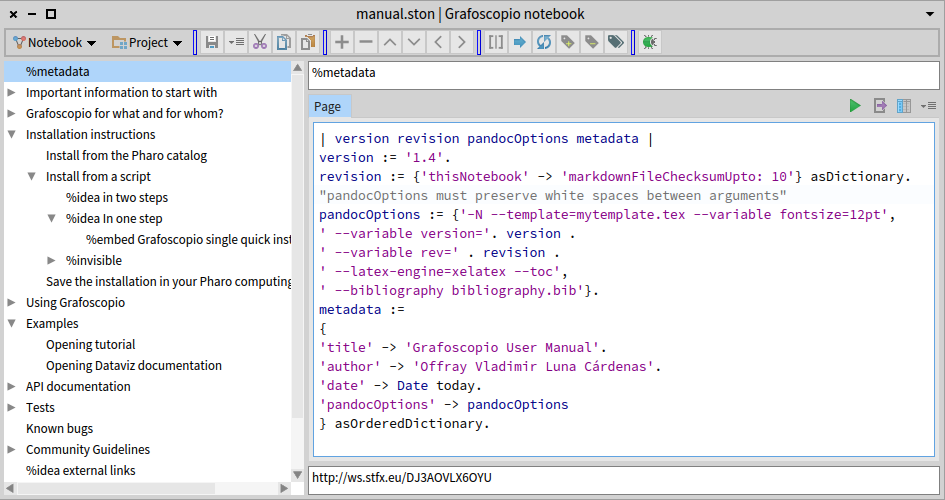
How would you feel if I took grafoscopio and made a custom GUI for it, mainly for personal usage ? Does it use the MIT license ? On Sat, Aug 26, 2017 at 6:56 PM Offray Vladimir Luna Cárdenas < offray.luna@mutabit.com> wrote:
No it can't. Grafoscopio Markdown nodes just plain text boxes with Markdown code inside, but I would like to have at least syntax hightlighting for it. What Grafoscopio can do is to traverse a tree and process node headers as markdown titles, footnotes and others to produce a flat Markdown file to be processed by Pandoc. Also, thanks to special %metadata nodes in the tree, Grafoscopio can control & feedback the Pandoc command line options *inside* the notebook, increasing reproducibility, just by using plain Pharo dictionaries and dynamic arrays. Then, you can use the Notebook menu to export as PDF by running such options from the GUI.
Cheers,
Offray
On 26/08/17 10:31, Dimitris Chloupis wrote:
Grafoscopio can display markdown files ?
On Sat, Aug 26, 2017 at 5:38 PM Offray Vladimir Luna Cárdenas < offray.luna@mutabit.com> wrote:
Dimitris,
I understand your practical reasons to have Markdown over Pillar and in fact I have advocated several of them. As I have said, Markdown ubiquity for complete documentation workflows (including complete books) is similar to git ubiquity for code. Despite having other personal preferences in markup and DVCS, I think is strategic to give them support in Pharo, without precluding any work on our own tools (Monticello, Metacello, Pillar, etc.).
I'll try to make some experiments with integration of Documenter in Grafoscopio and Markdown. They'll advance slowly, because time constrains now that I'm trying to finish my thesis, but once a week I'll try to show advancements and make questions.
Cheers,
Offray
On 26/08/17 01:55, Dimitris Chloupis wrote:
As I said the format is not so important for me, the reason why I chose markdown instead of pillar is because you can edit it using github web interface making it easier. The books will continue to use Pillar, because making a book is obviously a lot more sophisticated than creating a wiki that mainly has web links to various internet locations. Pillar already can export to markdown , latex, html and through latex it can also export to pdf.
After Stef requested it, I moved the wiki inside the pharo git repository here
https://github.com/pharo-project/pharo
I also added a link to it inside the git wiki of pharo
https://github.com/pharo-project/pharo/wiki
On Sat, Aug 26, 2017 at 2:17 AM Offray Vladimir Luna Cárdenas < offray.luna@mutabit.com> wrote:
So, we're going to have Markdown for the wiki and probably for documentation (via GitBooks)..., which is not surprising considering the vast amount of support such documentation format has and the extensions for a complete documentation toolchain and features. As I said, I think that is an important syntax and we should put Scholarly/Pandoc Markdown in the radar for documentation support in Pharo. Is what I'm doing with Grafoscopio and now that Pillar support is again taking momentum, the infrastructure there (parsers, highlighters, editors) could be extended to support Pandoc's Markdown.
I'll keep you posted.
Cheers,
Offray
On 24/08/17 17:59, Dimitris Chloupis wrote:
On Thu, Aug 24, 2017 at 11:32 PM Stephane Ducasse < stepharo.self@gmail.com> wrote:
You have Netstyle/Workflow too.
done
"Why are you using markup documents to create the wiki when you could use Github wiki itself?
For portability?"
good question. Yes for flexibility , another reason however is that Github wiki is a separate repo and I did not want that because in the very back of my head I am considering the option of creating software to allow access to wiki from inside Pharo and I wanted to be all (content and code) in the same repo. Its a very low priority for now.
Also Github wiki is basically the same as I am doing with some extra format (table of contents) , in my case I dont care because Github allows me to define HTML templates that will format the wiki webpage and make it look a a lot more polished that pharo wiki looks like. Generally there are some cool stuff you can do with Markdown and Github , plus the fact that markdown can embed HTML etc.
There is also the option of Gitbook which has some nice features for generating polished and well structured documentation.
So I like to keep my options open. For now I am focusing 100% on content.
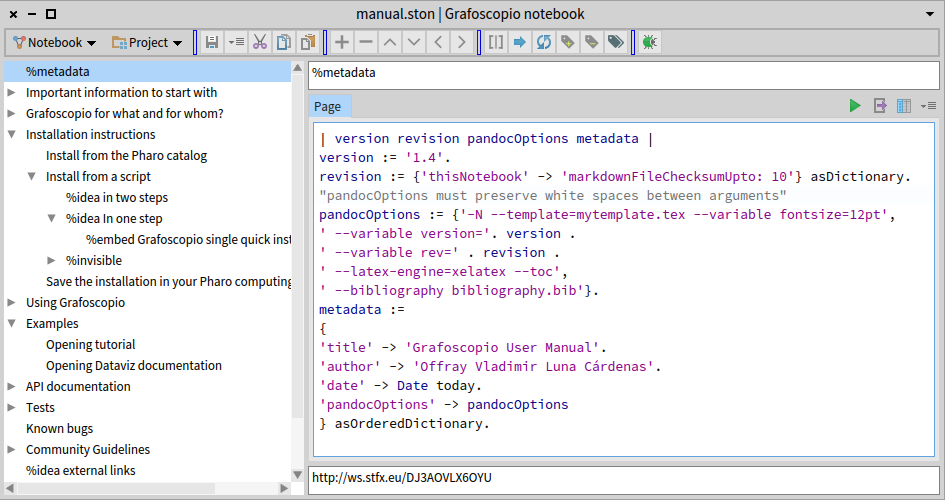
That would be pretty interesting and yes, it is under MIT. On custom GUI's I have thought about a mind mapping interface for Grafoscopio, for presentations. I would like to stretch the tree/graph metaphor so it can make what we do with different metaphors right now on "offimatics" (writing, calculation and presentation), so this custom metaphors are interesting to me. Cheers, Offray On 26/08/17 12:28, Dimitris Chloupis wrote:
How would you feel if I took grafoscopio and made a custom GUI for it, mainly for personal usage ? Does it use the MIT license ?
On Sat, Aug 26, 2017 at 6:56 PM Offray Vladimir Luna Cárdenas <offray.luna@mutabit.com <mailto:offray.luna@mutabit.com>> wrote:
No it can't. Grafoscopio Markdown nodes just plain text boxes with Markdown code inside, but I would like to have at least syntax hightlighting for it. What Grafoscopio can do is to traverse a tree and process node headers as markdown titles, footnotes and others to produce a flat Markdown file to be processed by Pandoc. Also, thanks to special %metadata nodes in the tree, Grafoscopio can control & feedback the Pandoc command line options *inside* the notebook, increasing reproducibility, just by using plain Pharo dictionaries and dynamic arrays. Then, you can use the Notebook menu to export as PDF by running such options from the GUI.
Cheers,
Offray
On 26/08/17 10:31, Dimitris Chloupis wrote:
Grafoscopio can display markdown files ?
On Sat, Aug 26, 2017 at 5:38 PM Offray Vladimir Luna Cárdenas <offray.luna@mutabit.com <mailto:offray.luna@mutabit.com>> wrote:
Dimitris,
I understand your practical reasons to have Markdown over Pillar and in fact I have advocated several of them. As I have said, Markdown ubiquity for complete documentation workflows (including complete books) is similar to git ubiquity for code. Despite having other personal preferences in markup and DVCS, I think is strategic to give them support in Pharo, without precluding any work on our own tools (Monticello, Metacello, Pillar, etc.).
I'll try to make some experiments with integration of Documenter in Grafoscopio and Markdown. They'll advance slowly, because time constrains now that I'm trying to finish my thesis, but once a week I'll try to show advancements and make questions.
Cheers,
Offray
On 26/08/17 01:55, Dimitris Chloupis wrote:
As I said the format is not so important for me, the reason why I chose markdown instead of pillar is because you can edit it using github web interface making it easier. The books will continue to use Pillar, because making a book is obviously a lot more sophisticated than creating a wiki that mainly has web links to various internet locations. Pillar already can export to markdown , latex, html and through latex it can also export to pdf.
After Stef requested it, I moved the wiki inside the pharo git repository here
https://github.com/pharo-project/pharo
I also added a link to it inside the git wiki of pharo
https://github.com/pharo-project/pharo/wiki
On Sat, Aug 26, 2017 at 2:17 AM Offray Vladimir Luna Cárdenas <offray.luna@mutabit.com <mailto:offray.luna@mutabit.com>> wrote:
So, we're going to have Markdown for the wiki and probably for documentation (via GitBooks)..., which is not surprising considering the vast amount of support such documentation format has and the extensions for a complete documentation toolchain and features. As I said, I think that is an important syntax and we should put Scholarly/Pandoc Markdown in the radar for documentation support in Pharo. Is what I'm doing with Grafoscopio and now that Pillar support is again taking momentum, the infrastructure there (parsers, highlighters, editors) could be extended to support Pandoc's Markdown.
I'll keep you posted.
Cheers,
Offray
On 24/08/17 17:59, Dimitris Chloupis wrote:
On Thu, Aug 24, 2017 at 11:32 PM Stephane Ducasse <stepharo.self@gmail.com <mailto:stepharo.self@gmail.com>> wrote:
You have Netstyle/Workflow too.
done
"Why are you using markup documents to create the wiki when you could use Github wiki itself?
For portability?"
good question. Yes for flexibility , another reason however is that Github wiki is a separate repo and I did not want that because in the very back of my head I am considering the option of creating software to allow access to wiki from inside Pharo and I wanted to be all (content and code) in the same repo. Its a very low priority for now.
Also Github wiki is basically the same as I am doing with some extra format (table of contents) , in my case I dont care because Github allows me to define HTML templates that will format the wiki webpage and make it look a a lot more polished that pharo wiki looks like. Generally there are some cool stuff you can do with Markdown and Github , plus the fact that markdown can embed HTML etc.
There is also the option of Gitbook which has some nice features for generating polished and well structured documentation.
So I like to keep my options open. For now I am focusing 100% on content.
mind mapping is an interest of mine too, though i never tried to make one app for it yet. Ok will see if I will go down the Grafoscopio route and will keep you posted. I was thinking using it as an in-image interface for the wiki. On Sat, Aug 26, 2017 at 10:15 PM Offray Vladimir Luna Cárdenas < offray.luna@mutabit.com> wrote:
That would be pretty interesting and yes, it is under MIT.
On custom GUI's I have thought about a mind mapping interface for Grafoscopio, for presentations. I would like to stretch the tree/graph metaphor so it can make what we do with different metaphors right now on "offimatics" (writing, calculation and presentation), so this custom metaphors are interesting to me.
Cheers,
Offray
On 26/08/17 12:28, Dimitris Chloupis wrote:
How would you feel if I took grafoscopio and made a custom GUI for it, mainly for personal usage ? Does it use the MIT license ?
On Sat, Aug 26, 2017 at 6:56 PM Offray Vladimir Luna Cárdenas < offray.luna@mutabit.com> wrote:
No it can't. Grafoscopio Markdown nodes just plain text boxes with Markdown code inside, but I would like to have at least syntax hightlighting for it. What Grafoscopio can do is to traverse a tree and process node headers as markdown titles, footnotes and others to produce a flat Markdown file to be processed by Pandoc. Also, thanks to special %metadata nodes in the tree, Grafoscopio can control & feedback the Pandoc command line options *inside* the notebook, increasing reproducibility, just by using plain Pharo dictionaries and dynamic arrays. Then, you can use the Notebook menu to export as PDF by running such options from the GUI.
Cheers,
Offray
On 26/08/17 10:31, Dimitris Chloupis wrote:
Grafoscopio can display markdown files ?
On Sat, Aug 26, 2017 at 5:38 PM Offray Vladimir Luna Cárdenas < offray.luna@mutabit.com> wrote:
Dimitris,
I understand your practical reasons to have Markdown over Pillar and in fact I have advocated several of them. As I have said, Markdown ubiquity for complete documentation workflows (including complete books) is similar to git ubiquity for code. Despite having other personal preferences in markup and DVCS, I think is strategic to give them support in Pharo, without precluding any work on our own tools (Monticello, Metacello, Pillar, etc.).
I'll try to make some experiments with integration of Documenter in Grafoscopio and Markdown. They'll advance slowly, because time constrains now that I'm trying to finish my thesis, but once a week I'll try to show advancements and make questions.
Cheers,
Offray
On 26/08/17 01:55, Dimitris Chloupis wrote:
As I said the format is not so important for me, the reason why I chose markdown instead of pillar is because you can edit it using github web interface making it easier. The books will continue to use Pillar, because making a book is obviously a lot more sophisticated than creating a wiki that mainly has web links to various internet locations. Pillar already can export to markdown , latex, html and through latex it can also export to pdf.
After Stef requested it, I moved the wiki inside the pharo git repository here
https://github.com/pharo-project/pharo
I also added a link to it inside the git wiki of pharo
https://github.com/pharo-project/pharo/wiki
On Sat, Aug 26, 2017 at 2:17 AM Offray Vladimir Luna Cárdenas < offray.luna@mutabit.com> wrote:
So, we're going to have Markdown for the wiki and probably for documentation (via GitBooks)..., which is not surprising considering the vast amount of support such documentation format has and the extensions for a complete documentation toolchain and features. As I said, I think that is an important syntax and we should put Scholarly/Pandoc Markdown in the radar for documentation support in Pharo. Is what I'm doing with Grafoscopio and now that Pillar support is again taking momentum, the infrastructure there (parsers, highlighters, editors) could be extended to support Pandoc's Markdown.
I'll keep you posted.
Cheers,
Offray
On 24/08/17 17:59, Dimitris Chloupis wrote:
On Thu, Aug 24, 2017 at 11:32 PM Stephane Ducasse < stepharo.self@gmail.com> wrote:
You have Netstyle/Workflow too.
done
"Why are you using markup documents to create the wiki when you could use Github wiki itself?
For portability?"
good question. Yes for flexibility , another reason however is that Github wiki is a separate repo and I did not want that because in the very back of my head I am considering the option of creating software to allow access to wiki from inside Pharo and I wanted to be all (content and code) in the same repo. Its a very low priority for now.
Also Github wiki is basically the same as I am doing with some extra format (table of contents) , in my case I dont care because Github allows me to define HTML templates that will format the wiki webpage and make it look a a lot more polished that pharo wiki looks like. Generally there are some cool stuff you can do with Markdown and Github , plus the fact that markdown can embed HTML etc.
There is also the option of Gitbook which has some nice features for generating polished and well structured documentation.
So I like to keep my options open. For now I am focusing 100% on content.
Thanks for keep me posted about your experiments. I would like to know where the current interface doesn't suit your needs/tastes and how easy was to use/extend the tool. I think that mind mapping problem would be particularly well suited for your GUI approaches. Cheers, Offray On 26/08/17 14:53, Dimitris Chloupis wrote:
mind mapping is an interest of mine too, though i never tried to make one app for it yet. Ok will see if I will go down the Grafoscopio route and will keep you posted. I was thinking using it as an in-image interface for the wiki.
On Sat, Aug 26, 2017 at 10:15 PM Offray Vladimir Luna Cárdenas <offray.luna@mutabit.com <mailto:offray.luna@mutabit.com>> wrote:
That would be pretty interesting and yes, it is under MIT.
On custom GUI's I have thought about a mind mapping interface for Grafoscopio, for presentations. I would like to stretch the tree/graph metaphor so it can make what we do with different metaphors right now on "offimatics" (writing, calculation and presentation), so this custom metaphors are interesting to me.
Cheers,
Offray
On 26/08/17 12:28, Dimitris Chloupis wrote:
How would you feel if I took grafoscopio and made a custom GUI for it, mainly for personal usage ? Does it use the MIT license ?
On Sat, Aug 26, 2017 at 6:56 PM Offray Vladimir Luna Cárdenas <offray.luna@mutabit.com <mailto:offray.luna@mutabit.com>> wrote:
No it can't. Grafoscopio Markdown nodes just plain text boxes with Markdown code inside, but I would like to have at least syntax hightlighting for it. What Grafoscopio can do is to traverse a tree and process node headers as markdown titles, footnotes and others to produce a flat Markdown file to be processed by Pandoc. Also, thanks to special %metadata nodes in the tree, Grafoscopio can control & feedback the Pandoc command line options *inside* the notebook, increasing reproducibility, just by using plain Pharo dictionaries and dynamic arrays. Then, you can use the Notebook menu to export as PDF by running such options from the GUI.
Cheers,
Offray
On 26/08/17 10:31, Dimitris Chloupis wrote:
Grafoscopio can display markdown files ?
On Sat, Aug 26, 2017 at 5:38 PM Offray Vladimir Luna Cárdenas <offray.luna@mutabit.com <mailto:offray.luna@mutabit.com>> wrote:
Dimitris,
I understand your practical reasons to have Markdown over Pillar and in fact I have advocated several of them. As I have said, Markdown ubiquity for complete documentation workflows (including complete books) is similar to git ubiquity for code. Despite having other personal preferences in markup and DVCS, I think is strategic to give them support in Pharo, without precluding any work on our own tools (Monticello, Metacello, Pillar, etc.).
I'll try to make some experiments with integration of Documenter in Grafoscopio and Markdown. They'll advance slowly, because time constrains now that I'm trying to finish my thesis, but once a week I'll try to show advancements and make questions.
Cheers,
Offray
On 26/08/17 01:55, Dimitris Chloupis wrote:
As I said the format is not so important for me, the reason why I chose markdown instead of pillar is because you can edit it using github web interface making it easier. The books will continue to use Pillar, because making a book is obviously a lot more sophisticated than creating a wiki that mainly has web links to various internet locations. Pillar already can export to markdown , latex, html and through latex it can also export to pdf.
After Stef requested it, I moved the wiki inside the pharo git repository here
https://github.com/pharo-project/pharo
I also added a link to it inside the git wiki of pharo
https://github.com/pharo-project/pharo/wiki
On Sat, Aug 26, 2017 at 2:17 AM Offray Vladimir Luna Cárdenas <offray.luna@mutabit.com <mailto:offray.luna@mutabit.com>> wrote:
So, we're going to have Markdown for the wiki and probably for documentation (via GitBooks)..., which is not surprising considering the vast amount of support such documentation format has and the extensions for a complete documentation toolchain and features. As I said, I think that is an important syntax and we should put Scholarly/Pandoc Markdown in the radar for documentation support in Pharo. Is what I'm doing with Grafoscopio and now that Pillar support is again taking momentum, the infrastructure there (parsers, highlighters, editors) could be extended to support Pandoc's Markdown.
I'll keep you posted.
Cheers,
Offray
On 24/08/17 17:59, Dimitris Chloupis wrote:
On Thu, Aug 24, 2017 at 11:32 PM Stephane Ducasse <stepharo.self@gmail.com <mailto:stepharo.self@gmail.com>> wrote:
You have Netstyle/Workflow too.
done
"Why are you using markup documents to create the wiki when you could use Github wiki itself?
For portability?"
good question. Yes for flexibility , another reason however is that Github wiki is a separate repo and I did not want that because in the very back of my head I am considering the option of creating software to allow access to wiki from inside Pharo and I wanted to be all (content and code) in the same repo. Its a very low priority for now.
Also Github wiki is basically the same as I am doing with some extra format (table of contents) , in my case I dont care because Github allows me to define HTML templates that will format the wiki webpage and make it look a a lot more polished that pharo wiki looks like. Generally there are some cool stuff you can do with Markdown and Github , plus the fact that markdown can embed HTML etc.
There is also the option of Gitbook which has some nice features for generating polished and well structured documentation.
So I like to keep my options open. For now I am focusing 100% on content.
Dimitris Please add a direct link to the Pillar chapter on the integration server https://ci.inria.fr/pharo-contribution/job/EnterprisePharoBook/lastSuccessfu... The current link on the Pharo books web site is broken and this seems to be the main piece of documentation about Pillar. --Hannes On 8/26/17, Offray Vladimir Luna Cárdenas <offray.luna@mutabit.com> wrote:
Thanks for keep me posted about your experiments. I would like to know where the current interface doesn't suit your needs/tastes and how easy was to use/extend the tool. I think that mind mapping problem would be particularly well suited for your GUI approaches.
Cheers,
Offray
On 26/08/17 14:53, Dimitris Chloupis wrote:
mind mapping is an interest of mine too, though i never tried to make one app for it yet. Ok will see if I will go down the Grafoscopio route and will keep you posted. I was thinking using it as an in-image interface for the wiki.
On Sat, Aug 26, 2017 at 10:15 PM Offray Vladimir Luna Cárdenas <offray.luna@mutabit.com <mailto:offray.luna@mutabit.com>> wrote:
That would be pretty interesting and yes, it is under MIT.
On custom GUI's I have thought about a mind mapping interface for Grafoscopio, for presentations. I would like to stretch the tree/graph metaphor so it can make what we do with different metaphors right now on "offimatics" (writing, calculation and presentation), so this custom metaphors are interesting to me.
Cheers,
Offray
On 26/08/17 12:28, Dimitris Chloupis wrote:
How would you feel if I took grafoscopio and made a custom GUI for it, mainly for personal usage ? Does it use the MIT license ?
On Sat, Aug 26, 2017 at 6:56 PM Offray Vladimir Luna Cárdenas <offray.luna@mutabit.com <mailto:offray.luna@mutabit.com>> wrote:
No it can't. Grafoscopio Markdown nodes just plain text boxes with Markdown code inside, but I would like to have at least syntax hightlighting for it. What Grafoscopio can do is to traverse a tree and process node headers as markdown titles, footnotes and others to produce a flat Markdown file to be processed by Pandoc. Also, thanks to special %metadata nodes in the tree, Grafoscopio can control & feedback the Pandoc command line options *inside* the notebook, increasing reproducibility, just by using plain Pharo dictionaries and dynamic arrays. Then, you can use the Notebook menu to export as PDF by running such options from the GUI.
Cheers,
Offray
On 26/08/17 10:31, Dimitris Chloupis wrote:
Grafoscopio can display markdown files ?
On Sat, Aug 26, 2017 at 5:38 PM Offray Vladimir Luna Cárdenas <offray.luna@mutabit.com <mailto:offray.luna@mutabit.com>> wrote:
Dimitris,
I understand your practical reasons to have Markdown over Pillar and in fact I have advocated several of them. As I have said, Markdown ubiquity for complete documentation workflows (including complete books) is similar to git ubiquity for code. Despite having other personal preferences in markup and DVCS, I think is strategic to give them support in Pharo, without precluding any work on our own tools (Monticello, Metacello, Pillar, etc.).
I'll try to make some experiments with integration of Documenter in Grafoscopio and Markdown. They'll advance slowly, because time constrains now that I'm trying to finish my thesis, but once a week I'll try to show advancements and make questions.
Cheers,
Offray
On 26/08/17 01:55, Dimitris Chloupis wrote:
As I said the format is not so important for me, the reason why I chose markdown instead of pillar is because you can edit it using github web interface making it easier. The books will continue to use Pillar, because making a book is obviously a lot more sophisticated than creating a wiki that mainly has web links to various internet locations. Pillar already can export to markdown , latex, html and through latex it can also export to pdf.
After Stef requested it, I moved the wiki inside the pharo git repository here
https://github.com/pharo-project/pharo
I also added a link to it inside the git wiki of pharo
https://github.com/pharo-project/pharo/wiki
On Sat, Aug 26, 2017 at 2:17 AM Offray Vladimir Luna Cárdenas <offray.luna@mutabit.com <mailto:offray.luna@mutabit.com>> wrote:
So, we're going to have Markdown for the wiki and probably for documentation (via GitBooks)..., which is not surprising considering the vast amount of support such documentation format has and the extensions for a complete documentation toolchain and features. As I said, I think that is an important syntax and we should put Scholarly/Pandoc Markdown in the radar for documentation support in Pharo. Is what I'm doing with Grafoscopio and now that Pillar support is again taking momentum, the infrastructure there (parsers, highlighters, editors) could be extended to support Pandoc's Markdown.
I'll keep you posted.
Cheers,
Offray
On 24/08/17 17:59, Dimitris Chloupis wrote:
On Thu, Aug 24, 2017 at 11:32 PM Stephane Ducasse <stepharo.self@gmail.com <mailto:stepharo.self@gmail.com>> wrote:
You have Netstyle/Workflow too.
done
"Why are you using markup documents to create the wiki when you could use Github wiki itself?
For portability?"
good question. Yes for flexibility , another reason however is that Github wiki is a separate repo and I did not want that because in the very back of my head I am considering the option of creating software to allow access to wiki from inside Pharo and I wanted to be all (content and code) in the same repo. Its a very low priority for now.
Also Github wiki is basically the same as I am doing with some extra format (table of contents) , in my case I dont care because Github allows me to define HTML templates that will format the wiki webpage and make it look a a lot more polished that pharo wiki looks like. Generally there are some cool stuff you can do with Markdown and Github , plus the fact that markdown can embed HTML etc.
There is also the option of Gitbook which has some nice features for generating polished and well structured documentation.
So I like to keep my options open. For now I am focusing 100% on content.
well i linked to the job so people can choose the format they like pdf or html, so i see no need to change it. On Mon, Aug 28, 2017 at 2:38 PM H. Hirzel <hannes.hirzel@gmail.com> wrote:
Dimitris
Please add a direct link to the Pillar chapter on the integration server
https://ci.inria.fr/pharo-contribution/job/EnterprisePharoBook/lastSuccessfu...
The current link on the Pharo books web site is broken and this seems to be the main piece of documentation about Pillar.
--Hannes
On 8/26/17, Offray Vladimir Luna Cárdenas <offray.luna@mutabit.com> wrote:
Thanks for keep me posted about your experiments. I would like to know where the current interface doesn't suit your needs/tastes and how easy was to use/extend the tool. I think that mind mapping problem would be particularly well suited for your GUI approaches.
Cheers,
Offray
On 26/08/17 14:53, Dimitris Chloupis wrote:
mind mapping is an interest of mine too, though i never tried to make one app for it yet. Ok will see if I will go down the Grafoscopio route and will keep you posted. I was thinking using it as an in-image interface for the wiki.
On Sat, Aug 26, 2017 at 10:15 PM Offray Vladimir Luna Cárdenas <offray.luna@mutabit.com <mailto:offray.luna@mutabit.com>> wrote:
That would be pretty interesting and yes, it is under MIT.
On custom GUI's I have thought about a mind mapping interface for Grafoscopio, for presentations. I would like to stretch the tree/graph metaphor so it can make what we do with different metaphors right now on "offimatics" (writing, calculation and presentation), so this custom metaphors are interesting to me.
Cheers,
Offray
On 26/08/17 12:28, Dimitris Chloupis wrote:
How would you feel if I took grafoscopio and made a custom GUI for it, mainly for personal usage ? Does it use the MIT license ?
On Sat, Aug 26, 2017 at 6:56 PM Offray Vladimir Luna Cárdenas <offray.luna@mutabit.com <mailto:offray.luna@mutabit.com>> wrote:
No it can't. Grafoscopio Markdown nodes just plain text boxes with Markdown code inside, but I would like to have at least syntax hightlighting for it. What Grafoscopio can do is to traverse a tree and process node headers as markdown titles, footnotes and others to produce a flat Markdown file to be processed by Pandoc. Also, thanks to special %metadata nodes in the tree, Grafoscopio can control & feedback the Pandoc command line options *inside* the notebook, increasing reproducibility, just by using plain Pharo dictionaries and dynamic arrays. Then, you can use the Notebook menu to export as PDF by running such options from the GUI.
Cheers,
Offray
On 26/08/17 10:31, Dimitris Chloupis wrote:
Grafoscopio can display markdown files ?
On Sat, Aug 26, 2017 at 5:38 PM Offray Vladimir Luna Cárdenas <offray.luna@mutabit.com <mailto:offray.luna@mutabit.com>> wrote:
Dimitris,
I understand your practical reasons to have Markdown over Pillar and in fact I have advocated several of them. As I have said, Markdown ubiquity for complete documentation workflows (including complete books) is similar to git ubiquity for code. Despite having other personal preferences in markup and DVCS, I think is strategic to give them support in Pharo, without precluding any work on our own tools (Monticello, Metacello, Pillar, etc.).
I'll try to make some experiments with integration of Documenter in Grafoscopio and Markdown. They'll advance slowly, because time constrains now that I'm trying to finish my thesis, but once a week I'll try to show advancements and make questions.
Cheers,
Offray
On 26/08/17 01:55, Dimitris Chloupis wrote:
As I said the format is not so important for me, the reason why I chose markdown instead of pillar is because you can edit it using github web interface making it easier. The books will continue to use Pillar, because making a book is obviously a lot more sophisticated than creating a wiki that mainly has web links to various internet locations. Pillar already can export to markdown , latex, html and through latex it can also export to pdf.
After Stef requested it, I moved the wiki inside the pharo git repository here
https://github.com/pharo-project/pharo
I also added a link to it inside the git wiki of pharo
https://github.com/pharo-project/pharo/wiki
On Sat, Aug 26, 2017 at 2:17 AM Offray Vladimir Luna Cárdenas <offray.luna@mutabit.com <mailto:offray.luna@mutabit.com>> wrote:
So, we're going to have Markdown for the wiki and probably for documentation (via GitBooks)..., which is not surprising considering the vast amount of support such documentation format has and the extensions for a complete documentation toolchain and features. As I said, I think that is an important syntax and we should put Scholarly/Pandoc Markdown in the radar for documentation support in Pharo. Is what I'm doing with Grafoscopio and now that Pillar support is again taking momentum, the infrastructure there (parsers, highlighters, editors) could be extended to support Pandoc's Markdown.
I'll keep you posted.
Cheers,
Offray
On 24/08/17 17:59, Dimitris Chloupis wrote:
On Thu, Aug 24, 2017 at 11:32 PM Stephane Ducasse <stepharo.self@gmail.com <mailto:stepharo.self@gmail.com>> wrote:
You have Netstyle/Workflow too.
done
"Why are you using markup documents to create the wiki when you could use Github wiki itself?
For portability?"
good question. Yes for flexibility , another reason however is that Github wiki is a separate repo and I did not want that because in the very back of my head I am considering the option of creating software to allow access to wiki from inside Pharo and I wanted to be all (content and code) in the same repo. Its a very low priority for now.
Also Github wiki is basically the same as I am doing with some extra format (table of contents) , in my case I dont care because Github allows me to define HTML templates that will format the wiki webpage and make it look a a lot more polished that pharo wiki looks like. Generally there are some cool stuff you can do with Markdown and Github , plus the fact that markdown can embed HTML etc.
There is also the option of Gitbook which has some nice features for generating polished and well structured documentation.
So I like to keep my options open. For now I am focusing 100% on content.

Why are you using markup documents to create the wiki when you could use Github wiki itself? For portability? Esteban A. Maringolo 2017-08-24 9:59 GMT-03:00 Dimitris Chloupis <kilon.alios@gmail.com>:
Actually I have already done this
https://github.com/SquareBracketAssociates/PharoWiki/blob/master/contents/pr...
when he announced the project on the mailing list, but thanks for trying to inform me, I appreciate it. I will try to update the wiki each time something new pops up in the mailing list that is usable which means a) new project b) some kind of news of general interest about pharo c) some kind of documentation (article, pdf, power point, blog post etc) about pharo or third party library/tool
On Thu, Aug 24, 2017 at 3:38 PM H. Hirzel <hannes.hirzel@gmail.com> wrote:
Another thing to add
link to https://github.com/dionisiydk/TelePharo
with short description
Complete toolset for remote development of Pharo images. It includes:
remote playground remote browser remote debugger remote inspector remote process browser
On 8/22/17, Dimitris Chloupis <kilon.alios@gmail.com> wrote:
absolutely
done !
https://github.com/SquareBracketAssociates/PharoWiki/blob/master/contents/pr...
On Tue, Aug 22, 2017 at 10:28 PM Stephane Ducasse <stepharo.self@gmail.com> wrote:
You should add the script that generate the list of catalog items so that we can update it.
On Tue, Aug 22, 2017 at 8:18 PM, Dimitris Chloupis <kilon.alios@gmail.com> wrote:
Ok I restructured the wiki , giving it a table of contents.
Added Pharo 6 Catalog projects Added PettitParser2 Added a sections for How tos , and a couple of them Added a news section Added a link to Grafoscopio homepage at its Catalaog section Added a wikis section with a link to Astares Pharo wiki
Keep your suggestions coming , thank you Hirzel
https://squarebracketassociates.github.io/PharoWiki/
On Mon, Aug 21, 2017 at 7:19 PM H. Hirzel <hannes.hirzel@gmail.com> wrote:
Please add the reference to the PetitParser2 book
https://kursjan.github.io/petitparser2/pillar-book/build/book.html
On 8/21/17, H. Hirzel <hannes.hirzel@gmail.com> wrote:
And this one produces a catalog list in markdown format
"Produce a list of Pharo 6 catalog entries (tag: 'Pharo 6.0')" | catalog | catalog := CatalogProvider default retrieveProjects select: [ :x | (x at: 'repositoryUrl') = 'http://smalltalkhub.com/mc/Pharo/MetaRepoForPharo60/main' ].
Transcript show: '# Pharo 6 catalog list'; cr.
(catalog asSortedCollection: [ :a :b | (a at: 'name') < (b at: 'name') ]) do: [ :entry | Transcript show: '## ', (entry at: 'name') ; cr; show: (entry at: 'description'); cr;cr. Transcript show: 'keywords: '. (entry at: 'keywords') sorted do: [ :keyword | Transcript show: keyword; space ]. Transcript cr; cr].
Transcript show: '# Pharo 6 catalog list - description is missing';
cr.
(catalog asSortedCollection: [ :a :b | (a at: 'name') < (b at: 'name') ]) do: [:entry | (entry at: 'description') ifNil: [ Transcript show: '- ', (entry at: 'name'); cr ] ].
................................................................................................
# Pharo 6 catalog list ## Animation Adds a delay operator turning any message send into a smooth
transition.
keywords: animation fun time
## Artefact Artefact is a library to generate PDF documents. It provides a document model and support the generation of PDF
keywords: PDF document layout
## AstaresDistribution Several Pharo goodies like Pomodoro, DesktopManager, QuickAccess, HubCap, ScriptManager, ... written by Torsten Bergmann (astares.com) bundled for easy installation
keywords: custom distribution goodies pharo
## Atlas A Python bridge (IPC - stream sockets) for Pharo, allowing Pharo to use Python libraries , mix with Python code and vice versa
keywords: Atlas IPC atlas pharo python sockets
## BitmapCharacterSet BitmapCharacterSet is a set for characters that uses a bitmap for storing wide characters and an array of truth values for byte characters. Used by XMLParser.
keywords: character collection set unicode
## Bootstrap "Bootstrap for Seaside" is a project combining Seaside and Twitter Bootstrap and easily use them to write professional looking web applications.
keywords: Bootstrap HTML Seaside query web
## Bugzilla Pharo wrapper for Bugzilla REST API
keywords: api bugzilla rest
## CPPBridge CPP is a library that allows Pharo to share memory with a C++ application. This means that both can share the exact same data and modify it. This also can allow Pharo and C++ to exacute one another library and code. Example provided
keywords: ++ ++ C IPC bridge c cpp file mapped memory shared
## Calypso Calypso is a new system browser based on new navigation model
keywords: IDE systemBrowser
## CheatSheet
Pharo Cheat Sheet.
Project main page: *http://www.smalltalkhub.com/#!/~PharoExtras/CheatSheet*
keywords: examples syntax
## ChronosManager ChronosManager is a time managment tool based on the pomodoro technique offering a stopwatch and timer for keeping track of time with tasks and goals
keywords: ChronosManager managment pomodoro time
## Citezen Citezen is a library to parse, query and manage bibtex scientific citations.
keywords: bibtex latex parser printer query
## CommandShell nil
keywords:
## Commander Commander models application actions as first class objects.
Every action is implemented as separate command class (subclass of CmdCommand) with #execute method and all state required for execution.
Commands are reusable objects and applications provide various ways to access them. Such information is attached to command classes as activator objects. Currently there are three types of activators: - CmdShortcutCommandActivator - CmdContextMenuCommandActivator - CmdDragAndDropCommandActivator
Activators are declared in command class side methods marked with pragma #commandActivator. For example following method will allow RenamePackageCommand to be executed by shortcut in possible system browser: RenamePackageCommand class>>packageBrowserShortcutActivator <commandActivator> ^CmdShortcutCommandActivator by: $r meta for: PackageBrowserContext And for context menu: RenamePackageCommand class>>packageBrowserMenuActivator <commandActivator> ^CmdContextMenuCommandActivator byRootGroupItemFor: PackageBrowserContext Activators are always declared with application context where they can be applied (PackageBrowserContext in example). Application should provide such contexts as subclasses of CmdToolContext with information about application state. Every widget can bring own context to interact with application as separate tool. For example system browser shows multiple panes which provide package context, class context and method context. And depending on context browser shows different menu and provides different shortcuts
keywords: command command pattern tools
## Community Community is a project to add some world menues to easily access some community pages
keywords: community pharo
## Complex Math-Complex brings back to Pharo the complex numbers like (1+2i) which used to be in Squeak Kernel.
keywords: complex math number
## DacapoEnergyConsumption This project run the Dacapo benchmarks, and monitor the energy consumption of the CPU. It is for research purposes.
keywords: consumption energy java
## DarkMetalTheme An alternative to DarkTheme, DarkMetalTheme offers "metalic"
tonalities
:)
keywords: theme ui
## DebuggerCritiques Add inlined critiques into Pharo debugger
keywords: critiques debugger smallLint
## DesktopManager A goodie to be able to manage multiple desktops in Pharo.
keywords: desktop goodie pharo tools
## DiscordSt DiscordSt is a library for Discord service, see https://discordapp.com for basic information about Discord and https://discordapp.com/developers/docs/intro for developer information.
The stable version supports Discord Webhooks. See https://github.com/JurajKubelka/DiscordSt for examples.
keywords: api chat client discord rest web webhook
## EventRecorder Record and replay screen events.
keywords: recording screen
## FamixDiff nil
keywords:
## FlatQA Hi, I'm your personal quality assistant. I run Smalllint rules on the code that you modify, and notify you about quality changes. https://github.com/Uko/QualityAssistant#qualityassistant
keywords: automatic critics quality smallint validation
## FogBugz Access to FogBugz from within Pharo environment.
keywords: fun web
## Garage Garage is the relational database driver for Pharo. Garage provides a common API to connect with several database servers in a coherent way (JDBC like). Along with Garage, we provide implementations of several database drivers.
keywords: api database drivers
## GarageGlorp This configuration loads the Garage database drivers along with the Glorp Object-Relational Mapper. It is a convenience configuration used to load both projects using a single config.
keywords: database driver orm persistence
## Gettext Gettext is an implementaion of https://www.gnu.org/software/gettext, the standard l17n package.
keywords: gettext i18n internationalization l10n localization
## Ghost nil
keywords:
## GitFileTree GitFileTree is an integration of Git commands below Monticello, allowing a very simple and powerfull integration with a git repository for tracking Monticello packages, allowing for example one to work from github.com (including with configurations support) without any use of the command line and with perfect support of whatever is the structure of the project under git.
Works with any possible organisation of the git repository related to the package (single language, multi language, single package, multiple packages, single remote repo, multiple remote repositories, branches, you name it).
GitFileTree: is integrated into FileTree, but not easily available. This configuration allow for a one step loading with the dependencies.
keywords: FileTree Monticello OSProcess OSSubprocess Packages Pharo5 Pharo6 git
## GitHubAPI A GitHub API Wrapper for Pharo to easily access informations from GitHub right from your Pharo image.
keywords: api git github
## GitHubcello Have it happened to you that you have your project on GitHub and it has a baseline but now you have to write down the Metacello script to load it? Not any more! Simply paste your repo URI into GTSpotter, wait a bit, select the baseline you want to load, and you're done! https://github.com/Uko/GitHubcello#githubcello-
keywords: github metacello spotter
## GlorpSQLite GlorpSQLite is the integration of Glorp with SQLite. This configuration loads UDBC, which contains SQLite, then loads Glorp. Once GlorpSQLite is loaded, provided Pharo can find the SQLite so/dylib/dll file on your system, start Test Runner and run the tests.
keywords: database orm persistence relational
## Grafoscopio Grafoscopio is a tool to create interactive notebooks and documentation for computer narratives and data visualization. They are structured as outlines/trees containing textual and code nodes that can be exported to several formats: LaTeX, HTML and pdf (via pandoc). It can be used in several endeavors like: reproductible open research and science, data journalism, data activism among others
keywords: data-activism data-journalism data-science data-visualization documentation interactive-notebook markdown markup open-data open-research open-science reproducible-research
## Grease The Grease Portability Library
keywords: framework portability
## Grid This package provides a grid (2D array) implementation.
keywords: 2D-array collection container matrix
## Hashids Hashids allow you to create URL friendly ids from sequential integer ids. NB it is should not be considered as encryption but it does provide a lightweight obfuscation of the underlying id. https://github.com/alacap/hashids-pharo
keywords: hashing
## Hubcap nil
keywords:
## INIFile A Parser for .INI files (as usually used on Windows)
keywords: configurations ini settings windows
## Iceberg Iceberg is a set of tools that allow one to handle git repositories directly from a Pharo image.
keywords: git vcs version control
## LightPhaser nil
keywords:
## MacroRecorder MacroRecorder is a tool that allows the developer to (i) record a sequence of transformations while they are applied a first time, either manually or with the assistance of refactoring tools; (ii) store and parameterize the transformations to allow their generalization; and (iii) apply automatically the sequence of transformations afterwards on different code locations.
For the last step, the developer could explicitly point to the entities to transform.
keywords: code change code manipulation programming by demonstration source code transformations
## MatchTool MatchTool is a simple UI for experimenting with the matching functionality of pattern code. MatchTool can be open from the World Menu > Tools category. More information can be read from within the tool by pressing help button.
keywords: code inspect match pattern rewrite rules
## MessageFlowBrowser A message flow browse to browser senders, implementors and messages of methods in a single window and folow the message flow
keywords: browser messageflow methods tools
## Mocketry Mocketry is mock objects framework. It provides simplest way to stub any message to any object and to verify any occurred behaviour.
mock := Mock new. mock stub someMessage willReturn: 1000.
mock someMessage should be: 1000. mock should receive someMessage.
rect := 0@0 corner: 2@3. rect stub width willReturn: 1000.
rect area should be: 3000 "area = width * height". rect should receive width.
keywords: BDD SUnit TDD framework mocks
## MooseProject MooseProject is a library to store many differents versions for a project. It will persist everything on the disk and allow you easily to recover the model associated to the desired version
keywords: Moose project version
## Mustache nil
keywords:
## NPMJS Spotter search of NPM packages
keywords: javascript nodejs
## Neo4reSt Neo4reSt is a rest client of Neo4j graph database. (http://neo4j.org/ )
Neo4reSt will provide:
- Raw rest client - Wrapper client which handles JSON well - Object level wrapper classes (Node, Relationship, Property)
keywords: Neo4j database graph persistence
## NeoCSV CSV (Comma Separated Values) is a popular data-interchange format. NeoCSV is an elegant and efficient standalone framework to read and write CSV converting to or from Smalltalk objects.
keywords: ascii comma-separated-values csv fields format input output records rfc-4180 tab-separated-values tabular-data text tsv
## NeoJSON JSON (JavaScript Object Notation) is a popular data-interchange format. NeoJSON is an elegant and efficient standalone Smalltalk framework to read and write JSON converting to or from Smalltalk objects.
keywords: encoding format input javascript json output serialization text
## Nginx Utility project to work with nginx from Pharo image (Windows only so far)
keywords: nginx server web windows
## OSLinuxCentOS A part of the OS-XXX series to easier work with native operating system platforms. Here for using CentOS Linux environments in Pharo.
keywords: centos linux native os unix
## OSLinuxUbuntu A part of the OS-XXX series to easier work with native operating system platforms. Here for using Ubuntu Linux environments in Pharo.
keywords: linux native os ubuntu unix
## OSOSX nil
keywords:
## OSProcess nil
keywords:
## OSRaspbian A part of the OS-XXX series to easier work with native operating system platforms. Here for using Raspbian environments in Pharo.
keywords: linux native os raspbian unix
## OSUnix A part of the OS-XXX series to easier work with native operating system platforms. Here for using Unix environments in Pharo.
keywords: native os unix
## OSWindows API wrappers and tools for the Windows operating system
keywords: api native win32 windows
## ObjectStatistics ObjectStatistics is tool to analyse set of objects by computing different kind of metrics and look at them from different angles. Imaging that we have collection of message sends and we want to know number of message sends in dimension of receiver, receiver class and message selector. We have different angles to look at this data: from receiver class to selector and receiver or from selector to receiver class and receiver or any other combination. We also could analyze different kind of metrics which could be computed on given objects. It could be number of unique receivers, execution time, executed lines of code, etc. This package implements computation of object statistics over declared metrics and dimensions space. Described example could be look like:
stat := ObjectStatistics. stat countAllAs: 'sends'; countDifferent: [ :message | message receiver ] as: 'instances'. stat dimension: [ :message | message receiver class ] named: 'classes'; with: [ stat dimension: [ :message | message selector ] named: 'msgs'; with: [ stat dimension: [ :r | r ] named: 'receivers'; ignoreMetrics: #('instances')]]; dimension: [ :message | message selector ] named: 'msgs'; with: [ stat dimension: [ :message | message receiver class ] named: 'classes'; with: [ stat dimension: [ :r | r ] named: 'receivers']].
stat accumulateAll: messageSends.
keywords: analysis framework
## ObjectTravel ObjectTravel implements traversal of full object graph. It enumerates each reference in breadth-first direction and visit every reference only once.
traveler := ObjectTraveler on: 10@30. traveler moveToNextReference. "true". traveler currentReference. "10" traveler nextReference. "30"
traveler := ObjectTraveler on: #(10 20 30). traveler nextReference "10" traveler nextReference "20"
Also ObjectTravel can replace references with new values:
traveler replaceCurrentReferenceWith: #newReference.
keywords: objectsTraversal stream tool
## Octopus A pharo tool that utilises Pillar library to process pillar text copied to the clipboard and convert it to HTML
keywords: HTML markdown pillar
## OrderPreservingDictionary This package has two ordered dictionary classes that behave like OrderedDictionary and OrderedIdentityDictionary in Pharo but are portable to Squeak and Gemstone, and other ordered dictionary classes needed by XMLParser.
keywords: collection dictionary order-preserving ordered
## Orion Orion is an interactive prototyping tool for reengineering, to simulate changes and compare their impact on multiple versions of software source code models.
keywords: Moose delta model versioning
## Pastell Pastell is an add-on for XMLParser which adds some methods that make navigation of an XML DOM tree much easier, it is a XMLPath-like library.
keywords: xml xpath
## PharoSprint The Pharo community regularly organize Pharo Sprint events. The Pharo Sprint is a regular (monthly) event when developers and users meet together to fix bugs. This usually takes place in a physical location, but people are welcomed to participate from any place. This is a great opportunity for novices to get involved and learn from experts!
For more information: http://bit.ly/SprintWeb and http://pharo.org/contribute-events
keywords: Bug Discord FogBugz PharoSprint Sprint SprintDay
## Pillar Pillar is a wiki-like syntax, its document model, a parser for it, and a set of exporters (e.g., HTML, LaTeX, Markdown...). Pillar is primarily used as the wiki syntax behind the *Pier CMS>http://piercms.com*. Pillar is also being used to write books: e.g., *the Enterprise Pharo book>http://books.pharo.org/*.
keywords: book document html latex markdown pier wiki
## PlotMorph PlotMorph is a nice plotting system. It can plot multiple series with different graphical attributes.
keywords: Morph UI graph plotting point series
## PolyMath Tools for scientific computation in Smalltalk
keywords: ODE mathematics science
## Pomodoro A pomodoro timer
keywords: GTD morphic pomodoro
## PunQLite UnQLite binding for Pharo Smalltalk. UnQLite is a fast, lightweight, portable, embedded KVS with a simple scripting engine (Jx9). By using PunQLite, you can store/load lots of data as if just using a normal Dictionary.
PunQLite uses UnQLite shared library. If you have no time to compile, just get pre-built binary from the github project page (https://github.com/mumez/PunQLite).
keywords: KVS NoSQL UFFI UnQLite database persistence
## QualityAssistant Hi, I'm your personal quality assistant. I run Smalllint rules on the code that you modify, and notify you about quality changes. https://github.com/Uko/QualityAssistant#qualityassistant
keywords: automatic critics quality smallint validation
## QuickAccess A manager for scripts with Quick access.
keywords: fun web
## RProjectConnector nil
keywords:
## RediStick RediStick is a redis client which supports auto-reconnecting.
Other features: - Minimum dependencies (runs on Pharo without other libraries) - Supports unicode strings
keywords: KVS NoSQL Redis database persistence
## ReferenceFinder Finds reference paths between objects to help find memory leaks.
keywords: memory objects references tracing
## RegexTools A tool to test and verify regular expressions
keywords: regex utilities
## Roassal2 Roassal is an agile visualization engine. Roassal graphically renders objects using short and expressive Smalltalk expressions. A large set of interaction facilities are provided for a better user experience. Painting, brushing, interconnecting, zooming, drag and dropping will just make you more intimate with any arbitrary object model.
keywords: charting data visualization
## SRT2VTT This package convert SRT to VTT (subtitles for videos plugins)
keywords: browser plugin srt videos vtt web
## ScriptManager A simple tool to manage scripts. Still based on Morphic. We would recommend users to switch to QuickAccess which is a better script manager than this tool.
keywords: fun script
## Seaside3 The framework for developing sophisticated web applications in Smalltalk. See http://www.seaside.st
keywords: framework seaside web
## SimilarityFlooding This project is an implementation of a FAMIX model difference algorithm based on Similarity Flooding algorithm as defined by Sergey Melnik, Hector Garcia-Molina, and Erhard Rahm in 'Similarity flooding: A versatile graph matching algorithm and its application to schema matching' and in the technical report associated. Check the github repository for documentation [https://github.com/juliendelplanque/SFDiff].
keywords: FAMIX SFDiff difference model similarity similarity flooding
## Spy2 Spy2 is a profiling framework. You can easily create profilers. You can have a look at a description http://bergel.eu/download/papers/Berg10f-Spy.pdf
The Hapao test coverage tool is included.
keywords: Hapao Memory Performance Profiling Roassal Spy
## Stamp Stamp is an implementation of STOMP 1.2, a protocol to access message oriented middleware like RabbitMQ.
keywords: client format messaging middleware queueing rabbitmq stomp
## StateSpecs StateSpecs is object state specification framework. It describes particular object states by first class specifications. For example there are SpecOfCollectionItem, SpecOfObjectClass and SpecOfObjectSuperclass. They can match and validate given objects. In case when object is not satisfied specification you will get failure result with detailed information about problem.
spec matches: anObject. spec validate: anObject. "it returns validation result which can be success or particular failure"
To easily create specifications and validate objects by them StateSpecs provides two kind DSL: should expressions and "word" classes. First allows you to write "assertions":
1 should be: 2 1 should equal: 10
And second allows you to instantiate specs by natural readable words:
Kind of: Number Instance of: String Equal to: 'test'
keywords: BDD SUnit TDD framework validation
## Ston Smalltalk Object Notation (STON) is a lightweight, text-based, human-readable data interchange format for class-based object-oriented languages like Smalltalk. It can be used to serialize domain level objects, either for persistency or network transport. As its name suggests, it is based on JSON (Javascript Object Notation). It adds symbols as a primitive value, class tags for object values and references.
keywords: encoding format input json output serialization ston text
## SublimishTheme
A dark theme for Pharo. If you like Sublime then you'll like Sublimish theme. Project main page: * https://github.com/sebastianconcept/SublimishTheme*
keywords: GUI IDE
## Tarantalk Tarantalk is a Tarantool (Lua with DBMS) connector.
You can: - Store/load tuples. - Find tuples by multiple indices - Evaluate Lua programs
keywords: KVS Lua NoSQL Tarantool Tuple database persistence
## Tarantube Tarantool message queue wrapper based on Tarantalk.
- Supporting FIFO queue with priority, TTL, TTR, delay and sub queues. - Need to install Tarantool + Tarantool queue module (https://github.com/tarantool/queue)
keywords: Lua MQ NoSQL Tarantalk Tarantool queue
## Tealight Tealight is a project defining a few extensions to the Teapot framework to make the (tea) time you spend with the Pharo Teapot system even easier..
keywords: api git github
## Teapot Teapot is micro web framework on top of the Zinc HTTP components, that focuses on simplicity and ease of use.
keywords: framework http micro sinatra web
## TestsUsageAnalyser nil
keywords:
## Trie This package provides a trie implementation (as developed by Benoit St-Jean. See https://en.wikipedia.org/wiki/Trie
keywords: collection containers retrieval trie
## Units Units is a simple and powerful library to manage different units.
keywords: Comparison Meter Points Units
## VMProfiler VMProfiler is a sampling profiler tracking down where the time is spent in the VM when executing a specific portion of code. It computes where the time is spent in the compiled C code of the VM, in the VM plugins and in the native functions. The results are available as a statistical report.
keywords: cog jit profiling virtual machine
## VerStix A Vert.x TCP EventBus client for Pharo Smalltalk.
You can: - interact with various Vert.x components (Web, Auth, DB, MQ, etc). - interact with other Smalltalk images - interact with various languages which support Vert.x EventBus
keywords: microservices network vertx
## VistaCursors Provide a better looking cursor (similar to Windows Vista).
keywords: cursor theming ui windows
## VoyageMongo Voyage-Mongo is an object persistence layer made for easy the work with *MongoDB>http://www.mongodb.org*. It is an "ODM" (Object-Document Mapper), in the same spirit of the ORMs for relational approaches.
keywords: database mongodb nosql persistence
## VoyageUnqlite Voyage-UnQLite is an object persistence layer made for easy the work with *UnQLite>https://unqlite.org*. It is an "ODM" (Object-Document Mapper), in the same spirit of the ORMs for relational approaches.
keywords: database nosql persistence unqlite
## WKHTML2PDF Render HTML into PDF and various image formats using the (external) Qt WebKit rendering engine directly from Pharo.
keywords: html pdf reporting
## WebBrowser General and platform independent WebBrowser access for Pharo 4.0 onwards based on NativeBoost, for Pharo 5.0 onwards based on UFFI
keywords: internet platform url utility web webbrowser
## XMI A XMI wrapper for Pharo to easily access XML Metadata informations.
keywords: omg uml xmi xml
## XMLParser XMLParser provides validating SAX and DOM parsers for well-formed XML documents on Pharo, Squeak, and Gemstone. It also provides a DOM API for manipulating documents, namespace support, and an optional XMLWriter for writing documents. Validation and namespace checking are enabled by default, but not resolution of external entities.
Implements: http://www.w3.org/TR/REC-xml/ http://www.w3.org/TR/REC-xml-names/ http://www.w3.org/TR/xml-id/ http://www.w3.org/TR/xmlbase/ https://www.w3.org/TR/xml-c14n
keywords: DOM DTD HTML SAX XHTML XML document markup parser validation web
## XMLParserHTML XMLParserHTML provides SAX and DOM parsers for HTML that convert possibly malformed HTML into well-formed XML.
keywords: DOM HTML SAX document markup parser web
## XMLParserStAX XMLParserStAX is a pull parser for XMLParser that provides a streaming interface for "pulling" XML events and also supports pull-style DOM parsing for dynamically converting events into DOM nodes.
keywords: DOM DTD HTML StAX XHTML XML XMLPullParser document markup parser pull pull-parser validation web
## XMLWriter XMLWriter allows you to generate well-formed XML documents using an API based on Seaside's canvas and tag brushes so all tags will be nested properly and not left unclosed.
keywords: HTML XHTML XML document markup web writer
## XPath An XPath library for Pharo, Squeak, and Gemstone leveraging the XML parsing capabilities of XMLParser. Supports XPath 1.0 syntax with extensions.
keywords: DOM HTML XHTML XML XPath document markup parser query web
## ZTimestamp The ZTimestamp project groups a number of classes that form an addition/alternative to DateAndTime/Timestamp. The core ZTimestamp class represents a point in time, with second precision and always in the UTC/GTM/Zulu timezone. It is faster and smaller. ZTimestampFormat is a formatter and parser that is example based. ZTimezone uses the standard Olsone timezone database to compute the offset for local time at specific points in time for a specified timezone. ZTimestampSNTPClient is an SNTP client to check the local clock against network time servers. This project is small and has no further dependencies. It runs in Pharo 2 and 3.
keywords: chronology date formatting parsing sntp time timestamp timezone
## ZincHTTPComponents Zinc HTTP Components is an open source Smalltalk framework to deal with HTTP. It models most concepts of HTTP and its related standards and offers both client and server functionality. One of its key goals is to offer understandability (Smalltalkâs design principle number one). Anyone with a basic understanding of Smalltalk and the HTTP principles should be able to understand what is going on and learn, by looking at the implementation.
keywords: character-encoding client http internet mime-type networking request response server url
# Pharo 6 catalog list - description is missing - CommandShell - FamixDiff - Ghost - Hubcap - LightPhaser - Mustache - OSOSX - OSProcess - RProjectConnector - TestsUsageAnalyser
On 8/21/17, H. Hirzel <hannes.hirzel@gmail.com> wrote:
This code snippet below gives a list of all Pharo 6.0 catalog entries
CatalogProvider default retrieveProjects select: [ :x | (x at: 'repositoryUrl') = 'http://smalltalkhub.com/mc/Pharo/MetaRepoForPharo60/main' ].
On 8/21/17, Dimitris Chloupis <kilon.alios@gmail.com> wrote:
absolutely , I will add Torsten's wonderful wiki and Grafoscopio details, keep them coming :)
Anything I miss, please alert me as Hizrel just did , I want to link to anything Pharo related ,lets bring everything under one roof ;)
On Mon, Aug 21, 2017 at 9:15 AM H. Hirzel <hannes.hirzel@gmail.com> wrote:
And add the overview to Grafoscopio
Aug 20, 2017 [Pharo-users] [Ann] [Grafoscopio] New release with major improvements
On 8/21/17, H. Hirzel <hannes.hirzel@gmail.com> wrote:
On 8/20/17, Dimitris Chloupis <kilon.alios@gmail.com> wrote: ......
you make any submission you want here in this thread and I will port it to wiki with copy paste and a bit of structuring :)
Dimitris,
Could you please do add a link in https://github.com/SquareBracketAssociates/PharoWiki
to Torsten's wiki
It has over 500 pages with good content I was not aware of....
Thanks, Hannes
participants (6)
-
 Dimitris Chloupis
 -
 Esteban A. Maringolo
 -
 H. Hirzel
 -
 Herby VojÄÃk
 -
 Offray Vladimir Luna Cárdenas
 -
 Stephane Ducasse