
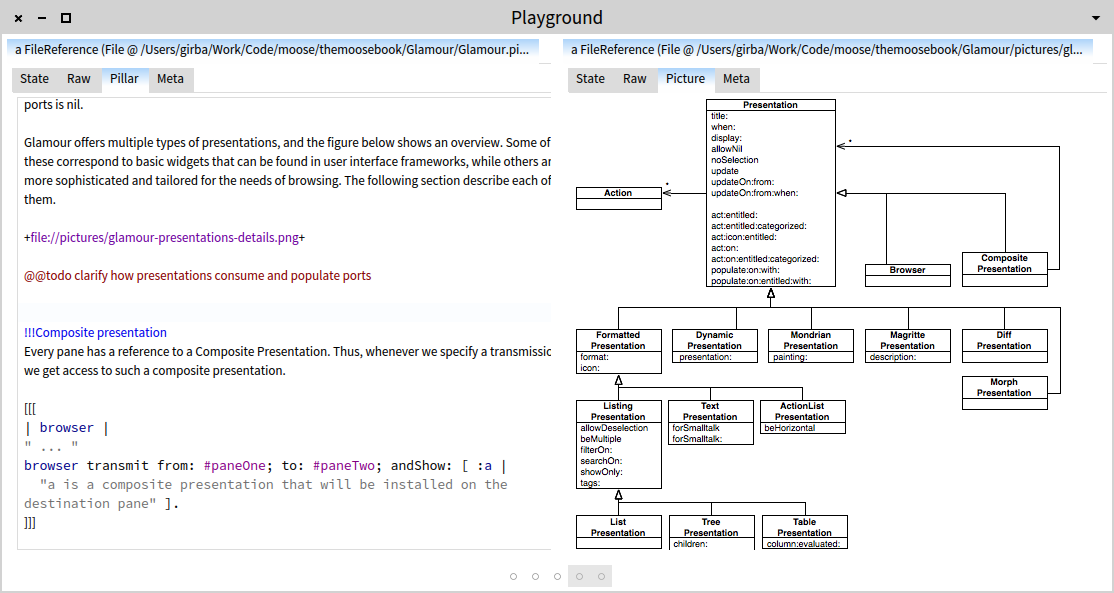
Hi, Documentation is important. To make it more likely and more enjoyable for people to write more of it, I teamed up with Andrei and Jan to build up support for Pillar in the GTInspector. The current solution brings the following: - Pillar specific syntax highlighting including Shout highlighting for code snippets - Embedded files validation and preview possibility - Quick browsing of Pillar book projects when inspecting the book folder - Class comment rendering using Pillar syntax when inspecting the class object - Text editor support for custom highlighting in Glamour (using Rubric for now) - Island parsing for quick specification of incomplete parser You can learn more about it here: http://www.humane-assessment.com/blog/writing-pillar-books-with-the-gtinspec... [image: Inline image 1] There is much more to do in this direction, and I would be happy to inspire some of you to join forces. Please let us know what you think. Cheers, Doru -- www.tudorgirba.com "Every thing has its own flow"

Beautiful work, great collaboration, inspiring ! On 07 Sep 2014, at 15:41, Tudor Girba <tudor@tudorgirba.com> wrote:
Hi,
Documentation is important. To make it more likely and more enjoyable for people to write more of it, I teamed up with Andrei and Jan to build up support for Pillar in the GTInspector.
The current solution brings the following: - Pillar specific syntax highlighting including Shout highlighting for code snippets - Embedded files validation and preview possibility - Quick browsing of Pillar book projects when inspecting the book folder - Class comment rendering using Pillar syntax when inspecting the class object - Text editor support for custom highlighting in Glamour (using Rubric for now) - Island parsing for quick specification of incomplete parser
You can learn more about it here: http://www.humane-assessment.com/blog/writing-pillar-books-with-the-gtinspec...
<pillar-book-picture.png>
There is much more to do in this direction, and I would be happy to inspire some of you to join forces. Please let us know what you think.
Cheers, Doru
-- www.tudorgirba.com
"Every thing has its own flow"

Hi Doru, I really like the advancements in this direction. If fact what I have trying to do, as a newbie, by making a Glamorous Toolkit powered outliner/tree like interface for writing structured documents tries something similar. I think that writing is mainly a non-linear experience and the usual metaphors of document processors are not powerful enough in expressing/exploring the structure of ideas in the writing process (some thought about it ane examples about how implement non-linear academic writing are in [1], in Spanish). [1] http://mutabit.com/offray/static/blog/output/posts/la-forma-en-que-escribo-p... I would like to create Visual Data Narratives inside Pharo/Moose/Roassal that use file system and web, and LateX as "exportation formats", but where the writing/structuring experience happen mainly inside Pharo. For that persistence/change of trees is important, but as I have documented in other threads, I'm having problems with it, using Glamorous Toolkit (specifically on updating objects from text panes and from emergent windows for tree names/properties). With your post, I'm wondering who difficult is: a. To put support to Pillar/Markdown inside text panes (something similar to the "smalltalkCode" message for showing Smalltalk in text panes but with "pillarCode" or "markdownCode" (or some dictionary with the #syntax keyword and the language as a value). b. To execute some parts of the code, for example the ones that are inside "[[[" "]]]" while the cursor is there, so we could not only preview imagages, but also execute code for visualizations or other computations c. The ability to support drag and drop to files to the tree (a Glamorous Tree) and get some kind of node pointing to that file. d. Tha ability to preview thumbnail images in a similar way of the "contextual places" for printing described on your post at [2] [2] http://www.humane-assessment.com/blog/rethinking-print-it-in-pharo/ e. The hability to show a preview of the pdf/html in an emergent lateral panel in a simlar way to what TeXStudio or TeXmaker do[3] [3] http://www.xm1math.net/texmaker/texmakertop_big.png So here I put my other ideas about "bringing liveliness to documentation" as you said and I would like to build them together. Cheers, Offray Ps: In the other threads I'm asking about how to advance in the outliner metaphor for live doc writing on Pharo/Moose/Roassal. I'll keep you posted. On 09/07/2014 08:41 AM, Tudor Girba wrote:
Hi,
Documentation is important. To make it more likely and more enjoyable for people to write more of it, I teamed up with Andrei and Jan to build up support for Pillar in the GTInspector.
The current solution brings the following: - Pillar specific syntax highlighting including Shout highlighting for code snippets - Embedded files validation and preview possibility - Quick browsing of Pillar book projects when inspecting the book folder - Class comment rendering using Pillar syntax when inspecting the class object - Text editor support for custom highlighting in Glamour (using Rubric for now) - Island parsing for quick specification of incomplete parser
You can learn more about it here: http://www.humane-assessment.com/blog/writing-pillar-books-with-the-gtinspec...
Inline image 1
There is much more to do in this direction, and I would be happy to inspire some of you to join forces. Please let us know what you think.
Cheers, Doru
-- www.tudorgirba.com <http://www.tudorgirba.com>
"Every thing has its own flow"
Hi, Thanks for the feedback. Indeed, your points are much inline with where we should go next. On Sun, Sep 7, 2014 at 9:50 PM, Offray Vladimir Luna Cárdenas < offray@riseup.net> wrote:
Hi Doru,
I really like the advancements in this direction. If fact what I have trying to do, as a newbie, by making a Glamorous Toolkit powered outliner/tree like interface for writing structured documents tries something similar. I think that writing is mainly a non-linear experience and the usual metaphors of document processors are not powerful enough in expressing/exploring the structure of ideas in the writing process (some thought about it ane examples about how implement non-linear academic writing are in [1], in Spanish).
[1] http://mutabit.com/offray/static/blog/output/posts/la- forma-en-que-escribo-para-el-doctorado.html
I would like to create Visual Data Narratives inside Pharo/Moose/Roassal that use file system and web, and LateX as "exportation formats", but where the writing/structuring experience happen mainly inside Pharo. For that persistence/change of trees is important, but as I have documented in other threads, I'm having problems with it, using Glamorous Toolkit (specifically on updating objects from text panes and from emergent windows for tree names/properties).
With your post, I'm wondering who difficult is:
a. To put support to Pillar/Markdown inside text panes (something similar to the "smalltalkCode" message for showing Smalltalk in text panes but with "pillarCode" or "markdownCode" (or some dictionary with the #syntax keyword and the language as a value).
That is precisely what already happened. If you load the code, you can take a look at the FileReference>>gtInspectorPillarIn: method to see how to specify the presentation.
b. To execute some parts of the code, for example the ones that are inside "[[[" "]]]" while the cursor is there, so we could not only preview imagages, but also execute code for visualizations or other computations
Exactly. That should definitely be a direction. We need to experiment here with the exact semantics. For example, you will not always want to execute the code. Or not all code is meant to be executed.
c. The ability to support drag and drop to files to the tree (a Glamorous Tree) and get some kind of node pointing to that file.
That is indeed something I would want as well. For example, we should be able to drag and drop a pier file from the outside and spawn an editor on it.
d. Tha ability to preview thumbnail images in a similar way of the "contextual places" for printing described on your post at [2]
[2] http://www.humane-assessment.com/blog/rethinking-print-it-in-pharo
Yes. This will likely come soon :) e. The hability to show a preview of the pdf/html in an emergent lateral
panel in a simlar way to what TeXStudio or TeXmaker do[3]
I do not know how to do it at this time. For this purpose, we would need to be able to embed a browser in a Pharo UI, and I am not aware of how to do it
So here I put my other ideas about "bringing liveliness to documentation" as you said and I would like to build them together.
Great. Please keep experimenting and keep us posted. Cheers, Doru
Cheers,
Offray
Ps: In the other threads I'm asking about how to advance in the outliner metaphor for live doc writing on Pharo/Moose/Roassal. I'll keep you posted.
On 09/07/2014 08:41 AM, Tudor Girba wrote:
Hi,
Documentation is important. To make it more likely and more enjoyable for people to write more of it, I teamed up with Andrei and Jan to build up support for Pillar in the GTInspector.
The current solution brings the following: - Pillar specific syntax highlighting including Shout highlighting for code snippets - Embedded files validation and preview possibility - Quick browsing of Pillar book projects when inspecting the book folder - Class comment rendering using Pillar syntax when inspecting the class object - Text editor support for custom highlighting in Glamour (using Rubric for now) - Island parsing for quick specification of incomplete parser
You can learn more about it here: http://www.humane-assessment.com/blog/writing-pillar-books- with-the-gtinspector
Inline image 1
There is much more to do in this direction, and I would be happy to inspire some of you to join forces. Please let us know what you think.
Cheers, Doru
-- www.tudorgirba.com <http://www.tudorgirba.com>
"Every thing has its own flow"
-- www.tudorgirba.com "Every thing has its own flow"
Maybe ... would anyone be interested in giving it a try? :) Doru On Mon, Sep 8, 2014 at 12:57 AM, Ben Coman <btc@openinworld.com> wrote:
Tudor Girba wrote:
Hi,
Thanks for the feedback. Indeed, your points are much inline with where we should go next.
On Sun, Sep 7, 2014 at 9:50 PM, Offray Vladimir Luna Cárdenas <offray@riseup.net> wrote:
Hi Doru,
I really like the advancements in this direction. If fact what I have trying to do, as a newbie, by making a Glamorous Toolkit powered outliner/tree like interface for writing structured documents tries something similar. I think that writing is mainly a non-linear experience and the usual metaphors of document processors are not powerful enough in expressing/exploring the structure of ideas in the writing process (some thought about it ane examples about how implement non-linear academic writing are in [1], in Spanish).
[1] http://mutabit.com/offray/static/blog/output/posts/la- forma-en-que-escribo-para-el-doctorado.html
I would like to create Visual Data Narratives inside Pharo/Moose/Roassal that use file system and web, and LateX as "exportation formats", but where the writing/structuring experience happen mainly inside Pharo. For that persistence/change of trees is important, but as I have documented in other threads, I'm having problems with it, using Glamorous Toolkit (specifically on updating objects from text panes and from emergent windows for tree names/properties).
With your post, I'm wondering who difficult is:
a. To put support to Pillar/Markdown inside text panes (something similar to the "smalltalkCode" message for showing Smalltalk in text panes but with "pillarCode" or "markdownCode" (or some dictionary with the #syntax keyword and the language as a value).
That is precisely what already happened. If you load the code, you can take a look at the FileReference>>gtInspectorPillarIn: method to see how to specify the presentation.
b. To execute some parts of the code, for example the ones that are inside "[[[" "]]]" while the cursor is there, so we could not only preview imagages, but also execute code for visualizations or other computations
Exactly. That should definitely be a direction. We need to experiment here with the exact semantics. For example, you will not always want to execute the code. Or not all code is meant to be executed.
c. The ability to support drag and drop to files to the tree (a Glamorous Tree) and get some kind of node pointing to that file.
That is indeed something I would want as well. For example, we should be able to drag and drop a pier file from the outside and spawn an editor on it.
d. Tha ability to preview thumbnail images in a similar way of the "contextual places" for printing described on your post at [2]
[2] http://www.humane-assessment.com/blog/rethinking-print-it-in-pharo
Yes. This will likely come soon :)
e. The hability to show a preview of the pdf/html in an emergent lateral
panel in a simlar way to what TeXStudio or TeXmaker do[3]
[3] http://www.xm1math.net/texmaker/texmakertop_big.png
I do not know how to do it at this time. For this purpose, we would need to be able to embed a browser in a Pharo UI, and I am not aware of how to do it
Maybe...
http://www.i-programmer.info/news/136-open-source/7433-google-open-sources-p...
cheers -ben
So here I put my other ideas about "bringing liveliness to documentation" as you said and I would like to build them together.
Great. Please keep experimenting and keep us posted.
Cheers, Doru
Cheers,
Offray
Ps: In the other threads I'm asking about how to advance in the outliner metaphor for live doc writing on Pharo/Moose/Roassal. I'll keep you posted.
On 09/07/2014 08:41 AM, Tudor Girba wrote:
Hi,
Documentation is important. To make it more likely and more enjoyable for people to write more of it, I teamed up with Andrei and Jan to build up support for Pillar in the GTInspector.
The current solution brings the following: - Pillar specific syntax highlighting including Shout highlighting for code snippets - Embedded files validation and preview possibility - Quick browsing of Pillar book projects when inspecting the book folder - Class comment rendering using Pillar syntax when inspecting the class object - Text editor support for custom highlighting in Glamour (using Rubric for now) - Island parsing for quick specification of incomplete parser
You can learn more about it here:http://www.humane-assessment.com/blog/writing-pillar-books- with-the-gtinspector
Inline image 1
There is much more to do in this direction, and I would be happy to inspire some of you to join forces. Please let us know what you think.
Cheers, Doru
--www.tudorgirba.com <http://www.tudorgirba.com> <http://www.tudorgirba.com>
"Every thing has its own flow"
-- www.tudorgirba.com "Every thing has its own flow"
Hi, Comments below. :-) On 09/07/2014 02:54 PM, Tudor Girba wrote:
Hi,
Thanks for the feedback. Indeed, your points are much inline with where we should go next.
[...]
I would like to create Visual Data Narratives inside Pharo/Moose/Roassal that use file system and web, and LateX as "exportation formats", but where the writing/structuring experience happen mainly inside Pharo. For that persistence/change of trees is important, but as I have documented in other threads, I'm having problems with it, using Glamorous Toolkit (specifically on updating objects from text panes and from emergent windows for tree names/properties).
[...]
Great. Please keep experimenting and keep us posted.
Well I have redefined my immediate goal for the next experiment as just updating an object from a text pane even if this is not automatic (as I said in the proper thread automatic updating is not working). So, how can I get the current content of a text pane and send it as an argument for updating an object value?
With your post, I'm wondering who difficult is:
a. To put support to Pillar/Markdown inside text panes (something similar to the "smalltalkCode" message for showing Smalltalk in text panes but with "pillarCode" or "markdownCode" (or some dictionary with the #syntax keyword and the language as a value).
That is precisely what already happened. If you load the code, you can take a look at the FileReference>>gtInspectorPillarIn: method to see how to specify the presentation.
I will as soon as I can load humane-assessment.com, to see your blog post again. In fact is usual for me not being able to load this site or Moose's ones on a regular basis (last time when I was trying to show this technology to a friend). If your have any possibility to consider another more stable hosting that would be nice for newcomers. Digital Ocean (I have not any affiliation with them) has been a nice solution for my for only USD $5 per month.
b. To execute some parts of the code, for example the ones that are inside "[[[" "]]]" while the cursor is there, so we could not only preview imagages, but also execute code for visualizations or other computations
Exactly. That should definitely be a direction. We need to experiment here with the exact semantics. For example, you will not always want to execute the code. Or not all code is meant to be executed.
Well for me that would be a human decision always and by default disabled. What I was thinking was more inline with IPython's notebook behaviour that executes a code cell with a shortcut. Would be nice to have a shortcut for executing code inside "[[[" "]]]" blocks if the cursor is inside them.
c. The ability to support drag and drop to files to the tree (a Glamorous Tree) and get some kind of node pointing to that file.
That is indeed something I would want as well. For example, we should be able to drag and drop a pier file from the outside and spawn an editor on it.
Yes.
d. Tha ability to preview thumbnail images in a similar way of the "contextual places" for printing described on your post at [2]
[2] http://www.humane-assessment.__com/blog/rethinking-print-it-__in-pharo <http://www.humane-assessment.com/blog/rethinking-print-it-in-pharo/>
Yes. This will likely come soon :)
Nice! Keep us posted.
e. The hability to show a preview of the pdf/html in an emergent lateral panel in a simlar way to what TeXStudio or TeXmaker do[3]
[3] http://www.xm1math.net/__texmaker/texmakertop_big.png <http://www.xm1math.net/texmaker/texmakertop_big.png>
I do not know how to do it at this time. For this purpose, we would need to be able to embed a browser in a Pharo UI, and I am not aware of how to do it
I would think in something like executing a browser inside a VNC client that can be shown inside Pharo. AFAIK that's the way that Open Croquet, Teleplace and other Smalltalk 3D worlds use to execute and show desktop apps inside the worlds. I imagine that something similar can be done in a Glamorous Toolkit pane. Cheers, Offray
Hi,
Great. Please keep experimenting and keep us posted.
Well I have redefined my immediate goal for the next experiment as just updating an object from a text pane even if this is not automatic (as I said in the proper thread automatic updating is not working). So, how can I get the current content of a text pane and send it as an argument for updating an object value?
With your post, I'm wondering who difficult is:
a. To put support to Pillar/Markdown inside text panes (something similar to the "smalltalkCode" message for showing Smalltalk in text panes but with "pillarCode" or "markdownCode" (or some dictionary with the #syntax keyword and the language as a value).
That is precisely what already happened. If you load the code, you can take a look at the FileReference>>gtInspectorPillarIn: method to see how to specify the presentation.
I will as soon as I can load humane-assessment.com, to see your blog post again. In fact is usual for me not being able to load this site or Moose's ones on a regular basis (last time when I was trying to show this technology to a friend). If your have any possibility to consider another more stable hosting that would be nice for newcomers. Digital Ocean (I have not any affiliation with them) has been a nice solution for my for only USD $5 per month.
Indeed, I have some problems with my server. I am not yet sure where the problem lies (the server itself or the provider). I restarted the server now and I hope it will be better for a while.
b. To execute some parts of the code, for example the ones that are
inside "[[[" "]]]" while the cursor is there, so we could not only preview imagages, but also execute code for visualizations or other computations
Exactly. That should definitely be a direction. We need to experiment here with the exact semantics. For example, you will not always want to execute the code. Or not all code is meant to be executed.
Well for me that would be a human decision always and by default disabled. What I was thinking was more inline with IPython's notebook behaviour that executes a code cell with a shortcut. Would be nice to have a shortcut for executing code inside "[[[" "]]]" blocks if the cursor is inside them.
Indeed, this is the first thing that popped in my mind as well. The problem is that often people use the code inside [[[ ]]] for incomplete snippets as well. So, it can actually be problematic to find the real code to run. At least in the current books.
c. The ability to support drag and drop to files to the tree (a
Glamorous Tree) and get some kind of node pointing to that file.
That is indeed something I would want as well. For example, we should be able to drag and drop a pier file from the outside and spawn an editor on it.
Yes.
d. Tha ability to preview thumbnail images in a similar way of the
"contextual places" for printing described on your post at [2]
[2] http://www.humane-assessment.__com/blog/rethinking-print-it- __in-pharo <http://www.humane-assessment.com/blog/rethinking-print-it-in-pharo/
Yes. This will likely come soon :)
Nice! Keep us posted.
e. The hability to show a preview of the pdf/html in an emergent
lateral panel in a simlar way to what TeXStudio or TeXmaker do[3]
[3] http://www.xm1math.net/__texmaker/texmakertop_big.png <http://www.xm1math.net/texmaker/texmakertop_big.png>
I do not know how to do it at this time. For this purpose, we would need to be able to embed a browser in a Pharo UI, and I am not aware of how to do it
I would think in something like executing a browser inside a VNC client that can be shown inside Pharo. AFAIK that's the way that Open Croquet, Teleplace and other Smalltalk 3D worlds use to execute and show desktop apps inside the worlds. I imagine that something similar can be done in a Glamorous Toolkit pane.
Would you be interested in producing a prototype in Morphic? Cheers, Doru
Cheers,
Offray
-- www.tudorgirba.com "Every thing has its own flow"
Hi, On 2014-09-08 00:11, Tudor Girba wrote: [...]
e. The hability to show a preview of the pdf/html in an emergent
lateral panel in a simlar way to what TeXStudio or TeXmaker do[3]
[3] http://www.xm1math.net/__texmaker/texmakertop_big.png <http://www.xm1math.net/texmaker/texmakertop_big.png>
I do not know how to do it at this time. For this purpose, we would need to be able to embed a browser in a Pharo UI, and I am not aware of how to do it
I would think in something like executing a browser inside a VNC client that can be shown inside Pharo. AFAIK that's the way that Open Croquet, Teleplace and other Smalltalk 3D worlds use to execute and show desktop apps inside the worlds. I imagine that something similar can be done in a Glamorous Toolkit pane.
Would you be interested in producing a prototype in Morphic?
Yes. As soon as I can get a minimal functional prototype of the outliner writer. For that, I need to solve the issues with updating objects from browsers, even if this is done explicitely instead of automatic. I have some clues and I imagine that can be solved with ports and message to the outside, but details still escape me. I have asked in the proper thread. Cheers, Offray

Offray Vladimir Luna Cárdenas wrote:
Hi Doru,
I really like the advancements in this direction. If fact what I have trying to do, as a newbie, by making a Glamorous Toolkit powered outliner/tree like interface for writing structured documents tries something similar. I think that writing is mainly a non-linear experience and the usual metaphors of document processors are not powerful enough in expressing/exploring the structure of ideas in the writing process (some thought about it ane examples about how implement non-linear academic writing are in [1], in Spanish).
[1] http://mutabit.com/offray/static/blog/output/posts/la-forma-en-que-escribo-p...
I would like to create Visual Data Narratives inside Pharo/Moose/Roassal that use file system and web, and LateX as "exportation formats", but where the writing/structuring experience happen mainly inside Pharo. For that persistence/change of trees is important, but as I have documented in other threads, I'm having problems with it, using Glamorous Toolkit (specifically on updating objects from text panes and from emergent windows for tree names/properties).
With your post, I'm wondering who difficult is:
a. To put support to Pillar/Markdown inside text panes (something similar to the "smalltalkCode" message for showing Smalltalk in text panes but with "pillarCode" or "markdownCode" (or some dictionary with the #syntax keyword and the language as a value).
b. To execute some parts of the code, for example the ones that are inside "[[[" "]]]" while the cursor is there, so we could not only preview imagages, but also execute code for visualizations or other computations
I have been thinking previously, that it would be good to have named code blocks "[[[ ]]]", some of which are visible which appear in the end document, and some are invisible, just used to scaffold the live document, e.g. to generate pictures. For example, visible code block code A might show the text to "create a class definition and accessors" and invisible code block B might say... "close all windows. run code block A. open System Browser at origin: 100@100 extent 500@300. System Browser select class and accessor just created. Screen snapshot and save to filenameXXX.png." cheers -ben
c. The ability to support drag and drop to files to the tree (a Glamorous Tree) and get some kind of node pointing to that file.
d. Tha ability to preview thumbnail images in a similar way of the "contextual places" for printing described on your post at [2]
[2] http://www.humane-assessment.com/blog/rethinking-print-it-in-pharo/
e. The hability to show a preview of the pdf/html in an emergent lateral panel in a simlar way to what TeXStudio or TeXmaker do[3]
[3] http://www.xm1math.net/texmaker/texmakertop_big.png
So here I put my other ideas about "bringing liveliness to documentation" as you said and I would like to build them together.
Cheers,
Offray
Ps: In the other threads I'm asking about how to advance in the outliner metaphor for live doc writing on Pharo/Moose/Roassal. I'll keep you posted.
On 09/07/2014 08:41 AM, Tudor Girba wrote:
Hi,
Documentation is important. To make it more likely and more enjoyable for people to write more of it, I teamed up with Andrei and Jan to build up support for Pillar in the GTInspector.
The current solution brings the following: - Pillar specific syntax highlighting including Shout highlighting for code snippets - Embedded files validation and preview possibility - Quick browsing of Pillar book projects when inspecting the book folder - Class comment rendering using Pillar syntax when inspecting the class object - Text editor support for custom highlighting in Glamour (using Rubric for now) - Island parsing for quick specification of incomplete parser
You can learn more about it here: http://www.humane-assessment.com/blog/writing-pillar-books-with-the-gtinspec...
Inline image 1
There is much more to do in this direction, and I would be happy to inspire some of you to join forces. Please let us know what you think.
Cheers, Doru
-- www.tudorgirba.com <http://www.tudorgirba.com>
"Every thing has its own flow"
Hi, On 09/07/2014 05:47 PM, Ben Coman wrote:
Offray Vladimir Luna Cárdenas wrote:
Hi Doru,
I really like the advancements in this direction. If fact what I have trying to do, as a newbie, by making a Glamorous Toolkit powered outliner/tree like interface for writing structured documents tries something similar. I think that writing is mainly a non-linear experience and the usual metaphors of document processors are not powerful enough in expressing/exploring the structure of ideas in the writing process (some thought about it ane examples about how implement non-linear academic writing are in [1], in Spanish).
[1] http://mutabit.com/offray/static/blog/output/posts/la-forma-en-que-escribo-p...
I would like to create Visual Data Narratives inside Pharo/Moose/Roassal that use file system and web, and LateX as "exportation formats", but where the writing/structuring experience happen mainly inside Pharo. For that persistence/change of trees is important, but as I have documented in other threads, I'm having problems with it, using Glamorous Toolkit (specifically on updating objects from text panes and from emergent windows for tree names/properties).
With your post, I'm wondering who difficult is:
a. To put support to Pillar/Markdown inside text panes (something similar to the "smalltalkCode" message for showing Smalltalk in text panes but with "pillarCode" or "markdownCode" (or some dictionary with the #syntax keyword and the language as a value).
b. To execute some parts of the code, for example the ones that are inside "[[[" "]]]" while the cursor is there, so we could not only preview imagages, but also execute code for visualizations or other computations
I have been thinking previously, that it would be good to have named code blocks "[[[ ]]]", some of which are visible which appear in the end document, and some are invisible, just used to scaffold the live document, e.g. to generate pictures. For example, visible code block code A might show the text to "create a class definition and accessors" and invisible code block B might say... "close all windows. run code block A. open System Browser at origin: 100@100 extent 500@300. System Browser select class and accessor just created. Screen snapshot and save to filenameXXX.png."
cheers -ben
What I made on Leo Outliner is to have some custom directive (@ words like "@ignore") as headers of a node, so I can ignore what is inside that part of the tree. For the ouliner on Pharo I'm thinking in adding tags to nodes so, some exportation procedures for the interactive book can be put in invisible nodes (I mean invisible in the context of the exportation of the book). That nodes can contain code for "Pharo selfies" where the environment takes screenshots of itself, or metadata for the exportation (template for document, database information and so on). I will be trying to make some progress on the saving/updating of trees front, but If I can not, I will be on the nodes tags and interface, at least to show some ideas and explain myself better with pictures :-). Cheers, Offray
Hi Ben, Exactly. In Pier, we used to have value links (see http://www.piercms.com/doc/syntax). I propose to introduce something like this: +object:"code that returns something that can be embedded like a graphical form"+ Doru On Mon, Sep 8, 2014 at 12:47 AM, Ben Coman <btc@openinworld.com> wrote:
Offray Vladimir Luna Cárdenas wrote:
Hi Doru,
I really like the advancements in this direction. If fact what I have trying to do, as a newbie, by making a Glamorous Toolkit powered outliner/tree like interface for writing structured documents tries something similar. I think that writing is mainly a non-linear experience and the usual metaphors of document processors are not powerful enough in expressing/exploring the structure of ideas in the writing process (some thought about it ane examples about how implement non-linear academic writing are in [1], in Spanish).
[1] http://mutabit.com/offray/static/blog/output/posts/la- forma-en-que-escribo-para-el-doctorado.html
I would like to create Visual Data Narratives inside Pharo/Moose/Roassal that use file system and web, and LateX as "exportation formats", but where the writing/structuring experience happen mainly inside Pharo. For that persistence/change of trees is important, but as I have documented in other threads, I'm having problems with it, using Glamorous Toolkit (specifically on updating objects from text panes and from emergent windows for tree names/properties).
With your post, I'm wondering who difficult is:
a. To put support to Pillar/Markdown inside text panes (something similar to the "smalltalkCode" message for showing Smalltalk in text panes but with "pillarCode" or "markdownCode" (or some dictionary with the #syntax keyword and the language as a value).
b. To execute some parts of the code, for example the ones that are inside "[[[" "]]]" while the cursor is there, so we could not only preview imagages, but also execute code for visualizations or other computations
I have been thinking previously, that it would be good to have named code blocks "[[[ ]]]", some of which are visible which appear in the end document, and some are invisible, just used to scaffold the live document, e.g. to generate pictures. For example, visible code block code A might show the text to "create a class definition and accessors" and invisible code block B might say... "close all windows. run code block A. open System Browser at origin: 100@100 extent 500@300. System Browser select class and accessor just created. Screen snapshot and save to filenameXXX.png."
cheers -ben
c. The ability to support drag and drop to files to the tree (a Glamorous Tree) and get some kind of node pointing to that file.
d. Tha ability to preview thumbnail images in a similar way of the "contextual places" for printing described on your post at [2]
[2] http://www.humane-assessment.com/blog/rethinking-print-it-in-pharo/
e. The hability to show a preview of the pdf/html in an emergent lateral panel in a simlar way to what TeXStudio or TeXmaker do[3]
[3] http://www.xm1math.net/texmaker/texmakertop_big.png
So here I put my other ideas about "bringing liveliness to documentation" as you said and I would like to build them together.
Cheers,
Offray
Ps: In the other threads I'm asking about how to advance in the outliner metaphor for live doc writing on Pharo/Moose/Roassal. I'll keep you posted.
On 09/07/2014 08:41 AM, Tudor Girba wrote:
Hi,
Documentation is important. To make it more likely and more enjoyable for people to write more of it, I teamed up with Andrei and Jan to build up support for Pillar in the GTInspector.
The current solution brings the following: - Pillar specific syntax highlighting including Shout highlighting for code snippets - Embedded files validation and preview possibility - Quick browsing of Pillar book projects when inspecting the book folder - Class comment rendering using Pillar syntax when inspecting the class object - Text editor support for custom highlighting in Glamour (using Rubric for now) - Island parsing for quick specification of incomplete parser
You can learn more about it here: http://www.humane-assessment.com/blog/writing-pillar-books- with-the-gtinspector
Inline image 1
There is much more to do in this direction, and I would be happy to inspire some of you to join forces. Please let us know what you think.
Cheers, Doru
-- www.tudorgirba.com <http://www.tudorgirba.com>
"Every thing has its own flow"
-- www.tudorgirba.com "Every thing has its own flow"
participants (5)
-
 Ben Coman
 -
 Offray Vladimir Luna Cárdenas
 -
offray@riseup.net
-
 Sven Van Caekenberghe
 -
 Tudor Girba