
One nice way to get in the mood of doing (and at the same time testing the system) is to start with trivial improvements. This is especially nice as a "starter" when you never contributed any change to Pharo. And by trivial I mean *really* mean trivial: -> a typo in a comment -> remove a temp not accessed -> clean out some trivial dead code -> do a simplistic refactoring of a bad smell, even inside a single method -> document something -> structure bad stuff better so it is easier to replace later Taken in itself, single changes like these have no influence, but: -> they get you in a mood of doing. -> they make you feel that Pharo is "owned" by you. -> take 1000 of those trivialities and they *do* make a difference. -> next time something bothers you, you will have the context of "I can just fix it". The critic tools is one way of finding these places, another is to just note down every time you see a triviality and later go through that list. The bug tracker can be source, too. Marcus

+100 On 10 Oct 2013, at 13:21, Marcus Denker <marcus.denker@inria.fr> wrote:
One nice way to get in the mood of doing (and at the same time testing the system) is to start with trivial improvements.
This is especially nice as a "starter" when you never contributed any change to Pharo.
And by trivial I mean *really* mean trivial: -> a typo in a comment -> remove a temp not accessed -> clean out some trivial dead code -> do a simplistic refactoring of a bad smell, even inside a single method -> document something -> structure bad stuff better so it is easier to replace later
Taken in itself, single changes like these have no influence, but:
-> they get you in a mood of doing. -> they make you feel that Pharo is "owned" by you. -> take 1000 of those trivialities and they *do* make a difference. -> next time something bothers you, you will have the context of "I can just fix it".
The critic tools is one way of finding these places, another is to just note down every time you see a triviality and later go through that list. The bug tracker can be source, too.
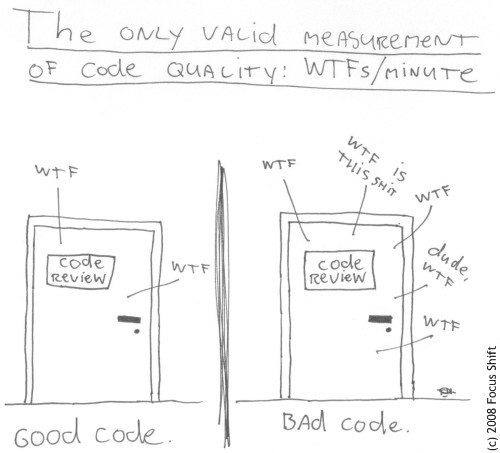
<wtfm.jpg>
Marcus

Thank you, Marcus! Could you post this on the Pharo blog? Doru On Thu, Oct 10, 2013 at 1:36 PM, Sven Van Caekenberghe <sven@stfx.eu> wrote:
+100
On 10 Oct 2013, at 13:21, Marcus Denker <marcus.denker@inria.fr> wrote:
One nice way to get in the mood of doing (and at the same time testing the system) is to start with trivial improvements.
This is especially nice as a "starter" when you never contributed any change to Pharo.
And by trivial I mean *really* mean trivial: -> a typo in a comment -> remove a temp not accessed -> clean out some trivial dead code -> do a simplistic refactoring of a bad smell, even inside a single method -> document something -> structure bad stuff better so it is easier to replace later
Taken in itself, single changes like these have no influence, but:
-> they get you in a mood of doing. -> they make you feel that Pharo is "owned" by you. -> take 1000 of those trivialities and they *do* make a difference. -> next time something bothers you, you will have the context of "I can just fix it".
The critic tools is one way of finding these places, another is to just note down every time you see a triviality and later go through that list. The bug tracker can be source, too.
<wtfm.jpg>
Marcus
-- www.tudorgirba.com "Every thing has its own flow"

On Oct 10, 2013, at 1:42 PM, Tudor Girba <tudor@tudorgirba.com> wrote:
Thank you, Marcus!
Could you post this on the Pharo blog? And put a link to Camillo's guide on bug fixing, so enthusiasts will know how to contribute :)
Doru
On Thu, Oct 10, 2013 at 1:36 PM, Sven Van Caekenberghe <sven@stfx.eu> wrote: +100
On 10 Oct 2013, at 13:21, Marcus Denker <marcus.denker@inria.fr> wrote:
One nice way to get in the mood of doing (and at the same time testing the system) is to start with trivial improvements.
This is especially nice as a "starter" when you never contributed any change to Pharo.
And by trivial I mean *really* mean trivial: -> a typo in a comment -> remove a temp not accessed -> clean out some trivial dead code -> do a simplistic refactoring of a bad smell, even inside a single method -> document something -> structure bad stuff better so it is easier to replace later
Taken in itself, single changes like these have no influence, but:
-> they get you in a mood of doing. -> they make you feel that Pharo is "owned" by you. -> take 1000 of those trivialities and they *do* make a difference. -> next time something bothers you, you will have the context of "I can just fix it".
The critic tools is one way of finding these places, another is to just note down every time you see a triviality and later go through that list. The bug tracker can be source, too.
<wtfm.jpg>
Marcus
-- www.tudorgirba.com
"Every thing has its own flow"

good idea yes for the blog entry On Oct 10, 2013, at 1:42 PM, Tudor Girba <tudor@tudorgirba.com> wrote:
Thank you, Marcus!
Could you post this on the Pharo blog?
Doru
On Thu, Oct 10, 2013 at 1:36 PM, Sven Van Caekenberghe <sven@stfx.eu> wrote: +100
On 10 Oct 2013, at 13:21, Marcus Denker <marcus.denker@inria.fr> wrote:
One nice way to get in the mood of doing (and at the same time testing the system) is to start with trivial improvements.
This is especially nice as a "starter" when you never contributed any change to Pharo.
And by trivial I mean *really* mean trivial: -> a typo in a comment -> remove a temp not accessed -> clean out some trivial dead code -> do a simplistic refactoring of a bad smell, even inside a single method -> document something -> structure bad stuff better so it is easier to replace later
Taken in itself, single changes like these have no influence, but:
-> they get you in a mood of doing. -> they make you feel that Pharo is "owned" by you. -> take 1000 of those trivialities and they *do* make a difference. -> next time something bothers you, you will have the context of "I can just fix it".
The critic tools is one way of finding these places, another is to just note down every time you see a triviality and later go through that list. The bug tracker can be source, too.
<wtfm.jpg>
Marcus
-- www.tudorgirba.com
"Every thing has its own flow"
participants (5)
-
 Marcus Denker
 -
 Stéphane Ducasse
 -
 Sven Van Caekenberghe
 -
 Tudor Girba
 -
 Yuriy Tymchuk