[ANN] PharoLambda a demo of Pharo running on AWS Lambda

Hi - Iâve been playing around with getting Pharo to run well on AWS Lambda. Itâs early days, but I though it might be interesting to share what Iâve learned so far. Usage examples and code at https://gitlab.com/macta/PharoLambda <https://gitlab.com/macta/PharoLambda> With help from many of the folks here, Iâve been able to get a simple example to run in 500ms-1200ms with a minimal Pharo 6 image. You can easily try it out yourself. This seems slightly better than what the GoLang folks have been able to do. Tim
Things move fast, I already got a shout out from an AWS advocate - https://twitter.com/chrismunns/status/885959425860808704 <https://twitter.com/chrismunns/status/885959425860808704> Tim
On 15 Jul 2017, at 00:39, Tim Mackinnon <tim@testit.works> wrote:
Hi - Iâve been playing around with getting Pharo to run well on AWS Lambda. Itâs early days, but I though it might be interesting to share what Iâve learned so far.
Usage examples and code at https://gitlab.com/macta/PharoLambda <https://gitlab.com/macta/PharoLambda>
With help from many of the folks here, Iâve been able to get a simple example to run in 500ms-1200ms with a minimal Pharo 6 image. You can easily try it out yourself. This seems slightly better than what the GoLang folks have been able to do.
Tim

Nice job! Doru
On Jul 15, 2017, at 1:43 AM, Tim Mackinnon <tim@testit.works> wrote:
Things move fast, I already got a shout out from an AWS advocate - https://twitter.com/chrismunns/status/885959425860808704
Tim
On 15 Jul 2017, at 00:39, Tim Mackinnon <tim@testit.works> wrote:
Hi - Iâve been playing around with getting Pharo to run well on AWS Lambda. Itâs early days, but I though it might be interesting to share what Iâve learned so far.
Usage examples and code at https://gitlab.com/macta/PharoLambda
With help from many of the folks here, Iâve been able to get a simple example to run in 500ms-1200ms with a minimal Pharo 6 image. You can easily try it out yourself. This seems slightly better than what the GoLang folks have been able to do.
Tim
-- www.tudorgirba.com www.feenk.com "Every thing has its own flow."
I just wanted to thank everyone for their help in getting my pet project further along, so that now I can announce that PharoLambda is now working with the V7 minimal image and also supports post mortem debugging by saving a zipped fuel context onto S3. This latter item is particularly satisfying as at a recent serverless conference (JeffConf) there was a panel where poor development tools on serverless platforms was highlighted as a real problem. In our community weâve had these kinds of tools at our fingertips for ages - but I donât think the wider development community has really noticed. Debugging something short lived like a Lambda execution is quite startling, as the current answer is âadd more loggingâ, and we all know that sucks. To this end, Iâve created a little screencast showing this in action - and it was pretty cool because it was a real example I encountered when I got everything working and was trying my test application out. Iâve also put a bit of work into tuning the excellent GitLab CI tools, so that I can cache many of the artefacts used between different build runs (this might also be of interest to others using CI systems). The Gitlab project is on: https://gitlab.com/macta/PharoLambda <https://gitlab.com/macta/PharoLambda> And the screencast: https://www.youtube.com/watch?v=bNNCT1hLA3E <https://www.youtube.com/watch?v=bNNCT1hLA3E> Tim
On 15 Jul 2017, at 00:39, Tim Mackinnon <tim@testit.works> wrote:
Hi - Iâve been playing around with getting Pharo to run well on AWS Lambda. Itâs early days, but I though it might be interesting to share what Iâve learned so far.
Usage examples and code at https://gitlab.com/macta/PharoLambda <https://gitlab.com/macta/PharoLambda>
With help from many of the folks here, Iâve been able to get a simple example to run in 500ms-1200ms with a minimal Pharo 6 image. You can easily try it out yourself. This seems slightly better than what the GoLang folks have been able to do.
Tim

Hi Tim, Impressive pet project you have. And what a way to deliver! Not only with fun features never built before, but also with a documented repo and a detailed screencast. Congratulations. In my self interest, and indirectly for the Pharo community, I look forward to see more contributions like this from you. Regards! Esteban A. Maringolo 2017-08-10 10:47 GMT-03:00 Tim Mackinnon <tim@testit.works>:
I just wanted to thank everyone for their help in getting my pet project further along, so that now I can announce that PharoLambda is now working with the V7 minimal image and also supports post mortem debugging by saving a zipped fuel context onto S3.
This latter item is particularly satisfying as at a recent serverless conference (JeffConf) there was a panel where poor development tools on serverless platforms was highlighted as a real problem.
In our community weâve had these kinds of tools at our fingertips for ages - but I donât think the wider development community has really noticed. Debugging something short lived like a Lambda execution is quite startling, as the current answer is âadd more loggingâ, and we all know that sucks. To this end, Iâve created a little screencast showing this in action - and it was pretty cool because it was a real example I encountered when I got everything working and was trying my test application out.
Iâve also put a bit of work into tuning the excellent GitLab CI tools, so that I can cache many of the artefacts used between different build runs (this might also be of interest to others using CI systems).
The Gitlab project is on: https://gitlab.com/macta/PharoLambda And the screencast: https://www.youtube.com/watch?v=bNNCT1hLA3E
Tim
On 15 Jul 2017, at 00:39, Tim Mackinnon <tim@testit.works> wrote:
Hi - Iâve been playing around with getting Pharo to run well on AWS Lambda. Itâs early days, but I though it might be interesting to share what Iâve learned so far.
Usage examples and code at https://gitlab.com/macta/PharoLambda
With help from many of the folks here, Iâve been able to get a simple example to run in 500ms-1200ms with a minimal Pharo 6 image. You can easily try it out yourself. This seems slightly better than what the GoLang folks have been able to do.
Tim

Impressive stuff!! Alexandre -- _,.;:~^~:;._,.;:~^~:;._,.;:~^~:;._,.;:~^~:;._,.;: Alexandre Bergel http://www.bergel.eu ^~:;._,.;:~^~:;._,.;:~^~:;._,.;:~^~:;._,.;:~^~:;.
On Aug 10, 2017, at 9:47 AM, Tim Mackinnon <tim@testit.works> wrote:
I just wanted to thank everyone for their help in getting my pet project further along, so that now I can announce that PharoLambda is now working with the V7 minimal image and also supports post mortem debugging by saving a zipped fuel context onto S3.
This latter item is particularly satisfying as at a recent serverless conference (JeffConf) there was a panel where poor development tools on serverless platforms was highlighted as a real problem.
In our community weâve had these kinds of tools at our fingertips for ages - but I donât think the wider development community has really noticed. Debugging something short lived like a Lambda execution is quite startling, as the current answer is âadd more loggingâ, and we all know that sucks. To this end, Iâve created a little screencast showing this in action - and it was pretty cool because it was a real example I encountered when I got everything working and was trying my test application out.
Iâve also put a bit of work into tuning the excellent GitLab CI tools, so that I can cache many of the artefacts used between different build runs (this might also be of interest to others using CI systems).
The Gitlab project is on: https://gitlab.com/macta/PharoLambda <https://gitlab.com/macta/PharoLambda> And the screencast: https://www.youtube.com/watch?v=bNNCT1hLA3E <https://www.youtube.com/watch?v=bNNCT1hLA3E>
Tim
On 15 Jul 2017, at 00:39, Tim Mackinnon <tim@testit.works <mailto:tim@testit.works>> wrote:
Hi - Iâve been playing around with getting Pharo to run well on AWS Lambda. Itâs early days, but I though it might be interesting to share what Iâve learned so far.
Usage examples and code at https://gitlab.com/macta/PharoLambda <https://gitlab.com/macta/PharoLambda>
With help from many of the folks here, Iâve been able to get a simple example to run in 500ms-1200ms with a minimal Pharo 6 image. You can easily try it out yourself. This seems slightly better than what the GoLang folks have been able to do.
Tim

Yeah, very nice. I just watched it all and looks cool. I am happy that the debugger/stack/context serialization is still breaking other people's mind :) There are a few limitations and problems with the serialization of debugger and materialization in another image. I think I listed those several times in the mailing list, but if you want, let me know, and I can remind them again (there we workarounds or help with the limits). Cheers, On Thu, Aug 10, 2017 at 5:57 PM, Alexandre Bergel <alexandre.bergel@me.com> wrote:
Impressive stuff!!
Alexandre -- _,.;:~^~:;._,.;:~^~:;._,.;:~^~:;._,.;:~^~:;._,.;: Alexandre Bergel http://www.bergel.eu ^~:;._,.;:~^~:;._,.;:~^~:;._,.;:~^~:;._,.;:~^~:;.
On Aug 10, 2017, at 9:47 AM, Tim Mackinnon <tim@testit.works> wrote:
I just wanted to thank everyone for their help in getting my pet project further along, so that now I can announce that PharoLambda is now working with the V7 minimal image and also supports post mortem debugging by saving a zipped fuel context onto S3.
This latter item is particularly satisfying as at a recent serverless conference (JeffConf) there was a panel where poor development tools on serverless platforms was highlighted as a real problem.
In our community weâve had these kinds of tools at our fingertips for ages - but I donât think the wider development community has really noticed. Debugging something short lived like a Lambda execution is quite startling, as the current answer is âadd more loggingâ, and we all know that sucks. To this end, Iâve created a little screencast showing this in action - and it was pretty cool because it was a real example I encountered when I got everything working and was trying my test application out.
Iâve also put a bit of work into tuning the excellent GitLab CI tools, so that I can cache many of the artefacts used between different build runs (this might also be of interest to others using CI systems).
The Gitlab project is on: https://gitlab.com/macta/PharoLambda And the screencast: https://www.youtube.com/watch?v=bNNCT1hLA3E
Tim
On 15 Jul 2017, at 00:39, Tim Mackinnon <tim@testit.works> wrote:
Hi - Iâve been playing around with getting Pharo to run well on AWS Lambda. Itâs early days, but I though it might be interesting to share what Iâve learned so far.
Usage examples and code at https://gitlab.com/macta/PharoLambda
With help from many of the folks here, Iâve been able to get a simple example to run in 500ms-1200ms with a minimal Pharo 6 image. You can easily try it out yourself. This seems slightly better than what the GoLang folks have been able to do.
Tim
-- Mariano http://marianopeck.wordpress.com

Tim I definitively think that we could turn it into a Pharo success story or something that we can keep on the web site because it is really nice. Stef On Thu, Aug 10, 2017 at 3:47 PM, Tim Mackinnon <tim@testit.works> wrote:
I just wanted to thank everyone for their help in getting my pet project further along, so that now I can announce that PharoLambda is now working with the V7 minimal image and also supports post mortem debugging by saving a zipped fuel context onto S3.
This latter item is particularly satisfying as at a recent serverless conference (JeffConf) there was a panel where poor development tools on serverless platforms was highlighted as a real problem.
In our community weâve had these kinds of tools at our fingertips for ages - but I donât think the wider development community has really noticed. Debugging something short lived like a Lambda execution is quite startling, as the current answer is âadd more loggingâ, and we all know that sucks. To this end, Iâve created a little screencast showing this in action - and it was pretty cool because it was a real example I encountered when I got everything working and was trying my test application out.
Iâve also put a bit of work into tuning the excellent GitLab CI tools, so that I can cache many of the artefacts used between different build runs (this might also be of interest to others using CI systems).
The Gitlab project is on: https://gitlab.com/macta/PharoLambda And the screencast: https://www.youtube.com/watch?v=bNNCT1hLA3E
Tim
On 15 Jul 2017, at 00:39, Tim Mackinnon <tim@testit.works> wrote:
Hi - Iâve been playing around with getting Pharo to run well on AWS Lambda. Itâs early days, but I though it might be interesting to share what Iâve learned so far.
Usage examples and code at https://gitlab.com/macta/PharoLambda
With help from many of the folks here, Iâve been able to get a simple example to run in 500ms-1200ms with a minimal Pharo 6 image. You can easily try it out yourself. This seems slightly better than what the GoLang folks have been able to do.
Tim
+1 Doru
On Aug 10, 2017, at 11:34 PM, Stephane Ducasse <stepharo.self@gmail.com> wrote:
Tim
I definitively think that we could turn it into a Pharo success story or something that we can keep on the web site because it is really nice.
Stef
On Thu, Aug 10, 2017 at 3:47 PM, Tim Mackinnon <tim@testit.works> wrote:
I just wanted to thank everyone for their help in getting my pet project further along, so that now I can announce that PharoLambda is now working with the V7 minimal image and also supports post mortem debugging by saving a zipped fuel context onto S3.
This latter item is particularly satisfying as at a recent serverless conference (JeffConf) there was a panel where poor development tools on serverless platforms was highlighted as a real problem.
In our community weâve had these kinds of tools at our fingertips for ages - but I donât think the wider development community has really noticed. Debugging something short lived like a Lambda execution is quite startling, as the current answer is âadd more loggingâ, and we all know that sucks. To this end, Iâve created a little screencast showing this in action - and it was pretty cool because it was a real example I encountered when I got everything working and was trying my test application out.
Iâve also put a bit of work into tuning the excellent GitLab CI tools, so that I can cache many of the artefacts used between different build runs (this might also be of interest to others using CI systems).
The Gitlab project is on: https://gitlab.com/macta/PharoLambda And the screencast: https://www.youtube.com/watch?v=bNNCT1hLA3E
Tim
On 15 Jul 2017, at 00:39, Tim Mackinnon <tim@testit.works> wrote:
Hi - Iâve been playing around with getting Pharo to run well on AWS Lambda. Itâs early days, but I though it might be interesting to share what Iâve learned so far.
Usage examples and code at https://gitlab.com/macta/PharoLambda
With help from many of the folks here, Iâve been able to get a simple example to run in 500ms-1200ms with a minimal Pharo 6 image. You can easily try it out yourself. This seems slightly better than what the GoLang folks have been able to do.
Tim
-- www.tudorgirba.com www.feenk.com "Reasonable is what we are accustomed with."
Very nice work, Tim! It is quite impressive what you could do within a short amount of time (essentially since PharoDays). Please do keep this up. Cheers, Doru
On Aug 10, 2017, at 3:47 PM, Tim Mackinnon <tim@testit.works> wrote:
I just wanted to thank everyone for their help in getting my pet project further along, so that now I can announce that PharoLambda is now working with the V7 minimal image and also supports post mortem debugging by saving a zipped fuel context onto S3.
This latter item is particularly satisfying as at a recent serverless conference (JeffConf) there was a panel where poor development tools on serverless platforms was highlighted as a real problem.
In our community weâve had these kinds of tools at our fingertips for ages - but I donât think the wider development community has really noticed. Debugging something short lived like a Lambda execution is quite startling, as the current answer is âadd more loggingâ, and we all know that sucks. To this end, Iâve created a little screencast showing this in action - and it was pretty cool because it was a real example I encountered when I got everything working and was trying my test application out.
Iâve also put a bit of work into tuning the excellent GitLab CI tools, so that I can cache many of the artefacts used between different build runs (this might also be of interest to others using CI systems).
The Gitlab project is on: https://gitlab.com/macta/PharoLambda And the screencast: https://www.youtube.com/watch?v=bNNCT1hLA3E
Tim
On 15 Jul 2017, at 00:39, Tim Mackinnon <tim@testit.works> wrote:
Hi - Iâve been playing around with getting Pharo to run well on AWS Lambda. Itâs early days, but I though it might be interesting to share what Iâve learned so far.
Usage examples and code at https://gitlab.com/macta/PharoLambda
With help from many of the folks here, Iâve been able to get a simple example to run in 500ms-1200ms with a minimal Pharo 6 image. You can easily try it out yourself. This seems slightly better than what the GoLang folks have been able to do.
Tim
-- www.tudorgirba.com www.feenk.com "Quality cannot be an afterthought."

This is cool Tim. So what image size you deployed at the end? 2017-08-10 15:47 GMT+02:00 Tim Mackinnon <tim@testit.works>:
I just wanted to thank everyone for their help in getting my pet project further along, so that now I can announce that PharoLambda is now working with the V7 minimal image and also supports post mortem debugging by saving a zipped fuel context onto S3.
This latter item is particularly satisfying as at a recent serverless conference (JeffConf) there was a panel where poor development tools on serverless platforms was highlighted as a real problem.
In our community weâve had these kinds of tools at our fingertips for ages - but I donât think the wider development community has really noticed. Debugging something short lived like a Lambda execution is quite startling, as the current answer is âadd more loggingâ, and we all know that sucks. To this end, Iâve created a little screencast showing this in action - and it was pretty cool because it was a real example I encountered when I got everything working and was trying my test application out.
Iâve also put a bit of work into tuning the excellent GitLab CI tools, so that I can cache many of the artefacts used between different build runs (this might also be of interest to others using CI systems).
The Gitlab project is on: https://gitlab.com/macta/PharoLambda And the screencast: https://www.youtube.com/watch?v=bNNCT1hLA3E
Tim
On 15 Jul 2017, at 00:39, Tim Mackinnon <tim@testit.works> wrote:
Hi - Iâve been playing around with getting Pharo to run well on AWS Lambda. Itâs early days, but I though it might be interesting to share what Iâve learned so far.
Usage examples and code at https://gitlab.com/macta/PharoLambda
With help from many of the folks here, Iâve been able to get a simple example to run in 500ms-1200ms with a minimal Pharo 6 image. You can easily try it out yourself. This seems slightly better than what the GoLang folks have been able to do.
Tim

hi Tim, That is..... AWESOME! Very nice delivery - it flowed well with great narration. I loved @2:17 "this is the interesting piece, because PharoLambda has serialized the execution context of its application and saved it into [my S3 bucket] ... [then on the local machine] rematerializes a debugger [on that context]." There is a clarity in your video presentation that really may intrigue outsiders. As a community we should push this on the usual hacker forums - ycombinator could be a good starting point (but I'm locked out of my account there). An enticing title could be... "Debugging Lambdas by re-materializing saved execution contexts on your local machine." cheers -ben On Fri, Aug 11, 2017 at 3:37 PM, Denis Kudriashov <dionisiydk@gmail.com> wrote:
This is cool Tim.
So what image size you deployed at the end?
2017-08-10 15:47 GMT+02:00 Tim Mackinnon <tim@testit.works>:
I just wanted to thank everyone for their help in getting my pet project further along, so that now I can announce that PharoLambda is now working with the V7 minimal image and also supports post mortem debugging by saving a zipped fuel context onto S3.
This latter item is particularly satisfying as at a recent serverless conference (JeffConf) there was a panel where poor development tools on serverless platforms was highlighted as a real problem.
In our community weâve had these kinds of tools at our fingertips for ages - but I donât think the wider development community has really noticed. Debugging something short lived like a Lambda execution is quite startling, as the current answer is âadd more loggingâ, and we all know that sucks. To this end, Iâve created a little screencast showing this in action - and it was pretty cool because it was a real example I encountered when I got everything working and was trying my test application out.
Iâve also put a bit of work into tuning the excellent GitLab CI tools, so that I can cache many of the artefacts used between different build runs (this might also be of interest to others using CI systems).
The Gitlab project is on: https://gitlab.com/macta/PharoLambda And the screencast: https://www.youtube.com/watch?v=bNNCT1hLA3E
Tim
On 15 Jul 2017, at 00:39, Tim Mackinnon <tim@testit.works> wrote:
Hi - Iâve been playing around with getting Pharo to run well on AWS Lambda. Itâs early days, but I though it might be interesting to share what Iâve learned so far.
Usage examples and code at https://gitlab.com/macta/PharoLambda
With help from many of the folks here, Iâve been able to get a simple example to run in 500ms-1200ms with a minimal Pharo 6 image. You can easily try it out yourself. This seems slightly better than what the GoLang folks have been able to do.
Tim

done: https://www.reddit.com/r/programming/comments/6t9242/debugging_lambdas_by_re... <https://www.reddit.com/r/programming/comments/6t9242/debugging_lambdas_by_re...> https://news.ycombinator.com/item?id=14998234 <https://news.ycombinator.com/item?id=14998234> Esteban
On 12 Aug 2017, at 17:26, Ben Coman <btc@openinworld.com> wrote:
hi Tim,
That is..... AWESOME!
Very nice delivery - it flowed well with great narration.
I loved @2:17 "this is the interesting piece, because PharoLambda has serialized the execution context of its application and saved it into [my S3 bucket] ... [then on the local machine] rematerializes a debugger [on that context]."
There is a clarity in your video presentation that really may intrigue outsiders. As a community we should push this on the usual hacker forums - ycombinator could be a good starting point (but I'm locked out of my account there). An enticing title could be... "Debugging Lambdas by re-materializing saved execution contexts on your local machine."
cheers -ben
On Fri, Aug 11, 2017 at 3:37 PM, Denis Kudriashov <dionisiydk@gmail.com <mailto:dionisiydk@gmail.com>> wrote: This is cool Tim.
So what image size you deployed at the end?
2017-08-10 15:47 GMT+02:00 Tim Mackinnon <tim@testit.works <mailto:tim@testit.works>>: I just wanted to thank everyone for their help in getting my pet project further along, so that now I can announce that PharoLambda is now working with the V7 minimal image and also supports post mortem debugging by saving a zipped fuel context onto S3.
This latter item is particularly satisfying as at a recent serverless conference (JeffConf) there was a panel where poor development tools on serverless platforms was highlighted as a real problem.
In our community weâve had these kinds of tools at our fingertips for ages - but I donât think the wider development community has really noticed. Debugging something short lived like a Lambda execution is quite startling, as the current answer is âadd more loggingâ, and we all know that sucks. To this end, Iâve created a little screencast showing this in action - and it was pretty cool because it was a real example I encountered when I got everything working and was trying my test application out.
Iâve also put a bit of work into tuning the excellent GitLab CI tools, so that I can cache many of the artefacts used between different build runs (this might also be of interest to others using CI systems).
The Gitlab project is on: https://gitlab.com/macta/PharoLambda <https://gitlab.com/macta/PharoLambda> And the screencast: https://www.youtube.com/watch?v=bNNCT1hLA3E <https://www.youtube.com/watch?v=bNNCT1hLA3E>
Tim
On 15 Jul 2017, at 00:39, Tim Mackinnon <tim@testit.works <mailto:tim@testit.works>> wrote:
Hi - Iâve been playing around with getting Pharo to run well on AWS Lambda. Itâs early days, but I though it might be interesting to share what Iâve learned so far.
Usage examples and code at https://gitlab.com/macta/PharoLambda <https://gitlab.com/macta/PharoLambda>
With help from many of the folks here, Iâve been able to get a simple example to run in 500ms-1200ms with a minimal Pharo 6 image. You can easily try it out yourself. This seems slightly better than what the GoLang folks have been able to do.
Tim
Thanks Esteban. @everyone, please vote & share. cheers -ben On Sat, Aug 12, 2017 at 11:35 PM, Esteban Lorenzano <estebanlm@gmail.com> wrote:
done:
https://www.reddit.com/r/programming/comments/6t9242/debugging_lambdas_by_ rematerializing_saved/ https://news.ycombinator.com/item?id=14998234
Esteban
On 12 Aug 2017, at 17:26, Ben Coman <btc@openinworld.com> wrote:
hi Tim,
That is..... AWESOME!
Very nice delivery - it flowed well with great narration.
I loved @2:17 "this is the interesting piece, because PharoLambda has serialized the execution context of its application and saved it into [my S3 bucket] ... [then on the local machine] rematerializes a debugger [on that context]."
There is a clarity in your video presentation that really may intrigue outsiders. As a community we should push this on the usual hacker forums - ycombinator could be a good starting point (but I'm locked out of my account there). An enticing title could be... "Debugging Lambdas by re-materializing saved execution contexts on your local machine."
cheers -ben
On Fri, Aug 11, 2017 at 3:37 PM, Denis Kudriashov <dionisiydk@gmail.com> wrote:
This is cool Tim.
So what image size you deployed at the end?
2017-08-10 15:47 GMT+02:00 Tim Mackinnon <tim@testit.works>:
I just wanted to thank everyone for their help in getting my pet project further along, so that now I can announce that PharoLambda is now working with the V7 minimal image and also supports post mortem debugging by saving a zipped fuel context onto S3.
This latter item is particularly satisfying as at a recent serverless conference (JeffConf) there was a panel where poor development tools on serverless platforms was highlighted as a real problem.
In our community weâve had these kinds of tools at our fingertips for ages - but I donât think the wider development community has really noticed. Debugging something short lived like a Lambda execution is quite startling, as the current answer is âadd more loggingâ, and we all know that sucks. To this end, Iâve created a little screencast showing this in action - and it was pretty cool because it was a real example I encountered when I got everything working and was trying my test application out.
Iâve also put a bit of work into tuning the excellent GitLab CI tools, so that I can cache many of the artefacts used between different build runs (this might also be of interest to others using CI systems).
The Gitlab project is on: https://gitlab.com/macta/PharoLambda And the screencast: https://www.youtube.com/watch?v=bNNCT1hLA3E
Tim
On 15 Jul 2017, at 00:39, Tim Mackinnon <tim@testit.works> wrote:
Hi - Iâve been playing around with getting Pharo to run well on AWS Lambda. Itâs early days, but I though it might be interesting to share what Iâve learned so far.
Usage examples and code at https://gitlab.com/macta/PharoLambda
With help from many of the folks here, Iâve been able to get a simple example to run in 500ms-1200ms with a minimal Pharo 6 image. You can easily try it out yourself. This seems slightly better than what the GoLang folks have been able to do.
Tim
Hey guys, thanks for your enthusiasm around this - and I cannot stress enough how this was only possible because of the work that has gone into making Pharo (in particular the 64bit image, as well as having a minimal image, and some great blog posts on serialising contexts) as well as the patience from everyone in answering questions and helping me get it all working. Iâm still quite keen to get my execution time back down under 800ms and Iâd like to actually get back to writing a few skills to automate a few things around my house. To Answer Denisâ question - My final footprint is 30.4mb - thats composed of a 22mb image (with a simple example that pulls in Fuel, ZTimestamp and the S3 Library which depends on XMLParser) and then the VM (from which I removed obvious dllâs). In my original experiments with a 6.0 minimal image - I did manage to get to a 13.4mb image (which started out as 12mb original size, and then loaded in STON and had only a simple clock example). I think the sweet spot is around 20mb total footprint as that seems to get me into the 450ms-900ms range. The 7.0 min image now starts out at 15mb and then Iâm not sure why loading Fuel, S3 and XMLParser takes 7mb (it seems big to me - but Iâve not dug into that). Iâve also found (and this on the back of unserialising the context in my example) that the way we build images has 15+ saved stack sessions that have saved on top of each other from the way we build up the images. I donât yet know the implications of size/speed of these - but we need a better way of folding executions when we snapshot headless images. Iâm also not clear if there are any other startup tasks that take precious time (this also has implications for our fat development images as they take much longer to appear than they really should). Iâll be exploring some of these size/speed tradeoffâs in follow on messages. But once again, a big thanks - Iâve not enjoyed programming like this for ages. Tim
On 12 Aug 2017, at 16:26, Ben Coman <btc@openInWorld.com> wrote:
hi Tim,
That is..... AWESOME!
Very nice delivery - it flowed well with great narration.
I loved @2:17 "this is the interesting piece, because PharoLambda has serialized the execution context of its application and saved it into [my S3 bucket] ... [then on the local machine] rematerializes a debugger [on that context]."
There is a clarity in your video presentation that really may intrigue outsiders. As a community we should push this on the usual hacker forums - ycombinator could be a good starting point (but I'm locked out of my account there). An enticing title could be... "Debugging Lambdas by re-materializing saved execution contexts on your local machine."
cheers -ben
On Fri, Aug 11, 2017 at 3:37 PM, Denis Kudriashov <dionisiydk@gmail.com <mailto:dionisiydk@gmail.com>> wrote: This is cool Tim.
So what image size you deployed at the end?
2017-08-10 15:47 GMT+02:00 Tim Mackinnon <tim@testit.works <mailto:tim@testit.works>>: I just wanted to thank everyone for their help in getting my pet project further along, so that now I can announce that PharoLambda is now working with the V7 minimal image and also supports post mortem debugging by saving a zipped fuel context onto S3.
This latter item is particularly satisfying as at a recent serverless conference (JeffConf) there was a panel where poor development tools on serverless platforms was highlighted as a real problem.
In our community weâve had these kinds of tools at our fingertips for ages - but I donât think the wider development community has really noticed. Debugging something short lived like a Lambda execution is quite startling, as the current answer is âadd more loggingâ, and we all know that sucks. To this end, Iâve created a little screencast showing this in action - and it was pretty cool because it was a real example I encountered when I got everything working and was trying my test application out.
Iâve also put a bit of work into tuning the excellent GitLab CI tools, so that I can cache many of the artefacts used between different build runs (this might also be of interest to others using CI systems).
The Gitlab project is on: https://gitlab.com/macta/PharoLambda <https://gitlab.com/macta/PharoLambda> And the screencast: https://www.youtube.com/watch?v=bNNCT1hLA3E <https://www.youtube.com/watch?v=bNNCT1hLA3E>
Tim
On 15 Jul 2017, at 00:39, Tim Mackinnon <tim@testit.works <mailto:tim@testit.works>> wrote:
Hi - Iâve been playing around with getting Pharo to run well on AWS Lambda. Itâs early days, but I though it might be interesting to share what Iâve learned so far.
Usage examples and code at https://gitlab.com/macta/PharoLambda <https://gitlab.com/macta/PharoLambda>
With help from many of the folks here, Iâve been able to get a simple example to run in 500ms-1200ms with a minimal Pharo 6 image. You can easily try it out yourself. This seems slightly better than what the GoLang folks have been able to do.
Tim

Hi Tim, On Mon, Aug 14, 2017 at 11:41 AM, Tim Mackinnon <tim@testit.works> wrote:
Hey guys, thanks for your enthusiasm around this - and I cannot stress enough how this was only possible because of the work that has gone into making Pharo (in particular the 64bit image, as well as having a minimal image, and some great blog posts on serialising contexts) as well as the patience from everyone in answering questions and helping me get it all working.
Iâm still quite keen to get my execution time back down under 800ms and Iâd like to actually get back to writing a few skills to automate a few things around my house.
To Answer Denisâ question -
My final footprint is 30.4mb - thats composed of a 22mb image (with a simple example that pulls in Fuel, ZTimestamp and the S3 Library which depends on XMLParser) and then the VM (from which I removed obvious dllâs).
In my original experiments with a 6.0 minimal image - I did manage to get to a 13.4mb image (which started out as 12mb original size, and then loaded in STON and had only a simple clock example). I think the sweet spot is around 20mb total footprint as that seems to get me into the 450ms-900ms range.
The 7.0 min image now starts out at 15mb and then Iâm not sure why loading Fuel, S3 and XMLParser takes 7mb (it seems big to me - but Iâve not dug into that).
You can do further space analysis using the following expression SpaceTally new printSpaceAnalysis You can do that in an eval and check what's taking space. With measures we can iterate and improve :).
Iâve also found (and this on the back of unserialising the context in my example) that the way we build images has 15+ saved stack sessions that have saved on top of each other from the way we build up the images. I donât yet know the implications of size/speed of these - but we need a better way of folding executions when we snapshot headless images. Iâm also not clear if there are any other startup tasks that take precious time (this also has implications for our fat development images as they take much longer to appear than they really should).
I'm working on this as I'm writing this mail ;) https://pharo.fogbugz.com/f/cases/20309 https://github.com/pharo-project/pharo/pull/196 I'll write down the implications further in a different thread.
Iâll be exploring some of these size/speed tradeoffâs in follow on messages.
But once again, a big thanks - Iâve not enjoyed programming like this for ages.
Tim
On 12 Aug 2017, at 16:26, Ben Coman <btc@openInWorld.com> wrote:
hi Tim,
That is..... AWESOME!
Very nice delivery - it flowed well with great narration.
I loved @2:17 "this is the interesting piece, because PharoLambda has serialized the execution context of its application and saved it into [my S3 bucket] ... [then on the local machine] rematerializes a debugger [on that context]."
There is a clarity in your video presentation that really may intrigue outsiders. As a community we should push this on the usual hacker forums - ycombinator could be a good starting point (but I'm locked out of my account there). An enticing title could be... "Debugging Lambdas by re-materializing saved execution contexts on your local machine."
cheers -ben
On Fri, Aug 11, 2017 at 3:37 PM, Denis Kudriashov <dionisiydk@gmail.com> wrote:
This is cool Tim.
So what image size you deployed at the end?
2017-08-10 15:47 GMT+02:00 Tim Mackinnon <tim@testit.works>:
I just wanted to thank everyone for their help in getting my pet project further along, so that now I can announce that PharoLambda is now working with the V7 minimal image and also supports post mortem debugging by saving a zipped fuel context onto S3.
This latter item is particularly satisfying as at a recent serverless conference (JeffConf) there was a panel where poor development tools on serverless platforms was highlighted as a real problem.
In our community weâve had these kinds of tools at our fingertips for ages - but I donât think the wider development community has really noticed. Debugging something short lived like a Lambda execution is quite startling, as the current answer is âadd more loggingâ, and we all know that sucks. To this end, Iâve created a little screencast showing this in action - and it was pretty cool because it was a real example I encountered when I got everything working and was trying my test application out.
Iâve also put a bit of work into tuning the excellent GitLab CI tools, so that I can cache many of the artefacts used between different build runs (this might also be of interest to others using CI systems).
The Gitlab project is on: https://gitlab.com/macta/PharoLambda And the screencast: https://www.youtube.com/watch?v=bNNCT1hLA3E
Tim
On 15 Jul 2017, at 00:39, Tim Mackinnon <tim@testit.works> wrote:
Hi - Iâve been playing around with getting Pharo to run well on AWS Lambda. Itâs early days, but I though it might be interesting to share what Iâve learned so far.
Usage examples and code at https://gitlab.com/macta/PharoLambda
With help from many of the folks here, Iâve been able to get a simple example to run in 500ms-1200ms with a minimal Pharo 6 image. You can easily try it out yourself. This seems slightly better than what the GoLang folks have been able to do.
Tim
-- Guille Polito Research Engineer French National Center for Scientific Research - *http://www.cnrs.fr* <http://www.cnrs.fr> *Web:* *http://guillep.github.io* <http://guillep.github.io> *Phone: *+33 06 52 70 66 13
In a full image (just bootstrapped) we have: 7.7 MB of arrays (probably in collections, we should check usages) 6.3 MB of methods 5.3 MB of ByteArrays 3.3 MB of ByteStrings 2.7 MB of Bitmaps 1.8 MB of ByteSymbols That sumps up aready ~27 MB On Mon, Aug 14, 2017 at 11:49 AM, Guillermo Polito < guillermopolito@gmail.com> wrote:
Hi Tim,
On Mon, Aug 14, 2017 at 11:41 AM, Tim Mackinnon <tim@testit.works> wrote:
Hey guys, thanks for your enthusiasm around this - and I cannot stress enough how this was only possible because of the work that has gone into making Pharo (in particular the 64bit image, as well as having a minimal image, and some great blog posts on serialising contexts) as well as the patience from everyone in answering questions and helping me get it all working.
Iâm still quite keen to get my execution time back down under 800ms and Iâd like to actually get back to writing a few skills to automate a few things around my house.
To Answer Denisâ question -
My final footprint is 30.4mb - thats composed of a 22mb image (with a simple example that pulls in Fuel, ZTimestamp and the S3 Library which depends on XMLParser) and then the VM (from which I removed obvious dllâs).
In my original experiments with a 6.0 minimal image - I did manage to get to a 13.4mb image (which started out as 12mb original size, and then loaded in STON and had only a simple clock example). I think the sweet spot is around 20mb total footprint as that seems to get me into the 450ms-900ms range.
The 7.0 min image now starts out at 15mb and then Iâm not sure why loading Fuel, S3 and XMLParser takes 7mb (it seems big to me - but Iâve not dug into that).
You can do further space analysis using the following expression
SpaceTally new printSpaceAnalysis
You can do that in an eval and check what's taking space. With measures we can iterate and improve :).
Iâve also found (and this on the back of unserialising the context in my example) that the way we build images has 15+ saved stack sessions that have saved on top of each other from the way we build up the images. I donât yet know the implications of size/speed of these - but we need a better way of folding executions when we snapshot headless images. Iâm also not clear if there are any other startup tasks that take precious time (this also has implications for our fat development images as they take much longer to appear than they really should).
I'm working on this as I'm writing this mail ;)
https://pharo.fogbugz.com/f/cases/20309 https://github.com/pharo-project/pharo/pull/196
I'll write down the implications further in a different thread.
Iâll be exploring some of these size/speed tradeoffâs in follow on messages.
But once again, a big thanks - Iâve not enjoyed programming like this for ages.
Tim
On 12 Aug 2017, at 16:26, Ben Coman <btc@openInWorld.com> wrote:
hi Tim,
That is..... AWESOME!
Very nice delivery - it flowed well with great narration.
I loved @2:17 "this is the interesting piece, because PharoLambda has serialized the execution context of its application and saved it into [my S3 bucket] ... [then on the local machine] rematerializes a debugger [on that context]."
There is a clarity in your video presentation that really may intrigue outsiders. As a community we should push this on the usual hacker forums - ycombinator could be a good starting point (but I'm locked out of my account there). An enticing title could be... "Debugging Lambdas by re-materializing saved execution contexts on your local machine."
cheers -ben
On Fri, Aug 11, 2017 at 3:37 PM, Denis Kudriashov <dionisiydk@gmail.com> wrote:
This is cool Tim.
So what image size you deployed at the end?
2017-08-10 15:47 GMT+02:00 Tim Mackinnon <tim@testit.works>:
I just wanted to thank everyone for their help in getting my pet project further along, so that now I can announce that PharoLambda is now working with the V7 minimal image and also supports post mortem debugging by saving a zipped fuel context onto S3.
This latter item is particularly satisfying as at a recent serverless conference (JeffConf) there was a panel where poor development tools on serverless platforms was highlighted as a real problem.
In our community weâve had these kinds of tools at our fingertips for ages - but I donât think the wider development community has really noticed. Debugging something short lived like a Lambda execution is quite startling, as the current answer is âadd more loggingâ, and we all know that sucks. To this end, Iâve created a little screencast showing this in action - and it was pretty cool because it was a real example I encountered when I got everything working and was trying my test application out.
Iâve also put a bit of work into tuning the excellent GitLab CI tools, so that I can cache many of the artefacts used between different build runs (this might also be of interest to others using CI systems).
The Gitlab project is on: https://gitlab.com/macta/PharoLambda And the screencast: https://www.youtube.com/watch?v=bNNCT1hLA3E
Tim
On 15 Jul 2017, at 00:39, Tim Mackinnon <tim@testit.works> wrote:
Hi - Iâve been playing around with getting Pharo to run well on AWS Lambda. Itâs early days, but I though it might be interesting to share what Iâve learned so far.
Usage examples and code at https://gitlab.com/macta/PharoLambda
With help from many of the folks here, Iâve been able to get a simple example to run in 500ms-1200ms with a minimal Pharo 6 image. You can easily try it out yourself. This seems slightly better than what the GoLang folks have been able to do.
Tim
--
Guille Polito
Research Engineer
French National Center for Scientific Research - *http://www.cnrs.fr* <http://www.cnrs.fr>
*Web:* *http://guillep.github.io* <http://guillep.github.io>
*Phone: *+33 06 52 70 66 13 <+33%206%2052%2070%2066%2013>
-- Guille Polito Research Engineer French National Center for Scientific Research - *http://www.cnrs.fr* <http://www.cnrs.fr> *Web:* *http://guillep.github.io* <http://guillep.github.io> *Phone: *+33 06 52 70 66 13
On Mon, Aug 14, 2017 at 5:55 PM, Guillermo Polito <guillermopolito@gmail.com
wrote:
In a full image (just bootstrapped) we have:
7.7 MB of arrays (probably in collections, we should check usages) 6.3 MB of methods 5.3 MB of ByteArrays 3.3 MB of ByteStrings
What size do you get when all those ByteStrings are written to a text file and zipped up? (I'd try myself but I don't have access to Pharo from where I am right now) Perhaps on image save, all ByteStrings can be converted to ZippedByteStrings and lazily converted back as needed. Depending on the measured performance hit, "as needed" could be first access, or only when the string needs to be updated, or not at all. Now I was trying for a rough estimate of saved space like this... stringsToZip := ByteString allInstances. "do this line once only for repeatability" zipStrings := OrderedCollection new. entryPrefix := 'a'. "or... bbbbbbbbbbbbb" i := 0. zip := ZipArchive new. stringsToZip do: [ :bs | zipStrings add: (zip addDeflateString: bs as: entryPrefix, (i:=i+1) printString) ]. zip writeToFileNamed: 'ByteStrings.zip'. uncompressedSize := compressedSize := 0. zipStrings do: [ :zs | uncompressedSize := uncompressedSize + zs uncompressedSize. compressedSize := compressedSize + zs compressedSize. ]. (uncompressedSize//1024) -> (compressedSize//1024). " 2975->1365 <== entryPrefix='bbbbbbbbbbbbb' " " 2975->1365 <== entryPrefix='a' " We'd need to observe which/when strings are converted back to determine if its a real in-operation space saving, and what impact it has on performance. Has anyone done similar before? ----------------- Now before posting the above, I went back to chart the effect of compression... strSizes := Dictionary new. zipSizes := Dictionary new. zipStrings do: [ :zs | strSizes at: zs uncompressedSize accumulate: zs uncompressedSize. zipSizes at: zs uncompressedSize accumulate: zs compressedSize ]. strSizes keys sorted do: [ :strSize | Transcript cr; show: ( strSize printStringLength: 10); show: ((strSizes at: strSize) printStringLength: 10); show: ((zipSizes at: strSize) printStringLength: 10)] and loaded that output into Excel to produce the attached graph, which shows its detrimental for strings below 100 bytes, and limited benefit above that until the very last data point. For comparison, here are the last two data points (largest strings). 74498 74498 13781 1621978 1621978 234281 and its content on that largest string starts like this... 0000;<control>;Cc;0;BN;;;;;N;NULL;;;; 0001;<control>;Cc;0;BN;;;;;N;START OF HEADING;;;; 0002;<control>;Cc;0;BN;;;;;N;START OF TEXT;;;; 0003;<control>;Cc;0;BN;;;;;N;END OF TEXT;;;; 0004;<control>;Cc;0;BN;;;;;N;END OF TRANSMISSION;;;; 0005;<control>;Cc;0;BN;;;;;N;ENQUIRY;;;; 0006;<control>;Cc;0;BN;;;;;N;ACKNOWLEDGE;;;; 0007;<control>;Cc;0;BN;;;;;N;BELL;;;; 0008;<control>;Cc;0;BN;;;;;N;BACKSPACE;;;; 0009;<control>;Cc;0;S;;;;;N;CHARACTER TABULATION;;;; 000A;<control>;Cc;0;B;;;;;N;LINE FEED (LF);;;; 000B;<control>;Cc;0;S;;;;;N;LINE TABULATION;;;; 000C;<control>;Cc;0;WS;;;;;N;FORM FEED (FF);;;; 000D;<control>;Cc;0;B;;;;;N;CARRIAGE RETURN (CR);;;; Now #pointersTo shows that (apart from the dozens of GT objects grabbing at it) it is held by the "receiver" ivar of OpalCompiler. What does it do there? cheers -ben cheers -ben
2.7 MB of Bitmaps 1.8 MB of ByteSymbols
That sumps up aready ~27 MB
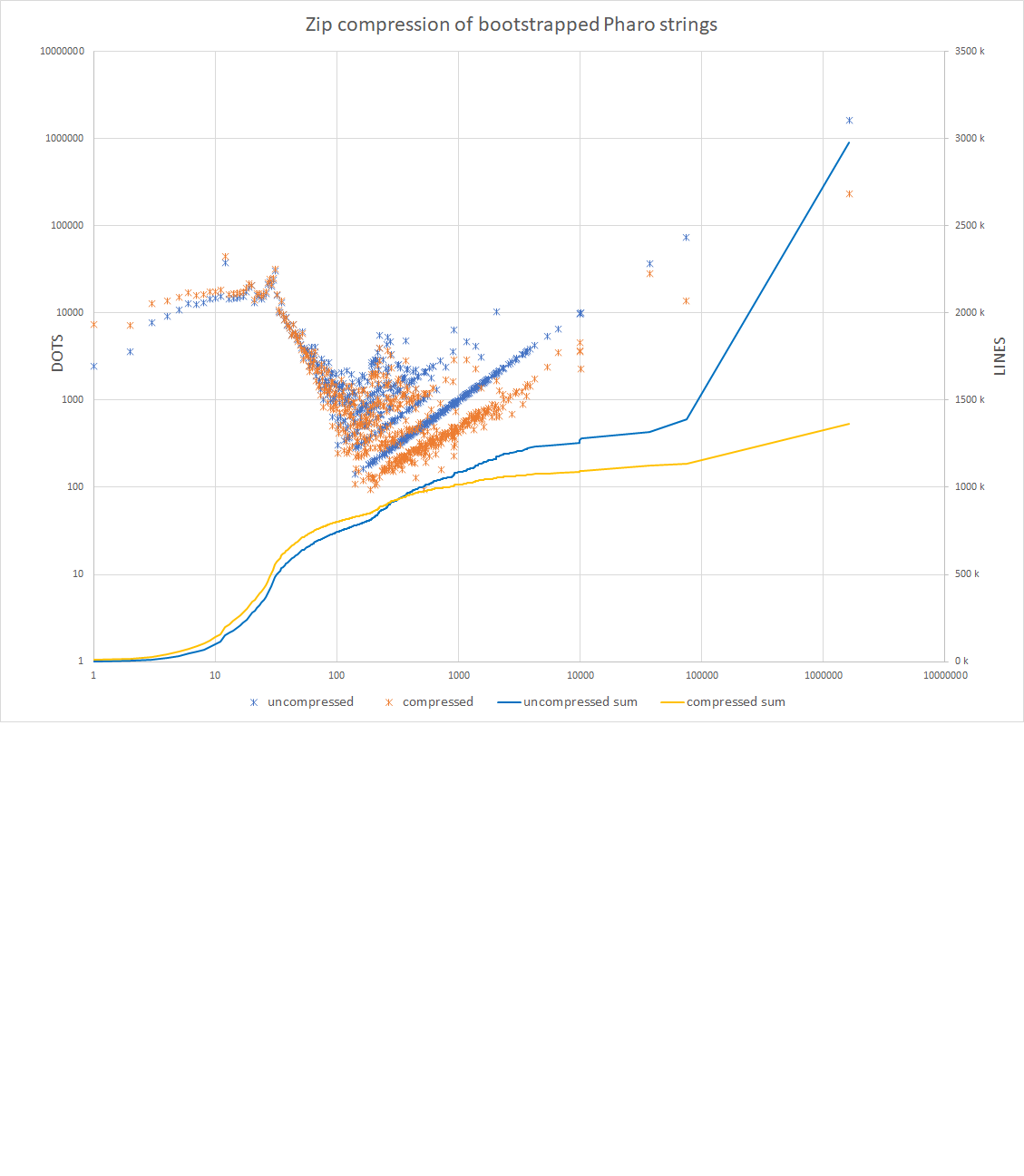
Hi Guille - just running SpaceTally on my dev image to get a feel for it. It turns out that in the minimal images youâve been creating, its not loaded (makes sense). Iâm wondering if there is an easy way to import it in (I guess that package should be in the Pharo git tree I cloned to get Fuel loaded right? Or is there a separate standalone source?). Thanks for all the support, and your email about why the contexts stack up is very well received (I will comment over there). By the way - it looks like Martin Fowler picked up on this announcement - so maybe we might get some interest from his mass of followers. Tim
On 14 Aug 2017, at 10:49, Guillermo Polito <guillermopolito@gmail.com> wrote:
Hi Tim,
On Mon, Aug 14, 2017 at 11:41 AM, Tim Mackinnon <tim@testit.works <mailto:tim@testit.works>> wrote: Hey guys, thanks for your enthusiasm around this - and I cannot stress enough how this was only possible because of the work that has gone into making Pharo (in particular the 64bit image, as well as having a minimal image, and some great blog posts on serialising contexts) as well as the patience from everyone in answering questions and helping me get it all working.
Iâm still quite keen to get my execution time back down under 800ms and Iâd like to actually get back to writing a few skills to automate a few things around my house.
To Answer Denisâ question -
My final footprint is 30.4mb - thats composed of a 22mb image (with a simple example that pulls in Fuel, ZTimestamp and the S3 Library which depends on XMLParser) and then the VM (from which I removed obvious dllâs).
In my original experiments with a 6.0 minimal image - I did manage to get to a 13.4mb image (which started out as 12mb original size, and then loaded in STON and had only a simple clock example). I think the sweet spot is around 20mb total footprint as that seems to get me into the 450ms-900ms range.
The 7.0 min image now starts out at 15mb and then Iâm not sure why loading Fuel, S3 and XMLParser takes 7mb (it seems big to me - but Iâve not dug into that).
You can do further space analysis using the following expression
SpaceTally new printSpaceAnalysis
You can do that in an eval and check what's taking space. With measures we can iterate and improve :).
Iâve also found (and this on the back of unserialising the context in my example) that the way we build images has 15+ saved stack sessions that have saved on top of each other from the way we build up the images. I donât yet know the implications of size/speed of these - but we need a better way of folding executions when we snapshot headless images. Iâm also not clear if there are any other startup tasks that take precious time (this also has implications for our fat development images as they take much longer to appear than they really should).
I'm working on this as I'm writing this mail ;)
https://pharo.fogbugz.com/f/cases/20309 <https://pharo.fogbugz.com/f/cases/20309> https://github.com/pharo-project/pharo/pull/196 <https://github.com/pharo-project/pharo/pull/196>
I'll write down the implications further in a different thread.
Iâll be exploring some of these size/speed tradeoffâs in follow on messages.
But once again, a big thanks - Iâve not enjoyed programming like this for ages.
Tim
On 12 Aug 2017, at 16:26, Ben Coman <btc@openInWorld.com <mailto:btc@openInWorld.com>> wrote:
hi Tim,
That is..... AWESOME!
Very nice delivery - it flowed well with great narration.
I loved @2:17 "this is the interesting piece, because PharoLambda has serialized the execution context of its application and saved it into [my S3 bucket] ... [then on the local machine] rematerializes a debugger [on that context]."
There is a clarity in your video presentation that really may intrigue outsiders. As a community we should push this on the usual hacker forums - ycombinator could be a good starting point (but I'm locked out of my account there). An enticing title could be... "Debugging Lambdas by re-materializing saved execution contexts on your local machine."
cheers -ben
On Fri, Aug 11, 2017 at 3:37 PM, Denis Kudriashov <dionisiydk@gmail.com <mailto:dionisiydk@gmail.com>> wrote: This is cool Tim.
So what image size you deployed at the end?
2017-08-10 15:47 GMT+02:00 Tim Mackinnon <tim@testit.works <mailto:tim@testit.works>>: I just wanted to thank everyone for their help in getting my pet project further along, so that now I can announce that PharoLambda is now working with the V7 minimal image and also supports post mortem debugging by saving a zipped fuel context onto S3.
This latter item is particularly satisfying as at a recent serverless conference (JeffConf) there was a panel where poor development tools on serverless platforms was highlighted as a real problem.
In our community weâve had these kinds of tools at our fingertips for ages - but I donât think the wider development community has really noticed. Debugging something short lived like a Lambda execution is quite startling, as the current answer is âadd more loggingâ, and we all know that sucks. To this end, Iâve created a little screencast showing this in action - and it was pretty cool because it was a real example I encountered when I got everything working and was trying my test application out.
Iâve also put a bit of work into tuning the excellent GitLab CI tools, so that I can cache many of the artefacts used between different build runs (this might also be of interest to others using CI systems).
The Gitlab project is on: https://gitlab.com/macta/PharoLambda <https://gitlab.com/macta/PharoLambda> And the screencast: https://www.youtube.com/watch?v=bNNCT1hLA3E <https://www.youtube.com/watch?v=bNNCT1hLA3E>
Tim
On 15 Jul 2017, at 00:39, Tim Mackinnon <tim@testit.works <mailto:tim@testit.works>> wrote:
Hi - Iâve been playing around with getting Pharo to run well on AWS Lambda. Itâs early days, but I though it might be interesting to share what Iâve learned so far.
Usage examples and code at https://gitlab.com/macta/PharoLambda <https://gitlab.com/macta/PharoLambda>
With help from many of the folks here, Iâve been able to get a simple example to run in 500ms-1200ms with a minimal Pharo 6 image. You can easily try it out yourself. This seems slightly better than what the GoLang folks have been able to do.
Tim
--
Guille Polito
Research Engineer French National Center for Scientific Research - http://www.cnrs.fr <http://www.cnrs.fr/>
Web: http://guillep.github.io <http://guillep.github.io/> Phone: +33 06 52 70 66 13
On Mon, Aug 14, 2017 at 4:42 PM, Tim Mackinnon <tim@testit.works> wrote:
Hi Guille - just running SpaceTally on my dev image to get a feel for it. It turns out that in the minimal images youâve been creating, its not loaded (makes sense).
Yup, it's loaded afterwards. All packages are loaded through metacello baselines. We should start refactoring and making standalone projects, each one with a baseline for himself, and his own dependencies described. I was checking on your gitlab and I have probably no access: how are you finally loading packages in the bootstrap image? Can you share that with us in text? I'd like to improve that situation.
Iâm wondering if there is an easy way to import it in (I guess that package should be in the Pharo git tree I cloned to get Fuel loaded right? Or is there a separate standalone source?).
Yes it is, you can get the package programatically doing SpaceTally package name And furthermore, get the baseline that currently is loading by doing package := SpaceTally package name. BaselineOf subclasses select: [ :e | e project version packages anySatisfy: [ :p | p name = package ]].
Thanks for all the support, and your email about why the contexts stack up is very well received (I will comment over there).
By the way - it looks like Martin Fowler picked up on this announcement - so maybe we might get some interest from his mass of followers.
Tim
On 14 Aug 2017, at 10:49, Guillermo Polito <guillermopolito@gmail.com> wrote:
Hi Tim,
On Mon, Aug 14, 2017 at 11:41 AM, Tim Mackinnon <tim@testit.works> wrote:
Hey guys, thanks for your enthusiasm around this - and I cannot stress enough how this was only possible because of the work that has gone into making Pharo (in particular the 64bit image, as well as having a minimal image, and some great blog posts on serialising contexts) as well as the patience from everyone in answering questions and helping me get it all working.
Iâm still quite keen to get my execution time back down under 800ms and Iâd like to actually get back to writing a few skills to automate a few things around my house.
To Answer Denisâ question -
My final footprint is 30.4mb - thats composed of a 22mb image (with a simple example that pulls in Fuel, ZTimestamp and the S3 Library which depends on XMLParser) and then the VM (from which I removed obvious dllâs).
In my original experiments with a 6.0 minimal image - I did manage to get to a 13.4mb image (which started out as 12mb original size, and then loaded in STON and had only a simple clock example). I think the sweet spot is around 20mb total footprint as that seems to get me into the 450ms-900ms range.
The 7.0 min image now starts out at 15mb and then Iâm not sure why loading Fuel, S3 and XMLParser takes 7mb (it seems big to me - but Iâve not dug into that).
You can do further space analysis using the following expression
SpaceTally new printSpaceAnalysis
You can do that in an eval and check what's taking space. With measures we can iterate and improve :).
Iâve also found (and this on the back of unserialising the context in my example) that the way we build images has 15+ saved stack sessions that have saved on top of each other from the way we build up the images. I donât yet know the implications of size/speed of these - but we need a better way of folding executions when we snapshot headless images. Iâm also not clear if there are any other startup tasks that take precious time (this also has implications for our fat development images as they take much longer to appear than they really should).
I'm working on this as I'm writing this mail ;)
https://pharo.fogbugz.com/f/cases/20309 https://github.com/pharo-project/pharo/pull/196
I'll write down the implications further in a different thread.
Iâll be exploring some of these size/speed tradeoffâs in follow on messages.
But once again, a big thanks - Iâve not enjoyed programming like this for ages.
Tim
On 12 Aug 2017, at 16:26, Ben Coman <btc@openInWorld.com> wrote:
hi Tim,
That is..... AWESOME!
Very nice delivery - it flowed well with great narration.
I loved @2:17 "this is the interesting piece, because PharoLambda has serialized the execution context of its application and saved it into [my S3 bucket] ... [then on the local machine] rematerializes a debugger [on that context]."
There is a clarity in your video presentation that really may intrigue outsiders. As a community we should push this on the usual hacker forums - ycombinator could be a good starting point (but I'm locked out of my account there). An enticing title could be... "Debugging Lambdas by re-materializing saved execution contexts on your local machine."
cheers -ben
On Fri, Aug 11, 2017 at 3:37 PM, Denis Kudriashov <dionisiydk@gmail.com> wrote:
This is cool Tim.
So what image size you deployed at the end?
2017-08-10 15:47 GMT+02:00 Tim Mackinnon <tim@testit.works>:
I just wanted to thank everyone for their help in getting my pet project further along, so that now I can announce that PharoLambda is now working with the V7 minimal image and also supports post mortem debugging by saving a zipped fuel context onto S3.
This latter item is particularly satisfying as at a recent serverless conference (JeffConf) there was a panel where poor development tools on serverless platforms was highlighted as a real problem.
In our community weâve had these kinds of tools at our fingertips for ages - but I donât think the wider development community has really noticed. Debugging something short lived like a Lambda execution is quite startling, as the current answer is âadd more loggingâ, and we all know that sucks. To this end, Iâve created a little screencast showing this in action - and it was pretty cool because it was a real example I encountered when I got everything working and was trying my test application out.
Iâve also put a bit of work into tuning the excellent GitLab CI tools, so that I can cache many of the artefacts used between different build runs (this might also be of interest to others using CI systems).
The Gitlab project is on: https://gitlab.com/macta/PharoLambda And the screencast: https://www.youtube.com/watch?v=bNNCT1hLA3E
Tim
On 15 Jul 2017, at 00:39, Tim Mackinnon <tim@testit.works> wrote:
Hi - Iâve been playing around with getting Pharo to run well on AWS Lambda. Itâs early days, but I though it might be interesting to share what Iâve learned so far.
Usage examples and code at https://gitlab.com/macta/PharoLambda
With help from many of the folks here, Iâve been able to get a simple example to run in 500ms-1200ms with a minimal Pharo 6 image. You can easily try it out yourself. This seems slightly better than what the GoLang folks have been able to do.
Tim
--
Guille Polito
Research Engineer French National Center for Scientific Research - *http://www.cnrs.fr* <http://www.cnrs.fr/>
*Web:* *http://guillep.github.io* <http://guillep.github.io/> *Phone: *+33 06 52 70 66 13 <+33%206%2052%2070%2066%2013>
-- Guille Polito Research Engineer French National Center for Scientific Research - *http://www.cnrs.fr* <http://www.cnrs.fr> *Web:* *http://guillep.github.io* <http://guillep.github.io> *Phone: *+33 06 52 70 66 13
Hi Guille/Ben - I got a quick moment to try the SpaceTally (aside: it seems very convoluted to load a single package into the image, I was trying to avoid having to create a baselineOf for something so simple - I ended up with: repo := MCFileTreeRepository new directory: './bootstrap' asFileReference. version := repo loadVersionFromFileNamed: 'Tool-Profilers.package'. version load. Anyway - in my minimal image, like in the fat image there seems to be a surprising amount of bytestrings (4mb worth?). I think that might need some digging into? It seems like a lot somehow. Although Benâs neat experiment of zipping strings shows thatâs not a real route. In a deployed minimal image - maybe I can get rid of some other things like MethodChangeRecords or MCMethodDefiniionâs (but they are smaller wins - but noticeable) Class code space # instances inst space percent inst average size ByteString 2640 37365 4823848 21.50 129.10 Array 3742 53002 3961944 17.60 74.75 CompiledMethod 19159 30481 2912968 13.00 95.57 Association 1148 58348 1867136 8.30 32.00 MethodChangeRecord 431 34312 1097984 4.90 32.00 ByteArray 4605 290 908728 4.00 3133.54 ByteSymbol 1698 22689 840168 3.70 37.03 IdentitySet 408 19076 610432 2.70 32.00 MethodDictionary 3310 3520 608688 2.70 172.92 WeakArray 1758 3024 597824 2.70 197.69 MCMethodDefinition 4318 6659 426176 1.90 64.00 Protocol 1679 8382 268224 1.20 32.00 OrderedCollection 6555 5509 220360 1.00 40.00 As an aside - my Gitlab project is public, the scripts that load things up are in ./scripts (build.sh, and minimal.st <http://minimal.st/> and loadlocal.st <http://loadlocal.st/>) Tim
On 15 Aug 2017, at 08:02, Guillermo Polito <guillermopolito@gmail.com> wrote:
On Mon, Aug 14, 2017 at 4:42 PM, Tim Mackinnon <tim@testit.works <mailto:tim@testit.works>> wrote: Hi Guille - just running SpaceTally on my dev image to get a feel for it. It turns out that in the minimal images youâve been creating, its not loaded (makes sense).
Yup, it's loaded afterwards.
All packages are loaded through metacello baselines. We should start refactoring and making standalone projects, each one with a baseline for himself, and his own dependencies described.
I was checking on your gitlab and I have probably no access: how are you finally loading packages in the bootstrap image? Can you share that with us in text? I'd like to improve that situation.
Iâm wondering if there is an easy way to import it in (I guess that package should be in the Pharo git tree I cloned to get Fuel loaded right? Or is there a separate standalone source?).
Yes it is, you can get the package programatically doing
SpaceTally package name
And furthermore, get the baseline that currently is loading by doing
package := SpaceTally package name. BaselineOf subclasses select: [ :e | e project version packages anySatisfy: [ :p | p name = package ]].
Thanks for all the support, and your email about why the contexts stack up is very well received (I will comment over there).
By the way - it looks like Martin Fowler picked up on this announcement - so maybe we might get some interest from his mass of followers.
Tim
On 14 Aug 2017, at 10:49, Guillermo Polito <guillermopolito@gmail.com <mailto:guillermopolito@gmail.com>> wrote:
Hi Tim,
On Mon, Aug 14, 2017 at 11:41 AM, Tim Mackinnon <tim@testit.works <mailto:tim@testit.works>> wrote: Hey guys, thanks for your enthusiasm around this - and I cannot stress enough how this was only possible because of the work that has gone into making Pharo (in particular the 64bit image, as well as having a minimal image, and some great blog posts on serialising contexts) as well as the patience from everyone in answering questions and helping me get it all working.
Iâm still quite keen to get my execution time back down under 800ms and Iâd like to actually get back to writing a few skills to automate a few things around my house.
To Answer Denisâ question -
My final footprint is 30.4mb - thats composed of a 22mb image (with a simple example that pulls in Fuel, ZTimestamp and the S3 Library which depends on XMLParser) and then the VM (from which I removed obvious dllâs).
In my original experiments with a 6.0 minimal image - I did manage to get to a 13.4mb image (which started out as 12mb original size, and then loaded in STON and had only a simple clock example). I think the sweet spot is around 20mb total footprint as that seems to get me into the 450ms-900ms range.
The 7.0 min image now starts out at 15mb and then Iâm not sure why loading Fuel, S3 and XMLParser takes 7mb (it seems big to me - but Iâve not dug into that).
You can do further space analysis using the following expression
SpaceTally new printSpaceAnalysis
You can do that in an eval and check what's taking space. With measures we can iterate and improve :).
Iâve also found (and this on the back of unserialising the context in my example) that the way we build images has 15+ saved stack sessions that have saved on top of each other from the way we build up the images. I donât yet know the implications of size/speed of these - but we need a better way of folding executions when we snapshot headless images. Iâm also not clear if there are any other startup tasks that take precious time (this also has implications for our fat development images as they take much longer to appear than they really should).
I'm working on this as I'm writing this mail ;)
https://pharo.fogbugz.com/f/cases/20309 <https://pharo.fogbugz.com/f/cases/20309> https://github.com/pharo-project/pharo/pull/196 <https://github.com/pharo-project/pharo/pull/196>
I'll write down the implications further in a different thread.
Iâll be exploring some of these size/speed tradeoffâs in follow on messages.
But once again, a big thanks - Iâve not enjoyed programming like this for ages.
Tim
On 12 Aug 2017, at 16:26, Ben Coman <btc@openInWorld.com <mailto:btc@openInWorld.com>> wrote:
hi Tim,
That is..... AWESOME!
Very nice delivery - it flowed well with great narration.
I loved @2:17 "this is the interesting piece, because PharoLambda has serialized the execution context of its application and saved it into [my S3 bucket] ... [then on the local machine] rematerializes a debugger [on that context]."
There is a clarity in your video presentation that really may intrigue outsiders. As a community we should push this on the usual hacker forums - ycombinator could be a good starting point (but I'm locked out of my account there). An enticing title could be... "Debugging Lambdas by re-materializing saved execution contexts on your local machine."
cheers -ben
On Fri, Aug 11, 2017 at 3:37 PM, Denis Kudriashov <dionisiydk@gmail.com <mailto:dionisiydk@gmail.com>> wrote: This is cool Tim.
So what image size you deployed at the end?
2017-08-10 15:47 GMT+02:00 Tim Mackinnon <tim@testit.works <mailto:tim@testit.works>>: I just wanted to thank everyone for their help in getting my pet project further along, so that now I can announce that PharoLambda is now working with the V7 minimal image and also supports post mortem debugging by saving a zipped fuel context onto S3.
This latter item is particularly satisfying as at a recent serverless conference (JeffConf) there was a panel where poor development tools on serverless platforms was highlighted as a real problem.
In our community weâve had these kinds of tools at our fingertips for ages - but I donât think the wider development community has really noticed. Debugging something short lived like a Lambda execution is quite startling, as the current answer is âadd more loggingâ, and we all know that sucks. To this end, Iâve created a little screencast showing this in action - and it was pretty cool because it was a real example I encountered when I got everything working and was trying my test application out.
Iâve also put a bit of work into tuning the excellent GitLab CI tools, so that I can cache many of the artefacts used between different build runs (this might also be of interest to others using CI systems).
The Gitlab project is on: https://gitlab.com/macta/PharoLambda <https://gitlab.com/macta/PharoLambda> And the screencast: https://www.youtube.com/watch?v=bNNCT1hLA3E <https://www.youtube.com/watch?v=bNNCT1hLA3E>
Tim
On 15 Jul 2017, at 00:39, Tim Mackinnon <tim@testit.works <mailto:tim@testit.works>> wrote:
Hi - Iâve been playing around with getting Pharo to run well on AWS Lambda. Itâs early days, but I though it might be interesting to share what Iâve learned so far.
Usage examples and code at https://gitlab.com/macta/PharoLambda <https://gitlab.com/macta/PharoLambda>
With help from many of the folks here, Iâve been able to get a simple example to run in 500ms-1200ms with a minimal Pharo 6 image. You can easily try it out yourself. This seems slightly better than what the GoLang folks have been able to do.
Tim
--
Guille Polito
Research Engineer French National Center for Scientific Research - http://www.cnrs.fr <http://www.cnrs.fr/>
Web: http://guillep.github.io <http://guillep.github.io/> Phone: +33 06 52 70 66 13 <tel:+33%206%2052%2070%2066%2013>
--
Guille Polito
Research Engineer French National Center for Scientific Research - http://www.cnrs.fr <http://www.cnrs.fr/>
Web: http://guillep.github.io <http://guillep.github.io/> Phone: +33 06 52 70 66 13
A weird observation - is it possible that source code is being stored in the image as strings somehow? When I do ./pharo PharoLambda.image eval "ByteString allInstances inject: (OrderedCollection new) into: [:r :i | i size > 500 ifTrue: [r add: i]. r]" I see to see reams of what looks like method source - but I thought source code was stored in the .sources file and the .changes file (and I havenât been bundling those in my deployed image). Iâm trying to figure out how you find references to a string object, to chase down what is pointing to these strings as maybe there is a quick 4mb win by simply nilâing out some obvious things. (This doesnât of course help with a default minimal image - but maybe a few tricks for packaging and deploying something). Tim
On 15 Aug 2017, at 22:26, Tim Mackinnon <tim@testit.works> wrote:
Hi Guille/Ben - I got a quick moment to try the SpaceTally (aside: it seems very convoluted to load a single package into the image, I was trying to avoid having to create a baselineOf for something so simple - I ended up with:
repo := MCFileTreeRepository new directory: './bootstrap' asFileReference. version := repo loadVersionFromFileNamed: 'Tool-Profilers.package'. version load.
Anyway - in my minimal image, like in the fat image there seems to be a surprising amount of bytestrings (4mb worth?). I think that might need some digging into? It seems like a lot somehow. Although Benâs neat experiment of zipping strings shows thatâs not a real route.
In a deployed minimal image - maybe I can get rid of some other things like MethodChangeRecords or MCMethodDefiniionâs (but they are smaller wins - but noticeable)
Class code space # instances inst space percent inst average size ByteString 2640 37365 4823848 21.50 129.10 Array 3742 53002 3961944 17.60 74.75 CompiledMethod 19159 30481 2912968 13.00 95.57 Association 1148 58348 1867136 8.30 32.00 MethodChangeRecord 431 34312 1097984 4.90 32.00 ByteArray 4605 290 908728 4.00 3133.54 ByteSymbol 1698 22689 840168 3.70 37.03 IdentitySet 408 19076 610432 2.70 32.00 MethodDictionary 3310 3520 608688 2.70 172.92 WeakArray 1758 3024 597824 2.70 197.69 MCMethodDefinition 4318 6659 426176 1.90 64.00 Protocol 1679 8382 268224 1.20 32.00 OrderedCollection 6555 5509 220360 1.00 40.00
As an aside - my Gitlab project is public, the scripts that load things up are in ./scripts (build.sh, and minimal.st <http://minimal.st/> and loadlocal.st <http://loadlocal.st/>)
Tim
On 15 Aug 2017, at 08:02, Guillermo Polito <guillermopolito@gmail.com <mailto:guillermopolito@gmail.com>> wrote:
On Mon, Aug 14, 2017 at 4:42 PM, Tim Mackinnon <tim@testit.works <mailto:tim@testit.works>> wrote: Hi Guille - just running SpaceTally on my dev image to get a feel for it. It turns out that in the minimal images youâve been creating, its not loaded (makes sense).
Yup, it's loaded afterwards.
All packages are loaded through metacello baselines. We should start refactoring and making standalone projects, each one with a baseline for himself, and his own dependencies described.
I was checking on your gitlab and I have probably no access: how are you finally loading packages in the bootstrap image? Can you share that with us in text? I'd like to improve that situation.
Iâm wondering if there is an easy way to import it in (I guess that package should be in the Pharo git tree I cloned to get Fuel loaded right? Or is there a separate standalone source?).
Yes it is, you can get the package programatically doing
SpaceTally package name
And furthermore, get the baseline that currently is loading by doing
package := SpaceTally package name. BaselineOf subclasses select: [ :e | e project version packages anySatisfy: [ :p | p name = package ]].
Thanks for all the support, and your email about why the contexts stack up is very well received (I will comment over there).
By the way - it looks like Martin Fowler picked up on this announcement - so maybe we might get some interest from his mass of followers.
Tim
On 14 Aug 2017, at 10:49, Guillermo Polito <guillermopolito@gmail.com <mailto:guillermopolito@gmail.com>> wrote:
Hi Tim,
On Mon, Aug 14, 2017 at 11:41 AM, Tim Mackinnon <tim@testit.works <mailto:tim@testit.works>> wrote: Hey guys, thanks for your enthusiasm around this - and I cannot stress enough how this was only possible because of the work that has gone into making Pharo (in particular the 64bit image, as well as having a minimal image, and some great blog posts on serialising contexts) as well as the patience from everyone in answering questions and helping me get it all working.
Iâm still quite keen to get my execution time back down under 800ms and Iâd like to actually get back to writing a few skills to automate a few things around my house.
To Answer Denisâ question -
My final footprint is 30.4mb - thats composed of a 22mb image (with a simple example that pulls in Fuel, ZTimestamp and the S3 Library which depends on XMLParser) and then the VM (from which I removed obvious dllâs).
In my original experiments with a 6.0 minimal image - I did manage to get to a 13.4mb image (which started out as 12mb original size, and then loaded in STON and had only a simple clock example). I think the sweet spot is around 20mb total footprint as that seems to get me into the 450ms-900ms range.
The 7.0 min image now starts out at 15mb and then Iâm not sure why loading Fuel, S3 and XMLParser takes 7mb (it seems big to me - but Iâve not dug into that).
You can do further space analysis using the following expression
SpaceTally new printSpaceAnalysis
You can do that in an eval and check what's taking space. With measures we can iterate and improve :).
Iâve also found (and this on the back of unserialising the context in my example) that the way we build images has 15+ saved stack sessions that have saved on top of each other from the way we build up the images. I donât yet know the implications of size/speed of these - but we need a better way of folding executions when we snapshot headless images. Iâm also not clear if there are any other startup tasks that take precious time (this also has implications for our fat development images as they take much longer to appear than they really should).
I'm working on this as I'm writing this mail ;)
https://pharo.fogbugz.com/f/cases/20309 <https://pharo.fogbugz.com/f/cases/20309> https://github.com/pharo-project/pharo/pull/196 <https://github.com/pharo-project/pharo/pull/196>
I'll write down the implications further in a different thread.
Iâll be exploring some of these size/speed tradeoffâs in follow on messages.
But once again, a big thanks - Iâve not enjoyed programming like this for ages.
Tim
On 12 Aug 2017, at 16:26, Ben Coman <btc@openInWorld.com <mailto:btc@openInWorld.com>> wrote:
hi Tim,
That is..... AWESOME!
Very nice delivery - it flowed well with great narration.
I loved @2:17 "this is the interesting piece, because PharoLambda has serialized the execution context of its application and saved it into [my S3 bucket] ... [then on the local machine] rematerializes a debugger [on that context]."
There is a clarity in your video presentation that really may intrigue outsiders. As a community we should push this on the usual hacker forums - ycombinator could be a good starting point (but I'm locked out of my account there). An enticing title could be... "Debugging Lambdas by re-materializing saved execution contexts on your local machine."
cheers -ben
On Fri, Aug 11, 2017 at 3:37 PM, Denis Kudriashov <dionisiydk@gmail.com <mailto:dionisiydk@gmail.com>> wrote: This is cool Tim.
So what image size you deployed at the end?
2017-08-10 15:47 GMT+02:00 Tim Mackinnon <tim@testit.works <mailto:tim@testit.works>>: I just wanted to thank everyone for their help in getting my pet project further along, so that now I can announce that PharoLambda is now working with the V7 minimal image and also supports post mortem debugging by saving a zipped fuel context onto S3.
This latter item is particularly satisfying as at a recent serverless conference (JeffConf) there was a panel where poor development tools on serverless platforms was highlighted as a real problem.
In our community weâve had these kinds of tools at our fingertips for ages - but I donât think the wider development community has really noticed. Debugging something short lived like a Lambda execution is quite startling, as the current answer is âadd more loggingâ, and we all know that sucks. To this end, Iâve created a little screencast showing this in action - and it was pretty cool because it was a real example I encountered when I got everything working and was trying my test application out.
Iâve also put a bit of work into tuning the excellent GitLab CI tools, so that I can cache many of the artefacts used between different build runs (this might also be of interest to others using CI systems).
The Gitlab project is on: https://gitlab.com/macta/PharoLambda <https://gitlab.com/macta/PharoLambda> And the screencast: https://www.youtube.com/watch?v=bNNCT1hLA3E <https://www.youtube.com/watch?v=bNNCT1hLA3E>
Tim
On 15 Jul 2017, at 00:39, Tim Mackinnon <tim@testit.works <mailto:tim@testit.works>> wrote:
Hi - Iâve been playing around with getting Pharo to run well on AWS Lambda. Itâs early days, but I though it might be interesting to share what Iâve learned so far.
Usage examples and code at https://gitlab.com/macta/PharoLambda <https://gitlab.com/macta/PharoLambda>
With help from many of the folks here, Iâve been able to get a simple example to run in 500ms-1200ms with a minimal Pharo 6 image. You can easily try it out yourself. This seems slightly better than what the GoLang folks have been able to do.
Tim
--
Guille Polito
Research Engineer French National Center for Scientific Research - http://www.cnrs.fr <http://www.cnrs.fr/>
Web: http://guillep.github.io <http://guillep.github.io/> Phone: +33 06 52 70 66 13 <tel:+33%206%2052%2070%2066%2013>
--
Guille Polito
Research Engineer French National Center for Scientific Research - http://www.cnrs.fr <http://www.cnrs.fr/>
Web: http://guillep.github.io <http://guillep.github.io/> Phone: +33 06 52 70 66 13
Just a hunch: could you inspect ur MethodChangeRecord instances ? Le mar. 15 août 2017 à 23:55, Tim Mackinnon <tim@testit.works> a écrit :
A weird observation - is it possible that source code is being stored in the image as strings somehow? When I do
./pharo PharoLambda.image eval "ByteString allInstances inject: (OrderedCollection new) into: [:r :i | i size > 500 ifTrue: [r add: i]. r]"
I see to see reams of what looks like method source - but I thought source code was stored in the .sources file and the .changes file (and I havenât been bundling those in my deployed image).
Iâm trying to figure out how you find references to a string object, to chase down what is pointing to these strings as maybe there is a quick 4mb win by simply nilâing out some obvious things. (This doesnât of course help with a default minimal image - but maybe a few tricks for packaging and deploying something).
Tim
On 15 Aug 2017, at 22:26, Tim Mackinnon <tim@testit.works> wrote:
Hi Guille/Ben - I got a quick moment to try the SpaceTally (aside: it seems very convoluted to load a single package into the image, I was trying to avoid having to create a baselineOf for something so simple - I ended up with:
repo := MCFileTreeRepository new directory: './bootstrap' asFileReference.
version := repo loadVersionFromFileNamed: 'Tool-Profilers.package'. version load.
Anyway - in my minimal image, like in the fat image there seems to be a surprising amount of bytestrings (4mb worth?). I think that might need some digging into? It seems like a lot somehow. Although Benâs neat experiment of zipping strings shows thatâs not a real route.
In a deployed minimal image - maybe I can get rid of some other things like MethodChangeRecords or MCMethodDefiniionâs (but they are smaller wins - but noticeable)
Class code space # instances inst space percent inst average size ByteString 2640 37365 4823848 21.50 129.10 Array 3742 53002 3961944 17.60 74.75 CompiledMethod 19159 30481 2912968 13.00 95.57 Association 1148 58348 1867136 8.30 32.00 MethodChangeRecord 431 34312 1097984 4.90 32.00 ByteArray 4605 290 908728 4.00 3133.54 ByteSymbol 1698 22689 840168 3.70 37.03 IdentitySet 408 19076 610432 2.70 32.00 MethodDictionary 3310 3520 608688 2.70 172.92 WeakArray 1758 3024 597824 2.70 197.69 MCMethodDefinition 4318 6659 426176 1.90 64.00 Protocol 1679 8382 268224 1.20 32.00 OrderedCollection 6555 5509 220360 1.00 40.00
As an aside - my Gitlab project is public, the scripts that load things up are in ./scripts (build.sh, and minimal.st and loadlocal.st)
Tim
On 15 Aug 2017, at 08:02, Guillermo Polito <guillermopolito@gmail.com> wrote:
On Mon, Aug 14, 2017 at 4:42 PM, Tim Mackinnon <tim@testit.works> wrote:
Hi Guille - just running SpaceTally on my dev image to get a feel for it. It turns out that in the minimal images youâve been creating, its not loaded (makes sense).
Yup, it's loaded afterwards.
All packages are loaded through metacello baselines. We should start refactoring and making standalone projects, each one with a baseline for himself, and his own dependencies described.
I was checking on your gitlab and I have probably no access: how are you finally loading packages in the bootstrap image? Can you share that with us in text? I'd like to improve that situation.
Iâm wondering if there is an easy way to import it in (I guess that package should be in the Pharo git tree I cloned to get Fuel loaded right? Or is there a separate standalone source?).
Yes it is, you can get the package programatically doing
SpaceTally package name
And furthermore, get the baseline that currently is loading by doing
package := SpaceTally package name. BaselineOf subclasses select: [ :e | e project version packages anySatisfy: [ :p | p name = package ]].
Thanks for all the support, and your email about why the contexts stack up is very well received (I will comment over there).
By the way - it looks like Martin Fowler picked up on this announcement - so maybe we might get some interest from his mass of followers.
Tim
On 14 Aug 2017, at 10:49, Guillermo Polito <guillermopolito@gmail.com> wrote:
Hi Tim,
On Mon, Aug 14, 2017 at 11:41 AM, Tim Mackinnon <tim@testit.works> wrote:
Hey guys, thanks for your enthusiasm around this - and I cannot stress enough how this was only possible because of the work that has gone into making Pharo (in particular the 64bit image, as well as having a minimal image, and some great blog posts on serialising contexts) as well as the patience from everyone in answering questions and helping me get it all working.
Iâm still quite keen to get my execution time back down under 800ms and Iâd like to actually get back to writing a few skills to automate a few things around my house.
To Answer Denisâ question -
My final footprint is 30.4mb - thats composed of a 22mb image (with a simple example that pulls in Fuel, ZTimestamp and the S3 Library which depends on XMLParser) and then the VM (from which I removed obvious dllâs).
In my original experiments with a 6.0 minimal image - I did manage to get to a 13.4mb image (which started out as 12mb original size, and then loaded in STON and had only a simple clock example). I think the sweet spot is around 20mb total footprint as that seems to get me into the 450ms-900ms range.
The 7.0 min image now starts out at 15mb and then Iâm not sure why loading Fuel, S3 and XMLParser takes 7mb (it seems big to me - but Iâve not dug into that).
You can do further space analysis using the following expression
SpaceTally new printSpaceAnalysis
You can do that in an eval and check what's taking space. With measures we can iterate and improve :).
Iâve also found (and this on the back of unserialising the context in my example) that the way we build images has 15+ saved stack sessions that have saved on top of each other from the way we build up the images. I donât yet know the implications of size/speed of these - but we need a better way of folding executions when we snapshot headless images. Iâm also not clear if there are any other startup tasks that take precious time (this also has implications for our fat development images as they take much longer to appear than they really should).
I'm working on this as I'm writing this mail ;)
https://pharo.fogbugz.com/f/cases/20309 https://github.com/pharo-project/pharo/pull/196
I'll write down the implications further in a different thread.
Iâll be exploring some of these size/speed tradeoffâs in follow on messages.
But once again, a big thanks - Iâve not enjoyed programming like this for ages.
Tim
On 12 Aug 2017, at 16:26, Ben Coman <btc@openInWorld.com> wrote:
hi Tim,
That is..... AWESOME!
Very nice delivery - it flowed well with great narration.
I loved @2:17 "this is the interesting piece, because PharoLambda has serialized the execution context of its application and saved it into [my S3 bucket] ... [then on the local machine] rematerializes a debugger [on that context]."
There is a clarity in your video presentation that really may intrigue outsiders. As a community we should push this on the usual hacker forums - ycombinator could be a good starting point (but I'm locked out of my account there). An enticing title could be... "Debugging Lambdas by re-materializing saved execution contexts on your local machine."
cheers -ben
On Fri, Aug 11, 2017 at 3:37 PM, Denis Kudriashov <dionisiydk@gmail.com> wrote:
This is cool Tim.
So what image size you deployed at the end?
2017-08-10 15:47 GMT+02:00 Tim Mackinnon <tim@testit.works>:
I just wanted to thank everyone for their help in getting my pet project further along, so that now I can announce that PharoLambda is now working with the V7 minimal image and also supports post mortem debugging by saving a zipped fuel context onto S3.
This latter item is particularly satisfying as at a recent serverless conference (JeffConf) there was a panel where poor development tools on serverless platforms was highlighted as a real problem.
In our community weâve had these kinds of tools at our fingertips for ages - but I donât think the wider development community has really noticed. Debugging something short lived like a Lambda execution is quite startling, as the current answer is âadd more loggingâ, and we all know that sucks. To this end, Iâve created a little screencast showing this in action - and it was pretty cool because it was a real example I encountered when I got everything working and was trying my test application out.
Iâve also put a bit of work into tuning the excellent GitLab CI tools, so that I can cache many of the artefacts used between different build runs (this might also be of interest to others using CI systems).
The Gitlab project is on: https://gitlab.com/macta/PharoLambda And the screencast: https://www.youtube.com/watch?v=bNNCT1hLA3E
Tim
On 15 Jul 2017, at 00:39, Tim Mackinnon <tim@testit.works> wrote:
Hi - Iâve been playing around with getting Pharo to run well on AWS Lambda. Itâs early days, but I though it might be interesting to share what Iâve learned so far.
Usage examples and code at https://gitlab.com/macta/PharoLambda
With help from many of the folks here, Iâve been able to get a simple example to run in 500ms-1200ms with a minimal Pharo 6 image. You can easily try it out yourself. This seems slightly better than what the GoLang folks have been able to do.
Tim
--
Guille Polito
Research Engineer French National Center for Scientific Research - *http://www.cnrs.fr* <http://www.cnrs.fr/>
*Web:* *http://guillep.github.io* <http://guillep.github.io/> *Phone: *+33 06 52 70 66 13 <+33%206%2052%2070%2066%2013>
--
Guille Polito
Research Engineer French National Center for Scientific Research - *http://www.cnrs.fr* <http://www.cnrs.fr/>
*Web:* *http://guillep.github.io* <http://guillep.github.io/> *Phone: *+33 06 52 70 66 13
--
Guille Polito Research Engineer French National Center for Scientific Research - *http://www.cnrs.fr* <http://www.cnrs.fr> *Web:* *http://guillep.github.io* <http://guillep.github.io> *Phone: *+33 06 52 70 66 13
Yes you were on to something there (and at the same time, by poking around with #pointersTo I noticed some chains of objects too). So I ran the following script (partially borrowed from ImageCleaner) and this has got me down to a 14mb image (instance sizes listed below, which is looking much healthier - and those MethodChangeRecords are gone too) !!! I suspect there are more monti/metacello things that are still lurking around. I also wonder if I need some the character sorting strings too. Tim "CmdLine script to debug the initial minimal image" | logger repo version | logger := FileStream stderr. logger cr; nextPutAll: 'Starting Minimal Cleanup Script...'. logger cr; nextPutAll: '>Resetting Class Comments'. Smalltalk allClasses do: [ :c | c classComment: '' stamp: '' ]. logger cr; nextPutAll: '>Removing MC holders'. MCMethodDefinition allInstances do: [:each | each become: String new ]. MCClassDefinition allInstances do: [:each | each become: String new ]. MCVersionInfo allInstances do: [:each | each become: String new ]. logger cr; nextPutAll: '>ImageCleaner release routines'. Smalltalk organization removeEmptyCategories. Smalltalk allClassesAndTraitsDo: [ :class | [ :each | each removeEmptyCategories; sortCategories ] value: class organization; value: class class organization ]. (RPackageOrganizer default packages select: #isEmpty) do: #unregister. Smalltalk organization sortCategories. Smalltalk garbageCollect. Smalltalk cleanOutUndeclared. Smalltalk fixObsoleteReferences. Smalltalk cleanUp: true except: #() confirming: false. logger cr; nextPutAll: '>GC'. 3 timesRepeat: [ Smalltalk garbageCollect. Smalltalk cleanOutUndeclared. Smalltalk fixObsoleteReferences]. logger cr; nextPutAll: 'Finished Script.'; cr; cr. My top instances are now: Class code space # instances inst space percent inst average size CompiledMethod 19159 30481 2912968 21.60 95.57 Array 3742 36495 2852448 21.10 78.16 ByteString 2640 24018 2517168 18.60 104.80 ByteSymbol 1698 20722 759208 5.60 36.64 Association 1148 19786 633152 4.70 32.00 IdentitySet 408 15452 494464 3.70 32.00 MethodDictionary 3310 3520 350192 2.60 99.49 Protocol 1679 8382 268224 2.00 32.00 WeakArray 1758 265 232304 1.70 876.62 OrderedCollection 6555 5043 201720 1.50 40.00 ClassOrganization 5281 3520 168960 1.30 48.00 Metaclass 7184 1748 153824 1.10 88.00
On 15 Aug 2017, at 23:00, Guillermo Polito <guillermopolito@gmail.com> wrote:
Just a hunch: could you inspect ur MethodChangeRecord instances ?
Le mar. 15 août 2017 à 23:55, Tim Mackinnon <tim@testit.works> a écrit :
A weird observation - is it possible that source code is being stored in the image as strings somehow? When I do
./pharo PharoLambda.image eval "ByteString allInstances inject: (OrderedCollection new) into: [:r :i | i size > 500 ifTrue: [r add: i]. r]"
I see to see reams of what looks like method source - but I thought source code was stored in the .sources file and the .changes file (and I havenât been bundling those in my deployed image).
Iâm trying to figure out how you find references to a string object, to chase down what is pointing to these strings as maybe there is a quick 4mb win by simply nilâing out some obvious things. (This doesnât of course help with a default minimal image - but maybe a few tricks for packaging and deploying something).
Tim
On 15 Aug 2017, at 22:26, Tim Mackinnon <tim@testit.works> wrote:
Hi Guille/Ben - I got a quick moment to try the SpaceTally (aside: it seems very convoluted to load a single package into the image, I was trying to avoid having to create a baselineOf for something so simple - I ended up with:
repo := MCFileTreeRepository new directory: './bootstrap' asFileReference. version := repo loadVersionFromFileNamed: 'Tool-Profilers.package'. version load.
Anyway - in my minimal image, like in the fat image there seems to be a surprising amount of bytestrings (4mb worth?). I think that might need some digging into? It seems like a lot somehow. Although Benâs neat experiment of zipping strings shows thatâs not a real route.
In a deployed minimal image - maybe I can get rid of some other things like MethodChangeRecords or MCMethodDefiniionâs (but they are smaller wins - but noticeable)
Class code space # instances inst space percent inst average size ByteString 2640 37365 4823848 21.50 129.10 Array 3742 53002 3961944 17.60 74.75 CompiledMethod 19159 30481 2912968 13.00 95.57 Association 1148 58348 1867136 8.30 32.00 MethodChangeRecord 431 34312 1097984 4.90 32.00 ByteArray 4605 290 908728 4.00 3133.54 ByteSymbol 1698 22689 840168 3.70 37.03 IdentitySet 408 19076 610432 2.70 32.00 MethodDictionary 3310 3520 608688 2.70 172.92 WeakArray 1758 3024 597824 2.70 197.69 MCMethodDefinition 4318 6659 426176 1.90 64.00 Protocol 1679 8382 268224 1.20 32.00 OrderedCollection 6555 5509 220360 1.00 40.00
As an aside - my Gitlab project is public, the scripts that load things up are in ./scripts (build.sh, and minimal.st and loadlocal.st)
Tim
On 15 Aug 2017, at 08:02, Guillermo Polito <guillermopolito@gmail.com> wrote:
On Mon, Aug 14, 2017 at 4:42 PM, Tim Mackinnon <tim@testit.works> wrote:
Hi Guille - just running SpaceTally on my dev image to get a feel for it. It turns out that in the minimal images youâve been creating, its not loaded (makes sense).
Yup, it's loaded afterwards.
All packages are loaded through metacello baselines. We should start refactoring and making standalone projects, each one with a baseline for himself, and his own dependencies described.
I was checking on your gitlab and I have probably no access: how are you finally loading packages in the bootstrap image? Can you share that with us in text? I'd like to improve that situation.
Iâm wondering if there is an easy way to import it in (I guess that package should be in the Pharo git tree I cloned to get Fuel loaded right? Or is there a separate standalone source?).
Yes it is, you can get the package programatically doing
SpaceTally package name
And furthermore, get the baseline that currently is loading by doing
package := SpaceTally package name. BaselineOf subclasses select: [ :e | e project version packages anySatisfy: [ :p | p name = package ]].
Thanks for all the support, and your email about why the contexts stack up is very well received (I will comment over there).
By the way - it looks like Martin Fowler picked up on this announcement - so maybe we might get some interest from his mass of followers.
Tim
On 14 Aug 2017, at 10:49, Guillermo Polito <guillermopolito@gmail.com> wrote:
Hi Tim,
On Mon, Aug 14, 2017 at 11:41 AM, Tim Mackinnon <tim@testit.works> wrote: Hey guys, thanks for your enthusiasm around this - and I cannot stress enough how this was only possible because of the work that has gone into making Pharo (in particular the 64bit image, as well as having a minimal image, and some great blog posts on serialising contexts) as well as the patience from everyone in answering questions and helping me get it all working.
Iâm still quite keen to get my execution time back down under 800ms and Iâd like to actually get back to writing a few skills to automate a few things around my house.
To Answer Denisâ question -
My final footprint is 30.4mb - thats composed of a 22mb image (with a simple example that pulls in Fuel, ZTimestamp and the S3 Library which depends on XMLParser) and then the VM (from which I removed obvious dllâs).
In my original experiments with a 6.0 minimal image - I did manage to get to a 13.4mb image (which started out as 12mb original size, and then loaded in STON and had only a simple clock example). I think the sweet spot is around 20mb total footprint as that seems to get me into the 450ms-900ms range.
The 7.0 min image now starts out at 15mb and then Iâm not sure why loading Fuel, S3 and XMLParser takes 7mb (it seems big to me - but Iâve not dug into that).
You can do further space analysis using the following expression
SpaceTally new printSpaceAnalysis
You can do that in an eval and check what's taking space. With measures we can iterate and improve :).
Iâve also found (and this on the back of unserialising the context in my example) that the way we build images has 15+ saved stack sessions that have saved on top of each other from the way we build up the images. I donât yet know the implications of size/speed of these - but we need a better way of folding executions when we snapshot headless images. Iâm also not clear if there are any other startup tasks that take precious time (this also has implications for our fat development images as they take much longer to appear than they really should).
I'm working on this as I'm writing this mail ;)
https://pharo.fogbugz.com/f/cases/20309 https://github.com/pharo-project/pharo/pull/196
I'll write down the implications further in a different thread.
Iâll be exploring some of these size/speed tradeoffâs in follow on messages.
But once again, a big thanks - Iâve not enjoyed programming like this for ages.
Tim
On 12 Aug 2017, at 16:26, Ben Coman <btc@openInWorld.com> wrote:
hi Tim,
That is..... AWESOME!
Very nice delivery - it flowed well with great narration.
I loved @2:17 "this is the interesting piece, because PharoLambda has serialized the execution context of its application and saved it into [my S3 bucket] ... [then on the local machine] rematerializes a debugger [on that context]."
There is a clarity in your video presentation that really may intrigue outsiders. As a community we should push this on the usual hacker forums - ycombinator could be a good starting point (but I'm locked out of my account there). An enticing title could be... "Debugging Lambdas by re-materializing saved execution contexts on your local machine."
cheers -ben
On Fri, Aug 11, 2017 at 3:37 PM, Denis Kudriashov <dionisiydk@gmail.com> wrote: This is cool Tim.
So what image size you deployed at the end?
2017-08-10 15:47 GMT+02:00 Tim Mackinnon <tim@testit.works>:
I just wanted to thank everyone for their help in getting my pet project further along, so that now I can announce that PharoLambda is now working with the V7 minimal image and also supports post mortem debugging by saving a zipped fuel context onto S3.
This latter item is particularly satisfying as at a recent serverless conference (JeffConf) there was a panel where poor development tools on serverless platforms was highlighted as a real problem.
In our community weâve had these kinds of tools at our fingertips for ages - but I donât think the wider development community has really noticed. Debugging something short lived like a Lambda execution is quite startling, as the current answer is âadd more loggingâ, and we all know that sucks. To this end, Iâve created a little screencast showing this in action - and it was pretty cool because it was a real example I encountered when I got everything working and was trying my test application out.
Iâve also put a bit of work into tuning the excellent GitLab CI tools, so that I can cache many of the artefacts used between different build runs (this might also be of interest to others using CI systems).
The Gitlab project is on: https://gitlab.com/macta/PharoLambda And the screencast: https://www.youtube.com/watch?v=bNNCT1hLA3E
Tim
On 15 Jul 2017, at 00:39, Tim Mackinnon <tim@testit.works> wrote:
Hi - Iâve been playing around with getting Pharo to run well on AWS Lambda. Itâs early days, but I though it might be interesting to share what Iâve learned so far.
Usage examples and code at https://gitlab.com/macta/PharoLambda
With help from many of the folks here, Iâve been able to get a simple example to run in 500ms-1200ms with a minimal Pharo 6 image. You can easily try it out yourself. This seems slightly better than what the GoLang folks have been able to do.
Tim
--
Guille Polito
Research Engineer French National Center for Scientific Research - http://www.cnrs.fr
Web: http://guillep.github.io Phone: +33 06 52 70 66 13
--
Guille Polito
Research Engineer French National Center for Scientific Research - http://www.cnrs.fr
Web: http://guillep.github.io Phone: +33 06 52 70 66 13
--
Guille Polito
Research Engineer French National Center for Scientific Research - http://www.cnrs.fr
Web: http://guillep.github.io Phone: +33 06 52 70 66 13
This means it would be healthy to do a cleanup (at least the non aggressive one, ChangeSets and MC stuff) on each of the images we produce and not just the latest one. On Wed, Aug 16, 2017 at 8:35 AM, Tim Mackinnon <tim@testit.works> wrote:
Yes you were on to something there (and at the same time, by poking around with #pointersTo I noticed some chains of objects too). So I ran the following script (partially borrowed from ImageCleaner) and this has got me down to a 14mb image (instance sizes listed below, which is looking much healthier - and those MethodChangeRecords are gone too) !!!
I suspect there are more monti/metacello things that are still lurking around.
I also wonder if I need some the character sorting strings too.
Tim
"CmdLine script to debug the initial minimal image"
| logger repo version |
logger := FileStream stderr. logger cr; nextPutAll: 'Starting Minimal Cleanup Script...'.
logger cr; nextPutAll: '>Resetting Class Comments'. Smalltalk allClasses do: [ :c | c classComment: '' stamp: '' ].
logger cr; nextPutAll: '>Removing MC holders'. MCMethodDefinition allInstances do: [:each | each become: String new ]. MCClassDefinition allInstances do: [:each | each become: String new ]. MCVersionInfo allInstances do: [:each | each become: String new ].
logger cr; nextPutAll: '>ImageCleaner release routines'. Smalltalk organization removeEmptyCategories. Smalltalk allClassesAndTraitsDo: [ :class | [ :each | each removeEmptyCategories; sortCategories ] value: class organization; value: class class organization ].
(RPackageOrganizer default packages select: #isEmpty) do: #unregister.
Smalltalk organization sortCategories. Smalltalk garbageCollect. Smalltalk cleanOutUndeclared. Smalltalk fixObsoleteReferences. Smalltalk cleanUp: true except: #() confirming: false.
logger cr; nextPutAll: '>GC'. 3 timesRepeat: [ Smalltalk garbageCollect. Smalltalk cleanOutUndeclared. Smalltalk fixObsoleteReferences].
logger cr; nextPutAll: 'Finished Script.'; cr; cr.
My top instances are now:
Class code space # instances inst space percent inst average size CompiledMethod 19159 30481 2912968 21.60 95.57 Array 3742 36495 2852448 21.10 78.16 ByteString 2640 24018 2517168 18.60 104.80 ByteSymbol 1698 20722 759208 5.60 36.64 Association 1148 19786 633152 4.70 32.00 IdentitySet 408 15452 494464 3.70 32.00 MethodDictionary 3310 3520 350192 2.60 99.49 Protocol 1679 8382 268224 2.00 32.00 WeakArray 1758 265 232304 1.70 876.62 OrderedCollection 6555 5043 201720 1.50 40.00 ClassOrganization 5281 3520 168960 1.30 48.00 Metaclass 7184 1748 153824 1.10 88.00
On 15 Aug 2017, at 23:00, Guillermo Polito <guillermopolito@gmail.com> wrote:
Just a hunch: could you inspect ur MethodChangeRecord instances ?
Le mar. 15 août 2017 à 23:55, Tim Mackinnon <tim@testit.works> a écrit :
A weird observation - is it possible that source code is being stored in the image as strings somehow? When I do
./pharo PharoLambda.image eval "ByteString allInstances inject: (OrderedCollection new) into: [:r :i | i size > 500 ifTrue: [r add: i]. r]"
I see to see reams of what looks like method source - but I thought source code was stored in the .sources file and the .changes file (and I havenât been bundling those in my deployed image).
Iâm trying to figure out how you find references to a string object, to chase down what is pointing to these strings as maybe there is a quick 4mb win by simply nilâing out some obvious things. (This doesnât of course help with a default minimal image - but maybe a few tricks for packaging and deploying something).
Tim
On 15 Aug 2017, at 22:26, Tim Mackinnon <tim@testit.works> wrote:
Hi Guille/Ben - I got a quick moment to try the SpaceTally (aside: it seems very convoluted to load a single package into the image, I was trying to avoid having to create a baselineOf for something so simple - I ended up with:
repo := MCFileTreeRepository new directory: './bootstrap' asFileReference.
version := repo loadVersionFromFileNamed: 'Tool-Profilers.package'. version load.
Anyway - in my minimal image, like in the fat image there seems to be a surprising amount of bytestrings (4mb worth?). I think that might need some digging into? It seems like a lot somehow. Although Benâs neat experiment of zipping strings shows thatâs not a real route.
In a deployed minimal image - maybe I can get rid of some other things like MethodChangeRecords or MCMethodDefiniionâs (but they are smaller wins - but noticeable)
Class code space # instances inst space percent inst average size ByteString 2640 37365 4823848 21.50 129.10 Array 3742 53002 3961944 17.60 74.75 CompiledMethod 19159 30481 2912968 13.00 95.57 Association 1148 58348 1867136 8.30 32.00 MethodChangeRecord 431 34312 1097984 4.90 32.00 ByteArray 4605 290 908728 4.00 3133.54 ByteSymbol 1698 22689 840168 3.70 37.03 IdentitySet 408 19076 610432 2.70 32.00 MethodDictionary 3310 3520 608688 2.70 172.92 WeakArray 1758 3024 597824 2.70 197.69 MCMethodDefinition 4318 6659 426176 1.90 64.00 Protocol 1679 8382 268224 1.20 32.00 OrderedCollection 6555 5509 220360 1.00 40.00
As an aside - my Gitlab project is public, the scripts that load things up are in ./scripts (build.sh, and minimal.st and loadlocal.st)
Tim
On 15 Aug 2017, at 08:02, Guillermo Polito <guillermopolito@gmail.com> wrote:
On Mon, Aug 14, 2017 at 4:42 PM, Tim Mackinnon <tim@testit.works> wrote:
Hi Guille - just running SpaceTally on my dev image to get a feel for it. It turns out that in the minimal images youâve been creating, its not loaded (makes sense).
Yup, it's loaded afterwards.
All packages are loaded through metacello baselines. We should start refactoring and making standalone projects, each one with a baseline for himself, and his own dependencies described.
I was checking on your gitlab and I have probably no access: how are you finally loading packages in the bootstrap image? Can you share that with us in text? I'd like to improve that situation.
Iâm wondering if there is an easy way to import it in (I guess that package should be in the Pharo git tree I cloned to get Fuel loaded right? Or is there a separate standalone source?).
Yes it is, you can get the package programatically doing
SpaceTally package name
And furthermore, get the baseline that currently is loading by doing
package := SpaceTally package name. BaselineOf subclasses select: [ :e | e project version packages anySatisfy: [ :p | p name = package ]].
Thanks for all the support, and your email about why the contexts stack up is very well received (I will comment over there).
By the way - it looks like Martin Fowler picked up on this announcement - so maybe we might get some interest from his mass of followers.
Tim
On 14 Aug 2017, at 10:49, Guillermo Polito <guillermopolito@gmail.com> wrote:
Hi Tim,
On Mon, Aug 14, 2017 at 11:41 AM, Tim Mackinnon <tim@testit.works> w rote:
Hey guys, thanks for your enthusiasm around this - and I cannot stress enough how this was only possible because of the work that has gone into making Pharo (in particular the 64bit image, as well as having a minimal image, and some great blog posts on serialising contexts) as well as the patience from everyone in answering questions and helping me get it all working.
Iâm still quite keen to get my execution time back down under 800ms and Iâd like to actually get back to writing a few skills to automate a few things around my house.
To Answer Denisâ question -
My final footprint is 30.4mb - thats composed of a 22mb image (with a simple example that pulls in Fuel, ZTimestamp and the S3 Library which depends on XMLParser) and then the VM (from which I removed obvious dllâs).
In my original experiments with a 6.0 minimal image - I did manage to get to a 13.4mb image (which started out as 12mb original size, and then loaded in STON and had only a simple clock example). I think the sweet spot is around 20mb total footprint as that seems to get me into the 450ms-900ms range.
The 7.0 min image now starts out at 15mb and then Iâm not sure why loading Fuel, S3 and XMLParser takes 7mb (it seems big to me - but Iâve not dug into that).
You can do further space analysis using the following expression
SpaceTally new printSpaceAnalysis
You can do that in an eval and check what's taking space. With measures we can iterate and improve :).
Iâve also found (and this on the back of unserialising the context in my example) that the way we build images has 15+ saved stack sessions that have saved on top of each other from the way we build up the images. I donât yet know the implications of size/speed of these - but we need a better way of folding executions when we snapshot headless images. Iâm also not clear if there are any other startup tasks that take precious time (this also has implications for our fat development images as they take much longer to appear than they really should).
I'm working on this as I'm writing this mail ;)
https://pharo.fogbugz.com/f/cases/20309 https://github.com/pharo-project/pharo/pull/196
I'll write down the implications further in a different thread.
Iâll be exploring some of these size/speed tradeoffâs in follow on messages.
But once again, a big thanks - Iâve not enjoyed programming like this for ages.
Tim
On 12 Aug 2017, at 16:26, Ben Coman <btc@openInWorld.com> wrote:
hi Tim,
That is..... AWESOME!
Very nice delivery - it flowed well with great narration.
I loved @2:17 "this is the interesting piece, because PharoLambda has serialized the execution context of its application and saved it into [my S3 bucket] ... [then on the local machine] rematerializes a debugger [on that context]."
There is a clarity in your video presentation that really may intrigue outsiders. As a community we should push this on the usual hacker forums - ycombinator could be a good starting point (but I'm locked out of my account there). An enticing title could be... "Debugging Lambdas by re-materializing saved execution contexts on your local machine."
cheers -ben
On Fri, Aug 11, 2017 at 3:37 PM, Denis Kudriashov <dionisiydk@gmail.com
wrote:
This is cool Tim.
So what image size you deployed at the end?
2017-08-10 15:47 GMT+02:00 Tim Mackinnon <tim@testit.works>:
I just wanted to thank everyone for their help in getting my pet project further along, so that now I can announce that PharoLambda is now working with the V7 minimal image and also supports post mortem debugging by saving a zipped fuel context onto S3.
This latter item is particularly satisfying as at a recent serverless conference (JeffConf) there was a panel where poor development tools on serverless platforms was highlighted as a real problem.
In our community weâve had these kinds of tools at our fingertips for ages - but I donât think the wider development community has really noticed. Debugging something short lived like a Lambda execution is quite startling, as the current answer is âadd more loggingâ, and we all know that sucks. To this end, Iâve created a little screencast showing this in action - and it was pretty cool because it was a real example I encountered when I got everything working and was trying my test application out.
Iâve also put a bit of work into tuning the excellent GitLab CI tools, so that I can cache many of the artefacts used between different build runs (this might also be of interest to others using CI systems).
The Gitlab project is on: https://gitlab.com/macta/PharoLambda And the screencast: https://www.youtube.com/watch?v=bNNCT1hLA3E
Tim
On 15 Jul 2017, at 00:39, Tim Mackinnon <tim@testit.works> wrote:
Hi - Iâve been playing around with getting Pharo to run well on AWS Lambda. Itâs early days, but I though it might be interesting to share what Iâve learned so far.
Usage examples and code at https://gitlab.com/macta/PharoLambda
With help from many of the folks here, Iâve been able to get a simple example to run in 500ms-1200ms with a minimal Pharo 6 image. You can easily try it out yourself. This seems slightly better than what the GoLang folks have been able to do.
Tim
--
Guille Polito
Research Engineer French National Center for Scientific Research - *http://www.cnrs.fr* <http://www.cnrs.fr/>
*Web:* *http://guillep.github.io* <http://guillep.github.io/> *Phone: *+33 06 52 70 66 13 <+33%206%2052%2070%2066%2013>
--
Guille Polito
Research Engineer French National Center for Scientific Research - *http://www.cnrs.fr* <http://www.cnrs.fr/>
*Web:* *http://guillep.github.io* <http://guillep.github.io/> *Phone: *+33 06 52 70 66 13 <+33%206%2052%2070%2066%2013>
--
Guille Polito
Research Engineer French National Center for Scientific Research - *http://www.cnrs.fr* <http://www.cnrs.fr/>
*Web:* *http://guillep.github.io* <http://guillep.github.io/> *Phone: *+33 06 52 70 66 13 <+33%206%2052%2070%2066%2013>
-- Guille Polito Research Engineer French National Center for Scientific Research - *http://www.cnrs.fr* <http://www.cnrs.fr> *Web:* *http://guillep.github.io* <http://guillep.github.io> *Phone: *+33 06 52 70 66 13
This is very encouraging, and also very instructive (your post on snapshot is also one in this area too. I have a queue of things to try for you on Friday). I'll try adding your ideas to my script and see if it squeezes some more. And then I guess we need to to decide which parts go into your minimum build steps and which are an external script (or possibly a HeadlessImageCleaner class we keep loaded so it's easier to maintain?) Tim Sent from my iPhone
On 16 Aug 2017, at 08:52, Guillermo Polito <guillermopolito@gmail.com> wrote:
This means it would be healthy to do a cleanup (at least the non aggressive one, ChangeSets and MC stuff) on each of the images we produce and not just the latest one.
On Wed, Aug 16, 2017 at 8:35 AM, Tim Mackinnon <tim@testit.works> wrote: Yes you were on to something there (and at the same time, by poking around with #pointersTo I noticed some chains of objects too). So I ran the following script (partially borrowed from ImageCleaner) and this has got me down to a 14mb image (instance sizes listed below, which is looking much healthier - and those MethodChangeRecords are gone too) !!!
I suspect there are more monti/metacello things that are still lurking around.
I also wonder if I need some the character sorting strings too.
Tim
"CmdLine script to debug the initial minimal image"
| logger repo version |
logger := FileStream stderr. logger cr; nextPutAll: 'Starting Minimal Cleanup Script...'.
logger cr; nextPutAll: '>Resetting Class Comments'. Smalltalk allClasses do: [ :c | c classComment: '' stamp: '' ].
logger cr; nextPutAll: '>Removing MC holders'. MCMethodDefinition allInstances do: [:each | each become: String new ]. MCClassDefinition allInstances do: [:each | each become: String new ]. MCVersionInfo allInstances do: [:each | each become: String new ].
logger cr; nextPutAll: '>ImageCleaner release routines'. Smalltalk organization removeEmptyCategories. Smalltalk allClassesAndTraitsDo: [ :class | [ :each | each removeEmptyCategories; sortCategories ] value: class organization; value: class class organization ].
(RPackageOrganizer default packages select: #isEmpty) do: #unregister.
Smalltalk organization sortCategories. Smalltalk garbageCollect. Smalltalk cleanOutUndeclared. Smalltalk fixObsoleteReferences. Smalltalk cleanUp: true except: #() confirming: false.
logger cr; nextPutAll: '>GC'. 3 timesRepeat: [ Smalltalk garbageCollect. Smalltalk cleanOutUndeclared. Smalltalk fixObsoleteReferences].
logger cr; nextPutAll: 'Finished Script.'; cr; cr.
My top instances are now:
Class code space # instances inst space percent inst average size CompiledMethod 19159 30481 2912968 21.60 95.57 Array 3742 36495 2852448 21.10 78.16 ByteString 2640 24018 2517168 18.60 104.80 ByteSymbol 1698 20722 759208 5.60 36.64 Association 1148 19786 633152 4.70 32.00 IdentitySet 408 15452 494464 3.70 32.00 MethodDictionary 3310 3520 350192 2.60 99.49 Protocol 1679 8382 268224 2.00 32.00 WeakArray 1758 265 232304 1.70 876.62 OrderedCollection 6555 5043 201720 1.50 40.00 ClassOrganization 5281 3520 168960 1.30 48.00 Metaclass 7184 1748 153824 1.10 88.00
On 15 Aug 2017, at 23:00, Guillermo Polito <guillermopolito@gmail.com> wrote:
Just a hunch: could you inspect ur MethodChangeRecord instances ?
Le mar. 15 août 2017 à 23:55, Tim Mackinnon <tim@testit.works> a écrit :
A weird observation - is it possible that source code is being stored in the image as strings somehow? When I do
./pharo PharoLambda.image eval "ByteString allInstances inject: (OrderedCollection new) into: [:r :i | i size > 500 ifTrue: [r add: i]. r]"
I see to see reams of what looks like method source - but I thought source code was stored in the .sources file and the .changes file (and I havenât been bundling those in my deployed image).
Iâm trying to figure out how you find references to a string object, to chase down what is pointing to these strings as maybe there is a quick 4mb win by simply nilâing out some obvious things. (This doesnât of course help with a default minimal image - but maybe a few tricks for packaging and deploying something).
Tim
On 15 Aug 2017, at 22:26, Tim Mackinnon <tim@testit.works> wrote:
Hi Guille/Ben - I got a quick moment to try the SpaceTally (aside: it seems very convoluted to load a single package into the image, I was trying to avoid having to create a baselineOf for something so simple - I ended up with:
repo := MCFileTreeRepository new directory: './bootstrap' asFileReference. version := repo loadVersionFromFileNamed: 'Tool-Profilers.package'. version load.
Anyway - in my minimal image, like in the fat image there seems to be a surprising amount of bytestrings (4mb worth?). I think that might need some digging into? It seems like a lot somehow. Although Benâs neat experiment of zipping strings shows thatâs not a real route.
In a deployed minimal image - maybe I can get rid of some other things like MethodChangeRecords or MCMethodDefiniionâs (but they are smaller wins - but noticeable)
Class code space # instances inst space percent inst average size ByteString 2640 37365 4823848 21.50 129.10 Array 3742 53002 3961944 17.60 74.75 CompiledMethod 19159 30481 2912968 13.00 95.57 Association 1148 58348 1867136 8.30 32.00 MethodChangeRecord 431 34312 1097984 4.90 32.00 ByteArray 4605 290 908728 4.00 3133.54 ByteSymbol 1698 22689 840168 3.70 37.03 IdentitySet 408 19076 610432 2.70 32.00 MethodDictionary 3310 3520 608688 2.70 172.92 WeakArray 1758 3024 597824 2.70 197.69 MCMethodDefinition 4318 6659 426176 1.90 64.00 Protocol 1679 8382 268224 1.20 32.00 OrderedCollection 6555 5509 220360 1.00 40.00
As an aside - my Gitlab project is public, the scripts that load things up are in ./scripts (build.sh, and minimal.st and loadlocal.st)
Tim
On 15 Aug 2017, at 08:02, Guillermo Polito <guillermopolito@gmail.com> wrote:
On Mon, Aug 14, 2017 at 4:42 PM, Tim Mackinnon <tim@testit.works> wrote:
Hi Guille - just running SpaceTally on my dev image to get a feel for it. It turns out that in the minimal images youâve been creating, its not loaded (makes sense).
Yup, it's loaded afterwards.
All packages are loaded through metacello baselines. We should start refactoring and making standalone projects, each one with a baseline for himself, and his own dependencies described.
I was checking on your gitlab and I have probably no access: how are you finally loading packages in the bootstrap image? Can you share that with us in text? I'd like to improve that situation.
Iâm wondering if there is an easy way to import it in (I guess that package should be in the Pharo git tree I cloned to get Fuel loaded right? Or is there a separate standalone source?).
Yes it is, you can get the package programatically doing
SpaceTally package name
And furthermore, get the baseline that currently is loading by doing
package := SpaceTally package name. BaselineOf subclasses select: [ :e | e project version packages anySatisfy: [ :p | p name = package ]].
Thanks for all the support, and your email about why the contexts stack up is very well received (I will comment over there).
By the way - it looks like Martin Fowler picked up on this announcement - so maybe we might get some interest from his mass of followers.
Tim
On 14 Aug 2017, at 10:49, Guillermo Polito <guillermopolito@gmail.com> wrote:
Hi Tim,
On Mon, Aug 14, 2017 at 11:41 AM, Tim Mackinnon <tim@testit.works> wrote: Hey guys, thanks for your enthusiasm around this - and I cannot stress enough how this was only possible because of the work that has gone into making Pharo (in particular the 64bit image, as well as having a minimal image, and some great blog posts on serialising contexts) as well as the patience from everyone in answering questions and helping me get it all working.
Iâm still quite keen to get my execution time back down under 800ms and Iâd like to actually get back to writing a few skills to automate a few things around my house.
To Answer Denisâ question -
My final footprint is 30.4mb - thats composed of a 22mb image (with a simple example that pulls in Fuel, ZTimestamp and the S3 Library which depends on XMLParser) and then the VM (from which I removed obvious dllâs).
In my original experiments with a 6.0 minimal image - I did manage to get to a 13.4mb image (which started out as 12mb original size, and then loaded in STON and had only a simple clock example). I think the sweet spot is around 20mb total footprint as that seems to get me into the 450ms-900ms range.
The 7.0 min image now starts out at 15mb and then Iâm not sure why loading Fuel, S3 and XMLParser takes 7mb (it seems big to me - but Iâve not dug into that).
You can do further space analysis using the following expression
SpaceTally new printSpaceAnalysis
You can do that in an eval and check what's taking space. With measures we can iterate and improve :).
Iâve also found (and this on the back of unserialising the context in my example) that the way we build images has 15+ saved stack sessions that have saved on top of each other from the way we build up the images. I donât yet know the implications of size/speed of these - but we need a better way of folding executions when we snapshot headless images. Iâm also not clear if there are any other startup tasks that take precious time (this also has implications for our fat development images as they take much longer to appear than they really should).
I'm working on this as I'm writing this mail ;)
https://pharo.fogbugz.com/f/cases/20309 https://github.com/pharo-project/pharo/pull/196
I'll write down the implications further in a different thread.
Iâll be exploring some of these size/speed tradeoffâs in follow on messages.
But once again, a big thanks - Iâve not enjoyed programming like this for ages.
Tim
On 12 Aug 2017, at 16:26, Ben Coman <btc@openInWorld.com> wrote:
hi Tim,
That is..... AWESOME!
Very nice delivery - it flowed well with great narration.
I loved @2:17 "this is the interesting piece, because PharoLambda has serialized the execution context of its application and saved it into [my S3 bucket] ... [then on the local machine] rematerializes a debugger [on that context]."
There is a clarity in your video presentation that really may intrigue outsiders. As a community we should push this on the usual hacker forums - ycombinator could be a good starting point (but I'm locked out of my account there). An enticing title could be... "Debugging Lambdas by re-materializing saved execution contexts on your local machine."
cheers -ben
On Fri, Aug 11, 2017 at 3:37 PM, Denis Kudriashov <dionisiydk@gmail.com> wrote: This is cool Tim.
So what image size you deployed at the end?
2017-08-10 15:47 GMT+02:00 Tim Mackinnon <tim@testit.works>:
I just wanted to thank everyone for their help in getting my pet project further along, so that now I can announce that PharoLambda is now working with the V7 minimal image and also supports post mortem debugging by saving a zipped fuel context onto S3.
This latter item is particularly satisfying as at a recent serverless conference (JeffConf) there was a panel where poor development tools on serverless platforms was highlighted as a real problem.
In our community weâve had these kinds of tools at our fingertips for ages - but I donât think the wider development community has really noticed. Debugging something short lived like a Lambda execution is quite startling, as the current answer is âadd more loggingâ, and we all know that sucks. To this end, Iâve created a little screencast showing this in action - and it was pretty cool because it was a real example I encountered when I got everything working and was trying my test application out.
Iâve also put a bit of work into tuning the excellent GitLab CI tools, so that I can cache many of the artefacts used between different build runs (this might also be of interest to others using CI systems).
The Gitlab project is on: https://gitlab.com/macta/PharoLambda And the screencast: https://www.youtube.com/watch?v=bNNCT1hLA3E
Tim
On 15 Jul 2017, at 00:39, Tim Mackinnon <tim@testit.works> wrote:
Hi - Iâve been playing around with getting Pharo to run well on AWS Lambda. Itâs early days, but I though it might be interesting to share what Iâve learned so far.
Usage examples and code at https://gitlab.com/macta/PharoLambda
With help from many of the folks here, Iâve been able to get a simple example to run in 500ms-1200ms with a minimal Pharo 6 image. You can easily try it out yourself. This seems slightly better than what the GoLang folks have been able to do.
Tim
--
Guille Polito
Research Engineer French National Center for Scientific Research - http://www.cnrs.fr
Web: http://guillep.github.io Phone: +33 06 52 70 66 13
--
Guille Polito
Research Engineer French National Center for Scientific Research - http://www.cnrs.fr
Web: http://guillep.github.io Phone: +33 06 52 70 66 13
--
Guille Polito
Research Engineer French National Center for Scientific Research - http://www.cnrs.fr
Web: http://guillep.github.io Phone: +33 06 52 70 66 13
--
Guille Polito
Research Engineer French National Center for Scientific Research - http://www.cnrs.fr
Web: http://guillep.github.io Phone: +33 06 52 70 66 13
Be careful because some of those aggressive cleanups may turn some parts of your image unstable. For example: This is dangerous: MCMethodDefinition allInstances do: [:each | each become: String new ]. MCClassDefinition allInstances do: [:each | each become: String new ]. MCVersionInfo allInstances do: [:each | each become: String new ]. And this may break some code if you're using non-ascii characters: Unicode classPool at: #GeneralCategory put: nil. Unicode classPool at: #DecimalProperty put: nil. On Wed, Aug 16, 2017 at 10:07 AM, Tim Mackinnon <tim@testit.works> wrote:
This is very encouraging, and also very instructive (your post on snapshot is also one in this area too. I have a queue of things to try for you on Friday).
I'll try adding your ideas to my script and see if it squeezes some more.
And then I guess we need to to decide which parts go into your minimum build steps and which are an external script (or possibly a HeadlessImageCleaner class we keep loaded so it's easier to maintain?)
Tim
Sent from my iPhone
On 16 Aug 2017, at 08:52, Guillermo Polito <guillermopolito@gmail.com> wrote:
This means it would be healthy to do a cleanup (at least the non aggressive one, ChangeSets and MC stuff) on each of the images we produce and not just the latest one.
On Wed, Aug 16, 2017 at 8:35 AM, Tim Mackinnon <tim@testit.works> wrote:
Yes you were on to something there (and at the same time, by poking around with #pointersTo I noticed some chains of objects too). So I ran the following script (partially borrowed from ImageCleaner) and this has got me down to a 14mb image (instance sizes listed below, which is looking much healthier - and those MethodChangeRecords are gone too) !!!
I suspect there are more monti/metacello things that are still lurking around.
I also wonder if I need some the character sorting strings too.
Tim
"CmdLine script to debug the initial minimal image"
| logger repo version |
logger := FileStream stderr. logger cr; nextPutAll: 'Starting Minimal Cleanup Script...'.
logger cr; nextPutAll: '>Resetting Class Comments'. Smalltalk allClasses do: [ :c | c classComment: '' stamp: '' ].
logger cr; nextPutAll: '>Removing MC holders'. MCMethodDefinition allInstances do: [:each | each become: String new ]. MCClassDefinition allInstances do: [:each | each become: String new ]. MCVersionInfo allInstances do: [:each | each become: String new ].
logger cr; nextPutAll: '>ImageCleaner release routines'. Smalltalk organization removeEmptyCategories. Smalltalk allClassesAndTraitsDo: [ :class | [ :each | each removeEmptyCategories; sortCategories ] value: class organization; value: class class organization ].
(RPackageOrganizer default packages select: #isEmpty) do: #unregister.
Smalltalk organization sortCategories. Smalltalk garbageCollect. Smalltalk cleanOutUndeclared. Smalltalk fixObsoleteReferences. Smalltalk cleanUp: true except: #() confirming: false.
logger cr; nextPutAll: '>GC'. 3 timesRepeat: [ Smalltalk garbageCollect. Smalltalk cleanOutUndeclared. Smalltalk fixObsoleteReferences].
logger cr; nextPutAll: 'Finished Script.'; cr; cr.
My top instances are now:
Class code space # instances inst space percent inst average size CompiledMethod 19159 30481 2912968 21.60 95.57 Array 3742 36495 2852448 21.10 78.16 ByteString 2640 24018 2517168 18.60 104.80 ByteSymbol 1698 20722 759208 5.60 36.64 Association 1148 19786 633152 4.70 32.00 IdentitySet 408 15452 494464 3.70 32.00 MethodDictionary 3310 3520 350192 2.60 99.49 Protocol 1679 8382 268224 2.00 32.00 WeakArray 1758 265 232304 1.70 876.62 OrderedCollection 6555 5043 201720 1.50 40.00 ClassOrganization 5281 3520 168960 1.30 48.00 Metaclass 7184 1748 153824 1.10 88.00
On 15 Aug 2017, at 23:00, Guillermo Polito <guillermopolito@gmail.com> wrote:
Just a hunch: could you inspect ur MethodChangeRecord instances ?
Le mar. 15 août 2017 à 23:55, Tim Mackinnon <tim@testit.works> a écrit :
A weird observation - is it possible that source code is being stored in the image as strings somehow? When I do
./pharo PharoLambda.image eval "ByteString allInstances inject: (OrderedCollection new) into: [:r :i | i size > 500 ifTrue: [r add: i]. r]"
I see to see reams of what looks like method source - but I thought source code was stored in the .sources file and the .changes file (and I havenât been bundling those in my deployed image).
Iâm trying to figure out how you find references to a string object, to chase down what is pointing to these strings as maybe there is a quick 4mb win by simply nilâing out some obvious things. (This doesnât of course help with a default minimal image - but maybe a few tricks for packaging and deploying something).
Tim
On 15 Aug 2017, at 22:26, Tim Mackinnon <tim@testit.works> wrote:
Hi Guille/Ben - I got a quick moment to try the SpaceTally (aside: it seems very convoluted to load a single package into the image, I was trying to avoid having to create a baselineOf for something so simple - I ended up with:
repo := MCFileTreeRepository new directory: './bootstrap' asFileReference.
version := repo loadVersionFromFileNamed: 'Tool-Profilers.package'. version load.
Anyway - in my minimal image, like in the fat image there seems to be a surprising amount of bytestrings (4mb worth?). I think that might need some digging into? It seems like a lot somehow. Although Benâs neat experiment of zipping strings shows thatâs not a real route.
In a deployed minimal image - maybe I can get rid of some other things like MethodChangeRecords or MCMethodDefiniionâs (but they are smaller wins - but noticeable)
Class code space # instances inst space percent inst average size ByteString 2640 37365 4823848 21.50 129.10 Array 3742 53002 3961944 17.60 74.75 CompiledMethod 19159 30481 2912968 13.00 95.57 Association 1148 58348 1867136 8.30 32.00 MethodChangeRecord 431 34312 1097984 4.90 32.00 ByteArray 4605 290 908728 4.00 3133.54 ByteSymbol 1698 22689 840168 3.70 37.03 IdentitySet 408 19076 610432 2.70 32.00 MethodDictionary 3310 3520 608688 2.70 172.92 WeakArray 1758 3024 597824 2.70 197.69 MCMethodDefinition 4318 6659 426176 1.90 64.00 Protocol 1679 8382 268224 1.20 32.00 OrderedCollection 6555 5509 220360 1.00 40.00
As an aside - my Gitlab project is public, the scripts that load things up are in ./scripts (build.sh, and minimal.st and loadlocal.st)
Tim
On 15 Aug 2017, at 08:02, Guillermo Polito <guillermopolito@gmail.com> wrote:
On Mon, Aug 14, 2017 at 4:42 PM, Tim Mackinnon <tim@testit.works> wrote:
Hi Guille - just running SpaceTally on my dev image to get a feel for it. It turns out that in the minimal images youâve been creating, its not loaded (makes sense).
Yup, it's loaded afterwards.
All packages are loaded through metacello baselines. We should start refactoring and making standalone projects, each one with a baseline for himself, and his own dependencies described.
I was checking on your gitlab and I have probably no access: how are you finally loading packages in the bootstrap image? Can you share that with us in text? I'd like to improve that situation.
Iâm wondering if there is an easy way to import it in (I guess that package should be in the Pharo git tree I cloned to get Fuel loaded right? Or is there a separate standalone source?).
Yes it is, you can get the package programatically doing
SpaceTally package name
And furthermore, get the baseline that currently is loading by doing
package := SpaceTally package name. BaselineOf subclasses select: [ :e | e project version packages anySatisfy: [ :p | p name = package ]].
Thanks for all the support, and your email about why the contexts stack up is very well received (I will comment over there).
By the way - it looks like Martin Fowler picked up on this announcement - so maybe we might get some interest from his mass of followers.
Tim
On 14 Aug 2017, at 10:49, Guillermo Polito <guillermopolito@gmail.com> wrote:
Hi Tim,
On Mon, Aug 14, 2017 at 11:41 AM, Tim Mackinnon <tim@testit.works> w rote:
Hey guys, thanks for your enthusiasm around this - and I cannot stress enough how this was only possible because of the work that has gone into making Pharo (in particular the 64bit image, as well as having a minimal image, and some great blog posts on serialising contexts) as well as the patience from everyone in answering questions and helping me get it all working.
Iâm still quite keen to get my execution time back down under 800ms and Iâd like to actually get back to writing a few skills to automate a few things around my house.
To Answer Denisâ question -
My final footprint is 30.4mb - thats composed of a 22mb image (with a simple example that pulls in Fuel, ZTimestamp and the S3 Library which depends on XMLParser) and then the VM (from which I removed obvious dllâs).
In my original experiments with a 6.0 minimal image - I did manage to get to a 13.4mb image (which started out as 12mb original size, and then loaded in STON and had only a simple clock example). I think the sweet spot is around 20mb total footprint as that seems to get me into the 450ms-900ms range.
The 7.0 min image now starts out at 15mb and then Iâm not sure why loading Fuel, S3 and XMLParser takes 7mb (it seems big to me - but Iâve not dug into that).
You can do further space analysis using the following expression
SpaceTally new printSpaceAnalysis
You can do that in an eval and check what's taking space. With measures we can iterate and improve :).
Iâve also found (and this on the back of unserialising the context in my example) that the way we build images has 15+ saved stack sessions that have saved on top of each other from the way we build up the images. I donât yet know the implications of size/speed of these - but we need a better way of folding executions when we snapshot headless images. Iâm also not clear if there are any other startup tasks that take precious time (this also has implications for our fat development images as they take much longer to appear than they really should).
I'm working on this as I'm writing this mail ;)
https://pharo.fogbugz.com/f/cases/20309 https://github.com/pharo-project/pharo/pull/196
I'll write down the implications further in a different thread.
Iâll be exploring some of these size/speed tradeoffâs in follow on messages.
But once again, a big thanks - Iâve not enjoyed programming like this for ages.
Tim
On 12 Aug 2017, at 16:26, Ben Coman <btc@openInWorld.com> wrote:
hi Tim,
That is..... AWESOME!
Very nice delivery - it flowed well with great narration.
I loved @2:17 "this is the interesting piece, because PharoLambda has serialized the execution context of its application and saved it into [my S3 bucket] ... [then on the local machine] rematerializes a debugger [on that context]."
There is a clarity in your video presentation that really may intrigue outsiders. As a community we should push this on the usual hacker forums - ycombinator could be a good starting point (but I'm locked out of my account there). An enticing title could be... "Debugging Lambdas by re-materializing saved execution contexts on your local machine."
cheers -ben
On Fri, Aug 11, 2017 at 3:37 PM, Denis Kudriashov <dionisiydk@gmail.c om> wrote:
This is cool Tim.
So what image size you deployed at the end?
2017-08-10 15:47 GMT+02:00 Tim Mackinnon <tim@testit.works>:
I just wanted to thank everyone for their help in getting my pet project further along, so that now I can announce that PharoLambda is now working with the V7 minimal image and also supports post mortem debugging by saving a zipped fuel context onto S3.
This latter item is particularly satisfying as at a recent serverless conference (JeffConf) there was a panel where poor development tools on serverless platforms was highlighted as a real problem.
In our community weâve had these kinds of tools at our fingertips for ages - but I donât think the wider development community has really noticed. Debugging something short lived like a Lambda execution is quite startling, as the current answer is âadd more loggingâ, and we all know that sucks. To this end, Iâve created a little screencast showing this in action - and it was pretty cool because it was a real example I encountered when I got everything working and was trying my test application out.
Iâve also put a bit of work into tuning the excellent GitLab CI tools, so that I can cache many of the artefacts used between different build runs (this might also be of interest to others using CI systems).
The Gitlab project is on: https://gitlab.com/macta/PharoLambda And the screencast: https://www.youtube.com/watch?v=bNNCT1hLA3E
Tim
On 15 Jul 2017, at 00:39, Tim Mackinnon <tim@testit.works> wrote:
Hi - Iâve been playing around with getting Pharo to run well on AWS Lambda. Itâs early days, but I though it might be interesting to share what Iâve learned so far.
Usage examples and code at https://gitlab.com/macta/PharoLambda
With help from many of the folks here, Iâve been able to get a simple example to run in 500ms-1200ms with a minimal Pharo 6 image. You can easily try it out yourself. This seems slightly better than what the GoLang folks have been able to do.
Tim
--
Guille Polito
Research Engineer French National Center for Scientific Research - *http://www.cnrs.fr* <http://www.cnrs.fr/>
*Web:* *http://guillep.github.io* <http://guillep.github.io/> *Phone: *+33 06 52 70 66 13 <+33%206%2052%2070%2066%2013>
--
Guille Polito
Research Engineer French National Center for Scientific Research - *http://www.cnrs.fr* <http://www.cnrs.fr/>
*Web:* *http://guillep.github.io* <http://guillep.github.io/> *Phone: *+33 06 52 70 66 13 <+33%206%2052%2070%2066%2013>
--
Guille Polito
Research Engineer French National Center for Scientific Research - *http://www.cnrs.fr* <http://www.cnrs.fr/>
*Web:* *http://guillep.github.io* <http://guillep.github.io/> *Phone: *+33 06 52 70 66 13 <+33%206%2052%2070%2066%2013>
--
Guille Polito
Research Engineer
French National Center for Scientific Research - *http://www.cnrs.fr* <http://www.cnrs.fr>
*Web:* *http://guillep.github.io* <http://guillep.github.io>
*Phone: *+33 06 52 70 66 13 <+33%206%2052%2070%2066%2013>
-- Guille Polito Research Engineer French National Center for Scientific Research - *http://www.cnrs.fr* <http://www.cnrs.fr> *Web:* *http://guillep.github.io* <http://guillep.github.io> *Phone: *+33 06 52 70 66 13
Yes - that is a fair warning - I guess Iâm looking for ways to reset Monticello/metocello artefacts and caching (maybe I should ask Dale for some tips - as I find the Monticello/metacello packages quite big and difficult to follow, and there are no class comments to give you any pointers). Iâm going on the assumption that regular code/classes shouldnât need any of this MC metadata/objects? Once my application is loaded and instantiated and saved in the image, I donât need update to update it in the image (I would run another CI build and generate a new image - which is a different pattern from more mainstream projects but as execution time and memory size are the key here, as Lambda is about short lived executions, so you would take the hit at build time). Tim
On 16 Aug 2017, at 09:11, Guillermo Polito <guillermopolito@gmail.com> wrote:
Be careful because some of those aggressive cleanups may turn some parts of your image unstable. For example:
This is dangerous: MCMethodDefinition allInstances do: [:each | each become: String new ]. MCClassDefinition allInstances do: [:each | each become: String new ]. MCVersionInfo allInstances do: [:each | each become: String new ].
And this may break some code if you're using non-ascii characters: Unicode classPool at: #GeneralCategory put: nil. Unicode classPool at: #DecimalProperty put: nil.
On Wed, Aug 16, 2017 at 10:07 AM, Tim Mackinnon <tim@testit.works <mailto:tim@testit.works>> wrote: This is very encouraging, and also very instructive (your post on snapshot is also one in this area too. I have a queue of things to try for you on Friday).
I'll try adding your ideas to my script and see if it squeezes some more.
And then I guess we need to to decide which parts go into your minimum build steps and which are an external script (or possibly a HeadlessImageCleaner class we keep loaded so it's easier to maintain?)
Tim
Sent from my iPhone
On 16 Aug 2017, at 08:52, Guillermo Polito <guillermopolito@gmail.com <mailto:guillermopolito@gmail.com>> wrote:
This means it would be healthy to do a cleanup (at least the non aggressive one, ChangeSets and MC stuff) on each of the images we produce and not just the latest one.
On Wed, Aug 16, 2017 at 8:35 AM, Tim Mackinnon <tim@testit.works <mailto:tim@testit.works>> wrote: Yes you were on to something there (and at the same time, by poking around with #pointersTo I noticed some chains of objects too). So I ran the following script (partially borrowed from ImageCleaner) and this has got me down to a 14mb image (instance sizes listed below, which is looking much healthier - and those MethodChangeRecords are gone too) !!!
I suspect there are more monti/metacello things that are still lurking around.
I also wonder if I need some the character sorting strings too.
Tim
"CmdLine script to debug the initial minimal image"
| logger repo version |
logger := FileStream stderr. logger cr; nextPutAll: 'Starting Minimal Cleanup Script...'.
logger cr; nextPutAll: '>Resetting Class Comments'. Smalltalk allClasses do: [ :c | c classComment: '' stamp: '' ].
logger cr; nextPutAll: '>Removing MC holders'. MCMethodDefinition allInstances do: [:each | each become: String new ]. MCClassDefinition allInstances do: [:each | each become: String new ]. MCVersionInfo allInstances do: [:each | each become: String new ].
logger cr; nextPutAll: '>ImageCleaner release routines'. Smalltalk organization removeEmptyCategories. Smalltalk allClassesAndTraitsDo: [ :class | [ :each | each removeEmptyCategories; sortCategories ] value: class organization; value: class class organization ].
(RPackageOrganizer default packages select: #isEmpty) do: #unregister.
Smalltalk organization sortCategories. Smalltalk garbageCollect. Smalltalk cleanOutUndeclared. Smalltalk fixObsoleteReferences. Smalltalk cleanUp: true except: #() confirming: false.
logger cr; nextPutAll: '>GC'. 3 timesRepeat: [ Smalltalk garbageCollect. Smalltalk cleanOutUndeclared. Smalltalk fixObsoleteReferences].
logger cr; nextPutAll: 'Finished Script.'; cr; cr.
My top instances are now:
Class code space # instances inst space percent inst average size CompiledMethod 19159 30481 2912968 21.60 95.57 Array 3742 36495 2852448 21.10 78.16 ByteString 2640 24018 2517168 18.60 104.80 ByteSymbol 1698 20722 759208 5.60 36.64 Association 1148 19786 633152 4.70 32.00 IdentitySet 408 15452 494464 3.70 32.00 MethodDictionary 3310 3520 350192 2.60 99.49 Protocol 1679 8382 268224 2.00 32.00 WeakArray 1758 265 232304 1.70 876.62 OrderedCollection 6555 5043 201720 1.50 40.00 ClassOrganization 5281 3520 168960 1.30 48.00 Metaclass 7184 1748 153824 1.10 88.00
On 15 Aug 2017, at 23:00, Guillermo Polito <guillermopolito@gmail.com <mailto:guillermopolito@gmail.com>> wrote:
Just a hunch: could you inspect ur MethodChangeRecord instances ?
Le mar. 15 août 2017 à 23:55, Tim Mackinnon <tim@testit.works <mailto:tim@testit.works>> a écrit : A weird observation - is it possible that source code is being stored in the image as strings somehow? When I do
./pharo PharoLambda.image eval "ByteString allInstances inject: (OrderedCollection new) into: [:r :i | i size > 500 ifTrue: [r add: i]. r]"
I see to see reams of what looks like method source - but I thought source code was stored in the .sources file and the .changes file (and I havenât been bundling those in my deployed image).
Iâm trying to figure out how you find references to a string object, to chase down what is pointing to these strings as maybe there is a quick 4mb win by simply nilâing out some obvious things. (This doesnât of course help with a default minimal image - but maybe a few tricks for packaging and deploying something).
Tim
On 15 Aug 2017, at 22:26, Tim Mackinnon <tim@testit.works <mailto:tim@testit.works>> wrote:
Hi Guille/Ben - I got a quick moment to try the SpaceTally (aside: it seems very convoluted to load a single package into the image, I was trying to avoid having to create a baselineOf for something so simple - I ended up with:
repo := MCFileTreeRepository new directory: './bootstrap' asFileReference. version := repo loadVersionFromFileNamed: 'Tool-Profilers.package'. version load.
Anyway - in my minimal image, like in the fat image there seems to be a surprising amount of bytestrings (4mb worth?). I think that might need some digging into? It seems like a lot somehow. Although Benâs neat experiment of zipping strings shows thatâs not a real route.
In a deployed minimal image - maybe I can get rid of some other things like MethodChangeRecords or MCMethodDefiniionâs (but they are smaller wins - but noticeable)
Class code space # instances inst space percent inst average size ByteString 2640 37365 4823848 21.50 129.10 Array 3742 53002 3961944 17.60 74.75 CompiledMethod 19159 30481 2912968 13.00 95.57 Association 1148 58348 1867136 8.30 32.00 MethodChangeRecord 431 34312 1097984 4.90 32.00 ByteArray 4605 290 908728 4.00 3133.54 ByteSymbol 1698 22689 840168 3.70 37.03 IdentitySet 408 19076 610432 2.70 32.00 MethodDictionary 3310 3520 608688 2.70 172.92 WeakArray 1758 3024 597824 2.70 197.69 MCMethodDefinition 4318 6659 426176 1.90 64.00 Protocol 1679 8382 268224 1.20 32.00 OrderedCollection 6555 5509 220360 1.00 40.00
As an aside - my Gitlab project is public, the scripts that load things up are in ./scripts (build.sh, and minimal.st <http://minimal.st/> and loadlocal.st <http://loadlocal.st/>)
Tim
On 15 Aug 2017, at 08:02, Guillermo Polito <guillermopolito@gmail.com <mailto:guillermopolito@gmail.com>> wrote:
On Mon, Aug 14, 2017 at 4:42 PM, Tim Mackinnon <tim@testit.works <mailto:tim@testit.works>> wrote: Hi Guille - just running SpaceTally on my dev image to get a feel for it. It turns out that in the minimal images youâve been creating, its not loaded (makes sense).
Yup, it's loaded afterwards.
All packages are loaded through metacello baselines. We should start refactoring and making standalone projects, each one with a baseline for himself, and his own dependencies described.
I was checking on your gitlab and I have probably no access: how are you finally loading packages in the bootstrap image? Can you share that with us in text? I'd like to improve that situation.
Iâm wondering if there is an easy way to import it in (I guess that package should be in the Pharo git tree I cloned to get Fuel loaded right? Or is there a separate standalone source?).
Yes it is, you can get the package programatically doing
SpaceTally package name
And furthermore, get the baseline that currently is loading by doing
package := SpaceTally package name. BaselineOf subclasses select: [ :e | e project version packages anySatisfy: [ :p | p name = package ]].
Thanks for all the support, and your email about why the contexts stack up is very well received (I will comment over there).
By the way - it looks like Martin Fowler picked up on this announcement - so maybe we might get some interest from his mass of followers.
Tim
On 14 Aug 2017, at 10:49, Guillermo Polito <guillermopolito@gmail.com <mailto:guillermopolito@gmail.com>> wrote:
Hi Tim,
On Mon, Aug 14, 2017 at 11:41 AM, Tim Mackinnon <tim@testit.works <mailto:tim@testit.works>> wrote: Hey guys, thanks for your enthusiasm around this - and I cannot stress enough how this was only possible because of the work that has gone into making Pharo (in particular the 64bit image, as well as having a minimal image, and some great blog posts on serialising contexts) as well as the patience from everyone in answering questions and helping me get it all working.
Iâm still quite keen to get my execution time back down under 800ms and Iâd like to actually get back to writing a few skills to automate a few things around my house.
To Answer Denisâ question -
My final footprint is 30.4mb - thats composed of a 22mb image (with a simple example that pulls in Fuel, ZTimestamp and the S3 Library which depends on XMLParser) and then the VM (from which I removed obvious dllâs).
In my original experiments with a 6.0 minimal image - I did manage to get to a 13.4mb image (which started out as 12mb original size, and then loaded in STON and had only a simple clock example). I think the sweet spot is around 20mb total footprint as that seems to get me into the 450ms-900ms range.
The 7.0 min image now starts out at 15mb and then Iâm not sure why loading Fuel, S3 and XMLParser takes 7mb (it seems big to me - but Iâve not dug into that).
You can do further space analysis using the following expression
SpaceTally new printSpaceAnalysis
You can do that in an eval and check what's taking space. With measures we can iterate and improve :).
Iâve also found (and this on the back of unserialising the context in my example) that the way we build images has 15+ saved stack sessions that have saved on top of each other from the way we build up the images. I donât yet know the implications of size/speed of these - but we need a better way of folding executions when we snapshot headless images. Iâm also not clear if there are any other startup tasks that take precious time (this also has implications for our fat development images as they take much longer to appear than they really should).
I'm working on this as I'm writing this mail ;)
https://pharo.fogbugz.com/f/cases/20309 <https://pharo.fogbugz.com/f/cases/20309> https://github.com/pharo-project/pharo/pull/196 <https://github.com/pharo-project/pharo/pull/196>
I'll write down the implications further in a different thread.
Iâll be exploring some of these size/speed tradeoffâs in follow on messages.
But once again, a big thanks - Iâve not enjoyed programming like this for ages.
Tim
On 12 Aug 2017, at 16:26, Ben Coman <btc@openInWorld.com <mailto:btc@openInWorld.com>> wrote:
hi Tim,
That is..... AWESOME!
Very nice delivery - it flowed well with great narration.
I loved @2:17 "this is the interesting piece, because PharoLambda has serialized the execution context of its application and saved it into [my S3 bucket] ... [then on the local machine] rematerializes a debugger [on that context]."
There is a clarity in your video presentation that really may intrigue outsiders. As a community we should push this on the usual hacker forums - ycombinator could be a good starting point (but I'm locked out of my account there). An enticing title could be... "Debugging Lambdas by re-materializing saved execution contexts on your local machine."
cheers -ben
On Fri, Aug 11, 2017 at 3:37 PM, Denis Kudriashov <dionisiydk@gmail.com <mailto:dionisiydk@gmail.com>> wrote: This is cool Tim.
So what image size you deployed at the end?
2017-08-10 15:47 GMT+02:00 Tim Mackinnon <tim@testit.works <mailto:tim@testit.works>>: I just wanted to thank everyone for their help in getting my pet project further along, so that now I can announce that PharoLambda is now working with the V7 minimal image and also supports post mortem debugging by saving a zipped fuel context onto S3.
This latter item is particularly satisfying as at a recent serverless conference (JeffConf) there was a panel where poor development tools on serverless platforms was highlighted as a real problem.
In our community weâve had these kinds of tools at our fingertips for ages - but I donât think the wider development community has really noticed. Debugging something short lived like a Lambda execution is quite startling, as the current answer is âadd more loggingâ, and we all know that sucks. To this end, Iâve created a little screencast showing this in action - and it was pretty cool because it was a real example I encountered when I got everything working and was trying my test application out.
Iâve also put a bit of work into tuning the excellent GitLab CI tools, so that I can cache many of the artefacts used between different build runs (this might also be of interest to others using CI systems).
The Gitlab project is on: https://gitlab.com/macta/PharoLambda <https://gitlab.com/macta/PharoLambda> And the screencast: https://www.youtube.com/watch?v=bNNCT1hLA3E <https://www.youtube.com/watch?v=bNNCT1hLA3E>
Tim
On 15 Jul 2017, at 00:39, Tim Mackinnon <tim@testit.works <mailto:tim@testit.works>> wrote:
Hi - Iâve been playing around with getting Pharo to run well on AWS Lambda. Itâs early days, but I though it might be interesting to share what Iâve learned so far.
Usage examples and code at https://gitlab.com/macta/PharoLambda <https://gitlab.com/macta/PharoLambda>
With help from many of the folks here, Iâve been able to get a simple example to run in 500ms-1200ms with a minimal Pharo 6 image. You can easily try it out yourself. This seems slightly better than what the GoLang folks have been able to do.
Tim
--
Guille Polito
Research Engineer French National Center for Scientific Research - http://www.cnrs.fr <http://www.cnrs.fr/>
Web: http://guillep.github.io <http://guillep.github.io/> Phone: +33 06 52 70 66 13 <tel:+33%206%2052%2070%2066%2013>
--
Guille Polito
Research Engineer French National Center for Scientific Research - http://www.cnrs.fr <http://www.cnrs.fr/>
Web: http://guillep.github.io <http://guillep.github.io/> Phone: +33 06 52 70 66 13 <tel:+33%206%2052%2070%2066%2013>
--
Guille Polito
Research Engineer French National Center for Scientific Research - http://www.cnrs.fr <http://www.cnrs.fr/>
Web: http://guillep.github.io <http://guillep.github.io/> Phone: +33 06 52 70 66 13 <tel:+33%206%2052%2070%2066%2013>
--
Guille Polito
Research Engineer French National Center for Scientific Research - http://www.cnrs.fr <http://www.cnrs.fr/>
Web: http://guillep.github.io <http://guillep.github.io/> Phone: +33 06 52 70 66 13 <tel:+33%206%2052%2070%2066%2013>
--
Guille Polito
Research Engineer French National Center for Scientific Research - http://www.cnrs.fr <http://www.cnrs.fr/>
Web: http://guillep.github.io <http://guillep.github.io/> Phone: +33 06 52 70 66 13
On Tue, Aug 15, 2017 at 11:26 PM, Tim Mackinnon <tim@testit.works> wrote:
Hi Guille/Ben - I got a quick moment to try the SpaceTally (aside: it seems very convoluted to load a single package into the image, I was trying to avoid having to create a baselineOf for something so simple - I ended up with:
I know, I also believe we have to simplify this. In any case, baselines are healthy as they allow to also express dependencies. Otherwise you'll end up loading dependencies by hand. We'll fix this soon I hope.
repo := MCFileTreeRepository new directory: './bootstrap' asFileReference.
version := repo loadVersionFromFileNamed: 'Tool-Profilers.package'. version load.
Anyway - in my minimal image, like in the fat image there seems to be a surprising amount of bytestrings (4mb worth?). I think that might need some digging into? It seems like a lot somehow. Although Benâs neat experiment of zipping strings shows thatâs not a real route.
In a deployed minimal image - maybe I can get rid of some other things like MethodChangeRecords or MCMethodDefiniionâs (but they are smaller wins - but noticeable)
Class code space # instances inst space percent inst average size ByteString 2640 37365 4823848 21.50 129.10 Array 3742 53002 3961944 17.60 74.75 CompiledMethod 19159 30481 2912968 13.00 95.57 Association 1148 58348 1867136 8.30 32.00 MethodChangeRecord 431 34312 1097984 4.90 32.00 ByteArray 4605 290 908728 4.00 3133.54 ByteSymbol 1698 22689 840168 3.70 37.03 IdentitySet 408 19076 610432 2.70 32.00 MethodDictionary 3310 3520 608688 2.70 172.92 WeakArray 1758 3024 597824 2.70 197.69 MCMethodDefinition 4318 6659 426176 1.90 64.00 Protocol 1679 8382 268224 1.20 32.00 OrderedCollection 6555 5509 220360 1.00 40.00
As an aside - my Gitlab project is public, the scripts that load things up are in ./scripts (build.sh, and minimal.st and loadlocal.st)
Tim
On 15 Aug 2017, at 08:02, Guillermo Polito <guillermopolito@gmail.com> wrote:
On Mon, Aug 14, 2017 at 4:42 PM, Tim Mackinnon <tim@testit.works> wrote:
Hi Guille - just running SpaceTally on my dev image to get a feel for it. It turns out that in the minimal images youâve been creating, its not loaded (makes sense).
Yup, it's loaded afterwards.
All packages are loaded through metacello baselines. We should start refactoring and making standalone projects, each one with a baseline for himself, and his own dependencies described.
I was checking on your gitlab and I have probably no access: how are you finally loading packages in the bootstrap image? Can you share that with us in text? I'd like to improve that situation.
Iâm wondering if there is an easy way to import it in (I guess that package should be in the Pharo git tree I cloned to get Fuel loaded right? Or is there a separate standalone source?).
Yes it is, you can get the package programatically doing
SpaceTally package name
And furthermore, get the baseline that currently is loading by doing
package := SpaceTally package name. BaselineOf subclasses select: [ :e | e project version packages anySatisfy: [ :p | p name = package ]].
Thanks for all the support, and your email about why the contexts stack up is very well received (I will comment over there).
By the way - it looks like Martin Fowler picked up on this announcement - so maybe we might get some interest from his mass of followers.
Tim
On 14 Aug 2017, at 10:49, Guillermo Polito <guillermopolito@gmail.com> wrote:
Hi Tim,
On Mon, Aug 14, 2017 at 11:41 AM, Tim Mackinnon <tim@testit.works> wrote:
Hey guys, thanks for your enthusiasm around this - and I cannot stress enough how this was only possible because of the work that has gone into making Pharo (in particular the 64bit image, as well as having a minimal image, and some great blog posts on serialising contexts) as well as the patience from everyone in answering questions and helping me get it all working.
Iâm still quite keen to get my execution time back down under 800ms and Iâd like to actually get back to writing a few skills to automate a few things around my house.
To Answer Denisâ question -
My final footprint is 30.4mb - thats composed of a 22mb image (with a simple example that pulls in Fuel, ZTimestamp and the S3 Library which depends on XMLParser) and then the VM (from which I removed obvious dllâs).
In my original experiments with a 6.0 minimal image - I did manage to get to a 13.4mb image (which started out as 12mb original size, and then loaded in STON and had only a simple clock example). I think the sweet spot is around 20mb total footprint as that seems to get me into the 450ms-900ms range.
The 7.0 min image now starts out at 15mb and then Iâm not sure why loading Fuel, S3 and XMLParser takes 7mb (it seems big to me - but Iâve not dug into that).
You can do further space analysis using the following expression
SpaceTally new printSpaceAnalysis
You can do that in an eval and check what's taking space. With measures we can iterate and improve :).
Iâve also found (and this on the back of unserialising the context in my example) that the way we build images has 15+ saved stack sessions that have saved on top of each other from the way we build up the images. I donât yet know the implications of size/speed of these - but we need a better way of folding executions when we snapshot headless images. Iâm also not clear if there are any other startup tasks that take precious time (this also has implications for our fat development images as they take much longer to appear than they really should).
I'm working on this as I'm writing this mail ;)
https://pharo.fogbugz.com/f/cases/20309 https://github.com/pharo-project/pharo/pull/196
I'll write down the implications further in a different thread.
Iâll be exploring some of these size/speed tradeoffâs in follow on messages.
But once again, a big thanks - Iâve not enjoyed programming like this for ages.
Tim
On 12 Aug 2017, at 16:26, Ben Coman <btc@openInWorld.com> wrote:
hi Tim,
That is..... AWESOME!
Very nice delivery - it flowed well with great narration.
I loved @2:17 "this is the interesting piece, because PharoLambda has serialized the execution context of its application and saved it into [my S3 bucket] ... [then on the local machine] rematerializes a debugger [on that context]."
There is a clarity in your video presentation that really may intrigue outsiders. As a community we should push this on the usual hacker forums - ycombinator could be a good starting point (but I'm locked out of my account there). An enticing title could be... "Debugging Lambdas by re-materializing saved execution contexts on your local machine."
cheers -ben
On Fri, Aug 11, 2017 at 3:37 PM, Denis Kudriashov <dionisiydk@gmail.com> wrote:
This is cool Tim.
So what image size you deployed at the end?
2017-08-10 15:47 GMT+02:00 Tim Mackinnon <tim@testit.works>:
I just wanted to thank everyone for their help in getting my pet project further along, so that now I can announce that PharoLambda is now working with the V7 minimal image and also supports post mortem debugging by saving a zipped fuel context onto S3.
This latter item is particularly satisfying as at a recent serverless conference (JeffConf) there was a panel where poor development tools on serverless platforms was highlighted as a real problem.
In our community weâve had these kinds of tools at our fingertips for ages - but I donât think the wider development community has really noticed. Debugging something short lived like a Lambda execution is quite startling, as the current answer is âadd more loggingâ, and we all know that sucks. To this end, Iâve created a little screencast showing this in action - and it was pretty cool because it was a real example I encountered when I got everything working and was trying my test application out.
Iâve also put a bit of work into tuning the excellent GitLab CI tools, so that I can cache many of the artefacts used between different build runs (this might also be of interest to others using CI systems).
The Gitlab project is on: https://gitlab.com/macta/PharoLambda And the screencast: https://www.youtube.com/watch?v=bNNCT1hLA3E
Tim
On 15 Jul 2017, at 00:39, Tim Mackinnon <tim@testit.works> wrote:
Hi - Iâve been playing around with getting Pharo to run well on AWS Lambda. Itâs early days, but I though it might be interesting to share what Iâve learned so far.
Usage examples and code at https://gitlab.com/macta/PharoLambda
With help from many of the folks here, Iâve been able to get a simple example to run in 500ms-1200ms with a minimal Pharo 6 image. You can easily try it out yourself. This seems slightly better than what the GoLang folks have been able to do.
Tim
--
Guille Polito
Research Engineer French National Center for Scientific Research - *http://www.cnrs.fr* <http://www.cnrs.fr/>
*Web:* *http://guillep.github.io* <http://guillep.github.io/> *Phone: *+33 06 52 70 66 13 <+33%206%2052%2070%2066%2013>
--
Guille Polito
Research Engineer French National Center for Scientific Research - *http://www.cnrs.fr* <http://www.cnrs.fr/>
*Web:* *http://guillep.github.io* <http://guillep.github.io/> *Phone: *+33 06 52 70 66 13 <+33%206%2052%2070%2066%2013>
-- Guille Polito Research Engineer French National Center for Scientific Research - *http://www.cnrs.fr* <http://www.cnrs.fr> *Web:* *http://guillep.github.io* <http://guillep.github.io> *Phone: *+33 06 52 70 66 13
Actually it happens first that monticello is "nicely" coupled with the changeset system and logs all the source code loaded in change sets :D :/ ¬¬. Also, the first two strings in terms of size are related to unicode tables (we should put them in files instead of in the image and load them on demand), and the two biggest arrays also to unicode. I just tried the following in a clean bootstrapped "minimal" image (metacello): "Careful, this will make that #isLetter, #isUppercase #isLowercase, #toLowercase and #toUppercase only work on ascii" Character characterSet: nil. Unicode classPool at: #GeneralCategory put: nil. Unicode classPool at: #DecimalProperty put: nil. UnicodeDefinition removeFromSystem. ChangeSet removeChangeSetsNamedSuchThat: [ :each | true ]. ChangeSet resetCurrentToNewUnnamedChangeSet. MCDefinition clearInstances. Undeclared removeUnreferencedKeys. Smalltalk garbageCollect. like this: ./vm/pharo Pharo7.0-metacello-32bit-fa236b7.image eval --save "Character characterSet: nil. Unicode classPool at: #GeneralCategory put: nil. Unicode classPool at: #DecimalProperty put: nil. UnicodeDefinitions removeFromSystem. ChangeSet removeChangeSetsNamedSuchThat: [ :each | true ]. ChangeSet resetCurrentToNewUnnamedChangeSet. MCDefinition clearInstances. Undeclared removeUnreferencedKeys. Smalltalk garbageCollect." and my image went down from 11MB to 6.6MB (7.0 MB if I don't change back to ascii with the first three lines) Then I tried a tally: ./vm/pharo Pharo7.0-metacello-32bit-fa236b7.image save spacetally ./vm/pharo spacetally.image eval --save "repo := MCFileTreeRepository new directory: '../src' asFileReference. version := repo loadVersionFromFileNamed: 'Tool-Profilers.package'. version load." re-clean since i loaded some packages ./vm/pharo spacetally.image eval --save "ChangeSet removeChangeSetsNamedSuchThat: [ :each | true ]. ChangeSet resetCurrentToNewUnnamedChangeSet. MCDefinition clearInstances. Undeclared removeUnreferencedKeys. Smalltalk garbageCollect." This image is now 6.6MB (7.1MB with the unicode large arrays), 4.1% of strings (274k) what seems reasonable. Remaining big strings are Pharo's licence, the buffer of the changes file and then some class comments (shouldn't they be fetched from disk as any other method source code?). Making again a tally shows that ~30% of the space is taken by Arrays and 21.9% by compiled methods. But, BUT! :) I have ~30k arrays and lots of collections also: "MethodDictionary" 2872 + "IdentitySet" 12781 + "OrderedCollection" 4398 + "Set" 2959 + "Dictionary" 1997 + "IdentityDictionary" 454 ----------------------------------------------- 25461 So there are ~5k arrays that are used outside collections. Worth exploring a bit more I think. On Wed, Aug 16, 2017 at 1:23 AM, Guillermo Polito <guillermopolito@gmail.com
wrote:
On Tue, Aug 15, 2017 at 11:26 PM, Tim Mackinnon <tim@testit.works> wrote:
Hi Guille/Ben - I got a quick moment to try the SpaceTally (aside: it seems very convoluted to load a single package into the image, I was trying to avoid having to create a baselineOf for something so simple - I ended up with:
I know, I also believe we have to simplify this. In any case, baselines are healthy as they allow to also express dependencies. Otherwise you'll end up loading dependencies by hand. We'll fix this soon I hope.
repo := MCFileTreeRepository new directory: './bootstrap' asFileReference.
version := repo loadVersionFromFileNamed: 'Tool-Profilers.package'. version load.
Anyway - in my minimal image, like in the fat image there seems to be a surprising amount of bytestrings (4mb worth?). I think that might need some digging into? It seems like a lot somehow. Although Benâs neat experiment of zipping strings shows thatâs not a real route.
In a deployed minimal image - maybe I can get rid of some other things like MethodChangeRecords or MCMethodDefiniionâs (but they are smaller wins - but noticeable)
Class code space # instances inst space percent inst average size ByteString 2640 37365 4823848 21.50 129.10 Array 3742 53002 3961944 17.60 74.75 CompiledMethod 19159 30481 2912968 13.00 95.57 Association 1148 58348 1867136 8.30 32.00 MethodChangeRecord 431 34312 1097984 4.90 32.00 ByteArray 4605 290 908728 4.00 3133.54 ByteSymbol 1698 22689 840168 3.70 37.03 IdentitySet 408 19076 610432 2.70 32.00 MethodDictionary 3310 3520 608688 2.70 172.92 WeakArray 1758 3024 597824 2.70 197.69 MCMethodDefinition 4318 6659 426176 1.90 64.00 Protocol 1679 8382 268224 1.20 32.00 OrderedCollection 6555 5509 220360 1.00 40.00
As an aside - my Gitlab project is public, the scripts that load things up are in ./scripts (build.sh, and minimal.st and loadlocal.st)
Tim
On 15 Aug 2017, at 08:02, Guillermo Polito <guillermopolito@gmail.com> wrote:
On Mon, Aug 14, 2017 at 4:42 PM, Tim Mackinnon <tim@testit.works> wrote:
Hi Guille - just running SpaceTally on my dev image to get a feel for it. It turns out that in the minimal images youâve been creating, its not loaded (makes sense).
Yup, it's loaded afterwards.
All packages are loaded through metacello baselines. We should start refactoring and making standalone projects, each one with a baseline for himself, and his own dependencies described.
I was checking on your gitlab and I have probably no access: how are you finally loading packages in the bootstrap image? Can you share that with us in text? I'd like to improve that situation.
Iâm wondering if there is an easy way to import it in (I guess that package should be in the Pharo git tree I cloned to get Fuel loaded right? Or is there a separate standalone source?).
Yes it is, you can get the package programatically doing
SpaceTally package name
And furthermore, get the baseline that currently is loading by doing
package := SpaceTally package name. BaselineOf subclasses select: [ :e | e project version packages anySatisfy: [ :p | p name = package ]].
Thanks for all the support, and your email about why the contexts stack up is very well received (I will comment over there).
By the way - it looks like Martin Fowler picked up on this announcement - so maybe we might get some interest from his mass of followers.
Tim
On 14 Aug 2017, at 10:49, Guillermo Polito <guillermopolito@gmail.com> wrote:
Hi Tim,
On Mon, Aug 14, 2017 at 11:41 AM, Tim Mackinnon <tim@testit.works> w rote:
Hey guys, thanks for your enthusiasm around this - and I cannot stress enough how this was only possible because of the work that has gone into making Pharo (in particular the 64bit image, as well as having a minimal image, and some great blog posts on serialising contexts) as well as the patience from everyone in answering questions and helping me get it all working.
Iâm still quite keen to get my execution time back down under 800ms and Iâd like to actually get back to writing a few skills to automate a few things around my house.
To Answer Denisâ question -
My final footprint is 30.4mb - thats composed of a 22mb image (with a simple example that pulls in Fuel, ZTimestamp and the S3 Library which depends on XMLParser) and then the VM (from which I removed obvious dllâs).
In my original experiments with a 6.0 minimal image - I did manage to get to a 13.4mb image (which started out as 12mb original size, and then loaded in STON and had only a simple clock example). I think the sweet spot is around 20mb total footprint as that seems to get me into the 450ms-900ms range.
The 7.0 min image now starts out at 15mb and then Iâm not sure why loading Fuel, S3 and XMLParser takes 7mb (it seems big to me - but Iâve not dug into that).
You can do further space analysis using the following expression
SpaceTally new printSpaceAnalysis
You can do that in an eval and check what's taking space. With measures we can iterate and improve :).
Iâve also found (and this on the back of unserialising the context in my example) that the way we build images has 15+ saved stack sessions that have saved on top of each other from the way we build up the images. I donât yet know the implications of size/speed of these - but we need a better way of folding executions when we snapshot headless images. Iâm also not clear if there are any other startup tasks that take precious time (this also has implications for our fat development images as they take much longer to appear than they really should).
I'm working on this as I'm writing this mail ;)
https://pharo.fogbugz.com/f/cases/20309 https://github.com/pharo-project/pharo/pull/196
I'll write down the implications further in a different thread.
Iâll be exploring some of these size/speed tradeoffâs in follow on messages.
But once again, a big thanks - Iâve not enjoyed programming like this for ages.
Tim
On 12 Aug 2017, at 16:26, Ben Coman <btc@openInWorld.com> wrote:
hi Tim,
That is..... AWESOME!
Very nice delivery - it flowed well with great narration.
I loved @2:17 "this is the interesting piece, because PharoLambda has serialized the execution context of its application and saved it into [my S3 bucket] ... [then on the local machine] rematerializes a debugger [on that context]."
There is a clarity in your video presentation that really may intrigue outsiders. As a community we should push this on the usual hacker forums - ycombinator could be a good starting point (but I'm locked out of my account there). An enticing title could be... "Debugging Lambdas by re-materializing saved execution contexts on your local machine."
cheers -ben
On Fri, Aug 11, 2017 at 3:37 PM, Denis Kudriashov <dionisiydk@gmail.com
wrote:
This is cool Tim.
So what image size you deployed at the end?
2017-08-10 15:47 GMT+02:00 Tim Mackinnon <tim@testit.works>:
I just wanted to thank everyone for their help in getting my pet project further along, so that now I can announce that PharoLambda is now working with the V7 minimal image and also supports post mortem debugging by saving a zipped fuel context onto S3.
This latter item is particularly satisfying as at a recent serverless conference (JeffConf) there was a panel where poor development tools on serverless platforms was highlighted as a real problem.
In our community weâve had these kinds of tools at our fingertips for ages - but I donât think the wider development community has really noticed. Debugging something short lived like a Lambda execution is quite startling, as the current answer is âadd more loggingâ, and we all know that sucks. To this end, Iâve created a little screencast showing this in action - and it was pretty cool because it was a real example I encountered when I got everything working and was trying my test application out.
Iâve also put a bit of work into tuning the excellent GitLab CI tools, so that I can cache many of the artefacts used between different build runs (this might also be of interest to others using CI systems).
The Gitlab project is on: https://gitlab.com/macta/PharoLambda And the screencast: https://www.youtube.com/watch?v=bNNCT1hLA3E
Tim
On 15 Jul 2017, at 00:39, Tim Mackinnon <tim@testit.works> wrote:
Hi - Iâve been playing around with getting Pharo to run well on AWS Lambda. Itâs early days, but I though it might be interesting to share what Iâve learned so far.
Usage examples and code at https://gitlab.com/macta/PharoLambda
With help from many of the folks here, Iâve been able to get a simple example to run in 500ms-1200ms with a minimal Pharo 6 image. You can easily try it out yourself. This seems slightly better than what the GoLang folks have been able to do.
Tim
--
Guille Polito
Research Engineer French National Center for Scientific Research - *http://www.cnrs.fr* <http://www.cnrs.fr/>
*Web:* *http://guillep.github.io* <http://guillep.github.io/> *Phone: *+33 06 52 70 66 13 <+33%206%2052%2070%2066%2013>
--
Guille Polito
Research Engineer French National Center for Scientific Research - *http://www.cnrs.fr* <http://www.cnrs.fr/>
*Web:* *http://guillep.github.io* <http://guillep.github.io/> *Phone: *+33 06 52 70 66 13 <+33%206%2052%2070%2066%2013>
--
Guille Polito
Research Engineer
French National Center for Scientific Research - *http://www.cnrs.fr* <http://www.cnrs.fr>
*Web:* *http://guillep.github.io* <http://guillep.github.io>
*Phone: *+33 06 52 70 66 13 <+33%206%2052%2070%2066%2013>
-- Guille Polito Research Engineer French National Center for Scientific Research - *http://www.cnrs.fr* <http://www.cnrs.fr> *Web:* *http://guillep.github.io* <http://guillep.github.io> *Phone: *+33 06 52 70 66 13
Hi, tracing through your changes - it looks like: Smalltalk cleanUp: true except: #() confirming: false. Takes care of all the non-unicode changes you proposed (and it seems like its a known cleanup protocol). I wonder if the Unicode change is worth it/risky as many web based services I might connect to with Zinc do support Unicode so maybe I should keep that one in. (I will for now - might verify how much of a difference it really makes) I think my next port of call is cleanUp for Monticello/Metacello as I see a fair amount of that stuff floating around in my image (after Iâve used it to bootstrap my code). Tim
On 16 Aug 2017, at 02:32, Guillermo Polito <guillermopolito@gmail.com> wrote:
Actually it happens first that monticello is "nicely" coupled with the changeset system and logs all the source code loaded in change sets :D :/ ¬¬. Also, the first two strings in terms of size are related to unicode tables (we should put them in files instead of in the image and load them on demand), and the two biggest arrays also to unicode. I just tried the following in a clean bootstrapped "minimal" image (metacello):
"Careful, this will make that #isLetter, #isUppercase #isLowercase, #toLowercase and #toUppercase only work on ascii" Character characterSet: nil. Unicode classPool at: #GeneralCategory put: nil. Unicode classPool at: #DecimalProperty put: nil.
UnicodeDefinition removeFromSystem. ChangeSet removeChangeSetsNamedSuchThat: [ :each | true ]. ChangeSet resetCurrentToNewUnnamedChangeSet. MCDefinition clearInstances. Undeclared removeUnreferencedKeys. Smalltalk garbageCollect.
like this:
./vm/pharo Pharo7.0-metacello-32bit-fa236b7.image eval --save "Character characterSet: nil. Unicode classPool at: #GeneralCategory put: nil. Unicode classPool at: #DecimalProperty put: nil. UnicodeDefinitions removeFromSystem. ChangeSet removeChangeSetsNamedSuchThat: [ :each | true ]. ChangeSet resetCurrentToNewUnnamedChangeSet. MCDefinition clearInstances. Undeclared removeUnreferencedKeys. Smalltalk garbageCollect."
and my image went down from 11MB to 6.6MB (7.0 MB if I don't change back to ascii with the first three lines)
Then I tried a tally:
./vm/pharo Pharo7.0-metacello-32bit-fa236b7.image save spacetally
./vm/pharo spacetally.image eval --save "repo := MCFileTreeRepository new directory: '../src' asFileReference. version := repo loadVersionFromFileNamed: 'Tool-Profilers.package'. version load."
re-clean since i loaded some packages
./vm/pharo spacetally.image eval --save "ChangeSet removeChangeSetsNamedSuchThat: [ :each | true ]. ChangeSet resetCurrentToNewUnnamedChangeSet. MCDefinition clearInstances. Undeclared removeUnreferencedKeys. Smalltalk garbageCollect."
This image is now 6.6MB (7.1MB with the unicode large arrays), 4.1% of strings (274k) what seems reasonable. Remaining big strings are Pharo's licence, the buffer of the changes file and then some class comments (shouldn't they be fetched from disk as any other method source code?).
Making again a tally shows that ~30% of the space is taken by Arrays and 21.9% by compiled methods. But, BUT! :) I have ~30k arrays and lots of collections also:
"MethodDictionary" 2872 + "IdentitySet" 12781 + "OrderedCollection" 4398 + "Set" 2959 + "Dictionary" 1997 + "IdentityDictionary" 454 ----------------------------------------------- 25461
So there are ~5k arrays that are used outside collections.
Worth exploring a bit more I think.
On Wed, Aug 16, 2017 at 1:23 AM, Guillermo Polito <guillermopolito@gmail.com <mailto:guillermopolito@gmail.com>> wrote:
On Tue, Aug 15, 2017 at 11:26 PM, Tim Mackinnon <tim@testit.works <mailto:tim@testit.works>> wrote: Hi Guille/Ben - I got a quick moment to try the SpaceTally (aside: it seems very convoluted to load a single package into the image, I was trying to avoid having to create a baselineOf for something so simple - I ended up with:
I know, I also believe we have to simplify this. In any case, baselines are healthy as they allow to also express dependencies. Otherwise you'll end up loading dependencies by hand. We'll fix this soon I hope.
repo := MCFileTreeRepository new directory: './bootstrap' asFileReference. version := repo loadVersionFromFileNamed: 'Tool-Profilers.package'. version load.
Anyway - in my minimal image, like in the fat image there seems to be a surprising amount of bytestrings (4mb worth?). I think that might need some digging into? It seems like a lot somehow. Although Benâs neat experiment of zipping strings shows thatâs not a real route.
In a deployed minimal image - maybe I can get rid of some other things like MethodChangeRecords or MCMethodDefiniionâs (but they are smaller wins - but noticeable)
Class code space # instances inst space percent inst average size ByteString 2640 37365 4823848 21.50 129.10 Array 3742 53002 3961944 17.60 74.75 CompiledMethod 19159 30481 2912968 13.00 95.57 Association 1148 58348 1867136 8.30 32.00 MethodChangeRecord 431 34312 1097984 4.90 32.00 ByteArray 4605 290 908728 4.00 3133.54 ByteSymbol 1698 22689 840168 3.70 37.03 IdentitySet 408 19076 610432 2.70 32.00 MethodDictionary 3310 3520 608688 2.70 172.92 WeakArray 1758 3024 597824 2.70 197.69 MCMethodDefinition 4318 6659 426176 1.90 64.00 Protocol 1679 8382 268224 1.20 32.00 OrderedCollection 6555 5509 220360 1.00 40.00
As an aside - my Gitlab project is public, the scripts that load things up are in ./scripts (build.sh, and minimal.st <http://minimal.st/> and loadlocal.st <http://loadlocal.st/>)
Tim
On 15 Aug 2017, at 08:02, Guillermo Polito <guillermopolito@gmail.com <mailto:guillermopolito@gmail.com>> wrote:
On Mon, Aug 14, 2017 at 4:42 PM, Tim Mackinnon <tim@testit.works <mailto:tim@testit.works>> wrote: Hi Guille - just running SpaceTally on my dev image to get a feel for it. It turns out that in the minimal images youâve been creating, its not loaded (makes sense).
Yup, it's loaded afterwards.
All packages are loaded through metacello baselines. We should start refactoring and making standalone projects, each one with a baseline for himself, and his own dependencies described.
I was checking on your gitlab and I have probably no access: how are you finally loading packages in the bootstrap image? Can you share that with us in text? I'd like to improve that situation.
Iâm wondering if there is an easy way to import it in (I guess that package should be in the Pharo git tree I cloned to get Fuel loaded right? Or is there a separate standalone source?).
Yes it is, you can get the package programatically doing
SpaceTally package name
And furthermore, get the baseline that currently is loading by doing
package := SpaceTally package name. BaselineOf subclasses select: [ :e | e project version packages anySatisfy: [ :p | p name = package ]].
Thanks for all the support, and your email about why the contexts stack up is very well received (I will comment over there).
By the way - it looks like Martin Fowler picked up on this announcement - so maybe we might get some interest from his mass of followers.
Tim
On 14 Aug 2017, at 10:49, Guillermo Polito <guillermopolito@gmail.com <mailto:guillermopolito@gmail.com>> wrote:
Hi Tim,
On Mon, Aug 14, 2017 at 11:41 AM, Tim Mackinnon <tim@testit.works <mailto:tim@testit.works>> wrote: Hey guys, thanks for your enthusiasm around this - and I cannot stress enough how this was only possible because of the work that has gone into making Pharo (in particular the 64bit image, as well as having a minimal image, and some great blog posts on serialising contexts) as well as the patience from everyone in answering questions and helping me get it all working.
Iâm still quite keen to get my execution time back down under 800ms and Iâd like to actually get back to writing a few skills to automate a few things around my house.
To Answer Denisâ question -
My final footprint is 30.4mb - thats composed of a 22mb image (with a simple example that pulls in Fuel, ZTimestamp and the S3 Library which depends on XMLParser) and then the VM (from which I removed obvious dllâs).
In my original experiments with a 6.0 minimal image - I did manage to get to a 13.4mb image (which started out as 12mb original size, and then loaded in STON and had only a simple clock example). I think the sweet spot is around 20mb total footprint as that seems to get me into the 450ms-900ms range.
The 7.0 min image now starts out at 15mb and then Iâm not sure why loading Fuel, S3 and XMLParser takes 7mb (it seems big to me - but Iâve not dug into that).
You can do further space analysis using the following expression
SpaceTally new printSpaceAnalysis
You can do that in an eval and check what's taking space. With measures we can iterate and improve :).
Iâve also found (and this on the back of unserialising the context in my example) that the way we build images has 15+ saved stack sessions that have saved on top of each other from the way we build up the images. I donât yet know the implications of size/speed of these - but we need a better way of folding executions when we snapshot headless images. Iâm also not clear if there are any other startup tasks that take precious time (this also has implications for our fat development images as they take much longer to appear than they really should).
I'm working on this as I'm writing this mail ;)
https://pharo.fogbugz.com/f/cases/20309 <https://pharo.fogbugz.com/f/cases/20309> https://github.com/pharo-project/pharo/pull/196 <https://github.com/pharo-project/pharo/pull/196>
I'll write down the implications further in a different thread.
Iâll be exploring some of these size/speed tradeoffâs in follow on messages.
But once again, a big thanks - Iâve not enjoyed programming like this for ages.
Tim
On 12 Aug 2017, at 16:26, Ben Coman <btc@openInWorld.com <mailto:btc@openInWorld.com>> wrote:
hi Tim,
That is..... AWESOME!
Very nice delivery - it flowed well with great narration.
I loved @2:17 "this is the interesting piece, because PharoLambda has serialized the execution context of its application and saved it into [my S3 bucket] ... [then on the local machine] rematerializes a debugger [on that context]."
There is a clarity in your video presentation that really may intrigue outsiders. As a community we should push this on the usual hacker forums - ycombinator could be a good starting point (but I'm locked out of my account there). An enticing title could be... "Debugging Lambdas by re-materializing saved execution contexts on your local machine."
cheers -ben
On Fri, Aug 11, 2017 at 3:37 PM, Denis Kudriashov <dionisiydk@gmail.com <mailto:dionisiydk@gmail.com>> wrote: This is cool Tim.
So what image size you deployed at the end?
2017-08-10 15:47 GMT+02:00 Tim Mackinnon <tim@testit.works <mailto:tim@testit.works>>: I just wanted to thank everyone for their help in getting my pet project further along, so that now I can announce that PharoLambda is now working with the V7 minimal image and also supports post mortem debugging by saving a zipped fuel context onto S3.
This latter item is particularly satisfying as at a recent serverless conference (JeffConf) there was a panel where poor development tools on serverless platforms was highlighted as a real problem.
In our community weâve had these kinds of tools at our fingertips for ages - but I donât think the wider development community has really noticed. Debugging something short lived like a Lambda execution is quite startling, as the current answer is âadd more loggingâ, and we all know that sucks. To this end, Iâve created a little screencast showing this in action - and it was pretty cool because it was a real example I encountered when I got everything working and was trying my test application out.
Iâve also put a bit of work into tuning the excellent GitLab CI tools, so that I can cache many of the artefacts used between different build runs (this might also be of interest to others using CI systems).
The Gitlab project is on: https://gitlab.com/macta/PharoLambda <https://gitlab.com/macta/PharoLambda> And the screencast: https://www.youtube.com/watch?v=bNNCT1hLA3E <https://www.youtube.com/watch?v=bNNCT1hLA3E>
Tim
On 15 Jul 2017, at 00:39, Tim Mackinnon <tim@testit.works <mailto:tim@testit.works>> wrote:
Hi - Iâve been playing around with getting Pharo to run well on AWS Lambda. Itâs early days, but I though it might be interesting to share what Iâve learned so far.
Usage examples and code at https://gitlab.com/macta/PharoLambda <https://gitlab.com/macta/PharoLambda>
With help from many of the folks here, Iâve been able to get a simple example to run in 500ms-1200ms with a minimal Pharo 6 image. You can easily try it out yourself. This seems slightly better than what the GoLang folks have been able to do.
Tim
--
Guille Polito
Research Engineer French National Center for Scientific Research - http://www.cnrs.fr <http://www.cnrs.fr/>
Web: http://guillep.github.io <http://guillep.github.io/> Phone: +33 06 52 70 66 13 <tel:+33%206%2052%2070%2066%2013>
--
Guille Polito
Research Engineer French National Center for Scientific Research - http://www.cnrs.fr <http://www.cnrs.fr/>
Web: http://guillep.github.io <http://guillep.github.io/> Phone: +33 06 52 70 66 13 <tel:+33%206%2052%2070%2066%2013>
--
Guille Polito
Research Engineer French National Center for Scientific Research - http://www.cnrs.fr <http://www.cnrs.fr/>
Web: http://guillep.github.io <http://guillep.github.io/> Phone: +33 06 52 70 66 13 <tel:+33%206%2052%2070%2066%2013>
--
Guille Polito
Research Engineer French National Center for Scientific Research - http://www.cnrs.fr <http://www.cnrs.fr/>
Web: http://guillep.github.io <http://guillep.github.io/> Phone: +33 06 52 70 66 13
On Wed, Aug 16, 2017 at 11:46 AM, Tim Mackinnon <tim@testit.works> wrote:
Hi, tracing through your changes - it looks like:
Smalltalk cleanUp: true except: #() confirming: false.
Takes care of all the non-unicode changes you proposed (and it seems like its a known cleanup protocol).
I based my script on #cleanupForRelease ^^. But I did not just blindly execute it as is because I wanted to understand the implications of each line.
I wonder if the Unicode change is worth it/risky as many web based services I might connect to with Zinc do support Unicode so maybe I should keep that one in. (I will for now - might verify how much of a difference it really makes)
No, it should not break any encoding/decoding. The changes I proposed will just nil out two things:
- the uppercase/lowercase mapping unicode tables that says for each codepoint if the codepoint is uppercase/lowercase and allows transformations from/to uppercase/lowercase. This means that these may not work as expected: aChar asLowercase aChar asUppercase aChar toLowercase aChar toUppercase - the unicode classification table that says if a character is letter or digit, and so on. This means that these may not work as expected: aChar isLetter aChar isDigit aChar isAlphaNumeric
I think my next port of call is cleanUp for Monticello/Metacello as I see a fair amount of that stuff floating around in my image (after Iâve used it to bootstrap my code).
Tim
On 16 Aug 2017, at 02:32, Guillermo Polito <guillermopolito@gmail.com> wrote:
Actually it happens first that monticello is "nicely" coupled with the changeset system and logs all the source code loaded in change sets :D :/ ¬¬. Also, the first two strings in terms of size are related to unicode tables (we should put them in files instead of in the image and load them on demand), and the two biggest arrays also to unicode. I just tried the following in a clean bootstrapped "minimal" image (metacello):
"Careful, this will make that #isLetter, #isUppercase #isLowercase, #toLowercase and #toUppercase only work on ascii" Character characterSet: nil. Unicode classPool at: #GeneralCategory put: nil. Unicode classPool at: #DecimalProperty put: nil.
UnicodeDefinition removeFromSystem. ChangeSet removeChangeSetsNamedSuchThat: [ :each | true ]. ChangeSet resetCurrentToNewUnnamedChangeSet. MCDefinition clearInstances. Undeclared removeUnreferencedKeys. Smalltalk garbageCollect.
like this:
./vm/pharo Pharo7.0-metacello-32bit-fa236b7.image eval --save "Character characterSet: nil. Unicode classPool at: #GeneralCategory put: nil. Unicode classPool at: #DecimalProperty put: nil. UnicodeDefinitions removeFromSystem. ChangeSet removeChangeSetsNamedSuchThat: [ :each | true ]. ChangeSet resetCurrentToNewUnnamedChangeSet. MCDefinition clearInstances. Undeclared removeUnreferencedKeys. Smalltalk garbageCollect."
and my image went down from 11MB to 6.6MB (7.0 MB if I don't change back to ascii with the first three lines)
Then I tried a tally:
./vm/pharo Pharo7.0-metacello-32bit-fa236b7.image save spacetally
./vm/pharo spacetally.image eval --save "repo := MCFileTreeRepository new directory: '../src' asFileReference. version := repo loadVersionFromFileNamed: 'Tool-Profilers.package'. version load."
re-clean since i loaded some packages
./vm/pharo spacetally.image eval --save "ChangeSet removeChangeSetsNamedSuchThat: [ :each | true ]. ChangeSet resetCurrentToNewUnnamedChangeSet. MCDefinition clearInstances. Undeclared removeUnreferencedKeys. Smalltalk garbageCollect."
This image is now 6.6MB (7.1MB with the unicode large arrays), 4.1% of strings (274k) what seems reasonable. Remaining big strings are Pharo's licence, the buffer of the changes file and then some class comments (shouldn't they be fetched from disk as any other method source code?).
Making again a tally shows that ~30% of the space is taken by Arrays and 21.9% by compiled methods. But, BUT! :) I have ~30k arrays and lots of collections also:
"MethodDictionary" 2872 + "IdentitySet" 12781 + "OrderedCollection" 4398 + "Set" 2959 + "Dictionary" 1997 + "IdentityDictionary" 454 ----------------------------------------------- 25461
So there are ~5k arrays that are used outside collections.
Worth exploring a bit more I think.
On Wed, Aug 16, 2017 at 1:23 AM, Guillermo Polito < guillermopolito@gmail.com> wrote:
On Tue, Aug 15, 2017 at 11:26 PM, Tim Mackinnon <tim@testit.works> wrote:
Hi Guille/Ben - I got a quick moment to try the SpaceTally (aside: it seems very convoluted to load a single package into the image, I was trying to avoid having to create a baselineOf for something so simple - I ended up with:
I know, I also believe we have to simplify this. In any case, baselines are healthy as they allow to also express dependencies. Otherwise you'll end up loading dependencies by hand. We'll fix this soon I hope.
repo := MCFileTreeRepository new directory: './bootstrap' asFileReference.
version := repo loadVersionFromFileNamed: 'Tool-Profilers.package'. version load.
Anyway - in my minimal image, like in the fat image there seems to be a surprising amount of bytestrings (4mb worth?). I think that might need some digging into? It seems like a lot somehow. Although Benâs neat experiment of zipping strings shows thatâs not a real route.
In a deployed minimal image - maybe I can get rid of some other things like MethodChangeRecords or MCMethodDefiniionâs (but they are smaller wins - but noticeable)
Class code space # instances inst space percent inst average size ByteString 2640 37365 4823848 21.50 129.10 Array 3742 53002 3961944 17.60 74.75 CompiledMethod 19159 30481 2912968 13.00 95.57 Association 1148 58348 1867136 8.30 32.00 MethodChangeRecord 431 34312 1097984 4.90 32.00 ByteArray 4605 290 908728 4.00 3133.54 ByteSymbol 1698 22689 840168 3.70 37.03 IdentitySet 408 19076 610432 2.70 32.00 MethodDictionary 3310 3520 608688 2.70 172.92 WeakArray 1758 3024 597824 2.70 197.69 MCMethodDefinition 4318 6659 426176 1.90 64.00 Protocol 1679 8382 268224 1.20 32.00 OrderedCollection 6555 5509 220360 1.00 40.00
As an aside - my Gitlab project is public, the scripts that load things up are in ./scripts (build.sh, and minimal.st and loadlocal.st)
Tim
On 15 Aug 2017, at 08:02, Guillermo Polito <guillermopolito@gmail.com> wrote:
On Mon, Aug 14, 2017 at 4:42 PM, Tim Mackinnon <tim@testit.works> wrote:
Hi Guille - just running SpaceTally on my dev image to get a feel for it. It turns out that in the minimal images youâve been creating, its not loaded (makes sense).
Yup, it's loaded afterwards.
All packages are loaded through metacello baselines. We should start refactoring and making standalone projects, each one with a baseline for himself, and his own dependencies described.
I was checking on your gitlab and I have probably no access: how are you finally loading packages in the bootstrap image? Can you share that with us in text? I'd like to improve that situation.
Iâm wondering if there is an easy way to import it in (I guess that package should be in the Pharo git tree I cloned to get Fuel loaded right? Or is there a separate standalone source?).
Yes it is, you can get the package programatically doing
SpaceTally package name
And furthermore, get the baseline that currently is loading by doing
package := SpaceTally package name. BaselineOf subclasses select: [ :e | e project version packages anySatisfy: [ :p | p name = package ]].
Thanks for all the support, and your email about why the contexts stack up is very well received (I will comment over there).
By the way - it looks like Martin Fowler picked up on this announcement - so maybe we might get some interest from his mass of followers.
Tim
On 14 Aug 2017, at 10:49, Guillermo Polito <guillermopolito@gmail.com> wrote:
Hi Tim,
On Mon, Aug 14, 2017 at 11:41 AM, Tim Mackinnon <tim@testit.works> w rote:
Hey guys, thanks for your enthusiasm around this - and I cannot stress enough how this was only possible because of the work that has gone into making Pharo (in particular the 64bit image, as well as having a minimal image, and some great blog posts on serialising contexts) as well as the patience from everyone in answering questions and helping me get it all working.
Iâm still quite keen to get my execution time back down under 800ms and Iâd like to actually get back to writing a few skills to automate a few things around my house.
To Answer Denisâ question -
My final footprint is 30.4mb - thats composed of a 22mb image (with a simple example that pulls in Fuel, ZTimestamp and the S3 Library which depends on XMLParser) and then the VM (from which I removed obvious dllâs).
In my original experiments with a 6.0 minimal image - I did manage to get to a 13.4mb image (which started out as 12mb original size, and then loaded in STON and had only a simple clock example). I think the sweet spot is around 20mb total footprint as that seems to get me into the 450ms-900ms range.
The 7.0 min image now starts out at 15mb and then Iâm not sure why loading Fuel, S3 and XMLParser takes 7mb (it seems big to me - but Iâve not dug into that).
You can do further space analysis using the following expression
SpaceTally new printSpaceAnalysis
You can do that in an eval and check what's taking space. With measures we can iterate and improve :).
Iâve also found (and this on the back of unserialising the context in my example) that the way we build images has 15+ saved stack sessions that have saved on top of each other from the way we build up the images. I donât yet know the implications of size/speed of these - but we need a better way of folding executions when we snapshot headless images. Iâm also not clear if there are any other startup tasks that take precious time (this also has implications for our fat development images as they take much longer to appear than they really should).
I'm working on this as I'm writing this mail ;)
https://pharo.fogbugz.com/f/cases/20309 https://github.com/pharo-project/pharo/pull/196
I'll write down the implications further in a different thread.
Iâll be exploring some of these size/speed tradeoffâs in follow on messages.
But once again, a big thanks - Iâve not enjoyed programming like this for ages.
Tim
On 12 Aug 2017, at 16:26, Ben Coman <btc@openInWorld.com> wrote:
hi Tim,
That is..... AWESOME!
Very nice delivery - it flowed well with great narration.
I loved @2:17 "this is the interesting piece, because PharoLambda has serialized the execution context of its application and saved it into [my S3 bucket] ... [then on the local machine] rematerializes a debugger [on that context]."
There is a clarity in your video presentation that really may intrigue outsiders. As a community we should push this on the usual hacker forums - ycombinator could be a good starting point (but I'm locked out of my account there). An enticing title could be... "Debugging Lambdas by re-materializing saved execution contexts on your local machine."
cheers -ben
On Fri, Aug 11, 2017 at 3:37 PM, Denis Kudriashov <dionisiydk@gmail.c om> wrote:
This is cool Tim.
So what image size you deployed at the end?
2017-08-10 15:47 GMT+02:00 Tim Mackinnon <tim@testit.works>:
I just wanted to thank everyone for their help in getting my pet project further along, so that now I can announce that PharoLambda is now working with the V7 minimal image and also supports post mortem debugging by saving a zipped fuel context onto S3.
This latter item is particularly satisfying as at a recent serverless conference (JeffConf) there was a panel where poor development tools on serverless platforms was highlighted as a real problem.
In our community weâve had these kinds of tools at our fingertips for ages - but I donât think the wider development community has really noticed. Debugging something short lived like a Lambda execution is quite startling, as the current answer is âadd more loggingâ, and we all know that sucks. To this end, Iâve created a little screencast showing this in action - and it was pretty cool because it was a real example I encountered when I got everything working and was trying my test application out.
Iâve also put a bit of work into tuning the excellent GitLab CI tools, so that I can cache many of the artefacts used between different build runs (this might also be of interest to others using CI systems).
The Gitlab project is on: https://gitlab.com/macta/PharoLambda And the screencast: https://www.youtube.com/watch?v=bNNCT1hLA3E
Tim
On 15 Jul 2017, at 00:39, Tim Mackinnon <tim@testit.works> wrote:
Hi - Iâve been playing around with getting Pharo to run well on AWS Lambda. Itâs early days, but I though it might be interesting to share what Iâve learned so far.
Usage examples and code at https://gitlab.com/macta/PharoLambda
With help from many of the folks here, Iâve been able to get a simple example to run in 500ms-1200ms with a minimal Pharo 6 image. You can easily try it out yourself. This seems slightly better than what the GoLang folks have been able to do.
Tim
--
Guille Polito
Research Engineer French National Center for Scientific Research - *http://www.cnrs.fr* <http://www.cnrs.fr/>
*Web:* *http://guillep.github.io* <http://guillep.github.io/> *Phone: *+33 06 52 70 66 13 <+33%206%2052%2070%2066%2013>
--
Guille Polito
Research Engineer French National Center for Scientific Research - *http://www.cnrs.fr* <http://www.cnrs.fr/>
*Web:* *http://guillep.github.io* <http://guillep.github.io/> *Phone: *+33 06 52 70 66 13 <+33%206%2052%2070%2066%2013>
--
Guille Polito
Research Engineer French National Center for Scientific Research - *http://www.cnrs.fr* <http://www.cnrs.fr/>
*Web:* *http://guillep.github.io* <http://guillep.github.io/> *Phone: *+33 06 52 70 66 13 <+33%206%2052%2070%2066%2013>
--
Guille Polito
Research Engineer French National Center for Scientific Research - *http://www.cnrs.fr* <http://www.cnrs.fr/>
*Web:* *http://guillep.github.io* <http://guillep.github.io/> *Phone: *+33 06 52 70 66 13 <+33%206%2052%2070%2066%2013>
-- Guille Polito Research Engineer French National Center for Scientific Research - *http://www.cnrs.fr* <http://www.cnrs.fr> *Web:* *http://guillep.github.io* <http://guillep.github.io> *Phone: *+33 06 52 70 66 13
Just thought I would report back a bit more on this - The Unicode change doesnât work in my case (possibly not for command line Pharo as well) as I get an error where OS filenameâs need unicode support (actually I think this is where its trying to write to stdout, but I didnât dig more into this): Error: Instances of UndefinedObject are not indexable UndefinedObject(Object)>>error: UndefinedObject(Object)>>errorNotIndexable UndefinedObject(Object)>>size Unicode class>>isLetter: Character>>isLetter Path class>>isAbsoluteWindowsPath: Path class>>from:delimiter: MacStore(FileSystemStore)>>pathFromString: FileSystem>>pathFromString: ByteString(String)>>asPathWith: FileSystem>>pathFromObject: FileSystem>>referenceTo: ByteString(String)>>asFileReference FileStream class>>fullName: FileStream class>>fileNamed: SmalltalkImage>>openLog I was able to improve on Guilleâs warning about how to safely clear up monticello/metacello (and not use become: String new) with the following (I actually think Metacello should provide a #cleanUp method, so I raised a pr for consideration) logger cr; nextPutAll: '>Removing Clearing MC Registry'. MetacelloProjectRegistration resetRegistry. Iâm then able to be by image down from 22mb to 13.8 (which is pretty good). As a further experiment I also noticed that there is a fair amount of space trapped in Protocols and ClassOrganisation - so I tried clearing those out (as they are lazily cached) with: Smalltalk allClassesAndTraits do: [:c | c basicOrganization: nil ]. This seems to give me a further 1mb back (but I haveât tried performance tests on this, but my naive assumption is that in a running system that isnât adding/manipulating code - that I donât think Protocols are used?). So Iâm now at 21mb. Tim
On 16 Aug 2017, at 10:53, Guillermo Polito <guillermopolito@gmail.com> wrote:
On Wed, Aug 16, 2017 at 11:46 AM, Tim Mackinnon <tim@testit.works <mailto:tim@testit.works>> wrote: Hi, tracing through your changes - it looks like:
Smalltalk cleanUp: true except: #() confirming: false. Takes care of all the non-unicode changes you proposed (and it seems like its a known cleanup protocol).
I based my script on #cleanupForRelease ^^. But I did not just blindly execute it as is because I wanted to understand the implications of each line.
I wonder if the Unicode change is worth it/risky as many web based services I might connect to with Zinc do support Unicode so maybe I should keep that one in. (I will for now - might verify how much of a difference it really makes)
No, it should not break any encoding/decoding. The changes I proposed will just nil out two things:
- the uppercase/lowercase mapping unicode tables that says for each codepoint if the codepoint is uppercase/lowercase and allows transformations from/to uppercase/lowercase. This means that these may not work as expected:
aChar asLowercase aChar asUppercase aChar toLowercase aChar toUppercase
- the unicode classification table that says if a character is letter or digit, and so on. This means that these may not work as expected:
aChar isLetter aChar isDigit aChar isAlphaNumeric
I think my next port of call is cleanUp for Monticello/Metacello as I see a fair amount of that stuff floating around in my image (after Iâve used it to bootstrap my code).
Tim
On 16 Aug 2017, at 02:32, Guillermo Polito <guillermopolito@gmail.com <mailto:guillermopolito@gmail.com>> wrote:
Actually it happens first that monticello is "nicely" coupled with the changeset system and logs all the source code loaded in change sets :D :/ ¬¬. Also, the first two strings in terms of size are related to unicode tables (we should put them in files instead of in the image and load them on demand), and the two biggest arrays also to unicode. I just tried the following in a clean bootstrapped "minimal" image (metacello):
"Careful, this will make that #isLetter, #isUppercase #isLowercase, #toLowercase and #toUppercase only work on ascii" Character characterSet: nil. Unicode classPool at: #GeneralCategory put: nil. Unicode classPool at: #DecimalProperty put: nil.
UnicodeDefinition removeFromSystem. ChangeSet removeChangeSetsNamedSuchThat: [ :each | true ]. ChangeSet resetCurrentToNewUnnamedChangeSet. MCDefinition clearInstances. Undeclared removeUnreferencedKeys. Smalltalk garbageCollect.
like this:
./vm/pharo Pharo7.0-metacello-32bit-fa236b7.image eval --save "Character characterSet: nil. Unicode classPool at: #GeneralCategory put: nil. Unicode classPool at: #DecimalProperty put: nil. UnicodeDefinitions removeFromSystem. ChangeSet removeChangeSetsNamedSuchThat: [ :each | true ]. ChangeSet resetCurrentToNewUnnamedChangeSet. MCDefinition clearInstances. Undeclared removeUnreferencedKeys. Smalltalk garbageCollect."
and my image went down from 11MB to 6.6MB (7.0 MB if I don't change back to ascii with the first three lines)
Then I tried a tally:
./vm/pharo Pharo7.0-metacello-32bit-fa236b7.image save spacetally
./vm/pharo spacetally.image eval --save "repo := MCFileTreeRepository new directory: '../src' asFileReference. version := repo loadVersionFromFileNamed: 'Tool-Profilers.package'. version load."
re-clean since i loaded some packages
./vm/pharo spacetally.image eval --save "ChangeSet removeChangeSetsNamedSuchThat: [ :each | true ]. ChangeSet resetCurrentToNewUnnamedChangeSet. MCDefinition clearInstances. Undeclared removeUnreferencedKeys. Smalltalk garbageCollect."
This image is now 6.6MB (7.1MB with the unicode large arrays), 4.1% of strings (274k) what seems reasonable. Remaining big strings are Pharo's licence, the buffer of the changes file and then some class comments (shouldn't they be fetched from disk as any other method source code?).
Making again a tally shows that ~30% of the space is taken by Arrays and 21.9% by compiled methods. But, BUT! :) I have ~30k arrays and lots of collections also:
"MethodDictionary" 2872 + "IdentitySet" 12781 + "OrderedCollection" 4398 + "Set" 2959 + "Dictionary" 1997 + "IdentityDictionary" 454 ----------------------------------------------- 25461
So there are ~5k arrays that are used outside collections.
Worth exploring a bit more I think.
On Wed, Aug 16, 2017 at 1:23 AM, Guillermo Polito <guillermopolito@gmail.com <mailto:guillermopolito@gmail.com>> wrote:
On Tue, Aug 15, 2017 at 11:26 PM, Tim Mackinnon <tim@testit.works <mailto:tim@testit.works>> wrote: Hi Guille/Ben - I got a quick moment to try the SpaceTally (aside: it seems very convoluted to load a single package into the image, I was trying to avoid having to create a baselineOf for something so simple - I ended up with:
I know, I also believe we have to simplify this. In any case, baselines are healthy as they allow to also express dependencies. Otherwise you'll end up loading dependencies by hand. We'll fix this soon I hope.
repo := MCFileTreeRepository new directory: './bootstrap' asFileReference. version := repo loadVersionFromFileNamed: 'Tool-Profilers.package'. version load.
Anyway - in my minimal image, like in the fat image there seems to be a surprising amount of bytestrings (4mb worth?). I think that might need some digging into? It seems like a lot somehow. Although Benâs neat experiment of zipping strings shows thatâs not a real route.
In a deployed minimal image - maybe I can get rid of some other things like MethodChangeRecords or MCMethodDefiniionâs (but they are smaller wins - but noticeable)
Class code space # instances inst space percent inst average size ByteString 2640 37365 4823848 21.50 129.10 Array 3742 53002 3961944 17.60 74.75 CompiledMethod 19159 30481 2912968 13.00 95.57 Association 1148 58348 1867136 8.30 32.00 MethodChangeRecord 431 34312 1097984 4.90 32.00 ByteArray 4605 290 908728 4.00 3133.54 ByteSymbol 1698 22689 840168 3.70 37.03 IdentitySet 408 19076 610432 2.70 32.00 MethodDictionary 3310 3520 608688 2.70 172.92 WeakArray 1758 3024 597824 2.70 197.69 MCMethodDefinition 4318 6659 426176 1.90 64.00 Protocol 1679 8382 268224 1.20 32.00 OrderedCollection 6555 5509 220360 1.00 40.00
As an aside - my Gitlab project is public, the scripts that load things up are in ./scripts (build.sh, and minimal.st <http://minimal.st/> and loadlocal.st <http://loadlocal.st/>)
Tim
On 15 Aug 2017, at 08:02, Guillermo Polito <guillermopolito@gmail.com <mailto:guillermopolito@gmail.com>> wrote:
On Mon, Aug 14, 2017 at 4:42 PM, Tim Mackinnon <tim@testit.works <mailto:tim@testit.works>> wrote: Hi Guille - just running SpaceTally on my dev image to get a feel for it. It turns out that in the minimal images youâve been creating, its not loaded (makes sense).
Yup, it's loaded afterwards.
All packages are loaded through metacello baselines. We should start refactoring and making standalone projects, each one with a baseline for himself, and his own dependencies described.
I was checking on your gitlab and I have probably no access: how are you finally loading packages in the bootstrap image? Can you share that with us in text? I'd like to improve that situation.
Iâm wondering if there is an easy way to import it in (I guess that package should be in the Pharo git tree I cloned to get Fuel loaded right? Or is there a separate standalone source?).
Yes it is, you can get the package programatically doing
SpaceTally package name
And furthermore, get the baseline that currently is loading by doing
package := SpaceTally package name. BaselineOf subclasses select: [ :e | e project version packages anySatisfy: [ :p | p name = package ]].
Thanks for all the support, and your email about why the contexts stack up is very well received (I will comment over there).
By the way - it looks like Martin Fowler picked up on this announcement - so maybe we might get some interest from his mass of followers.
Tim
On 14 Aug 2017, at 10:49, Guillermo Polito <guillermopolito@gmail.com <mailto:guillermopolito@gmail.com>> wrote:
Hi Tim,
On Mon, Aug 14, 2017 at 11:41 AM, Tim Mackinnon <tim@testit.works <mailto:tim@testit.works>> wrote: Hey guys, thanks for your enthusiasm around this - and I cannot stress enough how this was only possible because of the work that has gone into making Pharo (in particular the 64bit image, as well as having a minimal image, and some great blog posts on serialising contexts) as well as the patience from everyone in answering questions and helping me get it all working.
Iâm still quite keen to get my execution time back down under 800ms and Iâd like to actually get back to writing a few skills to automate a few things around my house.
To Answer Denisâ question -
My final footprint is 30.4mb - thats composed of a 22mb image (with a simple example that pulls in Fuel, ZTimestamp and the S3 Library which depends on XMLParser) and then the VM (from which I removed obvious dllâs).
In my original experiments with a 6.0 minimal image - I did manage to get to a 13.4mb image (which started out as 12mb original size, and then loaded in STON and had only a simple clock example). I think the sweet spot is around 20mb total footprint as that seems to get me into the 450ms-900ms range.
The 7.0 min image now starts out at 15mb and then Iâm not sure why loading Fuel, S3 and XMLParser takes 7mb (it seems big to me - but Iâve not dug into that).
You can do further space analysis using the following expression
SpaceTally new printSpaceAnalysis
You can do that in an eval and check what's taking space. With measures we can iterate and improve :).
Iâve also found (and this on the back of unserialising the context in my example) that the way we build images has 15+ saved stack sessions that have saved on top of each other from the way we build up the images. I donât yet know the implications of size/speed of these - but we need a better way of folding executions when we snapshot headless images. Iâm also not clear if there are any other startup tasks that take precious time (this also has implications for our fat development images as they take much longer to appear than they really should).
I'm working on this as I'm writing this mail ;)
https://pharo.fogbugz.com/f/cases/20309 <https://pharo.fogbugz.com/f/cases/20309> https://github.com/pharo-project/pharo/pull/196 <https://github.com/pharo-project/pharo/pull/196>
I'll write down the implications further in a different thread.
Iâll be exploring some of these size/speed tradeoffâs in follow on messages.
But once again, a big thanks - Iâve not enjoyed programming like this for ages.
Tim
On 12 Aug 2017, at 16:26, Ben Coman <btc@openInWorld.com <mailto:btc@openInWorld.com>> wrote:
hi Tim,
That is..... AWESOME!
Very nice delivery - it flowed well with great narration.
I loved @2:17 "this is the interesting piece, because PharoLambda has serialized the execution context of its application and saved it into [my S3 bucket] ... [then on the local machine] rematerializes a debugger [on that context]."
There is a clarity in your video presentation that really may intrigue outsiders. As a community we should push this on the usual hacker forums - ycombinator could be a good starting point (but I'm locked out of my account there). An enticing title could be... "Debugging Lambdas by re-materializing saved execution contexts on your local machine."
cheers -ben
On Fri, Aug 11, 2017 at 3:37 PM, Denis Kudriashov <dionisiydk@gmail.com <mailto:dionisiydk@gmail.com>> wrote: This is cool Tim.
So what image size you deployed at the end?
2017-08-10 15:47 GMT+02:00 Tim Mackinnon <tim@testit.works <mailto:tim@testit.works>>: I just wanted to thank everyone for their help in getting my pet project further along, so that now I can announce that PharoLambda is now working with the V7 minimal image and also supports post mortem debugging by saving a zipped fuel context onto S3.
This latter item is particularly satisfying as at a recent serverless conference (JeffConf) there was a panel where poor development tools on serverless platforms was highlighted as a real problem.
In our community weâve had these kinds of tools at our fingertips for ages - but I donât think the wider development community has really noticed. Debugging something short lived like a Lambda execution is quite startling, as the current answer is âadd more loggingâ, and we all know that sucks. To this end, Iâve created a little screencast showing this in action - and it was pretty cool because it was a real example I encountered when I got everything working and was trying my test application out.
Iâve also put a bit of work into tuning the excellent GitLab CI tools, so that I can cache many of the artefacts used between different build runs (this might also be of interest to others using CI systems).
The Gitlab project is on: https://gitlab.com/macta/PharoLambda <https://gitlab.com/macta/PharoLambda> And the screencast: https://www.youtube.com/watch?v=bNNCT1hLA3E <https://www.youtube.com/watch?v=bNNCT1hLA3E>
Tim
On 15 Jul 2017, at 00:39, Tim Mackinnon <tim@testit.works <mailto:tim@testit.works>> wrote:
Hi - Iâve been playing around with getting Pharo to run well on AWS Lambda. Itâs early days, but I though it might be interesting to share what Iâve learned so far.
Usage examples and code at https://gitlab.com/macta/PharoLambda <https://gitlab.com/macta/PharoLambda>
With help from many of the folks here, Iâve been able to get a simple example to run in 500ms-1200ms with a minimal Pharo 6 image. You can easily try it out yourself. This seems slightly better than what the GoLang folks have been able to do.
Tim
--
Guille Polito
Research Engineer French National Center for Scientific Research - http://www.cnrs.fr <http://www.cnrs.fr/>
Web: http://guillep.github.io <http://guillep.github.io/> Phone: +33 06 52 70 66 13 <tel:+33%206%2052%2070%2066%2013>
--
Guille Polito
Research Engineer French National Center for Scientific Research - http://www.cnrs.fr <http://www.cnrs.fr/>
Web: http://guillep.github.io <http://guillep.github.io/> Phone: +33 06 52 70 66 13 <tel:+33%206%2052%2070%2066%2013>
--
Guille Polito
Research Engineer French National Center for Scientific Research - http://www.cnrs.fr <http://www.cnrs.fr/>
Web: http://guillep.github.io <http://guillep.github.io/> Phone: +33 06 52 70 66 13 <tel:+33%206%2052%2070%2066%2013>
--
Guille Polito
Research Engineer French National Center for Scientific Research - http://www.cnrs.fr <http://www.cnrs.fr/>
Web: http://guillep.github.io <http://guillep.github.io/> Phone: +33 06 52 70 66 13 <tel:+33%206%2052%2070%2066%2013>
--
Guille Polito
Research Engineer French National Center for Scientific Research - http://www.cnrs.fr <http://www.cnrs.fr/>
Web: http://guillep.github.io <http://guillep.github.io/> Phone: +33 06 52 70 66 13
Actually it looks like that extra 1.5mb is not worth having as It seems that something does end up using the class organisation and so it must recompute when the image is launched. Tim
On 17 Aug 2017, at 13:07, Tim Mackinnon <tim@testit.works> wrote:
Just thought I would report back a bit more on this -
The Unicode change doesnât work in my case (possibly not for command line Pharo as well) as I get an error where OS filenameâs need unicode support (actually I think this is where its trying to write to stdout, but I didnât dig more into this):
Error: Instances of UndefinedObject are not indexable UndefinedObject(Object)>>error: UndefinedObject(Object)>>errorNotIndexable UndefinedObject(Object)>>size Unicode class>>isLetter: Character>>isLetter Path class>>isAbsoluteWindowsPath: Path class>>from:delimiter: MacStore(FileSystemStore)>>pathFromString: FileSystem>>pathFromString: ByteString(String)>>asPathWith: FileSystem>>pathFromObject: FileSystem>>referenceTo: ByteString(String)>>asFileReference FileStream class>>fullName: FileStream class>>fileNamed: SmalltalkImage>>openLog
I was able to improve on Guilleâs warning about how to safely clear up monticello/metacello (and not use become: String new) with the following (I actually think Metacello should provide a #cleanUp method, so I raised a pr for consideration) logger cr; nextPutAll: '>Removing Clearing MC Registry'. MetacelloProjectRegistration resetRegistry.
Iâm then able to be by image down from 22mb to 13.8 (which is pretty good).
As a further experiment I also noticed that there is a fair amount of space trapped in Protocols and ClassOrganisation - so I tried clearing those out (as they are lazily cached) with: Smalltalk allClassesAndTraits do: [:c | c basicOrganization: nil ]. This seems to give me a further 1mb back (but I haveât tried performance tests on this, but my naive assumption is that in a running system that isnât adding/manipulating code - that I donât think Protocols are used?). So Iâm now at 21mb.
Tim
On 16 Aug 2017, at 10:53, Guillermo Polito <guillermopolito@gmail.com <mailto:guillermopolito@gmail.com>> wrote:
On Wed, Aug 16, 2017 at 11:46 AM, Tim Mackinnon <tim@testit.works <mailto:tim@testit.works>> wrote: Hi, tracing through your changes - it looks like:
Smalltalk cleanUp: true except: #() confirming: false. Takes care of all the non-unicode changes you proposed (and it seems like its a known cleanup protocol).
I based my script on #cleanupForRelease ^^. But I did not just blindly execute it as is because I wanted to understand the implications of each line.
I wonder if the Unicode change is worth it/risky as many web based services I might connect to with Zinc do support Unicode so maybe I should keep that one in. (I will for now - might verify how much of a difference it really makes)
No, it should not break any encoding/decoding. The changes I proposed will just nil out two things:
- the uppercase/lowercase mapping unicode tables that says for each codepoint if the codepoint is uppercase/lowercase and allows transformations from/to uppercase/lowercase. This means that these may not work as expected:
aChar asLowercase aChar asUppercase aChar toLowercase aChar toUppercase
- the unicode classification table that says if a character is letter or digit, and so on. This means that these may not work as expected:
aChar isLetter aChar isDigit aChar isAlphaNumeric
I think my next port of call is cleanUp for Monticello/Metacello as I see a fair amount of that stuff floating around in my image (after Iâve used it to bootstrap my code).
Tim
On 16 Aug 2017, at 02:32, Guillermo Polito <guillermopolito@gmail.com <mailto:guillermopolito@gmail.com>> wrote:
Actually it happens first that monticello is "nicely" coupled with the changeset system and logs all the source code loaded in change sets :D :/ ¬¬. Also, the first two strings in terms of size are related to unicode tables (we should put them in files instead of in the image and load them on demand), and the two biggest arrays also to unicode. I just tried the following in a clean bootstrapped "minimal" image (metacello):
"Careful, this will make that #isLetter, #isUppercase #isLowercase, #toLowercase and #toUppercase only work on ascii" Character characterSet: nil. Unicode classPool at: #GeneralCategory put: nil. Unicode classPool at: #DecimalProperty put: nil.
UnicodeDefinition removeFromSystem. ChangeSet removeChangeSetsNamedSuchThat: [ :each | true ]. ChangeSet resetCurrentToNewUnnamedChangeSet. MCDefinition clearInstances. Undeclared removeUnreferencedKeys. Smalltalk garbageCollect.
like this:
./vm/pharo Pharo7.0-metacello-32bit-fa236b7.image eval --save "Character characterSet: nil. Unicode classPool at: #GeneralCategory put: nil. Unicode classPool at: #DecimalProperty put: nil. UnicodeDefinitions removeFromSystem. ChangeSet removeChangeSetsNamedSuchThat: [ :each | true ]. ChangeSet resetCurrentToNewUnnamedChangeSet. MCDefinition clearInstances. Undeclared removeUnreferencedKeys. Smalltalk garbageCollect."
and my image went down from 11MB to 6.6MB (7.0 MB if I don't change back to ascii with the first three lines)
Then I tried a tally:
./vm/pharo Pharo7.0-metacello-32bit-fa236b7.image save spacetally
./vm/pharo spacetally.image eval --save "repo := MCFileTreeRepository new directory: '../src' asFileReference. version := repo loadVersionFromFileNamed: 'Tool-Profilers.package'. version load."
re-clean since i loaded some packages
./vm/pharo spacetally.image eval --save "ChangeSet removeChangeSetsNamedSuchThat: [ :each | true ]. ChangeSet resetCurrentToNewUnnamedChangeSet. MCDefinition clearInstances. Undeclared removeUnreferencedKeys. Smalltalk garbageCollect."
This image is now 6.6MB (7.1MB with the unicode large arrays), 4.1% of strings (274k) what seems reasonable. Remaining big strings are Pharo's licence, the buffer of the changes file and then some class comments (shouldn't they be fetched from disk as any other method source code?).
Making again a tally shows that ~30% of the space is taken by Arrays and 21.9% by compiled methods. But, BUT! :) I have ~30k arrays and lots of collections also:
"MethodDictionary" 2872 + "IdentitySet" 12781 + "OrderedCollection" 4398 + "Set" 2959 + "Dictionary" 1997 + "IdentityDictionary" 454 ----------------------------------------------- 25461
So there are ~5k arrays that are used outside collections.
Worth exploring a bit more I think.
On Wed, Aug 16, 2017 at 1:23 AM, Guillermo Polito <guillermopolito@gmail.com <mailto:guillermopolito@gmail.com>> wrote:
On Tue, Aug 15, 2017 at 11:26 PM, Tim Mackinnon <tim@testit.works <mailto:tim@testit.works>> wrote: Hi Guille/Ben - I got a quick moment to try the SpaceTally (aside: it seems very convoluted to load a single package into the image, I was trying to avoid having to create a baselineOf for something so simple - I ended up with:
I know, I also believe we have to simplify this. In any case, baselines are healthy as they allow to also express dependencies. Otherwise you'll end up loading dependencies by hand. We'll fix this soon I hope.
repo := MCFileTreeRepository new directory: './bootstrap' asFileReference. version := repo loadVersionFromFileNamed: 'Tool-Profilers.package'. version load.
Anyway - in my minimal image, like in the fat image there seems to be a surprising amount of bytestrings (4mb worth?). I think that might need some digging into? It seems like a lot somehow. Although Benâs neat experiment of zipping strings shows thatâs not a real route.
In a deployed minimal image - maybe I can get rid of some other things like MethodChangeRecords or MCMethodDefiniionâs (but they are smaller wins - but noticeable)
Class code space # instances inst space percent inst average size ByteString 2640 37365 4823848 21.50 129.10 Array 3742 53002 3961944 17.60 74.75 CompiledMethod 19159 30481 2912968 13.00 95.57 Association 1148 58348 1867136 8.30 32.00 MethodChangeRecord 431 34312 1097984 4.90 32.00 ByteArray 4605 290 908728 4.00 3133.54 ByteSymbol 1698 22689 840168 3.70 37.03 IdentitySet 408 19076 610432 2.70 32.00 MethodDictionary 3310 3520 608688 2.70 172.92 WeakArray 1758 3024 597824 2.70 197.69 MCMethodDefinition 4318 6659 426176 1.90 64.00 Protocol 1679 8382 268224 1.20 32.00 OrderedCollection 6555 5509 220360 1.00 40.00
As an aside - my Gitlab project is public, the scripts that load things up are in ./scripts (build.sh, and minimal.st <http://minimal.st/> and loadlocal.st <http://loadlocal.st/>)
Tim
On 15 Aug 2017, at 08:02, Guillermo Polito <guillermopolito@gmail.com <mailto:guillermopolito@gmail.com>> wrote:
On Mon, Aug 14, 2017 at 4:42 PM, Tim Mackinnon <tim@testit.works <mailto:tim@testit.works>> wrote: Hi Guille - just running SpaceTally on my dev image to get a feel for it. It turns out that in the minimal images youâve been creating, its not loaded (makes sense).
Yup, it's loaded afterwards.
All packages are loaded through metacello baselines. We should start refactoring and making standalone projects, each one with a baseline for himself, and his own dependencies described.
I was checking on your gitlab and I have probably no access: how are you finally loading packages in the bootstrap image? Can you share that with us in text? I'd like to improve that situation.
Iâm wondering if there is an easy way to import it in (I guess that package should be in the Pharo git tree I cloned to get Fuel loaded right? Or is there a separate standalone source?).
Yes it is, you can get the package programatically doing
SpaceTally package name
And furthermore, get the baseline that currently is loading by doing
package := SpaceTally package name. BaselineOf subclasses select: [ :e | e project version packages anySatisfy: [ :p | p name = package ]].
Thanks for all the support, and your email about why the contexts stack up is very well received (I will comment over there).
By the way - it looks like Martin Fowler picked up on this announcement - so maybe we might get some interest from his mass of followers.
Tim
On 14 Aug 2017, at 10:49, Guillermo Polito <guillermopolito@gmail.com <mailto:guillermopolito@gmail.com>> wrote:
Hi Tim,
On Mon, Aug 14, 2017 at 11:41 AM, Tim Mackinnon <tim@testit.works <mailto:tim@testit.works>> wrote: Hey guys, thanks for your enthusiasm around this - and I cannot stress enough how this was only possible because of the work that has gone into making Pharo (in particular the 64bit image, as well as having a minimal image, and some great blog posts on serialising contexts) as well as the patience from everyone in answering questions and helping me get it all working.
Iâm still quite keen to get my execution time back down under 800ms and Iâd like to actually get back to writing a few skills to automate a few things around my house.
To Answer Denisâ question -
My final footprint is 30.4mb - thats composed of a 22mb image (with a simple example that pulls in Fuel, ZTimestamp and the S3 Library which depends on XMLParser) and then the VM (from which I removed obvious dllâs).
In my original experiments with a 6.0 minimal image - I did manage to get to a 13.4mb image (which started out as 12mb original size, and then loaded in STON and had only a simple clock example). I think the sweet spot is around 20mb total footprint as that seems to get me into the 450ms-900ms range.
The 7.0 min image now starts out at 15mb and then Iâm not sure why loading Fuel, S3 and XMLParser takes 7mb (it seems big to me - but Iâve not dug into that).
You can do further space analysis using the following expression
SpaceTally new printSpaceAnalysis
You can do that in an eval and check what's taking space. With measures we can iterate and improve :).
Iâve also found (and this on the back of unserialising the context in my example) that the way we build images has 15+ saved stack sessions that have saved on top of each other from the way we build up the images. I donât yet know the implications of size/speed of these - but we need a better way of folding executions when we snapshot headless images. Iâm also not clear if there are any other startup tasks that take precious time (this also has implications for our fat development images as they take much longer to appear than they really should).
I'm working on this as I'm writing this mail ;)
https://pharo.fogbugz.com/f/cases/20309 <https://pharo.fogbugz.com/f/cases/20309> https://github.com/pharo-project/pharo/pull/196 <https://github.com/pharo-project/pharo/pull/196>
I'll write down the implications further in a different thread.
Iâll be exploring some of these size/speed tradeoffâs in follow on messages.
But once again, a big thanks - Iâve not enjoyed programming like this for ages.
Tim
On 12 Aug 2017, at 16:26, Ben Coman <btc@openInWorld.com <mailto:btc@openInWorld.com>> wrote:
hi Tim,
That is..... AWESOME!
Very nice delivery - it flowed well with great narration.
I loved @2:17 "this is the interesting piece, because PharoLambda has serialized the execution context of its application and saved it into [my S3 bucket] ... [then on the local machine] rematerializes a debugger [on that context]."
There is a clarity in your video presentation that really may intrigue outsiders. As a community we should push this on the usual hacker forums - ycombinator could be a good starting point (but I'm locked out of my account there). An enticing title could be... "Debugging Lambdas by re-materializing saved execution contexts on your local machine."
cheers -ben
On Fri, Aug 11, 2017 at 3:37 PM, Denis Kudriashov <dionisiydk@gmail.com <mailto:dionisiydk@gmail.com>> wrote: This is cool Tim.
So what image size you deployed at the end?
2017-08-10 15:47 GMT+02:00 Tim Mackinnon <tim@testit.works <mailto:tim@testit.works>>: I just wanted to thank everyone for their help in getting my pet project further along, so that now I can announce that PharoLambda is now working with the V7 minimal image and also supports post mortem debugging by saving a zipped fuel context onto S3.
This latter item is particularly satisfying as at a recent serverless conference (JeffConf) there was a panel where poor development tools on serverless platforms was highlighted as a real problem.
In our community weâve had these kinds of tools at our fingertips for ages - but I donât think the wider development community has really noticed. Debugging something short lived like a Lambda execution is quite startling, as the current answer is âadd more loggingâ, and we all know that sucks. To this end, Iâve created a little screencast showing this in action - and it was pretty cool because it was a real example I encountered when I got everything working and was trying my test application out.
Iâve also put a bit of work into tuning the excellent GitLab CI tools, so that I can cache many of the artefacts used between different build runs (this might also be of interest to others using CI systems).
The Gitlab project is on: https://gitlab.com/macta/PharoLambda <https://gitlab.com/macta/PharoLambda> And the screencast: https://www.youtube.com/watch?v=bNNCT1hLA3E <https://www.youtube.com/watch?v=bNNCT1hLA3E>
Tim
On 15 Jul 2017, at 00:39, Tim Mackinnon <tim@testit.works <mailto:tim@testit.works>> wrote:
Hi - Iâve been playing around with getting Pharo to run well on AWS Lambda. Itâs early days, but I though it might be interesting to share what Iâve learned so far.
Usage examples and code at https://gitlab.com/macta/PharoLambda <https://gitlab.com/macta/PharoLambda>
With help from many of the folks here, Iâve been able to get a simple example to run in 500ms-1200ms with a minimal Pharo 6 image. You can easily try it out yourself. This seems slightly better than what the GoLang folks have been able to do.
Tim
--
Guille Polito
Research Engineer French National Center for Scientific Research - http://www.cnrs.fr <http://www.cnrs.fr/>
Web: http://guillep.github.io <http://guillep.github.io/> Phone: +33 06 52 70 66 13 <tel:+33%206%2052%2070%2066%2013>
--
Guille Polito
Research Engineer French National Center for Scientific Research - http://www.cnrs.fr <http://www.cnrs.fr/>
Web: http://guillep.github.io <http://guillep.github.io/> Phone: +33 06 52 70 66 13 <tel:+33%206%2052%2070%2066%2013>
--
Guille Polito
Research Engineer French National Center for Scientific Research - http://www.cnrs.fr <http://www.cnrs.fr/>
Web: http://guillep.github.io <http://guillep.github.io/> Phone: +33 06 52 70 66 13 <tel:+33%206%2052%2070%2066%2013>
--
Guille Polito
Research Engineer French National Center for Scientific Research - http://www.cnrs.fr <http://www.cnrs.fr/>
Web: http://guillep.github.io <http://guillep.github.io/> Phone: +33 06 52 70 66 13 <tel:+33%206%2052%2070%2066%2013>
--
Guille Polito
Research Engineer French National Center for Scientific Research - http://www.cnrs.fr <http://www.cnrs.fr/>
Web: http://guillep.github.io <http://guillep.github.io/> Phone: +33 06 52 70 66 13

Hi Tim, On Thu, Aug 17, 2017 at 01:07:06PM +0100, Tim Mackinnon wrote:
Just thought I would report back a bit more on this -
The Unicode change doesn?t work in my case (possibly not for command line Pharo as well) as I get an error where OS filename?s need unicode support (actually I think this is where its trying to write to stdout, but I didn?t dig more into this):
Error: Instances of UndefinedObject are not indexable UndefinedObject(Object)>>error: UndefinedObject(Object)>>errorNotIndexable UndefinedObject(Object)>>size Unicode class>>isLetter: Character>>isLetter Path class>>isAbsoluteWindowsPath: Path class>>from:delimiter: MacStore(FileSystemStore)>>pathFromString: FileSystem>>pathFromString: ByteString(String)>>asPathWith: FileSystem>>pathFromObject: FileSystem>>referenceTo: ByteString(String)>>asFileReference FileStream class>>fullName: FileStream class>>fileNamed: SmalltalkImage>>openLog
#size is only sent to UniCode's class variable GeneralCategory in #isLetter:. Are you sure that while preparing your image for deployment you didn't clear GeneralCategory accidentally? (in my image GeneralCategory is an instance of a SparseLargeTable) HTH, Alistair
On Thu, Aug 17, 2017 at 8:51 PM, Alistair Grant <akgrant0710@gmail.com> wrote:
Hi Tim,
On Thu, Aug 17, 2017 at 01:07:06PM +0100, Tim Mackinnon wrote:
Just thought I would report back a bit more on this -
The Unicode change doesn?t work in my case (possibly not for command line Pharo as well) as I get an error where OS filename?s need unicode support (actually I think this is where its trying to write to stdout, but I didn?t dig more into this):
Error: Instances of UndefinedObject are not indexable UndefinedObject(Object)>>error: UndefinedObject(Object)>>errorNotIndexable UndefinedObject(Object)>>size Unicode class>>isLetter: Character>>isLetter Path class>>isAbsoluteWindowsPath: Path class>>from:delimiter: MacStore(FileSystemStore)>>pathFromString: FileSystem>>pathFromString: ByteString(String)>>asPathWith: FileSystem>>pathFromObject: FileSystem>>referenceTo: ByteString(String)>>asFileReference FileStream class>>fullName: FileStream class>>fileNamed: SmalltalkImage>>openLog
#size is only sent to UniCode's class variable GeneralCategory in #isLetter:.
Are you sure that while preparing your image for deployment you didn't clear GeneralCategory accidentally? (in my image GeneralCategory is an instance of a SparseLargeTable)
Indeed, he did it on purpose trying to save 1.5MB of memory :P
HTH, Alistair
-- Guille Polito Research Engineer French National Center for Scientific Research - *http://www.cnrs.fr* <http://www.cnrs.fr> *Web:* *http://guillep.github.io* <http://guillep.github.io> *Phone: *+33 06 52 70 66 13
Tim could you send me a "sexy" screen capture for a success story half september? I will take you text as an input and come back to you. Stef On Thu, Aug 10, 2017 at 3:47 PM, Tim Mackinnon <tim@testit.works> wrote:
I just wanted to thank everyone for their help in getting my pet project further along, so that now I can announce that PharoLambda is now working with the V7 minimal image and also supports post mortem debugging by saving a zipped fuel context onto S3.
This latter item is particularly satisfying as at a recent serverless conference (JeffConf) there was a panel where poor development tools on serverless platforms was highlighted as a real problem.
In our community weâve had these kinds of tools at our fingertips for ages - but I donât think the wider development community has really noticed. Debugging something short lived like a Lambda execution is quite startling, as the current answer is âadd more loggingâ, and we all know that sucks. To this end, Iâve created a little screencast showing this in action - and it was pretty cool because it was a real example I encountered when I got everything working and was trying my test application out.
Iâve also put a bit of work into tuning the excellent GitLab CI tools, so that I can cache many of the artefacts used between different build runs (this might also be of interest to others using CI systems).
The Gitlab project is on: https://gitlab.com/macta/PharoLambda And the screencast: https://www.youtube.com/watch?v=bNNCT1hLA3E
Tim
On 15 Jul 2017, at 00:39, Tim Mackinnon <tim@testit.works> wrote:
Hi - Iâve been playing around with getting Pharo to run well on AWS Lambda. Itâs early days, but I though it might be interesting to share what Iâve learned so far.
Usage examples and code at https://gitlab.com/macta/PharoLambda
With help from many of the folks here, Iâve been able to get a simple example to run in 500ms-1200ms with a minimal Pharo 6 image. You can easily try it out yourself. This seems slightly better than what the GoLang folks have been able to do.
Tim
participants (11)
-
 Alexandre Bergel
 -
 Alistair Grant
 -
 Ben Coman
 -
 Denis Kudriashov
 -
 Esteban A. Maringolo
 -
 Esteban Lorenzano
 -
 Guillermo Polito
 -
 Mariano Martinez Peck
 -
 Stephane Ducasse
 -
 Tim Mackinnon
 -
 Tudor Girba