Is a non-break space whitespace?

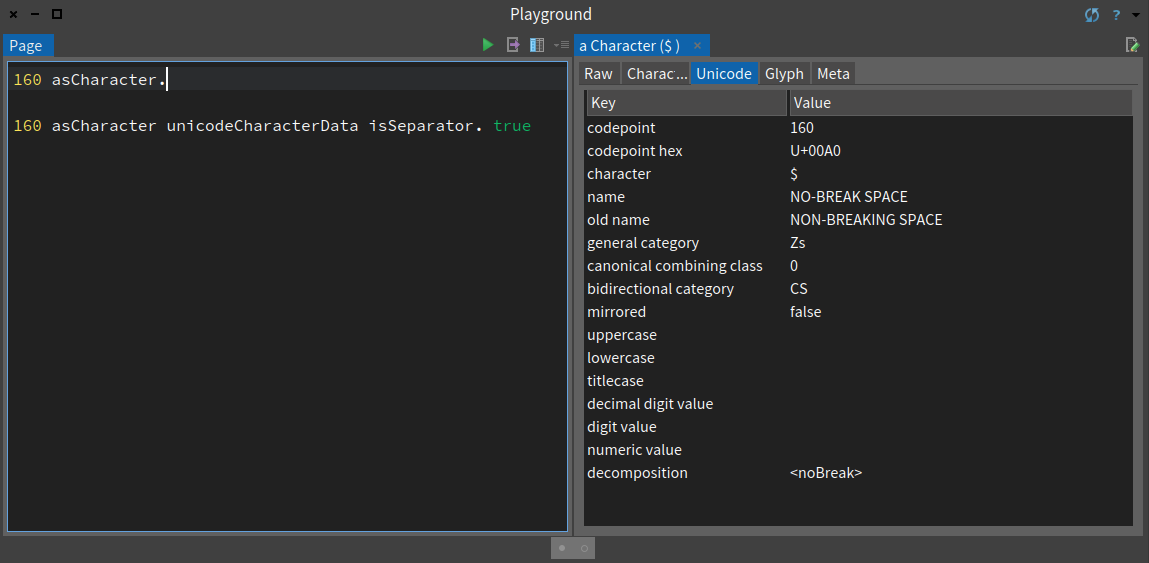
Hello All I have a little puzzle to disturb your Sunday lunch, maybe. I have been scraping text data from web pages, which often comes with redundant space before or after. I routinely use 'trim' on the final string output, but I have found cases where there are still redundant spaces. Inspecting the results, I find that the characters are non-break spaces (codepoint 160, Unicode U+00A0). Looking at the code, String>>#trim depends on Character>>#isSeparator, which does not answer true for a non-break space. I can use trimBoth: [:char| char asInteger = 160] to remove the redundant spaces if I know where to expect them, so it is not a major problem. But the question remains: should non-break space be included in the list of separators in Character>>#isSeparator. Peter Kenny

On 24-09-17 13:53, PBKResearch wrote:
I have a little puzzle to disturb your Sunday lunch, maybe. I have been scraping text data from web pages, which often comes with redundant space before or after. I routinely use âtrimâ on the final string output, but I have found cases where there are still redundant spaces. Inspecting the results, I find that the characters are non-break spaces (codepoint 160, Unicode U+00A0). Looking at the code, String>>#trim depends on Character>>#isSeparator, which does not answer true for a non-break space. I can use trimBoth: [:char| char asInteger = 160] to remove the redundant spaces if I know where to expect them, so it is not a major problem. But the question remains: should non-break space be included in the list of separators in Character>>#isSeparator.
In unicode, there are many more 'characters' that could be considered whitespace. You are collecting data from web pages, so you have no influence on what you'll get as input. I don't think this should be solved in #isSeparator. Stephan

may be we should have a trimWithSeparators: #() where we can specify what we want. For the question about isSeparator I do not know. On Sun, Sep 24, 2017 at 1:53 PM, PBKResearch <peter@pbkresearch.co.uk> wrote:
Hello All
I have a little puzzle to disturb your Sunday lunch, maybe. I have been scraping text data from web pages, which often comes with redundant space before or after. I routinely use âtrimâ on the final string output, but I have found cases where there are still redundant spaces. Inspecting the results, I find that the characters are non-break spaces (codepoint 160, Unicode U+00A0). Looking at the code, String>>#trim depends on Character>>#isSeparator, which does not answer true for a non-break space. I can use trimBoth: [:char| char asInteger = 160] to remove the redundant spaces if I know where to expect them, so it is not a major problem. But the question remains: should non-break space be included in the list of separators in Character>>#isSeparator.
Peter Kenny

On Sun, Sep 24, 2017 at 7:53 PM, PBKResearch <peter@pbkresearch.co.uk> wrote:
Hello All
I have a little puzzle to disturb your Sunday lunch, maybe. I have been scraping text data from web pages, which often comes with redundant space before or after. I routinely use âtrimâ on the final string output, but I have found cases where there are still redundant spaces. Inspecting the results, I find that the characters are non-break spaces (codepoint 160, Unicode U+00A0). Looking at the code, String>>#trim depends on Character>>#isSeparator, which does not answer true for a non-break space. I can use trimBoth: [:char| char asInteger = 160] to remove the redundant spaces if I know where to expect them, so it is not a major problem. But the question remains: should non-break space be included in the list of separators in Character>>#isSeparator.
Peter Kenny
Off the cuff.. intuitively "by definition" a Non-Break space seems to be Not-a-Separator. If the web pages you are scraping are misusing non-break space to munge formatting, that is not something to be solved by modifying semantics of #isSeparator. Stef's suggestion for a selector that takes a list of separators seems appropriate. cheers -ben

Ben Coman wrote
On Sun, Sep 24, 2017 at 7:53 PM, PBKResearch <
peter@.co
> wrote:
Hello All
I have a little puzzle to disturb your Sunday lunch, maybe. I have been scraping text data from web pages, which often comes with redundant space before or after. I routinely use âtrimâ on the final string output, but I have found cases where there are still redundant spaces. Inspecting the results, I find that the characters are non-break spaces (codepoint 160, Unicode U+00A0). Looking at the code, String>>#trim depends on Character>>#isSeparator, which does not answer true for a non-break space. I can use trimBoth: [:char| char asInteger = 160] to remove the redundant spaces if I know where to expect them, so it is not a major problem. But the question remains: should non-break space be included in the list of separators in Character>>#isSeparator.
Peter Kenny
Off the cuff.. intuitively "by definition" a Non-Break space seems to be Not-a-Separator. If the web pages you are scraping are misusing non-break space to munge formatting, that is not something to be solved by modifying semantics of #isSeparator. Stef's suggestion for a selector that takes a list of separators seems appropriate.
Rather than off-the-cuffing anything, please honour the Unicode Character Properties. Refer to https://en.wikipedia.org/wiki/Unicode_character_property#Whitespace, among others.
cheers -ben
-- Sent from: http://forum.world.st/Pharo-Smalltalk-Users-f1310670.html

On 25 Sep 2017, at 09:53, Richard Sargent <richard.sargent@gemtalksystems.com> wrote:
Ben Coman wrote
On Sun, Sep 24, 2017 at 7:53 PM, PBKResearch <
peter@.co
> wrote:
Hello All
I have a little puzzle to disturb your Sunday lunch, maybe. I have been scraping text data from web pages, which often comes with redundant space before or after. I routinely use âtrimâ on the final string output, but I have found cases where there are still redundant spaces. Inspecting the results, I find that the characters are non-break spaces (codepoint 160, Unicode U+00A0). Looking at the code, String>>#trim depends on Character>>#isSeparator, which does not answer true for a non-break space. I can use trimBoth: [:char| char asInteger = 160] to remove the redundant spaces if I know where to expect them, so it is not a major problem. But the question remains: should non-break space be included in the list of separators in Character>>#isSeparator.
Peter Kenny
Off the cuff.. intuitively "by definition" a Non-Break space seems to be Not-a-Separator. If the web pages you are scraping are misusing non-break space to munge formatting, that is not something to be solved by modifying semantics of #isSeparator. Stef's suggestion for a selector that takes a list of separators seems appropriate.
Rather than off-the-cuffing anything, please honour the Unicode Character Properties. Refer to https://en.wikipedia.org/wiki/Unicode_character_property#Whitespace, among others.
The Pharo Unicode Project (http://www.smalltalkhub.com/#!/~Pharo/Unicode) offers support for these properties. There is a performance cost though (it is a big database to load/use). I would not immediately change #isSeparator though.
cheers -ben
-- Sent from: http://forum.world.st/Pharo-Smalltalk-Users-f1310670.html
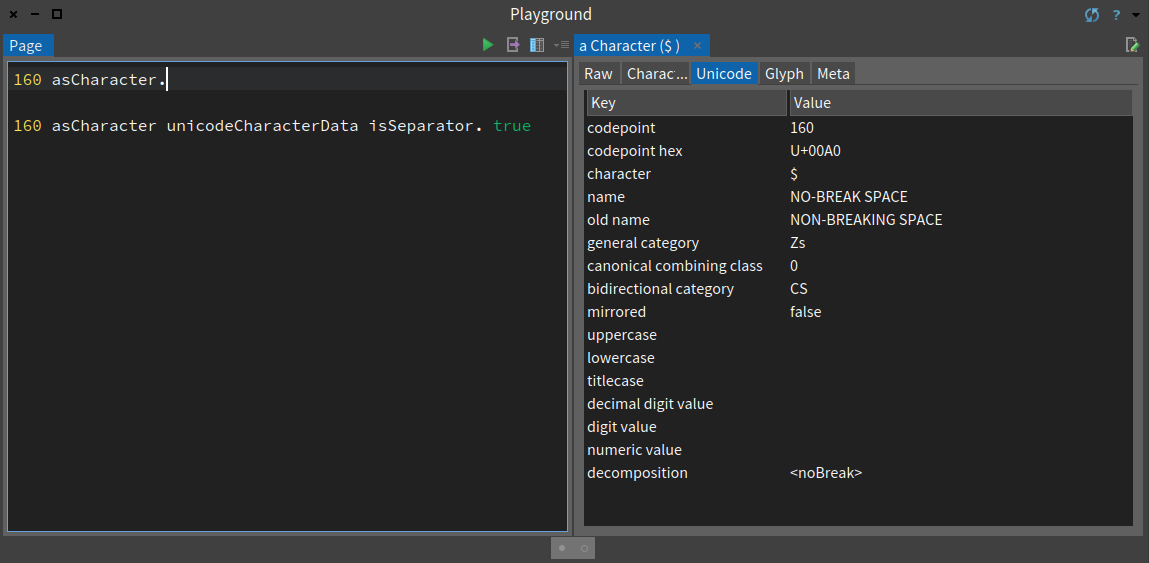
Hello One way of dealing with this in a general way is to introduce a new predicate #isWhitespace for Character, maybe following the Wikipedia definition as Richard suggests, and then either (a) recode String>>#trim and friends to use #isWhitespace rather than #isSeparator or (b) introduce a new operation String>>#trimWhitespace which uses #isWhitespace. @stef. There is already an operation which allows us to specify the characters to be trimmed, which I mentioned in my original post. We write trimBoth: aBlock, where aBlock value: char answers true if char is to be trimmed. I knew I could solve my immediate problem like this; I just wondered if there should be something more general. Peter Kenny From: Pharo-users [mailto:pharo-users-bounces@lists.pharo.org] On Behalf Of Sven Van Caekenberghe Sent: 25 September 2017 09:10 To: Any question about pharo is welcome <pharo-users@lists.pharo.org> Subject: Re: [Pharo-users] Is a non-break space whitespace? On 25 Sep 2017, at 09:53, Richard Sargent <richard.sargent@gemtalksystems.com <mailto:richard.sargent@gemtalksystems.com> > wrote: Ben Coman wrote On Sun, Sep 24, 2017 at 7:53 PM, PBKResearch < <mailto:peter@.co> peter@.co > wrote: Hello All I have a little puzzle to disturb your Sunday lunch, maybe. I have been scraping text data from web pages, which often comes with redundant space before or after. I routinely use âtrimâ on the final string output, but I have found cases where there are still redundant spaces. Inspecting the results, I find that the characters are non-break spaces (codepoint 160, Unicode U+00A0). Looking at the code, String>>#trim depends on Character>>#isSeparator, which does not answer true for a non-break space. I can use trimBoth: [:char| char asInteger = 160] to remove the redundant spaces if I know where to expect them, so it is not a major problem. But the question remains: should non-break space be included in the list of separators in Character>>#isSeparator. Peter Kenny Off the cuff.. intuitively "by definition" a Non-Break space seems to be Not-a-Separator. If the web pages you are scraping are misusing non-break space to munge formatting, that is not something to be solved by modifying semantics of #isSeparator. Stef's suggestion for a selector that takes a list of separators seems appropriate. Rather than off-the-cuffing anything, please honour the Unicode Character Properties. Refer to https://en.wikipedia.org/wiki/Unicode_character_property#Whitespace, among others. The Pharo Unicode Project (http://www.smalltalkhub.com/#!/~Pharo/Unicode) offers support for these properties. There is a performance cost though (it is a big database to load/use). I would not immediately change #isSeparator though. cheers -ben -- Sent from: http://forum.world.st/Pharo-Smalltalk-Users-f1310670.html
On Mon, Sep 25, 2017 at 3:53 PM, Richard Sargent < richard.sargent@gemtalksystems.com> wrote:
Ben Coman wrote
On Sun, Sep 24, 2017 at 7:53 PM, PBKResearch <
peter@.co
> wrote:
Hello All
I have a little puzzle to disturb your Sunday lunch, maybe. I have been scraping text data from web pages, which often comes with redundant space before or after. I routinely use âtrimâ on the final string output, but I have found cases where there are still redundant spaces. Inspecting the results, I find that the characters are non-break spaces (codepoint 160, Unicode U+00A0). Looking at the code, String>>#trim depends on Character>>#isSeparator, which does not answer true for a non-break space. I can use trimBoth: [:char| char asInteger = 160] to remove the redundant spaces if I know where to expect them, so it is not a major problem. But the question remains: should non-break space be included in the list of separators in Character>>#isSeparator.
Peter Kenny
Off the cuff.. intuitively "by definition" a Non-Break space seems to be Not-a-Separator. If the web pages you are scraping are misusing non-break space to munge formatting, that is not something to be solved by modifying semantics of #isSeparator. Stef's suggestion for a selector that takes a list of separators seems appropriate.
Rather than off-the-cuffing anything, please honour the Unicode Character Properties. Refer to https://en.wikipedia.org/wiki/Unicode_character_property#Whitespace, among others.
I hope it was clear I wasn't speaking from a position of authoritative knowledge.. Nice to learn something new. Thanks for the correction. cheers -ben
On 25-09-17 09:53, Richard Sargent wrote:
Rather than off-the-cuffing anything, please honour the Unicode Character Properties. Refer to https://en.wikipedia.org/wiki/Unicode_character_property#Whitespace, among others.
That is a good idea. And it won't help you if you scrape data from the web, as you'll find plenty of bad encoding. And unclarity over which version of which standard was used (see mongolian vowel separator) Stephan

The non breaking space, is a whitespace character or separator depending on the context. As far as i know it's not considered as a separator only when deciding text layout, it means do not break the line here: eg: "A distance of 100 meters" (nbsp between 100 and meters) should be rendered as either:
A distance of 100 meters or: A distance of 100 meters But not: A distance of 100 meters
There's an opposite character (don't remember the code) which means <you can break here if you need to> which is NOT a whitespace. On 25 September 2017 at 10:21, stephan <stephan@stack.nl> wrote:
On 25-09-17 09:53, Richard Sargent wrote:
Rather than off-the-cuffing anything, please honour the Unicode Character Properties. Refer to https://en.wikipedia.org/wiki/Unicode_character_property#Whitespace, among others.
That is a good idea. And it won't help you if you scrape data from the web, as you'll find plenty of bad encoding. And unclarity over which version of which standard was used (see mongolian vowel separator)
Stephan
participants (7)
-
 Ben Coman
 -
 Julián Maestri
 -
 PBKResearch
 -
 Richard Sargent
 -
 stephan
 -
 Stephane Ducasse
 -
 Sven Van Caekenberghe