Hi Andy,
I don't want to sound presumptuous, but I think that we can do
even better that Mathematica notebooks with the Pharo ecosystem.
Grafoscopio, for example, is just starting (yes, its first commit
was 3 years ago, but the development has been pretty sparse at the
beginning and it was my first Pharo/Smalltalk "app") and we can do
stuff that is difficult (or impossible) to do in platforms like
Jupyter or Mathematica. For example, we adapted Grafoscopio for
making the open sourced the Data Driven Journalism Handbook
(DDJH), Spanish version[1], and we have a single self contained
~600Kb file that is able to produce a 13 Mb pdf of 300+ pages
document with beautiful layout and design[2]. The self referential
properties of the Pharo environment give us a pretty flexible DOM,
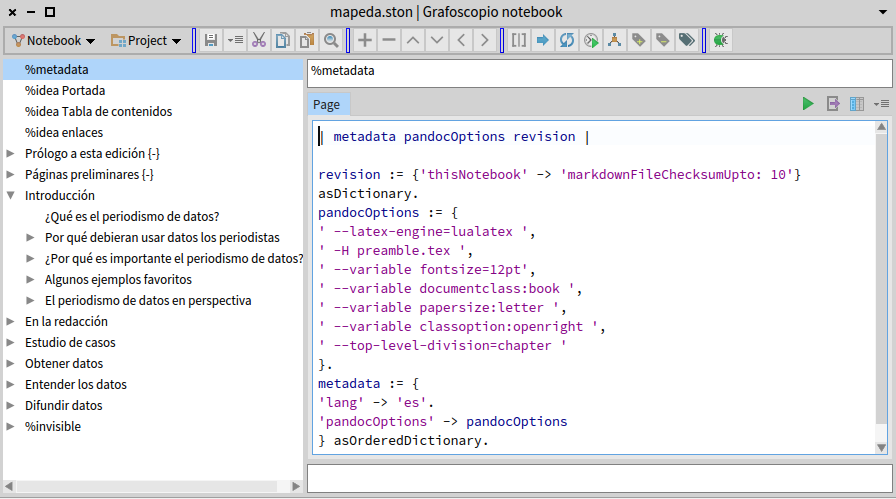
and as you can see (in the screenshot below), all the commands to
produce the Grafoscopio Manual or the DDJH are *inside* the
notebook, so the way you tweak Pandoc to produce a particular PDF
is expressed in plain Smalltalk, without relying on any external
JSON or any other external format config files. And this is just
the beginning if you consider reproducible research, because the
image metaphor is an excellent way to preserve all computation
state of any research output, including data and code, as told in
the Panama Papers post on Data continuum environments[2a] and how
we can package that in "pocket infrastructures". See, for example,
my 10 years old research simulation and dynamic presentation,
opening without any problem, a moth ago[3], using Etoys.
Wow! What a great collection of answers. Thanks everyone, I learned a lot from that relatively simple question.
I have installed QuickAccess - that's very cool. And, I have also tried the <script> pragma. Having the button is very nice. I will also try out Grafoscope. I have been playing with Mathematica Notebooks, and I think something similar within Pharo would be wonderful.
CheersAndy
Yes. Plenty of solutions, from just open your Playground in a scripts
folder, to QuickAccess, to objects, to embedding scripts into more
complete data narratives. They serve different purposes, so explore them
and see which ones serves better your taste and user case.
Cheers,
Offray
On 26/11/17 07:07, Stephane Ducasse wrote:
> Hi Andy
>
> As you saw there are plenty of solutions.
>
> Now what I learned is that it is often better in the long to have a
> little object because suddenly
> it opens your mind and you realise that you can teach him something more.
>
> So I often find myself realising that I created some class methods and
> that it was stupid
> better have a real little object because it can do more and in
> particular for open new path
>
> So now I do not use scripts but plain little classes with nice little
> printOn: methods and arguments
> to get customized.
>
> Stef
>
> On Sat, Nov 25, 2017 at 6:34 PM, Andy Burnett
> <andy.burnett@knowinnovation.com > wrote:
>> I have just created a couple of small playground scripts that do some useful
>> data wrangling. The chances are that I will reuse them from time to time,
>> but with tweaks. Does version 6 Have some way to store them? I think I am
>> after a sort of scripts catalogue.
>