class variable slots?

Hi, As far as I see, the class variables are not slots. Is that correct? If not, how do I get the slots? Cheers, Doru -- www.tudorgirba.com "Every thing has its own flow"

Hi Tudor, On Wed, Nov 26, 2014 at 6:02 AM, Tudor Girba <tudor@tudorgirba.com> wrote:
Hi,
As far as I see, the class variables are not slots. Is that correct?
That's right. They're associations in class pools, and are visible in the instance-side and class-side methods of the class and all its subclasses. See Class>>bindingOf: and Class's inst var classPool. Shared pools are similar. A shared pool stores its variables in its class pool, but other classes can have its class vars in scope by including the shared pool in its pool dictionaries.
If not, how do I get the slots?
Well, just for clarity (at least I hope it'll bring clarity). One can access the variables via MyClass classPool associations Note that these are entirely different from class instance variables, which are inst var slots in the class object. These hold things like the class's superclass, its method dictionary, etc. But one can add inst vars to one's own class. There are many examples of this. Since these slots are per-class every class gets its own copy of the slot, and because these are inst vars, they are only in scope in class-side methods of the defining class and subclasses. HTH
Cheers, Doru
-- www.tudorgirba.com
"Every thing has its own flow"
-- best, Eliot

On 26 Nov 2014, at 19:36, Eliot Miranda <eliot.miranda@gmail.com> wrote:
Hi Tudor,
On Wed, Nov 26, 2014 at 6:02 AM, Tudor Girba <tudor@tudorgirba.com <mailto:tudor@tudorgirba.com>> wrote: Hi,
As far as I see, the class variables are not slots. Is that correct?
That's right. They're associations in class pools, and are visible in the instance-side and class-side methods of the class and all its subclasses. See Class>>bindingOf: and Class's inst var classPool. Shared pools are similar. A shared pool stores its variables in its class pool, but other classes can have its class vars in scope by including the shared pool in its pool dictionaries.
If not, how do I get the slots?
Well, just for clarity (at least I hope it'll bring clarity). One can access the variables via
MyClass classPool associations
Note that these are entirely different from class instance variables, which are inst var slots in the class object. These hold things like the class's superclass, its method dictionary, etc. But one can add inst vars to one's own class. There are many examples of this. Since these slots are per-class every class gets its own copy of the slot, and because these are inst vars, they are only in scope in class-side methods of the defining class and subclasses.
One we did for Pharo4 is to use the Associations of Globals to model these variables as meta-objects (in the same spirit as the Slot objects). Thos means that -> there is an Api to get them -> they have an API to read /write This is just âsugarâ on what the associations did already: global := SmalltalkImage classVariableNamed: #CompilerClass. global read. global class ==> ClassVariable Then, I added that the Compiler actually delegates code generation for read and write to these meta-objects, meaning you can subclass them and add special kinds of Globals with special semantics (just like Slot Subclasses). This could be used for e.g.active globals that announce when changed. But the real use-case for this is putting meta-links on these globals. e.g. add a class TT with class var T and a method that reads it. |link | link := MetaLink new metaObject: Halt; selector: #now. (TT classVariableNamed: #T) link: link. TT new readT -> halt. This means that we can out break-points on class variables (as opposed to a single read or write). This all needs a bit more work to be really usable⦠Marcus

Le 26/11/14 21:10, Marcus Denker a écrit :
On 26 Nov 2014, at 19:36, Eliot Miranda <eliot.miranda@gmail.com <mailto:eliot.miranda@gmail.com>> wrote:
Hi Tudor,
On Wed, Nov 26, 2014 at 6:02 AM, Tudor Girba <tudor@tudorgirba.com <mailto:tudor@tudorgirba.com>> wrote:
Hi,
As far as I see, the class variables are not slots. Is that correct?
That's right. They're associations in class pools, and are visible in the instance-side and class-side methods of the class and all its subclasses. See Class>>bindingOf: and Class's inst var classPool. Shared pools are similar. A shared pool stores its variables in its class pool, but other classes can have its class vars in scope by including the shared pool in its pool dictionaries.
If not, how do I get the slots?
Well, just for clarity (at least I hope it'll bring clarity). One can access the variables via
MyClass classPool associations
Note that these are entirely different from class instance variables, which are inst var slots in the class object. These hold things like the class's superclass, its method dictionary, etc. But one can add inst vars to one's own class. There are many examples of this. Since these slots are per-class every class gets its own copy of the slot, and because these are inst vars, they are only in scope in class-side methods of the defining class and subclasses.
One we did for Pharo4 is to use the Associations of Globals to model these variables as meta-objects (in the same spirit as the Slot objects).
Thos means that -> there is an Api to get them -> they have an API to read /write
This is just âsugarâ on what the associations did already:
global := SmalltalkImage classVariableNamed: #CompilerClass. global read. global class ==> ClassVariable
but I do not get why a class variable is accessed as a global. To me it looks plain wrong. A class variable is like a shared variable between classes. In Clos it was the same as an instance variable but with a class scope. So could not we make that nicer. I really find terrible and an attack against modularity to have them managed that way. Why the compiler instead of going to Smalltalk the global namespace cannot ask the class that declares it? Even if we would have modules I do not see why a class var should be a module global because it is not what it is. I think that the original implementation is not aligned with the semantics.
Then, I added that the Compiler actually delegates code generation for read and write to these meta-objects, meaning you can subclass them and add special kinds of Globals with special semantics (just like Slot Subclasses). This could be used for e.g.active globals that announce when changed.
But the real use-case for this is putting meta-links on these globals.
e.g. add a class TT with class var T and a method that reads it.
|link | link := MetaLink new metaObject: Halt; selector: #now.
(TT classVariableNamed: #T) link: link.
TT new readT -> halt.
This means that we can out break-points on class variables (as opposed to a single read or write).
This all needs a bit more work to be really usableâ¦
Marcus
On 27 Nov 2014, at 08:09, stepharo <stepharo@free.fr> wrote:
Le 26/11/14 21:10, Marcus Denker a écrit :
On 26 Nov 2014, at 19:36, Eliot Miranda <eliot.miranda@gmail.com <mailto:eliot.miranda@gmail.com>> wrote:
Hi Tudor,
On Wed, Nov 26, 2014 at 6:02 AM, Tudor Girba <tudor@tudorgirba.com <mailto:tudor@tudorgirba.com>> wrote: Hi,
As far as I see, the class variables are not slots. Is that correct?
That's right. They're associations in class pools, and are visible in the instance-side and class-side methods of the class and all its subclasses. See Class>>bindingOf: and Class's inst var classPool. Shared pools are similar. A shared pool stores its variables in its class pool, but other classes can have its class vars in scope by including the shared pool in its pool dictionaries.
If not, how do I get the slots?
Well, just for clarity (at least I hope it'll bring clarity). One can access the variables via
MyClass classPool associations
Note that these are entirely different from class instance variables, which are inst var slots in the class object. These hold things like the class's superclass, its method dictionary, etc. But one can add inst vars to one's own class. There are many examples of this. Since these slots are per-class every class gets its own copy of the slot, and because these are inst vars, they are only in scope in class-side methods of the defining class and subclasses.
One we did for Pharo4 is to use the Associations of Globals to model these variables as meta-objects (in the same spirit as the Slot objects).
Thos means that -> there is an Api to get them -> they have an API to read /write
This is just âsugarâ on what the associations did already:
global := SmalltalkImage classVariableNamed: #CompilerClass. global read. global class ==> ClassVariable
but I do not get why a class variable is accessed as a global.
It is not. You have to ask the class for the class variable: SmalltalkImage classVariableNamed: #CompilerClass. This returns the class variable âCompilerClassâ of class SmalltalkImage.
To me it looks plain wrong. A class variable is like a shared variable between classes. In Clos it was the same as an instance variable but with a class scope. So could not we make that nicer. I really find terrible and an attack against modularity to have them managed that way.
Which way? ah, I think my example was a bad one: I used SmalltalkIamge as it is the class that comes to my mind that uses logs of class variables. I do not ask the global namespace anything, e.g. make a case TT with class var T and it is TT classVariableNamed: #T The variable is *not* global. Itâs a class variable. Marcus
but I do not get why a class variable is accessed as a global.
It is not. You have to ask the class for the class variable:
SmalltalkImage classVariableNamed: #CompilerClass.
This returns the class variable âCompilerClassâ of class SmalltalkImage.
ahhhh ok
To me it looks plain wrong. A class variable is like a shared variable between classes. In Clos it was the same as an instance variable but with a class scope. So could not we make that nicer. I really find terrible and an attack against modularity to have them managed that way.
Which way?
ah, I think my example was a bad one: I used SmalltalkIamge as it is the class that comes to my mind that uses logs of class variables. I do not ask the global namespace anything,
e.g. make a case TT with class var T and it is
TT classVariableNamed: #T
The variable is *not* global. Itâs a class variable.
Ok we are safe :)
Marcus
Hi, Indeed, this is what I am looking for: a dedicated object representing the class variable. This kind of objects become particularly useful in an interface like the inspector because we can define dedicated views on them. If they are generic associations or symbols, we cannot do much. Cheers, Doru On Wed, Nov 26, 2014 at 9:10 PM, Marcus Denker <marcus.denker@inria.fr> wrote:
On 26 Nov 2014, at 19:36, Eliot Miranda <eliot.miranda@gmail.com> wrote:
Hi Tudor,
On Wed, Nov 26, 2014 at 6:02 AM, Tudor Girba <tudor@tudorgirba.com> wrote:
Hi,
As far as I see, the class variables are not slots. Is that correct?
That's right. They're associations in class pools, and are visible in the instance-side and class-side methods of the class and all its subclasses. See Class>>bindingOf: and Class's inst var classPool. Shared pools are similar. A shared pool stores its variables in its class pool, but other classes can have its class vars in scope by including the shared pool in its pool dictionaries.
If not, how do I get the slots?
Well, just for clarity (at least I hope it'll bring clarity). One can access the variables via
MyClass classPool associations
Note that these are entirely different from class instance variables, which are inst var slots in the class object. These hold things like the class's superclass, its method dictionary, etc. But one can add inst vars to one's own class. There are many examples of this. Since these slots are per-class every class gets its own copy of the slot, and because these are inst vars, they are only in scope in class-side methods of the defining class and subclasses.
One we did for Pharo4 is to use the Associations of Globals to model these variables as meta-objects (in the same spirit as the Slot objects).
Thos means that -> there is an Api to get them -> they have an API to read /write
This is just âsugarâ on what the associations did already:
global := SmalltalkImage classVariableNamed: #CompilerClass. global read. global class ==> ClassVariable
Then, I added that the Compiler actually delegates code generation for read and write to these meta-objects, meaning you can subclass them and add special kinds of Globals with special semantics (just like Slot Subclasses). This could be used for e.g.active globals that announce when changed.
But the real use-case for this is putting meta-links on these globals.
e.g. add a class TT with class var T and a method that reads it.
|link | link := MetaLink new metaObject: Halt; selector: #now.
(TT classVariableNamed: #T) link: link.
TT new readT -> halt.
This means that we can out break-points on class variables (as opposed to a single read or write).
This all needs a bit more work to be really usableâ¦
Marcus
-- www.tudorgirba.com "Every thing has its own flow"
One we did for Pharo4 is to use the Associations of Globals to model these variables as meta-objects (in the same spirit as the Slot objects).
Thos means that -> there is an Api to get them -> they have an API to read /write
This is just âsugarâ on what the associations did already:
global := SmalltalkImage classVariableNamed: #CompilerClass. global read. global class ==> ClassVariable
Having objects for concepts like this allows of course to leverage the power of the tools⦠e.g. this adds an inspect pane that shows all users of variables: 14562 add a Users tab to GTInspector for Slots and LiteralVariables https://pharo.fogbugz.com/f/cases/14562
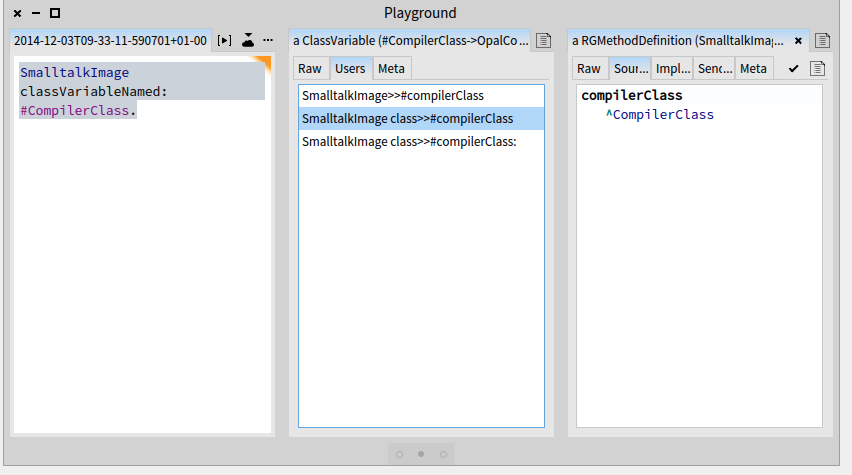
Exactly! This is what I was looking for :) Thanks, Doru On Wed, Dec 3, 2014 at 9:35 AM, Marcus Denker <marcus.denker@inria.fr> wrote:
One we did for Pharo4 is to use the Associations of Globals to model these variables as meta-objects (in the same spirit as the Slot objects).
Thos means that -> there is an Api to get them -> they have an API to read /write
This is just âsugarâ on what the associations did already:
global := SmalltalkImage classVariableNamed: #CompilerClass. global read. global class ==> ClassVariable
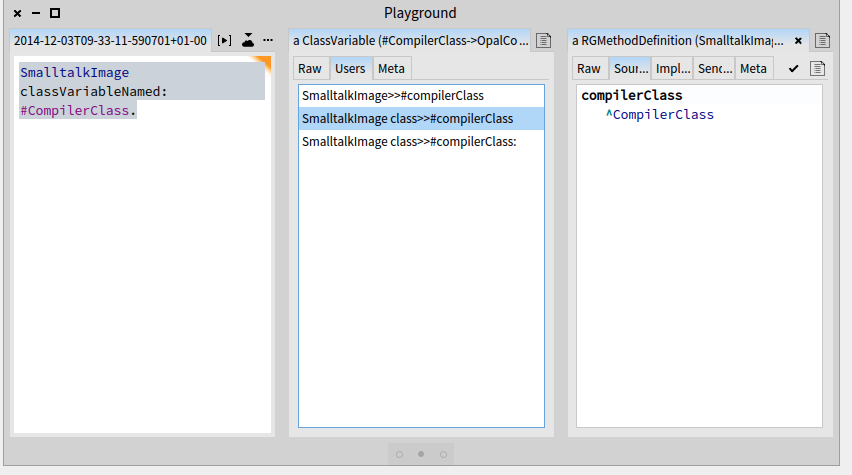
Having objects for concepts like this allows of course to leverage the power of the tools⦠e.g. this adds an inspect pane that shows all users of variables:
14562 add a Users tab to GTInspector for Slots and LiteralVariables https://pharo.fogbugz.com/f/cases/14562
-- www.tudorgirba.com "Every thing has its own flow"
On Wed, Dec 3, 2014 at 1:32 PM, Tudor Girba <tudor@tudorgirba.com> wrote:
Exactly! This is what I was looking for :)
This is now in 4.0 #397 e.g. use GTInspector on Object binding
Thanks, Doru
On Wed, Dec 3, 2014 at 9:35 AM, Marcus Denker <marcus.denker@inria.fr> wrote:
One we did for Pharo4 is to use the Associations of Globals to model these variables as meta-objects (in the same spirit as the Slot objects).
Thos means that -> there is an Api to get them -> they have an API to read /write
This is just âsugarâ on what the associations did already:
global := SmalltalkImage classVariableNamed: #CompilerClass. global read. global class ==> ClassVariable
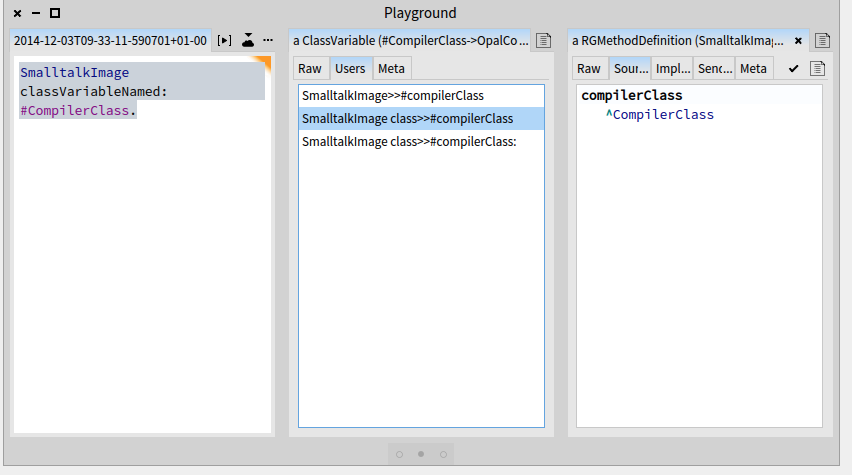
Having objects for concepts like this allows of course to leverage the power of the tools⦠e.g. this adds an inspect pane that shows all users of variables:
14562 add a Users tab to GTInspector for Slots and LiteralVariables https://pharo.fogbugz.com/f/cases/14562
-- www.tudorgirba.com
"Every thing has its own flow"
-- -- Marcus Denker -- denker@acm.org http://www.marcusdenker.de

Marcus Denker wrote:
On Wed, Dec 3, 2014 at 1:32 PM, Tudor Girba <tudor@tudorgirba.com <mailto:tudor@tudorgirba.com>> wrote:
Exactly! This is what I was looking for :)
This is now in 4.0 #397
e.g. use GTInspector on
Object binding
Is it feasible to get highlighting of 'Object' as well? cheers -ben
What do you mean? Doru On Wed, Dec 3, 2014 at 2:33 PM, Ben Coman <btc@openinworld.com> wrote:
Marcus Denker wrote:
On Wed, Dec 3, 2014 at 1:32 PM, Tudor Girba <tudor@tudorgirba.com <mailto:tudor@tudorgirba.com>> wrote:
Exactly! This is what I was looking for :)
This is now in 4.0 #397
e.g. use GTInspector on
Object binding
Is it feasible to get highlighting of 'Object' as well? cheers -ben
-- www.tudorgirba.com "Every thing has its own flow"
On 03 Dec 2014, at 14:41, Tudor Girba <tudor@tudorgirba.com> wrote:
What do you mean?
Highlight in the source where the reference is⦠Textual highlight should be simple (I did that for other tools already). But what we need is one with semantic knowledge⦠which should be easy, too. (using the AST). Marcus
Doru
On Wed, Dec 3, 2014 at 2:33 PM, Ben Coman <btc@openinworld.com <mailto:btc@openinworld.com>> wrote: Marcus Denker wrote:
On Wed, Dec 3, 2014 at 1:32 PM, Tudor Girba <tudor@tudorgirba.com <mailto:tudor@tudorgirba.com> <mailto:tudor@tudorgirba.com <mailto:tudor@tudorgirba.com>>> wrote:
Exactly! This is what I was looking for :)
This is now in 4.0 #397
e.g. use GTInspector on
Object binding
Is it feasible to get highlighting of 'Object' as well? cheers -ben
-- www.tudorgirba.com <http://www.tudorgirba.com/>
"Every thing has its own flow"
In System Browser, right-click on a class > Analyse > Class refs... or, select some text e.g. 'Object' > Extended search...>references to it and in both cases there is highlighting of the search for class, which I find useful. cheers -ben Tudor Girba wrote:
What do you mean?
Doru
On Wed, Dec 3, 2014 at 2:33 PM, Ben Coman <btc@openinworld.com <mailto:btc@openinworld.com>> wrote:
Marcus Denker wrote:
On Wed, Dec 3, 2014 at 1:32 PM, Tudor Girba <tudor@tudorgirba.com <mailto:tudor@tudorgirba.com> <mailto:tudor@tudorgirba.com <mailto:tudor@tudorgirba.com>>> wrote:
Exactly! This is what I was looking for :)
This is now in 4.0 #397
e.g. use GTInspector on
Object binding
Is it feasible to get highlighting of 'Object' as well? cheers -ben
-- www.tudorgirba.com <http://www.tudorgirba.com>
"Every thing has its own flow"
Hi Eliot, Thanks. I know what class variables are, I was just asking if there is a Slot-like meta-object in the implementation :). Cheers, Doru On Wed, Nov 26, 2014 at 7:36 PM, Eliot Miranda <eliot.miranda@gmail.com> wrote:
Hi Tudor,
On Wed, Nov 26, 2014 at 6:02 AM, Tudor Girba <tudor@tudorgirba.com> wrote:
Hi,
As far as I see, the class variables are not slots. Is that correct?
That's right. They're associations in class pools, and are visible in the instance-side and class-side methods of the class and all its subclasses. See Class>>bindingOf: and Class's inst var classPool. Shared pools are similar. A shared pool stores its variables in its class pool, but other classes can have its class vars in scope by including the shared pool in its pool dictionaries.
If not, how do I get the slots?
Well, just for clarity (at least I hope it'll bring clarity). One can access the variables via
MyClass classPool associations
Note that these are entirely different from class instance variables, which are inst var slots in the class object. These hold things like the class's superclass, its method dictionary, etc. But one can add inst vars to one's own class. There are many examples of this. Since these slots are per-class every class gets its own copy of the slot, and because these are inst vars, they are only in scope in class-side methods of the defining class and subclasses.
HTH
Cheers, Doru
-- www.tudorgirba.com
"Every thing has its own flow"
-- best, Eliot
-- www.tudorgirba.com "Every thing has its own flow"
participants (5)
-
 Ben Coman
 -
 Eliot Miranda
 -
 Marcus Denker
 -
 stepharo
 -
 Tudor Girba