
Hi, What is microdown ? What are its goals and objectives ? Where does it come from ? Is there any documentation about it ? There probably is a background story here, and it is probably a good idea, but unless I missed something, for me reading the mailing lists daily, it came from nowhere and got immediately integrated into Pharo 9. Sven

Hi Sven, I cannot say much as I was following this from afar, but the github repository should give you some answers :) https://github.com/pillar-markup/MicroDown Pierre On 07/07/2020 11:27, Sven Van Caekenberghe wrote:
Hi,
What is microdown ? What are its goals and objectives ? Where does it come from ? Is there any documentation about it ?
There probably is a background story here, and it is probably a good idea, but unless I missed something, for me reading the mailing lists daily, it came from nowhere and got immediately integrated into Pharo 9.
Sven

Microdown is a subset of markdown that can parse to a pillar model. So the discussions about pillar markup have finally settled and we have a syntax format that reads well in ascii which can be used in class comments even if it is a basic image. To integrate pillar core in pharo is not new just the change in syntax.
Am 07.07.2020 um 11:27 schrieb Sven Van Caekenberghe <sven@stfx.eu>:
Hi,
What is microdown ? What are its goals and objectives ? Where does it come from ? Is there any documentation about it ?
There probably is a background story here, and it is probably a good idea, but unless I missed something, for me reading the mailing lists daily, it came from nowhere and got immediately integrated into Pharo 9.
Sven
Thank you, Pierre and Norbert.
On 7 Jul 2020, at 14:32, Norbert Hartl <norbert@hartl.name> wrote:
Microdown is a subset of markdown that can parse to a pillar model. So the discussions about pillar markup have finally settled and we have a syntax format that reads well in ascii which can be used in class comments even if it is a basic image. To integrate pillar core in pharo is not new just the change in syntax.
Am 07.07.2020 um 11:27 schrieb Sven Van Caekenberghe <sven@stfx.eu>:
Hi,
What is microdown ? What are its goals and objectives ? Where does it come from ? Is there any documentation about it ?
There probably is a background story here, and it is probably a good idea, but unless I missed something, for me reading the mailing lists daily, it came from nowhere and got immediately integrated into Pharo 9.
Sven

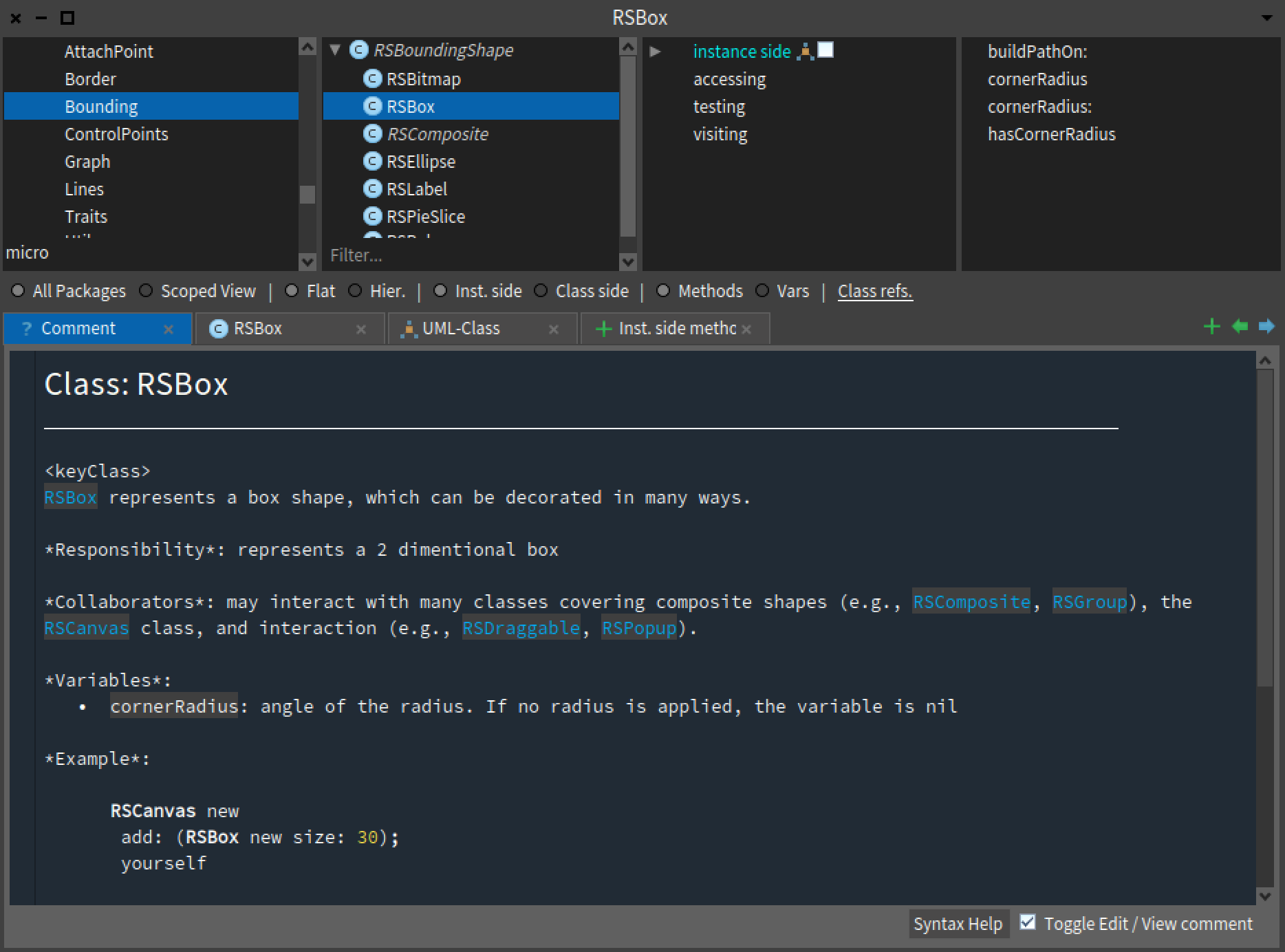
With MicroPrint, you can do this: Cheers, Alexandre -- _,.;:~^~:;._,.;:~^~:;._,.;:~^~:;._,.;:~^~:;._,.;: Alexandre Bergel http://www.bergel.eu ^~:;._,.;:~^~:;._,.;:~^~:;._,.;:~^~:;._,.;:~^~:;.
On 07-07-2020, at 14:07, Sven Van Caekenberghe <sven@stfx.eu> wrote:
Thank you, Pierre and Norbert.
On 7 Jul 2020, at 14:32, Norbert Hartl <norbert@hartl.name> wrote:
Microdown is a subset of markdown that can parse to a pillar model. So the discussions about pillar markup have finally settled and we have a syntax format that reads well in ascii which can be used in class comments even if it is a basic image. To integrate pillar core in pharo is not new just the change in syntax.
Am 07.07.2020 um 11:27 schrieb Sven Van Caekenberghe <sven@stfx.eu>:
Hi,
What is microdown ? What are its goals and objectives ? Where does it come from ? Is there any documentation about it ?
There probably is a background story here, and it is probably a good idea, but unless I missed something, for me reading the mailing lists daily, it came from nowhere and got immediately integrated into Pharo 9.
Sven

NorbertHartl wrote
Microdown is a subset of markdown that can parse to a pillar model. So the discussions about pillar markup have finally settled and we have a syntax format that reads well in ascii which can be used in class comments even if it is a basic image.
Rich text comments are an exciting development! I'd like to understand the benefit of Microdown vs. full Pillar syntax. Presumably the primary benefit is the size of the codebase. Any other reasons? Generally, I wonder about minimalism when it applies to areas of the system that seem inherently non-minimalist e.g. test harnesses, documentation, etc. I though a lot about this when trying to document and refactor SDL. The lack of a mock library in core was a big barrier to understanding the interactions between SDL objects. Maybe I'm being naive, but I feel like if someone wants a minimal image, they're not going to want to load SUnit or rich text documentation *at all*, so I don't see the risk-benefit of crippling these features. A few other questions about the "rich text doc" roadmap: 1. Could/will this be extended to method comments? That would be really cool :) 2. How close are we for someone to use full Pillar syntax in class comments in their own library? Any plans to make this possible? ----- Cheers, Sean -- Sent from: http://forum.world.st/Pharo-Smalltalk-Developers-f1294837.html
participants (5)
-
 Alexandre Bergel
 -
 hogoww
 -
 Norbert Hartl
 -
 Sean P. DeNigris
 -
 Sven Van Caekenberghe