Re: [Pharo-project] [squeak-dev] Xtreams up to date

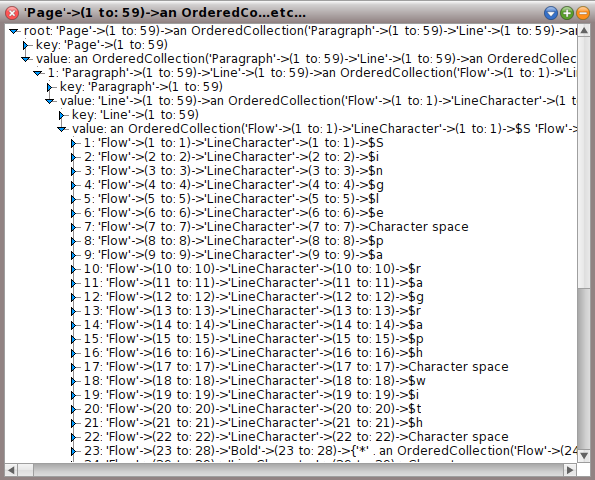
Thank you Martin, your explanations got me some steps further. I found the page http://pdos.csail.mit.edu/~baford/packrat/ by Bryan Ford which seems to be a good entry point for reading about PEG parsing. That page refers to http://en.wikipedia.org/wiki/Parsing_expression_grammar as a good technical overview. I took the wiki example from http://code.google.com/p/xtreams/wiki/Parsing and adapted the names so that it fits the Squeak implementation A Parser is created from a PEG grammar by parsing the grammar rules using the ParserParser. wikiGrammar := PEGParser grammarWiki reading. wikiParser := PEGParser parserPEG parse: 'Grammar' stream: wikiGrammar actor: PEGParserParser new. input := 'Single paragraph with *bold* and _italic_ text and a [link]' reading. "As you indicated I used the PEGTreeBuilder" wikiParser parse: 'Page' stream: input actor: PEGTreeBuilder new If I explore the resulting object I got what is shown in the screen shot. I am not sure how to interpret the result. "Regarding the wiki example: the class PEGWikiGenerator is not included" wikiParser parse: 'Page' stream: input actor: PEGWikiGenerator new. Where can I get this class? The comment of the method #parse:stream:actor: of class PEGParser is helpful "Parse @definition from aStream using @anActor to act on the matching rules. "" definition <String> identifies the rule of the grammar to apply to the input aStream <ReadStream> the input to parse anActor <Actor> receives callbacks from the parser for the successfully rules with the matching the input ^ <Object> result of the actor action for the @definition " As class methods of PEGParser there are 8 grammars included - CSS3, HttpUrl, JSON, JavaScript, PEG, Smalltalk, Wiki, XML. I think a simple complete example which actually does something would be helpful for me. TreeBuilder seems to do nothing and I do not see the tree. For example besides the classes PEGParserPEGTest and PEGParserSmalltalkTest (6 test cases) a class PEGParserHttpUrlTest or PEGParserJavaScriptTest would be helpful. Actually I would like to parse some simple Javascript like mySent = new aswExample('') mySent.addWord('Ninatoka') mySent.currentWord().firstLetterUppercase=true mySent.currentWord().addMorpheme('ni-','S1s-') mySent.currentWord().addMorpheme('na-','Pres.-') mySent.currentWord().addMorpheme('tok','come_from') mySent.currentWord().addMorpheme('-a','-VF') mySent.addWord('Uswisi.') mySent.currentWord().addMorpheme('Uswisi','Switzerland.') mySent.writeHTML() It is used for web pages on which Swahili text is displayed. On request a morphological analysis is shown. A note: this example could be parsed with some manually constructed code without PEG I assume, just string matching and some branching. So there is no pressure on this. But I'd like to use it to learn PEG parsing. The goal is to translate the JavaScript code to Smalltalk code (and later one to an XML representation for printing). --Hannes On 1/21/11, mkobetic@gmail.com <mkobetic@gmail.com> wrote:
"Hannes Hirzel"<hannes.hirzel@gmail.com> wrote:
Besides http://code.google.com/p/xtreams/wiki/Parsing are there more examples how to use Peg parsing?
Unfortunately that one is still waiting for documentation. Even the little bit that is on the wiki page uses an example that wasn't ported because it uses VW's XML Elements.
It's actually not that complicated to use. Basically you take a PEG grammar, you parse it as the wiki example shows (the first 2 lines). Then you need an 'actor' that will get callbacks from the parser when it parses some input. The Actor class provides simple pragma based dispatch mechanism for convenience, but ultimately the actor simply receives #process:object:start:stop: callbacks from successfully applied grammar rules. The TreeBuilder in the Tests package shows the simplest Actor that just collects all the callback arguments. The return value of the callback is important, the object: argument of the callback is a collection of what the lower level rules returned from their callbacks. Anyway that's real quick description of how the parsing mechanism works from user point of view. Real documentation needs a lot of simple examples to make that clearer, but hopefully this could get you going if you experiment with simpler grammars and the TreeBuilder a bit. I'll try to answer any more specific questions as I can.
HTH,
Martin
participants (1)
-
 Hannes Hirzel