
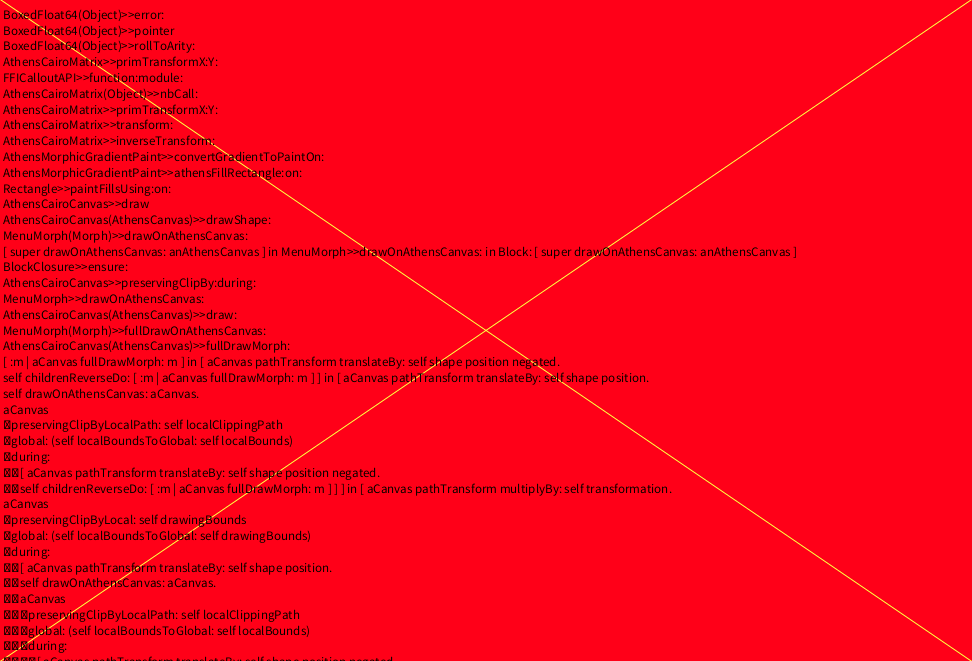
We have two identical bloc images built on ci with one day difference and *no changes to bloc* https://ci.inria.fr/pharo-contribution/job/Bloc/26/ - works https://ci.inria.fr/pharo-contribution/job/Bloc/27/ - drawing crashes with the following error: [image: Inline image 1] Looks like fix to issue https://pharo.fogbugz.com/f/cases/17564 in #50579 causes bug. Cheers, Alex

Oops⦠I didnât implemented #pointer for floats⦠it should be something like this: Float>>#pointer ^ (ByteArray new: FFIExternalType pointerSize) floatAt: 1 put: self; yourself can you test it? (and you can commit it to Pharo/NB-FFI repo⦠Iâm taking a plane now and I do not have the time until thursday :( ) Esteban
On 12 Feb 2016, at 16:46, Aliaksei Syrel <alex.syrel@gmail.com> wrote:
We have two identical bloc images built on ci with one day difference and no changes to bloc https://ci.inria.fr/pharo-contribution/job/Bloc/26/ <https://ci.inria.fr/pharo-contribution/job/Bloc/26/> - works https://ci.inria.fr/pharo-contribution/job/Bloc/27/ <https://ci.inria.fr/pharo-contribution/job/Bloc/27/> - drawing crashes with the following error:
<Screen Shot 2016-02-12 at 16.33.51.png>
Looks like fix to issue https://pharo.fogbugz.com/f/cases/17564 <https://pharo.fogbugz.com/f/cases/17564> in #50579 causes bug.
Cheers, Alex
(and you can commit it to Pharo/NB-FFI repo⦠Iâm taking a plane now and I do not have the time until thursday :( )
done Cheers, Alex On Fri, Feb 12, 2016 at 5:50 PM, Aliaksei Syrel <alex.syrel@gmail.com> wrote:
On Fri, Feb 12, 2016 at 5:45 PM, Esteban Lorenzano <estebanlm@gmail.com> wrote:
Float>>#pointer ^ (ByteArray new: FFIExternalType pointerSize) floatAt: 1 put: self; yourself
Yes it does the trick :) Thanks!
On 12 Feb 2016, at 17:50, Aliaksei Syrel <alex.syrel@gmail.com> wrote:
On Fri, Feb 12, 2016 at 5:45 PM, Esteban Lorenzano <estebanlm@gmail.com <mailto:estebanlm@gmail.com>> wrote: Float>>#pointer ^ (ByteArray new: FFIExternalType pointerSize) floatAt: 1 put: self; yourself
Yes it does the trick :) Thanks!
yes and no (I made a mistake): that works because incidentally pointers and floats have same size (4 bytes)⦠but can happen that it is not (doubles have 8 bytes)⦠but is ok for now :) I will fix it correctly next week. Esteban

I don't understand. All BoxedFloat have 8 bytes, that's why they are called BoxedFloat64. There are no 4-bytes floats in Pharo. Even in 32 bits. 2016-02-12 18:06 GMT+01:00 Esteban Lorenzano <estebanlm@gmail.com>:
On 12 Feb 2016, at 17:50, Aliaksei Syrel <alex.syrel@gmail.com> wrote:
On Fri, Feb 12, 2016 at 5:45 PM, Esteban Lorenzano <estebanlm@gmail.com> wrote:
Float>>#pointer ^ (ByteArray new: FFIExternalType pointerSize) floatAt: 1 put: self; yourself
Yes it does the trick :) Thanks!
yes and no (I made a mistake): that works because incidentally pointers and floats have same size (4 bytes)⦠but can happen that it is not (doubles have 8 bytes)⦠but is ok for now :) I will fix it correctly next week.
Esteban

I don't understand. All BoxedFloat have 8 bytes, that's why they are called BoxedFloat64. There are no 4-bytes floats in Pharo. Even in 32 bits.
I have some code that involve FFI and floats that was working before Spur. I got the error mentioned by Alex. Defining this pointer method gives a weird behavior. It would be great to have this fixed. Alexandre
2016-02-12 18:06 GMT+01:00 Esteban Lorenzano <estebanlm@gmail.com>:
On 12 Feb 2016, at 17:50, Aliaksei Syrel <alex.syrel@gmail.com> wrote:
On Fri, Feb 12, 2016 at 5:45 PM, Esteban Lorenzano <estebanlm@gmail.com> wrote: Float>>#pointer ^ (ByteArray new: FFIExternalType pointerSize) floatAt: 1 put: self; yourself
Yes it does the trick :) Thanks!
yes and no (I made a mistake): that works because incidentally pointers and floats have same size (4 bytes)⦠but can happen that it is not (doubles have 8 bytes)⦠but is ok for now :) I will fix it correctly next week.
Esteban
-- _,.;:~^~:;._,.;:~^~:;._,.;:~^~:;._,.;:~^~:;._,.;: Alexandre Bergel http://www.bergel.eu ^~:;._,.;:~^~:;._,.;:~^~:;._,.;:~^~:;._,.;:~^~:;.
On 17 Feb 2016, at 19:35, Alexandre Bergel <alexandre.bergel@me.com> wrote:
I don't understand. All BoxedFloat have 8 bytes, that's why they are called BoxedFloat64. There are no 4-bytes floats in Pharo. Even in 32 bits.
I have some code that involve FFI and floats that was working before Spur. I got the error mentioned by Alex. Defining this pointer method gives a weird behavior.
It would be great to have this fixed.
probably because of what I just described⦠I will commit a fix.
Alexandre
2016-02-12 18:06 GMT+01:00 Esteban Lorenzano <estebanlm@gmail.com>:
On 12 Feb 2016, at 17:50, Aliaksei Syrel <alex.syrel@gmail.com> wrote:
On Fri, Feb 12, 2016 at 5:45 PM, Esteban Lorenzano <estebanlm@gmail.com> wrote: Float>>#pointer ^ (ByteArray new: FFIExternalType pointerSize) floatAt: 1 put: self; yourself
Yes it does the trick :) Thanks!
yes and no (I made a mistake): that works because incidentally pointers and floats have same size (4 bytes)⦠but can happen that it is not (doubles have 8 bytes)⦠but is ok for now :) I will fix it correctly next week.
Esteban
-- _,.;:~^~:;._,.;:~^~:;._,.;:~^~:;._,.;:~^~:;._,.;: Alexandre Bergel http://www.bergel.eu ^~:;._,.;:~^~:;._,.;:~^~:;._,.;:~^~:;._,.;:~^~:;.
Thanks Esteban! Alexandre
On Feb 18, 2016, at 8:11 AM, Esteban Lorenzano <estebanlm@gmail.com> wrote:
On 17 Feb 2016, at 19:35, Alexandre Bergel <alexandre.bergel@me.com> wrote:
I don't understand. All BoxedFloat have 8 bytes, that's why they are called BoxedFloat64. There are no 4-bytes floats in Pharo. Even in 32 bits.
I have some code that involve FFI and floats that was working before Spur. I got the error mentioned by Alex. Defining this pointer method gives a weird behavior.
It would be great to have this fixed.
probably because of what I just described⦠I will commit a fix.
Alexandre
2016-02-12 18:06 GMT+01:00 Esteban Lorenzano <estebanlm@gmail.com>:
On 12 Feb 2016, at 17:50, Aliaksei Syrel <alex.syrel@gmail.com> wrote:
On Fri, Feb 12, 2016 at 5:45 PM, Esteban Lorenzano <estebanlm@gmail.com> wrote: Float>>#pointer ^ (ByteArray new: FFIExternalType pointerSize) floatAt: 1 put: self; yourself
Yes it does the trick :) Thanks!
yes and no (I made a mistake): that works because incidentally pointers and floats have same size (4 bytes)⦠but can happen that it is not (doubles have 8 bytes)⦠but is ok for now :) I will fix it correctly next week.
Esteban
-- _,.;:~^~:;._,.;:~^~:;._,.;:~^~:;._,.;:~^~:;._,.;: Alexandre Bergel http://www.bergel.eu ^~:;._,.;:~^~:;._,.;:~^~:;._,.;:~^~:;._,.;:~^~:;.
-- _,.;:~^~:;._,.;:~^~:;._,.;:~^~:;._,.;:~^~:;._,.;: Alexandre Bergel http://www.bergel.eu ^~:;._,.;:~^~:;._,.;:~^~:;._,.;:~^~:;._,.;:~^~:;.
but in C (32bits) floats are 4 bytes, so when you do: ByteArray new floatAt: 1 put: somePharoFloat; it will cast it to 4 bytes (if it fits which is most of the cases). but as I said⦠it is an error I need to fix :) Esteban
On 12 Feb 2016, at 20:50, Clément Bera <bera.clement@gmail.com> wrote:
I don't understand. All BoxedFloat have 8 bytes, that's why they are called BoxedFloat64. There are no 4-bytes floats in Pharo. Even in 32 bits.
2016-02-12 18:06 GMT+01:00 Esteban Lorenzano <estebanlm@gmail.com <mailto:estebanlm@gmail.com>>:
On 12 Feb 2016, at 17:50, Aliaksei Syrel <alex.syrel@gmail.com <mailto:alex.syrel@gmail.com>> wrote:
On Fri, Feb 12, 2016 at 5:45 PM, Esteban Lorenzano <estebanlm@gmail.com <mailto:estebanlm@gmail.com>> wrote: Float>>#pointer ^ (ByteArray new: FFIExternalType pointerSize) floatAt: 1 put: self; yourself
Yes it does the trick :) Thanks!
yes and no (I made a mistake): that works because incidentally pointers and floats have same size (4 bytes)⦠but can happen that it is not (doubles have 8 bytes)⦠but is ok for now :) I will fix it correctly next week.
Esteban
I don't understand. In 32 bits in C, there are 32 bits float called "float" or "single precision float" but its usage is very uncommon. People always use "double" as every 32 bits processors supports 64 bits float nowadays. When I look at the Cairo reference manual, only double are used, so I don't understand why you need to cast BoxedFloat64 to single precision float for FFI. The ThreadedIA32FFIPlugin has both #ffiPushDoubleFloat:in: and ffiPushSingleFloat:in: so all the support seems to be available. Can you explain why by default you reduce the precision of float to 32 bits ? Is it because the library used expects a single precision float to be passed ? 2016-02-18 11:57 GMT+01:00 Esteban Lorenzano <estebanlm@gmail.com>:
but in C (32bits) floats are 4 bytes, so when you do:
ByteArray new floatAt: 1 put: somePharoFloat;
it will cast it to 4 bytes (if it fits which is most of the cases).
but as I said⦠it is an error I need to fix :)
Esteban
On 12 Feb 2016, at 20:50, Clément Bera <bera.clement@gmail.com> wrote:
I don't understand. All BoxedFloat have 8 bytes, that's why they are called BoxedFloat64. There are no 4-bytes floats in Pharo. Even in 32 bits.
2016-02-12 18:06 GMT+01:00 Esteban Lorenzano <estebanlm@gmail.com>:
On 12 Feb 2016, at 17:50, Aliaksei Syrel <alex.syrel@gmail.com> wrote:
On Fri, Feb 12, 2016 at 5:45 PM, Esteban Lorenzano <estebanlm@gmail.com> wrote:
Float>>#pointer ^ (ByteArray new: FFIExternalType pointerSize) floatAt: 1 put: self; yourself
Yes it does the trick :) Thanks!
yes and no (I made a mistake): that works because incidentally pointers and floats have same size (4 bytes)⦠but can happen that it is not (doubles have 8 bytes)⦠but is ok for now :) I will fix it correctly next week.
Esteban
OK nevermind I got it now. I talked with Esteban. I had misunderstood. 2016-02-18 14:57 GMT+01:00 Clément Bera <bera.clement@gmail.com>:
I don't understand.
In 32 bits in C, there are 32 bits float called "float" or "single precision float" but its usage is very uncommon. People always use "double" as every 32 bits processors supports 64 bits float nowadays. When I look at the Cairo reference manual, only double are used, so I don't understand why you need to cast BoxedFloat64 to single precision float for FFI. The ThreadedIA32FFIPlugin has both #ffiPushDoubleFloat:in: and ffiPushSingleFloat:in: so all the support seems to be available.
Can you explain why by default you reduce the precision of float to 32 bits ? Is it because the library used expects a single precision float to be passed ?
2016-02-18 11:57 GMT+01:00 Esteban Lorenzano <estebanlm@gmail.com>:
but in C (32bits) floats are 4 bytes, so when you do:
ByteArray new floatAt: 1 put: somePharoFloat;
it will cast it to 4 bytes (if it fits which is most of the cases).
but as I said⦠it is an error I need to fix :)
Esteban
On 12 Feb 2016, at 20:50, Clément Bera <bera.clement@gmail.com> wrote:
I don't understand. All BoxedFloat have 8 bytes, that's why they are called BoxedFloat64. There are no 4-bytes floats in Pharo. Even in 32 bits.
2016-02-12 18:06 GMT+01:00 Esteban Lorenzano <estebanlm@gmail.com>:
On 12 Feb 2016, at 17:50, Aliaksei Syrel <alex.syrel@gmail.com> wrote:
On Fri, Feb 12, 2016 at 5:45 PM, Esteban Lorenzano <estebanlm@gmail.com> wrote:
Float>>#pointer ^ (ByteArray new: FFIExternalType pointerSize) floatAt: 1 put: self; yourself
Yes it does the trick :) Thanks!
yes and no (I made a mistake): that works because incidentally pointers and floats have same size (4 bytes)⦠but can happen that it is not (doubles have 8 bytes)⦠but is ok for now :) I will fix it correctly next week.
Esteban

I must admit, I don't get it either... When you have a signature with a pointer to a primitive type, it's usually because a) The method replaces the value b) The method expects a pointer to an array with items of the primitive type. In neither case is automatic marshalling from Smalltalk type very useful. On Thu, Feb 18, 2016 at 4:33 PM, Clément Bera <bera.clement@gmail.com> wrote:
OK nevermind I got it now. I talked with Esteban. I had misunderstood.
2016-02-18 14:57 GMT+01:00 Clément Bera <bera.clement@gmail.com>:
I don't understand.
In 32 bits in C, there are 32 bits float called "float" or "single precision float" but its usage is very uncommon. People always use "double" as every 32 bits processors supports 64 bits float nowadays. When I look at the Cairo reference manual, only double are used, so I don't understand why you need to cast BoxedFloat64 to single precision float for FFI. The ThreadedIA32FFIPlugin has both #ffiPushDoubleFloat:in: and ffiPushSingleFloat:in: so all the support seems to be available.
Can you explain why by default you reduce the precision of float to 32 bits ? Is it because the library used expects a single precision float to be passed ?
2016-02-18 11:57 GMT+01:00 Esteban Lorenzano <estebanlm@gmail.com>:
but in C (32bits) floats are 4 bytes, so when you do:
ByteArray new floatAt: 1 put: somePharoFloat;
it will cast it to 4 bytes (if it fits which is most of the cases).
but as I said⦠it is an error I need to fix :)
Esteban
On 12 Feb 2016, at 20:50, Clément Bera <bera.clement@gmail.com> wrote:
I don't understand. All BoxedFloat have 8 bytes, that's why they are called BoxedFloat64. There are no 4-bytes floats in Pharo. Even in 32 bits.
2016-02-12 18:06 GMT+01:00 Esteban Lorenzano <estebanlm@gmail.com>:
On 12 Feb 2016, at 17:50, Aliaksei Syrel <alex.syrel@gmail.com> wrote:
On Fri, Feb 12, 2016 at 5:45 PM, Esteban Lorenzano <estebanlm@gmail.com
wrote:
Float>>#pointer ^ (ByteArray new: FFIExternalType pointerSize) floatAt: 1 put: self; yourself
Yes it does the trick :) Thanks!
yes and no (I made a mistake): that works because incidentally pointers and floats have same size (4 bytes)⦠but can happen that it is not (doubles have 8 bytes)⦠but is ok for now :) I will fix it correctly next week.
Esteban
Floats and doubles in C have different size, regardless the size of floats in pharo who are always 64bits. But a call to a function(float a) expects a 32bits float and not a 64bit so a cast needs to be done (automatically in FFI), now if you are calling a function(float *a) and you have a float=42.0 you have to pass an address with place to store 32bits, not 64bits⦠so (ByteArray new: 4) floatAt: 1 put: 42.0 ⦠will do the job. But if you have a function(double *a), you need to do: (ByteArray new: 8) doubleAt: 1 put: 42.0 Now⦠old nativeboost was prepared to do that conversion for you (if this was a good idea or not, is another story and needs to be told in another moment, and thread). So, to allow operations style: UNIXTime localTime: (UNIXTime getTime: nil) where: UNIXTime>>localTime: time ^ self ffiCall: #(tm* localtime(time_t* time) ) module: LibC and: getTime: t ^self ffiCall: #(time_t time(time_t* t) ) module: LibC options: #(+ optCoerceNilToNull) (from OS-Unix package) To work fine, I need to reproduce that behaviour⦠which is what the #rollToArity: method does. So yes, is useful⦠very useful.
On 18 Feb 2016, at 17:51, Henrik Sperre Johansen <henrik.s.johansen@veloxit.no> wrote:
I must admit, I don't get it either... When you have a signature with a pointer to a primitive type, it's usually because a) The method replaces the value b) The method expects a pointer to an array with items of the primitive type.
In neither case is automatic marshalling from Smalltalk type very useful.
On Thu, Feb 18, 2016 at 4:33 PM, Clément Bera <bera.clement@gmail.com <mailto:bera.clement@gmail.com>> wrote: OK nevermind I got it now. I talked with Esteban. I had misunderstood.
2016-02-18 14:57 GMT+01:00 Clément Bera <bera.clement@gmail.com <mailto:bera.clement@gmail.com>>: I don't understand.
In 32 bits in C, there are 32 bits float called "float" or "single precision float" but its usage is very uncommon. People always use "double" as every 32 bits processors supports 64 bits float nowadays. When I look at the Cairo reference manual, only double are used, so I don't understand why you need to cast BoxedFloat64 to single precision float for FFI. The ThreadedIA32FFIPlugin has both #ffiPushDoubleFloat:in: and ffiPushSingleFloat:in: so all the support seems to be available.
Can you explain why by default you reduce the precision of float to 32 bits ? Is it because the library used expects a single precision float to be passed ?
2016-02-18 11:57 GMT+01:00 Esteban Lorenzano <estebanlm@gmail.com <mailto:estebanlm@gmail.com>>: but in C (32bits) floats are 4 bytes, so when you do:
ByteArray new floatAt: 1 put: somePharoFloat;
it will cast it to 4 bytes (if it fits which is most of the cases).
but as I said⦠it is an error I need to fix :)
Esteban
On 12 Feb 2016, at 20:50, Clément Bera <bera.clement@gmail.com <mailto:bera.clement@gmail.com>> wrote:
I don't understand. All BoxedFloat have 8 bytes, that's why they are called BoxedFloat64. There are no 4-bytes floats in Pharo. Even in 32 bits.
2016-02-12 18:06 GMT+01:00 Esteban Lorenzano <estebanlm@gmail.com <mailto:estebanlm@gmail.com>>:
On 12 Feb 2016, at 17:50, Aliaksei Syrel <alex.syrel@gmail.com <mailto:alex.syrel@gmail.com>> wrote:
On Fri, Feb 12, 2016 at 5:45 PM, Esteban Lorenzano <estebanlm@gmail.com <mailto:estebanlm@gmail.com>> wrote: Float>>#pointer ^ (ByteArray new: FFIExternalType pointerSize) floatAt: 1 put: self; yourself
Yes it does the trick :) Thanks!
yes and no (I made a mistake): that works because incidentally pointers and floats have same size (4 bytes)⦠but can happen that it is not (doubles have 8 bytes)⦠but is ok for now :) I will fix it correctly next week.
Esteban
participants (5)
-
 Alexandre Bergel
 -
 Aliaksei Syrel
 -
 Clément Bera
 -
 Esteban Lorenzano
 -
 Henrik Sperre Johansen