
How is #name used by the system? I often want to use it in my classes, but I don't want to mess with whatever Object is doing with it. There are +++ senders. On the flip side, should the system use a different, more specific, intention-revealing selector to avoid this confusion? Thanks. Sean -- View this message in context: http://forum.world.st/name-tp3739677p3739677.html Sent from the Pharo Smalltalk mailing list archive at Nabble.com.

+ 1 On 12.08.2011, at 17:35, Sean P. DeNigris wrote:
How is #name used by the system? I often want to use it in my classes, but I don't want to mess with whatever Object is doing with it. There are +++ senders.
On the flip side, should the system use a different, more specific, intention-revealing selector to avoid this confusion?
Thanks. Sean
-- View this message in context: http://forum.world.st/name-tp3739677p3739677.html Sent from the Pharo Smalltalk mailing list archive at Nabble.com.

I use #name all over the place and have never had problems. On Aug 12, 2011, at 9:35 AM, "Sean P. DeNigris" <sean@clipperadams.com> wrote:
How is #name used by the system? I often want to use it in my classes, but I don't want to mess with whatever Object is doing with it. There are +++ senders.
On the flip side, should the system use a different, more specific, intention-revealing selector to avoid this confusion?
Thanks. Sean
-- View this message in context: http://forum.world.st/name-tp3739677p3739677.html Sent from the Pharo Smalltalk mailing list archive at Nabble.com.
I have. For example: Implement #name in a couple of classes that form a hierarchy. Since #name is implemented in Object, you might not implement #name in an abstract superclass to send "self subclassResponsibility". Now, if you forget to implement #name in one of the classes in your hierarchy, you don't get a DNU but some cryptic exception since the value you expect from #name is not the one you get. I know, this isn't really that tragic but I've had it happen to me twice I think and both times I spent a couple of minutes tracking down the problem. Think of the time that is lost if only a couple of us encounter this problem once or twice. Max On 12.08.2011, at 19:18, Pat Maddox wrote:
I use #name all over the place and have never had problems.
On Aug 12, 2011, at 9:35 AM, "Sean P. DeNigris" <sean@clipperadams.com> wrote:
How is #name used by the system? I often want to use it in my classes, but I don't want to mess with whatever Object is doing with it. There are +++ senders.
On the flip side, should the system use a different, more specific, intention-revealing selector to avoid this confusion?
Thanks. Sean
-- View this message in context: http://forum.world.st/name-tp3739677p3739677.html Sent from the Pharo Smalltalk mailing list archive at Nabble.com.

Just for fun, try implementing #name on the class-side. Your image is pretty much hosed :-) Lukas On 13 August 2011 15:43, Max Leske <maxleske@gmail.com> wrote:
I have. For example:
Implement #name in a couple of classes that form a hierarchy. Since #name is implemented in Object, you might not implement #name in an abstract superclass to send "self subclassResponsibility". Now, if you forget to implement #name in one of the classes in your hierarchy, you don't get a DNU but some cryptic exception since the value you expect from #name is not the one you get.
I know, this isn't really that tragic but I've had it happen to me twice I think and both times I spent a couple of minutes tracking down the problem. Think of the time that is lost if only a couple of us encounter this problem once or twice.
Max
On 12.08.2011, at 19:18, Pat Maddox wrote:
I use #name all over the place and have never had problems.
On Aug 12, 2011, at 9:35 AM, "Sean P. DeNigris" <sean@clipperadams.com> wrote:
How is #name used by the system? I often want to use it in my classes, but I don't want to mess with whatever Object is doing with it. There are +++ senders.
On the flip side, should the system use a different, more specific, intention-revealing selector to avoid this confusion?
Thanks. Sean
-- View this message in context: http://forum.world.st/name-tp3739677p3739677.html Sent from the Pharo Smalltalk mailing list archive at Nabble.com.
-- Lukas Renggli www.lukas-renggli.ch

2011/8/13 Lukas Renggli <renggli@gmail.com>
Just for fun, try implementing #name on the class-side. Your image is pretty much hosed :-)
I guess that depends on what that name method does return, no? If it's a String or Symbol it looks funny, but the image doesn't seem to be hosed. :) Alex
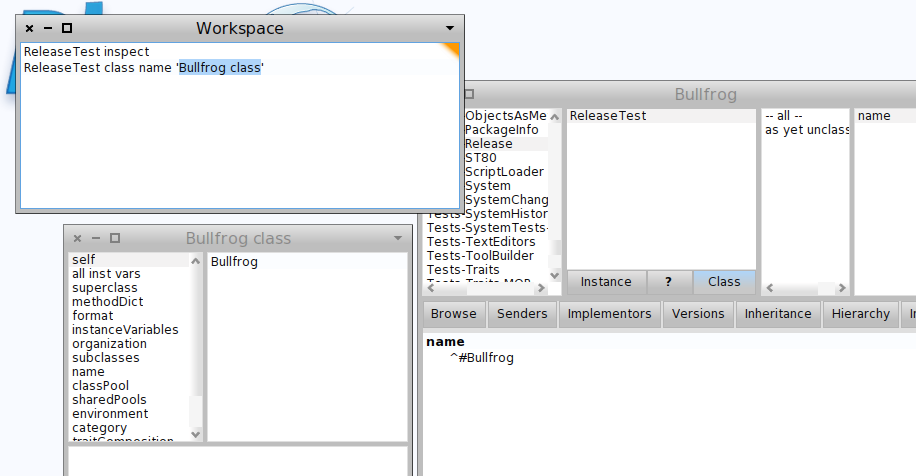

Do you really get that ? :) Stef On Aug 13, 2011, at 5:15 PM, Alexander LazareviÄ wrote:
2011/8/13 Lukas Renggli <renggli@gmail.com> Just for fun, try implementing #name on the class-side. Your image is pretty much hosed :-)
I guess that depends on what that name method does return, no? If it's a String or Symbol it looks funny, but the image doesn't seem to be hosed. :)
Alex <bullfrog.png>

I want to state that I naively and accidentally experienced this. I was using #name as a temp variable in a class method, representing the name of a file. I did not notice that my anticipated temp variable was not a temporary variable but rather a variable that once assigned to change the name of my class. I corrupted several images with this method before tracking down what was the cause of my corruption. I was not attempting to use #name as a class or instance variable. So this discussion did not come to memory. I just wanted to add my experience to the archives of this list so that others may understand the dangers involved and possibly help with discovery of their problem should they make the same mistake. Jimmie On 8/13/2011 9:39 AM, Lukas Renggli wrote:
Just for fun, try implementing #name on the class-side. Your image is pretty much hosed :-)
Lukas
On 13 August 2011 15:43, Max Leske<maxleske@gmail.com> wrote:
I have. For example:
Implement #name in a couple of classes that form a hierarchy. Since #name is implemented in Object, you might not implement #name in an abstract superclass to send "self subclassResponsibility". Now, if you forget to implement #name in one of the classes in your hierarchy, you don't get a DNU but some cryptic exception since the value you expect from #name is not the one you get.
I know, this isn't really that tragic but I've had it happen to me twice I think and both times I spent a couple of minutes tracking down the problem. Think of the time that is lost if only a couple of us encounter this problem once or twice.
Max
On 12.08.2011, at 19:18, Pat Maddox wrote:
I use #name all over the place and have never had problems.
On Aug 12, 2011, at 9:35 AM, "Sean P. DeNigris"<sean@clipperadams.com> wrote:
How is #name used by the system? I often want to use it in my classes, but I don't want to mess with whatever Object is doing with it. There are +++ senders.
On the flip side, should the system use a different, more specific, intention-revealing selector to avoid this confusion?
Thanks. Sean
-- View this message in context: http://forum.world.st/name-tp3739677p3739677.html Sent from the Pharo Smalltalk mailing list archive at Nabble.com.
On Aug 12, 2011, at 5:35 PM, Sean P. DeNigris wrote:
How is #name used by the system? I often want to use it in my classes, but I don't want to mess with whatever Object is doing with it. There are +++ senders.
Yes name is object is quite a bad smell to me. This is on my radar to nule setname: and friends. Since this is only used to give name to part in etoyish morphic If I remember also pay attention for class methods too.
On the flip side, should the system use a different, more specific, intention-revealing selector to avoid this confusion?
Thanks. Sean
-- View this message in context: http://forum.world.st/name-tp3739677p3739677.html Sent from the Pharo Smalltalk mailing list archive at Nabble.com.

I looked at this early on, and decided that since Object>>name is defined in terns of #printString, there couldn't be anything terribly important happening with the result, because #printSring is not under the system's control. I have freely added name as an instance variable in many classes. Process>>name and #name: are interesting. I didn't do the hash part, but I advocated for adding the name aspect to Process, and was very much surprised to see it adopted. This was in the days when most requests for changes prompted a reply something like "Do you realize that YOU can do that to YOUR image?" - emphasis added, but it was always clearly present. However, it has apparently been there since 2002. If there were going to be problems, I think we would have seen them by now :) That of course does nothing to fix the real problem, but I think it does provide evidence that one can safely ignore Object>>name. Bill ________________________________________ From: pharo-project-bounces@lists.gforge.inria.fr [pharo-project-bounces@lists.gforge.inria.fr] On Behalf Of Stéphane Ducasse [stephane.ducasse@inria.fr] Sent: Saturday, August 13, 2011 9:39 AM To: Pharo-project@lists.gforge.inria.fr Subject: Re: [Pharo-project] #name On Aug 12, 2011, at 5:35 PM, Sean P. DeNigris wrote:
How is #name used by the system? I often want to use it in my classes, but I don't want to mess with whatever Object is doing with it. There are +++ senders.
Yes name is object is quite a bad smell to me. This is on my radar to nule setname: and friends. Since this is only used to give name to part in etoyish morphic If I remember also pay attention for class methods too.
On the flip side, should the system use a different, more specific, intention-revealing selector to avoid this confusion?
Thanks. Sean
-- View this message in context: http://forum.world.st/name-tp3739677p3739677.html Sent from the Pharo Smalltalk mailing list archive at Nabble.com.

Hi Sean--
How is #name used by the system? I often want to use it in my classes, but I don't want to mess with whatever Object is doing with it. There are +++ senders.
And several implementers that could be using more descriptive selectors, too, which makes answering the question harder, of course.
On the flip side, should the system use a different, more specific, intention-revealing selector to avoid this confusion?
Certainly. From my work with minimal systems (which includes logging many specific send-sites), I'm convinced that this behavior should have a more descriptive selector, and is not essential to Object anyway. -C -- Craig Latta www.netjam.org/resume +31 6 2757 7177 + 1 415 287 3547
participants (9)
-
 Alexander LazareviÄ
 -
 Craig Latta
 -
 Jimmie Houchin
 -
 Lukas Renggli
 -
 Max Leske
 -
 Pat Maddox
 -
 Schwab,Wilhelm K
 -
 Sean P. DeNigris
 -
 Stéphane Ducasse