
Hi guys if Pharo is key for you then you should ask yourself what you did for Pharo recently. Writing code, writing documentation helping closing bug entries, participating to the association, to the consortium... Pharo is not happening from spontaneous generation. Stef

How does "extending Pharo help tool " sounds ? :) I am struggling to learn how morphic really works, especially TreeMorph. -- View this message in context: http://forum.world.st/if-Pharo-is-key-for-you-tp4708875p4708917.html Sent from the Pharo Smalltalk Developers mailing list archive at Nabble.com.

Stephane, This mail is in part a personal disclaimer and in part "a suggestion". In my case I'm chasing a big customer prospect (took longer than expected but we're almost there), at the beginning of this year we decided to use Pharo as the backend technology. But I already work as a full time Smalltalk PM+Developer and I don't have more than a few hours per week to dedicate to develop the core business of our project (which also has an Android client that also absorbs a lot of time). Being part of a loyal user base that promotes Pharo on every chance is important, maybe not as important as pushing code/docs back to the community, or paying a yearly fee. But I think that the user base, as humble or small as it might be, _must not be disregarded_. Today the overlap between the user base and the contributors is big, but I wouldn't see an small overlap as a bad thing. In fact it would be a good thing! Nobody would claim that Wikipedia is a failure because 99.98% of the readers never edit. On the other hand Business model/Funding is a WHOLE different story. Regards, Esteban. Esteban A. Maringolo 2013/9/18 kilon <thekilon@yahoo.co.uk>:
How does "extending Pharo help tool " sounds ? :)
I am struggling to learn how morphic really works, especially TreeMorph.
-- View this message in context: http://forum.world.st/if-Pharo-is-key-for-you-tp4708875p4708917.html Sent from the Pharo Smalltalk Developers mailing list archive at Nabble.com.
On Sep 18, 2013, at 3:35 PM, Esteban A. Maringolo <emaringolo@gmail.com> wrote:
Stephane,
This mail is in part a personal disclaimer and in part "a suggestion".
In my case I'm chasing a big customer prospect (took longer than expected but we're almost there),
cool I cross my fingers for you :)
at the beginning of this year we decided to use Pharo as the backend technology. But I already work as a full time Smalltalk PM+Developer and I don't have more than a few hours per week to dedicate to develop the core business of our project (which also has an Android client that also absorbs a lot of time).
I see and I understand.
Being part of a loyal user base that promotes Pharo on every chance is important,
Yes that too :)
maybe not as important as pushing code/docs back to the community, or paying a yearly fee.
But I think that the user base, as humble or small as it might be, _must not be disregarded_.
Did we ever give this impression? I hope not.
Today the overlap between the user base and the contributors is big, but I wouldn't see an small overlap as a bad thing. In fact it would be a good thing!
Nobody would claim that Wikipedia is a failure because 99.98% of the readers never edit. On the other hand Business model/Funding is a WHOLE different story.
Indeed. Still my question remains valid :). Stef
2013/9/18 Stéphane Ducasse <stephane.ducasse@inria.fr>:
On Sep 18, 2013, at 3:35 PM, Esteban A. Maringolo <emaringolo@gmail.com> wrote:
Stephane,
This mail is in part a personal disclaimer and in part "a suggestion".
In my case I'm chasing a big customer prospect (took longer than expected but we're almost there),
cool I cross my fingers for you :)
Keep them crossed ;-)
But I think that the user base, as humble or small as it might be, _must not be disregarded_.
Did we ever give this impression? I hope not. Still my question remains valid :).
I remember having read that if we want to make Pharo better we have to provide measurable contributions. As if opinions didn't count as such. They're certainly not measurable, but such expressions discourage/mute people enthusiasm (those whom have a lot of enthusiasm will stay though). Having that said, I'm happy with what I see and use everyday. The Pharo vision is getting real everyday. On the other hand, even considering myself a seasoned Smalltalker (VSE, VAST, Dolphin), the learning curve of Pharo "tools" and workflow requires dedication, is not as intuitive as one might think once used to them. Magic word for Pharo 3 and beyond: "convergence" :) Regards!
Stephane,
This mail is in part a personal disclaimer and in part "a suggestion".
In my case I'm chasing a big customer prospect (took longer than expected but we're almost there),
cool I cross my fingers for you :)
Keep them crossed ;-)
But I think that the user base, as humble or small as it might be, _must not be disregarded_.
Did we ever give this impression? I hope not. Still my question remains valid :).
I remember having read that if we want to make Pharo better we have to provide measurable contributions. As if opinions didn't count as such. They're certainly not measurable, but such expressions discourage/mute people enthusiasm (those whom have a lot of enthusiasm will stay though).
Having that said, I'm happy with what I see and use everyday. The Pharo vision is getting real everyday.
On the other hand, even considering myself a seasoned Smalltalker (VSE, VAST, Dolphin), the learning curve of Pharo "tools" and workflow requires dedication, is not as intuitive as one might think once used to them.
Magic word for Pharo 3 and beyond: "convergence" :)
We were discussing that for Pharo4.0 we will focus on tools (in addition to the rest) For Pharo3.0: OPAL and Athens.

kilon <thekilon@yahoo.co.uk> writes:
How does "extending Pharo help tool " sounds ? :)
I am struggling to learn how morphic really works, especially TreeMorph. Well that is a thing I tried more than once, but somehow I never understood on how to make good use for Morphic for me. I checked a lot of tutorial but then even simple things like menues seem to be doable but not for me..
It is strange and not "nice". Regards Friedrich
This is why I insist on collecting things on one place, inside pharo. Web is all over the place, its great for finding information and for getting people work together , but not great learning things you are not familiar with. Actually GUI wise Mophics is one the best examples. Think about it, if you try to use any GUI in python for example, you are out of luck it has none. Even Tkinter which is the gui it comes with cpython is not coded in python , its coded in tk a scripiting language. Python GUI APIs widely used include PyGTK , PyQT , WxPython , all of them wrappers for C/C++ libraries. Other dynamic languages follow the same recipe. Of course these frameworks are much more documented than morphic , but unlike morphic they follow a monolithic widget architecture, and modifying the source in any way requires a mandatory knowledge of C/C++. And we should exclude their myriad of problem , GTKs notorious buginess on macos and windows , QT massive complexity for big GUIs up to the point it offer a dedicated programming language QML just for designing GUIs. On the other hand morphic is to a very large extend smalltalk. So you get a lot of power but also a lot more simplicity. Some areas however are in need for some more love and of course documentation is lacking and the speed of the gui is far from breathtaking. Morphic is a very big reason why I am with pharo, to be exact I find its ability to do visual coding and transform a smalltalk object to a visual element very appealing and I would love to work on that. Morphic halos is another very nice feature. The other reason is live coding of course. I will try to add to the documentation of morphic, I agree 100% we need more of it. FDominicus wrote
kilon <
thekilon@.co
> writes:
How does "extending Pharo help tool " sounds ? :)
I am struggling to learn how morphic really works, especially TreeMorph. Well that is a thing I tried more than once, but somehow I never understood on how to make good use for Morphic for me. I checked a lot of tutorial but then even simple things like menues seem to be doable but not for me..
It is strange and not "nice".
Regards Friedrich
-- View this message in context: http://forum.world.st/if-Pharo-is-key-for-you-tp4708875p4709143.html Sent from the Pharo Smalltalk Developers mailing list archive at Nabble.com.

2013/9/19 kilon <thekilon@yahoo.co.uk>
This is why I insist on collecting things on one place, inside pharo. Web is all over the place, its great for finding information and for getting people work together , but not great learning things you are not familiar with.
Why not having the documentation the same way as in Eclipse ?
I mean the documentation would be on the web, available to anyone, and each class / each package inside Pharo has a link towards its online documentation. This way the image size does not grow because of massive documentation. It could be that showing the documentation of a class / package in Pharo would directly show inside Pharo a view of the web page corresponding to its actual documentation.
Actually GUI wise Mophics is one the best examples. Think about it, if you try to use any GUI in python for example, you are out of luck it has none. Even Tkinter which is the gui it comes with cpython is not coded in python , its coded in tk a scripiting language. Python GUI APIs widely used include PyGTK , PyQT , WxPython , all of them wrappers for C/C++ libraries. Other dynamic languages follow the same recipe.
Of course these frameworks are much more documented than morphic , but unlike morphic they follow a monolithic widget architecture, and modifying the source in any way requires a mandatory knowledge of C/C++. And we should exclude their myriad of problem , GTKs notorious buginess on macos and windows , QT massive complexity for big GUIs up to the point it offer a dedicated programming language QML just for designing GUIs.
On the other hand morphic is to a very large extend smalltalk. So you get a lot of power but also a lot more simplicity. Some areas however are in need for some more love and of course documentation is lacking and the speed of the gui is far from breathtaking.
Morphic is a very big reason why I am with pharo, to be exact I find its ability to do visual coding and transform a smalltalk object to a visual element very appealing and I would love to work on that. Morphic halos is another very nice feature. The other reason is live coding of course.
I will try to add to the documentation of morphic, I agree 100% we need more of it.
FDominicus wrote
kilon <
thekilon@.co
writes:
How does "extending Pharo help tool " sounds ? :)
I am struggling to learn how morphic really works, especially TreeMorph. Well that is a thing I tried more than once, but somehow I never understood on how to make good use for Morphic for me. I checked a lot of tutorial but then even simple things like menues seem to be doable but not for me..
It is strange and not "nice".
Regards Friedrich
-- View this message in context: http://forum.world.st/if-Pharo-is-key-for-you-tp4708875p4709143.html Sent from the Pharo Smalltalk Developers mailing list archive at Nabble.com.

On Sep 19, 2013, at 2:36 PM, Clément Bera <bera.clement@gmail.com> wrote:
2013/9/19 kilon <thekilon@yahoo.co.uk> This is why I insist on collecting things on one place, inside pharo. Web is all over the place, its great for finding information and for getting people work together , but not great learning things you are not familiar with.
Why not having the documentation the same way as in Eclipse ?
I mean the documentation would be on the web, available to anyone, and each class / each package inside Pharo has a link towards its online documentation. This way the image size does not grow because of massive documentation. It could be that showing the documentation of a class / package in Pharo would directly show inside Pharo a view of the web page corresponding to its actual documentation.
+1
Actually GUI wise Mophics is one the best examples. Think about it, if you try to use any GUI in python for example, you are out of luck it has none. Even Tkinter which is the gui it comes with cpython is not coded in python , its coded in tk a scripiting language. Python GUI APIs widely used include PyGTK , PyQT , WxPython , all of them wrappers for C/C++ libraries. Other dynamic languages follow the same recipe.
Of course these frameworks are much more documented than morphic , but unlike morphic they follow a monolithic widget architecture, and modifying the source in any way requires a mandatory knowledge of C/C++. And we should exclude their myriad of problem , GTKs notorious buginess on macos and windows , QT massive complexity for big GUIs up to the point it offer a dedicated programming language QML just for designing GUIs.
On the other hand morphic is to a very large extend smalltalk. So you get a lot of power but also a lot more simplicity. Some areas however are in need for some more love and of course documentation is lacking and the speed of the gui is far from breathtaking.
Morphic is a very big reason why I am with pharo, to be exact I find its ability to do visual coding and transform a smalltalk object to a visual element very appealing and I would love to work on that. Morphic halos is another very nice feature. The other reason is live coding of course.
I will try to add to the documentation of morphic, I agree 100% we need more of it.
FDominicus wrote
kilon <
thekilon@.co
writes:
How does "extending Pharo help tool " sounds ? :)
I am struggling to learn how morphic really works, especially TreeMorph. Well that is a thing I tried more than once, but somehow I never understood on how to make good use for Morphic for me. I checked a lot of tutorial but then even simple things like menues seem to be doable but not for me..
It is strange and not "nice".
Regards Friedrich
-- View this message in context: http://forum.world.st/if-Pharo-is-key-for-you-tp4708875p4709143.html Sent from the Pharo Smalltalk Developers mailing list archive at Nabble.com.

On 19 September 2013 14:36, Clément Bera <bera.clement@gmail.com> wrote:
2013/9/19 kilon <thekilon@yahoo.co.uk>
This is why I insist on collecting things on one place, inside pharo. Web is all over the place, its great for finding information and for getting people work together , but not great learning things you are not familiar with.
Why not having the documentation the same way as in Eclipse ?
I mean the documentation would be on the web, available to anyone, and each class / each package inside Pharo has a link towards its online documentation. This way the image size does not grow because of massive documentation. It could be that showing the documentation of a class / package in Pharo would directly show inside Pharo a view of the web page corresponding to its actual documentation.
even more, not only view, but also edit it in place. then we need just a simple server setup with REST protocol, which can be easily used by image via Zinc..
Actually GUI wise Mophics is one the best examples. Think about it, if you
try to use any GUI in python for example, you are out of luck it has none. Even Tkinter which is the gui it comes with cpython is not coded in python , its coded in tk a scripiting language. Python GUI APIs widely used include PyGTK , PyQT , WxPython , all of them wrappers for C/C++ libraries. Other dynamic languages follow the same recipe.
Of course these frameworks are much more documented than morphic , but unlike morphic they follow a monolithic widget architecture, and modifying the source in any way requires a mandatory knowledge of C/C++. And we should exclude their myriad of problem , GTKs notorious buginess on macos and windows , QT massive complexity for big GUIs up to the point it offer a dedicated programming language QML just for designing GUIs.
On the other hand morphic is to a very large extend smalltalk. So you get a lot of power but also a lot more simplicity. Some areas however are in need for some more love and of course documentation is lacking and the speed of the gui is far from breathtaking.
Morphic is a very big reason why I am with pharo, to be exact I find its ability to do visual coding and transform a smalltalk object to a visual element very appealing and I would love to work on that. Morphic halos is another very nice feature. The other reason is live coding of course.
I will try to add to the documentation of morphic, I agree 100% we need more of it.
FDominicus wrote
kilon <
thekilon@.co
writes:
How does "extending Pharo help tool " sounds ? :)
I am struggling to learn how morphic really works, especially TreeMorph. Well that is a thing I tried more than once, but somehow I never understood on how to make good use for Morphic for me. I checked a lot of tutorial but then even simple things like menues seem to be doable but not for me..
It is strange and not "nice".
Regards Friedrich
-- View this message in context: http://forum.world.st/if-Pharo-is-key-for-you-tp4708875p4709143.html Sent from the Pharo Smalltalk Developers mailing list archive at Nabble.com.
-- Best regards, Igor Stasenko.
*As long as I can view the documentation inside Pharo , thats perfectly fine for me. * When I said I will extend the pharo help tool, I only meant it in a minimum kinda of way. Small convenience like basic navigation, shortcut bindings, possibly embedding in with system browser and debugger , index search , links (not www links, but links to the documentation) and images. These things don't exist now, and I dont see anyone working on such features, so I decided it was time for DIY. I prefer my documentation the Spartan way, simple and straight to the point. I think 99% of the issue here is finding people willing to document Pharo. I will most certainly do my part, but we need to motivate people to document at least libraries they make , in a single place. Whether that is the image , or the web, makes small diffirence. What matters is documentation itself. I don't have unrealistic expectations of pharo in general , I know we are small but active community , but still small.
From my side, I will document NBOpenGL with my GLTutorials , Nativeboost and Morphic. All that documentation will be of course gradual , slow and partial as to be expected from a person with very limited free time.
I also don't care about wikis as much I care about internal documentation. Its a matter of convenience. But I have been using wikis and google searches when internal docs were simply not an option. So there is definitely room for everything here and I would never even dream of discouraging anyone from trying his own idea of how to do stuff. As matter of fact I love variation and original ideas :) Clément Bera-4 wrote
2013/9/19 kilon <
thekilon@.co
>
This is why I insist on collecting things on one place, inside pharo. Web is all over the place, its great for finding information and for getting people work together , but not great learning things you are not familiar with.
Why not having the documentation the same way as in Eclipse ?
I mean the documentation would be on the web, available to anyone, and each class / each package inside Pharo has a link towards its online documentation. This way the image size does not grow because of massive documentation. It could be that showing the documentation of a class / package in Pharo would directly show inside Pharo a view of the web page corresponding to its actual documentation.
Actually GUI wise Mophics is one the best examples. Think about it, if you try to use any GUI in python for example, you are out of luck it has none. Even Tkinter which is the gui it comes with cpython is not coded in python , its coded in tk a scripiting language. Python GUI APIs widely used include PyGTK , PyQT , WxPython , all of them wrappers for C/C++ libraries. Other dynamic languages follow the same recipe.
Of course these frameworks are much more documented than morphic , but unlike morphic they follow a monolithic widget architecture, and modifying the source in any way requires a mandatory knowledge of C/C++. And we should exclude their myriad of problem , GTKs notorious buginess on macos and windows , QT massive complexity for big GUIs up to the point it offer a dedicated programming language QML just for designing GUIs.
On the other hand morphic is to a very large extend smalltalk. So you get a lot of power but also a lot more simplicity. Some areas however are in need for some more love and of course documentation is lacking and the speed of the gui is far from breathtaking.
Morphic is a very big reason why I am with pharo, to be exact I find its ability to do visual coding and transform a smalltalk object to a visual element very appealing and I would love to work on that. Morphic halos is another very nice feature. The other reason is live coding of course.
I will try to add to the documentation of morphic, I agree 100% we need more of it.
FDominicus wrote
kilon <
thekilon@.co
writes:
How does "extending Pharo help tool " sounds ? :)
I am struggling to learn how morphic really works, especially TreeMorph. Well that is a thing I tried more than once, but somehow I never understood on how to make good use for Morphic for me. I checked a lot of tutorial but then even simple things like menues seem to be doable but not for me..
It is strange and not "nice".
Regards Friedrich
-- View this message in context: http://forum.world.st/if-Pharo-is-key-for-you-tp4708875p4709143.html Sent from the Pharo Smalltalk Developers mailing list archive at Nabble.com.
-- View this message in context: http://forum.world.st/if-Pharo-is-key-for-you-tp4708875p4709184.html Sent from the Pharo Smalltalk Developers mailing list archive at Nabble.com.

Clément Bera-4 wrote
the documentation would be on the web, available to anyone, and each class / each package inside Pharo has a link towards its online documentation. This way the image size does not grow because of massive documentation.
I agree that it would be nice for the docs to be on the web. But for me I would want that to be a mirror of what's available in the image. In general, I'd rather not context switch between the live, dynamic world of my image and a browser. Also, I don't think saving image size is enough of a benefit. Pharo is already tiny compared to other technologies, and the documentation would presumably be removed for production anyway. My 2c... ----- Cheers, Sean -- View this message in context: http://forum.world.st/if-Pharo-is-key-for-you-tp4708875p4709505.html Sent from the Pharo Smalltalk Developers mailing list archive at Nabble.com.

Hi, Indeed. Having documentation on the web is nice for exposure, but we have to bring the documentation in the environment for reducing the context switch. As for the size, I would love to have the problem of having to remove 50MB of documentation from the image :) Doru On Sat, Sep 21, 2013 at 3:35 PM, Sean P. DeNigris <sean@clipperadams.com>wrote:
Clément Bera-4 wrote
the documentation would be on the web, available to anyone, and each class / each package inside Pharo has a link towards its online documentation. This way the image size does not grow because of massive documentation.
I agree that it would be nice for the docs to be on the web. But for me I would want that to be a mirror of what's available in the image. In general, I'd rather not context switch between the live, dynamic world of my image and a browser. Also, I don't think saving image size is enough of a benefit. Pharo is already tiny compared to other technologies, and the documentation would presumably be removed for production anyway. My 2c...
----- Cheers, Sean -- View this message in context: http://forum.world.st/if-Pharo-is-key-for-you-tp4708875p4709505.html Sent from the Pharo Smalltalk Developers mailing list archive at Nabble.com.
-- www.tudorgirba.com "Every thing has its own flow"
Hi,
Indeed. Having documentation on the web is nice for exposure, but we have to bring the documentation in the environment for reducing the context switch.
As for the size, I would love to have the problem of having to remove 50MB of documentation from the image :)
if only :) But deep into pharo is 340 pages and Pharo for the entreprise starts to get large already. So if people would - write good class comments - tests with testThisGuyShouldBehaveLike that - participate to chapters then we have the documentation but talking is so simpler :D stef
Doru
On Sat, Sep 21, 2013 at 3:35 PM, Sean P. DeNigris <sean@clipperadams.com> wrote: Clément Bera-4 wrote
the documentation would be on the web, available to anyone, and each class / each package inside Pharo has a link towards its online documentation. This way the image size does not grow because of massive documentation.
I agree that it would be nice for the docs to be on the web. But for me I would want that to be a mirror of what's available in the image. In general, I'd rather not context switch between the live, dynamic world of my image and a browser. Also, I don't think saving image size is enough of a benefit. Pharo is already tiny compared to other technologies, and the documentation would presumably be removed for production anyway. My 2c...
----- Cheers, Sean -- View this message in context: http://forum.world.st/if-Pharo-is-key-for-you-tp4708875p4709505.html Sent from the Pharo Smalltalk Developers mailing list archive at Nabble.com.
-- www.tudorgirba.com
"Every thing has its own flow"
I agree 100% to fear the probability of image growing in size by 50 mbs is at best wishful thinking. Why ? Lets do the math. Taking a look at my word files shows me that 100kb files contains 25 pages that are 5000 words. You think 340 pages is alot ? Well if you do the math you will discover its nothing compared to 12.500 pages (for our american friends thats 12 thousands 500 pages) or 2,5 million (around 200 words per page) words of 50 mbs of documentation. And that could be even more depending on how much memory pharo consumes for regular text. Whos is going to write the first 1000 pages ? Dream on :D Plus I dont even think pharo would ever need such big documentation, at best I see 2-4 mbs growth in size for a 500-1000 pages documentation which should be more than fine and probably more than what most development enviroments out there can offer. Clearly Pharo is not far from this goal. The only problem is that we need to move this documentation inside the image (and potentially online and keeping supporting pdfs , latext etc ) and maybe polish it abit here and there and we will have accomplished a realistic goal. After that we can worry how to add up to 50 mbs of additional documentation. Stéphane Ducasse wrote
Hi,
Indeed. Having documentation on the web is nice for exposure, but we have to bring the documentation in the environment for reducing the context switch.
As for the size, I would love to have the problem of having to remove 50MB of documentation from the image :)
if only :)
But deep into pharo is 340 pages and Pharo for the entreprise starts to get large already. So if people would - write good class comments - tests with testThisGuyShouldBehaveLike that - participate to chapters
then we have the documentation but talking is so simpler :D
stef
Doru
On Sat, Sep 21, 2013 at 3:35 PM, Sean P. DeNigris <
sean@
> wrote:
Clément Bera-4 wrote
the documentation would be on the web, available to anyone, and each class / each package inside Pharo has a link towards its online documentation. This way the image size does not grow because of massive documentation.
I agree that it would be nice for the docs to be on the web. But for me I would want that to be a mirror of what's available in the image. In general, I'd rather not context switch between the live, dynamic world of my image and a browser. Also, I don't think saving image size is enough of a benefit. Pharo is already tiny compared to other technologies, and the documentation would presumably be removed for production anyway. My 2c...
----- Cheers, Sean -- View this message in context: http://forum.world.st/if-Pharo-is-key-for-you-tp4708875p4709505.html Sent from the Pharo Smalltalk Developers mailing list archive at Nabble.com.
-- www.tudorgirba.com
"Every thing has its own flow"
-- View this message in context: http://forum.world.st/if-Pharo-is-key-for-you-tp4708875p4709587.html Sent from the Pharo Smalltalk Developers mailing list archive at Nabble.com.

Amen. FWIW, I am promoting Pharo as a technology I'll use during the eGov Hackathon Weekend in early october. http://geoportail.wallonie.be/cms/home/agenda/agenda/hackathon-egov-wallonia... http://hackathonegovwallonia.net/ "C*hacun des prototypes de service ou dâapplications* développés au cours et dans le cadre du Hackathon eGov Wallonia feront lâobjet dâune *vaste publicité"* * * *Well, I guess I'll manage to get some Pharo mentions in there.* * * *(And I paid the EUR 85 ticket to get in, damnit.)* * * */Phil*
On Sep 18, 2013, at 4:00 PM, phil@highoctane.be wrote:
Amen.
FWIW, I am promoting Pharo as a technology I'll use during the eGov Hackathon Weekend in early october.
http://geoportail.wallonie.be/cms/home/agenda/agenda/hackathon-egov-wallonia... http://hackathonegovwallonia.net/
"Chacun des prototypes de service ou dâapplications développés au cours et dans le cadre du Hackathon eGov Wallonia feront lâobjet dâune vaste publicité"
Excellent!
Well, I guess I'll manage to get some Pharo mentions in there.
(And I paid the EUR 85 ticket to get in, damnit.)
the association can reimbruse you if you want.
/Phil
Nah, forget about the money. What I'd be interested in is any code/framework for GIS open data reading / Google Maps integration / Open Street Map stuff. I am going to spend a couple hours tomorrow looking and reading some data into Pharo (maybe using PetitParser and the XML stuff in the process). Here is a set of data I'll be looking at. http://www.symbaloo.com/mix/hackathonegov Question: are they any Pharo materials I can use to distribute around (except the leaflet) ? That's a case where Pharo T-shirts/stickers would come in handy. Open Data, Open Source, Public Sector, hey... Send me pointers so that I can arrange stuff for early october. Oh, another thing, I've the possibility to talk to future Polytechnic Engineers in november about mobile apps. I will for sure stick some Pharo in there (e.g. Seaside + jQuery Mobile) Regards, --- Philippe Back Dramatic Performance Improvements Mob: +32(0) 478 650 140 | Fax: +32 (0) 70 408 027 Mail:phil@highoctane.be | Web: http://philippeback.eu Blog: http://philippeback.be | Twitter: @philippeback Youtube: http://www.youtube.com/user/philippeback/videos High Octane SPRL rue cour Boisacq 101 | 1301 Bierges | Belgium Pharo Consortium Member - http://consortium.pharo.org/ Featured on the Software Process and Measurement Cast - http://spamcast.libsyn.com Sparx Systems Enterprise Architect and Ability Engineering EADocX Value Added Reseller On Wed, Sep 18, 2013 at 4:56 PM, Stéphane Ducasse <stephane.ducasse@inria.fr
wrote:
On Sep 18, 2013, at 4:00 PM, phil@highoctane.be wrote:
Amen.
FWIW, I am promoting Pharo as a technology I'll use during the eGov Hackathon Weekend in early october.
http://geoportail.wallonie.be/cms/home/agenda/agenda/hackathon-egov-wallonia... http://hackathonegovwallonia.net/
"C*hacun des prototypes de service ou dâapplications* développés au cours et dans le cadre du Hackathon eGov Wallonia feront lâobjet dâune *vaste publicité"*
Excellent!
* * *Well, I guess I'll manage to get some Pharo mentions in there.* * * *(And I paid the EUR 85 ticket to get in, damnit.)*
the association can reimbruse you if you want.
* * */Phil*
On Sep 18, 2013, at 5:21 PM, phil@highoctane.be wrote:
Nah, forget about the money.
What I'd be interested in is any code/framework for GIS open data reading / Google Maps integration / Open Street Map stuff.
I proposed a bachelor on open street map. I should publishe the topics :)
I am going to spend a couple hours tomorrow looking and reading some data into Pharo (maybe using PetitParser and the XML stuff in the process).
Here is a set of data I'll be looking at. http://www.symbaloo.com/mix/hackathonegov
Question: are they any Pharo materials I can use to distribute around (except the leaflet) ?
I did that to get started.
That's a case where Pharo T-shirts/stickers would come in handy. Open Data, Open Source, Public Sector, hey... Send me pointers so that I can arrange stuff for early october.
Oh, another thing, I've the possibility to talk to future Polytechnic Engineers in november about mobile apps. I will for sure stick some Pharo in there (e.g. Seaside + jQuery Mobile)
If you need some slides let us know. I just gave all my slides to Alain for his lecture
Regards,
--- Philippe Back Dramatic Performance Improvements Mob: +32(0) 478 650 140 | Fax: +32 (0) 70 408 027 Mail:phil@highoctane.be | Web: http://philippeback.eu Blog: http://philippeback.be | Twitter: @philippeback Youtube: http://www.youtube.com/user/philippeback/videos
High Octane SPRL rue cour Boisacq 101 | 1301 Bierges | Belgium
Pharo Consortium Member - http://consortium.pharo.org/ Featured on the Software Process and Measurement Cast - http://spamcast.libsyn.com Sparx Systems Enterprise Architect and Ability Engineering EADocX Value Added Reseller
On Wed, Sep 18, 2013 at 4:56 PM, Stéphane Ducasse <stephane.ducasse@inria.fr> wrote:
On Sep 18, 2013, at 4:00 PM, phil@highoctane.be wrote:
Amen.
FWIW, I am promoting Pharo as a technology I'll use during the eGov Hackathon Weekend in early october.
http://geoportail.wallonie.be/cms/home/agenda/agenda/hackathon-egov-wallonia... http://hackathonegovwallonia.net/
"Chacun des prototypes de service ou dâapplications développés au cours et dans le cadre du Hackathon eGov Wallonia feront lâobjet dâune vaste publicité"
Excellent!
Well, I guess I'll manage to get some Pharo mentions in there.
(And I paid the EUR 85 ticket to get in, damnit.)
the association can reimbruse you if you want.
/Phil
2013/9/18 Stéphane Ducasse <stephane.ducasse@inria.fr>:
On Sep 18, 2013, at 5:21 PM, phil@highoctane.be wrote:
What I'd be interested in is any code/framework for GIS open data reading / Google Maps integration / Open Street Map stuff.
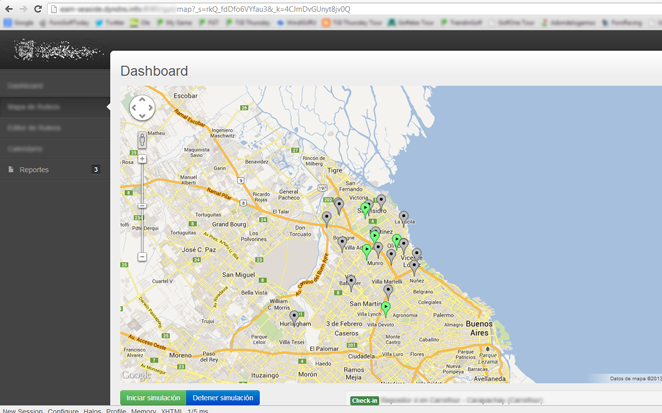
What do you mean by "Google Maps integration"? Attached goes a screenshot (*) of the pilot app I'm developing, it has a small set of JavaScript code on the client handling live updates coming from a Zinc Websocket (serialized by NeoJson), updates that were handled before by a Seaside-REST interface, handling requests coming from mobile clients. I plan to implement GeoJSON in my app and use it against the MongoDB of Voyage, but I didn't have time yet to properly integrate, not to mention to share it. Or by integration you mean Seaside integration? Like generating the map as if it were a seaside component? Regards, (*) Sorry it is blurred, I can't disclose more than this.

On 18 Sep 2013, at 21:41, "Esteban A. Maringolo" <emaringolo@gmail.com> wrote:
2013/9/18 Stéphane Ducasse <stephane.ducasse@inria.fr>:
On Sep 18, 2013, at 5:21 PM, phil@highoctane.be wrote:
What I'd be interested in is any code/framework for GIS open data reading / Google Maps integration / Open Street Map stuff.
What do you mean by "Google Maps integration"?
Attached goes a screenshot (*) of the pilot app I'm developing, it has a small set of JavaScript code on the client handling live updates coming from a Zinc Websocket (serialized by NeoJson), updates that were handled before by a Seaside-REST interface, handling requests coming from mobile clients.
I plan to implement GeoJSON in my app and use it against the MongoDB of Voyage, but I didn't have time yet to properly integrate, not to mention to share it.
Or by integration you mean Seaside integration? Like generating the map as if it were a seaside component?
Regards,
(*) Sorry it is blurred, I can't disclose more than this.
This is seriously cool, really. Too bad you can't say more ;-) I for one am very interested !
<Screenshot---Mapa.png>
Some sample datasets: http://data.gov.be/datasets --- Philippe Back Dramatic Performance Improvements Mob: +32(0) 478 650 140 | Fax: +32 (0) 70 408 027 Mail:phil@highoctane.be | Web: http://philippeback.eu Blog: http://philippeback.be | Twitter: @philippeback Youtube: http://www.youtube.com/user/philippeback/videos High Octane SPRL rue cour Boisacq 101 | 1301 Bierges | Belgium Pharo Consortium Member - http://consortium.pharo.org/ Featured on the Software Process and Measurement Cast - http://spamcast.libsyn.com Sparx Systems Enterprise Architect and Ability Engineering EADocX Value Added Reseller On Wed, Sep 18, 2013 at 11:32 PM, Sven Van Caekenberghe <sven@stfx.eu>wrote:
On 18 Sep 2013, at 21:41, "Esteban A. Maringolo" <emaringolo@gmail.com> wrote:
2013/9/18 Stéphane Ducasse <stephane.ducasse@inria.fr>:
On Sep 18, 2013, at 5:21 PM, phil@highoctane.be wrote:
What I'd be interested in is any code/framework for GIS open data reading / Google Maps integration / Open Street Map stuff.
What do you mean by "Google Maps integration"?
Attached goes a screenshot (*) of the pilot app I'm developing, it has a small set of JavaScript code on the client handling live updates coming from a Zinc Websocket (serialized by NeoJson), updates that were handled before by a Seaside-REST interface, handling requests coming from mobile clients.
I plan to implement GeoJSON in my app and use it against the MongoDB of Voyage, but I didn't have time yet to properly integrate, not to mention to share it.
Or by integration you mean Seaside integration? Like generating the map as if it were a seaside component?
Regards,
(*) Sorry it is blurred, I can't disclose more than this.
This is seriously cool, really. Too bad you can't say more ;-) I for one am very interested !
<Screenshot---Mapa.png>
OFF TOPIC. IGNORE AT WILL. 2013/9/18 Sven Van Caekenberghe <sven@stfx.eu>:
On 18 Sep 2013, at 21:41, "Esteban A. Maringolo" <emaringolo@gmail.com> wrote:
(*) Sorry it is blurred, I can't disclose more than this.
This is seriously cool, really. Too bad you can't say more ;-) I for one am very interested !
Well... that's an screenshot for a demo we did (no persistence, no authentication, no nothing, just the basic logic). Footnote: We built and demoed everything ALIVE so fast that they thought we already completed the development of the solution, others were still gathering requirements or doing Powerpoints... that's a key advantage of a self contained solution like Pharo. It hasn't changed much on the frontend (it should) but I've been working hard in the middleware and the android client (Java is a pain in the a** to debug, but the "user perceived value" is 100x of anything else you could do). STAMP will come handy if this gets real and with the planned user base of 200-1000 clients. I'm a big fan of all your frameworks. Meanwhile we just keep our fingers crossed... to have the pilot (50 users) approved... big companies are slow... Esteban A. Maringolo
On 19 Sep 2013, at 01:07, "Esteban A. Maringolo" <emaringolo@gmail.com> wrote:
OFF TOPIC. IGNORE AT WILL.
2013/9/18 Sven Van Caekenberghe <sven@stfx.eu>:
On 18 Sep 2013, at 21:41, "Esteban A. Maringolo" <emaringolo@gmail.com> wrote:
(*) Sorry it is blurred, I can't disclose more than this.
This is seriously cool, really. Too bad you can't say more ;-) I for one am very interested !
Well... that's an screenshot for a demo we did (no persistence, no authentication, no nothing, just the basic logic).
I understand. But what does it do, basically ? Show the positions of mobile devices on a map ? Are there two parts to the (web) app, a part on mobile devices and a part on a desktop ? What else does it do ? -- but I would understand if you prefer not to discuss it (yet)
Footnote: We built and demoed everything ALIVE so fast that they thought we already completed the development of the solution, others were still gathering requirements or doing Powerpoints... that's a key advantage of a self contained solution like Pharo.
Then you must have a good team with very good developers as well ;-)
It hasn't changed much on the frontend (it should) but I've been working hard in the middleware and the android client (Java is a pain in the a** to debug, but the "user perceived value" is 100x of anything else you could do). STAMP will come handy if this gets real and with the planned user base of 200-1000 clients. I'm a big fan of all your frameworks.
Thx.
Meanwhile we just keep our fingers crossed... to have the pilot (50 users) approved... big companies are slowâ¦
Good luck.
Esteban A. Maringolo
Sven
Yes, something like that. The ability to integrate a component showing a map with data from a collection mapping to it in a way and some Ajaxy popups with the details. Well, this is going to be a 3-day hackathon, not a full fledged dev. Thanks for the info. --- Philippe Back Dramatic Performance Improvements Mob: +32(0) 478 650 140 | Fax: +32 (0) 70 408 027 Mail:phil@highoctane.be | Web: http://philippeback.eu Blog: http://philippeback.be | Twitter: @philippeback Youtube: http://www.youtube.com/user/philippeback/videos High Octane SPRL rue cour Boisacq 101 | 1301 Bierges | Belgium Pharo Consortium Member - http://consortium.pharo.org/ Featured on the Software Process and Measurement Cast - http://spamcast.libsyn.com Sparx Systems Enterprise Architect and Ability Engineering EADocX Value Added Reseller On Wed, Sep 18, 2013 at 9:41 PM, Esteban A. Maringolo <emaringolo@gmail.com>wrote:
2013/9/18 Stéphane Ducasse <stephane.ducasse@inria.fr>:
On Sep 18, 2013, at 5:21 PM, phil@highoctane.be wrote:
What I'd be interested in is any code/framework for GIS open data reading / Google Maps integration / Open Street Map stuff.
What do you mean by "Google Maps integration"?
Attached goes a screenshot (*) of the pilot app I'm developing, it has a small set of JavaScript code on the client handling live updates coming from a Zinc Websocket (serialized by NeoJson), updates that were handled before by a Seaside-REST interface, handling requests coming from mobile clients.
I plan to implement GeoJSON in my app and use it against the MongoDB of Voyage, but I didn't have time yet to properly integrate, not to mention to share it.
Or by integration you mean Seaside integration? Like generating the map as if it were a seaside component?
Regards,
(*) Sorry it is blurred, I can't disclose more than this.
Sounds really cool. On Sep 18, 2013, at 9:41 PM, Esteban A. Maringolo <emaringolo@gmail.com> wrote:
2013/9/18 Stéphane Ducasse <stephane.ducasse@inria.fr>:
On Sep 18, 2013, at 5:21 PM, phil@highoctane.be wrote:
What I'd be interested in is any code/framework for GIS open data reading / Google Maps integration / Open Street Map stuff.
What do you mean by "Google Maps integration"?
Attached goes a screenshot (*) of the pilot app I'm developing, it has a small set of JavaScript code on the client handling live updates coming from a Zinc Websocket (serialized by NeoJson), updates that were handled before by a Seaside-REST interface, handling requests coming from mobile clients.
I plan to implement GeoJSON in my app and use it against the MongoDB of Voyage, but I didn't have time yet to properly integrate, not to mention to share it.
Or by integration you mean Seaside integration? Like generating the map as if it were a seaside component?
Regards,
(*) Sorry it is blurred, I can't disclose more than this. <Screenshot---Mapa.png>
participants (11)
-
 Clément Bera
 -
 Esteban A. Maringolo
 -
 Esteban Lorenzano
 -
 Friedrich Dominicus
 -
 Igor Stasenko
 -
 kilon
kilon -
 phil@highoctane.be
 -
 Sean P. DeNigris
 -
 Stéphane Ducasse
 -
 Sven Van Caekenberghe
 -
 Tudor Girba