
Hi the old inspector defined a hierarchy of specialized inspector and I was giving a lecture to serious programmers :) and I noticed that they were confused by the inspector when opening dictionary because we see the dictionary state. Stef

I do not fully understand what you mean, but I assume the difference between a basic inspector on the real fields of an object and a specialized dictionary inspector which shows the elements in the inspector? We added the custom dictionary inspector a while ago, plus there was the right-click menu with the basic-inspect entry. With the new inspector views you can switch between the basic inspectors and custom inspectors. Just do: Smalltalk globals inspect. and you have 3 choices now â+1 Collection Inspector (the original dictionary inspector) â+0 Basic Inspector (here alternatively â+1) â+3 Tree Inspector For other objects there are even more choices: World inspect. â+1 Basic Inspector â+2 Tree Inspector â+3 View Hierarchy Inspector â+4 Morphic Viewer (currently broken due to spec changes) On 2013-10-06, at 20:58, Stéphane Ducasse <stephane.ducasse@inria.fr> wrote:
Hi
the old inspector defined a hierarchy of specialized inspector and I was giving a lecture to serious programmers :) and I noticed that they were confused by the inspector when opening dictionary because we see the dictionary state.
Stef

On Oct 6, 2013, at 8:58 PM, Stéphane Ducasse <stephane.ducasse@inria.fr> wrote:
Hi
the old inspector defined a hierarchy of specialized inspector and I was giving a lecture to serious programmers :) and I noticed that they were confused by the inspector when opening dictionary because we see the dictionary state.
The new ones make this explicit: the menu on the top always lets you select the inspector. There always -> basic -> tree (explorer) and more if there is one. Now a class can define the default to be a different one that the basic. An example for that are collections. e.g. inspect Smalltalk globals World 1 FileSystem workingDirectory So for a Dictionary, you see key->value by default, but you can always jump to the basic inspector if needed. the only thing that is a bit confusing is that it show "class" and "self" in the basic inspector, but that very useful to have. (and technically class is a field in the object via the object header ;-) Marcus
the only thing that is a bit confusing is that it show "class" and "self" in the basic inspector, but that very useful to have. (and technically class is a field in the object via the object header ;-)
it would be nice to distinguish the calculated/virtual values by using a different font or icon...
Ok I see I was using Moose for the lecture so probably still in 2.0 Stef On Oct 6, 2013, at 9:26 PM, Camillo Bruni <camillobruni@gmail.com> wrote:
the only thing that is a bit confusing is that it show "class" and "self" in the basic inspector, but that very useful to have. (and technically class is a field in the object via the object header ;-)
it would be nice to distinguish the calculated/virtual values by using a different font or icon...

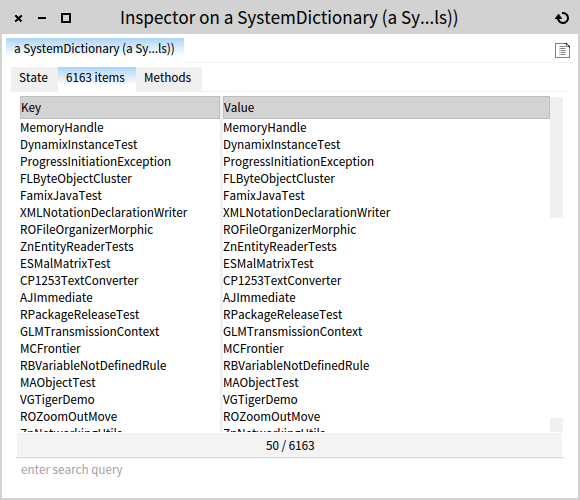
In the Moose image you should always use GTInspector which is mapped as the Explorer (Ctrl+Shift+i). This one gives you multiple facets to most important objects. For example a dictionary is represented as a table (see attached screenshot). Please look at this inspector for a bit. I believe it is significantly more advanced than anything I encountered in any IDE (including the new one in Pharo 3). Cheers, Doru [image: Inline image 1] On Sun, Oct 6, 2013 at 9:37 PM, Stéphane Ducasse <stephane.ducasse@inria.fr>wrote:
Ok I see I was using Moose for the lecture so probably still in 2.0
Stef
On Oct 6, 2013, at 9:26 PM, Camillo Bruni <camillobruni@gmail.com> wrote:
the only thing that is a bit confusing is that it show "class" and "self" in the basic inspector, but that very useful to have. (and technically class is a field in the object via the object header ;-)
it would be nice to distinguish the calculated/virtual values by using a different font or icon...
-- www.tudorgirba.com "Every thing has its own flow"
participants (4)
-
 Camillo Bruni
 -
 Marcus Denker
 -
 Stéphane Ducasse
 -
 Tudor Girba