[Pharo-project] Programming interactions with State Machines

Hello everyone! I'm here to tell you that I started experimenting with a Pharo implementation of this idea: http://swingstates.sourceforge.net/. For those into UI programming I really recommend reading the first paper cited in that page. It's for programming user interface interactions with state machines, an approach to avoid the classical "callback spaghetti" that sometimes we get with event handlers everywhere. I have a tiny first step that shows an example for changing the color of a button on mouse over and changing it back to the original color on mouse out. You can download the code from: http://smalltalkhub.com/mc/CarlaGriggio/StateMachines/main Evaluate this for executing the example: SMButton openWithStateMachineInteraction And here is the code of the state machine for that example: SMButton class >> openWithStateMachineInteraction |button stateMachine iddle hover | button := self new. stateMachine := *SMStateMachine* newForWidget: button. iddle := (*SMState* newWithName:'iddle') enter:[:stMachine | stMachine widget color: Color yellow ]; addTransition: ((*SMTransition* forEvent: 'mouse enter' withOutputState: 'hover') transitionAction: [:stMachine | stMachine widget color: Color red ]). hover := (*SMState* newWithName:'hover') addTransition: (*SMTransition* forEvent: 'mouse out' withOutputState: 'iddle'); addTransition: (*SMTransition* forEvent: 'mouse enter' withOutputState: 'hover'). stateMachine addState: iddle; addState: hover. stateMachine attachTo: button. ^button openInWorld That code corresponds to the following states diagram: [image: Inline image 2] I will keep experimenting with this during the next weeks, and specially try to compare the pros and cons with regular event handling. Something cool about this approach is that the same widget could change its interactive behaviour on the fly by just attaching a different interaction state machine to it :) Also, I'm doing this for programming user interface interactions, but it could be useful for anything that can be modelled with a state pattern. Is there something similar out there already working? I was so eager to try this that I didn't look for related existing projects. Cheers! Carla.

I did something similar (experiment). I introduced a mode stack for my morphs. So, all morphs has an initial "default" mode on stack. When mouse enters the morph, a new mode "over" pushed on stack. So, the "state" is not singular, it is composite. The intent to use stack of modes was to associate a visual style (and any properties , in general for each mode). For example, in default mode, the morph's color is red, but when 'over' mode pushed on stack, it overrides color property with blue. This means, that to get a property, morph asks top-most mode (on stack) if it defines it, and if not, goes to next one, up until default mode, which responds with default value(s) for all properties. Another example, is "disabled" mode.. when this mode is on stack, it prevents "over" mode to be pushed. So, you can imagine, that when morph being dragged, it has "dragged" mode on stack, or if it in some transition (showing sliding/zooming animation), it has "animated mode" and so on. In my experiment i even made a draw method to be a property of mode.. so morph's draw method looks like: drawOn: aCanvas "Draw a morph by using method, supplied by current mode" | method | method := mode styleAt: #drawMethod. ^ self perform: method with: aCanvas like that, i could able to even control how morph is drawn, not just changing the colors. On 6 May 2013 02:31, Carla F. Griggio <carla.griggio@gmail.com> wrote:
Hello everyone! I'm here to tell you that I started experimenting with a Pharo implementation of this idea: http://swingstates.sourceforge.net/. For those into UI programming I really recommend reading the first paper cited in that page. It's for programming user interface interactions with state machines, an approach to avoid the classical "callback spaghetti" that sometimes we get with event handlers everywhere.
I have a tiny first step that shows an example for changing the color of a button on mouse over and changing it back to the original color on mouse out.
You can download the code from: http://smalltalkhub.com/mc/CarlaGriggio/StateMachines/main
Evaluate this for executing the example:
SMButton openWithStateMachineInteraction
And here is the code of the state machine for that example:
SMButton class >> openWithStateMachineInteraction
|button stateMachine iddle hover | button := self new. stateMachine := *SMStateMachine* newForWidget: button. iddle := (*SMState* newWithName:'iddle')
enter:[:stMachine | stMachine widget color: Color yellow ];
addTransition: ((*SMTransition* forEvent: 'mouse enter' withOutputState: 'hover')
transitionAction: [:stMachine | stMachine widget color: Color red ]).
hover := (*SMState* newWithName:'hover')
addTransition: (*SMTransition* forEvent: 'mouse out' withOutputState: 'iddle');
addTransition: (*SMTransition* forEvent: 'mouse enter' withOutputState: 'hover').
stateMachine addState: iddle; addState: hover. stateMachine attachTo: button. ^button openInWorld
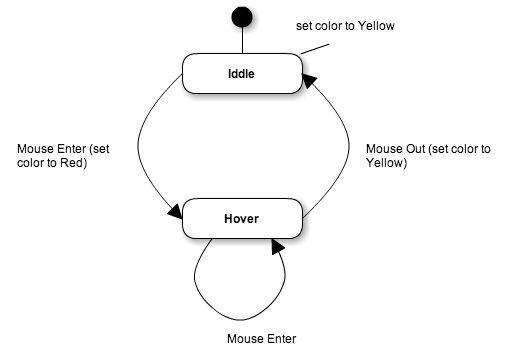
That code corresponds to the following states diagram:
[image: Inline image 2]
I will keep experimenting with this during the next weeks, and specially try to compare the pros and cons with regular event handling.
Something cool about this approach is that the same widget could change its interactive behaviour on the fly by just attaching a different interaction state machine to it :)
Also, I'm doing this for programming user interface interactions, but it could be useful for anything that can be modelled with a state pattern.
Is there something similar out there already working? I was so eager to try this that I didn't look for related existing projects.
Cheers! Carla.
-- Best regards, Igor Stasenko.

On 05/05/13 8:31 PM, Carla F. Griggio wrote:
I will keep experimenting with this during the next weeks, and specially try to compare the pros and cons with regular event handling.
I've always been curious to see how state machine transitions would map to Announcements/event handling.
Something cool about this approach is that the same widget could change its interactive behaviour on the fly by just attaching a different interaction state machine to it :)
Changing the state machine is called "subtype migration" in Shlaer-Mellor parlance. It seems to get tricky when the supertype also has a state machine.
Also, I'm doing this for programming user interface interactions, but it could be useful for anything that can be modelled with a state pattern.
Is there something similar out there already working? I was so eager to try this that I didn't look for related existing projects.
The PostgreSQL Client [1] (a native Smalltalk client connection to a Postgres server) uses an internal state machine to drive the client/server connection. It was built with the Shlaer-Mellor method [2] concepts in mind. There was an accompanying state machine diagram drawn with the Connectors [3] tool (the link from SqueakMap is long dead, but I could try to dig up a copy). The implementation is very awkward around where the public API to make SQL queries interacts with the underlying state machine inside the PGConnection object. There's a loop that continues until a "good" state is reached. Then the result is gathered from the connection object. Since the code making the SQL query is not event-driven, nor is it part of the same state-machine architecture of the postgres client, the result is the awkward loop. I'd really like to see more examples of state machine usage. [1] http://www.squeaksource.com/PostgresV2.html [2] http://en.wikipedia.org/wiki/ShlaerâMellor_method [3] http://wiki.squeak.org/squeak/1773
On 6 May 2013 08:22, Yanni Chiu <yanni@rogers.com> wrote:
On 05/05/13 8:31 PM, Carla F. Griggio wrote:
I will keep experimenting with this during the next weeks, and specially try to compare the pros and cons with regular event handling.
I've always been curious to see how state machine transitions would map to Announcements/event handling.
Something cool about this approach is that the same widget could change its interactive behaviour on the fly by just attaching a different interaction state machine to it :)
Changing the state machine is called "subtype migration" in Shlaer-Mellor parlance. It seems to get tricky when the supertype also has a state machine.
Also, I'm doing this for programming user interface interactions, but it could be useful for anything that can be modelled with a state pattern.
Is there something similar out there already working? I was so eager to try this that I didn't look for related existing projects.
The PostgreSQL Client [1] (a native Smalltalk client connection to a Postgres server) uses an internal state machine to drive the client/server connection. It was built with the Shlaer-Mellor method [2] concepts in mind. There was an accompanying state machine diagram drawn with the Connectors [3] tool (the link from SqueakMap is long dead, but I could try to dig up a copy).
The implementation is very awkward around where the public API to make SQL queries interacts with the underlying state machine inside the PGConnection object. There's a loop that continues until a "good" state is reached. Then the result is gathered from the connection object. Since the code making the SQL query is not event-driven, nor is it part of the same state-machine architecture of the postgres client, the result is the awkward loop.
I'd really like to see more examples of state machine usage.
[1] http://www.squeaksource.com/PostgresV2.html [2] http://en.wikipedia.org/wiki/ShlaerâMellor_method [3] http://wiki.squeak.org/squeak/1773
What i often observing is that it is not matter, how good & sound the scientific concept.. when it goes to implementation it has big chances to end up with messy code, ineffective, inappropriate and therefore useless :) That not to say that science is just waste of time.. it is to say that science alone is not enough. -- Best regards, Igor Stasenko.

On May 6, 2013, at 2:31 AM, Carla F. Griggio <carla.griggio@gmail.com> wrote:
Hello everyone! I'm here to tell you that I started experimenting with a Pharo implementation of this idea: http://swingstates.sourceforge.net/. For those into UI programming I really recommend reading the first paper cited in that page. It's for programming user interface interactions with state machines, an approach to avoid the classical "callback spaghetti" that sometimes we get with event handlers everywhere.
This is looking interesting. Now we should check how it works with inheritance. Keep us posted about your progress. Stef
I have a tiny first step that shows an example for changing the color of a button on mouse over and changing it back to the original color on mouse out.
You can download the code from: http://smalltalkhub.com/mc/CarlaGriggio/StateMachines/main
Evaluate this for executing the example:
SMButton openWithStateMachineInteraction
And here is the code of the state machine for that example:
SMButton class >> openWithStateMachineInteraction |button stateMachine iddle hover | button := self new. stateMachine := SMStateMachine newForWidget: button. iddle := (SMState newWithName:'iddle') enter:[:stMachine | stMachine widget color: Color yellow ]; addTransition: ((SMTransition forEvent: 'mouse enter' withOutputState: 'hover') transitionAction: [:stMachine | stMachine widget color: Color red ]). hover := (SMState newWithName:'hover') addTransition: (SMTransition forEvent: 'mouse out' withOutputState: 'iddle'); addTransition: (SMTransition forEvent: 'mouse enter' withOutputState: 'hover'). stateMachine addState: iddle; addState: hover. stateMachine attachTo: button. ^button openInWorld
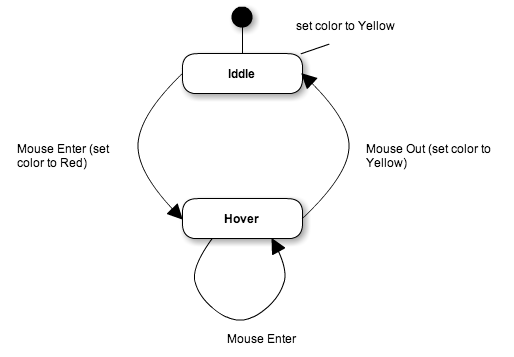
That code corresponds to the following states diagram:
<Screen Shot 2013-05-06 at 2.27.20 AM.png>
I will keep experimenting with this during the next weeks, and specially try to compare the pros and cons with regular event handling.
Something cool about this approach is that the same widget could change its interactive behaviour on the fly by just attaching a different interaction state machine to it :)
Also, I'm doing this for programming user interface interactions, but it could be useful for anything that can be modelled with a state pattern.
Is there something similar out there already working? I was so eager to try this that I didn't look for related existing projects.
Cheers! Carla.
participants (4)
-
 Carla F. Griggio
 -
 Igor Stasenko
 -
 stephane ducasse
 -
 Yanni Chiu